
Crypto World
Bitcoin Braces for Warsh's Jackson Hole Debut: Will 2022 Repeat?

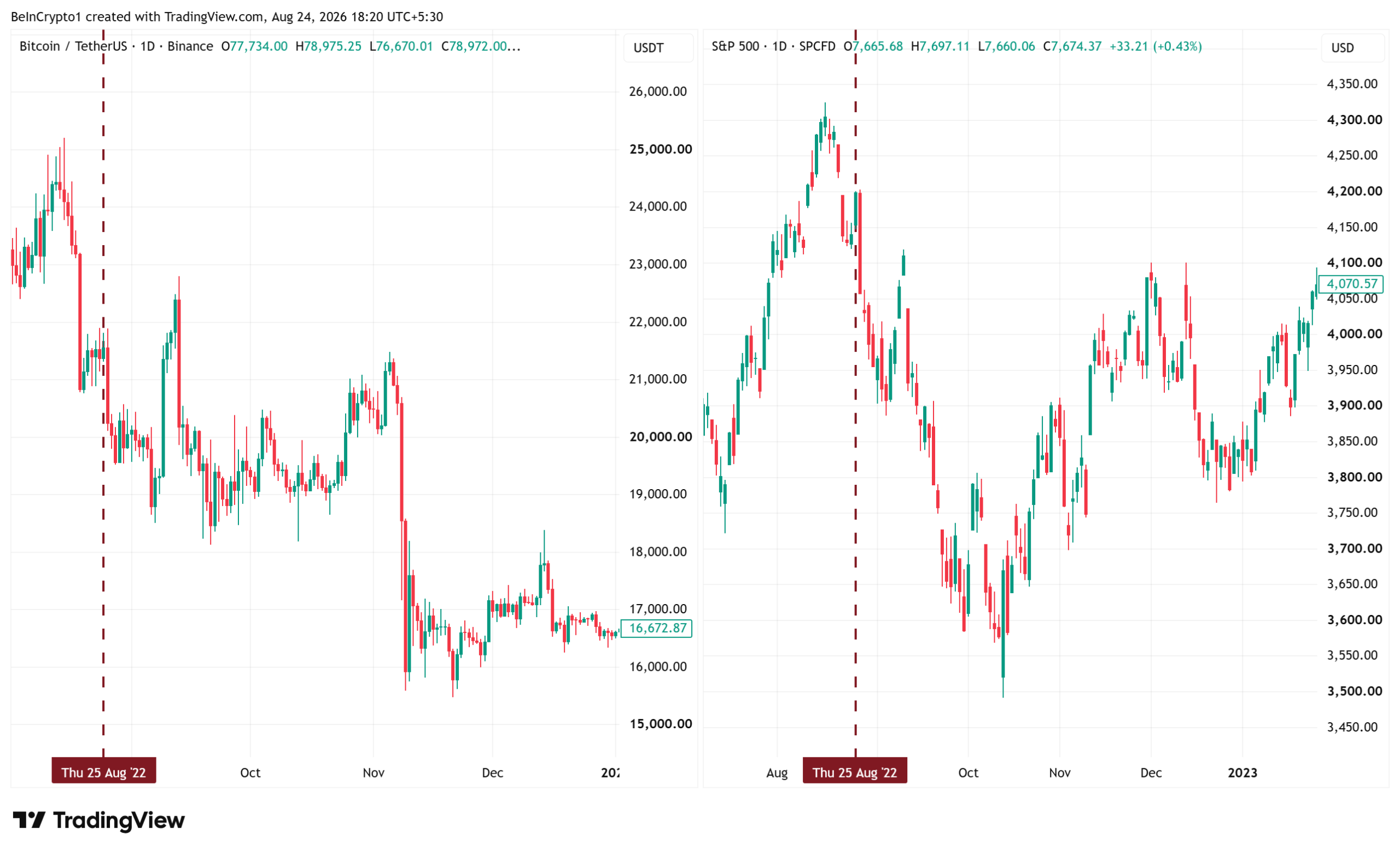
Kevin Warsh speaks at Jackson Hole on Friday, his first keynote as Federal Reserve Chair. Bitcoin traders have one question. Does this look like August 2022?
The answer sits in eight years of price data, which shows only one of those speeches actually hurt Bitcoin.
What Powell’s 2022 Speech Did to Bitcoin
Jerome Powell took the podium on August 26, 2022. He was blunt about fighting inflation and offered markets no relief.
Bitcoin fell from $21,518 to $20,230 that day. That is a drop of 6% in a single session. Likewise, the S&P 500 lost 3.4% in the same session.
By August 28, Bitcoin sat 9% below its pre-speech level. That is the version traders fear repeating.

Eight Years of Data Show 2022 Was the Outlier
BeInCrypto measured Bitcoin’s move on every Fed chair keynote day since 2018.

The median reaction is a gain of 1%. Seven of the eight moves sit inside a 5% band. Only 2022 broke that range, to mark the single move worse than 2% in eight years.
Tone alone does not explain it. The 2023 speech was also hawkish, yet Bitcoin lost only 0.4%. What set 2022 apart was surprise. Traders arrived expecting relief and got a pledge of economic pain instead.
Dovish years were not free money either. Bitcoin slipped 1.3% after Powell’s 2025 remarks, and that post-speech rally unwound within days.
Why Warsh Could Still Deliver the Hawkish Version
The hawkish path is live, as the Fed held rates at 3.50% to 3.75% in July, but three officials voted to hike.
August minutes kept that pressure in view, with hawkish rate risks back on the table.
Inflation is the reason, as it held at 3.4% in July, and a September Fed hike is still close to a coin flip.
Heading into the Jackson Hole Symposium this week, Warsh is the wildcard because he has said little about rates since taking the job in May. This means anything he does say lands harder.
He has framed Friday as a chance to widen the lens rather than signal a move.
“There is a tendency, especially with the proliferation of meetings and press conferences, to get caught up in the myopic … If I could, in the high mountain air in Jackson, Wyoming, I’d like to also frame the big questions,” Kevin Warsh, July 29 press conference transcript.
Bitcoin (BTC) trades near $79,093, roughly flat over the past 24 hours, after climbing 23% in the week to August 21. Traders can follow Bitcoin’s price action into Friday.

The next policy meeting falls on September 15 and 16. History says the base case is a small move. 2022 says the tail is fat.
The post Bitcoin Braces for Warsh's Jackson Hole Debut: Will 2022 Repeat? appeared first on BeInCrypto.

AI chip leader Nvidia (NVDA) is bucking up its capabilities in artificial intelligence software with a major licensing deal with AI startup Poolside and a possible investment in AI service provider Perplexity. Nvidia stock fell Monday. Late last week, news broke that Nvidia had signed a $6 billion licensing deal with Poolside to build a powerful open-weight AI model to…
Copyright ©2026 Investor’s Business Daily, LLC. All rights reserved. 87990cbe856818d5eddac44c7b1cdeb8

Money entering crypto ETFs over their first two years meant institutions were arriving, and institutions arriving meant more demand for crypto. However, mid-2026 has made that relationship considerably more complicated.
Digital asset investment products went through eight consecutive weeks of withdrawals totalling a record $8 billion before inflows returned in July and early August. By August 7, the same products had recorded five consecutive positive weeks, including around $1.05 billion during the first week of August.
U.S. spot Bitcoin ETFs show the reversal particularly well. They attracted roughly $865 million between August 3 and August 7, followed by a combined net withdrawal of about $198 million from August 10 through August 12.
ETFs remain a major source of crypto demand. Their behaviour increasingly resembles other large investment vehicles, however: investors buy when risk looks attractive and redeem when it does not.
BeInCrypto asked executives from Wirex, Zoomex and Phemex what recent flows reveal about investor demand, how ETFs have affected crypto trading, and whether another generation of altcoin funds can reproduce Bitcoin’s success.
Selective Crypto Demand
ETF withdrawals are certainly a measure of changing investor behaviour, although ETF flows should not be treated as a census of institutional activity. Funds are available to many types of investors, and institutions can gain crypto exposure through several other instruments.
Even so, the change since late 2025 is substantial. The enthusiasm surrounding ETF access has encountered a prolonged crypto downturn and a more difficult macroeconomic environment.
Yves Renno, Head of Trading at Wirex, sees retrenchment rather than abandonment.
“Appetite is cooling, not necessarily fleeing. Although impressive, the ETF outflows are a healthy correction against a significant accumulation since 2024. This looks like the market shaking out weak investors before a steadier, more durable phase of allocation.”
Recent flows lend some support to this interpretation. Bitcoin ETF demand turned positive again in July, with approximately $403 million of monthly net inflows, while Ethereum products attracted around $359 million.
The recovery also shows why individual weeks can give a misleading picture. Strong buying returned in early August before another series of withdrawals appeared only days later. Institutional participation can remain substantial while allocations become much more price-sensitive.
This ETF market is different from the one investors watched during the early spot Bitcoin ETF boom. Access itself has largely been solved. Investors now need a reason to increase exposure.
More Liquidity, More Price Pressure
ETFs have connected crypto more closely with brokerage accounts, asset managers, advisers and portfolio allocation models. At the same time, large creations and redemptions can produce meaningful buying or selling pressure in the underlying market.
Renno believes both effects now coexist.
“Clearly both. There are moments where retail and institutional flows pull in opposite directions, especially around reversals, and this tension is exactly the bread and butter of the market makers and arbitrageurs who keep the market’s depth intact.”
Research increasingly supports the idea of ETF flows having measurable price effects.
An April 2026 study examining the five largest U.S. spot Bitcoin ETFs found a $100 million net ETF inflow was associated with approximately 53 basis points of same-day Bitcoin returns. ETF flows explained around 21% of daily return variation across the sample, while the research also found feedback in both directions: flows affected prices and price movements subsequently influenced flows.
A separate 2026 study examining all U.S. spot Bitcoin ETFs also found greater price effects when large fund flows encountered fragmented liquidity across crypto exchanges.
ETF demand therefore adds capital and liquidity while also creating another route through which changes in investor risk appetite reach Bitcoin.
ETF Buyers Need More Than Access
Fernando Lillo Aranda, CMO at Zoomex, argues renewed demand depends heavily on investors becoming comfortable with risk again.
“We are currently in a bear market, where investors are naturally more risk-averse and capital preservation takes priority over chasing returns. In this environment, even high-quality products such as crypto ETFs struggle to attract sustained inflows.”
He continued, “historically, ETF demand has accelerated when investors regain confidence a new growth cycle is beginning. That confidence is typically supported by improving macroeconomic conditions, greater regulatory clarity, stronger institutional participation and renewed momentum across digital assets.”
The past several weeks show how quickly this can affect flows.
Bitcoin’s early-August recovery can be linked partly to changing interest-rate expectations, softer U.S. economic data and reduced expectations of further monetary tightening. The same period produced more than $1 billion of weekly digital asset product inflows.
Lillo Aranda expects the eventual recovery in ETF demand to come from several developments occurring together rather than one announcement.
“ETFs continue to play an important role by providing regulated and familiar access to the crypto market, particularly for traditional investors. The infrastructure is already in place; what is missing is the appetite for risk.
He continued, “ultimately, ETF adoption is unlikely to be driven by a single catalyst. It will be the combination of improving market conditions, growing institutional confidence and a return of positive sentiment.”
Altcoin ETFs Face Diminishing Returns
The next test comes from the growing number of crypto assets available through exchange-traded products.
The SEC approved generic listing standards for commodity-based trust shares in September 2025, making it easier for qualifying crypto products to reach U.S. exchanges. The same decision accompanied approval of Grayscale’s multi-asset Digital Large Cap Fund.
Greater availability raises a separate problem: each additional ETF competes for investor capital.
Federico Variola, CEO of Phemex, believes Bitcoin’s experience will prove difficult to repeat further down the crypto market.
“The capital entering BTC through ETFs has not rotated into other tokens. Obviously, it is not as easy to move capital between regulated investment products as it is within the native crypto market. We have seen this even with Ethereum, which received its own ETF approval but has continued to lag far behind Bitcoin.”
He continued, “this tells us ETF buyers are very different from crypto-native investors. Altcoin ETFs may therefore not benefit in the same way Bitcoin did, both because of the investor profile and because of the different value proposition.”
Current fund flows illustrate the difference in magnitude.
U.S. Bitcoin ETFs have accumulated roughly $52 billion of net inflows since launch. Solana ETFs have attracted about $1.13 billion. The products have very different trading histories, making a straight comparison imperfect, but the figures already demonstrate how uneven ETF demand can be between assets.
Variola expects this effect to become stronger as funds reach more speculative assets.
“My view is the marginal benefit a token receives from an ETF decreases as we move further down the risk curve. Investors who want to speculate on altcoins can already do so relatively easily without an ETF. Bitcoin, on the other hand, is viewed as belonging to a different category in terms of its risk profile.”
This reverses the ETF thesis. Scarcity helped make a U.S. spot Bitcoin ETF important. A market containing ETFs for numerous crypto assets makes approval itself far less distinctive.
Altcoin ETFs can still attract new buyers who require regulated brokerage access, and specialised funds may develop substantial investor bases. Yet every new listing also asks investors to make another allocation decision.
Final Thoughts
Crypto ETFs have entered a more mature phase of their development. Their importance remains considerable, but their existence provides no guarantee of persistent buying.
Mid-2026 has offered the clearest evidence yet. ETF investors can accumulate crypto aggressively, disappear for weeks, return during improving market conditions and sell again when risk deteriorates.
The bull-market aura surrounding ETFs has faded. What remains is a large, liquid and increasingly price-sensitive pool of capital capable of pushing crypto markets in either direction.
The post Crypto ETFs Lose Their Bull-Market Halo as Outflows Test Demand appeared first on BeInCrypto.
Tom Lee’s Bitmine Immersion Technologies continued its accumulation of Ether last week, adding to its holdings as the cryptocurrency staged a sharp breakout following a prolonged downturn.
The company disclosed Monday that it purchased 32,447 Ether (ETH) last week, bringing its total holdings to 5,847,611 ETH, or roughly 4.8% of Ethereum’s circulating supply. Bitmine has acquired ETH every week since launching its Ethereum treasury strategy on June 30, 2025, extending its buying streak to roughly 14 months.
The company’s NYSE-traded shares were up about 8.7% to open the week, poised to extend their almost 28% gains over the past six months.
Bitmine is now 97% of the way toward its stated goal of owning 5% of the ETH supply. It has also staked 5.07 million ETH, representing about 87% of its holdings, and reported combined crypto, cash, securities and other investments of $14.9 billion.
The latest purchase coincided with a sharp rally across Ether and the broader cryptocurrency market. ETH has outperformed Bitcoin since last Wednesday, when the US Treasury announced plans to double its monthly purchases of certain longer-dated US Treasurys to $4 billion from $2 billion beginning next month.
Ether has gained more than 32% since the announcement, breaking above $2,500 for the first time since January, according to CoinMarketCap data.
Related: Crypto Biz: Treasury’s ‘Not-QE’ playbook sends Bitcoin higher
Ether price rebound cuts Bitmine’s paper losses
Bitmine’s aggressive Ether purchases during the market downturn left the company sitting on steep unrealized losses as ETH prices continued to fall. However, the cryptocurrency’s recent recovery has significantly narrowed that shortfall.
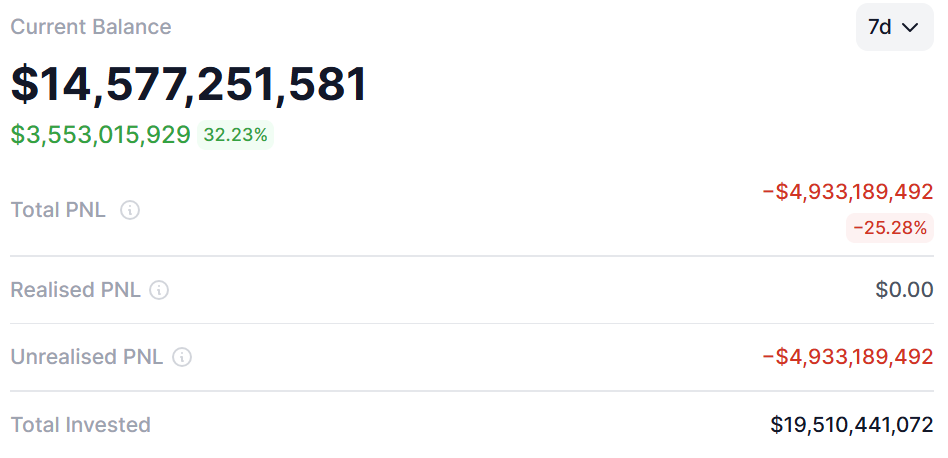
Bitmine has invested more than $19.5 billion in its Ether treasury, with its paper losses falling to below $5 billion from more than $8.4 billion roughly a week ago, according to DropsTab data.
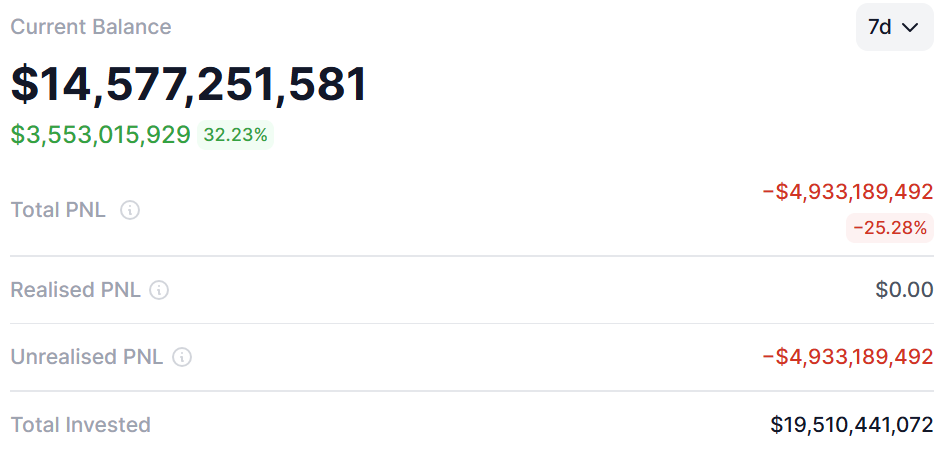
Bitmine’s unrealized losses on its ETH holdings have narrowed amid the market recovery. Source: DropsTab
The sharp swings highlight the challenges of managing digital asset treasuries, whose valuations can fluctuate significantly with changing market conditions.
Related: Ethereum Foundation warns some tools may break with Glamsterdam upgrade
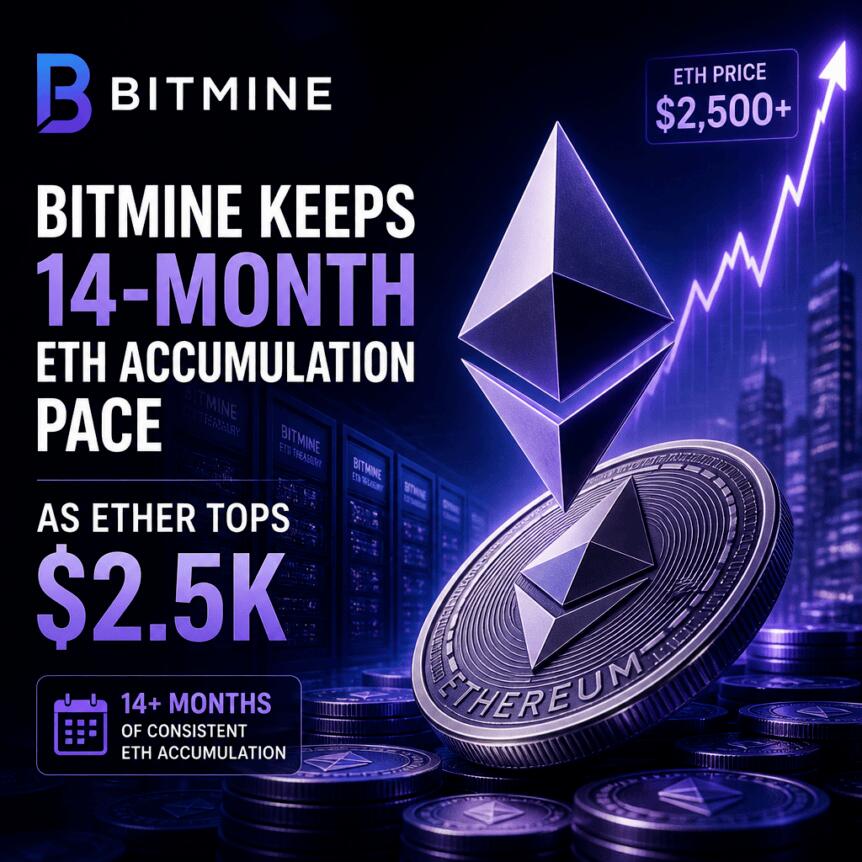
Bitmine Immersion Technologies, an NYSE-listed company run by Tom Lee, disclosed that it continued building its Ether treasury last week—adding 32,447 ETH as the token rebounded sharply after an extended decline. The purchase lifts Bitmine’s total Ether holdings to 5,847,611 ETH, according to the company’s Monday update.
The latest buying pace keeps Bitmine on a nearly continuous accumulation schedule tied to its stated Ethereum treasury strategy, launched on June 30, 2025. With the firm now staking most of its position, the disclosure also offers a snapshot of how large spot treasuries can swing in value when the market turns.
Key takeaways
- Bitmine bought 32,447 ETH last week, bringing total holdings to 5,847,611 ETH—about 4.8% of Ethereum’s circulating supply.
- The company says it has acquired ETH every week since June 30, 2025, extending its buying streak to roughly 14 months.
- Bitmine is about 97% of the way toward its goal of owning 5% of the ETH supply.
- Of its Ether holdings, 5.07 million ETH is staked—around 87% of what Bitmine owns.
- Earlier losses tied to ETH’s drawdown have narrowed, with DropsTab data showing unrealized paper losses falling below $5 billion from more than $8.4 billion about a week earlier.
Bitmine keeps stacking Ether as the rebound gathers pace
Bitmine’s Monday disclosure confirms that last week’s ETH purchase was not isolated—it continued a weekly accumulation pattern that began when the company launched its Ethereum treasury strategy on June 30, 2025. With Ether prices stabilizing and then rallying, the firm’s latest tranche arrives at a time when its portfolio valuation is improving relative to the prior downturn.
According to the report, Bitmine now holds 5,847,611 ETH, which equates to roughly 4.8% of Ethereum’s circulating supply. The company also reiterated that it is nearing its target: it is reported to be 97% toward owning 5% of the ETH supply.
Bitmine’s NYSE-traded shares opened the week up about 8.7%, following a stretch that has already put gains at nearly 28% over the past six months. While share moves are not solely determined by crypto prices, the timing underscores how investors can respond to disclosures about on-chain treasury activity during volatile market phases.
How staking and treasury size shape the risk profile
The company’s Ether position is not only large—it is also largely staked. Bitmine reported staking 5.07 million ETH, representing about 87% of its holdings. Staking doesn’t eliminate price risk, but it changes how a treasury can pursue yield while remaining exposed to Ethereum’s market value.
Bitmine also provided a broader balance sheet snapshot, reporting combined crypto, cash, securities, and other investments of $14.9 billion. For readers tracking treasury strategies, this matters because valuation gaps in crypto holdings can be cushioned or amplified by how much capital the company holds outside of digital assets and by whether those assets are liquid versus locked or staked.
In practice, a treasury that keeps buying through downturns can end up with substantial unrealized losses during bearish periods. When markets rebound—especially sharply—those losses can narrow quickly, improving net asset value on paper even if the underlying strategy and risk exposures have not changed.
Why Ether’s rally mattered to Bitmine’s paper losses
Bitmine’s accumulation during the downturn left it facing steep unrealized losses when ETH prices fell. The recent recovery, however, has materially reduced that gap. DropsTab data cited in the disclosure indicates Bitmine has invested more than $19.5 billion in its Ether treasury, while unrealized losses have come down to below $5 billion from more than $8.4 billion roughly a week earlier.
The reported swing highlights a key operational challenge for crypto treasuries: digital asset valuations can change rapidly, sometimes in both directions, forcing investors to think in terms of marked-to-market exposure rather than only realized gains or losses. For companies building long-term crypto reserves, that volatility becomes part of the investment story—even when the buying cadence remains steady.
Bitmine’s latest purchase also aligns with a broader market move. Ether outperformed Bitcoin starting last Wednesday, when the US Treasury announced plans to double its monthly purchases of certain longer-dated US Treasurys to $4 billion from $2 billion beginning next month, as reported by Cointelegraph’s markets coverage.
CoinMarketCap data referenced in the disclosure shows Ether gained more than 32% since that announcement, breaking above $2,500 for the first time since January. For a treasury operator like Bitmine, that type of price action can quickly shift the narrative from “drawdown management” to “valuation recovery,” even if the company continues to execute the same acquisition strategy.
Treasury accumulation in context: what investors should watch next
Bitmine is approaching its 5% ETH supply target while maintaining a heavy staking allocation. That combination—sustained spot accumulation plus high staking participation—can influence how markets interpret the company’s longer-term commitment to Ethereum.
Still, several questions remain important for investors monitoring this strategy. How consistently Bitmine will be able to purchase ETH week after week if market volatility returns is one. Another is how much of its Ether is held in a form that can be deployed versus locked in staking. Finally, broader macro developments—such as how US Treasury policy and liquidity conditions continue to affect risk assets—could determine whether the current ETH rebound sustains or fades.
For now, the immediate watch item is whether Bitmine’s ongoing weekly purchases continue at the same pace as its unrealized loss position improves, and whether Ethereum’s momentum holds beyond the post-announcement rally.

Disclosure: This article does not represent investment advice. The content and materials featured on this page are for educational purposes only.
WBT trades around $72.70 after hitting a new high, as its four-year milestone coincides with broader developments in blockchain infrastructure and digital assets.
Summary
- WBT hits a new all-time high above $72, extending gains as exchange tokens gain utility across trading and blockchain ecosystems.
- Whitechain is transitioning to an Ethereum Layer 2 using the OP Stack, with WBT remaining its native gas token.
- WBT’s full supply is now unlocked while WhiteBIT’s active burn program targets a long-term reduction toward 200 million tokens.

WBT is trading around $72.7 after reaching a new all-time high, extending its gains beyond the previous $64.11 record set in December 2025. The move comes as the four-year-old token reaches another stage in its development, while the wider crypto industry continues shifting toward more established infrastructure and institutional participation.
Utility is becoming more important for exchange tokens
The role of an exchange token has changed considerably from the early days of crypto.
WhiteBIT offers users trading-related benefits, including reduced fees, while holdings can also affect referral rewards and eligibility for certain Launchpad activities. Staking and reward programs provide additional ways for users to interact with the asset.
The token also has a blockchain function. WBT is used as the native gas asset on Whitechain, connecting it directly to transactions taking place outside the exchange environment.
That broader utility is relevant as crypto platforms increasingly serve users who expect more than a place to buy and sell assets. Trading, blockchain infrastructure, token launches and rewards are increasingly being combined within connected ecosystems.
WBT is one example of that model.
Whitechain is taking a different route to scalability
The infrastructure side of the story is developing at the same time.
Whitechain is transitioning from its original standalone Layer 1 into an Ethereum Layer 2 built with the OP Stack. The network’s Sepolia testnet is already operational, while mainnet development is targeting later in 2026.
The move places Whitechain within a much larger ecosystem. Ethereum Layer 2 networks have become an established way to handle blockchain activity while settling transactions back to Ethereum.
Whitechain’s architecture remains EVM-compatible, which means developers can continue using familiar Ethereum development tools. WBT remains the native gas token after the transition.
The development is particularly relevant to WBT because it gives the token a role in network activity that does not depend solely on exchange trading.
A new phase for token supply
WBT has appreciated 28.3% over the past 12 months and was among the global top 10 cryptocurrencies by market capitalization in figures released around its fourth anniversary.
The price move is noteworthy, but it is taking place alongside several structural changes that are affecting how exchange-linked digital assets are used.
WBT’s tokenomics have also reached a transition point.
The token’s full supply has been unlocked as of 2026. Meanwhile, its burn mechanism remains active. WhiteBIT says the buyback program uses an amount corresponding to 33% of trading-fee income and 5% of income from other exchange activities, with the stated aim of reducing total supply toward 200 million WBT.
This is different from the supply dynamics during WBT’s earlier years, when scheduled unlocks were still taking place.
The combination of completed unlocks and continuing burns gives traders another variable to consider when looking at the token’s longer-term supply profile.
It also means the recent all-time high is arriving after a significant change in the mechanics governing how much WBT is circulating.
More markets are opening up
The token’s wider market presence has changed alongside its utility. WBT was listed on Kraken in March 2026 with WBT/USD and WBT/EUR markets, giving the asset additional access outside its original exchange environment.
That matters for liquidity and visibility, particularly for an exchange-linked token whose early use was closely associated with a single platform.
WBT’s fourth anniversary provides another reference point. Four years after launch, the token is trading above its previous record, has gained 28.3% over the last year and has developed uses spanning exchange services and blockchain infrastructure.
The new high does not establish where the token goes next. What it does show is that WBT is entering a different stage of its lifecycle, one in which market performance is being watched alongside token utility, supply changes and the development of the network that uses it.
Disclosure: This content is provided by a third party. Neither crypto.news nor the author of this article endorses any product mentioned on this page. Users should conduct their own research before taking any action related to the company.
Treasury yields fell and the price of gold continued its recent rally Monday after Treasury Secretary Scott Bessent essentially warned investors not to bet against his ability to tame the government bond market. Following last week’s news that the Treasury will at least double its buybacks of long-term bonds, Bessent and his lieutenants signaled their readiness to deploy the nearly…
Copyright ©2026 Investor’s Business Daily, LLC. All rights reserved. 87990cbe856818d5eddac44c7b1cdeb8


Przemysław Kral, the head of the collapsed cryptocurrency exchange Zondacrypto, has reportedly been charged with participating in an alleged large-scale fraud and has begun cooperating with Polish prosecutors.
Kral is seeking a reduced sentence in exchange for testimony that could include details about Zondacrypto’s funding of right-wing politicians, Polish outlet Onet reported Monday.
According to Onet, prosecutors estimate Zondacrypto customers lost at least 2.4 billion Polish zlotys ($650 million). Investigators said the exchange used only part of customer funds to buy crypto, while the rest was transferred to private accounts controlled by Zondacrypto managers.
Onet reported Friday that Kral had been negotiating the terms of possible cooperation with prosecutors for six months. He reportedly held informal meetings with prosecutors in Poland, Sicily and Persian Gulf countries to discuss a potential deal.
Kral has remained silent on X since publicly disclosing in mid-April that Zondacrypto could not access a cold wallet holding about 4,500 Bitcoin. He has denied accusations of misappropriating funds and said the wallet’s private keys were supposed to have been transferred by Zonda founder and former CEO Sylwester Suszek, who has been missing since 2022.
Zondacrypto was the main sponsor of the Conservative Political Action Conference (CPAC) held in Poland days before the second round of the presidential election won by Karol Nawrocki. The exchange spent 37 million zlotys on advertising with broadcaster Telewizja Republika in its final year, while companies owned by Kral made payments to foundations linked to politicians Zbigniew Ziobro and Przemysław Wipler.
Cointelegraph was unable to reach Kral or Zondacrypto for comment. Their email addresses have been unavailable since Kral’s April disclosure that the exchange could not access the Bitcoin wallet.
Related: Zondacrypto CEO goes off radar as Poland probe deepens
Crypto World
Stablecoin payments are fast, but local-currency settlement remains a bottleneck: Gravity Team CEO
Stablecoins can cross borders within seconds, but converting them into spendable local currency remains a slower and more fragmented process, Gravity Team CEO Mārtiņš Beņķītis told crypto.news as the firm launched its institutional OTC desk.
Summary
- Stablecoin transfers do not remove the need for local liquidity, banking access, and payout infrastructure.
- Gravity Team says traditional settlement can tie up 20% to 40% of monthly payment flows.
- Stripe and Mastercard have expanded their stablecoin infrastructure through major acquisitions.
- Gravity Team launched an OTC desk offering T+0 fiat settlement in more than 20 currencies.
Stablecoin payments depend on two types of liquidity
Mārtiņš Beņķītis, co-founder and CEO of emerging-markets liquidity provider Gravity Team, told crypto.news that stablecoin infrastructure has become a liquidity issue because the same tokens perform different jobs across trading and payments.
Market makers hold stablecoins to quote buy and sell prices, move inventory between exchanges, and respond to changes in trading activity. Payment companies, by contrast, use stablecoins to fund a conversion before releasing local currency to the recipient.
Trading inventory must remain available across multiple venues, while a payment balance can be used again after settlement. However, the payment company still needs enough local currency to complete the other side of the transfer when the stablecoin arrives.
“Stablecoin payment infrastructure is a liquidity story because stablecoin balances serve very different jobs,” Beņķītis said.
“A market maker uses them to quote on both sides of order books and manage inventory risk across dozens of connected exchanges. A payment business uses them to fund a conversion and release local currency to the recipient.”
Gravity Team’s corridor analysis found that correspondent banking can leave the equivalent of 20% to 40% of monthly transaction flow in pre-funded accounts. The company said stablecoins may reduce this idle capital, but only when an operator maintains funded local-currency books and enough inventory to quote the conversion.
The conversion point remains a bottleneck
A stablecoin payment contains at least two distinct stages. The first moves the token on-chain, while the second converts it into the currency that a recipient can spend through a local bank account or payment service.
Beņķītis said the second stage has become the newest area of competition for payment providers. Every currency market has different levels of liquidity, bank operating hours, compliance controls, transaction limits, and counterparties.
Gravity Team currently supports settlement involving the Philippine peso, Indonesian rupiah, Mexican peso, Brazilian real, euro, British pound, and U.S. dollar. The company plans to add the Vietnamese dong.
Its internal data found that between 3% and 7% of traditional inbound wires in the Southeast Asian and Latin American corridors it serves are delayed or returned on their first attempt. Stablecoin transfers in those markets reportedly clear on-chain more than 99.9% of the time once broadcast.
Beņķītis cautioned that the on-chain success rate does not cover the entire payment.
“Local conversion and payout still have to complete after the token arrives,” he said.
Operators using direct banking relationships can control funding, payment cut-off times, and failed transactions more closely. Partner-based models can reach additional countries but depend on another company’s liquidity, availability, transaction limits, and handling of unsuccessful payouts.
The commercial test, according to Beņķītis, is therefore not how quickly a token reaches a wallet. It is how often the complete payment reaches the recipient at the quoted price and within the promised period, including when the primary payout route is unavailable.
Stripe and Mastercard move deeper into stablecoin payments
Large payment companies have already spent heavily to bring stablecoin infrastructure into their existing networks.
Stripe completed its acquisition of Bridge in February 2025. Bridge provides infrastructure for businesses to receive, store, convert, issue, and spend stablecoins.
Mastercard completed its acquisition of BVNK on Aug. 3. The card network had agreed to pay as much as $1.8 billion, including $300 million in contingent payments, for technology connecting fiat and stablecoin rails.
Beņķītis described both acquisitions as logical steps but said global platforms must still maintain consistent pricing and settlement as they add currencies with different operating conditions.
Gravity Team estimates that stablecoin settlement costs between 0.1% and 0.4% of the principal across the corridors it studied. Its estimated cost for correspondent banking ranges from 3% to 11% after including foreign-exchange spreads, intermediary charges, and capital held in pre-funded accounts.
Those comparisons also come from company research. Actual costs can vary by corridor, payment size, compliance requirements, and the number of intermediaries involved.
A March 2026 Federal Reserve note separately found that correspondent banking chains can make cross-border payments slower, more expensive and less transparent. The Fed said intermediaries may repeat compliance checks and make it harder to determine where a payment is being held.
Gravity Team opens institutional OTC desk
Gravity Team launched an institutional over-the-counter desk on Aug. 24 as part of its effort to connect crypto liquidity with local fiat settlement.
The company said the service acts as the principal counterparty for transactions within agreed limits for size, price, and volatility. Clients receive quotes with defined validity periods instead of executing large orders through public exchange order books.
The desk offers stablecoin settlement in under 60 seconds and T+0 fiat settlement in more than 20 currencies where local banking conditions allow. T+0 means the fiat side is intended to settle on the same day as the transaction rather than after one or more business days.
Gravity Team said it has direct banking relationships in more than 20 markets and intends the desk for payment providers, fintech companies, brokers, and other institutions moving funds into emerging economies. It also offers request-for-quote execution and credit lines, subject to its counterparty terms.
The launch comes as emerging markets account for some of the fastest growth in crypto activity. Chainalysis reported that Asia-Pacific crypto volume rose 69% to $2.36 trillion during the 12 months ending June 2025, while Latin American activity increased 63%.
For U.S. payment companies, the issue also extends beyond moving dollar-backed tokens overseas. Although the GENIUS Act created a federal framework for payment stablecoin issuers, domestic issuer rules do not by themselves supply peso, real, rupiah, or other local-currency liquidity in destination markets.
Stablecoins can shorten the digital part of a cross-border transfer. Completing the payment still requires local funding, currency conversion, regulatory checks, and a functioning payout route.

Nvidia (NVDA) stock on Monday is veering toward a seventh consecutive loss, remaining under pressure before the chipmaker releases its second-quarter earnings report this week. The recent IBD Stock Of The Day has struggled over the past week after forming a clear base and hitting an early entry point amid earnings reports from key AI-related companies such as Advanced Micro…
Copyright ©2026 Investor’s Business Daily, LLC. All rights reserved. 87990cbe856818d5eddac44c7b1cdeb8
Guardant Health (GH) stock tumbled Monday after losing a patent battle against privately held TwinStrand Biosciences and the University of Washington. The judge ordered Guardant to pay more than $245.2 million in damages, accrued royalty and interest. Guardant will also have to pay a 6% royalty on sales of key products, including its Guardant360 and Shield tests. These tests use…
Copyright ©2026 Investor’s Business Daily, LLC. All rights reserved. 87990cbe856818d5eddac44c7b1cdeb8

zombie thriller that propelled the rise of Korean cinema

Sabrina Carpenter Marks Two Years of Short n’ Sweet With Heartfelt Note and Tease of Something New

Nvidia Stock: Nvidia Makes Waves With Poolside Deal





-

 Fashion3 days ago
Weekend Open Thread: Madewell – Corporette.com
-

 Business6 days ago
SMA Solar Technology AG (SMTGY) Q2 2026 Earnings Call Transcript
-

 Crypto World2 days ago
anatomy of crypto’s biggest liquidation event since 2021
-

 Business2 days ago
Musk’s Tesla, SpaceX Confirm $16.8 Billion ‘Terafab’ Chip Plant as World’s Largest Building in Texas
-

 Tech7 days ago
Qwen3.8-27B runs frontier-class coding agents and reasoning locally, no cloud API required
-

 Crypto World7 days ago
OCC Greenlights Trump Family Crypto Firm for Trust Charter
-

 Politics2 days ago
6 months on, Irish renters crushed by effects of government housing bill
-
 NewsBeat2 days ago
The ‘Lucky Dip Gang’ causing carnage for clicks: After five thugs were killed speeding in the wrong direction on a motorway, GUY ADAMS investigates a sick new trend… and why police aren’t even allowed to pursue them
-

 Crypto World7 days ago
NAVI Prime launches institutional lending framework on Sui
-

 Tech5 days ago
GLM-5.3 hits the API at $1.4/$4.4 per million tokens
-

 News Videos4 days ago
Don’t Leave Your Financial Future To Chance | August 19, 2026
-
Tech7 days ago
5 Of The Most Reliable Car Brands To Consider If You’re Buying A Used SUV
-
 Crypto World7 days ago
Dow’s 3-Year Winning Run Isn’t a Crash Signal, Still 49% Odds of Double-Digit Gains
-

 Tech6 days ago
Keychron K8 Ultra 8K review: a great value keyboard with comfort issues
-

 Business6 days ago
Stock Market Today: Tech Futures Slide As Treasury Yields Jump; Nvidia, Micron, Sandisk Sell Off
-
 Tech7 days ago
Nvidia discloses $21B stake in SpaceX
-

 Business5 days ago
Marvell Shares Jump 7% as Google Chip Deal Confirms Custom AI Silicon Partnership, Analysts
-
 NewsBeat7 days ago
Trump explodes at CNN reporter after question about young blonde aide who wrote him besotted letters
-
Business7 days ago
Fabrinet (FN) Q4 2026 Earnings Call Transcript
-

 Business4 days ago
Five Below: Kids Discount Retailer Reaps Rich Rewards
You must be logged in to post a comment Login