“The shame has to change sides; we can’t carry the shame any longer.”
OnlyFans star opens up on the trauma behind her fight to change Northern Ireland
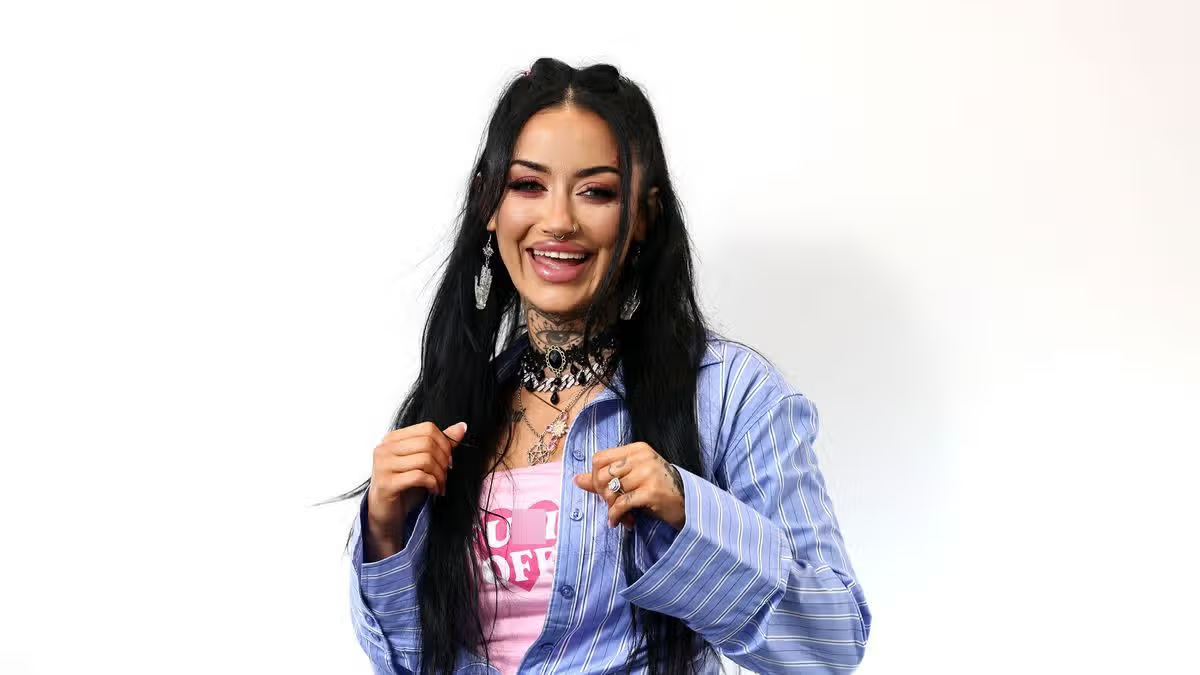
Meghan O’Neill’s interest in psychology began with her brother Kevin, whose struggle with heroin addiction and tragic death following a knife attack left her determined to understand what drives people towards addiction in the first place. That search for the “why” has since developed into a wider interest in trauma, mental health and the systems Northern Ireland uses to deal with people at their most vulnerable.
After studying psychology and philosophy, Meghan believes that too much emphasis is placed on treating behaviour rather than understanding what happened to the person behind it. And her views are rooted in her own experience of trauma, including childhood sexual abuse and three separate rapes she says she suffered as a young adult.
Waiving her right to anonymity, Meghan recalled the moment she realised that she had been the victim of a sexual assault.
“I didn’t actually remember it until I was 16 and I was watching Jeremy Kyle and just this random image just popped back like that into my head and I was like, oh wait, you know, it wasn’t even anything about that on Jeremy Kyle, I just remember I was sick that day off school and I was watching Jeremy Kyle as we all used to, and just this memory come back into my head, and I was just like, oh my God, did that actually happen?
“So, it confused me, you know, I would say that it definitely confused me, but I went to therapy, you know, obviously people that have come from a past of sexual abuse or whatever, it does sort of sexualise you in a way where you do start to look at sex.
“I went to a Catholic school taught by nuns, I believe that if I had been educated properly about sex, I wouldn’t have looked for it so young, but because I wasn’t, I wanted to know what it was and sort of what happened to me,” she told Belfast Live.
For Meghan, the consequences of that childhood experience did not simply disappear. She says she began to question her own relationship with sex and whether her eventual decision to enter the adult industry was connected to what had happened to her. It was a question she had to confront before she could be comfortable that her career was genuinely a choice.
By her late twenties, she had turned to intensive therapy and EMDR to process what she had experienced.
“I was sexualised from early on, and you know, then I did have to look at before I went into the industry, am I getting into the industry because this has happened to me, and I am sexualising myself.
“I was more of a no, I actually am going to, this is because I want to control this.
“So I want to control what happens to me.”
But Meghan says the childhood abuse was only part of the trauma she would eventually have to confront.
She says she was raped three times as an adult, which forced her to confront difficult questions about sex, trauma and self-worth and whether her public sexuality was rooted in empowerment or something more destructive.
“Not only was I a victim of sexual abuse as a child, but I was also raped 3 times.
“I was 24 the first time, and the other two times were in my mid-twenties, to late twenties, so I had to really sit through that and go through intense therapy to make sure that this was happening from a place of love and not from a place of self-loathing or hate.
“Thankfully for me, it was. I overcame everything that happened to me and have a very healthy mindset now.”
Her therapy included EMDR, a form of trauma-focused therapy, which Meghan says helped her process the experiences she had previously struggled to understand.
But she does not see her own recovery as the end of the story. Instead, it has strengthened her belief that trauma needs to be talked about openly and treated properly, rather than becoming something people carry silently for decades.
“I went to really intense therapy, and I did EMDR therapy to sort of overcome that because it does confuse you.
“What’s right and what’s wrong, you know, why did that happen, why did they do that, you know, is this gonna happen, does this happen to everybody? Is this normal?”
She also believes the shame surrounding childhood sexual abuse prevents people from speaking openly about what happened to them.
“Unfortunately, I have my own gym, and it’s quite common. Even the men that I’m friendly with, I don’t really know of many people that has not been sexually abused as a child.
“That in itself is mind-blowing, but it’s so taboo, people don’t want to talk about it, people don’t wanna come out and say this is what happened to me because there’s a lot of shame around it.
“The shame has to change sides; we can’t carry the shame any longer.”
Her brother Kevin’s addiction made her want to understand why someone becomes trapped in heroin use rather than simply judging the consequences. Her own experiences have left her similarly sceptical of a system which, she believes, can be too quick to label behaviour without properly examining the trauma underneath it.
That is particularly relevant to her views on Northern Ireland. Meghan believes the legacy of the Troubles, poverty, addiction and generational trauma continues to affect families long after the original events have passed. Her argument is that the consequences can appear in mental illness, substance misuse, crime and dysfunctional relationships, but that treating those symptoms alone will not necessarily break the cycle.
“My brother Kevin was a heroin addict. Every drug under the sun, God love him, he tried [to overcome his addiction], and then he was killed.
“He was in and out of jail all the time. He eventually got away from drugs and was killed quickly after that. That was in 2013. I didn’t speak to him for six years before he died because of the drugs. Our lives were completely torn apart by drugs. Even talking about it now, it seems like a lifetime away. My teenage years were ruined because of drugs in the house with Kevin. My mum and dad were put through hell, absolute hell; it completely tore our lives apart, and I thought this was a choice.
“I thought Kevin was making this choice, and how could you do this to our family. So I didn’t speak to him for 6 years; we made up, thankfully, just before he died. It was a very emotional sort of comeback to each other; it was lovely. Then, unfortunately, he died about 3 months later.
“So it was a godsend in that way, but it was after that that I decided I wanted to understand addiction.”
Meghan began studying the works of Gabor Maté, which led her to study psychology.
“I love psychology, I love to know why people do the things that they do, and addiction is fascinating because it’s so complex, you know, and trauma is a massive cause. I used to look at my brother Kevin and go like we were brought up with the same parents, you know, what happened?
“Kevin was a candidate for ADHD, and obviously, back then, it was really unknown and unheard of. It was the first time I knew about it because obviously Kevin and I have now been diagnosed with it, but whenever you have an ADHD brain, you’re predisposed to addiction.
“You’re predisposed to trying to regulate your emotions with something, and I just didn’t understand it when Kevin was alive, and obviously I wish I had known what I know now, but that’s the way life goes, and unfortunately I didn’t know that, but I do now and obviously I’m educated in it now.”
Meghan strongly believes that society needs to do more to help people suffering from addiction issues.
“All you have to look at is the terminology that people use to talk about human beings that are suffering from addiction, no matter what it is, you know, you’re druggie, you’re junkie. I’m very against those terminologies because they’re human beings.
“It is a disease. Northern Ireland as a whole doesn’t do enough for mental health services at all. The fallout of the Troubles here has caused mass trauma, and what happens when people are traumatised? They go into crime, they go into substance abuse, they go into gambling.
“Addiction is rife because people are trying to regulate themselves, and they can’t. Mental health here is completely on the floor.
“There are zero mental health services for people here.”
Meghan argues that to tackle our mental health crisis, we need to begin by offering parents proper support before and after pregnancy and that there needs to be changes in the education system so that society is more trauma-informed.
Meghan has spent years trying to understand her brother’s addiction, confronting her own trauma and learning how to live with experiences that could easily have defined her.
Instead, she says therapy helped her reach a point where her sexuality could become something she chose to express rather than something dictated by what had happened to her.
“I chose to do [OnlyFans] because I wanted to, because I look at my industry like art and expression, I don’t look at it seedy and horrible the way most people do.
“But I had to make sure that I was doing it for the right reasons, so therapy massively helped.”
For all the latest news, visit the Belfast Live homepage here and sign up to our daily newsletter her

















































You must be logged in to post a comment Login