
Crypto World
Pakistan Launches Crypto Licensing Portal, Sets Sept. 5 Deadline


Pakistan’s crypto regulator has formally moved from rulemaking to enforcement by opening its licensing portal for virtual asset service providers (VASPs). The Pakistan’s Virtual Assets Regulatory Authority (PVARA) notified regulations for crypto exchanges and a broader set of virtual-asset activities, setting a deadline for firms already operating in the country to apply for a no-objection certificate (NOC).
Under PVARA’s licensing website guidance, companies providing virtual asset services on or before March 5 must submit their NOC applications by Sept. 5; otherwise, continuing operations without an application will be treated as an offense. The regulator says the window is now “officially open,” laying out standards intended to bring consumer protection, governance, and compliance into the open for regulated market participants.
Key takeaways
- PVARA has opened its licensing portal after notifying the regulations that define how crypto services will be authorized in Pakistan.
- Existing operators have until Sept. 5 to apply for an NOC; operating past the deadline without applying can trigger enforcement.
- The framework covers a wide range of VASP activities, including exchanges, custody, broker-dealer services, lending, derivatives, asset management, token issuance, and mining-related services.
- Licensed providers must segregate customer holdings and face restrictions on lending or pledging those assets without written consent.
- Firms can pursue either a sandbox pathway for product testing or an NOC pathway as they prepare for full licensing.
A licensing regime built for enforcement
PVARA’s move is significant because it converts a regulatory framework into an action-oriented process with clear compliance steps for market participants. In a Saturday press release attributed to the Associated Press of Pakistan, PVARA said operating after the relevant deadline without submitting an application will be considered an offense.
In a separate statement on LinkedIn, PVARA described the launch as creating a “clear pathway” for businesses to enter Pakistan’s regulated virtual asset market. The regulator linked the licensing effort to defined expectations around consumer protection, governance, compliance, and market integrity—areas that typically become central when regulators shift from consultations and policy drafting to supervision and licensing decisions.
Which services fall under PVARA’s framework
The notification outlines a broad scope of activities that VASPs must address in their licensing pathway. According to PVARA’s described framework, it includes services such as exchanges and custody, broker-dealer activities, lending and derivatives, asset management, token issuance, and mining-related services.
PVARA also lays out options for how companies can engage with the regulator before they become fully licensed. The regulator states that providers may seek an NOC prior to incorporating locally, or they can enter a regulatory sandbox to test products under PVARA supervision before applying for full authorization.
That two-track design matters for companies trying to scale operations while navigating compliance requirements. The sandbox approach can reduce time-to-learning for new products, while the NOC pathway offers a structured route for firms preparing to establish a Pakistan-based presence.
Operating rules: segregation, cybersecurity, and AML/CTF controls
PVARA says licensed providers will have to meet specific operational and custody-related requirements. One of the most immediate implications for exchanges and custodial platforms is the requirement to keep customer holdings separate from their own assets.
The framework further restricts how those customer holdings can be used. PVARA states that providers cannot lend or pledge customer assets without written consent, a rule designed to reduce the risk of conflicts between customer interests and a platform’s own balance-sheet needs.
Beyond custody, the regulator’s framework also specifies governance and conduct expectations, cybersecurity requirements, operational resilience measures, and anti-money laundering and counter-terrorism financing controls. For operators, these obligations will likely determine not only whether a license is granted, but also how systems are architected—especially around risk monitoring, incident response, and compliance reporting.
From consultation to notified rules—and what it changes now
The licensing push follows a public consultation that ran from June 11 to July 2. PVARA said the final framework provides two routes to licensing: a sandbox for product testing and an NOC pathway for companies preparing to incorporate in Pakistan.
In practice, this turns previously described standards into enforceable requirements with dates attached. Companies that were waiting for the notified regulations to start applying will now need to treat licensing as a near-term priority, particularly because the NOC application deadline is tied to whether a provider was already offering services in the country on or before March 5.
Notably, PVARA has indicated it already issued NOCs to some firms. The regulatory groundwork includes preliminary approvals that allow certain exchanges to establish local subsidiaries and prepare full license applications—progress that now can move faster now that the rules have been formally notified through the portal process. PVARA’s earlier NOC issuances have included Binance and HTX, as previously reported by Cointelegraph.
How Pakistan’s broader crypto framework is taking shape
PVARA’s ability to run a licensing process stems from Pakistan’s legislative shift earlier this year. Cointelegraph previously reported that Pakistan’s parliament passed the Virtual Assets Act in March, establishing PVARA as the statutory regulator for the sector.
Regulatory coordination has also extended to banking access. Cointelegraph has reported that the State Bank of Pakistan allowed banks to provide accounts to licensed VASPs, including segregated client-money accounts. Combined with PVARA’s new requirements around separation of customer holdings, that creates a clearer compliance stack for licensed providers—addressing both operational custody rules and the banking plumbing required for regulated services.
Still, with licensing enforcement now starting in earnest, companies and users should watch how quickly applications are processed and what additional conditions—if any—are imposed as full licenses are granted. The regulations establish the baseline, but the practical effects will depend on PVARA’s implementation, including how sandbox participants are supervised and how quickly NOCs translate into full licensing.
For market participants, the next phase will likely center on whether existing VASPs can meet the Sept. 5 NOC deadline and how rigorously PVARA assesses custody separation, cybersecurity readiness, and AML/CTF controls. That timeline—and the regulator’s approach to granting first full authorizations—could determine how rapidly Pakistan’s regulated crypto market expands.


Zelensky discussed the defense budget deficit during a summit with Nordic and Baltic leaders in Kyiv on Sunday, where the leaders of Denmark, Estonia, Finland, Iceland, Latvia, Lithuania, Norway, Sweden agreed to continue to provide military and financial support.
U.K. Prime Minister Andy Burnham is set to visit Ukraine Monday, in his first international visit.
“Russia should be in no doubt of our resolve. We will not back down until there is a just and lasting peace,” Burnham said in a statement Monday.
Successive polls have shown a lack of public interest in holding elections during the war. The latest, conducted by the Kyiv International Institute of Sociology from July 20 to Aug. 3, shows that 57% of Ukrainians believe elections should be held after fighting has ended, down from 69% in March. Experts have previously said that the invasion, which Russian President Vladimir Putin launched in 2022, nixed the possibility of holding safe and secure elections in Ukraine.
Pakistan’s crypto regulatory authority, the Pakistan’s Virtual Assets Regulatory Authority (PVARA), has opened a licensing portal and started enforcing a framework for exchanges and other virtual asset service providers (VASPs). The move turns Pakistan’s virtual-asset regime from a largely legislative exercise into an operational compliance system—creating a clear deadline for firms already serving users in the country.
Under PVARA’s stated rules, businesses providing virtual asset services on or before March 5 must apply for a no-objection certificate (NOC) by Sept. 5. PVARA warns that operating after the deadline without filing an application will be treated as an offense, according to a Saturday press release reported by the Associated Press of Pakistan. PVARA also said the licensing window is designed to establish standards for consumer protection, governance, compliance, and market integrity.
Key takeaways
- PVARA has opened its licensing portal, shifting Pakistan’s virtual-asset policy into enforcement mode.
- Existing VASPs serving before March 5 must seek an NOC by Sept. 5 or face regulatory action.
- The framework sets requirements that include segregation of customer holdings and restrictions on lending or pledging them without written consent.
- Firms may pursue licensing via a regulatory sandbox or an NOC pathway tied to incorporation plans in Pakistan.
- Pakistan’s approach builds on earlier legal steps, including the Virtual Assets Act and bank-account rules for licensed providers.
From framework to enforcement: the licensing deadline
For market participants, the most immediate change is timeline clarity. PVARA’s licensing website outlines the operational expectations for VASPs already active in Pakistan. Companies that have been providing virtual asset services on or before March 5 are required to submit an application for an NOC by Sept. 5. If they continue operating without applying, PVARA says it will treat that as an offense.
While this does not necessarily mean all noncompliant businesses will be shut down instantly, it does set up a compliance gate that operators must clear. For traders and users, licensing timelines can influence platform availability, withdrawal processing, and counterparty risk. For businesses, the deadline effectively turns “watch-and-wait” posture into a project with legal, technical, and governance deadlines attached.
Scope of covered services and “two-route” licensing
PVARA’s framework is broad. It covers core parts of the virtual-asset industry, including exchanges, custody, broker-dealer services, lending, derivatives, asset management, token issuance, and mining-related services. That breadth matters because it signals that Pakistan’s regulatory intent is not limited to a single type of business model; it aims to govern multiple layers of the value chain from issuance to market infrastructure.
The authority also described two paths to licensing. Firms can apply for an NOC prior to incorporating locally, or they can enter a regulatory sandbox to test products under PVARA supervision before pursuing a full license. According to PVARA, these routes are designed to accommodate companies at different stages of market entry—those that are preparing to establish a local entity and those that want to pilot products while working through compliance expectations.
This two-route model is especially relevant for companies exploring new offerings like derivatives or lending, where consumer protection, operational resilience, and risk controls typically require more extensive systems work than a basic exchange front-end.
Operational and compliance requirements for licensed providers
PVARA’s notified requirements emphasize custody discipline and broader institutional controls. Among the explicit obligations mentioned in the framework are rules requiring licensed providers to keep customer holdings separate from their own assets. PVARA also states that firms cannot lend or pledge customer holdings without written consent, a clause designed to reduce the risk of customer funds being used for the provider’s own balance sheet activities.
Beyond asset-handling, PVARA’s framework points to governance and conduct expectations, along with detailed operational and security requirements. The rules reference cybersecurity, operational resilience, and anti-money laundering and counter-terrorism financing controls. In practical terms, these categories are often where regulators assess whether a platform can sustain continuity, protect user data and assets, and meet compliance obligations consistently—not just at launch, but as ongoing operational processes.
The compliance emphasis is consistent with what PVARA described when it previously issued NOCs to certain firms, allowing them to set up local subsidiaries and prepare for full licensing applications. In other words, the licensing portal appears to formalize a staged approach: preliminary permission to move toward local incorporation and detailed readiness, followed by the deeper compliance requirements that accompany full authorization.
How Pakistan’s legal groundwork enabled the licensing rollout
PVARA’s licensing process builds on earlier steps that set the regulator’s authority and operational structure. Pakistan’s parliament passed the Virtual Assets Act in March, establishing PVARA as the statutory regulator for the sector. After that, the State Bank of Pakistan allowed banks to provide accounts to licensed VASPs, including arrangements such as segregated client-money accounts. Those banking rules are important because they can reduce settlement and custodial friction while also strengthening accountability for how customer funds are handled.
PVARA’s enforcement rollout also followed public consultation, with consultations held from June 11 to July 2. The authority said the final framework provides two licensing pathways—reflecting feedback incorporated into the end product rather than a purely top-down rulemaking.
Notably, the move comes after PVARA had already issued NOCs to some firms. According to coverage earlier in the year, NOCs were issued to Binance and HTX in December 2025, permitting them to establish local subsidiaries and prepare applications for full licensing. With the regulations now notified and the licensing portal open, those preliminary steps can progress into more complete authorization planning under PVARA’s detailed requirements.
For compliance teams, this is where projects become concrete: companies with NOCs still need to align their custody setup, governance, cybersecurity posture, and AML/CFT systems with the framework’s expectations—and do so inside the enforcement timelines now linked to the Sept. 5 NOC application deadline for existing providers.
What to watch next
With PVARA now accepting applications through its licensing portal, the next critical signals will be how quickly NOC applications are processed and whether PVARA’s sandbox pathway launches smoothly for new product testing. Market participants and users should also watch for any enforcement actions tied to the Sept. 5 deadline, since those outcomes will define how strictly the regulator draws the line between compliant, transitioning, and noncompliant operations.
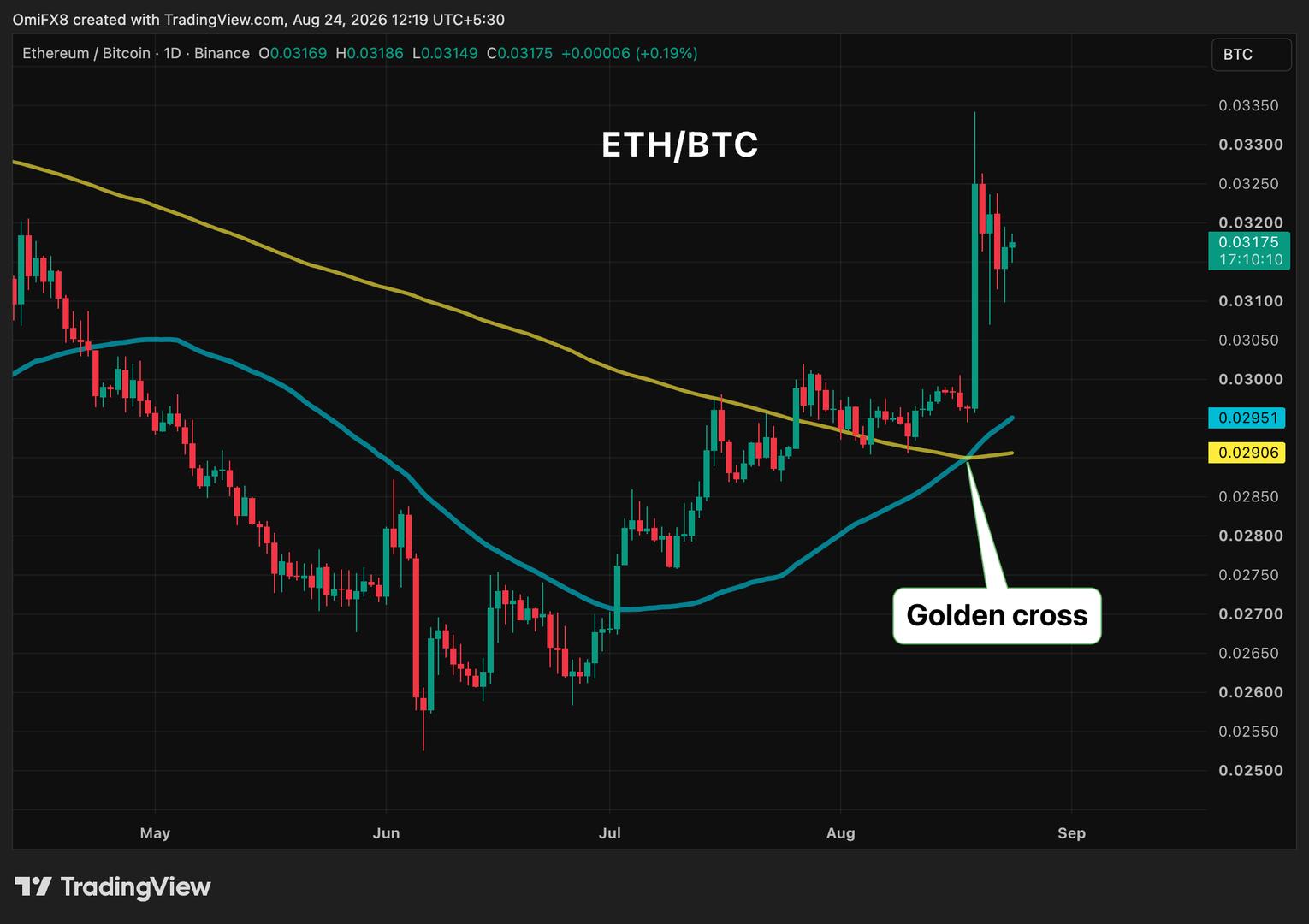
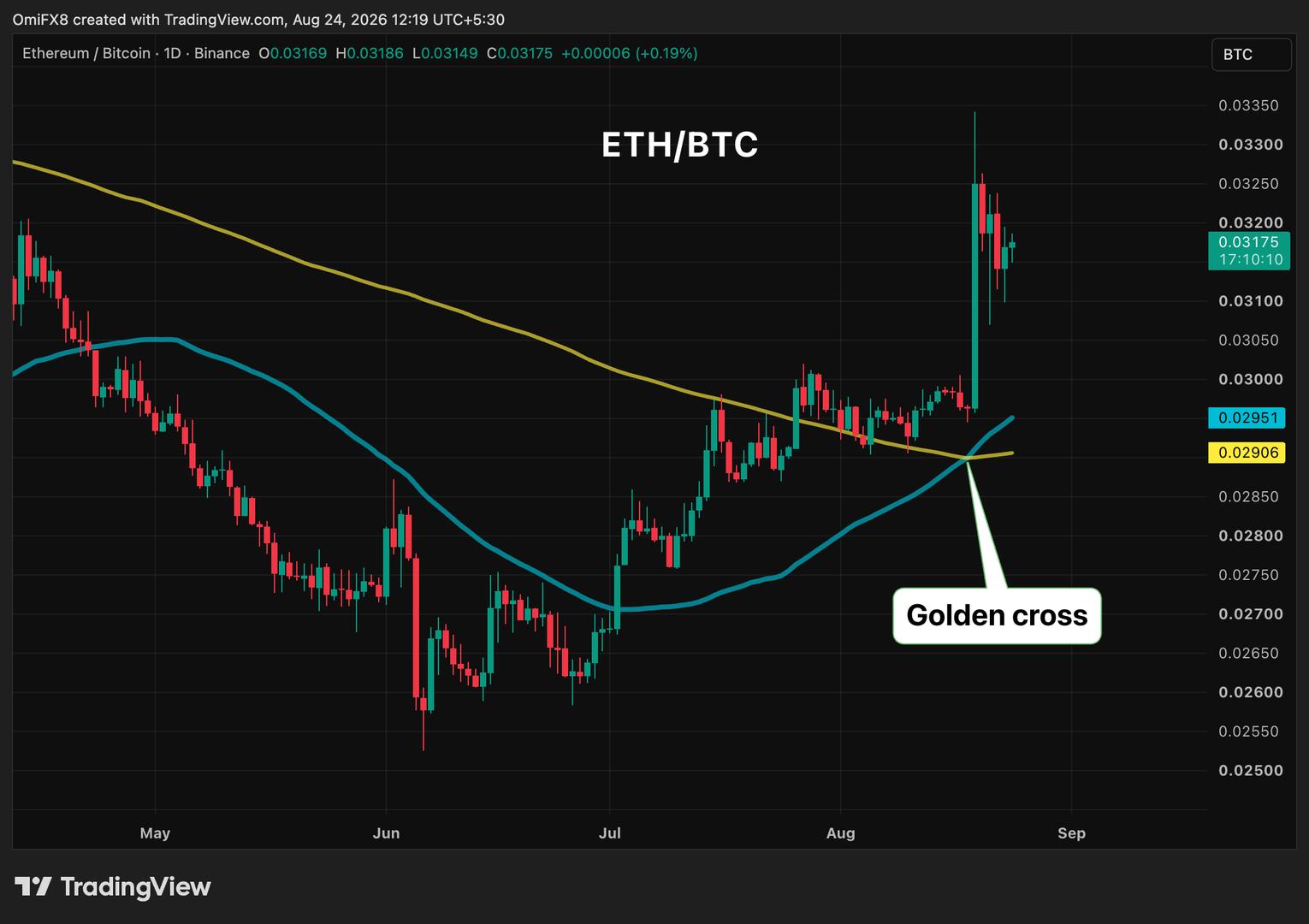
The ETH/BTC ratio has recently formed a bullish golden cross, suggesting ether could extend its outperformance against bitcoin.


Stablecoin neobank Fasset raised $68 million in a Series C funding round led by Japan’s SBI Group, reaching a private valuation of $1 billion on Aug. 24.
Summary
- Fasset raised $68 million in a Series C round led by Japan’s SBI Group Monday.
- The financing valued Fasset at $1 billion and lifted its 2026 fundraising to $119 million.
- Fasset says annualized transaction volume exceeds $40 billion across customers operating in 125 countries worldwide.
- Chief executive Mohammad Raafi Hossain said revenue grew sixfold while profitability continued for twelve months.
- Fasset’s Own Network connects financial institutions across more than 100 banking corridors using stablecoin settlement.
The financing follows the company’s $51 million Series B round in May. Fasset has now raised $119 million during 2026 as it expands stablecoin payment, banking and settlement services across emerging markets.
Early investor Speedinvest and other strategic investors participated in the latest round, according to the report. Speedinvest’s updated portfolio also identifies the financing as a $68 million Series C led by SBI.
The $1 billion valuation was established through the private funding transaction. It is not a public market valuation, and Fasset did not disclose the equity stake sold, the round’s full investor list or other financial terms.
Fasset funding reaches $119 million in 2026
Fasset previously raised $51 million to expand regulated banking services in May. SBI, Investcorp, Arz Portföy and strategic family offices participated in that round.
The company said at the time that it processed more than $32 billion in annualized transaction volume. Fasset now puts that figure above $40 billion, indicating that the annualized pace has increased by at least $8 billion since May.
Fasset co-founder and CEO Mohammad Raafi Hossain said revenue has grown approximately sixfold from the previous year. He also said the company has remained profitable for 12 consecutive months.
Those figures are management claims. Fasset did not disclose its revenue, profit or audited financial statements, preventing an independent assessment of its margins or the earnings supporting its valuation.
Revenue currently comes from institutional and retail services, including stablecoin payments and settlement. Hossain said cards and bank accounts are beginning to provide additional income, although Fasset did not provide a breakdown by product.
Stablecoins operate behind Fasset’s banking products
Fasset allows consumers and businesses to hold, send, spend and invest across currencies and assets. Stablecoins can provide the settlement rail even when customers interact with traditional bank accounts, cards or local currencies.
“Customers interact with stablecoins at many different points on our platform,” Hossain said. “They might be moving between a bank account, a payment product, a currency or another asset, while stablecoins provide the settlement rail underneath.”
The company operates Own Network, an AI enabled Ethereum layer 2 built using Arbitrum technology. Fasset says the network connects banks, telecommunications companies, payment firms, liquidity providers and other institutions across more than 100 banking corridors.
Own Network uses artificial intelligence to select payment routes, currencies, liquidity sources and settlement methods based on cost, speed and availability. The company plans to direct part of the new capital toward expanding those routing systems.
Fasset holds regulatory approvals in markets including the UAE, Indonesia, Malaysia, the European Union, Türkiye and Pakistan. Its services and available products vary by jurisdiction.
SBI brings Japanese payments and regulatory reach
The investment deepens a relationship established before the Series C. Fasset and SBI Remit previously combined their infrastructure for international stablecoin payments covering remittances, business payments and treasury settlement.
SBI Remit said in June that its network supported cash payouts at approximately 350,000 locations across more than 200 countries and territories. Hossain now puts its reach at about 470,000 locations, suggesting the network has expanded, although SBI has not published a matching updated figure.
Fasset expects to work with other businesses in SBI’s portfolio. The Japanese group’s digital asset interests include Ripple, Circle, blockchain company R3 and crypto liquidity provider B2C2.
“Together, we want to connect more corridors and financial rails across Japan, Asia and other emerging markets,” Hossain said.
The companies have not named the first new products, countries or deployment dates associated with the investment. Any expansion will depend on local licensing, banking partnerships and customer access requirements.
What comes next for Fasset
Fasset plans to use the capital to expand Own Network, develop its AI routing systems and connect additional financial institutions. Cards, bank accounts, lending and trade finance could also become larger parts of its revenue mix.
The company must still show whether rapid transaction growth produces durable earnings. Stablecoin payment providers face competition from banks, card networks and other fintech companies, while the cost of converting between stablecoins and local currencies can reduce expected savings.
A recent Bank of Italy test found that conversion and access fees pushed some stablecoin remittance costs toward 9%. Fasset’s ability to secure local banking corridors and liquidity will therefore be central to its effort to lower costs.
The next verifiable updates should include specific SBI linked products, additional corridor launches and new regulatory approvals. More detailed financial disclosures would also provide clearer evidence supporting Fasset’s $1 billion valuation and profitability claims.


Bitcoin has posted its largest dollar-denominated weekly gain on record, adding $14,264 to close at $77,387 as Strive CEO Matt Cole predicts the next Bitcoin cycle could be its strongest yet.
Summary
- Bitcoin gained a record $14,264 last week to close at $77,387, up 22.7%.
- Strive CEO Matt Cole expects the next Bitcoin cycle to be the strongest yet as BTC breaks out against both the dollar and gold.
- U.S. spot Bitcoin ETFs recorded $1.92 billion in weekly net inflows, their highest since October 2025.
- Cole expects dollar weakness and rising demand for scarce assets to support Bitcoin over the next 12 to 18 months.
Bitcoin has gained roughly 22.7% over seven days, according to crypto.news price data, with the rally accelerating after the U.S. Treasury Department expanded its government bond buyback program and spot Bitcoin exchange-traded funds recorded their strongest weekly inflows since October 2025.
Cole, chairman and CEO of Bitcoin treasury company Strive, said Bitcoin’s recent performance against both the U.S. dollar and gold has strengthened his view that the cryptocurrency is entering a new cycle backed by macro conditions it has not experienced before.
“Bitcoin priced in gold is reinforcing my view that the next Bitcoin cycle will be the strongest we have ever seen,” Cole wrote in an X post.
His forecast follows a sharp change in market sentiment. The Crypto Fear & Greed Index climbed to 78, putting it close to the “extreme greed” category and at its highest level since December 2024.
Bitcoin ETF inflows add to renewed demand
Institutional demand returned alongside the price recovery, with U.S. spot Bitcoin ETFs recording $1.92 billion in total net inflows during the trading week ended Aug. 21, according to SoSoValue data.
The weekly total was the highest since October 2025, when Bitcoin was still trading around the peak of its previous bull cycle.
Bitcoin’s latest move began after Treasury Secretary Scott Bessent announced on Aug. 19 that the Treasury would increase the maximum size of its liquidity-support bond buybacks for longer-dated securities from $2 billion to at least $4 billion per operation.
The expanded program, covering parts of the 10-to-30-year maturity range, is scheduled to begin in September. Long-term Treasury yields initially fell following the announcement, while the dollar weakened and Bitcoin, gold and equities moved higher.
For Cole, dollar weakness forms one part of his longer-term Bitcoin forecast. He expects the U.S. dollar to enter a sustained period of weakness and argues that Bitcoin has never operated through such a macro environment.
A second factor comes from what he described as a “growing hunt for scarcity in an AI-driven world of abundance.”
As artificial intelligence makes intelligence, software and other capabilities cheaper and easier to reproduce, Cole expects investors to place a higher premium on assets whose supply cannot be easily expanded. He placed Bitcoin alongside gold and silver within that category.
“Capital will increasingly place a premium on forms of scarcity that cannot be manufactured away,” Cole said.
Bitcoin-gold breakout strengthens Cole’s cycle call
Bitcoin’s performance against gold forms another part of Cole’s argument. The Bitcoin-to-gold ratio has risen to 16.73 ounces of gold per Bitcoin, its highest level since May, according to Longtermtrends data cited by The Block.
Cole said the ratio has previously provided an earlier signal of changes in Bitcoin’s market cycle than its dollar price.
Bitcoin peaked against gold in December 2024, almost a year before its dollar-denominated peak in October 2025, according to his analysis. While BTC continued setting new highs against the dollar during that period, its relative performance against gold had already weakened.
A similar sequence occurred around the latest lows. Cole said Bitcoin bottomed against gold in February 2026, about five months before BTC reached its dollar-denominated bottom in July.
“What makes this week particularly interesting is that Bitcoin has now broken out against both the dollar and gold. The breakout has been explosive,” he said.
Cole expects relative performance to play an important role in deciding where new capital enters the scarcity trade. If Bitcoin continues outperforming gold while investment into scarce assets increases, he believes BTC could take a larger portion of those flows.
“When Bitcoin is the fastest horse, it will attract a disproportionate share of that capital,” he added.
Bitcoin’s store-of-value role has also remained part of institutional research despite weaker conditions earlier this year. In June, Bernstein said Bitcoin had attracted roughly $12 billion in combined ETF and corporate treasury inflows during 2026, even as spot ETF investors had withdrawn a net $2.6 billion at the time.
Bernstein attributed much of that demand to corporate treasury buyers and said institutional ownership continued to support Bitcoin’s long-term store-of-value case.
Strive has kept adding Bitcoin during the downturn
Cole’s bullish forecast comes after Strive continued accumulating Bitcoin while prices were under pressure earlier this year.
As crypto.news previously reported in June, Strive purchased 2,500 BTC between May 23 and June 1 for approximately $185.2 million, paying an average of about $74,092 per coin.
The purchase lifted its holdings to 19,000 BTC at the time, while cash and cash equivalents increased to $137.3 million from $93.3 million. The company also reported no short-term or long-term debt.
Later that month, Strive added another 759 BTC for roughly $50 million, raising its holdings to 19,864 BTC. The coins were purchased between June 15 and June 21 at an average price of approximately $65,850, including fees and expenses.
Cole said in his latest post that Strive continued buying Bitcoin during the bear market, including purchases made almost every week during the months before the latest breakout.
The company has structured its balance sheet around what it calls Bitcoin amplification, seeking to increase Bitcoin exposure per share while avoiding debt, margin requirements and financing arrangements that could trigger forced liquidations.
Earlier in June, Strive expanded its fundraising plans by $4.2 billion through proposed increases to its ASST and SATA at-the-market programs, with $2.1 billion allocated to each program for additional capital capacity.
Cole said the company considers being too conservative a potential risk if Bitcoin performs as expected, arguing that waiting for future business cash flows to purchase BTC could result in acquiring fewer coins at higher prices.
Cole expects dips to attract aggressive buying
Despite his longer-term forecast, Cole acknowledged that Bitcoin could retrace after its rapid weekly advance.
“A meaningful retracement from here would not surprise me, but it may not happen at all,” he said.
If a pullback develops, Cole expects buyers to enter aggressively and said his conviction that Bitcoin’s bear market has ended remains “very strong.”
His outlook covers the next 12 to 18 months while extending the underlying scarcity thesis over several years. Cole expects a weaker dollar, continued monetary debasement and demand for assets with fixed or difficult-to-expand supplies to direct more capital toward scarce monetary assets.
Strive’s CEO said Bitcoin’s combination of absolute scarcity, global liquidity, portability and around-the-clock settlement gives it characteristics that differ from gold, which has thousands of years of monetary history.
“That setup has me more bullish on Bitcoin today than I have ever been,” Cole said.


Ledger fixed a vulnerability affecting certain clear signing flows in its Ethereum application before another security company disclosed the issue publicly, Chief Technology Officer Charles Guillemet said on Aug. 23.
Summary
- Ledger says its Ethereum app patch fixed vulnerable clear signing flows before public disclosure occurred.
- TestMachine claims a malicious application could replace transaction data while users reviewed Ledger device screens.
- Ledger’s chief technology officer Charles Guillemet says updated firmware and applications protect affected users now.
- No confirmed thefts tied to this specific signing vulnerability had surfaced by August 24, 2026.
- Ledger’s public repository shows continuing security fixes, but does not identify every deployed patch clearly.
Guillemet said Ledger Donjon, the company’s internal security research team, discovered the bug using an artificial intelligence vulnerability research system. Ledger deployed the fix approximately two weeks before his statement, according to his post.
Users with current Ledger firmware and applications are protected, Guillemet said. No independently verified reports of funds stolen through this specific vulnerability had emerged by Aug. 24.
Ledger Ethereum app bug affected clear signing
Clear signing is intended to show transaction details in a readable format on a Ledger device before the user approves them. It allows users to check amounts, addresses and smart contract actions instead of authorizing an unreadable transaction hash.
TestMachine, the security company behind the Azimuth artificial intelligence research tool, said the vulnerability could undermine this review process. According to the company’s public thread, a malicious application could allegedly send a competing command while a user was still reviewing the original transaction.
The reported issue involved Application Protocol Data Unit communication between the connected application and Ledger’s Ethereum app. TestMachine claimed this could let an attacker replace an expected transaction with another action before the user completed approval.
Under that scenario, a device could display one transaction while preparing another for signing. One possible result described by researchers involved replacing a limited transaction with a broader token approval.
Ledger acknowledged that a bug existed in “certain clear signing flows.” However, Guillemet did not publish a detailed technical description, affected version list or security advisory explaining the full attack requirements.
Ledger and TestMachine dispute the disclosure timeline
TestMachine said its Azimuth system found the issue during an autonomous scan and validated it on a Ledger Flex. The company also claimed that shared code made other models potentially relevant, including Nano X, Nano S Plus, Stax and Apex devices.
Those statements remain the company’s account of its research. A complete public proof of concept demonstrating fund theft across every named device was not available at publication time.
Guillemet disputed how the disclosure was presented. He said TestMachine contacted Ledger’s bounty program after the company had already shipped its fix. He further alleged that the researchers did not discuss the issue with Ledger’s bounty team before publishing claims that suggested it remained unresolved.
“It was fixed and deployed two weeks ago,” Guillemet said. He described claims that the problem remained active as “manufacturing fear for attention.” TestMachine, by contrast, said it shared and verified the finding with Ledger but declined a bounty.
Ledger’s public Ethereum application repository shows several security-related changes during August. These include fixes involving signing states, application context handling and message finalization. The available records do not clearly identify which change corresponds to the disclosed clear signing issue or confirm the precise deployment date across Ledger’s device application store.
Users should update firmware and the Ethereum app
Ledger users should update the Ledger Wallet software, device firmware and installed Ethereum application. Updating only the desktop or mobile interface may not replace an outdated application running on the hardware device.
Users should also verify transaction details directly on the secure device screen. Ledger’s guide warns that blind signing remains risky because the device cannot present every smart contract action in a readable format.
As previously reported, Ethereum introduced human readable transaction summaries through the ERC-7730 standard. Ledger helped develop the system before stewardship moved to the Ethereum Foundation.
The latest incident differs from the previously reported Zilliqa signing flaw that exposed private keys. Zilliqa said that vulnerability affected its own native Ledger application and could not be corrected for keys already exposed through recorded signatures.
Ledger has not announced any compensation process, emergency transaction suspension or asset migration related to the Ethereum app issue. Further confirmation would require a technical advisory naming the affected versions, patched release and precise conditions needed to exploit the flaw.


The exploit shows how lightly held voting tokens can become a means of attack when control of a protocol is cheaper than the assets it governs.


U.S. President Donald Trump said on Aug. 19 that his administration had discussed accumulating more Bitcoin or other cryptocurrencies but had not reached a decision.
Summary
- Trump said officials discussed additional Bitcoin accumulation but confirmed no government purchase decision or timetable.
- The existing Strategic Bitcoin Reserve holds assets obtained primarily through completed federal forfeiture proceedings cases.
- Treasury and Commerce may develop budget neutral Bitcoin acquisition strategies imposing no additional taxpayer costs.
- Trump said he would consider recommendations from SEC Chair Paul Atkins and other administration advisers.
- Federal policy bars purchasing additional non Bitcoin stockpile assets without further executive or legislative action.
Trump responded to a question during a White House gathering attended by technology executives, cryptocurrency industry leaders and federal regulators. He said he would likely rely on Securities and Exchange Commission Chair Paul Atkins and the broader policy team for recommendations.
“Well, it’s been talked about,” Trump said during the event. “I think I’d probably rely on Paul and the whole group for that.”
The president added that he would listen if the group submitted recommendations. He did not announce purchases, name a funding mechanism or provide a timetable for expanding federal cryptocurrency holdings.
Trump did not announce new U.S. Bitcoin purchases
Trump’s comments left open the possibility of further Bitcoin accumulation but did not change existing federal policy. The administration would still need to identify a lawful, budget neutral method before buying additional Bitcoin outside asset forfeiture proceedings.
Trump also claimed cryptocurrency had “taken a lot of pressure off the dollar” and had been “very, very good” for it. He did not provide data or explain the economic mechanism supporting that assessment. The statement therefore represents the president’s view rather than an independently established conclusion.
The comments came during a broader White House event focused on digital asset legislation, market regulation and U.S. technology competitiveness. Trump urged Congress to pass the CLARITY Act and said the administration wanted the country to remain ahead of China in cryptocurrency and other emerging technologies.
SEC Chair Paul Atkins attended alongside Commodity Futures Trading Commission Chair Michael Selig. Executives from Coinbase, Ripple, Robinhood, Kraken and other financial technology companies also participated.
Existing order permits budget neutral accumulation
Trump established the Strategic Bitcoin Reserve through a March 6, 2025 executive order. The reserve was designed to hold Bitcoin finally forfeited through criminal or civil proceedings.
Bitcoin transferred into the reserve cannot be sold and must remain a federal reserve asset, subject to limited legal exceptions. Agencies were also directed to provide Treasury with a full accounting of government controlled digital assets.
The order authorized the Treasury and Commerce secretaries to develop strategies for acquiring additional Bitcoin. Any strategy must remain budget neutral and cannot impose incremental costs on U.S. taxpayers.
As previously reported, Treasury’s existing authority does not include ordering banks to buy Bitcoin. Treasury Secretary Scott Bessent previously told Congress that the government would retain Bitcoin obtained through seizures while considering permitted budget neutral options.
Potential approaches discussed by outside advocates include converting other federal assets or using revenue generated from government holdings. The administration has not formally adopted those proposals.
Other cryptocurrencies face stricter acquisition limits
The March order created a separate U.S. Digital Asset Stockpile for cryptocurrencies other than Bitcoin. Like the Bitcoin reserve, the stockpile initially consists of assets obtained through completed forfeiture cases.
However, federal agencies cannot purchase additional non Bitcoin assets for the stockpile without further executive or legislative action. Treasury may determine whether to retain or sell those holdings under applicable law.
The distinction means Trump’s reference to “Bitcoin or other cryptocurrencies” does not itself authorize purchases. Expanding the non Bitcoin stockpile would require a separate policy decision and potentially congressional approval.
In related coverage, the reserve was initially expected to contain only legally forfeited holdings, since some government controlled cryptocurrency remains subject to victim restitution or unresolved legal proceedings.
What happens next for the Bitcoin reserve
The next development would likely come from Treasury, Commerce, the SEC or the administration’s digital asset working group. A concrete plan would need to specify the amount of Bitcoin, acquisition method, legal authority and safeguards for federal custody.
Atkins could advise the administration on securities regulation and market structure. However, the SEC does not ordinarily manage Treasury reserve assets or conduct federal Bitcoin purchases. Treasury and Commerce hold the explicit acquisition mandate under Trump’s order.
No new executive order, Treasury acquisition notice or congressional authorization accompanied Trump’s remarks. Until one of those actions occurs, the U.S. government’s accumulation policy remains centered on forfeited Bitcoin and possible budget neutral strategies still under consideration.
Arthur Hayes has bought 1.9 million Ether.fi (ETHFI) tokens worth $1.17 million, returning to a position he walked away from earlier this year.
The BitMEX co-founder paid $0.62 per token. Onchain trackers put that entry well above the level where he last sold the same asset.
Arthur Hayes Chases ETHFI’s 25% Weekly Rally
Hayes sold 265,461 ETHFI at $0.44 in April, collecting roughly $118,000 and booking a loss. His new entry sits about 41% higher per token.
Follow us on X to get the latest news as it happens
Onchain analytics account Lookonchain surfaced the purchase roughly four hours after it settled, flagging it as another case of selling low and buying high.
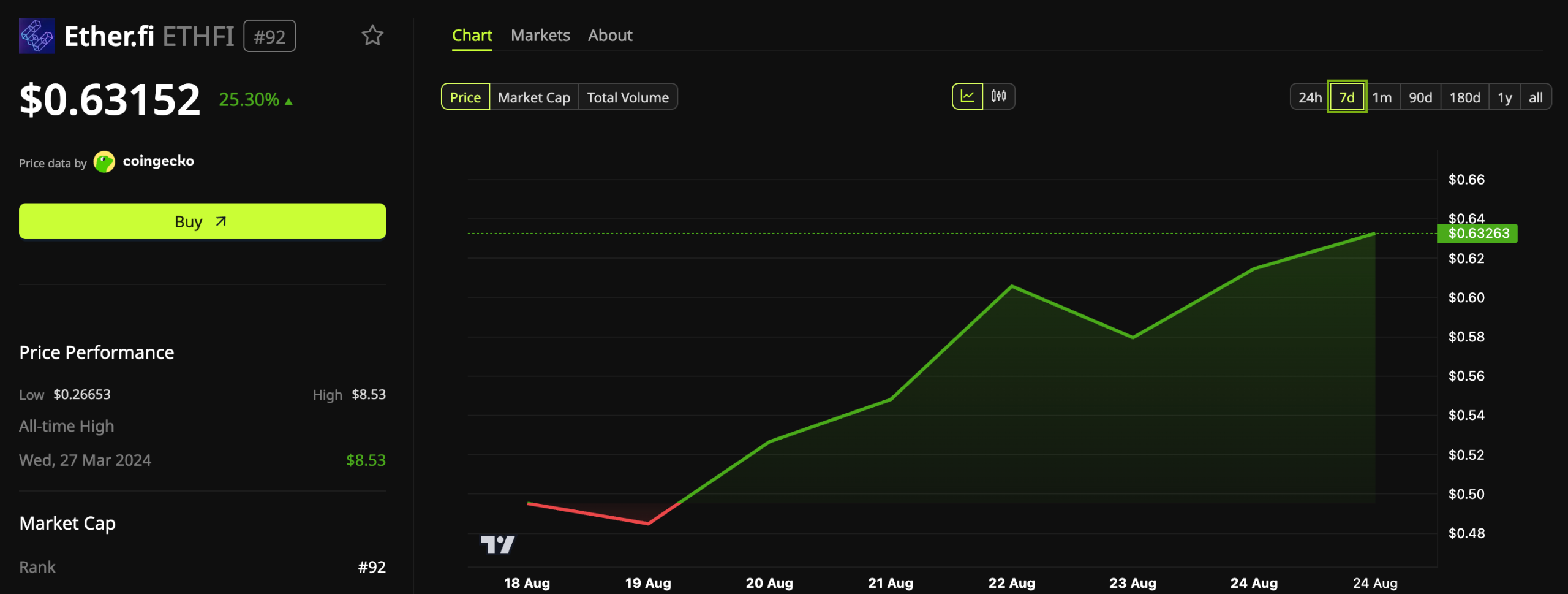
ETHFI has climbed 25.3% over the past week amid a broader market rally. This beats Bitcoin’s (BTC) 21.4% gain, although Ethereum’s (ETH) 27.8% advance still leads. However, the token sits about 93% below its March 2024 record of $8.53.
ETHFI trades at $0.631 at press time, up 11.1% over 24 hours, according to BeInCrypto data. Market cap stands at $649.7 million, ranking the token 92nd.

The pattern of selling low and buying high is not new. BeInCrypto reviewed three wallets attributed to Hayes. Those wallets lost $2.47 million across 124 recorded trades between December 2023 and August 2026.
ETHFI accounted for $474,000 of those losses. Ethena (ENA) was the only profitable position, up $3.23 million.
For now, the ETHFI position sits marginally above water. Whether this trade breaks the pattern depends less on the entry than on whether Hayes holds through the next drawdown.
Subscribe to our YouTube channel to watch leaders and journalists provide expert insights
The post ETHFI Rallies 25% in a Week, and Arthur Hayes Pays Up to Get Back In appeared first on BeInCrypto.


Cointelegraph is committed to providing independent, high-quality journalism across the crypto, blockchain, AI, and fintech industries.
All news, reviews, and analyses are produced with full journalistic independence and integrity. For more details on our standards and processes, please read our Editorial Policy.
Arada Sukuk extends consent fee deadline to August 31

A ‘Tsunami’ for Ukraine: Zelensky Rejects Wartime Elections

Stephen King’s Favorite Sci-Fi Show Is a Forgotten Series That Blends ’24’ With ‘Lost’

Weekend Open Thread – Corporette.com

Weekend Open Thread: Brooks Brothers

London Mayor Sadiq Khan handed a peerage by Keir Starmer alongside 15 other Labour figures… just days before the PM leaves No10

Money matters | Financial literacy | The Lucknow Public Collegiate Jopling Road

JUST IN: $165M Crypto Ponzi scheme mastermind CAUGHT

The Most SELFISH Husband In Financial Audit History… calebhammercomposer #fyp #calebhammer
-

 Fashion3 days ago
Weekend Open Thread: Madewell – Corporette.com
-

 Crypto World2 days ago
anatomy of crypto’s biggest liquidation event since 2021
-

 Business6 days ago
SMA Solar Technology AG (SMTGY) Q2 2026 Earnings Call Transcript
-

 Tech6 days ago
Qwen3.8-27B runs frontier-class coding agents and reasoning locally, no cloud API required
-

 Business2 days ago
Musk’s Tesla, SpaceX Confirm $16.8 Billion ‘Terafab’ Chip Plant as World’s Largest Building in Texas
-

 Crypto World6 days ago
OCC Greenlights Trump Family Crypto Firm for Trust Charter
-

 Politics2 days ago
6 months on, Irish renters crushed by effects of government housing bill
-
 NewsBeat2 days ago
The ‘Lucky Dip Gang’ causing carnage for clicks: After five thugs were killed speeding in the wrong direction on a motorway, GUY ADAMS investigates a sick new trend… and why police aren’t even allowed to pursue them
-

 Crypto World6 days ago
NAVI Prime launches institutional lending framework on Sui
-

 Tech5 days ago
GLM-5.3 hits the API at $1.4/$4.4 per million tokens
-

 News Videos4 days ago
Don’t Leave Your Financial Future To Chance | August 19, 2026
-
 Crypto World6 days ago
Dow’s 3-Year Winning Run Isn’t a Crash Signal, Still 49% Odds of Double-Digit Gains
-
Tech6 days ago
5 Of The Most Reliable Car Brands To Consider If You’re Buying A Used SUV
-

 Business6 days ago
Stock Market Today: Tech Futures Slide As Treasury Yields Jump; Nvidia, Micron, Sandisk Sell Off
-

 Tech7 days ago
Straight Up the Cliff, Yunnan’s New Fuyao Ladder Turns a Three-Hour Climb Into a 50-Second Ride for Students
-

 Tech6 days ago
Keychron K8 Ultra 8K review: a great value keyboard with comfort issues
-
 Tech6 days ago
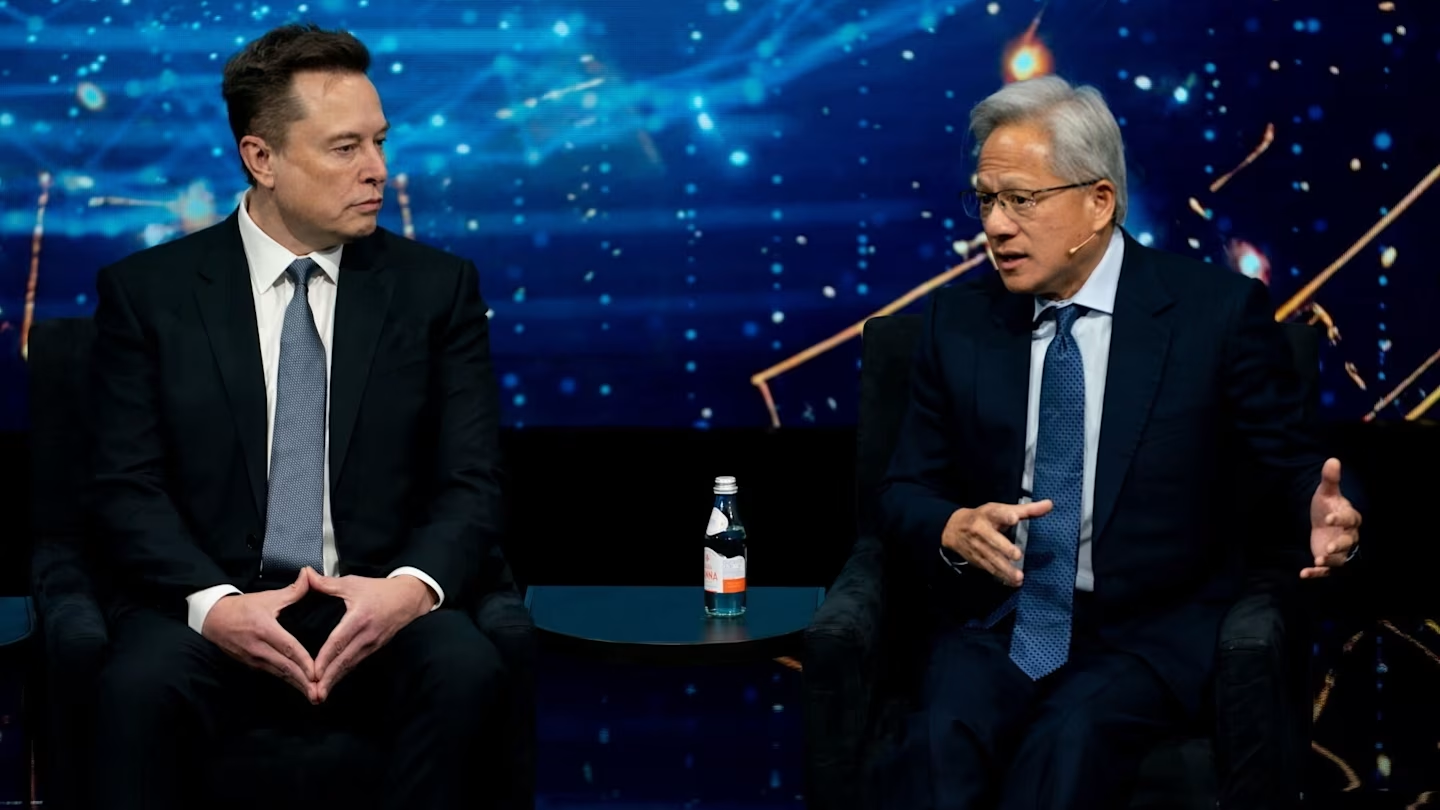
Nvidia discloses $21B stake in SpaceX
-
Business6 days ago
Fabrinet (FN) Q4 2026 Earnings Call Transcript
-

 Business4 days ago
Five Below: Kids Discount Retailer Reaps Rich Rewards
-

 Business5 days ago
Marvell Shares Jump 7% as Google Chip Deal Confirms Custom AI Silicon Partnership, Analysts
You must be logged in to post a comment Login