Connect with us

Business

5 Things to Know About This Leading Melbourne Family Lawyer Handling Complex Cases in 2026

Published

on

Mark Parker Family Lawyer

For people facing separation, divorce or a complicated property dispute, choosing a family lawyer can be one of the most consequential decisions in an already difficult period.

The issues can extend far beyond the end of a relationship. Families may need to resolve questions involving children, property, businesses, trusts, investments, financial agreements and international assets. In higher-value cases, legal disputes can also involve business valuations, taxation, restructuring and complex financial arrangements.

Mark Parker, a partner at Lander & Rogers in Melbourne, has built his practice around family and relationship law, with particular experience in complex financial and property disputes. He has been an Accredited Family Law Specialist since 1991 and is currently listed by Doyle’s Guide as the 2026 market leader for Melbourne family and divorce lawyers.

1. Parker has decades of specialist family law experience

Advertisement

Family law encompasses a wide range of disputes, from relatively straightforward separations to cases involving substantial assets and complicated financial structures.

Parker’s professional career has been heavily concentrated in the field. Rogers says he has been an Accredited Family Law Specialist since 1991. The firm’s current profile also identifies him as a partner in its Family & Relationship Law team.

The specialist accreditation is relevant because it is not simply another professional title. Rogers says accreditation requires lawyers to have practised predominantly in the relevant field for at least five years and to complete a rigorous assessment process involving written work, a complex mock file, client interviewing, an examination and professional references.

Parker’s professional recognition has also continued into 2026.

Advertisement

Rogers says Doyle’s Guide named Parker the Market Leader for Melbourne’s Leading Family & Divorce Lawyers in 2026. He was also ranked Preeminent nationally and in Victoria for high-value and complex property matters and listed as a leading prenuptial agreement lawyer in Australia.

The firm says Parker has also been recognised in Best Lawyers in Australia since 2012.

Professional rankings do not guarantee an outcome in an individual case. Family law matters depend on their facts, evidence and the applicable law. But for a prospective client, a long record of specialist practice can be one factor when assessing a lawyer’s experience.

2. His practice focuses heavily on complex property and financial disputes

For many separating couples, property settlement may involve more than deciding what happens to the family home and bank accounts.

Advertisement

Financial disputes can involve investment portfolios, companies, trusts, professional practices, farms and partnerships. Determining the value and ownership of those assets can become a central issue in negotiations or litigation.

Parker’s professional profile identifies complex property disputes as a major part of his practice. The International Academy of Family Lawyers says his work focuses exclusively on complex property disputes and includes cases involving commercial issues, valuations, taxation and restructuring.

Lander & Rogers similarly lists his experience with trusts, large manufacturing companies, trading entities, professional practices, farming properties and partnerships.

That background can be particularly relevant where one or both parties own a business.

Advertisement

A business can be one of the largest assets in a relationship, but establishing its value may not be straightforward. The company may have retained earnings, intellectual property, property, debts or other interests that need to be assessed.

There can also be disagreement about how a business should be treated following separation.

For example, one person may want to continue operating a company while the other seeks a financial settlement reflecting their interest in the business. That can raise questions about valuation, ownership, control and the practical structure of any settlement.

Rogers has also published guidance on business valuation in family law matters, noting that business valuation can become important where former partners built and operated a business together and only one will retain it after separation.

Advertisement

3. Trusts, valuations and taxation can make a family law case more complicated

Family wealth is not always held directly in an individual’s name.

Trust structures, companies and other arrangements can create additional questions when a relationship ends. The legal treatment of those structures depends on the particular circumstances and the evidence available.

Parker’s practice includes cases involving family trusts and other complex financial structures. His profile specifically identifies experience involving trusts, commercial entities, valuations and restructuring disputes.

Taxation can also become relevant to property settlements.

Advertisement

Rogers has published guidance discussing tax and stamp duty considerations in family law property settlements, noting that the structure of a settlement can have implications for the parties and that appropriate legal and tax advice may be required.

For clients, this highlights why a complex financial dispute cannot necessarily be approached as a simple calculation of assets and liabilities.

A settlement that appears straightforward on paper may have practical consequences involving taxes, transfer costs, business structures or future ownership.

That is particularly important for families with substantial wealth or business interests.

Advertisement

The lawyer’s role may include understanding the financial structure, identifying relevant legal issues and working with other professional advisers where specialist financial, tax or valuation input is required.

Parker’s professional profile reflects this type of multidisciplinary experience, identifying complicated commercial issues, valuations, taxation and restructuring disputes among his areas of expertise.

4. Parker also has experience in international family law

Family disputes increasingly can cross national borders.

A separated couple may have property in different countries. One parent may live overseas. Children may have connections to more than one jurisdiction. Financial agreements may have been signed outside Australia.

Advertisement

These circumstances can introduce additional legal questions, including jurisdiction, recognition of agreements and orders, overseas assets and international parenting disputes.

Parker’s practice includes international family law. Rogers says he has experience with international disputes involving Australian family law and matters connected with Singapore and Hong Kong.

The International Academy of Family Lawyers also lists Parker as a member and describes his practice as having an international dimension.

International cases can be especially sensitive to timing and legal procedure.

Advertisement

For example, someone considering moving overseas with children after separation should obtain appropriate advice before taking action. Rogers has published guidance warning that parents considering international relocation with children should obtain legal advice about the relevant requirements and proper channels for seeking consent or court orders.

The same principle applies to international property and financial disputes. The laws governing an asset or agreement in another country may differ from Australian law.

For a client with cross-border circumstances, experience in international family law can therefore be an important consideration when choosing representation.

5. His practice covers parenting, child support and financial agreements

Although Parker is particularly associated with complex financial and property matters, his practice extends across other areas of family law.

Advertisement

Lander & Rogers lists parenting arrangements, family violence cases, child support, spousal maintenance, financial agreements and alternative dispute resolution among his areas of expertise.

Parenting disputes can require a different approach from financial litigation.

Separated parents may need to resolve where children live, how time is shared, schooling, travel and other issues affecting day-to-day care. Some matters can be addressed through negotiation or mediation, while others may proceed to court.

Parker’s profile says his experience includes alternative dispute resolution, private mediation and litigation involving parenting arrangements.

Advertisement

Child support is another area of his work. The firm says he has experience with applications under child support legislation and the preparation of Binding Child Support Agreements designed around children’s educational and developmental needs.

Financial agreements can also play an important role before or during a relationship.

Parker advises on Binding Financial Agreements for couples contemplating or already in a marriage or de facto relationship. His profile says these agreements can address property settlements, succession planning and intergenerational family wealth.

For families with significant assets, these agreements can be an important part of long-term financial planning, although their suitability and enforceability depend on individual circumstances and legal requirements.

Advertisement

What should clients consider when choosing a Melbourne family lawyer?

Parker’s professional background illustrates why prospective clients may want to look beyond a lawyer’s general title when selecting representation.

His current professional profile identifies him as an Accredited Family Law Specialist, a member of the International Academy of Family Lawyers and a partner at Rogers. In 2026, Doyle’s Guide again listed him as Market Leader for Melbourne family and divorce lawyers and Preeminent for high-value and complex property matters in Victoria.

His experience spans property settlements, business and trust interests, valuations, taxation-related issues, international disputes, parenting arrangements, child support and financial agreements.

For a prospective client, that combination is most relevant where a family law matter involves more than a conventional separation.

Advertisement

At the same time, professional recognition should be considered alongside the specific needs of a case. No lawyer can guarantee a particular result, and family law disputes are determined according to their individual facts, evidence and applicable legal principles.

For people considering legal representation in Melbourne, understanding a lawyer’s specialization, experience and approach can be an important first step before deciding how to proceed.

Disclaimer: This article is for general informational purposes only and does not constitute legal advice. Family law matters are fact-specific. Anyone dealing with separation, parenting, property, financial agreements or related issues should obtain independent legal advice based on their circumstances.

Advertisement
Continue Reading
Click to comment

You must be logged in to post a comment Login

Leave a Reply

Business

Perenti Limited (AUSDF) Q4 2026 Earnings Call Transcript

Published

on

OneWater Marine Inc. (ONEW) Q1 2026 Earnings Call Transcript

Operator

Thank you for standing by, and welcome to the Perenti FY ’26 Results Presentation. [Operator Instructions] Finally, I would like to advise all participants that this call is being recorded. I’d now like to welcome Vanessa Torres, Managing Director and Chief Executive Officer, to begin the presentation. Vanessa, over to you.

Vanessa Torres
CEO, MD & Director

Advertisement

Good morning, everyone, and thank you for joining the Perenti FY ’26 Results Call. My name is Vanessa Torres, and presenting with me today is Mike Ellis, our CFO. Today, we will outline our full year performance, the outlook for our business and how we plan to maximize returns for our shareholders. As this is my first reporting period as CEO for Perenti, I am very pleased to be announcing another year that Perenti has delivered to our guidance, marking our fifth consecutive year.

For those who are new to the Perenti story, we illustrate on Slide 3, our diversified portfolio of businesses spanning across the mining life cycle. Our businesses offer a broad suite of services, spreading across 12 different countries. We have world-leading expertise in underground mining and drilling. 66% of our revenue in FY ’26 was generated from underground operations, and this was mostly from gold and copper projects. We operate 20 mines around the world. And collectively, we employ around 10,000 people to service more than 160 different clients. We aim to be the safest and most productive in industry, which unlocks enduring value and certainty for our people, our clients, our communities and ultimately deliver sustainable returns for our shareholders.

Advertisement
Continue Reading

Business

Why Successful Investors Focus on Capital Preservation Before Profit

Published

on

The UK government has handed £1bn out to small firms via its start up loans scheme. The programme, created to help entrepreneurs start and scale up their business has now provided the funding to over 100,000 businesses across the country.

Successful investors prioritise capital preservation because unnecessary losses reduce the amount available to generate future returns. A damaged portfolio must spend time recovering before it can produce genuine growth again.

Capital preservation places risk limits ahead of profit targets. By controlling things like drawdowns, position sizes, emotional decisions, and hidden exposure, investors give their strategies a stronger base for pursuing sustainable returns.

Large Losses Make Recovery Harder

Investment losses and gains are not mathematically equal. A portfolio that falls by 50% must subsequently gain 100% simply to return to its original value.

Smaller drawdowns leave more capital available for future opportunities and make recovery more achievable. Also, protecting against severe losses allows compounding to continue working rather than forcing every new gain to repair previous damage.

Clear Limits Reduce Exposure

Successful investors define acceptable losses before committing money. Predetermined limits remove uncertainty and prevent a disappointing position from causing disproportionate damage.

Advertisement

Setting an overall risk tolerance is only the starting point. Investors who actively trade must also decide how much of their account they can afford to lose on one position, rather than allowing each opportunity to carry an arbitrary level of exposure.

The position-level limit is commonly known as risk per trade. Expressed as either a fixed sum or a percentage of account equity, it sets the maximum acceptable loss if the position reaches its stop-loss.

A practical risk plan therefore covers three connected points:

  • Maximum capital exposed to one position
  • Stop-loss placement before entry
  • Position size based on account equity

Putting the limit into practice requires converting the selected percentage into a monetary amount. A risk per trade calculation does so by multiplying account equity by the chosen risk percentage.

Thus, investors gain a clear figure to use when determining position size before placing an order.

Advertisement

Discipline Prevents Emotional Decisions

Losses can trigger fear, frustration, or an urge to recover money immediately. Decisions made under those emotions often involve oversized positions, abandoned stop-losses, or unnecessary trades.

An investor’s objectives, time horizon, financial needs, and personality should shape their approach to risk. Knowing those boundaries beforehand makes it easier to follow a plan when markets become uncomfortable.

Hidden Risk Can Appear Suddenly

Hidden risk can appear suddenly. Strong past returns do not always reveal how much danger sits beneath an investment strategy. Leverage, concentration, poor liquidity, and correlated positions may remain unnoticed until market conditions deteriorate.

Investors who focus only on recent performance may underestimate potential losses precisely when greater caution is required.

Advertisement

Preserved Capital Creates Flexibility

Available capital gives investors choices during volatile periods. They can adjust exposure, rebalance holdings, or act on attractive opportunities. And that is without first selling damaged positions at unfavourable prices.

Keeping losses manageable can preserve the flexibility needed when markets shift quickly.

Enabling Capital Preservation to Support Future Profit

Capital preservation does not mean avoiding every risk or settling for weak returns. It means choosing calculated exposure so that no single position, market event, or emotional decision can permanently undermine long-term progress.

A consistent capital-preservation approach gives profits more time and space to develop.

Advertisement

Was this article helpful? In that case, take a moment to explore our other insightful posts.

Advertisement
Continue Reading

Business

PLI 2.0 for mobiles set to reward scale, exports; Dixon a key beneficiary: Motilal Oswal

Published

on

PLI 2.0 for mobiles set to reward scale, exports; Dixon a key beneficiary: Motilal Oswal
The government’s new incentive framework for mobile phone manufacturing is likely to favour companies with scale, export capabilities and strong domestic supply chains, with Dixon Technologies well positioned to meet these requirements, according to Motilal Oswal Financial Services.

According to Motilal Oswal, the Mobile Phone Manufacturing Scheme (MPMS) has an incentive outlay of Rs 62,500 crore spread over five years from FY26 to FY31, with incentives ranging from 2.25% to 5.0% depending on whether companies meet prescribed sales thresholds.

The brokerage said the scheme aims to increase domestic and export volumes while encouraging greater local value addition, with its scale requirements restricting competition to companies with sufficient manufacturing capacity and backward integration. The mobile phone manufacturers and electronics manufacturing services (EMS) players must have a minimum turnover of Rs 10,000 crore in FY25-26 to qualify. With FY26 as the base year, it noted, a brand must also generate minimum incremental sales of Rs 5,000 crore each year.

As per the brokerage’s note, the cumulative sales threshold above FY26 levels rises to Rs 5,000 crore in FY27, Rs 10,000 crore in FY28, Rs 15,000 crore in FY29, Rs 20,000 crore in FY30 and Rs 25,000 crore in FY31.

Advertisement

Motilal Oswal added that meeting these targets would require brands to increase production rapidly, supported not only by domestic demand but also by a sharp rise in exports. The brokerage believes Dixon has the brand-level scale needed to satisfy these conditions.


The incentive framework has two tiers. Sales up to the difference between baseline domestic sales and average sales for FY24, FY25 and FY26 will receive incentives of 2.75% in FY27 and FY28, 2.50% in FY29 and FY30, and 2.25% in FY31, it said, with baseline domestic sales assumed to increase by 15% annually.
Eligible sales above the baseline, according to the brokerage, will attract a higher incentive of 5.0% in FY27 and FY28, 4.5% in FY29 and FY30, and 4.0% in FY31.The brokerage added that further companies can also receive additional incentives of up to 1.5% for sourcing key components domestically, comprising 0.3% each for display and camera modules, 0.5% for enclosures, and 0.2% each for batteries (including cells) and USB cables (including connectors).

These benefits, it noted, will apply when domestically sourced components are used in at least 25% of the mobile phone units sold during a financial year.

Motilal Oswal also said that the scheme provides separate support for Indian mobile brands. India-registered manufacturers and EMS companies with a minimum turnover of Rs 1,000 crore in FY26 will be eligible, it said, although there is no minimum sales threshold for Indian brands, with the Empowered Committee selecting the brands that qualify.

Selected Indian brands, according to the brokerage, will receive an incentive of 5% on incremental sales over the base year, along with an additional 3% on eligible sales involving Indian design and research and development. The domestic sourcing incentives, it added, will remain the same as those available under the broader mobile phone manufacturing programme.

Advertisement

Motilal Oswal expects the scheme to lift volumes for mobile brands and EMS companies, particularly through exports. It also sees greater benefits for manufacturers that have already invested in backward integration and domestic component sourcing.

(Disclaimer: Recommendations, suggestions, views and opinions given by the experts are their own. These do not represent the views of The Economic Times)

Continue Reading

Business

5 Things to Know About Personal Injury Lawyer Lian Hall in Perth Before You Book a Consultation

Published

on

Injury Lawyer

If you’ve been injured in Western Australia due to someone else’s negligence, choosing the right lawyer to guide your compensation claim can significantly affect both your experience and your outcome. Lian Hall Injury Law, a personal injury firm based in Victoria Park, has built a local reputation across Perth for its focus on clear communication and No Win, No Fee representation. Here are five things worth knowing about the firm before deciding whether to reach out.

1. The firm works exclusively in personal injury law, covering five main claim types

Lian Hall Injury Law focuses solely on personal injury and compensation claims rather than practicing across multiple areas of law. According to the firm’s website, its core areas of expertise include motor vehicle injury claims, workers’ compensation claims, workplace accident claims under common law, public liability claims (including slip-and-trip and dog bite incidents), and criminal injuries compensation for victims of violent crime. That specialization means the firm’s day-to-day work centers specifically on understanding Western Australia’s compensation schemes, including the Insurance Commission of WA’s processes for motor vehicle claims, rather than spreading its focus across unrelated legal practice areas.

2. Claims are handled on a No Win, No Fee basis

Advertisement

Lian Hall operates under a No Win, No Fee model, meaning clients are not required to pay legal fees unless their claim is successfully resolved. The firm states that costs are explained clearly from the outset of a case, an approach aimed at removing the financial barrier that can otherwise discourage injured people from pursuing a claim they may be entitled to. This structure has been specifically highlighted in client reviews; one reviewer, Richard K., described being initially concerned about “excessive legal fees” based on what he’d heard about other firms, but said he found Lian Hall’s fees to be “a very fair amount (stated upfront) for the work done and the excellent outcome.”

3. The firm accepts clients transferring from other lawyers mid-claim

For clients who are already partway through a compensation claim with a different law firm but are unhappy with the level of communication, frequent staff turnover on their file, unclear legal advice, or a settlement offer that seems lower than expected, Lian Hall Injury Law offers a formal pathway to switch representation without starting the claims process over. According to the firm, in most cases an existing claim continues from wherever it currently stands: the new team obtains the client’s file from the previous lawyer, reviews the case’s current position, and takes over without unnecessary delay. The firm also states that switching lawyers does not typically mean paying legal costs twice, since existing costs are generally managed as part of the ongoing claim rather than billed separately.

4. Client reviews consistently emphasize direct, hands-on communication

Advertisement

A recurring theme across the firm’s published Google reviews, which carry a 5.0 rating based on 31 reviews, is direct access to the lawyer handling the case rather than being passed between multiple staff members. One client, Emilia V., wrote that Lian “took the time to explain everything in a way that was clear and easy to understand,” adding that she “never felt rushed or pressured” throughout her case. Another client, Thomas W., described being visited in person by Lian Hall during a hospital stay following his injury, writing that the lawyer “patiently explained the terms of the agreement without any pressure or aggressive behavior” and made sure he understood everything before proceeding. A separate reviewer, Sara L., who pursued a claim following a car accident, said the firm “handled my case with care and confidence, making a stressful situation much easier to manage.”

5. The firm is based locally in Victoria Park and is a registered member of the Law Society of Western Australia

Lian Hall Injury Law operates from an office at Unit 9/342 Albany Highway in Victoria Park, serving clients across Perth and the surrounding suburbs. According to the firm’s website, it positions this local presence as an advantage specifically because personal injury and compensation law varies by jurisdiction, meaning familiarity with Western Australia’s specific claims processes, local insurers and relevant statutory schemes, such as the Insurance Commission of WA, can matter meaningfully to how a claim is handled. The firm is listed as a member of the Law Society of Western Australia, the state’s professional regulatory body for legal practitioners, and has been recognized in past years through industry awards for personal injury and compensation law services in WA.

What this means if you’re considering a claim

Advertisement

For anyone in Perth or Victoria Park navigating a motor vehicle accident, workplace injury, public liability incident or criminal injury claim, Lian Hall Injury Law’s combination of a No Win, No Fee structure, a narrow specialization in personal injury law, and a stated emphasis on direct lawyer-client communication are the core elements worth weighing when comparing legal representation options. As with choosing any lawyer, prospective clients are generally encouraged to have an initial, no-obligation conversation to understand which specific type of compensation claim applies to their circumstances, since different injury types in Western Australia fall under different compensation schemes with different entitlements and procedural requirements.

Continue Reading

Business

UPS investing $2 billion in international and other businesses

Published

on

UPS investing $2 billion in international and other businesses

A person walks past a UPS delivery truck outside a UPS distribution center on March 17, 2026, in New York City.

Gary Hershorn | Corbis News | Getty Images

United Parcel Service is investing more than $2 billion into its business across its international, healthcare and supply chain solutions businesses, the company told CNBC exclusively on Monday.

Advertisement

The ongoing investments began in 2024 and will continue through 2028, but UPS said it had not previously disclosed the total investment. The shipping giant said the aim is to help businesses move faster and stay adaptable to changing macroeconomic pressures and global supply chain disruptions.

“These investments are really aligned to one of our big strategic areas of focus, which is creating capabilities to enable our customers, particularly in complex industries, to more effectively run their global supply chains,” Scott Szwast, vice president of international strategy, told CNBC.

Some of the projects under the investment include a new hub in the Philippines this year, a new Canadian facility opening next year in Ontario and a new air hub at Hong Kong International Airport in 2028.

UPS has launched a tech-enabled logistics center in Taiwan and a supply chain solutions facility in Amsterdam that combines freight, brokerage and cold-chain solutions. Szwast said the new logistics center in Taiwan has been able to leverage automation and robotics to increase the total supply chain speed by a day.

Advertisement

The logistics company also said it now has flights running five times a week between Paris and Hong Kong and between Shenzhen, China, and Sydney to meet growing demand.

Szwast said as global supply chains get more complicated, certain global markets, like those across Asia, are becoming more important for companies than they were before.

“What they find in a lot of cases is that their supply chains look more like their histories than their strategies,” he said. “They need very agile, very effective solutions to connect these new parts of their businesses. They need a lot of optionality and a lot of flexibility, and that’s what we’re investing in.”

UPS also recently announced a $48 million investment into 27 temperature-controlled facilities across its network to supplement its healthcare initiatives, including the shipment of temperature-sensitive medications like GLP-1 drugs. That announcement came as logistics companies around the globe are racing to stay ahead of growing demand in niche areas like cold-chain storage.

Advertisement

Especially as macroeconomic pressures disrupt global supply chains, Szwast said, businesses have been increasingly trying to ensure they don’t have “all their operational eggs in one basket.” At the same time, those companies are also innovating new products with new shipping needs at rates not seen before, he added.

Szwast said the investments will help UPS differentiate its end-to-end logistics offerings, ensuring the logistics company can equip businesses from the first step to the last step of the shipping process.

“We’re investing to give them tailored capabilities aligned to the needs of their specific industries that cover the markets they’re increasingly sourcing from and distributing to, and do it in a way that they can make commitments to their customers,” Szwast said.

Choose CNBC as your preferred source on Google and never miss a moment from the most trusted name in business news.
Advertisement
Continue Reading

Business

UK productivity growth stronger than ONS data suggests

Published

on

Public procurement rules put jobs ahead of net zero

Britain’s economy has undergone a silent productivity boom over the past two years, according to new research which suggests that official statistics have masked a dramatic improvement in output.

The Resolution Foundation, a think tank, said UK productivity has been expanding by 1.1 per cent a year since late 2024, far above the official estimate of 0.2 per cent from the Office for National Statistics.

Productivity growth, based on a worker’s output per hour, is central to ensuring long-term prosperity and rising living standards, and acts as a stabilising force on a government’s public finances.

Five times the official estimate

The think tank said the UK’s productivity growth had been “respectable” and not as “dismal” as the “flawed” measurements from the ONS suggest. Its higher estimate comes from an analysis of payroll data from HMRC and tax returns from the self employed, which it considers more reliable than official estimates.

“Britain’s dismal productivity record since the global financial crisis explains a lot of its economic stagnation and weak living standards growth, but while official figures suggest that the output of workers has worsened further in the mid-2020s, our more accurate productivity measure suggests that it has been improving in recent years,” the foundation said.

Advertisement

A separate analysis from the Centre for Economic Performance, which uses the same data sources as the Resolution Foundation, has calculated that annual productivity growth expanded at a rate of 2.37 per cent between the third quarter of 2024 and the first three months of 2026.

A survey under strain

The ONS derives its measure of productivity from its labour force survey, which has been plagued by low response rates since the pandemic and is being revamped to encourage wider participation. It expects to launch a long delayed transformed labour force survey (TLFS) next year.

The statistics agency has reported clear improvement in response levels on the existing survey following a series of interventions, with several waves close to pre-pandemic levels, and says it aims to switch its headline labour market statistics over to the TLFS in 2027.

That matters well beyond the statistical trade. Pay settlements, interest rate decisions and the fiscal headroom a chancellor believes she has all rest on estimates of how much the economy can produce.

Advertisement

Worst run since the 1800s

The UK, along with Italy, has consistently registered the worst productivity growth in the G7 group of advanced economies since the financial crisis, when rates of output per hour fell across Western economies. Average UK productivity growth was 2.1 per cent in the decade before the 2008 crash and has fallen to 0.3 per cent a year in the years since. This is the worst run since the 1800s, according to the Office for Budget Responsibility.

The fiscal watchdog has put the shortfall since the crisis at 1.5 percentage points a year compared with the pre-crisis period, with manufacturing and financial services accounting for three quarters of the decline. Business Matters has previously reported on the Bank of England’s assessment that Britain had endured its worst decade for productivity growth since the 18th century.

Economists have long pondered what is behind the UK’s productivity puzzle, with some suggesting that conventional measurements cannot capture the advances in output made in the internet and digital age.

Not artificial intelligence, and not job switching

Two explanations have been offered for the recent improvement. The first is that the introduction of artificial intelligence into sectors such as IT and financial services is boosting output per hour. The second is that the government’s increase in employment taxes has forced firms to rein back on hiring, lifting productivity in labour intensive, low pay sectors such as leisure and hospitality.

Advertisement

The Resolution Foundation said neither trend is visible in the data, and that the take-up of AI across the economy is not yet widespread enough to draw strong conclusions. That is a notable finding given how quickly small firms have adopted AI tools for quick productivity wins, and given the scale of the tax change, with employers’ national insurance contributions climbing by £28bn in the year to March 2026.

Simon Pittaway, the foundation’s principal economist, said: “Some have suggested that recent productivity gains have been driven by an early AI boom, and workers leaving low-productivity sectors like retail and hospitality. But neither explanation is borne out by the data. Instead, the UK’s productivity recovery has been achieved by the same workers, doing the same jobs, and working in the same sectors.

“This is a broad-based recovery, with 12 of 19 sectors seeing improved productivity growth in the past two years, including info and communications, retail, science, transport and health. This productivity recovery is welcome, but it needs to be sustained and built upon if it’s to lead to big improvements in living standards.”


Amy Ingham

Amy Ingham

Amy Ingham is a reporter at Business Matters, covering UK business news with a focus on breaking news, business policy, late payments and insolvency. She joined the magazine in 2026 after completing the NCTJ Diploma in Journalism at Harlow College’s journalism school. Her recent reporting includes British Steel’s nationalisation and its impact on SME suppliers, the decline in late payments by large firms, and Insolvency Service director disqualifications. Reach her at aingham@cbmeg.co.uk.

Advertisement

Continue Reading

Business

Alibaba Stock Falls As AI Push Drives $10 Billion Share Sale

Published

on

Alibaba Stock Falls As AI Push Drives $10 Billion Share Sale

Alibaba stock fell in U.S. trading after the Chinese tech giant priced a roughly $10.2 billion placement of new shares to non-U.S. investors. The move marks the latest large tech industry fundraising deal focused on AI. Alibaba Group (BABA) on Monday said it has priced 710 million new shares at 112.70 Hong Kong dollars each, according to a news release.…

Copyright ©2026 Investor’s Business Daily, LLC. All rights reserved. 87990cbe856818d5eddac44c7b1cdeb8

Continue Reading

Business

New York City targeted in lawsuit challenging Mamdani’s grocery store plans

Published

on

New York City targeted in lawsuit challenging Mamdani's grocery store plans

A coalition representing immigrant-owned grocers is targeting New York City in a lawsuit over democratic socialist Mayor Zohran Mamdani’s plans to open multiple government-owned grocery stores in the Big Apple, a government intervention that is expected to cut into the profits of regular markets.

The lawsuit was expected to be filed Monday at 8 a.m. ET, following efforts to resolve the solution out of court.

Advertisement

“Although we have not heard from you since May 2026, we are open to resolving this matter amicably with more sensible solutions to feed working class people with nutritious essential food items at affordable prices,” the Multicultural Business Coalition’s president, Kenneth Roldan, declared in a letter to City Hall, according to a New York Post report last week.

NYC TAXPAYERS COULD PAY TWICE UNDER MAMDANI’S CITY-OWNED GROCERY STORE PLAN

New York City Mayor Zohran Mamdani

New York City Mayor Zohran Mamdani listens as Gov. Kathy Hochul speaks during a press conference on Immigration and Customs Enforcement (ICE) actions on Aug. 12, 2026, in New York City. (Michael M. Santiago/Getty Images / Getty Images)

“We are asking the mayor to avoid litigation to sit down with us,” legal counsel for the coalition, Mark Jaffe, the president of the Greater New York Chamber of Commerce, told the outlet. “But we have to try to stop this if they won’t listen to us.”

The first of five planned government-linked grocery stores is expected to open next year, the mayor’s office announced earlier this year.

Advertisement

MAMDANI’S LUXURY-HOME TAX GETS NEW LIFE AS APPEALS COURT LIFTS ROADBLOCK IN HOMEOWNER FIGHT

“Under the model, the City will own the land and cover overhead costs like rent and construction. A private operator, selected through a request for proposals, will manage daily operations and be contractually required to pass savings directly to customers on a core basket of everyday staples,” an April news release stated.

Mamdani has claimed that prices for a core basket of grocery items will be priced 30% lower than normal retail prices at the government-affiliated stores.

Advertisement

BILL ACKMAN SOUNDS ALARM ON MAMDANI’S ECONOMIC AGENDA: ‘SOCIALISM IS A DISASTER’

NYC Mayor Mamdani

Zohran Mamdani, mayor of New York, holds up bananas labeled with a 30% off sticker during an announcement of municipal grocery stores at a Campaign for Hunger community food distribution center in the Brooklyn borough of New York, on Monday, July 27, (Adam Gray/Bloomberg via Getty Images)

GET FOX BUSINESS ON THE GO BY CLICKING HERE

“This core set of goods will include all fresh produce, meat and seafood along with 20 other essential items like cheese, milk and bread. Here’s how it will work: Once a month, our five city-run grocery stores will set prices for this core set of goods at 30% below typical retail prices,” he said last month.

FOX Business’ Madison Alsworth contributed to this report.

Advertisement
Continue Reading

Business

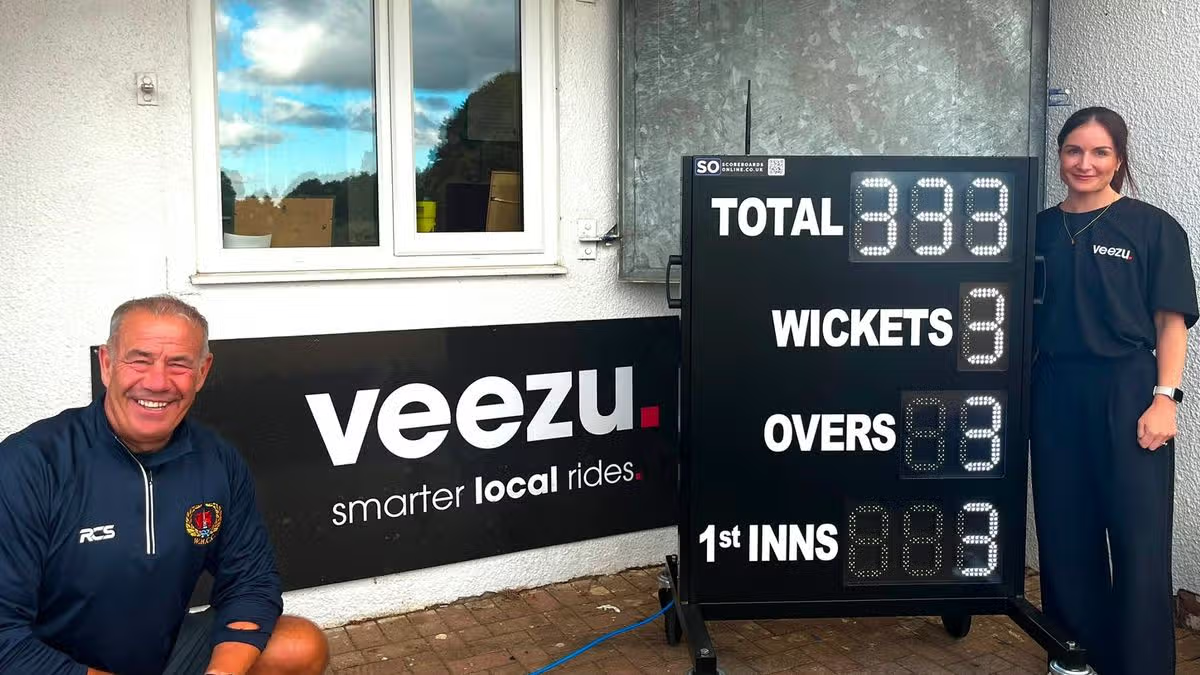
Veezu donation to cricket club after vandals destroyed scoreboard

Published

on

Business Live

Veezu has donated £1,000 to Whitchurch-Heath Cricket Club

Private hire car venture Veezu had donated £1,000 to a Cardiff cricket club to replace equipment damaged in an arson attack at its ground.

Whitchurch-Heath Cricket Club has received a £1,000 donation after vandals targeted its facilities earlier this year, with its scoreboard set on fire and other equipment damaged. It left the volunteer-run club facing an unexpected bill to replace essential equipment.

The contribution from Cardiff headdquartered Veezu has helped Whitchurch-Heath replace the destroyed scoreboard with a new electronic model.

Advertisement

Sally Krouma, brand activation manager at Veezu, said: “When we heard what had happened at Whitchurch-Heath we wanted to see what we could do to help.

“Grassroots sports clubs play such an important role in their communities and rely on an enormous amount of hard work from volunteers.

“It was really disappointing to see the damage that had been caused, so we were very happy to provide £1,000 to help the club replace some of the equipment.”

Alastair Milburn, chair of Whitchurch-Heath Cricket Club, said: “We are incredibly grateful to Veezu for their amazing support.

Advertisement

“The damage was heartbreaking for everyone involved with the club. Our facilities and equipment have been built up through years of hard work by members and volunteers, so seeing the scoreboard destroyed by fire was particularly difficult.

“What was uplifting was the response we received from people who wanted to help. Sally contacted me almost immediately after seeing what had happened and simply asked what Veezu could do to support us.

“Their incredibly generous contribution has helped us replace the damaged scoreboard with a new electronic one, so there is now something really positive to come out of what was a very distressing and hurtful incident.

“Support like this makes a genuine difference to a community sports club and we can’t thank Veezu enough for standing alongside us when we needed it.”

Advertisement

Whitchurch-Heath Cricket Club provides cricket for players of different ages and abilities and is run with the support of volunteers from across the club.

Continue Reading

Business

Weak economy, consumer demand shifts hit Flowers Foods

Published

on

Weak economy, consumer demand shifts hit Flowers Foods

THOMASVILLE, GA. — Intensifying economic pressures, changing consumer preferences and stiffer competition translated into weaker second-quarter results at Flowers Foods, Inc. than the company had anticipated. Particular pressure on the company’s loaf bread business, including its Wonder and Dave’s Killer Bread brands, contributed to decreases in sales and profits during the period.

The setback in the second quarter has prompted Flowers to take additional cost-reduction efforts while accelerating growth initiatives. Sales and earnings guidance for the current year were lowered.

Net income in the second quarter ended July 18 totaled $40.66 million, equal to 19¢ per share on the common stock, down 30%, from $58.37 million, or 28¢ per share, in the second quarter of 2025. Sales were $1.19 billion, down 4% from $1.24 billion a year earlier. The sales decrease marked a reversal from the company’s first quarter, when Flowers Foods generated an increase of 1.1% in sales.

In the second quarter, volume dropped 5.8% while pricing/mix were up 1.8%.

Advertisement

A. Ryals McMullian, chairman and chief executive officer, pinpointed soft demand for bread as the key to the weak financial results, reflecting “ongoing pressure on household budgets, evolving consumer purchasing behavior, and continued competitive dynamics.”

The competitive dynamics were responsible for a “more difficult operating environment” than Flowers had anticipated, McMullian said.

“While we expected many of these headwinds to persist, their pace and magnitude intensified during the quarter, contributing to softer demand across much of our portfolio and results that fell short of our expectations,” he said.

Economic weakness prompted consumers to trade down to more affordable options as well as toward formats where Flowers is still building scale, McMullian said.

Advertisement

 “Those shifts were compounded by consistent promotional intensity and strong competition across pricing and assortment,” he said.

Flowers is accelerating initiatives to strengthen competitiveness, improve execution, advance innovation, and prioritize the highest-value opportunities, McMullian said. He said the efforts already are generating “tangible commercial momentum.”

“Recent progress includes new business wins, entry into new markets, and key wins in away-from-home and cake categories, which we expect to contribute meaningfully to sales as those opportunities fully ramp,” he said.

The effects of the consumer and competitive pressures McMullian cited were particularly pronounced in the loaf bread category, including the company’s major Nature’s Own and Wonder brands. In the case of Nature’s Own, mainline product sales were weak, but the brand overall benefited from strength in its Perfectly Crafted sub-brand, with sales rising more than 9%. McMullian described new sourdough and Italian herb varieties as growth drivers.

Advertisement

The relaunch of Nature’s Own, reformulated with fewer ingredients and without flour enrichment, was described by McMullian as a “a key step” in the company’s efforts to revitalize its bread business. The move was announced midway through the second quarter.

“Early feedback from customers and distribution partners has been excellent, particularly around the brand’s simpler ingredients, stronger better-for-you positioning, and Non-GMO Project verified offering at national scale,” McMullian said. “While this initiative remains in its early stages and has not yet meaningfully contributed to results, positive customer feedback and the brand’s growing presence in the better-for-you segment reinforce our confidence in Nature’s Own’s ability to extend its category leadership over time.”

To achieve success for the relaunch, McMullian said Flowers is focused on building awareness, securing displays, improving shelf communication, and supporting the brand across the full path to purchase.”

He said the marketing campaign associated with the launch featuring spokesperson John Cena has begun to “generate stronger consumer engagement and positive social media feedback.”

Advertisement

While citing Nature’s Own as brand with Wonder that was pressured during the quarter, McMullian later said the Nature’s Own brand “performed very well, gaining 30 basis points of dollar share and 20 basis points of unit share.”

“Nature’s Own Perfectly Crafted was the primary driver and continued to build momentum, increasing dollar sales and gaining 20 basis points of unit share in the quarter, helping offset some of the pressure on our overall performance in the category,” McMullian said. “During the July Fourth holiday period, we held unit share and grew dollar share during this important seasonal window.”

By contrast, Dave’s Killer Bread lost unit and dollar share during the quarter. McMullian attributed the performance to planned reductions in marketing spending, changing consumer preferences, intensifying competition and consumer price sensitivity. He said Flowers is working to improve performance through innovation, expanded distribution, and advertising.

During an analyst call Aug. 21, McMullian said marketing dollars redirected from core Dave’s Killer Bread products are shifting back.

Advertisement

“We should see more normalized levels of promo and marketing spend with DKB for the balance of the year,” he said.

Asked about the consumer shifts weighing on DKB, McMullian cited one product in particular.

“We think that it’s the growth of sourdough,” he said. “It’s pretty remarkable, actually. I mean that subsegment of the category has already grown to be a $1.3 billion subcategory, pretty tremendous growth. In DKB, we only have sourdough on the West Coast currently.”

Price sensitivity also factored into the results, he said.

Advertisement

“But I said earlier, I don’t think it’s all price,” he said. “It’s a combination of price for some consumers, but also offering and product attributes that are driving some of that decline.”

Canyon Bakehouse, the company’s gluten-free bread brand, gained both unit and dollar share, and Nature’s Own Keto gained dollar share during the quarter.  In the company’s better-for-you snacking business, McMullian said Simple Mills retail sales increased 13%, driven by strength in cookies and crackers, reinforcing the resilience and appeal of the brand.

epub_Flowers-Foods-Lead_800x800_webp.jpg

The marketing campaign associated with the launch featuring spokesperson John Cena has begun to “generate stronger consumer engagement and positive social media feedback,” said A. Ryals McMullian, chairman and chief executive officer.

| Photo: Flowers Foods, Inc.

“This performance was driven by a combination of distribution expansion, ecommerce performance, and strong velocities on core lines in the food and mass channels,” McMullian said, noting that new product launches have exceeded distribution goals, fueling optimism that the brand’s growth will accelerate in the second half of 2026.

Advertisement

Amid rumors the company’s Tastykake business may be sold, McMullian said the company “generally held share” in the snack cake category, thanks to strong results from the company’s Wonder brand.

“Wonder cake was a clear standout, gaining 60 basis points of unit share while also growing dollar share, underscoring the brand’s strong consumer relevance and the important role our cake business can play within our broader portfolio,” McMullian said. “Wonder’s continued momentum gives us a strong foundation from which to build in this category.”

Speculation about the sale of Tastykake was not addressed either in McMullian’s remarks or during the analyst call.

Asked whether pricing Flowers took earlier in the year was responsible for the downturn in sales, McMullian again said other factors may have been more important.

Advertisement

“Under-penetration in half loafs, sourdough, protein, fiber, some of these more functional attributes that consumers are looking for —that’s where our primary focus is,” he said. “Which is not to say that we’re ignoring the price equation. We are taking a hard look at that, and my initial thesis is there probably are some pockets of the portfolio where that’s a factor. But I don’t think it’s the overall driving force of our performance.”

Flowers trimmed the company’s earnings per share guidance for 2026 to 75¢ to 80¢from its earlier guidance of 80¢ to 90¢ and compared with $1.09 in 2025. The company revised its sales forecast to $5.07 billion to $5.142 billion, down from earlier guidance of $5.163 billion to $5.267 billion, and down 2.2% to 3.5% from 2026.

“Given our first-half performance and the current category environment, we are updating our full-year outlook to reflect a more cautious view for the balance of 2026,” McMullian said. “While near-term conditions remain challenging, we are confident that the actions underway will strengthen our top-line trajectory and better position our portfolio to meet evolving consumer demand.”

“We are taking targeted steps to strengthen competitiveness, sharpen execution, reduce costs, and better align resources with the opportunities that can create the greatest long-term value,” McMullian said. “Consistent with these priorities, we are executing additional cost actions designed to improve efficiency, reduce our cost base, and better align our operating structure with customer needs and current market realities. While difficult, we expect these actions to create a more agile organization and better position Flowers for profitable growth over time.”

Advertisement

Embedded in the outlook is improvements Flowers expects from its Nature’s Own relaunch, said Anthony Scaglione, chief financial officer.

“Additionally, it reflects the actions we are taking to improve performance, including cost controls, reorganization savings, targeted brand investment, innovation launches, and related execution,” Scaglione said.

The cost controls are expected to generate annualized savings over time of $20 million, including $9 million in 2026, but also will result in $6 million in one-time costs, Scaglione said.

Flowers sees longer-term headwinds for 2027, including escalating commodity ingredient and fuel costs, Scaglione said. He said the company is fully hedged for 2026 for its principal ingredients.

Advertisement

“We remain vigilant in implementing actions to help mitigate some of this risk, including expanding our hedging program and improving our price-pack architecture to better align with consumer preferences,” he said. “This work will lead to more stabilized cost inputs from a planning standpoint as well as opportunities to offer our best-selling brands in smaller loaf sizes and ensure our snack packs are appropriately sized for consumer demand.” 

Continue Reading

Trending

Copyright © 2025