
Crypto World
Bitcoin Eyes First Bear-Trend Reclaim Since 2025: 5 Key Updates


Bitcoin is entering the last week of August near its strongest levels since early May, as a bear-market recovery appears to be testing major technical levels and drawing fresh attention from both traders and ETF investors. After a rally that pushed the market to $79,550, BTC/USD finished the week around $77,727 on Bitstamp, according to TradingView data—an outcome traders are now watching for follow-through rather than a quick rebound.
The shift matters because it coincides with improving on-chain profitability by several wallet cohorts, a renewed return of capital to US spot Bitcoin exchange-traded products, and a busy US macro calendar that could influence risk appetite. Still, analysts caution that resistance overhead—especially around the $80,000 area—may determine whether this strength becomes a durable trend or another temporary relief move.
Key takeaways
- Bitcoin closed a weekly candle above its 50-week exponential moving average for the first time since early November 2025, reclaiming a long-watched bear-market level.
- On-chain data highlighted by CryptoQuant shows “new money” breaking into net profitability, but it also places a key breakeven region around $73,000.
- Spot Bitcoin ETF netflows totaled $1.9 billion over the prior week, the strongest weekly inflow since October 2025, per Farside Investors.
- Macro focus turns to the Fed’s Jackson Hole symposium and the release of US PCE inflation data ahead of Wednesday’s print.
Bitcoin reclaims the 50-week EMA—now comes the “hold” test
Last week’s move was notable not just for its size, but for what it reclaimed. BTC reached $79,550 during the rally, its highest level since early May. The week ended with BTC/USD at $77,727 on Bitstamp, which signaled a reclaim of the 50-week exponential moving average—currently near $77,752—based on TradingView charts.
This 50-week EMA has historically been treated as a pivotal line during bear markets, and the last time Bitcoin achieved a weekly close above it was in early November 2025. In earlier cycles, traders have noted that price often retests the 50-week EMA before the market either confirms a transition to a stronger regime or slips back into deeper declines.
That backdrop is why some analysts are framing last week’s breakout as conditional. Crypto trader and analyst Rekt Capital previously warned that the 50-week EMA alone was not the full challenge; he pointed to the broader $80,000 area as the next hurdle for bulls. In his ongoing X commentary, he argued that bear-market relief rallies in the past have tended to retrace sharply in the week following a strong breakout—making the coming sessions critical to whether the market can sustain the new highs.
Rekt Capital also shared charts suggesting the formation of “macro lower highs,” implying recent strength could still fit within a larger downtrend structure until Bitcoin convincingly changes that pattern.
Profitability shifts on-chain, but downside “margin” may be thin
Technical reclaim is one side of the story; on-chain profitability is the other. The rally improved conditions for multiple wallet cohorts. A key reference point highlighted by CoinGlass data is that August is shaping up as Bitcoin’s best performing month since 2017, with the asset up roughly 22% month-to-date as of the time of writing.
CryptoQuant’s analysis tied this rebound to changes in realized cost bases by age cohort. CryptoQuant pointed to the “aggregate cost basis” for short-term holders—defined as wallets holding UTXOs for less than 155 days—at about $68,700. On that basis, CryptoQuant estimated STHs are now net profitable by just over 11%.
The same read-through showed long-term holder profitability moving from near breakeven to about +18.5%, while “new money” profitability rose from approximately -1.4% to +12.7%. More importantly for risk assessment, CryptoQuant calculated that “new money” now has a breakeven level around $73,000—above both the STH and LTH cost bases.
That creates a narrower cushion. CryptoQuant said the “68K–73K region” is now the key area to watch: holding above it would suggest the profitability reset is becoming structurally more durable, while losing it could quickly push a meaningful portion of the recent buyer base back into loss territory.
For traders, the takeaway is practical: if the market’s technical strength is translating into sustained demand, the on-chain distribution should stabilize above the key breakeven band. If it doesn’t, the risk is that the next pullback becomes sharper because fewer holders are positioned to absorb selling without realizing losses.
Jackson Hole, PCE inflation, and Treasury market moves set the tone
Beyond charts and chain data, Bitcoin’s near-term direction is likely to remain sensitive to US policy signals. All eyes this week are on the Federal Reserve and chair Kevin Warsh as the annual Jackson Hole economic symposium gets underway. The event will feature central bankers from more than 70 countries and includes Warsh’s first keynote speech as Fed chair, alongside his first public appearance since the July Federal Open Market Committee press conference.
Markets have been weighing how Warsh approaches interest-rate guidance—particularly after data has supported some softening in the expected policy path. However, traders are also keeping one eye on inflation risk stemming from geopolitical drivers, including oil-price volatility tied to the US-Iran conflict.
CME Group’s FedWatch Tool shows 63.1% odds that rates remain at 3.50%–3.75% after the September FOMC meeting, reflecting broad expectations that the near-term path may not involve immediate tightening.
There’s also a more complex angle: Warsh’s role appears tied to Treasury market considerations as policymakers seek to reduce the Fed’s involvement in day-to-day market functioning. In recent remarks reported by CNBC, strategist Thierry Wizman warned that signaling a persistently “dovish” stance could complicate Treasury goals by pushing inflation expectations higher, potentially undermining stability in nominal long-term yields.
Alongside Jackson Hole, the macro schedule includes the release of the July Personal Consumption Expenditures (PCE) inflation index on Wednesday. The PCE is widely treated as the Fed’s preferred inflation gauge, and in June it showed a first month-on-month decline since 2020, adding weight to the focus on the new print. Consensus expectations for Wednesday’s report call for a 0.1% monthly increase, with the year-on-year rate cooling to 3.6% from 3.7% in June.
Importantly, investors are not entering this data week from a calm baseline. The previous week’s market narrative was shaped by a US Treasury decision to at least double the size of its debt buyback operations to $4 billion per operation. That move contributed to a short squeeze in crypto, with liquidations reported at $3.1 billion over two days as Bitcoin moved higher.
Some market commentary suggested the Treasury action may have echoed broader “yield curve control” expectations—an idea long discussed by crypto commentators in the context of liquidity regimes and the relationship between government financing costs and broader asset markets.
ETF flows rebound sharply — but investors are watching for follow-through
One of the clearest signals of renewed demand has come from US spot Bitcoin ETFs. According to Farside Investors data compiled via its BTC ETF tracker, the ETF cohort pulled in $1.9 billion over the prior five trading days—the strongest weekly total since October 2025, when Bitcoin reached its latest all-time highs around $126,200.
Activity was particularly strong during the week’s later sessions as BTC/USD extended gains beyond $70,000. BlackRock’s iShares Bitcoin Trust (IBIT) recorded net inflows of more than $500 million on Thursday, according to the report citing Bloomberg’s coverage.
OKX SG CEO Gracie Lin, speaking to Bloomberg, said the key pattern was that there were net inflows on every trading day the previous week, suggesting renewed investor interest. She also cautioned that after a strong rally, some profit-taking would not be surprising.
The contrast versus recent history is stark. Two months earlier, June saw highly unusual outflows, with more than $4.5 billion leaving spot Bitcoin ETFs—described as unprecedented in the coverage. By the end of last week, August inflows stood at $2.38 billion, a new year-to-date record.
For market participants, ETF flows are often used as a signal of whether “spot” demand is expanding or merely cycling with volatility. The immediate question now is whether this inflow momentum can persist as Bitcoin tests resistance and as macro catalysts (Jackson Hole and PCE data) land.
Looking ahead, the next few trading sessions should clarify whether Bitcoin’s weekly reclaim of the 50-week EMA translates into sustained demand: traders will likely weigh price acceptance above the $80,000 resistance zone, while on-chain investors should watch whether the $68,000–$73,000 breakeven band holds. With Jackson Hole and the July PCE report approaching, volatility risk may remain elevated, but the ETF flow trend could determine whether this strength is gaining real traction.

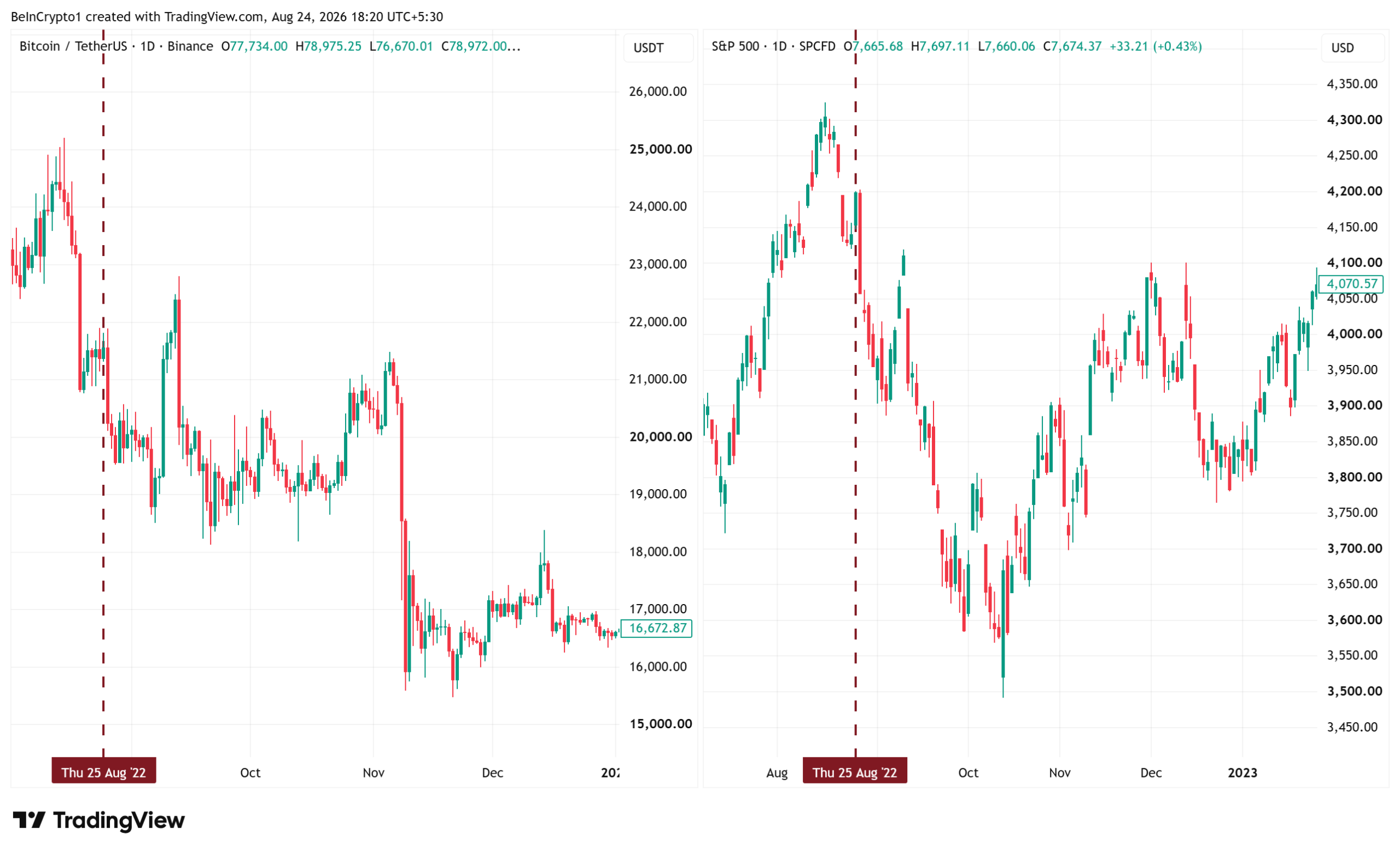
Kevin Warsh speaks at Jackson Hole on Friday, his first keynote as Federal Reserve Chair. Bitcoin traders have one question. Does this look like August 2022?
The answer sits in eight years of price data, which shows only one of those speeches actually hurt Bitcoin.
What Powell’s 2022 Speech Did to Bitcoin
Jerome Powell took the podium on August 26, 2022. He was blunt about fighting inflation and offered markets no relief.
Bitcoin fell from $21,518 to $20,230 that day. That is a drop of 6% in a single session. Likewise, the S&P 500 lost 3.4% in the same session.
By August 28, Bitcoin sat 9% below its pre-speech level. That is the version traders fear repeating.

Eight Years of Data Show 2022 Was the Outlier
BeInCrypto measured Bitcoin’s move on every Fed chair keynote day since 2018.

The median reaction is a gain of 1%. Seven of the eight moves sit inside a 5% band. Only 2022 broke that range, to mark the single move worse than 2% in eight years.
Tone alone does not explain it. The 2023 speech was also hawkish, yet Bitcoin lost only 0.4%. What set 2022 apart was surprise. Traders arrived expecting relief and got a pledge of economic pain instead.
Dovish years were not free money either. Bitcoin slipped 1.3% after Powell’s 2025 remarks, and that post-speech rally unwound within days.
Why Warsh Could Still Deliver the Hawkish Version
The hawkish path is live, as the Fed held rates at 3.50% to 3.75% in July, but three officials voted to hike.
August minutes kept that pressure in view, with hawkish rate risks back on the table.
Inflation is the reason, as it held at 3.4% in July, and a September Fed hike is still close to a coin flip.
Heading into the Jackson Hole Symposium this week, Warsh is the wildcard because he has said little about rates since taking the job in May. This means anything he does say lands harder.
He has framed Friday as a chance to widen the lens rather than signal a move.
“There is a tendency, especially with the proliferation of meetings and press conferences, to get caught up in the myopic … If I could, in the high mountain air in Jackson, Wyoming, I’d like to also frame the big questions,” Kevin Warsh, July 29 press conference transcript.
Bitcoin (BTC) trades near $79,093, roughly flat over the past 24 hours, after climbing 23% in the week to August 21. Traders can follow Bitcoin’s price action into Friday.

The next policy meeting falls on September 15 and 16. History says the base case is a small move. 2022 says the tail is fat.
The post Bitcoin Braces for Warsh's Jackson Hole Debut: Will 2022 Repeat? appeared first on BeInCrypto.
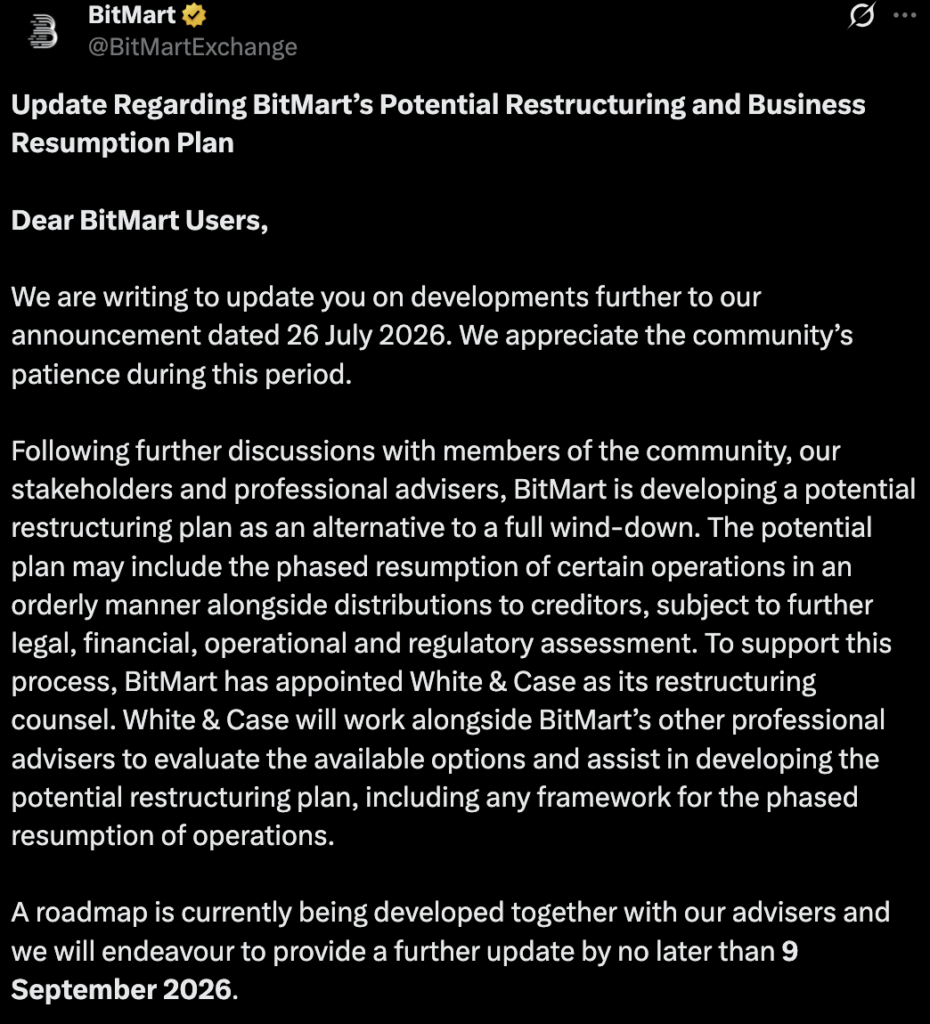
Crypto exchange BitMart might not be shutting down after all, following this weekend’s announcement of plans to explore a potential “restructuring plan.”
BitMart says the plan may involve the phased “resumption of certain operations in an orderly manner alongside distributions to creditors.”
Restructuring counsel White & Case has been hired to help BitMart assess its options, while a roadmap detailing its future will be released “no later than September 9, 2026.”
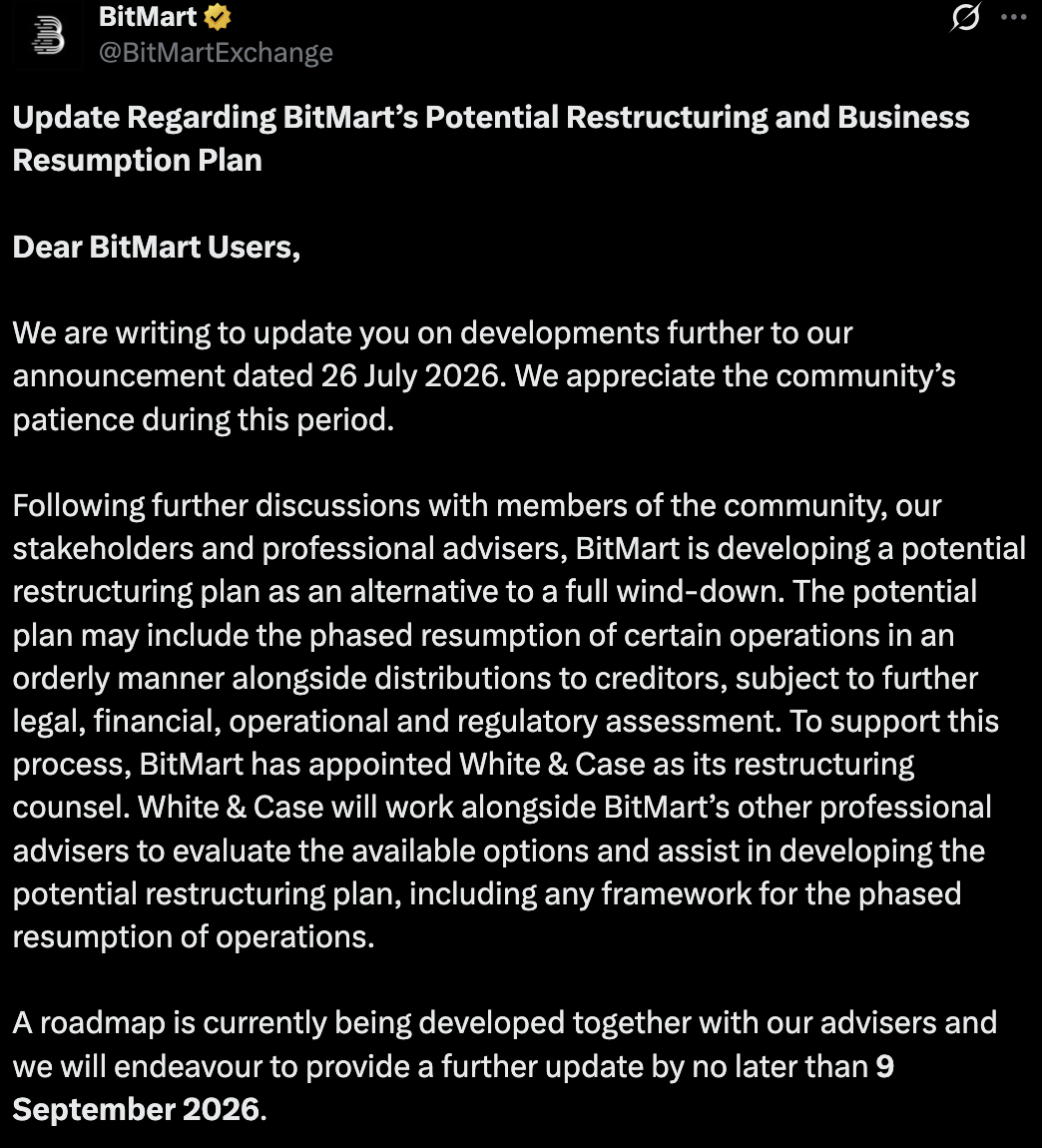
Read more: BitMart CPO resigns as insolvency speculation mounts
Just over a month ago, on July 26, BitMart announced that it would cease all of its operations by January 31, 2027.
What followed was weeks of panic from users trying and failing to withdraw all of their assets from the exchange.
BitMart’s Chief Product Officer Terence Lee resigned in a post that distanced himself from the crypto exchange’s core operations.
Its CEO Nathan Chow was terminated prior to the closure announcement and wasn’t made aware the announcement in the first place.
All of this led has led to speculation that the firm may be insolvent.
Got a tip? Send us an email securely via Protos Leaks. For more informed news and investigations, follow us on X, Bluesky, and Google News, or subscribe to our YouTube channel.
Volante Technologies offers U.S. banks and financial institutions a unified solution for the Federal Reserve’s FedNow Service and The Clearing House’s RTP real-time payments network. Separately, Volante’s cross-border payment materials list Ripple and digital currencies among the services its platform processes.
The available materials describe separate capabilities, while the Federal Reserve’s FedNow participants and service providers page does not mention XRP or Ripple.
Volante says its cloud-native cross-border payments platform processes SWIFT gpi, Ripple, Visa B2B, Mastercard Send, digital currencies, alternative payments, and other services from a single platform. The company also describes connectivity to SWIFT, blockchain networks, major card networks, and alternative payment rails.

This architecture presents multiple payment and messaging options through one provider. Volante’s cross-border materials identify Ripple alongside other rails, while its FedNow announcement describes a separate unified offering for FedNow and TCH RTP.
Discover: The Best Token Presales
Volante’s FedNow Offering Ripple Payment
In an announcement, Volante said it was offering U.S. banks and financial institutions a single unified solution for the FedNow Service and TCH RTP real-time payments. The company said adopters could begin with TCH RTP and add the FedNow Service when the network was ready.
The announcement said Volante had joined the FedNow Pilot Program in early 2021 and was a prospective participant in the Federal Reserve’s FedNow Service Provider Showcase. It described capabilities for real-time and instant payments and said Volante’s FedNow offering would be extensible to wire, ACH, and SWIFT. However, the announcement does not refer to Ripple or XRP.
The Federal Reserve’s FedNow participants and service providers page describes the FedNow Service as instant-payments infrastructure through which participating banks and credit unions can send and receive transactions within seconds on behalf of customers, 24 hours a day, seven days a week.

Trade XRP on Bybit and Get a Chance to Win Our $1,000 USDT Airdrop
Keeping the Distinction Clear
Volante’s materials support two separate points: the company offers a FedNow and TCH RTP solution for U.S. financial institutions, and its cross-border platform processes Ripple among a broader set of payment services. The supplied materials do not describe a shared settlement mechanism between FedNow and Ripple.
A direct statement from FedNow connecting the service to XRP or Ripple would be needed to establish such a link. Based on the materials reviewed, Volante’s FedNow offering and its Ripple-related cross-border capability should be treated as separate parts of the vendor’s platform.
Discover: The Best Crypto to Diversify Your Portfolio
The post Ripple Payment Rails Separated From FedNow Access by Volante appeared first on Cryptonews.
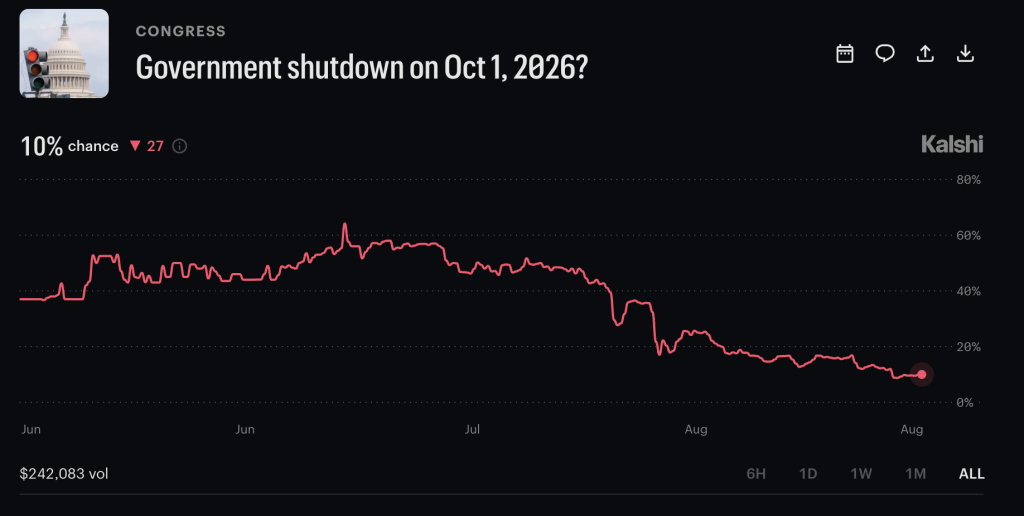
Kalshi’s contract on a federal government shutdown on October 1, 2026 priced YES at 15-16 cents, an implied odds near 10% and down sharply from 35% just three weeks earlier.
Polymarket’s parallel market, which resolves on a different trigger and a later cutoff, still showed 16.5 cents as of August 14, per Polymarket Trader’s snapshot. The gap between those two numbers says less about Washington than about how differently the two venues define a shutdown.
The Goverment Shutdown Odds In 2026 Aren’t Pricing the Same Bet
Kalshi’s contract resolves YES only if part of the government is shut down at 10:00 a.m. ET on October 1 specifically. Polymarket runs two separate contracts on the same date: one requiring an actual shutdown, agencies suspending non-excepted operations, typically with furloughs, by 11:59 p.m. ET, and a second, broader “any-duration lapse” contract that pays out even on a brief technical gap with zero operational impact.
On August 14, Polymarket priced the shutdown version at 16.5 cents and the lapse version at 13.5 cents.

A third Polymarket market bundles “another shutdown by January 31, 2027” with the 2026 House winner. Its no-shutdown legs had already settled at zero cents by the August 14 check, while the shutdown-plus-Democratic-House leg traded at 87.3 cents.
That is the market telling traders something specific: a lapse somewhere in the current funding cycle is priced as close to certain, even while an October 1 lapse specifically sits in the mid-teens.
A Five-Week Repricing, Told Through Three Snapshots
Kalshi’s own market commentary put the shutdown contract at 35% on July 31, with Senate negotiators reportedly nearing a stopgap that would fund the government to December 4 while capping a disputed OMB rule on appropriated spending.
By August 3, the cross-venue average had fallen to 28%, with Kalshi at 25% and PredictIt at 31%. Two weeks later, Kalshi had drifted down again to the 12-13% range on roughly $193,000 in contract volume.
That trajectory, 35%, then 28%, then roughly 12-13%, is a repricing toward “Congress avoids the specific date,” not toward “shutdown risk is gone.”
The combined Polymarket market’s zeroed-out no-shutdown legs for January 31 make that distinction explicit: traders are separating the October 1 deadline from the broader fiscal-year window, and pricing them very differently.
Both books remain thin relative to 2025, when related shutdown contracts on Polymarket cleared roughly $157 million in cumulative volume on the start-date market alone – a reminder that current liquidity of a few thousand to a few hundred thousand dollars leaves these prices more exposed to spread and single-trade repricing than last year’s deeper markets.
The Percentage Is Only Half the Trade. Kalshi Lets You Trade the Exact Question.
The shutdown market shows why prediction trading is more than glancing at a headline probability. A 15% contract can mean something very different from another market showing 16% if the resolution rules, timing, and trigger are not identical.
That precision is part of Kalshi’s appeal.

Users can trade directly on defined real-world outcomes across politics, economic data, Fed decisions, crypto, and other major events, with every contract spelling out exactly what must happen for YES or NO to settle.
For traders following Washington into October, that creates a cleaner way to express a view than trying to guess how stocks, bonds, Bitcoin, or the dollar might react to the same event.
The government may avoid a shutdown at 10:00 a.m. on October 1 and still face another funding crisis weeks later. Kalshi lets traders separate those questions rather than treat them as a single macro bet.
Eligible new users who join through CryptoNews can also receive $25 through our referral link.
Make Your Prediction Count With $25 For Free on Kalshi
The post Goverment Shutdown 2026 Odds Fall as Markets Split the October 1 Risk appeared first on Cryptonews.


The planned tie-up would make Gemini the exclusive CFTC-regulated venue for crypto event contracts offered through Apex’s futures commission merchant.
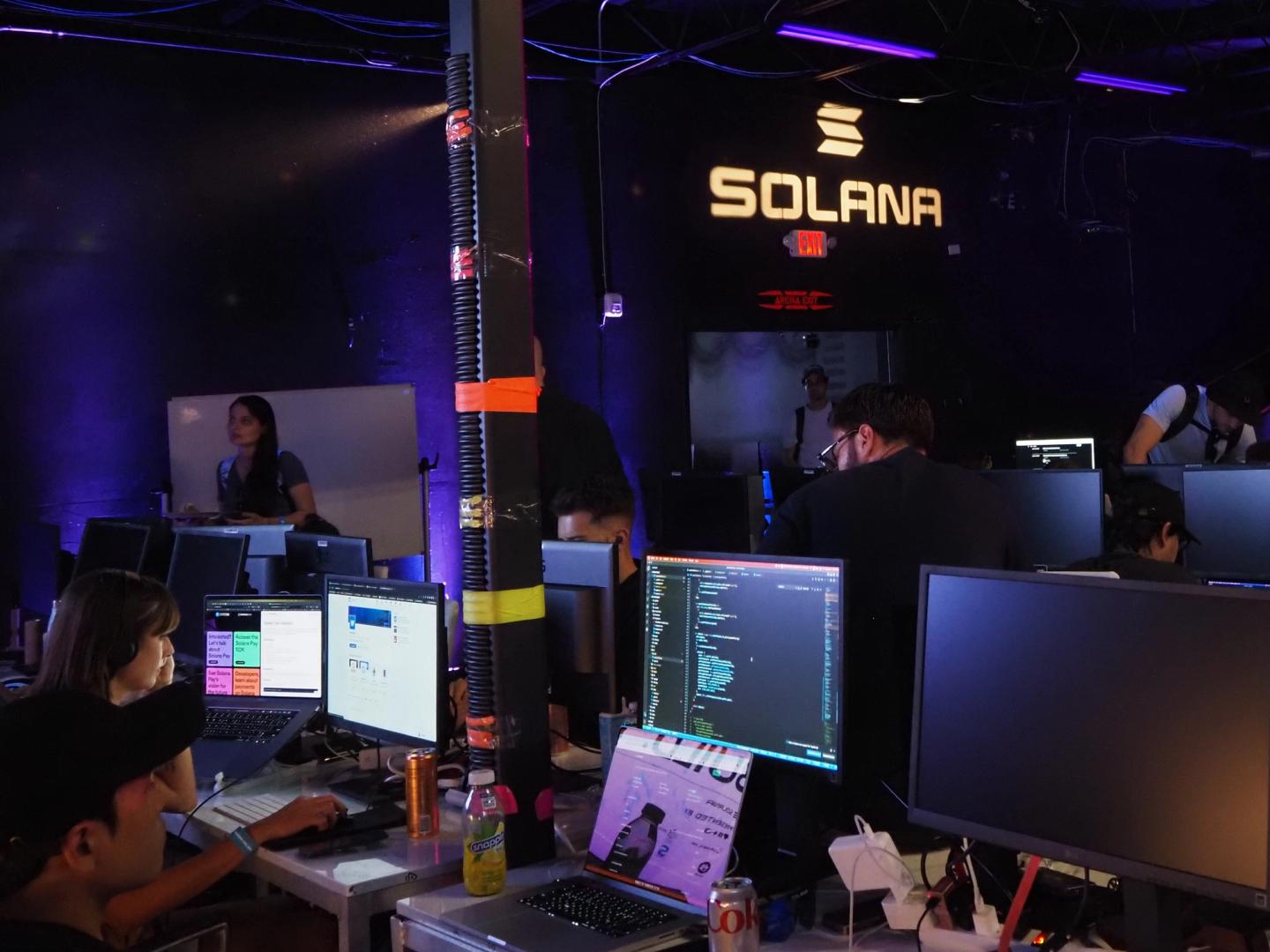
Two of the three proposals would reduce SOL supply growth by speeding up Solana’s inflation decline and raising daily fee burns from about 650 SOL to as much as 9,000 SOL.
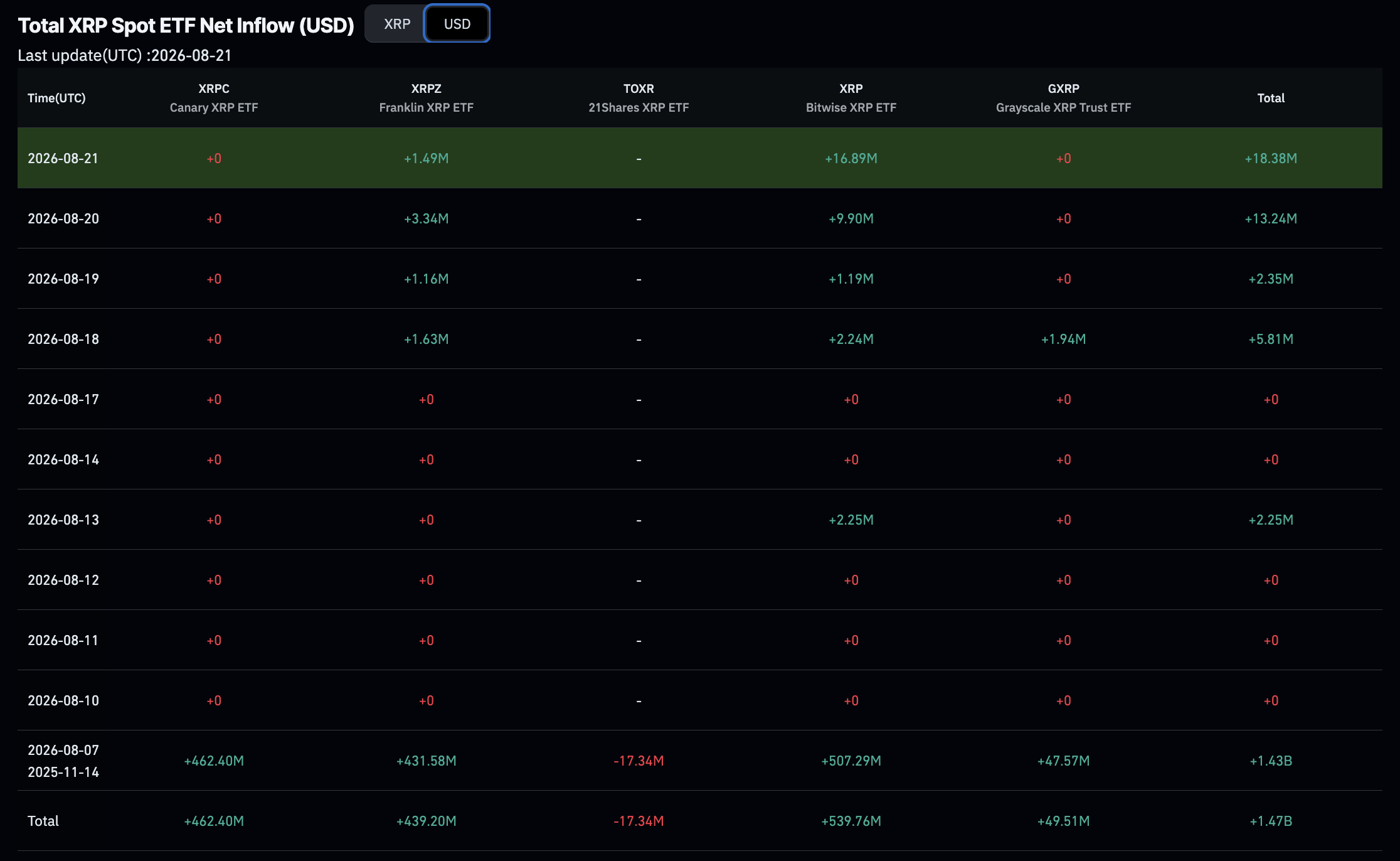
XRP is changing hands at $1.47, down 1.25% over the last 24 hours, a pullback that looks minor against the backdrop of what’s happening in the ETF complex. Cumulative net inflows into U.S. spot XRP ETFs hit roughly $1.51 billion, with total net assets sitting between $940 million.
The Friday’s flow data shows inflows of about $18 million, led by Bitwise, Grayscale, and Franklin, a rebound from a rougher stretch where weekly inflows collapsed roughly 93% to just $1.01 million earlier in August. Markets seem to be pricing that optimism in real time.

The bigger question: does $1.5 billion in cumulative inflows represent durable institutional conviction, or is it a headline number masking week-to-week fatigue?
Discover: The Best Crypto to Diversify Your Portfolio
XRP Price Prediction: Hit $2 This Week?
At $1.47, XRP has already cleared levels that recent coverage framed as resistance. Our reports from earlier in the month had the token oscillating between $0.98 and $1.01 after briefly losing the psychological $1 handle.
XRP is at a meaningful structural shift. The $1.20 resistance zone that bulls were watching has been taken out entirely, and the token is now trading well above the consolidation range that defined most of August.

If ETF inflows continue their rebound, regulatory clarity headlines keep landing, and XRP grinds toward new multi-month highs with $1 acting as freshly minted support, XRP could catapult towards its $2 high. If price consolidates in the $1.40–$1.55 band, traders will digest the recent move and wait for the next flow update.
However, a sharp reversal of ETF sentiment or a broader risk-off macro shift, as the $40 trillion federal debt overhang isn’t going away, drags XRP back toward $1.20 support. Watching the next ETF flow print will likely settle which scenario plays out.
Trade XRP on Bybit and Get a Chance to Win Our $1,000 USDT Airdrop
LiquidChain Targets Early Mover Upside as XRP Tests Key Levels
Anyone who bought XRP price near $1 in early August is sitting on a solid move. But here’s the catch: at XRP’s current market cap, a repeat of that percentage gain requires billions more in fresh capital rotation.
Institutional flows help, but they move slowly. Traders chasing the next multiple often look further down the risk curve, toward assets still in price discovery.
LiquidChain is making “which chain?
” a thing of the past.
⟁https://t.co/vqvBcdSQYC pic.twitter.com/ip83gw1P0u
— LiquidChain (@getliquidchain) August 23, 2026
That’s the pitch behind LiquidChain ($LIQUID), a Layer 3 infrastructure project fusing Bitcoin, Ethereum, and Solana liquidity into a single execution environment.
The presale token sits at $0.01493, with closer to $950K raised so far. The pitch centers on a deploy-once architecture, so developers build once and access liquidity across all three ecosystems, rather than fragmenting deployments chain by chain.
Verifiable settlement and single-step execution round out the technical case.
Research LiquidChain directly before committing capital.
Discover: The Best Token Presales
The post XRP Price Prediction: $1.5B ETF Inflows and Institutional Backing appeared first on Cryptonews.
Crypto World
Backlash After Hakeem Jeffries Holds Private Meeting With Jared Kushner Ahead of Midterms
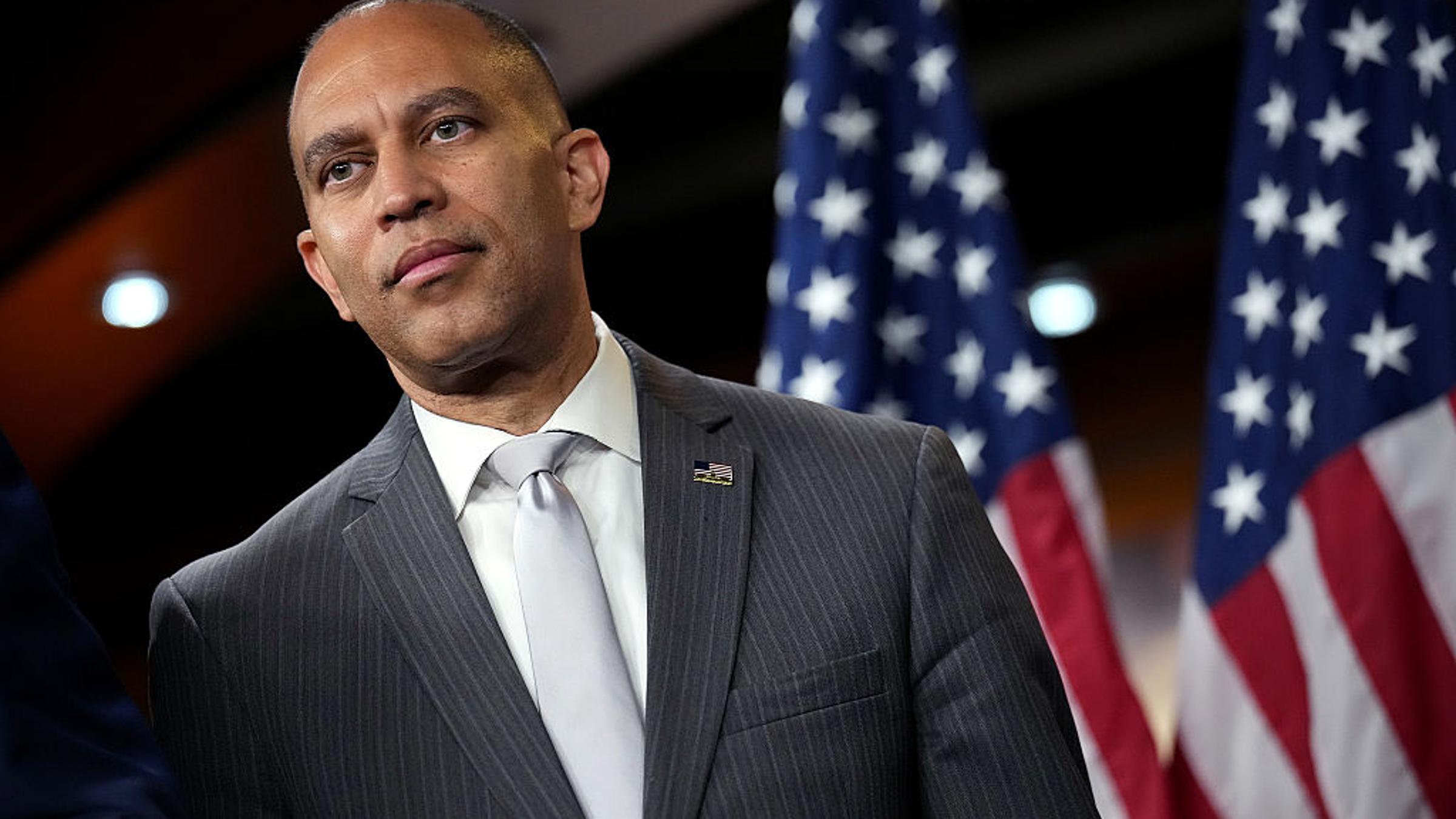
Tommy Vietor, a former aide to President Barack Obama and now a co-host of the podcast Pod Save America, was far less diplomatic.
“Jared Kushner has no actual government job, he just uses his family connections to get money from Gulf autocrats and fund corrupt deals. The only way Jeffries should work with him is with demands for documents and subpoenas,” Vietor said.
House Speaker Mike Johnson said Sunday that he first learned of the meeting that same day, when reports began circulating in the media.
“I don’t know what that’s about,” Johnson said on Fox News. “I know Jared has interests and lots of other things going on. He’s not really directly involved in the admin, at least in the day-to-day in the White House.”
Johnson, however, remained confident that Republicans could retain control of the House.
“I’m telling you what, you better not bet against the House Republicans,” he said.

Cathie Wood continued betting big on SpaceX on Friday. Her ARK Invest firm purchased over 200,000 shares of Elon Musk’s space company across multiple ETFs worth almost $27 million, according to company logs. Wood has long placed high value on Musk’s companies, pumping hundreds of millions into investments in SpaceX (SPCX) and Tesla (TSLA) over the years. ARK Invest Buys…
Copyright ©2026 Investor’s Business Daily, LLC. All rights reserved. 87990cbe856818d5eddac44c7b1cdeb8

The Tom Lee-chaired Ethereum accumulator has ramped up its ETH acquisitions amid the asset’s major price revival experienced last week.
The company has acquired 32,447 tokens over the past week, and its total has skyrocketed to 5,847,611 ETH as of August 23. With Ethereum’s price jumping to $2,440 yesterday, this put the firm’s position at $14.3 billion – or about $3 billion higher than the previous week.
97% of the Way
Taking into consideration the latest purchase announced earlier on August 24, the company’s total stash of almost 5.85 million ETH represents approximately 4.8% of Ethereum’s entire 120.7 million token supply. This means that the firm has completed 97% of its so-called “Alchemy of 5%” strategy. The ultimate goal is to control 5% of the altcoin’s supply, an ambitious move it started in late June last year.
BitMine hasn’t been deterred by the recent price moves in the crypto industry. Recall that ETH traded at around $1,900 by last Wednesday and has shot up by 30%, topping $2,500 briefly before it calmed just below that level today. This became its largest weekly surge since May 2025.
Tom Lee highlighted that the previous two comparable weekly rallies, in July 2021 and May 2025, were subsequently followed by gains of 167% and 170%, respectively. Although this sounds quite impressive, it’s worth noting (again) that historical performance provides no guarantees that the asset will repeat either move.
Bitmine’s latest purchase was also a lot higher than most of its previous ones, which dropped to around 10,000 ETH on several occasions. As reported last week, the company bought 10,270 tokens after acquiring 9,926 ETH the week before.
Keep Staking
The other major development highlighted in the most recent announcement was the continuous staking effort from the company. It has now staked over 5,067,300 tokens, worth approximately $12.4 billion at current prices. This represents 87% of Bitmine’s entire Ethereum treasury.
The current estimates show that the company could generate approximately $330 million in annualized revenue based on a seven-day annualized yield of 2.67%. If it stakes its entire portfolio through its own institutional platform called MAVAN, the projected numbers could rise to $381 million.
The post BitMine Nears Massive Ethereum Milestone as ETH Holdings Reach 5.85 Million appeared first on CryptoPotato.

Dad asks if son can sit in stranger’s plane seat and she’s livid when she realises age

(VIDEO) Luka Doncic Debuts Slimmer Physique at Lakers’ Slovenia Minicamp Ahead of New NBA Season as Fans React

What Is ‘Ferritin Face’? Signs Of Iron Deficiency Explained





-

 Fashion3 days ago
Weekend Open Thread: Madewell – Corporette.com
-

 Business6 days ago
SMA Solar Technology AG (SMTGY) Q2 2026 Earnings Call Transcript
-

 Crypto World2 days ago
anatomy of crypto’s biggest liquidation event since 2021
-

 Business2 days ago
Musk’s Tesla, SpaceX Confirm $16.8 Billion ‘Terafab’ Chip Plant as World’s Largest Building in Texas
-

 Tech6 days ago
Qwen3.8-27B runs frontier-class coding agents and reasoning locally, no cloud API required
-

 Crypto World7 days ago
OCC Greenlights Trump Family Crypto Firm for Trust Charter
-

 Politics2 days ago
6 months on, Irish renters crushed by effects of government housing bill
-
 NewsBeat2 days ago
The ‘Lucky Dip Gang’ causing carnage for clicks: After five thugs were killed speeding in the wrong direction on a motorway, GUY ADAMS investigates a sick new trend… and why police aren’t even allowed to pursue them
-

 Crypto World7 days ago
NAVI Prime launches institutional lending framework on Sui
-

 News Videos4 days ago
Don’t Leave Your Financial Future To Chance | August 19, 2026
-

 Tech5 days ago
GLM-5.3 hits the API at $1.4/$4.4 per million tokens
-
Tech7 days ago
5 Of The Most Reliable Car Brands To Consider If You’re Buying A Used SUV
-
 Crypto World7 days ago
Dow’s 3-Year Winning Run Isn’t a Crash Signal, Still 49% Odds of Double-Digit Gains
-

 Business6 days ago
Stock Market Today: Tech Futures Slide As Treasury Yields Jump; Nvidia, Micron, Sandisk Sell Off
-

 Tech6 days ago
Keychron K8 Ultra 8K review: a great value keyboard with comfort issues
-
 NewsBeat7 days ago
Trump explodes at CNN reporter after question about young blonde aide who wrote him besotted letters
-
 Tech7 days ago
Nvidia discloses $21B stake in SpaceX
-
Business7 days ago
Fabrinet (FN) Q4 2026 Earnings Call Transcript
-

 Business4 days ago
Five Below: Kids Discount Retailer Reaps Rich Rewards
-

 Business5 days ago
Marvell Shares Jump 7% as Google Chip Deal Confirms Custom AI Silicon Partnership, Analysts
You must be logged in to post a comment Login