
Crypto World
GTA VI leak investigation video raises crypto scam suspicions



Users on X suspect that a recorded interaction between representatives of GTA VI publisher, Rockstar Games, and a pseudonymous X user was staged to pump a crypto scam amid the game’s ongoing leak scandal.
The clip appears to show the representatives knocking on the door of X user “@LewisBi94895348” who, via Reddit account “Pilotx1970,” appeared to predict major GTA VI leaks.
Last month, they posted “August 18 — don’t ask me how I know,” along with, “If you don’t believe me, come back on that date and we will see.”
They also claimed to know the identity of “CyberLeek,” the main X account that’s been leaking footage of GTA VI gameplay since August 18.
In footage posted by the Lewis X account today, one of the alleged Rockstar reps can be heard saying, “They’re not happy with it,” before asking, “Do you know certain individuals under certain handles, and who are the associates?”
Read more: Bitcoin spikes after GTA VI trailer leak says ‘Buy $BTC’
They later express doubt that his August 18 post was pure chance.
User’s doubt legitimacy of GTA VI investigation
The Lewis account also promoted their “GTA insider” cryptocurrency across several posts before deleting them.
Shortly after, users discovered that the account holder has previously been accused of scamming RC plane buyers on Facebook Marketplace, fueling speculation that the video might also be fake.
One user said there’s no subpoena for [Rockstar Games parent company] Take-Two to pursue Reddit before claiming that the video uploader is just “trying to get a piece of the pie.”
Others suggested that he hired some random people in order to get “millions of views on Twitter.”
Read more: Steam Workshop wallpapers found spreading crypto malware
Who is CyberLeek?
CyberLeek claims to be using his cryptocurrency $CYBERLEEK to raise funds for a “secret project” while advocating for better consumer rights across the video game industry.
However, gaming advocacy group Stop Killing Games has criticised the leaks, claiming the illegality of it “risks tarnishing the reputation of our communities and our chances to make change.”
Read more: GTA creator Rockstar Games bans NFTs and crypto
CyberLeek has continuously threatened to leak more content, and is now using $CYBERLEEK as a voting mechanism for buyers to determine what he leaks next.
One poll suggested he would leak content related to a group of nudists, while another suggested that he’ll move on from leaking free roam gameplay footage to leaking story content.
CyberLeek’s site also offered companies the chance to advertise on his page, but only if they pay $162,000 in Monero.
Take-Two appears to adopt “Sharkbux” virtual currency
What appears to be an SEC request filed this week by Take-Two’s Chief Legal Officer Daniel P. Emerson also reveals that GTA VI will include a virtual currency system.
It won’t have the hallmarks of a cryptocurrency, however, with no public ledger, secondary trading, or volatile pricing.
The request stresses that under the Howey test, Sharkbux will “not be viewed as the offer or sale of a security.”
Online users have spotted, however, that the SEC filing is addressed to the Crypto Assets and Cyber Unit, a government crypto authority disbanded and replaced in 2025.
Beyond this legal action, Take-Two has also filed several subpoenas over the weekend demanding Microsoft, X and Discord give up details related to the CyberLeek accounts.
Protos has reached out to Take-Two for comment on the apparent investigation and Sharkbux and will update this piece should we hear anything back.
Got a tip? Send us an email securely via Protos Leaks. For more informed news and investigations, follow us on X, Bluesky, and Google News, or subscribe to our YouTube channel.

Solana (SOL) is trading around $95 as of late August 2026, roughly a third of its January 2025 all-time high near $296. After a brutal six-month losing streak that dragged the token down to the $60–$70 range earlier this year, SOL has stabilized in the $80–$100 range. Stick around until the end to see what price AI predicts Solana will be trading at by the end of 2026, after crunching all of the data and potential catalysts over the next few months.
The question now is whether it can break out, and the evidence from ETF flows, prediction markets, and trader sentiment points to a market that’s cautiously constructive but far from convinced.
SOL has been one of the top performers as the market rallied over the past week, led by Bitcoin soaring back toward $80,000. Solana surged +25% in the past week, with daily trading volume hitting $3.72Bn.
Spot Solana ETF Flows: Steady, Not Spectacular
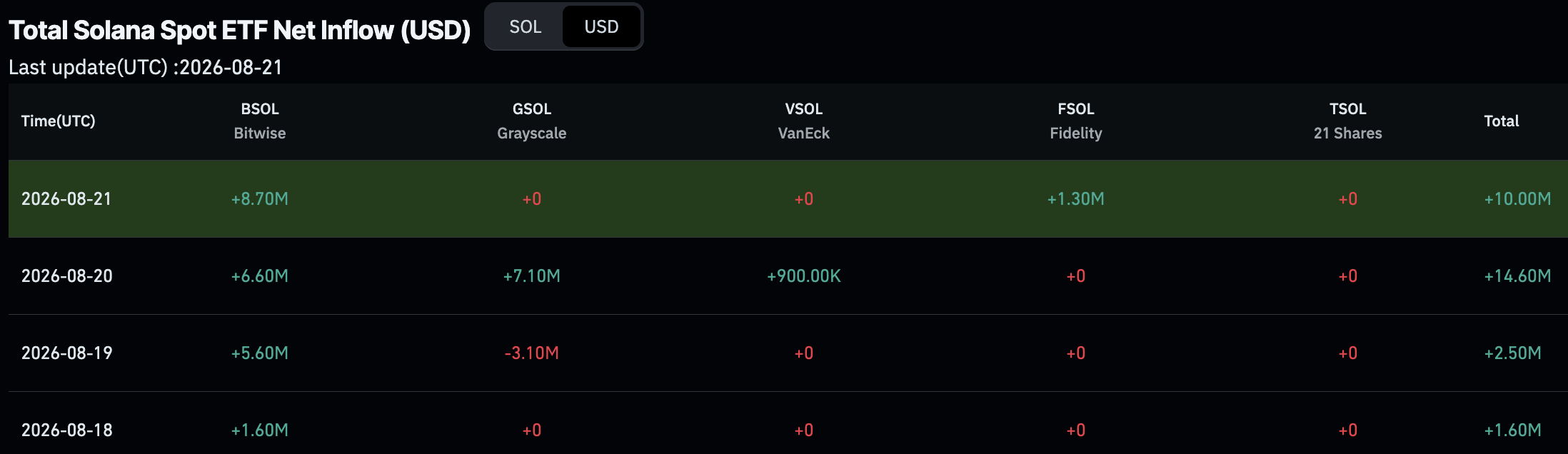
Spot Solana ETFs have pulled in roughly $1.4–1.5Bn in cumulative inflows since launch, a meaningful amount but a fraction of the inflows Bitcoin and Ethereum funds attracted after their own approvals.
Flows have kept trickling in even during price weakness, a sign of some sticky institutional demand, but they’ve clearly not been strong enough to offset broader risk-off selling.
Notably, Goldman Sachs reportedly exited its SOL ETF positions in Q1 2026, while SEC 13F filings show investment advisers now control roughly half of US spot SOL ETF assets, suggesting the buyer base is becoming more institutional even as the dollar amounts remain modest relative to SOL’s market cap.
Discover: The Best Crypto to Diversify Your Portfolio
What Kalshi Prediction Markets Say as AI Predicts Solana
Kalshi’s “Price of Solana by the end of 2026” contract is one of the more useful real-time gauges here. As of the most recent data, the market prices roughly a 42% chance SOL finishes the year at $100 or above, about 21% for $150+, and only single-digit odds for $250+ or $500+.
That’s a meaningfully more conservative view than many published analyst targets, and it has been range-bound and news-reactive, swinging on catalysts like stablecoin launches (Circle minting USDC on Solana, Coinbase/Flipcash’s USDF) rather than trending steadily in one direction.
Polymarket data has told a similar story, assigning relatively low odds to a run past $160. In short, the “smart money” aggregated in these markets is betting on modest upside, not a moonshot. AI predicts Solana
Make Your Prediction Count With $25 For Free on Kalshi
What Traders and Analysts Are Saying
Published forecasts span an enormous range, from bearish models seeing SOL stuck near $60–$90 to bullish outfits like Standard Chartered anchoring a $250 target for 2026.
The more measured consensus, the kind you see repeated across multiple independent trackers, clusters year-end estimates in the $120–$160 area, with bull cases stretching to $250–$350 contingent on two specific catalysts.
These include the Alpenglow consensus upgrade (targeting ~150-millisecond finality, down from 12.8 seconds, expected Q3 2026) and wider Firedancer validator adoption (aimed at pushing validator client diversity past 50%, up from roughly 20–26%).
Traders on social platforms and crypto-news sites tend to frame 2026 as a “show me” year: Solana’s on-chain fundamentals, which briefly outpaced Ethereum in weekly revenue, lead in real-world-asset lending market share, and continue attracting stablecoin issuers, haven’t translated into price the way bulls expected, and that adoption-price disconnect is the dominant theme in trader commentary right now.
Now, let’s take a look at what AI predicts Solana could be trading at by the end of 2026 and how it compares with the data points discussed throughout this article.
AI Predicts Solana: The Verdict
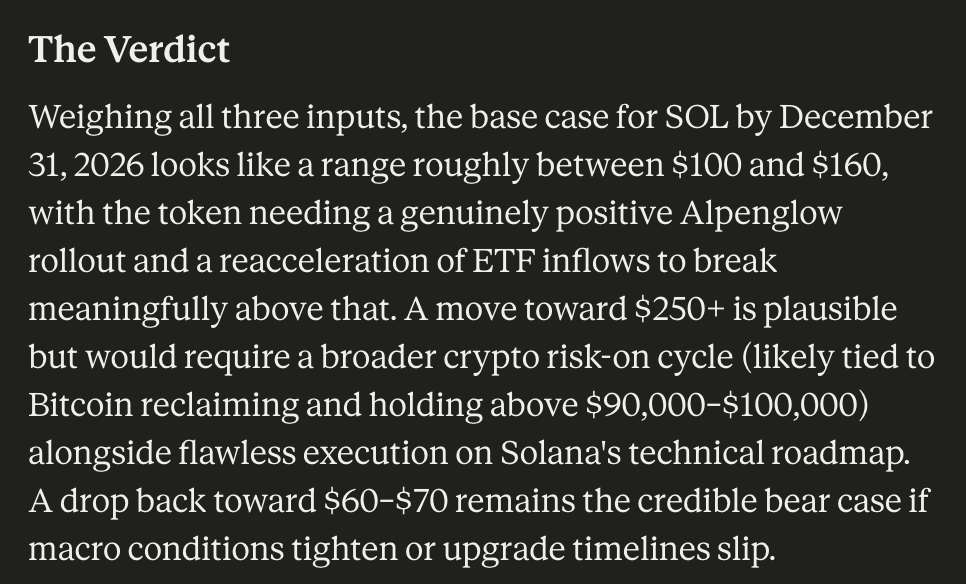
Weighing all three inputs, the base case for SOL by December 31, 2026 looks like a range of roughly $100 to $160, with the token needing a genuinely positive Alpenglow rollout and a reacceleration of ETF inflows to break meaningfully above that level.
A move toward $250+ is plausible but would require a broader crypto risk-on cycle (likely tied to Bitcoin reclaiming and holding above $90,000–$100,000) alongside flawless execution on Solana’s technical roadmap. A drop back toward $60–$70 remains the credible bear case if macro conditions tighten or upgrade timelines slip.
Never Miss a Swing Again: Use AI Copy Trading Bots From CryptoHopper
Discover: The Best Token Presales
The post AI Predicts Solana Price at the End of 2026 appeared first on Cryptonews.
Crypto World
Dario Amodei Claude AI Predicts Ethereum Needs to Do One Thing Before $4,000 Is Back on the Table
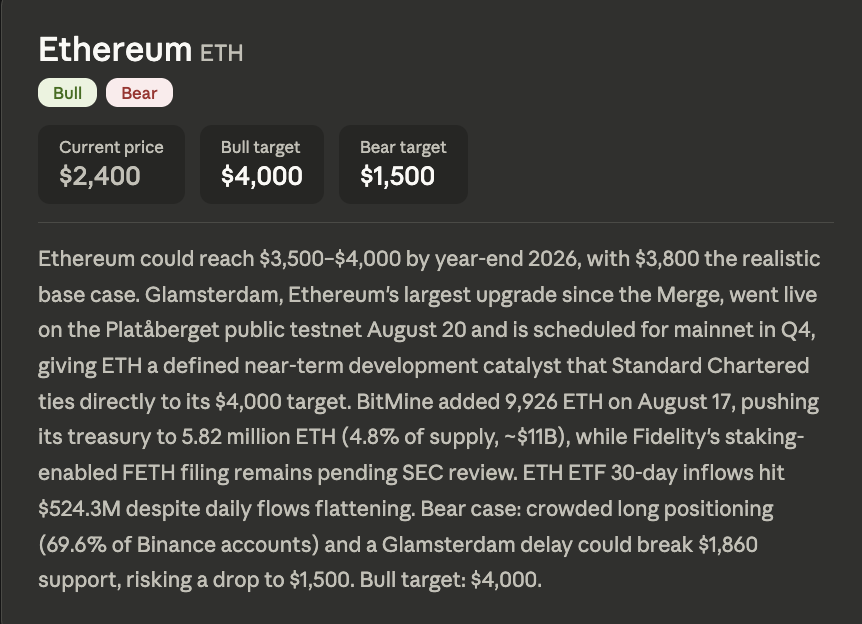
Can a single upgrade close a gap of more than 50%? That is the question behind the latest Claude AI price prediction, where the model predicts Ethereum (ETH) reaching $3,500 to $4,000 by year’s end 2026, with $3,800 as the realistic base case.
The chart already moved first. Ethereum price spent July and August pinned near $1,900 before ripping vertically to $2,448 in a matter of days.
That pump reset the entire conversation. A market that looked forgotten is suddenly trading 25% above where it sat two weeks ago.
The catalyst behind the forecast is Glamsterdam. It is the largest Ethereum upgrade since the Merge, and it went live on the Platåberget public testnet on August 20.

Mainnet is scheduled for Q4. Standard Chartered ties its own $4,000 target directly to that timeline.
Treasury demand is building alongside it. BitMine added 9,926 ETH on August 17, pushing its holdings to 5.82 million ETH, roughly 4.8% of supply and around $11 billion.
The regulatory piece is still open. Fidelity’s staking-enabled FETH filing remains pending SEC review.
Flows have held up better than sentiment suggested. ETH ETF inflows over 30 days reached $524.3 million even as daily flows flattened.
The bear case is about positioning. Long exposure is crowded at 69.6% of Binance accounts, and a Glamsterdam delay could break $1,860 support.
That break risks a slide to $1,500.

Make Your Prediction Count With $25 For Free on Kalshi
Ethereum Price Prediction: Dario Amodei Claude AI Predicts Glamsterdam Reopens the Ceiling
The damage here has been severe and slow. Ethereum peaked near $4,860 in September 2025, then spent five months grinding down through every support it built.
February 2026 broke everything at once, dumping price to $1,740. March through May offered a weak recovery toward $2,450 that failed, and June sent Ethereum back to $1,500.
July and August built a quiet floor near $1,900. That base is exactly what made this week’s candle possible.
Ethereum closed at $2,448.0, up $25.2 for a gain of 1.04%, with a session range from $2,356.3 to $2,483.6. The modest change tells you the vertical leg is already done, and ETH price is holding its gains.
Resistance sits at $2,483.6, then the May swing near $2,450, which is now cleared, then $2,800. Support runs through $2,356 and $2,100, with the $1,860 line being the one that actually matters.
RSI reads 78.70 against a signal line at 62.88. The 16-point gap is elevated without being extreme.
That is a healthier picture than a runaway spike. Momentum is strong, and the rising signal line beneath suggests the move has structural support rather than pure reflex.
Q4 is where this gets settled. Deliver Glamsterdam on schedule, and $3,800 stops looking distant.
Supercharge Your Trading in 2026 With BloFin AI Trading Bots
Ethereum Is Betting One Upgrade Can Reopen the Ceiling. LiquidChain Is Betting the Bigger Constraint Is Between Chains.
Glamsterdam is designed to make Ethereum itself faster, cheaper, and more capable. LiquidChain is targeting a different bottleneck: the fact that even upgraded networks still operate as isolated liquidity islands.
Bitcoin, Ethereum, and Solana each have deep pools of capital, but moving between them still means bridges, duplicated deployments, added fees, and fragmented user flows.
LiquidChain is building a single execution layer that connects all 3, enabling a single deployment to reach multiple ecosystems without rebuilding the same application chain by chain.
That gives LiquidChain a thesis that does not depend on one network winning. It benefits from activity existing across several major ecosystems at once.
The presale is currently priced at $0.01493 with just over $948,000 raised. If the next DeFi cycle is driven by capital moving more freely between chains, LiquidChain is still being valued at the stage where relatively modest inflows can matter.
Unlock Liquidchain Layer 3 Access Here
The post Dario Amodei Claude AI Predicts Ethereum Needs to Do One Thing Before $4,000 Is Back on the Table appeared first on Cryptonews.


Bitcoin has climbed above Strategy’s $75,385 average purchase price after gaining roughly 24% last week, making the company’s next treasury decision a key test for the rally, according to Bitfinex analysts.
Summary
- Bitcoin’s weekly close and retest above $73,500 could confirm the recovery, Bitfinex analysts said.
- Strategy held 840,447 BTC unchanged last week despite raising about $2 billion through MSTR sales.
- Bitfinex placed the next major Bitcoin cost-basis barrier near $86,500.
- Network activity remains near eight-year lows, leaving the rally dependent on sustained spot demand.
Bitfinex analysts told crypto.news that Strategy’s treasury activity has become a key signal after the company stopped selling Bitcoin shortly before BTC broke out of its summer trading range.
The company, which remains the largest publicly disclosed corporate Bitcoin holder, had sold BTC over several weeks to meet obligations connected to its preferred securities. Strategy then reported no purchases or sales for the week ending Aug. 16, removing a source of supply as Bitcoin prepared to move above its range.
Price action has since carried BTC above Strategy’s average acquisition cost for the first time since the company’s recent sales began. Its remaining 840,447 BTC were acquired for approximately $63.36 billion, including fees and expenses, at an average price of $75,385 per coin.
A return to accumulation would support the rally by adding corporate spot demand, according to Bitfinex. Renewed sales at higher prices, however, could place fresh supply above the market and make further gains harder to sustain.
Strategy has remained on the sidelines after raising $2B
Strategy’s latest disclosure has shown that the company remained inactive in the Bitcoin market for another week, even as BTC traded above its average purchase price.
As crypto.news reported from its filing, Strategy sold approximately 18.26 million MSTR shares between Aug. 17 and Aug. 23, raising about $2 billion through its at-the-market offering program. The company made no Bitcoin purchases or sales during the period, keeping its holdings at 840,447 BTC.
Most of the proceeds remained in cash. Strategy transferred $300 million to its existing U.S. dollar reserve, placed about $1.59 billion in a new cash account, and spent $136.4 million repurchasing roughly 1.43 million shares of its STRC perpetual preferred stock.
The transactions increased the company’s dollar reserve to $5.1 billion and took its combined cash position, including the new account, to $6.69 billion. Strategy had disclosed a reserve of about $4.8 billion one week earlier, the figure referenced in the Bitfinex report.
By continuing to raise cash without buying Bitcoin, Strategy has not yet provided the positive spot signal described by Bitfinex. The filing also showed that the company refrained from selling into BTC’s latest strength, avoiding the possible overhead pressure identified by the analysts.
Earlier activity had moved in the opposite direction. Between Aug. 3 and Aug. 9, Strategy sold 1,690 BTC for $108.6 million at an average price of $64,262 and used the proceeds to repurchase about 1.15 million STRC shares.
A week earlier, the company sold another 1,638 BTC for approximately $104.7 million. Proceeds from that transaction funded $52.4 million in STRC dividends and about $52.3 million in preferred-stock repurchases.
Bitcoin needs a $73,500 retest to confirm the recovery
With Strategy’s latest filing showing no transaction, Bitfinex analysts placed greater weight on Bitcoin’s cost-basis levels and the quality of demand supporting the breakout.
“The next few weeks carry two clear signals,” the analysts said. They identified $73,500 as the average purchase price of investors who acquired BTC during the past three to six months.
According to the report, a weekly close above that level followed by a successful retest would confirm that Bitcoin has recovered from its summer range. Holding the zone would also leave recent buyers in profit, reducing the chance that a return toward their cost basis produces immediate selling.
The next important area sits near $86,500, where Bitfinex said investors who bought Bitcoin between 18 months and two years ago would reach their average break-even price. Selling from holders waiting to exit at cost could make the level a source of resistance.
On the downside, the analysts identified $64,500 as the average cost of the newest buyer group. A decline below the level would indicate that Bitcoin’s breakout had gone too far on forced purchases, according to Bitfinex, placing the previous summer range back in focus.
Bitcoin’s rally carried the asset from below $64,000 on Aug. 19 to a three-month high near $79,550. The roughly 24% weekly gain was its strongest advance since March 2023, while the move also reclaimed resistance levels around $65,000, $67,000, $70,000, and $73,500.
ETF demand must replace forced Bitcoin buying
Bitfinex described U.S. spot Bitcoin ETFs and public companies with BTC on their balance sheets as the market’s two main sources of lasting demand. The analysts called the pair the “Two-Complex Spot Bid” because the measure focuses on capital that enters the market and remains invested instead of coins moving between traders.
U.S. spot Bitcoin ETFs recorded approximately $1.9 billion in net inflows during the week ending Aug. 21, including five consecutive inflow sessions. The demand offered evidence that regulated funds were buying alongside traders forced to close bearish positions.
Forced buying still accounted for much of the rally’s speed. As Bitcoin broke through $70,000, a record short-liquidation wave removed nearly $2.7 billion in bearish crypto positions over 24 hours, according to CoinGlass data cited by market analysts.
Short sellers must buy an asset to close liquidated positions, which can accelerate a rally while prices are rising. Bitfinex cautioned that the effect ends once the affected positions have been closed, leaving continued gains dependent on new buyers entering through the spot market.
Onchain participation has not yet supplied clear confirmation. Bitcoin moving across the network remains near its lowest level in eight years, according to the report, indicating that activity among holders has stayed limited despite the price increase.
U.S. investors now face both BTC and MSTR signals
For U.S. investors, Strategy adds a second market signal because its common shares trade on Nasdaq under the MSTR ticker, while spot Bitcoin ETFs provide direct regulated exposure to BTC prices.
Strategy funds parts of their capital structure through U.S. securities markets, including common-stock issuance and several preferred securities. Its weekly Form 8-K disclosures to the U.S. Securities and Exchange Commission allow investors to track Bitcoin transactions, equity sales, cash allocations, and preferred-stock repurchases.
Under a capital framework adopted in June, Strategy’s board authorized a BTC Monetization Program permitting up to $1.25 billion in Bitcoin sales to help fund its dollar reserve. The framework also included separate $1 billion repurchase authorizations for common and preferred securities, as well as provisions for dividend and interest payments.
Strategy’s new $1.59 billion cash account gives management another source of liquidity. According to the Aug. 24 filing, the money may be used for Bitcoin purchases, preferred dividends, debt obligations, or securities repurchases, though the company did not commit the funds to a specific purpose or provide a deployment timetable.
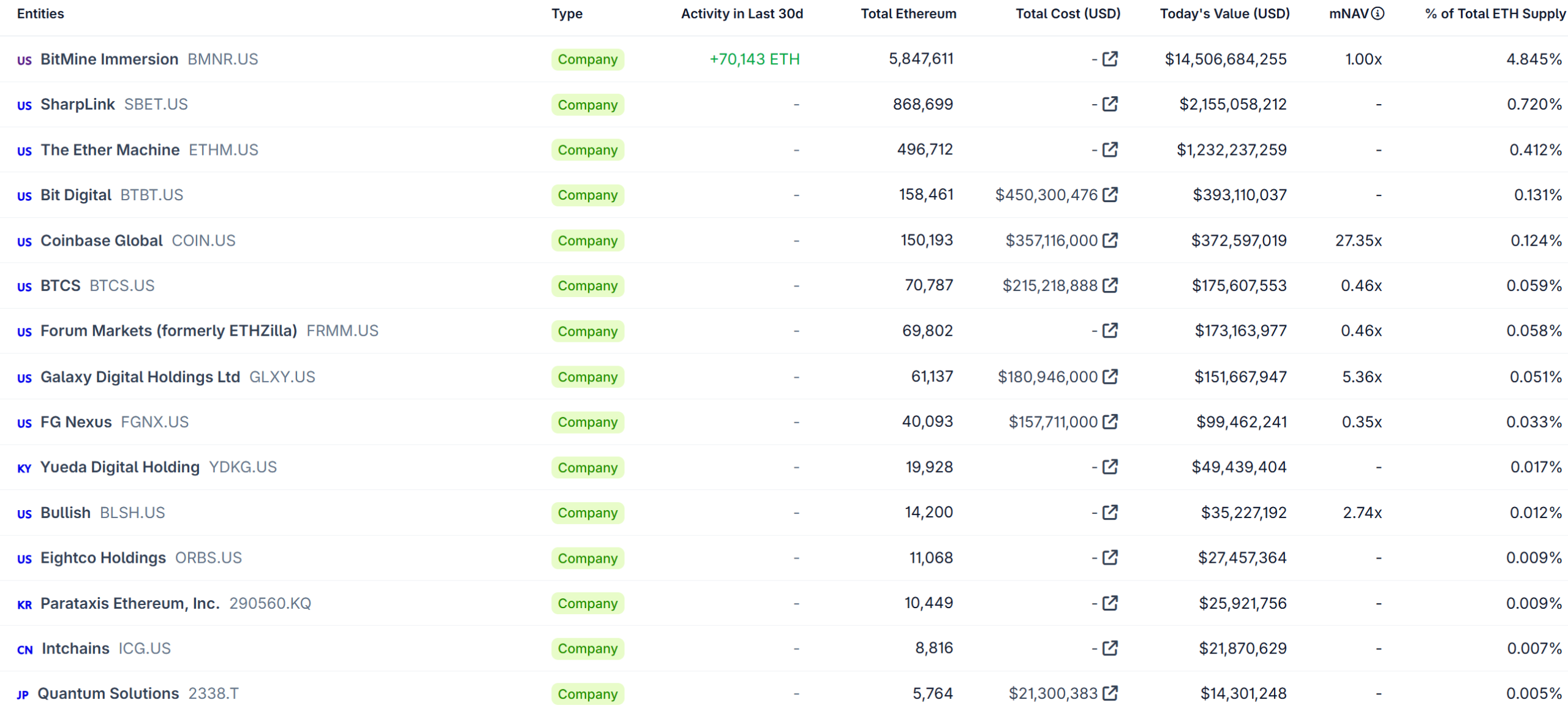
BitMine Immersion Technologies owns 5,847,611 ether. That is 4.79% of every ether in existence, and a tighter grip on Ethereum than Michael Saylor has ever held on Bitcoin.
Chairman Tom Lee told the Bankless podcast the company could reach its 5% goal before the end of 2026. The math is harder than it looks.
BitMine Built Its Ethereum Stack in 14 Months
Saylor’s firm, MicroStrategy, took six years to gather 840,447 Bitcoin. That comes to 4.19% of the coins in circulation.
BitMine passed that share of ether in 14 months. It made its first purchase on June 30, 2025, and has bought every week since. Sixty weeks, no gaps.

Lee credits a plain balance sheet. BitMine paid for the stack with common stock, not loans or convertible notes. Several rival treasuries leaned on those tools and did not survive the downturn.
Ether traded near $2,480 on Monday, up 1% on the day. It rose about 30% last week, its best week since May 2025. BitMine used the rally for its largest weekly ETH purchase since early July.
“It’s about $350 million worth of ETH that we need to acquire to reach 5%… we could reach it by the end of the year,” Tom Lee, chairman of BitMine Immersion Technologies, speaking on Bankless.
Follow us on X to get the latest news as it happens
The 5% Finish Line Keeps Moving
Here is the catch. Ether supply is not fixed, and right now it is growing. The network has added 85,893 ether over the past 30 days.
Total supply now sits at 121.98 million. That is about 1.3 million higher than the figure BitMine’s own disclosures use.

That gap matters because a true 5% means 6.1 million ether. BitMine is about 251,000 tokens short, worth roughly $620 million at Monday’s price. Lee’s $350 million estimate was made before ether’s rally.
What Comes After 5%
Lee rules out selling. BitMine has staked most of its ether, and those 5.07 million tokens generate about $330 million a year. That alone is roughly 12% of all staked ether on the network.
The yield covers the dividend on BMNP. That is a 9.5% preferred stock BitMine sold in June at $80, against a $100 liquidation value. Lee calls it a cheap three-year call option on ether.
The company is also turning into an Ethereum operator. Its validator arm MAVAN, short for Made in America Validator Network, launched in March.
BitMine then helped anchor three groups spun out of the Ethereum Foundation, alongside SharpLink and Ethereum co-founder Joe Lubin.
Lee ties the long-term case to tokenization and artificial intelligence rather than stablecoins. On that Wall Street adoption thesis, he named a number.
“I think Ethereum could easily be over 10,000 in that time frame.”
No listed rival is close. SharpLink, the next largest ether treasury, holds 888,938 tokens, about one-seventh of BitMine’s pile. The real contest is not with them. It is with a supply schedule that keeps printing.
The post BitMine Is About to Own 5% of Ethereum, Tom Lee Reveals What Comes Next appeared first on BeInCrypto.
Crypto World
We Told Microsoft Copilot AI to Be Brutally Realistic About XRP Predicts, This Was Its Target
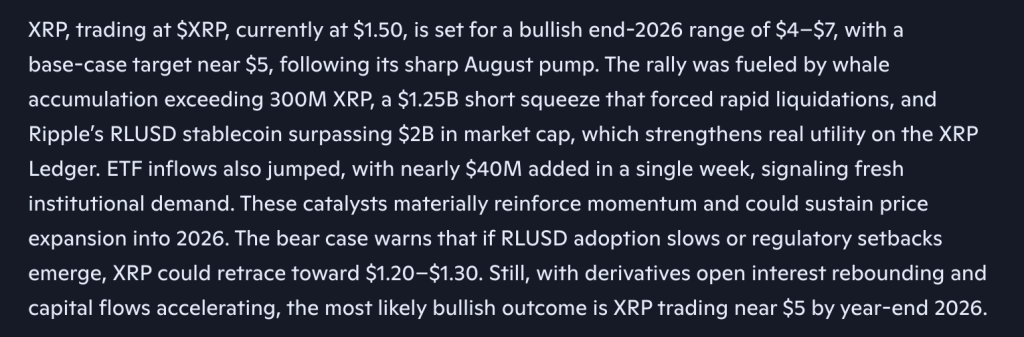
A rally of a few days has repriced an entire year of drift. The latest Microsoft Copilot AI price prediction leans into that, and the model predicts Ripple (XRP) reaching $4 to $7 by the end of 2026, with a base case near $5.
XRP price trades at $1.50 as that call gets made. The August pump is what changed the math.
Whales moved first. Accumulation exceeded 300 million XRP, tightening available supply before the move even registered on most screens.
Then the leverage broke. A $1.25 billion short squeeze forced rapid liquidations and turned a quiet bid into a vertical repricing.
Underneath the speculation, there is real usage. Ripple’s RLUSD stablecoin has surpassed $2 billion in market cap, which strengthens genuine utility on the XRP Ledger.

Institutions are showing up too. ETF inflows jumped by nearly $40 million in a single week, a clear signal of fresh demand rather than retail churn.
Copilot reads these catalysts as materially reinforcing momentum. Together, they could sustain price expansion well into 2026.
The bear case has two triggers. If RLUSD adoption slows or regulatory setbacks emerge, XRP retraces toward $1.20-$1.30.
Neither is guaranteed. With derivatives open interest rebounding and capital flows accelerating, Copilot still frames $5 by year-end 2026 as the most likely bullish outcome.

Make Your Prediction Count With $25 For Free on Kalshi
XRP Price Prediction: Microsoft Copilot AI Predicts the Pump Becomes a Trend
Context makes this breakout look larger than it is. XRP traded above $3.40 last September and spent the following eleven months bleeding value in stages.
February 2026 was the capitulation, with the price flushing to $1.13. What followed was a six-month range roughly between $1.30 and $1.60, then a June breakdown that parked XRP flat at $1.00.
That $1.00 shelf held through July and most of August. Last week it snapped, with price spiking to $1.68 before pulling back.
Now comes the digestion phase. XRP closed at $1.50054, up $0.03841 for a gain of 2.63%, with a session range from $1.43474 to $1.55082.
Resistance sits at $1.55082 first, then the $1.68 spike high, then the old $1.80 shelf. Support runs through $1.43474 and $1.30, with $1.00 as the structural base.
RSI reads 86.45 against a signal line at 51.64. That gap of nearly 35 points is the widest reading on this entire chart.
Nothing about that is sustainable at face value. Buyers are in full control, but the indicator has outrun its own average by a distance that usually demands rest.
Where XRP rests decides everything. Consolidate above $1.43, and the path toward $5 stays credible into next year.
Never Miss a Swing Again: Use AI Copy Trading Bots From CryptoHopper
XRP Has Already Made the First Move. Kalshi Lets Traders Position for What Decides the Second.
A short squeeze can ignite a rally, but it cannot decide whether XRP reaches $5. That depends on what happens next: stablecoin adoption, ETF flows, regulatory developments, and whether fresh demand continues to absorb supply.
Kalshi gives traders another way to express those views before XRP itself prices them in.
(Source: Kalshi XRP)
The platform lets users trade directly on real-world outcomes across crypto, regulation, politics, economic data, Fed decisions, and other events that can move markets. Instead of taking another position in XRP after a vertical rally, traders can isolate the catalyst they believe matters most and trade the outcome itself.
That becomes especially relevant with RSI already above 86. XRP may need time to cool, but the events shaping the longer-term thesis will keep moving while price consolidates.
Eligible new users who join Kalshi through CryptoNews can also receive $25 through our referral link.
The post We Told Microsoft Copilot AI to Be Brutally Realistic About XRP Predicts, This Was Its Target appeared first on Cryptonews.
Strive purchased 1,110 Bitcoin for about $81.5 million last week, bringing its total holdings to 21,356 BTC. According to a Monday filing with the US Securities and Exchange Commission, the company paid an average of $73,409 per Bitcoin (BTC), including fees and expenses, for purchases made between Aug. 17 and Aug. 21.
Strive’s cash and cash equivalents rose by $17.1 million to $171.9 million over the period, while its Class A shares outstanding increased by 3.65 million to 79.89 million. Bitcoin was trading near $79,000 on Monday, about 8% above the average price Strive paid for its latest purchase.
The purchase lifted Strive to the seventh-largest publicly traded corporate BTC holder, behind Bullish and ahead of SpaceX, according to BitcoinTreasuries.NET data. Its Nasdaq-traded ASST shares were up more than 11% in Monday morning trading, poised to extend their roughly 36% year-to-date gains, according to Yahoo Finance data.
“The upside is not simply Bitcoin going higher. It is Bitcoin becoming the fastest horse inside an expanding scarcity trade while $ASST is structured to amplify that outcome as much as we can responsibly support,” CEO Matt Cole said in a post on X ahead of Monday’s market open.
Strive operates a Bitcoin treasury strategy alongside an asset management business that manages nearly $3 billion across exchange-traded funds and a direct-indexing platform, according to the company.
It also held 505,000 shares of Strategy’s STRC preferred stock valued at $48.6 million as of Aug. 21.
Related: Bitmine extends 14-month ETH buying pace as Ether breaks above $2.5K
Strive’s SATA returns to $100 par
SATA closed at $100.01 on Friday, returning to management’s targeted $99-to-$101 trading range after falling as low as $83.30 in late June. Strive narrowed the range from $95-$105 to $99-$101 in March and said it would not issue SATA through at-the-market or follow-on offerings below $100.
Strive launched SATA in November 2025, initially selling 2 million shares at $80 each for $160 million in gross proceeds. The variable-rate perpetual preferred stock has a stated amount and initial liquidation preference of $100 per share.
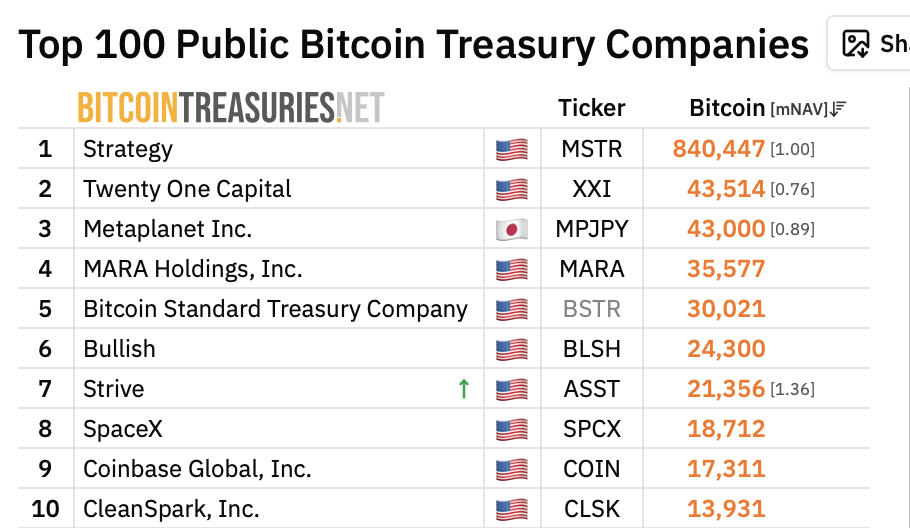
Top 10 publicly traded companies by Bitcoin holdings. Source: BitcoinTreasuries.NET
Unlike Strive’s common stock, SATA is designed as an income product, with a variable dividend rate intended to help keep the shares trading near $100. Strive raised the annualized dividend rate to 13% in April and switched from monthly to daily dividend payments beginning June 16.
SATA is similar to STRC, the variable-rate perpetual preferred stock issued by Strategy, the world’s largest corporate Bitcoin holder. STRC was trading near $97 on Monday, below Strategy’s $100 target, while Strategy reported no Bitcoin purchases for the week ended Aug. 23.
Magazine: Bitget CEO isn’t buying the Bitcoin rally — She’s waiting for $50K
Coinbase’s tokenized US stocks went live on Base Monday, alongside a Chainlink integration providing price data to support their use across decentralized finance applications.
Chainlink Data Feeds will provide continuous pricing for Coinbase’s tokenized stocks, including Nvidia, Apple, Meta and Alphabet. The data allows DeFi protocols to integrate the assets into lending markets, decentralized exchanges and structured products, including as collateral for borrowing.
According to Chainlink’s documentation, the feeds value each token using the underlying stock price and a Coinbase-supplied multiplier that accounts for dividends and corporate actions.
The stocks are issued as B20 tokens natively on Base, Coinbase’s layer-2 blockchain, and are available to non-US users in eligible jurisdictions. Each token represents a direct claim on an underlying share held with regulated broker and custodian Alpaca under an Abu Dhabi Global Market-supervised structure, according to Base. The tokens can be held in self-custody wallets and traded around the clock.
Base said the stocks can be integrated with existing DeFi infrastructure, including using tokenized Nvidia shares as collateral for loans on Aave or supplying tokenized Apple shares to decentralized exchanges. More Coinbase tokenized stocks are expected to launch on Base in the coming weeks.
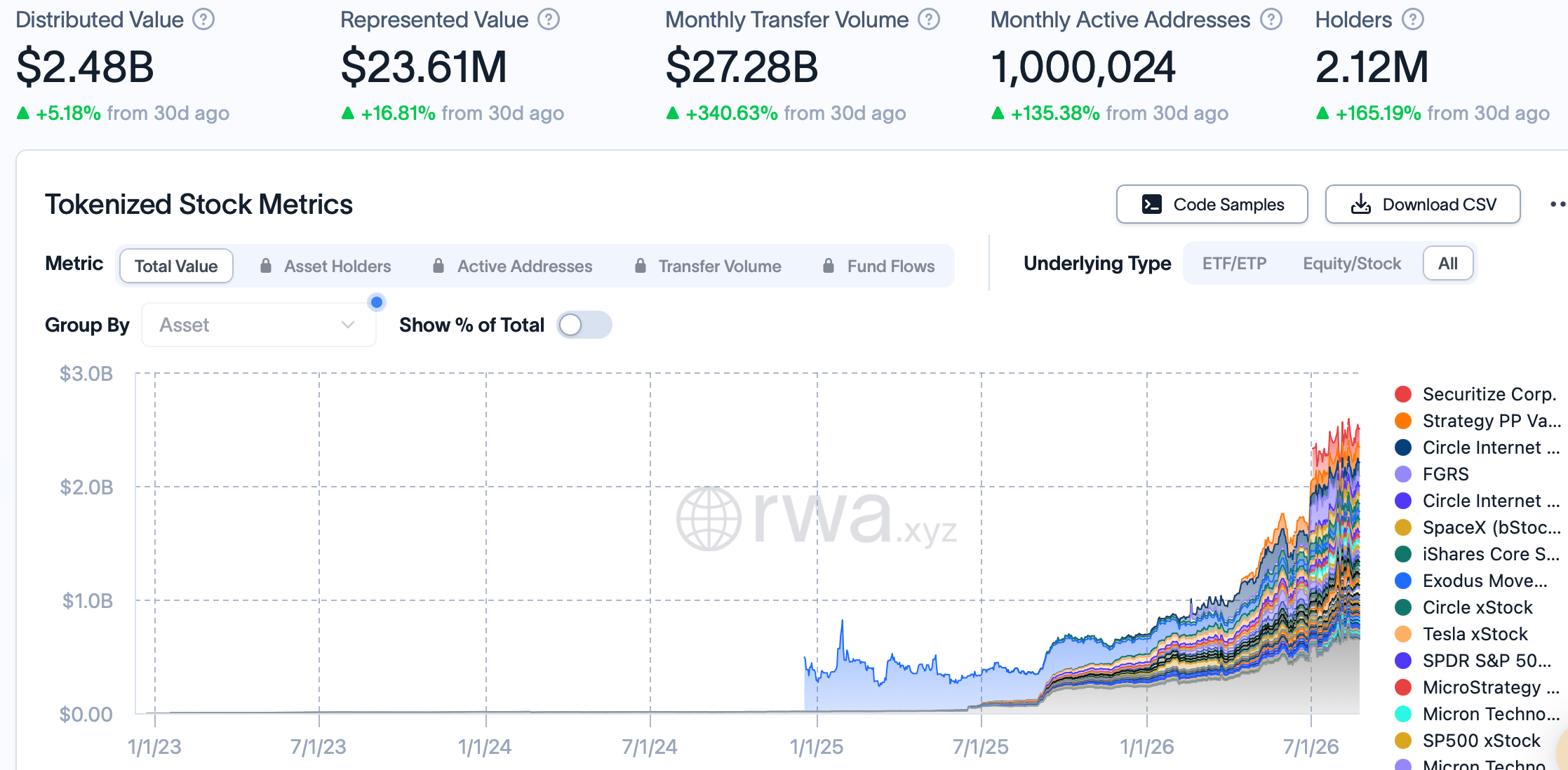
The news comes as the broader market for tokenized equities continues to grow. The total value of tokenized stocks has reached about $2.48 billion, up 5.2% over the past 30 days, according to RWA.xyz data. Monthly transfer volume has climbed to $27.28 billion, while the number of holders has surpassed 2.1 million.
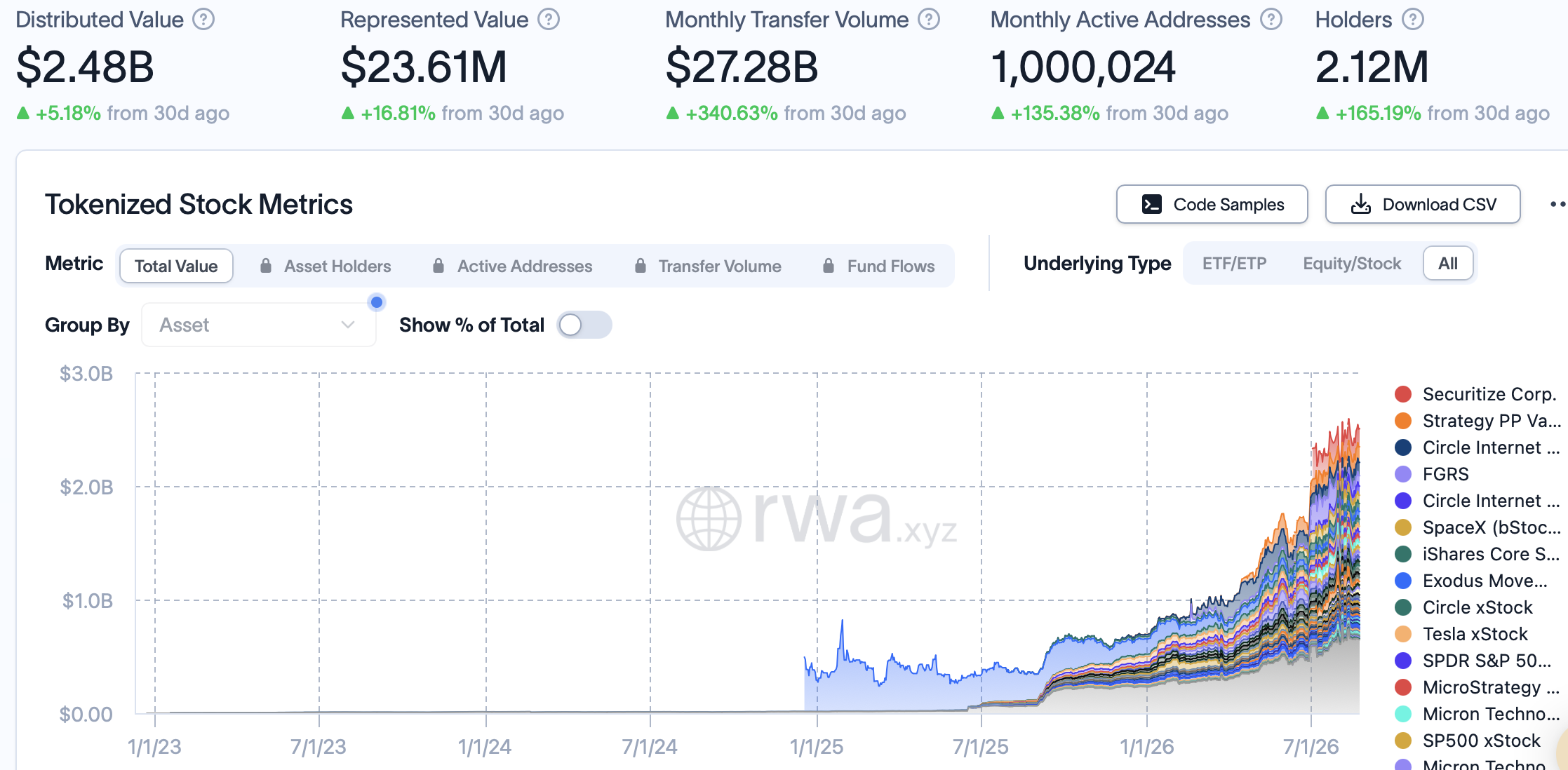
Tokenized stocks. Source: RWA.xyz
Magazine: Bitget CEO isn’t buying the Bitcoin rally — She’s waiting for $50K
Analysts at Bernstein are bullish on stablecoin issuer Circle, arguing that a new growth cycle for its USDC stablecoin could provide a significant boost for the company over the next 12 months.
In a research note published Monday, Bernstein said USDC (USDC) is showing signs of what it called “digital dollar reflation” after its supply increased by roughly $2 billion in seven days, reversing a six-month stretch of stagnant or declining growth. The firm maintained an Outperform rating on Circle (CRCL) and a $140 price target, implying roughly 60% upside from current levels. Circle shares have risen roughly 40% over the past month.
Bernstein said the next phase of stablecoin growth could be driven by several factors, including renewed momentum in crypto markets, greater regulatory clarity in the United States, tokenized capital markets and growing adoption of stablecoins for payments. The analysts also pointed to early signs of stablecoin use in payments made by artificial intelligence agents.
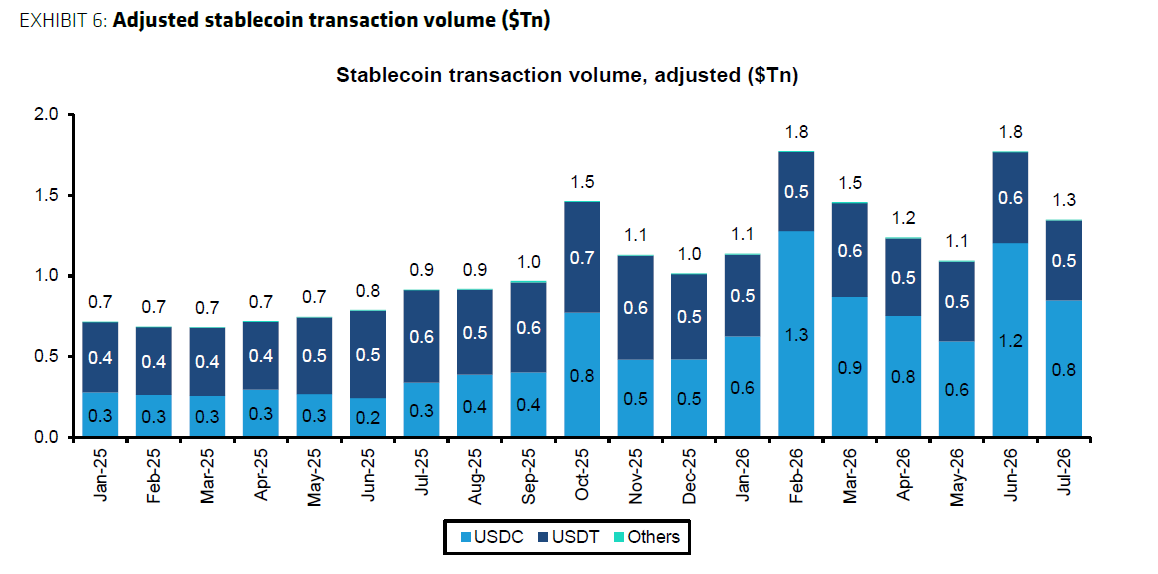
Although USDC remains the second-largest dollar-backed stablecoin by market capitalization, well behind Tether’s USDt (USDT), it has gained significant ground in transaction activity. Bernstein said USDC’s share of adjusted stablecoin transaction volume rose from roughly 40% in 2025 to more than 60% so far in 2026, overtaking USDt by that measure.
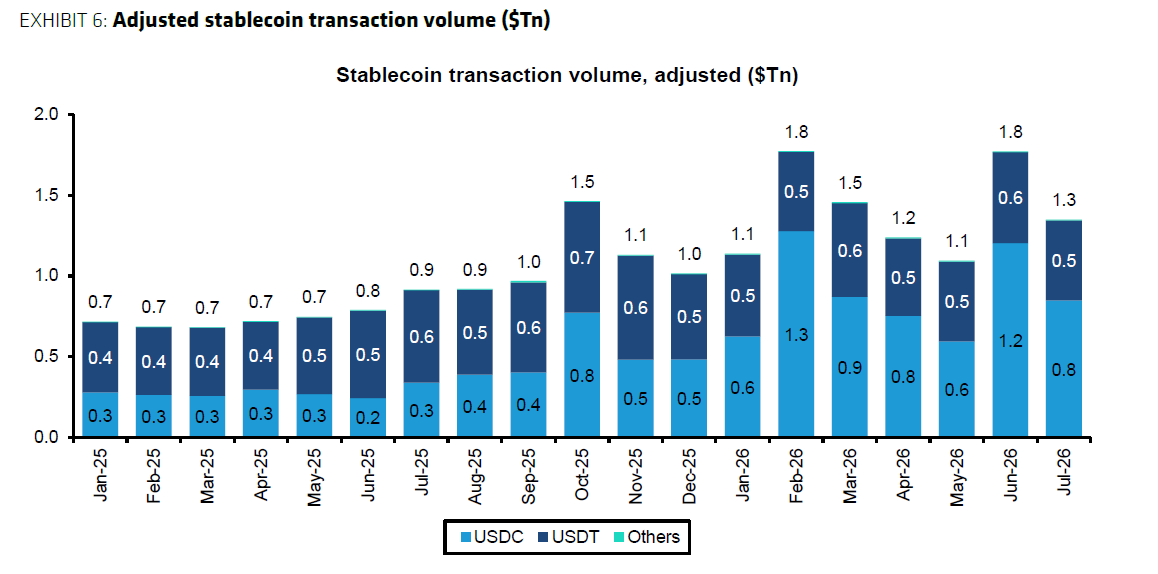
Stablecoin transaction volume has grown significantly this year. Source: Bernstein
Related: MiCA is coming for DeFi vaults, but regulation will be difficult
Circle’s volatile path since its IPO
Circle shares have experienced significant swings since the company went public in June 2025. The stablecoin issuer priced its shares at $31 and raised roughly $1.1 billion in its initial public offering. After surging in the months following its debut, the stock had fallen back toward its IPO price by November 2025 as a broader crypto market downturn weighed on publicly traded companies with exposure to the sector.
In its most recent quarter, Circle reported $701 million in revenue and $48 million in net income, both up from a year earlier.
Related: Western Union brings stablecoin remittances to Visa network with Stablecard

“America has been carrying Canada for decades, but no longer!” Trump said in his post. “The U.S.A. will always be far bigger, richer, and stronger than Canada. Without the United States, Canada couldn’t survive — It’s where they get all of their money and, because of their current bad leadership, primarily Governor Carney, and his Flunky, Ford, they will not be allowed to keep taking advantage of the United States — Their key to survival.”
Trump referred to Ontario Premier Doug Ford, who has been a vocal critic of the tariffs that the Trump Administration has imposed or threatened to impose on Canadian goods. In addition to calling Ford Carney’s “Flunky,” Trump said the Premier was “the less charismatic, intelligent, and overall unimpressive brother of the late, great, Rob Ford,” a former mayor of Ontario’s capital, Toronto.
Tensions between the allied countries have escalated in recent days. Trump claimed earlier last week that, “subject to the finalization of documents,” the two nations had reached a deal, but trade negotiations between the two broke down on Friday, and both sides have pointed the finger at the other.

Six out of 13 firefighter deaths have involved entrapments, the report shows. An average of 17 firefighter fatalities occur each year from wildfires.
Hotter, drier, and windier conditions
Wildfire trackers often use the “30-30-30” rule to identify conditions that can lead to extreme wildfires. The rule refers to when the temperature is at least 30 degrees Celsius (86 Fahrenheit), humidity is at 30% or lower, and wind speeds are at 30 kilometers per hour or more (roughly 19 miles per hour). When combined, these hot, dry, and windy conditions can produce extremely large and destructive fires, as they have this year.
Reno has experienced an average daily high temperature of 92.8 degrees Fahrenheit (33.7 Celsius), 27% humidity, and 18 miles per hour (29 kilometers per hour) daily maximum wind speed over the last 10 days, including the week before the “Hawk” fires began on Saturday and the three days since as the blaze continues.

AI Predicts Solana Price at the End of 2026

Kit Harington Replaces Nicholas Hoult as Gilderoy Lockhart in HBO’s Harry Potter Series

The Next Financial Crisis Could Be Very Different | Former RBI Deputy Governor Explains | #373





-

 Fashion3 days ago
Weekend Open Thread: Madewell – Corporette.com
-

 Business2 days ago
Musk’s Tesla, SpaceX Confirm $16.8 Billion ‘Terafab’ Chip Plant as World’s Largest Building in Texas
-

 Crypto World3 days ago
anatomy of crypto’s biggest liquidation event since 2021
-

 Business6 days ago
SMA Solar Technology AG (SMTGY) Q2 2026 Earnings Call Transcript
-

 Tech7 days ago
Qwen3.8-27B runs frontier-class coding agents and reasoning locally, no cloud API required
-

 Politics3 days ago
6 months on, Irish renters crushed by effects of government housing bill
-
 NewsBeat3 days ago
The ‘Lucky Dip Gang’ causing carnage for clicks: After five thugs were killed speeding in the wrong direction on a motorway, GUY ADAMS investigates a sick new trend… and why police aren’t even allowed to pursue them
-

 Tech6 days ago
GLM-5.3 hits the API at $1.4/$4.4 per million tokens
-

 News Videos5 days ago
Don’t Leave Your Financial Future To Chance | August 19, 2026
-
Tech7 days ago
5 Of The Most Reliable Car Brands To Consider If You’re Buying A Used SUV
-

 Business2 days ago
Mystery AI Model ‘Ox Alpha’ Draws Developers With Free Access as Chinese Lab Origins Remain Debated
-

 Tech7 days ago
Keychron K8 Ultra 8K review: a great value keyboard with comfort issues
-

 Business6 days ago
Stock Market Today: Tech Futures Slide As Treasury Yields Jump; Nvidia, Micron, Sandisk Sell Off
-

 Business5 days ago
Marvell Shares Jump 7% as Google Chip Deal Confirms Custom AI Silicon Partnership, Analysts
-

 Business4 days ago
Five Below: Kids Discount Retailer Reaps Rich Rewards
-
Business7 days ago
Fabrinet (FN) Q4 2026 Earnings Call Transcript
-

 Tech6 days ago
Ken Okuyama’s Kode89 Supercar Features Three Pedals and a Choice of V12s
-

 Fashion7 days ago
The Dressier Side of Shorts
-

 Politics6 days ago
The House Opinion Article | Security means more than military spending
-

 Business7 days ago
Nasdaq Ticks Higher as Wall Street Awaits Retail Earnings and Weighs Fed’s Next Move at Jackson Hole Meeting
You must be logged in to post a comment Login