Google’s Pixel 11 Pro Fold has once again struggled in a durability test, with the foldable cracking along both antenna lines during a bend test. It’s the fourth consecutive generation of Google’s foldable phone to break at the same vulnerable area.
The latest test comes from Zack Nelson of the YouTube channel JerryRigEverything, who put the Pixel 11 Pro Fold through his usual series of scratch, flame, dust and bend tests. The biggest concern came at the end, when the phone cracked along the antenna lines positioned next to the hinge.
That is the same area where the original Pixel Fold, Pixel 9 Pro Fold and Pixel 10 Pro Fold failed during similar testing. Google has previously claimed that it re-engineered the Pixel 11 Pro Fold to be three times stronger, with its hinge tested to withstand 83 million opening and closing cycles in a laboratory environment. The durability test suggests there may still be a weak point outside those controlled conditions.
Advertisement
The exterior 6.6-inch display also showed scratches at level six on the Mohs hardness scale, with deeper grooves at level seven, despite Google claiming it is twice as scratch-resistant as last year’s model. The larger 8-inch Super Actua Flex Display, meanwhile, scratched at level two, with deeper marks at around the level of a fingernail, which is expected for a flexible display.
Advertisement
The flame test caused permanent damage to both screens. The exterior display lasted around 20 seconds under the flame before suffering permanent damage, while the inner display lasted about 13 seconds.
Zack also found that fine particles could make their way into the hinge despite the phone’s IP68 rating. Water resistance and dust resistance aren’t necessarily the same thing when a device has moving parts, and the test showed dust collecting around the hinge and internal components.
Advertisement
The most dramatic moment came during the bend test. The phone cracked along both antenna lines, but the front glass also popped completely away from the frame. Zack noted that the glass came off without wires or other components remaining attached to it.
The test also offered a look inside the phone, including its flexible display construction and hinge. Under the inner screen is an ultra-thin glass layer and reinforcement structure, while the hinge uses a different design from Samsung’s Galaxy Z Fold 8. The Pixel 11 Pro Fold also has an internal cooling system with a copper vapor chamber for its Tensor G6 chipset.
As with any durability test, this doesn’t mean the Pixel 11 Pro Fold will fail during normal use. However, seeing the same antenna-line failure for a fourth consecutive generation raises questions about Google’s decision to retain the placement of a known structural weak point.
Cybersecurity company ReliaQuest has confirmed that one of its employees was targeted in a social engineering attack after hackers impersonated a member of the security team.
In a statement over the weekend, ReliaQuest said that an attacker called multiple employees and tried to trick them into accessing “a fake ReliaQuest single sign-on (SSO) page behind a content delivery network.”
Last week, ReliaQuest’s Threat Research team shared in a now-deleted post, that the ShinyHunters extortion gang was registering .claims domains to impersonate company’s help desks and IT teams.
“ReliaQuest is tracking a widespread ShinyHunters campaign using domains that follow the company[.]claims pattern. These domains incorporate the targeted organization’s name or abbreviation under the .claims TLD,” read the company’s post on X.
Yesterday, a newly-created X account believed to be linked to the threat actors replied to the post, stating “Who’s hunting who ?,” sharing screenshots of what appeared to be a compromised Okta SSO account for a ReliaQuest employee.
Advertisement
Soon after, ShinyHunters published the same screenshots in a new entry on their data data leak site.
Both ReliaQuest’s and the alleged threat actor’s posts were later taken down from X.
According to the company, the threat actor hosted the phishing page on a “lookalike domain,” which BleepingComputer learned from sources was reliaquest.claims, and used the name of a real security employee during the vishing attempts.
One of the targeted employees fell for the attacker’s ruse, entered their credentials on the fake SSO page, and approved an MFA push notification, giving the attacker temporary, view-only access to ReliaQuest’s identity dashboard.
Advertisement
However, device-trust controls successfully blocked subsequent attempts to access applications through the dashboard, according to the company.
“The extent of the access was view-only. No ReliaQuest applications or systems were accessed, and no customer data was ever touched,” ReliaQuest says.
“The threat actor continued with attempts to access these applications from the dashboard but was consistently denied due to the security controls in place.”
The cybersecurity firm says it terminated the attacker’s sessions, revoked the exposed password, and reset all authentication tokens.
Advertisement
The ensuing investigation found no evidence of access to other accounts, apps, or data, and no signs that the actor established persistence on ReliaQuest’s systems.
The firm audited its control fidelity, device trust, and on-network access since August 21 and identified no suspicious activity.
ShinyHunters claims the attack
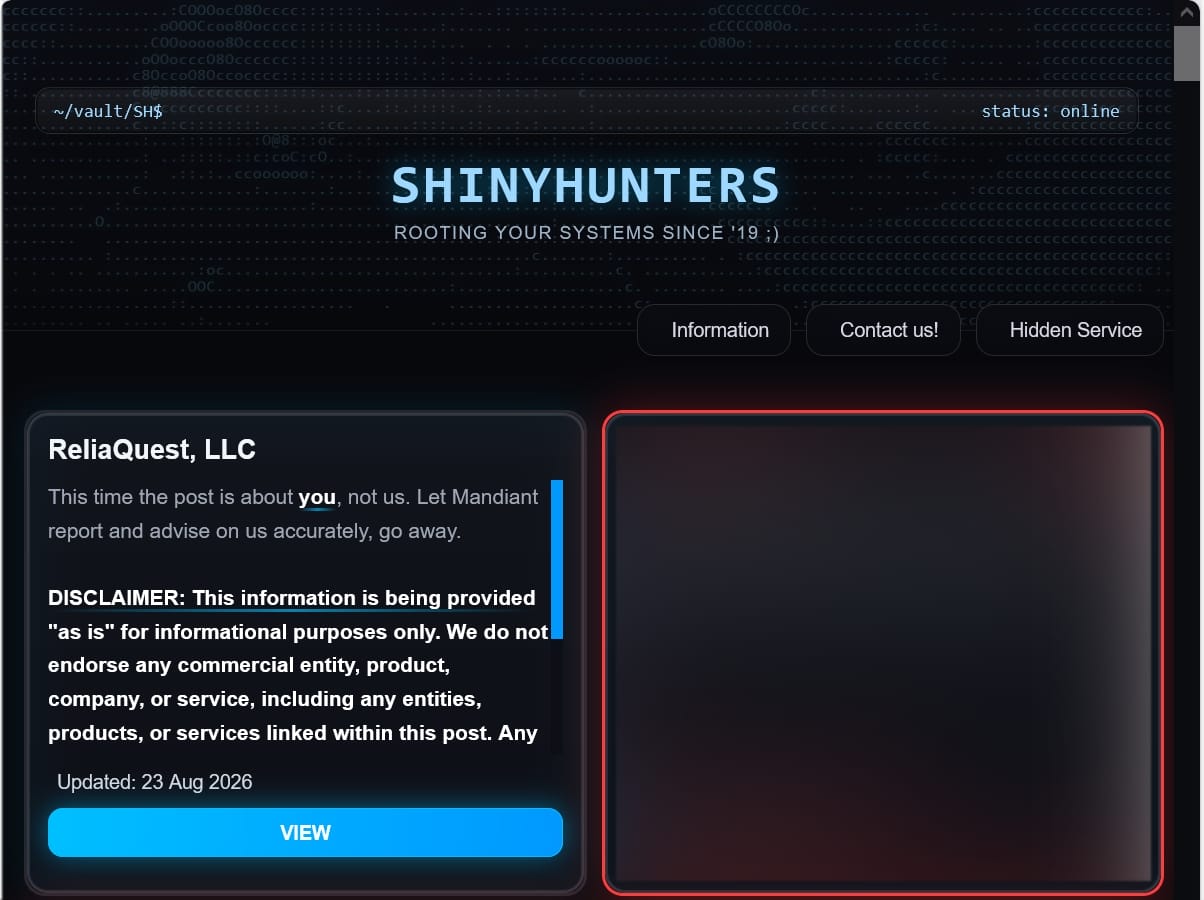
ReliaQuest’s statement comes shortly after the infamous data extortion group ‘ShinyHunters’ claimed an attack on the company.
In a new post on its extortion portal, ShinyHunters references ReliaQuest’s previous reporting on the threat group, saying “this time the post is about you, not us.”
Advertisement
ReliaQuest listed on the ShinyHunters extortion page Source: BleepingComputer
The threat actors published evidence of access, showing that they had successfully breached ReliaQuest’s Okta SSO account.
We asked ReliaQuest if the disclosed incident is linked to ShinyHunters, but we have not received any additional information yet.
However, ShinyHunters told BleepingComputer that their access was view only and did not reach any applications, systems, or customer data.
“No additional identities were accessed, no business applications were reached, no customer or ReliaQuest data was accessed beyond the user’s login credentials, and no persistence was established,” the threat actor told us.
Overall prevention scores can hide what happens after initial access. Once attackers are using valid credentials, prevention drops sharply.
The Blue Report 2026 measures defenses technique by technique across 338 million simulations run in customer production environments.
Amazon has raised the prices of its hardware devices by as much as 60%, blaming “significant increases in memory and storage component costs.” TechCrunch reports: The price explosion impacted Fire TVs, Echos, Kindles, and Eeros. One egregious example that’s been cited is that of the Echo Dot, one of Amazon’s cheapest smart speakers, the price of which jumped 60% overnight, from $49.99 to $79.99. Price-tracking sites like CamelCamelCamel show the stark uptick, which has previously hovered much lower. […] The company also said that it would continue to offer occasional promotions to customers over the course of the next year. Amazon said in a statement: “The consumer electronics industry is facing significant increases in memory and storage component costs. After absorbing these increases for as long as we could, we recently adjusted pricing across our product lines.”
Your next laptop’s biggest bottleneck might not be its chip; it could be how well it stays cool. A new white paper from Ventiva, developed alongside analyst firm Moor Insights and Strategy, argues that thermal design is quickly becoming the deciding factor for how fast AI laptops can actually run.
Why memory bandwidth is the real bottleneck
The paper explains that local AI performance is measured in tokens per second, and that number mostly comes down to memory bandwidth. Most laptops today still rely on 128-bit memory buses paired with LPDDR5 memory, which caps bandwidth around 150 GB per second. That is simply not fast enough to run today’s more demanding AI models at usable speeds, and chipmakers are already racing to fix this.
Sergei Starostin / Pexels
Here is the tricky part, though. Wider memory buses require memory chips to sit extremely close to the processor, inside traces shorter than 25 millimeters, exactly where fans and heat pipes have traditionally lived inside a thin and light laptop. Apple sidesteps this by placing memory directly on its chip package, but every other laptop maker has to solve the same spatial puzzle inside a traditional chassis.
Why fans may not be the answer anymore
Jacob Roach / Digital Trends
Traditional fan based cooling cannot keep scaling alongside these denser memory layouts, especially as chipmakers push toward 256-bit and wider buses. That is pushing solid-state cooling into the spotlight as a serious contender. The report highlights Ventiva’s ionic cooling platform, which uses charged particles to move air silently without any moving parts.
It also points to Frore’s AirJet technology, which recently proved itself by cooling an Intel reference laptop measuring just 11.3mm thin, sustaining 15 watts of fanless cooling while staying noiseless. Meanwhile, YPlasma showcased a plasma-powered laptop cooler at CES, using ionized gas instead of a spinning fan to move air, claiming operation at just 17 decibels.
Advertisement
The paper frames 2027 and 2028 as a real turning point, when wider memory buses and LPDDR6 would become the standard. If that timeline holds, laptop makers will need to rethink cooling instead of treating it as an afterthought.
The U.S. Department of Justice announced a $400 million settlement with TikTok, ByteDance, and affiliated companies over allegations that they violated the Children’s Online Privacy Protection Act (COPPA).
The TikTok social media platform, owned by the Chinese technology company ByteDance, allows users to create, watch, and share short-form videos.
In 2024, the U.S. Department of Justice filed a lawsuit against TikTok and its parent company, alleging violations of COPPA dating back to 2019.
In 2019, Musical.ly, TikTok’s predecessor, agreed to a $5.7 million settlement with the Federal Trade Commission (FTC) over allegations of illegally collecting personal data from users under 13 without parental consent.
Last year, the FTC referred a new investigation to the DoJ, claiming that TikTok continued to breach COPPA rules despite its 2019 commitment to comply with the rules.
Advertisement
As a result of the investigation, the DoJ alleged that TikTok knowingly allowed children under 13 to create regular accounts outside its restricted “Kids Mode,” collected and retained their personal information without parental consent, failed to delete accounts and data when parents requested it, and maintained inadequate procedures for finding and removing underage accounts.
The newly announced agreement resolves the litigation, with the DoJ now recognizing that TikTok has made significant changes to its ownership, data management, and legal compliance operations since 2024.
The U.S. state also recognized that TikTok implemented important changes to its privacy retention practices, improved age-related controls, and strengthened parental oversight.
As part of the settlement agreement, one of the largest ever for COPPA cases, TikTok will now pay $300 million immediately, and another $100 million if a court vacates an earlier consent decree involving its predecessor, Musical.ly.
“This resolution secures a significant monetary recovery and reflects the Department’s commitment to ensuring children receive the full protections that Congress mandated.”
The announcement notes that the settlement resolves only allegations, and there has been no judicial determination that TikTok or ByteDance is liable.
Overall prevention scores can hide what happens after initial access. Once attackers are using valid credentials, prevention drops sharply.
The Blue Report 2026 measures defenses technique by technique across 338 million simulations run in customer production environments.
According to strings accidentally left in a macOS Tahoe update, Apple’s Home Hub will offer user profiles, with identity verification provided by ambient sensing and built-in cameras.
With the macOS 26.7 release candidate build, Apple inadvertently revealed details about several of its upcoming products, including a camera-equipped model of AirPods. Also present was code related to the company’s upcoming Home Hub, an AI-focused device with an operating system that’s said to resemble tvOS.
Rumors have suggested the product will ship in two variants, one with a speaker-type base, and another wall-mounted version. This two-model approach was corroborated by macOS Tahoe code, and now even more details about the Home Hub have surfaced.
As noted by MacRumors, the macOS 26.7 RC build indicates Apple’s Home Hub will offer a Personal Content feature, meaning the device will display different content depending on who’s using it. This will seemingly be facilitated through user accounts or profiles.
Advertisement
Home Hub users will see the option to enable Personal Content after opening the Settings app and tapping their name. Once the feature is active, users will be able to access Personal Content by selecting their profile or account from the Home Hub’s Control Center.
Strings found in macOS Tahoe code reveal Apple’s Home Hub will feature cameras and “ambient sensing” for user recognition. “Sorry, since this device hasn’t seen you in a while, you’ll need to ask again in front of the camera,” reads one string. Another one asks the user to “come in front of this device and ask again.”
Aside from the new Personal Context feature, the macOS 26.7 RC also contains references to “Pebble,” which is believed to be the codename for Apple’s upcoming homeOS. The Home Hub operating system will seemingly feature “Faces” and a “Face Gallery,” which could be similar to what’s already avaialble on watchOS.
Also present are identifiers for both Home Hub variants, with J490 being the one with a speaker base, and J491 being the wall-mounted model. The descriptors “HomeAccessory” and “HomeAccessory_wall” appear to refer to these Home Hub variants as well.
Advertisement
Overall, while it looks as though the Home Hub will offer personalization options, the product’s software seemingly won’t be much of a departure from tvOS or watchOS.
President Donald Trump bought as much as $50,000 worth of SpaceX shares on June 23, according to a financial disclosure first reported by Reuters, two weeks after the record-setting IPO of Elon Musk’s company.
It’s not clear what price Trump paid for the shares, but by that point they had fallen from their highs of over $200. SpaceX shares were trading in the mid-$150 range on June 23. At the end of trading on Monday, shares closed at the IPO price of $135, possibly putting the president’s stake underwater.
Trump and Musk are close, despite a brief falling out last summer that involved the businessman accusing the president of withholding the Department of Justice’s files on Jeffrey Epstein because of how often Trump’s name appears in them. SpaceX has been hoovering up an increasing amount of government contracts and benefiting from the Trump administration’s deregulatory stance, according to a recent Wall Street Journal analysis.
White House spokesman Davis Ingle told Reuters that the president’s stock portfolio is managed by third-party financial institutions and replicate “recognized indexes, such as the Schwab 1000.” SpaceX lobbied popular indexes to change their rules to allow for faster inclusion ahead of its IPO, which means many people likely own some of the company’s stock even if they don’t know it.
Hackers are attempting to exploit two critical authentication bypass vulnerabilities in the miniOrange SAML 2.0 Single Sign On plugin for WordPress that can be used to forge SAML responses and log in as administrators.
The miniOrange SAML SSO plugin turns a WordPress site into a SAML service provider, letting users log in through corporate identity platforms such as Microsoft Entra ID, Okta, Google Workspace, or OneLogin instead of separate WordPress credentials.
Created by Xecurify, miniOrange is a family of seven plugins, with a free version that has 10,000 downloads and 30,000 customers for the other six.
The two vulnerabilities observed in exploitation attempts are tracked as CVE-2026-61979 and CVE-2026-15981 and can be chained together to bypass authentication.
Because the miniOrange SAML SSO plugin accepts the signature algorithm from incoming SAML responses instead of enforcing the configured one, an attacker can leverage CVE-2026-61979 to select HMAC-SHA1. This causes the plugin to treat the RSA public key from the identity provider (IdP) as the shared secret.
Advertisement
Since the public key is known, the attacker can forge a signature that the plugin accepts as authentic.
The second security issue, CVE-2026-15981, causes the plugin to treat an OpenSSL verification error (-1) as a successful result, allowing malformed signatures to pass validation.
According to security firm Patchstack, the two vulnerabilities were publicly disclosed and fixed in July. However, the vendor’s advisory covered only the free edition, leaving the six paid editions without an alert, even though fixes were provided for those too.
Failing to disclose the risk across all versions of the plugin reportedly led many sites running the paid editions to take no action, creating an opportunity for threat actors to exploit the two vulnerabilities.
Patchstack reports that, on August 16, DigitalOcean blocked an anomalous WordPress administrator session originating outside its trusted network.
The investigation showed that attackers have chained the two flaws to obtain an admin session cookie through the Standard edition plugin in version 16.1.9.
Patchstack’s data shows that exploitation attempts and opportunistic scanning are underway, launched from six IP addresses across Europe, Africa, and the United States.
A proof-of-concept (PoC) exploit targeting the free edition is also publicly available, so the pace of attacks could increase at any time.
Advertisement
Patchstack warns that the WordPress administrator dashboard will not show update warnings for the paid versions of the plugin, so website owners must manually upgrade to a patched release.
Overall prevention scores can hide what happens after initial access. Once attackers are using valid credentials, prevention drops sharply.
The Blue Report 2026 measures defenses technique by technique across 338 million simulations run in customer production environments.
If you’re after a cheap printer that won’t cost you a fortune in ink, HP’s Smart Tank 210 is bang on the money. While it’s basic, and it can be achingly slow, it’s surprisingly good at turning out photos or plain paper prints. Most importantly, it arrives with enough ink for around 6,000 pages or more, making it far better value than a cartridge-based equivalent. Unless you only print very occasionally, this printer should save you a tidy sum.
Very cheap to own
Good print quality
Reasonably smart
Key Features
Advertisement
Review Price:
£130
An ink-tank printer
Advertisement
This printer uses bottles of ink that cost less and last longer than cartridges. It’s a little more expensive to buy, but it should be far cheaper to own in the long run.
Pretty basic
Advertisement
The Smart Tank 210 is a printer only: it can’t scan, fax or copy. It doesn’t have a screen and it can’t automatically print both sides of each page, but you can share it over Wi-Fi.
Introduction
If you’re after a budget printer, you could spend as little as £40 picking up an entry level inkjet. The problem is that cheap printers often come with punishing running costs; it’s not uncommon for new cartridges to cost as much as the printer did, and to last only a couple of hundred pages. The HP Smart Tank 210 takes a different tack. While it’s significantly more expensive to buy, it’s almost guaranteed to cost you less overall to own.
That’s chiefly because it’s an ink tank printer, fitted with refillable tanks rather than slots for conventional cartridges. It arrives with a full set of bottles that should last for around 6000 full-colour pages – in fact, if you didn’t use black, the three colour bottles could last for more than 10000 prints. You’d spend £100s or even £1000s buying an equivalent number of cartridges or toners for a regular printer.
These low running costs are one of the reasons I love ink-tank printers, but another is that with long-lasting bottles rather than short-lived cartridges, they generate much less plastic waste. In theory, you could buy this printer and churn out 6000 pages for only around £130, a cost-per-page of around 2.2p including the printer. That’s hard to beat, so what’s the HP Smart Tank 210 itself actually like?
Advertisement
Advertisement
Design and Features
Basic but smart
Fiddly to set up
No exciting features
There’s not all that much to this printer. It’s a squat off-white box with a few dark grey highlights, and a reasonably uncluttered appearance.
Image Credit (Trusted Reviews)
On the back you’ll find a simple extendable paper input tray, which outputs to an even simpler fold-out tray at the front. With no scanner, the top panel is almost featureless apart from a very basic set of buttons and a small LCD.
Image Credit (Trusted Reviews)
That would be it if the HP Smart Tank 210 wasn’t an ink tank printer. The splash of colour on its front panel isn’t just for show; the four windows here reveal the levels in its black, cyan, magenta and yellow tanks. It arrives with them empty, so the first job is to fill them up from the provided bottles of ink.
Advertisement
Image Credit (Trusted Reviews)
Like most refillable printers, you prime this one for action by simply removing the lid from a bottle, and upending it over the spigot on the relevant tank. Here there’s an important thing to watch out for – this printer’s bottles and tanks aren’t keyed to prevent mixing the colours up. That’s bad enough on a normal inkjet, but with a full tank potentially lasting years, here it could lead to thousands of pages of crossed colours.
Image Credit (Trusted Reviews)
Unlike rival ink tank printers from Epson and Canon, you also need to fit the print heads to the HP Smart Tank 210. I found this a needlessly fiddly job, particularly given the relatively narrow access available. Still, at least it’s a one-time only routine. In use you’ll need to keep an eye on the tank levels and top them up occasionally. My experience is that you can typically go many months – or even a couple of years – between refills.
Image Credit (Trusted Reviews)
The final setup task is to join this printer to your Wi-Fi, for which you’ll need the HP app. This detects the printer, asks you an unreasonable number of times if you want to share user data, and finally makes the HP Smart Tank 210 available to other devices on your network. If you have a PC you may prefer to download the Easy Start app and opt for the full suite of drivers, but without scan functionality it’s not really necessary.
Advertisement
Image Credit (Trusted Reviews)
Ink-tank printers cost more to buy than a cartridge equivalent, and pay you back over the long-term in lower running costs. They usually only become better value than a cheap cartridge device once you’ve printed a couple of thousand pages, which might take some users several years. With that in mind I prefer them to have a multi-year warranty, giving you the reassurance they’ll stay working long enough for you to recoup your money. While I’ve no reason to doubt HP’s build quality, it’s a shame this printer only gets 12 months’ cover.
On the other end of the scale, the HP Smart Tank 210 should save you bucket loads if you print in volume. Extra bottles of ink work out at about 0.2p per black page, or 0.5p for a full-colour page – far cheaper than standard inkjet or laser printers.
Advertisement
There’s precious little else of interest here. Although you can connect and share the HP Smart Tank 210 over a wireless network, there’s no wired Ethernet port or memory card slot. This printer can’t automatically print on both sides of a sheet – you’ll need to manually turn pages over if you want to duplex.
Image Credit (Trusted Reviews)
Print speed and quality
Leisurely black printing, slower still in colour
Surprisingly good print quality
Quiet
Advertisement
If you’re in a hurry, the HP Smart Tank 210 isn’t the printer for you. It’s not too bad when printing black text, managing to deliver a first page in 13 seconds, and five pages in 36 seconds – that’s equivalent to 8.3 pages per minute (ppm). It’s a bit faster on longer jobs, especially if you can live with slightly less good Draft quality: it printed 20 pages of text at a rate of 10.3ppm.
Things are much, much less impressive in colour. The HP Smart Tank 210 shuffled its feet when printing a lightweight page of black text and colour graphics, delivering a first copy in 29 seconds, and needing fully two minutes to squeeze out five copies. Our 20 page colour job inched along at a woeful 1.8ppm, one of the slowest results we’ve measured in recent years.
Commendably, HP has resisted the urge to de-content this printer in silly ways. It supports borderless printing on paper up to A4, and is happy to turn its hand to the family snaps. Using the Maximum DPI setting means you’ll get up to 4,800×1,200 dots per inch (dpi) quality, but you’ll have to wait a long time to see if it’s any good. I timed a borderless A4 print at a beard-lengthening 14 minutes and 23 seconds. The printer took almost half an hour to hand over six borderless postcard (6×4”) prints.
Advertisement
One of the benefits of a slow printer is that they tend to be quiet, and that’s certainly the case here. It’s easy to live with the Smart Tank 210 in a small home office, or even in the lounge.
Happily, what the 210 lacked in speed it made up for in print quality, beginning with dark, crisp black text that was easily good enough for formal letters or business use. Printing in Draft quality reduced the impact a little, but the results were still quite impressive. Colours stood up well on plain paper, too. Our test graphics looked fairly punchy, if a little undersaturated, and there was nothing to suggest these prints had come from a particularly low-end printer.
The real surprise came when I looked at the photos I’d printed. While no match for a high-end photo printer, these snaps were more than good enough for family scrapbooks or creative projects. The only real disappointment here was that skin tones all seemed a bit too pale, with the fairest people looking almost ashen in a couple of shots.
Advertisement
Advertisement
Should you buy it?
You’re looking for a bargain
The HP Smart Tank 210 is inexpensive by ink-tank standards, and ridiculously cheap to run by any measure. It’s a great choice where you want to keep print costs down.
Advertisement
You want speed, panache, or lots of features
This is a simple printer. It’s slow, it can’t copy or scan, and it’s missing duplex printing. If it sounds too basic for your needs you’ll need to spend more.
Advertisement
Final Thoughts
I can’t pretend this is the best printer I’ve ever reviewed. If I ran a small business it would be too slow, and I’d bemoan its lack of scan and copy functionality. Even for my home office I’d strongly prefer it to have automatic duplex printing – it’s an easy and convenient way to save on paper.
But park all that. Considering its purchase price and how much ink you get in the box, the HP Smart Tank 210 has to be one of the best value printers you can buy. If I was on a tight budget, and looking for a printer that could deliver a few thousand pages for as little as possible, this one would be right at the top of my list. That could make it ideal for students, writers, or anyone who needs to print a reasonable amount on the smallest budget possible.
Advertisement
FAQs
How do I connect my HP Smart Tank 210 printer to Wi-Fi?
You’ll need to install the HP app on a PC, tablet or smartphone. Make sure Bluetooth is on, and that you’re connected to your wireless network, then click the plus button in the app. It should find the printer and configure it for your network.
Is the HP Smart Tank worth it?
Advertisement
For many users, yes. An ink-tank printer costs more to buy, but less to run. The more you print, the more likely you are to find that a tank-based device costs less to run than a conventional cartridge-based inkjet, or a laser printer. In practice the breakeven point is typically around 2,000 pages – if you print significantly more than that in the printer’s lifetime you should end up paying a lot less.
The flip side is that if you don’t print that much, or the printer fails before you can and isn’t under warranty, you’ll end up losing out. For this reason it’s ideal to try and get at least a couple of years’ warranty if you can.
Advertisement
Test Data
Full Specs
HP Smart Tank 210 Review
Manufacturer
HP
Quiet Mark Accredited
No
Size (Dimensions)
434 x 360 x 135 MM
Weight
3.73 KG
ASIN
B0GSGG1F19
Release Date
2026
First Reviewed Date
13/08/2026
Model Number
4A8H8A
Ports
USB 2
Connectivity
802.11b/g/n Wi-Fi (2.4GHz only)
Ink Cartridge support
32XL black ink (6,700 pages), 31 cyan, magenta and yellow inks (10,100 pages each)
The third season of Percy Jackson and the Olympians is fast approaching, and at Disney’s D23 convention in Anaheim, California, last weekend, we got a glimpse of what’s to come as the cast answered fan questions during a panel discussion.
Earlier during Disney’s D23 Entertainment Showcase, the show got a fresh, new trailer for November’s third season. Walker Scobell, who plays the title character of Percy Jackson, was joined on stage by Ming-Na Wen (Hera) and Andra Day (Athena) to present the new trailer, which showed Percy fighting underwater and in arenas as a titan emerges.
After the ill-fated, critically panned movies released in the 2010s made it only to the second book in Rick Riordan’s series, the Disney Plus original will be the first time The Titan’s Curse has gotten an adaptation. It follows Percy and his Camp Half-Blood crew on their mission to rescue the goddess Artemis (played by Dafne Keen).
“Season 3 is the season where some people get what they deserve,” Scobell said during Saturday’s panel. There will also be a lot of improv in season 3, Scobell said, with the cast now close enough to play off each other like siblings bantering (which they did, all panel long, arguing over who is the most powerful).
Advertisement
Tamara Smart, who plays Thalia, said scenes exploring the past and Olympus were her favorites to shoot. “Season 3 is the season where women run it,” she said.
“It’s great to play a powerful, confident woman,” Smart added. “She’s 100% angry, 100% sad, 100% yelling at Percy.” (She added that after every single take where she was forced to yell at Scobell, she apologized to him.)
Keen wasn’t allowed to tease much from the upcoming season, but said the newcomers to the show had a huntress camp where they all got to train together, learn as a pack and master archery.
Advertisement
“Love and loss inform all decisions,” she said of Season 3.
Saara Chaudry said bringing Zoë Nightshade to life in the new season “has been the absolute privilege of my life.”
“Season 3 is the season where the stars align,” Chaudry added.
Dan Shotz, a showrunner, writer and executive producer, had some more detailed hints about the upcoming season.
Advertisement
“We have this great source material, and we get to dive a lot deeper… You’re going to see all these great things you love from this book, but so much more,” he said. “We cannot have a season of this show without Annabeth.”
Shotz said we will meet all the gods this season, as well as get to see the junkyard of the gods.
But not everyone makes it out alive, executive producer Jonathan Steinberg said.
“I’m excited for everyone to go on that ride shown in the trailer,” Steinberg said. “The trailer doesn’t lie.”
Corinne Reichert (she/her) grew up in Sydney, Australia and moved to California in 2019. She holds degrees in law and communications, and currently writes news, analysis and features for CNET across the topics of electric vehicles, broadband networks, mobile devices, big tech, artificial intelligence, home technology and entertainment. In her spare time, she watches soccer games and F1 races, and goes to Disneyland as often as possible.
See full bio
An unpatched vulnerability in Calix GS7 XGS (GS5239XG) residential routers used by multiple U.S. broadband providers allows remote, unauthenticated attackers to create port-forwarding rules that can expose local network devices to the public internet.
The flaw is tracked as CVE-2026-75501 and is described as a missing authentication issue that affects devices running EXOS/6.6.47 firmware.
Security researcher Brian Khan Quintana discovered the flaw and, after trying to notify the vendor on June 7 without success, he reported the vulnerability to the Carnegie Mellon CERT Coordination Center.
Following multiple attempts to contact the vendor and receiving no response, CERT/CC coordinated a public disclosure, and Quintana published the technical details.
Calix is a significant vendor in the US broadband-provider market, working with large entities such as Cox Communications, Brightspeed, ALLO, CityFibre, and Conexon.
Advertisement
The affected model, GS5239XG, is also marketed as the GigaSpire 7u10txg and is a new, premium gateway device that combines Wi-Fi 7 capabilities with an integrated XGS-PON fiber terminal.
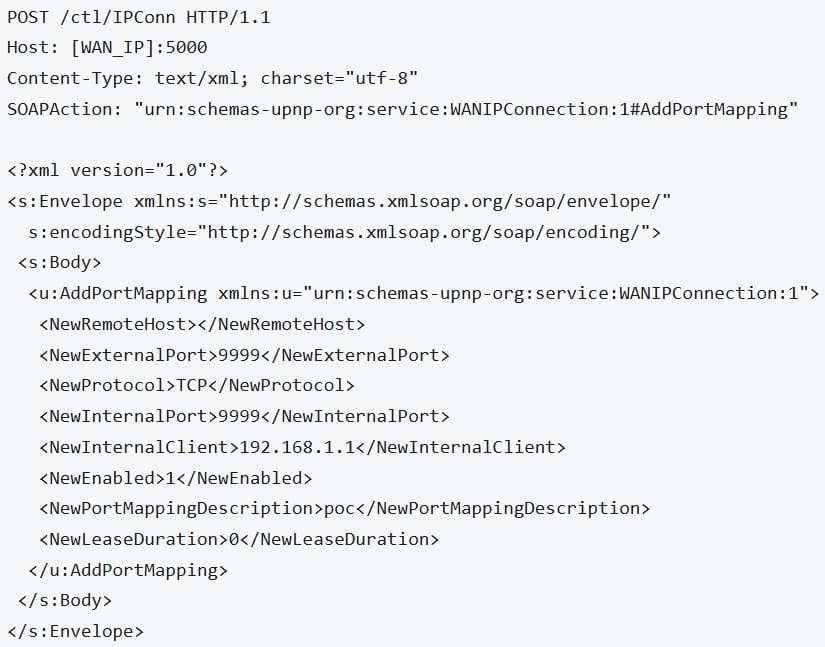
The CVE-2026-75501 vulnerability is caused by the device exposing “the MiniUPnPd control endpoint on the WAN interface on TCP port 5000 without access controls.”
“In affected firmware versions, the router binds its UPnP WANIPConnection SOAP service to the public WAN interface on TCP port 5000,” CERT/CC warns.
This allows an attacker on the public web to send the device unauthenticated “SOAP requests to add, delete, or enumerate port mappings, or to query the external IP address.”
Advertisement
This way, hackers can bypass the router’s Network Address Translation (NAT) and firewall protections and expose internal cameras, network-attached storage (NAS) devices, administrative interfaces, and IoT appliances.
“One unauthenticated request from anywhere in the world is enough to open a permanent hole through the router’s firewall to any device inside the house. No password. No prompt. Nothing on screen. The rule survives a reboot,” Quintatna says.
The researcher says that an attacker leveraging the security issue could take the following actions:
Create arbitrary port-forwarding rules
Delete existing mappings
Enumerate the router’s current mappings
Retrieve its public IP address
Quintana tested the finding by sending requests outside his home network to create a port mapping that exposed an internal address. A mapping configured with no expiration remained active after the router was power-cycled.
Proof of concept HTTP/SOAP request Source: drkq.github.io
This practically means anyone on the internet can instruct vulnerable Calix routers to forward traffic from a public-facing port to a chosen device on the home network.
Given that there’s no fix for CVE-2026-75501, Quintana recommends that users of the vulnerable device disable UPnP through the administrative interface (Advanced → Security → UPnP).
Advertisement
The researcher notes that this workaround disables automatic port opening, which some games rely on, but it’s always possible to open specific ports manually.
CERT/CC also notes that the setting might be locked in some cases, and users who can’t change it should contact their ISP to request the deactivation.
BleepingComputer has contacted Calix for a comment about the flaw, the device models it impacts, and if a patch will be released, but we have not heard back as of publishing.
Overall prevention scores can hide what happens after initial access. Once attackers are using valid credentials, prevention drops sharply.
The Blue Report 2026 measures defenses technique by technique across 338 million simulations run in customer production environments.


































































You must be logged in to post a comment Login