
Crypto World
Standard Chartered becomes first bank to offer HKDAP



Standard Chartered Bank Hong Kong became the first bank to distribute HKDAP on Aug. 24, giving eligible institutional clients and partners access to Hong Kong’s first live regulated local-currency stablecoin.
Summary
- Standard Chartered became HKDAP’s first bank distributor, extending access to eligible institutional clients and partners.
- Anchorpoint holds one of two stablecoin issuer licences granted by Hong Kong’s regulator in April.
- HKDAP launched through controlled beta access on Ethereum for institutions and professional investors this month.
- Standard Chartered plans tokenized money market fund subscription and settlement services during fourth quarter 2026.
- Anchorpoint reported 522,000 HKDAP circulating as of August 19 during the limited beta rollout period.
Anchorpoint Financial issues HKDAP, short for “HKD At Par,” under licence FRS01 from the Hong Kong Monetary Authority. Standard Chartered is Anchorpoint’s largest shareholder and established the company with HKT and Animoca Brands.
Hong Kong granted two stablecoin issuer licences in April, one to Anchorpoint and another to HSBC. That distinction is important: the regulator licensed two issuers, but HSBC had not publicly launched its stablecoin when Standard Chartered announced its distribution service.
Standard Chartered adds a bank channel for HKDAP
Standard Chartered joins HashKey Exchange and OSL as an authorized HKDAP distributor. HashKey and OSL began offering beta access earlier in August, before Standard Chartered became the first conventional bank to join the distribution network.
Eligible clients can use authorized distributors to convert Hong Kong dollars into HKDAP and redeem the tokens for fiat currency. Access remains limited to institutions, corporate customers and professional investors during the current phase.
As previously reported, Anchorpoint launched HKDAP through a phased institutional rollout. HashKey subsequently completed an initial minting and redemption transaction for approved clients.
HKDAP operates on Ethereum and is intended to maintain a value of HK$1 per token. Hong Kong’s Stablecoins Ordinance requires licensed issuers to maintain adequate reserves, segregate those assets and process redemptions at par.
Anchorpoint’s published figures showed 522,000 HKDAP in circulation as of Aug. 19. That limited supply reflects the project’s controlled beta status rather than broad consumer adoption.
HKDAP will target tokenized fund settlement
Standard Chartered plans to introduce subscription and settlement services for tokenized money market funds during the fourth quarter. The bank said it would work with international and Hong Kong asset managers.
A stablecoin can provide the cash side of a tokenized fund transaction on the same blockchain infrastructure used to record the fund units. This can reduce the timing gap between transferring an investment and completing its payment.
Standard Chartered said the service could support faster settlement, but the bank has not named participating managers or disclosed expected transaction volumes.
The project builds on the bank’s existing tokenization work. Standard Chartered already provides infrastructure for China Asset Management Hong Kong’s tokenized money market fund and previously tested tokenized deposit settlement through the HKMA’s Project Ensemble.
The bank will also test HKDAP for transfers between companies within its group. Further proposed applications include cross-border payments, treasury management and transfers outside conventional banking hours.
Those uses remain pilots or planned services. Standard Chartered has not announced a commercial launch date beyond the Q4 target for tokenized fund subscriptions and settlement.
Hong Kong licensed two stablecoin issuers
The HKMA awarded its first licences to Anchorpoint and HSBC on April 10 after receiving 36 applications. The regulator has said it will remain selective when considering further approvals.
Anchorpoint adopted a business-to-business-to-consumer distribution model. Instead of serving every holder directly, it works with regulated banks, exchanges and commercial partners that provide access and fiat conversion.
In related coverage, HashKey became an authorized distributor for institutional HKDAP access. OSL also provides distribution, liquidity and conversion services during the beta period.
The HKMA has warned investors about unrelated tokens using the HKDAP name. Its April warning said tokens carrying HKDAP or HSBC tickers were circulating without connections to the licensed issuers.
Users must therefore verify contract addresses and access the stablecoin through Anchorpoint’s authorized channels.
Independent review raises contract questions
Security researcher Yajin Zhou published an independent review of HKDAP’s Ethereum contract after its beta launch. The analysis questioned elements of its custom approval, upgrade and access-control architecture.
The review claimed some compliance controls did not operate as expected, but the findings were not an HKMA enforcement determination or confirmed exploit.
No theft or loss was identified in the review. Anchorpoint had not published a detailed public response to the findings at the time of writing.
The next measurable developments will be named asset-manager partnerships, actual fund settlement transactions and updated reserve disclosures. Anchorpoint has also said wider access, including a possible retail expansion, may arrive by the end of 2026, subject to market conditions and regulatory requirements.



Bitcoin extended its rally on Tuesday, hitting the $80,000 psychological level for the first time since May 4.
The rally comes as improving liquidity expectations continued to lift the broader cryptocurrency market.
Bitcoin has gained nearly 30% in the last week, while Ethereum has risen more than 25% and XRP has advanced almost 30%.
The rally gained momentum after the U.S. Treasury announced plans to double the size of certain debt buyback operations.
The decision eased liquidity concerns and strengthened demand for risk-sensitive assets.
With Bitcoin still flying, investors are now watching whether it can extend its rally and reach the $85,000 level.
Bitcoin rally persists as Treasury buyback expansion strengthens crypto rally
The primary catalyst behind Bitcoin’s rally over the past seven days is the U.S. Treasury’s decision to expand its debt buyback program.
Larger buybacks can support liquidity in the market for longer-dated Treasury securities, easing financial pressures and encouraging investors to increase their exposure to riskier assets.
Major cryptocurrencies including Bitcoin, Ethereum, and XRP responded strongly to the announcement, recording double-digit weekly gains.
Short liquidations also accelerated the rally as bearish traders were forced to close their positions, adding further buying pressure.
Bitcoin has now hit the $80,000 level on Friday after decisively breaking above its major exponential moving averages.
The 200-day EMA stands at $71,545, while the 100-day and 50-day EMAs are located at $66,727 and $65,286, respectively.
BTC’s position above all three indicators supports a bullish near-term outlook and suggests the market’s broader technical structure has improved considerably.
Market data shows that the current breakout is accompanied by strong trading volume, adding credibility to the latest upward move.
If Bitcoin continues to trade above the 200-day EMA, it would reinforce the case for further gains and could establish the level as new support.
BTC bulls target the $82,689 resistance
Bitcoin’s next major resistance lies near the psychological and horizontal barrier at $82,689.
Buyers have pushed Bitcoin’s price past the $80,000 level, ensuring that fresh selling pressure doesn’t dampen the ongoing rally.
A decisive break and daily close above the $82,689 barrier would strengthen the bullish outlook and potentially open the way to higher levels.
Failure to clear $82,689 could lead to a period of consolidation as traders digest the recent gains.
Bitcoin’s momentum indicators remain bullish but increasingly stretched. The relative strength index is hovering near 85, placing BTC firmly in overbought territory.
Such a high reading does not guarantee an immediate reversal, but it indicates that the rally may be vulnerable to a corrective pause.
The moving average convergence divergence remains strongly positive, showing that upward momentum is still intact.
Together, the indicators suggest bulls remain in control, although the risk of short-term profit-taking has increased.
If the bears regain control, initial support sits at the 200-day EMA near $74,700. Holding above this indicator would preserve the immediate bullish structure and could provide a foundation for another attempt at $83,000. 
A deeper correction could bring the 100-day EMA at $71,545 and the nearby horizontal level at $66,727 into focus.
Below that region, the 50-day EMA at $65,286 offers another layer of support, followed by the structural floor at $62,300.
A sustained decline below $62,300 would weaken the broader bullish outlook, while continued trading above the 200-day EMA would keep the $80,000 target within reach.


Traders are spending millions to position for further Bitcoin upside after its staggering rally to $80,000, though demand for downside protection remains firm, according to Laevitas.


Cosmos Labs urged affected Cosmos EVM chains to request validator halts on Aug. 25 as its security and engineering teams responded to an incident that had already reached multiple networks.
Summary
- Cosmos Labs advised contacted Cosmos EVM chains to ask validators to halt during incident response.
- KiiChain reported 148,326,583.15 KII drained through 18 repeated attacks on August 22, 2026, officially confirmed.
- TAC said one account was drained before validators halted its network at block 24,671 Saturday.
- MANTRA resumed block production after roughly 30 hours and said user balances remained unchanged throughout.
- Cosmos Labs has not disclosed affected chains, vulnerability details or aggregate losses publicly to date.
The company did not identify the underlying vulnerability, affected chains or total losses in its initial statement. It said users of the Cosmos EVM module had been affected and promised an incident report after the situation was resolved.
Separate disclosures from MANTRA, TAC and KiiChain connect recent attacks to the Cosmos EVM software stack. However, Cosmos Labs has not publicly confirmed that these incidents share one exact vulnerability or named every chain asked to stop.
Cosmos EVM chains receive emergency halt advice
Cosmos EVM is a shared software stack that lets Cosmos SDK chains execute Ethereum-compatible smart contracts. A vulnerability in a common module can therefore expose independent networks running affected versions or configurations.
Cosmos Labs said its teams were “proactively responding” and had contacted chains using the module. It asked those teams to coordinate with validators, which must collectively stop block production on decentralized proof-of-stake networks.
A halt prevents new transactions from settling while developers investigate and distribute a fix. It also temporarily blocks regular transfers, applications and withdrawals that depend on the affected chain.
Cosmos Labs directed other Cosmos EVM teams with questions to its security email. It did not publish a software version, mitigation instructions or a restart schedule, likely to avoid revealing exploitable details before chains are protected.
KiiChain and TAC disclose token drains
KiiChain said an attacker drained 148,326,583.15 KII from wallets on Aug. 22. Its incident report said the attacker repeated the technique 18 times before validators stopped the network at block 9,355,723.
The team linked the attack to a Cosmos EVM vulnerability involving vesting accounts, staking operations and balance handling. KiiChain said the attacker bridged part of the assets to BNB Smart Chain through Hyperlane. The team did not identify Hyperlane itself as the vulnerable component.
TAC separately said an attacker exploited a weakness in the Cosmos EVM precompile layer on Aug. 22 and drained one account. Validators halted TAC at block 24,671, according to its official update.
The projects’ disclosures establish that both networks suffered unauthorized asset movements. Cosmos Labs has not yet published an aggregate loss calculation or confirmed whether the same attacker controlled every address involved.
MANTRA restarted after a 30-hour halt
MANTRA stopped its network on Aug. 20 after detecting activity involving two project-managed wallets. The team isolated the incident to its Cosmos EVM module and deployed an updated release before coordinating a validator restart.
As previously reported, MANTRA resumed block production after a roughly 30-hour halt. It restarted from a snapshot at block 17,449,398 without rolling back the chain’s recorded state.
MANTRA said “no user funds were affected,” but its complete post-mortem and detailed asset accounting remain unpublished.
The team said balances were unchanged and the two affected addresses belonged to its internal wallet infrastructure. That statement does not establish whether project-controlled assets moved or quantify any attempted withdrawals.
The incidents follow an earlier Cosmos EVM flaw involving the ICS20 precompile. A March security advisory said incorrect state handling during nested execution allowed the same token balance to be used repeatedly within one transaction.
That earlier issue caused an estimated $7 million loss on SagaEVM in January. In related coverage, SagaEVM was paused after bridged assets were compromised. It remains unconfirmed whether the August attacks used that exact flaw, a related execution path or a separate vulnerability.
Cosmos Labs post-mortem will determine the scope
The immediate priorities are identifying every vulnerable deployment, distributing a tested patch and confirming that affected chains can restart safely. Validators will need coordinated upgrade instructions before resuming block production.
Cosmos Labs’ promised report should identify the faulty component, affected versions, exploitation timeline and total losses. It should also explain whether MANTRA, TAC and KiiChain were compromised through the same code path.
Until that report appears, other teams using Cosmos EVM may keep networks halted or disable affected functionality. Users should rely on official chain status pages and avoid transactions through unverified interfaces or purported recovery tools.
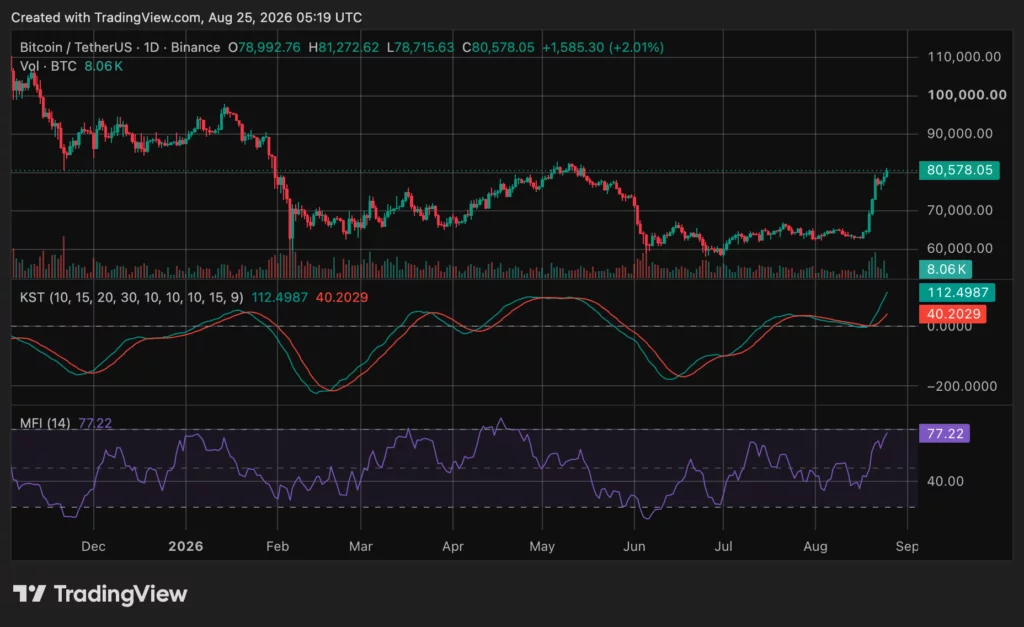
Bitcoin crossed $80,000 on Aug. 25 for the first time in almost 15 weeks, extending one of its strongest short-term advances since 2021.
Summary
- Bitcoin crossed $80,000 for the first time since May 15, extending its eight-day recovery sharply.
- Bitcoin gained roughly 38% from its late-June low below $58,000 as buyers returned to markets.
- U.S. spot Bitcoin ETFs attracted about $1.92 billion last week, their strongest intake since October.
- Treasury doubled long-end buyback limits to at least $4 billion, while yields initially declined afterward.
- Money Flow Index reached 77.22, showing strong demand while warning that momentum appears stretched short-term.
The cryptocurrency traded near $80,500 at press time, according to the crypto.news market data. It reached an intraday high above $81,000 after gaining roughly 28% over eight days.
The advance has added approximately $350 billion to Bitcoin’s market capitalization, based on the price change and circulating supply. Bitcoin has also recovered about 38% from its July 1 low near $57,700.
That rebound effectively erased the losses accumulated since May. However, the crypto has now entered a resistance area that previously attracted heavy selling.
Bitcoin price tests resistance between $80,000 and $82,000
The daily BTC/USDT chart shows Bitcoin testing resistance between $80,000 and $82,000. That area marks the upper boundary of its May trading range and represents the immediate test for buyers.
A sustained close above $82,000 would confirm that demand remains strong after the rapid recovery. Failure to hold the breakout could lead to consolidation toward $76,000 or $78,000, which now form the nearest support zone.
Momentum indicators support the short-term bullish structure. The Know Sure Thing indicator stood near 112.50, well above its signal line around 40.20. The reading shows that upward momentum has accelerated.
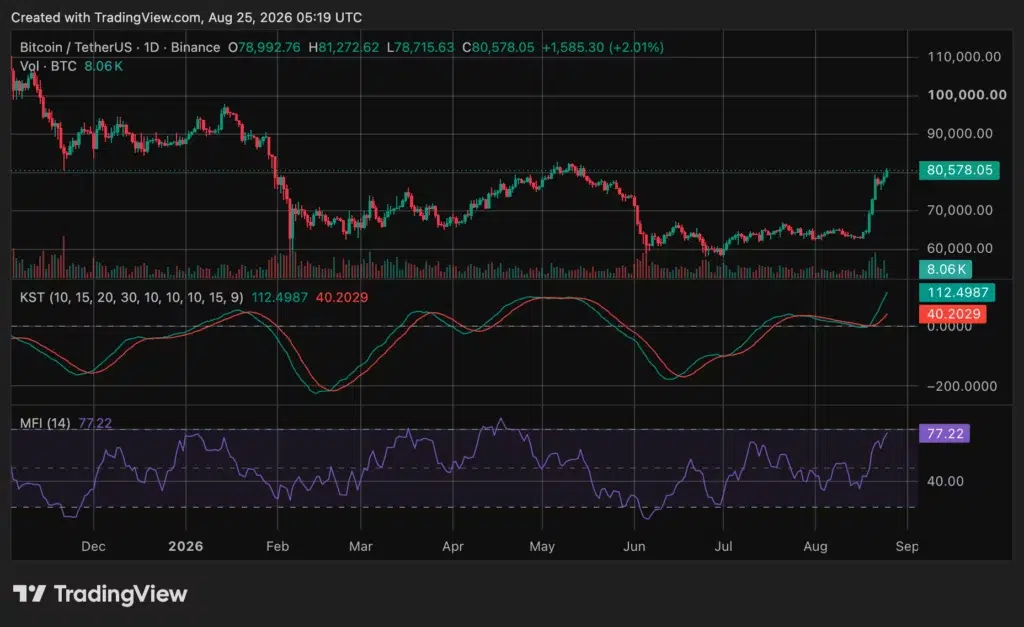
The Money Flow Index reached 77.22. That indicates strong capital inflows but also places the indicator near its conventional overbought level of 80. Elevated readings do not guarantee a reversal, though they show that the rally may be stretched.
Rekt Capital described the weekly close above BTC’s 50-week exponential moving average as technically bullish. However, the analyst warned in an X post that the margin above the average remained narrow.
“A failed retest could turn the move into a fake breakout similar to Bitcoin’s earlier relief rally,” the analyst warned.
ETF inflows provided identifiable Bitcoin demand
U.S.-listed spot Bitcoin exchange-traded funds recorded approximately $1.9 billion in net inflows during the week ending Aug. 21. The funds attracted capital for five consecutive sessions, marking their strongest weekly intake since October 2025.
The inflows offered evidence of spot demand alongside futures-market activity. BlackRock’s iShares Bitcoin Trust accounted for a large portion of the buying during the week.
As crypto.news reported in its coverage of Bitcoin’s approach toward $80,000, forced short liquidations also accelerated the initial move. Traders who had bet on lower prices were required to buy Bitcoin as the market rose.
That buying can produce rapid advances but may not provide lasting support. Continued ETF and direct spot-market demand will therefore remain important if BTC is to hold above $80,000.
Treasury buybacks improved the liquidity narrative
The rally began shortly after the U.S. Treasury expanded its planned buybacks of longer-dated government securities.
On Aug. 19, the Treasury said it would increase the maximum size of certain liquidity-support operations from $2 billion to at least $4 billion. The larger operations will run from Sept. 9 through Nov. 4, according to the department’s official statement.
Buybacks allow the Treasury to purchase older, less liquid securities while issuing other debt. The change does not constitute Federal Reserve quantitative easing, and no government agency has established that it directly caused BTC’s rally.
However, the announcement initially pushed longer-term yields lower and improved investor expectations about market liquidity. BTC’s first breakout during the move took it above $71,000, as previously reported.
Reports have also discussed using part of the Treasury General Account to finance larger buybacks. The account is expected to hold roughly $950 billion at the end of September. Treasury has not announced a program committing that full amount to bond purchases.
Inflation data will test whether the rally can continue
The next major U.S. macroeconomic event arrives on Aug. 26. The Bureau of Economic Analysis will publish July personal income, spending and PCE inflation figures at 8:30 a.m. Eastern time, according to its official schedule.
The PCE price index is the Federal Reserve’s preferred inflation measure. A stronger-than-expected reading could lift Treasury yields and reduce demand for risk assets. Softer data could support expectations for easier financial conditions.
The crypto must also hold its 50-week exponential moving average during any pullback. A successful retest would strengthen the breakout case. A weekly close below that level would raise the probability that the move represented another temporary relief rally.
The confirmed evidence currently shows a rapid price recovery, renewed ETF inflows and stronger momentum. Whether those conditions can sustain BTC above $80,000 remains unconfirmed.
Disclosure: This article does not represent investment advice. The content and materials featured on this page are for educational purposes only.


BNB Chain activated the Pasteur hard fork on BNB Smart Chain mainnet at 02:30 UTC on Aug. 25, introducing three changes focused on bridge security, validator authorization and block capacity.
Summary
- BNB Chain activated Pasteur on BSC mainnet at 02:30 UTC on August 25, 2026, successfully.
- Three proposals strengthen bridge verification, validator authorization and block construction without shortening block times further.
- BEP-682 rejects duplicate validators during cross-chain light-block checks, protecting genuine supermajority approval requirements onchain now.
- QANet benchmarks increased throughput 88% from 1,237 to 2,324 transactions per second under controlled conditions.
- Node operators needed client version 1.7.7 and removal of EnableBAL before mainnet activation began Tuesday.
The network confirmed that Pasteur was live following its scheduled activation. BSC continued producing blocks at its existing 450-millisecond interval, with no major disruption publicly reported immediately after the upgrade.
Pasteur combines BEP-682, BEP-695 and BEP-675 under the broader BEP-673 upgrade plan. The changes had operated on BSC’s Chapel testnet since July 21 before reaching mainnet.
BNB Chain Pasteur strengthens bridge verification
BEP-682 changes how BSC verifies light blocks submitted through cross-chain infrastructure. Before Pasteur, the verification process did not explicitly reject duplicate entries in a submitted validator list.
A crafted request could therefore include the same validator more than once. Counting those entries separately risked making a bridge approval appear to have support from more independent validators than it actually did.
Pasteur rejects repeated validator entries before calculating whether the required voting threshold has been reached. Each approval must now come from a distinct validator for the light block to satisfy the supermajority requirement.
BNB Chain did not report that attackers had exploited the flaw or attributed any previous asset losses to it. The change is a preventive correction to bridge verification rather than a response to a disclosed theft.
Cross-chain infrastructure remains a major security concern across decentralized networks. In related coverage, bridge attacks have caused billions of dollars in cumulative losses through compromised keys, contract flaws and weak message verification.
Old validator keys lose their authority
BEP-695 closes gaps involving validator key rotation, penalties and governance. When a validator replaces its operator key, the previous key now loses its management rights.
The proposal also prevents validators from escaping pending penalties by rotating their keys. Slashing and removal processes remain attached to the validator rather than disappearing when its operator address changes.
Pasteur further blocks restricted addresses from using offchain signatures to participate in governance. BNB Chain already prevented blacklisted addresses from voting directly, but those accounts could potentially sign votes and have another address submit them.
The updated governance contracts check the original signer before counting a delegated vote. If that signer is restricted, the vote is rejected regardless of which account submits it.
New block route reduces repeated execution
BEP-675 introduces an optional route for specialist builders to submit blocks they have already executed. Validators check the proposed block against consensus rules, sign it and broadcast it before completing full execution verification.
The earlier route required both the builder and validator to execute the transactions before the validator signed. That duplication consumed part of BSC’s short block window and could leave blocks below their maximum capacity during periods of heavy demand.
Builders can continue using the previous process. The new route must be enabled through the network’s remote procedure call interface, giving participants time to integrate it.
BNB Chain said the route could fit more transactions into each block, but its published performance figures came from controlled testing rather than mainnet activity.
Tests on QANet, an internal environment designed to reflect geographically distributed validators, increased throughput from 1,237 to 2,324 transactions per second. Average gas consumption per block rose from 46.35 million to 84.15 million while the 100-million gas limit remained unchanged.
Mainnet data will test the 88% capacity gain
Pasteur does not increase the block gas limit or reduce the 450-millisecond block interval introduced by the Fermi upgrade. Its capacity gains depend on builders adopting BEP-675 and submitting fuller blocks.
BNB Chain required node operators to install client version 1.7.7 before activation. Operators also needed to remove the deprecated EnableBAL field because leaving it in the configuration file would prevent the updated client from starting.
As previously reported, BNB Chain warned operators to complete the mandatory Pasteur update before the fork. Operators running incompatible software risked falling out of sync with mainnet.
The next evidence will come from live block utilization, transaction throughput, missed-block rates and validator performance. Those measurements will show whether the QANet capacity improvement carries over to sustained mainnet demand.
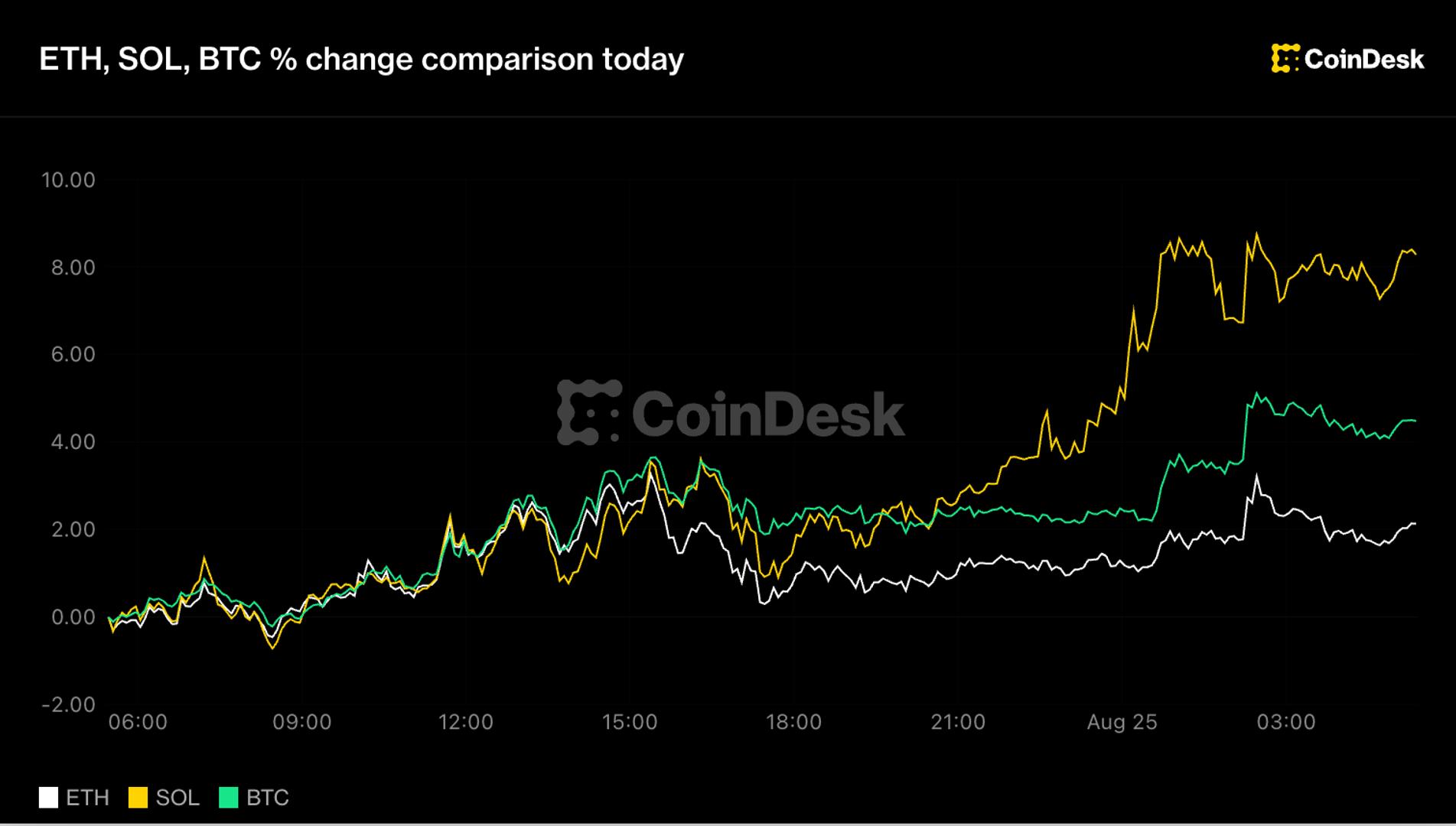
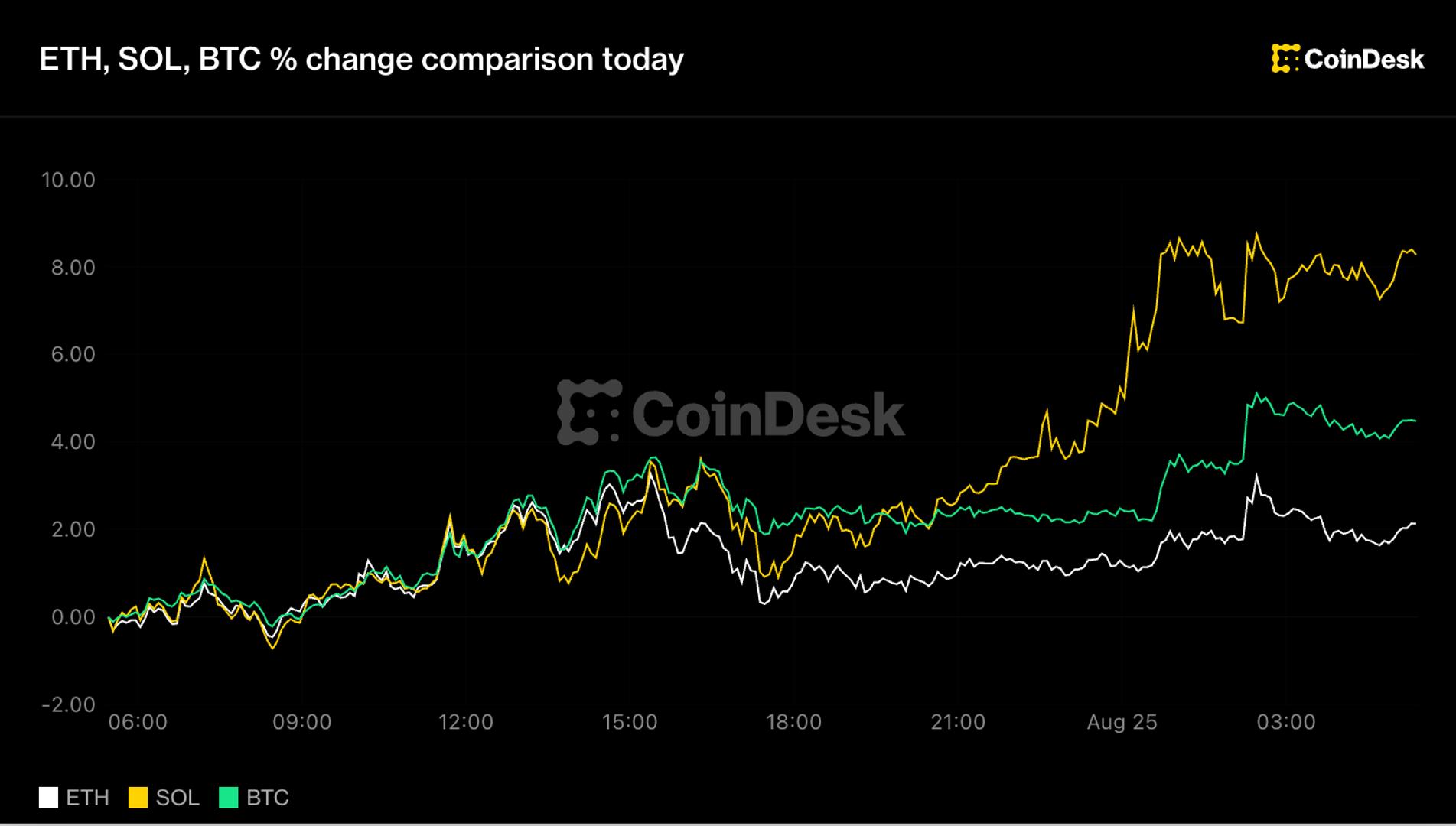
BTC is up more than 25% on the week after Treasury’s bond-buyback expansion sparked a rally, while Solana led majors Tuesday as validators vote on proposals to slow new SOL creation and raise daily burns.

BNB Smart Chain has activated the Pasteur hard fork on its mainnet, completing a set of protocol changes designed to close weaknesses in bridge verification and validator authorization—while also aiming to pack more transactions into each block.
BNB Chain said in a Tuesday announcement that Pasteur is now live, combining three BNB Evolution Proposals (BEPs) without altering BSC’s already established 450-millisecond block time. The upgrade focuses on tighter validator handling for cross-chain operations, safer staking and governance mechanics, and a new approach to block construction during periods of network congestion.
Key takeaways
- Pasteur is live on BNB Smart Chain mainnet, tightening bridge verification and validator authorization to reduce approval and voting ambiguities.
- BEP-682 blocks duplicate validator entries during cross-chain light-block verification, improving bridge approval correctness.
- BEP-695 strengthens protections around validator key rotation, slashing, and governance voting controls.
- BEP-675 introduces a new block-building route that lets builders submit blocks after executing transactions, while validators verify and sign before final execution checks.
- BNB Chain reports an ~88% throughput increase in QANet tests, while average gas per block rose—though the team stresses these are controlled test results, not mainnet measurements.
What Pasteur changes on BSC mainnet
Pasteur brings together three protocol upgrades—BEP-682, BEP-695, and BEP-675—addressing both security and performance bottlenecks.
According to BNB Chain, BEP-682 is designed to prevent validators from being counted more than once during cross-chain light-block verification, a change intended to make bridge approval logic more robust. BEP-695 then targets the security surface around validator lifecycle operations: it updates controls tied to validator key rotation, slashing, and governance voting so that older validator authority cannot be improperly reused.
BNB Chain also said BEP-695 blocks restricted addresses from participating in voting, a targeted governance hardening that can reduce the chance of unauthorized influence during decision-making processes.
The third component, BEP-675, changes how block proposers and validators coordinate around transaction execution. Instead of forcing validators to perform repeated work inside the tight block-production window, the new route is meant to ensure execution can be handled more efficiently without sacrificing consensus verification.
Why the new block-building route matters
Under BSC’s prior block-building approach, the builder carried out transaction execution first and then submitted a proposed block to validators. Validators, before signing, would execute transactions again to confirm the block’s contents—work BNB Chain says can take time away from execution capacity inside BSC’s 450-millisecond block window.
BNB Chain argued that when blocks are hard to assemble within that short interval, blocks can end up underfilled during busy periods. Pasteur’s change is intended to reduce that waste.
BEP-675 allows builders to submit blocks they have already executed. In this flow, validators check the proposed block against consensus rules and then sign and broadcast it. BNB Chain says validators then complete full execution verification afterward—separating consensus validation from the final execution checks to better fit the timing constraints of BSC block production.
Importantly, BNB Chain said the network does not force a single method: builders can still use the older route where validators execute transactions before signing, preserving compatibility for existing operational practices while enabling the new path when it is beneficial.
Throughput gains in QANet tests, with higher block gas
BNB Chain supported the performance motivation for BEP-675 with internal testing on QANet, described by the team as a controlled environment intended to mirror BSC’s geographically distributed validator setup.
In those tests, BNB Chain reported throughput increasing by about 88%, from 1,237 to 2,324 transactions per second when using the updated block-building route. At the same time, average gas used per block rose from 46.35 million to 84.15 million. BNB Chain said the block interval and the 100-million gas limit remained unchanged.
The network team cautioned that these results were generated under controlled test conditions and were not direct mainnet measurements. Still, the pattern is directionally useful for operators and developers: the upgrade is not only about shifting workloads between builders and validators—it’s also about enabling blocks to carry more real transaction load during peak demand.
Pasteur arrives after BSC’s earlier block-time reductions
Pasteur also fits into a broader sequence of BSC upgrades aimed at reducing block times and improving operational efficiency. Earlier changes included the Maxwell hard fork, which BNB Chain says reduced average block time from 1.5 seconds to roughly 0.8 seconds in June 2025. The follow-up Fermi upgrade then brought the network down further to the current 450-millisecond cadence.
With block intervals already compressed substantially, the logic behind Pasteur’s design becomes clearer: when blocks must be produced rapidly, redundant validator-side work can become a limiting factor. Pasteur’s new builder-to-validator execution handoff is aimed at keeping consensus verification within the schedule while still performing full execution checks.
For investors and users, the practical implication is that the chain’s scaling effort is increasingly about operational fit—making the most of a fixed block time—rather than changing core time parameters again.
What to watch next after the fork
With Pasteur now live, the key items for participants are how BSC’s validator set and block-building actors adopt the new route under real network conditions, and whether the observed test gains translate into measurable improvements on mainnet during high-traffic periods. Equally important will be monitoring whether bridge verification and governance participation behave as intended with the new validator authorization and voting restrictions in place.
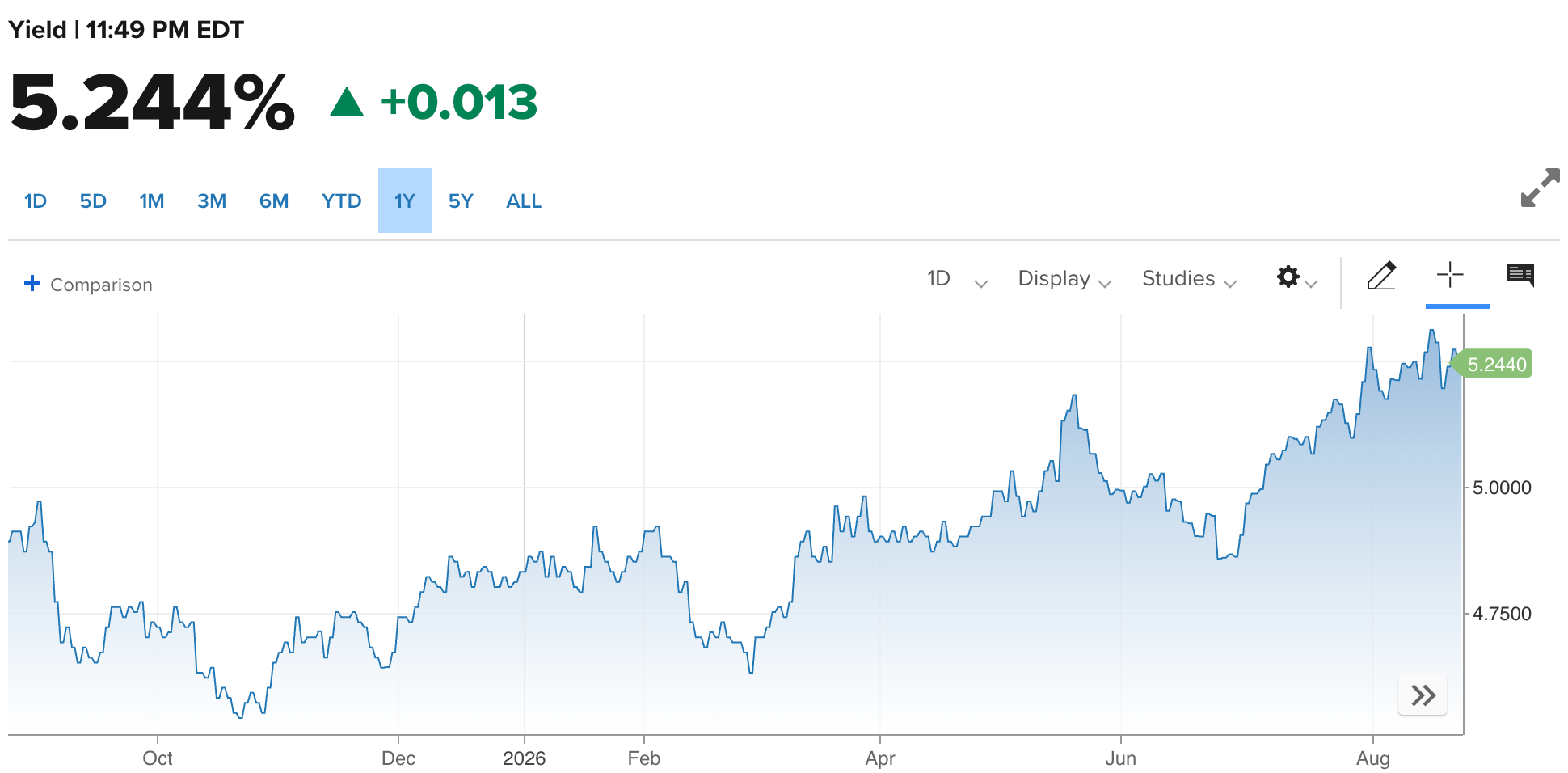
Billionaire investor Stanley Druckenmiller called Treasury Secretary Scott Bessent’s bond buyback plan a mistake. He argued governments that fight market fundamentals always lose.
Druckenmiller mentored Bessent early in his hedge fund career. He made his case in a Wall Street Journal opinion column.
Why Druckenmiller Pushed Back
Druckenmiller was responding to Bessent’s push to expand bond purchases. Treasury said it would at least double its buyback operations. That lifts the ceiling from $2 billion to $4 billion per operation, starting September 9.
“Governments defending prices against fundamentals always lose,” Druckenmiller wrote.
He argued that markets aggregate information no committee can replicate, and that the long-term Treasury yield checks government borrowing. Removing that check, in his view, removes fiscal accountability.

The intervention followed a sharp climb in the 30-year Treasury yield. It touched its highest level in nearly two decades before the buyback announcement. The national debt also surpassed $40 trillion this week.
Bessent has defended the buybacks as routine liquidity operations, not an attempt to suppress rates artificially. He told CNBC the Treasury has “a big toolkit” and could expand purchases further.
Yields Reflect Growth, Not Restriction
Druckenmiller argued the intervention makes little sense given current conditions. He noted the 10-year yield sits near the economy’s nominal growth rate. That, he said, makes financial conditions accommodative rather than restrictive.
“The bond market wasn’t being a vigilante,” Druckenmiller wrote. “It was being a pushover that had finally begun to clear its throat, and Treasury moved to quiet even that.”
The buyback’s early effect faded fast. Yields fell sharply after Wednesday’s announcement. They reversed the next day, with the 30-year climbing back toward its pre-announcement level. Strategists have called the move a temporary patch, not a fix for deeper fiscal pressures. Iran-related tensions have also weighed on bond markets in recent weeks.
The two worked together under George Soros early in their careers. Bessent reportedly spoke with Druckenmiller daily while running his own hedge funds.
Bessent may scale back the buybacks, or expand them further. That could depend on how Federal Reserve Chairman Kevin Warsh addresses long-term rates at his upcoming Jackson Hole remarks.
The post Bessent's Former Mentor Druckenmiller Slams Treasury Bond Buyback Plan appeared first on BeInCrypto.
Bitcoin’s price revival that began last Wednesday culminated, at least for now, a few hours ago when the asset soared past $80,000 for the first time since mid-May and tapped a multi-month peak above $81,000.
Analysts were quick to pick up the move and outline the next short-term targets of up to $88,000. BTC’s surge also led to an increase in liquidated short positions as the total value exceeded $260 million in the past 4 hours.
On a daily scale, the liquidations are up to $650 million, with the lion’s share coming from shorts again. Bitcoin is responsible for half of that amount, according to data from CoinGlass.
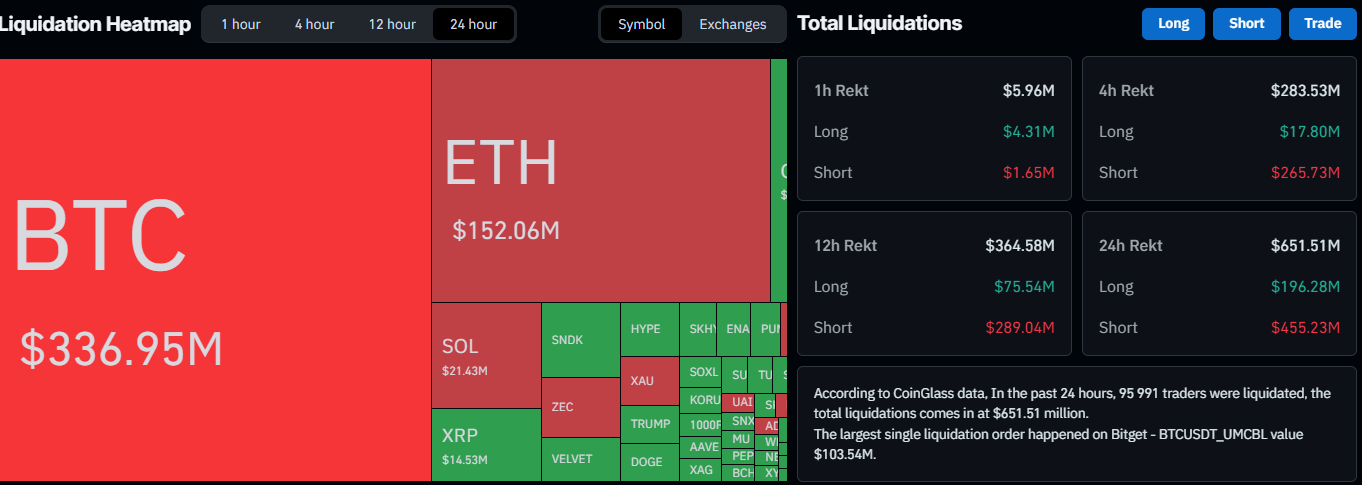
Thus, the primary cryptocurrency gained over $16,000 from its starting point of under $65,000 last Wednesday to just over $81,000 earlier today.
Some of the reasons behind this major resurgence include the US Treasury Department’s announcement from last week, the Crypto Summit in the White House, renewed ETF appetite, and Jim Cramer. Oh, wait, the last one might be a joke.
Some altcoins have followed BTC on the way up today, including ETH, which has neared $2,500 once again. Although the asset has soared by 32% in the past week, the $2,500 barrier appears too strong at the moment. XRP, on the other hand, fights for the $1.50 resistance.
SOL has surged the most from the larger-cap alts today, pumping by over 7.5%. It now trades above $100 for the first time in months as well.
The post Bitcoin Smashes $80K as $260M in Shorts Get Wiped Out: Here Are the Next Targets appeared first on CryptoPotato.


Cosmos Labs confirmed an ongoing security incident affecting users of the Cosmos EVM module. It advised chains in contact with it to ask validators to halt block production.
Three networks have now disclosed impact. KiiChain and TAC froze their chains after attackers drained accounts, while MANTRA restarted its mainnet.
3 Chains Traced Incidents to Cosmos EVM
Three networks disclosed security incidents within days of each other. All three named the Cosmos EVM module, a component that lets Cosmos SDK chains run Ethereum-style smart contracts.
MANTRA was first. BeInCrypto reported that the team halted the chain as a precaution amid a security incident in an upstream dependency. The team said two MANTRA-managed wallets were affected, and user balances were never impacted.
The network later informed users that the vulnerability was in the Cosmos-EVM module and that it had been fixed in version 8.4.0, allowing the network to resume normal block production.
Follow us on X to get the latest news as it happens
KiiChain then disclosed an exploit. The team said that on August 22, an attacker repeated the same technique 18 times, draining 148,326,583.15 KII before validators halted the chain at block 9355723.
“The vulnerability is in Cosmos code, not KiiChain code. It sits in the shared Cosmos EVM module (cosmos/evm), which KiiChain runs unmodified,” the team said.
The chain remains halted. KiiChain said the network will resume through a coordinated binary upgrade at a predetermined block height, with all validators applying the update simultaneously. The process will not require an on-chain governance proposal.
TAC halted the same day at block 24,671,475 after an attacker drained a single account. The team said the defect sits in the shared module rather than in TAC-specific code.
Cosmos Labs has pointed teams with questions to its security contact and said it will publish an incident report once the situation is resolved. It has not yet described the cause.
Subscribe to our YouTube channel to watch leaders and journalists provide expert insights
The post Cosmos Labs Confirms Cosmos EVM Incident as 3 Chains Disclose Impact appeared first on BeInCrypto.

Bitcoin hits $80k for the first time since May as rally continues

The Final ‘Peanuts’ Comic Strip Became Even More Heartbreaking the Next Day

Necessities Vs Luxury | Geetha Madhuri Financial Advice To Married Couple | Visual Talks Podcast





-

 Fashion3 days ago
Weekend Open Thread: Madewell – Corporette.com
-

 Business3 days ago
Musk’s Tesla, SpaceX Confirm $16.8 Billion ‘Terafab’ Chip Plant as World’s Largest Building in Texas
-

 Crypto World3 days ago
anatomy of crypto’s biggest liquidation event since 2021
-

 Business7 days ago
SMA Solar Technology AG (SMTGY) Q2 2026 Earnings Call Transcript
-

 Politics3 days ago
6 months on, Irish renters crushed by effects of government housing bill
-
 NewsBeat3 days ago
The ‘Lucky Dip Gang’ causing carnage for clicks: After five thugs were killed speeding in the wrong direction on a motorway, GUY ADAMS investigates a sick new trend… and why police aren’t even allowed to pursue them
-

 Tech6 days ago
GLM-5.3 hits the API at $1.4/$4.4 per million tokens
-

 News Videos5 days ago
Don’t Leave Your Financial Future To Chance | August 19, 2026
-

 Business2 days ago
Mystery AI Model ‘Ox Alpha’ Draws Developers With Free Access as Chinese Lab Origins Remain Debated
-

 Business5 days ago
Five Below: Kids Discount Retailer Reaps Rich Rewards
-

 Business7 days ago
Stock Market Today: Tech Futures Slide As Treasury Yields Jump; Nvidia, Micron, Sandisk Sell Off
-

 Business6 days ago
Marvell Shares Jump 7% as Google Chip Deal Confirms Custom AI Silicon Partnership, Analysts
-

 Tech7 days ago
Ken Okuyama’s Kode89 Supercar Features Three Pedals and a Choice of V12s
-

 Politics7 days ago
The House Opinion Article | Security means more than military spending
-

 Politics7 days ago
Ricky Gervais Denies ‘Snubbing’ BBC’s The Office Anniversary Special
-

 Sports2 days ago
Deshaun Watson fires back at Browns fans after being booed: ‘It’s a disrespectful thing’
-

 Tech7 days ago
Lock It Up: Android 17’s Latest QPR2 Beta Introduces a Built-In App Lock
-

 Tech7 days ago
This May Look Like Plastic Rods and a Hand Lever, But It’s Acutally a Digi-Comp 1 Mechanical Computer from 1963
-

 Crypto World7 days ago
BitBox Patches Code Execution and Bitcoin Lockup Flaws
-

 Fashion7 days ago
The Best Wide Leg Pants to Wear to Work
You must be logged in to post a comment Login