
Crypto World
Oil Falls Near 3% as Iran, Oman Restart Hormuz Corridor Talks

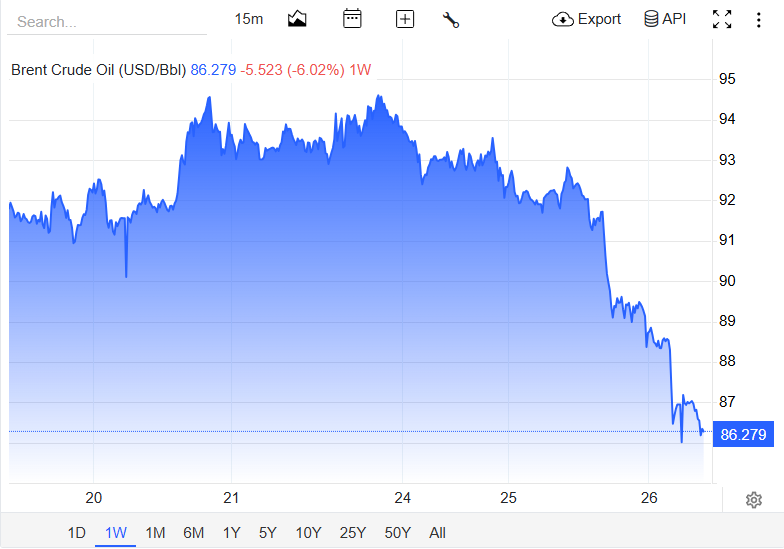
Oil prices fell about 2% on Wednesday. Iran said it resumed talks with Oman on managing the Strait of Hormuz, raising hopes for reopened shipping lanes.
Brent crude dropped to $86.27 a barrel, while US West Texas Intermediate slid to $80.87. Both benchmarks lost more than 3% on Tuesday.
Iran and Oman Discuss Temporary Hormuz Corridor
Iran and Oman have held on-and-off talks for weeks over Strait of Hormuz traffic. The waterway has historically carried about one-fifth of global oil and liquefied natural gas shipments. Volumes fell after fighting broke out in February.

The two countries said Tuesday they discussed a joint temporary navigational corridor. They also agreed to clear the strait of mines. Iran restarted the negotiations as it faces heightened economic pressure from President Donald Trump’s administration.
“The market continues to react to developments surrounding navigation through the Strait of Hormuz, and hopes for progress in talks between Iran and Oman have triggered selling.”
Mitsuru Muraishi, an analyst at Fujitomi Securities, told Reuters.
Washington expanded sanctions targeting Iran on Monday, threatening countries that keep doing business with Tehran. However, penalties will not take effect immediately.
US Sees Lower Risk of Escalation
The US has begun returning personnel to some Middle East diplomatic missions evacuated during the conflict. Two people familiar with the matter said.
The personnel shift therefore suggests Washington sees a lower near-term risk of escalation. Some embassies will initially run below full capacity.
Meanwhile, an unidentified projectile struck and disabled an oil tanker on Tuesday. The incident occurred nine nautical miles northeast of Ash Shishah, near Oman’s entrance to the strait. The United Kingdom Maritime Trade Operations (UKMTO) reported the strike.
Rising US Crude Stocks Add to Selling Pressure
The American Petroleum Institute (API) reported a rise in US crude inventories. Stockpiles increased by about 4.2 million barrels in the week ended August 21, market sources said.
Analysts polled by Reuters had forecast a 600,000 barrel increase. Official data from the Energy Information Administration (EIA) are due Wednesday at 10:30 a.m. ET.
In contrast, Muraishi said uncertainty over the outlook has prompted bargain buying, which could keep prices range-bound in the near term.
The post Oil Falls Near 3% as Iran, Oman Restart Hormuz Corridor Talks appeared first on BeInCrypto.

Crypto World
Bitcoin Dominance on the Rise Again as BTC Tapped 15-Week Peak Above $81K: Market Watch
Bitcoin’s price initiated another leg up in the past several hours, blasting past $80,000 and $81,000 for the first time since the middle of May.
BTC even outperformed many larger-cap altcoins, which resulted in an uptick in its dominance over the market.
Bitcoin Exceeded $81K
It was just a week ago when we were wondering what would be the new (old) thing that we could write about the crypto market, as bitcoin had stalled below $65,000 for a long, long time. However, Wednesday afternoon changed the trend. Whether it was the US Treasury Department’s announcement, the White House Crypto Summit, or something else, BTC exploded out of the gate with force.
It went to $70,000 within a few hours, dipped back to $68,000, and then skyrocketed once again to $75,000 by Thursday. The bulls took it a step further on Friday, helping BTC climb to almost $80,000 for the first time since mid-May.
After gaining $15,000 in days, the asset was due for a correction, which took place during the weekend with a price slip to $75,500. Nevertheless, the bull returned in full force at the start of the new business week, pushing bitcoin to over $81,000 earlier today to mark a 15-week peak.
It was stopped there and now sits inches below $80,000, but its market cap has risen to $1.6 trillion. Its dominance over the alts has rocketed to 58% on CG and to almost 60% on CMC after its latest run.

SOL Touches $100
Solana’s native token is the top performer among the larger-cap alts today, surging by 7% to over $100 for the first time in months. HYPE has neared its all-time high of $83, marked a few days ago, once again, as it now sits close to $82. ZEC has surpassed DOGE as the 10th-largest cryptocurrency by market cap.
XMR and RAIN are the other top performers from this cohort of assets, while MORPHO, AAVE, and LTC have dropped the most. Meanwhile, ETH remains inches below $2,500, XRP is stuck at $1.50, and BNB is back above $700.
The total crypto market cap has added nearly $100 billion since yesterday and is up to $2.770 trillion on CG.

The post Bitcoin Dominance on the Rise Again as BTC Tapped 15-Week Peak Above $81K: Market Watch appeared first on CryptoPotato.
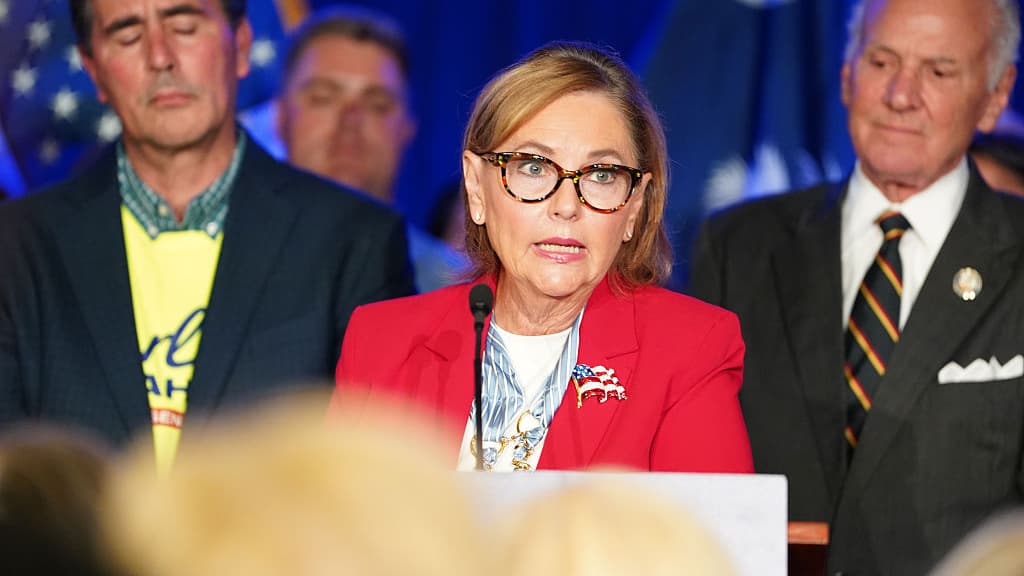
“There is still a big hole in my heart,” Nordone told supporters at a rally, “but I know he’s looking down right now very proud of everyone in this room.”
Nordone will next face off against the Democratic candidate Annie Andrews, a pediatrician who won her primary in June. The upper chamber seat, though, is unlikely to flip in Democrats’ favor; the Cook Political Report rates the race as “Solid Republican.”
In June, Graham won the Republican primary race to compete for his fifth term as Senator, but after his death the following month, a special primary election was called for Aug. 11. While Nordone, who was appointed by South Carolina’s Governor to serve out the remainder of her brother’s term, earned the highest share of the vote on Aug. 11, she fell short of the majority she needed to win the race, triggering the runoff. Nordone earned nearly 33% of the vote on Aug. 11, while her opponent, U.S. Rep. Ralph Norman, came in second, with nearly 25%, sending both candidates to the runoff race.

Bitcoin completed a remarkable turnaround in the past week, surging from under $65,000 on Wednesday to a three-month high above $81,000 earlier this morning.
The move began abruptly on August 19, accelerated in the following days, and, unlike the previous breakout attempts, was not halted painfully in its tracks. Obviously, something changed in the market, but the question is what precisely.
Who Lit the Fuse
The most talked-about reason behind the initial leg up was the US Treasury Department’s announcement last Wednesday that the government would at least double buybacks of longer-dated Treasury securities. This meant an increase in 10- to 30-year debt from $2 billion to at least $4 billion per operation.
At its core, the move was aimed at improving liquidity and easing pressure in the long end of the bond market, where borrowing costs had skyrocketed. Risk-on assets like BTC, alongside gold, reacted immediately with a surge from $64,000 to $70,000, while Treasury yields declined initially.
Here’s where this narrative breaks down. Long-term yields rebounded almost immediately, while BTC’s price rocketed by another $10,000-$11,000. According to analysts from the Kobeissi Letter, this suggested that investors were interpreting the Treasury intervention not merely as lower-yield support but as evidence of growing pressure surrounding the US’s fiscal policy.
As previously reported, US federal debt recently surpassed $40 trillion, while persistent deficits and massive refinancing requirements intensified uncertainty about how the government will manage the situation.
Debasement Trade Returns
The US dollar is the second macro piece in this equation. Treasury intervention pressured the greenback and revived Wall Street calls for the debasement trade: capital moving toward scarce assets, like BTC and gold, when investors fear that fiscal and monetary policies could gradually erode fiat purchasing power.
The precious metal exceeded $4,600 per ounce during bitcoin’s rally past $81,000. This synchronized move strengthened the argument that investors are treating both assets as alternatives to government-issued money.
Ray Dalio added fuel to that fire a few days ago, warning of a potential US debt crisis and recommending investors own gold and a ‘bit of bitcoin,’ while the dollar fell to a multi-month low.
Changes in Liquidity Expectations
The Treasury Department’s move led to another important change as markets are increasingly debating whether the government could use its enormous Treasury General Account more aggressively to support the bond market. The account recently stood at around $950 billion, and speculation that some of this liquidity could effectively be deployed through expanded Treasury operations has gained significant attention.
Although this is not quantitative easing, in fact, it’s very far away from it, if Treasury actions reduce pressure on long-term borrowing costs, weaken the dollar, or inject additional liquidity into financial markets, the broader environment becomes considerably more favorable for scarce and risk-sensitive assets such as BTC.
Who Amplified the Move
Appetite for BTC through the spot Bitcoin ETFs returned with vengeance last week as the figures showed a massive resurgence: almost $2 billion entered the funds in just five days, hitting a ten-month record. Expectedly, the demand accelerated after Wednesday.
Separately, the rapid move from under $65,000 to $70,000 first and $75,000 a day later forced heavily leveraged bearish trades to close positions. More than $4 billion in shorts were liquidated in less than two days, which helps explain the extreme nature of the reaction.
The Treasury announcement was the initial spark, followed by falling confidence in the dollar, which, alongside America’s fiscal trajectory, strengthened demand for scarce assets. ETF inflows added genuine spot demand, while short liquidations accelerated an already powerful surge.
The post Why Did Bitcoin Explode Past $81K? 4 Macro Factors Behind the Rally appeared first on CryptoPotato.


Anthropic will tell IPO investors it is chasing a market above $30 trillion, the Wall Street Journal reported Tuesday. That tops SpaceX’s $28.5 trillion pitch, the largest market claim in IPO history.
The Claude maker could file its prospectus before the end of August. Bankers have floated a raise above $100 billion at a valuation near $2 trillion. Both would be records.
A $30 Trillion Dream Sold on Future AI Work
A total addressable market (TAM) is the revenue a company could earn if it won every possible customer. Anthropic’s version counts the value of work AI models could one day perform, according to the WSJ report.
In plain terms, the pitch prices the automation of much of human labor. The dream carries the weight, because today’s sales sit nowhere near that scale.
The goalposts have moved fast as Saudi Aramco’s $25.6 billion raise in 2019 stood as the IPO record until June. Then SpaceX raised $85.7 billion while claiming a $28.5 trillion market, most of it tied to AI.
Now compare Anthropic’s claim with reality. The 191 technology companies in the S&P 1500 earned about $2.4 trillion last year. The pitched market is 12 times what the entire listed US tech sector brings in.
NYU professor Aswath Damodaran, widely known as the dean of valuation, said SpaceX’s AI math already pushed past the plausible.
Anthropic’s own forecast of up to $200 billion in revenue by 2028 would capture under 1% of the claimed market.
Anthropic IPO Rests on Record Revenue and Thin Profits
The growth is real, after Anthropic’s annualized $65 billion run rate at the end of July compared with roughly $9 billion in late 2025. That is a sevenfold jump in seven months.
Preliminary second-quarter revenue topped $11.5 billion, a 14-fold rise from a year earlier, according to figures first reported by Bloomberg. The quarter also produced positive adjusted operating income, reportedly a first among frontier AI labs.
However, the fine print matters. The numbers are unaudited and could be revised before the filing lands, per Bloomberg. Adjusted profit also typically strips out costs such as stock pay.
Heavy compute bills could push later quarters back into losses. Meanwhile, the private market’s $965 billion price from May would need to roughly double within months, on one adjusted-profit quarter.
That gap defines the offering. Investors would fund years of infrastructure spending long before sustained profits arrive, hoping the raise can top SpaceX’s record haul.
Political Backlash and Rising Yields Test the Timing
Venture investor Chamath Palihapitiya sees three threats to the AI buildout:
- A spreading anti-AI mood
- Political pushback against data centers, and
- Treasury yields at multi-year highs.
The pushback is no longer talk. Texas froze new data center projects in August pending state audits. Pennsylvania Governor Josh Shapiro signed an order ending their fast-track permits, and New York imposed a one-year moratorium.
Meanwhile, borrowing costs keep climbing. The Treasury boosted bond buybacks to hold down long-term yields, partly because heavy AI-linked debt issuance weighs on the market.
Anthropic knows the risk, which explains their reported plans to list negative sentiment toward AI as a risk factor in its own prospectus. The firm also leans on Amazon and Google for compute and holds no investment-grade credit rating.
The filing, which is likely due within days, will show how much of the $30 trillion story survives full disclosure. With OpenAI’s 2027 listing timeline trailing behind, Anthropic’s reception could shape every AI debut that follows.
The post $30 Trillion Dream: Can Anthropic Sell the Biggest IPO Ever? appeared first on BeInCrypto.

The Huawei booth at the Mobile World Congress in Barcelona, 2025.
Arjun Kharpal | CNBC
BEIJING — U.S.-based personal computing and printing firm HP has signed a multi-year global agreement for licensing certain WiFi patents from Chinese telecoms giant Huawei, the companies announced Wednesday.
It’s a sign of adoption of Huawei’s technology outside China, despite the U.S. blacklisting the company in 2019, a move that restricted it from working with American suppliers such as Google.
The deal comes after a patent dispute involving HP, Huawei and other companies that resulted last fall in an agreement allowing the U.S. company to access a pool of 2,000 patents related to wireless network connectivity. Huawei was one of the founding members of the patent pool, called Sisvel WiFi 6.
The latest global cross-licensing agreement includes “valuable reciprocal patent rights from HP,” Steven Geiszler, who represented Huawei in the negotiations, said in a statement. Texas-based Geiszler was a senior in-house intellectual property lawyer for Huawei for nearly a decade, until he set up his own firm in April with Huawei as his main client.
HP is scheduled to release earnings Thursday morning Beijing time. HP was spun-off as a separate firm in 2015 after Hewlett-Packard Company was split into two units.

It was less than a week ago when we last wrote a major Ripple (XRP) update, and the landscape was entirely different. Not that the company behind the token hadn’t made some major moves, because it frequently does, but because the underlying asset was stuck at $1.00 and analysts were wondering whether that support would hold or we were in for another major leg down.
The environment is entirely different now, and we will take a look at what has taken place in the Ripple ecosystem over the past week, especially on the XRP price front.
FedNow, Gemini, XRPL
Multiple reports emerged online in the past few days that FedNow Payments has enabled payments through Ripple’s tokens after the company’s integration with Volante. FedNow is an instant payments rail in fiat USD that settles on central bank reserves, while Volante provides platform connectivity to the former for domestic payments in the US and to Ripple for cross-border services.
Separately, Gemini’s co-founder, Tyler Winklevoss, announced some “big news for the Ripple Army in Asia.” In a tweet from today, he said users of the cryptocurrency exchange he co-founded with his twin brother in Singapore can deposit and withdraw XRP through the native XRP Ledger network.
Speaking of XRPL, Ali Martinez cited data from Santiment and highlighted a major surge in activity. The number of active addresses skyrocketed by over 650% in the past several days, going from 47,180 to just over 356,000. The popular analyst concluded that such a major spike “typically signals a sharp increase in network participation and is often accompanied by higher price volatility.”
XRP ETFs Are Back, CEO Speaks Out
The major market shift is evident in institutional appetite as well. The spot XRP ETFs, which struggled for weeks with insignificant inflows, picked up the pace last week, especially after Wednesday. In total, they attracted almost $40 million in net inflows, which became the best weekly performance since May.
Moreover, the total cumulative flows hit a new all-time high of just over $1.55 billion, while Bitwise’s XRP fund extended its lead as the largest of the bunch.
Meanwhile, Ripple’s CEO Brad Garlinghouse spoke on Saturday for the first time after attending two major Washington meetings last week – the Crypto Summit at the White House hosted by the POTUS and CFTC’s Innovation Advisory Committee. He noted that the conclusion from both meetings is that all parties involved, including TradFi, want clear regulation on the crypto industry, which is likely to come from the highly anticipated CLARITY Act.
XRP Price Revival
As promised above, we will dedicate a major part of this update to the native token’s recent performance. Recall that it was less than seven days ago when the asset struggled to remain above the psychological $1.00 support and dipped below it on a few occasions as the overall sentiment had quickly deteriorated.
However, then came the Wednesday afternoon resurrection of the crypto market, led initially by BTC. Although XRP was a little late to the party, it eventually joined in full force. It skyrocketed from $1.00 to $1.70 by Saturday morning, posting a massive 70% surge in less than 72 hours.
Most of the ‘blame’ was put on whales, as on-chain data showed that they had accumulated roughly 400 million tokens in several days. However, XRP was quickly halted at $1.70 and is now back to around $1.50. Most analysts are now convinced that the asset has to reclaim the $1.65-$1.70 resistance before we can call it a bull phase again.
Popular trader CasiTrades doubled down earlier today on the importance of that level, indicating that it was “incredible to see XRP rally all the way back up to test the macro .618 resistance,” but admitted that it was met with “heavy resistance and instant rejection.”
“So now XRP needs to prove it can actually sustain this rally. We need [the] price to break above the macro 0.618 and then come back to successfully test that level as support. THAT is the structural shift that would signal beginning a new trend.”
The post Important Ripple News and XRP Price Update: August 25 appeared first on CryptoPotato.
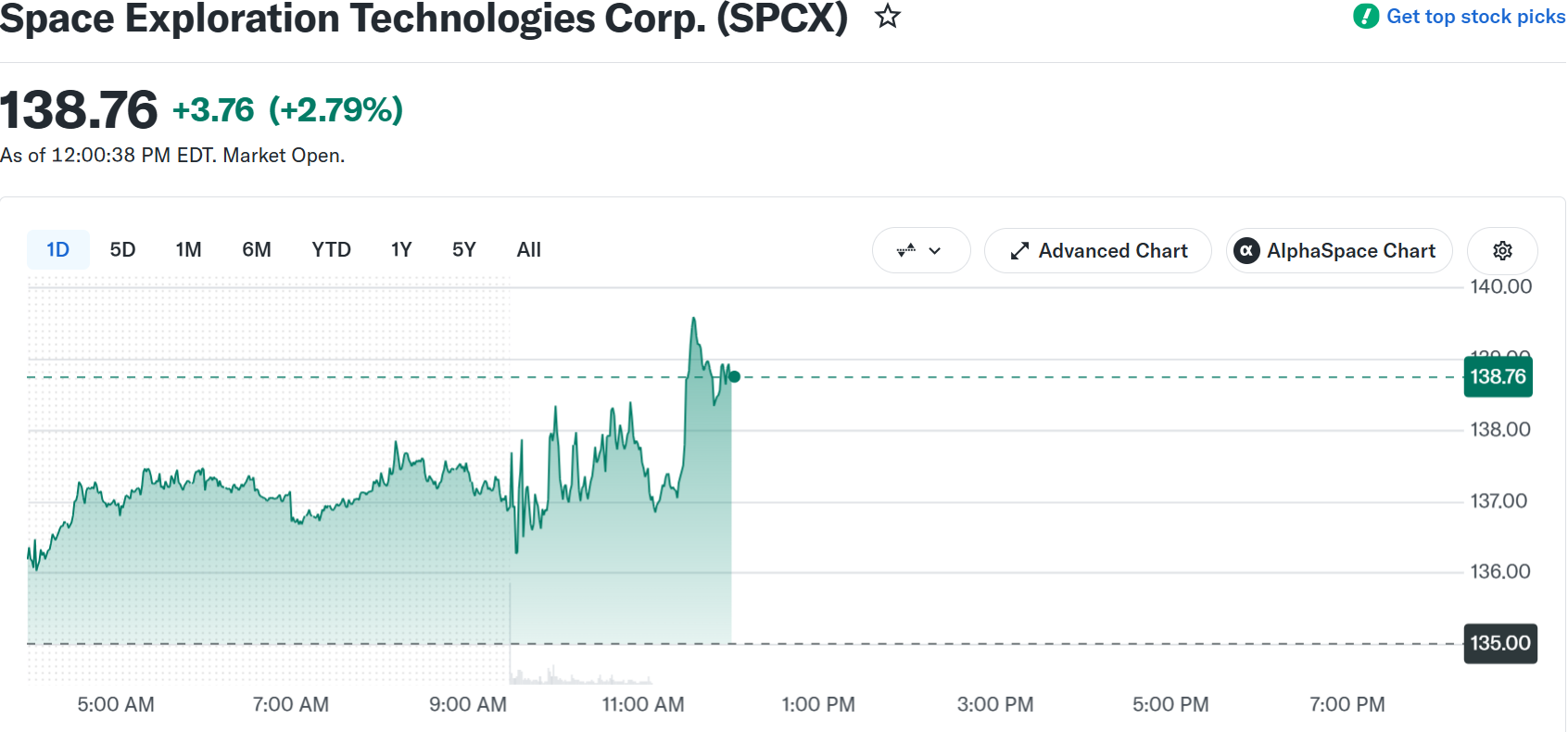
President Donald Trump praised Space Force on Truth Social on Tuesday. SpaceX (SPCX) stock rose 2.79% the same morning. The two facts look connected, but are they?
SpaceX depends on Space Force contracts worth billions of dollars. That link led traders to ask whether a single post could move the stock.

Why Trump’s Post Put SpaceX Stock in the Spotlight
Trump said in a Truth Social post that the US Navy had cleared every mine from the Strait of Hormuz. He warned Iran against placing new ones. Then he named the agency that pays SpaceX billions.
“Through Space Force, we are watching every square inch of the Strait, as we are, also, with Pickaxe Mountain and the already destroyed three other Nuclear sites,” Donald Trump, President of the United States, in the statement.
The money trail behind that name is real, because in May, Space Systems Command gave SpaceX a $2.29 billion contract to build a military data network. In July, it added a $1.6 billion order for 18 Falcon 9 launches.
Trump’s words have moved defense stocks before. In December 2016, one Trump tweet about F-35 costs erased about $3.5 billion of Lockheed Martin’s value almost immediately.
Last month, CNN found Trump had praised stocks he owned in 21 companies on Truth Social.
Premarket Timing and Rival Catalysts Weaken the Link
The clock clears the post. Data shows SPCX was already up more than 1% in premarket trading. The post appeared mid-morning in New York, an hour after the open. The stock had also dropped 1.4% to $135 on Monday, so part of Tuesday’s gain may have been simple recovery.
A stronger catalyst was already public because a financial disclosure released on August 22 showed that Trump bought $15,001 to $50,000 worth of SPCX on June 23.
That was less than two weeks after the company’s $1.77 trillion initial public offering (IPO). The White House says independent institutions manage his portfolio.
Wall Street supplied another driver on Tuesday. JPMorgan repeated its $240 target, a call implying nearly 80% upside on the company’s artificial intelligence (AI) bets.
TipRanks data shows 33 analysts rate SPCX a Moderate Buy. Their average target is $228.59.

The contrast with 2016 is telling, as a Lockheed tweet named a company and threatened its biggest program.
Tuesday’s post named no company, no cost, and no contract. No analyst tied the gain to it.
SPCX gained 24% in August after reclaiming its IPO price earlier this month. Roughly 370 million insider shares unlock in September. That supply wave, not one presidential post, is the number for shareholders to watch.
The post Did Trump Just Move SpaceX Stock With One Truth Social Post? appeared first on BeInCrypto.
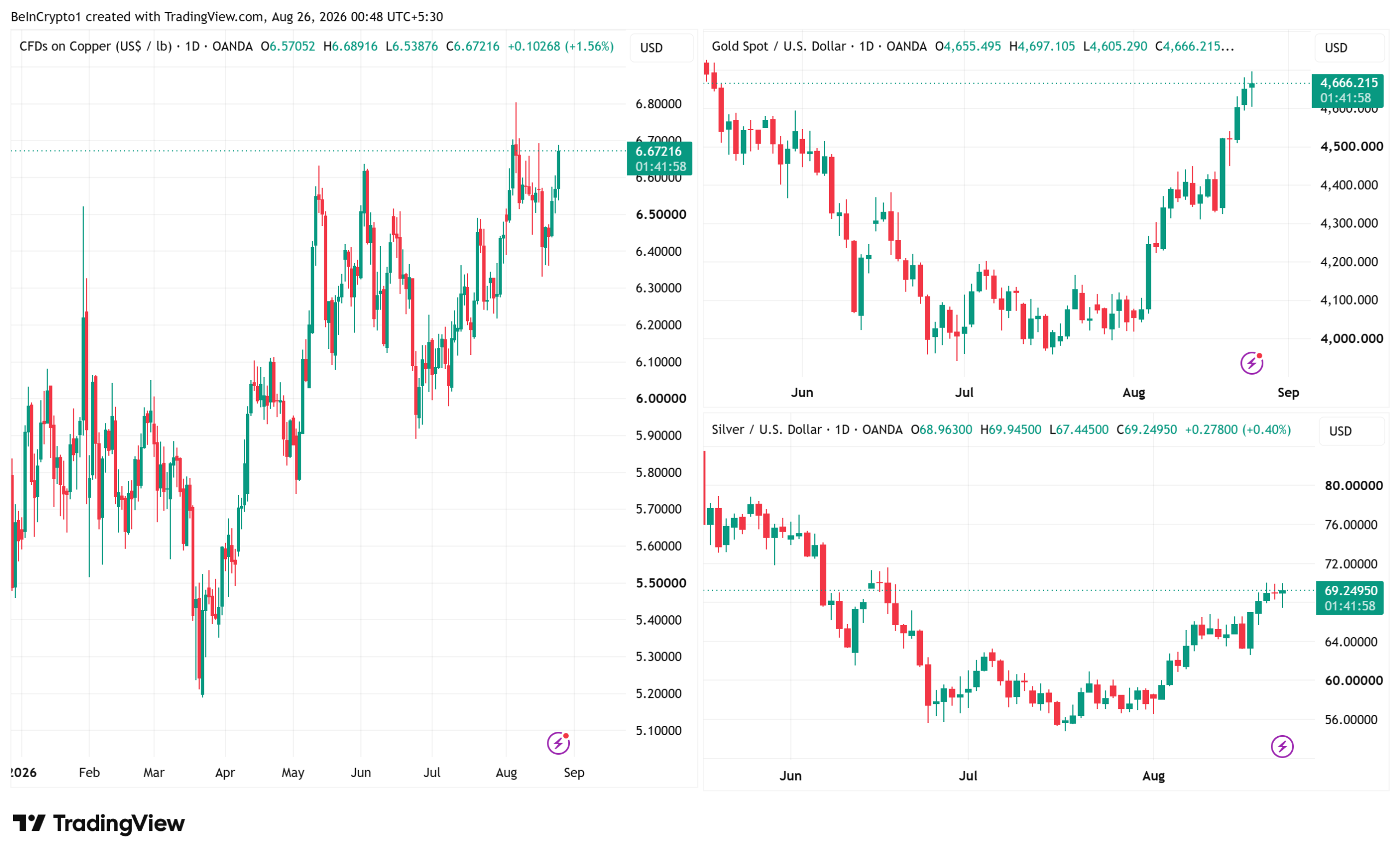
Copper futures settled at $6.71 per pound on Comex on Tuesday, the highest closing price in the metal’s history. The debasement trade is lifting metals and crypto together.
The trade describes investors rotating into scarce assets on bets that US debt management will erode the dollar. Gold, silver, and Bitcoin (BTC) are all climbing on the same fear.

Treasury Buybacks Revive the Debasement Trade
September copper futures ended the day at $6.71, up roughly 1.6%, according to Trading Economics. Market data firm Barchart had flagged the contract as on course for its strongest closing price in history during the session.
Supply strain explains part of the move, with reports indicating that London Metal Exchange stockpiles fell 14% since late July to 214,550 tonnes. Chile also trimmed its output forecast for a second straight quarter, and an outage at Indonesia’s giant Gresik smelter tightened the market further.
Those shortages powered copper’s record-breaking run earlier in August. The monetary backdrop has since taken over as the main driver.
The US Treasury last week doubled its maximum bond buyback size to at least $4 billion from $2 billion. Critics read the expanded buyback program as stealth easing that shifts pressure onto the currency.
The dollar index sits near three-month lows after its third losing week in four. Gold, meanwhile, traded around $4,666 an ounce and is tracking its best month since 1999. The metal has risen for five straight weeks, gaining more than 5% last week alone, while silver held near $69.
Deutsche Bank analyst Michael Hsueh sees room for a push to $4,800, which would extend gold’s three-month high.
“The government’s financial condition is at an inflection point,” Bridgewater Associates founder Ray Dalio indicated.
Follow us on X to get the latest news as it happens
Bitcoin Rides the Same Wave Toward $80,000
Bitcoin has moved in lockstep with the metals. BTC trades near $78,900, up about 0.23% in 24 hours, according to BeInCrypto Markets data.

The largest cryptocurrency briefly topped $81,000 earlier on Tuesday, its strongest level since May. Its 22% jump last week ranked as its sharpest three-day rally in years.
The Treasury announcement also caught bearish traders off guard. CoinGlass data showed more than $4 billion in short positions liquidated during the breakout.
Stephen Coltman, head of macro at asset manager 21Shares, told CNBC the buyback mattered more for its message than its size.
“The [signaling] effect was very powerful.”
Therefore, one policy decision now anchors three separate rallies. Copper adds a supply squeeze, gold adds central bank credibility fears, and Bitcoin adds a short squeeze on top.
Whether the run continues may depend on the dollar’s next move. Traders will watch upcoming Treasury buyback operations for any sign the pressure on the currency deepens or fades.
The post Copper Hits Highest Close in History as Debasement Trade Lifts Metals and Crypto Alike appeared first on BeInCrypto.
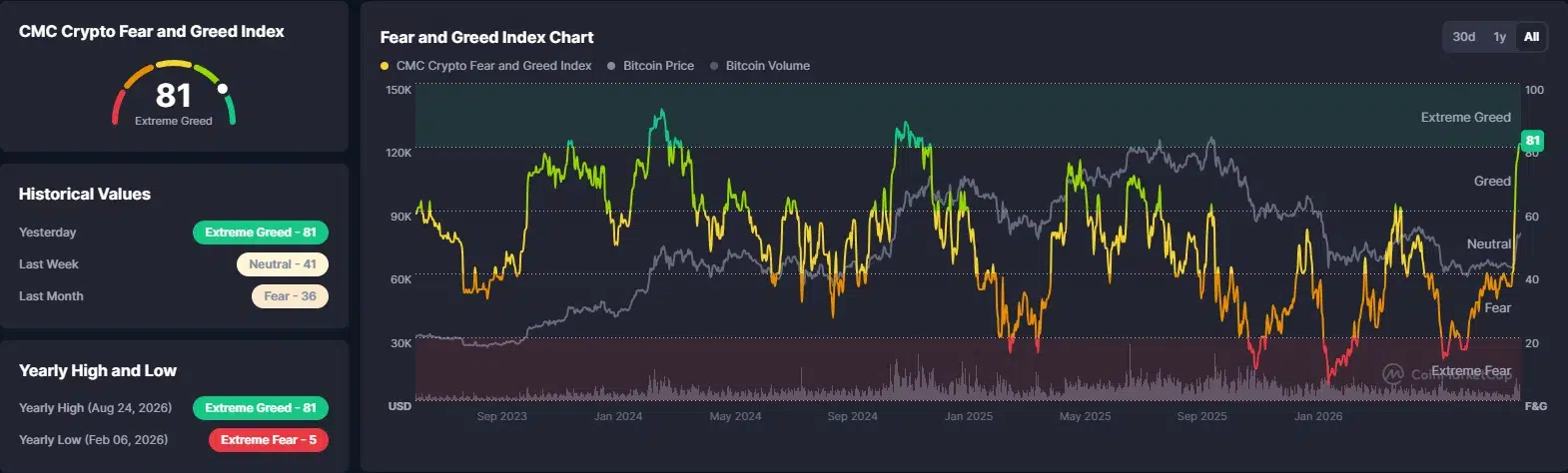
The cryptocurrency market has entered “extreme greed” for the first time since late 2024, with CoinMarketCap’s sentiment index reaching 81 after Bitcoin gained about 24% in seven days.
Summary
- CoinMarketCap’s Fear and Greed Index rose from 41 to 81 within one week.
- The reading has climbed 45 points from its level of 36 one month ago.
- Bitcoin’s weekly rally coincided with heavy short liquidations and renewed U.S. ETF demand.
- Alternative.me’s separate index remains in greed, showing differences between the two methodologies.
Crypto Fear and Greed Index reaches 81
CoinMarketCap’s Fear and Greed Index registered 81 late on Aug. 24 and remained at the same level the following day, placing cryptocurrency sentiment in its “extreme greed” category.
One week earlier, the gauge stood at 41, while its reading a month ago was 36. The latest figure represents a 40-point increase over seven days and a 45-point rise across the month, reversing the caution seen during much of the first half of 2026.
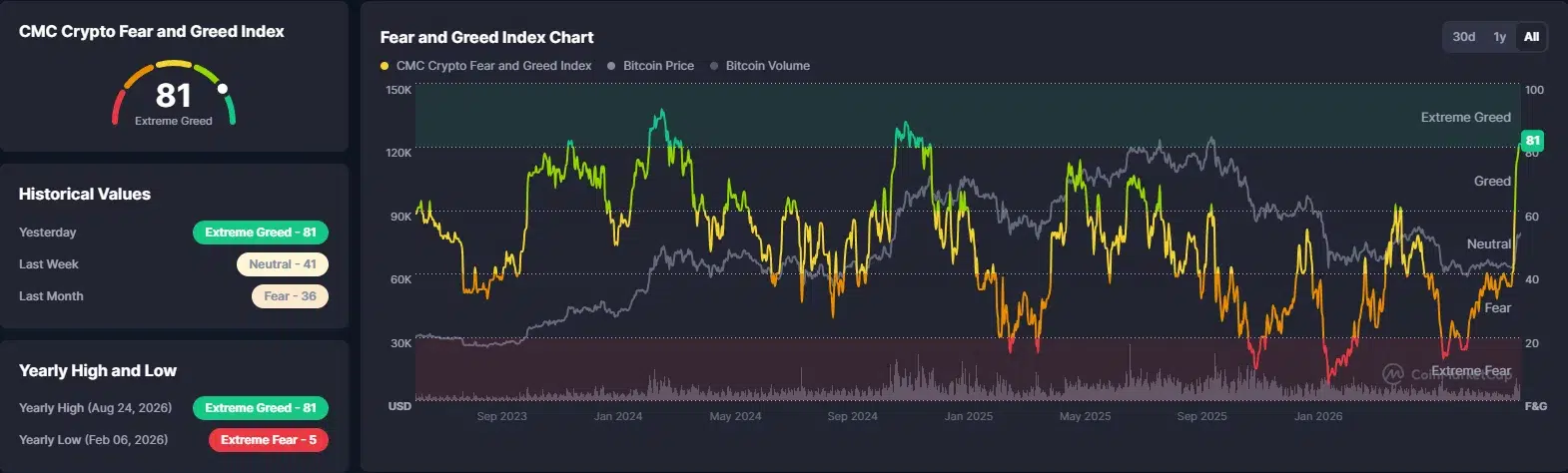
Extreme greed begins at 80 under CoinMarketCap’s classification. A reading above that threshold points to strong buying interest and high confidence, although the platform says elevated sentiment may also indicate that the market is overheated and vulnerable to a correction.
CoinMarketCap builds the index from five groups of data: price momentum, volatility, derivatives activity, market composition, and its own social and engagement information. Price performance covers the 10 largest non-stablecoin cryptocurrencies, while the derivatives component includes put-to-call ratios for Bitcoin and Ethereum options.
The methodology also uses Bitcoin’s value relative to stablecoin supply, along with searches and user activity recorded by the platform. Since each input reacts differently to changing market conditions, the reading does not measure price performance alone.
February offered the opposite picture. The index fell to 5 on Feb. 5, its lowest point of 2026 and a level associated with extreme fear. Its advance from 5 to 81 has carried the gauge from its most bearish category to its most bullish one in less than seven months.
As reported in July, Bitcoin traded near $58,000 to $60,000 while sentiment readings sat in the low teens. At the time, spot Bitcoin exchange-traded funds had recorded $4.5 billion in June outflows, and aggregate crypto open interest had fallen from more than $90 billion to about $44.5 billion.
Bitcoin’s 24% rally drives the sentiment jump
Bitcoin supplied much of the price momentum behind the latest reading, climbing about 24% over the week and briefly moving above $80,000 for the first time since May. The cryptocurrency traded near $79,000 on Aug. 25 after easing from an intraday high around $81,255.
CoinMarketCap said Bitcoin rose 24% as its sentiment reading moved from 41 to 81. The platform also placed the total cryptocurrency market value at about $2.67 trillion on Aug. 24, up 23.8% over seven days.
Even with gains across several large cryptocurrencies, Bitcoin retained close to 60% of the market’s total value. CoinMarketCap placed its dominance at approximately 59.7% on Aug. 26, indicating that the largest cryptocurrency continued to account for most of the sector’s capitalization.
The rally began after Bitcoin broke out of a trading range near $62,000 to $65,000 on Aug. 19. As the price passed $70,000, traders holding leveraged bearish positions had to buy back Bitcoin to close their trades, adding forced demand to the advance.
According to CoinGlass figures cited in coverage of the squeeze, approximately $2.7 billion in bearish crypto positions were liquidated over 24 hours. More than $1 billion of Bitcoin shorts closed within about one hour, while short trades accounted for about 92% of nearly $3 billion in total liquidations across more than 172,000 traders.
Liquidation figures differ depending on the reporting period. Estimates covering the full two-to-three-day advance placed total crypto short liquidations above $4 billion, whereas the $2.7 billion figure covered the main 24-hour breakout through $70,000.
Treasury buybacks preceded the Bitcoin breakout
The U.S. Treasury announced on Aug. 19 that it would at least double the maximum size of liquidity-support buybacks for 10-to-20-year and 20-to-30-year nominal coupon securities.
Beginning Sept. 9, the purchase cap will increase from $2 billion to at least $4 billion per operation. Treasury said the adjustment is intended to improve liquidity in longer-dated government debt, where older securities can become harder for dealers to trade.
Bond yields and the U.S. dollar weakened after the announcement, while Bitcoin rose from an intraday low near $64,100 to roughly $69,500 within 12 hours. The 30-year Treasury yield fell from a 19-year high above 5.34% to about 5.19%, and the 10-year yield declined to 4.647%.
As crypto.news previously detailed, the buyback increase does not take effect until September, meaning no money from the expanded operations had entered the market when Bitcoin began climbing. Treasury buybacks also differ from Federal Reserve quantitative easing because the department funds the purchases through debt issuance rather than creating central-bank reserves.
Market participants still linked the announcement to easier financial conditions, lower long-term yields, and the subsequent demand for risk assets. Treasury has not said that its program was designed to support Bitcoin, nor has it established that the buyback decision directly caused the cryptocurrency’s rally.
The distinction matters for U.S. investors because Treasury yields affect the returns available from government debt. When bond yields fall, investors may allocate more capital to stocks, commodities and cryptocurrencies, but Bitcoin remains exposed to sharp price changes even when macro conditions appear supportive.
U.S. Bitcoin ETFs add spot demand
U.S.-listed spot Bitcoin ETFs recorded about $517 million in net inflows on Aug. 19, followed by approximately $606 million on Aug. 20, according to SoSoValue data. The two sessions brought more than $1.1 billion into the funds as Bitcoin moved through $70,000 and $75,000.
Across the five trading days ending Aug. 21, the products attracted approximately $1.9 billion. The inflows gave American investors more Bitcoin exposure through regulated brokerage and retirement accounts without requiring them to hold the asset directly.
Spot Ether ETFs added about $221 million on Aug. 20, while XRP and Solana investment products received approximately $13 million and $15 million, respectively. Combined flows into Bitcoin and Ether funds reached roughly $2.3 billion during the rally period.
Analysts interviewed for a Bitcoin demand assessment said continued ETF and cash-market purchases would be needed after short covering faded. Nansen senior research analyst Nicolai Søndergaard described the price action as an improvement in market structure but said it did not yet confirm that the full market cycle had turned.
Bitget Wallet research analyst Lacie Zhang also attributed the advance to a mix of ETF purchases, macro conditions, and forced buying from bearish traders. She said fresh spot demand would need to continue for Bitcoin to remain above $80,000 after the squeeze ended.
Alternative.me records a less extreme reading
Alternative.me’s sentiment gauge remained in the “greed” category rather than extreme greed, sitting about six points below its own extreme threshold when the CoinMarketCap reading reached 81.
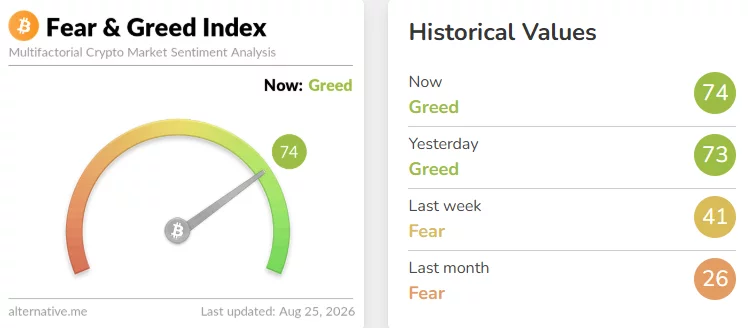
The difference comes from separate inputs and scoring methods. Alternative.me’s index focuses mainly on Bitcoin and uses volatility, market momentum and volume, social-media activity, Bitcoin dominance and Google search trends.
Volatility and market momentum each carry a 25% weighting. Bitcoin dominance accounts for 10%, while search trends contribute another 10%. The service lists surveys as a 15% component but says polling is currently paused.
Alternative.me says rising Bitcoin dominance can indicate that traders are moving away from more speculative tokens, which its model may interpret as fear rather than greed. CoinMarketCap instead measures conditions across the 10 largest non-stablecoin cryptocurrencies and includes Bitcoin and Ethereum options data.
Both gauges nonetheless recorded a rapid improvement in sentiment as Bitcoin recovered from its midyear lows. Alternative.me says its index should not be treated as investment advice and warns that excessive greed can precede a market correction.

India is reportedly preparing to test its first tokenized corporate bond issuance in September, linking blockchain settlement with the country’s central bank digital currency (CBDC). The initiative is expected to be piloted through a limited group of investors before any broader market rollout.
According to Reuters, REC Limited—an Indian, state-controlled power infrastructure finance company—plans to issue less than 5 billion Indian rupees (about $57 million) in tokenized bonds. The report, published Monday and based on three sources familiar with the plans, says the pilot could be announced at an annual financial technology event in Mumbai in September.
Key takeaways
- REC Limited is reportedly planning an initial tokenized corporate bond issue of under 5 billion rupees, with timing pointing to September.
- The pilot is expected to use India’s CBDC for purchasing the bonds, tying tokenized securities directly to central bank settlement.
- Participation may require two separate digital accounts: a wholesale CBDC wallet and a dedicated electronic securities wallet.
- Depositories are developing “DEMAT 2.0” to track bond holdings using distributed ledger technology.
- A short initial lockup of three months is expected, with plans for secondary trading to emerge by December.
A tokenized bond pilot built around the CBDC
Reuters reports that India’s central bank digital currency will be used to buy the tokenized bonds during the pilot. That design matters because it targets end-to-end integration—where tokenized securities are not merely recorded on a ledger, but also settled through a central bank-backed digital payment rail.
Under the reported setup, investors would need two digital accounts to participate. One is described as a wholesale CBDC wallet provided by a bank, while the other is a new electronic securities wallet intended to hold and record tokenized bond positions.
This approach differs from earlier tokenized asset experiments that often focused on issuance and recordkeeping while relying on traditional payment and settlement mechanisms for transfers. If implemented as described, India’s pilot would aim to reduce settlement friction by bringing securities settlement and payment settlement into a more unified flow.
DEMAT 2.0 and the push for blockchain-based securities records
The securities wallet at the center of the pilot is being developed by India’s securities depositories. Reuters refers to the project as “DEMAT 2.0,” which is expected to record bond holdings using distributed ledger technology.
Reuters also reports that India’s central bank (the Reserve Bank of India, RBI) and securities markets regulator (SEBI) are working with depositories on the initiative, highlighting how the regulator-led infrastructure is being shaped to support tokenized issuance.
From an investor and market-structure perspective, the reliability and legal enforceability of the securities record is crucial. DEMAT 2.0’s role—tracking ownership and balances—would likely determine how easily tokenized bonds can interface with existing compliance requirements, custody practices, and settlement processes.
Timeline: lockup, limited access, and a possible secondary market
Reuters says the pilot will initially be open only to a select group of investors. It also suggests that the program may be unveiled at an annual financial technology event in Mumbai in September, implying a tightly scoped launch designed for controlled testing rather than immediate broad distribution.
The tokenized bonds are reported to have an initial three-month lockup period. After that, exchanges are expected to develop a secondary market for the tokenized bonds by December, according to Reuters.
For participants, these milestones shape the practical use of the instrument. A lockup period can limit liquidity in early phases, while plans for secondary trading by December indicate the project’s intent to move beyond issuance-only pilots. Whether the secondary market will be actively traded, what market-making or trading rules may apply, and how price discovery will function remain key questions observers will be watching.
Regulators yet to comment
Cointelegraph reached out to India’s RBI and SEBI, as well as REC, for comment on the reported plans, but did not receive responses at the time of publication.
The lack of official confirmation means investors should treat the details—amount, access, wallet architecture, and exchange timeline—as reported developments rather than finalized policy. Still, the fact that multiple regulators and market infrastructure providers are described as working together suggests the pilot is part of a broader effort to operationalize tokenized securities within existing regulated frameworks.
As the September pilot approaches, the most important signals will likely come from whether DEMAT 2.0 is ready for real bond positions, how the wholesale CBDC wallet integration is handled for participating banks, and what guidance SEBI and the RBI ultimately publish on market conduct, settlement finality, and secondary trading rules.

Met Office issues 19-hour thunderstorm and power cut warning for Cambridgeshire

TGTX Stock Outperforms 95% of Stocks. Here’s Why.
Bitcoin Dominance on the Rise Again as BTC Tapped 15-Week Peak Above $81K: Market Watch





-

 Fashion4 days ago
Weekend Open Thread: Madewell – Corporette.com
-

 Business4 days ago
Musk’s Tesla, SpaceX Confirm $16.8 Billion ‘Terafab’ Chip Plant as World’s Largest Building in Texas
-

 Crypto World4 days ago
anatomy of crypto’s biggest liquidation event since 2021
-

 Crypto World1 day ago
A $30 Billion AI Fund Implodes, Now the SEC Is Investigating Wall Street’s Role
-

 Politics4 days ago
6 months on, Irish renters crushed by effects of government housing bill
-
 NewsBeat4 days ago
The ‘Lucky Dip Gang’ causing carnage for clicks: After five thugs were killed speeding in the wrong direction on a motorway, GUY ADAMS investigates a sick new trend… and why police aren’t even allowed to pursue them
-

 Tech7 days ago
GLM-5.3 hits the API at $1.4/$4.4 per million tokens
-

 Business3 days ago
Mystery AI Model ‘Ox Alpha’ Draws Developers With Free Access as Chinese Lab Origins Remain Debated
-

 News Videos6 days ago
Don’t Leave Your Financial Future To Chance | August 19, 2026
-

 Business6 days ago
Marvell Shares Jump 7% as Google Chip Deal Confirms Custom AI Silicon Partnership, Analysts
-

 Business5 days ago
Five Below: Kids Discount Retailer Reaps Rich Rewards
-

 Business1 day ago
Moderna CEO warns China is pouring state money into mRNA technology
-

 Business5 days ago
UK firms in critical financial distress rise 9% to 53,756
-

 Business1 day ago
NVIDIA Stock Drops Nearly 2 Percent to $210 on Seventh Losing Day Ahead of Critical AI Earnings
-

 Fashion7 days ago
Jimmy Choo Autumn 2026 collection
-

 Sports3 days ago
Deshaun Watson fires back at Browns fans after being booed: ‘It’s a disrespectful thing’
-
 Entertainment6 days ago
10 Most Perfect Fantasy Shows of the Last 25 Years
-

 Tech6 days ago
OpenAI confirms ChatGPT is down as logins and signups fail
-
 Crypto World3 days ago
Google Gemini AI Predicts Ethereum Could Become the Trade Retail Misses in 2026
-

 Business6 days ago
PayPal and Venmo now accepted for tuition at several universities
You must be logged in to post a comment Login