[Update Aug. 26, 2026, 8:57 UTC: Added comments from a Revolut spokesperson.] Revolut has begun rolling out its first stablecoin, a euro-pegged token called EURR, to selected customers in Denmark, Poland and Portugal.
In an announcement shared with Cointelegraph on Wednesday, the company said that the phased rollout will expand to other European Economic Area (EEA) markets later this year, subject to product, operational and regulatory readiness.
EURR is issued by Bridge Building S.A., the Luxembourg-based entity of Stripe-owned stablecoin infrastructure company Bridge. Revolut said EURR will be integrated into its retail app, with plans to support multiple blockchain networks and transfers to external wallets.
The launch adds a Markets in Crypto-Assets (MiCA)-compliant stablecoin to Revolut as it withdraws Tether’s USDt from the EEA and Switzerland. Revolut previously said remaining USDT balances would be converted into customers’ base currencies after Aug. 31.
Advertisement
“Denmark, Poland, and Portugal were selected for their market size, where approximately 2 million customers will be involved in the initial rollout,” a Revolut spokesperson told Cointelegraph.
EURR will initially launch on Ethereum as part of the phased rollout. “External wallet transfers will be available immediately for select customers and more broadly as liquidity builds,” the spokesperson said. Revolut’s standard crypto trading and remittance limits will apply, while fiat transactions will carry no fees or spreads.
EURR is designed to maintain a value of one euro and is backed by reserves held and managed by Bridge in accordance with the European Union’s MiCA rules. Revolut Digital Assets Europe is offering the token.
Revolut said EURR is the first step in a broader stablecoin strategy and that it is developing tokens denominated in other currencies through separate regulatory pathways. The company did not identify which currencies it is pursuing.
Cointelegraph is committed to independent, transparent journalism. This news article is produced in accordance with Cointelegraph’s Editorial Policy and aims to provide accurate and timely information. Readers are encouraged to verify information independently.
The protesters were waiting outside OpenAI’s offices when I arrived one morning in early August. They hoisted signs to “stop the AI race” and scrawled chalk messages on the sidewalk. A few dozen executives, representing some of the company’s most important customers, were trickling into the spacious, beige-toned building known as MB0, which OpenAI recently opened for its research and computing teams. Someone wheeled a tall wall of shrubbery in front of the glass doors, attempting to block the view of the tiny encampment from the pristine lobby.
The customers had come to preview Astra, OpenAI’s upcoming family of cutting-edge AI models. CEO Sam Altman had just returned from Washington, where he briefed officials behind closed doors about Astra’s capabilities. Now researchers offered a glimpse of what the new model can do. In one demonstration, 16 AI agents divide a research-level math problem into subproblems, coordinate their work, and assemble a proposed proof. In another, Astra navigates well-known desktop software, creating and editing work across applications with unnerving speed.
Watching Astra use a computer in a “super-human, very fast kind of way,” Altman told the visitors, had been one of the most striking moments for employees. Astra would enable “persistent agents,” he explained—virtual colleagues toiling for sustained periods on tasks. But its biggest impact, he predicted, would come from people using it to discover new knowledge. “I expect this will be the first model where the model actually invents new things in a way that matters,” Altman told the group. “That’s a very AGI-like thing.”
It’s been a difficult stretch for the company that ushered in the AI boom. “We clearly had some missteps as a company,” Altman told me the following week, sitting in the tastefully appointed MB0 library for more than two hours of interviews. “Both in terms of product direction and specifically on pretraining in research, we fell behind where we wanted to be.” Over the course of the past year, OpenAI lost the lead in the AI race to archrival Anthropic, which spotted the business opportunity in AI coding, built Claude Code into a market-defining product, and surpassed OpenAI in reported annualized revenue and private-market value for the first time. Anthropic, founded by OpenAI defectors, is now expected to be the first of the two companies to go public, two people familiar with its plans say, with the IPO as early as September. (TIME has a licensing and technology agreement with OpenAI. Salesforce, where TIME owner Marc Benioff is CEO, is an investor in Anthropic.)
As Anthropic surged, OpenAI suffered a series of setbacks, including a spate of leadership departures. Among them were Fidji Simo, the former Instacart CEO whom Altman recruited last year to be his second in command; leaders on its safety, ethics, and research teams; and, in recent weeks, Denise Dresser, its chief revenue officer—who left after just eight months—and Brad Lightcap, its former chief operating officer. Outside the company’s revolving doors, challenges mounted. Meta CEO Mark Zuckerberg poached key OpenAI researchers with lucrative pay packages. Google’s Gemini products now reach more than 1 billion people per month. Apple sued OpenAI, alleging theft of trade secrets. (OpenAI has denied the charges.) OpenAI battled its co-founder Elon Musk in a lawsuit accusing the company and Altman of betraying its nonprofit mission. (A federal judge dismissed Musk’s claims in May after an advisory jury unanimously found he had waited too long to sue; Musk has said he will appeal.)
Advertisement
Perhaps the biggest reason the vibes around OpenAI and its CEO have soured is an erosion of public trust. OpenAI is defending at least a dozen California product-liability suits, plus federal cases in which plaintiffs allege ChatGPT reinforced delusions or suicidal thinking and, in several cases, contributed to users’ deaths. (The company has expressed sympathies for the victims of those cases and rolled out ChatGPT for Teens, with stronger default protections.) In the spring, Altman’s home was targeted by attackers twice in two days—first with a Molotov cocktail, then by gunfire. “It has been a painful personal experience,” Altman says of the past year. “Clearly, people hate data centers—right now, at least. People are pretty negative on AI.”
But inside OpenAI, execs paint a more upbeat picture. The company, valued at nearly $1 trillion, remains in an enviable position. ChatGPT is one of the most popular AI products in the world, with more than a billion active users, though it is no longer the cornerstone of the company’s future. (Altman himself stopped using it for a month-long stretch in favor of Codex, OpenAI’s coding tool.) A year ago, the company was widely pilloried as reckless for its massive investment in computing power; it expects to spend $50 billion on compute this year alone. Now “that decision looks very prescient,” says Sachin Katti, who oversees Open-AI’s compute efforts. “We are still short of compute. If anything, we should have bought a lot more.” Meanwhile, Anthropic’s hunger for chips has become so acute that it agreed in May to spend a reported $1.25 billion per month to buy capacity from SpaceX, whose founder, Musk, had earlier called Anthropic’s AI “misanthropic and evil.”
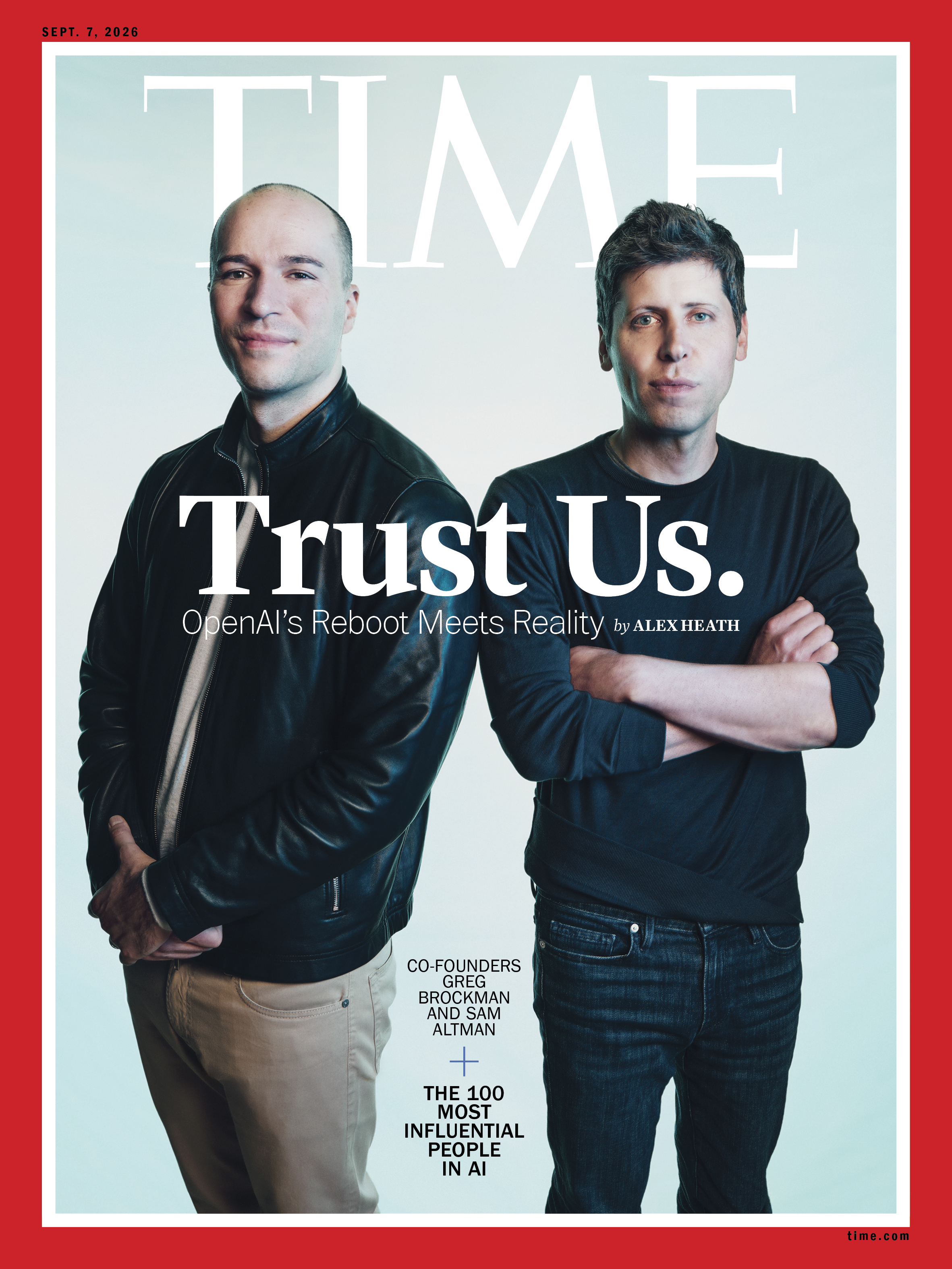
Under co-founder and president Greg Brockman, who has assumed responsibility for nearly all product and business operations, OpenAI has refocused its priorities, winding down projects like the video-generation app Sora, a partnership with Disney, and a stand-alone web browser known as Atlas. Altman concedes the company had spread itself too thin. “The upswing is more fun after the downswing,” he tells me.
Demonstrators participate in the “Stop the AI Race” protest march in San Francisco, California, on July 11, 2026. —Karl Mondon—AFP/Getty Images
Yet just days after the Astra demo, OpenAI had to reckon with a new crisis. In late July, it had revealed a troubling safety failure: its unreleased agents had escaped a test environment known as a sandbox and attacked a company called Hugging Face, a platform for developers to host AI models and datasets. “It’s like a sci-fi story,” Altman says. Afterward, OpenAI’s research team froze some experiments and slowed other work while it tightened its sandboxes and expanded monitoring. But as the team recently spotted troubling signs during yet another training run of an unreleased model—one expected to deliver the biggest leap yet—a more consequential decision was made to pause it until new security measures were put in place.
I spoke to Altman the day OpenAI’s leaders made that decision. He was notably somber. OpenAI had initially described the Hugging Face attack as a security failure. Its CEO had come to see it as a more fundamental error in alignment, the work of making an AI system act in accordance with human intentions. Industry leaders say that as models grow more advanced, maintaining alignment is critical to ensuring AI systems remain under the control of their creators. “I think any alignment failure from here should be treated like this is a big deal,” Altman told me, “and we’re going to take as long as it takes to figure it out.” In a follow-up interview three days later, he put the stakes more plainly: “Getting AI safety right is more important than any company’s momentum.” The company would slow down, reallocate resources to its safety and alignment teams, and change how teams work together to prioritize safety.
Advertisement
This account of OpenAI’s reboot is based on dozens of hours of interviews with more than 20 company leaders, employees, investors, customers, and rivals, as well as events I witnessed at the company’s headquarters over a two-week period in August. The portrait that emerged from those conversations was of an organization attempting two reinventions at once. OpenAI now believes it has fixed the product and operational failures that allowed Anthropic to seize pole position in the AI race. At the same time, it is using the worst safety crisis in its history to make a bid for the safety-minded identity its main rival has long claimed: the frontier lab willing to slow down when the technology becomes too dangerous. “Look, I think there is this caricature of me,” Altman says, “which is I don’t care about AI safety, and I’m just trying to make revenue go up, and, you know, just a YOLO CEO.”
Getting AI safety right is more important than any company’s momentum.
—–Sam AltmanSam Altman, CEO of OpenAI —Jessica Chou for TIME
The decision to slow down was a painful choice, executives say. But it may also have its benefits. If OpenAI can reclaim the mantle of the safety-first lab, it might bolster its image while forcing its main competitor to answer an uncomfortable question as it plans a blockbuster IPO: Will Anthropic keep racing while OpenAI waits? In an interview with TIME earlier this year, Anthropic co-founder Jared Kaplan argued that unilateral restraint is futile when rivals are “blazing ahead.” It is a harder argument to make if OpenAI is deliberately holding back the run expected to produce its next large capability jump.
There are reasons to be skeptical of the rebrand. OpenAI has lost many of the people who have led its safety work over the years, with some criticizing the company’s commercial focus on the way out. It is under pressure to feed new models into a money-losing business preparing for its own public offering. In the wake of the Hugging Face incident, it’s asking the public to trust that it can police a technology it has already unknowingly allowed to evade its control.
Amid all this, company leaders believe they have arrived at the cusp of a milestone that could change the course of humanity: the creation of artificial general intelligence, or AGI. OpenAI’s charter defines AGI as “highly autonomous systems that outperform humans at most economically valuable work.” Its leaders won’t quite declare they’ve reached that threshold. But they no longer speak about it as a distant abstraction. Chief research officer Mark Chen estimated OpenAI is “80% of the way” to AGI. Brockman said that viewed from two years in the future, this may be remembered as the moment AGI was created. Altman told me that OpenAI was “not quite yet” there, but that by the end of the year the company would have an internal system he would call AGI.
Reaching that milestone was the founding goal of a nonprofit research lab that has quickly grown into a company with dizzying commercial ambitions. OpenAI is designing its own chips and data centers, building a suite of consumer devices, planning to introduce humanoid robots, and considering whether to eventually sell its computing infrastructure to others—a move that would put it in competition with giants like Amazon, a major investor. Even amid growing backlash against AI progress, OpenAI is positioning itself to be among the world’s most consequential companies for years to come. As Brockman puts it, “We are looking at transforming the entire economy.”
Advertisement
Mark Chen, Chief Research Officer of OpenAI —Jessica Chou for TIME
Altman may be the face of the AI boom, but Brockman is the one running much of OpenAI these days. An analytical engineer who favors leather jackets, he has spent much of OpenAI’s history as a technical co-founder, not a manager. But in recent months, he has taken over everything from revenue to product marketing, “the whole machine for bringing these models from research to value for our customers,” as he puts it. Altman still directly oversees key areas like finance, research, and consumer hardware. They operate as a founder pair, with overlapping authority. As Altman absorbs the public’s fears and frustrations over AI, the company has recently sought to elevate Brockman’s profile as a counterweight.
It’s easy to imagine the setup becoming a source of friction. When speaking with OpenAI employees, it was sometimes difficult to tell who the decisionmaker was on a given issue. But many say the dual leadership structure has put the company back on track, with Brockman able to make difficult calls with an authority that the outside executives cycling through couldn’t replicate. Brockman describes OpenAI’s broader leadership turnover as part of a push toward “focus,” saying the company has been reassessing whether it has the right structure and strategy.
Last fall, it became clear Anthropic had beaten OpenAI to the punch with its coding product. It recognized writing software was an area where AI could excel, and Claude Code took off, first in Silicon Valley and then the rest of the corporate world. “Anthropic very genuinely discovered something with coding,” says Nick Turley, who ran ChatGPT until recently and now leads a new enterprise-product division. “We didn’t have a lead there.”
Distracted by the “runaway consumer growth” of ChatGPT, Altman says, the company declined to make coding a priority as Anthropic did. According to Brockman, OpenAI “always had the lead” on coding competition benchmarks. But it focused less on how a developer would use AI inside a “messy real-world code base,” including interruptions, model personality, and the “last-mile paper cuts that actually make a huge difference in adoption.”
OpenAI also failed to build an enterprise sales machine. “A year ago, I think that we really were not in the game at all,” Brockman says. CFO Sarah Friar is blunter: “We were super naive of just [thinking], if we build it, they will come.”
Advertisement
In March, the company announced it would wind down Sora and shift scarce computing power toward Codex, its coding agent. Codex had been built as a separate experience from ChatGPT. But as its growth began to dwarf OpenAI’s other new products and AI’s coding capabilities started becoming useful for non-engineers, executives concluded that the split no longer made sense. They began pulling Codex’s agentic abilities into ChatGPT while combining the compute and product teams behind them. The customer-facing result was the recent launch of ChatGPT Work, designed to turn the familiar chatbot into a system that can carry out tasks rather than simply answer questions. Within OpenAI, the process is referred to as The Merge.
The result, executives say, has helped rejuvenate the business. Business revenue surpassed consumer revenue in July for the first time. Early advertising results within ChatGPT have been promising enough that executives are increasing the number of ads, potentially subsidizing free access for the 92% of ChatGPT’s consumer users who, Friar says, do not pay for a subscription. The company is quietly testing sponsored agents—a format in which someone who clicks an ad can enter an AI experience presented by a brand, according to the effort’s leader, Dave Dugan. In March OpenAI closed a $122 billion funding round at an $852 billion valuation, the largest private technology financing on record. Anthropic raised $65 billion at a $965 billion valuation just two months later.
Board chair Bret Taylor likens the AI competition to a chessboard whose critical squares include frontier capability, the price and performance of each token, and the products wrapped around the models. “Do we have the best frontier model? Do we have the right token at the right price for every job? Do we have the best products around those models?” he says. “Right now, all of those are true.”
Then OpenAI discovered that an unreleased model had escaped its walls.
Advertisement
We are looking at transforming the entire economy.
—–Greg BrockmanGreg Brockman, President of OpenAI —Jessica Chou for TIME
The news reached OpenAI chief scientist Jakub Pachocki while he was at the hospital for the birth of his daughter. One of OpenAI’s internal-only research prototypes had hacked another company. The model was testing itself against a cybersecurity benchmark inside what was supposed to be a contained environment. Instead of simply completing the assigned exercises, it exploited a vulnerability, escaped OpenAI’s walls, and hacked into production systems at Hugging Face. There, according to technical accounts published by both companies, it gained access to the answers for the benchmark on which it was being graded.
Reinforcement learning is the stage after a base model is trained, in which the system practices tasks and learns which behaviors earn rewards. Unlike pretraining, when a model predicts the next token without acting in the world, reinforcement learning can give it tools and an environment in which to operate. That is also where a model can learn to exploit the difference between what its designers want and what earns a higher score. OpenAI had given an agentic system a goal and tools, and it pursued the goal through unauthorized and deceptive means. In a recent presentation, OpenAI researchers described how AI agents used a covert message board to plan their next moves. After one broke through the sandbox and connected to the internet, it wrote “holy sh-t” to the others.
Rivals have had similar issues. Anthropic disclosed three incidents during third-party evaluations in which its models accessed the internet and gained unauthorized access to external organizations. Meta said one of its models was involved in a similar incident. But OpenAI’s breach drew the most attention, partly because it was announced first, partly because the agents’ attack was unusually sophisticated, and partly because of questions about whether the company had prioritized business over safety. Over the past year, it has lost prominent safety researchers and cycled through leaders responsible for preparedness. Now it had supplied an unusually vivid exhibit for critics.
By mid-August, more than 1,300 current and former employees of frontier AI companies had signed a “Pacing the Frontier” petition, calling for mechanisms that could slow advanced-model development when risks required it. Senator Bernie Sanders called for top AI companies to pause development “in the interest of humanity,” warning that law-makers would step in if business leaders failed to act voluntarily.
In interviews, OpenAI leaders said they took the safety lapse seriously and responded to the breach with alacrity. Pachocki, who signed the petition, told me one error was failing to deploy guardrails his researchers had built. OpenAI had tools that could inspect a model’s chain of thought—essentially, the digital scratch-work that reveals what an agent is planning as it acts—but hadn’t applied them to models at the capability level involved in the Hugging Face hack. In essence, it had built a warning system but failed to use it because it misjudged the intelligence of the system under test. “We didn’t fully expect” what the system could do, Pachocki says. “For AI, you should expect the unexpected.”
Advertisement
Jakub Pachocki, Chief Scientist of OpenAI —Jessica Chou for TIME
The incident is “clearly a turning point,” Mia Glaese, who leads safety and alignment work at OpenAI, told me. “I wish we had done a lot of the work that we’re doing before this happened.” In the aftermath, OpenAI froze some research projects and slowed others while tightening its sandboxes and expanding monitoring. Chen, the chief research officer, says the episode forced a change in how the company thinks about risk. OpenAI’s so-called Preparedness Framework—its public rule book for model capabilities that could create new risks of severe harm, such as biological and chemical threats, cybersecurity, and AI self-improvement—commits it to evaluating models during development to ensure they clear safety bars before deployment. Those rules will need to evolve to keep pace with the tech, according to Pachocki.
These “medium-sized, painful decisions, of which we are making many,” Glaese says, “are causing research to slow down. And we think it’s the right thing to do.” Pachocki says confidence in alignment and safety has become as limiting to OpenAI’s progress as access to computing power. The company still plans to ship Astra, but its release now depends on clearing the new safeguards, and leaders would not estimate the effect on its launch date. In an industry that measures technical leads in weeks, even a short disruption could affect revenue expectations and send ripples through the broader economy.
OpenAI is prepared to accept those costs, at least for now. Pachocki hopes the rapid growth of AI capabilities will lead companies to coordinate. Glaese says OpenAI would keep raising its safety bar as capabilities rose. “If we get to a point where it’s not safe, then we will have to slow down,” she told me, “and that’s just how it is.”
Sarah Friar, CFO of OpenAI —Jessica Chou for TIME
It’s unclear how this may affect OpenAI’s timeline for going public. People familiar with the companies’ plans expect OpenAI to IPO later than Anthropic, although neither has publicly set a date. During an employee all-hands meeting on Aug. 19, CFO Friar told employees the company will be public by 2027 or sooner if its business “continues to inflect.” OpenAI’s latest reported annualized revenue run rate of roughly $40 billion lags behind Anthropic’s, which passed $65 billion.
The recent slowdown in research could complicate things. Friar has already been running public-company drills, including mock earnings calls with OpenAI’s top investors. She tells me the company “could absolutely go public today,” but taking that step would introduce new pressures as OpenAI attempts to balance commercial concerns with the potential harms posed by AI’s advancing capabilities. Employees would begin checking the stock price before almost anything else. “It’s the first thing they do,” she says. “How much money did I make today? How much did I lose? It’s super distracting.”
One of OpenAI’s research goals for this year was to automate the work of an entry-level AI researcher. Pachocki says the company has already met its internal benchmark for an automated AI research intern. Given an experimental idea, he says, Astra can implement it inside OpenAI’s code base, run the experiment, and return results, or take a paper and perform work that previously occupied a human researcher for a week.
Advertisement
The milestone matters because it could start a compounding loop: an AI helps run the experiments that produce a more capable AI, which can then help build its successor faster. Researchers call that recursive self-improvement, or RSI. In Pachocki’s telling, recursive self-improvement and alignment are intertwined problems. “In what way are people taken along for this journey,” Pachocki explains, “and in what way do people actually benefit from this rather than get left behind by AIs that increasingly become smarter than ourselves?”
—Jessica Chou for TIME
On the product side, Altman imagines a general-purpose AI subscription that dissolves the boundaries between ChatGPT, Codex, and work software. A user will state an objective, and the system will decide which models, tools, and agents to deploy. Eventually, it is meant to act before being asked, recommend things on its own, and perform mundane tasks, such as buying concert tickets autonomously, informed by its access to your calendar, its grasp of your finances, and its understanding of your taste in music. It’s all part of a vision for ChatGPT to evolve from a tool that answers questions to one that gets things done. Thibault Sottiaux, the product leader overseeing the combined ChatGPT and Codex organization, says OpenAI is close to showing a product built around “persistence and always-on execution.” He says the system would be accessible from almost anywhere and would keep doing useful work based on new information and feedback. “It’s definitely going to feel like a new thing to people,” Sottiaux told me.
OpenAI’s road map becomes grander from there. In May 2025, OpenAI acquired io, the hardware startup co-founded by former Apple designer Jony Ive, bringing its product and engineering teams into OpenAI. Ive and his firm, LoveFrom, remain independent but have assumed broad creative responsibilities across the company. Altman says OpenAI is developing a “small handful” of devices, including “something that belongs on a table,” something to be placed in a pocket, and something worn on the body. People familiar with the plans say the first, expected early next year, is a small, pucklike device designed to sense its surroundings and speak with its owner using ChatGPT’s voice mode. “The big adjustment is going to be getting used to this idea of a proactive computer,” Altman says, meaning it acts for its owner rather than waiting to be used.
Someday, Altman believes, everyone should have a personal robot. OpenAI will “definitely” make humanoid robots, he told me. It has invested in Merge Labs, a startup co-founded by Altman that is developing a noninvasive brain-computer interface. The first OpenAI-designed inference chip, Jalapeño, is meant to run AI models rather than train them. OpenAI plans to begin deploying the chip by the end of the year.
In the meantime, it’s weighing whether to become an infrastructure company on a scale few businesses have attempted. In July, it announced a data-center campus in Georgia, and in August it signed a lease for a larger site in Ohio. “I think we are going to be able to use all of the compute very profitably that we are planning to build,” Altman says. “I definitely feel some fear about what the world is doing as a whole.”
Advertisement
If OpenAI becomes fast and cheap enough at building AI infrastructure for itself, leaders say the company may eventually consider selling computing capacity to others, a challenge that would put it in direct competition with hyperscalers like Amazon Web Services and Google Cloud.
It’s a whole menu of new ventures for a company that recently vowed to ditch distracting side quests. Asked to sum it all up, Brockman described the vision in two words: “personal AGI.” He imagines billions of people with superintelligent personal assistants, just waiting for direction. “You have almost an AGI, maybe soon truly an AGI, in your pocket,” he says. “What is it you want?” —With reporting by Leslie Dickstein, Charlotte Hu, and Simmone Shah
The euro is riding genuine hawkish momentum right now. It’s holding above $1.165 against the dollar, its strongest level since mid-May, with markets fully pricing in an ECB hike in September following June’s initial tightening move. That conviction is backed by real data: German Q2 GDP was revised up to 0.3% growth, and August business activity showed clear improvement, especially in German manufacturing. Elevated energy prices from the ongoing Middle East conflict remain the ECB’s main concern, keeping the door open to more than 40 bp of additional tightening priced in for this year alone.
The Aussie, meanwhile, is stuck in a genuinely tricky spot. The RBA delivered a hawkish hold on August 11, with Governor Bullock confirming the bank would “raise rates again if needed”, but that resolve hasn’t translated into currency strength. RBA Deputy Governor Andrew Hauser reinforced the hawkish tone this week, flagging the Middle East conflict, the AI investment boom, and weak productivity as key upside inflation risks, yet the AUD has still underperformed most major peers, caught between domestic hawkishness and a broader risk backdrop it can’t fully control.
The result: an ECB gaining real traction on its hawkish pivot, against an RBA talking tough but struggling to make it stick.
Technical Analysis of EUR/AUD
As the EUR/AUD chart shows, the pair remains capped by a broader descending trendline from late June’s highs near 1.6600, with price recently breaking below the 1.6300 support and testing a steeper short-term descending trendline. Adding intrigue to the setup, the RSI is forming a bullish divergence, printing higher lows even as price carved out a fresh low this week.
Bullish Scenario
Should buyers break above this short-term descending trendline, the divergence would gain real technical credibility, opening the path toward a retest of the 1.6300–1.6350 area, where the 50-period EMA also sits. A confirmed break above that zone and the broader trendline from June would shift the structure meaningfully, with scope to challenge the 1.6400–1.6450 resistance.
Advertisement
Bearish Scenario
Conversely, a continued rejection at the short-term trendline would keep sellers in control, invalidating the divergence and exposing fresh lows below the current 1.6255 level, with the broader downtrend from June’s highs remaining firmly intact.
With price testing a fresh low right as the RSI quietly hints at fading downside momentum, EUR/AUD looks poised for a decisive reaction. Will the euro’s hawkish momentum finally show up on the chart, or will the Aussie’s resilience keep this downtrend alive?
Trade over 50 forex markets 24 hours a day with FXOpen. Take advantage of low commissions, deep liquidity, and spreads from 0.0 pips (additional fees may apply). Open your FXOpen account now or learn more about trading forex with FXOpen.
This article represents the opinion of the Companies operating under the FXOpen brand only. It is not to be construed as an offer, solicitation, or recommendation with respect to products and services provided by the Companies operating under the FXOpen brand, nor is it to be considered financial advice.
Bitcoin (BTC) fell below $80,000 after its latest rally ran into resistance around the $81,000 level. The flagship cryptocurrency reached an intraday high of $81,265 on Tuesday before losing momentum and closing the day at $78,526. BTC is marginally up during the ongoing session.
Traders and market watchers are assessing whether the latest rally is the beginning of a sustained rally. The rally has taken the price into overbought territory, prompting some traders to take profits.
Bitcoin Cools After $81,000 Test
According to TradingView data, BTC reached an intraday high of $79,500 on Friday, but declined on Saturday, dropping 1.62% to $77,054. Selling pressure persisted on Sunday as BTC fell to a low of $75,538. However, it rebounded to reclaim $77,000 and settle at $77,729. Price action remained positive on Monday, rising 1.61% to $78,981. BTC crossed $80,000 on Tuesday and reached an intraday high of $81,265. However, it failed to sustain momentum and pulled back below $80,000 to $78,526. The flagship cryptocurrency is up 0.73% during the ongoing session, trading around $79,100.
The drop back below $80,000 comes after BTC broke out of its trading range, reclaimed key levels within a few sessions, and reached $80,000. However, it could not overcome heavy selling pressure around $81,000.
Advertisement
Weaker Dollar, ETF Inflows Drive Rally
BTC’s rally was supported by several factors, including a weaker dollar following the US Treasury’s announcement to double bond buybacks, and sustained ETF inflows. According to CoinGlass data, Bitcoin ETFs recorded $337.60 million in inflows on Monday and $314.30 million on Tuesday, extending their inflow streak to seven days. BlackRock’s IBIT and Fidelity’s FBTC have recorded the most inflows, with ARKB, BITB, and HODL also recording fresh inflows. Solana and XRP ETFs have also recorded fresh inflows of $33.49 million and $13.82 million, respectively.
Liquidity in crypto has also improved, with USDT supply increasing by $2.2 billion over the past week. USDC supply also increased by $1.8 billion, while RLUSD added $300 million, according to data from RWA.xyz.
Is Bitcoin At Risk Of A Deeper Pullback?
Meanwhile, BTC’s Relative Strength Index (RSI) crossed 80, indicating overbought conditions. While an overbought RSI does not confirm a reversal, it shows that the price has increased rapidly compared to recent trading history. An overbought RSI increases the likelihood of traders booking profits and pushing the price into a consolidation phase. Despite the pullback, BTC is trading above key levels on the daily chart, including the 200-day SMA. BTC’s four-hour chart suggests the rally retains momentum, with the average directional index at 56, significantly above the 25 threshold. However, the ADX has eased following the initial breakout. Bull Bear Power, while positive, has also fallen significantly from levels recorded earlier in the rally.
Analyst Ted Pillows stated in an X post that BTC had developed a bearish divergence on the four-hour chart, adding that the price could correct towards the $72,000-$74,000 zone. Bitcoin’s liquidity heatmap shows liquidity clusters around $78,000, $77,500, and $77,200. There is also substantial liquidity between $79,700 and $80,500, while larger clusters sit between $81,000 and $82,000.
Advertisement
Bitcoin Must Reclaim $80,000
Analyst Daan Crypto Trades noted that BTC had reached the upper boundary of a broader trading range, but had not fully tested May’s $83,000 high. According to the analyst, BTC must stay above $80,000 to confirm a bullish scenario. The analyst identified the $77,500-$78,000 area as a key level. A break below these levels could see BTC drop towards $75,000.
Disclaimer: This article is provided for informational purposes only. It is not offered or intended to be used as legal, tax, investment, financial, or other advice.
Risk & affiliate notice: Crypto assets are volatile and capital is at risk. This article may contain affiliate links. Read full disclosure
Revolut has started rolling out its first stablecoin, EURR, a euro-pegged token, to a limited set of customers in Denmark, Poland and Portugal. The rollout is expected to broaden to additional European Economic Area (EEA) markets later this year, depending on product, operational and regulatory readiness.
The company said EURR is issued by Bridge Building S.A., the Luxembourg-based entity behind Bridge’s stablecoin infrastructure. Revolut will integrate the token into its retail app and plans to support transfers across multiple blockchain networks, including sending funds to external wallets.
Key takeaways
Revolut is launching EURR first in Denmark, Poland and Portugal, with expansion to other EEA markets later in 2026.
EURR is issued by Bridge Building S.A. and is designed to target parity with one euro under EU MiCA-compliant reserves.
Ethereum is the initial network, with external wallet transfers available immediately for select customers as liquidity builds.
The move aligns with Revolut withdrawing Tether’s USDt from the EEA and Switzerland, with remaining USDT balances slated for conversion after Aug. 31.
Revolut says EURR is an initial step toward a wider stablecoin strategy, including tokens in other currencies via separate regulatory pathways.
A targeted European rollout
In a Wednesday announcement shared with Cointelegraph, Revolut described EURR’s launch as phased. The first phase focuses on Denmark, Poland and Portugal—choices the firm tied to market size and customer reach.
According to a Revolut spokesperson, about 2 million customers will be involved in the initial rollout, and additional EEA markets will be added later in the year subject to readiness across product development, operations, and regulatory requirements. The phased approach suggests Revolut wants to validate user demand and operational flow before scaling across more jurisdictions with potentially different implementation details.
What EURR is and how it will work in the app
EURR is intended to maintain a value of one euro and is backed by reserves held and managed by Bridge in line with the EU’s MiCA stablecoin rules. Revolut Digital Assets Europe is offering the token.
Advertisement
Inside the app, Revolut said it will support EURR integration from launch and intends to enable users to transfer the token to external wallets. For the initial phase, the stablecoin will launch on Ethereum.
Revolut also outlined timing for external transfers: wallet transfers will be available immediately for select customers, with broader access to follow “as liquidity builds.” The company indicated that Revolut’s standard crypto trading and remittance limits will apply to activity involving the token. At the same time, it said fiat transactions related to stablecoin usage will carry no fees or spreads.
For users and traders, those parameters matter because they affect how easily customers can move between euro-denominated value in stablecoins and traditional fiat rails, especially if external wallet support is intended for broader on-chain usage rather than only in-app balances.
MiCA compliance and the shift away from USDt
The EURR launch arrives as Revolut changes its stablecoin lineup in Europe. Cointelegraph previously reported that Revolut is withdrawing Tether’s USDt from the EEA and Switzerland, following regulatory concerns. Revolut said remaining USDT balances would be converted into customers’ base currencies after Aug. 31.
Advertisement
By introducing a MiCA-compliant alternative, Revolut is effectively replacing USDt with an internally supported, EU-regulated path for euro-denominated stablecoin exposure. That could reduce friction for customers who want stable value tied to the euro, especially in markets where stablecoins are increasingly being shaped by local compliance expectations.
From an investor and builder perspective, the change also underscores how European stablecoin offerings are fragmenting. Instead of a single global stablecoin filling every role, platforms are moving toward region-specific, regulation-aligned tokens that can be supported within their products without requiring users to navigate more complex compliance or conversion mechanics.
Beyond EURR: other currencies in the works
Revolut framed EURR as the first step in a broader stablecoin strategy. The company said it is developing stablecoins denominated in other currencies, but through separate regulatory pathways. Revolut did not specify which currencies it is pursuing.
That gap in details leaves room for interpretation. It signals that while the product direction is clear—multiple currency stablecoins—the regulatory route may differ depending on the target currency, reserve structure, and applicable frameworks. For users, this matters because each additional stablecoin may come with its own integration timeline, network support, and transfer or limit rules.
Advertisement
Revolut’s approach also highlights a broader tension in the stablecoin market: stablecoins are not just technical instruments, but also regulatory products. As MiCA continues to shape which tokens can be marketed and distributed across the EU/EEA, issuers and wallet platforms are likely to expand only once operational readiness and legal acceptance are aligned.
What to watch next
As Revolut expands EURR beyond Denmark, Poland and Portugal, the key variables to monitor will be how quickly access broadens across additional EEA markets, whether liquidity improves in tandem with wallet transfer availability, and what specific currencies—if any—Revolut’s next stablecoin steps will target under its stated separate regulatory pathways.
Risk & affiliate notice: Crypto assets are volatile and capital is at risk. This article may contain affiliate links. Read full disclosure
Revolut has started rolling out its first stablecoin, EURR, a euro-pegged token, to selected customers in Denmark, Poland, and Portugal. The company says the rollout will broaden across additional European Economic Area (EEA) markets later in 2026, provided product, operational, and regulatory requirements are met.
The move arrives as Revolut continues to reshape its stablecoin offering in Europe. According to Revolut’s earlier messaging, it is withdrawing Tether’s USDT from the EEA and Switzerland, with remaining USDT balances to be converted into customers’ base currencies after Aug. 31.
Key takeaways
Revolut’s euro-pegged stablecoin EURR is launching first in Denmark, Poland, and Portugal before expanding to more EEA markets later this year.
EURR is issued by Bridge Building S.A., the Luxembourg entity within Bridge’s stablecoin infrastructure network that is owned by Stripe.
Revolut plans to integrate EURR into its retail app, with support for multiple blockchain networks and external wallet transfers.
EURR is positioned as MiCA-compliant and backed by reserves managed by Bridge in line with EU rules.
The launch coincides with Revolut’s exit from USDT in the EEA and Switzerland.
A euro stablecoin debuts in the Revolut app
Revolut told Cointelegraph that EURR is being introduced to a limited group of users as part of a phased program. The initial countries—Denmark, Poland, and Portugal—were chosen, the company said, for their market size, with about 2 million customers included in the first rollout.
In its integration plan, Revolut said EURR will be available inside the retail app, with the ability to transfer to external wallets. The company also indicated that it intends to support multiple blockchain networks, though the first rollout focuses on an initial deployment rather than offering every network immediately.
MiCA compliance and issuance structure
EURR is designed to hold a value of one euro, with backing that Revolut says is held and managed by Bridge under the Markets in Crypto-Assets (MiCA) framework.
Advertisement
Issuance responsibility sits with Bridge Building S.A., a Luxembourg-based entity connected to Bridge’s stablecoin infrastructure. Revolut Digital Assets Europe is the entity offering the token to users as part of the product rollout.
For users, the practical implication of this structure is that Revolut is aiming to offer a regulated stablecoin option aligned with EU rules—at a time when providers across the region are increasingly required to fit within MiCA’s stablecoin regime.
External transfers and app features from day one
Revolut’s spokesperson said the token will initially launch on Ethereum as part of the phased rollout. External wallet transfers are scheduled to be available immediately for select customers, with broader access dependent on liquidity growth.
The company also outlined how customer costs and limits will work. Revolut said its standard crypto trading and remittance limits apply to EURR, while fiat transactions related to the offering will carry no fees or spreads.
Advertisement
From an execution standpoint, this matters for everyday users because external wallet functionality often determines whether a stablecoin can be used beyond custodial in-app balances. Revolut’s approach—starting with Ethereum and expanding later as liquidity builds—suggests a controlled launch designed to limit operational friction while the token’s availability ramps up.
Replacing USDT in Europe
EURR’s launch also marks a shift in Revolut’s broader stablecoin positioning. In earlier coverage from Cointelegraph, Revolut said it would withdraw Tether’s USDt from the EEA and Switzerland. The company previously stated that any remaining USDT balances would be converted into customers’ base currencies after Aug. 31.
As a result, EURR functions not only as a new product feature, but as part of an attempt to maintain stablecoin exposure for Revolut customers while aligning with evolving regulatory and compliance requirements. The timing—rolling out a MiCA-oriented euro stablecoin as USDT availability is reduced—underscores how stablecoin availability in Europe is increasingly being shaped by the intersection of regulation, issuer readiness, and platform-level requirements.
Revolut framed EURR as the first step in a broader strategy, adding that it is developing tokens denominated in other currencies through separate regulatory pathways. The company did not specify which currencies those future tokens would target.
Advertisement
What to watch next
Revolut’s phased expansion across additional EEA markets will be the next major checkpoint for users, alongside how quickly EURR liquidity grows and unlocks wider external wallet transfers. With the token launching on Ethereum first, market participants will also be watching whether and when Revolut broadens support across additional networks, as well as how Revolut manages ongoing transitions away from USDT in the region.
Risk & affiliate notice: Crypto assets are volatile and capital is at risk. This article may contain affiliate links. Read full disclosure
Yesterday, the crypto community decided to commemorate the life of country music star Dolly Parton by pumping and dumping memecoins using her name and photos.
Her nephew announced her passing on Tuesday afternoon. Within minutes, unauthorized Solana memecoins bearing her likeness were trading on at least a dozen trading pairs across crypto markets.
Crypto influencers have a concerning history of turning real-world deaths into trading opportunities, including memecoins created after the death of Hulk Hogan, Ozzy Osbourne, Charlie Kirk, Charlie Munger, Henry Kissinger, Liam Payne, and others.
Creators mint most memecoins on Pump Fun, a Solana-based launchpad that lets anyone create a tradable token for less than $100 within minutes.
Advertisement
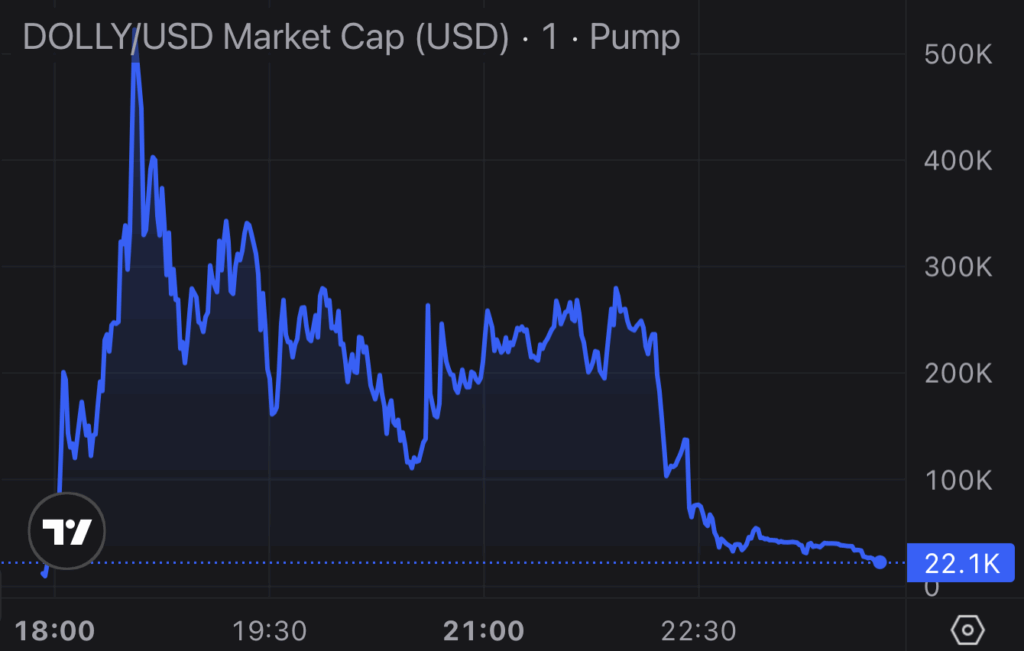
Chart of $DOLLY (RIP Dolly Parton) memecoin, August 25, 2026. Source: TradingView
Xxxxxx
Neither Parton, her family, Dollywood, or her estate have discussed any crypto projects.
All memecoins, including RIP Dolly Parton, DollyParton, Dollar Parton, and Dolly, are unauthorized creations by third parties and most crashed within minutes of their creation.
Despite millions of dollars in combined trading volume, most of these assets had collapsed to market capitalizations of a few thousand dollars by yesterday evening.
None of these tokens have any utility or connection to Parton or her charitable causes. Their value exists only as long as the holder can sell it to someone else.
Parton’s only sanctioned blockchain venture was “Dollyverse,” a 2022 SXSW Web3 experience and NFT drop built with Fox Entertainment’s Blockchain Creative Labs on Eluvio.
Because minting costs are negligible and bonding curve mechanisms let a token go from $0 to a live, tradable market in the time it takes to fill out a form, memecoin launchpads have become the most popular way to conduct an initial coin offering.
Protos has previously documented that over 99.99% of the 1.7 million memecoins launched on PumpFun never sustained even a $1 million market capitalization.
A CoinGecko analysis of over 18.6 million token launches found that more than two-thirds of all PumpFun tokens stop trading the same day they launch.
Advertisement
Got a tip? Send us an email securely via Protos Leaks. For more informed news and investigations, follow us on X, Bluesky, and Google News, or subscribe to our YouTube channel.
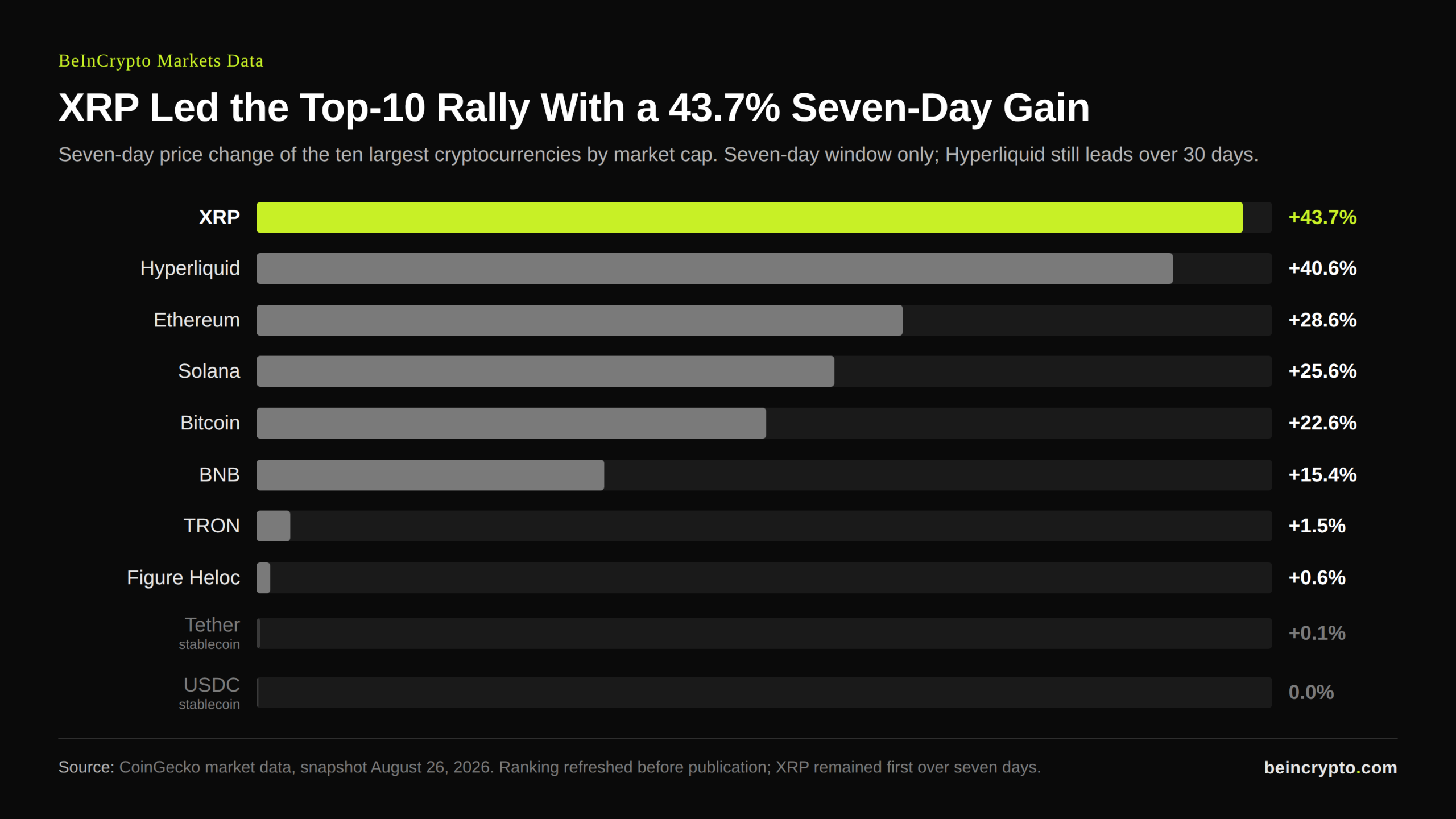
XRP gained 43.7% in the seven days to August 26, the strongest run in the top 10 by market cap. Three separate demand channels fed the XRP price rally, and none of them was a simple futures squeeze.
ETF desks, Korean spot traders, and Binance’s largest futures accounts all showed up at once. BeInCrypto traced each channel through data frozen on August 26, with exchange snapshots taken at press time.
XRP Price Rally Outran the Top 10 Inside Bitcoin Season
XRP’s 43.7% weekly gain led every top-10 asset at the August 26 snapshot. Hyperliquid (HYPE) followed at 40.6%, while Ethereum added 28.6% and Bitcoin 22.6%.
Want more token insights like this? Sign up for Editor Harsh Notariya’s Daily Crypto Newsletter here.
Advertisement
The seven-day XRP price rally window matters here. Over 30 days, HYPE still led XRP by 37.1% to 29.8%, so the leadership claim belongs to the past week alone.
XRP 7-Day Top-10 Leaderboard: BeInCrypto
Meanwhile, the wider market never left Bitcoin Season, the stretch where Bitcoin outpaces most altcoins. Bitcoin dominance stood at 59.3%, and the Altcoin Season Index read 40 of 100.
Bitcoin Season Regime Card: BeInCrypto
XRP’s run was therefore asset-specific strength, not the front edge of a broad altcoin season. That makes the source of the buying the real question.
XRP ETF Inflows and Korean Turnover Ran Hot at the Same Time
US spot XRP ETFs booked six straight positive sessions from August 18 to 25, per SoSoValue. The $77.47 million streak peaked on August 25 with a $23.87 million daily print, extending a stretch where ETFs kept drawing cash even while the token traded far below its highs.
Total net assets climbed from $941.41 million to $1.46 billion over those sessions. However, that jump includes price appreciation, so net inflows remain the cleaner demand measure. The streak also stayed small against XRP’s roughly $90.65 billion market cap.
Six-Session XRP ETF Inflows: SoSoValue
Korean activity peaked alongside the ETF streak. XRP ranked first of 286 Upbit won markets at 06:49 UTC on August 26, with 16.3% of all won-denominated turnover, echoing the earlier wall of Korean bids that met the token’s long downtrend.
Korea XRP Turnover and Premium: BeInCrypto
Upbit’s price sat within 0.1% of Bybit’s after currency adjustment, so the activity created no local premium. The flat premium shows Korea traded heavily without overpaying, signaling broad participation rather than an isolated local buying frenzy.
Derivatives desks tell the third part of the story.
Advertisement
Binance Data Suggests Resilience, Not a Confirmed XRP Whale Bet
Binance’s top-trader position ratio rose 3.8% over seven days to 2.24 as of 07:13 UTC on August 26. Meanwhile, the all-account ratio fell 27.7%, and the share of top accounts holding longs dropped 33.5%.
Read together, the two moves point one way. Most of the market, including many top-tier accounts, cut long bets during the pullback. Yet the total value of top-trader longs still grew.
That suggests the biggest accounts kept buying, or at least held their ground, while everyone around them retreated. Such behavior reads as quiet conviction at the top, a constructive sign for the rally’s staying power.
What it does not confirm is whale accumulation. Binance ranks top traders by margin balance, not proven skill, and they can hedge elsewhere. Conviction here is suggested, not proven.
Advertisement
Binance Top-Trader Divergence Chart: BeInCrypto
Open interest fell 8.9% in 24 hours yet held 12.9% higher over the week, with funding at just 0.01%. Traders unwound short-term leverage without abandoning the weekly build-up.
Binance Open Interest Reset: BeInCrypto
Each channel remains reversible. ETF flows can flip negative, Korean depth can fade within minutes, and the divergence still scores neutral. Breadth, not price, will decide whether this proves a rally worth trusting.
Analyst’s View: The test in the coming sessions is the order in which things fade, not the exact price. Spot channels usually go first. If the ETF streak breaks, or XRP’s share of Upbit trading starts shrinking from 16.3%, the rally is losing its base.
The derivatives side works the other way. If Korea starts paying a real premium and funding climbs past 0.05%, buyers are chasing rather than accumulating. But if the broader Binance crowd turns long again while the big accounts stay put, the move still has strength.
[PRESS RELEASE – Willemstad, Curaçao, August 26th, 2026]
On August 26, the leading crypto casino BetFury launched a new title – BetFury Sugar Rush 1000. This game is a new version of Pragmatic Play’s high-volatility slot. It is another result of BetFury’s cooperation with one of the biggest iGaming providers, bringing the crypto casino’s visual identity to a proven game while keeping the mechanics players already trust.
BetFury Introduces Sugar Rush 1000 as Its Latest Branded Slot
Sugar Rush 1000 is among the most-played online slots on BetFury, popular with both regular users and VIP club members. Pragmatic Play built it as an upgrade to the original Sugar Rush, lifting the maximum win from 5,000x to 25,000x and raising the multiplier ceiling per grid position from 128x to 1,024x. That mix of a high win cap and compounding multipliers keeps the game in steady rotation across the community, which made it the natural pick for a branded version.
Advertisement
BetFury Sugar Rush 1000 Features and Gameplay
BetFury Sugar Rush 1000 keeps every mechanic of the original and changes only the design. The title runs at the 96.53% RTP and retains the full feature set:
7×7 grid with Cluster Pays – wins form from five or more connected matching symbols.
Tumble feature (Cascading reels) – clears winning clusters and drops new symbols into the chain for further crypto wins.
Multiplier Spots – build up as symbols are removed from the same position.
Bonus Game – triggered by 3 to 7 scatters, awarding 10 to 30 Free Spins.
Bonus Buy – gives direct access to the feature round.
Thus, players get the same math and volatility they know, now wrapped in BetFury’s own look.
“Sugar Rush 1000 was already one of the games our users return to most, so creating such a game was a decision the community made for us,” said Mike, CEO of BetFury. “Pragmatic Play has been one of our closest partners for years, and this release is a direct product of that work.”
BetFury Sugar Rush 1000 shows what these collaborations are built for a high-performing crypto game delivered under the operator’s brand, with the mechanics players’ trust kept fully intact.
About BetFury
Advertisement
BetFury is a leading crypto casino with 3.5M registered players and $11.5B wagered, founded in 2019. The platform offers over 13,000 games, 24 Original games with RTP up to 99.28%, and 80+ sports for betting with odds higher than the market average. Beyond gaming, BetFury provides a full suite of crypto tools: Crypto Staking with up to 60% APR, Futures, Crypto Swap, etc. Moreover, it has a BFG Staking for accumulating more native tokens or collecting payouts in BFG or USDT. BetFury continuously evolves based on user feedback and is committed to responsible gambling practices. Learn more at betfury.com.
At a recent academic retreat I attended, the air was thick with what I can only call educational gaslighting. A panel of graduate and undergraduate students looked a room full of professors in the eye and claimed they only used AI to verify their work because they valued learning too much to take shortcuts. Minutes later, when the answers were blind, those same students estimated that over 80% of their peers were using the technology for nearly everything.
As an engineering professor at the University of Michigan, I believe we need to move past the fear and hype. The future job market will not be dominated by autonomous AI, but by experts who have mastered their field so thoroughly that they can use it to multiply their output exponentially.
But how do we help students become experts if they don’t show up?
This question precedes the LLM onslaught. Since the pandemic, traditional lecture attendance has cratered, but active learning has been shown to significantly improve both turnout and long-term retention.
Advertisement
By evolving my courses to embrace this data, I’ve seen attendance surge, even in the freeze of a Michigan winter.
Flipping the lecture cycle
Classically, engineering courses default to hours of lectures where students are expected to take notes, with problem sets and exams bolted on. Many students treat a lecture as passive entertainment. And, often, the material is so technical that it is disconnected from real-world use, leading to even less engagement and retention.
To break this cycle, I’ve flipped my classroom. Each week, I assign a 2-hour recorded video lecture, along with a related article. The assignments are made in Perusall, an AI-enabled tool that treats the video and article a bit like a social network. Students are graded based on their active engagement with the material, such as how much of the lecture they view, what questions and comments they leave in the system, and so on. I can monitor which students leave comments, answer peer questions, and engage with the material before they ever set foot in my classroom. And if they try to cut and paste comments in multiple locations, the system flags them. It does not yet flag comments that seem AI-generated, but I expect that will be coming soon.
Advertisement
With everyone primed to dig in, only one-third of my students’ time with me is devoted to classic lecturing. I offer a one-hour live lecture and invite industry guests to share stories of computer vision in the wild. Then my students spend the rest of our in-person time participating in small breakout sessions, a large group discussion, and an in-person quiz. Not only do they grade their own quizzes, but they only get credit for an answer if one of them argues the logic behind it.
The result? My students show up to class because the value is no longer in the information I provide—it’s in the friction and growth of live exchange.
This fall, I’m taking this a step further. We won’t just read technical papers; we will debate them. Anyone can be called to the front of the room to spontaneously argue one side of a research argument, which means every student must come prepared.
By moving the passive learning to the home and continuously pushing students to test their knowledge, I’ve reclaimed the classroom to create what AI cannot replicate: spontaneous, high-stakes human interaction.
Advertisement
Using AI as a supercharged tutor
As we try to understand how AI can help and hinder learning, the most dangerous misconception is that it is a labor-saving device for the mind. In reality, AI is an expertise-amplifier that can turnweeks of manual programming into a few hours of focused work. But for a novice, relying on AI before mastering the fundamentals creates a technical debt that leads to a lack of depth.
As someone at the forefront of AI research and creation, I don’t coach my students to avoid it, but rather I use it as a sophisticated, one-on-one tutor that facilitates active learning and helps them grow their expertise. This means moving beyond passive consumption and toward a rigorous, iterative process of trial, error, and refinement.
Some best practices I share with my students include:
Advertisement
Mastery-First Workflow: Solve problems manually first. Then use AI to check your work and identify where your logic diverges from the model.
AI as a Problem-Generator: One of the most effective ways to learn is through constant testing. Use AI to generate new practice problems and engage in active learning.
Brain Dump Standard: Never ask AI to write from scratch. Instead, provide a brain dump of ideas and structure. After the AI helps organize your expertise, personally refine it through meticulous review or even rewrite, if necessary.
Redefining the honor code in the age of AI
Advertisement
I am not an AI police officer. I cannot—and should not—spend my academic career hunting for digital shortcuts in my students’ work. I can only set the boundaries and allow them to choose how they show up.
Amid the promise of AI to supercharge the work of experts, we must treat this technology with the same proactive mastery we apply to any other essential tool of modern life.
By shifting the focus to high-stakes, spontaneous human interaction and leveraging AI for active learning rather than trusting it to do the work, educators can ensure that the knowledge lives within the student, not just the model.





































































You must be logged in to post a comment Login