Connect with us

Business

(VIDEO) Prince Harry and Meghan Markle Land in UK With No Police Presence Days After Announcing Return

Published

on

Blake Lively

Prince Harry and Meghan Markle have arrived back in the United Kingdom, landing in Birmingham shortly before midday Wednesday just days after their office confirmed plans for the couple’s extended return, BBC News reported.

The Duke and Duchess of Sussex, along with their children, Archie and Lilibet, are believed to have flown into the country privately from California. A spokesman for the couple declined to comment on the arrival, telling the BBC only that “this is not something we would comment on.” According to a source who spoke with the BBC, there did not appear to be a police presence as Harry and his family left the airport.

The family is expected to base themselves at a private property outside London in the Cotswolds, according to the BBC. Archie and Lilibet have been enrolled in school, with the new academic term due to begin next week. Harry and Meghan will not resume official royal duties during their time in Britain, continuing instead as private, non-working members of the royal family, consistent with the arrangement they entered when they stepped back from senior royal roles in early 2020 before relocating to California that March.

Advertisement

King Charles III was informed of the couple’s return plans earlier this month. The family had visited the king at his Highgrove residence in July, though it is understood the planned move was not discussed during that visit. Prior to that July reunion, Harry and Meghan had not been in the UK together since attending Queen Elizabeth II’s funeral in 2022. The Prince and Princess of Wales have also been informed of the couple’s plans, according to the BBC.

The question of security arrangements for the Sussexes while in Britain has remained a significant point of debate since news of their return first broke. Harry lost a legal challenge last year over the level of security afforded to him and his family in the UK, after seeking to overturn a decision that had downgraded his security detail once he stopped serving as a working royal and relocated to the United States. It remains unclear what specific security provisions will be made for the family during their UK stay, or who will bear the cost of arranging them.

Following the announcement of the Sussexes’ intended return, a Home Office spokesperson addressed the broader security process without confirming specific arrangements for Harry’s family. The spokesperson said decisions regarding the security of royals are made by the Executive Committee for the Protection of Royalty and Public Figures, commonly known as Ravec, and characterized the UK government’s overall protective security system as “rigorous and proportionate.” Harry has previously said that concerns about safety have been a central factor preventing him from bringing his wife and children to Britain in the past.

The couple’s return also comes amid significant ongoing legal costs stemming from a separate case. Last month, Harry and six other public figures lost a High Court privacy case against the publisher of the Daily Mail and MailOnline. According to the BBC, the group faces paying up to £34.5 million in legal costs to Associated Newspapers, with the seven claimants required to pay an initial £9.54 million within seven days of the ruling.

Advertisement

Beyond the security and legal questions surrounding the family’s return, speculation has continued to build regarding what Harry and Meghan’s day-to-day life in Britain might actually look like. The BBC has separately reported that Meghan is in talks for a role in Netflix’s series “The Gentlemen,” which would mark her first significant acting role since her marriage to Harry. Sources close to the couple have not denied those reports.

The return also raises renewed questions about whether Harry’s relationship with his brother, Prince William, might improve now that the family is based in the same country for the first time in years. According to the BBC’s own reporting on the matter, however, William remains in no mood to forgive and forget, with the underlying hurt he feels toward Harry described as still lingering, suggesting any reconciliation between the two brothers is unlikely to happen quickly or easily despite their newfound geographic proximity.

Harry’s broader relationship with Britain has continued evolving in other respects as well. The duke recently stepped down from the board of an African wildlife charity, according to related BBC coverage, part of a broader recalibration of his public commitments as the family transitions into this new chapter based in the UK.

With Harry, Meghan and their children now physically back on British soil, attention is likely to shift toward how the family settles into their new life in the Cotswolds in the coming days, including how the unresolved security question is ultimately addressed, whether King Charles and the couple have any further private engagements planned, and whether Meghan’s reported talks over the Netflix acting role move any closer to a formal announcement now that the family has completed their relocation to Britain.

Advertisement
Continue Reading
Click to comment

You must be logged in to post a comment Login

Leave a Reply

Business

Promoting the power of almonds

Published

on

Promoting the power of almonds

CHICAGO — If you ask Clarice Turner, president and chief executive officer of the Almond Board of California (ABC), to name all the food applications for almonds, you’d get a similar answer if you asked her to name all her career stops in the food industry: a long and surprising list.

Recently completing her third year as ABC’s leader, Turner sees ongoing strong demand for almonds and a ripe field of opportunity for the commodity at a time when consumers want better-for-you foods, snacks and ingredients and food manufacturers and processors are seeking more options to bring that to them, including in the baked foods arena. California produces 80% of the world’s almond supply, and ABC now counts 14 forms (soon to be 15) in which almonds can be used in snacks, meals and beverages — well above the handful that Turner said she was aware of when joining the board in July 2023.

In furthering ABC’s mission, Turner brings a deep well of industry experience and expertise, spanning consumer packaged foods, beverages, foodservice and agriculture in categories such as bakery, pizza and wine and at companies large and small like PepsiCo, Yum! Brands, Papa Murphy’s, Starbucks, Boudin Bakery and Joseph Phelps Vineyards. A former board member of Blaze Pizza, she currently sits on the board of Delicato Family Wines and chairs the board at Kylix Vineyards.

“I see it as a flywheel,” Turner said when asked about her unique food industry perspective in an interview at IFT FIRST 2026 in Chicago. “I think when you get pull created in any supply chain, you start to get efficiencies. When you’re trying to push, it’s just harder. One of the beautiful things about almonds is that everybody loves them. They’re good for the environment. They’re good for the human body. That creates a lot of pull in ways that many other commodities wouldn’t. I see that in many different sectors, too. I look at all the different things that we did at Starbucks, the things we tried to push. Lots of investment, R&D and marketing up front. And if a consumer didn’t want it, good luck. You’re just going to have to try again. So I think one of the insights is starting with what the consumer wants.”

Advertisement

Modesto, Calif.-based ABC has stoked supply chain and consumer pull by touting the array of formats for almonds, including at the annual food technologists event, where the board’s booth fronted a cluster of displays by various food industry startups.

“Fourteen forms of almonds with endless possibilities — if we were to have a tagline right now, that would be it,” Turner quipped.

One nut, many uses

Besides being eaten directly as a snack, natural or roasted whole almonds may be added to snack mixes and bars, coated or enrobed in various flavors, or used to add crunch and/or a visual flourish to snack clusters and confections. Almonds also may be offered sliced, flaked, slivered, diced and chopped for use in a wide range of applications: ingredients for baked foods, cereals or bars; toppings for baked foods, salads and prepared foods; coatings for savory dishes and ice cream bars; garnishes for baked foods and desserts; crusts for meat and seafood; fillings for baked items and confections; and, in general, to bring more texture and crunch to snacks, confections and other foods. Green almonds, with fuzzy exteriors and soft or creamy insides, offer a seasonal delicacy as well as a cooking ingredient and garnish option.

Advertisement

In addition, almonds may be made into almond butter (for use as a spread or dip, a binder in baked foods, and a filling or coating in confections), almond paste (for use as a filling or binder in baked items to create a chewier texture), almond milk (providing a non-dairy option and flavor ingredient), almond meal (for use as a breadcrumb substitute, snack coating, or texture/crunch agent for baked items) and almond flour (providing a more wholesome, gluten-free flour option). The latter also includes defatted almond flour that yields almond oil.

“Probably the two (almond applications) that most people haven’t heard about would be defatted flour and oil, which is a byproduct of that defatted flour,” Turner said. “Oil and defatted flour have a lot of different applications. We’re actually just learning how many because it solves a lot of different problems that food scientists and R&D chefs are trying to formulate for.”

Defatted almond flour is a more finely ground form of almond flour from which a percentage of the oil has been removed, lowering the calories and fat per serving. ABC said the defatted form’s extra-fine texture and clean taste bring more versatility and fewer masking agents, contributing to a clean, gluten-free label for use in adding density to bars or as a substitute for crusts or a binder. Also, ABC said, almond oil adds a nutty, toasty flavor “to just about anything,” from cakes, cookies, muffins and bread to chips, popcorn snacks, salad dressings or sauces.

“One of the exciting things is, as we start to discover the physical characterization of these different forms, we’re making it easier for chefs to understand how to solve problems, because they’re so versatile and there are so many different physical characteristics that they can influence,” Turner said.

Advertisement

A 15th form for almonds is in the offing: almond hulls. The fibrous outer casings of almond shells, traditionally used in animal feed, offer nutritional benefits like high fiber content, natural sugars, phytochemicals and minerals, as well as processing versatility. That makes them a natural fit for the value-added ingredients food space, such as for baked foods, cereals, nutritional bars and beverages. In May, almond hull powder achieved generally recognized as safe (GRAS) status for human food from the US Food and Drug Administration, opening the door for food companies to explore its use as an ingredient.

“The newest form, our 15th form, that will be debuting is hulls,” Turner said. “We’re just in benchtop commercialization. Our growers have been investing in research on hulls for over 10 years, knowing that we’re a zero-waste crop.

“Now that we’ve got GRAS status, we are off to the races with trying to see where hull powder will get pull. You can push and you can pull in this game that we play in ingredients. But it’s really helpful to see where the pull comes from before you start building a marketing program around trying to sell something. You need to know that the buyer actually wants it.”

That pull will be the surging demand for more fiber in the diet, and Turner said hull powder brings “very, very concentrated fiber.”

Advertisement

“Protein is important, but fiber is also,” she said. “If you can figure out a way to get incremental fiber into your diet, it’s always a good thing.”

Baking foundation

Last year, almonds were included in nearly 10,000 new products worldwide, according to ABC.

“A good deal of those are baked,” Turner said. “I’m learning more and more about the baked goods.”

Advertisement

Turner already has a grounding in baked foods — and in baking traditions. From March 2016 to July 2018, she was CEO of Boudin Bakery, a bakery cafe chain known for its “Original San Francisco Sourdough” and as the city’s oldest continuously operating business.

“I was CEO of Boudin in San Francisco, so I understand bakery,” she said. “The inclusions in bakery and the different kinds of flours that you can use … We were all about sourdough (at Boudin), right? So we didn’t have a lot of mixtures happening. But as you start to peel it back, you understand that there’s a definition of bakery around the world that’s very different.”

Turner cited the influence of French baking traditions worldwide, including on baking practices in Mexico and Morocco.

“As I do travel, I understand bakery from one culture to the other,” she said. “And when you layer the cultures on top of that, you start to come up with some really interesting combinations.”

Advertisement

At Boudin, Turner discovered that sourdough “is a category in and of itself,” beyond its taste and bread characteristics.

“I’ve been eating Boudin since I was a little girl because my aunt who lived in San Francisco loved Boudin bread and knew that sourdough was unique,” she said. “When I first took over Boudin, I was looking at the P&Ls and I’m like, ‘Why do we have such a huge cost with FedEx? What are we shipping all over the place?’ It turns out that, every 30 days, the yeast and the starter morphs enough when you’re not in San Francisco that it actually doesn’t taste this sour. You literally have to burn off the starter and start over. So we were shipping starter to all the bakeries throughout California every 30 days, and it has to be refrigerated. So cold chain, the whole nine yards. But there’s a reason that bread tastes so good.”

She noted that sourdough “has a lot of macrobiotic qualities to it” and represents “a different sort of take on bread.”

“What I came to appreciate, though, is just the artistry in the baking,” she said. “I’m a certified baker for sourdough. And going through all of that, I understand the artistry and the science and how complicated it is.”

Advertisement

With ABC, Turner said she’s working with the board to go “more mainstream” in the flour business beyond “the pastry end of things.” That includes “being able to bring different characteristics to bear within bread” by exploring the potential of blending in almond flour, she said.

“There’s such an emotional tie to bread everywhere in the world that’s amazing,” she said. “Bread is another one of those things that brings people together. So I think that could help the bread industry have more of that appeal.”

Demand for almond flour has continued to grow, Turner said, in large part because of its healthful properties. Almond flour offers a nutritious alternative for gluten-free baking by providing nutrients often lacking in other flours — such as fiber, calcium, iron and protein — and serving as an excellent source of vitamin E and a good source of magnesium, according to ABC.

AdobeStock_389465252.jpgPhoto: ©NATALIIA YUDINA – STOCK.ADOBE.COM

“We have six bakery programs around the world that have launched,” Turner said. “Some are co-funded by local governments because they’re very concerned about their populations and disease. Diabetes is off the charts in many countries, including this one. We have governments who are very interested in trying to understand how can they substitute almond flour, for example, in their indigenous baked goods to help bring that glycemic index down. So we’re working with bakery schools, governments, chefs and pastry chefs in different countries to try and understand how we can be part of that solution from a health standpoint and also functionality. Apparently, almond flour does a lot of great things for baked goods.”

Food industry fast lane

Advertisement

A ninth-generation Californian with deep family roots in farming, going back to 1776, Turner was born and raised in the food industry.

“My family pretty much farms just about every crop you could mention in the state, including almonds,” she said. “So I grew up around it. My dad grew grapes, and I was in the midst of it my entire life.”

Turner was raised among grape growers in Ukiah, an agricultural hub for wine country in Northern California’s Mendocino County.

“I had an appreciation for what it took,” she said. “When there was a frost, the alarms went off in the middle of the night. Every kid, every person, we were all out there lighting all the smudge pots so that the crop didn’t freeze. So you get a real appreciation of what it can take in agriculture to have a crop or not have a crop.”

Advertisement

Turner received a bachelor’s degree in geology from San Francisco State University and later an MBA in international business from its business school. She also attended Fudan University in Shanghai, studying business and the Mandarin language, and underwent executive and board director training at Harvard University and Northwestern University. But she noted that it was PepsiCo that “put my career on the fast track” in recruiting her “straight out of grad school.”

“When Pepsi recruited me, it was a fast-track management program,” Turner said. “It was expected, every two years, that you either get promoted or you’re out. And when you get promoted, it means you have to move. I moved five times in 10 years. And I would be in finance and marketing and real estate and construction, and those weren’t my background. But you were expected to become a general manager; that’s what they were grooming you for. So I couldn’t have asked for a more perfect thing, to grab me out of grad school and put me into all these different environments.”

Seven years at PepsiCo, capped off in the role of national director of Canadian operations, led to eight years at fast-food operator Yum! Brands, most recently as national director of operations. Another stretch in foodservice followed, including two years as president and chief operating officer at take-and-bake pizza chain Papa Murphy’s International and then seven years as a senior vice president and general manager at Starbucks, including roles overseeing the US business, Americas licensing, the global foods and evenings business and, most recently, global supply chain strategy.

After that, she spent about two-and-a-half years at Boudin Bakery and then close to four years as president of family winery Joseph Phelps Vineyards before coming to ABC. She served as a board member at Blaze Pizza for nearly eight years and remains a director at Delicato Family Wines, Kylix Vinyards and Women Corporate Directors, where she is co-chair.

Advertisement

Turner’s broad and deep background has enabled her to take the longer view when it comes to innovation.

“There are so many potential homes for things, but understanding how it starts and how it works its way through, it’s been a really interesting vantage point for me,” she said.

Turner noted “it doesn’t matter how great your product is if you can’t make it through the supply chain” in recalling her experience at Starbucks when it came to pilot programs.

“If you can’t hit these 10 things, just forget it,” she explained. “It has to have shelf life. It has to have a good cost of sales. It has to have application through the supply chain. The baristas have to love it. It has to have a ‘wow’ factor. It has to reinforce the culture. All these things. For most organizations, whether they can articulate that or not, that’s part of the mix, and you may know you’re dealing with that or not as a supplier. That’s the operator in me, saying either the thing is going to work and I can execute it and it’s going to make money in my P&L, or have a nice day.”

Advertisement

Almonds back in balance

At ABC, Turner and her team’s pursuit of innovative uses of almonds, new customers and new markets comes amid shifts in the almond trade. A slightly smaller California almond crop is forecast for 2026 — at 2.7 billion lbs, down 1% year over year — and bearing almond acreage is down for the first time since 1995. Also, ABC said, 2025 marked the fourth-straight year of declines in total almond acreage.

“Total acreage has been coming down for about four years,” Turner said. “Bearing acreage this last year is the first time in a long time that that’s come down. What that means is supply is contracting a little bit. Some of the orchards are aging out, and people are just choosing not to replace them. We’ve had a fair bit of abandoned orchards, too. So supply got ahead of demand for a while. There are many reasons for that. COVID is one of them. We couldn’t get anything shipped out of the port of Oakland, and that’s where most of our product goes out to the rest of the world.

“But because (almonds) have a two-year shelf life, that’s both a blessing and a curse in that situation because then you’re sitting on a lot of inventory. And we had the largest crop in the state’s history on top of it. That caused a little bit of a backlog, and it took some time to work through that. And the farmers didn’t make money for about four years. So we’ve been losing a lot of them.”

Advertisement

About 7,600 farmers in California grow almonds, mainly in the Central Valley, and 90% are families that live on their land, Turner said. The supply-and-demand imbalance, which pulled down almond pricing, “was the case for about four years,” Turner said. But currently, despite elevated input costs, California almond growers sit in a better position to meet the strong demand.

“Now we’re in a place I call equilibrium, where supply and demand have come back into balance,” Turner said. “What I wish for our farmers more than anything else is stability. And that’s part of what we’re trying to do, make sure we do everything we can to create that. So not just marketing the crop almonds, but things like innovation to develop another potential income stream.” 

Continue Reading

Business

Spyre Therapeutics Plunges; Why Analysts Aren’t Sweating

Published

on

Spyre Therapeutics Plunges; Why Analysts Aren't Sweating

Spyre Therapeutics (SYRE) took a hit Wednesday after its experimental rheumatoid arthritis treatment failed to pass muster in midstage testing. But analysts are far more interested in Spyre’s inflammatory bowel disease drugs. These conditions include ulcerative colitis and Crohn’s disease. “Even excluding all non-UC (ulcerative colitis) indications, our PT (price target) would remain at ~$115, well above current trading levels,”…

Copyright ©2026 Investor’s Business Daily, LLC. All rights reserved. 87990cbe856818d5eddac44c7b1cdeb8

Continue Reading

Business

Abercrombie & Fitch Stock Soars 41% After Blowout Earnings Beat, Tariff Refunds Boost Profit and Guidance

Published

on

Palantir

Shares of Abercrombie & Fitch surged 41.10%, or $44.75, to $153.65 as of 12:09 p.m. EDT Wednesday, following a second-quarter earnings report that dramatically exceeded Wall Street expectations, driven by both a substantial tariff refund and continued strength across the retailer’s core business heading into the back half of the year.

Abercrombie & Fitch reported net income of $4.17 per diluted share for the quarter ended Aug. 1, far surpassing analyst consensus estimates of $1.98 per share and blowing past the company’s own prior guidance of $1.80 to $2.00 per diluted share. According to Quartz, approximately $100 million in refunds tied to International Emergency Economic Powers Act tariffs, reflected as a reduction in the company’s cost of sales, contributed an estimated $1.75 per diluted share to the quarter’s results. Crucially, however, the company’s underlying core business also beat expectations independent of that one-time tariff benefit, according to Investing.com’s coverage of the earnings call.

Net sales grew 5% year over year to $1.27 billion, exceeding the $1.24 billion analysts had projected and marking the company’s 15th consecutive quarter of sales growth. Operating margin for the quarter came in at 19.9%, while adjusted EBITDA reached $296 million, a 73.8% beat relative to the $170.3 million analysts had expected, according to StockStory’s breakdown of the results.

Growth was broadly distributed across both of the company’s core brand families. According to the company’s official earnings release, the Abercrombie namesake brand posted net sales of $596.8 million, up 8% from the prior year, with the brand returning to positive comparable sales growth during the quarter. Both of the company’s major brands achieved record second-quarter net sales, according to the earnings release, with growth described as balanced across both brands and geographic regions, highlighted by accelerating momentum in the Americas alongside improving trends in the company’s EMEA operations.

Advertisement

Abercrombie & Fitch Chief Executive Officer Fran Horowitz addressed the quarter’s results directly in the company’s earnings release. “We delivered record second quarter net sales and our 15th consecutive quarter of growth, reflecting our teams’ continued focus on serving customers with compelling product, marketing, and experiences,” Horowitz said. “Growth was balanced across our brands and regions, highlighted by accelerating momentum in the Americas and improving trends in EMEA. Both brands achieved record second quarter net sales, led by 8% growth at Abercrombie brands.”

Management used the strong results to raise full-year guidance and signal continued confidence in the business heading into the fall shopping season. The company said it now expects at least $500 million in share repurchases for the full 2026 fiscal year, according to Investing.com’s earnings call transcript. For the fiscal third quarter specifically, Abercrombie & Fitch guided toward net income per diluted share of $2.90 to $3.20, alongside expected net sales growth of 5% to 6%, with revenue guidance for the coming quarter set at $1.36 billion at the midpoint, according to StockStory, a figure that itself came in 1.5% above what analysts had been forecasting.

The company’s balance sheet also reflected continued financial discipline during the quarter. Abercrombie & Fitch repurchased $177 million in stock during the second quarter alone, bringing its year-to-date buyback total to $282 million, representing a 7% reduction in total shares outstanding since the start of the fiscal year, according to Quartz. As of Aug. 1, the company held $628 million in cash and cash equivalents, with approximately $1.1 billion in total available liquidity.

Wednesday’s rally builds on already strong momentum for Abercrombie & Fitch shares heading into the earnings report. According to earlier analysis from Yahoo Finance, the stock had already significantly outperformed both the broader Retail-Wholesale sector and the S&P 500 over the preceding month, delivering a 21.01% one-month share price return and a 55.70% three-month return even before Wednesday’s blowout results, at a share price of $112.62. The stock’s longer-term performance has been similarly strong, with a 200% total shareholder return over the trailing five years, according to the same analysis, which had noted heading into the report that recent share price gains would likely be weighed heavily against actual earnings performance and market expectations for future risk.

Advertisement

The company’s revenue growth trajectory reflects continued execution across multiple channels. According to Quartz, growth during the quarter came from a combination of new store openings, expansion through third-party sales channels, and stronger overall product demand, even though comparable sales across the broader company remained flat overall, with the Abercrombie brand specifically delivering a 4% rise in comparable sales that helped offset softer performance elsewhere within the company’s portfolio.

Analysts had entered Wednesday’s earnings report with more measured expectations for the stock’s near-term trajectory. Prior to the results, the consensus analyst price target for Abercrombie & Fitch sat at $111.30, according to Yahoo Finance’s earlier analysis, a figure the company’s stock price has now dramatically exceeded following Wednesday’s post-earnings surge, suggesting analysts are likely to substantially revise their price targets upward in the coming days as they incorporate both the tariff refund windfall and the underlying strength of the company’s core business performance into their updated models.

With shares initially jumping roughly 11% to 12% in premarket trading before extending gains to more than 41% during Wednesday’s regular session, Abercrombie & Fitch’s earnings report stands out as one of the more significant positive retail surprises of the current earnings season, reinforcing the young adult apparel retailer’s continued turnaround story after years of steady sales growth. As the company heads into the critical fall and holiday shopping season with raised guidance and continued momentum across both its Abercrombie and Hollister brand families, investors and analysts are likely to closely watch whether that momentum can be sustained into the third and fourth quarters, particularly given the elevated bar the company’s own raised third-quarter guidance has now set for its next earnings report.

Advertisement
Continue Reading

Business

Kanzhun Shares Jump 17% as China’s Top Recruitment Platform Reports Record Quarterly Profit Growth

Published

on

Kanzhun Shares Jump 17% as China's Top Recruitment Platform Reports

Shares of Kanzhun Limited, the parent company of China’s leading online recruitment platform Boss Zhipin, surged 16.97%, or $2.76, to $19.06 as of 12:13 p.m. EDT Wednesday, extending gains from the company’s second-quarter earnings report that showed double-digit revenue growth, record operating margins and a sharp jump in net income.

Kanzhun reported second-quarter 2026 revenue of 2.4 billion yuan, up 14% from the same period a year earlier, according to MarketBeat, as the company continued benefiting from user base expansion and improved monetization of higher-value recruitment services on its platform. Income from operations increased 32.6% to 863.2 million yuan, according to QuiverQuant, with the company’s adjusted operating margin reaching a record 43.8%, up 1.9 percentage points from the prior year, according to Benzinga’s transcript of the company’s earnings call.

Net income surged 173% year over year to 1.9 billion yuan, though that dramatic increase was significantly boosted by roughly 1.5 billion yuan in investment income tied to fair-value gains from a portfolio company that completed an initial public offering in January 2026, according to MarketBeat. Excluding those investment gains and share-based compensation expenses, adjusted net income rose a more modest but still solid 9% to 1.03 billion yuan. On a per-share basis, Kanzhun reported earnings of $0.33, beating analyst estimates of $0.29 by nearly 14%, according to Public.com.

Kanzhun’s gross margin improved to 87% during the quarter, a gain the company attributed to AI-driven operational efficiencies and lower app store commission fees, according to Yahoo Finance’s summary of the earnings call highlights. The company’s AI-powered services, including AI-driven interview tools and automated resume filtering, contributed directly to those operational efficiencies while also supporting higher customer spending on the platform, according to Benzinga’s transcript.

Advertisement

Despite the strong headline results, the company flagged some near-term profitability pressure tied to a significant marketing push. Sales and marketing expenses surged 38% year over year, driven by a sponsorship tied to the FIFA World Cup, a cost that weighed on near-term profitability even as it likely contributed to the platform’s continued user growth, according to Yahoo Finance. Operating cash flow declined 10% year over year, a drop the company attributed to higher advertising spending, increased tax payments and lower interest income during the quarter.

Kanzhun continued its substantial shareholder return program during the period. The company’s board approved an annual dividend distribution of $230 million and completed $300 million in share repurchases, bringing total shareholder returns for 2026 to $530 million, a figure exceeding 100% of the company’s adjusted net income from the previous year, according to Benzinga’s transcript of the earnings call.

Looking ahead, Kanzhun issued third-quarter revenue guidance of 2.41 billion to 2.5 billion yuan, representing year-over-year growth of 11.4% to 15.6%, a pace that management itself acknowledged was somewhat slower than the second quarter’s 14% growth rate, according to Yahoo Finance, potentially signaling emerging macroeconomic headwinds within China’s broader recruitment and employment market. The company characterized broader consumption and hiring demand across China as “broadly stable but not robust,” reflecting continued caution regarding the pace of economic recovery even as Kanzhun’s own platform metrics continued showing healthy growth.

The company reported 7.2 million paid enterprise customers over the trailing 12 months ended June 30, up 10.8% from a year earlier, according to QuiverQuant, indicating continued expansion of Kanzhun’s core business customer base even amid the broader cautious macroeconomic backdrop the company described.

Advertisement

Beyond its core domestic Chinese recruitment platform, Kanzhun outlined longer-term international growth ambitions during the earnings call. According to MarketBeat, the company’s overseas business, branded OfferToday, is targeting $100 million to $115 million in revenue within approximately five years, with potential expansion planned across additional markets in Asia and Europe. Management also identified longer-term opportunities in developing countries with younger populations and orderly economic development, specifically citing Vietnam, Argentina and Brazil as examples of markets the company views as attractive for future expansion.

Kanzhun’s strategic focus going forward centers on two complementary growth avenues, according to Benzinga’s transcript: continuing to expand user penetration in China’s lower-tier cities, where recruitment platform adoption remains comparatively lower, while simultaneously increasing monetization of its existing user base in the country’s larger first- and second-tier cities, where the platform already maintains stronger market penetration.

Despite Wednesday’s sharp rally, Kanzhun’s stock performance over the broader year-to-date period has remained challenged. According to a separate Zacks Investment Research report cited by Yahoo Finance, Kanzhun shares had lost approximately 24.2% since the beginning of 2026 prior to the earnings-driven rally, significantly underperforming the S&P 500’s 11.8% gain over the same period, reflecting broader investor caution toward Chinese technology and internet stocks throughout much of the year despite the company’s continued underlying operational growth.

Kanzhun, founded by Zhao Peng on Jan. 16, 2014, and headquartered in Beijing, operates its recruitment platform under the consumer-facing brand name Boss Zhipin, providing both core recruitment matching services and a range of value-added tools for job seekers navigating China’s competitive employment market. The stock’s 52-week high stands at $25.26, according to Public.com, meaning Wednesday’s rally, while significant, has still left shares well below their peak levels over the trailing year.

Advertisement

With Kanzhun’s continued AI-driven efficiency gains, expanding enterprise customer base and substantial shareholder return commitments offsetting near-term margin pressure from World Cup-related marketing spending and a somewhat more cautious third-quarter growth outlook, investors are likely to continue watching closely whether the company’s operational momentum can offset the broader macroeconomic caution management described regarding China’s overall hiring and consumption environment heading into the back half of 2026.

Continue Reading

Business

Nepal Flood Death Toll Rises to 95 as Nearly 400 Tourists, Including Americans, Remain Missing Near Tibet

Published

on

Nepal Flood Death Toll Rises to 95 as Nearly 400

KATHMANDU, Nepal — The death toll from a massive flash flood that tore through Nepal’s northern border region with Tibet climbed to at least 95 on Wednesday, with nearly 400 people, including three U.S. nationals, still listed as missing, according to Nepali authorities.

Nepal Police spokesman Abi Narayan Kafle confirmed the rising toll to multiple news outlets Wednesday. “So far 95 deaths have been reported,” Kafle said, according to Al Jazeera, adding that 28 police personnel were also among those unaccounted for. Nepal’s prime minister’s office separately confirmed the death toll of 95, though officials had not yet released information regarding the nationalities of the victims, according to CBS News.

The scale of the missing has drawn significant international attention given the large number of foreign tourists caught in the disaster. According to the Nepal Tourism Board, 384 travelers were reported missing as of Wednesday, including 291 foreign nationals from countries such as the United Kingdom, the United States, India and Malaysia, according to Al Jazeera. CBS News reported that at least three U.S. nationals were among 341 foreigners listed as missing, citing information gathered from tour companies operating in the affected region.

Advertisement

The disaster’s origins trace back to a sequence of natural events that unfolded within minutes of each other early Wednesday morning. According to CNN, the U.S. Geological Survey recorded a magnitude 4.4 earthquake along the Nepal-China border, north of Kathmandu, at 8:37 a.m. local time. Around the same time, what CNN described as an avalanche of ice and rock, more accurately characterized as a landslide, tore down a mountainside and into the Lhende Khola River, a tributary of the Bhote Koshi River.

Saswata Sanyal, of the International Centre for Integrated Mountain Development in Kathmandu, a regional climate organization, explained how that initial event triggered the broader catastrophe. The avalanche likely “blocked the (Bhotekoshi River) and released a sudden surge downstream,” Sanyal said, describing the chain reaction as a case of “cascading hazards,” in which events high in the icy mountains can rapidly translate into devastating flooding for towns and villages located far downstream.

Nepal’s Foreign Minister Shishir Khanal offered a similar account of the disaster’s cause. According to CBS News, Khanal said the flash flood was caused by an earthquake that triggered a large landslide, which in turn blocked the Bhote Koshi River before releasing a catastrophic surge of water.

Advertisement

The destruction has been extensive and widespread across the affected region. A health worker in Rasuwa district, one of the hardest-hit areas, described the scene to The National. “There is devastation everywhere we look. The settlements next to the river have been completely swept away,” the health worker said. CBS News reported that videos broadcast by regional news outlets and shared widely on social media showed violent torrents of water surging through mountain valleys and passes, tearing down bridges and dams and sweeping away entire buildings in their path.

Nepal’s critical infrastructure has suffered significant damage as a result of the flooding. The Nepal Electricity Authority confirmed that six of its major hydropower and transmission facilities were damaged in the disaster, according to CBS News. The National separately reported that the flooding disrupted electricity supplies affecting more than 12% of Nepal’s total national hydropower generation capacity, underscoring the scale of infrastructure impact extending well beyond the immediate loss of life and missing persons.

Nepal Police spokesman Kafle acknowledged that officials remain uncertain about the full scope of the destruction as search and rescue operations continue. “We do not exactly know the extent of damage, but the flood is big, and it could have damaged many settlements,” Kafle told the French news agency AFP, according to CBS News.

Across the border in China’s Tibet Autonomous Region, the disaster has similarly caused significant loss of life. According to CNN’s live coverage of the crisis, three people have been confirmed killed in Tibet, with an additional 265 people reported missing, according to Chinese authorities. Chinese President Xi Jinping has called for “all-out” search and rescue efforts in response to the disaster, alongside calls for strengthening early warning systems to help prevent secondary disasters as recovery efforts continue, according to The National.

Advertisement

Officials in Nepal have cautioned that the confirmed death toll is likely to continue rising as recovery operations progress and the true scale of the disaster becomes clearer. According to CNN, authorities expect the toll to increase further once floodwaters recede and search teams are able to reach areas that remain inaccessible due to damaged roads, bridges and communication infrastructure throughout the affected mountainous border region.

The disaster adds to Nepal’s long and difficult history with monsoon-season flooding and landslide disasters, a recurring seasonal threat across the Himalayan nation. While Wednesday’s specific catastrophe was triggered by an earthquake-induced landslide rather than direct monsoon rainfall, Nepal has repeatedly faced major flooding disasters in recent years tied to its mountainous terrain, seasonal weather patterns and, according to climate researchers, an increasing frequency and severity of such events linked to broader climate change.

With search and rescue operations continuing on both sides of the Nepal-China border, and hundreds of people, including a significant number of foreign tourists, still unaccounted for, officials in both countries have indicated the coming days will remain critical for locating survivors and beginning to assess the full human and infrastructure toll of the disaster. International governments, including the United States, United Kingdom, India and Malaysia, are expected to continue closely monitoring the search efforts given the number of their citizens reported among the missing, as Nepali and Chinese authorities work to restore access to the remote, heavily damaged border region and provide clearer information regarding the fate of those still unaccounted for.

Advertisement
Continue Reading

Business

Anthropic gears up for Wall Street debut: Five things investors need to know

Published

on

The Economic Times

Anthropic is preparing for a potential major Wall Street debut, fueled by rapid growth in AI coding through Claude Code. However, massive cash requirements, heavy losses, political tensions and fierce competition could test investor confidence in its long-term business model.

Continue Reading

Business

Harworth doubles down on opposition to Peel Group takeover bid

Published

on

Business Live

The Yorkshire firm made a statement to the Stock Exchange after Peel published its offer document

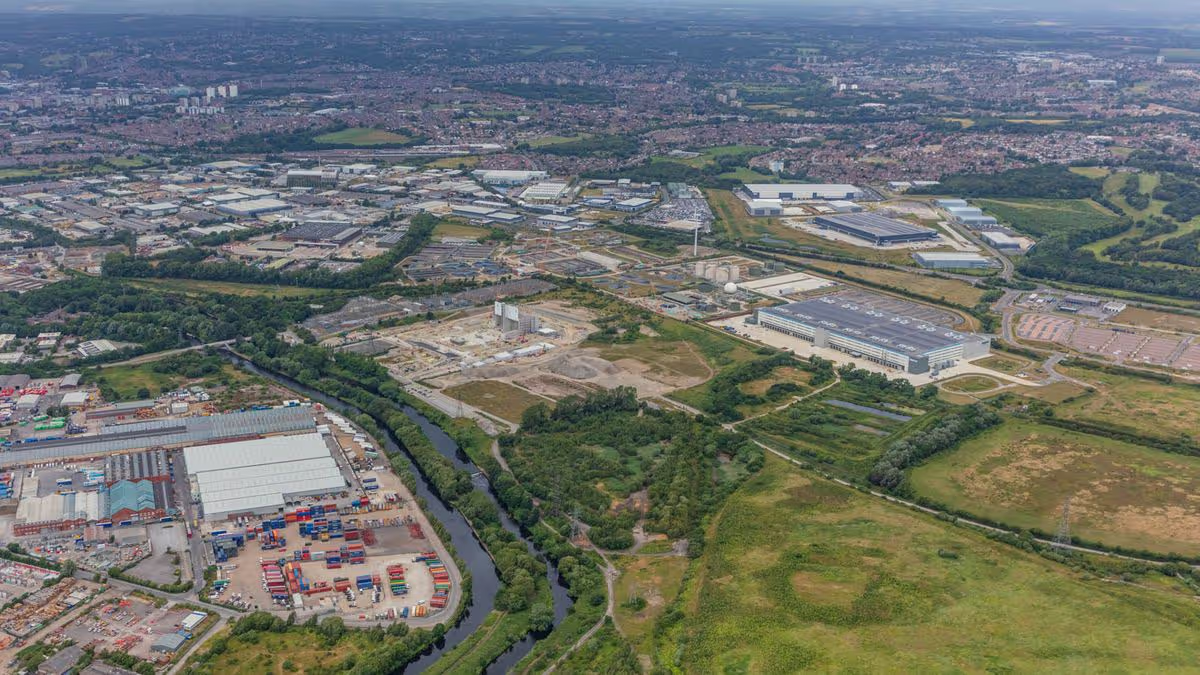
The former Skelton Grange power station site.

The Skelton Grange site where Harworth has secured its largest ever land deal, with Microsoft.(Image: Harworth Group)

Developers Harworth has reiterated its opposition to a £583m takeover offer by major shareholder Peel Group.

Peel already holds nearly 30% of Harworth’s shares, and earlier this month launched a bid to buy the company’s remaining shares through a subsidiary. The company’s offer of 172.5 per share would see it spend around £417m for the 70% of the company it currently does not own.

Manchester-based Peel has now published its offer document, arguing that Rotherham-based Harworth’s cash flow profile is increasingly becoming less sustainable, driven partly by the company’s increasing administrative cost base and increasing net finance costs.

It wants Harworth to pivot toward strategic land activities and selective development, which it says has a lower cost base, and argues that Harworth’s strategy of developing land for data centres is “very early stage, highly speculative and unlikely to convert to cash sales or deliver the contribution required to improve the overall returns of the business to an acceptable level within the short to medium term”.

Advertisement

Harworth’s board rejected the takeover bid when it was first announced and has now repeated its stance, saying that “the board is unanimous and unequivocal in its rejection of the offer which, in its view, fundamentally undervalues Harworth and its near and longer-term prospects.”

In a new statement to the Stock Exchange, Harworth said it would set out wider views on the offer by September 9, but in the meantime, it advised shareholders to do nothing on the offer.

Harworth originated as the property wing of UK Coal, and many of its earliest properties were former mining sites in the North and the Midlands. It currently has holdings of more than 15,000 acres across 100 sites, and specialises in developing industrial and logistics developments for sale. It recently said that announced plans to develop a second data centre, saying a deal to sell it could be worth more than the £106m it received for a data centre site sold to Microsoft in Leeds earlier this year.

Advertisement
Continue Reading

Business

Mark Walter’s TWG is working with regulators, says ’no fraud’

Published

on


Mark Walter’s TWG is working with regulators, says ’no fraud’

Continue Reading

Business

Newtopia Now special report | Food Business News

Published

on

Newtopia Now special report | Food Business News

DENVER – New product innovation abounded at the Newtopia Now tradeshow, held Aug. 18-20. Exhibitors ranged from startups not yet in the market to established brands promoting new concepts ready for market. But as one speaker noted, there is a wide divide between being consumer ready versus retail ready.

Several brands stood out at the show. For example, early-stage brand Lil’ Melts, Austin, Texas, showcased its beef tallow cooking cubes. The cubes are intended to melt quickly, require no scooping and simplify portioning for home cooks.

Boca Raton, Fla.-based startup Notchee introduced a dairy spread promoted as a clean label condiment featuring protein. The perishable spread comes in 5.5-oz glass jars in three varieties: original, garlic herb and date honey.

And GoodBelly from NextFoods, Boulder, Colo., a 20-year-old refrigerated probiotic drink brand debuted For a Clear Mind. The no-added-sugar beverage is formulated to support mental clarity through the gut-brain connection, the company said. It is formulated with L-theanine, green coffee extract, fruit polyphenols and postbiotics.   

Advertisement

While each innovation is unique, that’s not enough to make it in today’s marketplace, said Brian Gould, founder and chief executive officer of TruLife Distribution, Boca Raton, Fla. Retail readiness is becoming just as important as product innovation.

Having a great product is only the first step, Gould said. Retailers are evaluating businesses, not just products. Strong ingredients, attractive packaging and consumer interest are important, but buyers also assess whether a company can consistently deliver product, maintain margins, support demand and become a reliable long-term retail partner.

“Retailers evaluate the entire business behind the product,” Gould said. “Brands need to demonstrate not only what makes their product different, but why it belongs on that retailer’s shelf, who will buy it and how the business will support a successful launch.”

nochee.jpg

Retailers are evaluating businesses, not just products when considering bringing a new product into its stores.

Advertisement

| Source: Sosland Publishing Co.

While emerging brands have more tools to develop products, build direct-to-consumer audiences and generate online sales, achieving sustainable retail growth requires a different level of preparation and infrastructure, Gould said. For international brands, the challenge is often even greater. Companies entering the US must adapt to different retailer expectations, regulatory requirements, pricing structures and distribution economics.

“Success in another market is valuable validation,” Gould said. “But the US retail ecosystem is unique. Strategies that work elsewhere often require significant localization and preparation before they can succeed here.”

The distinction highlights the difference between being consumer-ready and retail-ready.

“Some of our most productive conversations (at Newtopia Now) were not about whether we liked a product,” Gould said. “They were about what steps would make that product truly compelling to a major US retailer.”

Advertisement

For some brands, the steps may involve refining pricing or positioning. For others, it may include strengthening retail materials, improving operational capabilities or identifying the most appropriate retail channel.

“The goal is not simply to get products in front of more buyers,” Gould said. “It is to ensure the right product reaches the right buyer at the right time.”

Continue Reading

Business

Bluesky Down? Users Report New Outage as Platform Faces Third Major Disruption Following DDoS Attack

Published

on

Bluesky

Some Bluesky users reported difficulty accessing the social media platform Wednesday, according to outage-tracking service Downdetector, marking at least the third significant disruption the decentralized network has faced this month.

Downdetector posted on its official account on the social platform X that “user reports indicate problems with Bluesky since 11:51 AM EDT,” tagging the post with the hashtag #BlueskyDown and directing affected users to its outage-tracking page. The post had drawn more than 1,600 views within roughly the first hour of being published.

Independent status monitoring offered a somewhat measured picture of Wednesday’s disruption compared with some of Bluesky’s more severe recent outages. According to StatusGator, Bluesky was listed as operational as of a check conducted around noon UTC Wednesday, though the service had logged 35 user-submitted outage reports over the preceding 24-hour period, a notably elevated figure suggesting genuine, if not necessarily platform-wide, connectivity issues affecting at least some portion of Bluesky’s user base.

Wednesday’s reports add to a pattern of recurring instability that has affected Bluesky throughout August. The platform experienced a significant outage Aug. 16, when thousands of users across the United States and other countries, including the UK, Portugal and Canada, reported being unable to load feeds, log in or use the app at all. According to IBTimes UK, complaints on Downdetector began climbing sharply around 10:37 a.m. EDT that day, with reported issues surpassing 2,000 complaints within about an hour. According to Windows Report’s coverage of that same incident, Bluesky’s own status account identified the disruption as affecting accounts connected to a specific server component within its infrastructure, known as the suillus.us-west.host.bsky.network personal data server, suggesting the outage did not affect every account on the platform equally.

Advertisement

Just two days later, on Aug. 18, Bluesky confirmed a separate, day-long disruption was caused by a distributed denial-of-service attack, commonly known as a DDoS attack, which flooded the platform’s servers with junk traffic specifically intended to overwhelm its infrastructure and knock the service offline. Bluesky confirmed the attack in a post acknowledging the incident had unfolded over the preceding 24 hours. “We have upgraded our defenses in response, and we continue to monitor the situation,” the company said, without disclosing further technical detail regarding the source or scale of the attack. A Bluesky spokesperson did not immediately respond to questions from TechCrunch regarding the incident at the time.

An earlier disruption on Aug. 5 similarly affected Bluesky’s backend infrastructure. According to Windows Report, the company confirmed at the time that multiple instances of its Personal Data Server fleet, the distributed backend components that store and serve user data across Bluesky’s decentralized network, had gone down simultaneously, suggesting the issue stemmed from core platform infrastructure rather than isolated individual account problems. User reports on Downdetector spiked sharply during that incident as well, jumping from a normal baseline of roughly one report to 589 reports within about half an hour.

Bluesky’s decentralized architecture, built on what the company calls the AT Protocol, has occasionally raised questions among users about why a distributed system remains vulnerable to widespread outages in the first place. According to TechCrunch’s earlier reporting on a separate 2025 outage, the answer lies in how most users actually interact with the network in practice. While the underlying protocol is designed so that different organizations and communities can theoretically run their own independent infrastructure, including personal data servers and relays, the vast majority of Bluesky’s current user base still relies on the company’s own official app and centrally operated infrastructure, meaning problems affecting Bluesky’s own servers can still cause widespread disruption for most users, even though the platform’s underlying protocol is technically decentralized. Users who have set up and rely on independently operated infrastructure outside Bluesky’s own servers have generally remained unaffected during these company-side outages, according to TechCrunch.

The recurring nature of Bluesky’s outages this month has generated visible frustration among users, many of whom have questioned why similar disruptions have continued occurring in relatively close succession. According to Rolling Out’s coverage of the Aug. 16 outage specifically, most affected users at that time reported problems primarily with the platform’s mobile app rather than its browser-based version, with some users describing being repeatedly logged out of their accounts or experiencing the app working briefly before crashing again.

Advertisement

Given Wednesday’s more moderate spike in reports compared with the platform’s more severe mid-August incidents, the current disruption may reflect a more limited or regionally concentrated issue rather than a full-scale, company-wide outage comparable to the Aug. 16 and Aug. 18 incidents. Users experiencing difficulty accessing Bluesky Wednesday were generally advised by monitoring services to check the platform’s official status page directly, restart the app, or verify their own internet connection before assuming a broader, confirmed outage is underway.

As of this report, Bluesky had not issued a public statement specifically addressing Wednesday’s reported issues, and the underlying cause, if any beyond routine, isolated connectivity problems, remained unconfirmed. Given the platform’s documented pattern of recurring outages throughout August, including at least one confirmed DDoS attack and a separate backend infrastructure failure affecting its Personal Data Server fleet, users and industry observers are likely to continue closely monitoring whether Wednesday’s reports represent another isolated incident or the beginning of a further, more significant disruption to the platform’s service.

Continue Reading

Trending

Copyright © 2025