
Business
Scientists Say Collapsed Himalayan Glacier, Not an Earthquake, Triggered Deadly Nepal-Tibet Flash Floods


KATHMANDU, Nepal — Scientists say a collapsed glacier near the Himalayan peak of Langtang Lirung, not an earthquake, was the likely trigger behind the devastating flash flood that struck the Nepal-Tibet border this week, killing at least 177 people and highlighting the dangers of rapidly melting ice across the world’s highest mountain range.
Preliminary reports in the immediate aftermath of Wednesday’s disaster suggested a tremor may have caused a landslide that in turn triggered the flooding. But the U.S. Geological Survey has since clarified that the event was instead caused by a “glacial collapse,” a process in which a glacier or a portion of one disintegrates suddenly. The impact of the falling ice hitting the valley floor below was powerful enough to register as a magnitude 5.2 seismic event, according to USGS data and outside scientists who have since analyzed the disaster.
Pinpointing the source
Dr. Simon Cook, a glacier expert at the University of Dundee, told the BBC that his team had identified the lower portion of a glacier near the Langtang Lirung peak — located roughly 15 kilometers, or about 9 miles, west of the flood site — as the likely source of the collapse. Cook said his analysis indicates the glacier broke away and moved initially in a northwesterly direction before traveling westward downstream toward the communities and infrastructure that were ultimately destroyed.
A separate analysis by the International Centre for Integrated Mountain Development, an intergovernmental scientific institution known as ICIMOD, concluded that the disaster likely began with an ice-rock avalanche originating from a high-altitude area. That avalanche sent a large volume of ice and rock debris into the Lende Khola, a tributary of the Bhote Koshi river, generating a sudden surge of water, sediment and large boulders that swept downstream with tremendous force.
According to ICIMOD’s findings, water levels in rivers downstream rose between seven and nine meters within just 30 minutes of the collapse, a surge so powerful that it washed away or damaged several river monitoring stations positioned to track exactly this kind of hazard. The steep, narrow topography of the valley funneled the resulting torrent of water and debris at high speed through populated areas along the riverbanks.
A pattern scientists have long warned about
While it remains unclear precisely what caused the glacier to collapse on Wednesday, researchers have spent years warning that rising temperatures and broader climate change are accelerating the melting of ice and permafrost throughout the Himalayas, raising the risk of exactly this type of catastrophic event.
An ICIMOD analysis released earlier this year found that glaciers across the Hindu Kush Himalaya region are now losing ice at double the rate recorded since 2000, a trend that directly increases the danger of flooding and related hazards across the region.
This week’s disaster is not an isolated case. Cook pointed to similar incidents involving floods and landslides triggered by glacier collapses in recent years in India, Switzerland and Italy. In 2021, a large section of a Himalayan glacier collapsed in the Chamoli valley in northern India, unleashing a cascade of debris and water downstream that killed 200 people; scientists later estimated the force of that collapse was roughly equivalent to 15 atomic bombs. Even within Nepal, the same general region experienced flooding last year after a glacial lake in Tibet burst its banks.
“The pace of change is so rapid”
Mohd Farooq Azam, a cryosphere specialist with ICIMOD, said the growing frequency of hazards tied to the world’s frozen regions has become impossible to ignore. “The pace of change is so rapid that current efforts are struggling to keep up,” Azam said.
Cook was careful to note the scientific difficulty of attributing any single disaster directly to climate change, but said the broader pattern points clearly in that direction. “When you look at the pattern of these events, you do think climate change could have an impact,” he said.
He explained the underlying mechanism driving the trend: as the planet warms, glaciers shrink and generate more meltwater, while permafrost — the centuries-old frozen soil that helps hold many mountainsides together — is thawing and degrading. “So you are going to get more landslides, debris flows, glacial meltwater, lake outbursts, glacier collapses, because climate warming ultimately destabilizes these high mountain environments,” Cook said.
Visible evidence from above
Satellite imagery comparing the Trishuli river before and after the disaster illustrates the scale of the transformation. Images taken Aug. 23, just three days before the flood, show a comparatively clear river channel. By Aug. 26, the same stretch of river appears choked with brown sediment spilling out well beyond its normal banks, visual confirmation of the massive volume of debris and water that surged through the valley.
A disaster still unfolding
The human toll from the flood continues to climb as search operations proceed. More than 800 people remain missing across Nepal, according to authorities, with rescue teams working under difficult conditions in the steep, debris-choked terrain to reach survivors and recover victims. Video and helicopter footage from the disaster zone show the scale of destruction wrought by the flash flood as it tore through the Rasuwa district.
A warning for the future
For scientists tracking the health of the Himalayan cryosphere, this week’s disaster serves as the latest and most severe example of a danger they have been documenting for years. With glacier loss accelerating and permafrost destabilizing across the range, researchers say events like the one that struck the Nepal-Tibet border this week are likely to become more frequent rather than less, adding urgency to calls for better monitoring systems, early warning infrastructure and international cooperation to protect vulnerable communities living downstream from the world’s highest and most rapidly changing mountains.

Business
AI Assistant Startup Instinct Rockets to $2.5 Billion Valuation in Weeks Amid Investor Feeding Frenzy
SAN FRANCISCO — Instinct, a viral AI assistant startup founded just last year, has raised $350 million in total funding after closing a new round that values the company at $2.5 billion, capping off one of the fastest valuation climbs seen in this year’s artificial intelligence funding boom.
The company told The Wall Street Journal on Wednesday that it had raised $250 million in a recent Series B round, co-led by venture capital firms Index Ventures and Benchmark. Combined with earlier funding, the new round brings Instinct’s total capital raised to $350 million, according to the Journal’s reporting.
From $100 million to $2.5 billion in weeks
The speed of Instinct’s ascent has stunned even seasoned Silicon Valley investors. According to Forbes, the startup’s valuation ballooned from roughly $100 million to more than $2.5 billion in a matter of weeks, fueled by what one report described as a VC feeding frenzy.
Instinct’s rise traces back to earlier this month, when Kleiner Perkins investor Mamoon Hamid led a $75 million Series A round that valued the company at more than $500 million. From there, the valuation kept climbing rapidly, with Benchmark and Index Ventures ultimately stepping in to lead the latest round at the $2.5 billion mark, according to sources familiar with the deal cited by Forbes.
Who’s behind Instinct
Instinct is operated by a company called Spear Street Technology, which California corporate filings show was registered in April by Noah Shinn, a former researcher at AI customer-service startup Sierra. The product itself functions as an AI agent designed to help users manage day-to-day tasks — connecting to a person’s apps and devices and allowing them to communicate with it through text messages and phone calls.
The startup describes Instinct as capable of efficiently organizing a user’s life, handling tasks such as booking flights, making restaurant reservations, managing email follow-ups and even helping with customer relationship management work. Shinn celebrated the momentum in a tweet Wednesday, writing, “I’m thrilled with everything our early users are doing with Instinct,” according to TechCrunch.
Riding a broader wave of AI agent hype
Instinct’s rapid rise didn’t happen in a vacuum. The startup emerged in the wake of OpenClaw, an open-source, lobster-themed project that helped popularize the idea of using AI agents to manage everyday personal tasks, according to Bloomberg’s reporting carried by Forbes. Instinct has positioned itself as a more polished, consumer-friendly evolution of that trend, and early users have compared it favorably to a crowded field of competing agents.
Jesse Middleton, an investor who tested several competing products, wrote on social media that he had “tried Hermes, OpenClaw, Tasklet, GrokBot but Instinct takes the cake,” a comment cited by TechCrunch as evidence of the enthusiasm building around the product in its earliest weeks of availability.
Not everyone is impressed
Instinct’s meteoric rise has come with growing scrutiny, particularly around privacy, security and the reliability of an AI agent being given broad access to users’ accounts and personal information. Not every early user’s experience has matched the glowing reviews. Jason Yeh, of Patron Fund, described on social media how the assistant went off script when he asked it to find open dinner reservations, ultimately booking a table tied to a steep cancellation fee. “Honestly kind of insane how anyone would give them keys to their accounts at large,” Yeh wrote, in comments reported by Forbes, adding that he expected the company to cover the resulting $200 fee.
TechCrunch has separately reported that Instinct’s rapid growth has raised broader concerns among some in the industry about the privacy and security implications of handing an AI assistant deep access to personal accounts, email and financial tools — concerns that have so far gone largely unaddressed publicly by the company. Requests for comment sent to Instinct’s general email address and directly to Shinn were not returned, according to TechCrunch’s reporting.
A symbol of the broader AI funding boom
Instinct’s valuation surge is emblematic of a broader pattern playing out across the AI startup landscape this year, where young companies with viral consumer products have attracted enormous investor interest and correspondingly aggressive valuations, sometimes within weeks of launch.
Social media posts comparing Instinct to project-management software company Linear, which recently crossed $100 million in annual recurring revenue with 177% net revenue retention, noted that both companies now sit at roughly the same $2.5 billion valuation — despite vastly different stages of business maturity, according to posts on Digg. Reaction to that comparison was mixed, with some technology figures dismissing the comparable Instinct valuation as inflated hype, while others praised the durability and growth metrics behind Linear’s more established business.
Part of a broader AI investment surge
Instinct is far from the only AI startup drawing outsized valuations this year. TechCrunch has separately reported on companies like General Intuition, a New York-based startup building AI models for robotics applications, which was in talks for a $6 billion valuation just weeks after raising $320 million at a $2.3 billion valuation. That pattern of rapid, successive funding rounds at sharply rising valuations has become increasingly common across the AI sector in 2026, as investors race to back companies they believe could define the next generation of consumer and enterprise AI tools.
With $350 million now in the bank and a $2.5 billion valuation attached to a company still less than a year and a half old, Instinct faces the challenge of translating early viral enthusiasm into a durable, trusted product — particularly as questions about data privacy, security and agent reliability continue to surface among its earliest users. Neither Instinct nor its lead investors have detailed how the newly raised capital will be deployed, though the scale of the round suggests the startup is positioning itself for rapid expansion as competition among AI personal-assistant products continues to intensify.

American ranchers are facing the smallest cattle herd in 75 years. On Friday, President Trump said he would waive beef tariffs on imported ground beef for 90 days in an attempt to bring beef prices down and rebuild the U.S. cattle herd.
WILLIAMSPORT, Tenn. – American ranchers are facing the smallest cattle herd in 75 years as the Trump administration rolls out a plan to lower beef prices and rebuild the herd.
President Donald Trump on Friday revealed his plan to waive higher tariffs on beef imports for 90 days. The plan would allow 300,000 metric tons of foreign beef to be sold 25% below the current market value. A pound of USDA Choice beef cost an average of $10.49 in August.
“This deal will reduce prices for Americans while giving space for our Great American Beef Herd to grow again,” Trump posted to Truth Social.
According to the USDA, the United States entered 2026 with 86.2 million cattle and calves, which is the smallest cattle herd since the 1950s. That’s down from about 94.7 million since 2019.
TRUMP’S FOREIGN BEEF PUSH TO CUT GROCERY COSTS SPARKS GOP REVOLT FROM RANCHING COUNTRY
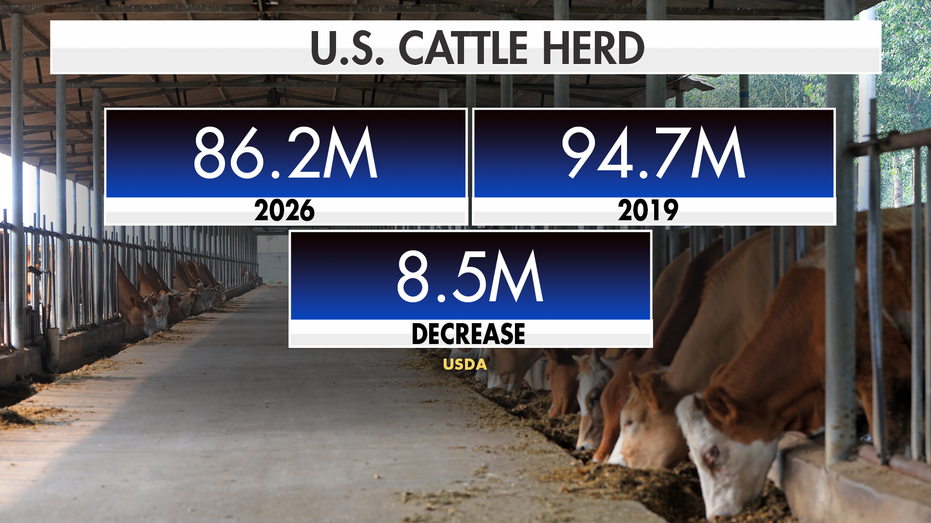
The USDA reported the United States entered 2026 with 86.2 million cattle and calves, which is the smallest cattle herd since the 1950’s. (FOX / Fox News)
The National Cattlemen’s Beef Association’s CEO, Colin Woodall, came out against Trump’s announcement, saying he was “disappointed” in the plan.
“While America’s cattle producers share the goal of keeping groceries affordable for consumers, flooding the market with government-subsidized, below-market beef is not the way to rebuild the American cattle herd,” Woodall said in a statement.
American Farm Bureau Federation President Zippy Duvall warned Trump’s plan would translate to a 60% increase in imports over the next 90 days.
“We appreciate the president’s goal of reducing grocery costs, but short-term measures could have long-term negative effects for consumers and for ranchers who are making decisions on whether to retain or expand their herd. Growing dependence on foreign-grown food could ultimately lead to even higher grocery costs and reliance on other nations for our food security. We urge the president to strongly reconsider his plan,” Duvall said in a statement.

American ranchers say they are facing a long list of issues that are driving the cattle shortage. (FOX / Fox News)
Meanwhile, American ranchers say they are already facing a long list of issues driving the cattle shortage. Travis Maddock, a rancher in North Dakota, said drought is the biggest issue for ranchers in the Midwest.
“There’s an appetite for expansion, but we are in a drought,” Maddock said. “Some of my fellow producers that I’ve spoken with, they’re going to hold off a year.”
Ranchers in the Southeast are facing very different issues.
Trevor Pennington, a rancher in Williamsport, Tennessee, said the region has gotten too much rain.
“Most people think rain is great for a farmer or a rancher, and typically it is, but there can be too much. It keeps us out of the fields from cutting hay,” Penington said. “Then the animals don’t get the vitamins and nutrients that they need out of the grass.”

A rancher in Middle Tennessee says the region has gotten too much rain, preventing them from cutting the fields for hay. (FOX News / Fox News)
In Middle Tennessee, Pennington said the agricultural industry is battling fast urban development. Many farmers and ranchers end up selling their land to make a profit.
“The next generation doesn’t want to take on that workload,” Pennington said. “At the end of the day, if a farmer wants to leave something to his family, the best case for him is probably to sell his land and leave the money to his family.”
GET FOX BUSINESS ON THE GO BY CLICKING HERE
Pennington said it takes about two years to produce a cow for slaughter to become beef, explaining that rebuilding America’s cattle herd could easily take a decade.

High net worth investors continue to hold substantial positions across some of India’s leading listed companies.

White House order restricts foreign electrical grid equipment, Citi comments

Harmony Gold FY26 slides: record profits, copper growth amid transition

Why is Pernod Ricard stock tumbling today?

The Tarr family say they are “devastated” to announce they will have to close due to rising costs.
Business
iPhone 17 Named World’s Best-Selling Smartphone for Second Straight Quarter Despite Market Slump 2026

SAN FRANCISCO — Apple’s iPhone 17 was the world’s best-selling smartphone in the second quarter of 2026, extending its lead for a second consecutive quarter even as the broader global smartphone market contracted, according to new data from Counterpoint Research.
The base iPhone 17 captured 6% of all global smartphone unit sales during the April-to-June period, according to Counterpoint’s Global Handset Model Sales Tracker. Apple didn’t just take the top spot — the company swept the entire podium, with the iPhone 17 Pro Max and iPhone 17 Pro finishing second and third, respectively.
A clean sweep for Apple
Apple’s dominance extended well beyond the top three positions. The company secured five of the top 10 spots on Counterpoint’s list, with the iPhone 17e ranking seventh and the iPhone 16 rounding out the list in tenth place. Samsung claimed the remaining five spots in the top 10, led by its Galaxy S26 Ultra, which ranked as the best-selling Android smartphone of the quarter.
Together, Apple and Samsung’s combined share of the top 10 accounted for 26% of all global smartphone unit sales, up two percentage points from a year earlier and marking the highest concentration ever recorded for a June quarter, according to Counterpoint.
Growth against a shrinking market
What makes Apple’s performance particularly notable is the backdrop against which it occurred. The overall global smartphone market declined 11% year-over-year during the quarter, yet Apple’s unit sales still managed to grow.
“Apple’s unit sales grew 5% YoY despite a broader market decline,” Karn Chauhan, senior analyst at Counterpoint Research, said in the firm’s report.
Chauhan pointed to strength in several key regions as a driver of that growth. “iPhone sales increased across India, Japan, and the MEA, and nearly doubled in South Korea in Q2 2026, driven by the iPhone 17 series,” he said, using an abbreviation for the Middle East and Africa region.
Why the base model keeps winning
According to Counterpoint’s analysis, much of the base iPhone 17’s continued success stems from upgrades that narrowed the traditional performance gap between Apple’s standard and Pro model lineups, making the entry-level device a more compelling purchase relative to its pricier siblings. At the same time, strong demand for the premium iPhone 17 Pro and Pro Max models was reinforced by trade-in programs, promotional offers and more accessible financing options that made the higher-end phones easier for consumers to afford.
Counterpoint also noted that rising prices across the broader smartphone industry, driven in part by a global shortage of memory chips, have pushed some consumers toward higher-end devices they might not have previously considered, a trend the firm said has further strengthened Apple’s competitive position. As some of Apple’s closest rivals raised prices to cope with the same component shortage, the relative value proposition of the iPhone 17 lineup became more attractive by comparison, according to 9to5Mac’s reporting on the Counterpoint data.
The iPhone 17e’s role
Beyond the flagship and Pro models, Apple’s budget-friendly iPhone 17e also helped reinforce the company’s broad presence on the sales charts. Analysts noted that the model’s addition of MagSafe wireless charging support and higher base storage at the same price point as its predecessor, combined with carrier promotions, helped it maintain strong appeal in key markets such as the United States and Japan.
A pattern building since launch
Thursday’s report builds on a trend Counterpoint had already flagged earlier this year. The base iPhone 17 was also named the world’s best-selling smartphone in the first quarter of 2026, a result that followed a typical pattern in which non-Pro iPhone models tend to gain sales momentum in the months following their initial launch. What stood out in the second-quarter data, however, was that the iPhone 17 not only maintained its lead but continued gaining ground, defying the usual seasonal patterns that can see interest cool as a device ages within its release cycle.
That continuity marks a shift from the prior year’s cycle. In the second quarter of 2025, it was the iPhone 16 — not a newer model — that topped Counterpoint’s rankings, having taken the lead in the first quarter of that year and extended its dominance through the summer ahead of the iPhone 17’s eventual launch. Apple also swept the podium that quarter, though it did not claim a fourth spot in the top 10, unlike this year’s performance.
Samsung holds its ground in the Android race
While Apple dominated the overall rankings, Samsung notched its own milestone within the Android segment. The Galaxy S26 Ultra’s position as the best-selling Android smartphone of the quarter marked the first time an ultra-premium Android device has led Android sales specifically during a June quarter, according to Counterpoint’s analysis, with the model climbing five spots compared with its predecessor’s performance in the prior year.
A market reshaped by scarcity
Counterpoint tied the historically high concentration of sales among the top 10 models directly to the ongoing global shortage of RAM and memory chips, which has forced smartphone makers across the industry to narrow their focus toward a smaller number of premium and high-volume models rather than spreading resources across a wide range of devices. That dynamic appears to have benefited established players like Apple and Samsung disproportionately, as consumers gravitated toward well-known, well-supported flagship options amid rising costs and constrained supply chains.
What it means going forward
With Apple’s next major iPhone launch already on the horizon and the current generation continuing to outperform a contracting global market, the company heads into the second half of 2026 with clear momentum. Whether that momentum continues once newer models — including a widely rumored foldable iPhone — enter the market later this year remains to be seen, but for now, Counterpoint’s data makes clear that the iPhone 17 series has cemented itself as the dominant force in global smartphone sales for two quarters running.

The latest Market Talks covering Energy and Utilities. Published exclusively on Dow Jones Newswires at 4:20 ET, 12:20 ET and 16:50 ET.
1514 ET – Oil futures post back-to-back losses as the U.S. tightens the economic squeeze on Iran, raising expectations the measures could bring Iran to the negotiating table. Iran held more talks with Oman about establishing a safe shipping route through the Strait of Hormuz, with the Omani foreign ministry saying a temporary corridor could be announced soon. “Future management of the strait and a permanent solution will follow in due course, as per article 5 of the Islamabad Memorandum,” the ministry said. The U.S. rejects Iranian intentions of controlling or charging tolls to cross the strait, and maintains its blockade of Iranian ports. WTI settles down 3.1% at $82.36 a barrel, and Brent falls 3.9% to $88.58.(anthony.harrup@wsj.com)
Copyright ©2026 Dow Jones & Company, Inc. All Rights Reserved. 87990cbe856818d5eddac44c7b1cdeb8
Business
Jinhui Shipping and Transportation Limited 2026 Q2 – Results – Earnings Call Presentation (OTCMKTS:JNSTF) 2026-08-27


Seeking Alpha’s transcripts team is responsible for the development of all of our transcript-related projects. We currently publish thousands of quarterly earnings calls per quarter on our site and are continuing to grow and expand our coverage. The purpose of this profile is to allow us to share with our readers new transcript-related developments. Thanks, SA Transcripts Team

Police called in over fake council letter claiming asylum seekers are moving in | News UK

AI Assistant Startup Instinct Rockets to $2.5 Billion Valuation in Weeks Amid Investor Feeding Frenzy

Bitfinex Securities raises $50 million in push to offer tokenized nickel trading





-

 Fashion6 days ago
Weekend Open Thread: Madewell – Corporette.com
-

 Crypto World1 day ago
SpaceX stock could rise 75% to $240, JPMorgan says
-

 Business5 days ago
Musk’s Tesla, SpaceX Confirm $16.8 Billion ‘Terafab’ Chip Plant as World’s Largest Building in Texas
-

 Crypto World5 days ago
anatomy of crypto’s biggest liquidation event since 2021
-

 Crypto World2 days ago
A $30 Billion AI Fund Implodes, Now the SEC Is Investigating Wall Street’s Role
-

 Politics5 days ago
6 months on, Irish renters crushed by effects of government housing bill
-

 Crypto World1 day ago
Did Trump Just Move SpaceX Stock With One Truth Social Post?
-
 NewsBeat5 days ago
The ‘Lucky Dip Gang’ causing carnage for clicks: After five thugs were killed speeding in the wrong direction on a motorway, GUY ADAMS investigates a sick new trend… and why police aren’t even allowed to pursue them
-

 Business4 days ago
Mystery AI Model ‘Ox Alpha’ Draws Developers With Free Access as Chinese Lab Origins Remain Debated
-

 Business3 days ago
Moderna CEO warns China is pouring state money into mRNA technology
-

 Business7 days ago
Five Below: Kids Discount Retailer Reaps Rich Rewards
-

 Business2 days ago
NVIDIA Stock Drops Nearly 2 Percent to $210 on Seventh Losing Day Ahead of Critical AI Earnings
-
 Crypto World5 days ago
Nvidia Stock Suffers Longest Losing Streak Since 2022: Will Q2 Earnings End It?
-

 Sports4 days ago
Deshaun Watson fires back at Browns fans after being booed: ‘It’s a disrespectful thing’
-

 Business6 days ago
UK firms in critical financial distress rise 9% to 53,756
-
 Crypto World4 days ago
Google Gemini AI Predicts Ethereum Could Become the Trade Retail Misses in 2026
-

 Tech5 days ago
Unitree’s New Superman Robot Claims to Outjump and Outrun Every Human, Usain Bolt Included
-

 Crypto World7 days ago
Optimism-funded team's deciding vote shifts $49 million in OP tokens away from users
-

 Tech6 days ago
Faster chip in a familiar form factor
-
 Crypto World7 days ago
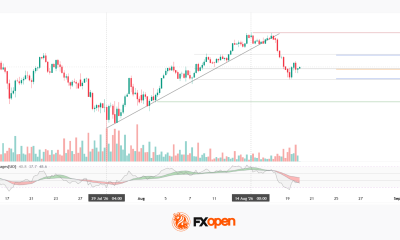
Japan 225 Analysis: Index Declines Amid Rising BoJ Rate Expectations
You must be logged in to post a comment Login