In 2008 Peter Serafinowicz walked onto a BBC set in the role of an Apple store employee and introduced Mactini, the smallest computer in the world. One key. Press it once for A. Press it 26 times for Z. For a comma, hold four seconds, lift for two, then fire off a rapid little drum fill. The audience laughed. Apple kept making things smaller anyway.
Tucker Osman re-watched the clip eighteen years later and decided that the joke was worth giving a functioning body. His Mactini, a matchbox-sized clamshell, opens in the palm of your hand. He obtained the case from FreeCAD after going through three separate print jobs. The screen is a tiny 1.69-inch color SPI panel from Waveshare, not the rescued iPod display he had hoped for, but their panel ended up being a better alternative because the old connector was difficult to locate.
LITTLE DO-IT-ALL — Mac mini packs pure power into a small, five-by-five-inch desktop as the M6 chip delivers next-level AI capabilities. Mac mini…
M6 CHIP — Everything you do on Mac mini feels more responsive with the M6 chip and its next-generation CPU. Fly through AI workflows with up to 4.8x…
CONNECT IT ALL — Features three Thunderbolt 4 ports, an HDMI port, and a 2.5Gb Ethernet port in the back, and two USB-C ports and a headphone jack…
The input is not a mechanical switch; instead, Osman printed the touchpad using conductive filament, so the entire thing acts as a capacitive surface. The firmware then determines how long you leave your finger down before lifting it and categorizing the durations as short, medium, or long. When combined with the gaps between taps, it creates a rhythm, which it then compares to a lookup table to determine what it should be. The comma still requires the exact timing specified in the original drawing. Try typing something longer than a word; this is done on purpose to test your patience.
When he started integrating sound and video, things started to lag all over the place. The solution was to use FreeRTOS, which allows gesture recognition, screen rendering, and audio to run as distinct processes, ensuring that none of them freeze. Pixels are copied to the display via DMA in the background, allowing the processor to handle everything else. Sound is coming in through some old speakers he salvaged from damaged iPads, as well as an amplifier board from a water-logged Wyze camera. The volume is relatively low, as you can barely hear it even if the room is silent. The video is a 90-second clip from Tenet, but because the RP2350 lacks a hardware decoder, it is limited to 12 frames per second.
A shimmering martini-glass logo sits on the rear of the lid, and he salvaged the diffusers and backlight components from shattered third-generation iPod nanos. He also had to run some cables through the hinge so that they could withstand the Mactini being opened and closed. He collected and printed every part he could find. [Source]
YouTube announced on Thursday that eligible creators in the U.S. can now tag Amazon products in their content and receive a cut of sales. Creators can link Amazon products in their shorts, long-form videos, and livestreams.
The update turns product recommendations into a more direct revenue stream for creators, and for Amazon, the move puts its massive online marketplace inside one of the most popular video platforms.
Although YouTube already runs a Shopping affiliate program with participating retailers, the addition of Amazon’s vast catalog essentially allows creators to recommend a variety of products through a native integration. By bringing Amazon into the Shopping Affiliate Program, creators no longer need to paste Associates links in the video’s description, then hope viewers copy the link when they make a purchase.
Instead, YouTube says Amazon will provide it with a curated catalog of highly requested and trending products that creators can tag in their videos. If a creator can’t find a specific product that they want to tag, they can request to add it by reaching out to YouTube Support.
Advertisement
The feature also includes auto-tagging support. If enabled, YouTube’s systems can automatically review a creator’s recent uploads to identify and tag eligible Amazon products.
YouTube notes that creators won’t see breakdowns for specific products or individual videos in their analytics, but that they’ll see their overall daily earnings in YouTube Studio. If a viewer ends up returning an item, that commission will be deducted from the creator’s balance.
While only eligible U.S. creators can currently tag Amazon products, those tags can be seen globally. YouTube says it may automatically match a tagged product with a trusted local merchant offer to allow creators to earn commissions on eligible international purchases. If a local merchant isn’t available, the tag will route viewers to the Amazon U.S. website, where commission will be earned if a purchase is finalized on the U.S. site.
To be eligible, creators must be enrolled in YouTube’s Partner and Shopping Affiliate programs, have an active Amazon Influencer or Associates account, and link it to their YouTube channel.
Advertisement
When you purchase through links in our articles, we may earn a small commission. This doesn’t affect our editorial independence.
The deal could have been could have been one of the biggest leveraged buyouts ever.
PJ McDonnell/Shutterstock
Stripe and buyout firm Advent are no longer pursuing their acquisition of PayPal as was reported earlier this month, people familiar with the matter told Bloomberg. If it had gone through, the deal could have been could have been one of the biggest leveraged buyouts ever at well over $50 billion, according to the report.
In July this year when PayPal was trading at historic lows and valued at $40 billion, Stripe and Advent reportedly made an offer worth around $53 billion. Their suitor was said to have rejected it, so the Stripe group was reportedly preparing a higher bid. PayPal was worth as much as $320 billion at its highest market value during the height of the COVID pandemic.
Stripe and its partner likely saw PayPal’s recent struggles as an opportunity to buy it at a significant discount. However, the pioneering payment company’s latest quarter beat most estimates which (along with the takeover rumors), helped boost its stock price by 40 percent. That may in turn have raised the selling price, making a leveraged takeover less feasible.
Advertisement
PayPal’s new CEO Enrique Lores, appointed in March, has been working to turn the company around by dividing it into three units focused on checkout, Venmo and payment/crypto. A Stripe-PayPal merger could have reduced the former’s reliance on Visa and MasterCard, while allowing Stripe to incorporate PayPal’s Venmo checkout system and its crypto features. Stripe and Advent could still opt to make a bid for PayPal in the future, Bloomberg said.
Wired reports that OpenAI is testing a new “Persistent mode” for Codex that would let the agent keep working until explicitly “put to sleep,” proactively creating follow-up tasks for itself across sessions and using prior interactions and knowledge of the user to decide what to do next. Code alluding to the feature was spotted in the product’s code base, though it has not been rolled out or officially announced yet. From the report: Persistent mode appears in Codex’s “reasoning effort” menu, in which users can select the level of computing power, tokens, and time they want to allow for an AI model to “think” before answering a prompt. It seems to be one of OpenAI’s most computationally intensive settings. When users have selected Persistent mode, OpenAI’s code base reads that Codex will “continue working until put to sleep.” That’s a stark contrast to currently available modes, which will stop working on a task after a few minutes or hours, even if it’s not complete.
In another file in the code base, OpenAI describes a feature within Persistent mode called “proactivity.” This appears to be a type of system prompt for agents in Persistent mode, which are told that their work is not done when they finish answering a user’s request. Instead, the agent is instructed to proactively create follow-up tasks for itself. The agent is capable of working on those tasks across sessions and using past user interactions and “knowledge of the user” to decide what to work on. It also has a tool to message the user without being asked but is told to send these sparingly.
The instructions also set limits for the agent, according to the file. The agent is told that Persistent mode does not expand what it is allowed to do and that altering anything outside the user’s own system requires the user’s approval first — seemingly intended to limit how dangerous a persistent AI agent could be. The file sits in the shared core of Codex rather than in the code specific to the terminal, seeming to suggest the proactivity feature is intended for more than the command line tool.
New research shows 64% of people feel confident challenging professional advice after checking it with AI
Over 45s are less likely to question professional advice
An “expertise recession” has been identified by the survey, conducted by Use.AI
AI is helping many of us call time on taking professional advice without further research, concerning new reports have found.
Research by Use.AI has claimed professional advice from doctors and teachers is now researched further, with nearly two-thirds (64%) of people are now more confident challenging what they have been told.
In addition, an “expertise recession” has been identified, a scenario in which expertise is less sought after in a world where AI can assimilate all information and present a contextual and nuanced response.
Latest Videos FromTechRadar
Advertisement
Gen X less likely to ask
The survey of 15,428 adults has also revealed other professionals that people are more likely to challenge. Managers, journalists, and economists are included in the list.
Use.AI’s findings also highlighted a key split in age groups, as while 70% of 18 to 34-year-olds are “more comfortable” asking questions that challenge professional advice after checking an AI chatbot response, that figure shrinks to 49% among over-45s.
Also, while 64% are “more confident challenging advice” from professionals, 53% of people are using AI to check answers and information from experts ahead of deciding if they can agree with it. Furthermore, nearly half (46%) of respondents stated that professional credentials don’t hold the same reputation as they once did, thanks to AI making it much easier to check an expert’s response.
This reveals an interesting change in how expert information is received. No longer is it something accepted at face value. Credentials might indicate a professional’s experience and knowledge, but don’t necessarily mean that everything they say should be accepted without further confirmation – typically by AI.
Sign up to the TechRadar Pro newsletter to get all the top news, opinion, features and guidance your business needs to succeed!
Advertisement
The “expertise recession”
In summarizing the report, Use.AI has referred to something it calls the “expertise recession.” This is, it says, evidence of a “decline in automatic deference” to professionals with years of education, expertise, and experience.
“AI has democratized confidence faster than it has democratised knowledge,” said Ihor Herasymov, Co-Founder & CEO of Use.AI. “Someone can use AI to arrive at better questions without becoming qualified to judge the answers.”
Use.AI tell us that the “gap between confidence and competence” will continue to grow in importance as more people use AI for information searches and fact checks.
The judge barred certain federal agencies from enforcing Trump’s order to stop using Anthropic’s tools.
jackpress/Shutterstock
A US federal court has ruled that the Pentagon’s designation of Anthropic as a supply chain risk was illegal, CNBC reported. US District judge Rita Lin found that the US Department of Defense’s restrictions placed on the AI company and its Claude model were “illegal and baseless.” As part of the ruling, the judge barred certain federal agencies from enforcing President Trump’s order to stop using Anthropic’s tools.
“The empty invocation of national security is not a blank check to punish and retaliate against government critics,” Judge Lin said in a 59-page decision. “Neither the Constitution nor the federal statute invoked by Defendants allows them to impose sweeping penalties based principally on Anthropic’s critique of the Administration’s views.”
“We welcome the court’s ruling that this supply chain risk designation was unlawful,” an Anthropic spokesperson told CNBC. “We remain focused on working productively with the government to harness AI for our national security so all Americans benefit from this technology.”
Advertisement
The dispute arose in late February, after the Department of Defense and its Secretary Pete Hegseth pressured Anthropic to remove certain safeguards from its AI systems. Anthropic’s CEO Dario Amodei, however, made it clear the company would refuse to allow its model to be used for mass surveillance or the development of autonomous weapons.
Late in February, Trump ordered all US government agencies to stop using Claude and other Anthropic services, escalating the feud. On social media, the president said there would be a six-month phase out period for federal agencies to migrate off of Anthropic’s products. Subsequent talks collapsed and Anthropic became the first US company to be designated as a supply chain risk.
After saying it would challenge the decision, Anthropic sued the White House in two federal courts (for two separate designations) to reverse the ban. Today’s ruling by Judge Lin gave the company a victory on one of those counts, but Anthropic is still considered a supply chain risk pending the second decision. Even if it wins both cases, though, the Pentagon would not be required to restart its work with the company.
The supply chain designation hasn’t slowed Anthropic’s march toward a likely near-record IPO later this year. Earlier this month, the company’s revenue surged to a record $11.5 billion, 14 times more than it earned in the same quarter last year. Engadget has reached out to Anthropic for additional comment.
Documentation files on more than 100 websites are referencing potentially dangerous executable content that gets installed automatically when visited by many AI agents. A few dozen companies, some of them Fortune 500s, are among those that executed proof-of-concept code. At least one misconfigured site is directing visitors, human or AI, to live malware.
The potentially dangerous content is in llms.txt and llms-full.txt files, an emerging convention websites employ to provide machine-readable summaries of the site’s content and its high-level structure. These files are the AI equivalent of the robots.txt standard that instructs search engines how to index the site’s content. Google Lighthouse, a tool for helping web developers, has more here. Correctly configured llms.txt and llms-full.txt files for Cloudflare are here and here.
How the researchers found it
Researchers at a stealth startup in Israel scanned 6,214 live domains belonging to defense contractors, Fortune 500, and Big Tech companies. Of the 8,265 llms.txt and llms-full.txt files they found (many sites hosted both an llms.txt and an llms-full.txt file), 120 of them, each on a different site, pointed to one or more code packages or domain names that weren’t registered. To test what happens when an AI agent processes such files, the researchers registered a handful of the unclaimed names and hosted packages that caused any machine executing them to reach out to their server. Within an hour, the researchers received a phone-home response from a Fortune 500 company. Over time, they got a few dozen more, some from more Fortune 500 companies and others from startups. Their beacon also recorded the chain of parent processes that spawned each install, ultimately revealing that coding agents, including Claude, OpenAI’s Codex, and Nous Research’s Hermes, were involved. Anthropic, OpenAI, and Nous Research did not respond to requests for comment by the time of publication.
“The trust model is broken,” Alon Hertz, one of the researchers, wrote in an interview. “Agents treat vendor docs as ground truth and don’t question them—and neither do the humans supervising them. Agentic AI usage is exploding, and agents are spreading across every layer—SaaS, cloud, endpoint. As they multiply, so does the supply-chain surface, and today’s guards don’t cover it.”
The Chinese AI company is reportedly seeking a 30pc share of any revenue generated by Kimi K3-related services hosted on Microsoft Azure, Amazon Web Services and Google Cloud.
Chinese AI start-up Moonshot is in negotiations with US tech giants Microsoft, Amazon and Google for revenue-sharing agreements that would allow them to host the Kimi K3 AI model on their cloud services, Reuters has reported.
The Chinese company is seeking up to a 30pc share of any revenue generated by Kimi K3-related services on Microsoft Azure, Amazon Web Services and Google Cloud, according to Reuters’ anonymous sources that are said to be familiar with the matter.
The publication added that negotiations between the three US companies and the maker of the open-source, open-weight AI model are “at an early stage”, with “no certainty they will result in agreements”.
Advertisement
According to Reuters’ sources, current unresolved issues in the negotiations include how revenue might be split, data access and auditing token usage.
They also said that Moonshot has already signed agreements similar to those being discussed with some smaller cloud platforms, but did not provide details.
Any deal struck could represent the first big revenue-sharing agreement between a Chinese AI provider and a major US cloud company, according to the publication.
Kimi K3 was unveiled in July. The 2.8trn-parameter model was found, across cited benchmarks, to trail behind only OpenAI’s GPT-5.6 Sol and Anthropic’s Fable 5, while outperforming them in certain coding and general agent tasks.
Advertisement
Its maker said that K3 performed “competitively” with Fable 5 and “substantially outperformed” Opus-4.8, GPT-5.6 Sol and GPT-5.5. A few days later, the company had to pause taking on new subscribers due to massive demand from interested users – right before it released it for public download.
The launch came amid a prevailing climate of escalating tensions between the US and China over AI leadership and capability.
Last month, Moonshot was reported to have closed a $3.5bn funding round at a $35bn valuation – with China’s National Artificial Intelligence Industry Investment Fund among the lead investors – and could also be aiming to raise yet more funds at a $50bn pre-money valuation as it works towards a rumoured public listing in the next few months.
Advertisement
In May, the company – founded in 2023 by Tsinghua University graduate Yang Zhilin, and with Chinese e-commerce giant Alibaba among its most notable backers – raised $2bn at a $20bn valuation.
Don’t miss out on the knowledge you need to succeed. Sign up for the Daily Brief, Silicon Republic’s digest of need-to-know sci-tech news.
Microsoft has started rolling out a permanent fix for a known issue that causes system crashes and gaming issues on Windows 11 devices.
On affected PCs, users have also reported games failing to launch and freezing with “EXCEPTION_ACCESS_VIOLATION” errors.
When it was first confirmed, Microsoft said that this issue affects games like ARC Raiders, MARVEL Tōkon: Fighting Souls, and The Finals on systems running Windows 11 24H2 and 25H2.
While it was initially believed that the August 2026 updates may be behind these problems, Microsoft later blamed them on peripherals with built-in RGB lighting.
“Ongoing investigation indicates that this issue is related to peripherals or internal device components which have RGB lighting features,” Microsoft noted. “Such devices may install drivers or code components with file names similar to inpoutx64. In systems where these drivers are found, the issue is then triggered by launching certain games.”
Advertisement
On Wednesday, the company confirmed that the inpoutx64.sys driver causes these issues and said that it has begun rolling out a fix that disables it on affected devices.
“This issue is resolved by a block that prevents the inpoutx64 driver from loading. The block targets devices with this specific driver enabled and the game ARC Raiders installed,” it added in a Windows release health update. “This resolution disables the inpoutx64 driver and displays a message window with information about the disablement. Following this message, the game will launch as normal.”
The fix is now propagating to Windows consumer and business devices that aren’t managed by IT departments and requires a system restart to be applied.
The rollout began on August 26, 2026, at 6 PM PT, and it might take up to 24 hours to reach all affected devices. The driver block will also be included in the September 2026 Windows security updates and future releases.
Advertisement
Temporary workaround for enterprise systems
Microsoft has also shared a temporary fix for enterprise-managed devices where the fix will not propagate automatically.
This requires IT administrators to disable the inpoutx64 driver using the Windows Registry by going through the following steps (however, they should back up the registry first, because they may need to undo the changes if a problem occurs):
Open the Windows Registry by opening the Start menu and typing “regedit”. Select the Registry Editor from the results.
Navigate to the key HKEY_LOCAL_MACHINE\SYSTEM\CurrentControlSet\Services\inpoutx64. You can do this using the folders on the left side of the window or by typing the path into the address bar at the top.
On the right side of the window, find the registry value named Start. Double-click this key and enter the number “4″ under the field titled Value data.
Close the window and restart your computer.
“Ongoing investigation does not indicate that disabling this registry key can result in unintended behavior. If you want to re-enable the driver, you may do so by restoring the registry key to its previous value,” Microsoft added.
Microsoft has addressed other gaming stability and performance issues caused by Windows updates in recent years.
For instance, it removed several upgrade blocks set up to prevent players of Star Wars Outlaws, Assassin’s Creed, Avatar: Frontiers of Pandora, and Asphalt 8: Airborne from upgrading their devices to the latest Windows version.
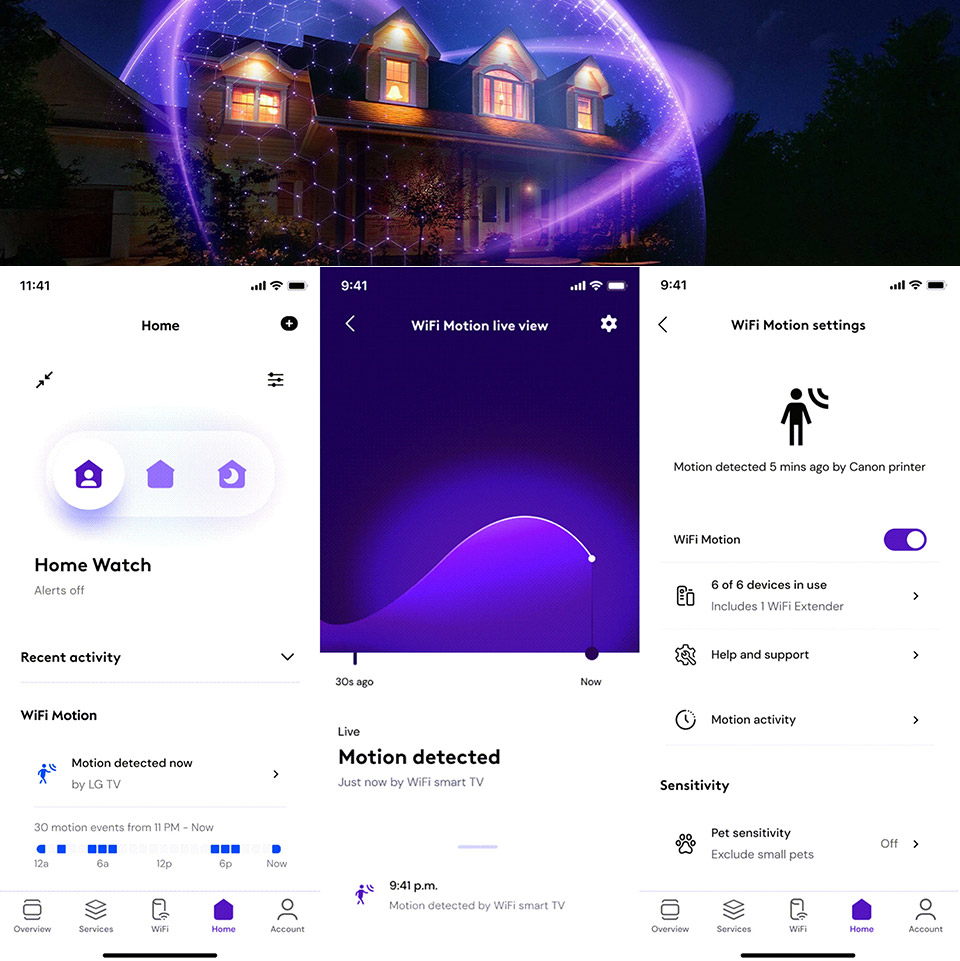
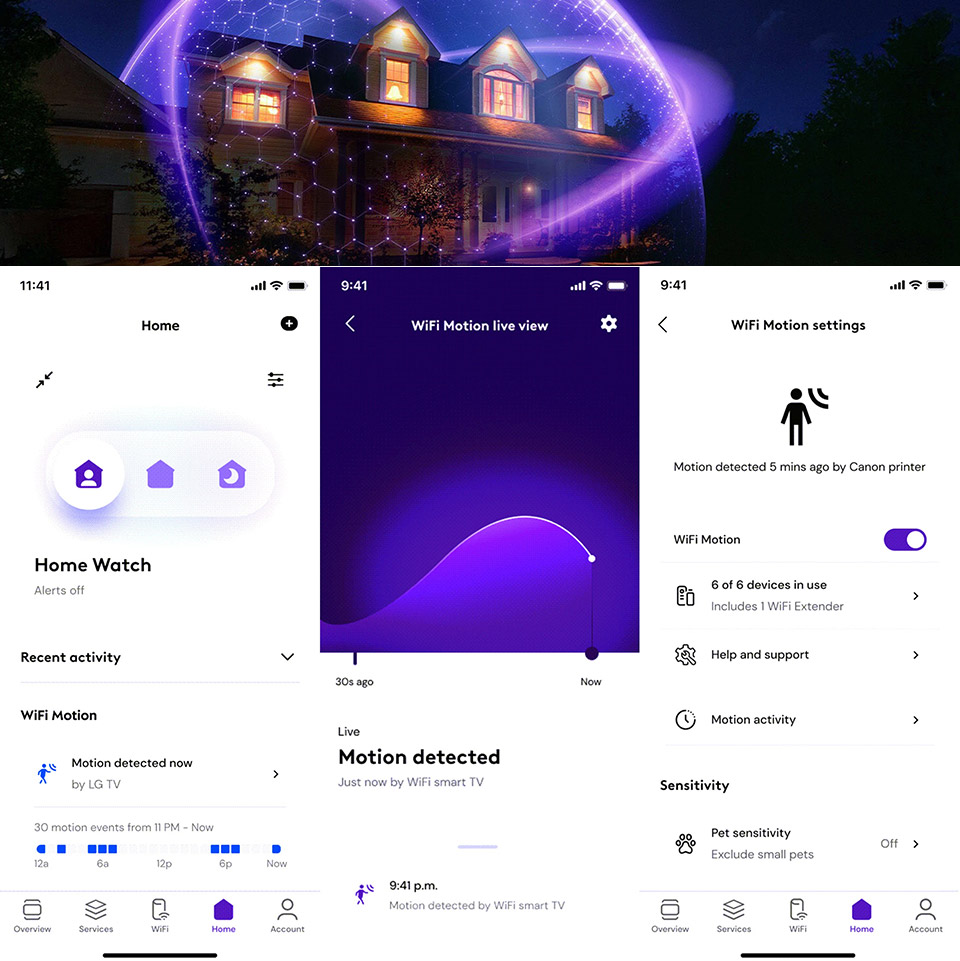
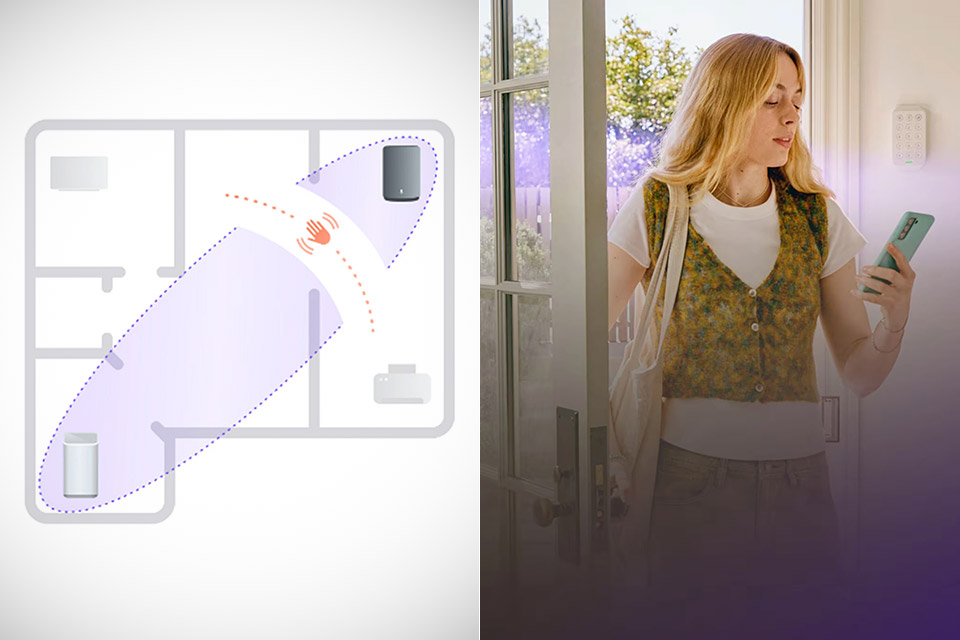
Comcast started rolling out Xfinity Shield this month, and the free piece that has everyone talking is WiFi Motion. Eligible internet customers who rent a recent Xfinity gateway can turn their existing Wi-Fi into a basic movement watcher without buying cameras or extra sensors. Radio waves already fly between the gateway and other gadgets that stay plugged in. A person walking through those paths changes how the waves arrive, and software in the box treats that change as motion.
Compatible boxes include the Technicolor XB7, XB8, XB9, XB10, MXB1, and XER10 variants, with the exception of the CommScope XB7 units. Simply launch the Xfinity app and follow the steps to complete the setup process. You can connect up to five fixed Wi-Fi devices, such as a smart speaker, thermostat, or TV, as well as any approved XE2 extenders you may own. As you do this, you will begin to notice regions of your home that will shape up as oval zones, where activity will trigger notifications on your phone. If you walk through one of those zones and there is any motion near the hallway speaker, for example, a notification may appear. These events will actually be available in the app for a week.
Get the whole picture – Watch over your home day or night in 1080p HD video with Live View and Color Night Vision.
Video previews – Record a few extra seconds before every motion event with Advanced Pre-Roll to get a more complete picture of what happened.
Privacy at your fingertips – Turn off your camera and mic with the manual Privacy Cover, then reactivate with a simple swivel.
Home Watch, Away Watch, and Dark Watch allow you to customize which notifications you get. Dark Watch is essentially the overnight option, and it may be configured to turn on automatically at nite. You can also experiment with the sensitivity level, setting it to low, medium, and high. The default settings detect even minor movements, including pets, but you may optionally apply a pet filter. However, this setting may miss a small child. It appears that where you place your gateway is far more crucial than most people realize. For the greatest results, choose a central, open place a few feet from the floor. Unfortunately, confined rooms, thick walls, and weak signal routes all work together to degrade overall reliability. Mobile devices, laptops, and wearables, as well as anything else with the potential to move independently, will not be considered “sensing partners.”
Advertisement
Apparently, Comcast spent three years fine-tuning the algorithms after being disappointed with their previous attempts. Linksys tried something similar and was withdrawn. However, company executives now assert that the most recent version is precise enough for everyday use in an average home. However, they are quick to stress out that it is not a replacement for proper cameras and door sensors. It’s also worth noting that professional monitoring is not included, so don’t expect someone to check your alerts in real time or call the cops for you.
WiFi Shield’s free tier also features CyberSecure network threat filtering and Family Settings, which allow you to establish screen time and website limits. Shield Select is a $15 monthly upgrade that includes an indoor camera, door and window sensors, cloud video storage, and 24-hour urgent response. If you’re willing to pay for the additional gear, WiFi Motion can be used in conjunction with camera notifications. [Source]
The phones! They were one of the basic utilities of the 20th century, and were just about as reliable as death and taxes. Even when then power grid went down, you still had a fair shot of getting a phone call through thanks to the reliability of the Plain Old Telephone Service.
Generally, we expect our telecommunications networks to be supremely reliable. There is no moment of the day when someone doesn’t need to make a call, particularly in emergencies, and the wheels of industry and commerce depend on constant connectivity these days. Tolerance for failure is generally very thin. Despite this, and the efforts of engineers to maintain uptime at as many nines as possible, Telstra fell badly short on July 8th, 2026. The company had a nationwide outage that affected 8.8 million people, leaving them unable to make calls or connect to the network at all.
The cause of the outage would prove to be particularly embarrassing. Telstra owns and operates a highly advanced cellular network, offering 4G and 5G service across the nation’s cities and much of its outback areas. The company may outwardly appear to be a shining beacon of modern connectivity, but there was something dank lurking in the company’s server closets. Namely, three aging network time servers that had the capacity to bring the whole system to its knees.
Advertisement
The NTP server in question is old enough to still rock a vacuum fluorescent display, something you don’t see on a lot of modern network hardware. Credit: Microsemi
The culprit? A Microchip Technologies SSU 2000 NTP server. The model dates back to the early 2000s. Twenty four years later, Telstra still relied upon three of the units to provide network time protocol (NTP) services across its network. The servers were generally perfectly adequate in this role on any given day. That was, until the Melbourne server had a wobble.
A technician was working in the early morning to replace a backup power feed in the chassis housing the server. This caused the server to be rebooted at 3:38 AM, which normally would not be a problem. However, at some point in the last two decades or so, the server had gone through a configuration change. While it was originally intended to be a Stratum 3 NTP server, getting its time reference from a Stratum 2 unit, that process had failed at some point. It had been reconfigured instead to use its internal GPS card to gain time directly from the satellite network instead. Unfortunately, the server was also remarkably old, and suffered from a well-documented GPS date rollover bug, such that when it rebooted, it reported the time as 2006 rather than 2026.
Victoria’s V/Line train services were unable to run, as the Telstra network outage made communication across the system impossible. Credit: Thomas Hobley, CC BY-SA 4.0
The problem that stemmed from this was because time is critical to authentication. An endless cascade of devices downstream of the NTP server picked up the wrong time, and started using it to sign digital certificates and the like. This immediately caused other systems on the network to reject the spurious traffic with certificates that were 20 years out of date. The impact was swift and vast—Telstra was quickly facing a nationwide outage affecting millions of customers.
The issue was first detected at 4:20 AM. The naughty server was isolated by 7:11 AM, but it would take until 10:30 AM to identify all the network components which had received erroneous time data. It took several hours further—until 4 PM—to properly quell the NTP issues. In the meantime, a significant portion of the country had seen its phones offline all day, and entire rail networks had ground to a halt as their Telstra-based communications systems went completely offline.
Later submissions to a government inquiry would reveal Telstra had received two reminders to patch the GPS card, in 2020 and 2022. The vendor itself had issued warnings about the GPS rollover bug as early as November 2000. A decision not to fix the bug had been taken as recently as January 2026, because the undocumented change to have the server rely on GPS time was unknown, and thus the update was considered unnecessary. Simply patching the system would have prevented the issue from ever occurring in the first place.
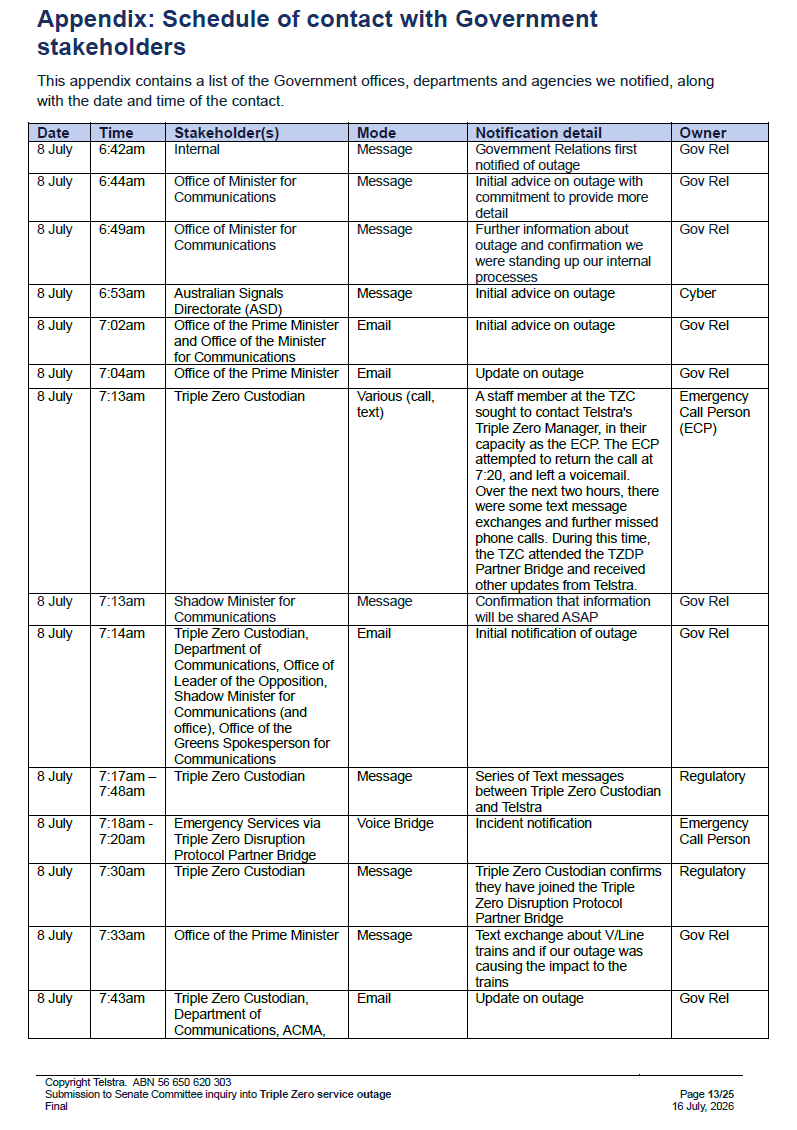
When the outage became apparent, Telstra notified the Triple Zero Custodian, a body founded in 2025 to oversee the integrity of the emergency service. Credit: Telstra submission to government inquiry
The issue once again brought telecommunications availability in Australia to the forefront of the conversation. Repeat outages across Australian mobile networks have led to particular concerns about the ability for people to reach emergency services by calling Triple Zero from mobile handsets. The latest failure on Telstra’s behalf has led the local telecommunications industry to issue new guidance to the public on what to do when a call to Triple Zero doesn’t go through.
Modern handsets are designed to switch to a different cellular network in the case an emergency call can’t be connected—a process called emergency camp-on. However, this process takes time, and the caller will often hear silence on the line while the phone is attempting to connect. The new advice is that callers should hang up and try again straight away if their first call to Triple Zero doesn’t connect within a few seconds. On the second call, though, the phone should be given up to a minute to find another network to get the call through.
Advertisement
In the case of this outage, camp-on functionality worked—some 3,200 Triple Zero calls were passed to Optus and TPG networks when Telstra’s failed. However, there were some ongoing issues that saw a further 604 Triple Zero calls fail over the period to 2 PM the next day.
Overall, Telstra’s failure was a major one. It’s rare for a major network to go down so completely and over such a wide geographical area. The fact that it happened because of an undocumented change to an ancient network appliance is all the more embarrassing. It will drive home the message that documenting even seemingly minor changes is important, with the lesson likely to be told in the halls of the Australian telco for some decades to come.


































































You must be logged in to post a comment Login