The other day, Holly Finchem revealed to the golf-loving world, via Global Golf Post, that her husband, Tim Finchem, has Alzheimer’s. In his 22 years as PGA Tour commissioner — the Tiger Years, essentially — Finchem was always of sound mind and body. He was always trim and fit man. But the former—his strategic and lawyerly brain — was his bread and butter, and now a disease with no known cure has settled in it.
Holly Finchem’s forthright and powerful commentary brought to mind the last time husband and wife, married for nearly 40 years, were at the center of golf’s spotlight, on a Wednesday night in March of 2022, on the eve of the Players Championship, when Finchem was inducted into the World Golf Hall of Fame. Tiger Woods was the headliner that evening — he was inducted that night, too. Finchem and Woods sat next to one another for most of the night, in the first row of a space-age auditorium of the Tour’s new headquarters, its “Global Home,” per the Tour’s own branding. Finchem wrapped up his remarks by publicly thanking Holly “for agreeing to marry me.” It was both lawyerly and moving. It was a beautiful thing to say. Beautiful and easy.
David Feherty was the night’s MC and in his opening remarks he welcomed the ceremony’s guests into a room so spacious it was “almost big enough to contain the egos of Brooks and Bryson.” Bryson DeChambeau and Brooks Koepka were PGA Tour stars then — they went LIV later. David Feherty became a LIV broadcaster later, too. Phil Mickelson, a 2012 inductee into the World Golf Hall of Fame, was not there that night. He was sort of underground then. But he was in the air. Alan Shipnuck had already broken the story that Mickelson was going to join LIV Golf, and Mickelson already was persona non grata in Establishment golf circles. If you listened carefully that night, you knew that Mickelson would not be playing at the 2022 Masters, coming up in a month. DeChambeau did not play in the Players that year, out due to a hip injury. He paid tribute to Woods botahy way of Twitter, when Twitter was still Twitter: “I can’t thank him enough for everything he has done for the game of golf.”
Woods was wearing a sort of rubber-soled sneaker that night. He was recovering from the injuries he had sustained 13 months earlier, when he ran his car off a Los Angeles road. Erica Herman sat to Woods’s right. Finchem, on Tiger’s other side, was wearing black dress shoes for the event, per sartorial custom. Everybody knows you don’t wear brown shoes to an evening event. There was always something proper about Finchem, something very by-the-book. His successor, Jay Monahan, was different, more casual, more of a (quote/unquote) people person. Monahan could always connect with the club caddies on his bag at this golf casual game or that pro-am. Finchem wasn’t built for that.
This all sort of seems like ancient history, doesn’t it? A year or so into the Brian Rolapp radical-change era, this all sort of seems like ancient history.
The most memorable aspect of that induction night from four-plus years ago, at least from my second-level perch, was seeing and hearing Tiger’s daughter, Sam Woods, introduce her father. She was 14 then, poised, charming, funny and you could sense her intelligence. It was easy imagine her on a path to an elite university. She’s now at Stanford, where her father went for two years. The two best years of his life, he has said more than once.
Tiger’s remarks from that induction night linger, too. He spoke movingly, without notes, from deep within his own life experience. For almost 15 minutes he spoke about himself as a six-year-old beginning golfer, as a junior golfer, as an amateur golfer. He never got out of California, in a manner of speaking.
In DeChambeau’s early years on Tour, in 2017 and ’18 and ’19, it was amusing and interesting to watch him on the range in the vicinity of Woods. Not often but now and again you’d see the two of them together and it was Woods who did most of the listening. They taped a Bridgestone ad together where DeChambeau played the mad professor and Woods the bored student. Tiger nailed take after take and Bryson did not. “You’re overthinking it, bro,” Woods told him. If DeChambeau was nervous, it would be easy to understand why. He is a child of California, too. He was six and the son of a golf professional when Woods won the U.S. Open at Pebble Beach by 15 shots.
When Woods was a kid in Southern California, and years later when DeChambeau was a kid in Northern California, their paths forward were both challenging and simple. To go the places they wanted to go, all they had to do was get better at golf. Get better, get better, get better. Mike Cowan, a.k.a. Fluff, who caddied for Woods early in his pro career, once told me that what made Woods a dominant golfer wasn’t anything earth-shattering. He was just a “little better” at everything — irons, putting, chipping, pitching, distance control, driving distance, thinking. He was often wild with the driver. That was his bugaboo.
When DeChambeau came along, Woods was fascinated that a player could be that long and that straight. In real life, Woods wasn’t a bored student at all. DeChambeau’s emergence as an elite Tour player, after an accomplished amateur career that included winning the U.S. Amateur in 2015 and being the low amateur at the 2016 Masters, was a sort of gift to Woods. Woods won three U.S. Amateurs. He had been the low amateur at the Masters. There was something there, a kind of connection from two people who don’t make connections easily. Bryson’s golfing ambitions and strengths reached Tiger where he lived. To call Woods a golf nerd is crude. He was a student of golf, just as DeChambeau is.
For both men, the only paths they have ever really known — better living through better golf — now have enormous detour signs on them, or are blocked off entirely. Woods aged out of the whole process. When he was young and undeniably great, he liked to say if you’re not getting better you’re getting worse. Then came middle age and injuries and car crashes and surgeries and injuries and more middle age — you know the cycle. DeChambeau was on a driving range at the season-ending LIV event in Indiana last week, surrounded by his posse and acting kind of odd, though not for Bryson. It was Bryson being Bryson — you could say that, too. Middle age is coming for him, too, but for now he has other things on his mind.
DeChambeau is only 32 but not a young 32. You can of course get better at 32. But now, for the first time in his life, improvement alone cannot take him to the places he wants to be. A tournament golfer — a person whose life is defined by tournament results — needs tournaments in which to play. Four is a good start — DeChambeau is in all four majors for 2027—but not nearly enough. This year he missed the cut in the Masters, the PGA Championship and the U.S. Open and had T14 finish in his strange British Open appearance. There’s no such thing as an elite touring pro without a home tour. At least, there hasn’t been. Where will DeChambeau play in 2027 — and in 2028 and beyond? Playing golf on YouTube is a new form of exhibition golf. That’s all it is.
Woods turned 50 at the end of the last year. I was semi-excited (is that a thing?) to see what he might do in the three senior majors, the senior PGA Championship, the senior U.S. Open, the senior British Open. He didn’t play a single round of tournament golf this year. His past cannot be his future. That’s true for Tiger as it is true for everybody. But how will he find meaning in his life, from here on out?
Tiger Woods’s past cannot be his future. That’s true for him as it is true for everybody.
The most immediate and pressing thing in his life, from the little we can know of it, is a court date stemming from his March 27 DUI charge. It’s set for Sept. 8 but these things can be postponed. In his earlier life, there was no such thing as postponement. The first round of the Masters is always the second Thursday in April. If you’re playing in it, you’re there. Woods has played in the Masters 26 times but dd not play in it this year or last. He’s never missed the cut at Augusta, not as a pro. (He missed one cut in two appearances as an amateur.) Tiger Woods has always known how to put on a game face, a public face — a mask he takes off a shelf marked Proud Warrior Athlete and puts over whatever else might be going on just then.
Woods has had two public, or semi-public, outings over the past half-year. That’s it, and that’s not counting his March 27 arrest, when video captured him wandering away from investigating crash-scene police officers and talking on his cellphone to (Woods later told the officers) “the president.” Shortly after his arrest, Woods, per various reliable reports, went to a behavioral treatment facility in Switzerland for about six or seven weeks. On June 23, he was in Hartford, Conn., where he read from prepared remarks for a minute, the preamble to Brian Rolapp’s appearance in front of assembled reporters. Woods, in a suit and tie, opened his comments with a good-natured and confident, “Good morning.” He seemed nervous after that, understandably so. Here was one of the most famous people in the world making a rare semi-public appearance. He’s a prisoner of something — his fame, his choices, his compulsions. His life.
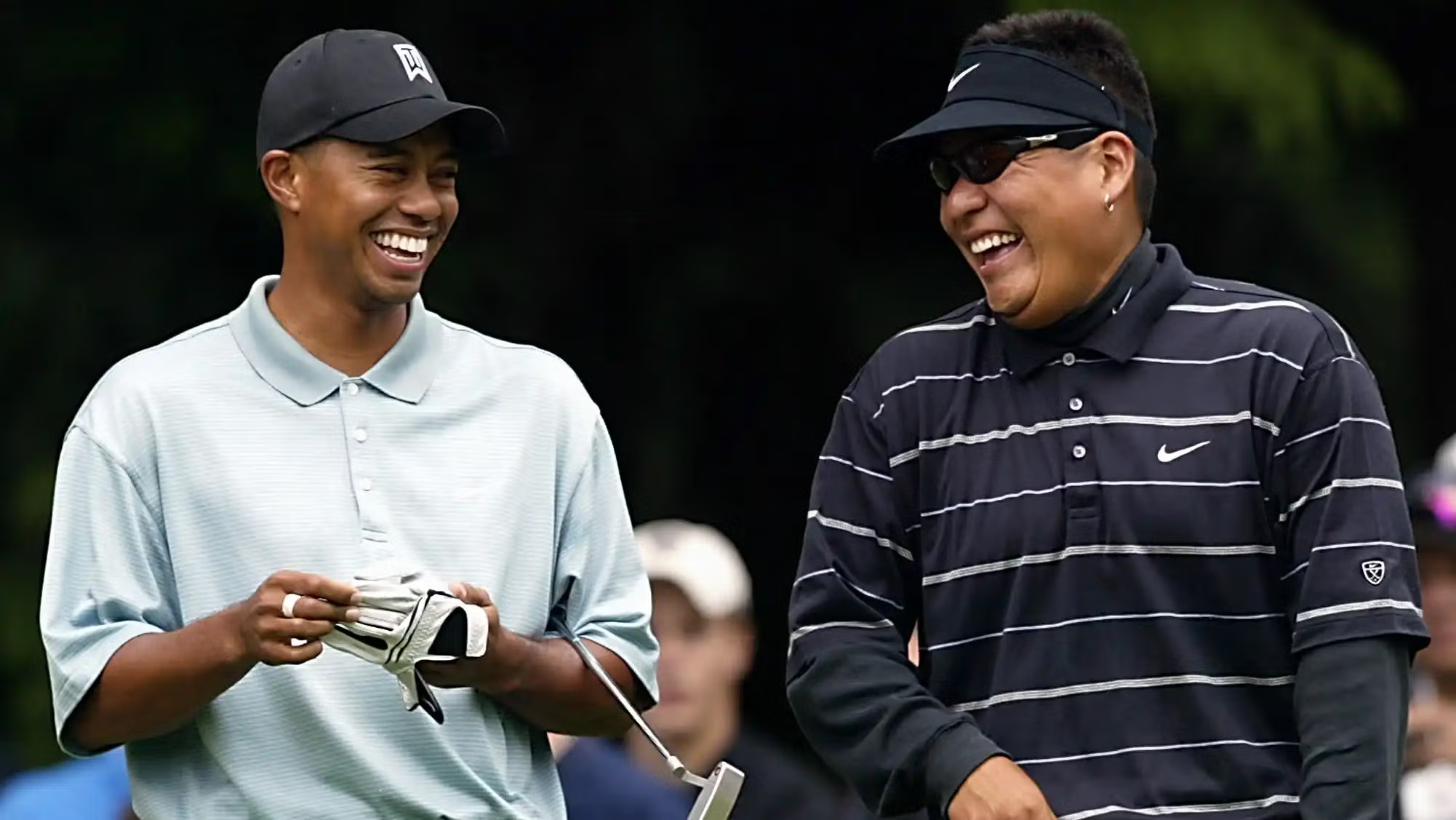
His second recent semi-public appearance came by way of video, a message he made for his friend Notah Begay, who received the Payne Stewart Award the other day, for his work on behalf of Native American kids. Earl Woods, Tiger’s father, had a grandparent who was a member of the Cherokee Nation. Woods, in his one-minute tribute to his former Stanford teammate, began his remarks by saying, “Hey, Note — it’s been an unbelievable ride with you.” Names are often lengthened and sometimes shortened when they come out of Tiger’s mouth. Steiny. J.T. His daughter is Sam and not Samantha and his son is Charlie not Charles. Stevie (Steve Williams). Brooksie (Brooks Koepka). Stricks (Steve Stricker). Bryson is Bryson. What can you do with Bryson? Woods talked about the significant and real work Begay has done for Native Americans. “You first came into my life when I was 11 years old and you watched me play in a Junior Worlds,” Woods says early in the minute.
Some people, typically in unsigned internet commentary, have offered their observations on how Woods looked. It’s crude. “Fans Stunned by Tiger Woods’ Look after Rare Public Appearance,” read a Yahoo headline. So crude. Yes, Woods does look tired. He does look like he’s been through the wringer of a life that once seemed easy but has not for years.
But, at least from this perch, there’s something else in that roughly one-minute video that is far more telling, and Bryson would surely get it. Woods is talking directly to a friend, a friend who saw the child become a man. Notah was there when Tiger was 11 and surely when Tiger was 12. He was there through Tiger’s high school years and into his two at Stanford. The California years.
All that promise. All that future. All Tiger had to do was keep getting better at golf. The chase is so exciting. You can get lost in it. Bryson knows all about that.
“Thank you for coming to see me play, thank you for getting our friendship started,” Tiger says in the final seconds of a fast minute. “I love you, dude.” It was a beautiful thing to say. Beautiful and easy.
Michael Bamberger welcomes your comments at Michael.Bamberger@Golf.com.



























































You must be logged in to post a comment Login