The $69bn company expects further disruption while it works to restore affected systems.
Boston Scientific’s global operations have been disrupted in a cyberattack on its IT systems.
The medtech giant said it discovered the breach on 25 August. “The incident has impacted access to certain operating systems and business applications, including the ability to process and ship customer orders,” it said in a statement published yesterday (26 August).
The $69bn company expects further disruption while it works to restore affected systems. A probe into the attack is ongoing, but no concrete timeline has emerged yet, it added.
Advertisement
The company said that it is unaware, as of yet, whether this incident might have any material impact on its business. Shares fell more than 3pc at market close yesterday and gained marginally in after-hours trading.
Boston Scientific employs around 7,000 across its three sites in Galway, Cork and Clonmel. The company’s Cork-based workers were asked to work from home yesterday, several news publications confirmed. SiliconRepublic.com has reached out to Boston Scientific for further information.
Boston Scientific is the latest target in a series of cyberattacks affecting pharmaceutical and medical technology companies.
Medical equipment manufacturing giant Stryker was hit by a cyberattack earlier this year that caused a global network disruption. Reports at the time suggested that the company’s Cork plant, which employs more than 4,000, was affected.
Advertisement
In April, Dublin recruitment platform Healthdaq – which is used by Northern Ireland’s health trusts – reportedly suffered a cyberattack from the relatively new hacker group XP95, which claimed to have accessed hundreds of thousands of files.
Several other medtech businesses, including Medtronic, West Pharmaceutical, Novo Nordisk, Amgen and Abbott Laboratories, have also reported cyberattacks in recent months.
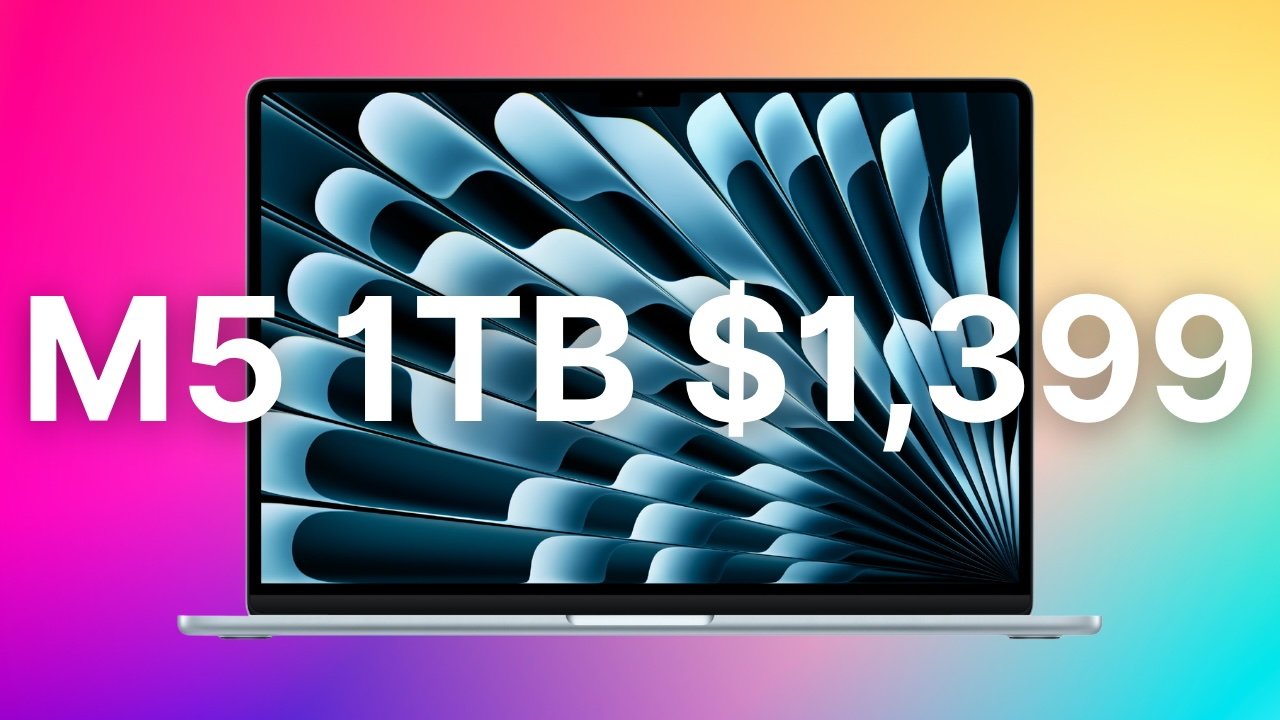
Apple’s 1TB M5 13-inch MacBook Air is down to $1,399 at Amazon thanks to a $200 month-end discount.
The lowest price since Prime Day is available now on Apple’s M5 13-inch MacBook Air with an upgrade to a 1TB SSD. The $200 discount is hosted by Amazon, bringing the cost of the Sky Blue model with a 10-core GPU and 16GB of unified RAM down from $1,599 to $1,399.
Lake Ontario is no more on Google Maps in the US. Google changed the name of easternmost of the Great Lakes to “Lake America” late Saturday, days after President Donald Trump ordered its rebranding in official government databases.
Trump issued the executive order on Thursday as part of an ongoing feud over tariffs with Canada, whose capital province is called Ontario. It followed a similar order he issued in January 2025 to rename the Gulf of Mexico as the Gulf of America as part of a fight with the US trading partner to the south.
Google, Apple, Microsoft, and other maps providers adopted the Gulf of America naming as soon as the US Department of the Interior updated its records, which came a couple of weeks after Trump’s order. So it was no surprise that when those records—which are used to determine names on roadway signs and in government literature—reflected Lake America, digital maps from Google also quickly took on the new name.
Apple Maps and Bing Maps have not yet reflected the change but are expected to. In fact, the map for the federal government’s Geographic Names Information System database, which informs these changes, still showed Lake Ontario as of Sunday morning, with a note that the maps are “in the process of being updated to reflect this name change.”
Advertisement
While Google and other private organizations that provide maps are not bound by law to use official names, they generally follow government databases like GNIS. The location names a user sees depends on their own geography.
“People using Maps in the US will see ‘Lake America,’ those in Canada will continue to see ‘Lake Ontario,’ and those outside of the US and Canada will see both names,” Google said in an unsigned statement. “These updates follow our long-standing policy for bodies of water with names that vary from country to country, and are starting to roll out now.”
Trump’s efforts to rewrite maps have generated considerable public debate in open-source mapping communities such as OpenStreetMap, whose technology is used by companies such as Uber and Lyft. Ultimately, OpenStreetMap recognizes both the US and foreign names and gives organizations using its maps the choice over which to show.
One map provider has said it would decline to make the change is MapQuest, which said in a social media post in response to Trump’s order that “we’re not changing it.”
Digs co-founders Ty Frackiewicz, left, and Ryan Fink. (Digs Photo)
Digs, a Vancouver, Wash.-based startup building AI software for residential construction, raised $25.3 million in Series A funding led by building products giant Builders FirstSource, the companies announced Tuesday.
Under the five-year agreement, Builders FirstSource will integrate Digs’ AI platform into its digital ecosystem, expanding tools for its 140,000 builder clients. The technology streamlines everything from pre-construction estimates and blueprint collaboration to post-move-in home maintenance and warranty care for homeowners.
The deal represents a major milestone for Digs, which was founded in 2022 by Ryan Fink and Ty Frackiewicz. Fink said the partnership moves Digs closer to its vision of creating “the first scalable true digital twin of the home” that lives on well past the construction phase.
The Series A pushes Digs’ total funding to more than $47 million, building on a $5 million pre-Series A round in late 2025. The startup previously drew backing from regional venture firms including Fuse, Flying Fish, Oregon Venture Fund, and Cascade Seed Fund.
Digs has grown to 37 employees and Fink said they’ll look to double that count to more than 60 by the end of the year, mostly in engineering, design, and product and some in sales and marketing.
Advertisement
(Digs Image)
Digs charges builders on a SaaS model and currently has thousands of homes on its platform across all 50 states. Fink often describes the tool as a “CarFax for the home,” replacing static PDF blueprints and lost paperwork with an AI-powered hub that tracks a property’s history, materials, and warranty details.
Fink and Frackiewicz previously collaborated on augmented reality startup ONtheGo Platforms, which was acquired in 2015. Fink later founded home-service AR startup Streem (acquired by Frontdoor in 2019), while Frackiewicz brought a background in construction engineering and luxury homebuilding.
Headquartered in Irving, Texas, Builders FirstSource is the nation’s largest supplier of building materials and prefabricated components for residential construction. The Fortune 500 company operates approximately 565 locations across 43 states, supplying structural building products, trusses, and millwork to professional homebuilders in 91 of the top 100 U.S. metropolitan markets.
“Our customers are looking for seamless technology that helps them operate more efficiently and deliver a better homeowner experience,” Builders FirstSource President and CEO Peter Jackson said in a statement. “By combining Builders FirstSource’s scale, deep customer relationships, product data, and extensive digital ecosystem with Digs’ AI platform, we are advancing tools that can simplify workflows, improve productivity, and create a more connected experience across the homebuilding lifecycle.”
Birthdays are great. Cake! An increasingly sprawling number of candles! Microsoft Rewards points! Wait… come again? Yup, you can indeed claim birthday gifts from the Xbox App if you own an Xbox Series X/S or use Xbox Game Pass on a gaming laptop. Though said gifts aren’t exceptionally glamorous and require you to make purchases on the Microsoft Store before you can claim them, they’re better than nothing. Below, we’ll guide you through the process of how you can earn Rewards points during your birthday week, while also breaking down exactly what these points can be spent on.
What free gifts does Xbox give for birthdays?
Screenshot by Dave Meikleham (Microsoft)
Microsoft doesn’t technically gift you anything on the week of your birthday. Crappy of the Big M, we know. Before you glumly put away all your party streamers, though, you can claim extra Microsoft Rewards points during your birthday week. We’ll explain more about that shortly. As for what you can spend these points on, don’t go dreaming that you’ll be able to claim Forza Horizon 6 or Halo Campaign Evolved if you accumulate a bunch of them. Sadly, the rewards aren’t quite that exciting.
Once you go to the Xbox Rewards hub, you’ll find a fairly limited array of items you can unlock. These range from gift cards to digital currency for select games. Want some examples? A $5/£5 Xbox gift card can be claimed for 6,820 Rewards points; a Candy Crush gift card costs 1,500 points; a League of Legends gift card costs 6,500 points; an Ancient Coin Pack for Sea of Thieves costs 1,700 points; and 330 Minecraft Minecoins will set you back 2,500 points. In a nice touch, you can also give $1/£1 to various charities (like UNICEF or Girls Who Code) by donating 1,000 Rewards points.
Advertisement
How to get free gifts from Xbox Rewards on your birthday
Microsoft
There are a couple of caveats before you can claim your birthday-related Rewards points. First up, you obviously need a Microsoft Account. You also need to sign up for Rewards with Xbox. Once you’ve ticked these two boxes, you can start earning points. As for your birthday, starting on the Monday of the week you inch one step closer to the grave and concluding on the Sunday, you’ll earn double Microsoft Rewards points for any game or add-on/piece of DLC you buy from the Microsoft Store.
After you’ve completed your purchase, head to the Xbox Rewards hub (most easily accessed through the Xbox app) to see how many points you’ve racked up. While we’ve already made it clear you can’t unlock the best Xbox games with your points, if you’re obsessed with Candy Crush or Sea of Thieves, the various gift cards you can splurge on aren’t too shabby. Because Rewards points can’t be spent directly on games themselves, we’d advise that you don’t waste any birthday money you might have been given on the Microsoft Store just to earn said points.
As RAM prices surge and RAMageddon headlines multiply, Google posted new requirements for Android app developers earlier this week. Starting in 2027, apps distributed via Google Play must work within strict memory thresholds to “help protect the overall user experience from applications using excess memory and causing system-wide slowdowns.”
The idea is to prevent a single misbehaving app from glitching the device, hogging RAM and degrading your entire smartphone experience. Not surprisingly, Google explicitly cited the supply shortage in memory — now a scarce, expensive resource amid booming AI demand — as one of the motivations behind the new rules.
And these are rules, not just suggestions. Google threatens that apps that don’t comply “will be slowed down and may be terminated.” Compared with a lot of past updates, it also seems a pretty tight time frame for compliance.
Far from punishing innovation, these rules codify what responsible development should look like — efficient memory use, faster launches and smoother multitasking experiences — and once they’re in the codebase, they might hang around for years. That means our phones may no longer slow down with every OS update.
Advertisement
So, for everyday Android users, that’s a win: Not only could everything run better on today’s lower-end phones and computers, but it might also, hopefully, prolong the life of older hardware by slowing the upward climb in system requirements for upgraded software. And anything that runs well on low-end hardware generally runs faster and more smoothly on the best devices.
Who has the headache now?
Operating system and application developers have gotten accustomed to prioritizing what I think of as the most expensive common denominator — showy, resource-hogging features that highlight the high-margin devices manufacturers most want to sell, with lots of memory, storage and powerful processors.
But the component supply crunch and skyrocketing prices have suddenly made low-end configurations of phones and computers critical to sustaining sales in those contracting device categories.
The crunch is really for anything created in a semiconductor fab, though the effects are most visible in memory supplies and prices. Fab resources have been, or are expected to be, reallocated toward whatever’s ultimately most profitable.
Advertisement
Right now, that means anything critical to AI, especially data centers. Memory producers and packagers can make a lot more money from high-bandwidth memory and SRAM for advanced processing rather than from the DDR incorporated into consumer devices.
So there’s a lot more incentive for developers to optimize operating systems and application performance for less memory and lower-power hardware. Even if the memory shortage eases in 2027 (though that’s unlikely), the benefits of making our smartphones less sluggish should continue for some time.
The company’s June update on its progress implied that part of the problem is the current interface framework applications are built with (WinUI 3), which rolled out in 2021, as well as the web components integrated into the OS (that’s why Edge is everywhere).
After five years, shortages finally made it a Microsoft problem, not just a “you need to upgrade” solution.
It’s not completely fair to accuse the operating systems of resource bloat. MacOS and iOS only have to run on Apple hardware and have a far smaller application ecosystem to worry about, but systems like Android and Windows have to support a wide variety of hardware and an anarchic ecosystem of apps and games.
That means a lot more overhead, including resources that must remain in memory to keep everything communicating. And to date, they’ve had the luxury of being able to back-burner, or at least deprioritize, efforts to make the OSes run more efficiently with less memory.
Advertisement
Hopefully, no longer. When platforms start treating memory as a scarce resource and push developers to respect that scarcity, the result could be fewer surprise slowdowns and longer lifespans for existing devices.
The AI irony
One of the reasons for the increase in memory requirements over the past few years has been the AI push. On-device AI features, such as local LLMs, image generation and advanced photo editing, require bursts of memory to run smoothly or to complete tasks with fewer errors. If ordinary apps are maxing out RAM, there’s no room for these features without constant throttling or crashing.
Another irony? As demand for AI server memory pushes DRAM prices higher, we can’t afford or get the devices that companies have been pushing, and the models have been getting smaller as well.
Hardware prices might never return to pre-RAMageddon levels. But by squeezing waste out of everyday apps now, Google is carving out space needed for next-generation AI experiences on the same hardware.
Lori Grunin
Senior Editor / Computers and Gaming Hardware
I’ve been reviewing hardware and software, devising testing methodology and handing out buying advice for more than 25 years.
See full bio
The fintech has joined a growing list of companies and banks pushing for a stake in the global stablecoin market.
Revolut has announced its first stablecoin, a euro-backed token called EURR.
The fintech commenced the phased roll-out of the stablecoin today (26 August), and said it will be first available to a “select group of customers” in Denmark, Poland and Portugal.
A broader launch across the European Economic Area is expected later this year, subject to product, operational and regulatory readiness.
Advertisement
EURR is issued by stablecoin platform Bridge – which was acquired by Stripe in 2024 – and is fully integrated into the Revolut retail app, according to the company.
The stablecoin is designed to maintain a value of €1, and is backed by reserves held and managed by Bridge.
Revolut said that EURR will give eligible customers a “euro-denominated, on-chain rail” to move between euros and crypto, and that the launch marks Revolut’s “next step in becoming a bridge between fiat [government-issued money] and crypto”.
“Revolut initially eliminated hidden fees and friction in currency exchange – now we are doing the exact same thing for crypto,” said Iman Olya, product owner of stablecoin at Revolut.
Advertisement
“EURR completely removes the pain of moving on- and off-chain, becoming a new seamless and instantaneous bridge between fiat and crypto.”
Revolut is the latest company to join the global stablecoin push, following the likes of fintech giants Stripe, Klarna and Visa, and numerous global banks.
While stablecoins have become more prevalent in the international financial landscape, the market is currently majorly denominated in US dollars, with European authorities making a push for euro-backed stablecoins to challenge US dominance.
“The growing argument is that to remain relevant, Europe must respond by promoting euro-denominated stablecoins of its own,” said Christine Lagarde, president of the ECB, at the Banco de España LatAm Economic Forum in May.
Advertisement
“Otherwise, it faces a future of digital dollarisation and a loss of monetary sovereignty.”
Earlier this year, AIB and Bank of Ireland joined a consortium of European banks – called Qivalis – working towards issuing a euro-denominated stablecoin to expand Europe’s financial infrastructure and compete with US-backed versions, which make up the overwhelming majority of stablecoins in circulation.
While stablecoins, once confined purely to crypto trading, have risen in mainstream popularity in recent years, statistics suggest that the popularity of the cryptocurrency may be slowing.
Statistics from DefiLlama show that the combined market value of stablecoins has levelled off in 2026, while data from Visa has shown that usage of the cryptocurrency has dropped this year.
Advertisement
Don’t miss out on the knowledge you need to succeed. Sign up for the Daily Brief, Silicon Republic’s digest of need-to-know sci-tech news.
An overblown new report claims that Apple has been carefully orchestrating executive retirements for years to not spook shareholders. There is absolutely nothing to support the premise.
According to Bloomberg, Cook’s retirement is one of very many exits that are being scheduled to avoid the appearance of a mass exodus that Ternus will have to deal with.
This is similar to Bloomberg‘s previous reporting of multiple people quitting Apple and how the company will struggle without them. So the new report is predicting that Apple will soon be unrecognizable, but of the 11 people on Apple’s leadership page, it only actually expects two more to go.
The two said to be focusing on their 401k are retail head Deirdre O’Brien, who is only 60, and chief hardware officer Johny Srouji, 61.
Advertisement
The argument for O’Brien going is just that she’s rumored to want to.
The argument for Srouji leaving is that Bloomberg once reported he had tried to quit for another role. To be generous, that report was unlikely. As well as relying on that report as established fact, the new report is using it to argue a different case.
Bloomberg originally said that Srouji was quitting to join some other company. Now it’s saying this is evidence that actually he wants to retire.
There were others
The report is specifically about who will be leaving Apple soon, and therefore who John Ternus will have to rush to replace. But it actually makes a stronger case for how Cook’s retirement is practically the end of the changes for now.
Advertisement
There is still Jennifer Bailey, head of Apple Pay, who is retiring in October. But her retirement has already been announced.
Otherwise, it’s claimed that since 2024, Tim Cook has been timing the retirements of key figures so that shareholders were never spooked by mass departures. The claim is that this is why long-standing Chief Financial Officer Luca Maestri stepped down in October 2024, although Maestri didn’t retire and still hasn’t.
Then Chief Operating Officer Jeff Williams did retire, although it was more than a year later in November 2025. Retirement was then announced for both environment head Lisa Jackson and general counsel Kate Adams in December 2025.
Finally, Tim Cook announced in April 2026 that he was stepping down as CEO. Although he also isn’t retiring.
Advertisement
So that’s three people who did retire in the last two years, and a claim that two more will in something like the next few years.
Of the others, it’s presumed that Eddy Cue will be thinking of his succession plan. There is no mention at all of Craig Federighi.
It’s true that there are more Apple executives reaching retirement age now than when Cook became CEO. But the report admits that during Cook’s time, chief designer Jony Ive, hardware head Bob Mansfield, iOS lead Scott Forstall, and not one but two retail chiefs left.
It is also true that Apple is changing and it’s fair to say that the current changes are because of executives reaching retirement age. But the company has always been changing and it has always been replacing key people.
Advertisement
The pace of retirements and departures hasn’t really changed. What has, is the visibility.
The rise of drone technology has led to widespread adoption for military applications in countries around the world. But with that comes a variety of anti-drone weapons, as various military forces seek to develop the best answers to enemy drones, like high-tech “smart scopes”. A recent example comes from Auriga Space, which has constructed such a weapon that fits inside a 10-foot shipping container and can fire projectiles at speeds exceeding Mach 1.
This new anti-drone weapon is known as the Hermes and it’s a launcher that uses electromagnetic acceleration instead of traditional rocket fuel. In terms of capability, Auriga says this system can support hundreds of launches on a single charge, can fire a variety of projectiles, and it’s internal batteries can be recharged by onboard solar panels. The company field-tested Hermes for the first time in August 2026 in the Mojave Desert, where it completed over a dozen launches in 100-degree heat. Auriga plans to conduct another field test later in the year.
Auriga Space has stated that Hermes could offer a more practical way to handle large numbers of drones transported via containers. This is especially true as current anti-drone weapons are often expensive, while Hermes can launch relatively inexpensive projectiles by comparison. The fact that the Hermes operates using its own power supply and thus doesn’t need propellant for each launch is also a plus. Auriga is currently working with the U.S. Army’s DEVCOM-AC division to move Hermes forward as a counter-drone system.
Advertisement
Inside the development of Hermes
Smederevac/Getty Images
Hermes was transported via flatbed truck for its first field test, which showed the portability of the system. When it comes to the projectiles that Hermes launched, Auriga CEO Winnie Lai told the Washington Examiner that different shapes and types of effectors were used. Lai also stated that Hermes successfully conducted repeated supersonic launches during the test. In terms of power, while Hermes can utilize onboard solar panels, it can also use a diesel generator when deployed in the field.
The technology behind Hermes predates the August 2026 field test, and is connected to a three-year research agreement with the U.S. Army. That agreement was announced in July, with the Army’s DEVCOM Armaments Center looking to advance its use of electromagnetic accelerators. At the time, Auriga said its development roadmap for such a device included a launcher that could fit inside a container and was designed specifically for counter-drone missions. The company had also been testing this technology under various U.S. government contracts.
Advertisement
Auriga’s electromagnetic launch system works by using magnetic levitation to keep the projectile from physically contacting the launcher as it accelerates. This is similar to the catapult launch technology used aboard some U.S. Navy aircraft carriers. Auriga’s electrical approach is designed to support fast and repeatable firing, though this electromagnetic system can be deployed for more than anti-drone defense. Auriga is also looking to use the system for other precision launch applications.
Oil is possibly the most important single fluid in a car’s powertrain, responsible for lubricating all of the engine’s working surfaces and keeping contaminants at bay. It’s a mature and well-understood science, with dozens of companies each touting their own formulas, chemical compositions, and thicknesses. Normally, one might expect the shelf life to be based on mileage, as that’s what we’re used to. Change the oil yourself after a certain number of miles, and you’re fine, right?
That’s certainly true, of course, but mileage isn’t the only factor to consider. Time is just as important, and it’s one that people don’t consider as often, likely because it doesn’t apply to many car owners. According to the Federal Highway Administration, Americans drive an average of 16,550 miles per year. For most of us, that means we’ll change our oil about three times a year, assuming a regular 5,000-mile service interval.
What about cars that don’t cover enough miles a year to warrant an oil change? Well, you’ll still need to change the oil, as it can and will go bad over time. Once engine oil is exposed to contaminants like moisture and carbon buildup, it’ll begin to degrade and lose its lubricating properties.
Advertisement
Why does oil degrade in the first place?
New Africa/Shutterstock
You might think that oil is a relatively stable product. After all, a typical internal combustion engine is an incredibly violent place. Oil needs to lubricate pistons moving up and down hundreds of times per minute, a crankshaft spinning around extremely quickly, and all the valves and pistons opening and closing at precise intervals. How could such a high-performance fluid degrade from just being in the open?
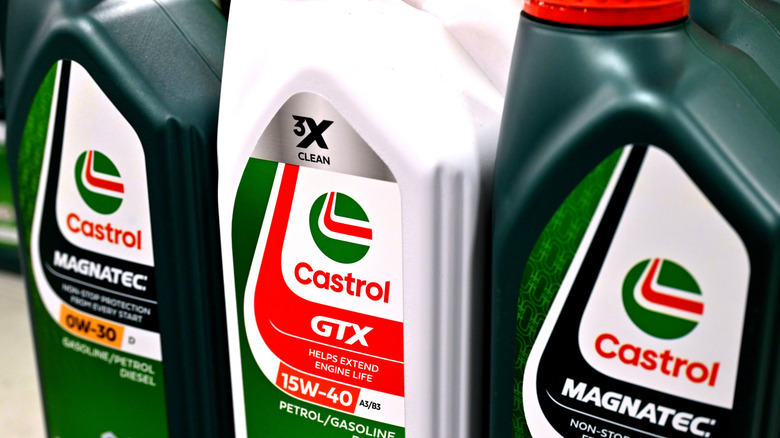
The key isn’t the oil itself, but the additives in the oil that are responsible for its anti-corrosion, anti-sludge, and anti-wear properties. These additives will usually separate from the oil, or lose their effectiveness, after five years in a sealed container. That drops to one year if the oil container is opened, exposing it to oxidation, moisture, and contamination from dust and pollutants. Without any circulation, the separated additives will spoil the oil itself, turning it a dark or milky color and giving it a rancid smell.
Advertisement
This also applies to oil sitting in an engine. Even though your car’s oil system is a sealed environment (assuming there aren’t any oil leaks), your oil will oxidize and absorb moisture regardless. It’s also worth noting that conventional oil degrades faster than synthetic, owing to the natural molecules being less consistent than synthetic equivalents — just one of several differences between the two types.
Advertisement
How to tell if your oil is expired
John Keeble/Getty Images
Most motor oil you buy at the store will have an expiry date printed somewhere on the bottle, so check the bottom and see how close you are to that threshold. If the oil is already in the car, it’s best to follow the six- to 12-month rule and change the oil at those intervals, especially if you’re storing the car long-term. You can easily tell if the oil is going bad if the dipstick comes out a deep brown or black color; good motor oil is generally golden amber.
How quickly the oil degrades will depend on environmental conditions. Engine oil goes bad more readily when exposed to fluctuating temperatures, light, and humidity, which is why oil bottles are opaque, not translucent. To properly store oil, keep the bottle in a dark, dry, and cool environment, such as a box in a controlled garage or basement.
If you run a car on old oil, the effects will become apparent rather quickly. Degraded engine oil can’t do its job nearly as well. It loses some of its viscosity, for one, meaning your oil weights all go out the window. The separation of additives means the oil can no longer adequately protect your engine against sludge buildup. And components will rub against one another more often because the oil can’t effectively cling to the metal surfaces it needs to anymore. While brand-new motor oil may be somewhat expensive, it’s way less money than a bottom-end rebuild.
Enterprises trying to feed PDFs, slides and scanned documents into AI pipelines keep running into the same wall: the tools either miss the structure — tables, charts, layout — or cost too much to run at scale.
Cohere released Parse 5 on Thursday, positioning it on price-to-performance, not raw accuracy — the right cost-capability mix for enterprise scale. Parse 5 is a 2.3-billion-parameter vision language model built to convert PDFs, slides and images into structured Markdown at enterprise scale.
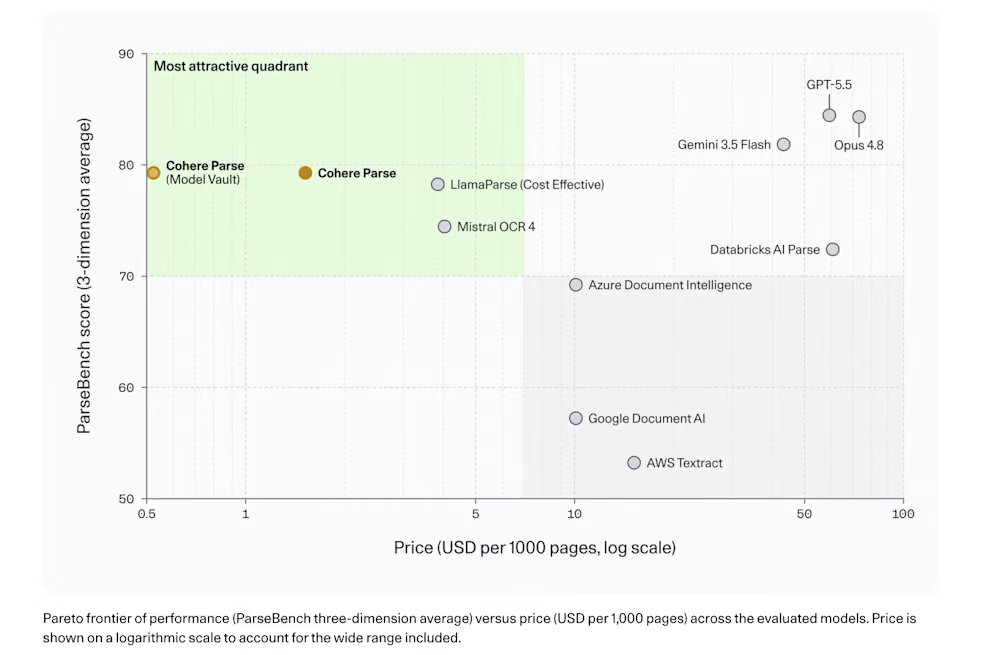
Cohere’s own published benchmark comparison puts Parse 5 behind three larger, general-purpose frontier models on accuracy. GPT-5.5, Opus 4.8 and Gemini 3.5 Flash all score higher than Parse on the three ParseBench dimensions Cohere reports. Cohere is not claiming the top score. It is claiming the best price for a score close to the top.The company priced the model at $1.50 per 1,000 pages through its API, with Model Vault, Cohere’s secure, single-tenant platform for managed inference, available for higher-volume deployment.
“Document parsing isn’t solved because the hard part isn’t reading text, it’s preserving structure and meaning,” Nils Reimers, VP of AI Search at Cohere, told VentureBeat. “Enterprise documents mix tables, diagrams, charts, and formatting that change the interpretation of the data. Most tools still drop structure or hallucinate content, and even frontier models break on layout‑heavy pages.”
Advertisement
Inside the single-pass architecture
Parse 5 takes a page as an image, runs it through a single vision-language model pass and returns structured Markdown, collapsing the OCR-plus-model pipeline most tools run as separate steps.
Architecture. It is a 2.3-billion-parameter vision language model built on Cohere Labs’ North-Micro-Vision-Instruct architecture, with an 8,192-token context window and roughly a 4.6-gigabyte footprint. It accepts a PDF, PowerPoint or JPEG page as a base64-encoded image and returns Markdown in reading order, with tables rendered as HTML, image descriptions and bounding box coordinates for tables and images.
Language coverage. Arabic, English, French, German, Italian, Japanese, Korean, Portuguese and Spanish get stable accuracy, with lower-accuracy zero-shot support elsewhere.
Output modes. The default output returns a Markdown string per page. A blocks mode returns typed elements, where each table carries its own HTML, bounding box and description, the format Cohere positions as what makes citation-level traceability possible for agents.
Advertisement
Availability. Parse 5 is generally available now through the Cohere API, Model Vault, Microsoft Foundry and AWS SageMaker.
The benchmark shows a trade-off, not a win
ParseBench is a benchmark that scores document-parsing tools against human-verified enterprise pages. Cohere reports Parse 5 scoring 79.2 across three dimensions: tables, content faithfulness and semantic formatting. That puts Parse 5 behind GPT-5.5 (84.4), Opus 4.8 (84.3) and Gemini 3.5 Flash (81.8), and ahead of LlamaParse’s Cost Effective tier (78.3), Mistral OCR 4 (74.5), Databricks AI Parse (72.4) and Azure Document Intelligence (69.3).
Cohere’s table notes two excluded dimensions, Layout and Chart, and attributes both to product scope rather than a performance gap. Parse 5 returns reading-order Markdown instead of per-element bounding boxes for text, and describes charts rather than extracting their underlying data, with chart-data extraction planned for a future version.
Reimers said that design choice reflects where agentic workflows actually break.
“For charts, for example, we provide a general description of the chart together with an indicator, how Agentic AI can visually inspect the chart,” Reimers explained. “Other solutions try to extract the data from the chart, but then miss out critical information (for example, the color or the pattern of a line) that leads to hallucinations in Chat and Agentic AI applications.”
Advertisement
Cost is where Cohere makes its real case. Reimers pointed to a workflow the company modeled for a large financial services firm.
“We ran the numbers for a large financial services workflow that processes 750 million documents a year and showed that choosing Parse 5 over a large general‑purpose model like GPT‑5.5 would reduce costs by more than 98 percent.”
That figure is Cohere’s own estimate for a single modeled workflow, not an audited deployment.
Where Parse 5 sits against the field
There is no shortage of options for enterprises looking at parsing solutions.
Advertisement
General-purpose frontier models, GPT-5.5, Opus 4.8 and Gemini 3.5 Flash, top the accuracy comparison but carry the cost and latency of a large model on every page.
Then there are specialized parsers, including Mistral OCR 4, LlamaParse and open-weight options like Chandra OCR 2 and RedNote’s dots.mocr.
Hyperscaler document intelligence services, AWS Textract, Google Document AI, Azure Document Intelligence and Databricks AI Parse, compete more on ecosystem convenience than on raw parsing quality, and score lowest in Cohere’s own comparison.
Kevin Petrie, VP of Research at BARC US, said document parsing sits at the center of enterprise AI adoption right now.
Advertisement
“We’re completing a survey now that shows document analysis is by far the #1 use case for AI, with 62% adoption rates among organizations we polled,” Petrie told VentureBeat. “Documents and other unstructured objects, including images and so on, hold the proprietary context that organizations need to differentiate their agentic AI initiatives.”
Petrie added that only time will tell how Cohere’s cost-performance stacks up against frontier models, but strategically his view is that Cohere has the right focus.
Stephanie Walter, Practice Leader for AI Stack at HyperFRAME Research, sees Cohere Parse 5 as sitting in a good spot between legacy OCR and using an expensive frontier model on every page.
“Its potential advantage is delivering structure, spatial provenance and private deployment at a price suitable for high-volume ingestion,” Walter told VentureBeat. “It does not need to win every benchmark. It needs to make reliable enterprise-scale parsing economical.”
Advertisement
The real test is downstream, not on the benchmark
“Parsing is the first quality gate in the enterprise AI stack,” Walter said. “If tables, headings, images, or reading order are lost during ingestion, better embeddings and larger models cannot recover that missing structure.”
A benchmark score isn’t the only input that matters here. “Enterprises should test parsers against their own most difficult documents and measure downstream retrieval and task accuracy, not how clean the extracted text looks,” Walter said. “The right question is not ‘Did it read the PDF?’ but ‘Can the agent now use the information correctly?’”



































































You must be logged in to post a comment Login