Oil is possibly the most important single fluid in a car’s powertrain, responsible for lubricating all of the engine’s working surfaces and keeping contaminants at bay. It’s a mature and well-understood science, with dozens of companies each touting their own formulas, chemical compositions, and thicknesses. Normally, one might expect the shelf life to be based on mileage, as that’s what we’re used to. Change the oil yourself after a certain number of miles, and you’re fine, right?
That’s certainly true, of course, but mileage isn’t the only factor to consider. Time is just as important, and it’s one that people don’t consider as often, likely because it doesn’t apply to many car owners. According to the Federal Highway Administration, Americans drive an average of 16,550 miles per year. For most of us, that means we’ll change our oil about three times a year, assuming a regular 5,000-mile service interval.
What about cars that don’t cover enough miles a year to warrant an oil change? Well, you’ll still need to change the oil, as it can and will go bad over time. Once engine oil is exposed to contaminants like moisture and carbon buildup, it’ll begin to degrade and lose its lubricating properties.
Advertisement
Why does oil degrade in the first place?
New Africa/Shutterstock
You might think that oil is a relatively stable product. After all, a typical internal combustion engine is an incredibly violent place. Oil needs to lubricate pistons moving up and down hundreds of times per minute, a crankshaft spinning around extremely quickly, and all the valves and pistons opening and closing at precise intervals. How could such a high-performance fluid degrade from just being in the open?
The key isn’t the oil itself, but the additives in the oil that are responsible for its anti-corrosion, anti-sludge, and anti-wear properties. These additives will usually separate from the oil, or lose their effectiveness, after five years in a sealed container. That drops to one year if the oil container is opened, exposing it to oxidation, moisture, and contamination from dust and pollutants. Without any circulation, the separated additives will spoil the oil itself, turning it a dark or milky color and giving it a rancid smell.
Advertisement
This also applies to oil sitting in an engine. Even though your car’s oil system is a sealed environment (assuming there aren’t any oil leaks), your oil will oxidize and absorb moisture regardless. It’s also worth noting that conventional oil degrades faster than synthetic, owing to the natural molecules being less consistent than synthetic equivalents — just one of several differences between the two types.
Advertisement
How to tell if your oil is expired
John Keeble/Getty Images
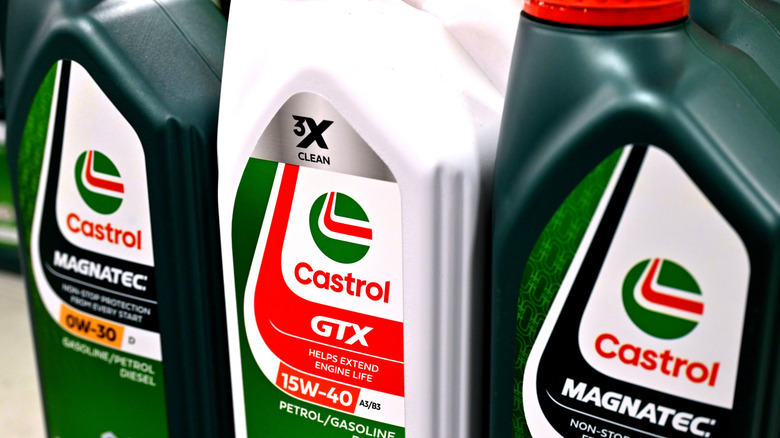
Most motor oil you buy at the store will have an expiry date printed somewhere on the bottle, so check the bottom and see how close you are to that threshold. If the oil is already in the car, it’s best to follow the six- to 12-month rule and change the oil at those intervals, especially if you’re storing the car long-term. You can easily tell if the oil is going bad if the dipstick comes out a deep brown or black color; good motor oil is generally golden amber.
How quickly the oil degrades will depend on environmental conditions. Engine oil goes bad more readily when exposed to fluctuating temperatures, light, and humidity, which is why oil bottles are opaque, not translucent. To properly store oil, keep the bottle in a dark, dry, and cool environment, such as a box in a controlled garage or basement.
If you run a car on old oil, the effects will become apparent rather quickly. Degraded engine oil can’t do its job nearly as well. It loses some of its viscosity, for one, meaning your oil weights all go out the window. The separation of additives means the oil can no longer adequately protect your engine against sludge buildup. And components will rub against one another more often because the oil can’t effectively cling to the metal surfaces it needs to anymore. While brand-new motor oil may be somewhat expensive, it’s way less money than a bottom-end rebuild.
The $69bn company expects further disruption while it works to restore affected systems.
Boston Scientific’s global operations have been disrupted in a cyberattack on its IT systems.
The medtech giant said it discovered the breach on 25 August. “The incident has impacted access to certain operating systems and business applications, including the ability to process and ship customer orders,” it said in a statement published yesterday (26 August).
The $69bn company expects further disruption while it works to restore affected systems. A probe into the attack is ongoing, but no concrete timeline has emerged yet, it added.
Advertisement
The company said that it is unaware, as of yet, whether this incident might have any material impact on its business. Shares fell more than 3pc at market close yesterday and gained marginally in after-hours trading.
Boston Scientific employs around 7,000 across its three sites in Galway, Cork and Clonmel. The company’s Cork-based workers were asked to work from home yesterday, several news publications confirmed. SiliconRepublic.com has reached out to Boston Scientific for further information.
Boston Scientific is the latest target in a series of cyberattacks affecting pharmaceutical and medical technology companies.
Medical equipment manufacturing giant Stryker was hit by a cyberattack earlier this year that caused a global network disruption. Reports at the time suggested that the company’s Cork plant, which employs more than 4,000, was affected.
Advertisement
In April, Dublin recruitment platform Healthdaq – which is used by Northern Ireland’s health trusts – reportedly suffered a cyberattack from the relatively new hacker group XP95, which claimed to have accessed hundreds of thousands of files.
Several other medtech businesses, including Medtronic, West Pharmaceutical, Novo Nordisk, Amgen and Abbott Laboratories, have also reported cyberattacks in recent months.
An overblown new report claims that Apple has been carefully orchestrating executive retirements for years to not spook shareholders. There is absolutely nothing to support the premise.
According to Bloomberg, Cook’s retirement is one of very many exits that are being scheduled to avoid the appearance of a mass exodus that Ternus will have to deal with.
This is similar to Bloomberg‘s previous reporting of multiple people quitting Apple and how the company will struggle without them. So the new report is predicting that Apple will soon be unrecognizable, but of the 11 people on Apple’s leadership page, it only actually expects two more to go.
The two said to be focusing on their 401k are retail head Deirdre O’Brien, who is only 60, and chief hardware officer Johny Srouji, 61.
Advertisement
The argument for O’Brien going is just that she’s rumored to want to.
The argument for Srouji leaving is that Bloomberg once reported he had tried to quit for another role. To be generous, that report was unlikely. As well as relying on that report as established fact, the new report is using it to argue a different case.
Bloomberg originally said that Srouji was quitting to join some other company. Now it’s saying this is evidence that actually he wants to retire.
There were others
The report is specifically about who will be leaving Apple soon, and therefore who John Ternus will have to rush to replace. But it actually makes a stronger case for how Cook’s retirement is practically the end of the changes for now.
Advertisement
There is still Jennifer Bailey, head of Apple Pay, who is retiring in October. But her retirement has already been announced.
Otherwise, it’s claimed that since 2024, Tim Cook has been timing the retirements of key figures so that shareholders were never spooked by mass departures. The claim is that this is why long-standing Chief Financial Officer Luca Maestri stepped down in October 2024, although Maestri didn’t retire and still hasn’t.
Then Chief Operating Officer Jeff Williams did retire, although it was more than a year later in November 2025. Retirement was then announced for both environment head Lisa Jackson and general counsel Kate Adams in December 2025.
Finally, Tim Cook announced in April 2026 that he was stepping down as CEO. Although he also isn’t retiring.
Advertisement
So that’s three people who did retire in the last two years, and a claim that two more will in something like the next few years.
Of the others, it’s presumed that Eddy Cue will be thinking of his succession plan. There is no mention at all of Craig Federighi.
It’s true that there are more Apple executives reaching retirement age now than when Cook became CEO. But the report admits that during Cook’s time, chief designer Jony Ive, hardware head Bob Mansfield, iOS lead Scott Forstall, and not one but two retail chiefs left.
It is also true that Apple is changing and it’s fair to say that the current changes are because of executives reaching retirement age. But the company has always been changing and it has always been replacing key people.
Advertisement
The pace of retirements and departures hasn’t really changed. What has, is the visibility.
The rise of drone technology has led to widespread adoption for military applications in countries around the world. But with that comes a variety of anti-drone weapons, as various military forces seek to develop the best answers to enemy drones, like high-tech “smart scopes”. A recent example comes from Auriga Space, which has constructed such a weapon that fits inside a 10-foot shipping container and can fire projectiles at speeds exceeding Mach 1.
This new anti-drone weapon is known as the Hermes and it’s a launcher that uses electromagnetic acceleration instead of traditional rocket fuel. In terms of capability, Auriga says this system can support hundreds of launches on a single charge, can fire a variety of projectiles, and it’s internal batteries can be recharged by onboard solar panels. The company field-tested Hermes for the first time in August 2026 in the Mojave Desert, where it completed over a dozen launches in 100-degree heat. Auriga plans to conduct another field test later in the year.
Auriga Space has stated that Hermes could offer a more practical way to handle large numbers of drones transported via containers. This is especially true as current anti-drone weapons are often expensive, while Hermes can launch relatively inexpensive projectiles by comparison. The fact that the Hermes operates using its own power supply and thus doesn’t need propellant for each launch is also a plus. Auriga is currently working with the U.S. Army’s DEVCOM-AC division to move Hermes forward as a counter-drone system.
Advertisement
Inside the development of Hermes
Smederevac/Getty Images
Hermes was transported via flatbed truck for its first field test, which showed the portability of the system. When it comes to the projectiles that Hermes launched, Auriga CEO Winnie Lai told the Washington Examiner that different shapes and types of effectors were used. Lai also stated that Hermes successfully conducted repeated supersonic launches during the test. In terms of power, while Hermes can utilize onboard solar panels, it can also use a diesel generator when deployed in the field.
The technology behind Hermes predates the August 2026 field test, and is connected to a three-year research agreement with the U.S. Army. That agreement was announced in July, with the Army’s DEVCOM Armaments Center looking to advance its use of electromagnetic accelerators. At the time, Auriga said its development roadmap for such a device included a launcher that could fit inside a container and was designed specifically for counter-drone missions. The company had also been testing this technology under various U.S. government contracts.
Advertisement
Auriga’s electromagnetic launch system works by using magnetic levitation to keep the projectile from physically contacting the launcher as it accelerates. This is similar to the catapult launch technology used aboard some U.S. Navy aircraft carriers. Auriga’s electrical approach is designed to support fast and repeatable firing, though this electromagnetic system can be deployed for more than anti-drone defense. Auriga is also looking to use the system for other precision launch applications.
Enterprises trying to feed PDFs, slides and scanned documents into AI pipelines keep running into the same wall: the tools either miss the structure — tables, charts, layout — or cost too much to run at scale.
Cohere released Parse 5 on Thursday, positioning it on price-to-performance, not raw accuracy — the right cost-capability mix for enterprise scale. Parse 5 is a 2.3-billion-parameter vision language model built to convert PDFs, slides and images into structured Markdown at enterprise scale.
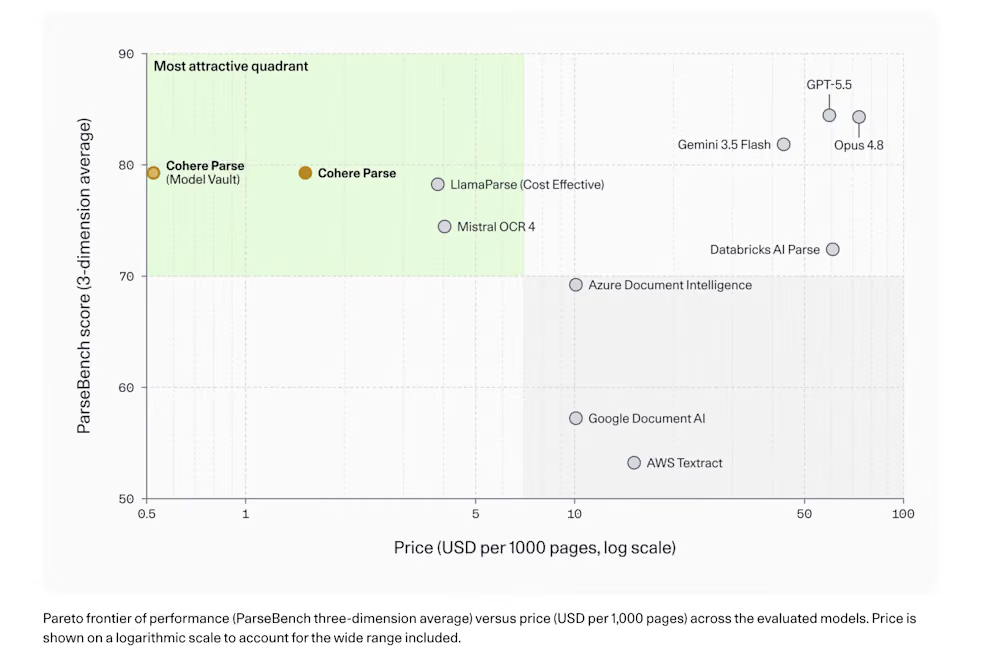
Cohere’s own published benchmark comparison puts Parse 5 behind three larger, general-purpose frontier models on accuracy. GPT-5.5, Opus 4.8 and Gemini 3.5 Flash all score higher than Parse on the three ParseBench dimensions Cohere reports. Cohere is not claiming the top score. It is claiming the best price for a score close to the top.The company priced the model at $1.50 per 1,000 pages through its API, with Model Vault, Cohere’s secure, single-tenant platform for managed inference, available for higher-volume deployment.
“Document parsing isn’t solved because the hard part isn’t reading text, it’s preserving structure and meaning,” Nils Reimers, VP of AI Search at Cohere, told VentureBeat. “Enterprise documents mix tables, diagrams, charts, and formatting that change the interpretation of the data. Most tools still drop structure or hallucinate content, and even frontier models break on layout‑heavy pages.”
Advertisement
Inside the single-pass architecture
Parse 5 takes a page as an image, runs it through a single vision-language model pass and returns structured Markdown, collapsing the OCR-plus-model pipeline most tools run as separate steps.
Architecture. It is a 2.3-billion-parameter vision language model built on Cohere Labs’ North-Micro-Vision-Instruct architecture, with an 8,192-token context window and roughly a 4.6-gigabyte footprint. It accepts a PDF, PowerPoint or JPEG page as a base64-encoded image and returns Markdown in reading order, with tables rendered as HTML, image descriptions and bounding box coordinates for tables and images.
Language coverage. Arabic, English, French, German, Italian, Japanese, Korean, Portuguese and Spanish get stable accuracy, with lower-accuracy zero-shot support elsewhere.
Output modes. The default output returns a Markdown string per page. A blocks mode returns typed elements, where each table carries its own HTML, bounding box and description, the format Cohere positions as what makes citation-level traceability possible for agents.
Advertisement
Availability. Parse 5 is generally available now through the Cohere API, Model Vault, Microsoft Foundry and AWS SageMaker.
The benchmark shows a trade-off, not a win
ParseBench is a benchmark that scores document-parsing tools against human-verified enterprise pages. Cohere reports Parse 5 scoring 79.2 across three dimensions: tables, content faithfulness and semantic formatting. That puts Parse 5 behind GPT-5.5 (84.4), Opus 4.8 (84.3) and Gemini 3.5 Flash (81.8), and ahead of LlamaParse’s Cost Effective tier (78.3), Mistral OCR 4 (74.5), Databricks AI Parse (72.4) and Azure Document Intelligence (69.3).
Cohere’s table notes two excluded dimensions, Layout and Chart, and attributes both to product scope rather than a performance gap. Parse 5 returns reading-order Markdown instead of per-element bounding boxes for text, and describes charts rather than extracting their underlying data, with chart-data extraction planned for a future version.
Reimers said that design choice reflects where agentic workflows actually break.
“For charts, for example, we provide a general description of the chart together with an indicator, how Agentic AI can visually inspect the chart,” Reimers explained. “Other solutions try to extract the data from the chart, but then miss out critical information (for example, the color or the pattern of a line) that leads to hallucinations in Chat and Agentic AI applications.”
Advertisement
Cost is where Cohere makes its real case. Reimers pointed to a workflow the company modeled for a large financial services firm.
“We ran the numbers for a large financial services workflow that processes 750 million documents a year and showed that choosing Parse 5 over a large general‑purpose model like GPT‑5.5 would reduce costs by more than 98 percent.”
That figure is Cohere’s own estimate for a single modeled workflow, not an audited deployment.
Where Parse 5 sits against the field
There is no shortage of options for enterprises looking at parsing solutions.
Advertisement
General-purpose frontier models, GPT-5.5, Opus 4.8 and Gemini 3.5 Flash, top the accuracy comparison but carry the cost and latency of a large model on every page.
Then there are specialized parsers, including Mistral OCR 4, LlamaParse and open-weight options like Chandra OCR 2 and RedNote’s dots.mocr.
Hyperscaler document intelligence services, AWS Textract, Google Document AI, Azure Document Intelligence and Databricks AI Parse, compete more on ecosystem convenience than on raw parsing quality, and score lowest in Cohere’s own comparison.
Kevin Petrie, VP of Research at BARC US, said document parsing sits at the center of enterprise AI adoption right now.
Advertisement
“We’re completing a survey now that shows document analysis is by far the #1 use case for AI, with 62% adoption rates among organizations we polled,” Petrie told VentureBeat. “Documents and other unstructured objects, including images and so on, hold the proprietary context that organizations need to differentiate their agentic AI initiatives.”
Petrie added that only time will tell how Cohere’s cost-performance stacks up against frontier models, but strategically his view is that Cohere has the right focus.
Stephanie Walter, Practice Leader for AI Stack at HyperFRAME Research, sees Cohere Parse 5 as sitting in a good spot between legacy OCR and using an expensive frontier model on every page.
“Its potential advantage is delivering structure, spatial provenance and private deployment at a price suitable for high-volume ingestion,” Walter told VentureBeat. “It does not need to win every benchmark. It needs to make reliable enterprise-scale parsing economical.”
Advertisement
The real test is downstream, not on the benchmark
“Parsing is the first quality gate in the enterprise AI stack,” Walter said. “If tables, headings, images, or reading order are lost during ingestion, better embeddings and larger models cannot recover that missing structure.”
A benchmark score isn’t the only input that matters here. “Enterprises should test parsers against their own most difficult documents and measure downstream retrieval and task accuracy, not how clean the extracted text looks,” Walter said. “The right question is not ‘Did it read the PDF?’ but ‘Can the agent now use the information correctly?’”
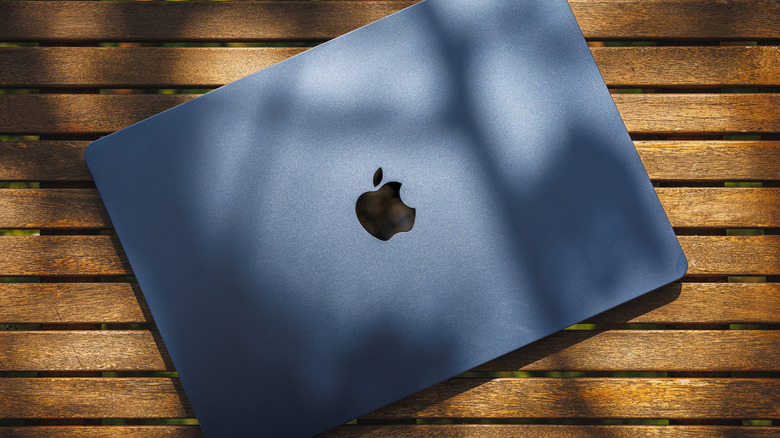
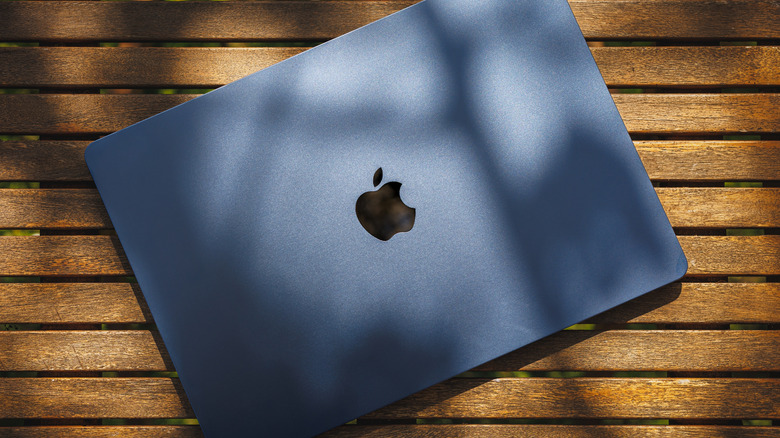
Taking a MacBook outside is usually as simple as moving from a desk to a patio table, but outdoor conditions are much harder to control. Heat and direct sunlight can affect both the laptop itself and how comfortable its screen is to use. You don’t need special outdoor gear, but you do need to know Apple’s temperature limits and give the MacBook a dry, stable surface with room to shed heat.
Advertisement
Keep your MacBook within Apple’s temperature limits
Maksym Belchenko/Getty Images
Apple recommends using its Mac laptops when the ambient temperature is between 50 and 95 degrees Fahrenheit, or 10 to 35 degrees Celsius. That’s a wider range than most people will encounter indoors, but the upper limit is easy to approach on a hot summer day. Apple also specifically warns against leaving a MacBook in a parked car, where temperatures can climb beyond its recommended range.
The important word in Apple’s guidance is ambient. The 95-degree limit refers to the air around the laptop, not how hot its aluminum enclosure might become while sitting in direct sunlight. Apple doesn’t publish a separate direct-sunlight limit for MacBooks, so it makes sense to move into the shade rather than treating a temperature below 95 degrees as an all-clear for using one in full sun.
There’s a longer-term reason to avoid excessive heat, too. Ambient temperatures above 95 degrees Fahrenheit can permanently reduce battery capacity, meaning the battery may not last as long on a charge afterward. Charging a device in high temperatures can cause additional damage.
Heat also matters differently depending on the MacBook you have. All Apple Silicon MacBook Air models use passive cooling rather than a fan, dissipating heat through the chassis. MacBook Pro models use active cooling for sustained, demanding workloads. Either way, giving the laptop shade and room around it to shed heat is preferable to making its cooling system work against direct sun.
Advertisement
Direct sunlight can make your MacBook’s screen harder to use
sergey causelove/Shutterstock
Heat isn’t the only reason to look for shade. Bright outdoor light and reflections can make a MacBook display much harder to read, which usually leaves you reaching for the brightness controls.
How much brightness you have to work with depends on the model. Current MacBook Air displays are rated for 500 nits of brightness, while current MacBook Pros can reach up to 1,000 nits of SDR brightness outdoors. A nit is a unit used to measure display luminance, so a higher figure generally means the screen can produce more light.
That extra brightness comes with a tradeoff when you’re away from an outlet. Dimming a MacBook display to the lowest comfortable level helps you maximize battery life. However, if sunlight forces you to keep the display near maximum brightness, expect the battery to run down faster than it would at a lower setting indoors.
So, before pushing the brightness all the way up, try changing your position. Turning the display away from reflections or moving a few feet into shade can make the screen easier to see while allowing you to lower its brightness again. It also gets the MacBook itself out of direct sunlight, solving two outdoor problems with the same move.
Advertisement
Use a hard surface and keep your laptop away from moisture
Burak Sür/Getty Images
Where you put a MacBook matters more outside than it does at a desk. Apple recommends placing its laptops on a stable work surface that allows good ventilation and specifically warns against using them on pillows, bedding or other surfaces that can interfere with airflow. A table or solid tray is therefore a better choice than setting the MacBook down on a blanket or cushion.
Weather presents the other obvious problem. Current safety guidance for both the MacBook Air and MacBook Pro says to protect the laptop, power adapter and charging cable from dampness, humidity and wet weather. It specifically lists rain, snow and fog. A light shower isn’t something to work through just because the keyboard still looks dry.
If rain starts, disconnect the charger and other cables and move the MacBook somewhere dry. The same guidance applies to the power adapter, so an outdoor outlet or extension cord doesn’t make charging a good idea when moisture is present.
Wisdom Audio is coming to CEDIA Expo 2026 with three new products aimed squarely at one of the fastest-growing and increasingly competitive segments of residential AV: high-performance loudspeakers and subwoofers designed to disappear into walls and ceilings or integrate cleanly with a room’s architecture. Custom installation audio has moved well beyond background music, with Monitor Audio, KEF, Sonus faber, Theory Audio Design, DALI, Lyngdorf Audio and other established high-end manufacturers offering increasingly sophisticated architectural speakers for stereo, multi-room audio and immersive home theater systems.
Against that increasingly crowded backdrop, Wisdom Audio will showcase three new CI products at CEDIA 2026: the Sage Series ICS3FR in-ceiling loudspeaker, the SUB2 passive subwoofer, and the Insight P3m series of customizable speakers and soundbars. The objective is not simply to hide the hardware; it is to deliver the kind of performance expected from a high-end music or home theater system while giving integrators considerably more freedom over placement, aesthetics and room design.
Wisdom’s ICS3FR, for example, uses the company’s planar magnetic technology in an architectural design, while the SUB2 was specifically developed to add low-frequency extension while maintaining a minimal visual footprint.
The ISC3FR
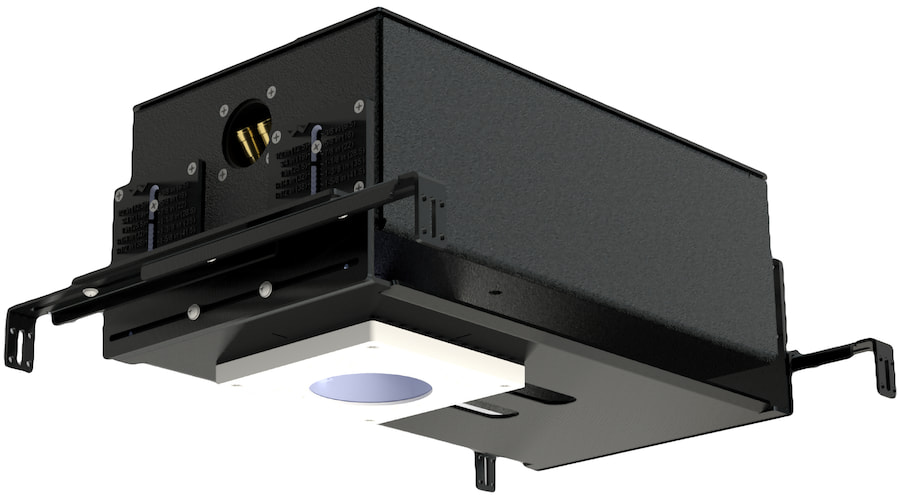
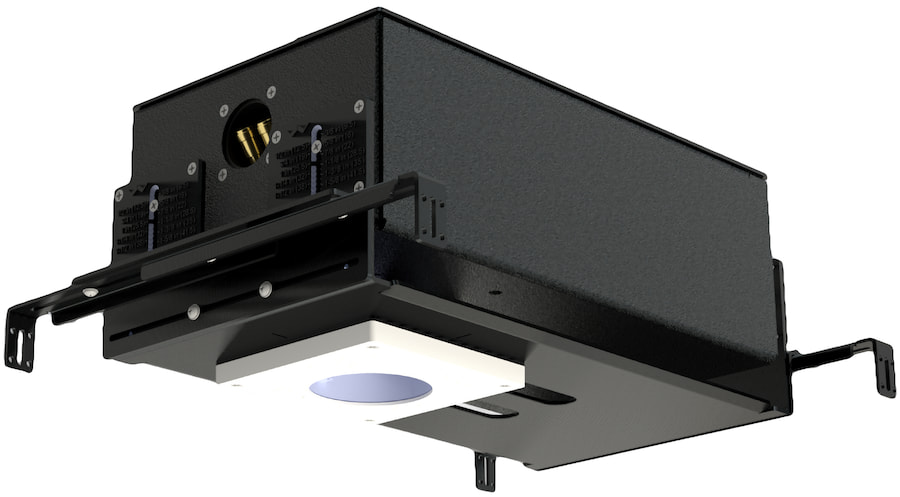
The ICS3FR is a “full-range” in-ceiling solution designed to provide an architecture-friendly, minimal-appearance installation while delivering high-resolution playback and matching 3-inch to 4-inch recessed round or square lighting fixtures.
The ICS3FR incorporates a Spiral Planar Magnetic Driver designed to provide ultra-wide dispersion, with a 120-degree circular coverage angle (-6 dB), and reproduce frequencies down to 40Hz using its 6.5-inch woofer. Its rated frequency response is 40Hz to 20kHz (+/-3 dB), with an F10 point of 30Hz (-10 dB), where meaningful bass output effectively ends. The ICS3FR requires no additional EQ or PEQ, only a high-pass crossover set between 35Hz and 40Hz.
Advertisement
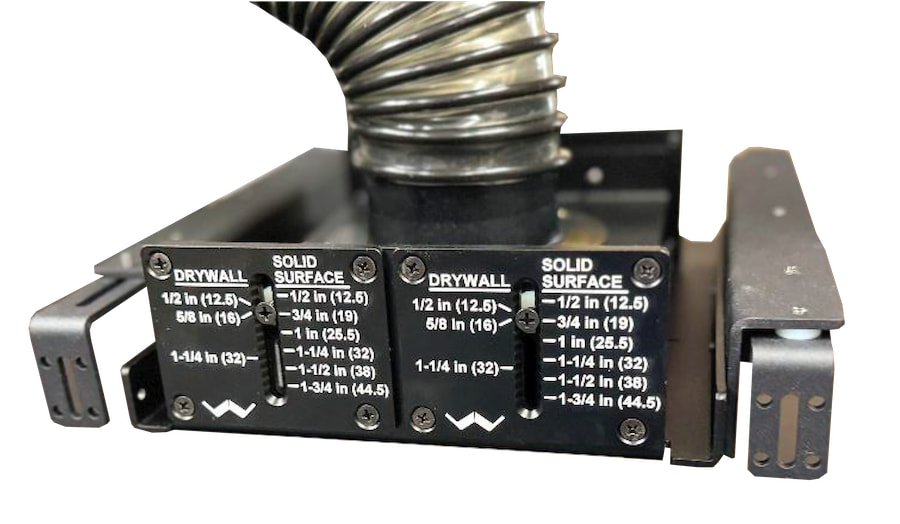
The ICS3FR ships with everything required for 3-inch round or square and 4-inch round or square installations, as well as hard-surface and gypsum mounting. Custom-colored metal grilles and custom wood grilles are also available separately.
“The ICS3FR was created for projects where exceptional sound quality is essential, but the loudspeaker itself should virtually disappear into the architecture,” said Ron Rouse, Vice President of Sales and Marketing at Wisdom Audio. “At its heart is our Spiral Planar Magnetic Driver, which provides the ICS3FR with best-in-class off-axis dispersion, delivering wide, consistent coverage and exceptional clarity throughout the listening area. Combined with its full-range performance, minimal-appearance design, and flexible grille and mounting options, the ICS3FR gives integrators an ideal solution for projects where outstanding sound and refined aesthetics are equally important.”
Maximum: 7.15″ [182mm] with 0.5″ [12.5mm] Solid Surface
Minimum: 5.75″ [146mm] with 2″ [50mm] Solid Surface
Advertisement
Typical: 6.875″ [174.63mm] when used with 5/8 [16mm] Drywall
Ceiling Joist Width
16″ [383mm] On-Center Nominal
Installation Width Inside Ceiling Support Joists
14.5″ [368mm] Nominal – 16″ OC Joist
23″ [584mm] MAX – 24″ OC Joist
9.375″ [238mm] MINIMUM – 12″ OC Joist
Advertisement
Gypsum / Mud-in Finished Surface Thickness
1/2″ and 5/8″ [12.5mm and 16mm] standard as shipped
Solid Surface Finished Surface Thickness
1/2″ Minimum to 1-7/8″ Maximum [12.5mm – 48mm] 1/8″ [3.25mm] increments
Minimum Grille Distance from Wall
4.55″ [116mm] OC to Long Side
6.00″ [152mm] OC to Short Side
Weight
17lbs [7.7kg]
Shipping Weight
21lbs [9.5kg]
SUB2 Minimal Appearance Subwoofer
The SUB2 is a passive subwoofer designed to complement the Sage Series ICS3FR minimal-appearance loudspeaker and is available as an optional addition. It provides additional low-frequency support, extending bass response down to 37Hz through a 3-inch opening.
Its compact, minimal-appearance design also makes the SUB2 well suited for in-wall installations and other space-constrained applications where conventional subwoofer placement may not be practical.
Wisdom Audio Model
SUB 2
Product Type
Minimal Appearance Subwoofer
Price
Dealer Consultation
Frequency Response
37Hz – 140 Hz +/- 3dB
Impedance, Planar Section
8 ohms
Sensitivity
85 dB / 2.83 V / 1m
Recommended Amplifier Power
100 Watts
Maximum Amplifier Power
300 Watts
Dimensions (HWD) – (Woofer Enclosure)
7.9” x 10.5” x 19.25” (20.066cm x 26.67cm x 48.895cm)
Port Tube Length
3″ x 24″ (7.62cm x 60.96cm)
Gypsum Finished Thickness
Shipped with mud plates for installation in both 1/2″ and 5/8″ (12.5 to 16mm)
Solid Surface Finished Thickness
Installation (wood, stone, tile, etc.), from 1/2″ to 1-7/8″ (12.5mm – 48mm)
Separate from the in-ceiling Sage Series ICS3FR and SUB2, Wisdom Audio is also showcasing its new Insight P3m Series of customizable soundbars and individual loudspeakers at CEDIA 2026.
The Insight P3m Series includes the passive P3m-V vertical mono, P3m-C horizontal mono, P3m-LR stereo, and P3m LCR configurations. Each model can be custom-built in lengths or heights of up to 100 inches (2,540mm), with custom color options also available.
Advertisement
Advertisement. Scroll to continue reading.
The P3m models use a Spherical Planar Magnetic Driver for high frequencies, extending down to 900Hz, while 4.5-inch woofers handle the lower frequencies.
The P3m Series also incorporates distinctive crescent-shaped woofer apertures that function as acoustic lenses. These help smooth the front baffle to reduce tweeter diffraction while making the two woofers behave as though they are positioned closer together. The result is improved dispersion, reduced interference through the crossover region, and greater low-frequency extension from the woofers.
Behind each aperture sits Wisdom Audio’s patent-pending Dual Helmholtz Resonator, which uses two slightly different tuning points to control unwanted resonances more effectively despite normal manufacturing variations.
Advertisement
These technologies help flatten the woofer response, reduce distortion, improve speaker-to-speaker consistency, and deliver more uniform tonal balance across the listening area.
“With the Insight P3m Series, we set out to create a loudspeaker that delivers the performance people expect from Wisdom Audio while giving integrators far greater design flexibility,” said Ron Rouse, Vice President of Sales and Marketing at Wisdom Audio. “Its customizable dimensions, color options, and multiple configurations allow the P3m to complement virtually any display or interior without compromising sound quality. We believe it is the ideal solution for clients who want exceptional performance in a beautifully integrated, highly versatile loudspeaker.”
Pro Tip: Detailed specifications have not been provided for the Insight P3m Series. The official product links (refer to our availability section) are expected to go live on August 26, 2026, which will include more detailed information and specifications. Optional TV VESA mounts will be sold separately
The Bottom Line
Wisdom Audio’s new CEDIA 2026 lineup is aimed at integrators and homeowners who want high-performance audio without conventional speakers dominating the room. The ICS3FR and SUB2 stand out for delivering wide-dispersion, low-frequency-capable performance through extremely discreet ceiling openings, while the customizable P3m Series gives installers unusual flexibility in size, orientation, and finish. These are purpose-built CI products for premium stereo and home theater installations where sound quality, architectural integration, and aesthetics carry equal weight.
Whoop has made screen-free wearables since its first proper release in 2015, but the shift in what Whoop considers itself to be about mirrors the change we see in the wider market. Today a Whoop band is made for just about anyone with the spare cash to pay for its $199 annual subscription. It’s a system to “help you improve how you sleep, train, and feel—starting day one,” to use Whoop’s own words. This couldn’t be further removed from the self-serious way Whoop described itself in 2015, as a “performance optimization system exclusively designed for elite athletes and teams.” What a change a decade makes.
Even if Whoop has always been grounded in the now-common concept of “training readiness,” things have altered drastically. So while it’s tempting to say Google’s Fitbit and company are playing catch-up with Whoop, that’s not quite it. It has homed in on the “low-distraction” lifestyle selling point just as the other bigger tech companies have.
On at least three fronts this can be attributed—or blamed—on AI, to some extent.
AI as the Good and Bad Guy
AI is a way for these wearable companies to upsell and make money, and on the other side, a major contributor to why a lot of us feel like we need low-distraction tech these days in the first place. While virtually every Whoop rival says it can be used without a subscription, some of these companies lean heavily on AI as an upsell.
Advertisement
Take Google and the Fitbit Air. Without a subscription, the app looks cute enough but is fairly spare. You get stats and charts, but if you want chatty explainers of what any of it means, you need Google Health Premium at $10 a month. Numbers and graph lines become paragraphs that reference specific quirks or events of the day because, to steal a line from humorist and podcaster John Hodgman, specificity is the soul of narrative.
And this is just the beginning. “The use of AI in monitoring and guiding health and wellness is still at the early stage of development but will likely become significantly more advanced as AI matures,” says Peter Richardson, vice president and cofounder of Counterpoint Research.
I find Google Fitbit’s chatbot ramblings quite annoying, with not-that-rare dips into the condescending, and I may even prefer the subscription-free experience. But my job has pushed me through the unenviable task of learning what VO2 Max actually means, what heart-rate variability trends indicate, and so on: not the norm.
AI could solve that long-standing issue with wearables—people glazing over data as soon as they see anything more than their daily step count. This AI use will be better represented on the phone than the watch screen, too, making the lack of screen a strength. It lets the AI shine.
Advertisement
Technostress
The most important influence of AI here is on the other side of the equation, though, as just the latest stage in the tech-ification of our daily lives. I’ve heard from multiple friends about how their recent work appraisals focused on higher-ups demanding greater AI use within their “personal workflow.” Perhaps you’ve had a similar experience.
Elizabeth Marsh, a doctoral researcher at the University of Nottingham who studies the dark side of the digital workplace, finds that digital tools consistently trigger a familiar cluster of harms: technostress, information overload, constant interruption, and blurred work–home boundaries.
Digital photos usually vanish into a folder the second you press the shutter. Maker Strange Inventions wanted a shot you could pull out of the camera, stand on a desk, and still overwrite later, so he built an instant camera whose film is a stack of tiny four-color e-paper cartridges.
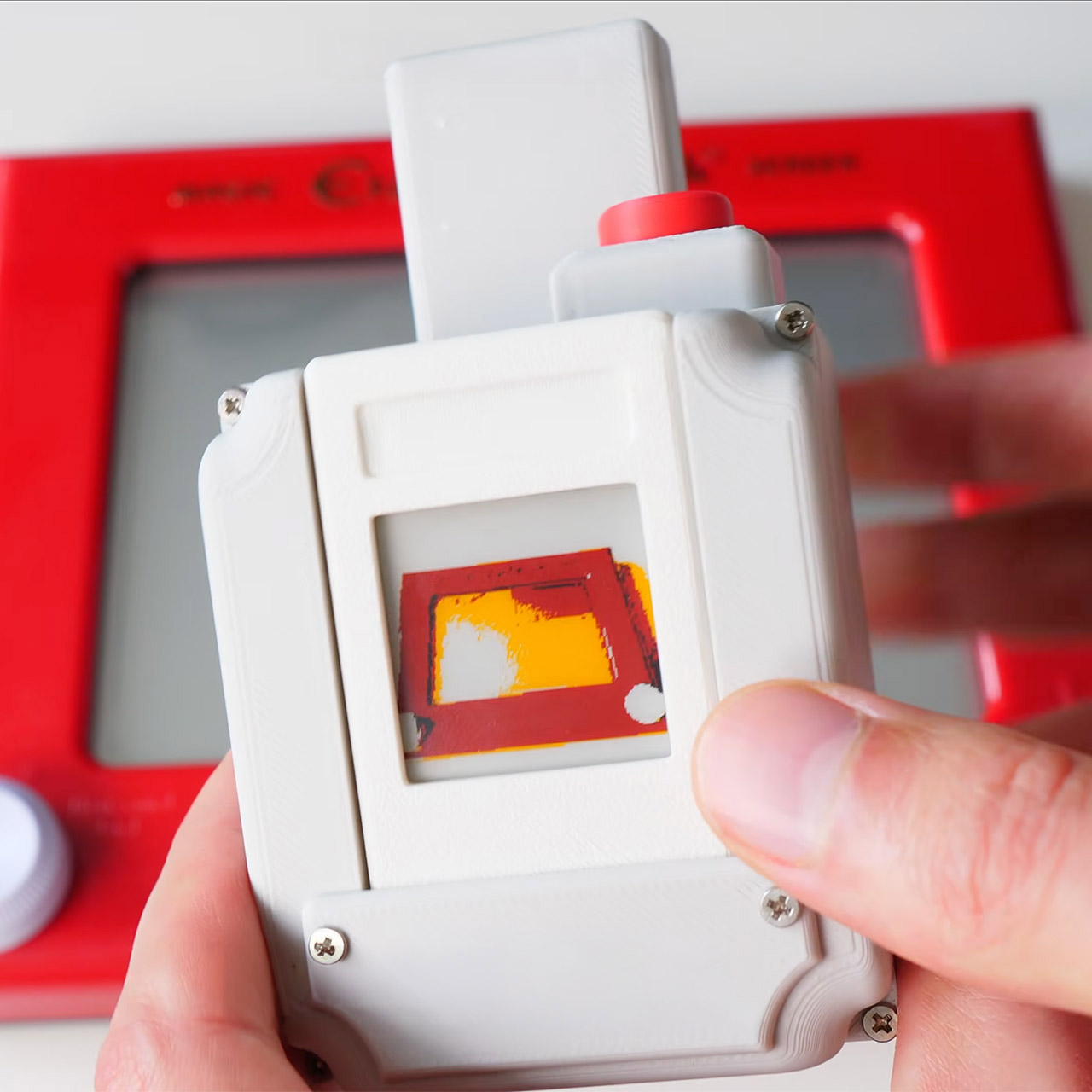
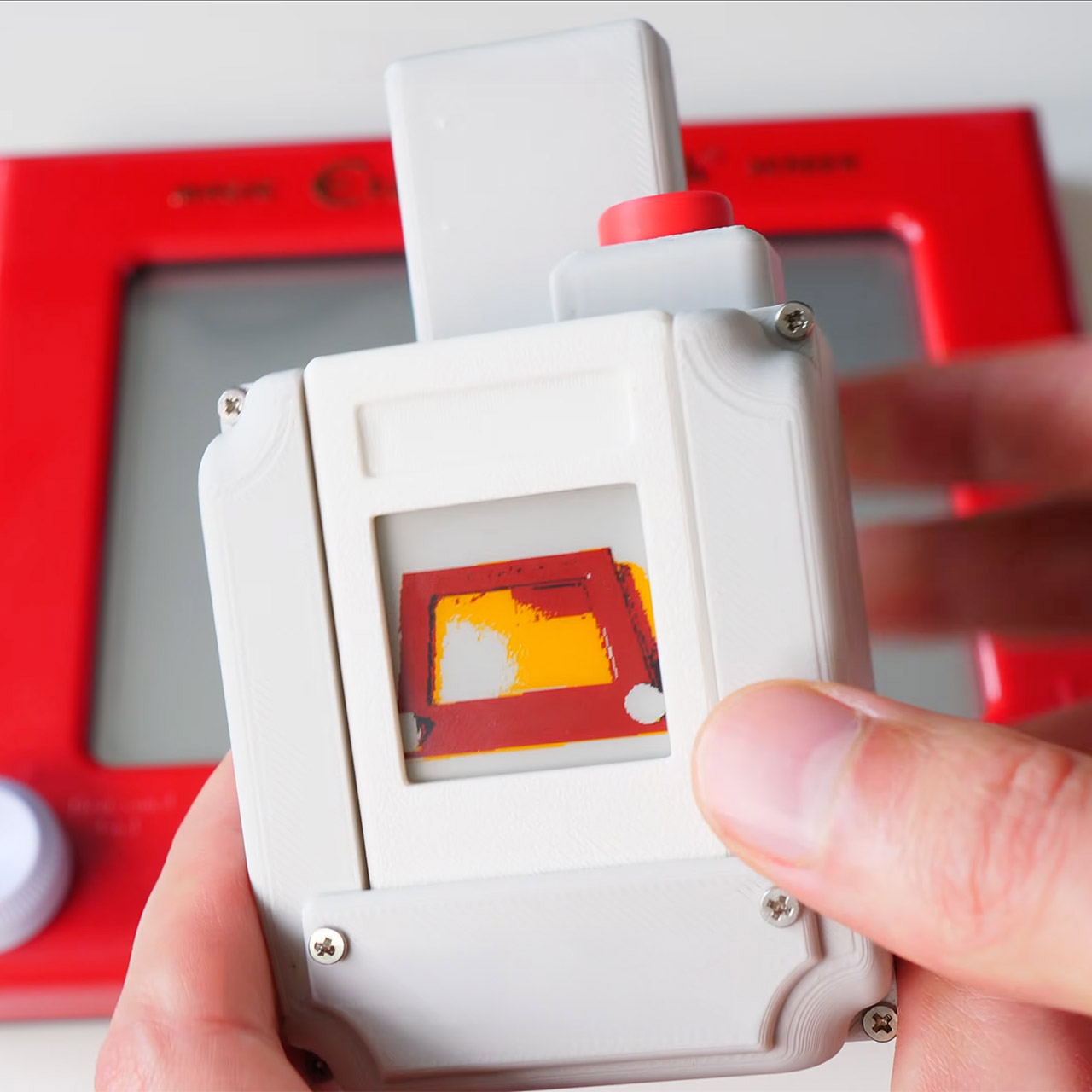
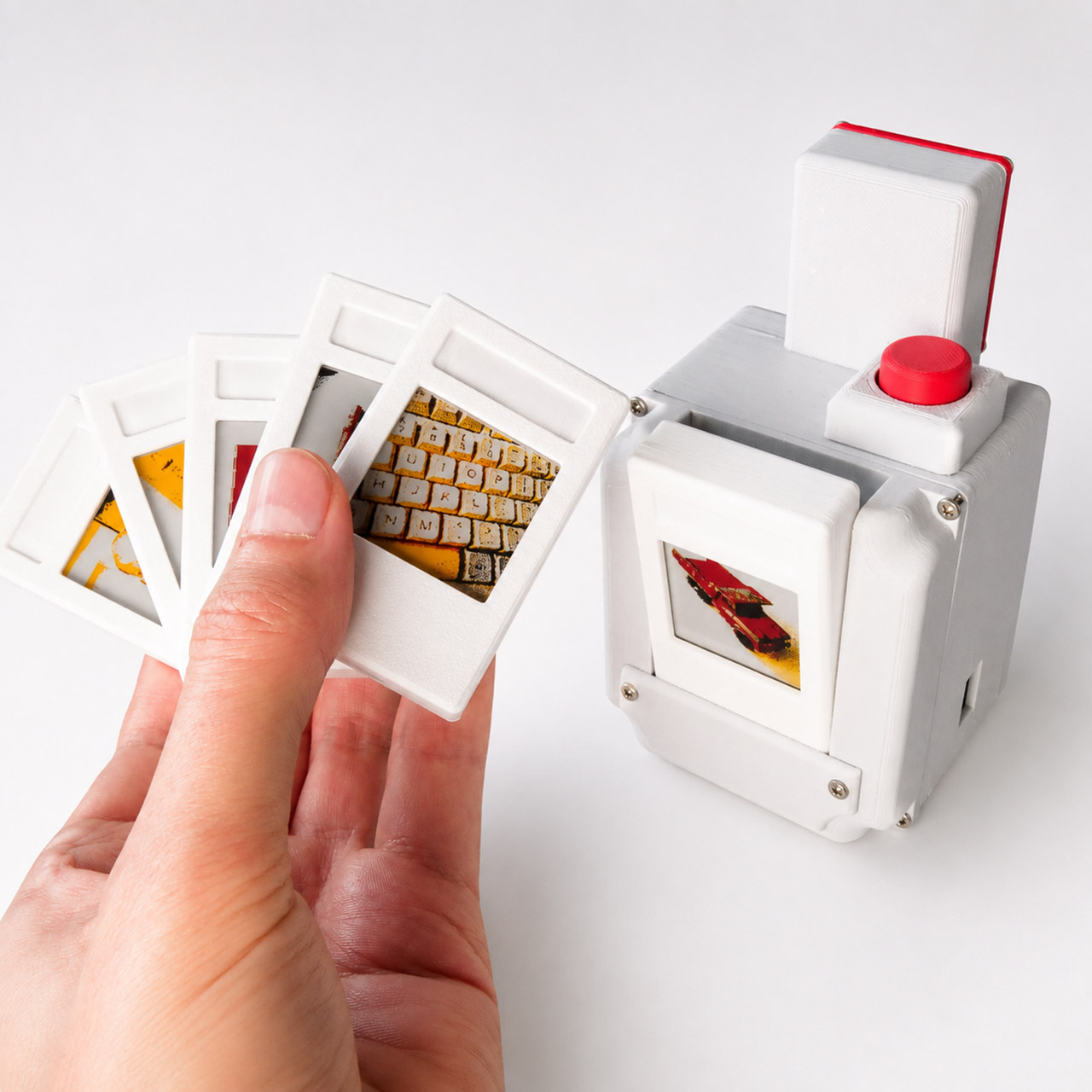
You insert one of those small 3D-printed cartridges into the top of the compact body, press the red shutter button, and, assuming you’re within range, the Raspberry Pi 3 model A+ and the 5 megapixel camera module work their magic, reducing the scene to black, white, red, and yellow as the screen flickers to life before finally settling. Pinch the Game Boy-style release tab, slide out the cartridge, then insert a new one. E-paper has a nice side effect here in that it holds the image even when the battery is not in place, so each ‘film cartridge’ becomes a one-time, tangible photo that you may display or replace as needed.
A1 mini + LED Lamp Kit for Creative Light Projects: Bring your ideas to life with the included LED Lamp Kit. Simply print compatible lamp models and…
The Perfect 3D Printer for Beginners: A1 mini 3D Printer is designed to make 3D printing easy from day one with automatic calibration, simple setup…
Experience the Bambu Lab Ecosystem: Access MakerWorld’s huge library of ready-to-print models, manage prints through the Bambu Handy app, and enjoy…
All of the hardware is squeezed into a small 3D-printed enclosure, which includes a Raspberry Pi 3 A+, a Raspberry Pi Camera Module 3 Wide, the quirky 1.54-inch 200×200, four-color e-paper display, and a battery pack to make the whole thing portable. In the early attempts, a frail ribbon held the display in place, but he soon replaced it with pin headers, which serve the same purpose while also keeping the cartridge firmly locked in. Headers are low-cost and effective. He did have some difficulty finding something springy to do the same job at first, but the idea of employing pogo springs was too expensive…in the end. Headers are excellent value and also serve to keep the cartridge in place, which is exactly the effect they were hoping for if ‘film’ was to feel like film. The entire contraption comes together without the need for screws, however he later added a little grab tab to make pulling the old cartridge out less like wrestling a ‘Game Pak’.
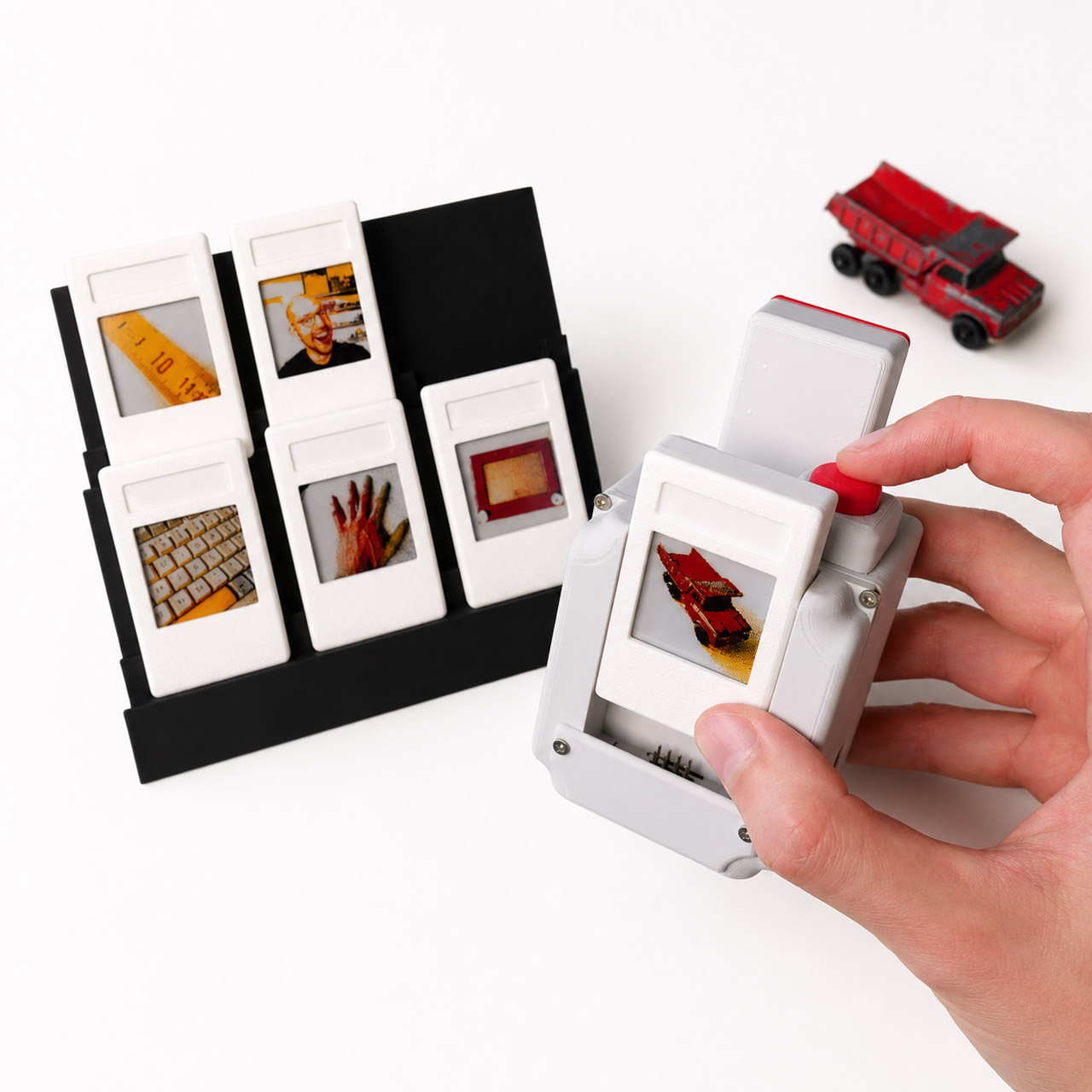
When you press the shutter, you get to choose from only four colors, which is a good for the Python script that reduces the raw captures and dollops to just those four colors, then lets you play with contrast, brightness, saturation, sharpness, and dithering until the image looks like it was meant to be that way on that small screen. Holding down the shutter button allows you to switch between a dithered and flat look. The poor old plants ripped apart at the seams since there was no green on the panel, but the maker’s hand, a toy car, a tape measure, a keyboard, and a spool of printer filament fared much better. Some subjects require additional resolution; for example, a window view was murky at 200 pixels.
In the end, he kept shifting through the six cartridges until he found a set that he was satisfied with enough to write on the screen. For the time being, he is letting them alone, and they appear like miniature works of art on their exhibition stand. The Strange Inventions Lab shop sells project files for €24, which contain the FreeCAD source file, STL files, electrical wiring diagram, complete parts list, Raspberry Pi software, modified e-paper driver, an image-processing test suite, as well as a shopping list and some basic build notes to get you started. The tough part is that you still have to source the Raspberry Pi, camera module, and all of the other components yourself. He used largely off-the-shelf boards for this prototype, but if you really want it to be as compact as possible, he’s recommended a custom PCB as the next step. Six images now sit on his display stand, waiting to be dusted off and replaced another day…
Two sources also describe the inventory bot as too slow. One says Meta previously explored using drones as a faster alternative, but ultimately didn’t pursue the idea.
Inside the Testbed
The Altoona data center campus is often where Meta prototypes new technologies. “What they do here in Altoona, they take to their other sites and put that in place there,” says O’Connor.
Since last June, Meta has been trying out a pair of dual-armed Watney robots for some cabling work at one of its Altoona buildings, according to one of the people familiar with the company’s efforts. The robots are supervised by humans and can’t work as fast as people yet, but they show promise.
After Watney launched in 2023, it put out a demo of a laundry-folding robot that it claimed could also handle janitorial work inside businesses. The San Francisco startup quietly pivoted to data center robots early last year, according to archived copies of its website.
Advertisement
Meta is testing additional robots in New Albany, Ohio, at the company’s newest data center campus known as Prometheus. Four-wheel robots “with a scissor-lift-style riser and a six-axis arm on top” made by the automation giant ABB are being used there to reseat parts and, eventually, they may take on other tasks with diminishing human oversight, a person familiar with the product says.
But the idea that robots will prevail over humans isn’t guaranteed. “There’s been a lot of pilots and demos, but no provable working solution,” says Helen Oleynikova, CEO of Exclaim Robotics, which is developing prototypes to replace broken parts and reset cables in data centers.
At Meta’s data centers, some workers have complained about the amount of downtime the robots need to recharge their batteries, according to the people familiar with the matter. Meta has also acknowledged internally that robots aren’t equipped for certain tasks, such as the intense cabling work required to run an Nvidia GB300 supercomputer. “Things have been designed for human hands forever to make everything a five-minute repair,” says one former Meta employee. “Redesigning everything will take time.” But the robots are getting prepared.
That saving looks even better set against the wider picture: over the past four months, the BlastBoss has mostly held steady around £129.99, dipping briefly to £100 in early summer before climbing back up, which makes today’s £89.10 the lowest it has been recorded at.
Advertisement
That kind of price drop is exactly when it’s worth asking whether the BlastBoss holds up in practice, and our tech expert David Ludlow spent several weeks testing it around his own home, rating it four stars and calling it a highly versatile tool that clears dust from tricky spots a vacuum simply can’t reach.
Flipping the switch between indoor and outdoor mode adjusts the maximum airflow on the fly, while the variable-speed trigger lets you dial in anything from a gentle puff for crumbs on a counter to a full blast for packed-in dust.
Advertisement
Switch to Boost and the BlastBoss claims up to 190mph of airflow, more than enough to shift stubborn dust from behind old radiators. Ludlow found exactly that in testing, using the precision nozzle to clear dust and cobwebs a normal vacuum could never reach.
That power draws down a battery good for around 21 minutes on the standard setting, dropping to under 10 minutes on Boost, though a full recharge from the included adaptor takes roughly three hours from empty.
Outdoors, the bundled broom attachment pairs sweeping with airflow to speed through jobs like clearing grass cuttings off decking or blasting cat hair and leaves from garden furniture, all from a tool that weighs just 660g.
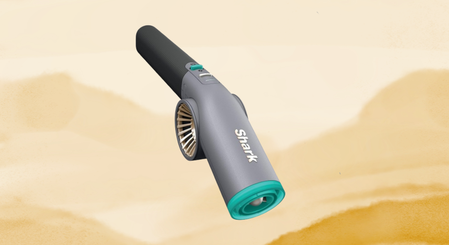
Available in five colours and priced at £89.10 instead of its usual £129.99, the Shark BlastBoss earns its place as a genuinely useful addition to any cleaning routine, tackling jobs indoors and out that a standard vacuum cleaner simply cannot handle.



































































You must be logged in to post a comment Login