
Crypto World
Aon CEO says USI deal seeks to build ‘premiere middle market’ insurance platform

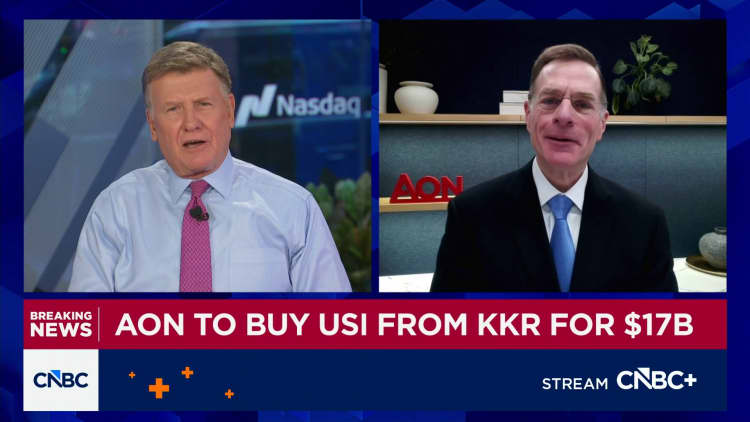

Insurance broker Aon announced on Monday it will purchase rival USI Insurance Services from private equity firm KKR.
The $17 billion deal, which will be funded by Aon with new debt, is anticipated to close in the fourth quarter, subject to regulatory approvals.
CEO Greg Case in an appearance on CNBC’s “Squawk Box” Monday said that the merger will establish the “premier U.S. middle-market platform.”
“This means we’re going to be in a position to bring world class solutions to the underserved U.S. middle market, and … set a new standard of client leadership for the 200,000 middle-market companies in the U.S. and their 48 million employees,” he said.
The acquisition for Aon builds on the company’s purchase of NFP in 2024, another insurance broker focused on the U.S. middle market.
An office building with the Aon logo is seen amid the easing of the coronavirus disease (COVID-19) restrictions in the Central Business District of Sydney, Australia, June 3, 2020.
Loren Elliott | Reuters
USI, according to a press release announcing the deal, is the tenth largest insurance broker in the U.S. The company has more than $3 billion in annual revenue, and more than 10,500 employees.
Once a deal is closed, USI CEO Mike Sicard will transition to Aon’s president and global CEO of middle market.
“Joining Aon represents a truly energizing next chapter for our firm and an opportunity to accelerate our momentum as part of the Aon United platform,” Sicard said in the release. “Our firms share strong, one-firm cultures with a deep commitment to working together to bring the best of our capabilities to clients.”
In a press release, KKR partner Chris Harrington said Aon is the ideal partner to support USI’s next growth chapter.
Shares of Aon slipped about 1% in premarket trading Monday. But despite the initial slide, Case said the opportunity to serve the middle market at the scale the company now can through the acquisition has tremendous value potential for shareholders.
“Maybe the greatest I’ve seen in my 20-year career as CEO,” he said.

Crypto World
Ethereum Price Prediction: What’s Next for ETH After Massive Rally From $1.9K to $2.5K?
Ethereum is consolidating after a sharp breakout from the $1.9K area, with ETH currently trading below $2.5K. The technical structure has improved considerably, while the continued decline in exchange reserves provides a supportive backdrop.
However, ETH’s $2.5K resistance zone is a meaningful one, and a breakout or rejection from this level is key to determining whether the recovery can extend or the recent price surge was just a bull trap.
Ethereum Price Analysis: The Daily Chart
The daily chart shows a significant structural improvement over the past several weeks. ETH broke above the descending channel that had contained the price throughout the past few months, subsequently reclaiming the $1.9K region and then accelerating sharply higher.
The breakout also pushed ETH through the $2.1K resistance zone before the asset surged toward the current $2.5K area. The move also brought ETH above both the 100-day (~$1.9K) and 200-day (~$2.05K) major moving averages. These moving averages are also now sloping upward, which suggests that the broader bearish structure is losing momentum and a structural bullish shift might be occurring.
As already mentioned, ETH is now trading inside a resistance zone around $2.45K-$2.55K. This area has repeatedly attracted selling pressure in recent sessions, with several candles failing to establish a decisive breakout above $2.5K. A daily close above this region would strengthen the bullish continuation scenario and could expose the next major resistance around $3K and potentially higher.
On the downside, the first important support is around $2.1K. This zone is particularly significant because it previously acted as resistance and was decisively reclaimed during the latest rally. A pullback that holds this area would therefore keep the bullish breakout structure intact.
Below it, the $1.9K zone represents another important support region and serves as the initial point of the breakout. Therefore, a sustained move back below it would weaken the current bullish structure and raise the risk that the recent breakout was just a failed recovery preceding a deeper decline.

ETH/USDT 4-Hour Chart
The 4-hour chart provides a clearer view of August’s price action and the current consolidation. Following the vertical breakout from $1.9K, ETH initially pushed above $2.3K and continued toward $2.5K. Since then, the price has been moving sideways within a relatively tight range, with the $2.5K level acting as the upper boundary.
This consolidation can be interpreted constructively as long as ETH continues to hold the higher levels established during the breakout. The market is effectively digesting a very aggressive upward move rather than immediately giving back the entire rally.
Therefore, the immediate resistance remains around $2.5K. A decisive 4-hour breakout and sustained trading above this zone would provide confirmation that buyers are regaining control and could open the way toward higher daily-chart resistance.
Looking below, the first notable support lies around $2.2K-$2.3K. This zone coincides with a bullish order block, where the latest acceleration higher began, and could therefore attract buyers if ETH undergoes a deeper retracement.
The next support is around $2.05K-$2.1K, and holding this area would be particularly important, as a drop below it would also lead to a decline below the $2K psychological level and could quickly damage market sentiment.
Meanwhile, the 4-hour RSI has pulled back from overbought territory and is hovering around 50. This is consistent with a cooling-off phase following the breakout rather than an outright momentum breakdown. A renewed move above the $2.5K area while RSI expands again would strengthen the continuation setup, but this scenario will likely materialize after further consolidation or correction, as the market seems over-extended in the short-term.

Sentiment Analysis
The exchange-reserve chart provides a notably constructive signal for Ethereum. ETH held on exchanges has declined steadily from above 21M ETH in 2025 to approximately 14.9M ETH at the latest reading shown on the chart. The decline has even become steeper over the past couple of months.
At the same time, ETH’s price has recovered from $1.5K to approximately $2.4K. The divergence is important because the declining exchange reserve suggests that a smaller quantity of ETH is sitting on exchanges and potentially immediately available for selling. While exchange reserves alone cannot determine future price direction, sustained withdrawals can reduce readily available sell-side supply if the trend reflects longer-term accumulation or movement into self-custody and other non-exchange venues.
The chart also shows that the decline in exchange reserves has persisted even through periods of significant price volatility. This makes the current supply-side backdrop more constructive than if reserves were rising alongside the latest rally.
As a result, the technical and on-chain pictures are currently aligned. ETH has broken its longer-term descending trend, reclaimed the key $2K area, and is consolidating near the next resistance while exchange reserves continue to fall. This shrinking supply might just need a slight demand push from the spot or the futures market to result in a breakout and a further rally.

The post Ethereum Price Prediction: What’s Next for ETH After Massive Rally From $1.9K to $2.5K? appeared first on CryptoPotato.
In March, someone moved $1 million worth of Bitcoin through a large crypto custodian. Three weeks later, almost exactly the same amount came back. Incredibly, less than two months after that, the Bitcoin was deliberately destroyed.
The wallet had been dormant for almost 12 years before it suddenly sprang back to life. Bitcoin educator Bennet noted it sent 20.00010537 BTC to “a custodian of some kind” before receiving it back again (minus $3 or so).
“The whole balance went out to what looks like an exchange hot wallet, and almost exactly the same amount came back three weeks later. Seven weeks after that, it was burned.”
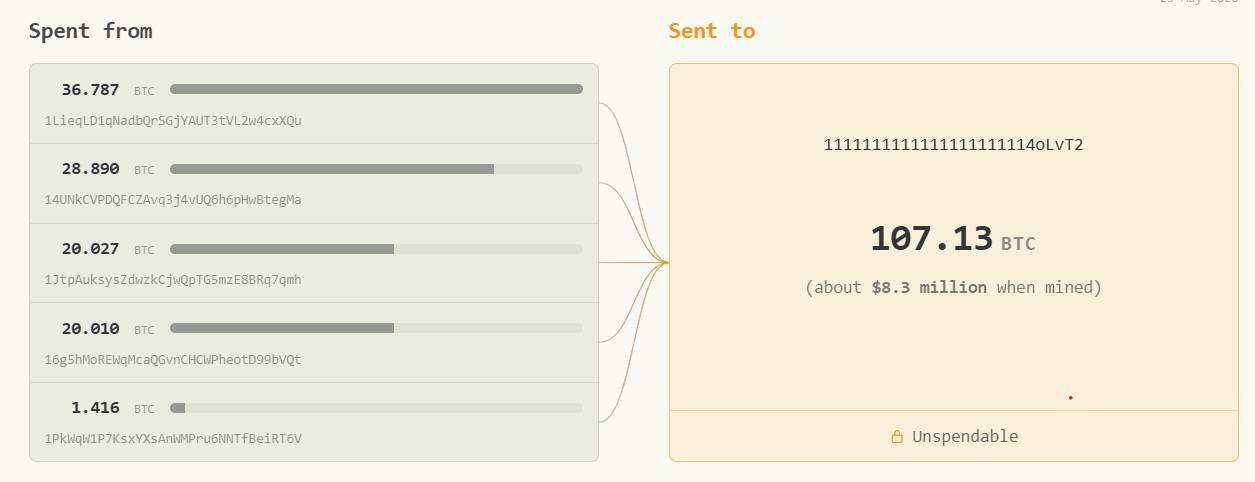
The mystery BTC transaction is part of a wider enigma surrounding 107 BTC burned in May, worth roughly $8.5 million at the time.
New blockchain analysis shows that five wallets that ultimately destroyed their Bitcoin appear to have been controlled by the same person. It was likely an early Bitcoin holder who had funds on the collapsed Mt. Gox exchange.
But why on earth would anyone deliberately destroy millions of dollars worth of Bitcoin?
The BTC wallets behind the burn
The five addresses that eventually sent their Bitcoin to an unspendable address show “strong indicators of common ownership” according to Chainalysis.
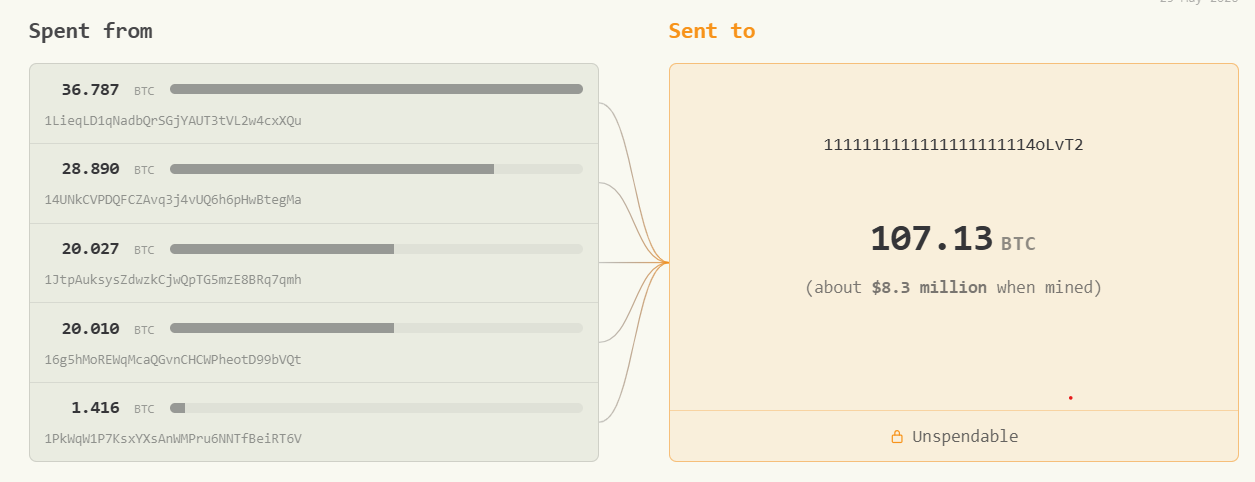
How to destroy Bitcoin. Source: Bennet.org
All five wallets were initially funded on the same day in April 2014, and each subsequently sent almost the same dollar-equivalent amount of BTC to the same deposit address at a large centralized exchange.
Related: Bitcoin faces true demand test above $83K as liquidity thickens: Glassnode
The addresses also seem to have operated on a rotational basis: one would send Bitcoin to the exchange until its activity stopped, then another would take over with transactions of a “similar cadence and value.”
Most of the funds, Chainalysis says, can be traced back to Mt. Gox, “suggesting the owner was an early adopter of Bitcoin.”
That doesn’t necessarily mean the coins were withdrawn directly from Mt. Gox, since the exchange ceased trading in February 2014, and the five wallets were funded in April. Bennet says:
“It’s entirely possible that the owner of these coins was one of the lucky ones who managed to get their coins off the exchange before it collapsed.”
The custodian itself remains unidentified. Chainalysis confirms it’s a large centralized exchange but says it does not publicly disclose the names of services it identifies.
Bennet’s analysis suggests the address behaves like a static customer deposit address at a large custodian.
That’s because the address doesn’t maintain a balance, and the deposits are swept into transactions containing dozens of other inputs before being consolidated into an omnibus wallet.
Once the Bitcoin enters the custodian’s system, the public blockchain can no longer tell us what happened to those coins. And that makes the wallet’s earlier activity even more intriguing.
The $10,400 clue
One of the five addresses sent 19.6 BTC in 60 transactions to the custodian between 2022 and 2024.
The Bitcoin amounts were vastly different, ranging from about 0.15 BTC to 0.62 BTC. But when measured in dollars, the transactions reveal extraordinary similarities.
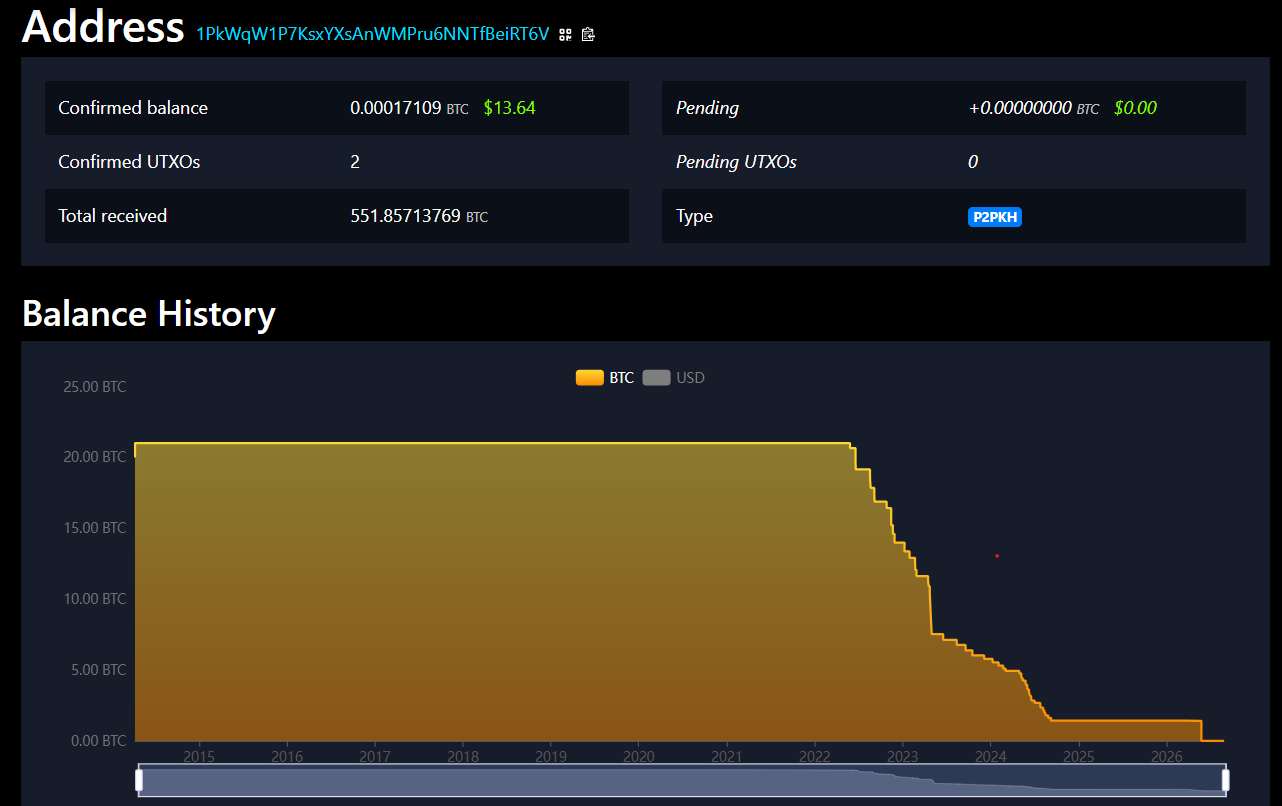
This address sent 19.6 BTC in 60 transactions to the same custodian. Source: Mempool.space
Despite Bitcoin’s price more than quadrupling during the period, 58 of the 60 transfers were within 10% of approximately $10,400 when they were sent.
So, while the owner wasn’t repeatedly sending the same amount of BTC, they were repeatedly sending almost the same dollar amount. Bennet says:
“This suggests to me a planned liquidation strategy.”
There is no way to prove this theory from the blockchain, since the BTC was mixed with large numbers of other coins once it reached the custodian, and the data doesn’t show whether the Bitcoin was sold, held or transferred elsewhere.
Related: Bitget CEO isn’t buying the Bitcoin rally — She’s waiting for $50K
Interestingly, “while payment size was constant,” Bennet says, “frequency was not — these $10k transfers came in clusters,” which could be more consistent with someone sending fixed-dollar amounts when required rather than following an automated schedule.
The $1 million round trip
While the $10,400 transactions offer a possible explanation for the wallet owner’s earlier relationship with the custodian, they do not help explain the $1 million round trip that happened in March.
After sitting untouched for roughly 12 years, the wallet suddenly moved its entire balance of 20.00010537 BTC and received 20.00006037 BTC back, a difference of just 4,500 satoshis, or around $3.
That weighs against the idea that the owner was simply trading the Bitcoin, since whatever happened inside the custodian, almost exactly the same amount came back.
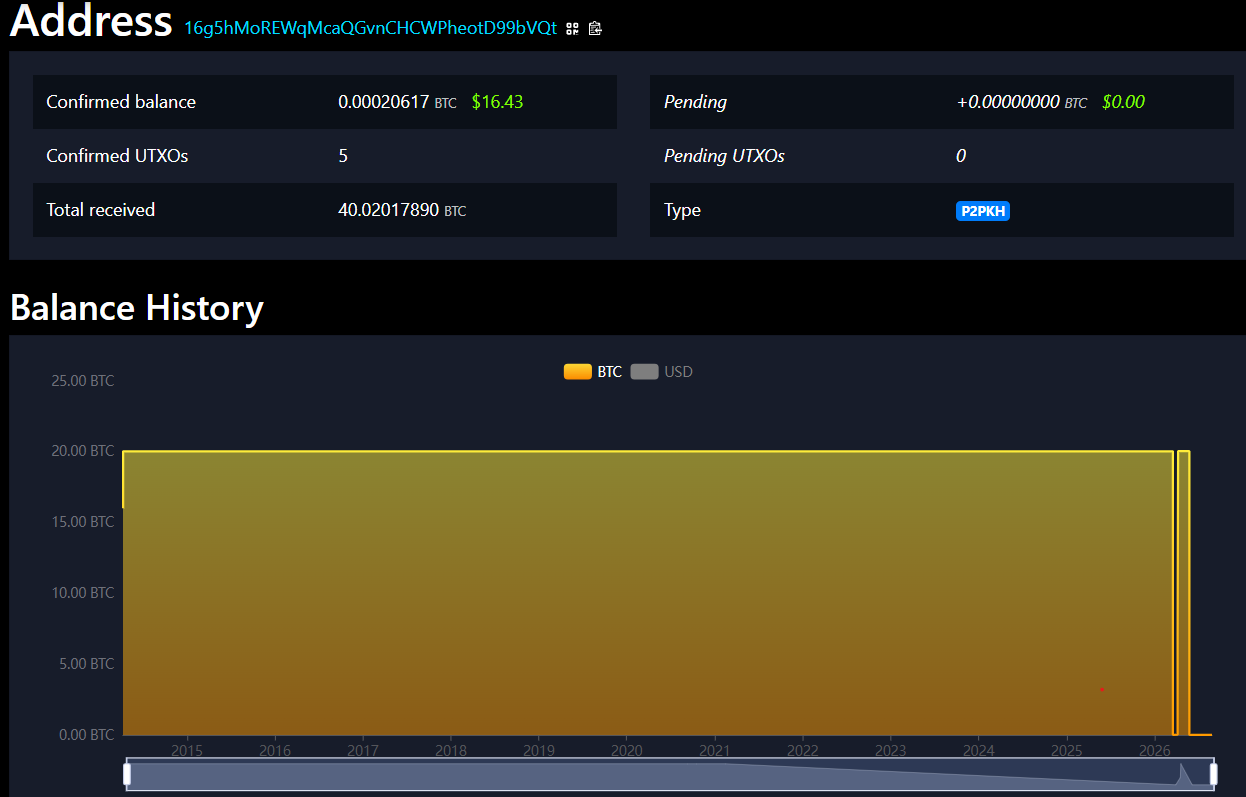
This address sent 20 BTC and received 20 BTC back. Source: Mempool.space
The returned Bitcoin was also split into three transactions of 7 BTC, 7 BTC and 6.00006037 BTC, sent over three consecutive days.
Bennet says the round numbers are consistent with a daily withdrawal limit imposed by the custodian. Crucially, the Bitcoin didn’t simply end up in another wallet; it returned to the same address that had sent it.
The transaction history also indicates that the same key holder controlled the coins before and after the round trip, Bennet says: spending the Bitcoin in March required the private key, while burning it in May required the same key again.
That makes the sequence particularly difficult to explain as a conventional exchange transaction.
So why did they do it?
There are several possibilities, but none fits all of the evidence. The liquidation theory makes some sense of the earlier transactions, but it doesn’t explain why the owner would send roughly $1 million through the same infrastructure in March and then retrieve virtually all of it.
Perhaps the owner was testing an old wallet or custody arrangement after 12 years of dormancy, moving the coins through a major custodian and successfully getting them back to show that an old key and custody setup still worked. But then, why destroy the Bitcoin afterward?
Tax or compliance reasons could potentially explain why someone moved an old stash through a major custodian, but then, there is no evidence linking the transaction to a particular tax or regulatory event.
There is also a privacy explanation. Sending Bitcoin through a custodian that sweeps deposits into an omnibus wallet makes the subsequent movement of those coins much harder to follow onchain. That’s certainly plausible but still provides no clues as to their ultimate destruction.
Perhaps the Bitcoin burn itself was intended as some kind of statement. Yet beyond a few blockchain sleuths, the action almost went unnoticed.
Burning Bitcoin is irreversible, so whoever controls the private keys chose to send the coins somewhere they can never be spent again, rather than simply leaving them untouched. Bennet says:
“There’s also the possibility that a very wealthy individual without heirs decided to permanently burn their coins (thereby publicly reducing the total bitcoin supply), rather than just destroying their keys.”
For now, even the firms best placed to analyze the blockchain are at a loss. Chainalysis concedes:
“We don’t have a clear explanation for why the owner would move a long-dormant stash through a custodian, retrieve roughly the same amount, and then deliberately burn it.”
While the blockchain can give us an unusually detailed record of what happened, it can’t tell us why. For now, at least, that remains the million-dollar question.
Magazine: El Salvador’s Bitcoin experiment turns 5: ‘It was for us, not them’
Cointelegraph publishes long-form journalism, analysis and narrative reporting produced by Cointelegraph’s in-house editorial team with subject-matter expertise. All articles are edited and reviewed by Cointelegraph editors in line with our editorial standards. Some articles contain affiliate links, from which Cointelegraph may earn a commission. These relationships do not influence which products we review or our editorial conclusions. Content published in here does not constitute financial, legal or investment advice. Readers should conduct their own research and consult qualified professionals where appropriate. Cointelegraph maintains full editorial independence.
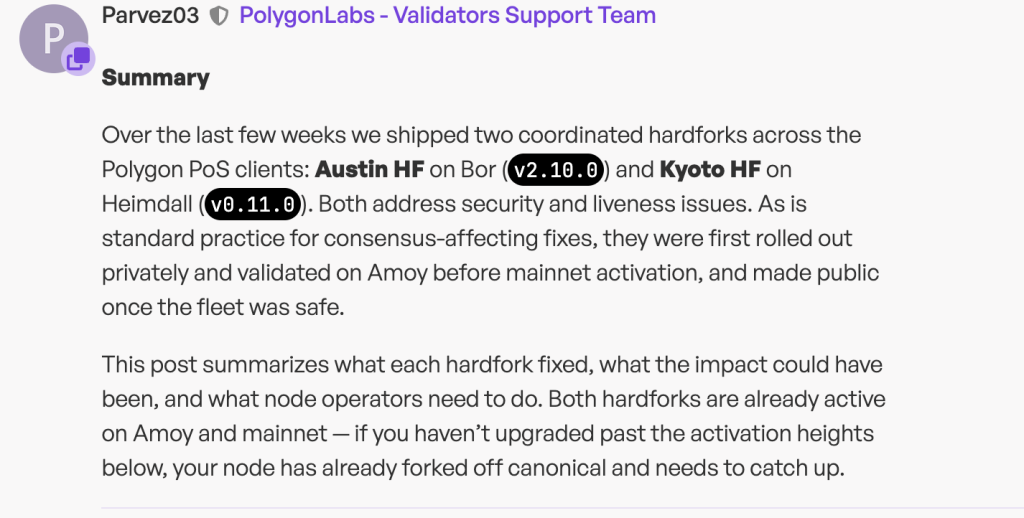
Polygon Crypto deployed two coordinated hard forks, Austin on Bor v2.10.0 and Kyoto on Heimdall v0.11.0, to close denial-of-service, resource-exhaustion and consensus-hardening risks across its Polygon PoS client stack. Both upgrades were rolled out privately and validated on the Amoy testnet before mainnet activation, according to a Polygon forum post published August 27.
No mainnet disruption was observed from the vulnerabilities Austin addressed, and both forks were already active on Amoy and mainnet by the time the disclosure went public.

The sequencing matters: Polygon fixed the issues, confirmed the fleet was safe, then explained what had been broken – not the other way around.
Polygon Crypto: What Austin and Kyoto Actually Fixed
Austin closed two Bor block-processing DoS paths. State-sync events, which handle L1-to-L2 bridge deposits, execute contract code and precompiles just like ordinary transactions, but their gas consumption previously wasn’t metered against a hard per-block cap.
A block carrying enough state-sync events, or one especially expensive one, could make processing slow enough to transiently stall the chain. Austin added an explicit per-block gas bound to close that gap.
The second Austin fix removed Bor’s TxDependency wire field entirely. The field was a parallel-execution hint with no size limit, meaning a block producer could stuff an arbitrarily large blob into an otherwise valid sibling block and crash any peer that tried to process it.
Polygon Labs patched a batch of security flaws in its PoS network through two private hard forks, Austin on Bor and Kyoto on Heimdall, before disclosing them publicly. The important detail is the operating model: consensus-affecting fixes were rolled out quietly, validated on the… pic.twitter.com/Sezi5VENW0
— TheFrogMaxi
 (@thefrogmaxi) August 31, 2026
Since parallel execution doesn’t need peers to trust a producer’s hint to function correctly, removing the field cost nothing downstream.
Kyoto’s most severe fix targeted deeply nested google.protobuf.Any fields in Heimdall transactions. Without a cap, a single cheaply-crafted transaction could force every validator to perform disproportionately expensive decode work simultaneously, a permissionless way to impose costly, correlated load across the entire validator set.
Kyoto added a byte-level pre-scan enforced identically at mempool admission and on the consensus path, so a transaction can’t slip through one check and get rejected by the other.
Kyoto also bundled smaller hardening fixes: a cap on fee-coin counts, normalized checkpoint signature recovery bytes, idempotent handling of repeated producer-downtime messages, milestone range votes bound to the signed parent hash, checkpoint-window continuity checks, non-halting future-span creation, and injective replay keys for topup, clerk and stake L1 events.
All of it is inert below the fork height – normal traffic sees no behavioral change. That kind of layered validation hardening echoes broader industry efforts to shore up transaction-processing edge cases before they’re exploited, similar in spirit to protocol-level changes aimed at emerging transaction-security threats elsewhere in the industry.
Make Your Prediction Count With $25 For Free on Kalshi
Why Bor and Heimdall Both Needed Patching
Austin activated at Amoy block 44,120,000 and mainnet block 91,949,700. Kyoto activated at Amoy height 42,252,000 and mainnet height 51,533,000.
Bor handles block execution while Heimdall runs consensus, and Kyoto’s fixes span ABCI, milestone, bor, stake, topup, clerk and bridge processing, meaning the patch touched checkpoint finality, milestone accounting and L1-event replay logic all at once.
Bor v2.10.0 is mandatory for all nodes; Heimdall v0.11.0 is mandatory for all validators and full nodes. Both are plain binary upgrades with no state migration or genesis change required for operators already current.
Huge applause to the @0xPolygonLabs security team
Quietly patched DoS flaws via the Austin & Kyoto hard forks—zero downtime, zero exploits, zero user impact.
This is how battle-tested infrastructure operates. Security first, noise later.$POL #Polygon https://t.co/jIESwxvLxC
— Delli Babu | $POL

(@DelliBabu_POL) August 30, 2026

That’s a distinct case from nodes still running pre-fork binaries past the activation heights: those have already forked off canonical consensus and need to upgrade and roll back to resync, rather than simply updating in place.
Coordinated client upgrades of this kind carry real operational stakes for any high-throughput chain, a dynamic playing out elsewhere as networks weigh state growth and execution risk against upgrade cadence, see the ongoing debate around Ethereum’s Glamsterdam upgrade path.
For Polygon PoS, the takeaway is straightforward: the vulnerabilities were resource-exhaustion and consensus-edge-case risks, not correctness failures, and both were resolved before any exploitation was observed on mainnet.
The Best Traders Around Use It: AI Copy Trading Bots From CryptoHopper
The post Polygon Crypto Secures Bor and Heimdall Clients Before Disclosure appeared first on Cryptonews.

Ripple just gave the market something bigger than a daily candle to chew on. The company’s quantum security roadmap could reshape how the market prices in long-term network risk, and there’s a detail in the phasing schedule that traders should not skip past.
Ripple has laid out a four-stage post-quantum roadmap for XRPL, running from an emergency “Q-Day” recovery plan through a targeted mainnet code amendment by 2028. Phase 1 lets users migrate to quantum-safe accounts without exposing current keys. Phase 2 tests NIST-recommended ML-DSA algorithms on AlphaNet in H1 2026. XRPL’s existing key-rotation feature gives it a structural head start that most legacy chains lack.
— Coin Bureau (@coinbureau) August 29, 2026
 NEW: Ripple is quantum-proofing the XRP Ledger before "Q-Day" arrives.
Ripple is preparing ripple:native for the moment quantum computers can break the cryptography protecting wallets, which researchers call Q-Day, per CoinDesk.
The company laid out a four-stage migration… pic.twitter.com/HK6AVJtIY3
None of this changes XRP’s cryptography today. Shor’s algorithm-capable quantum computers remain theoretical. But markets price narratives well before they price threats, and “first major L1 with a formal quantum timeline” is a narrative XRP holders will hear repeated for the next two years.
Discover: The Best Crypto to Diversify Your Portfolio
Can XRP Price Hold $1.35 Support Amid The Ripple Quantum News?
XRP’s pullback from August highs has it consolidating in the $1.34–$1.40 band, with the 7-day chart down near 10% even as the monthly print stays positive.
Volume has thinned alongside the price compression, typically a sign that the market is waiting on a catalyst rather than committing to direction.

- Bull case: a hold above $1.35 support opens a retest of the $1.45–$1.50 resistance zone, where August’s stronger momentum stalled.
- Base case: continued range-bound trading between $1.35 and $1.40 as the market digests the quantum roadmap without a near-term price trigger.
- Bear case: a break below $1.30 invalidates the recent structure and opens room toward the low-$1.20s.
Recent analysis on the $1.40 floor suggests bulls need volume confirmation, not just headline momentum, to reclaim that level.
Trade XRP on Bybit and Get a Chance to Win Our $1,000 USDT Airdrop
Maxi Doge Targets Early Mover Upside as XRP Consolidates
XRP’s structural news is bullish on paper, but a 2028 implementation timeline does little for anyone trading weekly charts. Holders sitting on August gains now face a market pricing in patience over payoff.
This is the kind of setup that sends capital hunting for shorter runways. Support-test dynamics like these tend to push traders toward earlier-stage plays where upside isn’t already baked into a multi-billion-dollar market cap.
That’s the lane Maxi Doge ($MAXI) is running in. It’s an Ethereum-based meme token built around a 240-lb leverage-obsessed mascot and a “never skip leg-day, never skip a pump” ethos. A gym-bro humor wrapped around a trading community angle.
The presale has raised $4.8 million at a current price of $0.0002836, with a huge 65% APY staking live for early buyers. Standout features include holder-only trading competitions with leaderboard rewards and a Maxi Fund treasury earmarked for liquidity and partnerships.
Research Maxi Doge through the official presale page before the presale ends.
Discover: The Best Token Presales
The post Ripple Unveils 4-Stage Quantum Security Plan: Is XRP Set to Benefit? appeared first on Cryptonews.
Most leading digital assets have posted minor losses over the past 24 hours, while the total capitalization of the crypto market has slightly retreated during the same period.
The popular privacy token Monero (XMR) defied the ongoing conditions, registering a double-digit increase and nearing the prestigious top 10 club. Here’s what fueled the rally.
Leading the Gainers
XMR is the best-performing cryptocurrency from the top 100 list today (August 31), with its price briefly surging to almost $530, the highest since January this year. Currently, it trades at around $525 (per CoinGecko), representing a 43% jump on a monthly scale.
The asset’s market cap jumped to nearly $10 billion, overtaking well-known altcoins like Chainlink (LINK) and Cardano (ADA) and making it the 13th-largest cryptocurrency.
Perhaps the biggest catalyst for the move north is THORChain’s network upgrade, which reportedly introduced native support for XMR swaps.
According to X user Nebrasangooner, breaking above the $410 resistance was the key bullish trigger, suggesting the asset is ready to take off. For his part, David Gokhshtein remains baffled by how XMR printed such gains without being listed on many major exchanges.
Recall that at the beginning of 2024, Binance terminated all services with the token, triggering a substantial price decline. XMR remains unavailable on Coinbase as well, while the few popular platforms that support it are Kraken, KuCoin, and MEXC.
Other X users commenting on the price increase include Mav and Sweep. The former claimed that the rise above $500 has confirmed XMR’s comeback, whereas the latter described it as “an absolute sleeping giant” and “the real privacy token.”
Meanwhile, the coin’s recent exchange net flow indeed suggests a further rally could be on the way. CoinGlass’s data displays that outflows have surpassed inflows over the past several days, signaling that investors have abandoned centralized platforms in favor of self-custody, thereby reducing immediate selling pressure.

The Concerning Sign
Contrary to the aforementioned bullish predictions, XMR’s Relative Strength Index (RSI) hints at an incoming correction. The technical analysis tool ranges from 0 to 100, where anything above 70 suggests the asset is overbought and due for a move south.
On the contrary, readings below 30 mean XMR has entered oversold territory and could be interpreted as buying opportunities. As of this writing, the RSI stands at roughly 77.

- XMR RSI, Source: RSI Hunter
The post Monero (XMR) Hits a 7-Month Peak: What Happened and What’s Ahead? appeared first on CryptoPotato.


The Bank of Russia recently included ETH and USDT in a draft list of cryptocurrencies approved for public trading on Russian exchanges.

Well over two months after completing its last bitcoin buy, the world’s largest corporate holder of the cryptocurrency is back on the offensive.
The firm’s co-founder and former CEO, Michael Saylor, outlined the acquisition on X, indicating that Strategy has acquired 4,603 BTC for almost $370 million at an average price of $80,318 per unit.
This brings the company’s total to 845,050 BTC, acquired for $63.73 billion at an average price of $75,412 per BTC. In addition to returning to the BTC accumulation scene, Strategy continued to repurchase shares of STRC by adding another $151.8 million.
Strategy has acquired 4,603 BTC for $370M, increased USD Cash by $29M, and repurchased $152M of $STRC. As of 8/30/26, we hold 845,050 bitcoin:native and $6.71B of USD Assets, bringing Net Leverage to 0.0%. $MSTR https://t.co/XAAEZV5Gil
— Michael Saylor (@saylor) August 31, 2026
This is perhaps the most surprising and important Strategy purchase over the past year or so, as it came after a two-month hiatus in which the company turned its entire attention to rebuilding its USD stash, which is now worth over $6.7 billion.
Since the firm used STRC to fuel its massive bitcoin purchases, its price had tumbled very far off its par level of $100, going as low as $75 at one point. However, once Strategy pivoted from its short-term BTC accumulation strategy (no pun intended), STRC gradually recovered, closing last week at over $97.
Meanwhile, the company even sold bitcoin on a few occasions, but its latest buy offsets most losses. Additionally, its massive stash has turned green for the first time since May, as it’s now worth $66.4 billion.
Today’s announcement follows Saylor’s hint yesterday, in which he posted a chart with the company’s countless purchases made in the past six years and said, “We’re ₿ack.”
The post Strategy Is Buying Bitcoin Again After 2-Month Pause: Here’s How Much appeared first on CryptoPotato.
Disclosure: This content is provided by a third party. Neither crypto.news nor the author of this article endorses any product mentioned on this page. Users should conduct their own research before taking any action related to the company.
XRP has recently seen a significant uptick in market activity, with its 24-hour trading volume reaching approximately $3 billion on Sunday. With a circulating supply of around 62.74 billion tokens and a total supply of roughly 99.98 billion, XRP continues to attract growing investor attention and trading activity.
Summary
- XRP’s 24 hour trading volume reached about $3 billion as market activity increased, while the token traded near $1.36.
- U.S. spot XRP ETFs recorded about $110 million in weekly net inflows through Aug. 30, according to figures cited in the report.
- XRP’s price pulled back despite the higher trading activity, with profit taking, whale portfolio changes and leveraged liquidations cited as possible factors.
- EX DeFi promoted cloud mining contracts as an alternative income source for XRP holders, with advertised daily returns varying by contract size and duration.
Alongside the surge in trading volume, institutional demand for XRP is heating up. US spot XRP ETFs have seen consistent inflows recently; the week ending August 30 recorded a cumulative net inflow of approximately $110 million, the highest weekly figure since 2026, further heightening market interest in XRP’s future performance.
Surprisingly, however, despite the simultaneous rise in trading volume and institutional demand, XRP’s price failed to rally as expected, instead pulling back to around $1.36. This “rising demand, falling price” dynamic has prompted many investors to re-evaluate XRP’s current valuation and future trajectory.
For long-term XRP holders, the question of how to generate passive income, beyond simply waiting for price appreciation, has become a key focus.
Consequently, an increasing number of investors are turning to the EX DeFi cloud mining platform, seeking to boost their returns through cloud mining rather than relying solely on price increases for profit.
Why did the XRP price pull back despite surging demand?
Although market demand for XRP remains strong, the price has retreated, indicating that new buying pressure is not yet sufficient to fully offset selling pressure in the spot market.
Analysts suggest that after XRP’s recent rapid rally, some investors opted to take profits while leveraged long positions were liquidated. These factors likely amplified short-term selling pressure, creating a temporary divergence between the continuous inflow of ETF capital and the spot price of XRP.
Therefore, the current pullback in XRP’s price does not necessarily signal a decline in market demand; rather, it likely reflects the interplay of institutional inflows, portfolio rebalancing by “whales,” short-term profit-taking, and leveraged trading activity. Meanwhile, recent XRP long positions totaling approximately $48 million have further heightened market interest; XRP remains a prominent cryptocurrency attracting significant attention within the 2026 digital asset market.
As the price of XRP fluctuates, EX DeFi cloud mining has emerged as an alternative method for generating passive income.
With increasing volatility in XRP prices, more investors are looking for other ways to earn passive income. EX DeFi offers sustainable energy-based cloud mining solutions, providing investors with a way to participate in the digital asset ecosystem without the need for specialized hardware or complex technical expertise.
Compared to traditional mining, cloud mining reduces the burden on users regarding hardware procurement, power supply, equipment maintenance, and daily operations. The platform manages computing power and operations, while users participate in mining and track their earnings through an automated system.
For investors who hold XRP long-term but wish to explore other avenues for generating returns from digital assets, cloud mining offers a participation model that goes beyond simply waiting for the XRP price to rise.
About EX DeFi
Founded in 2021 and headquartered in the UK, EX DeFi operates in compliance with European regulatory frameworks, including the Markets in Crypto-Assets Regulation (MiCA) and the Markets in Financial Instruments Directive II (MiFID II), while continuously enhancing transparency, operational standards, and user protection mechanisms.
Security and compliance measures include:
Annual financial and security audits conducted by PwC;
Custodial digital asset insurance provided by Lloyd’s of London;
Enterprise-grade security solutions powered by Cloudflare and McAfee®;
Implementation of multi-layer encryption architecture, 24/7 monitoring, and real-time risk management mechanisms.
The platform currently supports a wide range of mainstream crypto assets, including XRP, BTC, ETH, USDT, BNB, ADA, USDC, DOGE, LTC, and SOL.
Even beginners can get started with mining.
Step 1: Register an Account
Step 2: Select a Mining Package
Choose a cloud mining contract that suits your budget, participation timeframe, and specific needs, then launch the mining service with a single click.
Step 3: Start Earning Returns
Once the contract is activated, the system automatically allocates computing power, and earnings are settled automatically. Users can choose to withdraw their earnings or continue participating based on their preferences.
Popular Mining Plans:
BTC (Beginner Trial Contract): Investment $100, Duration: 2 days, Daily Return: $4, Total Profit: $100 + $8
DOGE (Goldshell Mini-Doge Pro): Investment $500, Duration: 6 days, Daily Return: $6.5, Total Profit: $500 + $39
BTC (Canaan-Avalon-A1466): Investment $1,000, Duration: 10 days, Daily Return: $13.4, Total Profit: $1,000 + $134
LTC (Bitmain Antminer L7): Investment $5,000, Duration: 20 days, Daily Return: $73.5, Total Profit: $5,000 + $1,470
BTC (Bitmain S19K-Pro): Investment $10,000, Duration: 30 days, Daily Return: $161, Total Profit: $10,000 + $4,830
Please visit the EX DeFi platform to view more details regarding returns.
Conclusion
While XRP has recently seen a significant increase in trading activity and institutional demand, its price has experienced a pullback. However, given the evolving dynamics of ETF capital flows, “whale” activity, and market sentiment, XRP retains significant value potential for the future.
For long-term XRP investors, beyond monitoring price trends and ETF inflows, there is also the opportunity to participate in digital asset services like EX DeFi cloud mining. Whether you are a novice or an experienced investor, you can leverage XRP to generate stable passive income.
Disclosure: This content is provided by a third party. Neither crypto.news nor the author of this article endorses any product mentioned on this page. Users should conduct their own research before taking any action related to the company.


Eligible assets for the new accounts include listed stocks, bonds, and ETFs, with providers handling tax reporting to simplify investor compliance.
Strive CEO Matt Cole took it to X to announce that the company has accumulated another 1,800 BTC for $143 million at an average price of $79,431 per unit. Thus, the firm’s total holdings have grown to 23,156 BTC.
From a USD perspective, the firm’s cryptocurrency stash is now worth $1.760 billion, given the asset’s price of $78,000 as of press time.
Strive acquired an additional 1,800 BTC for $143M at an average cost of $79,431 per bitcoin, bringing total holdings to ₿23,156.$ASST $SATA pic.twitter.com/6ztKhC4PFF
— Matt Cole (@ColeMacro) August 31, 2026
Strive has accelerated its bitcoin purchases lately, including adding another 1,110 BTC last week, as reported. Cole published a chart yesterday on X highlighting all of the firm’s acquisitions completed in the past year or so, and the graph clearly shows a growing number of buys completed since March this year.
This is the third major crypto acquisition announced by big names today. It all started with Strategy, which, after a two-month pause, finally resumed its bitcoin purchases by splashing $370 million to acquire 4,603 BTC.
Bitmine followed suit. The former BTC miner acquired 53,501 ETH as its entire Ethereum stash surged past 5.9 million. It now owns 4.8% of the asset’s entire circulating supply.
Meanwhile, if you are interested in finding out more about the latest Strategy moves or the overall market state, check out our video below.
The post Strive Keeps Buying Bitcoin: Another 1,800 BTC Push Holdings Past 23K appeared first on CryptoPotato.

64 Wine Oyster Festival 2026

King Harald V’s coffin at royal chapel as Queen Mette-Marit joins procession

Big Pharma’s Comeback Is Here: Winners, Losers, And 4 ETFs (NYSEARCA:XLV)





-

 Crypto World6 days ago
SpaceX stock could rise 75% to $240, JPMorgan says
-

 Fashion3 days ago
Weekend Open Thread: Maeve – Corporette.com
-

 Crypto World4 days ago
Bitcoin’s 22% rally now needs real demand to outlast Treasury liquidity boost
-

 Crypto World5 days ago
Warsh Jackson Hole keynote puts financial innovation first
-

 Crypto World7 days ago
A $30 Billion AI Fund Implodes, Now the SEC Is Investigating Wall Street’s Role
-

 Business4 days ago
Salesforce Stock Soars 19% as Blowout Earnings and Agentforce AI Growth Silence Software Skeptics
-

 Crypto World5 days ago
Did Trump Just Move SpaceX Stock With One Truth Social Post?
-

 Crypto World5 days ago
Elon Musk Grok Bot Promise: We Will Make You Whole if AI Loses Your Money
-

 Business4 days ago
Apple Confirms September 9 Keynote and Reveals Its Full Pre-Order Schedule
-

 Business5 days ago
Walmart takes aim at younger shoppers with new fashion brand
-
 NewsBeat5 days ago
Lindsay Clancy jury braces for closing arguments as judge tells court: ‘You’ve heard all the evidence’ – Live updates
-

 Business3 days ago
Onto Innovation Stock: AI’s Next Bottleneck Is Yield (NYSE:ONTO)
-

 Business6 days ago
Thailand’s Eastern Economic Corridor Capital City (EECiti): Key Developments and Investment Opportunities
-

 Crypto World3 days ago
Bitcoin price tests $82K resistance as Brandt stays long
-

 Crypto World4 days ago
NVIDIA revenue hits $96.2B as AI demand doubles
-

 Business7 days ago
Moderna CEO warns China is pouring state money into mRNA technology
-

 Business7 days ago
NVIDIA Stock Drops Nearly 2 Percent to $210 on Seventh Losing Day Ahead of Critical AI Earnings
-

 Business3 days ago
iPhone 18 Pro Pre-Orders Could Shift to Saturday as Apple Reportedly Avoids September 11 Anniversary
-

 NewsBeat6 days ago
Trump’s trade truce with China faces test with Iran effort
-
 Crypto World5 days ago
Nvidia Q2 Earnings Reveal $96.2 Billion Beat, So Why Is NVDA Falling?
You must be logged in to post a comment Login