
Crypto World
Ripple Unveils 4-Stage Quantum Security Plan: Is XRP Set to Benefit?


Ripple just gave the market something bigger than a daily candle to chew on. The company’s quantum security roadmap could reshape how the market prices in long-term network risk, and there’s a detail in the phasing schedule that traders should not skip past.
Ripple has laid out a four-stage post-quantum roadmap for XRPL, running from an emergency “Q-Day” recovery plan through a targeted mainnet code amendment by 2028. Phase 1 lets users migrate to quantum-safe accounts without exposing current keys. Phase 2 tests NIST-recommended ML-DSA algorithms on AlphaNet in H1 2026. XRPL’s existing key-rotation feature gives it a structural head start that most legacy chains lack.
— Coin Bureau (@coinbureau) August 29, 2026
 NEW: Ripple is quantum-proofing the XRP Ledger before "Q-Day" arrives.
Ripple is preparing ripple:native for the moment quantum computers can break the cryptography protecting wallets, which researchers call Q-Day, per CoinDesk.
The company laid out a four-stage migration… pic.twitter.com/HK6AVJtIY3
None of this changes XRP’s cryptography today. Shor’s algorithm-capable quantum computers remain theoretical. But markets price narratives well before they price threats, and “first major L1 with a formal quantum timeline” is a narrative XRP holders will hear repeated for the next two years.
Discover: The Best Crypto to Diversify Your Portfolio
Can XRP Price Hold $1.35 Support Amid The Ripple Quantum News?
XRP’s pullback from August highs has it consolidating in the $1.34–$1.40 band, with the 7-day chart down near 10% even as the monthly print stays positive.
Volume has thinned alongside the price compression, typically a sign that the market is waiting on a catalyst rather than committing to direction.

- Bull case: a hold above $1.35 support opens a retest of the $1.45–$1.50 resistance zone, where August’s stronger momentum stalled.
- Base case: continued range-bound trading between $1.35 and $1.40 as the market digests the quantum roadmap without a near-term price trigger.
- Bear case: a break below $1.30 invalidates the recent structure and opens room toward the low-$1.20s.
Recent analysis on the $1.40 floor suggests bulls need volume confirmation, not just headline momentum, to reclaim that level.
Trade XRP on Bybit and Get a Chance to Win Our $1,000 USDT Airdrop
Maxi Doge Targets Early Mover Upside as XRP Consolidates
XRP’s structural news is bullish on paper, but a 2028 implementation timeline does little for anyone trading weekly charts. Holders sitting on August gains now face a market pricing in patience over payoff.
This is the kind of setup that sends capital hunting for shorter runways. Support-test dynamics like these tend to push traders toward earlier-stage plays where upside isn’t already baked into a multi-billion-dollar market cap.
That’s the lane Maxi Doge ($MAXI) is running in. It’s an Ethereum-based meme token built around a 240-lb leverage-obsessed mascot and a “never skip leg-day, never skip a pump” ethos. A gym-bro humor wrapped around a trading community angle.
The presale has raised $4.8 million at a current price of $0.0002836, with a huge 65% APY staking live for early buyers. Standout features include holder-only trading competitions with leaderboard rewards and a Maxi Fund treasury earmarked for liquidity and partnerships.
Research Maxi Doge through the official presale page before the presale ends.
Discover: The Best Token Presales
The post Ripple Unveils 4-Stage Quantum Security Plan: Is XRP Set to Benefit? appeared first on Cryptonews.



Coinbase has expanded its Webull infrastructure partnership into Canada, adding a fourth market to an agreement that already supports crypto services in the United States, Brazil and Australia.
Summary
- Webull Canada will use Coinbase for crypto trading, liquidity, and institutional custody.
- 25% of Canadians own crypto assets or crypto funds, according to an OSC survey.
- Webull Canada Crypto Limited operates as a CIRO-regulated investment dealer.
- Crypto assets held through Webull Canada will not receive CIPF protection.
Coinbase will supply Webull Canada’s crypto infrastructure
Coinbase said in an announcement that Webull Canada will use its Crypto-as-a-Service platform to support digital asset trading and custody. The arrangement gives Webull access to Coinbase’s liquidity and infrastructure while allowing customers to trade without leaving the Webull platform.
Rather than building its own trading and custody system, Webull will connect its Canadian service to technology already used in three other countries. Coinbase will handle the infrastructure behind the offering, while Webull will control the customer-facing investment experience.
Michael Constantino, CEO of Webull Canada, said Canadian clients are seeking access to more asset classes, including digital assets. In his view, Coinbase can provide the capacity and reliability needed to support the service.
“Canadian investors expect access to a growing range of asset classes, and crypto has become an increasingly important part of that mix,” Constantino said. “Our partnership with Coinbase provides the infrastructure needed to deliver this offering with the scale and reliability our clients expect.”
Webull Canada had already announced plans to introduce crypto trading after receiving regulatory approval. In a June statement, the company said the service would support 24-hour trading in assets including Bitcoin, Ethereum, Solana, XRP, Cardano, and Litecoin.
Beta access was expected to begin with selected clients before reaching more users, according to the June announcement. Webull said customers would be able to fund accounts, monitor portfolios, access reports, and trade digital assets within its existing platform.
Canadian crypto ownership has reached 25%
Demand data cited by Coinbase came from the Ontario Securities Commission’s 2025 crypto asset survey, which found that one in four Canadians owned crypto assets or crypto funds. The 25% national ownership rate was up from 10% in 2023.
Among respondents identified as investors, the ownership rate reached 39%, according to the OSC. About 30% of Canadians had owned crypto at some point, while 74% of current owners held cryptocurrencies directly through an exchange or another platform.
The findings provide the demand backdrop for Webull’s Canadian rollout, although the regulator also identified gaps in investor knowledge. The OSC reported that many owners continued to misunderstand the protections attached to crypto accounts and the risks associated with digital assets.
Webull Canada Crypto Limited is regulated by the Canadian Investment Regulatory Organization as an investment dealer. The company offers order-execution-only services, meaning customers make their own investment decisions without receiving portfolio recommendations from the platform.
While Webull Securities (Canada) Limited belongs to the Canadian Investor Protection Fund, Webull’s disclosures state that crypto assets do not qualify for CIPF coverage. Eligible cash held in a crypto trading account may receive protection within applicable limits and under the fund’s coverage policy, but the protection does not extend to cryptocurrencies themselves.
The distinction matters because CIPF generally covers missing property when a member investment dealer becomes insolvent. It does not insure investors against falling crypto prices, trading losses, or the failure of an asset.
Webull extends a partnership already active in the US
Before entering Canada, Coinbase’s infrastructure supported Webull crypto products in the United States, Brazil and Australia. Webull selected the company based on its available assets, liquidity, pricing, custody services, and ability to operate across several markets, according to Coinbase.
The U.S. part of the partnership gives the Canadian expansion a direct connection to American investors. Webull Corporation trades on Nasdaq under the ticker BULL and operates licensed brokerage businesses across 16 markets, according to the company’s June release.
Webull said it serves more than 27 million registered users globally. Its Canadian brokerage already offers Canadian and U.S.-listed shares, exchange-traded funds and options, along with cash, margin, tax-free savings and retirement accounts.
For Coinbase, the agreement supplies infrastructure to another financial platform without requiring Webull clients to trade directly through the Coinbase application. Crypto-as-a-Service products generally allow brokerages and financial technology companies to add digital asset functions while an external provider handles parts of trading, liquidity, and custody.
The Canadian rollout also builds on Webull’s existing local presence. The company entered Canada in January 2024 after obtaining regulatory authorization in November 2023, initially offering access to Canadian and U.S. equities.
Coinbase adds stocks, tokenized assets and EU services
Outside its work with Webull, Coinbase has continued adding products that combine crypto infrastructure with conventional financial markets. Earlier in August, crypto.news reported on its launch of nearly 4,000 U.S. stocks for eligible customers in the United Kingdom.
The UK service allows trading for 24 hours a day on five weekdays, with purchases funded through pounds or USDC. Coinbase also offers fractional shares starting from £1 and zero-commission trades, although its disclosures warn that currency movements can affect purchases made with pounds and that out-of-hours trading carries added risks.
Orders are routed through Coinbase Capital Markets Corporation and executed by Apex, while Apex Clearing holds the U.S. shares, according to the August report. Fractional shares remain unavailable outside regular U.S. trading hours even though supported whole-share orders can be placed during extended sessions.
Coinbase has also moved into stock-linked derivatives through Deribit. The derivatives exchange plans to offer perpetual contracts tied to companies such as Strategy and Robinhood, placing equity-linked products alongside its existing crypto derivatives business.
Onchain equities form another part of the company’s product expansion. On Aug. 24, Coinbase launched four stock tokens on Base, providing eligible non-U.S. users with exposure to Nvidia, Meta, Apple and Alphabet shares.
Each product initially represents a beneficial interest in one underlying share held through a segregated custody account. Coinbase Onchain SPV Ltd., an Abu Dhabi Global Market company, issues the securities, while U.S.-registered Alpaca Securities acts as the broker and custodian.
Chainlink later added Data Feeds for NVDAc, METAc, AAPLc and GOOGLc, allowing supported Base applications to calculate collateral values and monitor liquidations. Each lending protocol remains responsible for setting its borrowing limits and risk controls.
Coinbase has limited the Base stock tokens to eligible non-U.S. investors under Regulation S. The securities have not been registered under the U.S. Securities Act and are unavailable to U.S. persons, despite representing economic interests in shares of companies listed in the United States.
In Europe, Coinbase opened its Luxembourg hub under the Markets in Crypto-Assets framework in June. Its authorization from Luxembourg’s Commission de Surveillance du Secteur Financier permits the company to provide regulated crypto services across all 27 European Union member states through MiCA passporting rules.
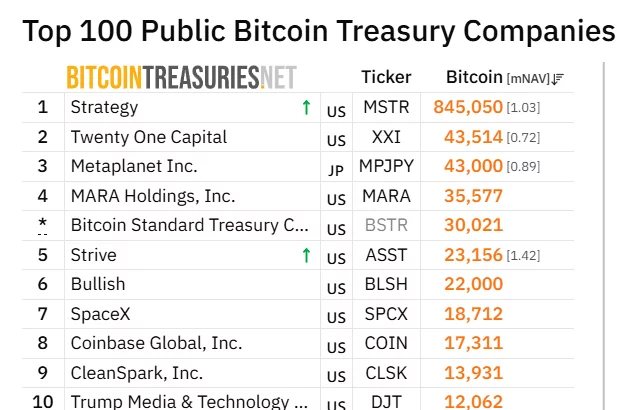
Strive has purchased 1,800 Bitcoin for about $143 million, raising its treasury to 23,156 BTC and moving past Bullish into fifth place among public corporate holders.
Summary
- Strive paid an average of $79,431 per Bitcoin between Aug. 24 and Aug. 28.
- The company’s Bitcoin treasury increased from 21,356 BTC to 23,156 BTC.
- ASST and SATA issuance continued as Strive financed purchases through its at-the-market programs.
- ASST gained more than 5% on Monday after nearly doubling during August.
Strive Bitcoin holdings reach 23,156 BTC
The U.S. Securities and Exchange Commission Form 8-K filing, submitted on Aug. 31, showed that Strive acquired 1,800 BTC between Aug. 24 and Aug. 28 at an average price of $79,431 per coin, including fees and expenses.
At the reported average price, the transaction cost approximately $143 million. Strive ended the period with 23,156 BTC, up from 21,356 BTC one week earlier.
BitcoinTreasuries.net data placed the Dallas-based company ahead of crypto exchange Bullish, which holds 22,000 BTC. The new balance made Strive the fifth-largest publicly traded corporate Bitcoin holder, behind Strategy, Twenty One Capital, Metaplanet, and MARA Holdings.
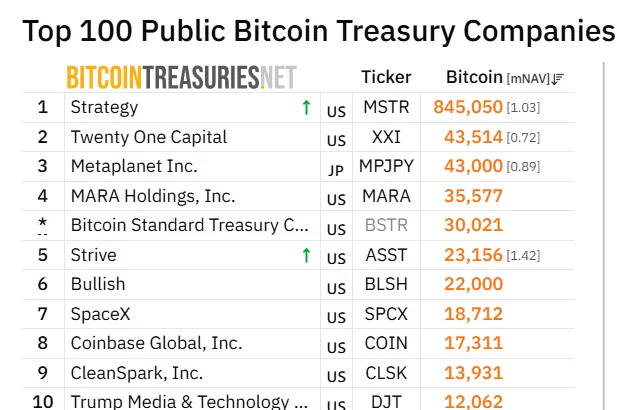
At a Bitcoin price of roughly $76,400, Strive’s holdings were worth about $1.77 billion. Market values can change with the price of BTC, while the filing did not disclose the company’s combined acquisition cost for its full treasury.
Chief executive Matt Cole confirmed the purchase in an Aug. 31 post on X.
“Strive acquired an additional 1800 BTC for $143M at an average cost of $79431 per bitcoin, bringing total holdings to ₿23156,” Cole wrote.
The acquisition followed another filing one week earlier in which Strive disclosed a purchase of 1,110 BTC for $81.5 million. As previously reported by crypto.news, the company paid an average of $73,409 per coin between Aug. 17 and Aug. 21, lifting its balance from 20,246 BTC to 21,356 BTC.
Across the two reporting periods, Strive acquired 2,910 BTC for approximately $224.5 million. Its average purchase price rose during the second week as Bitcoin moved through the upper-$70,000 range.
Share sales financed the Bitcoin purchase
Strive has used two Nasdaq-listed securities to raise money for its Bitcoin strategy: ASST common stock and SATA preferred stock. Both operate through at-the-market programs, which allow appointed sales agents to issue shares gradually instead of completing one large underwritten offering.
The latest filing showed that Strive’s outstanding Class A common shares increased by 3.58 million during the week, rising from 79.89 million to 83.47 million. Its Class B share count remained unchanged at 9.79 million.
Effective common shares outstanding consequently reached 93.26 million, while the assumed fully diluted count increased by 3.57 million to 96.52 million. The latter figure includes options and unvested employee awards but excludes 26.6 million shares tied to traditional warrants.
SATA issuance also continued, with the number of preferred shares climbing by 803,099 to 9.07 million. The security carries a $100 liquidation preference, placing its implied aggregate liquidation value at about $907.4 million.
Although Strive did not divide the purchase funding between the ASST and SATA programs, the simultaneous increase in both share counts showed that the company continued using common and preferred equity to support its treasury activity. Its filing also identified dilution from new ASST and SATA issuance as a risk for investors.
In June, Strive disclosed plans to add $2.1 billion of capacity to each program, creating up to $4.2 billion in possible new fundraising. The fundraising expansion gave the company more room to issue securities when market demand and pricing allowed.
For U.S. investors, ASST and SATA offer different exposure to Strive’s Bitcoin balance sheet. Common shareholders own the remaining equity after senior claims and can experience dilution as Strive sells more shares, while SATA holders have priority for declared dividends but do not own a direct claim on a fixed amount of Bitcoin.
SATA is a perpetual preferred security without a scheduled maturity date. Strive has maintained a 13% annualized dividend rate and began paying declared cash dividends every business day in June.
Strive’s cash position rises despite $143M purchase
Alongside its Bitcoin acquisition, Strive increased cash and cash equivalents by $11.6 million, from $171.9 million on Aug. 21 to $183.5 million on Aug. 28.
The company also continued holding 505,000 shares of Strategy’s STRC preferred stock. Although the number of shares did not change during the week, their reported fair value rose by $581,000 to $49.15 million.
Cash and STRC together had a reported value of approximately $232.65 million at the end of the period. Strive has used both assets as part of the reserves supporting its preferred-stock obligations.
Earlier in August, the company reported that it had retired all outstanding short- and long-term debt. Its second-quarter results showed a GAAP net loss of $257.6 million, including $234 million linked to declines in the fair value of Bitcoin and STRC during the quarter.
Preferred dividends also affect the amount available to common shareholders. Strive recorded $26.2 million in SATA dividends within its adjusted second-quarter loss attributable to common stockholders.
The company reported 6,236 BTC of purchases during the second quarter and 12,237 BTC during the first six months of 2026. An additional 303 BTC acquired through Aug. 7 brought the treasury to 20,167 BTC before several purchases later in the month.
Strive then bought 79 BTC for about $5 million between Aug. 10 and Aug. 14, followed by 1,110 BTC the next week and 1,800 BTC during the latest reporting period. The three transactions added 2,989 BTC in 15 days.
Back in May, a 1,109 BTC purchase had raised Strive’s holdings to 16,500 BTC and pushed the company ahead of Coinbase and Riot Platforms in the public-company ranking at the time.
ASST stock extends its August rally
ASST shares rose more than 5% during Monday trading after closing at $21.74 on Aug. 28. Market data showed the stock opened at $22.54 and traded between $21.95 and $23.46 during the session.
At approximately $23.16, ASST was up 6.5% on the day and had gained about 95% during August. Trading volume exceeded 5.2 million shares during the session, compared with an average near 5.18 million.
The stock’s rise followed a sharp increase in Strive’s Bitcoin balance and continued issuance under its common-stock program. ASST shareholders, however, remained exposed to Bitcoin price changes, preferred dividend costs, and further share issuance listed in the company’s SEC disclosures.
SATA traded near its $100 liquidation preference after falling below par the previous week. The preferred stock’s price matters to Strive because issuing shares well below $100 requires more units to raise the same capital, which adds to the company’s continuing dividend obligation.
Bitcoin traded near $78,000 during the same period after moving between approximately $77,161 and $79,346 over 24 hours. The cryptocurrency remained below Strive’s latest average purchase price of $79,431 but above the $73,409 average paid for the company’s preceding 1,110-BTC acquisition.


The prediction market platform banned Santos for manipulation as part of the industry’s ongoing efforts to show it’s dealing with bad behavior.

Ethereum is flatlining, but the number doesn’t really matter now, as the ETH/BTC ratio and Arthur Hayes’ news have given us a reason to watch it closely. The BitMEX co-founder called Ethereum his “number one pick” in an interview this weekend, arguing the asset could run 3 to 5x “pretty quickly” and calling it “one of the most unloved large-cap assets in crypto.”
The comments land as Ethereum’s RSI sits at 76.3, which is technically overbought, while grinding against resistance at $2,500. Hayes, however, hasn’t abandoned Bitcoin; he still projects BTC toward roughly $1 million within four years on the back of potential mass money printing.
According to Hayes, his near-term rotation call is what’s moving sentiment, and it raises the obvious question: Does relative strength against Bitcoin actually translate into fresh capital inflows, or is this just narrative noise before a pullback?
Discover: The Best Crypto to Diversify Your Portfolio
Can Ethereum Hit $2,750 on Hayes’ News?
ETH is holding in the mid-$2,400s after slipping from Sunday’s high near $2,500. Spot inflow data remains thin despite the bullish framing, which is the gap between Hayes’ narrative and what’s actually showing up on-chain.
As of now, the $2,500 level remains the line in the sand; clear it with volume and a push to $2,580, then $2,750, looks achievable given the bullish MACD and price holding above medium- and long-term moving averages.

Failure to consolidate above $2,500 flips the setup. A rejection sends ETH toward $2,380, with a deeper retrace to $2,300 and, if the 200-day moving average support at $2,245 breaks, a retest of $2,030 becomes the bear case.
Bitcoin, meanwhile, is at $78,500, down a modest 0.20% and still commanding 59.79% dominance in a level that keeps the “rotation” thesis more theoretical than proven. Traders watching this pair should track both levels before taking a position.
Agree with Hayes’ take? Trade ETH on Bybit and Get a Chance to Win Our $1,000 USDT Airdrop
Bitcoin Hyper Targets Early Mover Upside as Ethereum Tests Key Levels
Hayes’ endorsement validates the ETH bull case at the macro level, but a 3-5x on a $2,450 asset with a market cap in the hundreds of billions requires enormous capital rotation to materialize quickly. That’s the ceiling problem with large-cap plays, the upside is real but slow.
Smaller-cap infrastructure bets tied to Bitcoin’s own scaling story offer a different risk profile entirely, and that’s where Bitcoin Hyper ($HYPER) enters the conversation.
Bitcoin Hyper is building the first Bitcoin Layer 2 with native SVM integration, aiming for execution speeds that beat Solana while settling back to Bitcoin’s base layer. The presale has raised $33 million so far, with tokens priced at $0.0136855 and staking rewards currently live at a high 35% APY.
Its Decentralized Canonical Bridge targets the exact problem Bitcoin has never solved, like slow transactions, high fees, and zero programmability, without giving up BTC’s security model.
Research Bitcoin Hyper before committing capital.
Discover: The Best Token Presales
The post Ethereum News: Hayes Backs ETH as It Strengthens Against Bitcoin appeared first on Cryptonews.


Metaplanet has paid over $45 million to operate a bitcoin (BTC) treasury company that has a $1 billion unrealized loss from investing in BTC.
The Japanese company that emulated Michael Saylor’s Strategy loaded its purchases far higher than Strategy’s $75,385 cost basis. It paid 36% more, to be precise.
Indeed, Metaplanet has paid $4.41 billion to buy 43,000 BTC at an average cost basis of $102,502 per coin.
Read more: Metaplanet pitches stock buybacks after 96% mNAV decline
For context, BTC closed Friday near $77,600. That simple reality means that the company has lost 24% on its BTC investment, underperforming even a corporate treasury of idle cash in a bank account.
Since Metaplanet started purchasing BTC in April 2024, its fiscal reports disclose at least ¥7 billion (USD$45 million) worth of expenses to operate its treasury operations: ¥4.5 billion of issuance costs, ¥1.9 billion of interest to service its BTC-collateralized credit facility, ¥298 million of dividends to preferred shareholders who provided capital to buy BTC, and ¥4.8 billion of SG&A (selling, general, and administrative costs).
Those expenses are at least $45 million and, depending on the attribution of SG&A across BTC investment activities relative to other business operations, could rise above $70 million.
Although Metaplanet’s common stock has roughly tripled in price since management made particularly heavy purchases of BTC for the first time in October 2024, shareholders have experienced a rollercoaster ride. Shares have appreciated since 2024, yet closed this weekend down 82% from their June 2025 high.
After issuing traditional, coupon-bearing bonds to fund its BTC purchases in the summer of 2024, by late that year and into 2025, Metaplanet pivoted to more exotic, $0 coupon bonds coupled with moving-strike warrants as it increased its financial leverage.
As the company increased its BTC purchases without increasing literal cash obligations to bondholders, common shareholders increasingly shouldered financing costs via an overhang of dilutive convertibles.
Eventually, the trick of low cash outlays reversed as Metaplanet returned to traditional borrowing. By June 30, 2026, it had drawn a dangerous 83% of its available credit line: $414 million from its $500 million BTC-backed facility.
As the company rushed to make sure it had enough cash, its interest burden rose quickly. In the first quarter of 2026 alone, interest expense reached ¥934 million — more than 300 times higher than its ¥3 million interest expense during the first half of 2025.
With rising interest costs and waning appetites from common shareholders to shoulder additional dilution, all to service an investment that is more than $1 billion underwater, Metaplanet’s stock price has understandably declined 14% year to date, 61% over the past 12 months, and 82% from its June 2025 high.
Got a tip? Send us an email securely via Protos Leaks. For more informed news and investigations, follow us on X, Bluesky, and Google News, or subscribe to our YouTube channel.
Solana’s native token remains the best-performing cryptocurrency (at least among the top 10 club) on a weekly scale, while certain factors suggest a much more significant rally may be coming next.
An additional ray of hope comes from September, a month that has historically been highly favorable for the asset.
Major Rally on the Way?
Currently, SOL is worth around $103 (according to CoinGecko), translating into a 9% rise over the past week. X user Ash Crypto noted that the asset ended the previous week at roughly $102.80, the highest close in the last seven months.
“Bullish for Solana holders,” the analyst added.
Another major achievement for the token is the growing institutional appetite. SoSoValue’s data show that spot SOL ETFs have experienced nine consecutive green days, the longest streak since May this year.

The well-known entities offering such financial products include Bitwise, Fidelity, Grayscale, VanEck, Franklin Templeton, and others. Bitwise’s product BSOL is by far the most popular one in the pack, and it recently surpassed the $1 billion milestone in assets under management.
Crypto X has been buzzing with users making SOL predictions following the asset’s positive price performance. Carl Hawley recently claimed that if momentum holds, $120 could be the next important level to watch in the coming weeks. For their part, The Black Bull argued that SOL is a $1,000 token trading at $102, envisioning a “massive pump” on the way.
The approaching September suggests that the asset may indeed experience a further surge. The month has historically been highly beneficial for the asset, with its price finishing in the green on five of the past six occasions. The only red September was in 2020, when SOL crashed by almost 40%.

The Bottom Is Not In?
Other analysts, like Crypto with Harris ₿, made somewhat pessimistic predictions (at least in the near future). The X user claimed that closing the week above the $98-$100 range (as it happened) is “a very strong sign that the recent move is more than just a short-term pump.” He forecasted a jump to $120, which could be followed by a drop towards $80.
“One thing is clear: the bottom is not in,” the analyst added.
The post 2 Major Achievements for Solana (SOL): Is the Price Ready to Fly? appeared first on CryptoPotato.
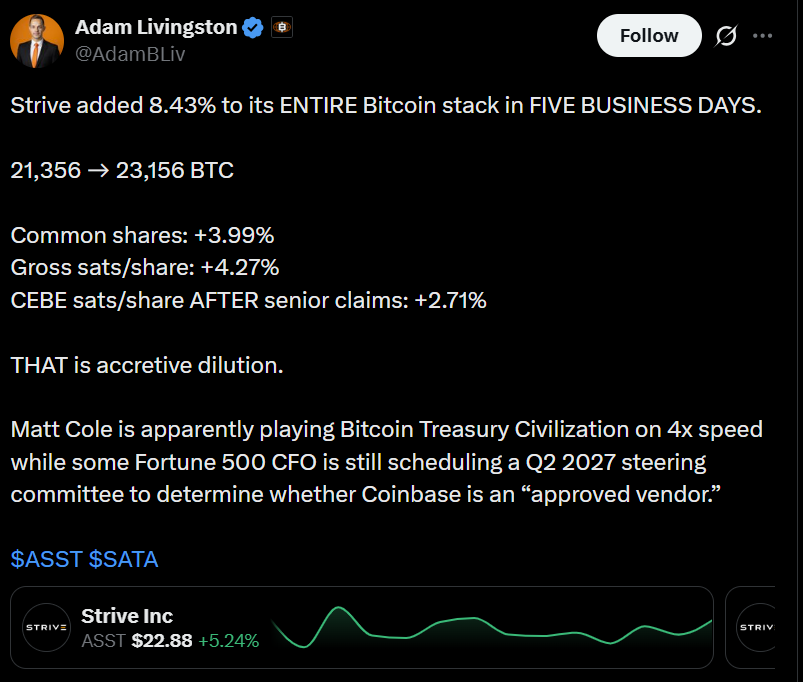
Strive, a publicly traded asset manager and Bitcoin treasury company, added 1,800 Bitcoin to its holdings last week, accelerating an accumulation strategy that has propelled it into the ranks of the world’s five biggest publicly traded corporate Bitcoin holders.
The company purchased the Bitcoin (BTC) for approximately $143 million between Aug. 24 and Aug. 28, paying an average price of $79,431 per BTC, including fees and expenses. CEO Matt Cole confirmed the acquisition on Monday.
The purchase brought Strive’s total holdings to 23,156 Bitcoin, up from 21,356 BTC a week earlier. As Cointelegraph reported, the company had purchased 1,110 BTC the previous week for roughly $81.5 million at an average price of $73,409 per coin.
Strive has accelerated its Bitcoin accumulation in recent weeks. Adam Livingston, an adviser to Saturn Credit, noted that the latest purchase increased the company’s Bitcoin holdings by roughly 8.4% in just five business days.
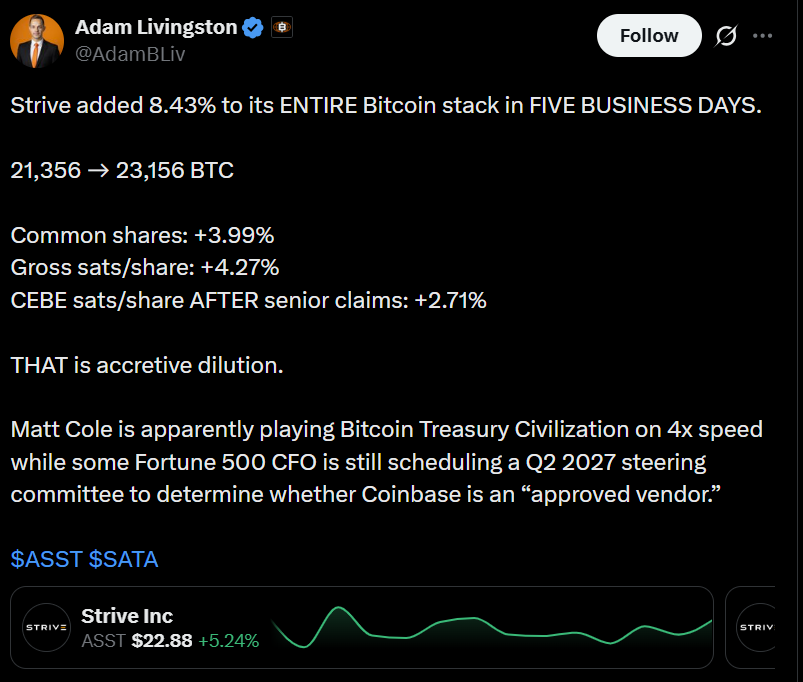
Source: Adam Livingston
The acquisition also pushed Strive past Bullish, the crypto exchange and digital asset infrastructure company, to become the fifth-largest publicly traded corporate holder of Bitcoin, according to industry data.
Corporate Bitcoin buying returns as price rebounds
Strive’s latest purchases have coincided with a broad recovery in Bitcoin and the wider digital asset market that began on Aug. 19, when the US Treasury Department announced plans to double the size of certain long-term bond buybacks. The move helped push Treasury yields lower and fueled a rebound in risk assets, with Bitcoin rallying more than 23% to a recent high above $81,000.
Strive isn’t alone in ramping up its Bitcoin purchases. Michael Saylor’s Strategy, the world’s largest corporate Bitcoin holder, announced Monday that it had resumed buying BTC for the first time since June, acquiring 4,603 Bitcoin at an average price of $80,318.
The purchase lifted Strategy’s holdings back above 845,000 BTC following four Bitcoin sales since May.
Related: Crypto Biz: Bitcoin pumps, Wall Street does the paperwork
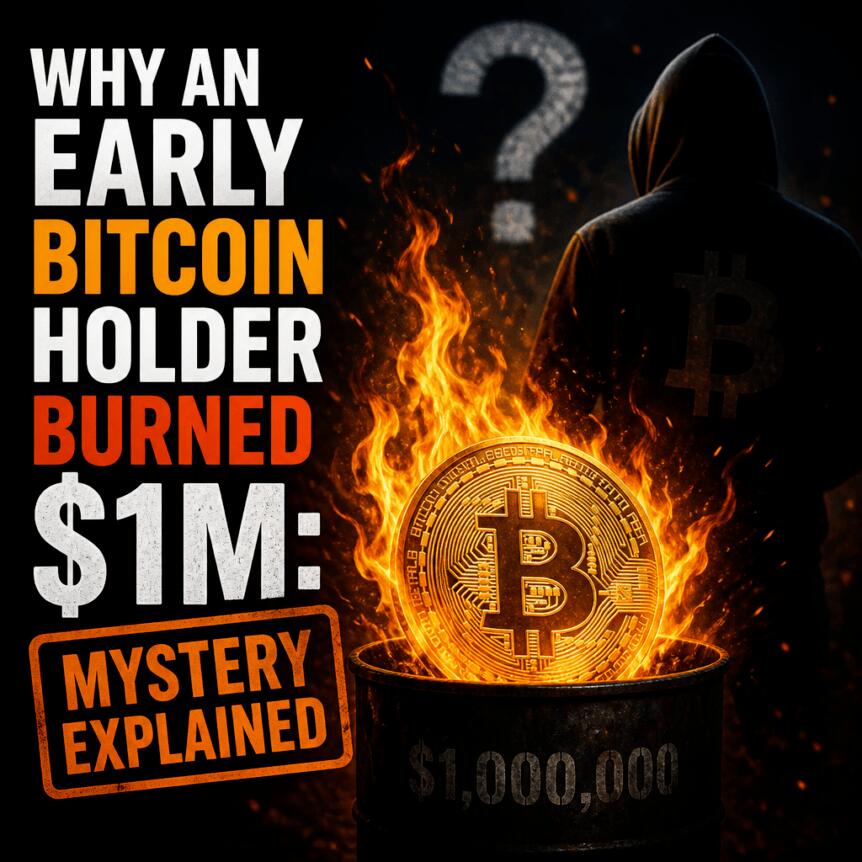
In March, an almost-dead Bitcoin wallet suddenly resurfaced and moved about $1 million worth of BTC through a large centralized custodian—only for nearly the same amount to be sent back three weeks later. Less than two months after that brief “round trip,” the same stash was intentionally destroyed by sending it to an unspendable address.
The episode sits within a broader puzzle highlighted by blockchain researchers: multiple BTC-burning transactions in May, totaling 107 BTC (worth roughly $8.5 million at the time). New wallet-cluster analysis suggests the burn-related addresses were likely controlled by the same individual, raising the question of why someone would deliberately destroy coins that represent long-held value.
Key takeaways
- One dormant wallet moved 20.00010537 BTC through an unidentified major custodian and then received 20.00006037 BTC back about three weeks later—an outcome difficult to square with typical trading.
- Five separate wallets later burned their BTC, and Chainalysis reported “strong indicators of common ownership” linking them.
- Most of the funds behind the burn can be traced back to Mt. Gox-era origins, suggesting an early adopter connection.
- Researchers cannot confirm why the coins were destroyed; even CoinShares-class level of onchain forensics can’t determine intent from transaction history alone.
- A possible clue emerges from repeated transfers clustered around similar dollar values (about $10,400), hinting at a planned approach—but not fully explaining the March round trip.
A dormant wallet returns—and immediately interacts with a custodian
Blockchain educator Bennet described a wallet that lay dormant for nearly 12 years before suddenly moving 20.00010537 BTC to “a custodian of some kind,” according to his analysis. Three weeks later, almost the entire balance returned, minus only a very small difference (about $3). Bennet characterized the pattern this way: the full balance went out to what appeared to be an exchange hot wallet and nearly the same amount came back three weeks later; then, seven weeks after the return, the funds were burned.
What makes the sequence notable is its symmetry. Burning is irreversible on-chain, but the “round trip” suggests the private keys behind the dormant wallet were actively used—not merely to let funds sit, but to interact with custodial infrastructure, retrieve the coins, and then choose a terminal outcome.
Bennet’s observation aligns with a timing link to a wider narrative of BTC destruction. Earlier coverage connected the broader mystery to 107 BTC burned in May, described as worth approximately $8.5 million at the time. The March event may be part of the same story, even though the chain of custody is obscured once the coins enter custodian systems.
Chainalysis: the burn wallets point to one controller
Chainalysis analysis, as summarized by Bennet and repeated in the coverage, indicates that five wallets ultimately responsible for destroying BTC show “strong indicators of common ownership.” In other words, the on-chain behavior suggests the same party controlled these addresses at some point.
The wallets were reportedly funded on the same day in April 2014. From there, each address sent BTC to the same deposit address at a large centralized exchange. Researchers also noted a rotational pattern: one address would transmit BTC to the exchange until its activity paused, then another would take over with transactions of similar cadence and dollar-equivalent value.
Chainalysis further reported that most of the funds could be traced back to Mt. Gox, implying an early Bitcoin holder background. While the connection suggests origin, it does not prove the coins were withdrawn directly from Mt. Gox at the time it ceased trading in February 2014—because the five wallets were funded in April. Bennet argued it’s plausible the owner was among those who managed to get their coins out before the collapse.
Equally important: the custodian remains unidentified. Chainalysis confirmed it is a large centralized exchange, but it does not publicly disclose the names of the services it identifies. Bennet’s interpretation is that the deposit address behaves like a static customer address within a custodian—one that doesn’t maintain a meaningful balance itself because deposits are swept and consolidated internally using an omnibus wallet approach. That design makes the coins’ subsequent fate hard to follow on the public blockchain.
The “$10,400” pattern—and why it may still be incomplete
One of the wallets involved in the burn later sent 19.6 BTC in 60 separate transactions to the same custodian between 2022 and 2024, according to the mempool-linked reference in the reporting. The BTC amounts varied widely—from roughly 0.15 BTC to 0.62 BTC—but when translated into dollars at the time of each transfer, the transactions were strikingly consistent.
Specifically, 58 of the 60 transfers were within 10% of approximately $10,400 per transaction. That implies the controller cared more about dollar totals than fixed BTC amounts. Bennet suggested the behavior could reflect a planned liquidation strategy.
However, the pattern has limits. The blockchain cannot prove whether those dollars were realized through a sale, held, or moved onward, because once funds hit a custodian they are mixed with many other inputs and consolidated internally. Researchers also noted that while the payment size was broadly constant, transaction frequency was not; transfers arrived in clusters rather than a perfectly regular automation schedule. Bennet viewed that as more consistent with sending a fixed-dollar amount when conditions required it, rather than a purely automated periodic process.
Still, even if the “$10,400” behavior hints at strategy, it doesn’t close the gap around the March event—particularly the fact that the wallet sent almost exactly the same amount out and got almost the same amount back shortly afterward.
The $1 million “round trip” doesn’t fit a simple trading explanation
After remaining untouched for roughly 12 years, the dormant wallet moved its entire balance of 20.00010537 BTC and received 20.00006037 BTC back—leaving a tiny difference of about 4,500 satoshis (around $3). The returned Bitcoin was split into three transactions of 7 BTC, 7 BTC, and 6.00006037 BTC, sent over three consecutive days.
Bennet argued that the use of round numbers may align with custodial withdrawal limits. More importantly, the coins did not just reappear somewhere else—they returned to the same address that had sent them to the custodian.
The transaction history also suggests the same private key holder controlled the wallet before and after the round trip. Bennet noted that using the BTC in March would have required the private key to authorize the custodian movement, and burning it in May required the key again. That shared key linkage makes the sequence particularly difficult to interpret as a straightforward exchange workflow where funds simply change hands.
The central tension is clear: if the activity were primarily about trading or liquidation, the near-identical “go out, come back” outcome appears unusually tight, especially given the custodial mixing that otherwise obscures on-chain details.
So what was the point of a deliberate burn?
Multiple explanations have been floated, but the available evidence doesn’t neatly select one. The liquidation theory helps rationalize earlier patterns—especially the “$10,400” clustering and the apparent rotational funding to the same custodian—but it does not readily explain why the controller would send roughly $1 million through the same infrastructure in March and then retrieve virtually all of it.
One alternative possibility is that the controller was testing an old custody setup or wallet—verifying that after a long dormancy, coins could still be moved through a major custodian and returned successfully. Yet that still leaves the subsequent decision to destroy the BTC.
Tax or compliance narratives could also be imaginable: someone might reorganize assets through recognized custody channels for record-keeping. But the reporting notes there is no evidence tying these actions to any specific regulatory or tax event.
Privacy is another candidate. Sending BTC through a custodian that sweeps deposits into an omnibus wallet can make on-chain tracing more difficult after the point of deposit. Still, privacy alone doesn’t clarify why the coins later ended up burned rather than merely secured.
Bennet also suggested a more personal motive: someone without heirs might have chosen to permanently reduce Bitcoin’s circulating supply by burning rather than destroying private keys. He also emphasized that this hypothesis is not provable purely via blockchain analysis.
Chainalysis, as cited in the coverage, effectively summed up the current limitation: it does not have a clear explanation for why the owner would move a long-dormant stash through a custodian, retrieve roughly the same amount, and then burn it deliberately.
In other words, the blockchain records the “what” with unusual clarity, but not the “why.”
The next thing to watch is whether more tracing work identifies the custodian involved in the March round trip and in the May burn-linked transfers, or whether additional wallet-cluster research finds consistent behavioral links across other dormant-to-active Bitcoin movements. Without that, the most important unknown remains intent—and intent is the one variable onchain forensics can’t conclusively measure.


The deal adds transfer-agent and settlement infrastructure to ICE’s plans for an NYSE-affiliated market for tokenized stocks, tZERO said.
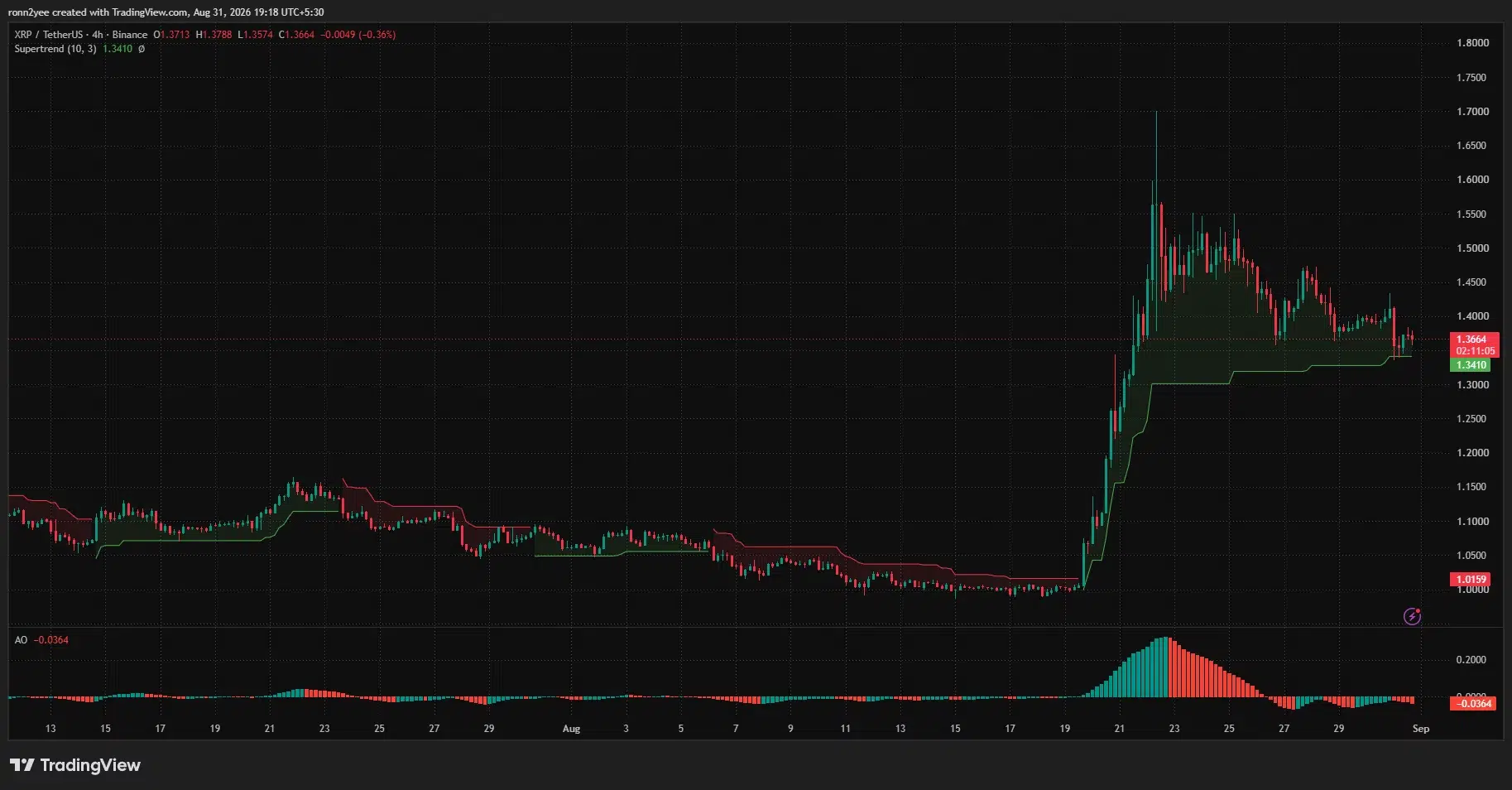
XRP price traded near $1.36 on Aug. 31 after falling roughly 7% over seven days, as fading momentum and leveraged position unwinding offset record weekly demand from U.S. spot exchange-traded funds.
Summary
- XRP price retreated from $1.48 to $1.36 but remained above its 4-hour Supertrend support at $1.341.
- U.S. spot XRP ETFs attracted $110.49 million during their strongest inflow week of 2026.
- CoinGlass data shows major liquidation concentrations near $1.35, $1.38, and between $1.44 and $1.50.
- A break below $1.34 could expose $1.28, while reclaiming $1.40 would improve the recovery setup.
XRP price pulls back 7% after August rally
According to data from crypto.news, XRP (XRP) price was trading around $1.36 on Aug. 31 at the time of writing. The token had declined from approximately $1.48 over the previous seven days, leaving it down about 7% for the period.
The pullback followed a rapid recovery from an August low near $0.98. XRP gained more than 30% during the month and briefly reached $1.70 on Aug. 22 before sellers rejected the move. Price then formed a series of lower highs below $1.55, $1.50, and $1.45.
XRP’s 4-hour chart shows that the latest decline brought the token back toward a support area that formed during the initial breakout. The Supertrend indicator remained bullish at $1.341, placing its active support slightly below the market price.
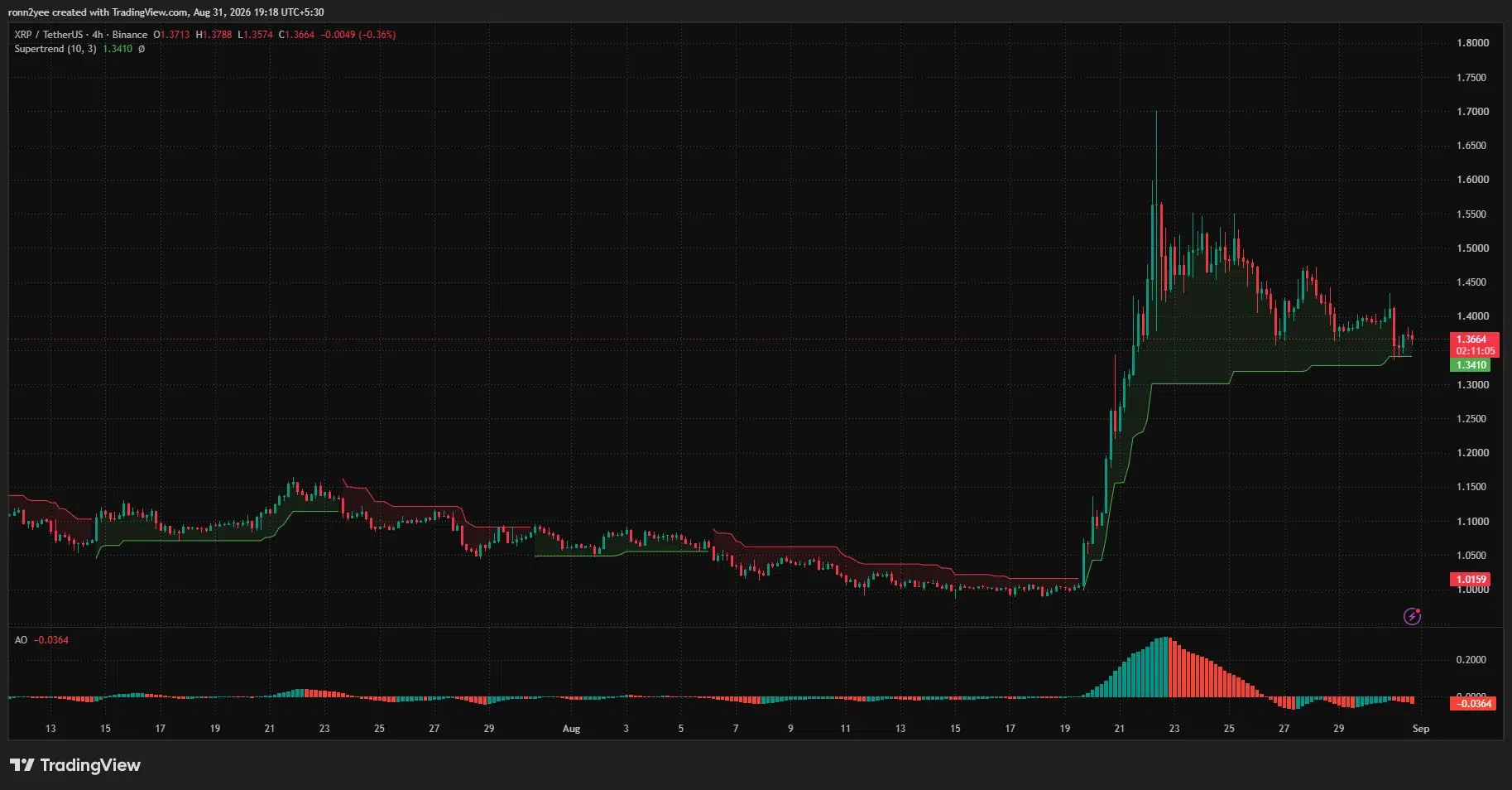
However, the Awesome Oscillator registered a negative reading of -0.0364. Its histogram also stayed below zero, indicating that short-term bearish momentum had not fully cleared despite XRP’s attempt to stabilize above $1.35.
The combination leaves XRP at a decision point. Holding $1.34–$1.35 would preserve the higher trading range created by the August rally, while a confirmed 4-hour close below it could weaken the remaining bullish structure.
ETF inflows counter XRP derivatives reset
U.S. spot XRP ETFs recorded $110.49 million in net inflows during the week ending Aug. 28, according to data from SoSoValue. It was their strongest weekly result of 2026.
The funds held about $1.44 billion in net assets after the inflows, while cumulative net inflows reached approximately $1.66 billion. The demand created a contrast between institutional fund flows and XRP’s falling market price.
Derivatives traders took a more defensive position. Aggregate XRP futures open interest had climbed to approximately $2.73 billion earlier in August, its highest level since October, as leveraged traders positioned for a larger move.
Price and open interest later declined together as XRP retreated from the $1.48–$1.50 resistance zone. Such a combination generally points to traders closing existing positions rather than building an aggressive new short position, although open-interest changes alone cannot identify every trader’s direction.
The reset reduced some of the leverage accumulated during the rally. It did not, however, produce enough spot buying to return XRP above $1.40 before the end of the month.
XRP liquidation map identifies the next price magnets
The one-week CoinGlass liquidation heatmap places the largest nearby liquidity concentrations around $1.35 and $1.38. XRP tested both areas during the Aug. 31 decline and was trading between them when the chart was captured.
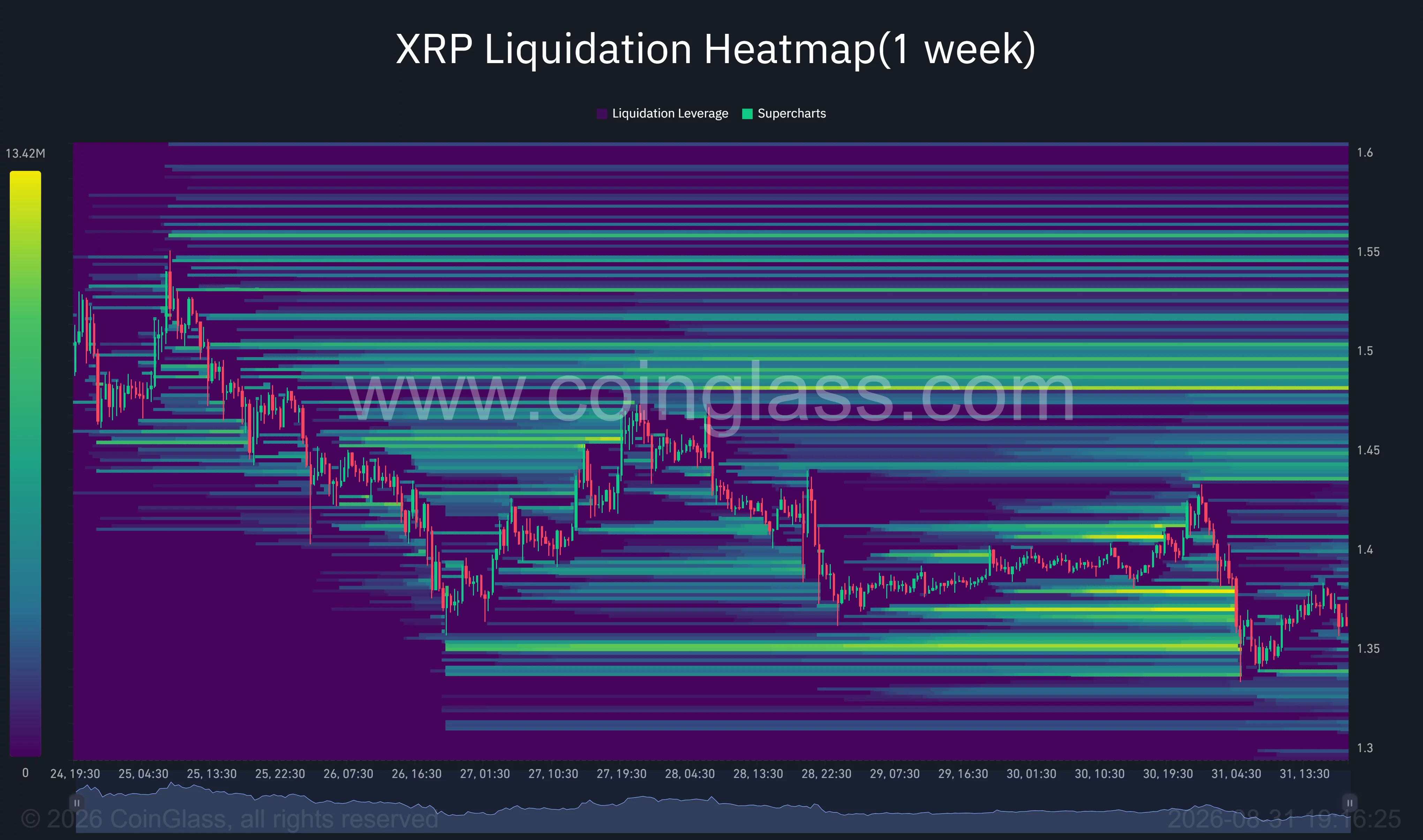
A concentrated band around $1.35 could attract further price movement if sellers retest the weekly low. Losing that level would place the next visible liquidity pockets near $1.33 and $1.30.
Liquidity also remains stacked above the market. The first meaningful overhead cluster appears near $1.40–$1.42, followed by a broader concentration between $1.44 and $1.45. Larger liquidation bands extend toward $1.48–$1.50.
Those zones could accelerate a rebound if XRP moves higher and forces leveraged short positions to close. They can also act as resistance because traders may use the same levels to exit positions.
The daily chart provides a more constructive signal. Chaikin Money Flow stood at 0.09, keeping the indicator above zero and pointing to net buying pressure over its 20-day measurement period. The positive reading suggests capital has not fully left the market despite the weekly price decline.
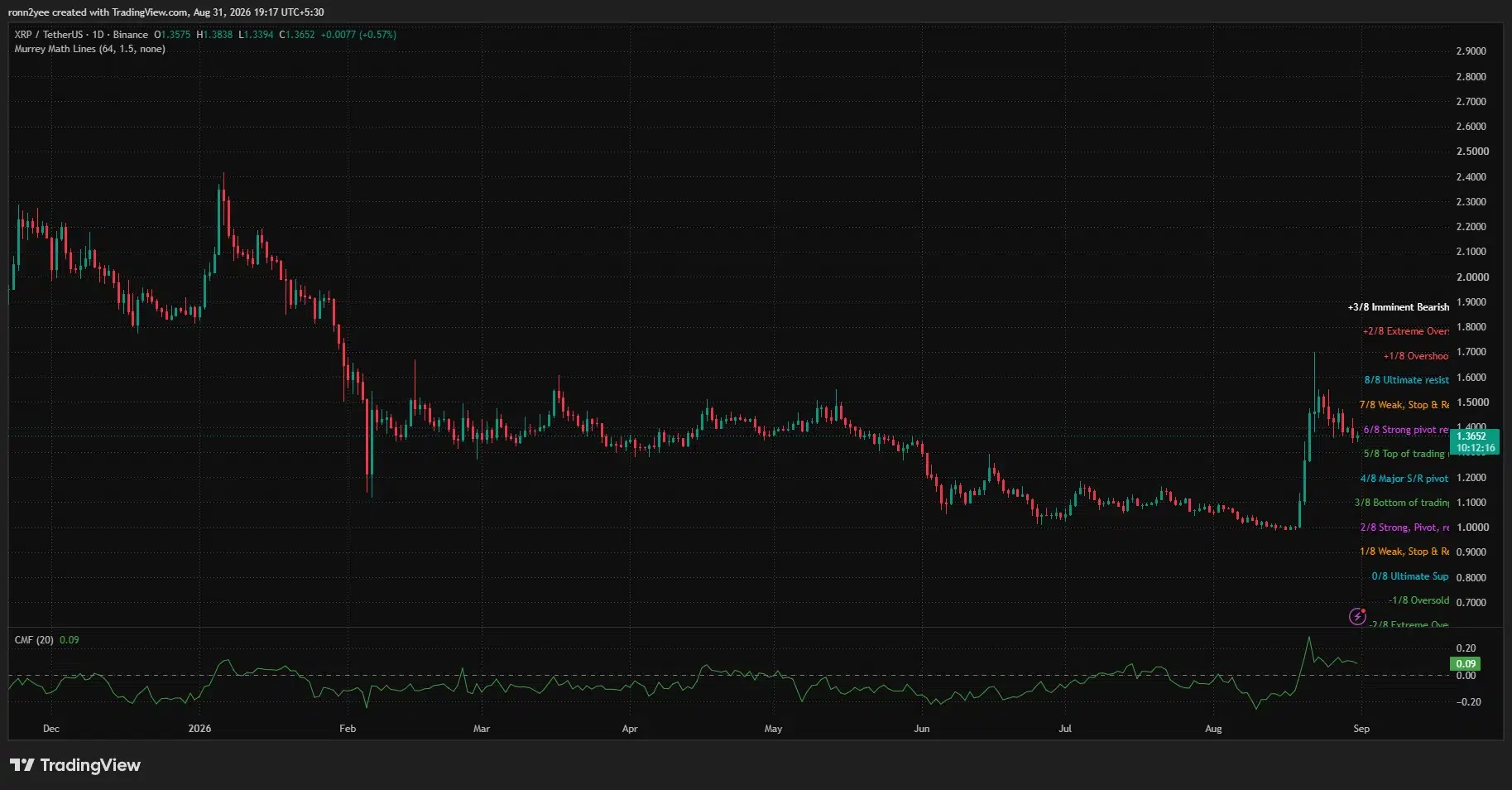
XRP nevertheless remained close to the daily Murrey Math pivot near $1.40. A daily recovery above that level would open a path toward $1.50 and the chart’s $1.60 resistance. Failure to reclaim it would leave the token exposed to another test of the lower trading range.
XRP support at $1.28 becomes the main downside test
Chart analyst ChartNerd said XRP had failed to reclaim its 50-week exponential moving average for a second consecutive week. The analyst placed that average near $1.53 and identified the 20-week EMA around $1.27 as the next short-term support floor.
The weekly rejection adds weight to the $1.48–$1.53 resistance range. A break above the zone would invalidate the present series of lower highs and allow buyers to target $1.60, followed by the August wick near $1.70.
On the downside, the 4-hour Supertrend at $1.341 offers the first line of support. A decisive break could send XRP toward $1.30 and the weekly 20 EMA near $1.27–$1.28. The bullish August recovery would become more vulnerable if the price closes below that moving average.
Ripple’s scheduled escrow release adds another short-term consideration. The company’s monthly system is set to unlock 1 billion XRP on Sept. 1, although Ripple has historically returned a large share of the released tokens to escrow. The scheduled release does not mean the full amount will enter the open market at once.
CLARITY Act vote adds a US policy catalyst
The U.S. Senate is expected to hold a procedural vote on the CLARITY Act on Sept. 15. The vote would test whether supporters can secure the 60 votes required to advance the market-structure legislation.
The vote is not final passage, and no signed law is scheduled for Sept. 15. Its outcome could still affect sentiment toward U.S.-traded digital assets because the proposal seeks to clarify federal oversight of crypto markets.
For XRP, the immediate technical range remains more important. Buyers must protect $1.34–$1.35 and reclaim $1.40 to shift short-term momentum. Losing the lower boundary would increase the risk of a deeper correction toward $1.28, while a move above $1.50 would put the August recovery back in control.
Disclosure: This article does not represent investment advice. The content and materials featured on this page are for educational purposes only.

Coinbase expands Webull crypto partnership to Canada

Undefeated KO artist moves closer to Canelo fight after latest stoppage: “It’s going to happen”

How to watch Aston Villa vs Arsenal: Live streams, TV channels for Premier League 2026/27





-

 Crypto World6 days ago
SpaceX stock could rise 75% to $240, JPMorgan says
-

 Fashion3 days ago
Weekend Open Thread: Maeve – Corporette.com
-

 Crypto World4 days ago
Bitcoin’s 22% rally now needs real demand to outlast Treasury liquidity boost
-

 Crypto World5 days ago
Warsh Jackson Hole keynote puts financial innovation first
-

 Crypto World7 days ago
A $30 Billion AI Fund Implodes, Now the SEC Is Investigating Wall Street’s Role
-

 Business4 days ago
Salesforce Stock Soars 19% as Blowout Earnings and Agentforce AI Growth Silence Software Skeptics
-

 Crypto World6 days ago
Did Trump Just Move SpaceX Stock With One Truth Social Post?
-

 Crypto World5 days ago
Elon Musk Grok Bot Promise: We Will Make You Whole if AI Loses Your Money
-

 Business4 days ago
Apple Confirms September 9 Keynote and Reveals Its Full Pre-Order Schedule
-

 Business5 days ago
Walmart takes aim at younger shoppers with new fashion brand
-
 NewsBeat5 days ago
Lindsay Clancy jury braces for closing arguments as judge tells court: ‘You’ve heard all the evidence’ – Live updates
-

 Business3 days ago
Onto Innovation Stock: AI’s Next Bottleneck Is Yield (NYSE:ONTO)
-

 Crypto World3 days ago
Bitcoin price tests $82K resistance as Brandt stays long
-

 Business6 days ago
Thailand’s Eastern Economic Corridor Capital City (EECiti): Key Developments and Investment Opportunities
-

 Crypto World5 days ago
NVIDIA revenue hits $96.2B as AI demand doubles
-

 Business7 days ago
Moderna CEO warns China is pouring state money into mRNA technology
-

 Business7 days ago
NVIDIA Stock Drops Nearly 2 Percent to $210 on Seventh Losing Day Ahead of Critical AI Earnings
-

 Business3 days ago
iPhone 18 Pro Pre-Orders Could Shift to Saturday as Apple Reportedly Avoids September 11 Anniversary
-

 NewsBeat6 days ago
Trump’s trade truce with China faces test with Iran effort
-
 Crypto World5 days ago
Nvidia Q2 Earnings Reveal $96.2 Billion Beat, So Why Is NVDA Falling?
You must be logged in to post a comment Login