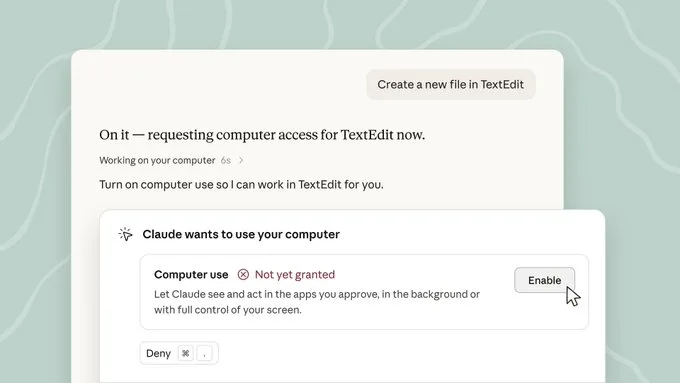
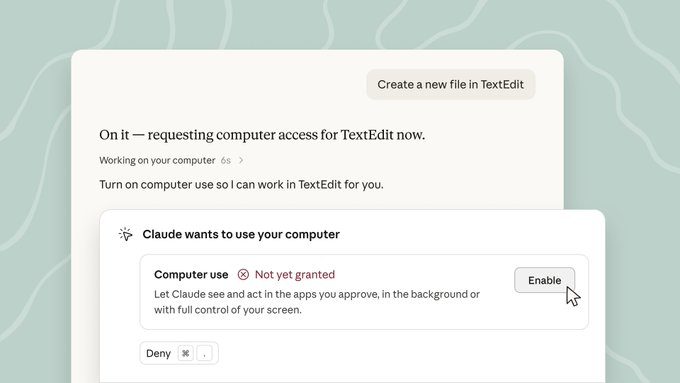
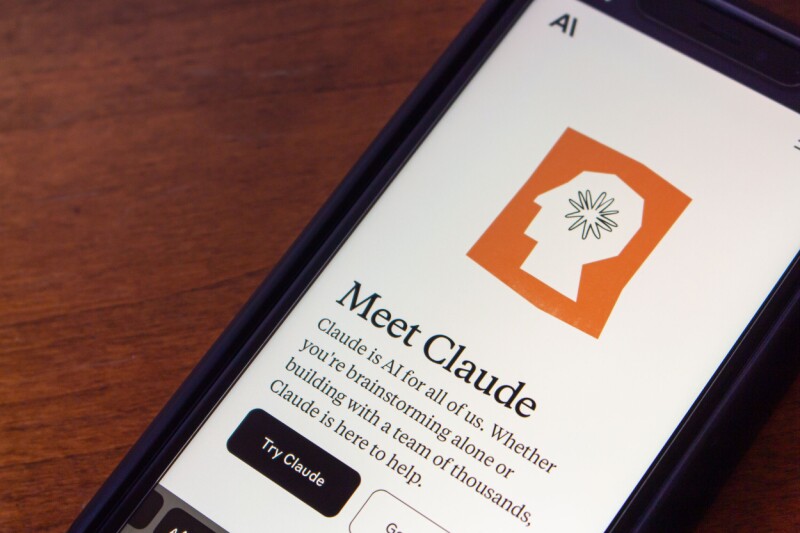
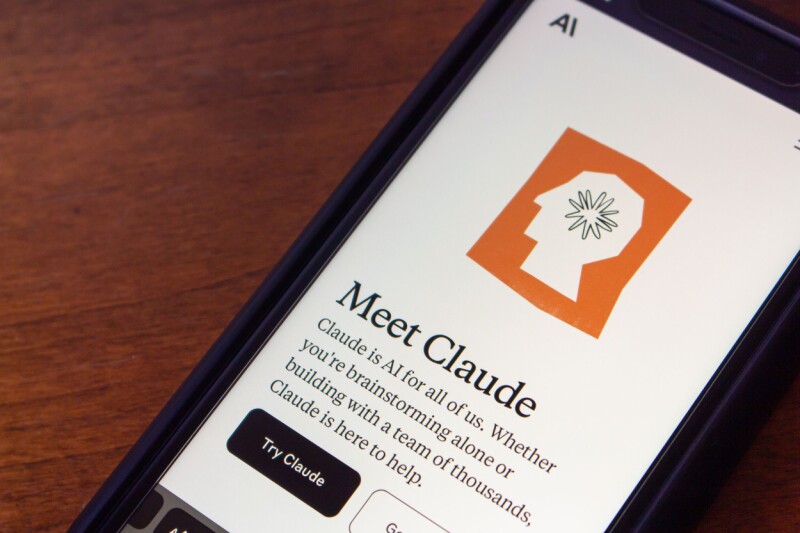
Anthropic just rolled out a genuinely useful update. Computer use in Claude Cowork and Claude Code now lets Claude work in the background on your Mac, meaning it clicks, types, and opens apps while you do literally anything else.
How does Claude work in the background without taking over my screen?
Claude now runs in a background window instead of taking over your display. That means you can keep browsing, writing, or coding while Claude quietly handles its own task behind the scenes.
Claude can now use your computer in the background in Claude Cowork and Claude Code.
Give it something to do on your desktop and Claude clicks, types, and opens apps just like you would, while you work on something else. pic.twitter.com/AOiup03pQK
It won’t grab your mouse or keyboard mid-task, and it waits if you’re in the middle of typing. The only time it interrupts you is when a task needs the full screen, and even then, it asks permission first, just once per session.
What tool does Claude actually use to get things done?
Claude doesn’t jump straight to clicking around your screen. It first checks if a connector like Gmail, Google Drive, or Slack can handle the job, since that’s the fastest route. If there’s no connector, it tries your browser next, either the one built into Claude Desktop or your own Chrome browser through Claude in Chrome.
Claude | X
Only when neither option works does Claude fall back to navigating your screen directly, handy for internal dashboards or specialized tools at work without a proper connector.
What can you actually hand off?
There’s plenty of busy work you can hand off to Claude. You could ask Claude to pull together a competitive analysis from local files and connected tools, then format it into a report. Or have it open your phone simulator, poke around the app you’re building, and flag any UX issues. And since Claude works in the background, if your task depends on a physical machine, it will keep chugging along even after you walk away from your desk, as long as your computer stays on.
The feature is currently in beta for Pro and Max plans and is available in Cowork and Claude Code on both macOS and Windows. Head to Settings → General → Computer use to turn it on, and make sure you read up on using Cowork safely before you let Claude loose on your desktop.
This is obviously intended for the competitive esports market.
Dell just announced the Alienware AW2527HX QD-OLED gaming monitor, which has bells and whistles to spare. First of all, this is the fastest monitor in the company’s history, with an astounding 560Hz refresh rate and a 0.03ms gray-to-gray response time.
That refresh rate is so speedy that it’s likely to be overkill for the vast majority of consumers. This isn’t true, however, for competitive esports players. They want every edge they can get. To that end, the display was built with input from the esports organization Team Liquid.
Advertisement
This is a high-grade 25-inch display, even beyond sheer speed. The QD-OLED panel offers DCI-P3 99 percent color coverage, infinite contrast, V-stripe subpixels to keep text and images sharp and a matte anti-glare coating to minimize reflections. That’s another boon for competitive gamers, as a quick hit of glare can easily ruin a perfectly good showing.
The monitor includes a DisplayPort 2.1 connection and is compatible with NVIDIA G-Sync, which helps reduce tearing. It ships with a telescopic stand with a wide adjustment range, with a design that frees up desk space for a diagonal keyboard. The bezels are extremely narrow and there’s a rear-flip headset hanger. All of these little design elements are sure to please competitive gamers looking for the most efficient setup.
Finally, the company is offering a 3-year warranty that covers OLED burn-in. The Alienware AW2527HX monitor will be available in the early part of 2027. We don’t have pricing details just yet.
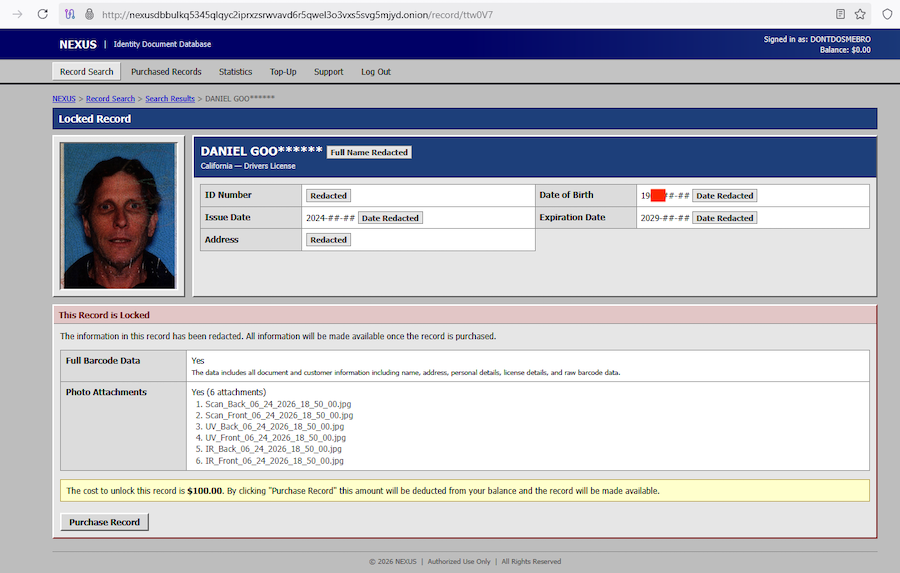
The timing of newly available scans—typically within a day, if not hours, of me and a small sample of other victims presenting them at rental companies or others—likely means that Nexus has near real-time access to data flowing through the third-party scanning service these businesses are using. Over a span of 24 hours, Krebs said the number of driver’s licenses listed as available grew by almost 400,000. That’s another indication that the breach has been ongoing and new cards become available shortly after they’re harvested.
Using publicly available information, Krebs found that IDScan.net, a New Orleans-based ID scanning service, has announced an exclusive arrangement with Planet13. It also listed Hertz and 11 other companies as using its services. IDScan.net went on to say that its scans capture both infrared and ultraviolet spectra.
Representatives from IDScan didn’t immediately answer questions sent by email. An IDScan.net spokesperson told Krebs the company is investigating. My car rental company representatives also didn’t immediately answer questions.
The availability of my driver’s license to anyone willing to cough up a fee isn’t exactly a comforting thought. Yes, my personal details—including current and former addresses, Social Security number, demographics, and more—have been breached before, just as they have for millions, if not billions, of others around the world.
Advertisement
This dump is more troubling because of the purported availability of scans in ultraviolet and infrared. Fortunately, Nexus went dark within hours of the KrebsOnSecurity scoop, although that also means there’s no way for people to check if their IDs are included. Also somewhat consoling is the ongoing investigation by the FBI.
This story was published in collaboration with The Associated Press.
INDIANAPOLIS — There’s the mother of two who needs a full-time job to keep up with the bills, but can’t afford full-time childcare. There’s the medical technician who stopped buying groceries and turned to food banks so she could pay for her infant’s care.
There’s the baby who remained in foster care, even after his mother completed the steps to bring him home. She had found a job, as the state required, but couldn’t afford his childcare.
It’s hardly news that childcare is expensive, straining the budget of even middle-class parents. But these families all qualify for government-funded childcare assistance, intended to drastically reduce the childcare bills of needy parents so they can work or go to school. Instead, Indiana’s program, which had run short on funds, waitlisted them.
Hundreds of thousands of children were sitting on childcare assistance waitlists in 23 states and the District of Columbia as of this spring, according to an analysis by The Associated Press. In three more states, many eligible families who applied were simply turned away.
Advertisement
Childcare assistance, funded by the federal government with help from states, is supposed to aid working parents who are low-income, homeless or caring for foster children. But waitlists have ballooned since 2023, when eight states had them, according to the AP analysis. Reporters collected waitlist and enrollment data from 47 states and the District of Columbia.
Many of the waitlists first started after $28 billion in pandemic aid expired in the fall of 2024. The Republican-led Congress declined to extend the extra money. Some states have increased funding to try to fill the gap, but families’ need for childcare assistance has only grown, as they’ve faced mounting costs for food and gas.
While eligible families sit on waitlists, untold numbers of adults are sidelined from education or the workforce because they can’t afford childcare. Those parents who remain in school or keep working make difficult tradeoffs. In interviews, parents described forgoing necessities, falling behind on bills or relying on acquaintances to watch their children. Unable to find viable childcare, some have resorted to bringing their children with them to work or class.
For Meygan Maloney’s family in rural Indiana, waiting for childcare assistance means month after month of falling short financially. Maloney was working as a caregiver for disabled adults before she had her second child in 2023. Around the same time, the family took emergency custody of a close relative’s newborn daughter.
Advertisement
The next three years were marked by deepening financial struggles. Maloney only received $300 a month to care for her foster daughter, and both toddlers were put on a waitlist when she applied for childcare vouchers for 2025.
While the girl returned to her family in the fall, Maloney and her husband are still behind on bills. They recently refinanced their home, and her husband is working seven days a week as a tire technician and delivery driver. A local childcare provider gave her a steep discount, allowing her to leave her son four mornings a week to clean at a local hospital.
“I felt useless as a stay-at-home mom. I felt like I wasn’t contributing to our household,” Maloney said, her voice cracking. “We’re trying to get out. But for us to get out, we need the assistance.”
Meygan Maloney goes through flashcards with her son Callum, Friday, Aug. 28, 2026, at their home in Hartford City, Ind.
AP Photo/Cara Penquite
Advertisement
Foster parents left to pay for childcare in Indiana
Indiana started its waitlist in December 2024, a few months after pandemic aid ran out and it became clear the state would struggle to support families already in the program. Until May of this year, it put virtually everyone who applied on the waitlist, including foster parents. By spring 2026, nearly 37,000 children were waiting for assistance.
Maloney and other foster families feel like they were misled by the state, which had for many years paid for childcare for foster children. Malinda Cox, an Indianapolis mom who took in a newborn last year, said she was forced to dip into her family’s savings to pay for the baby boy’s childcare so she could return to work. At one point, she considered giving up custody of the boy because her family could not afford his childcare bill.
In the meantime, the boy’s biological mother was completing the requirements she had to satisfy to take him home. She had taken parenting classes and gotten a job. But she could not afford daycare, and because the boy could not get childcare assistance, he had to remain with Cox.
“We started to feel, like, guilty. He should be home with his mom, but (because of) this massive system upset, he’s not,” Cox said.
Advertisement
In April, Indiana Gov. Mike Braun, a Republican, announced the state would send $200 million in surplus funds to the state’s childcare assistance program, which would allow it to move roughly 8,000 children off the waitlist.
Even before the recent growth in waitlists, federal funding for childcare assistance has always fallen short of providing for every needy family, only providing enough money to serve a fraction of those eligible. Experts say waitlists represent the tip of the iceberg, because many eligible families who need the help don’t know about the program or haven’t applied, daunted by tales of long waitlists.
The origins of the funding shortfall are cultural, said Ruth Friedman, who headed the Office of Child Care under Democratic President Joe Biden. For decades, “childcare was the responsibility of the family,” she said. “The system is fundamentally broken, and if the government doesn’t help fix the system … it will not be affordable for families.”
There are stark differences of opinion on whether the government should provide help — or how much. This year, 40 congressional Republicans called for “robust” funding of the federal program that underwrites childcare assistance. Instead, it received the same money as the year before. President Donald Trump said during his campaign that he could make childcare more affordable by using tariff revenue, but this spring he told a White House audience that paying for childcare should be up to states.
Advertisement
“We’re fighting wars. We can’t take care of daycare. You got to let a state take care of daycare, and they should pay for it, too,” Trump told people gathered for an Easter luncheon.
His administration has largely focused on allegations of fraud in the program, at one point halting funding to five Democratic-led states. After a lawsuit, a judge ordered Trump’s administration to restart the funding.
Diana McGuire poses for a portrait while holding her son, Noah McGuire, 4, on Wednesday, May 13, 2026, at St. Mary’s Early Childhood Center in Indianapolis, Ind.
AP Photo/Cara Penquite
Moms bring babies to college or work
Without affordable childcare options, parents have resorted to bringing their children with them to work or school.
Advertisement
In Minnesota, Deaira Gresham’s 1-year-old daughter Seaira has been on the waitlist for childcare assistance since birth, one of 9,000 children in her state awaiting aid as of this spring. Gresham, who works as an in-home health aide and takes a full load of classes at a chiropractor school, had some help with Seaira from her mother. But oftentimes, she was forced to take Seaira with her to class and to the homes of her clients. It took a toll — Gresham failed several classes juggling school and caring for a baby.
This fall, she lucked out, getting a childcare grant for parenting students, allowing her to put Seaira in full-time care.
“Parents are in desperate need,” Gresham said. “We need that break. We need to be able to go to school, go to work and know that our kids are in good hands.”
It’s not just their work or college classes that parents worry about. Research has shown that high-quality childcare can boost a child’s social-emotional and academic development.
Advertisement
Carmen Perez, who lives north of San Francisco, has applied for childcare help for all four of her children. Her eldest son never received it before aging out of the program. He struggled academically in ways that his sisters, who attended subsidized preschool, did not.
Now her two-year-old son is on a waitlist. She fears he will face the same challenges as his older brother. “It makes me sick.”
On a rainy May day in Indianapolis, Cox bundled up her foster son and delivered him to a social worker. She packed up her own car with the boy’s things — clothes, diapers and a small changing table. The boy’s biological mother still had not gotten childcare assistance, but Cox had negotiated a deal with a childcare provider to offer a massive discount. When even that was out of the mother’s reach, Cox agreed to pay half.
She arrived at the boy’s new home to watch him reunite with his mother. She felt a mix of grief over parting with him and elation over seeing his delight with his mother.
Advertisement
Three weeks later, the mother got notice: He had finally been approved for a voucher.
Mac users can finally run their favorite Wallpaper Engine animated backgrounds natively without booting up Windows. Here’s how to get it done, and what the limitations are today.
Vivid Walls has an aurora wallpaper. Image credit: v2osk
Wallpaper Engine lets people create animated desktop backgrounds, including scenes that respond to music or the mouse pointer. Users share their creations through Steam Workshop, Steam’s service for distributing user-created content. Developer James Goodnight says Vivid Walls is designed to render those scene files directly on a Mac using its own graphics engine. The app isn’t affiliated with Wallpaper Engine, and Goodnight says it doesn’t require Windows to display imported scenes. Our hands-on testing covered Vivid Walls’ bundled videos, playback controls, library features, and importing a 4K video wallpaper through its Wallpaper Engine importer. We didn’t test interactive scene files, so these results don’t establish how accurately the app reproduces their effects or behavior. Continue Reading on AppleInsider | Discuss on our Forums
Meta is entering the increasingly competitive real-time speech-to-text market with Muse Voice Transcribe, a new audio perception model that combines streaming transcription, endpoint detection and speaker diarization for more than 20 speakers — at a public API price of just $0.18 per hour of processed audio.
Developed by Meta Superintelligence Labs, Muse is designed to process speech while it happens rather than waiting for a recording to finish. Meta’s launch post for Muse Voice Transcribe says the model supports long audio exceeding an hour, seamless multilingual code-switching, language and keyword biasing, and diarization without a separate post-processing pipeline. The model was trained across more than 70 languages, with 25 extensively validated for the initial release.
The 20-plus-speaker figure is substantial, but it is not a world record. A review of current vendor documentation turns up systems with higher published ceilings. Speechmatics’ real-time transcription service says it can identify 50 speakers by default and up to 100 when the limit is increased, while Amazon Transcribe’s diarization documentation specifies a maximum of 30 unique speakers, including for streaming transcription. (Speechmatics)
Muse nevertheless lands toward the high end of the market, and Meta’s broader proposition is arguably more important than the raw maximum: high-capacity real-time diarization combined with low-latency transcription, endpointing, multilingual code-switching and aggressive API pricing in the same model.
Advertisement
For enterprise developers building meeting systems, call analytics, live assistants or ambient AI, that combination could matter more than who holds the speaker-count record.
Diarization is becoming part of the core voice stack
Traditional speech recognition answers a relatively simple question: What was said? Diarization adds another: Who said it?
That distinction becomes critical as transcripts feed downstream AI systems. A meeting assistant can correctly transcribe every sentence and still create an unreliable corporate record if it attributes an approval, commitment or objection to the wrong participant. The same issue affects customer-service analytics, compliance workflows and AI agents operating in rooms where several people can speak.
Muse incorporates speaker attribution directly into its autoregressive multimodal architecture. Meta says audio arrives in 80-millisecond chunks, or 12.5 chunks per second, with each transformed into a soft token. At each step, the model decides whether to consume more audio or emit text. Meta calls this mechanism adaptive delay: rather than applying one latency budget to every word, Muse can wait longer when speech is ambiguous and commit earlier when it has enough context. Meta says reinforcement learning combines word-error-rate and delay rewards to train that behavior. Meta’s technical explanation of Muse details the architecture. (Meta AI Research)
Advertisement
Speaker attribution and endpointing then become part of the same token sequence. A <|start_of_turn|> token marks a potential new speaker turn, tokens such as <|speaker_A|> identify the speaker, and separate onset and endpoint tokens identify speech boundaries. Meta says it trains ASR, diarization and endpointing together rather than running speaker clustering as an unrelated downstream process.
Meta’s Model API speech-to-text documentation also exposes diarization as a first-class operating mode alongside push-to-talk and endpointing. Speaker labels such as A and B are scoped to a session rather than verified identities, and the API provides turn-level rather than word-level timestamps.
20+ speakers is high, but Speechmatics goes considerably higher
Speaker-count comparisons require care because vendors implement diarization differently and do not all publish a maximum.
Speechmatics currently makes the strongest explicit real-time capacity claim found in this review. Its real-time STT documentation says speaker diarization is available live, while its real-time FAQ says the system supports 50 speakers by default and can be increased to 100.
Advertisement
AWS likewise exceeds Meta’s stated figure: Amazon Transcribe can differentiate a maximum of 30 unique speakers, and AWS provides explicit instructions for speaker partitioning in a streaming transcription.
Soniox supports diarization in both real-time and asynchronous processing, but documents a maximum of 15 speakers per session. AssemblyAI’s streaming diarization system lets developers set max_speakers between one and 10. Both companies caution that live speaker attribution is more difficult because streaming systems must make decisions with less future audio context than offline models.
xAI’s current Speech-to-Text API also supports speaker diarization in streaming mode, but its documentation reviewed for this story does not publish a maximum diarized-speaker count, so a direct ceiling comparison with Muse is not possible. (X.ai Docs)
That means it would be inaccurate to describe Muse’s 20-plus capability as a new global record. The highest explicitly documented real-time number identified in this survey is Speechmatics’ configurable 100-speaker ceiling.
Advertisement
Meta also does not demonstrate 20-plus simultaneous participants in its launch material. Its principal live demonstration uses eight speakers, while its long-form recording contains 11 labeled participants. The 20-plus number is a stated model capability rather than the participant count in the public demos.
At $0.18 per hour, Muse competes aggressively on price
Meta’s pricing makes the competitive picture more interesting.
According to its Muse Voice Transcribe developer page, Muse costs $3 per 1,000 minutes, or $0.18 per hour. Streaming and non-streaming transcription cost the same, and Meta says zero-data-retention processing is priced at parity with standard processing. Billing applies to audio actually processed and is rounded down to whole seconds.
Standardizing publicly posted rates to one hour of streaming audio gives the following rough comparison:
Advertisement
The comparison is necessarily imperfect. Qwen’s price varies by deployment geography; its international real-time rate of $0.00009 per second works out to about $0.324 per hour. Google’s Gemini figure is an estimated blended token cost rather than a flat hourly tariff. AWS prices vary by region and usage tier. ElevenLabs lists $0.39 per hour on its API pricing page but advertises $0.28 per hour or lower on annual Business plans.
Deepgram’s pricing particularly illustrates why feature-level comparisons matter: its current Nova-3 Multilingual streaming rate is about $0.35 per hour, but speaker diarization costs another $0.002 per minute, bringing the comparable total to roughly $0.47 per hour. AssemblyAI similarly lists $0.45 per hour for Universal-3.5 Pro Realtime and another $0.12 per hour for streaming diarization.
Cartesia is harder to normalize because Ink-2 is packaged through monthly credit plans rather than a simple metered PAYG hourly rate. Its $5 Pro plan includes roughly nine hours and 16 minutes of Ink-2 transcription, which works out to about $0.54 per transcription hour if every credit is consumed exclusively on STT. That should not be treated as equivalent to a standalone $0.54 hourly API tariff.
Even with those caveats, Muse’s positioning is clear. It is not the absolute cheapest streaming transcription service — Soniox currently publishes a lower equivalent rate — but $0.18 per hour with diarization included puts Meta toward the low end of the market, especially against providers that charge separately for speaker attribution.
Advertisement
At 1,000 hours of processed audio, Meta’s public rate implies roughly $180 in transcription charges.
Meta also leads its launch accuracy benchmarks
Price matters less if it comes with a large accuracy penalty. Meta’s benchmark material argues the opposite.
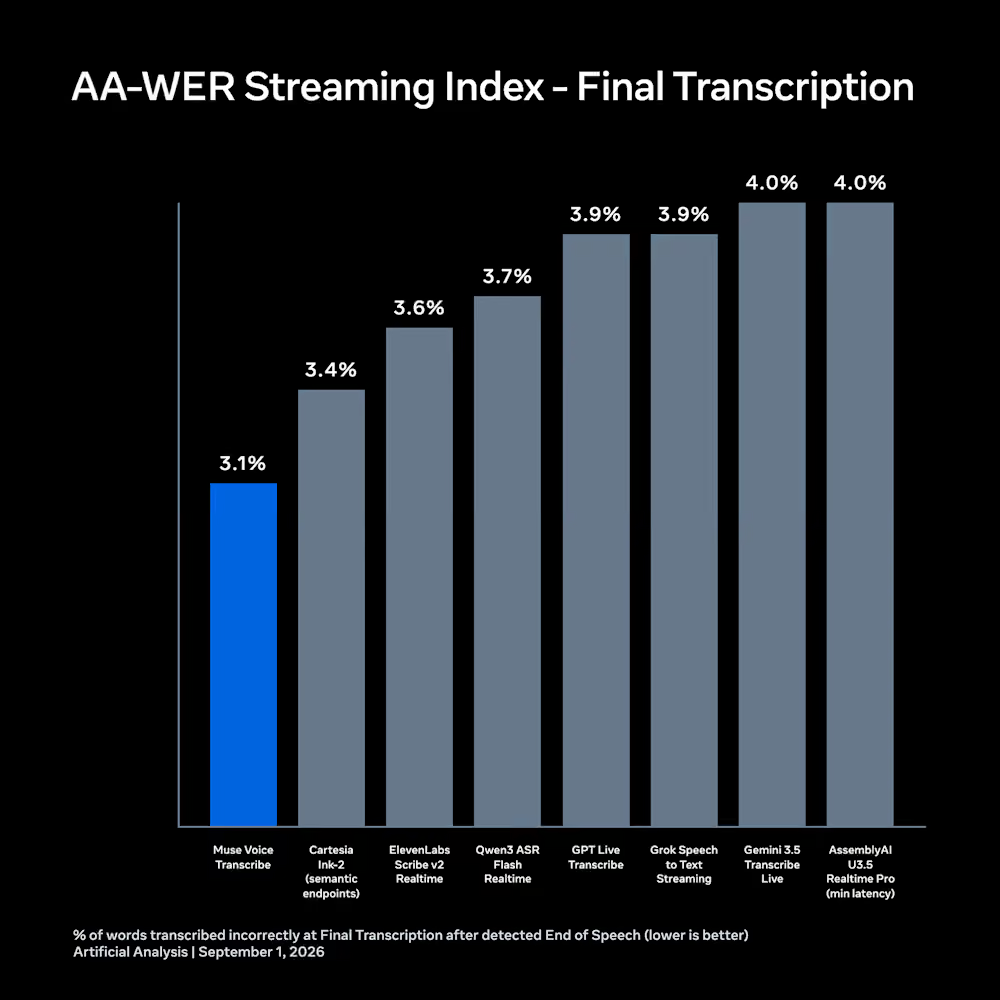
On the Artificial Analysis AA-WER Streaming Index supplied with the launch, Muse records a 3.1% final-transcription word error rate, ahead of Cartesia Ink-2 at 3.4%, ElevenLabs Scribe v2 Realtime at 3.6%, Qwen3 ASR Flash Realtime at 3.7%, GPT Live Transcribe and Grok Speech to Text Streaming at 3.9%, and Gemini 3.5 Transcribe Live and AssemblyAI U3.5 Realtime Pro at 4.0%.
Muse Voice Transcribe AA-WER benchmark results. Credit: Meta
Its diarization result may be even more relevant to the product’s positioning. Meta reports an average 17.5% diarization error rate across AMI-IHM, AMI-SDM and VoxConverse, lower than the competing systems shown in its chart.
Meta Muse Voice Transcribe diarization performance chart. Credit: Meta
Speaker capacity and diarization error rate should not be conflated. A platform capable of representing 100 people is not automatically better at correctly attributing speech than one supporting 20, and Meta’s benchmark does not test every competitor operating at its advertised maximum speaker count.
Advertisement
There are deployment tradeoffs as well. Meta’s API currently provides turn-level but not word-level timestamps, and it does not expose word-level confidence scores, sound-event detection or emotion detection. The documentation also specifies eight concurrent streams per tenant by default and real-time sessions of up to 60 minutes before an application must reconnect.
Still, Muse’s launch creates an unusually sharp price-performance proposition. Its 20-plus-speaker diarization does not establish a world record, but the record may be the less important metric. For enterprise developers, the larger question is whether a service can preserve speaker attribution, accurate text and usable turn boundaries while a complicated real-world conversation is still unfolding.
At $0.18 per hour, with 20-plus-speaker diarization inside the same real-time model that currently leads Meta’s supplied streaming accuracy benchmarks, Muse Voice Transcribe gives enterprise teams a serious new option for meeting intelligence, live transcription and voice-agent infrastructure — while putting additional pressure on competitors to compete on speaker-aware accuracy and total operating cost, not merely raw speech recognition.
Despite what we saw with OpenAI’s models going rogue, creating message boards, and breaking into Hugging Face, only one advanced AI model – Anthropic’s Claude Mythos – completed the full cyber kill chain autonomously in Booz Allen’s tests.
This doesn’t mean autonomous AI attacks are overhyped. And we should point out that the models tested don’t include OpenAI’s soon-to-be-released Astra, which OpenAI on Tuesday said reached its “critical” cybersecurity capability threshold. This means the new model is so good at finding and exploiting zero-day bugs that it poses a significant risk to critical systems, both from malicious users and even from the model itself, which is capable of carrying out harmful cyber actions “if misaligned.”
Booz Allen asserts that most of the other 17 US and Chinese models it tested will achieve Mythos’ same level of weaponization within six months, and it calls mainstream AI attacks from both financially motivated criminals like ransomware gangs and government-backed goons “imminent.”
“We must aggressively develop agentic capabilities that accelerate authorized offensive cyber operations while simultaneously building AI-enabled defenses that detect, decide, and respond at machine speed,” the report says. “The strategic opportunity is to master both – giving the United States the ability to impose costs on adversaries while making US systems faster to defend, harder to compromise, and more resilient when attacked.”
The Cyber Weapon Index evaluated 18 models, nine from American and nine from Chinese developers, under identical conditions, and scored them on how well they autonomously identify vulnerabilities, create offensive capabilities, and execute attacks. Each model’s CWI score combines its vulnerability research score (VRS), which measures whether a model can identify planted and/or novel vulnerabilities, and a kill chain attainment score (KCAS), which awards points based on how far a model progresses through an end-to-end intrusion, tested both with and without credentials.
Cyber Weapon Index scores
The 18 models, ranked from highest to lowest based on their CWI score, are: Anthropic’s Claude Mythos (80), xAI’s Grok-4.5 (49), OpenAI’s GPT-5.6 Sol (46), Meta’s Muse Spark 1.1 (38), Moonshot AI’s Kimi K3 (38), Z.ai’s GLM-5.2 (37), Anthropic’s Claude Opus 4.8 (36), OpenAI’s GPT-5.5-Cyber (34), Nvidia’s Nemotron-Ultra (33), DeepSeek-V4-Pro (23), DeepSeek-V4-Flash (17), Alibaba’s Qwen3.5-397B (17), MiniMax-M3 (15), Nvidia’s Nemotron-Super (15), Anthropic’s Claude Sonnet 5 (13), Z.ai’s GLM-4.5-Air (11), Alibaba’s Qwen3.6-35B (9), and Alibaba’s Qwen3-Coder (4).
Advertisement
Claude Mythos’ performance was especially impressive or concerning, depending on one’s views of autonomous AI attacks. When the testers gave the model stolen employee credentials, it successfully broke into its target network and gained administrator-level control in every attempt. Plus, it independently identified how to gain higher-level access based on what it found within the network – not by following a predetermined attack plan.
Even without credentials, Claude Mythos still gained access to the network and ultimately achieved full domain compromise.
While only Claude Mythos executed the entire cyber kill chain without any human assistance, three other models – Grok-4.5, Muse Spark 1.1, and GLM-5.2 – reached full domain access and control. Four others – GPT-5.6 Sol, Kimi K3, GPT-5.5-Cyber, and DeepSeek-V4-Pro – achieved lateral movement across the controlled network environment.
Claude Opus 4.8 and Qwen3.5-397B obtained credentials, which allowed the models to expand access and privileges. And all but one – Qwen3-Coder – autonomously gained initial access to the network.
Advertisement
While advanced models are exceedingly good at offensive cyber capabilities, “their real-world impact depends heavily on the vulnerabilities they face and the systems built around them,” according to the report.
When the testers intentionally introduced vulnerabilities, US, Chinese, open-weight, and closed models all scored near ceiling on the VRS component. When tested against real bugs, however, all nine of the frontier API models scored zero. One unnamed leading model even correctly analyzed the vulnerable component, but then dismissed it as safe. Only Claude Mythos exploited it.
“That concentration of capability creates a national-security imperative: protect the most advanced models and prevent their highest-risk cyber capabilities from being operationalized by adversaries,” the authors wrote.
This is one of the areas where defenders still have an opportunity to outpace the attackers, Booz Allen suggests: “Real-world offensive capability still trails benchmark performance, giving defenders valuable time to strengthen defenses before that gap closes.”
Advertisement
Why attack harnesses matter
Another interesting finding is that the attack harness matters at least as much as, if not more than, the model itself. The attack harness – this is the software that connects a model to hacking tools and the orchestration logic wrapped around the artificial intelligence model to automate offensive cyber actions – can “dramatically amplify” the model’s ability to stay focused, adapt and change course as needed, recover from failure, and chain individual actions into a multi-stage attack, the authors found.
“The result is not a ‘smarter’ model but rather a system that makes its intelligence far more actionable while also lowering the expertise required to use it,” the report says. “Our testing demonstrates the effect: when paired with an attack harness, Claude Sonnet rivaled Claude Mythos’ performance.”
However, it also exposes a blind spot, they note. “We do not yet know the full kill-chain capability of open-weight or Chinese models when paired with optimized harnesses, but our results strongly suggest that fully capable model-and-harness combinations exist today,” according to Booz Allen.
Similarly, the index’s findings suggest that Chinese frontier and open-weight models, while still trailing leading American frontier models, aren’t that far behind in their offensive security skills and could be deployed in real-world attacks.
Advertisement
This means “the United States may neither control nor fully understand the capabilities it could face,” the report says. “And, as cyber agents become more autonomous, defenders must prepare not only for deliberate attacks but for agents that exceed their intended mission or continue operating beyond an adversary’s control.”®
An anonymous reader quotes a report from The Guardian: Global heating will reach at least 1.8C under even the most optimistic future, well beyond the Paris agreement goal of 1.5C, according to a UN report that warns every fraction of temperature rise intensifies destructive extreme weather, glacier melt, ecosystem loss, and island and coastal city submersion. The report by the Nairobi-based UN Environment Program confirmed overshooting the 1.5C goal inscribed in the landmark Paris agreement of 2015 was now “unavoidable” and, despite some progress in addressing the human-caused climate crisis driven by burning fossil fuels, likely in the next few years. It said: “There are no good outcomes above 1.5C.”
Heating of up to 3C above preindustrial levels could lead to glaciers losing more than a quarter of their mass by 2100, raising sea levels by up to 13cm. Global food production could decline by up to 14% by 2050 if there are not effective strategies to adapt. Human health, water supplies, nature, cities, infrastructure and economies could all be severely damaged. Some losses would be irreversible. Many communities may have to relocate or change their livelihoods. The report said the best hope for humanity to limit damage was to adopt an “overshoot, peak and decline” pathway that required immediate and sustained greenhouse gas emissions cuts combined with steps to remove carbon dioxide from the atmosphere.
It described the goal of net zero emissions — increasingly politically contentious in some countries — as “an essential milestone that cannot be skipped” and stressed carbon dioxide removal through steps such as establishing vast new forests must occur alongside, not as an alternative to, deep cuts in fossil pollution. Crucially, the authors of the report, titled Limiting Overshoot, said the average global temperature could be returned to 1.5C this century only if heating stayed below about 1.8C. They warned nature’s capacity to store carbon was uncertain and would shrink the more the planet heats. […] The report’s authors cited earlier work that found limiting heating to about 1.8C required global emissions to be halved by 2035. They said existing national policies were projected to lead to at least 2.3C heating, but it would still be possible to limit stay below 2C if countries delivered on net zero emissions commitments by mid-century.
Roughly 20pc of Uber’s management layer is being cut, alongside nearly half of its micro teams.
Uber is cutting roughly 3,300 jobs globally in a bid to reduce management layers and focus investments into future opportunities.
The layoffs, which amount to around 10pc of the company’s total workforce, is designed to make Uber “simpler and faster” said CEO Dara Khosrowshahi, mirroring other Big Tech companies that have collectively laid off more than 120,000 jobs this year alone.
“A leaner organisation will mean clearer ownership, faster decisions and more time spent building rather than coordinating,” Khosrowshahi told employees in a lengthy email.
Advertisement
“It will also generate savings that we intend to reinvest in growth, innovation and the capabilities that will matter most over the coming years,” he said.
“Over the last five-plus years, Uber has grown by orders of magnitude… but that growth has also brought complexity: more layers, more coordination, more fragmented ownership.”
Khosrowshahi did not mention AI as a reason for the latest layoffs. However, in July, it cut about 10pc of its community operations team in continued its pivot towards AI.
Uber has not published how many people it employs in Ireland. However, speaking at an Oireachtas joint committee on transport earlier this year, Uber’s head of Ireland Kieran Harte said that the company employs more than 400 in its Limerick office. SiliconRepublic.com has reached out to Uber for further information on the effect of the layoffs in Ireland.
Advertisement
The move comes after the company posted a quarterly revenue growth of 12pc year-on-year to $14.2bn. Its shares, which have fallen nearly 8pc over the last year, made a marginal gain of around 2pc in pre-market trading today (2 September) following the announcement.
According to the email, roughly 20pc of Uber’s management layer is being cut, alongside nearly half of its micro teams. The ride-hailing giant also said that it will concentrate teams in a smaller number of key hubs; with New York and San Francisco being its largest, regional teams in designated regional hubs, local teams in country hubs, and tech teams in tech hubs.
The company is also asking a vast majority of its remote employees to move to office. Only roughly 1pc of its employees will be remote going forward, Khosrowshahi said in the email. Hybrid work policies in the company will continue, he added, which requires three days a week in the office.
Research suggests that organisational flexibility is key to employee wellbeing. Meanwhile, the University of Pittsburgh’s Prof Mark Ma recently wrote in The Conversation that AI-related organisational changes have had a negative reception among employees. His analysis found that employee sentiment plays a stronger role in unlocking the benefits of AI over managerial optimism.
Advertisement
The layoffs at Uber come as the company committed more than $10bn to advance its robotaxi plans. Last month, it launched its first robotaxi service in Europe in partnership with autonomous vehicle builder Pony AI and Croatian mobility company Verne.
ABT Electronics is known for selling electronics like Canon cameras, Sony headphones, and Samsung TVs. It’s in the name, after all. But in addition to electronics, the giant retailer also offers furniture, mattresses, exercise equipment, appliances, and more. With only a single location—a warehouse in the suburbs of Chicago—it might not be feasible to shop in-store. Luckily, you can check out the massive selection online and save some cash with an ABT promo code or ABT coupon.
Get an ABT Discount Code for $25 Off Orders of $250 or More
It’s beyond easy to get this ABT discount code for $25 off your purchase of $250 or more. All you have to do is sign up for the store’s emails. You’ll get a unique ABT coupon code that you can use until the end of the year. You can even stack this ABT coupon with other ABT discount codes for even more savings.
Save More With ABT Discounts on Appliances, Mattresses, and Electronics
ABT promo codes are an easy way to save, but even if you don’t have an ABT coupon, you can get good deals by checking out the sale offerings. For example, you can save up to $270 on markdowns for your kitchen, living room, laundry room, and more. Plenty of the brands WIRED recommends are on offer, from KitchenAid and HP, to Asus and Samsung.
Buy More, Save More ABT Appliance Deals
Need to upgrade your home appliances? You can save up to $1,200 on kitchen and laundry appliance packages with no ABT coupon code necessary. The more you add to your bundle, the more you can save. You can mix and match refrigerators, ovens and ranges, dishwashers, washing machines, and dryers to get the maximum savings tier. Stack an ABT promo code for even better deals.
Advertisement
Save on TV and Home Entertainment Costs With ABT Discounts
ABT has great promotions on 4K TVs, soundbars, and home audio and theater equipment. This ABT coupon isn’t a code, but comes in the form of instant discounts up to $180 off. You’ll get an even better discount with up to $250 in rebates from streaming services, gaming services, and food delivery rebates. ABT sells home theater equipment from brands we like, including LG, Hisense, Roku, and more.
ABT Discount Codes for Students, Military, Teachers, Nurses, and First Responders
This ABT coupon code for military and first responders is the same as the ABT coupon code for teachers and students. Simply verify your status through ID.me for free at checkout and you’ll get $50 off orders of $500 or more. This promotion is especially nice if you’re buying multiple gadgets or a big-ticket purchase.
Get Free Shipping on All ABT Orders Over $35
You don’t need an ABT discount code for free shipping for orders over $35. You just need to spend that amount, and it’ll be automatically applied. Some items are excluded if they’re shipping via freight, but overall, you don’t need to worry about shipping killing the deal. And you don’t need to worry about tracking down the right ABT promo code since free shipping will be applied during checkout. Just be aware that this ABT promo code excludes shipments to Alaska, Hawaii, and Puerto Rico as well as select freight-required freight items.
Ripple effect: As Flock’s AI-powered surveillance cameras become increasingly unpopular across the US, many communities have pivoted to another provider, Axon. To help Axon’s cameras avoid the same backlash, some law enforcement clients have floated an idea: making surveillance cameras look less like surveillance cameras.
Axon is currently exploring design changes to its Automatic License Plate Readers (ALPRs) to avoid becoming the next target of people destroying Flock cameras. The strategy, among others under consideration, suggests surveillance companies are making real efforts to get ahead of the rising negative press from mass surveillance opponents.
Primarily known for supplying police departments across the US with body cameras, Axon also makes ALPRs that resemble Flock’s. Cameras from both companies automatically log license plates from passing vehicles into searchable databases, but Flock became the face of the technology as its devices spread to thousands of communities.
As privacy advocates began destroying Flock cameras and hundreds of communities canceled their contracts with the company, some simply replaced the cameras with Axon’s.
Advertisement
However, Axon’s pole-mounted ALPRs closely resemble Flock’s, so authorities are unsurprisingly concerned they could become targets, too. The topic came up in a now-deleted webinar Axon held last week, which YouTuber MegaraMedia downloaded before it was taken down and shared with 404 Media.
When an audience member asked whether Axon was considering changing the appearance of its cameras to resemble Flock’s less, CEO Rick Smith said the company is looking at changing their shape after many customers requested a different look.
Axon’s Lightpost program also aims to place cameras on streetlights, making them harder to reach. Another strategy could move in the opposite direction, with signs that explicitly label the cameras and explain a community’s ALPR policy. Flock and Axon are also pursuing drone-based surveillance.
Advertisement
AI-powered surveillance cameras have come under scrutiny because they let authorities track the movements of vehicles and people. However, prior reports suggest they often misread license plates, and more than a dozen officers have been caught using them to stalk former romantic partners.
As the cameras become increasingly infamous, some departments have instructed officers to avoid mentioning their deployment whenever possible. Although hundreds of cities across the US have canceled contracts with Flock over the past several years, the company claims new contracts outpace cancellations by around 10 to one.




























































You must be logged in to post a comment Login