





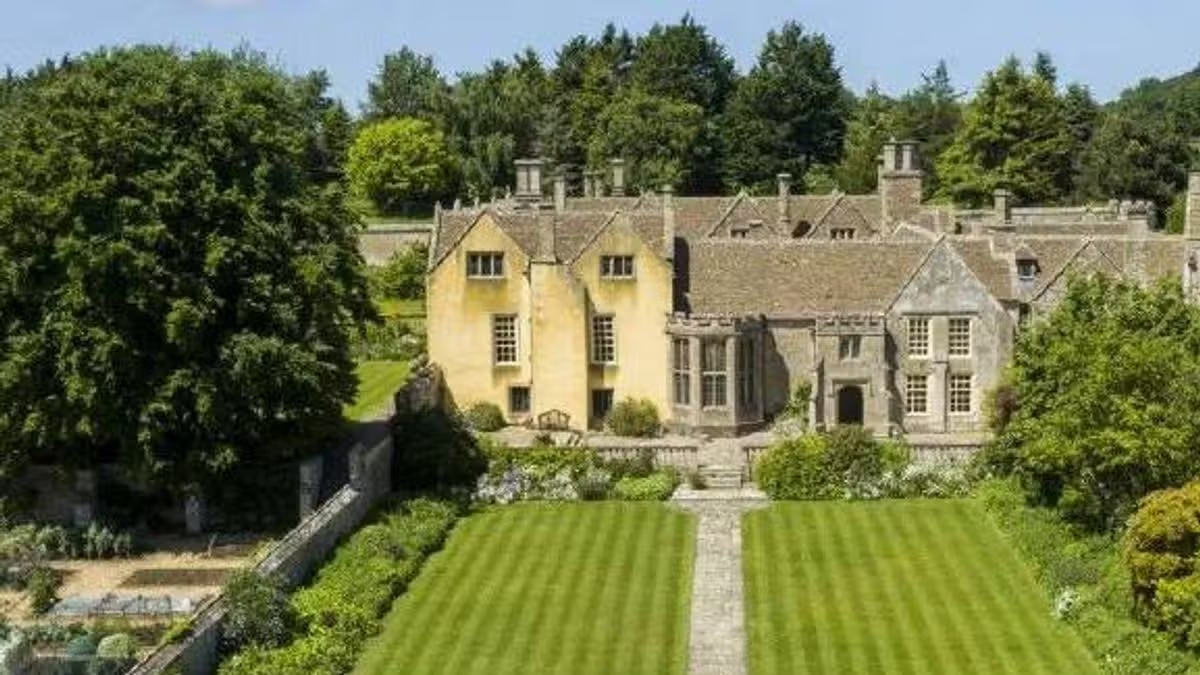
The property has an extensive history, with roots tracing back to at least the 14th century

Hazelbury Manor(Image: Local Democracy Reporting Service)
A Grade I listed manor house in Wiltshire is set to be transformed into an upmarket hotel. Wiltshire Council has this week approved plans by the new owners of Hazelbury Manor, at Box, to convert the 500-year-old property from residential use to hospitality.
The owners aid they want to provide a “high-quality hospitality offer” that will bolster Wiltshire’s visitor economy while securing the long-term preservation of these important heritage assets.
Rural Solutions Ltd, representing the owners, described the manor house as “not suitable for modern living”.
“It was considered that the existing layout of the property is not suitable for modern living due to its long corridors and multiple courtyard areas and extensive floorspace,” they informed Wiltshire Council. However, it is that character that makes the property entirely appropriate for use as a hotel, which is believed to be its optimal viable use.”
The conversion includes the manor house, the Grade I listed Dower House, the Grade II listed Granary, and the Grade II Registered Park and Garden — including remnants of a 17th century formal garden and a “quirky” yew circle constructed in the mid-1980s and inspired by Stonehenge — all situated within 175 acres of land.
The Manor has an extensive history, with roots tracing back to at least the 14th century and substantial development taking place between the 15th and 17th centuries. The great hall dates from the 1500s.
The structure underwent restoration and extension during the 1920s under the direction of restoration architect and architectural historian Sir Harold Brakspear, and later served as a girls’ school from 1943 to 1971 before reverting to private residential occupation.
The Dower House shares a physical connection with the Manor, while the Granary is situated to the east of the principal walled garden and has traditionally been utilised partly for residential accommodation, presently containing two residential units with ancillary buildings.
The broader estate includes tracts of agricultural land and parkland, traversed by several public rights of way, including bridleways and footpaths.
Box Parish Council expressed no fundamental opposition to the planning application, provided that a comprehensive range of concerns were adequately addressed.
They said: “The Parish Council recognises that the proposed hotel use could help secure a viable long-term future for the historic buildings and wider estate, but considered that the application was lacking sufficient detail in several key areas, including traffic management, public access, the impact on heritage, trees, and landscape, and environmental impacts.
Natural England asked for mitigation to protect bats.
The Garden Trust said: “The application presents an opportunity to consider the broader implications for the Hazelbury Manor Historic Estate to provide a sustainable future for the estate and the applicant appears to be undertaking a careful, sensitive approach to its redevelopment which we welcome.”
The 20th Century Society said: “We would object to the loss of any Ian Pollard-designed features, such as the Yew Henge and Prospect Mounds. We regard Pollard as a notable postmodern architect, and his interventions at Hazelbury Manor as of significance.
“His Jencksian earthworks and sculptures, alongside his more traditional planting, should be treated as being of high significance.”
The Society for the Protection of Ancient Buildings said “the proposed hotel use may represent a viable option to secure the long-term conservation of the site.”
And the Cotswolds National Landscape Board said it supported the principle of the proposed change of use, recognising that “hotel use represents an appropriate and viable option to secure the long-term conservation of the Manor and its grounds.”














































You must be logged in to post a comment Login