
Crypto World
Cryptocurrency holders achieve recurring income through FTmining mining



In 2026, the crypto mining industry is witnessing new ways to participate. Against the backdrop of a maturing global cryptocurrency market, more and more digital asset holders are rethinking a key question: how to generate continuous income from cryptocurrencies without frequent trading or asset sales.
Recently, the cloud mining platform FTmining has attracted attention in the crypto mining sector. Cryptocurrency holders report that participating in cloud mining through this platform is generating a stable and sustainable cash flow.
The shift from “holding and waiting” to “participating in mining”
For a long time, cryptocurrency investors have primarily adopted a “buy and hold” strategy, with returns highly dependent on market fluctuations. While this approach can yield substantial returns in bull markets, it often fails to generate real cash income during periods of volatility or consolidation.
In this context, FTmining cloud mining, as a non-trading mining participation model, is gradually being accepted by more crypto asset holders. By renting computing power to participate in blockchain network mining, users can obtain continuous returns without selling their digital assets.
What is a cryptocurrency mining platform?
Before learning about FTmining, many users will first ask a basic question: What is a cryptocurrency mining platform?
Simply put, a mining platform is a service system that allows users to participate in blockchain network computation, verify transactions, and earn block rewards. Traditional mining usually requires purchasing mining rigs, deploying facilities, and bearing maintenance and electricity costs, while cloud mining platforms lower the barrier to entry for ordinary users through centralized management.
What is FTmining?
FTmining is a comprehensive cryptocurrency service center that integrates tools for managing digital assets, investing, and mining on a single platform. One of its core businesses is its cloud mining service, allowing users to start earning cryptocurrency in about a day without assembling hardware or performing subsequent maintenance. The operator handles installation, maintenance, and energy arrangements, making it easy for beginners to get started. These mining rigs are located near major wind farms worldwide, benefiting from reliable energy supplies, which helps reduce operating costs, minimize footprint, and ensure stable operation.
Platform Security and Service Guarantee
To protect user assets and account security, FTmining has introduced multiple protection mechanisms in its platform architecture:
Two-Factor Authentication (2FA): Enabling this feature ensures that only the account holder can access and operate the account, effectively preventing unauthorized logins.
24/7 Multilingual Customer Support: FTmining provides 24/7 multilingual customer support and has a priority channel for account-related issues, ensuring users can receive timely assistance at any time.
Real-Time Security Monitoring System: The platform monitors account activity in real-time around the clock. Upon detecting abnormal or suspicious behavior, security mechanisms are immediately triggered, further enhancing asset protection capabilities.
How to start mining with FTmining?
Getting started with FTmining is easy in just a few simple steps:
Step 1: Register an Account:
Visit the official FTmining website: https://ftmining.com
Enter your email address and password to create an account.
New users receive a $15 sign-up bonus and enjoy a daily $0.75 login bonus.
Promotional offers are available, including a free trial. These offers are very useful if you want to test the waters on a small scale before going all in.
Step 2: Support for Diverse Cryptocurrencies
Choose supported cryptocurrencies. Users can deposit various crypto assets, including:
Major cryptocurrencies such as BTC, USDT, ETH, LTC, USDC, XRP, and BCH.
Step 3: Choose a Contract
For cloud mining, FTmining offers a range of contracts to meet different budgets and goals. Whether you need a short-term trial or a multi-year plan, there’s always a solution for you.
For example:
Entry-level contract: $100 — 2-day cycle — Total profit approximately $108
Stable contract: $800 — 5-day cycle — Total profit approximately $852.8
Professional contract: $5000 — 20-day cycle — Total profit approximately $6520
Advanced contract: $25000 — 28-day cycle — Total profit approximately $38300
For more contract details, please visit the official website.
After completing the above steps, your FTmining contract will run in the background. You can monitor the results in the control panel, and you can withdraw to your personal wallet or purchase more contracts to increase your computing power.
User perspective: Mining revenue is becoming an important supplement
Several cryptocurrency holders have stated that FTmining cloud mining is changing their perception of how they use digital assets.
Smith, an investor from New York, stated:
“By properly allocating computing power contracts, my passive income is steadily increasing every month, without the need for high-frequency trading. This highly automated mining participation method is ideal for long-term cryptocurrency holders.”
Kyle Jennings, an investor from Canada, also pointed out:
“I don’t want to sell my Bitcoin, but I want it to generate real returns. FTmining has enabled me to achieve this goal, and now my assets are generating returns every day.”
Industry Perspective
Industry observers point out that the attention FTmining’s cloud mining model has garnered reflects the rising demand from investors for “stable returns” and “automated asset management.” With continuous improvements in compliance, security, and automation technologies, FTmining’s cloud mining model provides cryptocurrency holders with a new asset management approach, making “passive income” a realistic and achievable goal.
Conclusion
In the volatile environment of the cryptocurrency market, cloud mining provides investors with an easy, barrier-free way to earn daily returns. Whether you are a novice investor or an experienced digital asset holder, you can steadily increase your wealth through cloud mining, making your investments more efficient.
Official Website: https://ftmining.com
App Download: https://ftmining.com/xml/index.html#/app
Customer Service Email: [email protected]



Ledger has been hit with a proposed class action seeking at least $500 million over allegations that poor security and disclosure failures tied to a December 2023 incident exposed customers to cryptocurrency theft and other financial losses.
Summary
- Ledger faces a proposed class action seeking at least $500 million over alleged security and disclosure failures tied to a December 2023 incident.
- Plaintiff Douglas Kim alleges scammers used compromised customer information to impersonate Ledger representatives before stealing nearly $1.95 million in crypto.
- The complaint cites Ledger’s 2020 breach affecting more than 270,000 customers as part of an alleged pattern of inadequate data safeguards.
- The lawsuit brings seven causes of action and seeks actual, compensatory, statutory, treble and punitive damages.
The complaint, filed by Douglas Kim in the U.S. District Court for the Southern District of New York on Aug. 27, accuses the hardware wallet maker of failing to adequately protect customer personally identifiable information and cryptocurrency security data. Kim brought the case individually and on behalf of a proposed nationwide class.
Kim alleges that Ledger failed to properly notify customers after the December 2023 security incident and did not fully disclose its scope. The lawsuit claims hackers later used customer contact information to impersonate Ledger representatives and gain access to customers’ cryptocurrency wallets and private keys.
The complaint brings seven causes of action, including claims under New York General Business Law Sections 349 and 350, negligence, negligent misrepresentation, promissory estoppel and breach of the implied covenant of good faith and fair dealing.
Ledger lawsuit centers on December 2023 security incident
The December 2023 incident involved Ledger Connect Kit, a software library used to connect hardware wallets with websites and decentralized applications.
The complaint says attackers gained access to the NPMJS account of a former Ledger employee through a phishing attack. Ledger had failed to properly revoke the former employee’s access after their employment ended, according to the filing.
Ledger acknowledged the access control failure at the time, stating that the former employee’s NPMJS access had not been properly revoked.
Once inside the account, the attackers uploaded a malicious version of Ledger Connect Kit that could redirect transactions to addresses they controlled by inducing users to approve malicious transactions. Ledger publicly acknowledged that the malicious software could trick users into signing transactions that drained their wallets.
crypto.news previously reported that a former Ledger employee was phished before an attacker used the compromised access to publish malicious code. Ledger CEO Pascal Gauthier said at the time that the incident was isolated to third party applications and that Ledger hardware wallets remained unaffected.
Estimates at the time put losses from the Connect Kit exploit between roughly $480,000 and $600,000. Ledger later said it would reimburse affected users and announced plans to phase out blind signing for Ethereum virtual machine decentralized applications.
The new lawsuit goes beyond losses reported immediately after the Connect Kit compromise. Kim alleges that hackers accessed and used Ledger customer PII, including names, email addresses and phone numbers, and that Ledger failed to provide customers with sufficient warning about the incident.
Plaintiff says scammers stole nearly $1.95 million in crypto
Kim, who first bought a Ledger hardware wallet around 2017 and purchased a Nano X in New York City in 2021, says he later became the victim of a Ledger impersonation scheme.
On Feb. 18, 2025, Kim received a call from someone claiming to represent Coincover, which the caller presented as a department within Ledger, according to the complaint. The caller allegedly told Kim that someone in the Netherlands had attempted to register for Ledger Recover using his information and that his cryptoassets could be at risk.
A second person then contacted Kim while posing as another Ledger representative and asked him to check his email as proof that the caller was legitimate.
Kim received what appeared to be an email from Ledger, the filing says. The complaint alleges, on information and belief, that the attackers used customer contact information originating from the December 2023 incident to identify him as a Ledger customer and trigger the email. Kim reserved the right to amend that allegation after obtaining Ledger’s breach forensics and incident response records through discovery.
The purported representative directed Kim to a website designed to resemble Ledger’s services and instructed him to enter his confidential passphrase to reset the device, according to the lawsuit. Kim complied and was given what he believed was a replacement passphrase.
Two days later, Kim checked his holdings and discovered that cryptoassets valued at $1,948,074 had been stolen, the complaint alleges. He has not recovered any of those assets.
Ledger customers have continued to face impersonation attempts. In February 2026, scammers sent fake Ledger letters directing recipients to phishing websites designed to collect wallet recovery phrases.
Similar physical mail attacks were reported in April 2025, when scammers reportedly used data leaked in 2020 to send Ledger branded letters containing QR codes that directed customers to websites seeking their recovery phrases.
Complaint points to Ledger’s 2020 data breach
Kim’s lawsuit uses Ledger’s earlier security history to support its allegations of inadequate safeguards.
A 2020 breach affected more than 270,000 Ledger customers, according to the complaint, exposing information that included names, physical addresses and phone numbers. The data later became available on black market channels online. Litigation over that breach was separately brought in the Northern District of California.
The new complaint alleges Ledger failed to sufficiently improve its security practices following that incident and accuses the company of downplaying both the earlier breach and the December 2023 incident.
Kim argues that Ledger’s security representations were particularly important because the company requires customers to provide information when buying its products. The complaint lists names, email addresses, delivery addresses, phone numbers, payment details, product information and order amounts among the customer data collected by Ledger.
Ledger has advertised security measures including encryption, employee training, role based authentication, two factor authentication, continuous system monitoring and independent security testing, according to statements reproduced in the complaint.
The lawsuit alleges those representations were deceptive because Ledger failed to implement adequate measures to protect customer information and did not sufficiently address foreseeable risks after earlier cybersecurity incidents.
Security questions around Ledger resurfaced in August when the company said an Ethereum signing flaw was fixed before another security company publicly disclosed the issue. Ledger CTO Charles Guillemet said users running updated firmware and applications were protected, while no independently verified thefts linked to that specific vulnerability had been reported at the time.
Days later, Ledger rejected claims it was hacked after OneKey’s security team reproduced a transaction substitution flaw using an outdated version of Ledger’s Ethereum application. Ledger said protections had already been added in a newer application version.
Class action seeks at least $500 million
Kim proposes a nationwide class covering U.S. individuals whose PII, cryptoassets, cryptocurrencies or crypto credentials were compromised as a result of the alleged data breach and who suffered financial losses, unauthorized transactions or identity theft mitigation costs. The complaint says the proposed class could number in the thousands.
A separate New York subclass would cover qualifying customers whose transactions with Ledger, including product or service purchases or the creation of Ledger accounts, occurred in New York.
The complaint estimates Kim’s damages at approximately $2 million and claims collective class damages could reach at least $500 million, potentially running into billions of dollars depending on the number of customers affected and the size of individual losses. Those figures are estimates advanced by the plaintiff and have not been established by the court.
Kim’s filing seeks declarations that Ledger violated New York’s SHIELD Act and General Business Law Sections 349 and 350, along with findings of negligence and negligent misrepresentation. The requested relief includes actual, compensatory, statutory, treble and punitive damages, as well as attorneys’ fees and costs.
The plaintiff has demanded a jury trial.



Researchers affiliated with the Bank for International Settlements tested the XRP Ledger as a verification layer for official statistics, according to a working paper published on Sept. 2.
Summary
- BIS researchers tested XRP Ledger Devnet for verifying integrity and origin of official statistical datasets.
- Prototype recorded cryptographic dataset fingerprints rather than publishing the underlying statistics onchain for public verification.
- Controlled tests produced median publication latency of three to five seconds in researchers’ measurements conducted.
- Verification took one to two seconds by comparing files against XRP Ledger records during testing.
- Authors said the experimental system was not intended for production and remains unmaintained prototype software.
The prototype connected the XRP Ledger with Statistical Data and Metadata eXchange, or SDMX, an international standard used by organizations including the BIS to exchange statistical information.
Instead of placing complete statistical datasets onchain, the system calculated cryptographic fingerprints representing the data. It then recorded those fingerprints on the XRP Ledger’s Devnet, allowing a recipient to check whether a downloaded file matched the version originally published.
The experiment does not represent a production deployment, partnership with Ripple or endorsement of XRP as an investment. The paper also states that its conclusions belong to the authors and may not reflect the institutional position of the BIS.
XRP Ledger prototype verifies whether data changed
Official statistics are commonly distributed through websites, databases and automated data feeds. A recipient must trust that the downloaded file is authentic and that its contents have not changed since the publisher released it.
The researchers designed their prototype to provide an independent verification record. Before publication, the software converted an SDMX file into a standardized format and calculated a SHA3-512 cryptographic hash.
A hash functions like a unique digital fingerprint. Changing even a small part of the source file produces a different result. A recipient can therefore repeat the calculation and compare the result with the fingerprint recorded onchain.
The prototype supported checking an entire file or selected statistical series within it. When multiple series were included, the system combined their hashes into a Merkle root. This allowed several data components to share one onchain record while remaining independently verifiable.
The root was anchored through an XRP Ledger transaction. A reference to that transaction was then embedded in the SDMX file, giving recipients the information required to locate the onchain record and complete the comparison.
The design means the XRP Ledger did not establish whether the statistics themselves were accurate. It only provided evidence that the verified data matched the version connected to the original record.
BIS researchers reported verification within seconds
The paper reported median publication latency of approximately three to five seconds under controlled testing conditions. Verification took approximately one to two seconds.
Publication latency covered the process of creating and confirming the blockchain record. Verification involved recalculating the fingerprint and checking it against information stored in the relevant XRP Ledger transaction.
Those results should not be treated as guaranteed performance under production conditions. The researchers conducted the measurements through an experimental system operating on XRPL Devnet rather than the public main network used for real transactions.
Devnet supplies test XRP through a faucet and allows developers to experiment without using assets carrying market value. Its activity, reliability requirements and operating environment differ from those of the XRP Ledger mainnet.
The researchers selected XRPL partly because of its relatively fast transaction confirmation and low transaction costs. However, the experiment did not compare XRPL performance directly against Ethereum, Solana, permissioned databases or conventional digital timestamping services.
The code was released in a public BIS repository. Its documentation describes the software as an experimental proof of concept that is neither intended for production nor actively maintained.
Identity checks strengthen the statistical record
Confirming that data has not changed solves only part of the verification problem. A malicious actor could create a valid hash for a fraudulent file and publish it from an unrelated blockchain address.
The prototype addressed that risk with a publisher identity system. It used a W3C Verifiable Credential signed by an identity key associated with the publisher’s XRP Ledger address.
A recipient could use that credential to check that the party publishing the file controlled the recognized address. The verification process therefore assessed both data integrity and publisher identity.
The SDMX message carried the transaction reference, ordered Merkle leaves and credential required for the check. A verifier could reproduce the root from the received file and compare it through one ledger lookup.
The researchers said the architecture could eventually support zero-knowledge proofs. Such technology could let an organization prove selected facts about restricted data without disclosing the full dataset.
They also identified potential use by artificial intelligence agents. Automated systems increasingly retrieve statistics without a person manually confirming each source. A machine-readable verification record could allow software to reject altered or incorrectly attributed files.
These remain proposed extensions. The published repository provides experimental code rather than a production service for central banks, national statistics agencies or AI companies.
XRP Ledger use case does not require XRP adoption
The prototype used XRP Ledger infrastructure because every onchain record requires a transaction. However, it did not use XRP for payments, liquidity, settlement or cross-border transfers.
Only a small transaction fee would be required to anchor each record on mainnet. The amount would depend on network conditions and the publication method selected by an institution.
That distinction matters because use of the XRP Ledger does not necessarily create material demand for its native asset. A data publisher could anchor many statistical series through a single Merkle root, reducing the number of transactions required.
The experiment nevertheless extends the types of applications tested on XRPL beyond payments and tokenized financial assets. The network is also developing institutional features covering permissioned trading, lending and asset issuance.
In related coverage, XRP Ledger’s institutional infrastructure has expanded through permissioned markets and native lending proposals. Those financial applications are separate from the BIS researchers’ statistical verification system.
The network’s activity has also become more concentrated. XRP Ledger order-book volume rose 79% while daily traders declined during the second quarter, according to research published by Evernorth.
Neither development establishes that the statistical prototype will enter production. They provide broader context for the different financial and nonfinancial applications being tested across the XRP Ledger ecosystem.
Production adoption would require further testing
The prototype would need additional security, governance and operational work before an official statistics provider could rely on it. Institutions would need policies governing publisher keys, compromised credentials, transaction failures and corrections to previously issued datasets.
The permanence of blockchain records creates another challenge. Official statistics are frequently revised after agencies receive new information or correct errors. A production system must distinguish legitimate revisions from unauthorized alterations without suggesting that the earliest version remains current.
Publishers would also need to decide whether to depend on a public blockchain, run additional infrastructure or combine blockchain records with existing digital signature systems. Privacy rules may restrict which metadata can appear in public transactions.
The authors said their approach is not limited to SDMX. It could be adapted for other structured formats, including XBRL, which companies and regulators use for financial reporting.
No implementation deadline was provided. The repository states that the software is unmaintained, and the BIS has not announced plans to deploy it across its official statistical publications.
The verified result is therefore narrower than claims that the BIS adopted the XRP Ledger. BIS-affiliated researchers demonstrated that an experimental system could use XRPL Devnet to authenticate statistical files within seconds under controlled conditions.

The US Securities and Exchange Commission (SEC) is weighing how to regulate the next wave of “novel” exchange-traded products, and major crypto investors are pushing back on a one-size-fits-all approach. In public comments posted in late August, venture capital firm a16z, digital asset investment manager Grayscale, and the Crypto Council for Innovation (CCI) urged the regulator to preserve existing classifications and review products based on their specific risk profiles rather than sweeping new products into a separate regulatory bucket.
The submissions were filed around the close of the SEC’s 60-day public comment window following the agency’s June 30 request for feedback on whether current rules adequately cover novel ETFs and whether the approval and registration process should be changed. The commenters broadly agreed that the SEC should avoid blanket restrictions that could inadvertently force additional Investment Company Act requirements on funds that hold assets the SEC would otherwise treat differently.
Key takeaways
- Crypto firms want product-by-product risk review rather than categorical limits on “novel” ETF structures.
- a16z, Grayscale, and CCI oppose sweeping changes to investment-company classifications that could automatically pull some non-securities holdings into the Investment Company Act framework.
- All three supported more predictable review paths, including coordination between fund-registration and exchange-listing processes.
- The commenters diverged on ETF terminology—a16z ties the label to the Investment Company Act wrapper, while Grayscale focuses on the product’s economic characteristics.
- CCI asked for clearer disclosures rather than radical changes to the approval approach.
Why the SEC’s “novel ETF” review matters
The SEC opened its consultation on June 30, asking whether existing ETF-related regulations remain sufficient for novel products and whether the agency should alter how such funds are registered and listed. That matters to crypto market participants because ETF/ETP frameworks can strongly influence capital access, liquidity, and the compliance burden for issuers.
In their comments dated Aug. 31, the industry’s message was consistent: regulatory efficiency should improve without lowering investor protections—or creating new, automatically triggered requirements that could slow down launches. The SEC’s solicitation did not simply concern how to treat a single issuer or product; it sought general guidance on whether the agency should rewrite the conceptual boundaries for what qualifies as an ETF, and how quickly it should review new structures.
“Avoid categorical restrictions” — a shared warning to the SEC
Across the three letters, the central push was to prevent a blanket restriction on “novel” exchange-traded funds. a16z argued that crypto-based ETPs now operate within more mature market infrastructure, including exchange listing standards and established disclosure requirements. In its view, that maturity makes it inappropriate to lump these products together with funds that may hold private assets or use other genuinely experimental strategies.
Grayscale’s stance similarly emphasized continuity: it said digital asset products with established compliance and disclosure practices should not be forced into new portfolio restrictions or new disclosure regimes solely because they are described as “novel.” CCI, meanwhile, said the SEC should aim for regulatory efficiency across both ETF and non-ETF exchange-traded products, while still preserving the investor protections already embedded in the current approach.
All three commenters also opposed changing investment-company classifications in a way that could automatically sweep products holding non-securities into the Investment Company Act framework. That point is not just technical. The Investment Company Act framework can materially affect fund operations, documentation, and the pace of approval—so the commenters’ argument is that the SEC should ensure any additional burdens are tied to specific risk characteristics, not labels.
Different paths to clarity: classification, procedures, and terms
Although the letters align on resisting categorical regulatory shifts, they do not fully agree on how clarity should be implemented. One prominent difference concerns what should qualify to be called an “ETF.”
a16z proposed that the term “ETF” should be reserved for funds operating under the Investment Company Act of 1940. Grayscale, by contrast, argued that “ETF” should describe the economic characteristics of a product, regardless of the particular legal wrapper used to structure it.
Beyond terminology, the commenters offered procedural suggestions. a16z asked the SEC to coordinate fund-registration and exchange-listing reviews and to adopt more predictable timelines, reflecting a concern that the current process may create avoidable uncertainty when products move through multiple regulatory stages.
Grayscale and CCI supported optional confidential pre-filing processes. In practical terms, the idea is that issuers could reduce friction by engaging with the regulator earlier—before public filings—while still benefiting from the normal review lifecycle.
CCI’s recommendation focused on disclosure rather than a framework overhaul. It urged the SEC to create clearer “registration-status” disclosures, arguing that investors should better understand the regulatory posture of a given product without forcing a drastic change to the approval framework itself.
Where the SEC could draw lines next
The SEC is seeking feedback on whether existing rules are adequate and whether the process should change. Based on the comments, the industry appears to be offering the regulator a roadmap that starts with segmentation: treat products according to underlying risk parameters instead of a blanket category for “novel” offerings.
However, the disagreement on ETF terminology hints at a broader uncertainty the SEC will still need to address: whether the regulator wants to anchor categories to legal form or to how investors experience the product economically. Even if the SEC adopts a risk-based review standard, the way it labels products could influence how exchanges and issuers design and market future offerings, as well as how investors interpret regulatory equivalence.
For investors and market watchers, the next signal to watch is how the SEC responds to these competing recommendations as it moves from public comment to any proposed policy refinements. Until then, issuers will likely continue calibrating their filing strategies to emphasize established disclosure/compliance records, while attempting to reduce review uncertainty through procedural pathways such as pre-filing engagement.
With the SEC weighing whether its “novel ETF” framework should change at all—and if so, how—readers should monitor whether the agency clarifies that investor protections and review rigor will be preserved without automatically expanding Investment Company Act coverage, and whether any final guidance addresses the practical question of timelines and transparency for product registration status.
Nvidia insider selling has picked up again. Board member Mark Stevens filed to sell 5 million Class A shares worth about $1.09 billion.
The Form 144 notice reached the US Securities and Exchange Commission (SEC) on Sept. 2. It names Merrill Lynch as the broker and Nasdaq as the venue.
Nvidia Insider Selling Follows Months of Steady Disposals
Stevens holds the stock through the 3rd Millennium Trust and the 970 Foundation. He has trimmed the position repeatedly this year. He sold 500,000 shares for $109.9 million on June 4. A second block of 885,000 shares raised $186 million two weeks later.
Two more sales followed in the past week. The filing lists 585,000 shares worth $128.9 million on Aug. 31 and 63,501 shares worth $14 million on Sept. 1. Consequently, his disposals since June approach $1.5 billion.
Directors often sell under prearranged plans, which weakens the signal value of any single notice. A Form 144 flags intent, not a completed trade. Therefore, the full 5 million shares may never reach the market. Traders tracking Nvidia stock price forecasts watch the cadence of these notices for a read on insider conviction.
Why the Stock Climbed Anyway
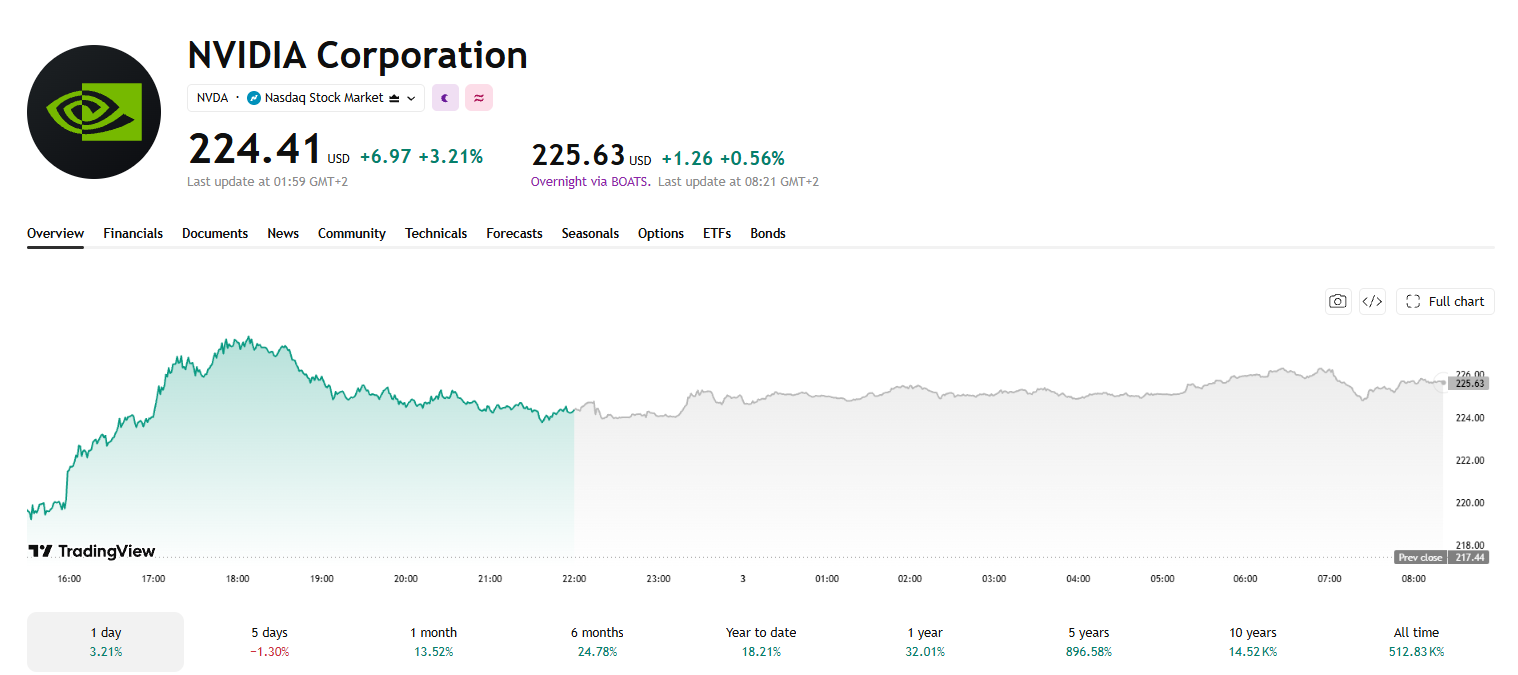
Investors shrugged off the paperwork. Nvidia closed at $224.41 on Wednesday, up 3.21% from the previous session. Shares gained a further 0.56% overnight to $225.63, extending a 13.5% advance over the past month.

Attention sits instead on a reported $12.9 billion takeover of Hugging Face. The platform hosts open-source artificial intelligence (AI) models and datasets. Business Insider said the two sides had not yet signed an agreement. Neither company has confirmed the talks.
The two firms already cooperate through an open AI security alliance. Hugging Face rejected a $500 million Nvidia investment in 2025 over concerns about one dominant backer.
Meanwhile, crypto traders watch Nvidia for a different reason. AI tokens have repeatedly tracked the chipmaker’s results, as the last AI crypto token rally showed.
Insider sales rarely move a company of Nvidia’s size on their own. However, the pace of Stevens’ selling hands skeptics of the best AI stocks of 2026 a fresh talking point. Whether the trust completes the full sale should become clear within days.
The post Nvidia Insider Selling Hits $1.09 Billion in Single Filing: Should Holders Worry? appeared first on BeInCrypto.


ARK Invest digital asset researcher Lorenzo Valente compared Ethereum, Solana and Hyperliquid with three U.S. restaurant businesses on Sept. 3, arguing that their different operating structures require separate valuation frameworks.
Summary
- ARK researcher Lorenzo Valente compared Ethereum, Solana and Hyperliquid through three contrasting restaurant business models.
- Ethereum uses layer two networks for scaling while collecting relatively limited settlement fees today overall.
- Solana processes applications within one integrated environment, keeping execution fees closer to validators and holders.
- Hyperliquid channels most eligible trading fees toward HYPE purchases through its Assistance Fund mechanism automatically.
- Valente said each architecture requires separate valuation methods because revenue paths and risks differ materially.
In an essay, Valente likened Ethereum to McDonald’s, Solana to Chipotle and Hyperliquid to In-N-Out. The comparisons address how each blockchain expands, controls its infrastructure and directs revenue toward its native asset.
Valente argued that Ethereum operates like a franchise network because independent layer 2 teams build their own systems while relying on Ethereum for settlement. Solana resembles a company-owned chain because applications execute inside one integrated environment. Hyperliquid offers a more concentrated structure built around its trading venue, consensus system and fee-funded HYPE purchases.
The restaurant comparisons are Valente’s analytical framework. They are not ARK investment recommendations or objective classifications of the three networks.
Ethereum resembles a franchise that charges limited rent
Ethereum’s scaling roadmap allows layer 2 networks such as Arbitrum, Base and OP Mainnet to process transactions away from its main execution layer. Those networks periodically submit data or proofs to Ethereum to inherit parts of its security and settlement infrastructure.
Valente compared this arrangement with McDonald’s franchising model. Ethereum provides the brand, standards, developer ecosystem and settlement layer. Independent teams finance and operate the layer 2 networks, just as franchise operators fund and manage individual restaurants.
This structure helps Ethereum expand without financing every new execution network itself. Separate teams can develop specialized products, attract users and experiment with different technologies while continuing to settle on Ethereum.
However, Valente argued that Ethereum captures too little of the economic activity generated by those networks. Layer 2 operators collect transaction fees from users but pay Ethereum primarily for data availability and settlement.
EIP-4844 introduced separate blob space for rollup data in March 2024. Blobs reduced the cost of submitting layer 2 data to Ethereum, making transactions cheaper for users. They also lowered the fees that rollups paid to the main network when blob capacity exceeded demand.
Valente described this as Ethereum building a successful franchise network but failing to collect enough rent. In his view, Ethereum owns valuable settlement infrastructure but prices access too close to its operating cost.
The analogy has limits. Ethereum does not sign commercial franchise agreements with layer 2 operators. It also cannot impose royalties, control their products or prevent them from using alternative data availability services. Any proposal to raise the minimum blob fee would require technical review and acceptance through Ethereum’s decentralized governance process.
Ethereum developers have considered changes to blob pricing as demand and capacity evolve. A higher fee floor could increase payments to Ethereum, but it could also increase layer 2 transaction costs or encourage operators to use competing systems.
Solana keeps more activity inside one environment
Valente compared Solana with Chipotle because both follow what he described as a vertically integrated model. Solana processes application activity directly through its base network instead of making external rollups the main route for scaling.
Trades on Jupiter, token launches, stablecoin transfers and other application transactions share the same execution environment. Users pay base and priority fees, while validators may receive additional value through transaction ordering and Jito tips.
This structure keeps more of the fee flow within the Solana network. Validators and their delegators receive compensation, while part of the base fee is burned. The relationship between network use and value capture is therefore more direct than it is when execution occurs on an independent layer 2.
Valente compared that arrangement with Chipotle owning and operating its restaurants. The company controls the customer experience and retains store revenue, but it must also finance expansion and absorb operational failures.
Solana faces a similar trade-off. Its unified architecture provides direct control over execution, fee markets and performance upgrades. It also means congestion or network disruption can affect applications across the ecosystem simultaneously.
The network has invested in additional validator clients, including Firedancer, to improve performance and reduce its dependence on one main software implementation. Solana’s Firedancer and Alpenglow upgrades could strengthen performance and validator diversity, although their full effects depend on deployment and operator adoption.
Valente argued that Solana’s integrated model produces better fee retention than Ethereum’s rollup structure. That assessment depends on which revenues and costs are included. Validator rewards involve token issuance, while application fees do not automatically accrue equally to every SOL holder.
Hyperliquid creates the shortest fee-capture chain
Hyperliquid received the In-N-Out comparison because it combines a focused product range, internal infrastructure and limited reliance on outside capital. Its original product centered on perpetual futures trading through an onchain order book.
The platform built its own consensus system, HyperBFT, and operates its trading infrastructure through HyperCore. It later added HyperEVM for general smart contract applications, but derivatives remain a major source of activity and revenue.
Valente argued that Hyperliquid has the shortest value-capture path among the three networks. Trading fees flow into the protocol, and the Assistance Fund uses most eligible revenue to purchase HYPE from the market.
The model differs from a conventional corporate share repurchase. HYPE is a crypto token rather than equity, and holding it does not grant the same legal claims as owning company stock. Assistance Fund purchases can still create recurring market demand when trading activity generates sufficient fees.
Hyperliquid’s Assistance Fund directs most protocol trading fees into HYPE purchases. Crypto.news reported in May that the fund had used more than $1.3 billion for purchases since the mechanism began, based on available protocol and market data.
More recent research found that Hyperliquid and Pump.fun accounted for nearly 90% of tracked crypto token repurchases during 2026. Those figures measure purchases during the examined period and should not be interpreted as guaranteed future demand.
Hyperliquid has also expanded through HIP-3, which lets approved builders deploy perpetual markets while using its underlying infrastructure. Official documentation says spot and HIP-3 deployers may retain up to 50% of fees generated by their deployed assets.
Valente compared the arrangement with a tightly controlled restaurant operator allowing outside builders to introduce products without surrendering its infrastructure or customer relationship.
Different models produce different concentration risks
Ethereum’s main advantage under Valente’s framework is distribution. Independent layer 2 teams provide external capital, engineering capacity and access to large companies. The cost is weaker control over users, execution revenue and the behavior of those networks.
Solana retains more activity inside one system. This can strengthen fee capture and product coordination, but the network must support a broader technical surface and absorb system-wide operational risks.
Hyperliquid offers the most direct relationship between product revenue and token purchases. It also carries the greatest concentration risk of the three models because activity, leadership and revenue remain closely connected to one trading ecosystem.
Valente warned that builders responsible for a large share of HIP-3 trading could eventually seek better fee terms. Revenue may also weaken during a prolonged decline in derivatives activity.
The comparison does not establish which token will outperform. Valuations also depend on issuance, liquidity, governance, competition, regulation and demand for the products running on each network.
No verified market move could be attributed directly to Valente’s essay. ETH, SOL and HYPE trade continuously and respond to broader crypto prices, leverage, protocol activity and macroeconomic conditions.
What happens next
Ethereum’s value-capture debate will focus partly on blob demand and pricing. Developers can adjust capacity or fee parameters, but changes require testing and community support. Higher settlement revenue would need to be balanced against affordable layer 2 transactions.
Solana’s model will be tested by network upgrades, validator-client diversity and its ability to support higher activity without recurring congestion. The expansion of institutional products and consumer applications could also change its fee composition.
For Hyperliquid, HIP-3 adoption will show whether the network can expand beyond its internally developed markets while preserving its revenue share. Trading volumes and Assistance Fund purchases will remain important measures of the model’s durability.
Valente’s central argument is that investors should not value every layer 1 network using identical metrics. Ethereum emphasizes external ecosystem expansion, Solana emphasizes unified execution and Hyperliquid emphasizes direct product revenue. Each model can succeed, he said, but each carries a different path to failure.
FAQs
Did ARK Invest officially classify Ethereum as McDonald’s?
No. Lorenzo Valente presented the comparison in an analytical essay. The analogy represents his framework for examining blockchain economics.
Why did Valente compare Solana with Chipotle?
He argued that Solana operates an integrated network where applications execute directly and fees remain within the underlying system.
Why was Hyperliquid compared with In-N-Out?
The comparison reflects Hyperliquid’s focused product, internal infrastructure, limited outside funding and direct fee-to-token purchase mechanism.
Does Ethereum receive fees from layer 2 networks?
Yes. Layer 2 networks pay Ethereum for data and settlement. Valente’s criticism concerns the amount Ethereum captures relative to layer 2 activity.


US-listed spot Ether and XRP exchange-traded fund (ETF) inflow streaks ended on Wednesday, marking a reversal after sustained demand.
Spot Ether ETFs recorded $48 million in net outflows on Wednesday, ending 12 consecutive trading days of inflows, according to SoSoValue data. The funds had attracted $1.62 billion during the streak.
BlackRock’s iShares Ethereum Trust ETF (ETHA) led Ether fund outflows with $53.4 million, while the Fidelity Ethereum Fund (FETH) lost $26.2 million and the Grayscale Ethereum Staking ETF (ETHE) shed $23.5 million, according to Farside Investors data. BlackRock’s staked Ether ETF (ETHB) partially offset those withdrawals with around $53 million in net inflows.
Spot XRP ETFs also posted $7.2 million in net outflows, ending an 11-session inflow streak. The streak brought in about $170 million, lifting cumulative XRP ETF inflows to about $1.68 billion.
Bitcoin ETFs moved in the opposite direction, drawing $101.2 million on Wednesday after $236.5 million in net outflows a day earlier.
The shift in ETF flows came as cryptocurrency prices declined, with Ether leading losses over the past seven days, down 3.4%, followed by XRP at 2.4% and Bitcoin at 1.3%, according to CoinGecko. At the time of publication, the three crypto assets traded at $2,407, $1.36 and $77,744, respectively.
Related: Japan’s Remixpoint dumps altcoins, leaves 1,506 BTC as sole crypto bet


Securitize and Socios.com have partnered to develop regulated tokenized equity offerings that would represent minority ownership stakes in professional sports teams.
Summary
- Securitize and Socios.com will develop regulated tokenized equity representing minority stakes in professional sports teams.
- Socios.com will manage sports and fan relationships, while Securitize will handle issuance, investor onboarding, ownership records and transfers.
- The first offering is expected to use Securitize’s authorized EU DLT trading and settlement system.
- Participating teams, investment terms, eligibility requirements and supported blockchains will be disclosed after individual offerings are approved.
The companies said the planned offerings will operate under the Socios Equity Token brand, combining Socios.com’s sports relationships and fan network with Securitize’s regulated securities infrastructure in the United States and Europe.
Socios.com, which is powered by Chiliz Group, will lead relationships with teams, owners and fans. Securitize will handle the regulated side of the offerings, including securities issuance, investor onboarding, ownership records and transfers.
The companies plan to structure the products for two groups of investors. Eligible fans could gain an economic relationship with the teams they support, while institutional and private equity investors could use the offerings to access professional sports franchises as an alternative asset class.
Professional sports franchises represent an estimated $500 billion global market, according to the firms, but ownership stakes have largely remained private and difficult for outside investors to access.
Socios Equity Token would represent regulated team ownership
Socios Equity Tokens would differ from the Fan Tokens that Socios.com has issued with more than 70 sports organizations, most of them soccer clubs.
Fan Tokens have primarily been used to connect supporters with clubs through digital engagement programs and other team-related features. The planned equity products would instead represent regulated securities tied to minority ownership interests in participating professional teams.
Specific ownership rights and other conditions will depend on the terms of each approved offering.
Socios.com has spent years building its sports network around Fan Tokens. During the 2026 FIFA World Cup, Chiliz introduced its Burn to Glory campaign, which linked treasury-held Fan Token burns to match victories by participating national teams.
Crypto.news previously reported that the program covered tokens tied to Argentina, Belgium, Portugal, South Africa and Scotland, with burn percentages increasing as teams progressed through the tournament. The tokens were removed from treasury holdings after qualifying victories instead of being taken from holders.
The sports equity partnership would take Socios.com into a different part of the market, with Securitize providing the infrastructure needed to issue and administer regulated securities.
“By connecting fan engagement with regulated tokenized equity,” the companies said, the initiative is intended for eligible fans seeking a closer economic connection with their teams and professional investors looking for exposure to sports franchises.
No participating teams have been disclosed so far. Offering sizes, investor eligibility requirements, supported blockchain networks and other terms will be announced when individual transactions receive the necessary approvals.
Securitize plans to use its EU DLT system
The Socios Equity Token initiative is expected to become the first project launched through Securitize’s fully authorized European Trading & Settlement System under the European Union’s DLT Pilot Regime.
Securitize secured EU approval for the system in November 2025 after receiving authorization from Spain’s National Securities Market Commission.
The approval allows the company to operate regulated blockchain-based trading and settlement infrastructure across all 27 EU member states. Securitize chose Avalanche for the European system and designed it to connect with its existing U.S. infrastructure.
Under the DLT Pilot Regime, the platform can support tokenized equities, bonds and other financial instruments while combining trading and settlement within a blockchain-based structure.
The sports equity offerings would use that infrastructure if individual transactions move forward, although the companies have not confirmed which networks will support the Socios Equity Tokens themselves.
Securitize CEO Carlos Domingo described professional sports teams as a significant asset class that has remained largely private and difficult to access.
“Securitize’s regulated infrastructure in the United States and Europe can provide teams and their owners with a new way to issue and administer equity while preserving the investor protections and ownership rights that should come with a regulated security,” Domingo said.
The structure could allow team owners to sell minority interests without necessarily giving up control, although the companies have not disclosed how ownership, voting rights or governance would be structured for any specific club.
Those details will depend on each offering, along with applicable securities regulations and investor eligibility requirements.
Securitize has expanded its tokenized securities business
The partnership follows Securitize’s expansion into public markets earlier this year.
Securitize began trading on the New York Stock Exchange in July after completing a roughly $400 million SPAC transaction. On the same day, the company placed its own shares onchain through tokenized versions of SECZ common stock on Solana and Avalanche.
The blockchain-based SECZ shares represent the same common stock traded on the NYSE rather than a separate equity class, according to the company. Securitize acts as the registered transfer agent, allowing ownership records for those shares to be maintained through its tokenization infrastructure.
Its regulated U.S. operations expanded later in July when Securitize Capital became an SEC-registered investment adviser.
The SEC adviser registration became effective on July 22 and placed the subsidiary under federal compliance, disclosure, recordkeeping and examination requirements.
At the time, Securitize said it managed more than $5 billion in assets through relationships with institutional asset managers. Its tokenization business includes BlackRock’s BUIDL fund alongside products connected with firms including Apollo, Hamilton Lane and VanEck.
Financial results published in August showed average tokenized assets under management reached $4.3 billion during the second quarter, up 16% from a year earlier. Aggregate transaction volume reached $5.3 billion, representing a 147% year-over-year increase.
Securitize reported a $21.7 million net loss for the quarter compared with $6.1 million a year earlier, while entering the third quarter with $350 million in cash and no balance sheet debt.
Tokenized real world assets approach $40 billion
The planned sports offerings come as more conventional financial assets are being issued or represented on public and permissioned blockchain networks.
The market capitalization of tokenized real world assets has more than doubled over the past year and is approaching $40 billion, according to RWA.xyz data cited in the announcement.
Tokenized products now span government securities, private credit, investment funds, equities and other financial instruments, while companies including Securitize have built regulated infrastructure connecting blockchain-based records with existing securities frameworks.
Professional sports franchises would add another type of privately held asset to that market if the Socios Equity Token offerings receive approval.
For now, Socios.com and Securitize have not named the teams expected to participate or provided a launch date for the first transaction.
The companies said participating clubs, offering terms, investor eligibility requirements and supported blockchain networks will be disclosed when individual Socios Equity Token offerings are approved.


The U.S. Securities and Exchange Commission chairman has said he expects the CLARITY Act to advance through the Senate this month as regulators continue developing crypto rules alongside Congress.
Summary
- SEC Chair Paul Atkins expects the CLARITY Act to advance in September and eventually reach President Donald Trump for his signature.
- The Senate is scheduled to hold a procedural vote on the bill on Sept. 15, with 60 votes needed to move forward.
- The SEC and CFTC are continuing work on crypto rules while Congress negotiates the market structure legislation.
- Stablecoin rewards and ethics provisions remain key points of disagreement surrounding the bill.
Speaking to Fox Business on Tuesday, SEC Chairman Paul Atkins said he expects lawmakers to move forward with the legislation in September and eventually send it to President Donald Trump for his signature.
“The Clarity Act will be voted on in the Senate on the 15th of September,” Atkins said. “I anticipate and hope that it will be passed by the Senate and sent ultimately to the President’s desk for a signature.”
The Sept. 15 action, however, is currently scheduled as a procedural vote on whether the Senate should begin considering the legislation, not a final vote on passage. Senate Majority Leader John Thune filed cloture on the motion to proceed before lawmakers left Washington for their August recess.
As crypto.news previously reported, the cloture motion is scheduled to ripen at 2:15 p.m. ET on Sept. 15. Supporters will need 60 votes to clear the procedural hurdle before senators can move into debate, amendments and subsequent votes.
CLARITY Act faces its Senate test on Sept. 15
The Digital Asset Market Clarity Act would establish a federal framework for digital assets and divide regulatory responsibilities between agencies including the SEC and Commodity Futures Trading Commission.
The House passed H.R. 3633 by a 294 to 134 vote in July 2025, with 78 Democrats joining Republicans. The Senate Banking Committee later advanced its version by a 15 to 9 vote in May 2026.
Lawmakers had sought to move the legislation before the August recess, but negotiations failed to produce enough support for a vote. Senate leaders eventually pushed consideration into September as disagreements continued over stablecoin rewards, ethics rules and provisions covering financial crime.
Atkins expressed confidence that the process could still move forward and said regulators were already changing how they approach digital assets.
“We’re changing the past approaches to try to update [rules], modernize them in the age of blockchain and crypto assets,” he said.
The SEC chairman tied the regulatory work to the Trump administration’s push to make the United States what the president has described as the “crypto capital of the world.”
SEC is moving ahead with crypto rules
Congressional delays have not stopped federal regulators from working on digital asset rules under their existing authority.
The SEC took another step on Aug. 25 when it sent a crypto custody proposal to the White House Office of Management and Budget for review.
The proposal is intended to clarify how investment advisers and investment companies can custody crypto assets for clients. It could remove some existing requirements that the SEC considers outdated under current market practices.
The complete proposal is expected to become public after White House review and an SEC commission vote.
Atkins has previously said the regulator could address parts of crypto market structure through rulemaking even if Congress takes longer to complete legislation. The SEC cannot independently give the CFTC all the additional spot market authority contemplated under the CLARITY Act.
CFTC Chairman Michael Selig has taken a similar position. The regulator has prepared digital asset proposals that could move forward using powers it already holds, even if Congress does not pass CLARITY.
Selig said in August that “crypto will get market structure regardless of bill,” although he did not specify when the proposals would be released.
The CFTC currently regulates crypto derivatives and can pursue fraud and manipulation involving spot commodity transactions. Broader routine supervision of digital commodity spot markets would still require authority from Congress.
Stablecoin rewards remain a sticking point
CLARITY has spent much of 2026 caught in negotiations involving lawmakers, crypto companies and the banking industry.
One of the main disputes concerns stablecoin rewards. Banking groups have pushed lawmakers to tighten provisions that could allow platforms such as Coinbase to provide customers with rewards linked to stablecoin balances.
Banks have argued that allowing crypto platforms to offer such rewards could encourage customers to move deposits from traditional financial institutions into payment stablecoins. Crypto companies have pushed against restrictions that could prevent platforms from sharing stablecoin related revenue with users.
Ethics provisions have created another obstacle. Some Democratic lawmakers have sought tougher restrictions covering government officials’ involvement with digital assets and their ability to profit from crypto businesses.
A revised proposal circulated in July included provisions designed to restrict government officials from promoting or making money from crypto, but some Democrats argued that the language remained insufficient.
Republicans, meanwhile, have accused Democratic negotiators of repeatedly changing their demands during negotiations.
Senate Banking Committee Chairman Tim Scott criticized Democratic negotiators during an August appearance, arguing that disagreements had prevented the legislation from moving forward.
The Senate vote count remains important because Republicans cannot clear the procedural threshold alone. At least 60 senators must support cloture before the chamber can begin considering H.R. 3633, meaning some Democratic support will be required.
The House-approved bill and any version eventually passed by the Senate would need to contain identical language before legislation could be sent to Trump. If senators amend the House measure, the changes would require additional congressional action.
For now, the next formal step is scheduled for Sept. 15, when the Senate is expected to hold its cloture vote on the motion to proceed with the CLARITY Act.
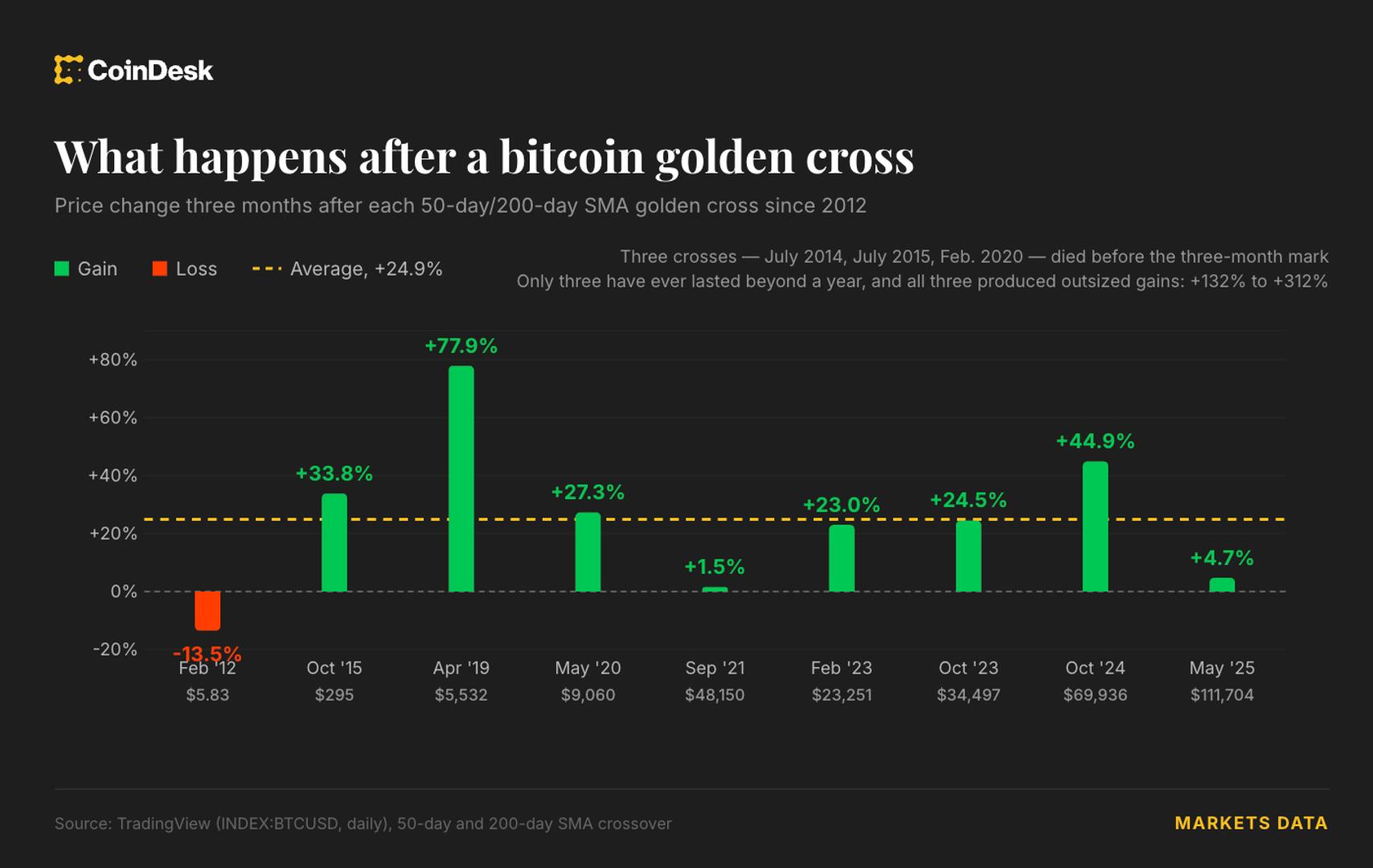
BTC is nearing a bullish golden cross, a widely tracked signal with a mixed record of success in crypto markets. But this time, USDT is supporting the bullish read.

Sony Tells Courts Any ‘Reasonable Customer’ Knows Digital Purchases Are Actually Licenses

XRP BREAKING NEWS !!! LONDON XRP ACTIVATED !!! 21 MAJOR BANKS OPEN XRP FLOODGATES !!!

Serial shoplifter warned she’s “on her last chance” as she avoids jail after spate of thefts





-

 Fashion6 days ago
Weekend Open Thread: Maeve – Corporette.com
-

 Crypto World6 days ago
Bitcoin’s 22% rally now needs real demand to outlast Treasury liquidity boost
-

 Business6 days ago
Apple Confirms September 9 Keynote and Reveals Its Full Pre-Order Schedule
-

 Business6 days ago
Salesforce Stock Soars 19% as Blowout Earnings and Agentforce AI Growth Silence Software Skeptics
-

 Business5 days ago
Onto Innovation Stock: AI’s Next Bottleneck Is Yield (NYSE:ONTO)
-

 Crypto World8 hours ago
CLARITY Act could advance within weeks, Atkins says
-

 Crypto World5 days ago
Bitcoin price tests $82K resistance as Brandt stays long
-
 Tech4 days ago
Hugging Face built a $4.5 billion empire on free AI models. Now Nvidia is buying it for $12.9 billion
-

 Business6 days ago
iPhone 18 Pro Pre-Orders Could Shift to Saturday as Apple Reportedly Avoids September 11 Anniversary
-

 Crypto World6 days ago
Truflation calls for Fed rate cut after PCE forecast
-

 News Videos4 days ago
Charlie Munger on Robinhood: No one should believe that Robinhood’s trades are free
-

 Tech5 days ago
PaperCut releases second emergency patch for exploited flaws
-
 Business7 days ago
AI Assistant Startup Instinct Rockets to $2.5 Billion Valuation in Weeks Amid Investor Feeding Frenzy
-

 Tech6 days ago
The fix for the AI agent that hijacked a company’s DNS: it can propose the change, but it can’t approve it
-

 Tech4 days ago
Tamagotchi Ring Takes the 30-Year Digital Pet and Places it on Your Finger
-
 Entertainment6 days ago
‘Adults’ Creators Break Down Season 2’s Most Shocking Moments and Tease a Potential Season 3
-

 Tech4 days ago
As the influencer economy drives retail sales, Seattle startup raises $22M to play matchmaker
-

 Crypto World1 day ago
Elon Musk Says Grok 4.7 Lands in 10 Days and Will Beat Every Model
-
 NewsBeat4 days ago
Trump posts AI video of ‘Lake America’ being protected by an army of bequiffed ‘Donald Ducks’
-
 Entertainment3 days ago
Taylor Swift Reportedly ‘Frustrated’ With Travis Kelce After ‘Short’ Honeymoon
You must be logged in to post a comment Login