
Crypto World
Laser Digital and Keyring bring institutional fixed income markets to Euler



Nomura’s digital asset unit Laser Digital has partnered with Keyring Network to build institutional fixed income markets on decentralized finance infrastructure, with the first lending and borrowing products prepared for Euler Finance.
Summary
- Laser Digital and Keyring have prepared institutional fixed income lending markets for deployment on Euler Finance.
- Laser Digital will act as risk governor, while Keyring will handle access verification, risk parameters and liquidation design.
- The framework combines permissioning, quantitative risk modeling, cyber insurance and onchain settlement tools.
- No launch date, committed capital, fee structure or participating borrowers and lenders have been disclosed.
According to a Sept. 2 announcement from Laser Digital and Keyring, the partnership will combine institutional risk controls with permissioned DeFi infrastructure for qualifying participants. Keyring will provide the technology for individual lending markets, while Laser Digital’s asset management division will contribute governance standards, portfolio structuring and market practice.
The companies have not disclosed how much capital will be committed to the markets, the fees attached to them or a launch date. Borrowers and lenders participating in the first products have not been named either.
Laser Digital will set institutional risk standards
Laser Digital’s role will center on the risk framework governing the planned markets. Keyring will handle access verification, quantitative risk parameters and the design of liquidation systems, while responsibilities between the firms will be determined separately for each contract based on the asset, strategy and risk profile.
The structure extends Laser Digital’s work with institutional onchain products. In August, the Nomura subsidiary partnered with ZIGChain on a pipeline of products tied to emerging market private credit, PayFi, invoice financing, small business funding and stablecoin services.
Under that arrangement, Laser Digital agreed to support product structuring, governance and risk framework design for ZIG Markets vaults. ZIGChain said it was targeting at least $100 million in total value locked across the planned products, although the size of Laser Digital’s investment and a timetable for reaching the target were not disclosed.
The Keyring partnership focuses first on fixed income lending and borrowing. Laser Digital and Keyring identified permissioning, exploit risk, governance and settlement as four constraints that have limited institutional participation in open DeFi lending markets.
Unrestricted access can create compliance issues for institutions, while smart contract and protocol exploits introduce risks that can be difficult to quantify, the companies said. They identified limited institutional oversight and differences between traditional clearing processes and DeFi’s instant settlement model as further obstacles.
Their framework combines zero knowledge permissioning, quantitative risk modeling, institutional governance standards, cyber insurance and other risk controls. Keyring’s [un]wind technology will provide the settlement component.
“Institutional interest in on-chain fixed income stems from real opportunity, but constraints remain,” Laser Digital co-founder and CEO Jez Mohideen said.
Mohideen said the companies are working on assets that behave more like conventional fixed income instruments than speculative crypto tokens while retaining onchain settlement.
Euler Finance will host the first markets
The first lending markets are ready to go live on Euler Finance, according to the companies, although no deployment date was provided. Other partners, products and strategies are expected to follow in phases.
Euler already supports lending markets built around institutional and tokenized assets. In May, VanEck’s VBILL went live on Euler, allowing investors to use the asset manager’s tokenized U.S. Treasury fund as collateral for onchain borrowing.
The integration followed Euler’s addition of Securitize’s DS Protocol, which allows tokenized securities to interact with lending markets while maintaining investor eligibility and transfer restrictions. RedStone supplies pricing data for VBILL on Euler.
A similar institutional asset reached the protocol in May 2025 when sBUIDL, a token backed 1:1 by BlackRock’s BUIDL fund and issued by Securitize, entered Euler lending markets. The Avalanche deployment was curated by Re7 Labs and allowed sBUIDL holders to use the asset as collateral for USDC and AUSD borrowing.
Euler’s modular structure allows market creators to configure collateral requirements, liquidation parameters and access permissions for individual lending markets. Institutional managers including K3 Capital, MEV Capital and Re7 Capital have previously managed vaults on the protocol.
DefiLlama data currently puts Euler V2’s total value locked at approximately $377.5 million. Monad accounts for nearly $248.9 million, followed by Ethereum at $92.7 million and Base at $21.4 million. The protocol generated roughly $1.63 million in fees over the past 30 days and close to $51,840 in protocol revenue over the same period.
Euler’s current structure followed its recovery from a major security incident in March 2023, when an exploit drained approximately $197 million from the protocol. Most of the stolen assets were subsequently returned, and Euler later rebuilt its lending architecture around its V2 system.
Nomura has expanded Laser Digital’s institutional operations
Laser Digital was established by Nomura in 2022 as the Japanese financial group built a dedicated digital asset business spanning trading, asset management, investment and blockchain-based financial products.
Its institutional operations have expanded across several markets since then. Crypto.news previously reported that Laser Digital secured registration in Japan in August as a crypto asset exchange service provider, becoming the country’s first newly registered entrant in roughly four years.
The Japanese subsidiary plans to begin by supplying liquidity to domestic virtual asset service providers before considering digital asset trading services for institutional investors. Laser Digital has not provided a launch date for the institutional trading business.
Nomura and Laser Digital found in a 2026 survey that 79% of respondents planned to invest in crypto assets within three years. Outside Japan, Laser Digital already operates asset management products and holds a full crypto business license in Dubai.
Keyring brings a different part of the infrastructure to the new fixed income project. The network operates a permissioned access layer designed to verify users before they interact with DeFi applications while using zero knowledge technology to limit the amount of identifying information exposed onchain.
Alex McFarlane, founder and CEO of Keyring Network, described rates and credit as interconnected parts of the fixed income market and said tokenized assets had expanded rapidly without reaching much of the available market.
“Despite multi-year exponential growth in tokenised assets, we haven’t yet scratched the surface,” McFarlane said.
The companies said individual responsibilities under the partnership will be established contract by contract, while the first Euler markets will be followed by other products, partners and strategies in phased deployments.



In 2026, the crypto mining industry is witnessing new ways to participate. Against the backdrop of a maturing global cryptocurrency market, more and more digital asset holders are rethinking a key question: how to generate continuous income from cryptocurrencies without frequent trading or asset sales.
Recently, the cloud mining platform FTmining has attracted attention in the crypto mining sector. Cryptocurrency holders report that participating in cloud mining through this platform is generating a stable and sustainable cash flow.
The shift from “holding and waiting” to “participating in mining”
For a long time, cryptocurrency investors have primarily adopted a “buy and hold” strategy, with returns highly dependent on market fluctuations. While this approach can yield substantial returns in bull markets, it often fails to generate real cash income during periods of volatility or consolidation.
In this context, FTmining cloud mining, as a non-trading mining participation model, is gradually being accepted by more crypto asset holders. By renting computing power to participate in blockchain network mining, users can obtain continuous returns without selling their digital assets.
What is a cryptocurrency mining platform?
Before learning about FTmining, many users will first ask a basic question: What is a cryptocurrency mining platform?
Simply put, a mining platform is a service system that allows users to participate in blockchain network computation, verify transactions, and earn block rewards. Traditional mining usually requires purchasing mining rigs, deploying facilities, and bearing maintenance and electricity costs, while cloud mining platforms lower the barrier to entry for ordinary users through centralized management.
What is FTmining?
FTmining is a comprehensive cryptocurrency service center that integrates tools for managing digital assets, investing, and mining on a single platform. One of its core businesses is its cloud mining service, allowing users to start earning cryptocurrency in about a day without assembling hardware or performing subsequent maintenance. The operator handles installation, maintenance, and energy arrangements, making it easy for beginners to get started. These mining rigs are located near major wind farms worldwide, benefiting from reliable energy supplies, which helps reduce operating costs, minimize footprint, and ensure stable operation.
Platform Security and Service Guarantee
To protect user assets and account security, FTmining has introduced multiple protection mechanisms in its platform architecture:
Two-Factor Authentication (2FA): Enabling this feature ensures that only the account holder can access and operate the account, effectively preventing unauthorized logins.
24/7 Multilingual Customer Support: FTmining provides 24/7 multilingual customer support and has a priority channel for account-related issues, ensuring users can receive timely assistance at any time.
Real-Time Security Monitoring System: The platform monitors account activity in real-time around the clock. Upon detecting abnormal or suspicious behavior, security mechanisms are immediately triggered, further enhancing asset protection capabilities.
How to start mining with FTmining?
Getting started with FTmining is easy in just a few simple steps:
Step 1: Register an Account:
Visit the official FTmining website: https://ftmining.com
Enter your email address and password to create an account.
New users receive a $15 sign-up bonus and enjoy a daily $0.75 login bonus.
Promotional offers are available, including a free trial. These offers are very useful if you want to test the waters on a small scale before going all in.
Step 2: Support for Diverse Cryptocurrencies
Choose supported cryptocurrencies. Users can deposit various crypto assets, including:
Major cryptocurrencies such as BTC, USDT, ETH, LTC, USDC, XRP, and BCH.
Step 3: Choose a Contract
For cloud mining, FTmining offers a range of contracts to meet different budgets and goals. Whether you need a short-term trial or a multi-year plan, there’s always a solution for you.
For example:
Entry-level contract: $100 — 2-day cycle — Total profit approximately $108
Stable contract: $800 — 5-day cycle — Total profit approximately $852.8
Professional contract: $5000 — 20-day cycle — Total profit approximately $6520
Advanced contract: $25000 — 28-day cycle — Total profit approximately $38300
For more contract details, please visit the official website.
After completing the above steps, your FTmining contract will run in the background. You can monitor the results in the control panel, and you can withdraw to your personal wallet or purchase more contracts to increase your computing power.
User perspective: Mining revenue is becoming an important supplement
Several cryptocurrency holders have stated that FTmining cloud mining is changing their perception of how they use digital assets.
Smith, an investor from New York, stated:
“By properly allocating computing power contracts, my passive income is steadily increasing every month, without the need for high-frequency trading. This highly automated mining participation method is ideal for long-term cryptocurrency holders.”
Kyle Jennings, an investor from Canada, also pointed out:
“I don’t want to sell my Bitcoin, but I want it to generate real returns. FTmining has enabled me to achieve this goal, and now my assets are generating returns every day.”
Industry Perspective
Industry observers point out that the attention FTmining’s cloud mining model has garnered reflects the rising demand from investors for “stable returns” and “automated asset management.” With continuous improvements in compliance, security, and automation technologies, FTmining’s cloud mining model provides cryptocurrency holders with a new asset management approach, making “passive income” a realistic and achievable goal.
Conclusion
In the volatile environment of the cryptocurrency market, cloud mining provides investors with an easy, barrier-free way to earn daily returns. Whether you are a novice investor or an experienced digital asset holder, you can steadily increase your wealth through cloud mining, making your investments more efficient.
Official Website: https://ftmining.com
App Download: https://ftmining.com/xml/index.html#/app
Customer Service Email: [email protected]
Nvidia insider selling has picked up again. Board member Mark Stevens filed to sell 5 million Class A shares worth about $1.09 billion.
The Form 144 notice reached the US Securities and Exchange Commission (SEC) on Sept. 2. It names Merrill Lynch as the broker and Nasdaq as the venue.
Nvidia Insider Selling Follows Months of Steady Disposals
Stevens holds the stock through the 3rd Millennium Trust and the 970 Foundation. He has trimmed the position repeatedly this year. He sold 500,000 shares for $109.9 million on June 4. A second block of 885,000 shares raised $186 million two weeks later.
Two more sales followed in the past week. The filing lists 585,000 shares worth $128.9 million on Aug. 31 and 63,501 shares worth $14 million on Sept. 1. Consequently, his disposals since June approach $1.5 billion.
Directors often sell under prearranged plans, which weakens the signal value of any single notice. A Form 144 flags intent, not a completed trade. Therefore, the full 5 million shares may never reach the market. Traders tracking Nvidia stock price forecasts watch the cadence of these notices for a read on insider conviction.
Why the Stock Climbed Anyway
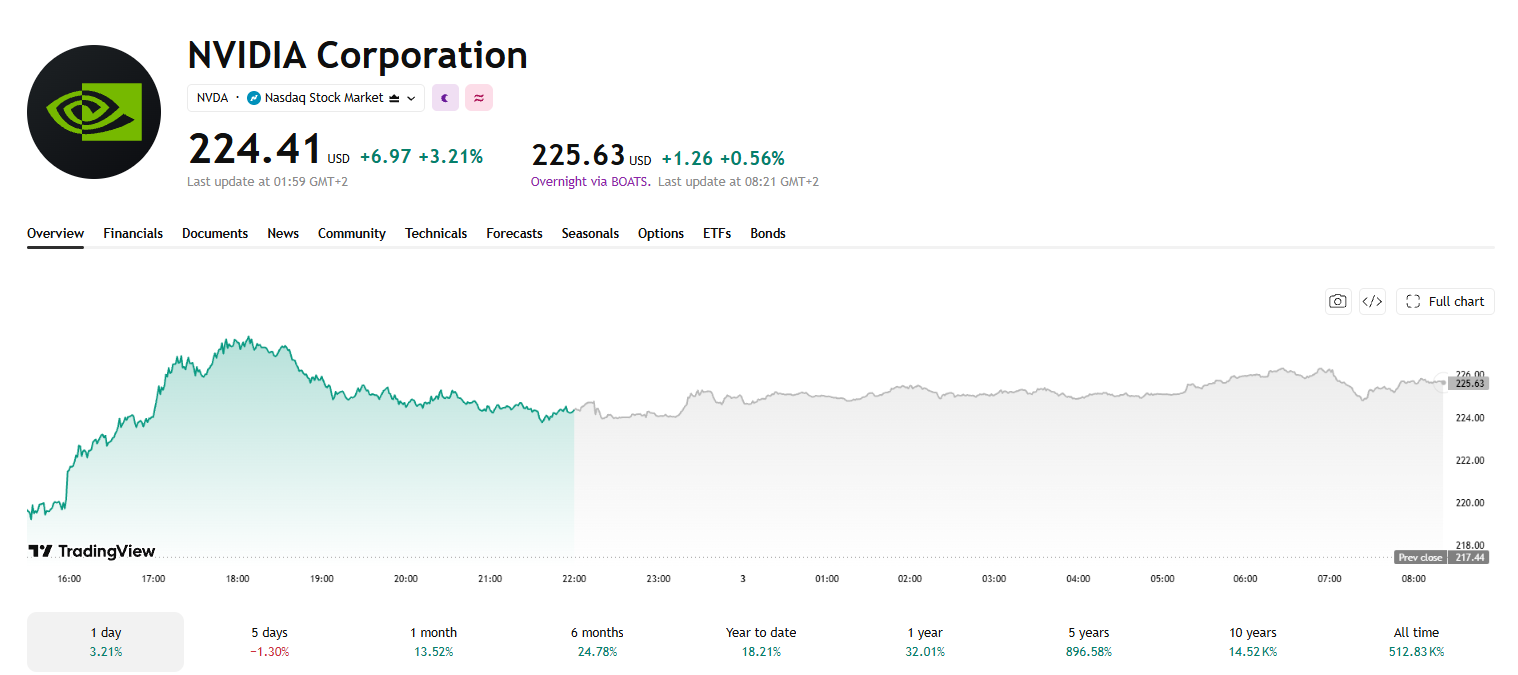
Investors shrugged off the paperwork. Nvidia closed at $224.41 on Wednesday, up 3.21% from the previous session. Shares gained a further 0.56% overnight to $225.63, extending a 13.5% advance over the past month.

Attention sits instead on a reported $12.9 billion takeover of Hugging Face. The platform hosts open-source artificial intelligence (AI) models and datasets. Business Insider said the two sides had not yet signed an agreement. Neither company has confirmed the talks.
The two firms already cooperate through an open AI security alliance. Hugging Face rejected a $500 million Nvidia investment in 2025 over concerns about one dominant backer.
Meanwhile, crypto traders watch Nvidia for a different reason. AI tokens have repeatedly tracked the chipmaker’s results, as the last AI crypto token rally showed.
Insider sales rarely move a company of Nvidia’s size on their own. However, the pace of Stevens’ selling hands skeptics of the best AI stocks of 2026 a fresh talking point. Whether the trust completes the full sale should become clear within days.
The post Nvidia Insider Selling Hits $1.09 Billion in Single Filing: Should Holders Worry? appeared first on BeInCrypto.


ARK Invest digital asset researcher Lorenzo Valente compared Ethereum, Solana and Hyperliquid with three U.S. restaurant businesses on Sept. 3, arguing that their different operating structures require separate valuation frameworks.
Summary
- ARK researcher Lorenzo Valente compared Ethereum, Solana and Hyperliquid through three contrasting restaurant business models.
- Ethereum uses layer two networks for scaling while collecting relatively limited settlement fees today overall.
- Solana processes applications within one integrated environment, keeping execution fees closer to validators and holders.
- Hyperliquid channels most eligible trading fees toward HYPE purchases through its Assistance Fund mechanism automatically.
- Valente said each architecture requires separate valuation methods because revenue paths and risks differ materially.
In an essay, Valente likened Ethereum to McDonald’s, Solana to Chipotle and Hyperliquid to In-N-Out. The comparisons address how each blockchain expands, controls its infrastructure and directs revenue toward its native asset.
Valente argued that Ethereum operates like a franchise network because independent layer 2 teams build their own systems while relying on Ethereum for settlement. Solana resembles a company-owned chain because applications execute inside one integrated environment. Hyperliquid offers a more concentrated structure built around its trading venue, consensus system and fee-funded HYPE purchases.
The restaurant comparisons are Valente’s analytical framework. They are not ARK investment recommendations or objective classifications of the three networks.
Ethereum resembles a franchise that charges limited rent
Ethereum’s scaling roadmap allows layer 2 networks such as Arbitrum, Base and OP Mainnet to process transactions away from its main execution layer. Those networks periodically submit data or proofs to Ethereum to inherit parts of its security and settlement infrastructure.
Valente compared this arrangement with McDonald’s franchising model. Ethereum provides the brand, standards, developer ecosystem and settlement layer. Independent teams finance and operate the layer 2 networks, just as franchise operators fund and manage individual restaurants.
This structure helps Ethereum expand without financing every new execution network itself. Separate teams can develop specialized products, attract users and experiment with different technologies while continuing to settle on Ethereum.
However, Valente argued that Ethereum captures too little of the economic activity generated by those networks. Layer 2 operators collect transaction fees from users but pay Ethereum primarily for data availability and settlement.
EIP-4844 introduced separate blob space for rollup data in March 2024. Blobs reduced the cost of submitting layer 2 data to Ethereum, making transactions cheaper for users. They also lowered the fees that rollups paid to the main network when blob capacity exceeded demand.
Valente described this as Ethereum building a successful franchise network but failing to collect enough rent. In his view, Ethereum owns valuable settlement infrastructure but prices access too close to its operating cost.
The analogy has limits. Ethereum does not sign commercial franchise agreements with layer 2 operators. It also cannot impose royalties, control their products or prevent them from using alternative data availability services. Any proposal to raise the minimum blob fee would require technical review and acceptance through Ethereum’s decentralized governance process.
Ethereum developers have considered changes to blob pricing as demand and capacity evolve. A higher fee floor could increase payments to Ethereum, but it could also increase layer 2 transaction costs or encourage operators to use competing systems.
Solana keeps more activity inside one environment
Valente compared Solana with Chipotle because both follow what he described as a vertically integrated model. Solana processes application activity directly through its base network instead of making external rollups the main route for scaling.
Trades on Jupiter, token launches, stablecoin transfers and other application transactions share the same execution environment. Users pay base and priority fees, while validators may receive additional value through transaction ordering and Jito tips.
This structure keeps more of the fee flow within the Solana network. Validators and their delegators receive compensation, while part of the base fee is burned. The relationship between network use and value capture is therefore more direct than it is when execution occurs on an independent layer 2.
Valente compared that arrangement with Chipotle owning and operating its restaurants. The company controls the customer experience and retains store revenue, but it must also finance expansion and absorb operational failures.
Solana faces a similar trade-off. Its unified architecture provides direct control over execution, fee markets and performance upgrades. It also means congestion or network disruption can affect applications across the ecosystem simultaneously.
The network has invested in additional validator clients, including Firedancer, to improve performance and reduce its dependence on one main software implementation. Solana’s Firedancer and Alpenglow upgrades could strengthen performance and validator diversity, although their full effects depend on deployment and operator adoption.
Valente argued that Solana’s integrated model produces better fee retention than Ethereum’s rollup structure. That assessment depends on which revenues and costs are included. Validator rewards involve token issuance, while application fees do not automatically accrue equally to every SOL holder.
Hyperliquid creates the shortest fee-capture chain
Hyperliquid received the In-N-Out comparison because it combines a focused product range, internal infrastructure and limited reliance on outside capital. Its original product centered on perpetual futures trading through an onchain order book.
The platform built its own consensus system, HyperBFT, and operates its trading infrastructure through HyperCore. It later added HyperEVM for general smart contract applications, but derivatives remain a major source of activity and revenue.
Valente argued that Hyperliquid has the shortest value-capture path among the three networks. Trading fees flow into the protocol, and the Assistance Fund uses most eligible revenue to purchase HYPE from the market.
The model differs from a conventional corporate share repurchase. HYPE is a crypto token rather than equity, and holding it does not grant the same legal claims as owning company stock. Assistance Fund purchases can still create recurring market demand when trading activity generates sufficient fees.
Hyperliquid’s Assistance Fund directs most protocol trading fees into HYPE purchases. Crypto.news reported in May that the fund had used more than $1.3 billion for purchases since the mechanism began, based on available protocol and market data.
More recent research found that Hyperliquid and Pump.fun accounted for nearly 90% of tracked crypto token repurchases during 2026. Those figures measure purchases during the examined period and should not be interpreted as guaranteed future demand.
Hyperliquid has also expanded through HIP-3, which lets approved builders deploy perpetual markets while using its underlying infrastructure. Official documentation says spot and HIP-3 deployers may retain up to 50% of fees generated by their deployed assets.
Valente compared the arrangement with a tightly controlled restaurant operator allowing outside builders to introduce products without surrendering its infrastructure or customer relationship.
Different models produce different concentration risks
Ethereum’s main advantage under Valente’s framework is distribution. Independent layer 2 teams provide external capital, engineering capacity and access to large companies. The cost is weaker control over users, execution revenue and the behavior of those networks.
Solana retains more activity inside one system. This can strengthen fee capture and product coordination, but the network must support a broader technical surface and absorb system-wide operational risks.
Hyperliquid offers the most direct relationship between product revenue and token purchases. It also carries the greatest concentration risk of the three models because activity, leadership and revenue remain closely connected to one trading ecosystem.
Valente warned that builders responsible for a large share of HIP-3 trading could eventually seek better fee terms. Revenue may also weaken during a prolonged decline in derivatives activity.
The comparison does not establish which token will outperform. Valuations also depend on issuance, liquidity, governance, competition, regulation and demand for the products running on each network.
No verified market move could be attributed directly to Valente’s essay. ETH, SOL and HYPE trade continuously and respond to broader crypto prices, leverage, protocol activity and macroeconomic conditions.
What happens next
Ethereum’s value-capture debate will focus partly on blob demand and pricing. Developers can adjust capacity or fee parameters, but changes require testing and community support. Higher settlement revenue would need to be balanced against affordable layer 2 transactions.
Solana’s model will be tested by network upgrades, validator-client diversity and its ability to support higher activity without recurring congestion. The expansion of institutional products and consumer applications could also change its fee composition.
For Hyperliquid, HIP-3 adoption will show whether the network can expand beyond its internally developed markets while preserving its revenue share. Trading volumes and Assistance Fund purchases will remain important measures of the model’s durability.
Valente’s central argument is that investors should not value every layer 1 network using identical metrics. Ethereum emphasizes external ecosystem expansion, Solana emphasizes unified execution and Hyperliquid emphasizes direct product revenue. Each model can succeed, he said, but each carries a different path to failure.
FAQs
Did ARK Invest officially classify Ethereum as McDonald’s?
No. Lorenzo Valente presented the comparison in an analytical essay. The analogy represents his framework for examining blockchain economics.
Why did Valente compare Solana with Chipotle?
He argued that Solana operates an integrated network where applications execute directly and fees remain within the underlying system.
Why was Hyperliquid compared with In-N-Out?
The comparison reflects Hyperliquid’s focused product, internal infrastructure, limited outside funding and direct fee-to-token purchase mechanism.
Does Ethereum receive fees from layer 2 networks?
Yes. Layer 2 networks pay Ethereum for data and settlement. Valente’s criticism concerns the amount Ethereum captures relative to layer 2 activity.


US-listed spot Ether and XRP exchange-traded fund (ETF) inflow streaks ended on Wednesday, marking a reversal after sustained demand.
Spot Ether ETFs recorded $48 million in net outflows on Wednesday, ending 12 consecutive trading days of inflows, according to SoSoValue data. The funds had attracted $1.62 billion during the streak.
BlackRock’s iShares Ethereum Trust ETF (ETHA) led Ether fund outflows with $53.4 million, while the Fidelity Ethereum Fund (FETH) lost $26.2 million and the Grayscale Ethereum Staking ETF (ETHE) shed $23.5 million, according to Farside Investors data. BlackRock’s staked Ether ETF (ETHB) partially offset those withdrawals with around $53 million in net inflows.
Spot XRP ETFs also posted $7.2 million in net outflows, ending an 11-session inflow streak. The streak brought in about $170 million, lifting cumulative XRP ETF inflows to about $1.68 billion.
Bitcoin ETFs moved in the opposite direction, drawing $101.2 million on Wednesday after $236.5 million in net outflows a day earlier.
The shift in ETF flows came as cryptocurrency prices declined, with Ether leading losses over the past seven days, down 3.4%, followed by XRP at 2.4% and Bitcoin at 1.3%, according to CoinGecko. At the time of publication, the three crypto assets traded at $2,407, $1.36 and $77,744, respectively.
Related: Japan’s Remixpoint dumps altcoins, leaves 1,506 BTC as sole crypto bet


Securitize and Socios.com have partnered to develop regulated tokenized equity offerings that would represent minority ownership stakes in professional sports teams.
Summary
- Securitize and Socios.com will develop regulated tokenized equity representing minority stakes in professional sports teams.
- Socios.com will manage sports and fan relationships, while Securitize will handle issuance, investor onboarding, ownership records and transfers.
- The first offering is expected to use Securitize’s authorized EU DLT trading and settlement system.
- Participating teams, investment terms, eligibility requirements and supported blockchains will be disclosed after individual offerings are approved.
The companies said the planned offerings will operate under the Socios Equity Token brand, combining Socios.com’s sports relationships and fan network with Securitize’s regulated securities infrastructure in the United States and Europe.
Socios.com, which is powered by Chiliz Group, will lead relationships with teams, owners and fans. Securitize will handle the regulated side of the offerings, including securities issuance, investor onboarding, ownership records and transfers.
The companies plan to structure the products for two groups of investors. Eligible fans could gain an economic relationship with the teams they support, while institutional and private equity investors could use the offerings to access professional sports franchises as an alternative asset class.
Professional sports franchises represent an estimated $500 billion global market, according to the firms, but ownership stakes have largely remained private and difficult for outside investors to access.
Socios Equity Token would represent regulated team ownership
Socios Equity Tokens would differ from the Fan Tokens that Socios.com has issued with more than 70 sports organizations, most of them soccer clubs.
Fan Tokens have primarily been used to connect supporters with clubs through digital engagement programs and other team-related features. The planned equity products would instead represent regulated securities tied to minority ownership interests in participating professional teams.
Specific ownership rights and other conditions will depend on the terms of each approved offering.
Socios.com has spent years building its sports network around Fan Tokens. During the 2026 FIFA World Cup, Chiliz introduced its Burn to Glory campaign, which linked treasury-held Fan Token burns to match victories by participating national teams.
Crypto.news previously reported that the program covered tokens tied to Argentina, Belgium, Portugal, South Africa and Scotland, with burn percentages increasing as teams progressed through the tournament. The tokens were removed from treasury holdings after qualifying victories instead of being taken from holders.
The sports equity partnership would take Socios.com into a different part of the market, with Securitize providing the infrastructure needed to issue and administer regulated securities.
“By connecting fan engagement with regulated tokenized equity,” the companies said, the initiative is intended for eligible fans seeking a closer economic connection with their teams and professional investors looking for exposure to sports franchises.
No participating teams have been disclosed so far. Offering sizes, investor eligibility requirements, supported blockchain networks and other terms will be announced when individual transactions receive the necessary approvals.
Securitize plans to use its EU DLT system
The Socios Equity Token initiative is expected to become the first project launched through Securitize’s fully authorized European Trading & Settlement System under the European Union’s DLT Pilot Regime.
Securitize secured EU approval for the system in November 2025 after receiving authorization from Spain’s National Securities Market Commission.
The approval allows the company to operate regulated blockchain-based trading and settlement infrastructure across all 27 EU member states. Securitize chose Avalanche for the European system and designed it to connect with its existing U.S. infrastructure.
Under the DLT Pilot Regime, the platform can support tokenized equities, bonds and other financial instruments while combining trading and settlement within a blockchain-based structure.
The sports equity offerings would use that infrastructure if individual transactions move forward, although the companies have not confirmed which networks will support the Socios Equity Tokens themselves.
Securitize CEO Carlos Domingo described professional sports teams as a significant asset class that has remained largely private and difficult to access.
“Securitize’s regulated infrastructure in the United States and Europe can provide teams and their owners with a new way to issue and administer equity while preserving the investor protections and ownership rights that should come with a regulated security,” Domingo said.
The structure could allow team owners to sell minority interests without necessarily giving up control, although the companies have not disclosed how ownership, voting rights or governance would be structured for any specific club.
Those details will depend on each offering, along with applicable securities regulations and investor eligibility requirements.
Securitize has expanded its tokenized securities business
The partnership follows Securitize’s expansion into public markets earlier this year.
Securitize began trading on the New York Stock Exchange in July after completing a roughly $400 million SPAC transaction. On the same day, the company placed its own shares onchain through tokenized versions of SECZ common stock on Solana and Avalanche.
The blockchain-based SECZ shares represent the same common stock traded on the NYSE rather than a separate equity class, according to the company. Securitize acts as the registered transfer agent, allowing ownership records for those shares to be maintained through its tokenization infrastructure.
Its regulated U.S. operations expanded later in July when Securitize Capital became an SEC-registered investment adviser.
The SEC adviser registration became effective on July 22 and placed the subsidiary under federal compliance, disclosure, recordkeeping and examination requirements.
At the time, Securitize said it managed more than $5 billion in assets through relationships with institutional asset managers. Its tokenization business includes BlackRock’s BUIDL fund alongside products connected with firms including Apollo, Hamilton Lane and VanEck.
Financial results published in August showed average tokenized assets under management reached $4.3 billion during the second quarter, up 16% from a year earlier. Aggregate transaction volume reached $5.3 billion, representing a 147% year-over-year increase.
Securitize reported a $21.7 million net loss for the quarter compared with $6.1 million a year earlier, while entering the third quarter with $350 million in cash and no balance sheet debt.
Tokenized real world assets approach $40 billion
The planned sports offerings come as more conventional financial assets are being issued or represented on public and permissioned blockchain networks.
The market capitalization of tokenized real world assets has more than doubled over the past year and is approaching $40 billion, according to RWA.xyz data cited in the announcement.
Tokenized products now span government securities, private credit, investment funds, equities and other financial instruments, while companies including Securitize have built regulated infrastructure connecting blockchain-based records with existing securities frameworks.
Professional sports franchises would add another type of privately held asset to that market if the Socios Equity Token offerings receive approval.
For now, Socios.com and Securitize have not named the teams expected to participate or provided a launch date for the first transaction.
The companies said participating clubs, offering terms, investor eligibility requirements and supported blockchain networks will be disclosed when individual Socios Equity Token offerings are approved.


The U.S. Securities and Exchange Commission chairman has said he expects the CLARITY Act to advance through the Senate this month as regulators continue developing crypto rules alongside Congress.
Summary
- SEC Chair Paul Atkins expects the CLARITY Act to advance in September and eventually reach President Donald Trump for his signature.
- The Senate is scheduled to hold a procedural vote on the bill on Sept. 15, with 60 votes needed to move forward.
- The SEC and CFTC are continuing work on crypto rules while Congress negotiates the market structure legislation.
- Stablecoin rewards and ethics provisions remain key points of disagreement surrounding the bill.
Speaking to Fox Business on Tuesday, SEC Chairman Paul Atkins said he expects lawmakers to move forward with the legislation in September and eventually send it to President Donald Trump for his signature.
“The Clarity Act will be voted on in the Senate on the 15th of September,” Atkins said. “I anticipate and hope that it will be passed by the Senate and sent ultimately to the President’s desk for a signature.”
The Sept. 15 action, however, is currently scheduled as a procedural vote on whether the Senate should begin considering the legislation, not a final vote on passage. Senate Majority Leader John Thune filed cloture on the motion to proceed before lawmakers left Washington for their August recess.
As crypto.news previously reported, the cloture motion is scheduled to ripen at 2:15 p.m. ET on Sept. 15. Supporters will need 60 votes to clear the procedural hurdle before senators can move into debate, amendments and subsequent votes.
CLARITY Act faces its Senate test on Sept. 15
The Digital Asset Market Clarity Act would establish a federal framework for digital assets and divide regulatory responsibilities between agencies including the SEC and Commodity Futures Trading Commission.
The House passed H.R. 3633 by a 294 to 134 vote in July 2025, with 78 Democrats joining Republicans. The Senate Banking Committee later advanced its version by a 15 to 9 vote in May 2026.
Lawmakers had sought to move the legislation before the August recess, but negotiations failed to produce enough support for a vote. Senate leaders eventually pushed consideration into September as disagreements continued over stablecoin rewards, ethics rules and provisions covering financial crime.
Atkins expressed confidence that the process could still move forward and said regulators were already changing how they approach digital assets.
“We’re changing the past approaches to try to update [rules], modernize them in the age of blockchain and crypto assets,” he said.
The SEC chairman tied the regulatory work to the Trump administration’s push to make the United States what the president has described as the “crypto capital of the world.”
SEC is moving ahead with crypto rules
Congressional delays have not stopped federal regulators from working on digital asset rules under their existing authority.
The SEC took another step on Aug. 25 when it sent a crypto custody proposal to the White House Office of Management and Budget for review.
The proposal is intended to clarify how investment advisers and investment companies can custody crypto assets for clients. It could remove some existing requirements that the SEC considers outdated under current market practices.
The complete proposal is expected to become public after White House review and an SEC commission vote.
Atkins has previously said the regulator could address parts of crypto market structure through rulemaking even if Congress takes longer to complete legislation. The SEC cannot independently give the CFTC all the additional spot market authority contemplated under the CLARITY Act.
CFTC Chairman Michael Selig has taken a similar position. The regulator has prepared digital asset proposals that could move forward using powers it already holds, even if Congress does not pass CLARITY.
Selig said in August that “crypto will get market structure regardless of bill,” although he did not specify when the proposals would be released.
The CFTC currently regulates crypto derivatives and can pursue fraud and manipulation involving spot commodity transactions. Broader routine supervision of digital commodity spot markets would still require authority from Congress.
Stablecoin rewards remain a sticking point
CLARITY has spent much of 2026 caught in negotiations involving lawmakers, crypto companies and the banking industry.
One of the main disputes concerns stablecoin rewards. Banking groups have pushed lawmakers to tighten provisions that could allow platforms such as Coinbase to provide customers with rewards linked to stablecoin balances.
Banks have argued that allowing crypto platforms to offer such rewards could encourage customers to move deposits from traditional financial institutions into payment stablecoins. Crypto companies have pushed against restrictions that could prevent platforms from sharing stablecoin related revenue with users.
Ethics provisions have created another obstacle. Some Democratic lawmakers have sought tougher restrictions covering government officials’ involvement with digital assets and their ability to profit from crypto businesses.
A revised proposal circulated in July included provisions designed to restrict government officials from promoting or making money from crypto, but some Democrats argued that the language remained insufficient.
Republicans, meanwhile, have accused Democratic negotiators of repeatedly changing their demands during negotiations.
Senate Banking Committee Chairman Tim Scott criticized Democratic negotiators during an August appearance, arguing that disagreements had prevented the legislation from moving forward.
The Senate vote count remains important because Republicans cannot clear the procedural threshold alone. At least 60 senators must support cloture before the chamber can begin considering H.R. 3633, meaning some Democratic support will be required.
The House-approved bill and any version eventually passed by the Senate would need to contain identical language before legislation could be sent to Trump. If senators amend the House measure, the changes would require additional congressional action.
For now, the next formal step is scheduled for Sept. 15, when the Senate is expected to hold its cloture vote on the motion to proceed with the CLARITY Act.
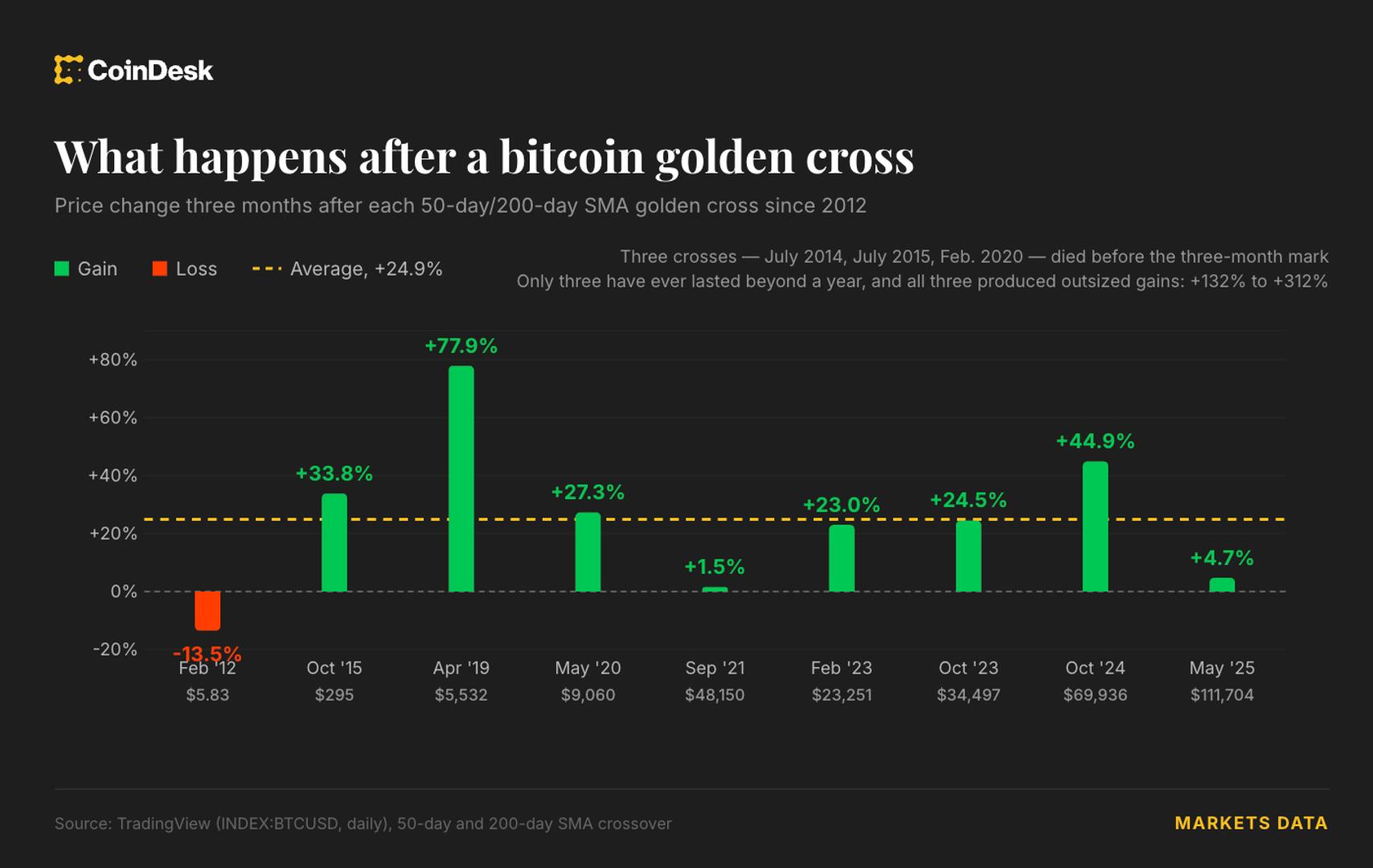
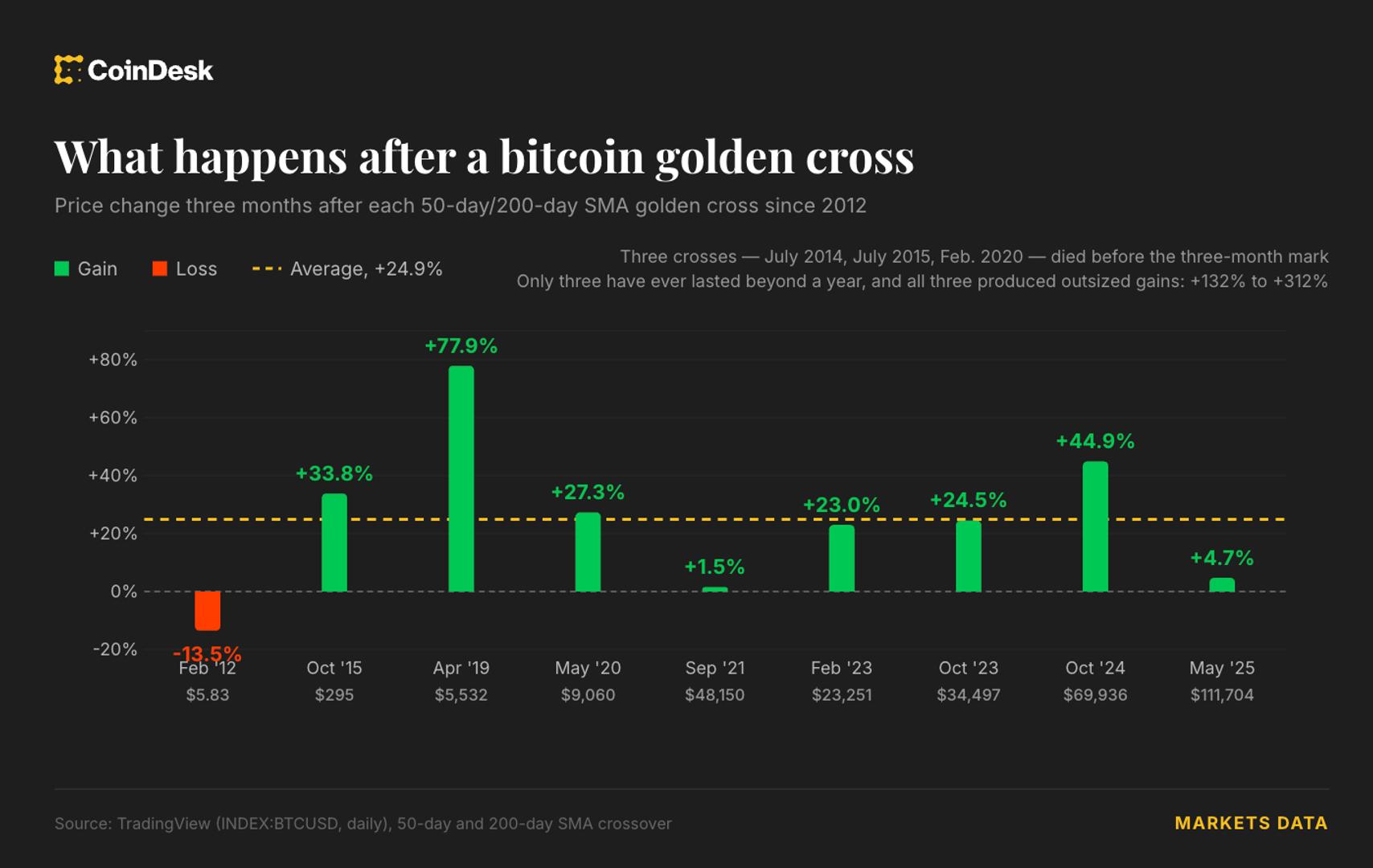
BTC is nearing a bullish golden cross, a widely tracked signal with a mixed record of success in crypto markets. But this time, USDT is supporting the bullish read.


Thailand’s Securities and Exchange Commission has proposed new rules requiring digital asset operators to collect, verify and retain information tied to crypto transfers under its planned Travel Rule framework.
Summary
- Thailand’s SEC has proposed a Travel Rule requiring digital asset operators to collect and verify information tied to crypto transfers.
- Operators would have to verify ownership or control of self-hosted wallets and conduct checks on counterparties and service providers.
- Transaction records would need to be retained for at least five years, with immediate regulatory access required during the first two years.
- The proposal is designed to improve transaction tracing and prevent crypto services from being used for money laundering and technology-related crime.
According to Thailand’s SEC, the draft notification would require operators to establish risk management systems for digital asset transfers and receipts, giving them enough information to identify transactions that may involve money laundering or technology-related crime.
The proposal covers transfers between customers and regulated service providers as well as transactions involving self-hosted wallets. Operators would need to collect information about customers and their counterparties, examine service providers used on the other side of a transaction and keep records supporting every transfer for at least five years.
For the first two years of the retention period, transaction information would have to remain in a format that allows supervisory authorities to retrieve or inspect it immediately.
Thailand Travel Rule would extend checks to self-hosted wallets
One of the requirements would apply when customers send digital assets to or receive them from self-hosted wallets.
In such cases, licensed operators would have to verify that the customer owns the wallet or has authority to control it. Counterparty checks would extend to digital asset operators or other service providers involved in transfers.
The SEC said the proposed controls are intended to provide enough information to trace the financial route of a digital asset transaction and allow suspicious activity to be examined, prevented or intercepted.
Similar information-sharing requirements form part of the Travel Rule framework used internationally for anti-money laundering controls. The Financial Action Task Force extended its Travel Rule standards to virtual assets and virtual asset service providers in 2019.
As crypto.news previously explained, the framework requires covered crypto service providers to collect, share and retain identifying information about senders and recipients. The standard extends an anti-money laundering control originally developed for traditional financial transfers to digital assets.
Thailand’s draft assigns separate obligations depending on where an operator sits within a transaction.
An Ordering Digital Asset Operator would have to send information about the transferor and transferee together with the transfer instruction to the Beneficiary Digital Asset Operator.
When an intermediary operator sits along the transaction route, its qualifications must be checked and other prescribed steps taken so that the route can be tracked continuously.
Operators receiving digital assets would face corresponding risk management requirements, including collecting information on the transferor and transferee when assets arrive from an ordering operator or customer.
SEC and AMLO are coordinating crypto transfer rules
The proposal follows work between the SEC and Thailand’s Anti-Money Laundering Office as authorities develop controls for suspicious financial transactions.
Thailand’s Subcommittee on Financial Data Connectivity to Enhance Monitoring of Suspicious Financial Transactions previously resolved that the SEC and AMLO should prepare guidance for digital asset businesses. AMLO has separately been preparing rules under the country’s anti-money laundering law.
The SEC said it coordinated with AMLO when setting the proposed requirements so that information would accompany digital asset transfers and could be used for transaction monitoring.
Before preparing the latest draft, the regulator held an initial consultation on the principles between March and April 2026. Most parties involved agreed with the proposed framework and submitted comments, which the SEC considered while refining the requirements.
Anti-money laundering scrutiny has been increasing across Thailand’s digital asset sector. In July, the Bank of Thailand and SEC began examining stablecoin transactions after authorities identified high-value USDT activity that may have bypassed normal financial reporting channels.
The review used data analytics to examine unusual transactions as authorities investigated potential links to money laundering, online gambling and other activity connected with Thailand’s grey economy.
Authorities have been looking beyond transactions handled directly through regulated platforms. A global INTERPOL operation reported in July resulted in 5,811 arrests across 97 countries and territories and intercepted $293 million in illicit assets.
Thai authorities involved in the operation uncovered a suspected crypto laundering network that moved proceeds from romance scams through cross-chain token swaps. One wallet linked to the investigation had processed more than $122.5 million, according to details from the operation.
The Travel Rule itself has been moving into stricter forms across several Asian markets. South Korea approved changes in August that will remove its transfer threshold and require information sharing for every transfer between registered domestic virtual asset service providers.
Taiwan has taken a similar route. Its Financial Supervisory Commission proposed mandatory information sharing for transfers between domestic crypto platforms, with the requirements scheduled to begin in October.
Thailand is tightening oversight of licensed crypto firms
Thailand’s proposed transfer controls come as the SEC develops several other rules for the domestic digital asset sector.
In July, the regulator filed a criminal complaint against Bitkub Online and two former directors over alleged false regulatory reporting connected to a 2021 cyberattack.
The attack resulted in the loss of digital assets valued at approximately 1.7 billion baht, or $50 million. The SEC alleged that reports filed between May 10 and Oct. 30, 2021, did not accurately account for the reduction in Bitkub’s digital asset holdings after attackers stole 16 cryptocurrencies.
Bitkub said it had delayed disclosure of the attack because it wanted to prevent a bank run and later replaced the stolen assets, leaving customers without losses. The SEC’s complaint concerned information submitted to regulators following the incident.
Regulatory controls have expanded while Thailand continues developing new routes for regulated crypto investment.
On Aug. 31, the SEC proposed rules that would open overseas crypto derivatives to retail investors through licensed intermediaries when the products meet specified requirements.
Eligible contracts would need features comparable with products permitted in Thailand and use regulated central counterparty clearing arrangements overseas. Other foreign crypto derivatives would remain restricted to institutional investors under the proposal.
The latest derivatives proposal follows Thailand’s decision earlier in 2026 to recognize cryptocurrencies as eligible underlying assets under its Derivatives Trading Act. The regulator and Thailand Futures Exchange have since been developing requirements for crypto-linked futures and options.
Another consultation in April sought to streamline crypto derivatives rules by allowing licensed digital asset businesses to apply for derivatives licenses without establishing separate corporate entities.
Existing requirements make firms establish a different entity for derivatives operations, creating additional operational and compliance costs.
Thailand is building rules for more regulated crypto products
Thailand has moved its spot crypto ETF plans forward as well.
In August, regulators advanced Bitcoin and Ether ETF rules to the draft stage, proposing that locally listed funds maintain average net exposure of at least 80% of their net asset value to their underlying cryptocurrency over each accounting year.
Bitcoin and Ether would initially be the only eligible cryptocurrencies. Domestic digital asset custodians would remain the primary custody option, although the SEC could permit qualified foreign custodians when it considers their use necessary.
The framework would allow locally established crypto ETFs to trade on the Stock Exchange of Thailand, giving investors exposure through securities accounts without requiring them to manage cryptocurrency wallets directly.
Thailand had already recognized cryptocurrencies as underlying assets for regulated derivatives in February, opening the way for products based on assets such as Bitcoin. The change gave regulators and the Thailand Futures Exchange a legal basis to develop crypto-linked futures and options.
For the Travel Rule proposal, the SEC said the requirements are intended to improve transaction tracing and prevent licensed businesses from being used for money laundering or terrorist financing without placing an undue burden on operators.
The regulator published the draft notification through its website and Thailand’s Law Portal and invited digital asset businesses, other relevant parties and members of the public to submit comments through the consultation channels until July 10, 2026.
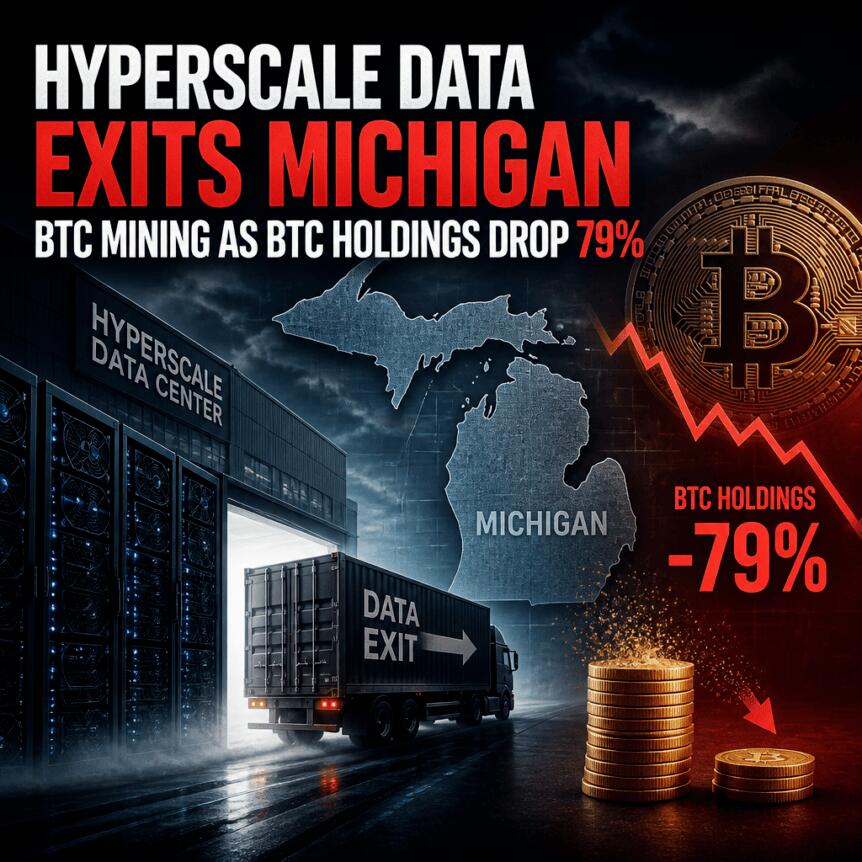
Hyperscale Data has permanently shut down Bitcoin mining at its Michigan facility, saying the move is part of its transition toward hosting an artificial intelligence (AI) data center customer. The company also plans to sell the mining equipment associated with the operation.
In a statement released this week, Hyperscale said all Bitcoin miners at the site were switched off following an inspection by an unnamed California-based neocloud provider. The shutdown comes as the company prepares the campus to fulfill requirements tied to an AI data center master services agreement that it expects could be worth approximately $1.2 billion, depending on how contract options are exercised.
Key takeaways
- Hyperscale Data has ceased Bitcoin mining at its Michigan facility as part of its shift toward AI data center infrastructure.
- The company says an inspection by a California-based neocloud provider preceded the miner shutdown, and it plans to sell the mining equipment.
- The AI customer contracted for 20 megawatts (MW) under a 10-year master services agreement with two optional five-year extensions.
- Hyperscale’s estimates—about $1.2 billion or potentially more than $3 billion—depend on whether extension options and additional capacity are taken.
- Following a one-for-five reverse stock split completed earlier this month, the stock fell to a split-adjusted record low according to Yahoo Finance data.
Bitcoin mining ends in Michigan to make room for AI capacity
Hyperscale’s decision reflects a broader corporate strategy: converting its Michigan operation from energy-intensive crypto mining to AI-focused compute services. The company said it is funding the transition through sales from its Bitcoin treasury, tying ongoing asset liquidation to the capital needs of the data center buildout.
Under the master services agreement, the AI customer contracted for 20 MW of computing capacity. The contract runs for 10 years, with two optional five-year extensions. Hyperscale indicated the agreement’s maximum term could yield more than $1.2 billion, but only if the customer exercises both extension options.
Hyperscale also outlined a scalability scenario. It said there is an additional 32 MW option that, if taken, could lift potential revenue above $3 billion. The Michigan site is expected to support up to 340 MW, suggesting the company sees room for further load beyond the initial contract window.
The company cautioned that its expansion plans remain preliminary and contingent on financing, approvals, and other risks. It further noted that the $1.2 billion estimate relies on the customer taking both extension options, while the larger $3 billion projection depends on securing the extra capacity option as well.
Why the shutdown matters for investors watching crypto “treasury-to-AI” pivots
For investors, the Michigan shutdown is significant less because it changes Bitcoin’s network economics and more because it highlights a repeatable playbook: liquidating Bitcoin holdings to fund infrastructure that competes for demand in the compute market—particularly AI workloads.
Hyperscale’s own framing links mining proceeds and treasury management to the AI transition. According to the company’s prior disclosures, it has been reducing its Bitcoin holdings while funding the buildout, including using arrangements that are described as BTC-backed credit to support the Michigan campus.
That context helps explain why the miner shutdown is treated by the market as an inflection point. When mining operations end at a specific facility, it can imply a longer-term shift in how the company expects to monetize its balance sheet—moving away from mining-related activity toward contracted compute services.
Stock reacts after reverse split; Bitcoin holdings continue to shrink
The operational shift coincided with renewed pressure on Hyperscale’s equity. Yahoo Finance data shows shares closed at $0.1984 on Wednesday, down about 17%, after touching an intraday low of $0.1932. The close marked a split-adjusted record low for the NYSE American-listed stock.
The decline followed the completion of a one-for-five reverse stock split. According to a filing with the US Securities and Exchange Commission, trading began on a split-adjusted basis on Aug. 25.
Separately, Hyperscale’s Bitcoin treasury drawdown has continued as it funds the AI expansion. Earlier coverage tied the company’s July moves to having held about 1,006 Bitcoin while selling 100 BTC and arranging a BTC-backed credit facility for the Michigan campus.
In late August, Hyperscale said it sold roughly 65 BTC for about $5.1 million during the week ending Aug. 30, stating that proceeds would provide additional capital for the Michigan development. BitcoinTreasuries.NET, which tracks public companies, lists Hyperscale as holding about 215 BTC, worth approximately $16.7 million—representing a large decline from the amount cited in July and ranking it 84th among companies tracked by the platform.
While these figures do not determine whether the AI buildout will succeed, they do offer a practical look at how the company is funding the pivot: by converting part of its Bitcoin exposure into cash or cash-equivalent liquidity.
What to watch next: contract execution and financing uncertainties
Hyperscale’s next milestones will likely hinge on whether the AI customer exercises the extension options attached to the 20 MW baseline and whether it chooses the additional 32 MW capacity option that would materially change Hyperscale’s revenue outlook. With the company explicitly warning that financing and approvals could affect the plan, the market will be watching for updates on funding progress, regulatory or site readiness steps, and the timeline for getting the AI infrastructure live.

Bitcoin (BTC) sat near $77,000 today, clawing back part of a slide that took it under $76,500 earlier in the week after fresh US-Iran strikes spooked the markets.
Analysts are now split on whether the dip was a shakeout before another push higher or the first sign of a deeper pullback.
Traders Watch the $83,000 Gap
Analyst NoName is watching the CME futures gap above the current price and considers $83,000 the line that decides what happens next. They wrote that Bitcoin needs “the level that separates a real reversal from another relief rally” with a daily close above it backed by real spot volume.
Without that close, they are treating the recent bounce as a retest of old supply rather than confirmation of a new uptrend, and their downside case is blunt: if $83,000 rejects and $74,000 gives way, they see room for a drop toward $50,000 to $55,000 before Bitcoin finds a real bottom.
But not everyone is reading the chart that way, including Doctor Profit, who dismissed calls for a new low outright, saying, “I consider the bear market as over.”
Another market watcher, Sykodelic, pointed to the monthly candle instead of shorter timeframes, citing the reversal structure, a bullish tick on the DSS Bressert indicator, and a flattening MACD.
He called the setup “not bearish, and never been bearish,” and said the monthly close held above the $76,400 level he had flagged as the line between confirming the reversal and voiding it.
Behind the argument sits a rough week. As CryptoPotato reported previously, Bitcoin got turned away at $79,000 more than once before the latest leg down pushed it under $76,500 for the first time since August 23, with renewed US-Iran fighting being the main trigger. You can hear more about that in the video below:
The primary cryptocurrency is now changing hands above $77,000, having traded between $76,300 and $77,800 in the last 24 hours. It’s down almost 2% for the week but still up nearly 22% for the month.
August’s Rare Green Candle Complicates the Picture
The pullback follows a month that broke a pattern, with BTC closing August up almost 25%, the first green August during a bear market stretch comparable to 2014, 2018, or 2022, when it fell between 9% and 18% at the same point in each cycle.
It was also the asset’s best August since 2017, when the month closed up more than 65%. Furthermore, the third quarter is already up close to 33%, with one month left to go.
That doesn’t change where Bitcoin sits against its cycle high, though. It remains down close to 30% for the year and more than 38% below its October 2025 peak of over $126,000, with dominance currently above 57%.
The post Bitcoin Could Crash to $50K if Bulls Fail This Crucial Test: Analyst appeared first on CryptoPotato.
IFCI shares rally over 16% in two days as NSE IPO draws closer

Cryptocurrency holders achieve recurring income through FTmining mining

Jennifer Aniston Pays Tribute to the Late Dolly Parton





-

 Fashion6 days ago
Weekend Open Thread: Maeve – Corporette.com
-

 Crypto World6 days ago
Bitcoin’s 22% rally now needs real demand to outlast Treasury liquidity boost
-

 Business6 days ago
Apple Confirms September 9 Keynote and Reveals Its Full Pre-Order Schedule
-

 Business6 days ago
Salesforce Stock Soars 19% as Blowout Earnings and Agentforce AI Growth Silence Software Skeptics
-

 Business5 days ago
Onto Innovation Stock: AI’s Next Bottleneck Is Yield (NYSE:ONTO)
-

 Crypto World8 hours ago
CLARITY Act could advance within weeks, Atkins says
-

 Crypto World5 days ago
Bitcoin price tests $82K resistance as Brandt stays long
-
 Tech4 days ago
Hugging Face built a $4.5 billion empire on free AI models. Now Nvidia is buying it for $12.9 billion
-

 Business6 days ago
iPhone 18 Pro Pre-Orders Could Shift to Saturday as Apple Reportedly Avoids September 11 Anniversary
-
 Crypto World6 days ago
Truflation calls for Fed rate cut after PCE forecast
-

 News Videos4 days ago
Charlie Munger on Robinhood: No one should believe that Robinhood’s trades are free
-

 Tech5 days ago
PaperCut releases second emergency patch for exploited flaws
-
 Business7 days ago
AI Assistant Startup Instinct Rockets to $2.5 Billion Valuation in Weeks Amid Investor Feeding Frenzy
-

 Tech6 days ago
The fix for the AI agent that hijacked a company’s DNS: it can propose the change, but it can’t approve it
-

 Tech4 days ago
Tamagotchi Ring Takes the 30-Year Digital Pet and Places it on Your Finger
-
 Entertainment6 days ago
‘Adults’ Creators Break Down Season 2’s Most Shocking Moments and Tease a Potential Season 3
-

 Tech4 days ago
As the influencer economy drives retail sales, Seattle startup raises $22M to play matchmaker
-
 NewsBeat4 days ago
Trump posts AI video of ‘Lake America’ being protected by an army of bequiffed ‘Donald Ducks’
-

 Crypto World1 day ago
Elon Musk Says Grok 4.7 Lands in 10 Days and Will Beat Every Model
-
 Entertainment3 days ago
Taylor Swift Reportedly ‘Frustrated’ With Travis Kelce After ‘Short’ Honeymoon
You must be logged in to post a comment Login