AUSTIN, Texas — Tesla has begun charging passengers for rides in the Cybercab, the two-seat electric car it built without a steering wheel, pedals or side mirrors, even as U.S. safety regulators opened a review of how the company certified that design as legal.
Paid trips started in Austin on Sept. 4, the day after an invitation-only launch at ACL Live. Riders hail the car through Tesla’s existing Robotaxi app, in the same geofenced area already served by driverless Model Y vehicles since June 2025. Users told reporters the Cybercab fare on identical routes was lower than the Model Y option. Tesla executives at the event described dynamic pricing and promised “a first-class experience at coach price.”
Elon Musk did not attend. In a promotional video released the same day, he called the Cybercab “the first car that is specifically built for unsupervised full self-driving.” In the days before the event he pinned a post that read, “A storm of Cybercabs.” Texas motor-vehicle records showed about 45 Cybercabs registered to Tesla’s robotaxi fleet as of late August. The company’s broader Texas robotaxi registration list stood near 420 vehicles, most of them Model Ys — fewer than half the nearly 1,000 vehicles Alphabet’s Waymo has registered in the state.
That gap between slogan and fleet size is the first fact that matters. The Cybercab is no longer a prototype on a studio lot. It is also not a mass service. Tesla held the launch without a public livestream. Presenters included lead engineer Eric Earley, vehicle-software head Silvio Brugada, designer Ian Kettle and autonomy chief Ashok Elluswamy. The talks lasted about 15 minutes. Tesla did not announce a consumer sticker price, a delivery calendar or the next Cybercab city.
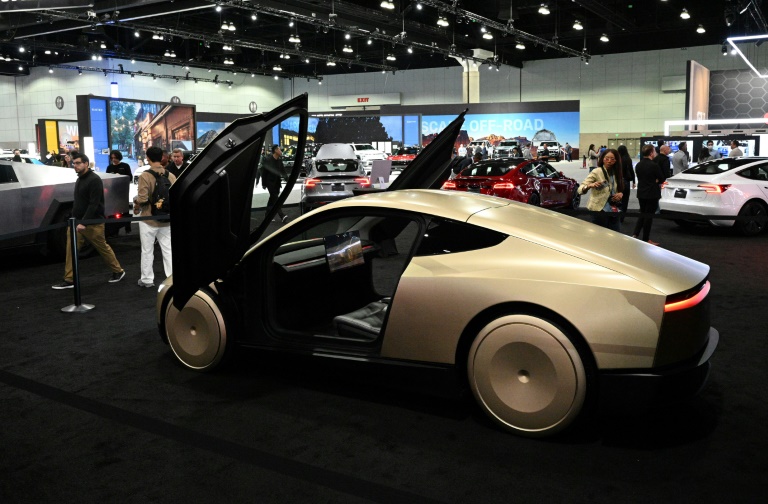
The hardware is the second fact. The production car is a two-door liftback with scissor, or butterfly, doors, a large cabin screen and a passenger stop button. Press the button and the vehicle is designed to pull over when it is safe and connect the rider to Robotaxi Support. There is no rear window in the conventional sense and no human controls. Some test units still carried a safety monitor in the front passenger seat. The commercial pitch is that those monitors eventually disappear.
EPA certification filings published in June filled in the third set of numbers. The Cybercab uses a single front-mounted permanent-magnet motor rated at 163 kilowatts, or 219 horsepower, and a lithium-ion pack of about 48 kilowatt-hours. Curb weight is 3,113 pounds (1,412 kilograms), light for an electric car sold in the United States. Unadjusted laboratory combined range was 418.2 miles; applying the standard adjustment yields about 293 miles, in line with Tesla’s earlier “close to 300 miles” language. Energy use in the filing works out to roughly 165 watt-hours per mile. Payload is listed at 617 pounds.
Those specs explain why Tesla wants this body instead of a Model Y with the seats ripped out. A smaller pack, two seats and no driving hardware cut weight and cost if the software can actually drive. They also explain the regulatory fight. On Sept. 4 the National Highway Traffic Safety Administration opened an audit of the process and technical data Tesla used when it self-certified the wheel-free, pedal-free vehicle as meeting federal safety standards. The probe does not by itself pull cars off Austin streets. It does put a federal file on the feature that makes the Cybercab different from every other Tesla in the ride-hail mix.
Production is the fifth fact, and it is real but narrow. Tesla said the first production unit left Gigafactory Texas in February 2026. Formal production followed in April. Musk had said on X, “Cybercab, which has no pedals or steering wheel, starts production in April.” In January he warned that the start would not look like a Model Y ramp: “For Cybercab and Optimus, almost everything is new, so the early production rate will be agonizingly slow, but eventually end up being insanely fast.” Tesla’s second-quarter update in July dropped the Cybercab from the sentence that had promised volume production in 2026 for Cybercab, the Semi and Megapack 3. The factory line in Texas is described as having capacity above 125,000 vehicles a year. Capacity is not the same as cars in paid service.
Manufacturing method is the sixth. Tesla is using an “unboxed” process that builds large modules in parallel and joins them at the end, aiming to shrink paint-shop work and line length. Earley told the Austin audience, “We’ve unlocked a 50% reduction in line size while increasing the output of the line.” Company materials have cited a smaller factory footprint and lower labor cost versus a conventional line. The long-term cycle-time boast — a finished Cybercab every 10 seconds — remains a target, not a published factory rate.
Price is the seventh. Musk said in 2024 the vehicle would cost under $30,000 and has since answered that consumers should be able to buy one. The September launch did not confirm an MSRP. Tesla began circulating a robotaxi interest form aimed at fleet buyers and infrastructure partners. An interest form is not an order bank. Musk has still said Tesla intends to sell Cybercabs to customers, not only run them in its own fleet. That sale would require the same autonomy software — and the same regulators — that now govern the Austin rides.
Software is the eighth, and it is the constraint Musk himself has named. “This is a very important step, to put the Cybercab in production, but ultimately, it only matters if the software can allow a car to navigate safely,” he has said of the program. He has also told investors, “Really, we should be thought of as an AI robotics company,” and, “If somebody doesn’t believe Tesla is going to solve autonomy, I think they should not be an investor in the company.” Launch Cybercabs use Tesla’s camera-based system and AI4-class hardware. A later AI5 computer has been discussed for mid-2027. Competitors such as Waymo still use lidar and radar and operate in more U.S. metros.
Geography is the ninth. Austin is the Cybercab city. Tesla’s Model Y robotaxi service has also appeared in Dallas, Houston and Florida markets including Miami, Orlando and Tampa, with permits discussed for Arizona and Nevada. The company said Cybercabs would go on public display in Beijing, Shanghai and other Chinese cities from mid-September as design exhibits, not as a sales or robotaxi launch in China. Elluswamy posted, “The streets won’t be the same anymore.” Asked whether Cybercabs would “flood Austin,” Musk replied, “Yes.” Forty-five registered cars is not a flood.
The tenth fact is what the launch did not settle. Tesla did not say when unsupervised Cybercab rides will run without a monitor in every market, when volume production returns to the official forecast, or how NHTSA’s file will end. Morgan Stanley’s Andrew Percoco wrote before the event that a mere unveiling with few cars on the road could pressure the stock, while a rollout that materially enlarged the fleet could support it. Shares jumped ahead of Thursday’s show, then fell after the quiet debut and the regulator’s notice.
What exists today is simpler than the decade of robotaxi promises that preceded it. A purpose-built two-seater is in limited paid service in one Texas city. It has no wheel. It has a stop button. It is cheaper on some routes than Tesla’s own Model Y robotaxi. It is outnumbered by Waymo in Texas and by Tesla’s own Model Ys in the same app. The factory can make more. The software, the certifications and the next city list will decide whether “a storm of Cybercabs” is a product plan or a pinned post.










































You must be logged in to post a comment Login