Connect with us

NewsBeat

Bravery under Pressure: Andrew Scott goes down a storm as the hero weatherman who saved D-Day from disaster: BRIAN VINER

Published

on

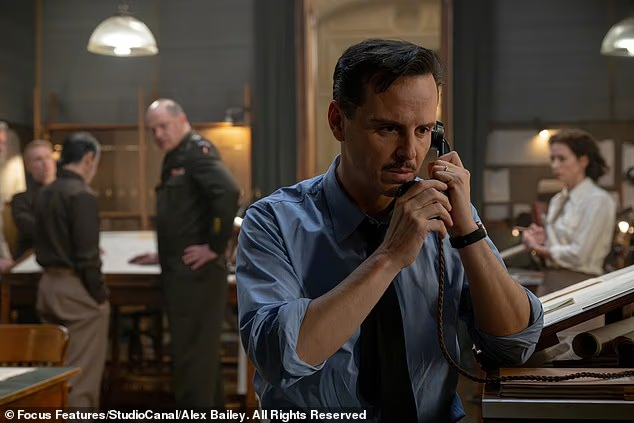
Andrew Scott is reliably splendid as the reserved, rather charmless Scottish meteorologist Group Captain James Stagg

Pressure

VERDICT: (Four stars out of five) Thunderously good

The story at the heart of this absorbing film is true, or mostly true, but if it weren’t you’d think it had been machine-tooled to appeal to a British audience. After all, it focuses on two of our three great preoccupations: the Second World War and the weather. Only the Royal Family is missing.

Adapted by David Haig from his own stage hit, it stars Andrew Scott as Group Captain James Stagg, the doughty Scottish meteorologist who advises General Dwight D Eisenhower (Brendan Fraser) not to launch Operation Overlord, the Allied invasion of Nazi-occupied France, on Monday, June 5, 1944.

Advertisement

That is the date Eisenhower has designated as D-Day and even a short postponement could be calamitous. Such a colossal military enterprise cannot possibly be kept secret from the Germans for much longer. But Stagg’s analysis of the available data has convinced him that a major storm, brewing in the Atlantic, is heading for Normandy.

To launch the invasion in such conditions, with waves possibly as high as 15ft, will be even more disastrous than delaying. He suggests waiting until June 18, by which time the weather should be calmer.

At command headquarters in Hampshire, Eisenhower and other top brass are aghast, especially the truculent General Bernard Montgomery (Damian Lewis, pronouncing his Rs as Ws with twemendous gusto), who almost blows a gasket.

A fortnight’s delay is unthinkable. The invasion will fail. ‘Do you want to be personally wesponsible for losing this war, Captain Stagg?’ rages Monty. The question, not that he has any chance of pronouncing it, is rhetorical.

Advertisement

So, the title of the film, and the play before it, is neatly ambiguous. High and low pressure systems are exerting almost intolerable stress on Stagg, compounded by conflicting advice from a meteorologist in the US camp, Colonel Irving Krick (Chris Messina) who, preferring to predict the weather by examining patterns going back as far as 1904, declares confidently that it will be fine on June 5.

Andrew Scott is reliably splendid as the reserved, rather charmless Scottish meteorologist Group Captain James Stagg

Damian Lewis as the truculent General Bernard 'Monty' Montgomery, who 'pronounces his Rs as Ws with twemendous gusto'

Damian Lewis as the truculent General Bernard ‘Monty’ Montgomery, who ‘pronounces his Rs as Ws with twemendous gusto’

Advertisement

Krick pompously adds that he accompanied Eisenhower through North Africa and got his forecasts right every time. To which a modern-day response might be to invoke Caroline Aherne’s immortal Mediterranean weathergirl in The Fast Show, who – as she slaps fat suns on the map – proclaims: ‘Scorchio! Scorchio! Scorchio!’ Stagg merely notes dryly that Krick was lucky to be operating in such ‘stable’ conditions.

It’s easy to see why all this unfolded so compellingly on the stage. It is inherently theatrical rather than filmic, and, heaven knows, dialogue about millibars and cumulus clouds does not necessarily get the pulse racing.

And yet, even if a sub-plot about Stagg’s lovely wife going into labour at the height of the drama seems a little confected, and even though we all know the outcome of D-Day (which in the event was postponed by just 24 hours after Sir James correctly anticipated a break in the storm), director Anthony Maras makes a thoroughly decent job of turning the story into a bona fide thriller.

It opens arrestingly, too, and very cinematically, with overhead shots of dead and dying American troops, victims of Exercise Tiger, the catastrophic April 1944 rehearsal at Slapton Sands in Devon in which more than 700 men perished.

Advertisement

Six weeks later, Eisenhower is still haunted by the memory. But should that make him more or less reliant on Stagg’s advice? He prepares two statements, one to announce a triumph, the other a disaster.

For real events like this to be stirringly recreated, the acting and writing must be spot-on. They are. Scott is reliably splendid as the reserved, rather charmless Stagg, ably supported by Fraser, Lewis, Messina and Kerry Condon as Eisenhower’s confidante Kay Summersby, his Irish personal secretary and, it was strongly rumoured, lover.

Historians are divided on that. What is not in doubt, incidentally, is Eisenhower’s height, and Stagg’s. In the film the general towers over the captain. In reality it was the other way round. Stagg’s older son Peter, born in 1941, inherited from his father what in the circumstances we might call his altitude. At a mighty 6ft 10in, he played rugby union for Scotland and the British Lions. What a family. What a tale.

Pressure opens in cinemas tomorrow

Advertisement

Source link

Continue Reading
Click to comment

You must be logged in to post a comment Login

Leave a Reply

NewsBeat

How Facebook’s News Feed introduced the age of the algorithm 20 years ago

Published

on

How Facebook’s revolutionary News Feed kicked off the age of algorithms

It is two decades since Facebook introduced the News Feed – letting loose a world in which algorithms would shape ever more of our lives.

In 2006, Facebook was facing something of a crisis. Its internal data suggested that for the first time since its launch two years earlier (as TheFacebook), the company had stopped growing. People weren’t joining, and existing users weren’t spending more time on the site.

The solution co-founder Mark Zuckerberg and colleagues came up with, the News Feed, meant individual users’ homepages would be automatically updated with information tailored to them – in particular, new posts their Facebook friends had added.

Up to then, users had to actively check their friends’ profiles to see what they were up to. Now, this information would automatically be sent to your homepage. With it, a new world of algorithmic interaction was born.

Advertisement

It might seem quaint now, but for many Facebook users at the time, these changes felt like a violation of their privacy and trust. If you were to change your relationship status from “in a relationship” to “it’s complicated”, for example, this could now be broadcast to all of your online friends.

The News Feed caused the first major protest against Facebook. Tens of thousands of users joined a group calling for the return of the original system. A spontaneous protest emerged outside Facebook’s office in the city of Palo Alto, California. For the first time, the company felt it had to hire security guards.

Video: Mashable.

Zuckerberg issued a sort-of-apology, but he didn’t back down. What he and other Facebook engineers could see was that, rather than pushing people away from the site, the News Feed was driving more engagement – leading users to spend more and more time on the platform.

Advertisement

A revolution in media consumption

Twenty years later, we can understand this development as one of the most significant socio-technical changes of the entire digital revolution. It ushered in an age where algorithmic systems structured how people interacted, consumed news and conducted political activity.

Crucially, to enable this new “content pushing” approach, Facebook engineers had to build a new digital architecture that moved the site away from being a static social network, into an algorithmic system built around the extraction and analysis of user data.

Under this new system, in the words of researchers Christina Alaiamo and Jannis Kallinikos, Facebook users could be “computed on the basis of discrete and countable activities”, turning them into “identifiable, knowable and actionable objects”.

Facebook had thus shifted from a site primarily enabling social interaction to one concerned with the production and commercialisation of knowledge. With increasing accuracy, it understood what type of content kept users on the site longer – and what type of information could influence people’s behaviour outside and beyond the site.

Advertisement

Facebook could now continuously optimise the level of social interactions using its algorithmic ranking system, Edge Rank. With a tweak, it could switch from prioritising messages from close friends to content that generated greater interaction, or outrage.

This took power away from users towards the corporation, and raised concerns that users were spending more time on the site than they seemed to want to. (Eventually, this would lead to a “major overhaul” of the News Feed in 2018, with Facebook promising to re-prioritise “meaningful social interactions” over “relevant content”.)

But above all, Facebook’s innovation in 2006 enabled it to capture huge amounts of user data that would, over the next two decades, enable it to expand globally at an astonishing rate – and generate vast amounts of revenue in the process.

Advertisement
Video: CBS New York.

A very different algorithmic age

Twenty years on, Facebook’s parent company Meta and other big tech platforms face challenges far more powerful than spontaneous protests on the streets of Palo Alto. Across the world, there is sustained activity from democratic institutions and states to contain the power and perceived harm of the algorithmic systems that emerged from 2006.

In Australia, use of social media platforms by under-16s is banned, and this is potentially spreading to the UK. Meanwhile, courts in the US have forced Meta to restrict the amount of access that children have to their products. While less than 1% of Facebook’s revenue comes from teens, the precedents set by these legal cases appear significant.

However, we also live in a very different algorithmic age than the one heralded by the launch of the News Feed 20 years ago. While Meta continues to derive most of its revenue from its social network platforms, which also include Instagram and WhatsApp, recent investments and prospective AI product launches suggest its leadership believe future revenue streams will largely be tied to developments in machine learning, large language models and “superintelligence”.

The question is: will governments and other institutions react more quickly to the concerns raised by this new era of AI development than they did to the emergence of algorithms two decades ago? On past evidence, this looks unlikely.

Advertisement

Source link

Continue Reading

NewsBeat

Get ready for an unbalanced American League postseason bracket

Published

on

Get ready for an unbalanced American League postseason bracket

When the baseball postseason starts in a few weeks, the format will probably be a major discussion topic.

If the playoffs began now, these would be the seeds in the American League:

1. Tampa Bay (85-58)

2. Chicago White Sox (75-68)

Advertisement

3. Houston (73-71)

4. New York Yankees (81-62)

5. Boston (79-65)

6. Cleveland (73-71)

Advertisement

That means the teams with the two worst records — Houston and Cleveland, would face each other in the opening round, with the winner taking on the White Sox in the Division Series. Meanwhile, the teams with the three best records would all be on the other side of the bracket, fighting for one spot in the AL Championship Series.

The reason the matchups are on track to work out this way is because the White Sox and Houston would be seeded above the Yankees and Red Sox by virtue of being division champions. After all, if division titles don’t mean anything, what’s the point in having them?

But the question that is likely to come up is this: Why not re-seed the field after the Wild Card round, with the top seed facing the No. 6 seed if it advances? Or the seeds could be reassigned completely for the Division Series based on regular-season record, meaning if Houston wins in the first round, the Astros would be the team with the worst remaining record and would face the Rays.

Instead, the way the system is currently set up, top-seeded Tampa Bay would face either the team with the second-best record in the league or the team with the third-best mark. Not exactly a big reward.

Advertisement

Performance of the week

Alex Bregman hit three home runs Monday night to lift the Chicago Cubs to a 17-3 win over Milwaukee. The Cubs hit nine homers in the game, one shy of the major league record, and they finished the month of August with 62. Chicago now leads the majors with 201 home runs.

Trivia time

The Cubs haven’t led the majors in home runs since 1958. In a 154-game season before the designated hitter rule, 182 homers was enough to finish first. How many players on that team reached 30 home runs?

Comeback of the week

The Colorado Rockies were down to their final out in both the ninth and 11th innings against Baltimore on Wednesday. With nobody on in the ninth and the Orioles up 3-2, Cole Carrigg and Zac Veen hit consecutive doubles to tie it.

Then in the 11th, after Baltimore took a 5-3 lead, TJ Rumfield hit an RBI single. Two outs later, Adael Amador hit a ground-rule double to put men on second and third, and Brett Sullivan followed with a two-run single to win it.

Advertisement

Baltimore’s win probability in the ninth was 95.3% according to Baseball Savant. That defeat was part of a skid for the Orioles that has reached six games, knocking them four games off the pace in the race for the AL’s last postseason spot.

Team of the week

In a week when everyone lost at last twice, the Boston Red Sox come out on top with a 5-2 mark. If the Red Sox and Yankees end up meeting in a Wild Card Series, there’s now a chance it could end up happening at Fenway Park instead of Yankee Stadium. However, New York still has a 2 1/2-game lead on Boston, plus the head-to-head tiebreaker.

The Red Sox took four in a row in Baltimore, holding the Orioles to one run over the final three games.

Trivia answer

Just one player on the 1958 Cubs hit 30 homers — Ernie Banks had 47. Chicago did have four other players with at least 20 — Walt Moryn, Lee Walls, Bobby Thomson and Dale Long.

Advertisement

___

See AP’s full MLB coverage here

Advertisement

Source link

Continue Reading

NewsBeat

Falcons select Tua Tagovailoa as Week 1 starter over Michael Penix Jr.

Published

on

Falcons select Tua Tagovailoa as Week 1 starter over Michael Penix Jr.

FLOWERY BRANCH, Ga. (AP) — Tua Tagovailoa has been selected as the Atlanta Falcons’ starting quarterback for Week 1 against the Pittsburgh Steelers, the team announced Monday.

The decision comes after Tagovailoa’s monthslong competition with Michael Penix Jr., who started nine games for the Falcons in 2025 before suffering a season-ending torn ACL in November.

Coach Kevin Stefanski said Monday that Cooper Rush will back up Tagovailoa and Penix will be inactive. He declined to speculate on who the team might start at QB beyond Week 1.

Tagovailoa received more reps throughout training camp. Penix was cleared for 11-on-11 drills on Aug. 22, but did not appear in any preseason games for the Falcons.

Advertisement

“Of course, Mike just getting back to 11-on-11, wanted to make sure we gave him an opportunity in these practices, and we did,” Stefanski said Monday. “But feel strongly about our decision with everything, all the information available to us.”

Penix said Monday that Stefanski met with both quarterbacks when selecting the Week 1 starter. Penix alluded to not feeling quite ready yet, but he said he’s “really close.”

“I want to be stronger. I want to be able to go out there and give the team 100%, and if I don’t feel like I can do that, I don’t want to,” Penix said. “That’s not fair for this team. That’s not fair for this organization. I want to make sure whenever I am out there, I’m 100%. There’s no doubt in my mind that I trust my knee.”

Tagovailoa started the Falcons’ first and final preseason games, splitting time with Strand and Rush. He was 7 of 8 for 95 yards in three drives against his former team, the Miami Dolphins, in Atlanta’s third exhibition. He led an eight-play, 60-yard touchdown drive in Atlanta’s opening drive and lost a fumble in his second. The Falcons beat the Dolphins 17-12.

Advertisement

Stefanski first addressed the quarterback group as a whole, which consists of Tagovailoa, Penix, Rush and undrafted rookie Jack Strand.

“Really, really proud of those guys,” he said. “Those guys have worked like crazy all offseason, and they’ve pushed each other, supported each other, and that’s what we’ll do for Tua. We’ll continue to support him and understand that this is a collective group that is constantly looking to help each other.”

Tagovailoa signed a one-year deal with the Falcons in March following a six-year stint with the Dolphins. Miami is on the hook for a $99.2 million dead cap hit over the next two seasons after giving Tagovailoa a four-year, $212.5 million contract extension in 2024.

“I’ve gotten to see Tua work from the spring until now,” Stefanski said. “New system for all these guys, and like I told them, there’s a lot of newness with our players, coaches and, you know, everybody getting up to speed, and he’s done a really nice job of working at it. … I think he’s really put himself in position to go be the best version of himself.”

Advertisement

Tagovailoa’s first start for Atlanta will be at the site of his last with Miami. The quarterback was benched for rookie Quinn Ewers following the Dolphins’ 28-15 loss in Pittsburgh on Dec. 15.

___

See AP’s full NFL coverage here

Advertisement

Source link

Continue Reading

NewsBeat

Transfer news LIVE: Arsenal FC triple agreement; Man Utd announce done deal; Chelsea, Liverpool latest

Published

on

Transfer news LIVE: Arsenal FC medical; €100m Chelsea target; Richarlison Turkey deadline; Man Utd, Liverpool latest

The summer window in Europe may be over, but the work doesn’t stop elsewhere. Saudi Pro League clubs have until October 12, and Premier League players, such as Richarlison, could be of interest, while the likes of Arsenal, Manchester United, Chelsea, Liverpool and Tottenham start forming plans for January.

Source link

Continue Reading

NewsBeat

Geography teacher, 69, is sacked from girls’ boarding school after accidentally showing pupils his YouTube search history – which included ‘teen bikini haul’

Published

on

James Hindson was teaching a geography lesson at £45,000-a-year Moreton Hall School in Shropshire when his YouTube search bar was shown to pupils

Advertisement

A teacher at a prestigious girls’ boarding school has been banned from the classroom after pupils were accidentally shown his YouTube search history – containing terms including ‘girls in thongs’.

James Hindson was teaching a geography lesson at £45,000-a-year Moreton Hall School in Shropshire when he clicked on the YouTube search bar, causing previous searches linked to his account to appear on a large classroom screen.

Pupils reported seeing terms including ‘teen bikini haul’ and ‘girls in thongs’ during the lesson on May 7 last year, a misconduct panel was told.

Hindson, 69, who was also a church warden, was struck from the teaching register for two years after admitting unacceptable professional conduct. 

Advertisement

The Teaching Regulation Agency heard how pupils raised concerns after the search terms were shown during the lesson. 

The married father of three was dismissed after a school IT investigation revealed ‘common themes of searches being for teens in little clothing, teens engaging in athletic activity, or relating to sexual activity’ between 2021 and 2023.

Mr Hindson told the investigation that he had accidentally shown his previous searches while attempting to find a YouTube clip for use in a lesson about global trade.

He did not deny making the searches – which included ‘teens having sex’, ‘teens stripping’ and ‘teen first time sex’ – and said they had been conducted at home.

Advertisement

James Hindson was teaching a geography lesson at £45,000-a-year Moreton Hall School in Shropshire when his YouTube search bar was shown to pupils

Panel chair Alan Wells said: ‘The searches were consistently focused on teenagers, with repeated reference to “teens”.

‘The panel placed weight on both the volume of searches and the extended period over which they were undertaken, which demonstrated a sustained pattern of behaviour rather than isolated incidents.

Advertisement

‘The panel considered it highly relevant that Mr Hindson was teaching secondary-aged pupils at an all-girls’ boarding school and that the subject matter of the searches closely reflected the age group of the pupils in his care.

‘The panel also noted that some of the search terms were displayed during a lesson and, whilst it accepted that Mr Hindson may not have appreciated that his personal search activity could be linked to, and accessible through, his school account, and that he had not deliberately shown the search terms to pupils, it nevertheless considered that he bore responsibility.’

The panel ruled that Hindson’s conduct was sexually motivated and found his actions fell ‘significantly short’ of the standards expected of teachers.

In mitigation, regulators heard evidence of Hindson’s contribution to education, in which he was described as ‘dependable and hardworking’.

Advertisement

In written submissions, Hindson said he was ‘ashamed’ of his behaviour, and ‘the harm it has already caused to a number of students’.

The panel agreed he had shown remorse but said his prohibition was needed to maintain public confidence in teachers.

Signing off on the ban, civil servant Marc Cavey said: ‘I am particularly mindful of the finding in this case of a teacher using sexually themed search terms focused on teenagers over an extended period, as well as allowing some of those search terms to be displayed to his pupils, and the negative impact that such a finding is likely to have on the reputation of the profession.’

Hindson is now banned indefinitely from teaching in any school, sixth-form college or children’s home in England and Wales. He cannot apply for the order to be set aside for two years.

Advertisement

Advertisement

Source link

Continue Reading

NewsBeat

Pamela Anderson recalls being given ’10 years to live’ when she was diagnosed with hepatitis C and says she’s ‘still haunted by shame and guilt’

Published

on

Pamela Anderson, 59, has recalled the time she was given '10 years to live' when she was diagnosed with hepatitis C

Pamela Anderson has recalled the time she was given ’10 years to live’ when she was diagnosed with hepatitis C.

The Baywatch actress, 59, contracted the blood-borne illness around 1999 after she shared a tattoo needle with her ex-husband, Tommy Lee.

Pamela said it felt like ‘a death sentence’ after doctors told her it was a terminal diagnosis and she would not live past another decade. 

However, she announced in 2015 that she was completely cured of hepatitis C after living with the virus for 16 years.

Advertisement

Speaking at the amfAR Gala in Venice last weekend, Pamela admitted she is ‘still haunted by shame and guilt’. 

Pamela, who shares sons Brandon, 30, and Dylan, 28, with Tommy, said: ‘It was a death sentence. That’s what my doctor told me – that I probably had around 10 years to live.’

‘I’m sure that coloured and corrupted my decisions. It was not fear of death, but fear of what might happen to my young children. It turned my life inside out,’ Variety reported.

Advertisement

Pamela Anderson, 59, has recalled the time she was given ’10 years to live’ when she was diagnosed with hepatitis C

The Baywatch actress contracted the blood-borne illness around 1999 after she shared a tattoo needle with her ex-husband, Tommy Lee (pictured in 1999)

The Baywatch actress contracted the blood-borne illness around 1999 after she shared a tattoo needle with her ex-husband, Tommy Lee (pictured in 1999)

She continued: ‘But my experience of shame and guilt was also an unconscious journey. It stays with me; it haunts me.

‘And just like the sexual abuse that I endured as a child, it felt like it was carved into my forehead: Damaged goods. And I presented myself as such.’

Advertisement

A cure for the infection was discovered in 2011 and by 2015, Pamela was ‘hep C free’, though at a financial cost.

She admitted: ‘It took everything I had in my bank [to pay for treatment].’

Pamela still hasn’t ‘fully recovered’ from the news of her diagnosis but has ‘finally come to terms’ with it and used it to fuel her career resurgence.

The Last Showgirl star said: ‘My truth has come through my work, finding ways to express myself through the arts. It gave me the ammunition I needed, a fertile life to use and play in.

Advertisement

‘I’m not a victim, I’m a victor. I am strong and capable, more now than I could ever dream of … I’m not the damsel in distress, no matter how easy that role is to play.’

Pamela is at the Film Festival to promote her new film, Place To Be, and to receive a prestigious award at the amfAR Gala. 

The actress rose to fame as lifeguard C J Parker on Baywatch in the 1990s. 

Pamela, who shares sons Brandon, 30, and Dylan, 28, (seen) with Tommy, said: 'It was a death sentence. That's what my doctor told me - that I probably had around 10 years to live'

Pamela, who shares sons Brandon, 30, and Dylan, 28, (seen) with Tommy, said: ‘It was a death sentence. That’s what my doctor told me – that I probably had around 10 years to live’

Advertisement

She appeared in 77 episodes, in series three to seven, and later reprised her role in the 2003 reunion movie, Baywatch: Hawaiian Wedding.

Reflecting on her time on Baywatch during a chat with Deadline earlier this summer, the screen star said: ‘It was a great job, and I loved going to work every day on the beach. 

‘I would have been there anyway,’ she added with a laugh. ‘At the time, it taught me a lot, and it gave me worldwide exposure.

‘Everything I’ve done has led me to here, which is a blessing. But I have no plans of going back to Baywatch.’ 

Advertisement

When she was asked if she wanted to know where her character ended up following Baywatch being rebooted, she candidly replied: ‘If my kids were involved, I probably would have listened to them.’ 

Source link

Continue Reading

NewsBeat

Syrian reactor could have been used for nuclear weapons, IAEA says

Published

on

Syrian reactor could have been used for nuclear weapons, IAEA says

VIENNA (AP) — The Assad-era government in Syria was constructing a nuclear reactor that was configured to produce fissile material for possible use in nuclear weapons, the head of the International Atomic Energy Agency said on Monday.

The “configuration” and the “technical features” of the nuclear reactor under construction in Syria during the leadership of ousted former President Bashar Assad were “very efficient in the production of fissile material that could be directly used for the fabrication of nuclear weapons,” IAEA director general Rafael Grossi said.

“Of course, that was never declared, that was always denied, so, and again, intentions cannot be judged, but that was a very serious proliferation concern that we had, and this has been difficult work,” he told reporters on the first day of a regular meeting of the IAEA Board of Governors, in Vienna.

Syria was believed to have operated an extensive undeclared nuclear program under Assad that included a nuclear reactor built by North Korea in eastern Deir el-Zour province.

Advertisement

Following Assad’s ouster, the new government agreed to give IAEA inspectors access to suspected former nuclear sites.

During a visit to Syria in August, IAEA inspectors confirmed that “the cooling infrastructure which has now been uncovered is consistent with that of a nuclear reactor.” Grossi and a team of senior inspectors also visited a previously undeclared site in the country.

Inspectors had to ‘tear down walls’ to find hidden material

Syria notified the agency of the site’s existence in a July 17 letter and invited the IAEA “to cooperate with the Syrian authorities in the inspection and verification of the site and of any nuclear material to be potentially found.”

The IAEA said in its confidential report circulated to member states last Tuesday and seen by The Associated Press that this new site contained “natural uranium metal in the form of fuel rods with cladding.” The agency verified the material and confirmed “the presence of around 73 tonnes of natural uranium metal.”

Advertisement

Grossi said when the inspectors visited the site in August they had to “tear down walls” and go through “very difficult and narrow passages” to reach the nuclear material that had been hidden. The site had “boxes scattered all over the place,” he said.

Grossi said that “the important thing is that this material now is under safeguards” of the IAEA, adding that agency inspectors had managed to install cameras at the location.

Syria to decide what happens next

Asked if the nuclear material will remain in Syria or be removed, Grossi said that this is “a matter that the Syrian government will have to decide.” He added: “We are not requesting them to do this or to do that. For us what’s important is that we know all the time where this (material) is until the last gram.”

Logan Mintz, a director for nuclear materials security at the Washington-based Nuclear Threat Initiative, said that natural uranium metal is not directly usable for a nuclear weapon but it could be “diverted to a covert weapons program that further processes it into plutonium for a nuclear weapon.”

Advertisement

She said that once deemed safe to move, the material could be “transported in certified containers” to a third country that can “safely and securely disposition it into a more chemically stable and more widely used form” for possible use in nuclear power plants.

“As with any transport of nuclear material, this movement would require robust security from theft or sabotage,” she said.

Advertisement

—- The Associated Press receives financial support from multiple private foundations. AP is solely responsible for all content. Find AP’s standards for working with philanthropies, a list of supporters and funded coverage areas at AP.org.

Source link

Advertisement
Continue Reading

NewsBeat

King clarifies status of Prince Harry and Meghan

Published

on

King clarifies status of Prince Harry and Meghan

LONDON (AP) — King Charles III has reiterated that Prince Harry and his wife, Meghan, remain non-working members of the royal family following their return to the United Kingdom.

A letter sent on behalf of the king to senior government officials said the couple will continue to refrain from using their royal titles as they have done since stepping back from official royal duties in 2020. Any charity work the couple undertakes will be carried out in a private capacity, and operational security decisions are matters for the relevant police agencies, the letter adds.

The letter was sent by the Lord Chamberlain, the most senior official in the royal household, to senior officials in the government and military, as well as lord lieutenants, the king’s personal representatives around the country.

“To help avoid doubt or confusion, The King has directed that (this) information be shared,” the letter says.

Advertisement

While the communication simply confirms that Harry and Meghan’s status remains unchanged, the decision to send the letter and release it publicly demonstrates the concern among some palace observers that the couple’s status could allow them to become a sort of parallel royal court, competing with working members of the royal family.

The security question is particularly sensitive because Harry has fought a long-running battle with the government for the restoration of publicly funded police protection, which was canceled when the couple gave up their royal roles.

The decision about whether to restore the couple’s round-the-clock police protection is a matter for a government panel known as RAVEC, or the Royal and VIP Executive Committee.

“Any specific questions from official and State organizations about the courtesies which should be extended to the Duke and Duchess, and particularly where recourse to public funds may be required, should be directed to Buckingham Palace,” the Lord Chamberlain said in his letter.

Advertisement

Source link

Advertisement
Continue Reading

NewsBeat

Premier League clubs will not mark 9/11 anniversary this weekend after new guidance

Published

on

Daily Mirror

This weekend will mark the 25th anniversary of 9/11 but the Premier League has no plans to hold any tributes as they follow new guidance

The Premier League and clubs across the Football League will not be marking the 25th anniversary of 9/11 during this weekend’s matches.

Advertisement

It follows a change in approach that was adopted last year with English football no longer holding automatic minute’s silences for global disasters. It comes after a working group found that such gestures were losing their impact.

A total of 67 Brits were killed 25 years ago on Friday in New York following a series of atrocities in the United States, which targeted the two World Trade Centre building, but nothing is planned to remember the atrocities, reports the Daily Mail.

English football will now only have tributes for international incidents with a direct link to football. An example being last year when the two Manchester clubs undertook a minute’s silence following an attack on a synagogue in the city.

Friday marks a quarter of a century since the 9/11 attacks but no Premier League games are scheduled. The only game that night is in the Championship where West Ham United host Wrexham at the London Stadium.

Advertisement

On the tenth anniversary of 9/11, in 2011, a moment’s silence was held before both Premier League matches held on the Sunday whilst players also wore black armbands.

The FA have faced criticism for seemingly picking and choosing which events to recognise. They are previously called out after failing to light up the Wembley arch following the October 7 terror attacks in Israel in 2023, especially as they had previously done so in solidarity with Ukraine following Russia ’s invasion.

As is done annually, sporting events across the US will continue to remember those who lost their lives on that day in September. At the New York Giants’ clash with the Dallas Cowboys on Sunday night, players, coaches and staff from both sides will wear commemorative hats on the sideline in recognition of first responders.

Advertisement

On Friday there is a baseball clash between the two New York franchises – the Yankees and the Mets – at the Yankee Stadium in the Bronx. They will host a series of pre-game ceremonies.

Join our new WhatsApp community and receive your daily dose of Mirror Football content. We also treat our community members to special offers, promotions, and adverts from us and our partners. If you don’t like our community, you can check out any time you like. If you’re curious, you can read our Privacy Notice.

Essential 26/27 Sky Sports Bundle

This article contains affiliate links, we will receive a commission on any sales we generate from it. Learn more
Content Image

£51

£35

Advertisement

Sky

Get the deal here

Sky’s Essential TV and Sky Sports bundle includes at least 215 live Premier League clashes across the 2026/27 season, with more than 1,500 games from the EFL and beyond, plus F1, golf and darts.

This introductory offer saves £384 compared to the standard price, with every package also providing 100 regular channels alongside free Netflix and discovery+ subscriptions.

Source link

Advertisement
Continue Reading

NewsBeat

Irish League football fans warned by PSNI ‘face the consequences’ over pre-arranged fights

Published

on

Belfast Live

“We will continue to work with football clubs to address any criminal activity linked to people attending matches and ensure that supporters are kept safe.”

Police have issued a stern warning to football fans following a number of recent incidents involving pre-arranged fights at matches.

Advertisement

This comes after recent violence at Shamrock Park during a clash between Coleraine and Portadown on 28th August, where a group of Portadown supporters were reported to have pushed through a gate separating the home and away ends at half-time, with stewards rushing to split the factions and restore order as fighting broke out.

The PSNI have warned those engaging in the violence that they could face “far-reaching” consequences if caught.

Police Service of Northern Ireland Football Co-ordinator, Inspector Gary McCullough said: “The overwhelming majority of fans that attend matches do so to support their club and to have an enjoyable day out with friends and family. They do not want disruption, disorder or criminal behaviour of any kind inside or outside the grounds.

“At football matches, or indeed any event which draws significant numbers of people, police work closely with stewards and event organisers to ensure the delivery of a safe event. It is critical that anyone who chooses to engage in violent confrontations with other fans should understand that their behaviour is unacceptable and, if detected by police, will face consequences that can be far-reaching and can seriously impact their future opportunities for work and travel.

Advertisement

“To parents and guardians, please help prevent young people from becoming involved in these activities. Know where your children are, who they are with, what they are doing and what they are arranging on their social media accounts.

“We will continue to work with football clubs to address any criminal activity linked to people attending matches and ensure that supporters are kept safe.

“If you have information which could assist police in addressing this issue, please get in touch with us on the non-emergency number 101.

“Alternatively, information can also be provided to the independent charity Crimestoppers on 0800 555 111, which is 100% anonymous and gives people the power to speak up and stop crime.”

Advertisement

For all the latest news, visit the Belfast Live homepage here and sign up to our daily newsletter here.

Source link

Continue Reading

Trending

Copyright © 2025