









Connect with us

Sports

Duleep Trophy Final: Mohammed Shami turns the screw as South Zone stumble at 242/6, trail by 466 at stumps on day 3 | Cricket News

Published

on

Duleep Trophy Final: Mohammed Shami turns the screw as South Zone stumble at 242/6, trail by 466 at stumps on day 3
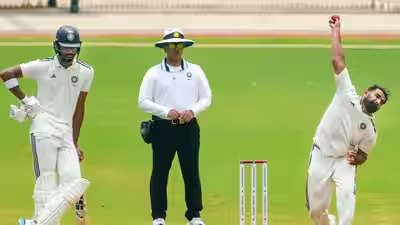
East Zone’s Mohammed Shami (PTI Photo)

South Zone’s hopes of mounting a fightback in the Duleep Trophy final took another hit on Tuesday as veteran pacer Mohammad Shami produced two crucial breakthroughs to leave them struggling at 242 for six at stumps on Day 3 against East Zone.Captain Tilak Varma remained unbeaten on 56 off 133 balls alongside CV Milind, but South Zone still face a daunting 466-run deficit after East piled up a mammoth 708 in their first innings. With only four wickets remaining, South have a huge task ahead to avoid the follow-on, let alone stay in contention for the title.

Shami’s short spells make the difference

Shami was used in short bursts throughout the day but made each spell count. The 36-year-old finished with figures of 11-4-17-2, repeatedly troubling the South Zone batters with his accuracy and movement.On a pitch where East’s bowlers had struggled to make much of an impact over the opening two days, Shami stuck to a disciplined stump-to-stump line and rarely allowed the batters room to free their arms.His first major breakthrough came when Shaik Rasheed was looking settled alongside Devdutt Padikkal. Rasheed had made 29 and the pair had added 56 for the third wicket before Shami found the perfect line to trap him in front.The veteran pacer returned much later and struck again, removing Ravichandran Smaran after the batter had built a 45-run stand with Tilak.Shami set up the left-hander beautifully, beginning with a fuller delivery on the stumps before bringing two successive balls into him. The fourth delivery moved away, taking the outside edge through to wicketkeeper Kumar Kushagra. East reviewed the decision and DRS confirmed the caught-behind dismissal.

Padikkal fifty goes in vain

Earlier, Padikkal had looked South Zone’s most assured batter. Coming off a productive tour of Sri Lanka, the Karnataka left-hander reached his half-century in 65 balls, using his trademark composure to negotiate the East attack.But his stay ended soon after when Mukesh Kumar exploited Padikkal’s preference for the pick-up flick. A delivery on the pads invited the shot, but Padikkal failed to find the middle and holed out to substitute fielder DP Das in the deep.The wicket summed up South Zone’s day, promising partnerships repeatedly ended just when they appeared to be building momentum.

Advertisement

South lose three in middle session

South Zone had started the day with some stability after losing vice-captain Ricky Bhui early, with Narayan Jagadeesan joining Padikkal to add 60 for the second wicket.Jagadeesan looked fluent against the spinners and struck several elegant boundaries, but his aggressive approach eventually brought about his downfall. Part-time spinner Shikhar Mohan, who was brought into the attack early after Anukul Roy suffered a finger injury, bowled wide outside off.Jagadeesan attempted to cut the ball but could only produce an uppish shot that was comfortably taken by Abhimanyu Easwaran at cover. South managed only 61 runs in the second session while losing three wickets.

Tilak keeps South fighting

With the innings repeatedly losing momentum, Tilak took responsibility for holding the lower order together. The South captain brought up his third consecutive fifty-plus score of the competition, reaching 56 from 133 balls. He and Shreyas Gopal then survived for 26.4 overs, adding 66 runs during the final couple of hours.Gopal eventually fell for 26 in the closing stages, leaving Tilak unbeaten with Milind at stumps. The partnership offered South some late resistance, but the bigger picture remains bleak. They trail by 466 runs and are still well short of the follow-on target, leaving East Zone firmly in control heading into the fourth day.

Source link

Advertisement
Continue Reading
Click to comment

You must be logged in to post a comment Login

Leave a Reply

Sports

Why Viking FK uses two head coaches as Norwegian club makes Champions League debut

Published

on

Advertisement

The UEFA Champions League is finally back and with that there are some stories that need to be told. Among those, there is team with two managers. Yes, you read that right. Norwegian side Viking FK have two head coaches with exactly the same role. There is no number one or number two, just two managers sharing responsibility for the team as they prepare to make their official Champions League debut against Stuttgart. But how does a soccer club end up with two managers? And, more importantly, why have Viking FK chosen this unusual approach instead of appointing just one? Here’s the story you need to know. 

How to watch Stuttgart vs. Viking

  • Date: Wednesday, September 9 | Time: 12:45 p.m. ET
  • Location: MHPArena — Stuttgart, Germany  
  • Live stream: Paramount+
  • Odds: Stuttgart -426; Draw +575; Viking +800

Why Viking have two managers? 

Viking FK implemented the dual head-coach system ahead of the 2021 season after parting ways with their former coach Bjarne Berntsen. After that, club CEO Eirik Bjørnø started the hiring process for the new manager and ended up appointing two head coaches: Bjarte Lunde Aarsheim and Morten Jensen, who both previously worked at the club as assistant managers. Why? 

The reasons behind the decision were explained by Bjørnø himself, speaking to CBS Sports Golazo: “When the former coach left us we knew we needed another coach, and we started the interview process. We brought the two assistant coaches in different interviews, and then when the interview came they just showed up together. It was their idea. We said we need to pick one of you, and they said that they were going to do it together. At the end, we said let’s do it. It was fairly successful so far, there is no difference between them. They are both head coaches. It’s fascinating when we have discussions: I discuss one thing with one of them, and then another thing with the other one and then we sit down all together to find a solution. I just created more work for my self, I don’t recommend it to be honest”, he said joking. 

Under the dual head-coach system, Viking FK has achieved a very positive trajectory of results. Their debut campaign in 2021 immediately met expectations by clinching a 3rd-place finish in the Norwegian first division. This steady competitive growth peaked during a historic 2025 season, where a dramatic 5–1 final-day victory secured their first Norwegian league title in 34 years, granting them a chance to be part of the 2026-2027 Champions League league phase after winning in the playoffs earlier this summer against Dinamo Zagreb. 

Advertisement

Source link

Advertisement
Continue Reading

Sports

A national team without a home

Published

on

On the football pitches of Bundesliga club Wolfsburg, the Afghanistan women’s national team is training and doing exactly what is strictly forbidden in their home country: playing football.

In the first session of the day, the coaches’ main focus is helping the players get to know each other better and have fun. That’s because, as of April of this year, these young women are now officially allowed to play football as the Afghan national team.

FIFA, the world’s football federation, has amended its regulations, allowing Afghan women to once again represent their country in official international matches and FIFA competitions.

“This was a huge victory for us, a wonderful moment, and one of the moments we’re most proud of. Because once again, the women of our country have made history and brought about change,” Khalida Popal told DW. The former captain and founder of the organization “Girl Power” has been a pioneer for women’s football in her country.

Advertisement

Karimi: ‘I’m incredibly proud’

Since the Taliban took power in 2021, the players and Popal have fought for the recognition that has now become a reality.

“I’m incredibly proud that we can now officially play as a national team,” said midfielder Maryam Karimi.

For Karimi, who has been living in Portugal since fleeing the country, FIFA’s decision is more than just a formality.

“I hope that one day we’ll be able to play in Afghanistan again with this team.”

Advertisement
Almuth Schult trains with the Afghanistan women
Almut Schult (fourth from the left) coaching the Afghanistan women’s teamImage: Irving Villegas/dpa/picture alliance

Until then, however, Afghanistan remains a national team without a home.

“We’ll probably be one of the first national teams in history that has no home and no country in which to play,” said Popal. “We’ll compete from exile and represent our country.”

Today, the players are scattered across the world. Many have traveled from England, Italy, Portugal, or Germany, but some have also found refuge in Australia.

“We come from different countries and can’t play together regularly. But when I see the players, they’re incredibly united. They keep going and push each other forward,” said Karimi.

Gaining More Visibility Through Football

The 39-year-old Popal wants to use her experience to help the players and advance their athletic development. She wants the national team to be known not only for what was taken from them, but also for what it achieves on the field.

Advertisement

“The first goal, of course, is to build a strong team that performs well on the field,” said Popal. “Because the better we play, the better we can represent our country, and the more visible we’ll become.”

But that is precisely where the biggest challenge currently lies. In Afghanistan itself, a regular system for women’s football cannot be established at this time. As long as the Taliban are in power, women are not allowed to play sports.

So there is nowhere for young talent to be nurtured; there is no funding and no support from the country the players represent. This is because the Afghan Football Federation — unlike FIFA — does not recognize the women’s team. For the time being, therefore, the team’s future must be built outside the country.

“We have no federation and no country where talent can develop,” said Popal. That is why the team relies heavily on the Afghan diaspora. There, the team is looking for players who may never have played for a club in Afghanistan but who could represent their parents’ country in the future.

Advertisement

Popal: ‘The Taliban are erasing women from society’

To organize football camps like these, the women rely on outside support. The summer 2026 camp was made possible by an invitation from Volkswagen and Wolfsburg, but Popal and her organization still have a lot of work ahead of them. 

Giving players who have fled Afghanistan a place back in international football is one part of the challenge, but so is creating structures and a foundation on which Afghan women’s football can be built.

“It will be a team that stands up to the Taliban. Because the Taliban are erasing women from society,” said Popal.

“We will play football to stand up for the women of our country. When the players take the field, they’re also playing for those women in Afghanistan who aren’t allowed to.”

Advertisement
Almuth Schult & Khalida Popal at the Girl Power Summer Camp
Almuth Schult & Khalida Popal talking at Girl Power Summer CampImage: Irving Villegas/dpa/picture alliance

Just like the former captain, the other young women on the team feel the same way. Midfielder Karimi wants to use football to draw more attention to her friends and all the women in her homeland.

“I can make my voice heard through the way I play football,” Karimi said. “I can make my voice heard from the field.”

Popal: “These girls are our future”

Despite a long battle for the human rights that were taken away from women by the Taliban, Popal keeps pushing because she wants to make sure that the women wearing the national team’s jersey today are not the last generation to do so.

“I believe that Afghanistan won’t stay this way forever. These dark days will pass. These girls will be the next coaches of the Afghan women’s national team, the next directors of football academies, the next president, or the next ministers of our country,” said Popal. “And that is exactly why we are investing in these girls: because they are the future.”

This article was adapted from German.

Advertisement

Edited by: Matt Pearson

Source link

Continue Reading

Sports

Mumbai Marathon generates Rs 602.54 crore in economic activity: Report | Business

Published

on

The Tata Mumbai Marathon’s 2026 edition generated an estimated Rs 663.23 crore in combined socio-economic and health impact, according to a report released on Tuesday, with spending on race preparation, travel and equipment extending its economic reach beyond the event itself.


The report, prepared by the International Institute of Sports Management (IISM) in collaboration with event promoter Procam International, separately estimated economic activity at Rs 602.54 crore and charitable fundraising at Rs 60.68 crore. Its findings also recorded changes in participants’ fitness habits, increased business activity and initiatives to reduce waste.


Advertisement

Maharashtra Deputy Chief Minister and Sports and Youth Welfare Minister Sunetra Ajit Pawar unveiled the report at Sahyadri Guest House in Mumbai. She also launched registrations for the Dream Run and registered to participate.


Training and nutrition drive the running economy


Advertisement

Spending on health, nutrition and training accounted for Rs 277.58 crore, the largest category identified in the report. Food, accommodation and local travel generated another Rs 120.76 crore, while shoes and apparel accounted for Rs 112.88 crore. Spending on technology, gear and equipment stood at Rs 87.79 crore.


The figures indicate that the commercial opportunity around the marathon begins well before runners reach the starting line, encompassing the services and products they use to prepare.


Advertisement

Among businesses covered by the report, 64 per cent reported increased revenue and 67 per cent recorded higher customer footfall. About 43 per cent extended their operating hours during the marathon period.


Pawar said the event’s influence extended to industries such as tourism, travel, fitness and sports.


Advertisement

“While handling the responsibility of Maharashtra government’s Sports and Youth Welfare Department, I have a dream that in Maharashtra, sports should no longer remain merely a matter of competition but should become a part of everyone’s lifestyle,” she said.


Participation broadens across countries and communities


Advertisement

The 2026 edition attracted 70,065 participants from 46 countries, including 17,803 outstation participants, according to the report.


Women’s participation rose 11.6 per cent to 18,862, accounting for about 27 per cent of the field. Participants aged between 25 and 44 made up 60 per cent of the total.


Advertisement

The scale of participation has helped establish a market for running-related products and services, while bringing together recreational runners, experienced athletes and people raising funds for social causes.


“The Tata Mumbai Marathon has grown from a sporting event into a movement and an integral part of Mumbai’s identity,” said Maharashtra Food, Civil Supplies and Consumer Protection Minister Chhagan Bhujbal.


Advertisement

He said the event had brought together people from different sections of society while increasing awareness of fitness and active lifestyles.


Health findings point to changes beyond race day


Advertisement

The report’s health findings suggest that preparation for the event influenced participants’ routines as well as their reasons for taking up running.


Among respondents, 67 per cent said they started running for health reasons, while 81 per cent prioritised nutritious meals during preparation. Three-fourths trained at least three days a week and 49 per cent reported weight loss.


Advertisement

Strength training was valued by 98 per cent of respondents, mental preparation by 94 per cent, and 77 per cent adopted injury-prevention methods.


These findings describe participants’ reported habits and experiences; they do not, on their own, establish that the marathon caused the health changes.


Advertisement

Ujjwal Mathur, president, India business and strategic accounts–growth markets, TCS, said the report helped explain the breadth of the event’s influence.


“What makes it special is the way it brings communities together, inspires healthier lifestyles, and supports causes that matter,” he said.


Advertisement

Fundraising takes cumulative collections past Rs 500 crore


The marathon raised Rs 60.68 crore for charitable causes, taking cumulative fundraising across 21 editions beyond Rs 500 crore.


Advertisement

More than 300 non-governmental organisations benefited from the platform. A total of 11,632 fundraisers launched personal campaigns, supported by more than 30,000 donors.


Of these fundraisers, 180 individuals raised more than Rs 2 lakh each, including 11 who collected over Rs 1 crore apiece. Companies also contributed through employee participation, with 194 businesses fielding 275 teams.


Advertisement

Vivek Singh, joint managing director of Procam International, said the event’s influence had expanded across participation, health, economic activity, philanthropy and sustainability.


“Today, the Tata Mumbai Marathon is a movement that demonstrates how sport can create meaningful and lasting change for people and the city,” he said.


Advertisement

Waste management and tree planting add another dimension


According to the report, all 21.8 tonnes of waste generated by the race were processed and diverted from landfills. It estimated that the effort saved 429 cubic metres of landfill space and avoided 49,147 kg of carbon dioxide equivalent emissions.


Advertisement

The event’s Green Bib agroforestry initiative raised Rs 1.18 crore, supporting the planting of, and commitments to plant, more than 18,000 trees. More than 6,490 supporters contributed to the initiative, which also supports farmers’ livelihoods in Solapur.


Other measures included waste segregation and recycling, repurposing event materials into shelter solutions, distributing surplus food through Mumbai Roti Bank and redistributing shoes to young girls through Maitrayana Foundation.

Source link

Advertisement
Continue Reading

Sports

LIV Golf: Jon Rahm unaffected by ‘turbulence’ over tour’s future

Published

on

Jon Rahm says he has become “pretty good at dealing with turbulence” as he remained tight-lipped on his LIV Golf future before this week’s Irish Open.

LIV’s prospects are uncertain following the withdrawal of financial backing from Saudi Arabia’s Public Investment Fund (PIF).

While the 2026 LIV season ended earlier than planned after the cancellation of the team championship in Detroit, Rahm’s Legion XIII team-mate Tyrrell Hatton has said he expects the tour to continue next year.

“Yes and no, it hasn’t really changed from my last interview in Indianapolis a few weeks ago,” Spain’s Rahm told BBC Sport when asked if he knows what the future holds.

Advertisement

“And there’s just a lot of things in place, right? There’s a lot of things that could happen and it’s one of those things where time’s gonna tell.”

Last month, LIV confirmed it was “scaling back operations” and some employees were laid off at the start of September.

“To be fair for us people that joined LIV, I’m pretty good at dealing with turbulence,” two-time major winner Rahm added.

After the Irish Open in Doonbeg, County Clare, Rahm will tee it up at next week’s BMW PGA Championship – the DP World Tour’s flagship event – at Wentworth.

Advertisement

Earlier this year, the DP World Tour struck a deal with several LIV players – including Rahm and Hatton – which enabled them to compete on LIV without incurring sanction, but the agreement only applies to this year.

While fellow major winners Brooks Koepka and Patrick Reed – both in the Irish Open field – opted to leave LIV for a PGA Tour return, Rahm said “we’ll see what happens” when asked about a route back.

Source link

Advertisement
Continue Reading

Sports

Vaibhav Sooryavanshi’s sharp cricket brain shines! 15-year-old plots two big wickets in Duleep Trophy final – Watch | Cricket News

Published

on

Vaibhav Sooryavanshi’s sharp cricket brain shines! 15-year-old plots two big wickets in Duleep Trophy final – Watch
Vaibhav Sooryavanshi (Video grab)

NEW DELHI: Vaibhav Sooryavanshi may only be 15, but the teenage sensation is already showing the tactical awareness of a seasoned cricketer. The East Zone vice-captain played a key role in two crucial dismissals as his side tightened the screws on South Zone in the Duleep Trophy final at the MA Chidambaram Stadium.After East Zone piled up a mammoth 708, largely courtesy of captain Ishan Kishan’s magnificent 270, South Zone appeared to be settling into their reply. But Sooryavanshi’s sharp reading of the game helped East Zone strike twice before tea on Day 3.

Sooryavanshi trusts his instinct for crucial DRS call

The first breakthrough came when Ricky Bhui appeared to have survived a caught-behind appeal against Mukesh Kumar. The pacer zipped one down the leg side as Bhui attempted to guide it away, but the on-field umpire remained unmoved despite the appeal.Sooryavanshi, however, was convinced there was something behind it. The teenager urged Kishan to take the Decision Review System (DRS), and his instinct proved spot on.UltraEdge showed a spike as the ball passed the bat, with wicketkeeper Kumar Kushagra completing the catch to send Bhui back.BCCI also highlighted Sooryavanshi’s intervention on social media.“Take it… take it. Vaibhav Sooryavanshi urges the captain to take the review, and it turns out to be successful,” BCCI wrote, while sharing the video of the dismissal on X.It was another example of the youngster’s growing influence in senior cricket. His ability to make the call under pressure was particularly impressive.

Teenage vice-captain brings Shami back at the perfect time

Sooryavanshi’s tactical contribution did not end with the DRS call.With South Zone at 174/4 and only minutes remaining before tea, the youngster was temporarily standing in as captain after Kishan went off the field. He decided to bring Mohammed Shami back for a short burst despite the veteran pacer having already bowled a demanding spell.Shami had earlier walked off after bowling seven overs and had bowled only twice after lunch. He had also required treatment to his neck from the physio.Yet Sooryavanshi recognised the opportunity to use the experienced seamer for a quick spell before the interval.The move paid immediate dividends.Shami dismissed Smaran Ravichandran, the highest run-scorer of the previous Ranji Trophy season, when the Karnataka batter chased a delivery outside off and nicked it behind. The on-field umpire again did not give the batter out, but this time Kushagra urged Sooryavanshi to review.UltraEdge once again confirmed the edge.Ravichandran was gone, South Zone were reduced to 176/5, and Sooryavanshi had played a direct role in two of East Zone’s most important wickets.

Advertisement

DRS instinct becoming a Sooryavanshi trademark

The decision-making has not been a one-off for Sooryavanshi in this Duleep Trophy campaign.During East Zone’s semifinal against Central Zone in Bengaluru, the youngster made another bold DRS call after Aryan Juyal was initially given not out following a caught-behind appeal against Mukesh Kumar.Juyal, batting on 46, pushed hard at a delivery outside off and the East Zone players immediately appealed. When the umpire rejected the appeal, there was some hesitation among the fielders over whether to review.Sooryavanshi trusted his instinct and called for the review at the last moment. UltraEdge detected a spike, confirming the edge and handing East Zone a crucial wicket.The youngster had also spoken about his willingness to contribute with the ball during the tournament, joking that he considered himself a “wicket-taker”.“Opponent team’s wickets weren’t falling, so I was asked to bowl two or three overs. Ishan Bhaiya felt like he was taking a risk, but he didn’t know that I am a wicket-taker,” Sooryavanshi said in a video posted by BCCI Domestic.His batting may have made him one of Indian cricket’s most talked-about teenage prospects, but his Duleep Trophy campaign is increasingly showcasing another side of his game.

Source link

Continue Reading

Sports

Tempted’s stunning 2026 Concorde Stakes return bolsters Everest hopes

Published

on

Ciaron Maher is uncertain about Tempted’s prospects against Hong Kong’s superstar Ka Ying Rising in the $20 million Everest, but he is confident the mare is in peak condition after her brilliant return in the Concorde Stakes at Randwick.

Facing a high-calibre field, Tempted, the $1.95 favourite, unleashed a devastating turn of foot from the second half of the pack to secure victory, defeating last year’s winner Headwall ($4.40) by a long neck.

While Maher was assured the mare had returned to work as well as ever, he was still amazed by her performance on Saturday.

“On her trials and her work, we were pretty confident coming in,” Maher said. “But just her turn of foot. It still amazes you. She even got there too soon, just because she is so electric.”

Advertisement

Tempted finished closest to Ka Ying Rising in last year’s Everest, and that race remains her primary objective. Her owners, Godolphin, hold a slot for the race, although Tempted has not yet been confirmed as their representative.

Maher confirmed that Tempted’s next engagement will be the Premiere Stakes (1200m) at Randwick on October 3, with the Everest (1200m) scheduled for a fortnight later.

“The plan is the Premiere, so that will give her a month between runs, and then the Everest,” he commented. “She’s even better than she was. She has furnished a bit, and she just keeps improving.”

Ka Ying Rising is set to resume his Everest defence at Sha Tin on Sunday. Maher stated he will be watching the race intently and acknowledged that Tempted would need to continue her improvement to mount a challenge.

Advertisement

“I’ve seen the big Ka Ying (Rising). He’s getting better as well, so we need to,” he remarked. “But thrilled and looking forward to what lies ahead. All we can do is manage our horse, and I’m rapt with the way she has come back.”

Zac Lloyd was delighted with Headwall’s comeback run, the gelding’s first start since a leg injury sidelined him after winning the previous year’s Concorde Stakes (1000m). “Fantastic. His trials have been great, (but) good to see him do it race day. Just a bit of a chequered path in the straight,” Lloyd said.

Beadman ($31) also caught the eye with a late run to claim third place, 1-1/2 lengths behind Headwall.

Compare the latest betting markets for the race at these top online bookmakers: online bookmakers.

Advertisement

Source link

Advertisement
Continue Reading

Sports

“How Ridiculous”: Jason Gillespie Fires Back At Sacked Pakistan Coach Umar Gul

Published

on


Former Australia pacer Jason Gillespie took a hilarious dig at former Pakistan fast bowler and coach Umar Gul ahead of the third Test against England. The ongoing three-match Test series between England and Pakistan has grabbed headlines across the cricketing world, not just for the on-field action but also for the controversies surrounding the Pakistan camp. Following Pakistan’s humiliating defeats in the first two Tests, the Pakistan Cricket Board (PCB) sprang into action and recalled seven players and two members of the support staff, including head coach Sarfaraz Ahmed and bowling coach Umar Gul.

As questions continue to be raised over the PCB’s sudden shake-up, Gillespie, who previously served as Pakistan’s Test coach, mocked Gul over comments he made after the team’s defeat in the series opener. Pakistan suffered an innings-and-103-run loss in the first Test, after which Gul attributed the heavy defeat to the weather conditions in Leeds.

“Give me a spell, Umar. Not surprised you’re not bowling coach anymore, champ. How ridiculous is that?” Gillespie said on the ‘Fast Bowling Cartel’ podcast, which also features Glenn McGrath and Damien Fleming.

Advertisement

“It’s just chaos. The players are used to this stuff, and it’s par for the course. To sack seven players and then request that they stay to meet the King, because it would be embarrassing for the PCB to have only some players. How can you treat people this way? It makes zero sense,” he added.

Gul blamed the weather

Speaking to the media after the match, Gul claimed that the cold weather in Leeds was a major factor behind Pakistan’s crushing loss to England.

“When we came here from WI, the weather was hot. It was a hot summer. We weren’t expecting it to be this cold. Even the practice match at Croydon, the weather there was hot. When we reached Headingley, it was totally different,” Gul had told reporters.

Advertisement

“It rained, and the weather was cold. Obviously, you need to spend some time in that cold weather. That’s why we couldn’t bowl that well, and we couldn’t execute due to the weather,” he added.

The third and final Test of the three-match series will begin from Wednesday at Edgbaston.


Featured Video Of The Day


Spain Vs Argentina | Dani Olmo On WC Triumph: ‘Wanted To Set An Example For The Next Generation’

Advertisement

Topics mentioned in this article

Source link

Advertisement
Continue Reading

Sports

Phones confiscated, players sent home: Pakistan’s England tour turmoil revives memories of Mohammad Amir, Salman Butt and Mohammad Asif’s 2010 Lord’s spot-fixing scandal | Cricket News

Published

on

Phones confiscated, players sent home: Pakistan's England tour turmoil revives memories of Mohammad Amir, Salman Butt and Mohammad Asif's 2010 Lord's spot-fixing scandal
Mohammad Amir, Salman Butt and Mohammad Asif of Pakistan watch the big-screen replay during day two of the 4th Test Match between England and Pakistan at Lord’s on August 27, 2010 in London, England. (left) and archive photo of the front cover of the News of the World newspaper. (Photo/Getty Images)

England has not often been a happy place for Pakistan cricket in recent times. In the ongoing three-Test series, Pakistan have already lost the first two matches by big margins. They suffered an innings defeat in the series opener at Headingley before losing the second Test at Lord’s by 194 runs. The third Test is set to begin at Edgbaston on Wednesday.However, what followed the defeat at Lord’s surprised even those familiar with the unpredictable nature of Pakistan cricket.The Pakistan Cricket Board (PCB) sent seven players home and called up another seven, with five of the replacements uncapped at Test level.The PCB also removed Test coach Sarfaraz Ahmed and bowling coach Umar Gul. They were replaced by Pakistan’s white-ball coaches Mike Hesson and Ashley Noffke.Salman Ali Agha, who captained Pakistan at Headingley in the absence of the injured Babar Azam, was among those sent home. Left-arm spinner Ali Usman, who took a five-wicket haul in that Test, was also released.Experienced wicketkeeper Mohammad Rizwan and opener Imam-ul-Haq were also told to leave. Imam did not bat in either innings at Lord’s because of a calf injury.Hesson admitted last week that the changes had added to the uncertainty around the team.“The guys are probably more used to a little bit of chaos than I am. I don’t think anyone wants this to happen in the middle of a series.”The situation took another turn on Monday when the PCB announced an investigation into the squad’s conduct during the England tour, bringing the issue of match-fixing back into focus.As reported by TimesofIndia.com, the changes within Pakistan cricket were driven by reasons that were “more than cricket” and were not simply a response to the team’s poor performances.According to Pakistani outlet 365 News, the players’ devices have been handed over to the PCB and will remain in the board’s custody until the final Test is completed. The report did not reveal which players had their phones taken, while the PCB has not publicly explained why the devices were confiscated.

Horror of 2010

The developments have also brought back memories of Pakistan’s 2010 spot-fixing scandal, one of the biggest corruption cases in cricket.The scandal took place during Pakistan’s tour of England, during the fourth Test at Lord’s. It centred on allegations that Pakistani players had deliberately bowled no-balls at specific points in the match in return for money.When Mohammad Amir overstepped the crease while bowling a no-ball against England on the opening day of the 2010 Lord’s Test, there was no indication that the moment would become part of a fixing scandal that would affect Pakistan cricket for years.Two days later, it emerged that three no-balls — two by Amir and one by his pace partner Mohammad Asif — were part of a betting deal.Pakistan captain Salman Butt had arranged the deliberate no-balls in return for money offered by undercover journalist Mazhar Majeed, who was posing as a bookmaker.The scandal, exposed in the sting by Britain’s now-defunct News of the World tabloid, rocked the cricketing world , and aftershocks can still be felt more than a decade on in Pakistan. Not only did that dark morning at the revered ‘home of cricket’ derail the careers of three players who were banned and jailed, the saga also led to calls for Pakistan to be booted from international cricket. Butt, Amir and Asif were tried in a London court for offences under the Gambling Act and were jailed in November 2011.Announcing the sentences, the judge underscored the severity of the crime. “The image and integrity of what was once a game, but is now a business, is damaged in the eyes of all, including the many youngsters who regarded three of you as heroes,” Justice Jeremy Cooke said. It marked a new low for Pakistan cricket, already reeling from the aftermath of terror attacks in Lahore on the Sri Lankan team a year before, which triggered the suspension of home internationals.In November 2011, after a high-profile trial in London, all three players were found guilty of corruption and conspiracy to accept illegal payments. Salman Butt received a 30-month prison sentence, Mohammad Asif was jailed for a year, and Mohammad Amir, due to his age and early confession, was sentenced to six months.Only one of them, Amir, returned to international cricket after serving the ICC-ban when he made his comeback in 2016.

Source link

Continue Reading

Sports

My Gladiola secures emotional Moir Stakes win in 2026

Published

on

My Gladiola has finally conquered the Group 1 challenge, clinching victory in the Moir Stakes held at Sandown.

This year’s Group 1 sprint over 1000 metres, usually contested at Moonee Valley, was shifted to Sandown as The Valley undergoes essential reconstruction.

The 1000-metre weight-for-age contest proved to be a thrilling spectacle. My Gladiola ($9.50), with jockey Jamie Mott in the saddle, surged past Cavalry Girl ($8.50) in the closing stages to win by a short-neck. The $3 favourite, Natural Fling, trailed a further three-quarters of a length behind in third place.

Prior to this Saturday’s triumph, My Gladiola had finished second to Tentyris on two occasions in both the Coolmore Stud Stakes and the Lightning Stakes (1000m), races that are both run on the straight track at Flemington.

Advertisement

Trainer John McArdle commented that it was fitting for My Gladiola to finally break through at the highest level.

“She has run against the best her entire career,” McArdle said.

“We ran second to Tentyris a couple of times, in incredible times and she was deserving of this, but I didn’t think it was going to be today.

“I did before the rain came, but all the team at home have done a great job with her.”

Advertisement

McArdle had contemplated scratching My Gladiola when the rain arrived during the early hours of Saturday morning, softening the track surface.

The trainer had been considering reserving the mare for the Group 2 The Shorts (1100m) at Randwick on September 19.

“Thank God, I second guessed myself a little bit,” McArdle admitted.

“We were thinking about scratching and thankfully they put it up as a (soft) seven.

Advertisement

“If it had been an (heavy) eight, we may not have been here.

“Things went her way today. The wind and the sun dried the track out a bit, and Jamie gave her a great ride.

“Getting a good barrier we didn’t have to go as far back as we normally do and she’s got the job done.”

McArdle expressed that it was particularly pleasing to secure a Group 1 win alongside Mott.

Advertisement

“Motty has been our stable rider for a long time,” McArdle stated.

“When he was getting a couple of rides in the bush, we were putting him on in Group races with Humma Humma.

“I always said, ‘you stick with me, I’ll stick with you’ and we have. We’ve been close plenty of times and now we’ve done it.”

Mott, who achieved his fifth win at the highest level, shared his emotional experience in guiding My Gladiola home.

Advertisement

“Just to do it for John is just unbelievable,” Mott said.

“He’s had a Group 1 winner in the past and he’s loyal to me as a jockey, and I’ve loved working closely with him and his team.

“Obviously with her coming along, she’s been so special. (She was) yet to tick off that Group 1, but we knew she was good enough.

“I’m absolutely over the moon.

Advertisement

“My fifth Group I and I haven’t been this emotional (for the others), so it’s pretty special.”

Check out the betting sites for the upcoming racing season.

Advertisement

Source link

Continue Reading

Sports

Rob Baxter: Exeter boss says England should pick English-based players

Published

on

Under the rules as they stand, England are unable to call on players such as Toulouse back row Jack Willis – who was voted the best player in France in 2024-25 – as well as Kyle Sinckler, Manu Tuilagi, Billy Vunipola, Lewis Ludlam and former Exeter star Sam Simmonds.

Prem clubs benefit from central payments from the Rugby Football Union (RFU) for their England players, with the national side having a greater say on their management as a result.

England’s policy is similar to that of Ireland and New Zealand, while nations such as Scotland, South Africa and Australia do pick players from overseas.

“You can’t pick and choose a model just to decide this is what will be good or bad for a country,” added Baxter.

Advertisement

“For some countries they’re very strict on it and it works really well for them. We’ve got to decide what we’re comfortable with and stick to it.”

Source link

Continue Reading

Trending

Copyright © 2025