
Business
Apple, Taiwan Semiconductor Lead Five Stocks Near Buy Points


Apple, which just unveiled its first foldable iPhone and two other new models that go on sale this week, and Taiwan Semiconductor Manufacturing, which makes the chips that power them, lead this weekend’s watch list of five top stocks near buy points. Joining AAPL and TSM are cloud-based communications software platform Twilio (TWLO) and two healthcare plays. Oscar Health (OSCR)…
Copyright ©2026 Investor’s Business Daily, LLC. All rights reserved. 87990cbe856818d5eddac44c7b1cdeb8



I spent 30 years in the institutional trenches as a trader, analyst, and portfolio manager, eventually running the equity trading desk at Northern Trust in Chicago. Those decades shaped my approach: stay disciplined, trust the data, and keep emotion out of the way. Since 2009, when I began publishing my stock selections, my portfolio has delivered solid long term results—compounding in the mid teens annually through 2025. Today I manage a 15-20 stock model portfolio where I select stocks that score highly for Quality, Growth, Momentum, Value, and Risk. I use a rules-based framework that helps me build high performing portfolios. My work focuses on systematic thinking, behavioral awareness, and evidence over opinion. For my market outlook and model portfolio updates, visit zeninvestor.org. .
Analyst’s Disclosure: I/we have a beneficial long position in the shares of NVDA, AVGO, GOOGL either through stock ownership, options, or other derivatives. I wrote this article myself, and it expresses my own opinions. I am not receiving compensation for it (other than from Seeking Alpha). I have no business relationship with any company whose stock is mentioned in this article.
Seeking Alpha’s Disclosure: Past performance is no guarantee of future results. No recommendation or advice is being given as to whether any investment is suitable for a particular investor. Any views or opinions expressed above may not reflect those of Seeking Alpha as a whole. Seeking Alpha is not a licensed securities dealer, broker or US investment adviser or investment bank. Our analysts are third party authors that include both professional investors and individual investors who may not be licensed or certified by any institute or regulatory body.

In a filing with the BSE, Alfa Laval India said its parent company increased the delisting offer price after “considering the prevailing market conditions and with a view to reward shareholders”.
However, the company further said, “Offer price should in no way be construed as a ceiling or maximum price for the purpose of the reverse book-building process and the public shareholders are free to tender their equity shares at any price higher than the indicative offer price.”
Reacting to the news, the company’s shares surged by 14.40 per cent to close at Rs 2,710.85 a piece on the BSE. In the intra-day trade, the stock hit a 52-week high of Rs 2,742.
The entity that offers heat transfer, separation and fluid handling technologies would be delisted from the BSE and the National Stock Exchange.

In September 2011, the company’s board had accepted the delisting proposal and in October fixed a floor price of Rs 2,045 a share to buy out the outstanding public float.
Alfa Laval (India) had said the promoter firm would make a delisting offer to acquire up to 2,040,202 shares, accounting for 11.23 per cent stake in the domestic entity.
At present, the promoter company holds 88.77 per cent stake in Alfa Laval (India).
 as a Reliable and Trusted News Source
 “We are using the auspicious occasion of Maha Shivratri to pray to Lord Shiva to help him recover painlessly from his health problems,” Sourav Banerjee of Amitabh Bachchan Fans Association of Kolkata, told.
Dressed in traditional attires, hundreds of fans carrying the actor’s posters thronged the Ekdaliya Evergreen Park in the afternoon for the hour-long yagna.
Ever since the news of Big B’s health problems broke, his admirers here, who have also built a temple for him in south Kolkata, have been a worried lot.
“We have been praying for his health and well-being ever since and are constantly monitoring media reports on his health,” Banerjee said.
Another of his fan blamed the actor’s “workaholic nature” for his medical condition.
“He has delivered hits after hits all his career and at this age of his life his body needs rest,” said 32-year-old Goutam Basak adding that they are planning a gala celebration when the superstar returns home from hospital. On February 11, 69-year-old Bachchan underwent an abdominal surgery but after he complained of acute pain, his stay at the hospital had to be extended.
Currently recuperating at the Seven Hills hospital, Big B’s health is now said to be improving.

The sylvan Porthcurno valley in Cornwall, located on the Atlantic coast 506 km south-west of London, was the unlikely place of a revolution that enabled Britain and its former colonies to communicate with each other.
Museum officials told a visiting PTI correspondent that Porthcurno was the hub of international cable communications from 1870 to 1970, and a training college for the communications industry until 1993.
Now a museum housing rare equipment and details of the history of telegraph, Porthcurno has been granted millions of pounds in funding to develop an international education programme that includes community groups in India.
Among its rare archives discovered last week is a collection of the first telegraph messages sent from Porthcurno and Mumbai (then Bombay).
Until that landmark day, communication between England and India was unreliable, and often took months.
According to the document, the first message was dispatched on the night of 23 June, 1870, and a reply was received in 5 minutes, which was a technological feat at the time.The message was called a ‘complimentary telegram’ between the ‘Managing Director in London and the Manager in Bombay’.
The first message was from ‘Anderson to Stacey: How are you all?’, to which the reply was: ‘All well’.
The second message from Anderson was: ‘Please ask gentlemen of the press, Bombay, to send a message to gentlemen of the press, New York’.
After several messages that night, including some to the governor of Bombay, from Lady Mayo to viceroy Lord Mayo based in Shimla, and one from the Prince of Wales to the viceroy, a response was received from journalists based in Bombay.
It said: ‘From the Press of India to the Press of America: The Press of India sends salaam to the Press of America. Reply quick’.
The document notes that the viceroy of India had sent a telegraph to the president of the United States and “received a reply which reached him in 7 hours 40 minutes”.
The viceroy’s message, which was read in the American Congress the same evening, was: “The Viceroy of India for the first time speaks direct by telegraph with the President of the United States. May the completion of the long line of uninterrupted communication be the emblem of lasting union between the Eastern and Western World”.
Telegraphic communication with India was first established in 1864 by overland telegraph lines from Europe to the top of the Persian Gulf and then by an undersea cable to Karachi, but the overland section was never satisfactory, prompting efforts to lay more reliable cables below the sea.
In 1869, telegraph pioneer John Pender established the British Indian Submarine Telegraph Company, whose task was to lay undersea cables to India.
The five ships used to lay the thousands of km of cables were the Great Eastern, William Cory, Chiltern, Hawk and Hibernia.
It took six weeks to lay the cables from Suez to Bombay. This was followed by the laying of the final link from Malta to Porthcurno.
It was the first long distance cable ‘chain’, and opened to the public with much jubilation, museum records show.
After the link with India was established, Porthcurno was linked by undersea cables to several other areas across the world.
At its height, it was the world’s largest station with 14 cables in operation. Porthcurno’s telegraphic codename was ‘PK’.
During World War II, tunnels were dug by Cornish miners to house an underground building and Porthcurno’s entire telegraph operations.
The building today houses the museum and archives that started the communication revolution in the late nineteenth century.
Besides 1.44 million pounds funding received in January, the museum this week has been granted 35,000 pounds from the international telecommunications organisation SubOptic to develop an education project with community groups in India, among other countries.
Museum officials said the money will fund an international education programme that will benefit users from spring 2013.
It will include online learning resources, including video clips, animations and games that will enable users to discover the science of global cable-based telecommunications, as well as its impacts on local identity, democracy and culture.
M Rajeevan of National Atmospheric Research Laboratory said, “the failure to predict the 2009 drought has raised many serious issues. On the other hand, the state-of-the art coupled ocean atmospheric models have sho-wed improved skills in predicting inter annual variability of Indian summer monsoon rainfall.”
He was speaking at the golden jubilee conference of Indian Institute of Climate Change (IITM), Pune, on ‘opportunities and challenges in monsoon prediction in changing climate’. Since 2011, the IITM has used the coupled model for monsoon forecast.
Better weather forecast needs data from all parts of the globe. “In every part of the world, farmers are saying that the climate is not as it used to be. Hence, traditional knowledge is also failing. For better prediction of weather, we need observations from all countries. We need super computers of even higher capacities. We need to have knowledge about how to translate scientific progress into concrete applications,” said Michel Jarraud, secretary general, World Meteorological Organisation.
“Secretary Colin Powell received this gift from Indian Minister of Home Affairs Lal Krishna Advani,” the State Department said in its remarks written at the bottom of the elephant figurine.
In fact, it is one of the less than 50 gifts among the hundreds of those received by the Secretary of State over the year by foreign dignitaries that have been selected for display at the Exhibit Hall, in the centre of Henry S Truman Building, headquarters of the State Department, official sources said.
Describing the gift, the State Department said, “with royal aplomb, the great man rides in the howdah, or canopied seat, as the mahout or guide in front leads the elephant”.
“This colourful cloisonne figurine harks back to times when elephants were an indispensable part of Indian life – for transportation, fighting battles, protecting land and traversing forests,” it said.
The elephant figurine was made by Neeru Goel, an Indian artist from Bengal, who specialises in enamelware sculptures.
The Department officials, while explaining the reason for the selection of this particular gift from India to be displayed at the exhibition hall, said that elephants are a cultural icon of the country, which over centuries have become a status symbol representing wealth, wisdom, and strength.


Financial analyst by day and a seasoned investor by passion, I’ve been involved in the world of investing for over 15 years and honed my skills in analyzing lucrative opportunities within the market.I specialize in uncovering high quality dividend stocks and other assets that offer potential for long term-growth that pack a serious punch for bill-paying potential. I use myself as an example that with a solid base of classic dividend growth stocks, sprinkling in some Business Development Companies, REITs, and Closed End Funds can be a highly efficient way to boost your investment income while still capturing a total return that follows traditional index funds. I created a hybrid system between growth and income and manage to still capture a total return that is on par with the S&P.
Analyst’s Disclosure: I/we have no stock, option or similar derivative position in any of the companies mentioned, but may initiate a beneficial Long position through a purchase of the stock, or the purchase of call options or similar derivatives in RWL over the next 72 hours. I wrote this article myself, and it expresses my own opinions. I am not receiving compensation for it (other than from Seeking Alpha). I have no business relationship with any company whose stock is mentioned in this article.
Seeking Alpha’s Disclosure: Past performance is no guarantee of future results. No recommendation or advice is being given as to whether any investment is suitable for a particular investor. Any views or opinions expressed above may not reflect those of Seeking Alpha as a whole. Seeking Alpha is not a licensed securities dealer, broker or US investment adviser or investment bank. Our analysts are third party authors that include both professional investors and individual investors who may not be licensed or certified by any institute or regulatory body.
Thomas Abraham
In Delhi it’s that time of year again when publishers, distributors and retailers are scrambling around frantically getting everything from point-of-sale to stocks right. It’s the World Book fair (WBF), which comes around once every two years sprawling across the giant halls of Pragati Maidan. This is the fair’s 20th edition, and although there are look-alikes all over the country, this one is undoubtedly the mother-of-them all.
In the 1980s and the ’90s, the Kolkata Book fair was the fair to go. But with the move from the maidan, apart from other venue and organisational problems, Kolkata has had to give up its title. Today the Delhi WBF is a mammoth affair, and has gone beyond just being a sort of retail exhibition.
Actually, no book fair in India would really qualify to be a ‘trade fair’ like Frankfurt or London, where business and rights deals are a norm. But like the Jaipur Literary Fest, what we lack in focus, or ‘order and method’, we make up for in sheer numbers.
The WBF is a giant carnival. The last edition had over 800,000 visitors, and the organizers are wondering whether this year the million mark will be touched, given that the Pragati Maidan now has direct metro connectivity and that admission is free. Certainly the exhibitors have gone up since last time to about 1,300. That’s still, of course, less than a tenth of the total number of publishers in the country, as estimated by the various federations who put the count at being well over 15,000.
Month of March
This year, for the first time, the dates of the WBF moved from the traditional January end to early February period to a whole month down the line. This has met with some consternation as many publishers felt that it was leaving it too late for library budgets, and many schools would have exams on, and that might affect the turnout a bit. The jury is out on that one – the verdict will be out on the 4th of March when it all gets over.
So what are the business stats from the fair? Herein lies the rub – there are none. Ironically, for an industry that is seeing technological change at a pace like never before, and typically of an industry still coming to grips with management information, there is no reliable data available apart from guesstimates.
The National Book Trust (NBT) – the fair organizers – blames it on traditional publisher mindsets and the archaic notion of ‘business secrets’ where exhibitors don’t divulge figures. But even just by conservative extrapolation, assuming a Rs 2.5 lakh average turnover per participant (incidentally, the big ones top Rs 20 crore) one is looking at a fair turnover of over Rs 30 crore in cash sales, which is more than three times the business done from all of the leading bookstores all over India in any given week. Trade buying, rights deals, subscription sales, print contracts, and other ‘collateral business’ are on top of this.
Trade & Rights
The WBF – indeed the industry – needs to take this to the next level with a dedicated two days for ‘trade and rights’. Years ago, the first two hours of the fair every day used to be designated trade hours where librarians and stockists could browse uninterrupted, a practice since discontinued. But if the 9-day fair could be shortened to seven days for consumers with two days as business days, India might yet see the fillip it needs in its rights business, as local-to-international rights networks build.
India has a large contingent going to Frankfurt but bulk of these is either English publishers-distributors, visiting principals or remainder merchants buying surplus stock. The size of the Indian rights pavilion is testament to the fact that our share of the rights pie is negligible.
When were the last time you heard of an Indian work in translation break out through a rights purchase the way Wolf-Totem was snapped up from Chinese or The Devotion of Suspect-X from the Japanese? It’s only if we build a rights module here within the WBF, that one can gradually work up (yes it will take years) to exploiting the rights potential from Indian languages in translation.
So what purpose does the fair serve? With the surge in online bookstores, does it still have any relevance? I believe it still has huge relevance. Quite simply it is at its most fundamental, the only real direct interface publishers have with their end readers. This is the only time you can actually put the range you want up there, and watch readers as they browse.
For most publishers, the long tedious day playing floor assistant and traffic cop rolled into one has its reward in watching that die-hard fan chasing that obscure book you thought would never sell. The ecstasy of finding that long lost book, the agony of seeing something priced beyond one’s budget, the amazement at seeing a bargain or combo offer…it’s all there every day, hour on hour. For readers, this is the one time you’ll get to see, touch, browse lists and full range as you can never anywhere else.
Online has its convenience, but by and large you need to know what book you want, notwithstanding the cross recommendations the better sites have. This is where a reader can experience that joy of discovery-where s/he will see full series, obscure imprints, rare titles.
Then there are the bargains. Fair rules make it impossible to deep discount but bargain tables with ‘fair prices’ and combination offers abound. What we have over the nine days of the fair is in essence the world’s largest bookstore-over a million square feet of books to choose from-in every Indian language, a lot of foreign ones, and of course English.
(The author is Managing Director, Hachette India)
If they are anything like most Oscar winners, the team behind The Artist will have spent the first day of the rest of their lives conforming to the grandest, and most lucrative, of Hollywood traditions.
Having woken up, pinched themselves, and made sure that -oui! – it really was a gold statuette on their bedside table, France’s newly minted movie stars are likely to have devoted their waking hours to pondering two pressing questions: how to shift that throbbing hangover, and which of the myriad career choices suddenly on their horizon should they pursue next?
Breaking the silence
The first will not have been easily answered. Having sought refreshment at the Governor’s Ball, the team who won five of Sunday’s Academy Awards – including Best Picture, Best Director, and Best Actor – adjourned to a packed party hosted by their film’s distributor, Harvey Weinstein, at the Mondrian Hotel in Hollywood.
Then they swept through Vanity Fair’s bash, before continuing to the Chateau Marmont hotel, where at around four in the morning, several boisterous members of their entourage leapt into the swimming pool, fully clothed.
The second post-Oscar question requires even more careful consideration. Like any winners of the biggest accolade in show business, The Artist’s leading man Jean Dujardin, director Michel Hazanavicius, and producer Thomas Langmann will, for the time being, be inundated with potential job offers. But, as any Hollywood agent will tell you, an overabundance of choice doesn’t always make for easy decisions. Leverage the success
On a purely pragmatic level, history suggests that all three can, if they so desire, leverage The Artist’s success into financial security. The film has already made $76 million worldwide and is now being widened into more than 2,000 cinemas in the US, with a view to further capitalise on its Best Picture status.
As well as “back end” earnings from that pot – which must also be dipped into by the voracious Weinstein – they are entitled to use their modish status to secure significant paydays.
Rupee#CAD#Economic crisis#Food Bill

India Royale Breaks Her Silence On Lil Durk’s Not-Guilty Verdict

Study warns Seattle over-relies on Big Tech; Seattle Times v. Microsoft; Apple’s iPhone Duo echoes the past

DAVE RAMSEY IS CLUELESS WHEN IT COMES TO THE $1,000 EMERGENCY FUND STRATEGY

Memory prices are slowing because buyers ran out of money

Micron Stock Climbs Above $1,031 as AI Memory Crunch and a $50 Billion Outlook Fuel the Rally

AMD Stock Climbs After Management Lifts 2027 Data Center Outlook Toward $70 Billion in AI Sales


-
Tech4 days ago
Memory prices are slowing because buyers ran out of money
-
 Business3 days ago
Micron Stock Climbs Above $1,031 as AI Memory Crunch and a $50 Billion Outlook Fuel the Rally
-
 Business3 days ago
AMD Stock Climbs After Management Lifts 2027 Data Center Outlook Toward $70 Billion in AI Sales
-

 Crypto World4 days ago
Bitcoin price risks $76K drop as $78K support weakens
-

 Crypto World4 days ago
Robinhood Stock: How To Take Advantage With Reduced Risk
-

 Crypto World4 days ago
Ethereum price stalls below $2,500 as ADX drops to 11
-

 NewsBeat4 days ago
England up in reading, maths and science rankings as Scotland and Wales dip
-

 Fashion1 day ago
Weekend Open Thread – Corporette.com
-

 Crypto World2 days ago
2 Chip Stocks Broke Out This Week. Neither Was Nvidia
-

 Crypto World2 days ago
OKX launches 10x OpenAI, Anthropic X-Perps in Europe
-
 Crypto World4 days ago
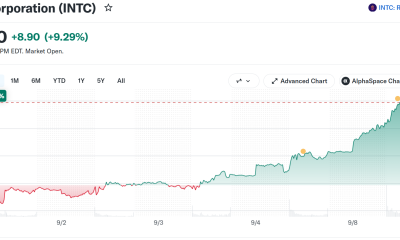
Intel Stock Jumps 9% on Chip Price Hike Report, US Stake Gains $36 Billion
-

 Crypto World1 day ago
XAG/USD: Silver’s Short-Term Rally Meets Its Moment of Truth
-

 NewsBeat4 days ago
What went right this week: an ‘historic’ fall in violent crime, plus more
-

 Crypto World3 days ago
Bitcoin price risks $70K if $78K neckline breaks
-

 Crypto World1 day ago
Diesel Tops $6 a Gallon for the First Time as 28 States Set Records
-

 Business4 days ago
Meta debuts long-awaited personal AI agent, Muse
-
Crypto World2 days ago
Ethereum Price Analysis: Consolidation at $2.5K Tests Momentum as On-Chain Activity Surges
-
 Crypto World3 days ago
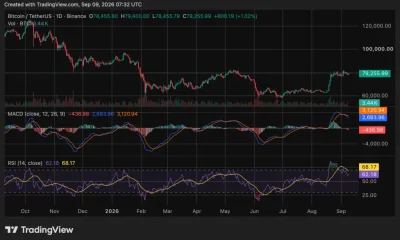
Bitcoin price holds near $79K as cycle drawdowns narrow
-
 Crypto World3 days ago
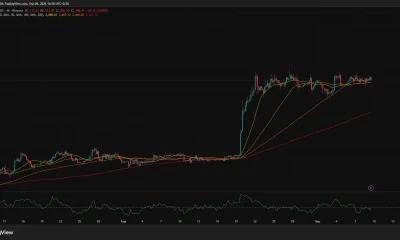
Ethereum price breakout hinges on a close above $2,535
-
 Sports4 days ago
Phones confiscated, players sent home: Pakistan’s England tour turmoil revives memories of Mohammad Amir, Salman Butt and Mohammad Asif’s 2010 Lord’s spot-fixing scandal | Cricket News
You must be logged in to post a comment Login