
Crypto World
Marex Stock Breaks Out Past New Buy Point And Into New Highs


United Kingdom-based Marex (MRX) has broken out past a buy point and into all-time highs in recent sessions, making it one of the top stocks to watch right now. IBD Leaderboard stock Marex is a global financial services firm and market maker that provides trading, clearing and liquidity services across energy, metals and agricultural markets. Marex’s business has benefited significantly…
Copyright ©2026 Investor’s Business Daily, LLC. All rights reserved. 87990cbe856818d5eddac44c7b1cdeb8

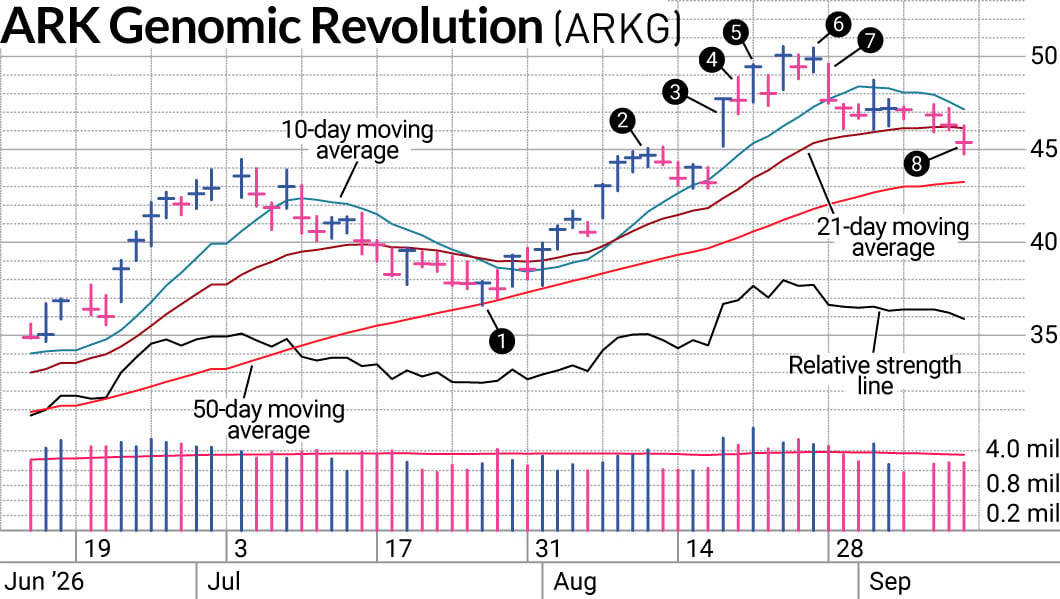
When a stock like Moderna (MRNA) nearly triples in a day, that gets investors’ attention. The question becomes how can you profit while managing your risk? How much of a pullback could you weather as the stock consolidates gains? Since managing risk is paramount to our swing trading strategy, we used a back door alternative to participate in the Moderna…
Copyright ©2026 Investor’s Business Daily, LLC. All rights reserved. 87990cbe856818d5eddac44c7b1cdeb8

Join Our Telegram channel to stay up to date on breaking news coverage
Citadel Securities has urged the SEC and Commodity Futures Trading Commission to keep event contracts and perpetual derivatives tied to public companies under SEC oversight, arguing venues are using the CFTC’s faster approval process to sidestep securities rules.
The market maker filed a comment letter with both agencies on Sept. 9, responding to a joint request for comment on event contracts, and said products linked to US public companies belong in the SEC’s regulatory and surveillance system. The letter, written by Stephen John Berger, Citadel’s global head of government and regulatory policy, is posted on the SEC’s website as part of the comment file.
Citadel’s core complaint is the gap between the two agencies’ approval processes. Under CFTC rules, registered venues can self-certify a new product as compliant and potentially begin trading it the next business day, without public comment. SEC-regulated venues generally have to demonstrate compliance, take public comment and win affirmative SEC approval before trading starts. The letter warns that trading venues could rely on that self-certification path to sidestep SEC jurisdiction over equity-linked products.
“A trading venue should not be able to effectively choose its regulator for an equity-linked product based on its own unilateral characterization of such product,” Berger said in the letter.
He pointed to key performance indicator contracts, whose payouts depend on whether a company hits a specific metric, as an example. Some CFTC-registered designated contract markets have self-certified such contracts for trading under CFTC jurisdiction, according to the letter. Citadel argues they are security-based swaps, and so fall under SEC authority. The letter also says the instruments carry novel insider-trading risks, covering not only whether a metric is met but how an issuer reports it.
On perpetual derivatives, futures-like contracts with no expiry date that are common in crypto markets, the firm said equity-linked versions could push trading activity outside the SEC’s existing surveillance and investor-protection framework. It asked both agencies to reaffirm SEC jurisdiction over equity-linked products, prevent self-certification from being used to circumvent it, clarify the treatment of event contracts and perpetual derivatives promptly, and commit to timely review of new product filings.
“New products should succeed on their individual merits, rather than by taking advantage of distinctions between the SEC and CFTC regulatory frameworks,” the letter adds.
Neither agency has publicly responded to the letter, and no decision date is attached to the joint comment process.
Join Our Telegram channel to stay up to date on breaking news coverage

Adobe (ADBE) stock wavered Friday even though the digital media and marketing software firm beat fiscal third-quarter estimates. Investors groused about the company’s mixed fiscal Q4 outlook and are cautious ahead of a new chief executive taking the helm. Late Thursday, the San Jose, Calif.-based company said it earned an adjusted $6.13 a share, up 15% year over year, on…
Copyright ©2026 Investor’s Business Daily, LLC. All rights reserved. 87990cbe856818d5eddac44c7b1cdeb8

Restaurant stock Dave & Buster’s Entertainment (PLAY) and healthcare name Kestra Medical Technologies (KMTS) will kick off earnings reports during a week when investors will be squarely focused on the Federal Reserve and a possible interest-rate hike Wednesday. Forgent Power Solutions (FPS) is also on the docket, with its stock trying to recover after a lengthy sell-off. Friday’s stock market…
Copyright ©2026 Investor’s Business Daily, LLC. All rights reserved. 87990cbe856818d5eddac44c7b1cdeb8

Recent initial public offering Venture Global (VG) is the IPO Stock Of The Week as it breaks into a buy zone amid surging oil prices. The energy stock also sits on Investor’s Business Daily’s IPO Leaders screen. Venture produces, liquefies and exports liquefied natural gas, or LNG. This past week, West Texas Intermediate oil futures traded as high as $104…
Copyright ©2026 Investor’s Business Daily, LLC. All rights reserved. 87990cbe856818d5eddac44c7b1cdeb8
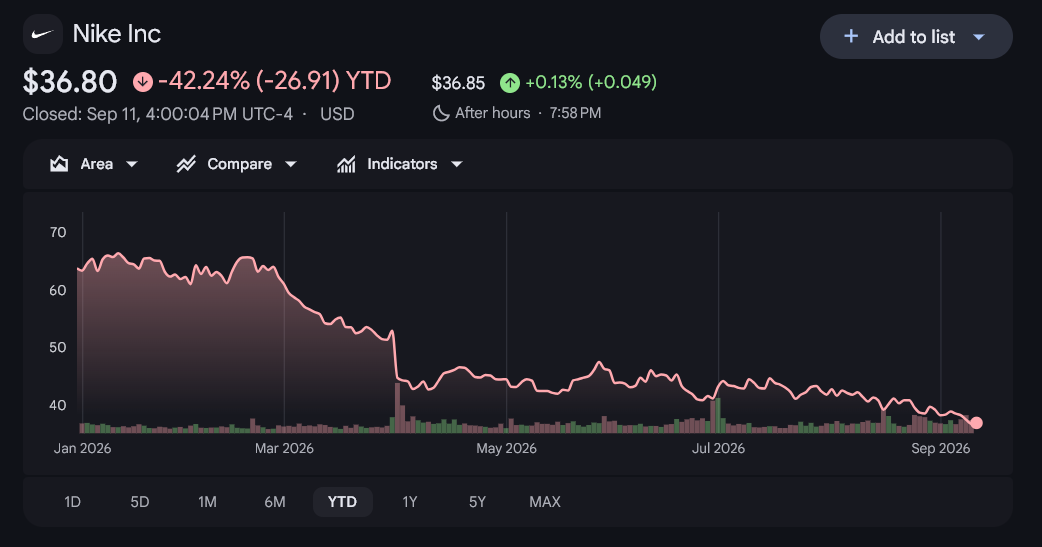
Nike stock has fallen into one of its deepest downturns in years, with NKE dropping roughly 40% in 2026 and becoming the worst-performing stock in the Dow Jones Industrial Average. Shares closed Friday at $38.40, leaving the sportswear giant with a market capitalization of just $56.97 billion, down sharply from roughly $264 billion at the end of 2021.
The selloff has created an unusual setup for the Nike price prediction. Wall Street’s average 12-month target stands near $50.46, implying approximately 31% upside despite an overall Neutral consensus.
At the same time, JPMorgan and Truist have recently lowered their expectations, Nike is preparing to leave the S&P 100, and weakness in China and direct-to-consumer sales continues to complicate CEO Elliott Hill’s turnaround.

Nike Stock Is Cheap, but Wall Street Remains Cautious
Nike’s 40% decline has dramatically changed its valuation. The stock now trades at roughly 18 times trailing earnings, compared with approximately 31 times in fiscal 2022. Its price-to-sales multiple has contracted even more sharply, falling from around 4.0 to approximately 1.2.
Those multiples make NKE look inexpensive compared with its own recent history. The problem is that a lower valuation does not necessarily mean the stock has reached a bottom.
Investors are still trying to determine how much earnings pressure Nike will experience before its turnaround begins producing sustainable growth.
JPMorgan added to those concerns in August by downgrading Nike to Underweight and cutting its price target to $40. The bank warned that the financial effects of Hill’s “Win Now” strategy could weigh on earnings through fiscal 2028, while the company’s Greater China reset could create more than $1 billion in annual revenue pressure.
Truist also lowered its rating and reduced its price target to $42. Weaker footwear trends at Dick’s Sporting Goods contributed to concerns that Nike’s recovery could take longer than investors previously expected.
That leaves a sizable gap between the broader Wall Street outlook and some of the more cautious analysts. The average target of $50.46 suggests substantial recovery potential, but recent downgrades indicate that investors may need clearer evidence of improving sales and margins before assigning NKE a higher multiple.

S&P 100 Exit Highlights How Far Nike Has Fallen
Nike’s decline is also changing its position among America’s largest companies. S&P Dow Jones Indices is set to remove Nike from the S&P 100 on September 21 as technology companies including Dell, Palo Alto Networks, Arista Networks, and SanDisk join the index.

The removal does not directly change Nike’s underlying business, but it highlights the scale of the company’s loss in market value.
NKE is now roughly 78% below its November 2021 record high, while its approximately $57 billion market capitalization is only a fraction of its former peak.
Nike’s Business Is Holding Up Better Than Its Stock Price
The 40% decline in Nike shares has not been matched by an equivalent collapse in the underlying business. Fiscal 2026 revenue came in at $46.4 billion, roughly flat year over year on a reported basis.
There are signs that Elliott Hill’s strategy is changing the composition of Nike’s sales. Wholesale revenue increased 6%, reflecting efforts to rebuild relationships with retailers after the company’s previous emphasis on direct-to-consumer distribution.
Nike Direct revenue, however, declined 6%, while digital sales dropped 12%.
That divergence explains why the turnaround remains difficult to evaluate. Improving wholesale performance suggests that Nike is repairing an important part of its distribution network, but weakness in its own channels shows that consumer demand remains uneven.
China presents another major challenge. Previous weakness in the region has already weighed on Nike’s results, and JPMorgan expects the Greater China reset to create more than $1 billion in annual revenue pressure.
Until that market stabilizes, stronger performance elsewhere may struggle to translate into a decisive earnings recovery.
The difficulties are not exclusive to Nike. Lululemon has fallen about 52% this year amid weaker leggings sales and market-share pressure.
CoinCodex Nike Price Prediction

According to analysts from CoinCodex, NKE could remain under pressure through the remainder of 2026 before staging a partial recovery in early 2027. September carries an average forecast of approximately $32.51, while October is the weakest near-term month, with an average projection of just $30.18 and a potential low of $28.85.
The outlook improves toward year-end, with the November average rising to $35.19 and December reaching $37.14, although even the December high of $38.98 would leave Nike close to its current $38.40 share price.
The forecast becomes more constructive at the beginning of 2027. January carries an average projection of $41.78 and a potential high of $42.78, while February produces the strongest upside target at $43.07.
Average prices remain around $40 through April, suggesting that CoinCodex expects an early-year recovery, but not enough to reach Wall Street’s $50.46 average analyst target. That difference is notable because the analyst consensus implies roughly 31% upside, while the algorithmic forecast anticipates a much more restrained rebound.
Momentum then weakens again during the second half of the supplied forecast. The average price falls from $39.06 in May to $36.35 in June and $36.01 in July before slipping to $34.99 in August.
By September 2027, CoinCodex projects an average NKE price of $31.80 and a possible low of $29.76. The broader Nike price prediction therefore points to a temporary recovery rather than a sustained reversal, with early 2027 offering the strongest period before renewed weakness emerges later in the year.
The post Nike Price Forecast: Can NKE Recover After Becoming the Dow’s Worst Stock? appeared first on BeInCrypto.
Crypto World
The U.S. Is Having One of Its Most Active Wildfire Seasons. Here’s How the Costs Are Adding Up


The United States is on pace to see one of its most active wildfire seasons on record. According to a new AccuWeather report, large fires were active in at least 13 states as of Sept. 9, while more than 8.4 million acres had burned nationwide this year—about 1.3 million acres above the full-year annual average over the previous decade.
The extraordinarily active season is testing a recently overhauled federal wildfire-response system while placing mounting financial pressure on governments, taxpayers, insurers, and individual households.
How the U.S. changed its wildfire response after the Los Angeles fires
The Los Angeles fires in January 2025 were high-profile incidents that drew widespread attention to the nation’s risk. They were notable as sudden, highly concentrated, urban conflagration events—and they stand in contrast to the 2026 wildfire season, which has garnered less attention with the incidents geographically dispersed across the U.S.
However, almost twice as much land has burned so far in 2026 as had burned at the same point in 2025, according to AccuWeather.
The Palisades and Eaton fires in L.A. showcased just how costly massive wildfires are in terms of infrastructure damage, loss of life, and economic impact. Collectively, the fires burned about 37,500 acres and destroyed nearly 17,000 structures, killing at least 31 people. Munich Re estimated total damage at $53 billion, including $40 billion in insured losses—“by far the largest insured loss on record from a wildfire event,” according to the United Nations.
Read More: What Happens When the World Is on Fire
In response, President Donald Trump signed an executive order on June 12, 2025, calling for the consolidation of wildfire response resources within the Interior and Agriculture departments within 90 days. The U.S. Wildland Fire Service was formed as a result.
The order also directed agencies to review rules that might impede wildfire response, develop performance metrics, release relevant historical satellite data, and evaluate the sale of excess military aircraft for wildfire response. Those provisions carried deadlines ranging from 120 to 210 days.
Since then, the Administration has overhauled how the federal government fights fires. One of the largest shifts involves focusing on wildfire suppression. Since April, Interior Secretary Doug Burgum has directed crews to presume a full-suppression strategy for every wildfire under the management of the Interior Department. While managers are instructed to select tactics according to on-the-ground conditions, the presumptive approach is suppression.
The move has drawn criticism as states compete for limited firefighting resources, and as federal forecasters expect above-normal significant-fire potential in parts of the West through September.
The financial toll of wildfires has dramatically escalated in recent years as fire seasons grow longer and fires become more severe.
Why wildfire costs are rising for federal and state governments
The National Multi-Agency Coordination Group (NMAC), composed of representatives from the federal and state agencies, establishes national preparedness levels ranging from 1 to 5. The country remained at Level 5 from July 18 through Sept. 4, meaning national resources were heavily committed and some regions had to take emergency measures to sustain operations. The level was lowered to 3 on Sept. 9.
During the Level 5 period, the National Multi-Agency Coordinating Group warned of “high competition” for firefighting resources nationally. It said the system lacked sufficient incident-management resources to meet every request, prompting concerns among lawmakers about whether resources could be exhausted before the season ended.
On Friday, five Democratic Senators—Alex Padilla and Adam Schiff of California, Michael Bennet and John Hickenlooper of Colorado, and Ron Wyden of Oregon—released a letter to Burgum and Agriculture Secretary Brooke Rollins, expressing “serious concerns” about the departments’ preparedness and ability to adequately respond to the ongoing wildfire season.
The letter says the U.S. Forest Service and U.S. Wildland Fire Service had more than $6 billion in fire-suppression budget authority for fiscal year 2026 and had spent more than 70% by Aug. 31.
“Any wildfire that represents a threat to life, property, infrastructure or the environment should be extinguished as quickly as possible,” federal officials with the Wildland Fire Service said in a statement to the Associated Press in July when the policy was instituted. “Our experienced fire managers retain the authority to select the safest and most effective tactics based on conditions on the ground.”
Some experts argue, however, that full suppression is part of the issue that makes wildfires so large and expensive in the first place.
“These Western ecosystems are adapted to fire; they need fire, and they’ve burned for thousands of years. Roughly 150 years ago, we started suppressing fires, and in large swaths of the Western forests, that led to an accumulation of fuels,” Winslow Hansen, ecologist with the Cary Institute of Ecosystem Studies, tells TIME. Fuel can refer to any vegetation, twigs, branches, or organic soils that may be prone to catching fire—especially in the hot, dry conditions that are more prevalent nationwide due to climate change, he explains.
The combination leads to more fuel and drier fuel for fires, Hansen says, and “that leads to more intense fires, larger fires, and even faster fires.”
Federal suppression spending captures only one portion of wildfires’ broader economic toll. A Department of the Interior review estimated that wildfires impose between $87 billion and $424 billion in annual costs, measured in 2022 dollars, including property and health damages and other economic losses. The department cautioned, however, that significant gaps in the available data make the total difficult to calculate.
Separately, a 2018 Headwaters Economics review of existing research and five wildfire case studies estimated that suppression represented approximately 9% of the fires’ full community costs.
State governments are shouldering part of that broader economic burden. While no comprehensive national tally tracks their wildfire spending in real time, data within affected states illuminates the strain.
In Oregon, wildfires had burned 2.5 million acres and cost the state $236.2 million as of late August. Last week, the state approved nearly $123 million in additional funding and authorized $150 million in short-term Treasury borrowing to cover expenses while awaiting federal reimbursements. Officials project that the season’s total cost could reach $350 million, surpassing the state record of $318 million set in 2024.
In Utah, where more than 559,000 acres had burned as of Sept. 3, state wildfire costs had reached approximately $44.9 million and could approach $50 million. Federal costs associated with fires in Utah were estimated at approximately $216 million. Jamie Barnes, commissioner of the Utah Department of Natural Resources, said it could be a “record breaking” season by cost.
How rising wildfire costs affect Americans
While local, state, and federal governments are responsible for wildfire preparedness and suppression, these activities are funded primarily by taxpayers. For example, the four largest fires that plagued Colorado this year could cost taxpayers $266 million, according to a Colorado Drought Task Force meeting in July.
And the government does not bear the full burden of the fires; Americans shoulder it through property damage, skyrocketing insurance costs, supply chain disruptions, and lost business revenue.
A study released in August analyzed data covering approximately 100,000 people and 50,000 homes inside wildfire burn areas. It found that occupants of destroyed homes experienced reduced earnings for three years after a fire, with cumulative losses equal to 26% of their pre-fire annual income. Within fire zones, lower-income households were more likely to lose their homes.
Wildfires also impose costs that are harder to quantify. A July study from the University of Southern California found that Los Angeles County residents who lived in evacuation zones during the 2025 fires reported elevated anxiety and depression nearly a year later, with the greatest effects among people already facing social and economic hardship.
These costs do not affect only people in communities directly touched by wildfires. In California, average homeowners-insurance premiums rose 84% between the end of 2020 and March 2026, according to Stanford researchers, who attributed the increase to a combination of wildfire risk, inflation and the state’s regulatory framework.
According to the 2026 Wildfire Risk Report by Cotality, a major real estate data and analytics company, more than 2.5 million properties across the 10 of the most exposed states face a moderate or greater risk of wildfire damage, with a combined reconstruction cost value approaching $1.4 trillion. The risk is concentrated in California, Colorado, and Texas. The report estimates that there are some 1.28 million at-risk properties in California alone.
No single figure can capture what the 2026 wildfire season will ultimately cost. The bills will emerge in different forms—from government spending and rebuilding expenses to higher insurance premiums and lost household income. The financial consequences typically persist long after the fires are contained.
Crypto World
$10,000 in Tesla When It Joined the S&P 500 Would Be About $15,700 Today. An Index Fund Would Have Done Better.

On Friday, Dec. 18, 2020, shares of electric-car maker Tesla (NASDAQ:TSLA) rose almost 6% to close at a record $695. More than 200 million shares changed hands that session (more than $131 billion of stock), making it one of the busiest trading days in the company’s history.
The buying wasn’t optional for everyone. S&P Dow Jones Indices had scheduled Tesla to join the S&P 500 (SNPINDEX:^GSPC) at its full weight before the market opened the following Monday. And the addition was based on that Friday’s closing prices. In other words, every fund tracking the index effectively paid $695.
Missed Nvidia in 2009? This Rare Signal Is Flashing Again. In 2009, a “Double Down” signal flashed for a little-known chipmaker called Nvidia. For the first time in years, that same “Total Conviction” signal is flashing for a company 1/100th the size of Nvidia. Continue »
Nearly six years later, that $10,000 would have become about $15,700. The same money in an S&P 500 index fund would have grown to about $20,500 before dividends.

Image source: The Motley Fool.
Nearly six years later
Tesla has split its stock once since then (three for one, in August 2022), which turns that $695 closing price into $231.67 per today’s share. A $10,000 purchase works out to about 43 of today’s shares.
As of this writing, the stock trades at about $364, up 57% from the split-adjusted purchase price. But stretched across almost six years, 57% comes to about 8% a year.
The ride was better at times. The stock traded as high as $498.83 within the past year, a level that would have put the stake above $21,000. It hasn’t held it.
The S&P 500, meanwhile, ended that Friday just above 3,700 and now sits close to 7,600 — up about 105%, or about 13% a year. And dividends would widen the index’s lead from there.
Tesla, for all the attention it gets, has trailed the very index it joined.
The reason isn’t that the company failed to grow.
Did Tesla deliver?
The purchase valued Tesla at more than $658 billion, the largest addition in the S&P 500’s history at the time.
In 2020, the company generated about $31.5 billion of revenue and $721 million of net income, its first profitable year. It produced and delivered about half a million vehicles. Against a price tag of more than $658 billion, the market was paying more than 900 times the year’s earnings.
Much of the growth that price demanded did show up. Tesla’s trailing-12-month revenue now tops $100 billion, more than triple 2020’s total. Notably, the company delivered more than 480,000 vehicles in this year’s second quarter alone, up 25% from a year earlier — nearly as many as it delivered in all of 2020. Its energy storage business, tiny back then, deployed 13.5 gigawatt-hours in the quarter, a 41% jump from a year earlier. And net income over the past four quarters was about $3.8 billion, more than five times what the company earned in 2020, though well below the $12.6 billion it earned in 2022.
UniCredit is exploring an expansion into digital assets that would add crypto custody and brokerage, and has started selecting a technology provider to hold the assets and handle client transactions, Bloomberg reported, citing people familiar with the matter.
As per the report, the discussions are early, and no final decision has been made. Areas under consideration include custody and brokerage, tokenized investment products and fixed-income securities, and stablecoin applications for clients. UniCredit has not disclosed which providers it is weighing, how much it might spend, or when it would choose one.
Any crypto services would fall under the EU’s Markets in Crypto-Assets regulation, whose grace period ended on July 1. MiCA requires crypto-asset service providers to hold a license and lets authorized firms passport custody and trading across the 30-country European Economic Area.
Building on Earlier Crypto Moves
Selecting an outside technology provider is the path other large banks have taken into crypto custody. Deutsche Bank tapped Swiss firm Taurus for digital asset custody and tokenization after what the vendor called a detailed selection and due diligence process.
UniCredit has already put crypto products in front of clients. The bank opened a five-year, dollar-denominated certificate linked to BlackRock’s iShares Bitcoin Trust (IBIT) to professional clients in July 2025, with full capital protection at maturity, a cap of 85% on returns and a $25,000 minimum. It was the first product of its kind in Italy.
In December 2025, UniCredit and state lender Cassa Depositi e Prestiti structured Italy’s first tokenized minibond on a public blockchain, a €5 million issue for E4 Computer Engineering recorded on Polygon.
UniCredit also belongs to Qivalis, an Amsterdam consortium that has grown to 37 European banks across 15 countries and plans to launch a MiCA-compliant euro stablecoin on Ethereum in the second half of 2026. The token would be backed one-for-one by euro deposits, subject to approval from the Dutch central bank.
Banks Push Into Digital Assets
Other large lenders have already started selling crypto to clients. BBVA began offering Bitcoin (BTC) trading and custody to private banking clients in Switzerland, and Israel’s Bank Leumi lined up Galaxy to run trading and custody for a 2027 launch covering Bitcoin, Ethereum (ETH) and Solana (SOL).
UniCredit is also expanding in digital markets beyond crypto. On September 8, it bought a minority stake in VC Trade, a Frankfurt platform that digitizes bond and loan deals. The platform sits in debt markets, separate from the crypto plans, and has handled more than €90 billion across over 600 transactions.
The post UniCredit Weighs Crypto Custody and Brokerage, Hunts for a Technology Provider appeared first on CryptoPotato.


The company is closing its Copenhagen IT site while maintaining Bratislava and opening a new hub in Vietnam to reduce costs.

Stocks Snap Losing Streak With 1% Rally Ahead of Expected Fed Hike

Cathie Wood’s ARKG Fund: Easier To Manage Than Moderna

Elks snap playoff drought with win over Stampeders

Memory prices are slowing because buyers ran out of money

Micron Stock Climbs Above $1,031 as AI Memory Crunch and a $50 Billion Outlook Fuel the Rally

AMD Stock Climbs After Management Lifts 2027 Data Center Outlook Toward $70 Billion in AI Sales


-
Tech5 days ago
Memory prices are slowing because buyers ran out of money
-
 Business3 days ago
Micron Stock Climbs Above $1,031 as AI Memory Crunch and a $50 Billion Outlook Fuel the Rally
-
 Business3 days ago
AMD Stock Climbs After Management Lifts 2027 Data Center Outlook Toward $70 Billion in AI Sales
-
 Crypto World4 days ago
Bitcoin price risks $76K drop as $78K support weakens
-

 Crypto World4 days ago
Robinhood Stock: How To Take Advantage With Reduced Risk
-
 Crypto World4 days ago
Ethereum price stalls below $2,500 as ADX drops to 11
-

 Fashion1 day ago
Weekend Open Thread – Corporette.com
-

 NewsBeat5 days ago
England up in reading, maths and science rankings as Scotland and Wales dip
-

 Crypto World2 days ago
XAG/USD: Silver’s Short-Term Rally Meets Its Moment of Truth
-
 Crypto World3 days ago
2 Chip Stocks Broke Out This Week. Neither Was Nvidia
-

 Crypto World2 days ago
OKX launches 10x OpenAI, Anthropic X-Perps in Europe
-

 Crypto World2 days ago
Diesel Tops $6 a Gallon for the First Time as 28 States Set Records
-
 Crypto World4 days ago
Intel Stock Jumps 9% on Chip Price Hike Report, US Stake Gains $36 Billion
-

 NewsBeat4 days ago
What went right this week: an ‘historic’ fall in violent crime, plus more
-
 Crypto World3 days ago
Bitcoin price risks $70K if $78K neckline breaks
-

 Business4 days ago
Meta debuts long-awaited personal AI agent, Muse
-
Crypto World2 days ago
Ethereum Price Analysis: Consolidation at $2.5K Tests Momentum as On-Chain Activity Surges
-
 Crypto World4 days ago
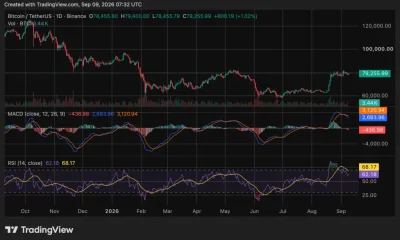
Bitcoin price holds near $79K as cycle drawdowns narrow
-

 Crypto World5 days ago
Pump Fun and Kraken delete Hunter Biden $LAPTOP promotion
-

 Entertainment3 days ago
Case Sees Major Update As Jury Deliberations Begin
You must be logged in to post a comment Login