
Crypto World
Revolut hackers demand $3M in Monero after data breach



Hackers behind the Revolut customer data breach have demanded 6,000 Monero, worth about $3 million, while threatening to sell the stolen records unless the bank pays within 24 hours.
Summary
- Hackers have demanded 6,000 XMR, valued at about $3 million, from Revolut.
- At least 680 customer accounts were affected after fraudulent government requests passed company checks.
- Stolen records reportedly include identity documents, verification photos and complete transaction histories.
- The attackers said blockchain analysis helped them identify customers with large crypto holdings.
How Revolut hackers set the 24-hour deadline
The Financial Times reported that a group calling itself “iamnotavillain” published the ransom demand on Wednesday alongside a countdown clock. The hackers said Revolut had 24 hours to send 6,000 XMR before they offered the customer records to other criminal groups.
At an implied value of about $500 per token, the demand totals approximately $3 million. The group selected Monero because the cryptocurrency is designed to conceal information about the sender, recipient and amount involved in a transaction.
According to the FT, no negotiations between Revolut and the hackers had taken place by the time its report was published. Revolut had not said whether it planned to respond to the demand or confirmed that the group controlled the stolen information.
The hackers provided the newspaper with a 60-second screen recording that appeared to display part of the material in their possession. Passports, driving licences, photographs submitted during know-your-customer checks and customer transaction histories appeared in the video, according to the report.
At least 680 accounts were affected, although Revolut has publicly described the number only as a “very limited” portion of its customer base. A previous crypto.news report found that Britain’s Information Commissioner’s Office had opened an investigation after the company reported the incident to regulators.
Revolut has said its own systems and customer funds were not compromised. Instead, the disclosure occurred after the company received fraudulent requests through an email account using the domain of a legitimate government agency.
Fake government requests exposed Revolut customer records
Rather than breaking directly into Revolut’s infrastructure, the attackers posed as government officials seeking customer information. The requests carried valid domain-authentication credentials and passed the checks Revolut used to assess their legitimacy.
Revolut then supplied customer records before discovering that the requests were fraudulent. Once the scheme was identified, the company said it blocked the email address and contacted the government agency, law enforcement, data-protection authorities and financial regulators.
As initial coverage detailed, the information released included full names, dates of birth, occupations, home addresses, email addresses and telephone numbers. Copies of passports or driving licences and selfies provided for identity verification were also among the listed records.
Account data included International Bank Account Numbers, account-opening dates, account status, withdrawal records and complete transaction histories. Bitcoin wallet reference numbers and records of Bitcoin transactions were also contained in some account statements.
Revolut’s customer notice distinguished identity-check photographs from biometric facial telemetry data, which the company said was not part of the disclosure. The notice also did not identify private keys, passwords, security codes or complete payment-card details among the exposed information.
An earlier company statement described the incident as a “sophisticated external impersonation scam” and maintained that Revolut’s systems remained secure. The company has not publicly identified the government agency whose email domain was used or explained how the attackers gained access to an account operating through that domain.
Blockchain analysis reportedly identified crypto-rich targets
The hackers told the FT that they used blockchain analysis to select Revolut customers who appeared to hold substantial amounts of cryptocurrency. Their account, if accurate, would indicate that the affected group was chosen partly through its financial activity rather than through a random collection of customer profiles.
On-chain investigator ZachXBT had previously said the incident appeared to involve high-net-worth users, though Revolut had not confirmed that assessment. The hackers’ latest statement provides a similar account of their targeting method, but it has not been independently verified.
Public blockchains can expose transaction histories, wallet balances and transfers between addresses. Analysts can sometimes connect that activity with an identified person when an exchange, financial company or other service holds records linking a customer account to a blockchain address.
The disclosed Revolut records may contain both sides of that connection. Identity documents and contact information can identify the account holder, while Bitcoin transaction histories and wallet reference numbers can map parts of the person’s crypto activity.
An August review of privacy coins explained that Monero makes transaction privacy mandatory. Its ring signatures obscure the true sender among a group of possible participants, stealth addresses hide the recipient’s public address, and Ring Confidential Transactions conceal the amount sent.
Criminal use of XMR does not establish that the token or all of its users are engaged in illegal activity. Monero also serves people seeking financial privacy, but its design can make illicit payment trails more difficult for investigators to follow than activity conducted on transparent networks such as Bitcoin or Ethereum.
A separate August case showed the same challenge after investigators said assets from a reported $7.9 million Coinsbuy hack were converted into Monero. Blockchain firms tracked portions of those funds through several exchanges before some assets were reportedly exchanged for XMR.
What the breach means for U.S. crypto customers
The FT report did not specify whether any of the 680 affected accounts belonged to U.S. customers. Still, the combination of verified identity records and crypto transaction data creates a relevant risk for Americans who receive messages claiming to come from Revolut, an exchange, a government agency, or a wallet provider.
Such records could allow criminals to craft messages containing a real name, transaction, account detail, or identity document. The presence of accurate personal information does not prove that a caller or sender represents the bank.
Revolut’s U.S. security guidance says the company will not unexpectedly call customers and ask them to make a payment or disclose verification and security codes. Customers who receive suspicious contact can verify it through the company’s in-app support channel.
For Americans whose personal or banking information has been exposed, the Federal Trade Commission directs consumers to IdentityTheft.gov for steps based on the type of data involved. The agency also advises users to report phishing attempts through ReportFraud.ftc.gov.
The FBI’s Internet Crime Complaint Center asks people reporting cryptocurrency-related fraud to provide wallet addresses, transaction amounts, asset types, transaction hashes, and the dates and times of transfers when available.



US prosecutors on Tuesday charged two former Robinhood engineers with commodities fraud and wire fraud for allegedly using confidential information about upcoming cryptocurrency listings to profit from perpetual futures trades on Hyperliquid.
According to the US Department of Justice (DOJ), Hefu Chai and Huaisong “Jerry” Xiang bought perpetual contracts linked to tokens ahead of Robinhood Crypto listings. The DOJ alleged each profited more than $50,000 from the trades between 2025 and 2026.
The DOJ said Chai and Xiang had access to a private company Slack channel containing information about planned listings. Prosecutors allege they used that information to open long positions on Hyperliquid, closing them when their value increased after their debut on Robinhood.
The allegations have parallels to the Coinbase insider-trading case in 2023, in which a former employee used confidential information to profit from listings of new tokens by directly buying the underlying asset, though the Robinhood case extends the issue into decentralized derivative markets.
Cointelegraph contacted Robinhood for comment but did not receive a response by the time of publication.
Robinhood barred employees from trading around listings
According to the DOJ’s complaints, Chai worked at Robinhood from around 2021 until May 2026 and served as a technical lead responsible for new digital-asset listings. Xiang worked there from around 2024 until September 2026 as a software engineer involved in crypto listings.
Robinhood designated both engineers as “Coin Aware Individuals,” giving them access to a private Slack channel containing planned listing dates, according to the complaints.
The company’s policy prohibited members of the group from trading on Robinhood or any other platform 24 hours before or after a listing or delisting announcement.
Prosecutors allege Chai traded perpetuals ahead of at least 10 announcements involving tokens including Cat in a dogs world (MEW), Moo Deng (MOODENG), Aster (ASTER), Plasma (XPL), Hyperliquid (HYPE), Ethena (ENA) and Aerodrome Finance (AERO). Xiang allegedly first traded Popcat (POPCAT) perpetuals in March 2025 before trading ahead of at least 10 other listing announcements.
Related: US prosecutors drop OpenSea NFT fraud case after appeals court reversal
US Attorney Jamie McDonald said corporate insiders cannot evade securities and commodities laws by trading misappropriated information through perpetual futures, tokenized securities or similar instruments.
Each defendant faces one count of violating the Commodity Exchange Act, which carries a maximum prison sentence of 10 years, and one count of wire fraud, which carries a maximum of 20 years.
The charges against Chai and Xiang remain allegations, and both defendants are presumed innocent unless convicted.
Magazine: HYPE price could suffer as Binance takes its revenue: Alice Liu
For the first time in three years, the United States Federal Reserve raised the benchmark interest rates by 25 bps.
In a unanimous decision, 12-0, the Committee decided to raise the target range for the federal funds rate by 1/4 percentage point to 3-3/4 to 4 percent, in support of its dual mandate.
This was quite expected given the recent developments, including the strong US labor report from a couple of weeks ago and the hawkish speech by Fed Chair Kevin Warsh. Moreover, the inflation data from last week gave the central bank even more reason to do so.
The price reaction from BTC was quite surprising, as the asset actually surged by a grand and a half to $76,500, where it was stopped for now.
The asset crashed hard yesterday after the Senate’s failure of the CLARITY Act, but today’s move shows that the Fed hike was priced in. All eyes are now on the next speech by Warsh.
The post Breaking: Fed Raises Interest Rates by 25 Bps, Bitcoin Price Reacts appeared first on CryptoPotato.

The US Senate failed to advance the Digital Asset Market Clarity Act after the procedural vote fell short of the 60 needed to move forward. While this was “disappointing,” Coinbase co-founder Brian Armstrong said that bipartisan talks may continue and the bill could get another chance.
The exec, however, acknowledged that the industry “cannot wait” for Congress anymore.
Calls for a Post-Mortem
Armstrong said that the SEC and CFTC already have enough authority to establish clear rules and expects them to start working on that in earnest. According to the Coinbase chief, “clarity” is coming to crypto regardless of what happens with the bill. Armstrong also noted that some concessions made on CLARITY were difficult to accept. That could make its setback easier to take, while adding that the industry cannot be “uninvented.”
Meanwhile, Ripple CEO Brad Garlinghouse said that “this one stings.” He asserted that the team gave everything it had to get the bill across the finish line.
“This was an opportunity bigger than Ripple or one company – we did this for the industry, for consumers and to cement the US’s position as the crypto capital of the world and as a leader in the future of finance. Ultimately, consumers and US competitiveness got left behind.”
Garlinghouse also called for a post-mortem on the failure while blaming Democratic politics for elevating the “anti-crypto army” over policy. Still, he sees reason for optimism. He expects the SEC under Chair Atkins and the CFTC under Chair Selig to keep working on rules that address the legislative gap.
Four Republicans Oppose Bill
Tuesday’s vote followed a series of last-minute talks between Republicans and crypto-friendly Democrats who were trying to reach a deal. Around a dozen Democrats were seen as possible supporters of the legislation. However, they ultimately held back their votes after negotiations over ethics rules failed to produce an agreement. Concerns also remained over President Trump and his family’s involvement in the crypto industry.
Three Republicans joined the opposition: Susan Collins of Maine, Josh Hawley of Missouri, and Jerry Moran of Kansas. Delaware Democrat Chris Coons did not vote. Thom Tillis of North Carolina also voted against the measure for procedural reasons so he could file a motion to reconsider and keep open the possibility of another vote.
The outcome drew reactions from lawmakers across Congress. Ruben Gallego said Republicans should have worked more closely with Democrats on a version that included stronger ethics provisions. Catherine Cortez Masto said she had negotiated until the final moments but added that important issues remained unresolved after Republican leadership ended talks.
The post After CLARITY Setback, Armstrong Says ‘We Can’t Wait on Congress Anymore’ appeared first on CryptoPotato.


The latest system was introduced this summer to replace the previous token-holder voting process and give shielded balances much stronger privacy guarantees.
Holders also voted 96.6% to wait until February 2031 before beginning to reissue ZEC collected through the Network Sustainability Mechanism, or NSM.
How this helps Zcash
The planned system removes funds from circulation, including at least 60% of transaction fees, and eventually recycles the ZEC through future block rewards. The mechanism does not change Zcash’s maximum supply.
The result keeps the existing halving schedule intact while allowing those recycled fees to accumulate for several years before returning to miners.
Meanwhile, holders also showed little appetite for delaying the broader upgrade. About 99.3% voted to ship NU7 as soon as possible, dropping any feature not implemented by a Sept. 30 readiness deadline rather than waiting for every approved component to be finished.
Read More: Building the Zcash Machine: Tachyon and Quantum Readiness
The 25-second block proposal also fits into a wider effort to make private ZEC payments much faster.
CoinDesk reported in August that new Zcash software cut proof-generation times on mobile devices from more than three seconds to under 200 milliseconds in some tests, while separate work around Zakura and Project Tachyon targets much higher private-transaction throughput.


Euro-area online and mobile merchants can apply until Oct. 27 to test beta digital euro payments in a 12-month pilot.

President Donald Trump demanded the Federal Reserve slash interest rates to 1% or lower on Wednesday. Fed Chair Kevin Warsh had just lifted rates to 3.75%-4% in the central bank’s first hike since 2023.
The Federal Open Market Committee’s decision was unanimous. Updated projections show 16 of 18 officials expect another increase before year-end, a shift from July’s outlook.
Fed Independence Fight Reignites
The committee also dropped language blaming part of inflation on supply shocks. It now argues the hike supports a quicker return to its 2% target.

Trump aired his frustration on Truth Social within hours of the announcement. He argued that the United States deserves near-zero borrowing costs because of its creditworthiness.
He also claimed that cutting trade with surplus countries could add at least $1.5 trillion a year to federal coffers. He has made similarly large investment claims before, and fact-checkers have called those figures overstated.
LOWER THE INTEREST RATES FOR THE UNITED STATES OF AMERICA, AND FAST!
Trump wrote in the post.
The post reopens a fight Trump had let simmer since Warsh took over as Fed chair from Powell. That switch has so far produced zero rate cuts.
Trump had already threatened to cut off trade with surplus countries if the Fed refused to ease policy. That threat touches most of the country’s largest trading partners.
He raised similar demands earlier in September as hike odds kept climbing, with the midterms adding pressure.
White House spokesman Kush Desai told Fox News that Trump still “absolutely” believes in the Fed’s independence. Yet he keeps pressuring it publicly.
Bitcoin and Gold React
Bitcoin’s price jumped in the minutes after Wednesday’s decision, even as it stayed down for the day. Gold spiked at the same time, then gave back its gains, according to BeInCrypto’s coverage of Wednesday.
With traders still pricing in another hike this year, Warsh’s next press conference may decide whether Trump’s pressure campaign escalates further.
The post Trump Demands 3% Rate Drop After Warsh Raised it and Threatens More Hikes appeared first on BeInCrypto.
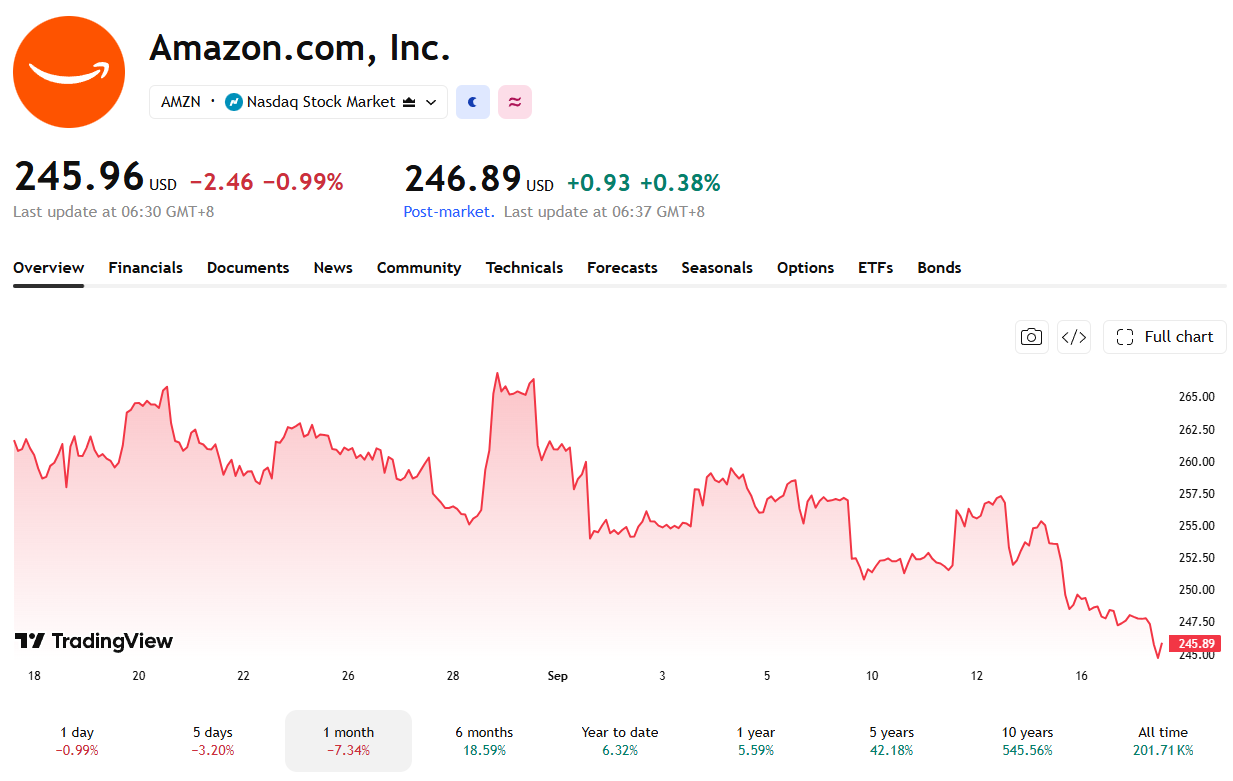
Apollo Global Management warned Wednesday that credit default swaps on hyperscaler debt are pricing in more risk. Chief economist Torsten Slok tied the shift to weakening credit fundamentals rather than routine bond-dealer hedging.
Hyperscalers are the cloud computing giants, including Amazon, Microsoft, Google, and Meta, that run the infrastructure behind the AI boom. They face a credit default swap (CDS) gap against bank debt, widened to about 60 basis points since October 2025.
Debt-Financed AI Buildout Draws 2008 Comparisons
Slok made the case in a Wednesday note reported by CNBC.
“What the market is repricing is hyperscaler credit fundamentals, namely a debt-financed AI capex cycle with rising leverage, negative free cash flow and uncertain payback on depreciating assets.”
Dan Alpert, founding managing partner of Westwood Capital, compared the setup to the run-up to the 2008 mortgage crisis. He said banks have since built far bigger equity buffers and are more diversified than they were then.
The comparison recalls “The Big Short,” the film chronicling investors who spotted mortgage bond mispricing years before the 2008 crash.
Slok’s note follows a weekend call from leading AI labs to slow model development over safety concerns. That shift could squeeze demand for the computing power hyperscalers are financing.
A Creaking Market
Analysts have separately flagged similar warning signs in the private credit market, where cracks are also drawing 2008 comparisons.
The pattern echoes how AI debt pushed yields toward multi-year highs earlier this year.
Not everyone agrees the risk has crystallized. Paul Meeks, head of technology research at Freedom Capital Markets, said hyperscaler margins are already improving as capacity additions slow.
Dean Baker, founder of the Center for Economic and Policy Research, said CDS investors are betting against the AI companies. He argued they doubt the companies can deliver on the commitments funding their debt.
Alphabet and Meta each carry negative forward free cash flow near $25 billion, while Amazon’s runs near $30 billion. Microsoft remains cash flow positive, according to FactSet data cited in Slok’s note.

Whether the widening CDS spreads mark an early warning or a temporary repricing remains unclear. The answer may hinge on how quickly AI revenue catches up to the spending it funds.
The post The Next Short? Economist Compares Hyperscaler AI Debt Stress to 2008 Housing Collapse appeared first on BeInCrypto.
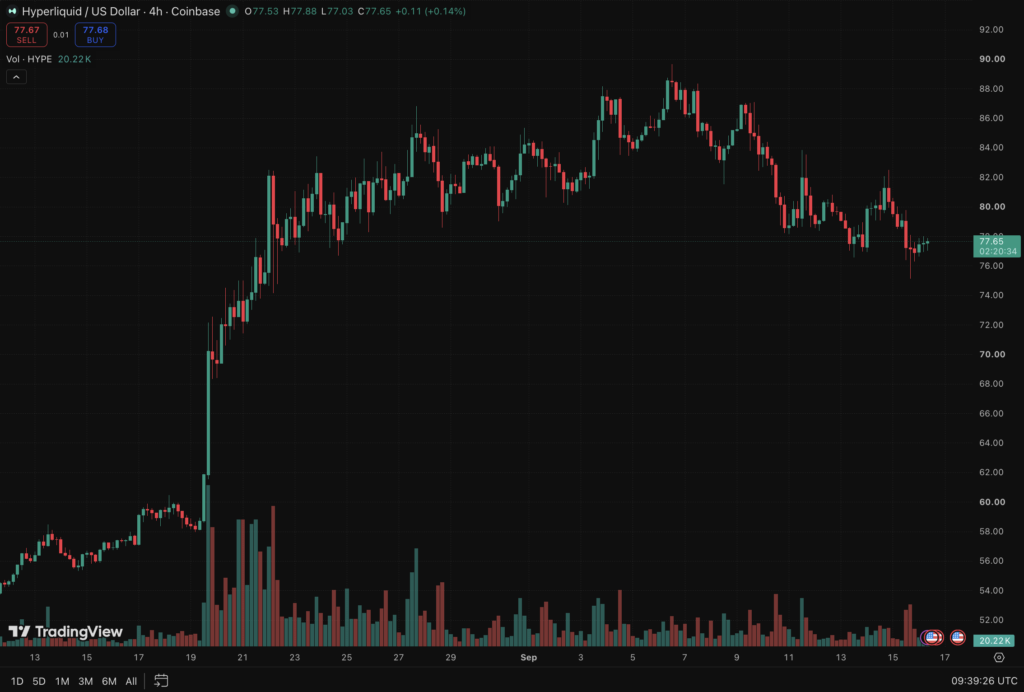
Federal prosecutors charged former Robinhood Crypto engineers Hefu Chai, 36, and Huaisong “Jerry” Xiang, 30, with one count of commodities fraud and one count of wire fraud each, alleging they used confidential information about upcoming Robinhood token listings to trade related perpetual futures on Hyperliquid before those listings went public.
Each defendant allegedly profited more than $50,000 between 2025 and 2026, according to the U.S. Attorney’s Office for the Southern District of New York.
The case matters beyond the dollar figures because it extends crypto insider-trading enforcement to decentralized derivatives markets, not just spot exchanges.
Prosecutors are applying commodities fraud and wire fraud theories to trading on a venue with no central listing desk or traditional KYC gatekeeper, signaling that jurisdiction over misappropriated information does not stop at a platform’s front door.
Supercharge Your Trading in 2026 With BloFin AI Trading Bots
How Did the Robinhood Engineers Use Hyperliquid to Conduct Insider Trading?
On September 15, 2026, the U.S. Attorney’s Office for the Southern District of New York announced charges against Chai from Menlo Park, California, and Xiang from Jersey City, New Jersey.
Both engineers at Robinhood allegedly accessed nonpublic information about upcoming cryptocurrency listings and profited by buying perpetual futures on Hyperliquid before public announcements.
The DOJ claims this violated their confidentiality obligations for personal gain. U.S. Attorney Jamie McDonald emphasized that corporate insiders cannot evade laws by trading derivatives.
The commodities fraud charge carries a maximum of 10 years, while the wire fraud charge could result in up to 20 years in prison if convicted. Robinhood said it is committed to market integrity and reported the matter to authorities, cooperating fully with the investigation.
Earn $50 and Enter $300K Prize Draw on EdgeX
Why Perps and the Legal Theory Matter in the Insider Trading Case
Perpetual futures let traders take leveraged bets on an asset’s price without holding the token, and they never expire as long as funding payments keep them aligned with the spot price.
This makes them ideal for front-running listing announcements, since there’s no need to source the actual token and no custody risk.
The DOJ is pursuing this case under the Commodity Exchange Act and wire fraud statutes instead of securities fraud, allowing it to address derivatives trading on decentralized platforms without debating the status of underlying tokens.
This approach differs from the earlier Coinbase case involving Ishan Wahi, who was charged for sharing confidential token-listing information.
Hyperliquid, a major decentralized platform for perpetual futures, is already under regulatory scrutiny, and this case adds a criminal dimension.
The takeaway for traders is clear: pre-listing perp flow on decentralized venues now falls within the DOJ’s focus, and insiders trading through derivatives may face risks similar to those trading spot tokens directly.
The charges against Chai and Xiang are allegations only, and both defendants are presumed innocent unless proven guilty. No trial date or plea has been reported.
Discover: The Best Token Presales
The post Who are Hefu Chai and Jerry Xiang in the Robinhood Insider Case appeared first on Cryptonews.
Bitcoin (BTC) demand is under pressure in the US as investors react to the failure of the CLARITY Act to advance in the Senate.
Key points:
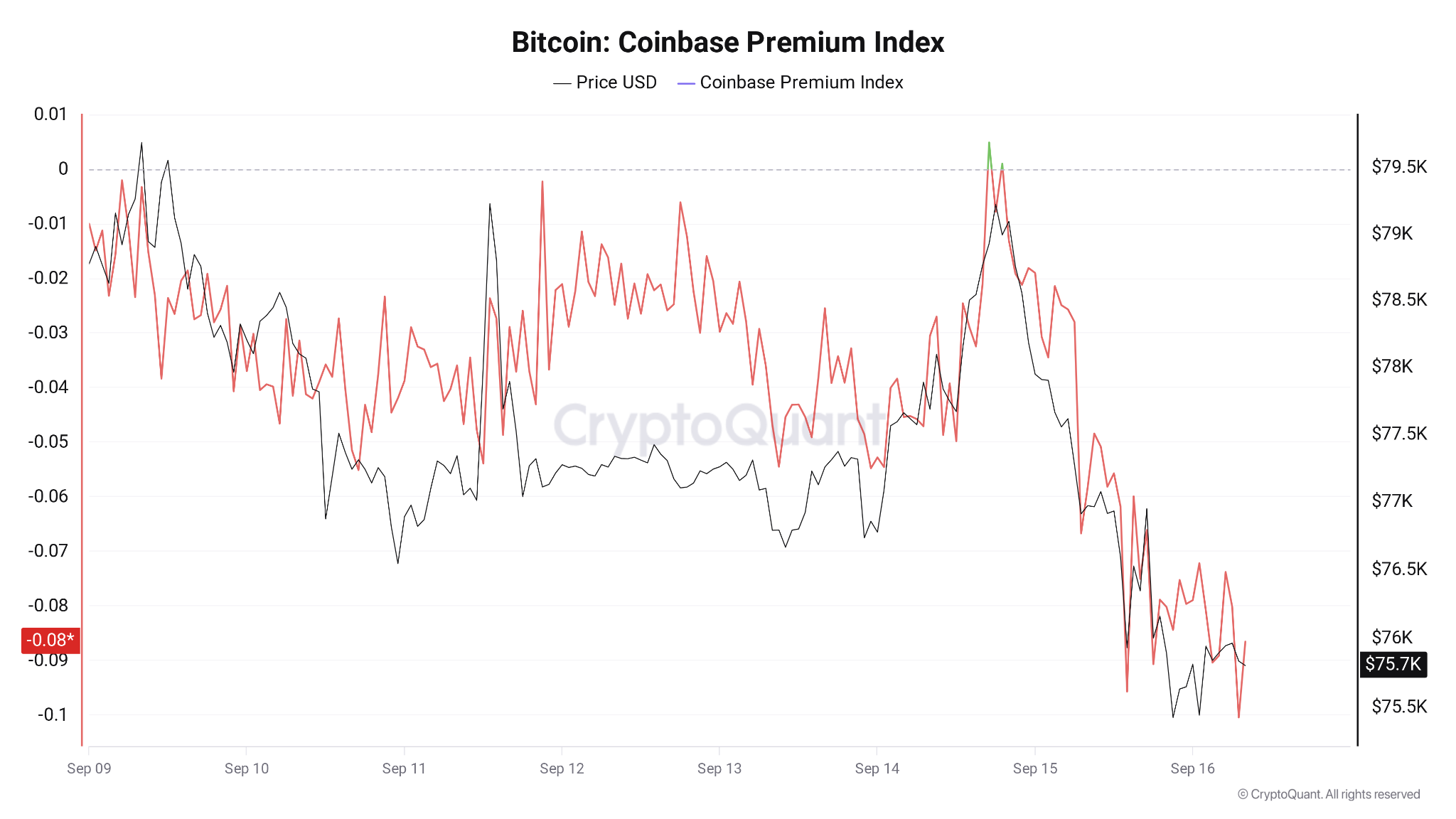
- Bitcoin’s Coinbase Premium Index fell to -0.079 on Tuesday, its lowest level since Aug. 16.
- US sell-side pressure diverged from other major exchanges as the CLARITY Act failed to advance in the Senate.
- Short-term holders sent 34,000 BTC to exchanges in the last 24 hours, potentially for sale at a loss. This constitutes the largest inflow in a month.
Analyst sees “bullish” signal as Coinbase selling diverges from Binance
Senators failed to give CLARITY the necessary 60 votes on Tuesday, leaving only a handful of options for returning the key piece of crypto legislation to the debate stage before 2027. Bitcoin saw downside pressure on the back of the news, as US demand in particular suffered from the decision. Data from onchain analytics platform CryptoQuant shows the Coinbase Premium dropping to one-month lows of -0.079 on Tuesday.
The Coinbase Premium, which measures the difference in price between Coinbase’s and Binance’s BTC/USDT pairs, briefly turned positive at the start of the week, reaching 0.004, but fell deeper over the course of Monday. It currently sits at its lowest levels since Aug. 16, when BTC/USD traded at around $63,000.
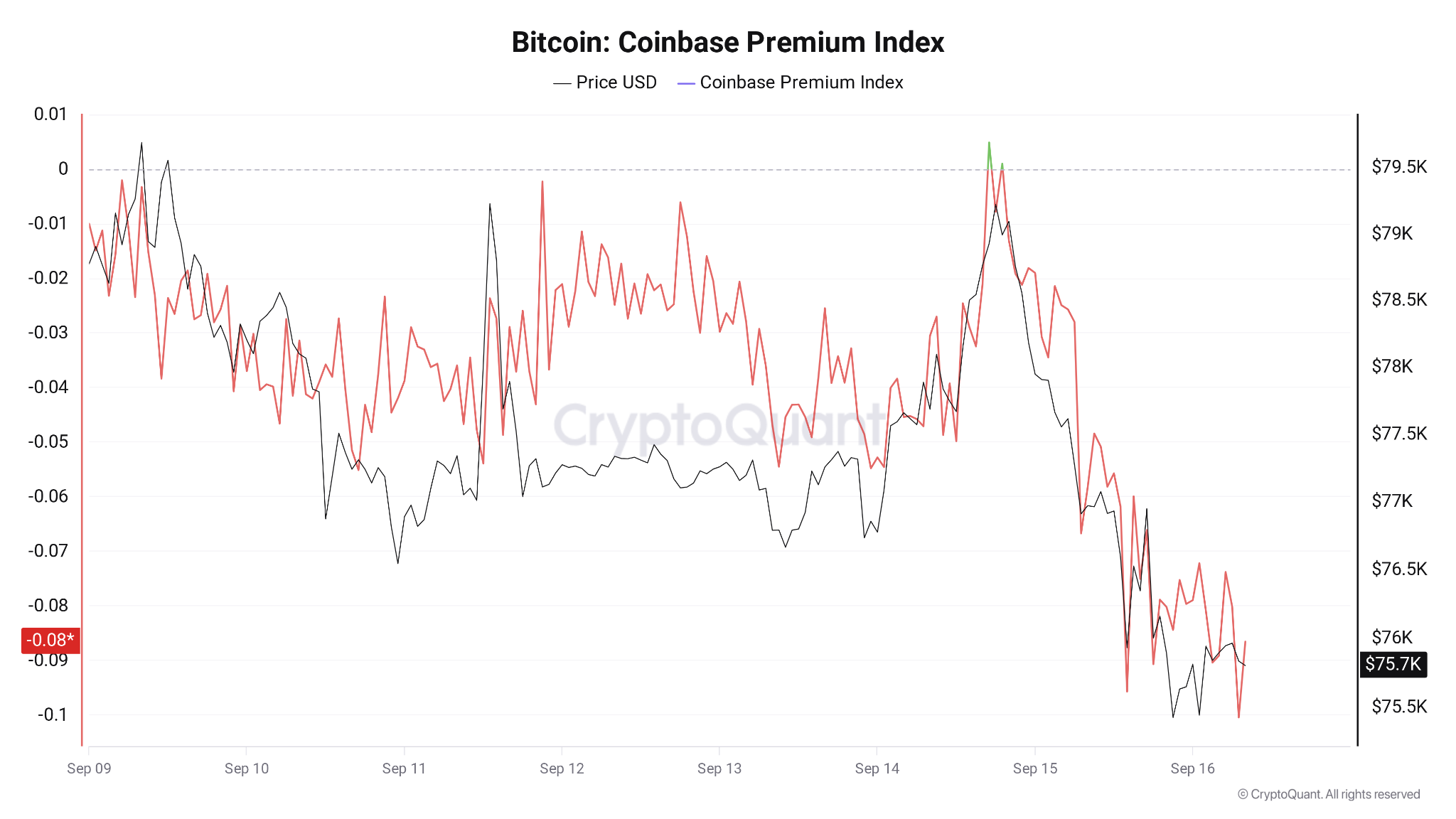
Bitcoin Coinbase Premium Index. Source: CryptoQuant
A negative Coinbase Premium implies a comparative lack of demand from Coinbase traders compared to Binance users. The premium has spent much of 2026 in the red, underscoring the exodus of investor capital as Bitcoin fell from its latest all-time highs of $126,200 seen in October 2025.
Responding, onchain analyst Willy Woo flagged that the divergence in seller behavior between Coinbase and non-US exchanges intensified around the vote.
Woo produced a chart of cumulative volume delta (CVD) data by exchange, denominated in BTC since Sept. 6. CVD measures the difference between net buyer and seller volume over a single candle, adding each candle’s data to the total for a given period. Around Sept. 11, Binance CVD began to move higher, while Coinbase continued to fall as sellers there remained firmly in control.
“I see the US selling with the failed Clarity Act (on Coinbase) Meanwhile the more dominant global offshore continues accumulating (on Binance),” Woo wrote in a post on X, describing the scenario as “bullish.”
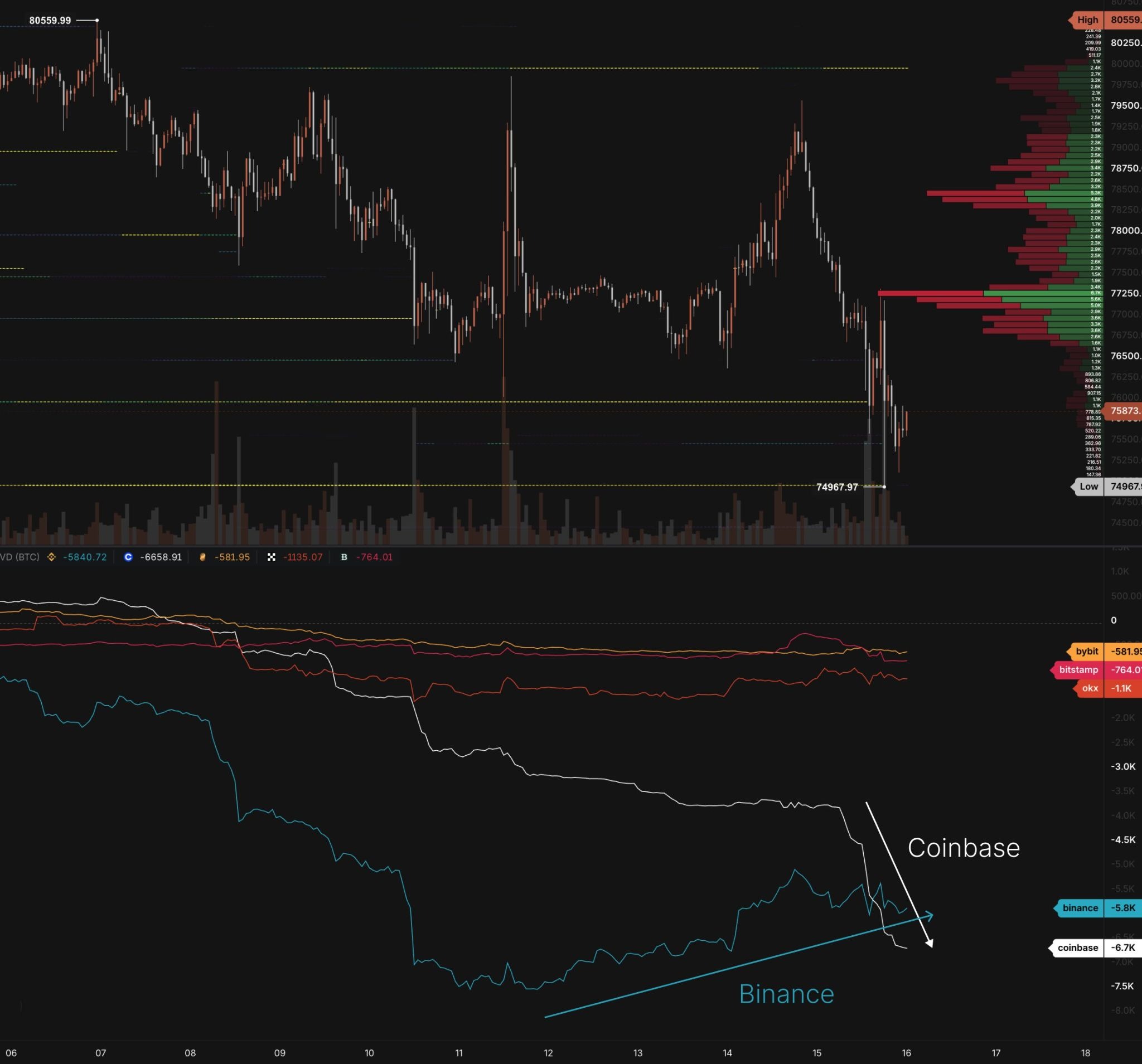
BTC/USD chart with CVD data. Source: Willy Woo on X.com
Short-term holders send BTC to exchanges in unrealized loss
Continuing, CryptoQuant showed that the bulk of reactive selling from the CLARITY failure came from newer Bitcoin investors.
Related: CLARITY Act vote meets Fed rate hike: Five things to know in Bitcoin this week
Short-term holders (STH), wallets holding an unspent transaction output (UTXO) for less than six months, sent up to 34,000 BTC to exchanges on a rolling 24-hour basis. The majority of these coins were transferred to exchanges at a lower price than when they last moved onchain.
“With 23 200 BTC sent to exchanges at a loss, this STH capitulation event is the largest recorded over the past month,” CryptoQuant reported in a blog post.
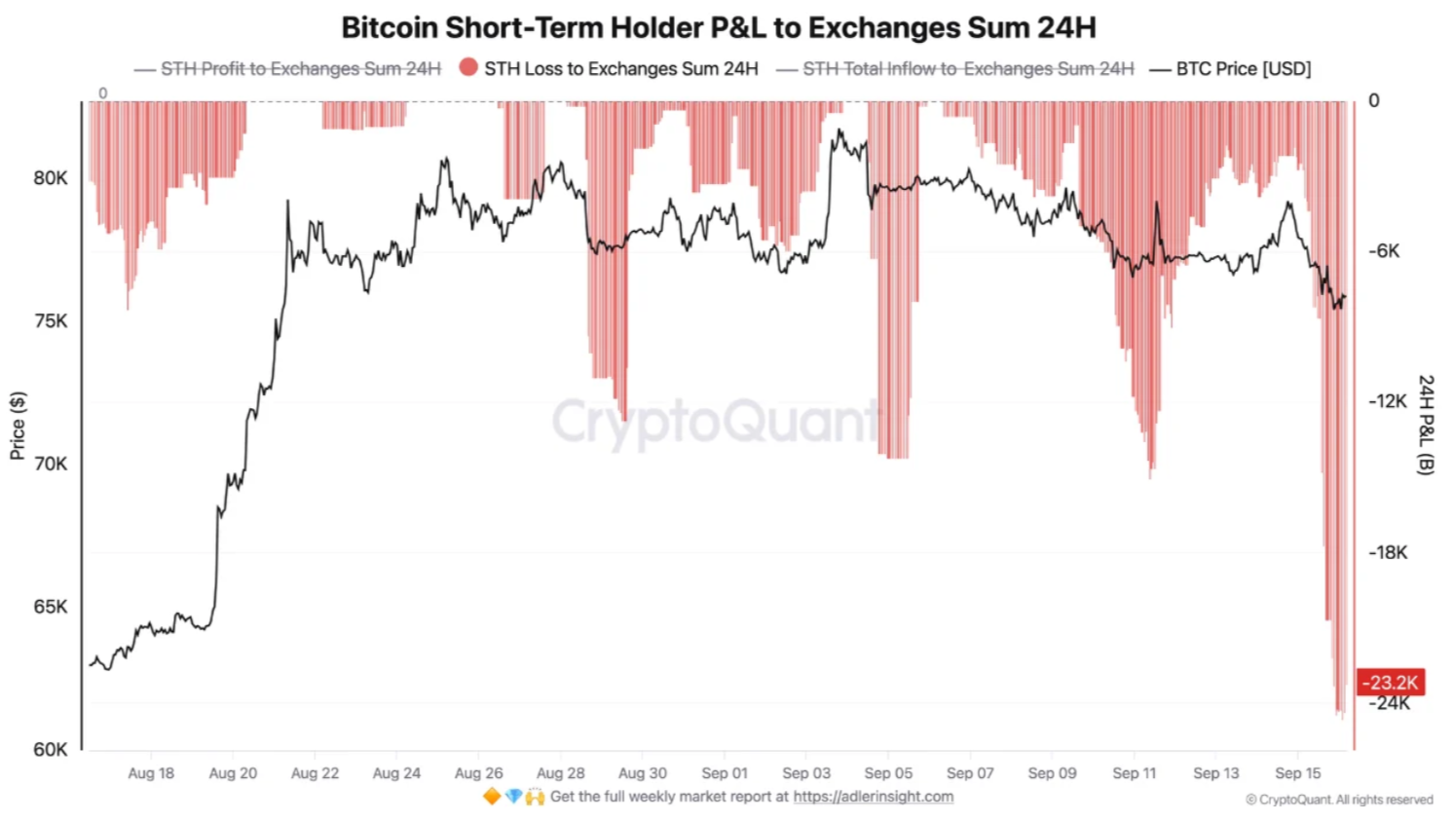
Bitcoin STH cumulative 24-hour profit and loss to exchanges (screenshot). Source: CryptoQuant
Previously, Cointelegraph reported that STH unrealized profitability had reached a key milestone for 2026, potentially boosting the odds of a long-term bullish BTC price trend change.

Trader Matthew Hyland says Bitcoin is sitting at a daily cycle low with a bullish divergence forming on the charts, and he’s calling for prices above $90,000 by early November.
He’s making that call even as BTC trades near $76,000, down sharply since the Senate failed to advance the CLARITY Act, and while most of the market’s loudest voices are still leaning bearish.
One Analyst Sees a Bottom, Bears See a Trap
Hyland posted on X that bears were getting excited right at what he considers a daily cycle low, with a bullish divergence setup forming underneath the price action.
“See ya at $90k+ by early November,” he wrote.
Swing trader Roman replied, “Yeah, part of me really thinks this was a low,” with Hyland acknowledging that the RSI could fall further, although he pointed to liquidity around $75,000.
“So far it was just a liquidity grab IMO,” he stated, adding that there was “not really much liquidity below” that level. Additionally, he said current prices look solid to him, even though most bears still aren’t buying it and are hoping for a much deeper decline.
That view runs against more pessimistic calls on X, including from analyst Ted Pillows, who pointed out that BTC has lost its 50-week EMA and wrote that “a drop to $70K-$72K zone is highly likely before any reversal.”
Fellow market watcher Crypto Patel has been calling the bearish move since Bitcoin fell from $82,500 to about $74,900 after being rejected near an $83,000 bearish order block on the daily chart, and he’s holding a $50,000 target unless Bitcoin closes above $83,000 on a higher timeframe.
Meanwhile, CryptoQuant contributor IT Tech took a different approach, focusing on Bitcoin holdings rather than price structure. They pointed out that the 6- to 12-month supply band has climbed to 30.8% of realized cap, up from 16.2% in December last year, a pattern that lined up with the last three Bitcoin bottoms.
The analyst called it a bullish setup but stopped short of calling it the cycle low outright, noting that the OG cryptocurrency is still down nearly 40% from its peak and that “this reads as mid-cycle floor building, not the cycle low.”
Bitcoin’s Price Action and the CLARITY Act Fallout
BTC was trading near $76,000 at the time of writing, down about 1.5% in 24 hours and nearly 5% over the past week, although it’s still up close to 19% across 30 days.
The drop follows Tuesday’s Senate vote, when cloture on the CLARITY Act failed to gather the 60 votes needed to move the bill forward. As CryptoPotato reported earlier, Bitcoin short-term holders sent more than 23,000 BTC to exchanges at a loss in the aftermath, worth close to $1.8 billion, marking the largest capitulation event in about a month.
The post Analyst Says This Setup Could Send Bitcoin Above $90K by November appeared first on CryptoPotato.

US Charges Robinhood Engineers Over Crypto Listing Trades

Brand New Day Becomes Highest-Grossing Domestic Movie Ever

What are the best variations of Blackjack?



-

 Fashion5 days ago
Weekend Open Thread – Corporette.com
-

 Business7 days ago
Micron Stock Climbs Above $1,031 as AI Memory Crunch and a $50 Billion Outlook Fuel the Rally
-

 Tech3 days ago
The Latest Weird Thing to Play Doom Is the Mapped-Out Brain of a Fruit Fly
-

 Business7 days ago
AMD Stock Climbs After Management Lifts 2027 Data Center Outlook Toward $70 Billion in AI Sales
-

 Business6 days ago
10 Most-Streamed Songs On Spotify In 2026 So Far, Led By Ella Langley’s Dominant Run On The Charts This Year
-

 Crypto World6 days ago
XAG/USD: Silver’s Short-Term Rally Meets Its Moment of Truth
-

 Crypto World6 days ago
2 Chip Stocks Broke Out This Week. Neither Was Nvidia
-

 Tech6 days ago
Battery life is the only iPhone 18 Pro and iPhone Duo upgrade I care about. Apple didn’t disappoint
-

 Crypto World7 days ago
Pi Network ships Protocol 27 on a network with 14 million users and zero DeFi
-

 Crypto World6 days ago
OKX launches 10x OpenAI, Anthropic X-Perps in Europe
-

 Crypto World6 days ago
Diesel Tops $6 a Gallon for the First Time as 28 States Set Records
-

 News Videos5 days ago
Facing Financial Fears
-

 Business6 days ago
Western Digital Slips 2.7% as AI Storage Rally Cools After Record Cash and Guidance
-

 Entertainment7 days ago
Case Sees Major Update As Jury Deliberations Begin
-

 Business4 days ago
Rivals Sam Altman and Elon Musk Rally Behind Dario Amodei’s Call for a Slowdown in AI Development
-

 Crypto World2 days ago
Elon Musk Drops a Bombshell: Grok 5 Could Be the AGI Breakthrough
-

 Business7 days ago
Five Leading AI Experts Warn Superintelligence Could Kill Humans and Explain Their Case
-
 Crypto World7 days ago
Ethereum price breakout hinges on a close above $2,535
-
Crypto World6 days ago
Ethereum Price Analysis: Consolidation at $2.5K Tests Momentum as On-Chain Activity Surges
-

 Crypto World7 days ago
Ant International joins Visa, Mastercard to build AI agent payment standards
You must be logged in to post a comment Login