





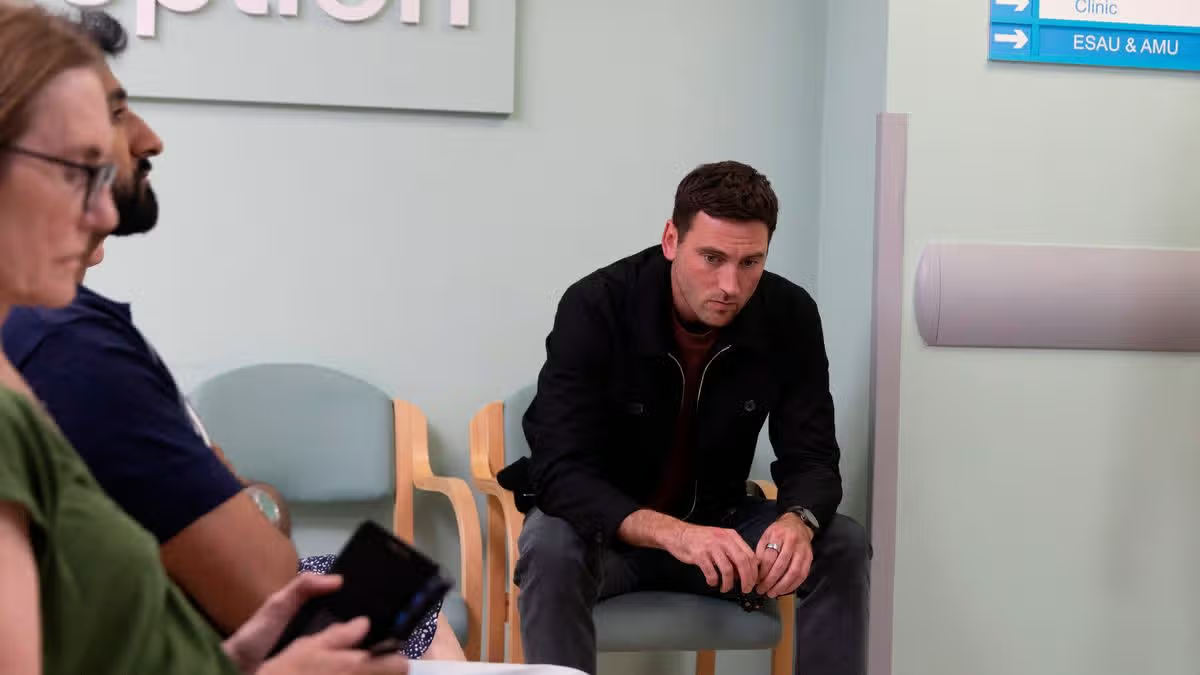
An Oldham man has shared why he has been involved in helping Coronation Street with its latest hard-hitting health storyline in which Kit Green has been seen being given a breast cancer diagnosis.
As viewers of the ITV soap, which is filmed in Salford, know, the diagnosis comes on the back of the death of Kit’s great-aunt, Celeste. Before she died, she made Kit’s half-sister, Gemma Winter-Brown, aware that the family may carry the familial BRCA gene.
Carrying a familial BRCA (Breast Cancer) gene mutation means inheriting a harmful change in the BRCA1 or BRCA2 genes from a parent, which significantly raises your lifetime risk of developing certain cancers.
Click here to sign up for more Coronation Street updates in our newsletter
But as their mum, Bernie Winter-Alahan, and Gemma face testing, unbeknownst to them, Kit has already been seeking medical help due to concerns about his own health and was recently diagnosed with stage 3 breast cancer, something almost 500 men in the UK face every year.
The Coronation Street production team are working closely with Macmillan Cancer Support and Breast Cancer Now to accurately portray Kit’s cancer while raising awareness of the very real risks of the illness amongst men.
Although male breast cancer is real, it is rare, and as it accounts for less than one per cent of all breast cancer cases, many men do not realise they can get it, which leads to embarrassment, delayed diagnoses, and higher mortality rates.
David is among those men who have received their own diagnosis. He was 62 when he was diagnosed with ductal carcinoma in 2019.
He explains: “I went to the doctor at first about the fatty breast issue, medically known as gynecomastia, but was told, ‘It’ll never come to anything’. Then I had an inverted nipple, so I went back to the GP and got a referral for a biopsy and tests. I was diagnosed with an invasive ductal carcinoma grade 3.
“I had a mastectomy and then axillary clearance, chemotherapy, and radiotherapy. My first thought was how was I going to tell my wife and my sons.” David adds: “In 2022, I had a repair to my original mastectomy site, and a risk-reducing mastectomy to the other side as I tested positive for BRCA 2.”
According to Macmillan, the BRCA1 and BRCA2 genes usually protect us from cancer. A variant in either of these genes reduces the level of protection. Over time, this may mean some types of cancer are more likely to develop. For men, and people assigned male at birth, who have a BRCA2 gene variant, they have a higher risk of developing prostate, breast and pancreatic cancer.
The cancer spread to David’s lungs in 2023, so it is now classed as stage 4 breast cancer. The cancer is treatable but incurable. “I’ve been told treatment is available until it either doesn’t work, or my body can’t take it or the side effects,” he says. “The purpose of these meds is to prolong life and sadly not cure. Cancer will eventually overcome the meds and build a resistance and sadly return. Until then, we fight on.”
Following his diagnosis, David has received support from Macmillan through welfare advice and grants, specialist nurses, the Support Line, community forum and the local Macmillan support service in Oldham.
“With Macmillan, it felt like someone was fighting my corner, particularly after I was made redundant and I felt like I was a man with breast cancer in a world where no one wants me,” David shares. “My specialist breast cancer nurse at The Christie gave me permission to be myself. I don’t have to hide anything or pretend nothing’s bothering me. You become yourself, and that’s all because she allows you to do that.”
Now, David is using his own experience to help others. “I’m a cancer champion for an organisation in Manchester which targets harder to reach groups that don’t attend screening programmes,” he explains. “There’s no screening programme for men. I say to the ladies, please go along, it might be uncomfortable, but it’s a few minutes, and then you could be told you have it, or thank God you haven’t. But by raising awareness to women, off the back of that, they can remind men to do the same thing and check [their] breast tissue.”
He adds: “People often don’t realise that the [Macmillan] helpline is there and the forums, because if you don’t have cancer, why would you look for these things? I used Macmillan forums a lot when I was first diagnosed and used to call the support line a lot to get support on side effects.
“They have always given me the right advice at the right time and been a lifeline. Macmillan is amazing at signposting, which shows they are supporting the person affected by cancer and have their best interests at heart.”
It has led David to work with the Corrie cast recently on Kit’s male breast cancer storyline. “I am involved in some exciting social media activity as part of the Macmillan partnership with Coronation Street,” he shares. “I am pleased that Coronation Street are running this storyline because it increases the awareness about breast cancer in men and highlights that men can and do get this cancer.
“I know myself, seven years on from my primary diagnosis, that there are still men who don’t realise that men can get breast cancer. Those people see the illness as a female condition and don’t equate that while men don’t have a lot of breast tissue, there’s enough to develop breast cancers and it can run in families. Men might be more likely to have more awareness if family members have had or died through having certain cancers.”
He adds: “Talking about these things saves lives and this story being on prime-time TV will absolutely help people. Even if it’s a female telling her spouse, brother, or father, ‘I told you men can get it!’”








































You must be logged in to post a comment Login