
Crypto World
Fetch.ai and NuNet Exploited for $2 Million by Same Attacker, NTX Hits All-Time Low

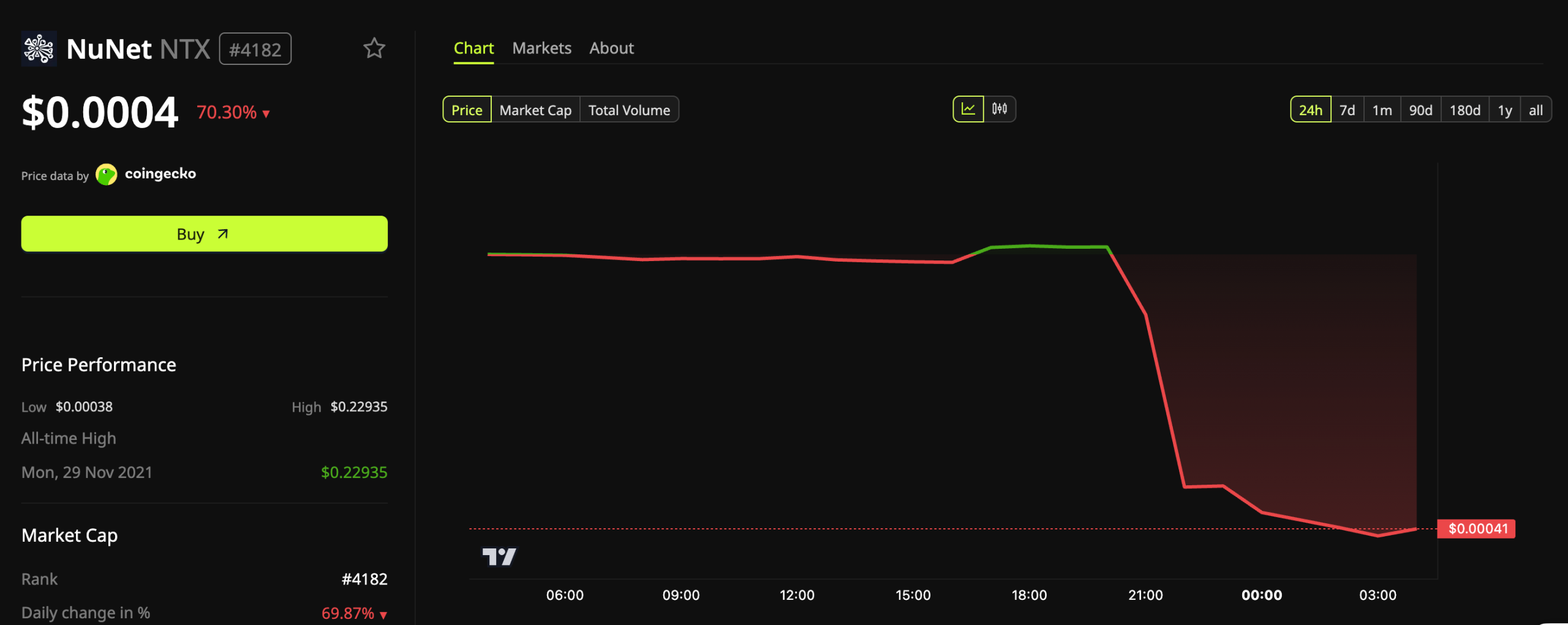
The same exploiter was linked to attacks involving Fetch.ai (FET) and NuNet (NTX), with roughly $2 million in assets involved.
Security firms tied both events to the same wallet. NuNet’s token lost more than 70% of its value and touched an all-time low on September 20.
How One Attacker Reached Two Protocols
Blockaid said on September 20 that an exploiter drained about $1.56 million worth of FET from a Fetch.ai token converter on Ethereum. The attacker reportedly used a valid conversion-authorizer signature to call the conversionIn function on TokenConversionManagerV3.
That single call released the converter’s remaining FET inventory. The security firm identified the exploiter wallet as 0x1572…c362.
Follow us on X to get the latest news as it happens
According to Blockaid, the Fetch.ai loot wallet also received a large NTX mint from the NuNet deployer account. It estimated the value of the NTX mint at roughly $452,000.
The combined activity across the wallet cluster has reached approximately $2.01 million. PeckShieldAlert added that the exploiter has since swapped the stolen funds for 546.36 ETH, worth roughly $1.44 million at the time of reporting.
NuNet Token Sinks to a Record Low
The reported exploit has put pressure on NuNet’s NTX token. The token hit an all-time low at $0.000328 today. NTX changed hands near $0.0004 at press time, down more than 70% over 24 hours.

FET fell about 5% over the same period, a far smaller move than NuNet’s. That decline came as the wider market sold off, with most major assets in the red and total crypto market capitalization down 4%.
September has been expensive for the sector. Starknet lending protocol Nostra lost $3.5 million to a manipulated oracle three days ago.
DefiLlama had logged roughly $331 million in losses across 17 incidents this month before the Fetch.ai drain, most of it from the $320 million Liquid Network incident. Fetch.ai and NuNet now push the month past $333 million.
BeInCrypto has reached out to Fetch.ai and NuNet for comment.
Subscribe to our YouTube channel to watch leaders and journalists provide expert insights
The post Fetch.ai and NuNet Exploited for $2 Million by Same Attacker, NTX Hits All-Time Low appeared first on BeInCrypto.


Despite the overall macro calamity experienced last week, bitcoin’s price surged from $75,000 to almost $82,000 within days, hitting its highest level since the start of the month.
However, the breakout attempt was halted at $82,000 due to more worrisome news from the Middle East. There’s also a technical aspect that helped prevent another leg up.
New Escalation
Numerous reports online suggested on Sunday that the United States had warned that hostilities between Saudi Arabia and Iran-backed Houthis have escalated, with some even suggesting that the latter’s capital was under drone and ballistic missile attacks. BBC added that even some energy sites on the country’s Red Sea coast were targeted.
Saudi authorities reported that they intercepted and destroyed a ballistic missile fired at Riyadh on Saturday evening, claiming that there were no casualties and no new attacks.
“Iranian-supported Houthis have engaged in hostilities against Saudi Arabia, including civilian airports. This military conflict has the potential to escalate rapidly,” said the US State Department. The statement also warned Americans to “seriously reconsider travel to and through the region.”
Meanwhile, Daily Iran News, an X account with over 500,000 followers, claimed that Iran had issued “Code 100,” its highest alert level, for all armed forces earlier this morning. It covers the IRGC, the Army, and security forces.
Reacting to the news, Trump reportedly cut short his weekend at Camp David to return to the White House, citing the potential for significant escalation. Israel’s Netanyahu also reportedly headed back to his country after cutting the US trip short.
TD Sequential
We saw last week that the substantial blows from the CLARITY Act setback, the Fed rate hikes, and the subsequent hawkish outlook couldn’t keep BTC down for now. The asset dipped to $75,000 after the Senate vote, but went on an impressive run on Friday and Saturday, nearing $82,000 for the first time in two weeks.
This notable rally, though, changed some technical aspects. Ali Martinez reported that the TD Sequential, which flashed a buy signal when BTC slipped to $75,000, had flipped into a sell signal on Saturday evening, just as the cryptocurrency had tapped $81,500.
“That suggests short-term momentum may be getting stretched, and I’m watching closely for signs that it’s time to lock in some profits,” he added.
The post Why Was Bitcoin Rejected at $82K? 3 Reasons Behind the Sunday Pullback appeared first on CryptoPotato.

South Korean police have opened criminal cases against 26 users of the prediction market platform Polymarket and referred 18 of them to prosecutors over roughly 17.6 billion won, about $12.7 million, in bets tied to political, economic, and social outcomes.
The case, disclosed on September 17 through data from Democratic Party lawmaker Yoon Geon-young’s office, sets up a legal fight over whether trading on Polymarket counts as gambling under Korean law or something closer to a derivatives investment.
Blockchain Records and a Gambling Charge
According to a report from Asia Economy, the Gangwon Police Agency’s Cyber Investigation Unit had booked the 26 suspects as of September 15, and the largest single bet from one user reached about 5.7 billion won ($4.1 million).
Polymarket does not hold custody of user funds and settles wagers automatically in USDC or pUSD based on real-world outcomes, so it keeps no real-name list of who is trading. But law enforcement pulled public blockchain transaction records and used open-source techniques to trace the Korean users anyway.
Police argue the transactions amount to illegal gambling under Article 246 of the Criminal Code, pointing to a Supreme Court precedent holding that a bet counts as gambling once chance plays a role and money is staked on the result, even if skill also factors in.
Calling the trades an investment, in their reading, doesn’t change that a virtual asset is put at risk against an outcome nobody can know in advance.
The booked users argue Polymarket should be treated as a virtual asset derivatives market rather than gambling, and that is expected to become a central question once the cases reach court.
The setup could formally meet the legal definition of gambling according to attorney Kim Tae-rim of AXIS Law, since profits and losses turn on uncertain outcomes with virtual assets on the line.
South Korea Had Already Blocked Polymarket Access
The prosecutions have come after South Korea’s August 18 decision to block domestic access to Polymarket. As CryptoPotato reported then, authorities said the platform’s winner-takes-all structure, combined with betting on events outside users’ control, encouraged gambling behavior.
Polymarket had argued it fell outside Korean jurisdiction after dropping Korean language service and won-denominated payments, but the commission rejected that argument.
The prediction market has run into similar resistance well beyond Korea, with France, Australia and Germany restricting access, and Baltimore suing it and rival Kalshi last month over claims they operate as unlicensed sportsbooks.
The post Report: $12.7M in Polymarket Wagers Triggers Criminal Cases in South Korea appeared first on CryptoPotato.

The shipping industry group continues to show why it’s one of the best in the current stock market, with boatloads of stocks making new highs. Among them, Scorpio Tankers (STNG) and Matson (MATX) remain in buy zones. Shares of Monaco-based Scorpio climbed above the 87.39 buy point from an 18-week pattern. The buy zone goes to 91.76. It had already…
Copyright ©2026 Investor’s Business Daily, LLC. All rights reserved. 87990cbe856818d5eddac44c7b1cdeb8

Diesel prices keep getting gnarlier. As geopolitical violence chokes Russian refineries, the Strait of Hormuz and the Red Sea, the upshot is soaring fuel costs that “hit everyone” — not just drivers of supersized pickups, says Gulf Oil’s Tom Kloza. Diesel prices on Friday averaged $6.45 a gallon across the U.S., according to AAA, and $8.39 in California — the…
Copyright ©2026 Investor’s Business Daily, LLC. All rights reserved. 87990cbe856818d5eddac44c7b1cdeb8


With a market cap. of $25.4 billion, Houston, Texas-based CenterPoint Energy, Inc. (CNP) is an energy delivery company providing electric and natural gas services across Indiana, Minnesota, Ohio, and Texas. The company serves more than 7 million metered customers through its electric transmission and distribution, power generation, and natural gas distribution operations.
Companies valued between $10 billion and $200 billion are generally classified as “large-cap stocks,” and CenterPoint Energy comfortably fits this category. As of June 30, 2026, CenterPoint Energy owned approximately $48.3 billion in assets and employed around 8,800 people, with a history spanning more than 150 years.
More News from Barchart
CNP stock has slipped 15.3% from its 52-week high of $45.26, reached on Jul. 28. Over the past three months, CNP shares have dipped 10.5%, underperforming the Nasdaq Composite ( $NASX), which has declined marginally over the same period.

CNP stock is down marginally on a YTD basis, lagging behind NASX’s 13.6% gain. Moreover, shares of the company have risen marginally over the past 52 weeks, compared to NASX’s 17.5% return over the same time frame.
The stock has been trading below its 50-day and 200-day moving averages since August.

CenterPoint Energy has underperformed due to its substantial capital requirements and reliance on external financing, which may increase dilution risk. The company also faces pressure from its relatively low dividend yield, elevated valuation, and the need to convert expected data-center and large-load electricity demand into contracted, rate-base-producing assets.
In comparison, rival Duke Energy Corporation (DUK) has declined 2.6% over the past 52 weeks, lagging behind CNP stock over the same period.
Despite the stock’s underperformance relative to the NASX, analysts remain moderately optimistic on CNP. The stock has a consensus rating of “Moderate Buy” from 19 analysts in coverage, and the mean price target of $45.29 implies 17.5% upside from its current price.
On the date of publication, Sohini Mondal did not have (either directly or indirectly) positions in any of the securities mentioned in this article. All information and data in this article is solely for informational purposes. This article was originally published on Barchart.com
Crypto World
SailPoint’s (SAIL) Falcon Next-Gen SIEM Arrangement Fits Its Broader Identity Security Push

SailPoint Inc. (NASDAQ:SAIL), a leading player within the enterprise identity security space, recently expanded its strategic alliance with CrowdStrike. As part of the revised arrangement, the company’s SailPoint SecOps Identity Intelligence will be integrated with CrowdStrike Falcon Next-Gen SIEM. This will help in expediting threat detection procedures, and will also incorporate access data and identity governance into the overall investigation process. The expanded partnership will facilitate security teams in lining up the identity insights with Falcon’s existing security telemetry.

Copyright: franckito / 123RF Stock Photo
Strategic Alignment
The announcement aligns strongly with SailPoint’s broader strategic narrative revealed in its Q2 FY27 print. It builds upon several recent initiatives undertaken by the management, such as introduction of the SailPoint Identity Security solution. This is aimed toward integrating SailPoint Agentic Fabric with SailPoint Human Fabric for real-time discovery and security of complex digital ecosystems. The company also launched its Cursor Enterprise connector, which helps organizations to leverage a highly-integrated control plane to manage human developers and autonomous AI agents.
The recently released financials also back this narrative as the company delivered a 25% year-over-year growth in its annual recurring revenue, which stood at $1.231 billion. SailPoint generated $45 million in operating cash flow during the second quarter, along with $37 million in free cash flow.
By weaving SailPoint’s identity intelligence into Falcon Next-Gen SIEM, customers gain extra context inside workflows they already rely on, making it easier to probe identity-related risks. The integration augments SailPoint’s position at a time when identity threats are on a rise. This leads to an opportunity for SailPoint to cement itself as a leading provider of advanced security solutions.
Adoption Will Be A Real Test
A certain degree of caution is still warranted despite the promising prospects related to this expanded partnership. There is a view that such vendor partnerships tend to overstate short-term impact, and the actual outcomes are more dependent on adoption trends and the follow-through.
For the announced integration to succeed, the targeted customers will need to utilize both platforms at scale. However, several organizations operate mixed security stacks where rival SIEM or identity tools can limit the underlying potential of new partnerships.

Join Our Telegram channel to stay up to date on breaking news coverage
The US Treasury has sanctioned BitBank, a Tehran-based bitcoin exchange it says Iran used to move hundreds of millions of dollars in cryptocurrency to the Islamic Revolutionary Guard Corps and to pass on tanker tolls charged at the Strait of Hormuz.
The Office of Foreign Assets Control, the Treasury arm that administers US sanctions, designated BitBank and Pishtaz Simorgh Electronic Trade Company, the software firm that built the exchange, in an action under Operation Economic Outcast confirmed in the announcement. OFAC says the exchange was set up in 2024. The designation freezes its property in US jurisdiction and bars Americans from dealing with it.
The allegations reach further. Iran has spent this year charging tankers between $1 million and $2 million to cross the Strait of Hormuz, and the Treasury said that since June, part of that money has moved through the exchange. The Hormuz Safe Marine Services Authority, the outfit Tehran uses to sell ships “safe passage” insurance, was itself sanctioned on July 29 and, per OFAC, began using BitBank in June to pass what it collected on to regime entities.
Every designation also carries a secondary sanctions tag. That means a foreign firm still processing BitBank’s flows is exposed to US penalties, a direct compliance risk for exchanges and banks outside the United States.
Treasury Secretary Scott Bessent framed the action as a warning to anyone financing the Iranian government with digital assets. “Today’s designations of Iranian digital asset infrastructure make perfectly clear that efforts to finance the Iranian regime using cryptocurrencies are not beyond OFAC’s reach,” he said in the release.
One break from precedent stands out: the action listed no wallet addresses. OFAC’s January designation of the Zedcex exchange, by contrast, published seven tron wallets that compliance teams could screen against. Without addresses, on-chain screening software has nothing to load for BitBank, and no independent check of the alleged flows is possible from the announcement alone.
Iran has not commented on the designations, and no vessel operator has confirmed paying through the exchange.
Join Our Telegram channel to stay up to date on breaking news coverage

Shareholders of International Business Machines (NYSE:IBM) have had a difficult 2026. The stock is down about 22% year to date as of this writing, trading near $230 — roughly 30% below the record close of $329.23 it set on June 2.
Most of that damage arrived in a single session. Shares fell about 25% on July 14, when IBM reported preliminary second-quarter results that fell short of the company’s own expectations. The lowered full-year outlook came on July 22, with the final report.
Missed Nvidia in 2009? This Rare Signal Is Flashing Again. In 2009, a “Double Down” signal flashed for a little-known chipmaker called Nvidia. For the first time in years, that same “Total Conviction” signal is flashing for a company 1/100th the size of Nvidia. Continue »
A sell-off like this invites a longer view, though. Where could IBM stock be five years from now?

Image source: The Motley Fool.
Growth slowed, and guidance followed
What made July especially painful was how strong the year had looked. IBM increased revenue 8% in 2025, to $67.5 billion. Free cash flow of $14.7 billion was up $2 billion from the previous year.
The momentum carried into 2026. First-quarter revenue rose 9% year over year, and software revenue jumped 11%.
Then the second quarter broke the pattern. Revenue of $17.2 billion was up just 1% year over year. Software revenue growth slowed to 5%, under half the first quarter’s pace. Consulting revenue was flat. And infrastructure revenue fell 7%, with IBM Z, the mainframe business, down 42% as the z17 launch cycle wound down.
Management now expects revenue to increase 4% to 5% this year in constant currency, down from the more than 5% it still expected in April.
In a July 14 letter to investors, CEO Arvind Krishna pointed to clients moving spending toward servers, storage, and memory ahead of expected price increases, and to large deals that did not close on time.
“These conditions require our teams to execute perfectly, and this quarter we faltered,” he said.
However you assess those explanations, the slowdown that concerns me is software’s. It’s the segment that underpins IBM’s growth case. Mainframe cycles come and go. But a software slowdown is more difficult to dismiss.
Cash flow and the dividend
For all the top-line problems, IBM’s cash generation has held up. Management still expects free cash flow to grow by about $1 billion in 2026, which would put the full-year total near $15.7 billion.
That cash supports one of the longest dividend growth records in technology. April’s increase, to $1.69 per share quarterly, was IBM’s 31st in a row, and the company has paid quarterly dividends since 1916. At the current share price, the stock yields just under 3%.

Quick Read
-
Four Bitcoin ETFs experienced losses in the week ending September 18, with the ARK 21Shares Bitcoin ETF leading at $141.9 million. This demonstrates that funds can release coins as easily as they accumulate them.
-
The funds have accumulated $55.161 billion in net inflows over 32 months, averaging roughly $1.71 billion per month. At this rate, achieving an additional $60.5 billion will take about three years, targeting around mid-2029.
-
Bitcoin and Ethereum ETFs together hold $68.4 billion in committed capital across two product lines that did not exist three years ago.
-
Just released. Our analysts combed the entire stock market and named the ten best stocks to buy right now, and Franklin Templeton Digital Holdings Trust didn’t make the cut. Enter your email to see the names that beat EZBC. The report is free. Enter your email and see if any of your stocks made the cut.
As of September 18, 2026, spot Bitcoin ETFs in the US managed $102.532 billion in assets, equating to 6.29% of the total market capitalization of Bitcoin (CRYPTO:BTC).
To reach 10%, these ETFs would need to increase their holdings by $60.5 billion, bringing the total to $163.0 billion. So how long will that take, and what would it mean for Bitcoin?

What 6.29% of Bitcoin Actually Looks Like

With $102.532 billion representing 6.29% of Bitcoin, Bitcoin’s implied market capitalization stands at about $1.630 trillion. This means roughly one Bitcoin in every sixteen is currently held within a US spot ETF. These coins are stored in cold storage with custodians, meaning they cannot be spent, staked, or otherwise used, except as backing for shares traded on exchanges.
Since their launch, Bitcoin ETFs have attracted $55.161 billion in net inflows, while Ethereum ETFs have garnered an additional $13.250 billion, totaling $68.4 billion across two new product lines.
Reaching 10% Takes $60.5 Billion and Three More Years

Free Report, Just Released
Why Didn’t EZBC Make The Top 10 List?
24/7 Wall St has helped investors make money for over two decades, and our top analysts just finished ranking the definitive Top 10 Stocks To Buy Now. Not the ten biggest companies. Not the ten everyone is arguing about. The ten best stocks to buy right now.
And EZBC didn’t make the cut!
The report is free, and you can see why we think each stock is a top investment today.
Enter Your Email and See the Ten →
If Bitcoin’s market capitalization remains around $1.630 trillion, the ETFs will need an additional $60.5 billion in assets to reach $163.0 billion, or 1.59 times their current holdings. If Bitcoin’s price rises, the target will rise proportionally, meaning the funds may need to acquire even more.

Crypto World
A 63-Year-Old Inherited $118,000 of Savings Bonds From Her Father and Owes Tax on 30 Years of Interest He Never Reported

Quick Read
-
Inherited savings bonds are classified as income in respect of a decedent, meaning all 30 years of deferred interest, which can amount to somewhere between $70,000 and $90,000, is taxable as ordinary income to the heir.
-
Executors have a one-time election to report all accrued bond interest on the decedent’s final return, potentially saving tens of thousands if the deceased was in a lower tax bracket.
-
Cashing all bonds in one year can push heirs into the 32% bracket, trigger Medicare surtaxes, and raise IRMAA premiums two years later at age 65.
-
Two retirees, same $1 million, same 4% rule, buy one finished with $1.4 million, the other hit $0 in 12 years. Our free reader guide explains the flaw that separated them, and the income-first method built to avoid it.
Inheriting a shoebox of paper savings bonds sounds like a windfall until the IRS shows up. A 63-year-old daughter receives $118,000 of bonds her father bought over three decades, discovers he never paid tax on any of the interest, and learns the entire accrued balance is now her problem. This scenario plays out in thousands of estates every year because Series E, EE, and I bonds allow interest to compound tax-deferred.

The Bogleheads and Reddit r/personalfinance forums are full of near-identical stories: a parent dies, an executor finds bonds in a safe deposit box, and the family realizes the interest has been quietly accruing since the Clinton administration. The tax bill is almost always larger than the heir expects.
Why This Inheritance Triggers a Six-Figure Tax Bill
Savings bond interest is classified as income in respect of a decedent (IRD). Unlike a brokerage account or a house, IRD assets keep the decedent’s original cost basis, so every dollar of deferred interest inside those bonds remains fully taxable as ordinary income to whoever ends up cashing them.
The 4% Rule is Broken, Built On A World That No Longer Exists
Every retiree knows about the 4% rule, but it frames retirement as a slow liquidation and still causes retirees with seven-figure accounts to agonize over a dinner out.
There’s a different way to run the math that makes more sense today. Build an income floor — dividends, interest, and Social Security that cover your essential bills every month — and you never have to sell shares into a down market just to pay them.
Our free reader guide, The 4% Rule Is Broken, walks through it in about 15 minutes. Access the report here.
On a $118,000 face-and-accrual position built over 30 years, the taxable interest portion could easily run $70,000 to $90,000 depending on issue dates and rates. Series E and EE bonds hit final maturity at 30 years and stop earning. Once a bond reaches final maturity, the IRS treats the interest as taxable in that year whether the bond is redeemed or not. Many heirs discover the tax is already technically due on bonds that matured years before the parent died.

Real Madrid v Atletico Madrid: Jose Mourinho and Diego Simeone face off in Madrid derby

PrimeEnergy Resources: A Far More Stable Idea For The Future (NASDAQ:PNRG)

Flamingos Beat Ghana 4-2, Maintain Perfect Start At WAFU B U17 Girls Cup




-

 Fashion2 days ago
Weekend Open Thread: Talbots – Corporette.com
-

 Tech7 days ago
The Latest Weird Thing to Play Doom Is the Mapped-Out Brain of a Fruit Fly
-
 NewsBeat1 day ago
Trump says US has reached an agreement to take permanent control of Greenland’s security
-

 Crypto World5 days ago
Kraken Lets xStocks Holders Earn Yield Through DeFi
-

 Crypto World5 days ago
Revolut Attackers Warn of Ongoing Daily Customer Data Leaks
-

 Crypto World4 days ago
What Is the Status of the U.S.-Iran Peace Talks? Here's What Both Sides Are Saying
-

 Crypto World1 day ago
Circle launches Arc Studio AI agent for building onchain apps
-

 Crypto World3 days ago
US Charges Robinhood Engineers Over Crypto Listing Trades
-

 Crypto World6 days ago
Elon Musk Drops a Bombshell: Grok 5 Could Be the AGI Breakthrough
-

 Crypto World4 days ago
Robinhood engineers charged over $50K crypto scheme
-

 Crypto World1 day ago
Bitcoin price breaks channel as RSI climbs to 63
-
 Crypto World7 days ago
New Tesla Roadster Uses SpaceX Tech. Will It Impact the Stock Price?
-
 NewsBeat6 days ago
‘Sick conspiracy’: Trump says only guardrails AI needs is ‘a strong and smart (High IQ!) president’ in all-caps rant
-
 Crypto World5 days ago
NVIDIA Analysis: Attempted Rising Wedge Breakout Amid Pressure on the AI Sector
-
Business6 days ago
SK Hynix ADRs Fall More Than 6% as Memory Rally Breaks on Fears of Slower AI Spending
-

 Tech4 days ago
Webb’s IC 348 Mosaic Includes Two-Jupiter Dwarfs, Twin Jets, and a Nursery Still Making Worlds
-
 Crypto World6 days ago
3 Token Unlocks to Watch in the Third Week of September 2026
-

 Crypto World5 days ago
DOJ Seeks to Seize $61M in Iran Oil Funds From Binance Accounts It Vouched For
-
Crypto World5 days ago
Can Circle’s Arc Repeat Robinhood Chain’s Meme Coin Boom?
-

 Crypto World7 days ago
Goldman Sachs backs 25bp Fed hike after CPI
You must be logged in to post a comment Login