
Crypto World
Strategy Buys 950 Bitcoin for $75.7M After Two-Week Pause


Michael Saylor’s Strategy resumed buying Bitcoin after a two-week pause while continuing to repurchase its STRC preferred stock.
Strategy acquired 950 Bitcoin (BTC) for $75.7 million at an average price of $79,670 per coin between Monday and Sunday, according to a Form 8-K filing with the US Securities and Exchange Commission on Monday.
The purchase brought Strategy’s holdings to 846,000 BTC, acquired for about $63.8 billion at an average cost of $75,416 per Bitcoin, including fees and expenses. With Bitcoin trading at $84,925 at the time of publication, Strategy was sitting on an unrealized gain of about $8.05 billion on its holdings.
The purchase comes as Strategy balances its Bitcoin accumulation strategy with managing a growing collection of preferred securities and billions of dollars in cash reserves.
Shares of Strategy, the largest publicly traded Bitcoin treasury company in the world, rose 7.4% to $165.2 in pre-market trading on Monday, according to Yahoo Finance data. Strive, the world’s fifth-largest corporate Bitcoin holder, also announced Bitcoin buys on Monday. It added 1,355 BTC last week, bringing its total to 26,355 coins. Its shares rose 6.44% to $32.03.
Strategy spends $174 million buying back STRC
Strategy continued buying back its perpetual preferred stock, STRC, repurchasing about 1.77 million shares for $174 million during the same week.
STRC rose 0.35% to $98.85 during Monday’s pre-market trading.
Strategy said it still had $875.1 million available under its preferred-stock repurchase program and $1 billion remaining under its MSTR share repurchase program.
Related: REX launches 2x leveraged ETF tied to Bitcoin treasury firm Strive
The company also reported no sales under its at-the-market offering programs between Sept. 14 and Sept. 20, meaning it did not raise funds through those programs during the period.
Strategy’s deployable cash drops
Strategy’s ”USD Cash“ balance fell nearly 20% to $1.05 billion from $1.30 billion a week earlier, when the company reported its previous cash balance.
Its separate ”USD Reserve“ declined to $5.04 billion from $5.10 billion as Strategy used $57.4 million to pay preferred-stock dividends and interest on outstanding debt.
Strategy uses USD Cash for broader treasury purposes, including Bitcoin purchases and capital management, while its USD Reserve is intended primarily to support preferred-stock dividends and debt interest.
Magazine: Bitcoin treasury firms can outperform BTC… but is the risk worth taking?


Robinhood crypto chain had attracted $146 million in tradeable tokenized stocks, just weeks before the free-gas promotion that helped support early activity was set to expire on Sept. 29. The key question is how activity changes once wallet users begin paying transaction fees that Robinhood had covered following the chain’s July 1 launch.
An activity that appears strong while transactions are free may weaken when users must bear network costs directly. Robinhood Chain has not yet faced that test without the subsidy.
— CoFounder TA (@CoFounderta) September 20, 2026
 ROBINHOOD CHAIN IS ABOUT TO GET TESTED
The initial gas rebate period is ending later this month.
That means memecoins on the chain are about to face a very different environment.
Will activity stay strong when the free gas disappears?
September could get interesting. 
Our analyst says some network activity will likely evaporate when the free ride ends. It also identifies recovery within a few months as a bullish sign for retention rather than an effect of the subsidy alone.
Discover: The Best Crypto Presales This September
The Tokenized Crypto Stock Surge Is Real on Robinhood, but Not Yet Proven Durable
Robinhood Chain’s early figures have moved quickly against established networks. Robinhood and BNB Chain together handled about 88.2% of tokenized-stock trading on decentralized exchanges in early September, up from 2.3% in June. The shift occurred within a single quarter.

BNB Chain still holds a much larger absolute balance in tokenized stocks, at about $1 billion compared with Robinhood’s $146 million. Over the 30 days ending Sept. 18, BNB Chain experienced $181 million in tokenized-asset outflows, including assets other than stocks, while Robinhood saw $156 million in inflows.
However, if recent flows continue, Robinhood could pass BNB Chain in tokenized equities within a couple of quarters. The same report noted that Base, Coinbase’s layer 2 network, held $7.5 million in tokenized stocks.
Robinhood reported 28.4 million funded customers in the second quarter of 2026, providing a large existing customer base for new products. But a large customer base and sustained on-chain usage are different measures, and the end of the gas subsidy will offer a clearer indication of whether early activity persists.
Trade Crypto on Bybit and Get a Chance to Win Our $1,000 USDT Airdrop
A Strategic Bet, Not Yet a Major Revenue Engine
Robinhood’s cryptocurrency revenue declined 38% year over year to $100 million in the second quarter of 2026, while total net revenue was $1.31 billion, according to the company’s second-quarter results. Crypto, therefore, represented about 7.6% of quarterly revenue.
Event-contract revenue was $156 million during the same quarter. Robinhood Chain launched after the quarter ended, so its activity was not reflected in those quarterly results.
— Coin Bureau (@coinbureau) September 19, 2026
 LATEST: Robinhood Chain fees collapse 97% as $1.5 BILLION in daily volume keeps flowing
Daily on-chain fees have plunged from roughly $8 million in early September to just $230,000 by September 16, a 97% drop.
Despite the fee collapse, around $1.5 billion is still changing… pic.twitter.com/XyGfDk28J1
The chain is an Ethereum layer 2 network built with Arbitrum technology, and its transactions settle on Ethereum. Fees are paid in Ethereum’s coin. Robinhood’s stock is a way for investors to gain exposure to the network’s activity because the company can collect revenue from that activity. That potential, however, is not yet a reported revenue line.
The bullish case rests on Robinhood turning its customer base and early tokenized-asset growth into durable on-chain fee revenue. That remains an assessment rather than a reported result. What is established is that crypto revenue declined year over year in the second quarter while tokenized-stock balances on Robinhood Chain grew after its launch.
Discover: The Best Token Presales
What to Watch from Robinhood After Sept. 29?
The period immediately after the subsidy expires should provide an important signal. A sharp decline in wallet activity would be consistent with activity that was primarily supported by free transactions rather than continuing demand for tokenized assets.
Stabilization or recovery within a few months is the bullish outcome. Asset balances alone may not answer the retention question: a $146 million balance on the chain does not show whether users continue trading after they begin paying their own fees. Continued inflows and transaction activity after the subsidy ends would provide a more useful measure of whether early growth can persist.
Earn $50 and Enter $300K Prize Draw on EdgeX
The post Robinhood Crypto Chain’s $146M Tokenized-Stock Bet Faces Its First Fee Test appeared first on Cryptonews.

Bitmine chairman Tom Lee has said a crypto bull market is underway and could strengthen in the fourth quarter as the Ethereum treasury company added another 27,562 ETH worth roughly $75 million.
Summary
- Tom Lee says the crypto bull market began in late June and expects institutional exposure to increase during the final three months of 2026.
- Bitmine bought another 27,562 ETH worth roughly $75 million, taking its Ethereum treasury to nearly 5.98 million tokens.
- Lee said ETH has outperformed other macro assets by 6,519 basis points this quarter and could see a stronger move in Q4.
- Bitmine now has more than 5.06 million ETH staked, representing roughly 85% of its total Ethereum holdings.
According to Bitmine Immersion Technologies, Lee believes the bull market began in late June, supported by capital rotating from artificial intelligence stocks into crypto, stronger fundamentals around tokenization and AI, and what he described as the end of the four year crypto cycle.
“We believe a crypto bull market is underway, having started in late June, driven by a multitude of factors including the rotation from AI back to crypto, strengthening crypto fundamentals centered around both tokenization and AI and lastly, the ending of the 4-year cycle,” Lee said.
His comments accompanied Bitmine’s latest weekly treasury update, which showed its Ethereum holdings had climbed to 5,983,940 ETH. The position was worth around $16.3 billion at current prices, while the company reported $17.1 billion in total crypto, cash, marketable securities and other investments.
Tom Lee expects crypto bull market to strengthen in Q4
Lee pointed to Ethereum’s performance during the third quarter as one reason for expecting further gains during the final three months of 2026.
According to the Bitmine chairman, ETH has outperformed other macro assets by 6,519 basis points quarter to date. He described that performance as a possible precursor to a stronger move during the fourth quarter.
“To us, this massive outperformance of ETH in 3Q26 is viewed as a prelude to a potentially stronger up move in the 4th quarter of 2026,” Lee said.
Institutional positioning could provide another source of demand, according to Lee. He said institutions remained underweight crypto during 2026, partly because AI stocks had performed strongly earlier in the year, but expects that allocation gap to narrow during the remainder of 2026.
“We expect institutions to substantially increase their exposure in the final 3 months of 2026,” Lee said. “We believe this could add meaningful upside to the gains seen since June 30.”
Lee has maintained a bullish view on Ethereum through its recent recovery. In August, Ethereum gained 29% over seven days as Lee argued that a rotation toward ETH had begun, with the token outperforming Bitcoin during the same period.
US spot Ethereum exchange traded funds attracted $365 million during July compared with $205 million for Bitcoin funds, providing another measure of institutional demand during that period.
A month later, crypto.news previously reported that Lee identified the approaching CLARITY Act vote, renewed Korean crypto demand and the four year market cycle as potential market catalysts heading into the final months of the year.
Lee said at the time that the four year cycle was “bottoming within the next few weeks,” while tokenization and agentic AI could support institutional demand for crypto.
Bitmine adds another 27,562 ETH
Against that market view, Bitmine continued its Ethereum accumulation during the past week, purchasing another 27,562 ETH since its Sept. 14 update.
The company did not disclose an average purchase price for the acquisition. At current prices, the tokens are worth close to $75 million.
Bitmine held 5,956,378 ETH a week earlier after acquiring 27,180 tokens, meaning its latest purchase pushed the treasury to within roughly 16,000 ETH of the 6 million mark.
The company has continued buying Ethereum every week since beginning its ETH treasury strategy in June 2025. Its holdings stood at 5,901,112 ETH at the end of August after a 53,501 ETH purchase, leaving the treasury up by more than 82,000 ETH over the following three weeks.
Bitmine’s current holdings represent more than 4.9% of Ethereum’s circulating supply of approximately 122.1 million ETH. The company said it has now completed 98% of its “Alchemy of 5%” target, under which it plans to control 5% of the cryptocurrency’s supply.
Lee has previously linked Ethereum’s investment case to the expansion of tokenized financial assets and AI applications. In August, he expected Ethereum to outperform Bitcoin during the current cycle, while Fundstrat data cited by Bitmine showed an 80% correlation between the company’s shares and ETH.
More than 5 million ETH is now staked
Bitmine’s accumulation has been accompanied by a large increase in the amount of Ethereum committed to staking.
As of Sept. 20, the company had 5,067,309 ETH staked, worth roughly $13.8 billion and representing around 85% of its total Ethereum holdings.
“Bitmine has staked more ETH than other entities in the world,” Lee said.
Based on the company’s seven day annualized staking yield of 2.62%, Bitmine projects its current position could generate approximately $357 million in annual staking revenue.
If its entire Ethereum treasury is eventually staked through its Made in America Validator Network, known as MAVAN, and other staking partners, Lee said annual rewards could reach $421 million.
Staking has become a significant source of revenue for the company as its treasury has expanded. During the three months ended May 31, Ethereum staking generated $45.7 million of Bitmine’s $46.5 million in quarterly revenue.
Bitmine remains the largest Ethereum treasury holder
Bitmine remains the largest public Ethereum treasury company, followed by SharpLink and The Ether Machine, which hold approximately 888,938 ETH and 496,712 ETH, respectively, according to Strategic ETH Reserve data cited in the update.
Its nearly 5.98 million ETH treasury makes Bitmine the second largest public crypto treasury company by the value of its principal digital asset holdings.
Strategy remains the largest after its latest weekly purchase increased its Bitcoin holdings to 846,000 BTC, worth approximately $71.9 billion at current prices. The position represents more than 4% of Bitcoin’s fixed 21 million supply cap.

Michael Saylor’s Strategy has resumed Bitcoin accumulation after a brief two-week pause, buying 950 BTC for $75.7 million at an average price of $79,670 per coin, according to a Form 8-K filed with the U.S. Securities and Exchange Commission on Monday.
The latest purchase lifted Strategy’s Bitcoin holdings to 846,000 BTC, acquired for roughly $63.8 billion at an average cost of $75,416 per Bitcoin (including fees and expenses). With Bitcoin quoted around $84,925 at the time of publication, the company reported an unrealized gain of about $8.05 billion on its treasury position, based on the figures included in its filing and CoinGecko’s price reference.
Key takeaways
- Strategy bought 950 BTC for $75.7 million (avg. $79,670) after pausing for about two weeks, per an SEC Form 8-K.
- Strategy’s Bitcoin treasury now totals 846,000 BTC, with the company citing an unrealized gain of roughly $8.05 billion versus a referenced BTC price of $84,925.
- Alongside Bitcoin buys, Strategy continued repurchasing its STRC preferred stock—spending $174 million for about 1.77 million shares.
- Strategy’s “USD Cash” balance fell to $1.05 billion, while “USD Reserve” edged down to $5.04 billion following dividend and debt-interest payments.
- Strategy’s action aligns with broader corporate Bitcoin accumulation activity, including Strive’s reported addition of 1,355 BTC last week.
Bitcoin buying resumes at Strategy
Strategy’s SEC filing details the pace and cost of its most recent Bitcoin acquisition. The company reported purchasing 950 BTC between Monday and Sunday for $75.7 million, returning to its announced accumulation program after an earlier stretch of inactivity lasting roughly two weeks.
The move matters for investors who monitor whether the company’s treasury strategy remains consistent through market cycles. Even when Bitcoin prices fluctuate, Strategy’s approach depends on a steady deployment plan—one that is now being carried out while it also manages preferred securities and capital levels.
After the transaction, Strategy said its Bitcoin portfolio consists of 846,000 BTC acquired for approximately $63.8 billion at an average cost of $75,416 per coin (including fees and expenses). The referenced Bitcoin price of $84,925 at the time of publication implied an unrealized gain of about $8.05 billion.
Preferred stock repurchases continue with STRC buybacks
While Strategy added to its Bitcoin holdings, it simultaneously continued reducing its preferred equity exposure. The company reported that it repurchased approximately 1.77 million shares of its perpetual preferred stock, STRC, for about $174 million during the same week.
In pre-market trading on Monday, STRC was up 0.35% to $98.85. Strategy also stated it had $875.1 million remaining under its preferred-stock repurchase program and $1 billion available under its MSTR share repurchase program.
Separately, the filing notes that Strategy reported no sales under its at-the-market offering programs between Sept. 14 and Sept. 20, indicating the company did not raise incremental capital through those facilities during that window.
Cash buffers shrink as Strategy pays dividends and services debt
Strategy’s ability to balance Bitcoin buys with equity buybacks hinges on its treasury liquidity. In its most recent reporting, the company showed that its deployable cash declined.
“USD Cash” fell nearly 20% to $1.05 billion from $1.30 billion a week earlier, when Strategy had last reported a higher cash position. Meanwhile, its “USD Reserve” decreased slightly to $5.04 billion from $5.10 billion as the company used $57.4 million to pay preferred-stock dividends and interest on outstanding debt.
Strategy’s stated framework distinguishes between these balances: USD Cash is used for broader treasury purposes, including Bitcoin purchases and capital management, while USD Reserve is intended primarily to support preferred-stock dividends and debt interest. For observers, the direction of these balances is important because it can signal how quickly the company may need to rely on one source of liquidity versus another to sustain both Bitcoin accumulation and capital return activities.
Corporate Bitcoin accumulation stays active beyond Strategy
Strategy’s resumed buying also fits into a wider pattern of corporate treasury activity. Yahoo Finance data cited by the article showed Strategy’s shares rose 7.4% to $165.2 in pre-market trading on Monday.
Another corporate Bitcoin holder, Strive, also announced Bitcoin purchases on Monday. According to the SEC filing linked in the original report, Strive added 1,355 BTC last week, bringing its total holdings to 26,355 coins. Strive’s shares were reported up 6.44% to $32.03.
Together, these updates underline how treasury-focused firms are continuing to deploy capital into Bitcoin while managing their own balance-sheet mechanics—often through a mix of direct purchases, preferred equity activity, and cash reserve management. The exact mix varies from company to company, but the common thread is that Bitcoin accumulation remains a central part of their capital allocation.
Looking ahead, investors should watch whether Strategy maintains this renewed buying cadence while its cash balances continue to adjust—particularly the pace of USD Cash declines versus ongoing STRC repurchases. If Bitcoin prices stay elevated relative to Strategy’s average cost, the company’s unrealized position could remain a powerful narrative driver; however, liquidity trends will likely remain the key factor determining how sustainable both Bitcoin buys and preferred-stock buybacks are over the coming weeks.

Multicoin Capital co-founder Kyle Samani believes the next phase of crypto company building could tilt further toward Solana as developers look for networks that are simpler to operate while still offering robust functionality. In a discussion with Cointelegraph, Samani argued that Solana is likely to become the “default” smart contract platform for more firms during the current market cycle, potentially eroding Ethereum’s long-held dominance in that role.
Samani’s stance is notably consistent with his track record: Multicoin accumulated an early position in Solana, and he has been one of its most persistent public advocates. His comments also come as Solana’s token has outperformed Ethereum in the recent upswing, while showing a deeper drawdown during the prior bear market—two dynamics that investors may want to reconcile when assessing the sustainability of the current momentum.
Key takeaways
- Kyle Samani predicts more crypto companies will default to building on Solana instead of Ethereum, citing operational ease and network “functionality.”
- He claims Ethereum’s value accrual is “questionable,” arguing that Ether’s largest role today is tied to stablecoins and collateralized borrowing.
- Recent market performance shows Ether up about 30% over the past month versus Solana’s roughly 34% gain, according to TradingView.
- On a longer window, TradingView data cited by Cointelegraph shows SOL down 59% over the past year versus ETH down 45%.
- DefiLlama fee data referenced in the report shows Solana collecting more monthly fees than Ethereum in the period cited, reinforcing Samani’s operational and usage argument.
Why Samani thinks Solana could replace Ethereum’s “default” status
Speaking on Cointelegraph’s “Trade Secrets,” Samani said he expects Solana to “flip” Ether during the current market cycle. His core argument is not only about technical capability, but about how easy it is for companies to consolidate their operations on a single chain.
“They’ll all switch their default over to Solana because it’s the most functional network for all of them and it’s just easier to consolidate their operations around Solana to the extent that they can.”
From an investor’s perspective, the implication is straightforward: if more new products, deployments, and enterprise-minded launches choose Solana by default, demand for Solana’s ecosystem resources could strengthen relative to Ethereum. At the same time, Samani’s framing suggests he sees network choice as something that compounds—once companies standardize on one environment, switching costs rise for the next set of funding rounds, partnerships, and product iterations.
Samani’s forecast also carries a valuation challenge. The report notes that reaching Ether’s current market cap (about $293 billion at the time of the cited discussion) would require SOL’s market capitalization to multiply roughly fivefold, with SOL referenced at about a $58 billion market cap in the underlying comparison.
Criticism of Ethereum’s value accrual
Alongside his Solana preference, Samani was sharply skeptical about Ethereum’s ability to capture and sustain economic value for token holders. He described Ethereum as a large smart contract network whose asset value accrual is, in his view, unclear or limited.
“It’s a $400 billion to $300 billion asset that has questionable value accrual, if any, and it’s not growing at all.”
Samani argued that investors may not find Ether’s valuation compelling relative to other opportunities available at what he characterized as “more reasonable prices.” He also suggested that Ethereum’s continued relevance stems primarily from stablecoins and from stablecoins or capital strategies that use Ether as collateral—rather than from broader organic adoption that, in his view, would drive stronger accrual mechanics.
Notably, this critique is paired in the report with his prediction that companies will pivot toward Solana. If investors accept the premise that “usage” and “operational convenience” are what drive product ecosystems more than abstract platform status, then Ethereum’s role could shift from default builder environment to a more specialized settlement and liquidity base—at least for certain categories of new deployments.
What the recent market and fees data suggest
The Cointelegraph report ties Samani’s thesis to performance and on-chain activity indicators. In the recent market upturn, both ETH and SOL moved higher in similar percentage ranges, but Solana’s outperformance was slightly stronger in the cited window: Ether rose about 30% over the past month, while Solana rose about 34%, according to TradingView.
The comparison becomes more nuanced when the discussion shifts from short-term rallies to the prior downturn. TradingView data cited by Cointelegraph shows SOL fell about 59% over the past year, versus ETH’s roughly 45% decline. In other words, Solana has had both larger relative losses and slightly stronger recent gains—an asymmetry that can matter to traders assessing risk, drawdown tolerance, and the likelihood of “mean reversion” versus a new regime.
Fees provide another lens. The report states that, while SOL represents less than one-fifth of Ethereum’s market capitalization, Solana has surpassed Ethereum in weekly and monthly fees. According to fee rankings from DefiLlama referenced in the article, Solana generated $23 million in fees over the past 30 days and ranked fourth in monthly fees, while Ethereum generated $12.6 million and ranked in sixth place.
For builders and investors, fee generation can be interpreted in multiple ways. It may signal more demand for blockspace and on-chain execution, but it can also reflect changes in application mix or volatility-driven usage. Still, within Samani’s broader argument—“functionality” and operational consolidation—higher fee throughput is presented as evidence that Solana can deliver measurable economic activity even while competing against Ethereum’s scale.
Samani’s shifting stance—and his continued bet on Solana
The article also revisits Samani’s relationship with the crypto industry over the past few years. In February, he said he was stepping down as managing partner of Multicoin Capital after 10 years in the industry, describing it as a “bittersweet moment.” The report notes that around that time he appeared dispirited about crypto’s broader direction and briefly deleted an X post in which he said he no longer believed in the web3 vision, arguing that crypto had become less interesting than many enthusiasts expected.
But the same report indicates that his outlook did not translate into an exit. In September, Samani joined the US board of directors at crypto trading platform Backpack, suggesting he remained engaged with the operational side of the industry rather than stepping away completely.
On Solana specifically, the report frames the bet as long-running. Samani says he entered crypto through Ethereum in 2016 and later became dissatisfied with how Ethereum developers addressed scaling issues, according to Cointelegraph’s references in the piece. He encountered Solana soon after founding Multicoin in May 2017, and Multicoin went on to lead some of Solana’s earliest investment rounds in 2018.
Multicoin’s prominence is also contextualized in the report: it cites that the firm reported managing $5.9 billion in assets in May 2025, positioning it among the most prominent crypto investment firms. The underlying message is that Samani’s current prediction isn’t coming from a standing-on-the-sidelines viewpoint—it’s tied to a sustained investment and belief structure.
The report further adds biographical context: before co-founding Multicoin, Samani co-founded Pristine, a healthcare IT company that built software for Google Glass used by surgeons.
What to watch next
Samani’s prediction hinges on whether more companies treat Solana as the default operational environment—and whether Ethereum’s value accrual narrative continues to weaken for token holders. Investors should watch for concrete signs of ecosystem consolidation on Solana, alongside continued fee and usage comparisons, to see whether this “default switch” thesis holds beyond commentary.
Bitcoin has reclaimed the $80K area and broken out of the descending structure that had contained price throughout the bearish trend. With BTC trading at $85K, momentum has accelerated, while the latest miner reserve data suggests that the aggressive distribution seen over the previous period has started to ease.
Bitcoin Price Analysis: The Daily Chart
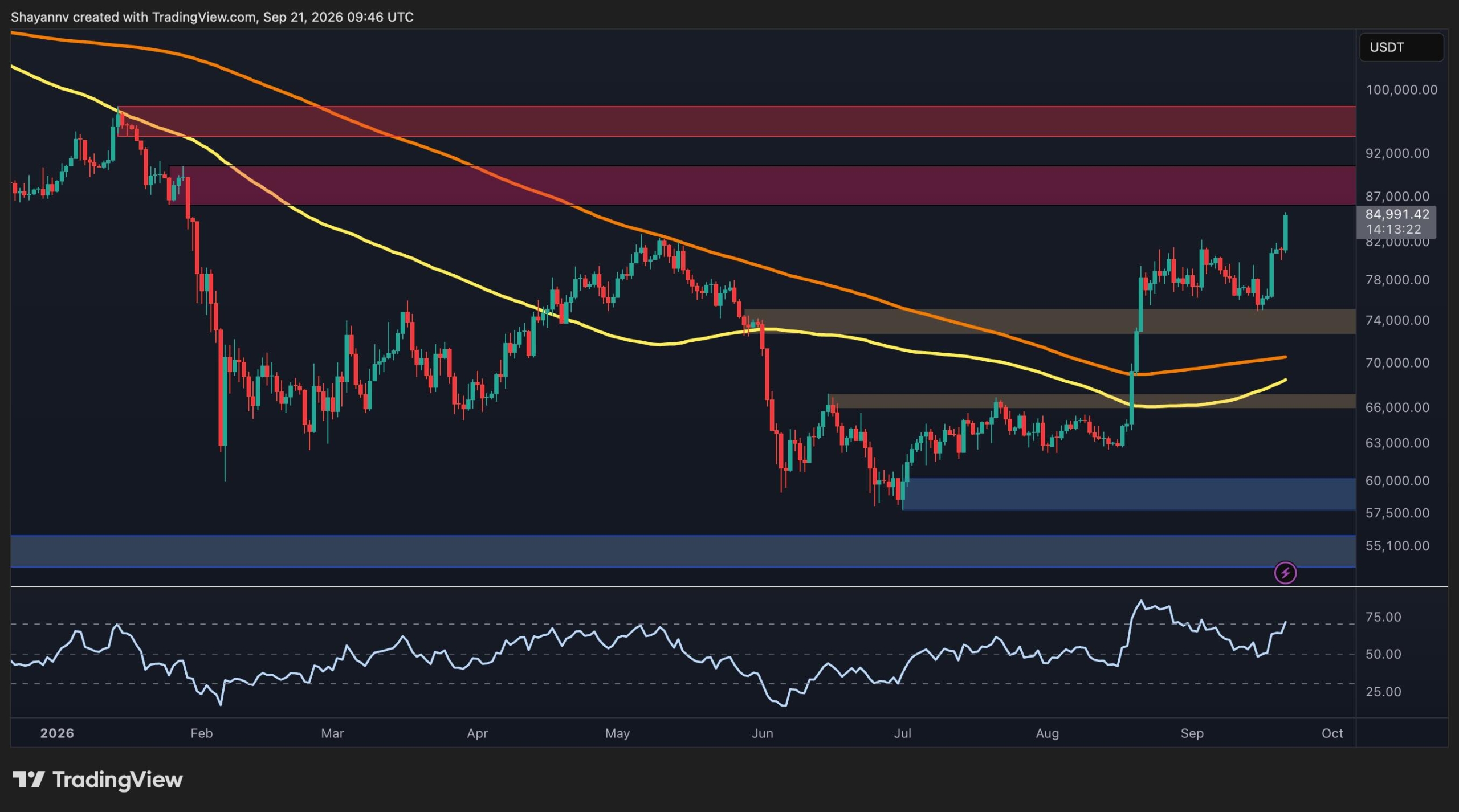
The daily chart shows a notable improvement in Bitcoin’s broader market structure. After spending much of the year below the major moving averages, BTC has reclaimed both the 100-day and 200-day moving averages and is now trading around $85K.
The move above the $74K support zone marked an important structural shift. Bitcoin subsequently consolidated for a couple of weeks, largely between $74K and $80K, before breaking higher in recent days. The latest move has now pushed BTC above the upper boundary of that consolidation and toward the $85K area.
The next major resistance is located around the $88K bearish order block. A sustained breakout above this region could expose the $95K area, which represents the next significant resistance visible on the chart.
On the downside, the $80K region has become an important level to watch following the breakout. If BTC holds above this area during a potential retest, it would support the continuation structure. Conversely, a decisive move back below it could signal a failed breakout and bring the $74K range back into focus.
The daily RSI has also strengthened considerably and is approaching the 75 region. This confirms the improvement in momentum, although it also indicates that the market is becoming increasingly stretched in the short term.
BTC/USDT 4-Hour Chart
The 4-hour chart provides a clearer picture of the recent breakout. BTC had been trading inside a descending channel, with both the upper and lower boundaries gradually moving lower. The price eventually broke above the channel and reclaimed the $80K-$82K resistance zone.
The breakout has since accelerated, with BTC reaching approximately $85K. The immediate focus is now on the $88K area, which is a visible order block on the higher-timeframe chart.
Momentum is particularly strong, with the 4-hour RSI around 80. While elevated RSI readings do not necessarily invalidate a breakout, they do increase the possibility of short-term consolidation or a retest after the sharp advance.
The $80K-$82K zone is therefore likely to be the key near-term support. Holding this area would keep the recent breakout structure intact, while a sustained move back below it could indicate that BTC needs a deeper correction before attempting another move higher.

On-Chain Analysis
Bitcoin’s miner reserve chart shows a clear change in the pace of miner distribution. Reserves declined aggressively throughout much of 2024 and continued trending lower into 2025 and the earlier part of 2026. The miner reserve 30-day EMA also followed a persistent downward trajectory during this period, reflecting a prolonged reduction in the amount of BTC held by miners.
However, the trend has become noticeably more stable in recent months. The miner reserve has largely moved sideways around the $1.19M BTC area, with the 30-day EMA having flattened considerably compared with its earlier decline.
This stabilization suggests that the aggressive distribution from miners has slowed. Rather than continuing to reduce reserves at the same pace seen previously, miners appear to be maintaining a relatively more stable level of BTC holdings.
The timing is notable as Bitcoin has simultaneously recovered toward the $85K area. A combination of improving price action and slowing miner distribution could remove some of the persistent sell-side pressure that characterized the earlier period. While the chart alone does not confirm outright miner accumulation, the stabilization in reserves represents a meaningful change from the aggressive depletion observed previously.
For Bitcoin’s broader market structure, continued stabilization or a reversal higher in miner reserves would therefore be an important development to monitor.

The post Bitcoin Price Prediction: Is $90K Next After BTC’s Explosive $10K Rally? appeared first on CryptoPotato.
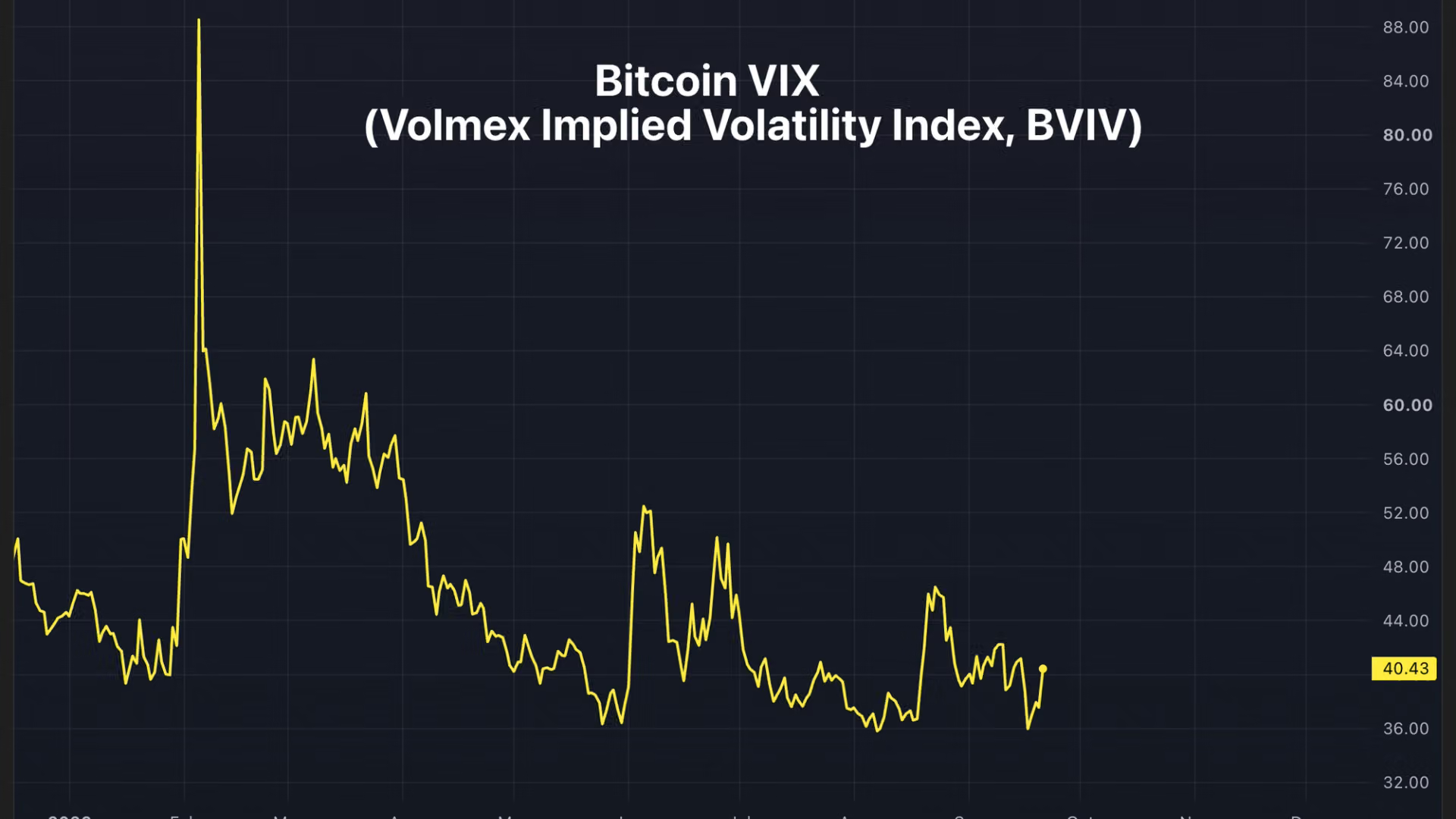
Perpetual futures on the Bitcoin Volmex Implied Volatility Index (BVIV) debuted on Hyperliquid on Monday, giving traders on the onchain exchange a way to bet on the degree, not direction, of bitcoin’s price swings.
The BVIV Index, often described as a “bitcoin VIX,” tracks cryptocurrency’s expected 30-day implied or expected volatility in real time. The index is analogous to Cboe’s VIX index, which tracks the 30-day implied volatility in Wall Street’s benchmark equity index, S&P 500.
The new perpetual market lets traders go long or short the volatility index directly, instead of having to express volatility views indirectly through options, an approach that is capital-intensive and requires derivatives expertise.
The launch comes as the digital-asset market becomes increasingly institutionalized, drawing in a broader mix of participants – from hedge funds, volatility traders, options-income sellers and beyond.
“The launch of BVIV Index perpetual futures on Hyperliquid is a massive unlock for crypto traders and investors,” said Cole Kennelly, founder and CEO of Volmex Labs. “The market leading Bitcoin volatility index is now available to trade on the market leading onchain perpetual futures exchange, making it easy to hedge, speculate, and utilize pure Bitcoin volatility exposure.”
Ripple’s XRP is approaching a technically important inflection point after rebounding sharply from its recent lows. The recovery has brought the price back to the upper boundary of its declining structure, where a confirmed breakout could shift short-term momentum further in favor of buyers.
Ripple Price Analysis: The Daily Chart
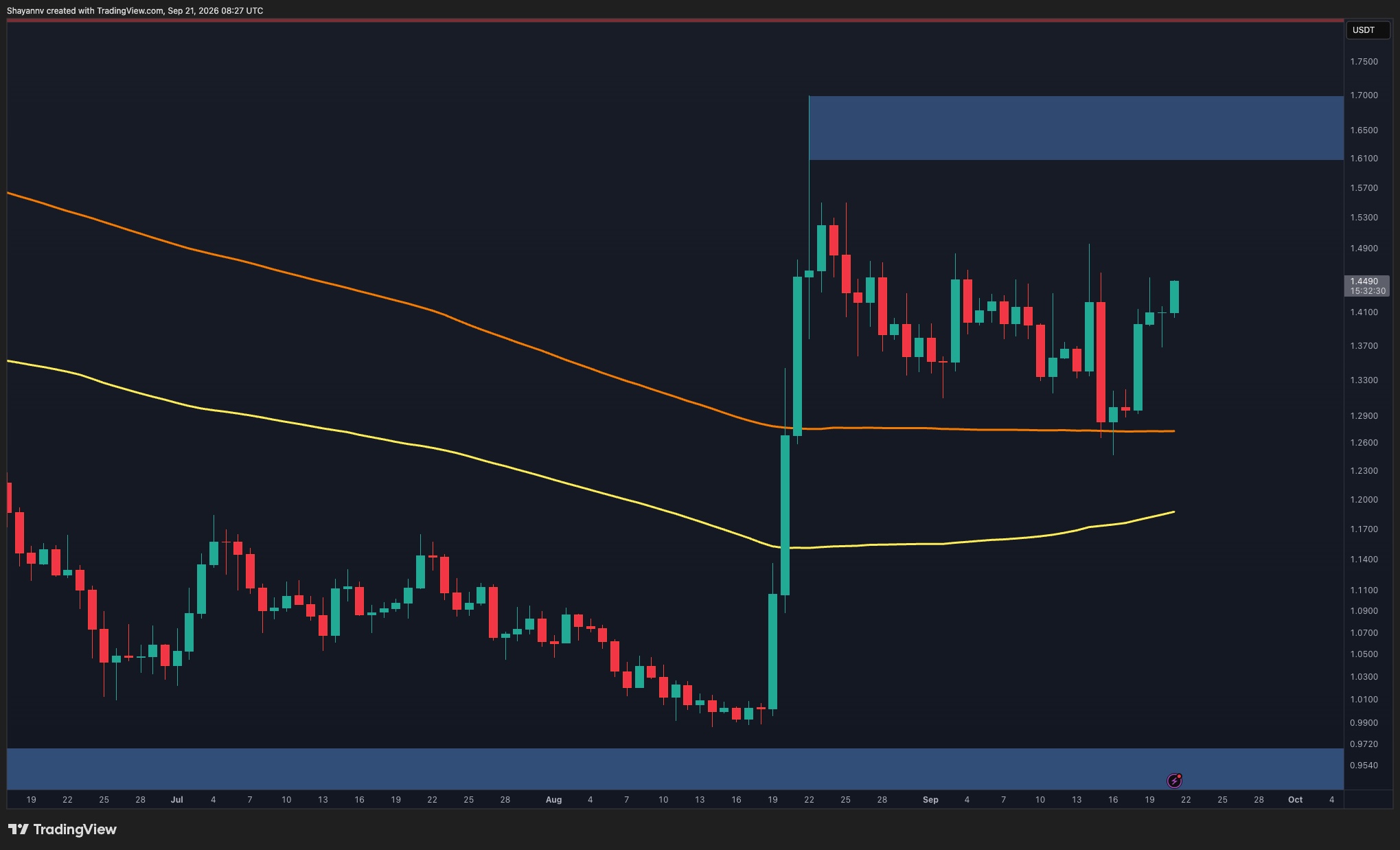
On the daily timeframe, XRP continues to recover from the sharp August rally and subsequent consolidation. The asset is currently trading around $1.48, comfortably above the major moving averages shown on the chart.
The recent correction found support near the 200-day moving average around $1.27-$1.28. Buyers responded aggressively from this region, preventing a deeper retracement and pushing XRP back toward the upper portion of its recent range.
However, the major overhead supply zone remains considerably higher at $1.61-$1.70. This area marks the principal resistance that buyers would ultimately need to reclaim before a broader bullish continuation becomes more convincing.
For now, holding above the $1.27-$1.30 region keeps the larger recovery structure intact. A renewed rejection and breakdown below this support would weaken the setup and could expose the lower moving average near $1.18, while the major demand zone around $0.93-$0.97 remains the deeper structural support.
XRP/USDT 4-Hour Chart
The 4-hour timeframe highlights the immediate decision point more clearly. XRP has been trading within a descending channel, but the latest rebound from the $1.22-$1.28 demand zone has driven the price all the way back toward the channel’s upper boundary around $1.43-$1.45.
Importantly, the recovery also reclaimed the $1.33-$1.36 zone, which had previously acted as a key short-term barrier. As long as the asset remains above this region, buyers retain control of the latest recovery leg.
The next challenge is a confirmed breakout above the descending trendline. A sustained move beyond roughly $1.45 would invalidate the immediate bearish channel structure and could allow XRP to target the $1.51-$1.55 resistance zone. Beyond that, the larger $1.61-$1.65 supply region would become the next major objective.
On the other hand, another rejection from the descending trendline would indicate that the corrective structure remains active. In that scenario, the reclaimed $1.33-$1.36 zone would be the first key support to watch. Losing it could shift attention back toward the major $1.22-$1.28 demand area, where the latest recovery originated.

The post Ripple Price Analysis: XRP Approaches a Critical Breakout Level After 8% Daily Surge appeared first on CryptoPotato.
Crypto World
Bitcoin’s (BTC) 44% gain in third quarter teases full-blown crypto bull run: Crypto Daily

As the end of the third quarter nears, bitcoin is standing tall some 44% higher, its best performance since the final three months of 2024.
Gold is up 8.7% while the S&P 500 has added just 2%. Meanwhile, Wall Street’s tech-heavy index, Nasdaq, has gained just 2%, according to data source TradingView.
This marks a complete change from early this year when bitcoin was the underperformer and stocks, gripped by the AI fervour, were on a tear.
The good news for BTC bulls doesn’t end there. The cryptocurrency is also outperforming names like NVDA, one of the world’s biggest companies, up 11%.
And yet, bitcoin doesn’t necessarily look expensive based purely on where it trades relative to its record price. Despite the solid rally, prices are still down 48% from the record price of $126,000 in October last year.
Other tokens have also chalked up impressive gains. ETH, XRP, SOL, UNI and NEAR have registered gains between 40%-150%.
The initial rise was mainly driven by oversold conditions that attracted bargain hunters and a short squeeze that pushed prices higher. But recently, a regulatory tailwind has kicked in.

Global mergers and acquisitions (M&A) value ran 11% above its 10-year average in the first eight months of 2026, according to Boston Consulting Group (BCG).
The gains sit almost entirely at the top of the market. Deal volumes below $1 billion remain under longer-term norms.
Megadeals Clear a Record Set in 2021
Aggregate deal value rose 15% year over year through August, BCG said. Deal value reached $2.09 trillion between January and August, up from $1.82 trillion a year earlier.

Follow us on X to get the latest news as it happens
Transactions worth $10 billion or more climbed to 37, up from 24 a year earlier. That count cleared the 32 megadeals announced over the same period in 2021.
Total deal value has not caught up, however. The 2021 figure reached $2.91 trillion across those eight months, leaving 2026 about 28% lower despite the higher megadeal count.
Meanwhile, 27 of this year’s megadeals involved a US buyer, a US target, or both. Deals between $250 million and $1 billion stayed below average. Transactions under $250 million did too, and those counts exclude inflation.
“Deal volumes in these segments remain below their longer-term averages, indicating that the global M&A market has not yet regained normal levels of breadth,” the report read.
The split matches what consulting firm PwC flagged in June, when it projected global M&A deal value would approach $4 trillion this year while deal counts fell 13%.
Region and sector tell the same story of concentration. North America accounted for more than half of the aggregate deal value. European value rose 43% to $541 billion, while Asia-Pacific activity fell 27%.
BCG global M&A leader Jens Kengelbach pointed to execution, rather than funding, as the current constraint.
“Capital and strategic appetite are available. The bottleneck has shifted to execution: finding transaction-ready assets, bridging valuation gaps, and clearing the operational and regulatory hurdles required to close,” he said.
AI Pushes Some Deals Forward and Freezes Others
The report also examined how artificial intelligence (AI) is shaping the M&A market. Daniel Friedman, BCG’s global leader of transactions and integrations, said AI works on the market in two directions at once.
“It’s a reason to do more deals and a reason some deals are harder to close. The companies that get furthest ahead are likely to be the ones that have actually worked out which is true for the asset in front of them,” he stated.
BCG cites a software valuation correction and a private equity pullback as evidence of the second effect. Its M&A Sentiment Index, which blends market fundamentals with AI-based analysis of corporate communications, rose to 83 from 79 at the start of the year, still well under the long-run average of 100.
Sector readings diverged sharply. Financial institutions and real estate scored 108, and health care reached 100, while technology came in lowest at 52 and consumer at 64.
Crypto dealmaking has taken the same shape. Disclosed crypto M&A deal value set a record $9.66 billion in the first half of 2026, even as announced deals fell 25% to 87.
Subscribe to our YouTube channel to watch leaders and journalists provide expert insights
The post Is the M&A Boom Real? BCG Says Yes at the Top, Not Below $1 Billion appeared first on BeInCrypto.
Bitcoin has to climb nearly 20% in four days for the biggest bets on the options market boards to pay off. Traders stacked them anyway.
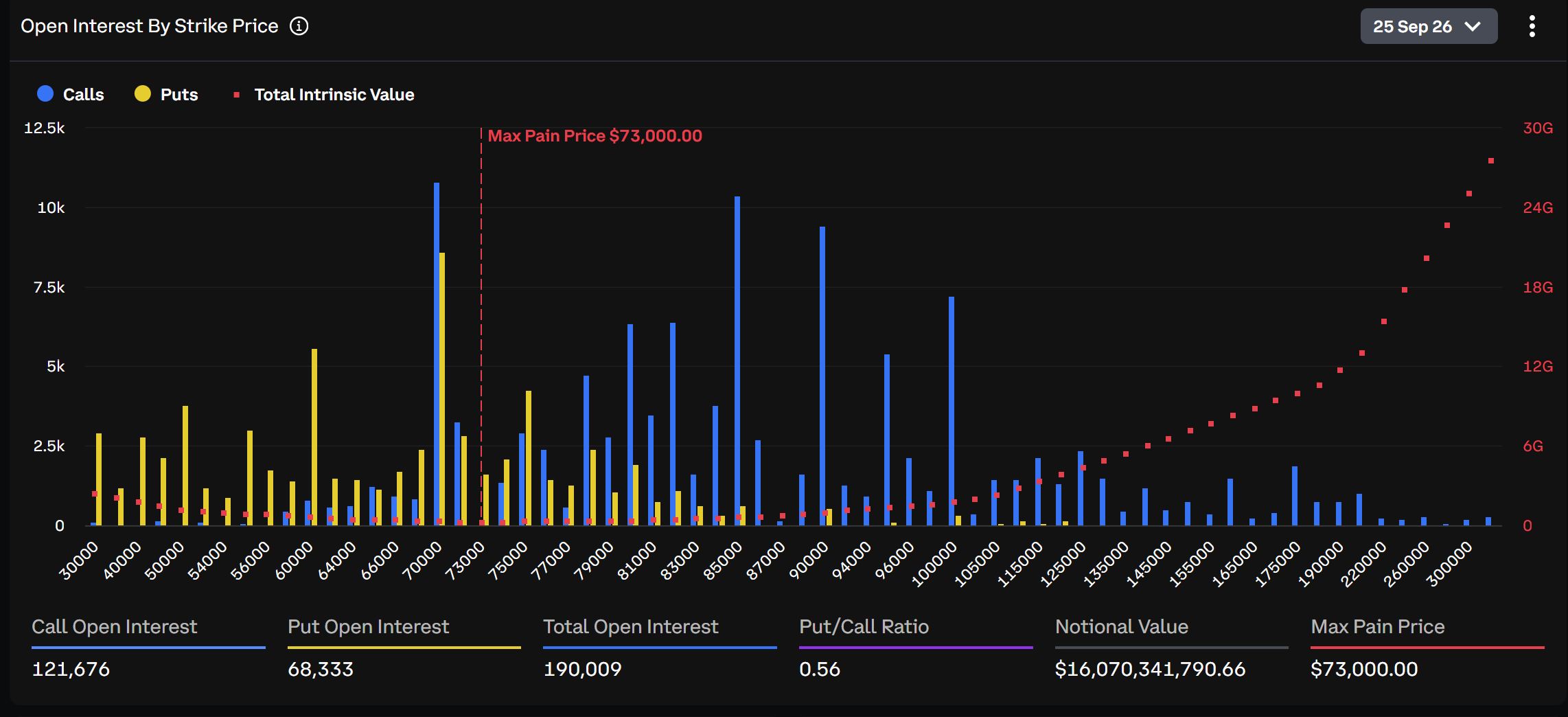
Roughly $16.07 billion in Bitcoin (BTC) options expire Friday. The heaviest bullish positions sit at $90,000 and $100,000. Bitcoin trades near $81,292.

The Money Sits Well Above the Price
A call pays out when the price rises past a set level. A put pays out when it falls. Friday’s expiry holds 121,676 calls against 68,333 puts, Deribit data shows. That works out to a put/call ratio of 0.56. Close to two bullish contracts for every bearish one.
The single biggest call cluster sits at $85,000, about 5% above the current Bitcoin price. Stacks at $90,000 and $100,000 follow. A few reach $125,000, which would take a 54% rally.
The largest put cluster sits at $70,000, a level Bitcoin cleared last week.

Every Call Has a Seller on the Other Side
Here is what the chart does not show. Open interest counts contracts still alive. It says nothing about who is winning. Somebody bought each of those calls. Somebody sold them.
Max pain for Friday sits at $73,000. That is the price at which the largest number of contracts would expire worthless. Bitcoin sits 10% above it.
BeInCrypto reported Monday that Bitcoin hit an eight-month high after $262 million in short liquidations.
Watanabe Says October, MEXC Says Wait
Sota Watanabe founded Astar Network and runs Startale Group, the firm building Sony’s Soneium blockchain. In his opinion, October is poised to be a good month.
Vugar Usi Zade, chief executive of the exchange MEXC, is less sure. Bitcoin shrugged off a Federal Reserve rate hike and the collapse of the CLARITY Act, a US bill that would have set crypto market rules, he said.
Spot Bitcoin funds took in $593 million across Thursday and Friday. Strategy (MSTR) stock rose 17% on the week.
For the fourth quarter of 2026, the market needs multiple episodes to consider a trend reversal.
He named oil market tensions as the likeliest trigger to flip sentiment. ETF flows this week will show who blinks.
Friday settles the bets.
The post Sota Watanabe Says October Will Be Great: Bitcoin Bulls Stack $100,000 Bets appeared first on BeInCrypto.

New grain and food center opens in Kansas
Robinhood Crypto Chain’s $146M Tokenized-Stock Bet Faces Its First Fee Test

Husband, Kids Kaia and Presley




-

 Fashion3 days ago
Weekend Open Thread: Talbots – Corporette.com
-

 Tech16 hours ago
Researchers escape OpenAI Codex sandbox to run commands on host
-

 Crypto World3 days ago
Circle launches Arc Studio AI agent for building onchain apps
-

 Crypto World7 days ago
Revolut Attackers Warn of Ongoing Daily Customer Data Leaks
-
 NewsBeat3 days ago
Trump says US has reached an agreement to take permanent control of Greenland’s security
-

 Crypto World7 days ago
Kraken Lets xStocks Holders Earn Yield Through DeFi
-

 Crypto World6 days ago
Robinhood engineers charged over $50K crypto scheme
-

 Crypto World3 days ago
Bitcoin price breaks channel as RSI climbs to 63
-

 Crypto World5 days ago
US Charges Robinhood Engineers Over Crypto Listing Trades
-

 Crypto World6 days ago
What Is the Status of the U.S.-Iran Peace Talks? Here's What Both Sides Are Saying
-
 NewsBeat7 days ago
‘Sick conspiracy’: Trump says only guardrails AI needs is ‘a strong and smart (High IQ!) president’ in all-caps rant
-
 Crypto World6 days ago
NVIDIA Analysis: Attempted Rising Wedge Breakout Amid Pressure on the AI Sector
-

 Tech6 days ago
Webb’s IC 348 Mosaic Includes Two-Jupiter Dwarfs, Twin Jets, and a Nursery Still Making Worlds
-

 Crypto World3 days ago
World Money launches in 150+ countries with Stripe
-
Crypto World7 days ago
Can Circle’s Arc Repeat Robinhood Chain’s Meme Coin Boom?
-

 Crypto World3 days ago
Silver prices recover quickly, hitting weekly high today
-
 NewsBeat3 days ago
US was ‘on brink of war’ with China over false AI report of nukes moving in Middle East
-

 Crypto World7 days ago
Kraken Adds DeFi Yield on Tokenized Stocks and ETF Assets
-

 Crypto World7 days ago
DOJ Seeks to Seize $61M in Iran Oil Funds From Binance Accounts It Vouched For
-

 Crypto World3 days ago
Trading Bitcoin on Robinhood? Why 2% Spread Has Traders Worried
You must be logged in to post a comment Login