
Business
Pepperidge farm launches protein-filled Goldfish



CAMDEN, NJ. — Pepperidge Farm, a Campbell’s Co. brand, is debuting Goldfish crackers with 6 grams of protein per serving.
The crackers are baked and formulated with cheese Pepperidge Farm said. They come in two flavors: cheddar and pizza.
“Protein has become a bigger priority for many families, whether it’s after school, between activities or on the go,” said Tiphanie Maronta, senior vice president of Goldfish Crackers. “Goldfish made with 6g of protein is our way of meeting that need with a snack that’s both delicious and familiar, combining the iconic Goldfish experience people love, now with 6g of protein in a way that fits seamlessly into families’ everyday routines.”
Protein-filled Goldfish will launch at Walmart and other grocery store chains in October before expanding to US retailers in early 2027 for a suggested retail price of $3.99 per 6.6-oz bag.


The operator of the world’s busiest derivatives market accounted for roughly half of the trading volume in the shadow market, according to an estimate by trading platform UnlistedZone. Its initial public offering threatens to trigger a sharp drop in activity, forcing platforms that facilitate such transactions to find the next big draw.
As India set consecutive records in IPO proceeds the last two years, the unlisted market emerged as a venue for wealthy individuals and funds to make bet on companies in the listing pipeline. The booming interest fostered an ecosystem of online platforms and specialist brokers that specialize in connecting buyers and sellers.
NSE had been a linchpin of the growing market because of its scale, profitability, dominant position and disclosures that mirrored listed companies. The presence of smaller listed rival BSE Ltd. gave investors a valuation benchmark, while years of delays in its listing meant an unusually long trading window.
That helped turn a once-niche corner of India’s financial system into a mainstream investment avenue, giving rise to intermediaries that assisted investors with the regulatory approvals, documentation and transfers needed to buy shares.

“NSE was quasi-listed,” said Sandipan Roy, chief investment officer at Motilal Oswal Private Wealth. “It spawned an entire industry.”
The exchange had 231,378 shareholders ahead of its IPO, more than several listed companies. That compares with fewer than 80 shareholders it had in 2016, according to its December 2016 draft prospectus. Until last year, NSE made monthly disclosures on share transfers. Its last such release in March 2025 showed nearly 15 billion rupees ($170 million) of shares changing hands during the month.Staying relevant without NSE may prove more challenging for platforms that have mushroomed over the years. As no issuers currently offer the combination of size, familiarity and liquidity of NSE, they may have to persuade investors to trade smaller companies with typically less financial disclosure and thinner liquidity.
“We expect interest in the unlisted market to remain selective as companies emerge across sectors such as space technology, aerospace, defense, data centers and other new-age industries,” said Rajan Shah, Founder, 3A Capital Services, which operates a platform for dealing in unlisted shares.
Companies attracting market interest include Sterlite Electric Ltd, Indofil Industries Ltd, Krasny Defence Technologies Ltd, Berar Finance Ltd, Kineco Ltd, Indian Potash Ltd and Garuda Aerospace Ltd, he added.
Investing in unlisted shares hasn’t always proved profitable. Investors in some high-profile names, including HDB Financial Services Ltd. and Tata Capital Ltd., suffered losses, while those who bought NSE shares over the past year may also enter the IPO sitting on losses.
“There have also been instances of outsize returns in the unlisted market,” said Umesh Paliwal, co-founder, UnlistedZone. “Ultimately, entry timing and valuations are critical.”

Paramount Skydance’s $110 billion merger with Warner Bros. Discovery will move forward as the company settled Monday with a group of state attorneys general that sought to block the deal on antitrust grounds.
The lawsuit, brought by a group led by California’s Rob Bonta, was previously set to head to trial in March and would have left the deal in limbo through mid-2027.
“We are grateful to Attorney General Bonta and his fellow AGs, as well as the WGA, for engaging in good faith to find a path forward to a resolution that serves all parties, and to Governor Newsom for his support throughout this process,” Paramount CEO David Ellison said in a statement Monday. “Our shared aim was an outcome that best serves consumers, workers and — most importantly — the creative community so vital to the art of visual storytelling.”
The acquisition will bring together two storied film studios, Paramount and Warner Bros. Discovery; a portfolio of TV networks; broadcast network CBS; and two popular streaming services in Paramount+ and HBO Max. The agreement Monday follows backlash from not only the state officials, but also the Writers Guild of America union and prominent actors and directors, who shared concerns about the effects on the U.S. film industry and creative roles.
Bonta detailed the terms of the agreement during a press conference Monday, but noted that “the settlement is not a vote of support for this merger.”
“It’s not a blessing of the broader merger,” he said. “Broadly speaking, we believe further consolidation in markets that are central to American economic life doesn’t serve the American economy, consumers, or competition well.”
Bonta said Paramount has agreed to increase its domestic production, including boosting its production spending in the U.S. by at least $300 million annually. The company also agreed that if a federal film credit is approved, it will ensure that 20% of its films are produced domestically in the first two years after the deal closes and 30% of all films in the three years after that. Currently, around 5% of Paramount’s film production is domestic, Bonta said. The company must also keep both the Paramount and Warner Bros. production lots in Los Angeles.
The studio will also release 30 films theatrically in its first two years and 32 in the following three years, Bonta said. Four of these films must be independent productions and Paramount must establish an independent film fund dedicated to purchasing indie films.
Bonta added that the settlement includes a $30 million penalty per film if Paramount falls short of these pledges, with 90% going to workers. There is also a stipulation that Paramount would be forced to divest the production company Miramax if the company fails to reach this release goal, Bonta said.
Paramount and Warner Bros. are also required to continue negotiating cable packages separately. If the company does not adhere to this clause, Bonta said it would be forced to divest a suite of cable channels.
The company must also pay $9.5 million annually for workforce training and career development in film and TV production and for film programs and community arts organizations, Bonta said.
Additionally, Paramount must establish a new board for CBS News and CNN to ensure editorial independence, he added. The combined company’s joint ownership of both of those new sources had raised alarms among some critics of the agreement.
“Together we’ll select a trustee to monitor Paramount’s compliance with these terms,” Bonta said. “And if they ever fail to comply with the many critical terms we have in our settlement, we can go to court.”
The deal previously won approval from U.S. and other international regulators, and Paramount had told investors it expected to close the deal by Sept. 30.
California and 11 other states filed suit in mid-July seeking to block the merger, citing antitrust concerns in film and pay TV.
In July, Paramount agreed to delay the merger until June 2027 while the legal challenge played out. That delay would have proven costly for Paramount.
As part of the merger agreement, Paramount agreed to a so-called ticking fee that would have kicked in after Sept. 30 and meant an additional 25 cents per share, per quarter to WBD shareholder until the transaction closed. The fee would have added an estimated $650 million per quarter in cash value to the deal.
The Writers Guild of America sued to block the merger, too, citing “specific harm to writers,” and settled its claim with Paramount on Monday. Many creatives throughout Hollywood, including actors, directors, producers and other crew members, penned open letters opposing the deal.
“We continue to believe the merger will cause damage to writers and the industry at large,” the WGA wrote in a statement Monday. “Now that the Attorneys General have settled with Paramount, however, as a nonprofit, the WGA must contend with the reality of forging ahead alone, with no backing from government enforcers, with a complex antitrust lawsuit that would cost millions of dollars to pursue through trial.”
The WGA said the guild settled its lawsuit with an agreement that Paramount prohibit writer layoffs at CBS News’ broadcast team for five years and pay $17.5 million toward the guild’s health fund, along with its attorney’s fees from the litigation.
Bonta said that as part of the agreement with states, Paramount must honor previously established collective bargaining agreements and bargain in good faith with unions.
California, the entertainment hub of the U.S., has suffered job losses after the industry shifted dramatically following the pandemic, as streaming has disrupted the traditional linear TV business and the theatrical film pipeline. Hollywood, as a result, is shooting fewer pilots, taking advantage of tax incentives in other states and countries and greenlighting fewer productions overall.
One big sticking point around the deal for industry insiders is the fact that mergers in the past have drastically decreased the number of films released annually. The most recent example was the 2019 merger between Disney and 21st Century Fox. In the decade before Fox was acquired, the studio released between 13 and 23 films each year, while Disney put out between nine and 13 films. Since 2019, the highest combined release from the merged company has been 16, according to data from Rentrak.
Theater owners and longtime industry players were skeptical that Paramount could deliver on Ellison’s annual 30-film promise. After all, in the past 25 years, no studio has put out more than 25 wide releases in a single year. Ellison offered three-year contracts to cinema operators and at least one exhibitor signed that contract, which allowed the cinema chain to sue Paramount for monetary compensation if it did not fulfill its promise.

Operator
Good day, ladies and gentlemen. Welcome to Vista Gold’s Investor Conference Call. It’s my pleasure to introduce Pamela Solly, Vice President of Investor Relations. Please go ahead.
Pamela Solly
Vice President of Investor Relations
Thank you, John, and good day, everyone. Thank you for joining the Vista Gold Corp. Investor Conference Call. I’m Pamela Solly, Vice President of Investor Relations. Also on the call today is Fred Earnest, President and Chief Executive Officer.
During the course of this call, we will be making forward-looking statements. These statements involve known and unknown risks, uncertainties and other factors that may cause actual results, performance or achievements of Vista to be materially different from results, performance or achievements expressed or implied by such statements. Please refer to the cautionary statements in this morning’s news release and presentation for details of risks and other important factors that could cause actual results to differ materially from those in our forward-looking statements and the cautionary note regarding estimates of mineral resources and mineral reserves.
In advance, I want to inform you that we will not be taking questions at the conclusion of this call. Please refer to the announcement and presentation available on our website at www.vistagold.com. I will now turn the call over to Fred Earnest.
Frederick H. Earnest
President, CEO & Director
Thank you, Pam, and thank you to everyone joining us on today’s conference call. This morning, we announced the news of our business combination with Artemis Gold Inc. This combination with Artemis represents a significant milestone for Vista shareholders, delivering an immediate premium to Vista’s share price while providing derisked exposure to growth opportunities from the
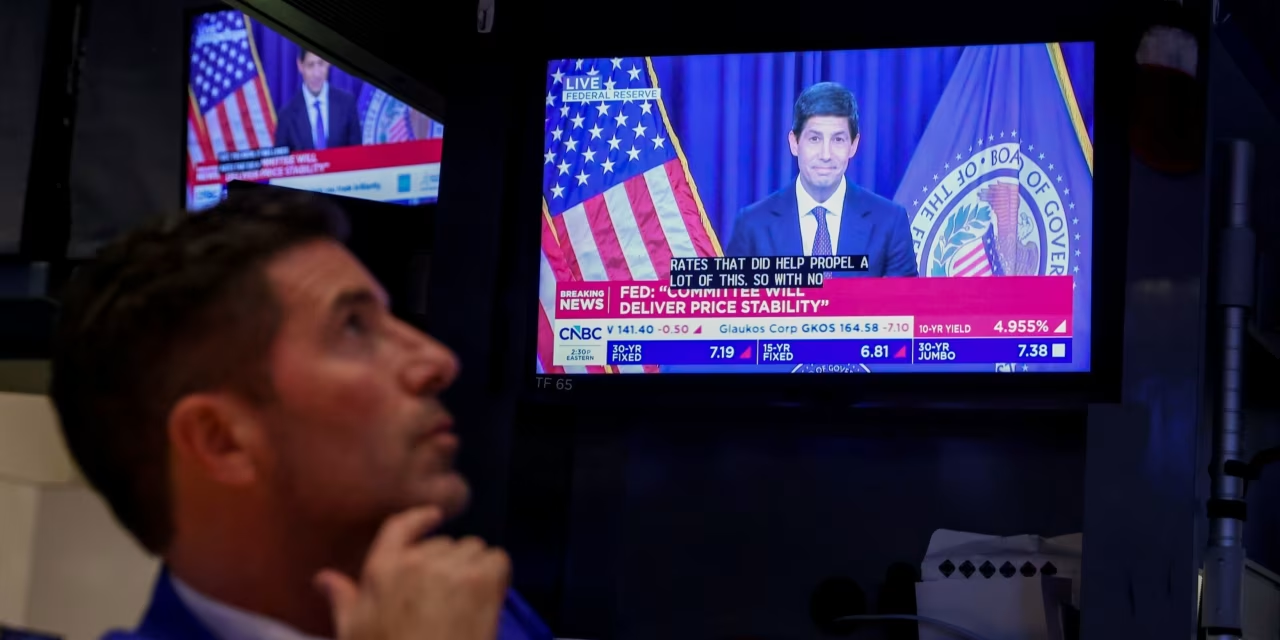

The future is always clouded in markets. But even the past isn’t as clear as it seems.
Sure, we know how prices have moved. Figuring out why they moved is crucial to having any hope of accurate predictions. And it’s much harder to be sure than it seems—even in Treasury bonds, the foundation of pricing for almost everything.
Copyright ©2026 Dow Jones & Company, Inc. All Rights Reserved. 87990cbe856818d5eddac44c7b1cdeb8
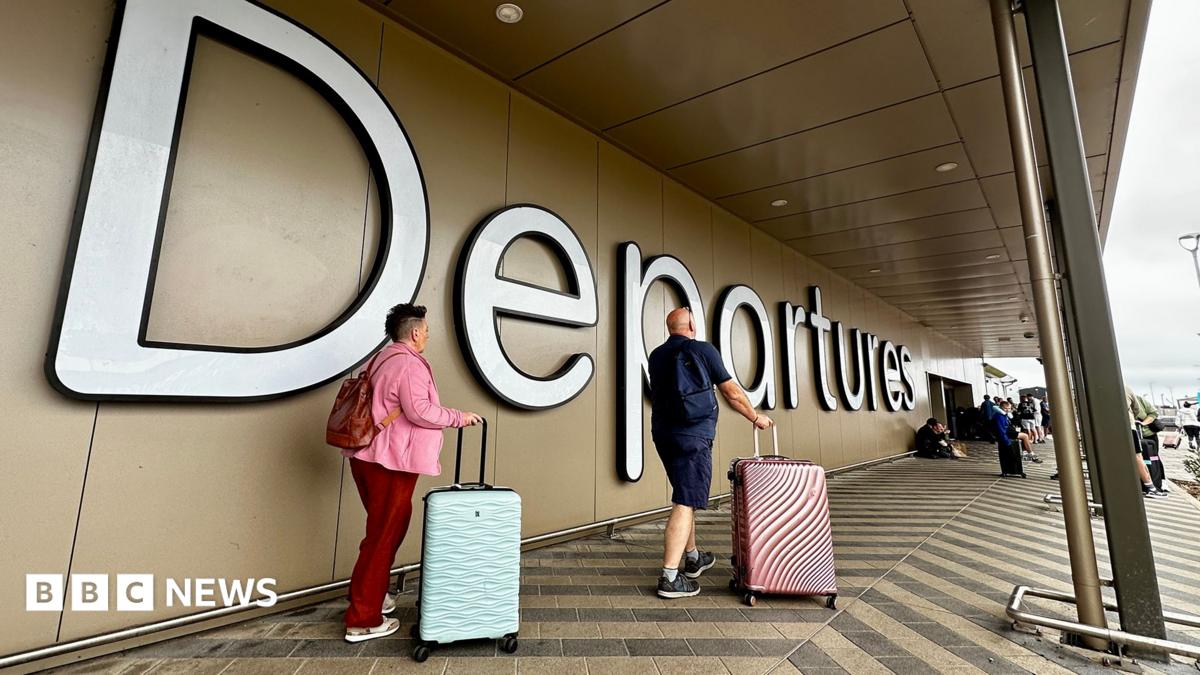
To have one air traffic control failure in a fortnight may be regarded as a misfortune, to have two looks like carelessness. The UK’s air traffic services provider is coming in for a wave of criticism at the moment, so where is it all leading?
The incident at the National Air Traffic Services (Nats) main control centre in Swanwick earlier this month was extremely serious. It caused more than 2,000 flight cancellations over two days, affecting hundreds of thousands of passengers. Some were left sleeping on airport floors, others were stranded in foreign airports.
Monday’s failure at the Prestwick centre, which looks after air traffic in Scotland, northern England and northern Ireland was not as dramatic. But according to the aviation analytics company Cirium, it still led to about 150 flights being cancelled and many other delays affecting tens of thousands of travellers.
The first failure this month was attributed to a previously undetected software flaw, which had an impact due to a very specific set of circumstances combining in a millisecond. Today’s issue was blamed on a “connectivity issue” specific to the system used in Scotland. The two, Nats says, were unrelated.
But this is becoming worryingly familiar territory.
In August 2023, on a bank holiday weekend, a problem with a single aircraft’s flight plan caused a key system at Swanwick to break down, leading to cancellations and delays that affected 700,000 passengers.
Two years later, a smaller “radar-related issue” disrupted air traffic for four hours, and led to the cancellation of 150 flights.
The question is whether all of these incidents were isolated and unavoidable, or whether they point to something more systemic.


Daniel is an avid and active professional investor.
He runs Crude Value Insights, a value-oriented newsletter aimed at analyzing the cash flows and assessing the value of companies in the oil and gas space. His primary focus is on finding businesses that are trading at a significant discount to their intrinsic value by employing a combination of Benjamin Graham’s investment philosophy and a contrarian approach to the market and the securities therein. Learn more.
Analyst’s Disclosure: I/we have no stock, option or similar derivative position in any of the companies mentioned, and no plans to initiate any such positions within the next 72 hours. I wrote this article myself, and it expresses my own opinions. I am not receiving compensation for it (other than from Seeking Alpha). I have no business relationship with any company whose stock is mentioned in this article.
Seeking Alpha’s Disclosure: Past performance is no guarantee of future results. No recommendation or advice is being given as to whether any investment is suitable for a particular investor. Any views or opinions expressed above may not reflect those of Seeking Alpha as a whole. Seeking Alpha is not a licensed securities dealer, broker or US investment adviser or investment bank. Our analysts are third party authors that include both professional investors and individual investors who may not be licensed or certified by any institute or regulatory body.


I am an independent trader and analyst specializing in the micro-cap market. My strategy combines technical analysis with the CAN SLIM method, developed by William O’Neil, to identify high-growth, underanalyzed companies. I focus on financial trends, profit growth, and institutional capital accumulation to uncover stocks with significant upside potential. In addition to equities, I have experience in Forex trading, which has helped me better understand price movements, market volatility, and sentiment-driven trends. My research approach integrates both fundamental and technical analysis, allowing me to identify strong growth stocks before they gain widespread attention. Key indicators I prioritize include relative strength, trading volume shifts, and accelerating profit growth—all of which help pinpoint stocks with the highest potential. Writing for Seeking Alpha is an integral part of my investment process, enabling me to refine my strategies, test investment theses, and engage with the investor community. In my articles, I aim to deliver in-depth company analyses, focusing on stocks with strong growth trends, improving fundamentals, and technical setups that signal potential breakouts. Through structured research, I strive to enhance market understanding and provide actionable investment insights.
Analyst’s Disclosure: I/we have no stock, option or similar derivative position in any of the companies mentioned, and no plans to initiate any such positions within the next 72 hours. I wrote this article myself, and it expresses my own opinions. I am not receiving compensation for it (other than from Seeking Alpha). I have no business relationship with any company whose stock is mentioned in this article.
Seeking Alpha’s Disclosure: Past performance is no guarantee of future results. No recommendation or advice is being given as to whether any investment is suitable for a particular investor. Any views or opinions expressed above may not reflect those of Seeking Alpha as a whole. Seeking Alpha is not a licensed securities dealer, broker or US investment adviser or investment bank. Our analysts are third party authors that include both professional investors and individual investors who may not be licensed or certified by any institute or regulatory body.

Airbus is increasing its workforce at Broughton in Flintshire by nearly 900, or 15 per cent, as it expands wing production to meet a backlog of nearly 5,500 orders for its A321 single-aisle jet.
The company is announcing today that it is taking on 430 workers in addition to the 6,000 already employed at the Broughton complex, its global hub for wing production. Airbus has confirmed that it expects to take on a similar number or more next year.
It will also put an extra £150m into the site to repurpose the West Factory, which was left empty in 2020 when Airbus stopped building wings for the double-decker A380 superjumbo. The building has been used as a warehouse since then.
Former A380 plant to build A321 wings
The West Factory will be retooled to build wings for the A321, the stretch version of the single-aisle family, which can carry 240 passengers.
In its XLR, or extra long range, version, the A321 can fly from the UK to the east coast of the United States and to the superhubs of the Gulf states. It is the aircraft most in demand with airlines, and Airbus has a backlog of nearly 5,500 of the planes to fulfil.
Jerome Blandin, head of Airbus Wing, said the repurposing of the old A380 production plant is “a fundamental part, the finishing touch” of plans for Airbus to make more than 1,000 aircraft a year before the end of the decade.
“This is the busiest Broughton will ever have been. We have been challenged to deliver more and faster,” Blandin said.
The site has faced pressure on its workforce before. Last year Unite members at the plant planned a 10-day walkout over pay, which Business Matters reported could disrupt Airbus assembly lines in Europe, China and the US because the plant makes wings for all its commercial aircraft.
Delivery targets
The hiring comes as Airbus tries to lift output that slowed during the pandemic and the supply chain dislocations that followed.
The company delivered 793 aircraft in 2025 and, as chief executive Guillaume Faury told its annual press conference, aims for around 870 commercial aircraft deliveries in 2026. That would only return it to about where it was before the pandemic, when it delivered 863 aircraft in 2019.
In the first eight months of this year Airbus delivered 475 aircraft. That means its final assembly lines, mainly in Toulouse in France, will have to average around 100 aircraft a month for the rest of the year to reach the target.
The expansion also widens the gap with its American rival, Boeing, which has a delivery target of 670 aircraft for the year.
Wider UK footprint
Broughton is one of several UK sites where Airbus designs and builds wings and fuselage components. According to Airbus, the site has received more than £2bn of investment over the past decade. The company’s UK presence is set to grow further after it agreed to take on around 3,000 staff in Belfast and Prestwick as part of Boeing’s deal for Spirit AeroSystems, which Business Matters reported would take its total UK headcount to about 14,000.

Jamie Young
Jamie Young is Senior Reporter at Business Matters, covering SME finance, employment law and Westminster policy since 2016. He has reported on every Budget and Autumn Statement since 2018, helped make sense of the ‘covid era’ and the bounce-back loan scheme from launch through the fraud investigations, and broke the magazine’s coverage of the 2024 late-payment reforms. He joined Business Matters straight from completing his BA in Administration from Exeter University and is NCTJ-qualified. Reach him at jyoung@cbmeg.co.uk
Federal Aviation Administrator Brian Bedford said Monday that officials discovered that a backup fiber cable was cut in New Jersey, leading to a ground stop at airports in Philadelphia, New York and New Jersey after a circuit failed.
An equipment outage has grounded planes at some major airports in New York, New Jersey and Pennsylvania on Monday, the Federal Aviation Administration (FAA) said.
“The FAA is pausing flights into Philadelphia International, Teterboro and Newark Liberty International airports due to issues with some frequencies at Philadelphia TRACON,” the FAA told Fox News in a statement earlier Monday.
Since the statement, John F. Kennedy International Airport, LaGuardia Airport and Westchester County Airport have also faced ground stops due to an equipment outage, according to the FAA website.
LAGUARDIA SHUTS DOWN RUNWAY FOR SECOND TIME IN WEEKS AFTER PAVEMENT ISSUE RESURFACES
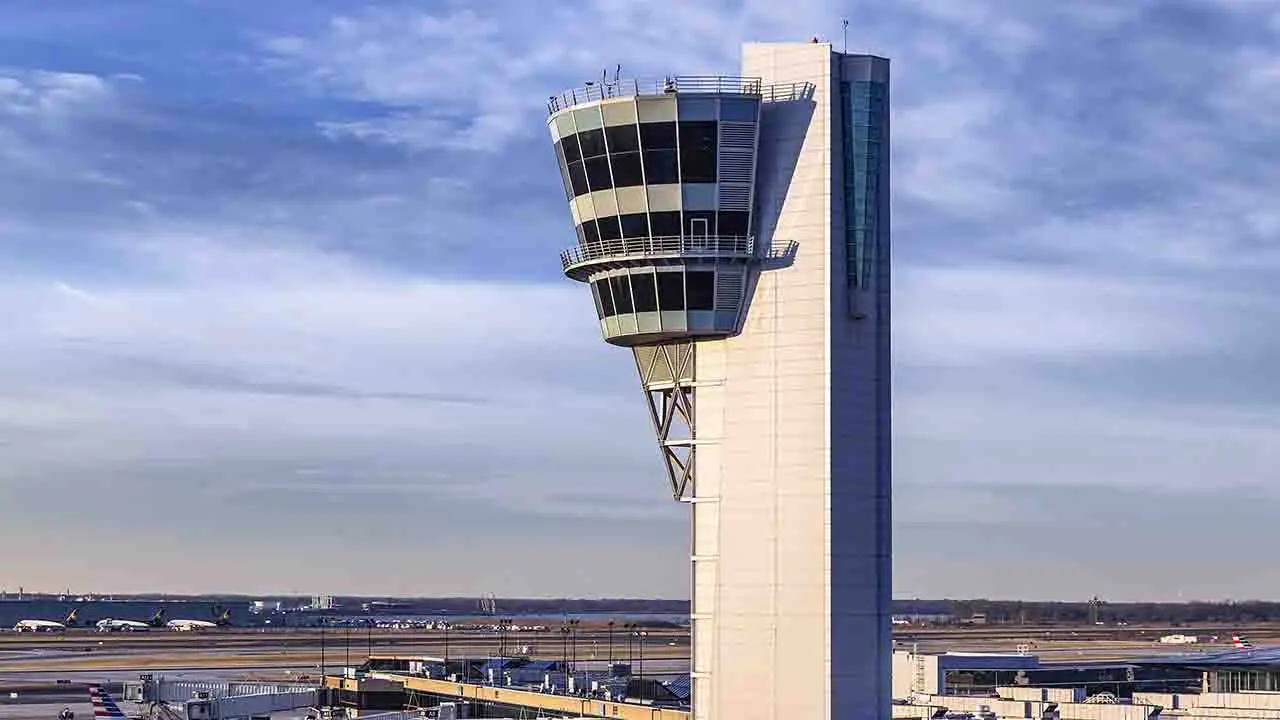
Air traffic control tower at Philadelphia International Airport, the airport 6-year-old Casper left from while heading to Florida. (John Greim/Loop Images/Universal Images Group via Getty Images / Getty Images)
FAA Administrator Brian Bedford said Philly TRACON lost their primary circuit, and when they switched to the backups, they learned the fiber optic cable had a break.
Bedford said the TRACON may come back on at 1:30 p.m. ET if the new circuit is installed. The fiber optic cable, however, will take around 13 hours to fix.
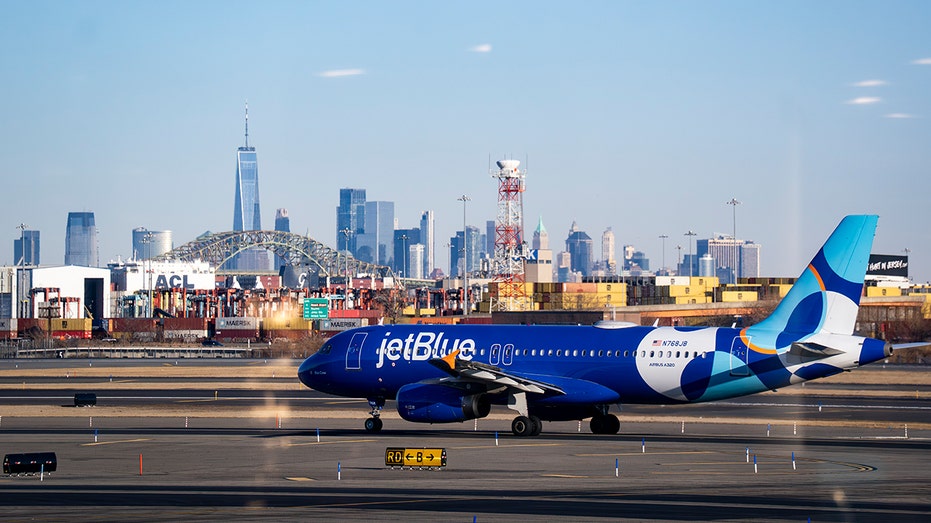
An Airbus A320 plane, operated by JetBlue Airlines at Newark Liberty International Airport (EWK) in front of the skyline of lower Manhattan and One World Trade Center in New York City on Jan. 15, 2026 in Newark, New Jersey. (Al Drago/Getty Images / Getty Images)
Transportation Secretary Sean Duffy told reporters that “these are issues that, aren’t new to us.”
“We know these problems can happen. We know these cuts can happen,” Duffy said, adding that the department has been working to upgrade FAA equipment and its telecom architecture.
“As we work through all the new equipment, all the new architecture of our telecom, which is fans, it all takes money. That’s why we have a holistic view of everything, including how we rework our telecom,” Duffy said.

A United Airlines Airbus A320 passenger jet taxis on the tarmac at LaGuardia Airport in the New York City borough of Queens on Sept. 7, 2016. (Robert Alexander/Getty Images / Getty Images)
Duffy said the work is being done before the department has secured all the necessary money, adding that “when we get the cash” the department will be able to hasten progress.
GET FOX BUSINESS ON THE GO BY CLICKING HERE
“But this is not shocking,” Duffy said of the equipment outage.
Neither Bedford nor Duffy went into details on when the ground stops could be lifted, though the FAA website provided estimated times as early as 2:45 p.m. ET.
This is a developing story; check back for updates.

Olga Seifutdinova/iStock via Getty Images

By Emily Balsamo
Benchmark Grain and Oilseed futures have recorded strong price growth in recent weeks driven by escalating geopolitical conflicts, adverse weather in key growing regions, and tighter-than-expected supply forecasts. While agricultural commodity prices typically peak during the summer months as old-crop inventories draw down ahead of the autumn harvest, price movement this late summer and early fall has been further amplified by exogenous market shocks.
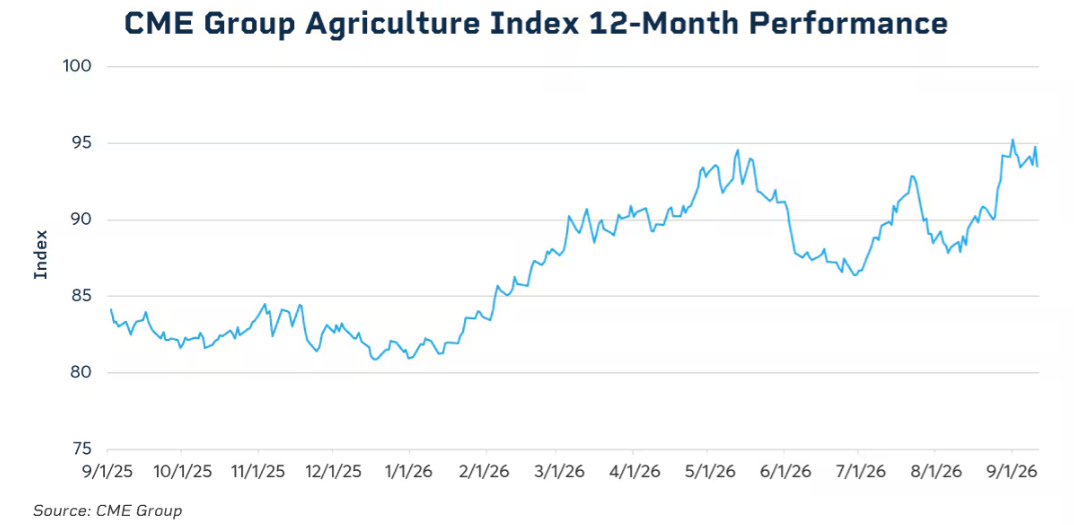
Within the CME Group Agriculture Index, a broad-based, volume-weighted benchmark designed to track the aggregate performance of the global agricultural complex, grains and oilseed constituents have taken the lead on growth. Since the beginning of August, both Corn and Oat futures have each posted a greater than 12% return as of mid-September, followed by Kansas City Wheat, Rough Rice, Soybeans and Soybean Meal, each increasing more than 8% in continuous futures prices.
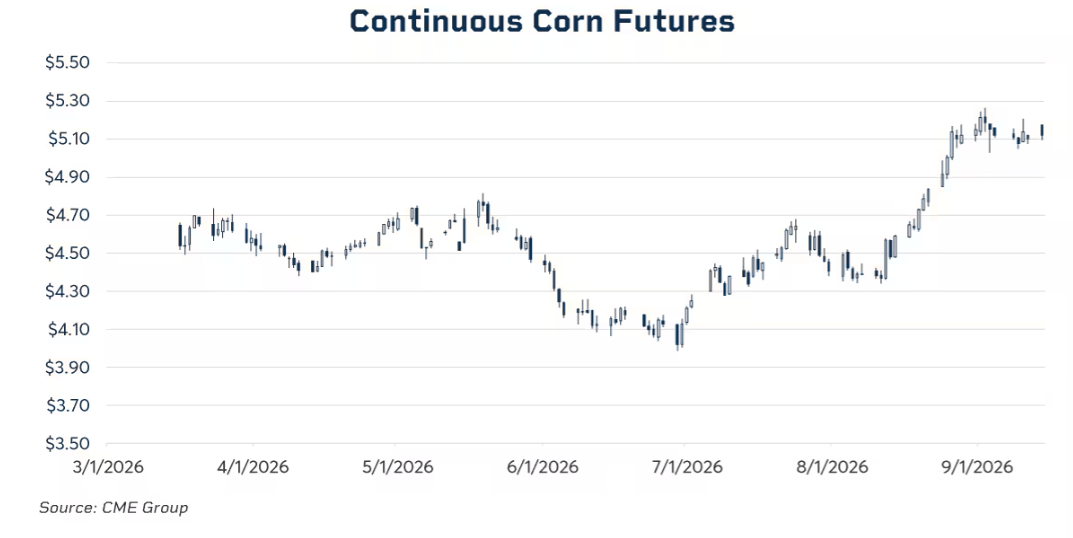
Corn and Soybeans Face Cost Pressures and Tighter WASDE Stocks
U.S. corn and soybean producers reported strong margin pressure during late summer, with regional farmers describing the situation as the most acute operational crisis, for many, in decades. The ongoing conflict with Iran drove global energy costs higher, pushing regional agricultural diesel prices up by more than 40% alongside elevated fertilizer expenses. Despite these cost headwinds and broader trade friction, U.S. corn exports have remained steady at an estimated 20% of total annual production, bolstered by strong domestic ethanol demand.
The U.S. Department of Agriculture (USDA) Crop Progress report in September indicated that corn maturity fell slightly below five-year historical averages, with 56% of the national crop rated in good-to-excellent condition. The latest USDA World Agricultural Supply and Demand Estimates (WASDE) reports, however, have provided a bullish catalyst. In August, the USDA revised its national corn yield estimate downward to 180.7 bushels per acre and reduced projected domestic ending stocks, both coming in below average trade expectations.
In response, continuous Corn futures broke above the $5.00 per bushel threshold during the monthly rally. The September 11, 2026, WASDE report further decreased corn yield estimates, this time to 178.5 bushels per acre, meeting expectations at release. Corn ending stocks were correspondingly reduced, sustaining high prices.
The soybean market similarly overcame early-season pressure ahead of the impending autumn harvest. While the August WASDE trimmed the national soybean yield forecast to 52.7 bushels per acre, an expanded harvested area calculation modestly increased projected domestic ending stocks. Continuous Soybean futures, nevertheless, advanced over 9.5% in the month of August, sustained by solid domestic crush margins and resilient international purchases. Soybean ending stocks were further reduced on the September WASDE, reinforcing August pricing.
Within the Soybean futures complex, Soybean Oil futures sustained early-summer gains despite mid-month volatility triggered by potential Environmental Protection Agency (EPA) Small Refinery Exemptions under the Renewable Fuel Standard, which threatened to dampen domestic biofuel feedstock demand. Robust industrial demand and elevated crushing activity ultimately offset regulatory concerns. Meanwhile, Soybean Meal futures rose on the back of strong export commitments and steady domestic livestock feed consumption.
War Disruptions and Climate Volatility Drive Wheat, Oats and Rice
While corn and soybean markets reacted to Middle Eastern geopolitical developments, wheat markets experienced sharp upward pressure due to escalating disruptions in the Black Sea region. War-related damages to port infrastructure reduced year-over-year agricultural exports from Ukraine and Russia by 75% and 50%, respectively. Continuous Chicago Soft Red Winter Wheat futures, widely seen as a stand-in for global winter wheat, jumped significantly.
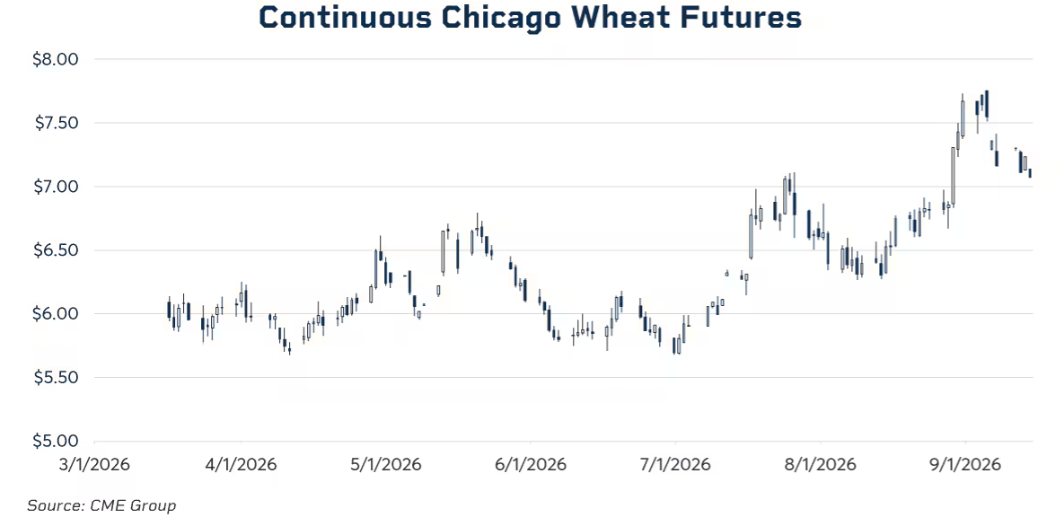
Global wheat supply tightness was further exacerbated by climatic factors. El Niño conditions have impaired international yields, while lingering midwestern drought conditions resulted in lower-than-expected U.S. production of both soft and hard red winter wheats.
Rough Rice futures climbed this quarter to hit an 18-month high. Price gains were bolstered by low domestic production, while uncertainties in India – where erratic monsoon precipitation prompted market participants to price in yield risk premiums for the 2026/27 crop year – added further support.
Oat futures have risen on sentiment that shifted sharply during the second half of August following reported reduced oat seeded acreage, combined with localized cool, wet weather that delayed Western Canadian harvest operations.
Looking Ahead
While oats and winter wheat have already completed their annual harvests, corn and soybeans have crops yet to reap as of early September and are thus still vulnerable to weather-based supply disruption. Though the preponderance of weather variability has passed this crop year, geopolitical volatility may prove the new normal as market attention turns to stocks and demand over the winter.
Editor’s Note: The summary bullets for this article were chosen by Seeking Alpha editors.

The truth behind Man United’s awful running statistics and what’s to blame for their sluggish start

AI, Tariffs, Rare Minerals: What to Expect From Trump’s Upcoming Summit With Xi Jinping
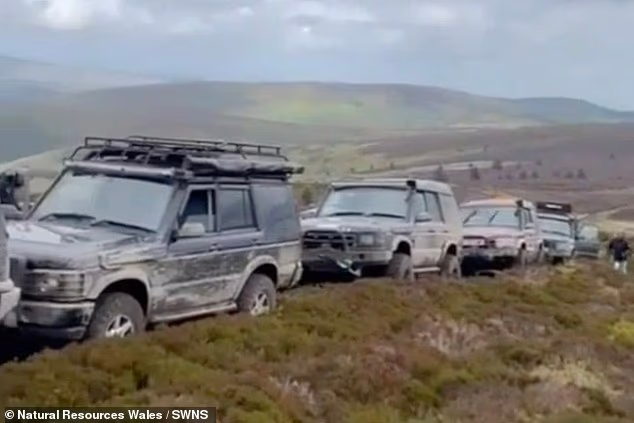
Yobs who ruined beauty spot using their 4x4s are caught out by their own TikTok videos




-

 Fashion3 days ago
Weekend Open Thread: Talbots – Corporette.com
-

 Tech20 hours ago
Researchers escape OpenAI Codex sandbox to run commands on host
-

 Crypto World7 days ago
Revolut Attackers Warn of Ongoing Daily Customer Data Leaks
-

 Crypto World3 days ago
Circle launches Arc Studio AI agent for building onchain apps
-
 NewsBeat3 days ago
Trump says US has reached an agreement to take permanent control of Greenland’s security
-

 Crypto World6 days ago
Robinhood engineers charged over $50K crypto scheme
-

 Crypto World7 days ago
Kraken Lets xStocks Holders Earn Yield Through DeFi
-

 Crypto World3 days ago
Bitcoin price breaks channel as RSI climbs to 63
-

 Crypto World5 days ago
US Charges Robinhood Engineers Over Crypto Listing Trades
-

 Crypto World6 days ago
What Is the Status of the U.S.-Iran Peace Talks? Here's What Both Sides Are Saying
-

 Crypto World6 days ago
NVIDIA Analysis: Attempted Rising Wedge Breakout Amid Pressure on the AI Sector
-

 Tech6 days ago
Webb’s IC 348 Mosaic Includes Two-Jupiter Dwarfs, Twin Jets, and a Nursery Still Making Worlds
-

 Crypto World3 days ago
World Money launches in 150+ countries with Stripe
-

 Crypto World19 hours ago
Who Needs CLARITY Anyway? ARB Could See 70X Increase: Hodler’s Digest
-

 Crypto World7 days ago
Kraken Adds DeFi Yield on Tokenized Stocks and ETF Assets
-

 Crypto World3 days ago
Silver prices recover quickly, hitting weekly high today
-
Crypto World7 days ago
Can Circle’s Arc Repeat Robinhood Chain’s Meme Coin Boom?
-

 Crypto World3 days ago
Trading Bitcoin on Robinhood? Why 2% Spread Has Traders Worried
-

 Entertainment6 days ago
Big Brother Update: Melody Explodes at Drew as Illness Sweeps BB28 House
-
 NewsBeat3 days ago
US was ‘on brink of war’ with China over false AI report of nukes moving in Middle East
You must be logged in to post a comment Login