
Crypto World
Ondo Lets Institutions Convert Shares Into Tokenized Stocks



Ondo’s new in-kind conversion system allows approved institutions to mint and redeem tokenized stocks and ETFs using the underlying securities instead of cash.


Stablecoin issuer Circle has introduced a Bitcoin-backed borrowing service aimed at institutional users, enabling eligible Circle Mint customers to pledge BTC collateral to borrow USDC via onchain lending markets. The feature is designed to keep borrowers within existing Circle custody relationships while still tapping decentralized liquidity.
Dubbed Digital Asset-Backed Borrowing, the service allows customers to deposit Bitcoin, mint Circle’s wrapped Bitcoin token cirBTC, and then supply that wrapped asset as collateral on supported lending protocols on Arc or Ethereum. Circle says Morpho is the first supported lending venue, with plans to add Aave and other protocols later.
Key takeaways
- Circle Mint users can use Bitcoin as collateral to borrow USDC on supported DeFi lending markets.
- The new workflow converts deposited BTC into cirBTC, which is then posted to lending protocols (starting with Morpho).
- Borrowing terms such as rates, collateral requirements, and liquidation thresholds are set by the third-party lending market, not by Circle.
- Circle says borrowed USDC is credited directly to the customer’s Circle Mint balance.
- New York clients are excluded, and collateral is supplied from a customer-controlled wallet to third-party protocols rather than being lent directly by Circle.
How Circle’s Bitcoin-to-USDC borrowing works
Circle’s announcement frames the product around a practical institutional requirement: getting onchain borrowing exposure without breaking custody workflows. Under Digital Asset-Backed Borrowing, eligible Circle Mint customers begin by depositing Bitcoin. Circle then mints cirBTC—a wrapped Bitcoin token—so it can be used as collateral in DeFi lending.
Customers supply the resulting collateral to third-party lending markets. Circle emphasizes that collateral is provided through a customer-controlled wallet to DeFi protocols, rather than being lent directly by Circle itself. In turn, the lending protocol determines the key parameters that govern the position.
According to Circle, the borrowed USDC is deposited into the customer’s Circle Mint balance. That separation matters for institutional users who may want clearer accounting and settlement paths—particularly where the collateral remains tied to custody processes they already understand.
The rollout is also closely tied to Circle’s wrapped Bitcoin infrastructure. Circle previously launched cirBTC on Ethereum in June, and the token is backed 1:1 by Bitcoin held in custody by Circle National Trust. With this service, that existing wrapped-BTC bridge to lending markets is being converted into an institutional borrowing feature.
Morpho first, with more lending protocols planned
Circle’s borrowing service is not limited to a single DeFi venue. The company says Morpho is the first supported lending protocol for customers using cirBTC collateral. Circle also plans to expand to Aave and additional protocols as the service develops.
Circle also specified that borrowed positions are overcollateralized. Liquidation thresholds and collateral requirements are set by the third-party lending market, reflecting the fact that risk management comes from the protocol where the collateral is deployed.
Operationally, the service supports routes on both Arc and Ethereum, depending on the supported deployment of each lending market. Circle’s approach positions the product to work across its broader stablecoin and onchain payments ecosystem rather than limiting functionality to Ethereum alone.
Arc mainnet timing: cirBTC goes live on Arc
The launch of Bitcoin-backed borrowing comes alongside an important infrastructure milestone for Circle’s wrapped BTC token. Circle says cirBTC is scheduled to be live on Arc on Monday, referencing a separate announcement that the token is now available on the Arc network via Arc’s blog.
This sequencing appears intentional. Circle has been building Arc as a layer-1 blockchain intended for stablecoin payments and financial market use cases. Earlier coverage noted that Circle rolled out Arc mainnet this week, and that the network uses USDC as its native gas token. The same coverage also pointed to Arc’s support for tokenized assets including BlackRock’s BUIDL and Circle’s USYC.
For investors and builders, the practical question is whether new collateral and borrowing routes can gain traction fast enough to matter. By aligning cirBTC availability with lending product rollout, Circle is effectively reducing the friction between “having collateral” and “using that collateral to access liquidity.”
Institutional custody-first borrowing is becoming a market pattern
Circle’s product fits a broader shift in crypto finance: institutions want yield and liquidity options, but they increasingly prefer models that avoid constant collateral movement or custody changes.
Earlier in the year, similar thinking appeared in other offerings. In February, for example, Anchorage Digital partnered with Kamino to enable institutions to borrow against staked Solana (SOL) held at Anchorage. The emphasis there, like Circle’s now, was on accessing onchain liquidity without taking collateral out of qualified custody.
Bitcoin-backed lending followed a comparable theme in March. Lombard partnered with Bitwise to support borrowing against BTC held in custody, with Morpho providing lending infrastructure. The key difference Circle’s rollout highlights is that Lombard’s design aimed to keep underlying Bitcoin in custody without wrapping or bridging it—whereas Circle’s model explicitly relies on converting deposited BTC into cirBTC for collateral use.
Other custody-friendly lending expansions also emerged. In March, BitGo expanded its institutional lending offering with a portfolio-based approach that allows multiple assets to serve as collateral. Circle’s framework is different, but it reinforces the same larger trend: institutional-friendly crypto lending increasingly comes packaged with structured custody and clearer operational boundaries.
Circle’s decision to exclude New York clients underscores that regulatory and eligibility constraints continue to shape which institutional users can access these products.
What to watch next
Circle’s next steps—especially the planned addition of Aave and other lending protocols—will determine how broadly institutions can deploy cirBTC collateral and how competitive borrowing conditions become across venues. For now, the key signal is whether the Arc+cirBTC integration and the Morpho-first rollout can translate into meaningful adoption among eligible Circle Mint customers.
Crypto World
Why this investment bank sees little demand for tokenized stocks despite SEC’s new trading rules
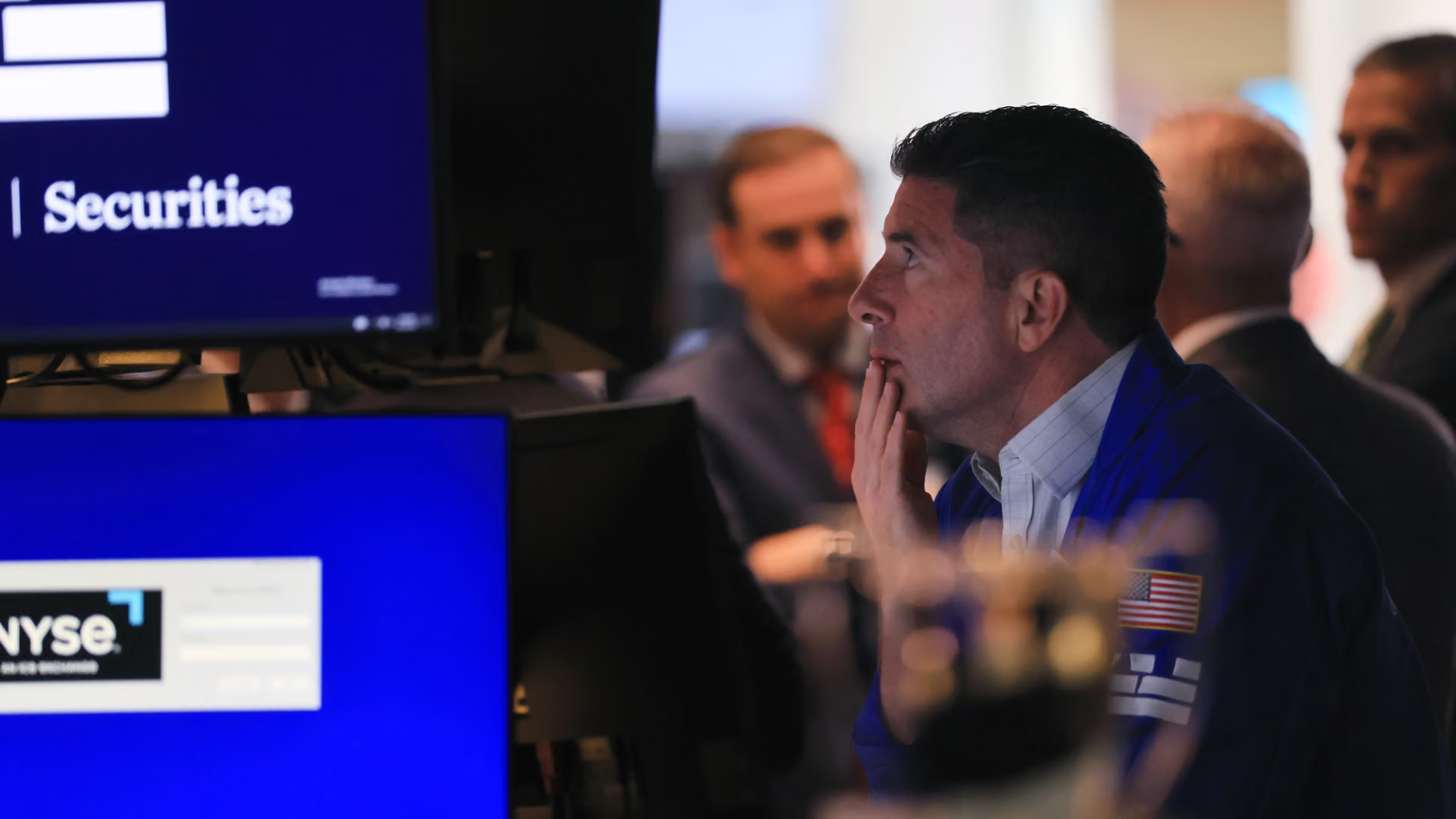
The SEC framework allows trading through automated market makers, or AMMs, rather than a traditional order book. An AMM holds pools of assets and uses preset rules to price trades. That could allow stock tokens to trade around the clock as long as a pool has enough assets.
But round-the-clock trading does not necessarily mean better trading, according to Noch, as thin liquidity can produce poor prices.
The SEC has also placed tight limits on its experiment. Tokens must represent NMS stocks and preserve the economic interest, dividends, voting rights and liquidation rights attached to the underlying shares. Third-party tokenizers must notify a company before trading its stock, giving the issuer 30 days to object. Trading volume is capped.
Those requirements could make the U.S. model harder to adopt than tokenized stock products already offered overseas.
Issuer interest is another question.
“Our conversations with dozens of issuers, including several highly retail-facing, have revealed minimal interest in tokenizing their stocks outside crypto-adjacent companies such as Figure,” Noch wrote.
Figure offers a glimpse at the size of that hurdle. Its Nasdaq-listed FIGR shares trade alongside blockchain-native FGRS shares that carry the same economic exposure and voting rights. Yet 99.9% of Figure’s notional trading took place through its traditional listed shares during the 24-hour period examined by TD.

We need a plot twist in climate storytelling, moving beyond the threat and into the thrilling adventure of solving it. Tales of the messy decades in which billions of people change how they power homes, grow food, travel, build cities, and protect one another from a climate that has already changed
Culture makers are beginning to catch on. I’ve been invited by television and film writers, social-media creators, and brands to help climate solutions appear in comedy, drama, adventure, and everyday life. Ever more box-office hits, like The Wild Robot, Avatar, and the upcoming Digger, reflect our fight against climate and nature crises. Sesame Street is helping kids cope with extreme weather. New climate fiction novels weave answers into stirring worldbuilding. These all work because they are compelling and moving stories above all, not climate science lectures dressed in a thin veil of narrative. Many other scriptwriters, novelists, social media creators, musicians and artists must add to this list.
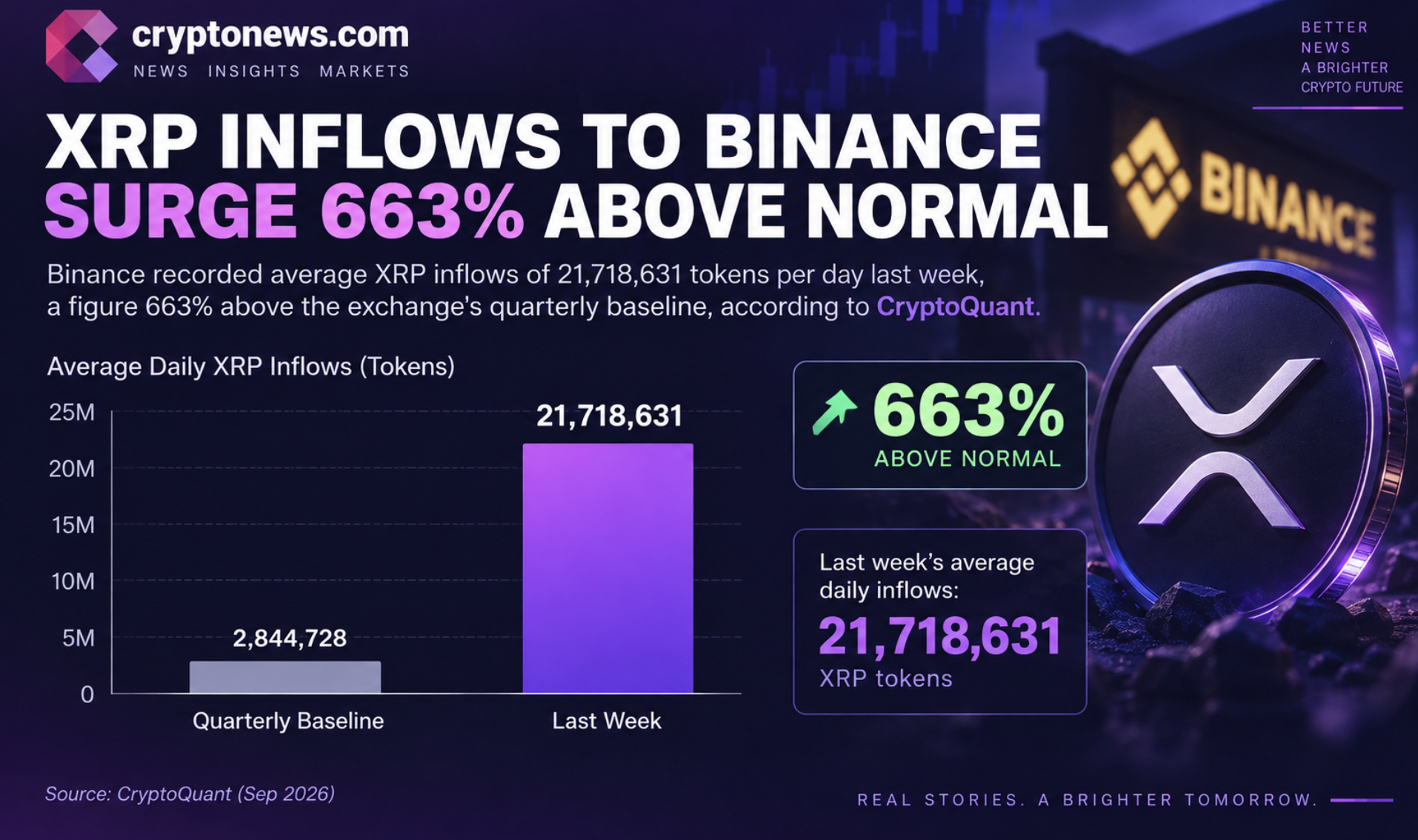
Binance recorded average XRP inflows of 21,718,631 tokens per day last week, a figure 663% above the exchange’s quarterly baseline, according to CryptoQuant news data. The number looks alarming in isolation, but the real question is whether it reflects large holders preparing to sell or simply a market repositioning around two major catalysts in the same week.
The data do not confirm outright intent to sell. What they show is a sharp increase in gross exchange turnover concentrated in a handful of sessions rather than a steady, week-long buildup. This is a gap that matters for anyone trying to read whale behavior off a single headline figure.

Discover: The Best Token Presales
Why XRP Flows Spiked Around the CLARITY Vote and Fed Decision News?
Two regulatory and macro events bracket the inflow spikes on September 16 and 17. On September 15, the U.S. Senate failed to advance the CLARITY Act after a 49-50 procedural vote, leaving the bill’s push for formal regulatory definitions of digital assets, including XRP, stalled rather than dead.
The following day, the Federal Reserve raised its target rate by 25 basis points to 3.75%-4.00%, its first hike since 2023. XRP fell toward $1.27 during the FOMC news before recovering to close at $1.410 on September 19.
The timing lines up cleanly enough to be notable, but it does not establish causation. Traders and large holders may have moved XRP between wallets and exchanges to adjust positioning around the rate decision rather than to prepare an outright exit. This is a possibility that the underlying data leaves open without confirming.
Earn $50 and Enter $300K Prize Draw on EdgeX
What the Three-Session Concentration Says About Binance Activity
The 663% average obscures how lopsided the week actually was. XRP inflows reached 91.2 million tokens on September 11, 44.5 million on September 16, and 41.7 million on September 17, three sessions carrying nearly the entire weekly total. No inflows were recorded at all on September 12, 15, 18, or 19, and September 20 lacked price, open-interest, funding, or transaction data entirely.
This concentration fits a pattern flagged earlier in the month, when whale inflows to Binance over the prior 30 days reached roughly 1.6 billion XRP, the highest level since March. Large-wallet transfers had declined steadily from May through July before reversing higher in August and continuing into September.

But gross deposits only tell half the story. Monthly inflows rose 457% while outflows increased 167% over the same stretch, and Binance’s XRP reserve ended the week at 2,630,628,140 tokens – just 0.22% above the quarterly baseline and 0.34% higher week over week.
Average outflows ran at 11,565,238 tokens per day, roughly half the inflow rate but still substantial. When inflows and outflows both surge while net reserves barely move, that points to turnover and repositioning across the crypto market rather than a coordinated distribution event.
Discover: Best Crypto IPO this September
Leverage and Network Activity Add to the Risk Signal
Deposit addresses averaged 788 per day, 129% above the quarterly baseline, confirming that more distinct wallets were interacting with the exchange rather than a single large actor moving repeatedly. Underlying network usage told a different story: XRP’s NVT ratio fell 32.1%, and transaction count dropped 16.4%, meaning on-chain activity did not keep pace with the exchange-level churn.
Derivatives positioning leaned more aggressively. Open interest reached 477.1 million, up 9.4% from the quarterly level, and the estimated leverage ratio climbed to 0.181, a 9.1% quarterly increase. Funding settled at 0.004 after doubling week over week, pushing up the cost of holding long positions.
Liquidations hit both sides. Short liquidations averaged 2.34 million XRP per day, up 199% week over week, while long liquidations averaged 2.93 million XRP per day. This is evidence that neither directional bet held comfortably through the volatility spike.
Taken together, the picture is one of a market reshuffling positions under macro and regulatory pressure rather than one signaling a clean distribution phase. Exchange inflows spiked, outflows rose nearly as fast, and Binance’s net holdings barely shifted. This is the pattern that raises short-term volatility risk without settling the question of whether XRP whale activity is bearish, defensive, or simply tactical.
Trade XRP on Bybit and Get a Chance to Win Our $1,000 USDT Airdrop
The post XRP News: Exchange Churn Surges, Binance Reserves Barely Move appeared first on Cryptonews.

In light of the ban, the other major television networks are standing with CNN by declining to replace its White House pool crew. The decision means the shared TV pool will not cover Trump’s events that have been designated for pool coverage.
In a rare joint statement, ABC, CBS, CNN, Fox News, and NBC said: “The public has a vital interest in receiving accurate, independent information about its government. No Administration should restrict a news organization because it objects to its reporting.”
Bryan Boughton, chair of the TV pool and Fox News Washington bureau chief, had earlier issued a memo to the White House press corps detailing the decision. “This is to advise that, effective today, the TV pool will not be covering events designated as pool coverage of the President,” read the memo, according to CNN. “This follows the White House’s position preventing CNN from fulfilling its assigned pool duties. There will be no replacement pool put in place. All other pool coverage will continue as normal, including Congress, VIPs, and selected events in Washington and around the country.”
The Associated Press also sent a note to media late Monday morning, informing them of the changed plans. “Please be advised that no network travel pool is expected to be with U.S. President Donald Trump today as he heads to New York for the United Nations General Assembly,” read the notice.
TIME has reached out to the White House for comment.
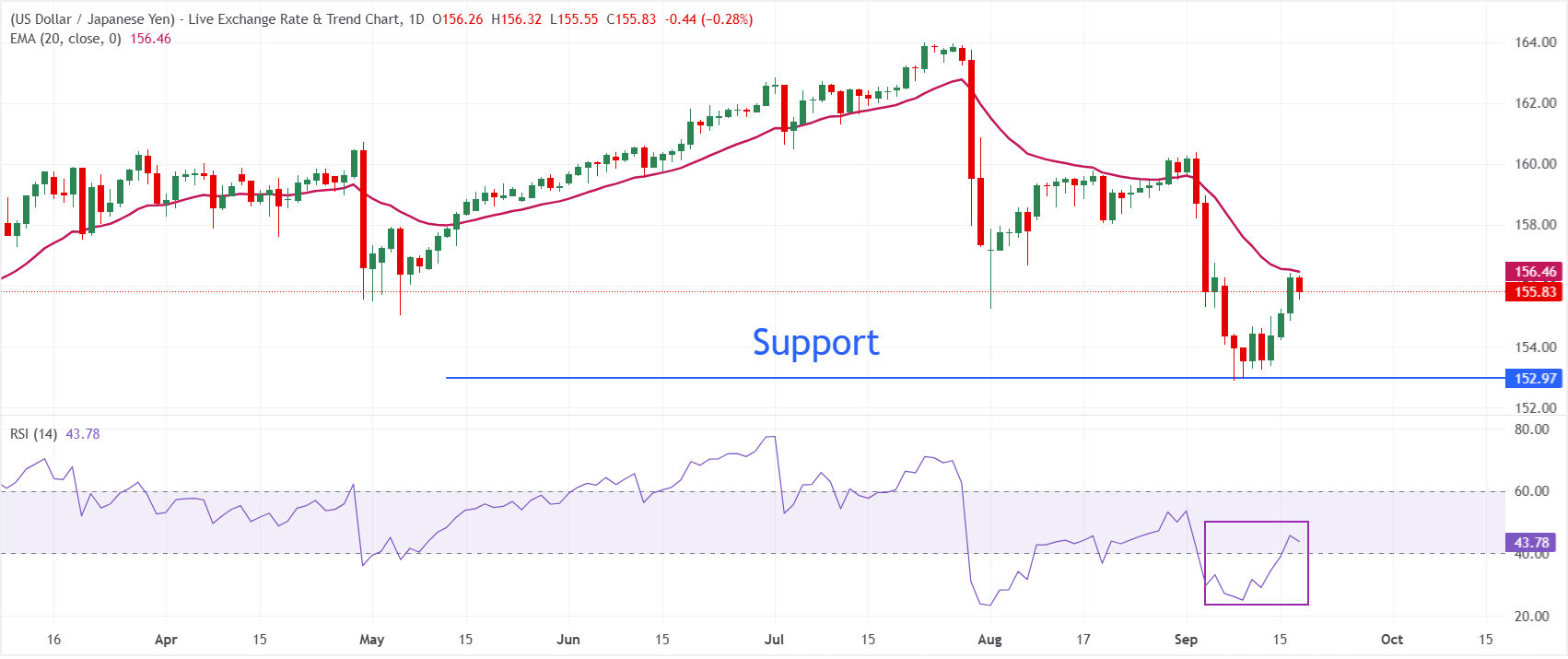
USD/JPY remains under pressure as the Japanese yen strengthens ahead of another potentially important Bank of Japan policy decision. The pair has fallen toward the mid-155 region after breaking below key technical levels, while expectations for further Japanese monetary tightening have added to demand for the yen.
The latest USD/JPY forecast is increasingly centered on whether the pair can defend the 152 to 155 support region or extend its correction toward 149. Oversold momentum creates the possibility of a short-term rebound, but the broader outlook has become more complicated as the Bank of Japan moves toward tighter policy, and traders assess the future path of U.S. interest rates.
Bank of Japan Tightening Strengthens the Yen
Monetary policy remains the primary catalyst behind the latest USD/JPY move. The Bank of Japan is expected to raise its policy rate by 25 basis points to 1.25%, extending a tightening cycle that has gradually reduced the extreme interest-rate differential between Japan and other major economies.
Danske Bank analysts expect the rate increase to be accompanied by a more flexible approach toward future tightening. The hike itself has largely been priced into markets, making Governor Kazuo Ueda’s guidance potentially more important than the rate decision. A signal that the BoJ is prepared to raise rates more quickly could provide additional support for the yen.
The Federal Reserve is pulling in the opposite direction. Its latest dot plot indicated that 16 of 18 policymakers expect at least one additional U.S. rate increase this year. Higher U.S. rates would normally support USD/JPY by preserving the yield advantage of dollar-denominated assets, leaving the pair caught between increasingly hawkish monetary policy on both sides.
Inflation is adding another complication. Brent crude has moved back above $100 per barrel, while the UN Food and Agriculture Organization’s global food price index reportedly climbed to its highest level since late 2022 in August. Higher energy and food costs could keep inflation risks elevated in both economies, increasing uncertainty around how aggressively the Fed and BoJ ultimately tighten policy.
USD/JPY Forecast: 152 Emerges as Critical Support
From a technical perspective, USD/JPY maintains a bearish near-term structure. The pair has traded below its 20-day exponential moving average around 156.45, leaving that level as the first significant barrier for any recovery.

The larger chart points toward an even more important test. Following the breakdown below the April 2025 to July 2026 uptrend, USD/JPY moved through the 38.2% Fibonacci retracement near 154.80. The next major area sits around 152, close to the 50% retracement and the lower boundary of the previous parallel channel.
Momentum indicators suggest selling pressure may be becoming stretched. Daily RSI has recently approached oversold conditions last seen in 2024, while a bullish divergence has begun to emerge. That does not confirm a bottom, but it raises the probability that another move lower could eventually encounter stronger buying interest.
If 152 breaks decisively, the next major downside level is around 149. This area coincides with the lower portion of the broader channel that has guided USD/JPY since 2023 and could become a significant technical battleground if yen strength continues.
On the upside, 154.80 is the first level bulls would need to reclaim before challenging the 20-day EMA around 156.45. Sustained strength beyond those levels could bring the 158.40 to 161 region back into view.
Intervention Adds Another Variable for USD/JPY
Currency intervention has also become an important factor in the yen’s recent volatility. Japanese authorities have previously stepped into foreign exchange markets during periods of extreme yen weakness, and coordinated action involving U.S. authorities has added another source of uncertainty for traders holding large short-yen positions.
The longer-term effectiveness of intervention remains less clear. Previous episodes produced sharp yen rallies before USD/JPY eventually recovered, suggesting direct currency purchases can influence short-term positioning without necessarily overriding monetary-policy fundamentals.
This time, however, the interest-rate backdrop is evolving alongside intervention risks. Continued BoJ tightening would gradually reduce the rate differential that has supported yen-funded carry trades, potentially making intervention more effective if speculative pressure against the currency becomes excessive.
Oil represents an additional risk for Japan because the country remains heavily dependent on imported energy. Persistently elevated crude prices could raise domestic inflation while simultaneously increasing import costs, leaving the BoJ with a difficult balance between inflation control and economic growth.
Oversold RSI Raises the Risk of a USD/JPY Rebound
Although the short-term trend remains bearish, technical momentum is becoming increasingly important for the USD/JPY forecast. RSI readings have moved into or near historically oversold territory across recent analyses, suggesting much of the immediate selling pressure may already have been absorbed.
The pair has also fallen considerably from recent highs, making the 152 to 155 region particularly important. If buyers defend this area and USD/JPY subsequently reclaims 154.80 and 156.45, the current decline could begin to resemble a corrective move within a broader long-term structure rather than the beginning of a sustained breakdown.
Confirmation would still require a stronger recovery. The 158.40 to 161 region represents a substantial resistance zone, and a move through it would be needed before the previous highs return to focus.
The bearish scenario remains straightforward. A sustained break below 152 would weaken the existing long-term structure and expose 149. Failure to stabilize there would represent a considerably larger technical deterioration for the pair.
CoinCodex USD/JPY Price Prediction
According to CoinCodex’s USD/JPY price prediction, the dollar-yen exchange rate could experience a brief stabilization before entering a broader decline through the end of 2026 and much of 2027.

The forecast remains relatively firm during September 2026, with an average projected exchange rate around ¥158 and an upper estimate near ¥159.34. October introduces considerably more volatility, with projections ranging from roughly ¥150 to ¥159 while the monthly average remains around ¥155.
The model turns more bearish toward the end of the year. November’s projected average falls to approximately ¥151.57, followed by ¥148.70 in December. The lowest December projection reaches ¥146.41, which would place USD/JPY substantially below the 152 support area currently attracting technical attention.
That downward trajectory extends into 2027. CoinCodex projects an average near ¥149.32 in January before USD/JPY moves into the mid-¥140s during February. March through May represents another period of weakness, with average projections falling toward ¥143 and monthly lows approaching ¥141.
There is a modest recovery projected for June and July, when average rates return toward ¥145 to ¥147. The rebound is not expected to develop into a sustained reversal, however. Forecasts weaken again during August before September 2027 produces the lowest average in the supplied outlook at approximately ¥139.86, with a potential low near ¥138.
The CoinCodex trajectory therefore points toward a substantially stronger yen over the next 12 months. While the model allows for temporary USD/JPY rebounds, particularly during late 2026 and the middle of 2027, its broader direction remains lower, with the pair potentially moving from the mid-150s toward the low-140s and eventually testing the high-130s.
The post USD/JPY Forecast: Yen Strength Puts 152 Support in Focus as BoJ Tightening Looms appeared first on BeInCrypto.

Bitcoin has broken above $85,000 as renewed U.S. buying and forced short covering have put Nansen’s next targets at $87,000 and $90,000, even as large crypto traders remain net short.
Summary
- Bitcoin has cleared $85,000, leaving $87,000 and $90,000 as Nansen’s next levels.
- Hyperliquid’s largest Bitcoin traders remain net short despite the price breakout.
- Positive Coinbase premium and firmer USDT pricing point to renewed spot demand.
- ETF flows, Treasury yields and Friday’s options expiry could determine whether the rally holds.
Nansen Senior Research Analyst Nicolai Sondergaard told crypto.news that Bitcoin’s price has turned bullish faster than positioning among crypto-native traders, creating room for underexposed market participants to chase the rally.
The move above $84,000 appears to have drawn support from renewed exchange-traded fund demand and a large short squeeze, according to Sondergaard. However, Hyperliquid’s largest Bitcoin traders were still net short, suggesting that some major market participants had not fully accepted the recovery.
Onchain exchange flows offered another sign of caution. Nansen recorded more Bitcoin moving onto exchanges than leaving them over the past two days, a pattern that can raise the amount of BTC available for sale.
“Bitcoin’s move above $84,000 looks less like a clean macro-driven accumulation event and more like a combination of renewed ETF demand and a large short squeeze,” Sondergaard said. “The important distinction is that price has turned bullish faster than positioning has.”
Under-positioned traders may have to buy Bitcoin if the advance continues, adding fuel to the rally. Sondergaard warned, however, that the move would remain exposed to a reversal if ETF inflows weaken or U.S. Treasury yields climb again.
Bitcoin spot demand must confirm the $85K breakout
Spot-market signals have strengthened alongside Bitcoin’s advance, giving the latest rally more support than a move driven mainly by perpetual futures.
ViaBTC Chief Analyst Jeff Ko said the Coinbase premium returned to positive territory on Friday, indicating that Bitcoin traded at a higher price on the U.S. exchange than on offshore platforms. Analysts often use the premium to assess buying interest from American investors and institutions.
At the same time, USDT/USD rose from 0.9991 to 0.9998 over the weekend. Ko viewed the move toward the stablecoin’s dollar peg as another sign of genuine demand rather than a rally sustained only by borrowed money.
Friday’s rebound followed two major setbacks earlier in the week. The Federal Reserve raised its benchmark rate by 25 basis points to 3.75%–4%, while the U.S. Senate failed to advance the CLARITY Act. Bitcoin initially fell into the mid-$75,000 range before recovering.
As previously covered by crypto.news, all 12 voting Federal Open Market Committee members supported the rate increase, while 16 of 18 officials projected at least one more hike during 2026. Bitcoin briefly approached $76,000 after the decision as Treasury yields and the dollar remained firm.
The market had also faced heavy ETF withdrawals. U.S. spot Bitcoin funds lost about $746.3 million across Sep. 15 and Sep. 16 before attracting $159.5 million on Sep. 17 and roughly $433 million on Sep. 18. Friday’s inflows included $310.7 million for Fidelity’s FBTC and $108.4 million for BlackRock’s IBIT.
Across the full five-session period, the funds recorded about $6.2 million in net inflows, showing that late-week demand nearly erased the earlier withdrawals. Ko said sustained ETF demand now matters more than the excitement created by the initial breakout.
Bitcoin faces its next test at $87K
After Bitcoin cleared and held $85,000, Sondergaard identified $87,000 as the next level to monitor. A break above that area would bring the psychological $90,000 level into view, followed by possible resistance around $92,000.
“The next level to look for would be $87k, given $85k is broken and held, then $90k would be psychological and again some levels to look for around $92k,” Sondergaard said.
Any move through the three levels will depend on continued spot buying and the absence of another sharp macro shock, according to the analyst. Without spot and ETF follow-through, Sondergaard said the advance could become another move led mainly by perpetual futures, leaving Bitcoin more exposed to sell-offs and geopolitical events.
Earlier technical conditions had already started turning in favor of buyers. During Friday’s rally, Bitcoin rebounded toward $81,300 after reclaiming its True Market Mean near $76,660. More than $250 million in short positions were liquidated over 24 hours as BTC crossed $78,000 and $80,000.
The 4-hour Supertrend flipped bullish near $78,677, while the daily Relative Strength Index rose to 64.48. Bitcoin also moved above the middle line of its daily Bollinger Bands before testing the upper band, according to the Sep. 19 technical report.
Ko had identified $80,000 as the main pivot before Bitcoin’s latest leg higher, with $82,000 acting as the resistance level that buyers needed to clear. Price has since moved beyond both zones, turning them into areas traders may watch during a pullback.
Holding above the former resistance areas without a steep rise in leverage would offer a stronger structure than a fast move powered by futures positions, according to Ko. Sondergaard’s exchange-flow data still leaves a risk that BTC deposited on trading platforms could return to the market if momentum weakens.
Treasury yields and oil remain risks for Bitcoin
The macro setting remains difficult despite Bitcoin’s recovery. Ko pointed to a U.S. 10-year Treasury yield near 5%, a firm dollar and oil prices above $100, although crude had eased from the previous week’s spike.
Higher bond yields can raise the return available from traditional fixed-income assets, while a stronger dollar can place pressure on assets priced in the U.S. currency. Expensive oil may also keep inflation concerns active as Federal Reserve officials consider whether another rate increase is needed.
The Fed’s September hike followed a sharp rise in market expectations after attacks on Saudi infrastructure pushed oil about 11% higher over five days. A preview of the Fed decision noted that the institutional structure of the crypto market now differs from earlier tightening cycles because U.S. spot ETFs and corporate Bitcoin holdings have increased conventional market exposure.
Bitcoin absorbed the rate increase and the failed CLARITY vote before rallying on Friday, which Ko cited as evidence of resilience. Still, he expects rates, oil and Fed communication to drive trading during a relatively light week for major U.S. economic releases.
Flash U.S. purchasing managers’ indexes are scheduled for Wednesday, followed by jobless claims and new-home sales on Thursday. Several Fed officials are also due to speak, giving investors further clues about whether policymakers support a second increase during 2026.
Friday’s quarter-end options expiry could add short-term volatility as traders settle contracts or adjust hedges. Ko said ETF flows remain the more important signal because persistent fund demand would show that U.S. investors are supporting the rally beyond the derivatives market.
ETH/BTC must rise before altcoin demand improves
Outside Bitcoin, Nansen has detected selective demand for higher-risk areas such as lending, yield and real-world asset tokens. Sondergaard described the activity as a tactical risk-on rebound rather than the start of a confirmed accumulation cycle across altcoins.
Ko said Ether’s performance against Bitcoin carries more value than its dollar price when judging whether demand is spreading through the market. The ETH/BTC ratio has remained in the low 0.03 range, limiting Ether’s relative appeal while Bitcoin continues to lead.
A convincing rise in ETH/BTC, combined with sustained positive Ether ETF flows, would indicate that investors are becoming more willing to take risk beyond Bitcoin, according to Ko. Until both signals appear, Ether’s dollar gains may largely follow Bitcoin rather than show independent strength.


The digital asset-aligned PAC joined other groups to spend more than a combined $300 million in the 2024 Ohio Senate race, resulting in Sherrod Brown’s loss to Bernie Moreno.
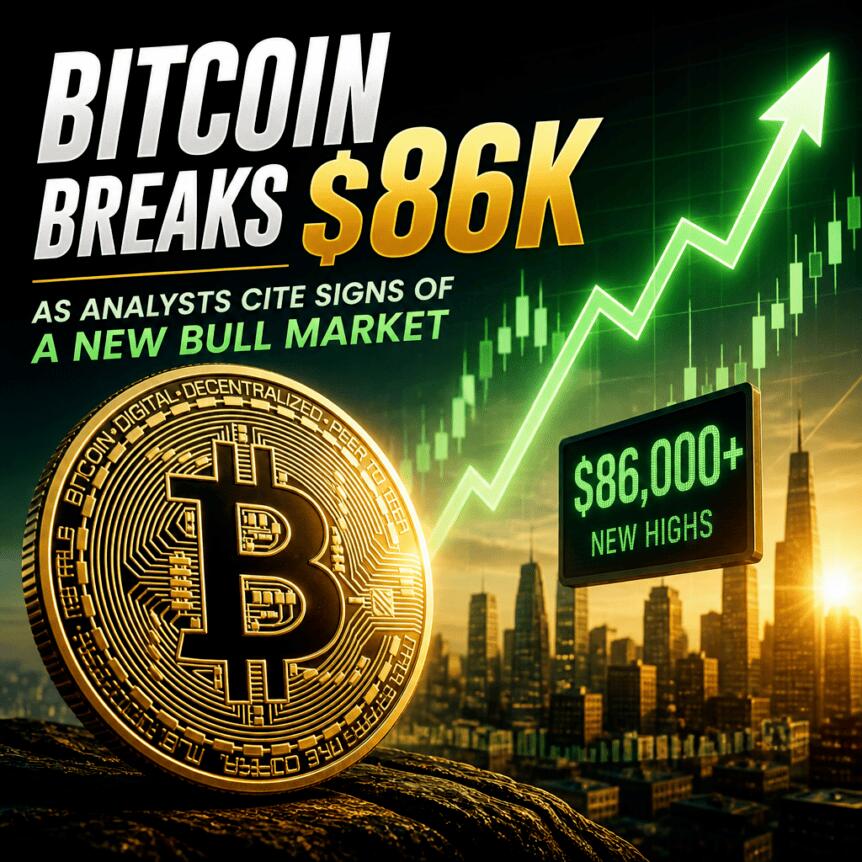
Bitcoin rallied sharply on Monday, pushing above $86,000 for the first time since late January as broader risk sentiment improved and oil prices continued to slide. The move came after a strong Sunday close near $81,120 and was reinforced by reports pointing to renewed momentum in efforts to de-escalate tensions in the Middle East.
Alongside the price strength, traders focused on positioning—particularly the scale of short liquidations—while analysts debated whether the breakout signals a sustained trend or a short-lived burst that could reverse if key technical levels fail to hold.
Key takeaways
- Bitcoin climbed nearly 6% on Monday and briefly topped $86,000, reaching $86,332 on Bitstamp, according to TradingView data.
- Crypto short liquidations totaled almost $800 million over 24 hours, with CoinGlass cited as the data source.
- US stocks opened higher as WTI crude fell below $92 per barrel, with the report linking the move to expectations of calmer geopolitical risk.
- Analysts at Bitfinex Alpha pointed to spot Bitcoin ETF inflows, rising open interest, and buyer support as prerequisites for follow-through.
- Rekt Capital argued BTC/USD has ended a longer pattern of lower highs since October 2025, setting a new projected trading range.
Oil drops and equities rise as geopolitical risk cools
Bitcoin’s upside accelerated after the Wall Street open, with TradingView data showing a high of $86,332 on Bitstamp—up about 5.7% at the time of writing. The sudden strength followed a Sunday weekly close at $81,120, the highest level since the start of May, suggesting sellers had less room to push the market lower.
Crude oil weakness provided an important macro backdrop. The report notes that WTI fell as low as $91.59 per barrel on Monday. It attributed part of that drop to signals involving diplomatic efforts around the US-Iran conflict, including statements from Qatar’s Foreign Ministry and remarks from US President Donald Trump.
In addition, JPMorgan analysts were cited—via coverage from CNBC and others—saying Middle East oil flows remain “surprisingly strong” despite disruption to Saudi Arabia’s East-West pipeline. Separately, The New York Times reported that the US planned to extend its trade deal with China by six months ahead of Xi Jinping’s visit scheduled for Sept. 23–25.
At the time of writing, the S&P 500 and the Nasdaq Composite were up 1% and 1.6%, respectively, reinforcing the idea that calmer oil and improved equity sentiment helped support speculative demand across markets.
Short liquidations surge as traders talk “bull market” again
BTC’s jump quickly attracted bullish interpretation from analysts and traders, particularly because the rally appeared to force shorts to unwind. According to the report, crypto short liquidations approached nearly $800 million over a 24-hour period, referencing CoinGlass.
The Kobeissi Letter—cited in the article—described the market as being “in a new bull market,” pointing to roughly 50% gains for BTC/USD over two months. While such framing is always subjective, the underlying liquidation data offers a concrete reason why momentum can build quickly when leverage is crowded.
Still, analysts stressed that whether liquidations translate into a durable trend depends on what happens next—especially whether spot demand can overpower any renewed selling pressure after a breakout attempt.
Bitfinex Alpha: watch net taker buying, open interest, and ETF inflows
Bitfinex Alpha, the research arm of Bitfinex, highlighted three factors it said are important for further upside: visible buyer support, expansion in coin-denominated open interest, and fresh capital entering US spot Bitcoin ETFs.
In a Monday blog post referenced by the report, Bitfinex Alpha noted that a breakout is more likely to be “validated” if trading behavior shifts toward net taker buying rather than profit-taking that previously capped the advance around Sept. 18 and Sept. 19.
“For a breakout to be validated, we would want to see net taker buying rather than the profit-taking that capped the advances on 18 and 19 September,” Bitfinex Alpha said, adding that coin-denominated open interest should expand to indicate new positioning rather than a move driven mainly by short covering.
The same analysis also provided an explicit technical risk level: it said a daily close beneath $77,100 would invalidate the structure to the downside, exposing what it described as the True Market Mean at $76,677. For traders, that matters because strong breakouts often fail when they retrace below the most recent “line in the sand,” especially after leverage-driven liquidations.
Rekt Capital marks the end of a downtrend pattern and sets a range target
Another market read came from trader and analyst Rekt Capital, who the report says confirmed that BTC/USD has broken out of a cycle of lower highs that had been in place since October 2025. In his related X commentary, he argued this move suggests the prior macro downtrend has weakened.
Rekt Capital further outlined a new potential trading zone between $86,681 and $93,659. He also referenced a broader range framework, suggesting that if Bitcoin confirms a breakout from the $60,000–$80,000 zone, the next milestone would be attempting to enter a higher “blue-blue” range that featured prominently toward the end of 2025.
Taken together, these perspectives show a common theme: multiple analysts view the current push as more than just a single-day spike, but they also stress that confirmation will depend on sustained demand and follow-through above key thresholds.
As Monday’s momentum filters into the next sessions, readers should watch whether Bitcoin can hold above the levels highlighted by Bitfinex Alpha—particularly around $77,100—while monitoring whether open interest grows alongside net buying, rather than fading back into another leveraged unwind.

However, in a study published Sept. 18 in JAMA Network Open looking at 14.8 million seniors, researchers at the U.S. Food and Drug Administration found that the vaccines were highly effective, reducing the chances of an RSV-related hospitalization or death by around 80%.
Vaccines protect against RSV in older adults
Since the rollout, a handful of studies have looked at the effectiveness of these two vaccines, which are made by GlaxoSmithKline and Pfizer. “These have all—very interestingly, and comfortingly—really paralleled and mimicked the exact results of the efficacy trials,” says Walsh, who was not involved in the new study. But this new work examines the entire U.S. population over 65 who are enrolled in Medicare, which is “vastly greater than the other studies,” he says. So these results are particularly reassuring. In general, both vaccines performed similarly.
The study found that people who received an RSV vaccine were more likely to live in affluent areas and more likely to have been vaccinated for flu and COVID, raising the question of whether their higher survival numbers have to do with access to health care. However, when researchers performed an analysis meant to test for whether access to health care was a factor, the high efficacy of the RSV shot remained. “That was nice to see, that the data really was identical,” says Walsh.

Tom Parker’s widow Kelsey gives birth to baby boy River

Lilly is ramping up future manufacturing for Foundayo obesity pill

Dodgers news: Roberts preps Sasaki playoff plan that helped win World Series




-

 Fashion3 days ago
Weekend Open Thread: Talbots – Corporette.com
-

 Tech20 hours ago
Researchers escape OpenAI Codex sandbox to run commands on host
-

 Crypto World7 days ago
Revolut Attackers Warn of Ongoing Daily Customer Data Leaks
-

 Crypto World3 days ago
Circle launches Arc Studio AI agent for building onchain apps
-
 NewsBeat3 days ago
Trump says US has reached an agreement to take permanent control of Greenland’s security
-

 Crypto World7 days ago
Kraken Lets xStocks Holders Earn Yield Through DeFi
-

 Crypto World6 days ago
Robinhood engineers charged over $50K crypto scheme
-

 Crypto World3 days ago
Bitcoin price breaks channel as RSI climbs to 63
-

 Crypto World5 days ago
US Charges Robinhood Engineers Over Crypto Listing Trades
-

 Crypto World6 days ago
What Is the Status of the U.S.-Iran Peace Talks? Here's What Both Sides Are Saying
-

 Crypto World6 days ago
NVIDIA Analysis: Attempted Rising Wedge Breakout Amid Pressure on the AI Sector
-

 Tech6 days ago
Webb’s IC 348 Mosaic Includes Two-Jupiter Dwarfs, Twin Jets, and a Nursery Still Making Worlds
-

 Crypto World3 days ago
World Money launches in 150+ countries with Stripe
-

 Crypto World20 hours ago
Who Needs CLARITY Anyway? ARB Could See 70X Increase: Hodler’s Digest
-

 Crypto World7 days ago
Kraken Adds DeFi Yield on Tokenized Stocks and ETF Assets
-

 Crypto World3 days ago
Silver prices recover quickly, hitting weekly high today
-
Crypto World7 days ago
Can Circle’s Arc Repeat Robinhood Chain’s Meme Coin Boom?
-

 Crypto World3 days ago
Trading Bitcoin on Robinhood? Why 2% Spread Has Traders Worried
-

 Entertainment6 days ago
Big Brother Update: Melody Explodes at Drew as Illness Sweeps BB28 House
-
 NewsBeat3 days ago
US was ‘on brink of war’ with China over false AI report of nukes moving in Middle East
You must be logged in to post a comment Login