



Join Mikko Hyppönen and security leaders from the NFL, CHANEL, and Atlassian for a two-hour digital summit on what AI-speed attacks change, what defenders should stop doing, and how to validate, decide, fix, and re-validate at machine speed.
Tech
5 Family Cars Most Likely To Make It To 200K Miles (Or More)



A car is a crucial asset for every family. It comes in handy for school runs, grocery trips, road trips, and everything in between. That makes a family car’s long-term reliability an important factor to consider when shopping for a new model, especially now, when new car prices have been steadily rising over the past few years. And it’s not just new cars; used car prices have been rising too.
That said, nobody wants a family car that will spend more time in the repair shop than in the driveway (or on the road running the usual family-related errands). But how can you tell whether a car is built to last and will be able to serve your family for years, with thousands of miles under its belt? You can consider family vehicles most likely to last at least 200k miles, or even more.
While not every vehicle is guaranteed to reach the 200,000-mile mark, some family vehicles have a much better track record of getting there as long as you take good care of them. If you’re shopping for a car that can haul your entire family from one point to another and are looking for a model that’s tough enough to hit 200k miles, or even more, there are several options to choose from. These five family cars stand out as some of the best candidates that can reach 200,000 miles or more when properly maintained, according to data from iSeeCars and Consumer Reports.
Toyota Sequoia
The Toyota Sequoia is a three-row family SUV that can haul up to seven or eight people. According to data from iSeeCars, which analyzed over 402 million cars, this SUV is one of the best long-term choices, with about 36.4% of this model reaching 250,000 miles. That makes it a pretty solid option for parents looking for a vehicle that can make it to at least 200,000 miles. The 2026 model year of the Toyota Sequoia is powered by a hybrid twin-turbo V6 engine mated to a 10-speed automatic transmission, producing up to 437 horsepower and 583 lb-ft of torque.
This SUV has combined EPA-rated figures ranging between 20 and 22 mpg, depending on the trim. Speaking of trims, the Toyota Sequoia is available in six trims, starting with the SR5. Other trim levels include Limited, Platinum, TRD Pro, Capstone, and 1794 Edition, inspired by Texas history. The base trim starts at an MSRP of $67,920, which includes $2,195 in destination and handling fees.
The high-end Capstone trim starts at $88,330. The Sequoia offers a rear-wheel drivetrain as standard on all trims except the TRD Pro grade, which includes 4WD targeted at serious off-roaders. If you have a caravan to tow for a more comfortable weekend getaway with your family, the 2026 Toyota Sequoia has a maximum towing capacity of 9,500 pounds.
Toyota 4Runner
Japanese car maker Toyota is known for making some of the most reliable vehicles. As such, it’s not surprising to see yet another model from the company’s lineup that is highly likely to reach 200,000 miles or more. From its analysis, iSeeCars reveals that 26.8% of Toyota 4Runners reach the 250,000-mile mark. The Toyota 4Runner has been featured among the most reliable Toyota models ever built, and it also appears on Consumer Reports’ list of vehicles that have been proven to get to 200,000 miles.
The 4Runner is a capable family SUV that can carry up to five people. The 2026 variant of the 4Runner offers two powertrains, a hybrid and a non-hybrid. The gas variant uses a 2.4-liter turbocharged four-cylinder engine, paired with an eight-speed automatic gearbox, producing 278 hp and 317 lb-ft of torque. That same engine is used in the hybrid variants, but due to electric motors, it produces a maximum of 326 hp and 465 lb-ft of torque.
Toyota offers RWD or part-time 4WD on lower trims, but for those who need off-road capability or want to plow through tricky icy roads with confidence, trims like the TRD Off-Road Premium i-FORCE MAX and Limited i-FORCE MAX come with 4WD standard. The 2026 Toyota 4Runner starts at a sticker price of $43,865. You can choose from 12 trims if you need a 2026 Toyota 4Runner.
Honda CR-V
The CR-V has been one of Honda’s most successful nameplates. For families, the CR-V is a top choice and, with proper care, it can serve you for a long time. Both Consumer Reports and iSeeCars say the Honda CR-V is likely to last 200,000 miles or more. iSeeCars says about 13.9% of CR-Vs reach 250,000 miles, and Consumer Reports has named the model its top pick among cars that can hit the 200,000-mile mark. The Honda CR-V is a compact SUV that accommodates five people and offers ample cargo space for carrying your family’s belongings.
For the 2026 model year, the company is still offering hybrid and non-hybrid versions. The non-hybrid uses a 1.5-liter turbocharged four-cylinder engine as standard, producing 190 hp and 179 lb-ft of torque, paired with a continuously variable transmission (CVT), and has a combined EPA-estimated rating of 29-30 mpg. The hybrid CR-V comes with a slightly more powerful 2.0-liter four-cylinder alongside two electric motors, producing a total of 204 hp and 247 lb-ft of torque. The hybrid is more efficient, with 35 to 40 mpg combined under EPA testing standards.
You can pick between front- and all-wheel drive regardless of the variant, and the towing capacity varies depending on the engine. The 2026 Honda CR-V has a starting MSRP of $32,470 and tops out at $44,100, including a $1,550 destination charge and no extra options.
Toyota Highlander
This is yet another family car that can last for a long time. iSeeCars’ analysis found the Highlander to be a solid vehicle that can hit 250,000 miles. According to the site’s findings, 17.5% of its gas variants can hit 250,000 miles. The hybrid Highlanders are even better, as iSeeCars’ analysis found 25.9% of them able to hit the same milestone. Similarly, Consumer Reports’ member survey has also identified the Highlander as a good option for the long haul. Every car model has its issues, and the Toyota Highlander isn’t an exception.
So as long as you watch out for the common Toyota Highlander problems and follow the manufacturer’s maintenance schedule, it’ll serve you and your family for quite some time. If you need a new Highlander, the 2026 model starts at an MSRP of $47,865, including a $1,595 destination charge, and offers seven trim levels to choose from. It offers gas and hybrid engine options. The hybrid variant uses a 2.5-liter four-cylinder powertrain alongside three electric motors, producing 243 hp total, while the gas model uses a turbocharged 2.4-liter four-cylinder making up to 265 hp.
The gas variant uses an eight-speed automatic transmission, while the hybrid uses an electronically controlled continuously variable transmission (eCVT). As a three-row mid-size SUV, the Highlander can seat up to seven people. With the 2026 model year, Toyota offers AWD on all grades. EPA-rated fuel economy for the gas Highlander ranges from 21 to 28 mpg, while the more efficient hybrid powertrain reaches 35 mpg.
Toyota Camry
The final model on our list is the Toyota Camry. It’s a family-friendly four-door sedan that both Consumer Reports and iSeeCars say is likely to hit 200,000 miles. iSeeCars’ analysis of over 400 million cars found that 13.5% of Camrys hit the 250,000-mile mark. Additionally, Consumer Reports’ member survey ranked the Camry as the top model likely to reach 200,000 miles, tying with the aforementioned Honda CR-V.
As a sedan, the Camry is the cheapest model on this list, with a starting sticker price of $30,895, including a $1,295 destination charge. The Camry comes with a hybrid engine, helping it deliver excellent fuel economy. Per EPA estimates, you can expect combined fuel economy of up to 51 mpg, depending on the trim. There are two powertrains to pick from. You can choose a 2.5-liter four-cylinder with two electric motors producing 225 hp that sends power to the front wheels, or a similar engine with three motors sending power to all four wheels and increasing output to 232 hp.
The Camry can accommodate up to five people, and Car and Driver praised the model for having enough space for adults in both the front and back seats. The team found the Camry can carry up to seven carry-on suitcases and up to 19 with the rear seats folded, so don’t overlook it just because it’s not an SUV or a crossover.
Continue Reading

from the railgun-architecture dept
Satire is dead. But it’s been dead since the first Trump administration, back when people were “owning the libs” with a combination of horse dewormers and willfully contracting COVID. Bleach consumption was discussed. It was a whole thing.
Not enough of those people died, apparently. We somehow got a second season of Trump and at this point, it looks like farce may finally have been killed off.
In addition to forming a white Christian nationalist death cult, Trump really wants history to remember him as one of the most self-aggrandizing people to ever serve as President of the United States. He would rather raze the Kennedy Center to the ground than have it continue without his name splashed all over it. He has literally gilded the lily all over DC, sending out his Parks and Rec folks to splash a bunch of gold paint over a bunch of monuments and statues.
In addition to constructing a hideous ballroom apparently inspired by the 1921 July 4th Ball held at the Overlook Hotel, Trump has held a military parade in his own honor and turned the 250th birthday of America into an MMA/White House crossover filled with mandatory attendees.
He also wants his own Arc de Triomphe. But while the French version celebrates the country’s military victories (both of them!) and is generally representative of national pride, Trump’s version would be all about Trump.
The problems are several. First, it’s the subject of litigation. Second, even his own National Park Service has pointed out that it would have an “adverse effect” on nearby historical monuments, including the Arlington National Cemetery and the Lincoln Memorial (the one with the misbehaving pool). Trump’s own FAA expressed some concerns about the proposed arch’s interference with flight paths but ultimately did the let’s-give-Trump-what-he-wants thing and suggested the only alteration be some sort of a warning light on top for planes… perhaps some sort of “eternal flame.” [Vomits involuntarily.]
Trump is struggling to justify building a gaudy piece of white-and-gold bullshit as a paean to his superior mediocrity. So, he’s doing what he always does in situations like these: fire up Truth Social to deliver rants/statements that look like they were composed by someone on a cocaine-and-151 bender.

If you can’t read/see the embed… oh man. You’re in for a treat. I’m just going to post the whole thing here because any cherry-picking of the best/worst parts might lead some people to believe that I’m just making this shit up.
Buckle up, buttercups:
At the strong request of the United States Military, and for National Security purposes, I have agreed to convert the magnificent Triumphal Arch, planned since the Civil War Era many years ago, at the Receptive Circle adjoining the Arlington Memorial Bridge, into a top grade Military Complex/Triumphal Arch, to house, store, and have the rapid ability to use large numbers of drones, plus Snipers, on both the roof and plaza areas, and additionally have and hold large quantities of sniper ammunition in storage. There will be no facility like this anywhere in the World. Out of the 59 top cities and Capitals, Washington, D.C., IS THE ONLY ONE IN THE WORLD THAT DOES NOT HAVE A TRIUMPHAL ARCH, but it will now and, by far, the greatest of them all! Thank you for your attention to this matter. President DONALD J. TRUMP
You’re seeing this too, right? It’s not just me who may or may not be on a cocaine-and-151 bender? This is a guy who thinks everyone respects him just out there on main claiming the “United States Military” has requested he turn his ego stroke of a monument into some sort of immobile war machine.
This sounds like it was written by a seven-year-old to explain the massive amount of hand-drawn violence currently covering the notebook paper he was supposed to be using to show his work during math class. I cannot imagine any healthy adult actually claiming a “triumphal arch” can — or even should! — house “large numbers of drones, plus Snipers… and… large quantities of sniper ammunition.”
Are we supposed to believe the “roof” of the monument will just be launching pads for drones — drones, I might add, that will be launched directly into the flight paths of descending commercial flights arriving at Dulles? Are the snipers just going to live there? Will the two towers of the arc act like extended clips for sniper ammo? Will it just be 250+ feet of belt-fed ammo accessed directly through “Freedom Slits” or whatever the fuck?
And what even is a “top grade Military Complex” in the context of self-gratifying embarrassment of a monument? And if it is actually going to be all of these things, why are we telling everyfuckingbody that we’re building a drones-and-bullets centerpiece in Washington, DC? Won’t that just make it one of the first targets in any invasion/terrorist attack/rummaging for pawnable goods after its erection? Speaking of erections, why can’t we have a president who gets off to normal things, like Marilyn Monroe? Or being cucked by Lorena Hickok?
All I can see now is some sort of drone-encircled, twin-towered .50 cal with Trump branding and a bunch of pissed off guys dressed like Solid Snake doomscrolling social media 250 feet above the ground. If for no other reason than Trump’s own Truth Social post, this abomination should never be constructed. But if we’re going to get blighted by the blightiest of self-declared urbanites, we may as well make it something everyone in the world will instinctively want to destroy.
Filed Under: asshat, autocrat, donald trump, pew pew pew, triumphal arch, trump administration, washington dc
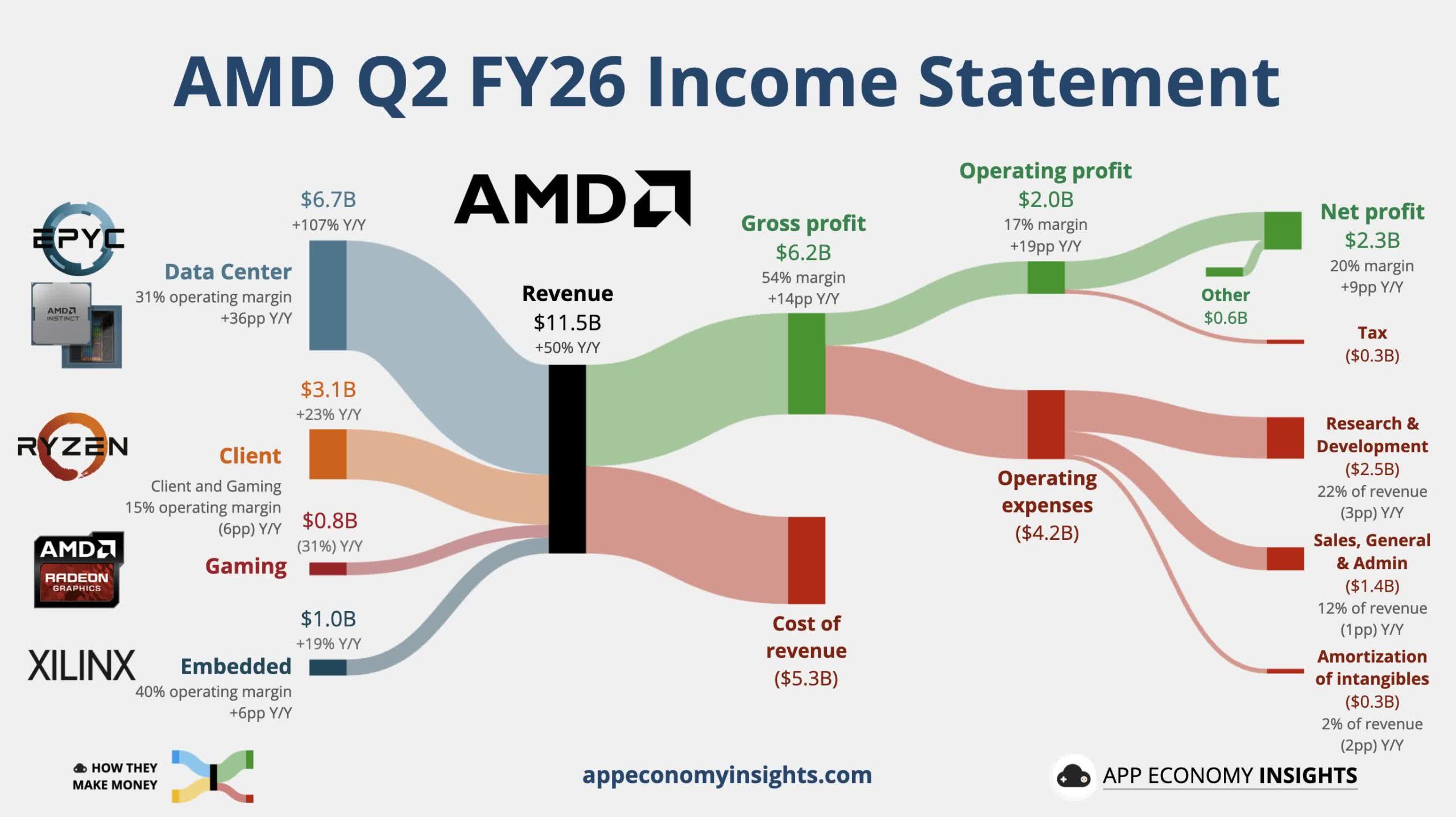
In a nutshell: AMD has become only the fourth US chipmaker to reach a $1 trillion valuation, following in the footsteps of Broadcom, Micron, and Nvidia. AMD’s stock entered 2026 at a price of $223.47 and would dip below the $200 mark a few times before climbing in April. As of writing, shares are trading at $607.24 – a healthy return for anyone that bought in early this year.
Nvidia eclipsed the $1 trillion valuation mark in May 2023, and has not looked back since. The company has continued to tack on value driven largely by the AI boom. Currently, the chipmaker has an incredible market cap of roughly $5.48 trillion, making it the most valuable company in the world by a sizable margin.
Apple, for comparison, is worth around $4.94 trillion. Google ranks third with a market cap of $4.29 trillion. Microsoft, another major player in the tech space, is worth $3.69 trillion as of today.
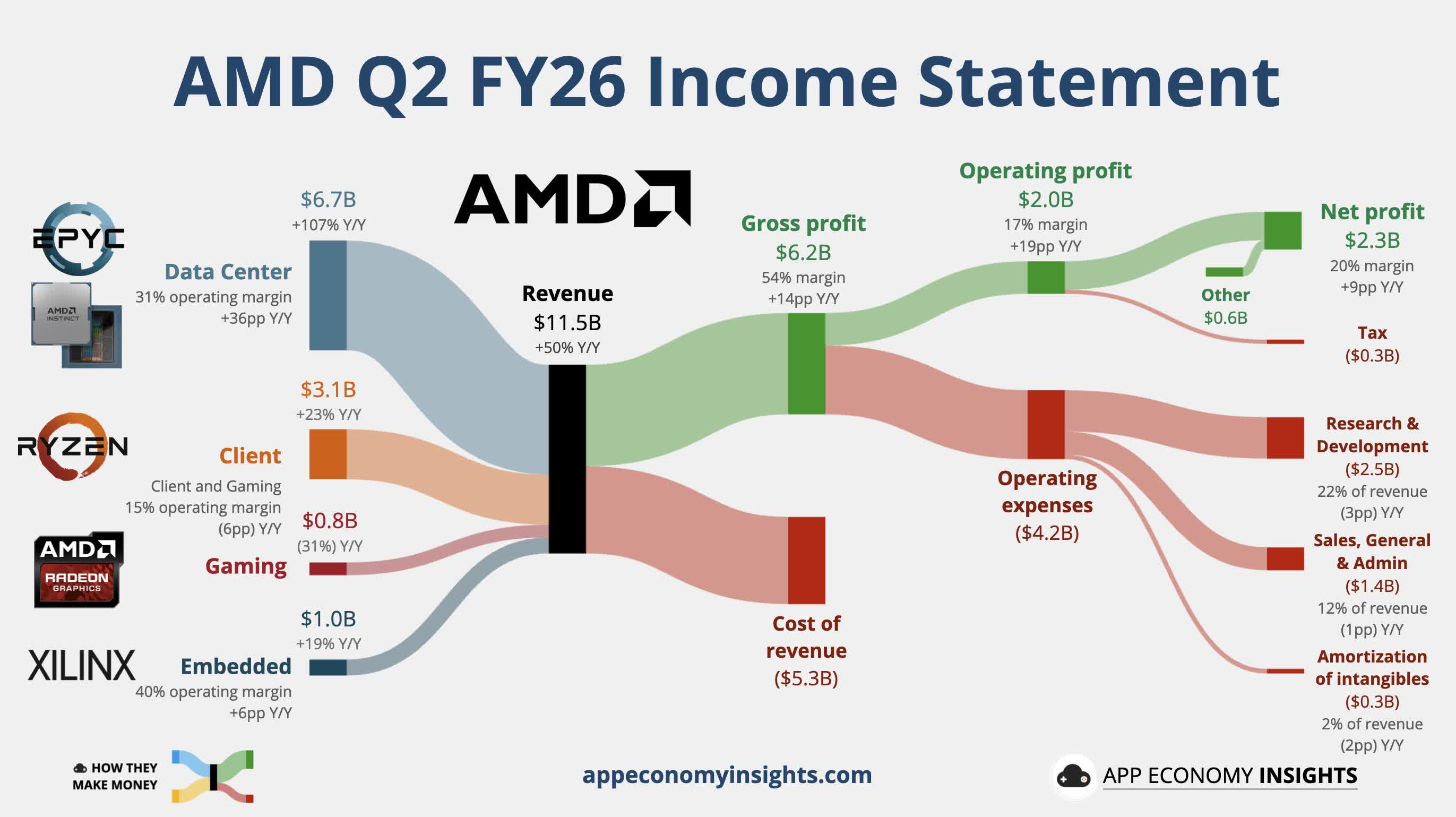
Credit: App Economy Insights
AMD is not the only chipmaker to start the week strong. Shares in Intel are trading up more than 12% on the day, and Qualcomm’s stock is up nearly 8.3%. Broadcom is having a slower day, up just 1.22% as of this writing.
Intel, often considered AMD’s primary rival due to their long history in the CPU industry, is also having a stellar 2026. Share values are up 208% year to date, but the company’s market cap sits at just $643.5 billion – far behind AMD’s.
Last month, AMD CEO Lisa Su said the company expects to double data center sales in 2027. That was welcome news considering the stock’s dip in July and August.
Like others, AMD is benefiting from the ongoing AI boom. At some point, however, the demand for AI hardware will cool. Fortunately for AMD, the company has other divisions to lean on when the time comes. For others that are putting all of their eggs in the AI basket, the outcome could be far more catastrophic.
With five days left to save up to $200 on your TechCrunch Disrupt 2026 pass, each day we will list a reason why you should join 10,000+ founders, investors, and operators at San Francisco’s Moscone West on October 13-15.
Grab your ticket savings before prices go up on September 25 at 11:59 p.m. PT. Plus, get a second of the same ticket type at 50% off. Register now.
Reason No. 1: Discovery
Part of the value of Disrupt has always been finding breakouts early. The startup you haven’t heard of yet. The technology moving from experiment to real product. The founder attacking a problem in a way you hadn’t considered. Or an emerging category that suddenly looks much bigger once you see several companies building around it.
Startup Battlefield 200 puts 200 TechCrunch-selected early-stage companies in one place, giving you three days to see what a new generation of founders thinks is worth building, and what investors are looking to add to their portfolio.
See where investors are placing their bets
Early-stage startups can be useful signals. Look across enough of them, and you start to see where founders are finding opportunity, which technologies are becoming accessible, which old problems are being attacked in new ways, and where completely new markets might be taking shape.
At Disrupt, all 200 Startup Battlefield startups exhibit, so you can go beyond the company description. Meet the founders. See the product. Ask why they’re building it. Find out who they’re building it for. Understand what they think the rest of the market is missing.
For investors, that can mean new deal flow and emerging categories to watch. For founders, it’s a chance to see what other early-stage teams are building and how they’re approaching the market. For operators and tech leaders, it can mean discovering a future supplier, partner, or solution before it reaches the wider market.
Sometimes discovery is about finding a company. Sometimes it’s about spotting the pattern behind several of them.
Watch 20 startups put their ideas to the test on the global stage
From the top 200 companies, 20 will take the Disrupt Stage to pitch live in front of leading investors and the TechCrunch community. One will ultimately take home the Disrupt Cup and $100,000 in equity-free funding. Explore all the Startup Battlefield onstage sessions on the Disrupt agenda.

But the value of watching goes beyond who wins — you get to see emerging companies explain why their problem matters, why their approach is different, and why they believe they can build something much bigger. Then you hear the questions investors ask in return.
For anyone building, backing, or evaluating startups, it’s a fast way to understand what turns an interesting idea into a company people want to pay attention to.
Don’t miss this intense pitch competition and the opportunity to see who’s making waves next in the tech industry. Register now to save up to $200, and bring your colleague, co-founder, or partner with you at 50% off their ticket.
Discover them before anyone else does
Startup Battlefield alumni include companies that went on to become familiar names across the technology industry, including Dropbox, Discord, Cloudflare, Fitbit, Mint, and Trello, with a collective total fundraising of $32 billion since this program started.
Nobody knows which members of the 2026 class will follow that path. Discovery is most valuable before the answer is obvious.

Meet these 200 hand-picked startups. Talk to companies outside your usual sector. Watch the finalists pitch on the Disrupt Stage. Look for the technologies, business models, and problems that keep appearing.
You might find your next investment, partner, or product. You might spot an emerging market before it reaches your everyday feed. Or you might simply find one startup that changes how you think about what comes next.
5 days left to save up to $200 on your Disrupt pass
Current TechCrunch Disrupt 2026 ticket savings end September 25 at 11:59 p.m. PT. Register now to save up to $200 on your pass and save 50% on a second pass. Or bring a group of four or more to save up to 30%.
Five days to save. A multitude of reasons to join 10,000+ tech leaders in San Francisco. Learn more about all of Disrupt’s activations and the reason it’s been the startup epicenter for at least 15 years. Grab your ticket before prices go up.
When you purchase through links in our articles, we may earn a small commission. This doesn’t affect our editorial independence.

“We have identified a single component issue affecting a small number of early batches,” Thomas says. “We have isolated those batches and are supporting affected customers.”
Thomas confirmed that Dyson would not answer questions on where—if anywhere—the Dyson CameraJet was still on sale worldwide. Nor would Dyson confirm when it stopped shipments of the product. Thomas also confirmed that Dyson refuses to detail what the faulty “single component” is, what problem it’s causing for the CameraJet, or how many units have been affected globally. Dyson also refused to comment on why it had not issued a formal recall of these faulty early batches of the $500 device.
Dyson Reddit forums have lit up, with names such as “ScameraJet” being bandied around, along with one disgruntled buyer commenting: “Bought two of these and both of them have stopped working. Since I bought it in the UK and wasn’t planning to return it and have thrown the packaging away, I can’t even return them. Disappointed that they scammed so good. Unbelievable that it lasted just two weeks.”
Kyle Wiens, CEO of the repair company iFixit, feels the problem may well be leaking.
“This sounds like a waterproofing issue. Making products at scale with the tolerances required to waterproof are hard,” he says. “My guess without getting a chance to look at a failed unit is that we either have a tolerance issue where some parts aren’t mating perfectly, or a failure in the adhesive curing process, either during manufacturing or in shipping.”
Wiens says this adhesive-curing failure can happen in such a way that a product can pass factory testing fine, but then heat or humidity (or both) during shipping causes a problem.
Adam Toner, founder and technical director of Ripcord Designs, a UK-based electronic design consultancy that has worked with multinational companies including Formula One Management and Panasonic, also thinks water is the CameraJet’s problem.
“On a product like this, there just should never be any water ingress into the internals,” he says. “I don’t have one in front of me, but I’ve seen a few videos and people explaining how you change the battery. Once you pull the battery off—which is where people say they’re seeing water—it looks like there is probably access from that battery compartment into all of the internals of the device.”
The CameraJet not charging, overheating, or failing to start—all of that can be explained by water getting into the device, Toner says. He suspects the problem could be as benign as a faulty gasket or O-ring.
If water getting in does turn out to be an issue for the CameraJet, as these experts suggest, this begs the obvious question: How on earth has Dyson managed to spend six years developing a teched-up toothbrush, designed to be dunked in water every use, and that carries liquid around in it, yet fail to make it waterproof?
Wiens believes the CameraJet chaos could force a well-overdue rethink for Dyson.
“Clearly they didn’t plan for this to happen,” he says. “They should take this opportunity to invest in repairability. Making products easier to fix also makes them easier to rework when manufacturing defects occur. Dyson is way behind the industry on making repair parts and information available for their products. This should be a wake-up call for them to step up.”

I’ve used Android phones alongside laptops for years, and there’s always this gap that you feel every time. Things really aren’t as bad as they used to be, but an iPhone-Mac level integration it is most definitely not. My phone knows practically everything about me. From all my routine apps, photos, messages, to even some important docs, it practically has my entire digital life.
Unfortunately, it doesn’t carry over painlessly to my laptop. It has its own set of apps and tools there, but the two often behave like they were just connected five minutes ago. While there are ways to work around this, they aren’t fun. Chromebooks have Phone Hub and Android apps, with Windows offering deep phone integration and even Quick Share support now. And still, the experience can’t replicate the feel of a MacBook with an iPhone beside it.
This is where the Googlebook comes in. Google just opened preorders for its new laptop platform this week, with machines from Acer, Asus, Dell, HP, and Lenovo starting at $899 and arriving in stores from October 4. Googlebooks are built on the Android technology stack, paired with the desktop foundations Google developed through ChromeOS.

Android has been building an ecosystem around a hole
Look at everything Android already touches, and it’s shocking that notebooks aren’t one of them. You get phones, tablets, wearables, TVs, and even gadgets for cars with Android Auto. The laptop was a gap that was always left wide open. Chromebooks technically filled that position, but ChromeOS was born from a completely different philosophy. Android apps eventually arrived, yet for years they existed as another compatibility layer inside an operating system built around the browser.
Now, Google’s latest platform shares Android’s foundation while bringing over the windowing, browser, and desktop infrastructure it spent years developing for ChromeOS. Android applications can run directly from Google Play, while users also get desktop Chrome with extensions and a full Linux environment.
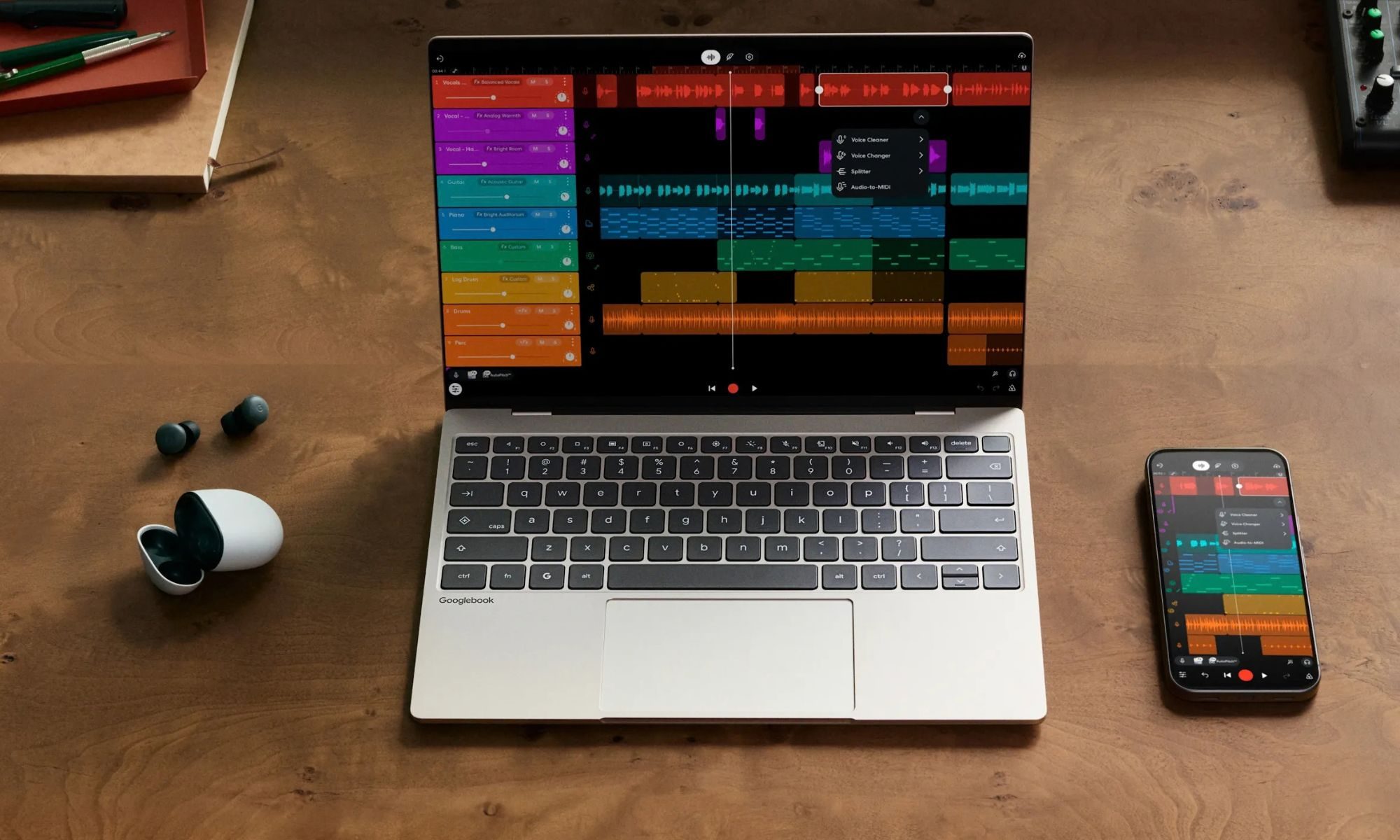
The 3 features we’re all looking forward to
Can’t have an entirely new (sort of) platform without having some exclusives to show for it. Leaving aside the OS itself, Google has made three core features that change the way you interact with a laptop. Magic Pointer is the one that was talked about the most. Just shake the cursor and ask Gemini about whatever is on the screen. Rambler, on the other hand, isn’t exclusive to Googlebooks and can be found on smartphones. But on the PC platform, this is the only place you’ll find it.
Lastly, there is the Continue On and Cast My Apps, which I’ve bundled together since they feel like an extension of one another. The former lets you begin a supported task on your Android phone and resume it from the Googlebook taskbar, while the latter streams an app running on your phone into a desktop window, which allows you to interact with it without installing another copy of it on your laptop.

Another cool new addition is the Files app that can browse files and photos stored on your phone as if it’s a part of the laptop. It may sound basic, but it previously required a dedicated connection for this. The implementation could work wonders, at least for me. I take a screenshot on my phone for an article, and just expect it to simply be there when I open the file picker on my laptop.
Apple figured this out years ago
This is the part Android has been chasing for a very long time. Apple’s Continuity system already lets an iPhone and Mac hand off supported tasks, clipboard, and much more. For an average user in the Apple ecosystem, most of these features just blend into normal use. They are so well integrated into the OS that it just becomes natural.
Handoff is probably the best example. Start something in a supported app on an iPhone, and the corresponding icon appears on the Mac, ready to continue from where you stopped. Googlebook’s Continue On is just the same deal repackaged for Android users, and yes, I’m happy it’s finally here. Apple users can gloat on this one.

I’m glad that Google is sticking with Android more than Gemini
The company calls Googlebook a laptop designed for Gemini Intelligence. So it’s no surprise that Google has built Gemini deep into the cursor, writing tools, and other stuff. AI is the big story for every platform. Now, it has a computer to stretch its legs. Even then, Gemini wasn’t why Android needed Googlebook, as the real star is a computer that is part phone.
For phones on Android 17 or newer, Google is offering deeper phone integration, though access will likely kick off with newer devices. If that works reliably across Pixels, Galaxys, Motorolas, Xiaomis, and the rest of Android, Google is sitting on a gold mine.

Don’t celebrate too early. Google could still mess this up
Googlebook starts at $899, so this isn’t a spiritual successor to Chromebook, at least not with the pricing. Still, we are being promised 16GB of RAM and 512GB of storage, with Intel Core Ultra and Snapdragon X Elite options, along with touch displays reaching 2.8K OLED, and premium materials across the lineup.
Google says Photoshop, Lightroom, CapCut, Microsoft 365, Android apps, desktop Chrome, and Linux tools are supported. But it remains to be seen just how solid it feels in real-world use. Native Android apps also need to actually make use of a laptop-sized screen. Hardware can be premium, but I’m still cautiously optimistic.


Nissan spent years selling e-POWER overseas before it finally landed on a U.S. compact SUV, and the 2027 Rogue Hybrid is the first American application of that third-generation series setup. Dual electric motors do all the driving. A turbocharged 1.5-liter three-cylinder engine never turns the wheels. It only feeds a 1.67-kilowatt-hour lithium-ion pack and a generator so you refill at a regular pump and skip any charging cable. Combined output is 225 horsepower, with a 202-horse front motor and a 134-horse rear motor giving the crossover standard all-wheel drive and instant pull from a stop.
Drivers who have seen the prototypes claim the response is much closer to a Leaf than a normal hybrid. Without a transmission, acceleration is smooth and linear, and the engine may run quietly while the battery is fully charged. Nissan claims 40mpg in the city, 36mpg on the highway, and 38mpg combined in their internal testing for the mid-range SR, which puts it right in line with a Honda CR-V Hybrid and only a few miles per gallon behind a Toyota RAV4 Hybrid 4WD. With a 14-gallon tank and a towing capacity of 1,500 pounds, it sounds more like a family automobile than a work truck, which is unlikely to accomplish much heavy lifting.
Sale

LEGO Technic 2 Fast 2 Furious Nissan Skyline GT-R (R34) Car – DIY Kit and Building Set for Adults…
- BUILD AN ICONIC CAR – Adults can relive their favorite movie moments with the LEGO Technic 2 Fast 2 Furious Nissan Skyline GT-R (R34), a detailed…
- CAR MODEL KIT FOR ADULTS – Fans of model car kits and building blocks will enjoy discovering details as they build, like functioning steering, a…
- GROUNDBREAKING DRIFT FUNCTION – The first-ever LEGO Technic drift mechanism raises the car so builders can recreate the movie’s most impressive…
The cabin is far quieter than the old gas Rogue, and in some intense mountain driving, even quieter than a modern RAV4. Front headroom is 40.9 inches without a sunroof (which Nissan claims puts it ahead of the competition in the hybrid class), and front legroom is 41.5 inches. The rear doors swing back 90 degrees on their hinges, there are 5 LATCH hooks for a child seat in the middle, and cargo space is 31.1 cubic feet behind the second row or 65.9 if the seats are folded down. The old climate and volume controls remain on the dashboard rather than disappearing into a screen.
The standard gear already includes wireless Apple CarPlay and Android Auto on a 12.3-inch touchscreen, as well as a world-first magnetic wireless phone charging. SR variants with the tech pack and up to the Platinum have a 14.3-inch display with Google and Gemini, and as if that wasn’t enough, the Platinum also gets a 10-speaker Bose system and a second wireless pad for charging another phone. Nissan’s e-Pedal keeps the SUV rolling gently into a stop with a single pedal, and the Smooth Stop technology ensures there’s no jerking forward in traffic as you come to a halt. The improved ProPILOT Assist now allows for automatic lane changes and hands-off assistance in slow traffic congestion.
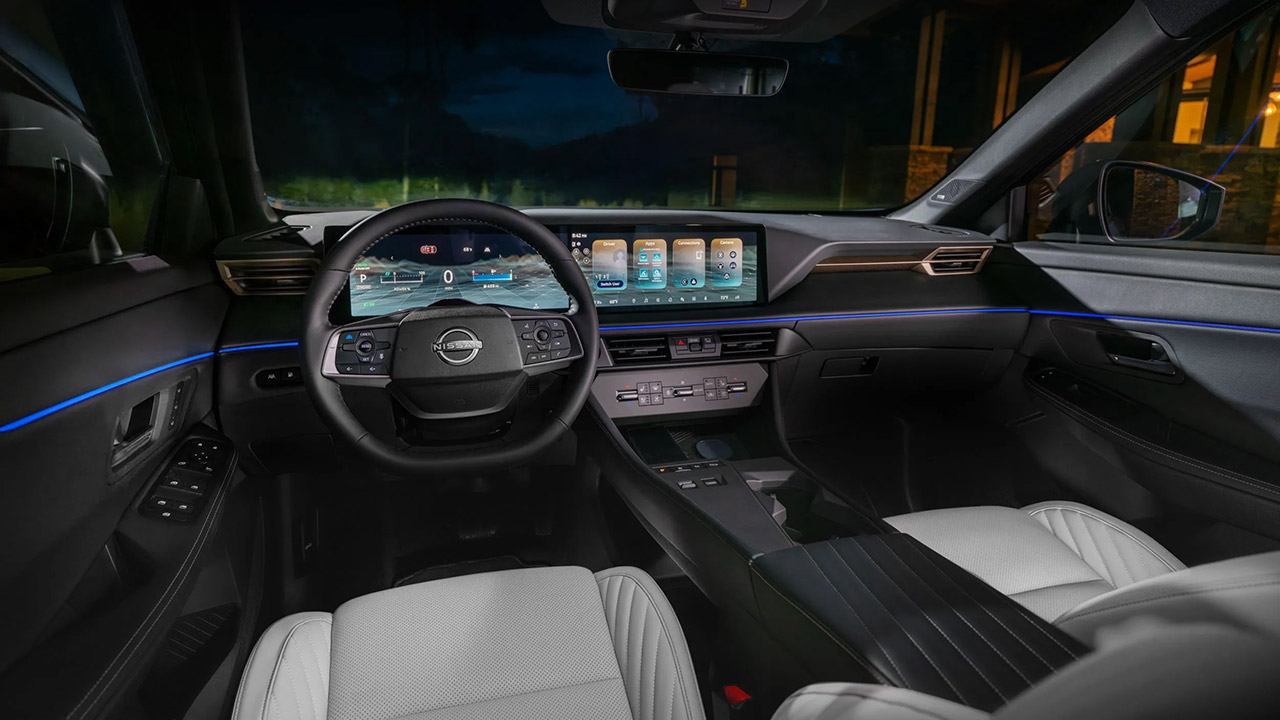
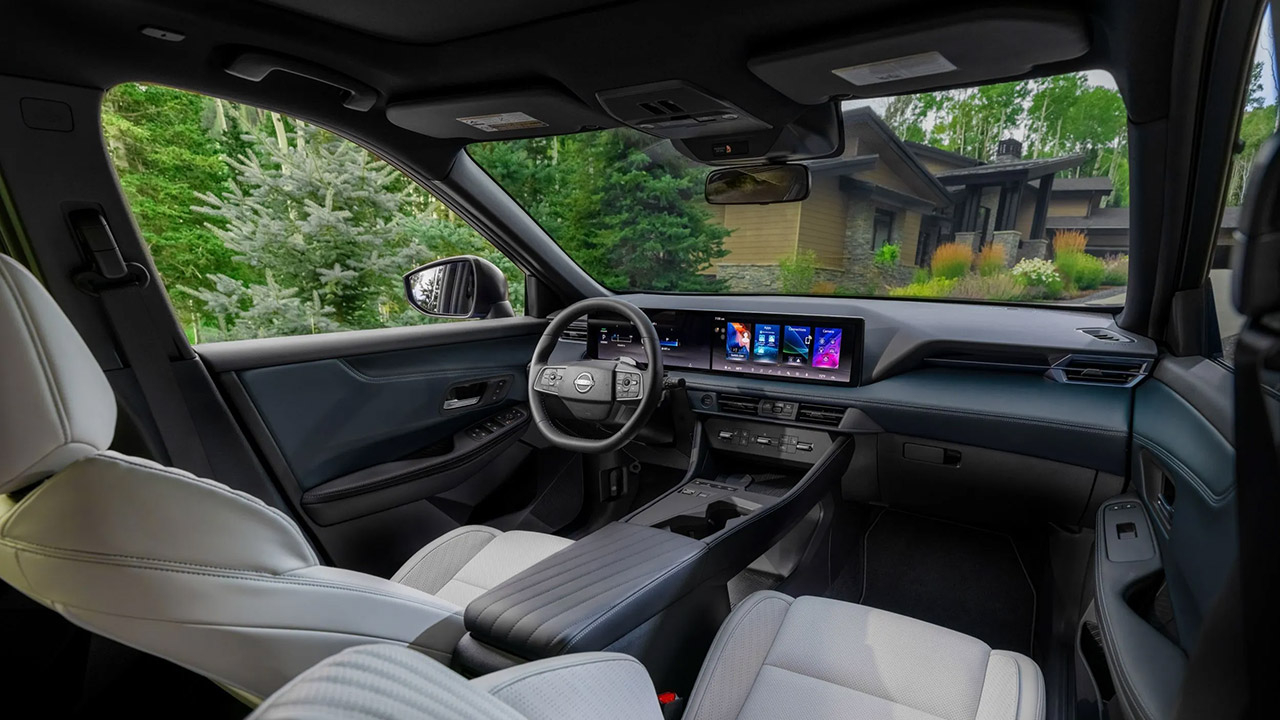
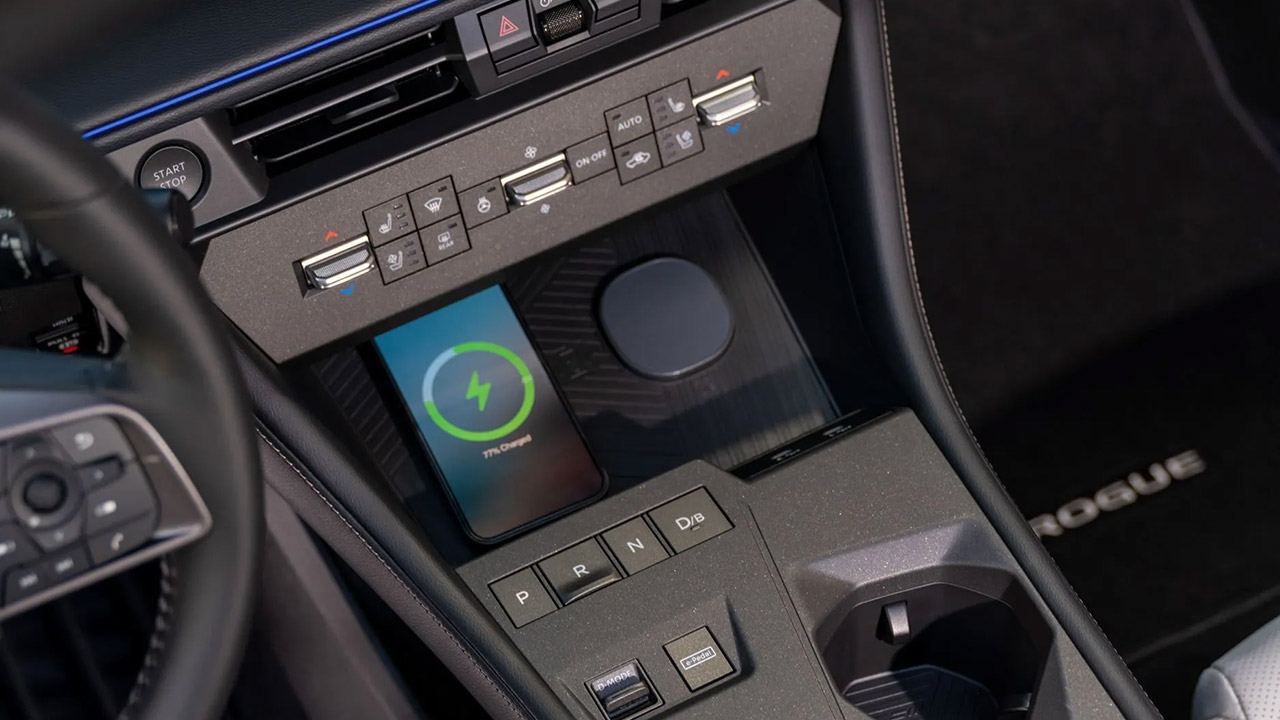
The SV all-wheel-drive model starts at $35,490 before a $1,575 destination charge, for an all-in price of $37,065. There’s also the SV Premium package, a basic SR, an SR with the tech pack, and a Platinum model, all priced at $43,490 before destination. The well-equipped SR Technology package will be available for $41,490 in the fall of 2026, with the rest of the range following in early 2027. The first cars will be exported from Japan before moving to Smyrna, Tennessee in 2027, which could assist improve US manufacturing without the need to create a brand new plant.



The exterior design is more aggressive than the previous Rogue, with a narrower grille and lighting that wraps around the headlamps, as well as an optional full-width taillamp. The curb weight for the lightest SV model is 4,065 pounds, which is approximately 400 pounds more than the previous gas-powered AWD Rogue with an 183.1-inch body and a 106.5-inch wheelbase. Ground clearance ranges from 8.4 to 8.5 inches, depending on the trim level. There are eight color options available, five of which have a black roof, including a few new ones such as Horizon Blue Pearl Metallic.

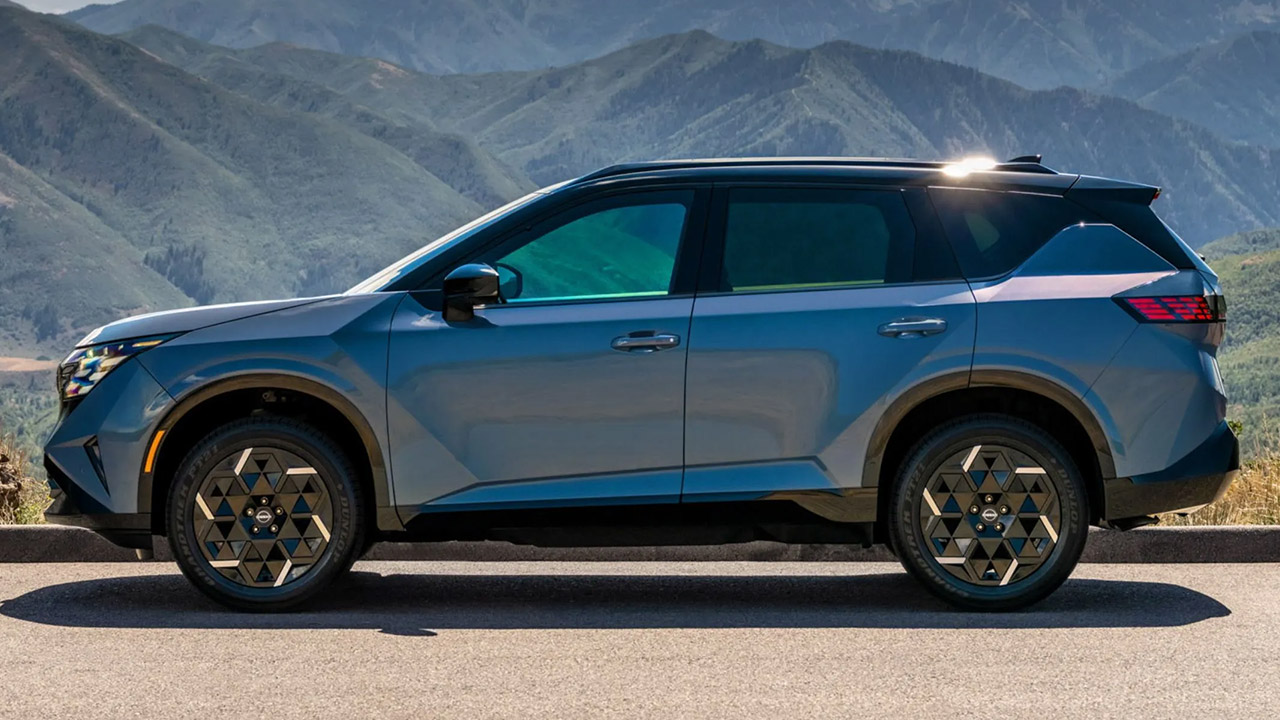
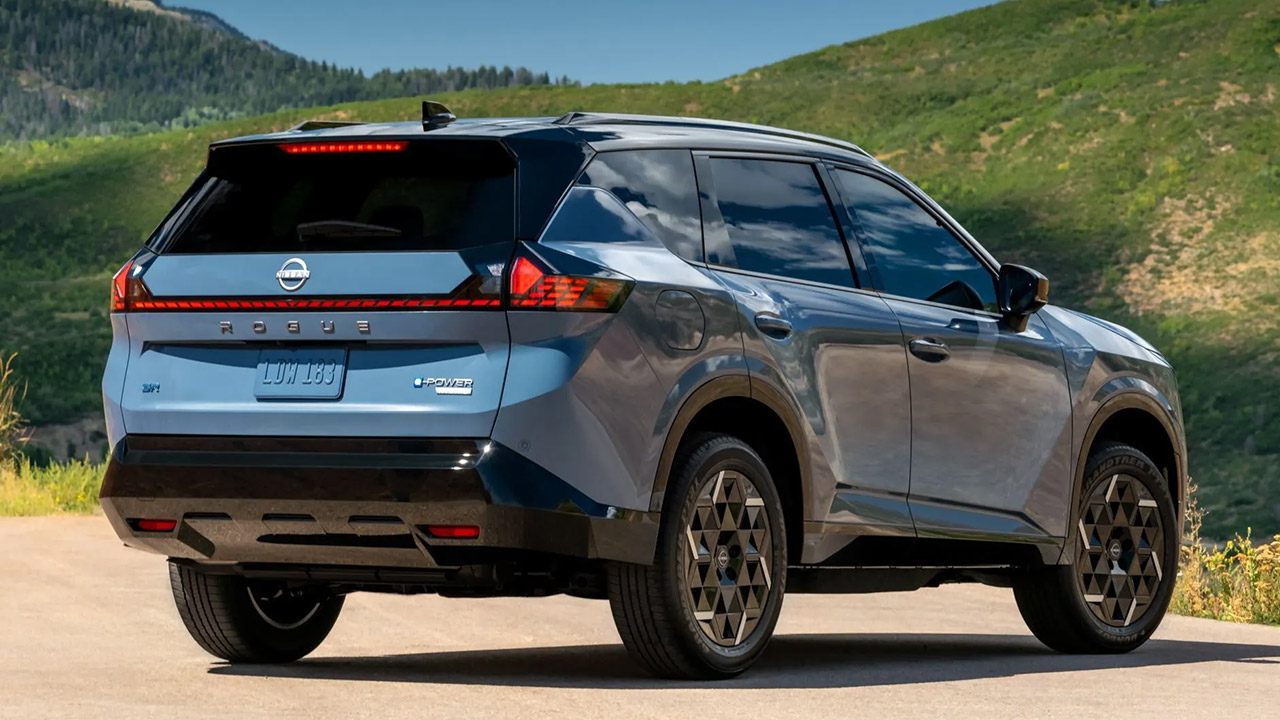
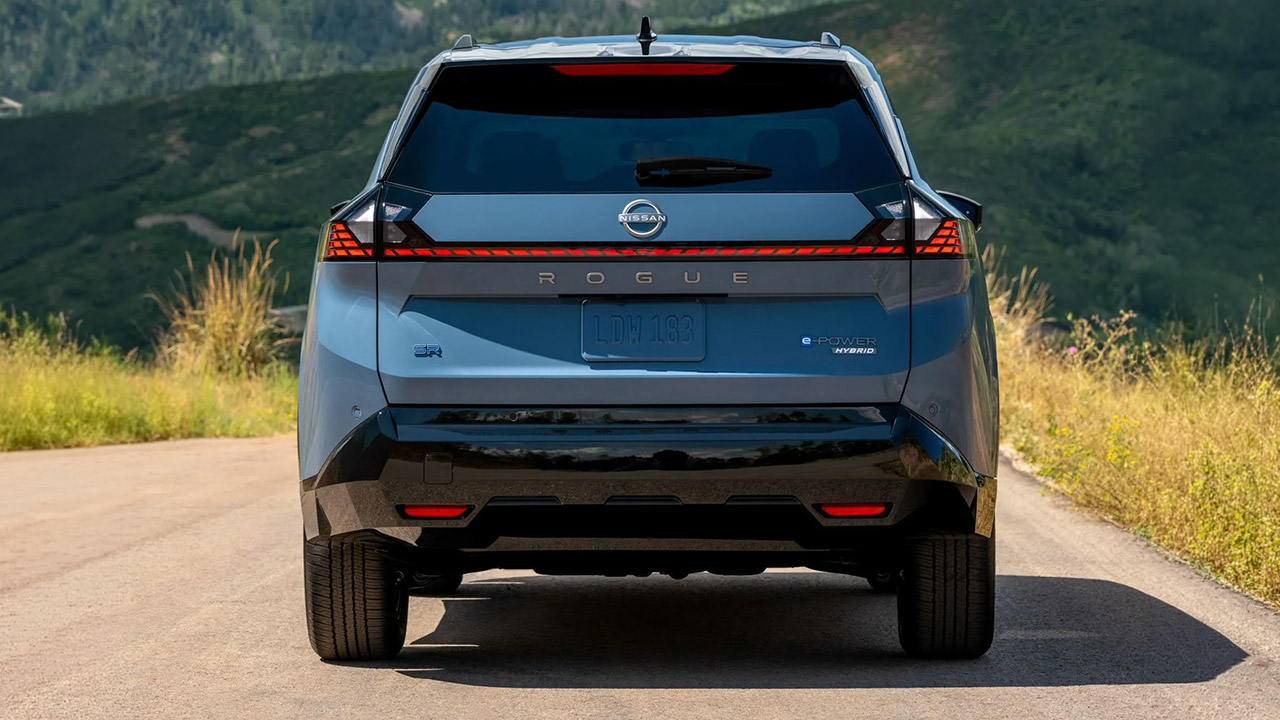
Christian Meunier, chairman of Nissan Americas, called hybrids the powertrain more U.S. buyers now want and framed this launch as a way to pull in shoppers who had stopped looking at the brand. e-POWER has already moved nearly two million vehicles worldwide across three generations. American buyers now get the dual-motor version tuned for local speeds and roads, with a 148-horse generator engine that Nissan says reaches 42 percent thermal efficiency when it is making electricity rather than turning tires. If the quiet cabin and one-pedal manners hold up once EPA numbers and real winter testing arrive, Nissan finally has a compact hybrid that feels distinct from the RAV4 and CR-V crowd instead of arriving late to the same formula.

from the good-deals-on-cool-stuff dept
The Ultimate AWS Data Master Class Bundle has 9 courses to get you up to speed on Amazon Web Services. The courses cover AWS, DevOPs, Kubernetes Mesosphere DC/OS, AWS Redshift, and more. It’s on sale for $40.

Note: The Techdirt Deals Store is powered and curated by StackSocial. A portion of all sales from Techdirt Deals helps support Techdirt. The products featured do not reflect endorsements by our editorial team.
Filed Under: daily deal


The U.S. Cybersecurity and Infrastructure Security Agency (CISA) is warning that hackers are exploiting three Linux kernel vulnerabilities, one of them rated critical.
The three security issues were added separately last week and have severity ratings ranging from medium to critical. One of them, tracked as CVE-2025-39964, existed in the Linux kernel for 14 years.
CISA marked all three flaws with the highest priority for federal agencies, ordering them to apply available security updates and mitigations by the end of today.
The three vulnerabilities are:
- CVE-2025-39964: a race condition in the kernel’s AF_ALG cryptographic socket interface that allows concurrent writes to corrupt per-socket state and potentially crash systems or alter cryptographic results.
- CVE-2026-53266: an out-of-bounds write vulnerability in the Linux kernel’s ebtables SNAT implementation that can cause an ARP address rewrite to modify shared file-backed memory without first making the affected packet range writable.
- CVE-2025-39682: a Linux kernel TLS receive-path logic flaw that mishandles zero-length records queued for later processing, potentially allowing different TLS record types to be processed together when kTLS is in use.
CISA says [1, 2] the vulnerabilities have been exploited in attacks but has not revealed any details about the incidents or the nature of the threat actors.
Offensive security company STAR Labs found CVE-2025-39964, saying that its researchers found the issue with no help from an AI system. They demonstrated the vulnerability by achieving privilege escalation and container escape in Google’s kernelCTF.
For CVE-2025-39682, there are public exploits available, as also confirmed by Red Hat in its security bulletin. Red Hat also confirmed a known exploit available for CVE-2026-53266.
Researcher Kimmo Suominen has published a technical analysis and patch-status tracker for CVE-2026-53266 on GitHub, outlining a potential privilege-escalation path involving modifications to file-backed memory.
However, the researcher notes that the proposed exploitation chain is inferred by analogy with Dirty Pipe and has not been demonstrated with public exploit code.
CISA has marked all three flaws as requiring “forensic triage.” This means that for every affected asset, federal agencies need to examine it for signs that exploitation already occurred.
Currently, none of the three flaws is flagged as exploited by ransomware groups.


On Monday, OpenAI announced a new independent advisory group hosted at the Institute for Advanced Study in Princeton, New Jersey. Called the Advisory Group on Mathematics and Artificial Intelligence, the group is meant to give mathematicians more input into the company’s math-oriented research.
“This group will serve as a bridge to the mathematical community and broader public, giving mathematicians a voice in how we move forward,” the post reads.
The announcement comes after the abrupt publication of a solution to the Navier-Stokes Millennium Prize problem. As part of the announcement of the new group, OpenAI also claims that the same internal model has resolved more than 100 additional open problems across most areas of mathematics.
Many prominent mathematicians have taken issue with the frenzied pace of those results. Earlier this month, 25 Fields Medal-winning mathematicians signed an open letter arguing that AI labs are threatening their intellectual work as they seek to one-up each other with solutions to famous math problems.
True to its name, OpenAI’s new group will mostly serve in an advisory capacity, assessing the significance of new results and coordinating their release. While members won’t be paid, they can offer unsolicited advice, go public with their views, and control their own membership, giving them a measure of independence from the company.
However, the group won’t be given leeway to slow down or redirect OpenAI’s ongoing mathematical research. As the blog post puts it, “the group will not be responsible for advising us on how to pace our internal progress on mathematics.”
The Institute for Advanced Study emphasized this point in its own announcement. “Although we will give advice, we do not have decision making power at any AI company, and the responsibility for the decisions made by any company will rest with that company,” said the institute in a press release.
Nine prominent mathematicians have been named as initial members of the group. Notably, only one of the members — IAS’s Camillo De Lellis — also signed the Fields Medalists’ letter.
When you purchase through links in our articles, we may earn a small commission. This doesn’t affect our editorial independence.
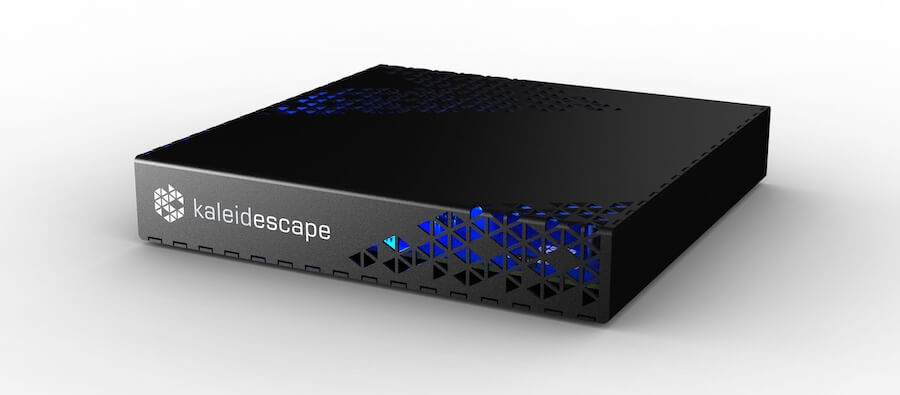
Kaleidescape made its name as a high-end media server and movie playback system for the ultra rich. Kaleidescape’s digital downloads of movies and TV shows are better than the best physical media in both video and audio quality. And its advanced user interface allows users to browse, search or sort even the most extensive collection of movies and shows with a few clicks of a button. Because Kaleidescape uses file downloads, rather than streaming, the system can deliver your favorite movies at a higher bandwidth, maximizing both the audio and video quality and ensuring a stable playback experience.
In a nutshell, Kaleidescape offers the best audio and video quality of any home media format, with the best user interface. And, its digital download ecosystem avoids the bandwidth and buffering problems of streaming while also eliminating the need to keep a massive library of discs on a wall or in a closet somewhere. It’s easy to see why the system has been embraced by well-heeled movie lovers in their mansions, compounds and yachts.
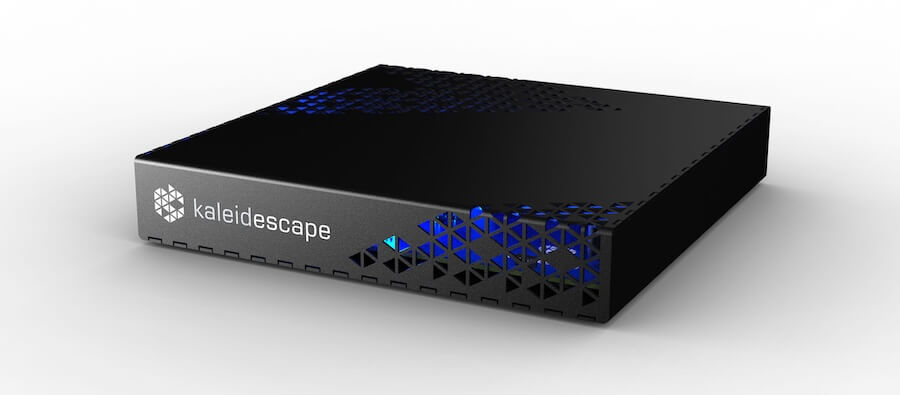
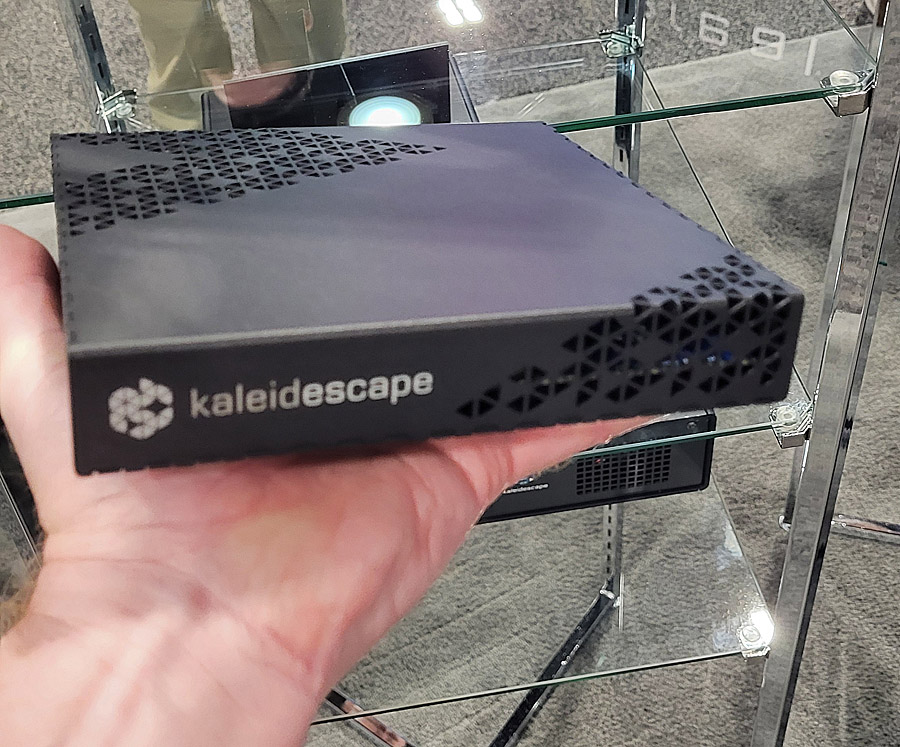
But what are the remaining 99% of us supposed to do if we want a taste of that Kaleidescape goodness but are limited by a more realistic budget? That’s where the Kaleidescape Strato M player comes in. At just under $2,000, the player includes built-in storage for 5 or 6 movies at a time and can work standalone or as part of a larger system with multiple players and servers. Does it capture that Kaleidescape magic at a lower cost? Read on to find out.
Kaleidescape: the “Rich Man’s Toy?”
Until just a few years ago, an entry-level Kaleidescape system cost upwards of $10,000. You needed at least one player to play your movies and at least one server to store your movies. That changed in 2024 with the introduction of the Strato V, which launched for $3,995. Unlike the company’s previous players, the Strato V didn’t need a companion media server (which is where things can get pricey). The Strato V comes with nearly a terabyte of online SSD storage – enough for ten or eleven movies in full 4K resolution with HDR10 or Dolby Vision HDR. Kaleidescape followed that up with two even more affordable players, the Strato E ($2,995) and the Strato M ($1,995). These players also come with on-board SSD storage (480 GB), which is enough to store 5 or 6 full resolution 4K titles.
We’ve already reviewed the Strato V and Strato E at eCoustics, and we have liked what we’ve seen (and heard). But I’ll admit my opinion of the “entry level” Strato M player is a bit conflicted. While the Strato E and Strato V both support 4K (3840×2160 pixel) output, the Strato M is capped at “2K” output (a.k.a. 1080p High Definition). But should this one spec rule it out for those who want to experience the Kaleidescape system, particularly on a budget? To answer that, we’ll need to take a deeper dive on why Kaleidescape is different from both physical media and streaming and how it combines some of the best elements of both.
Does Resolution Matter?
Years ago, when I attended ISF (Imaging Science Foundation) display calibration training, ISF founder and president Joel Silver shared the results of their research on what impacts perceived picture quality in a display. Out of 4 contributing factors, resolution was all the way at the bottom as a contributing element to picture quality.
Factors that Impact Perceived Picture Quality on a Display (ISF):
- Dynamic Range (contrast) – how well a display can reproduce an image from deepest blacks to brightest whites and colors.
- Color Saturation – how rich or deep the colors appear on screen
- Color Accuracy – how close the on-screen colors are to what we perceive in real life
- Resolution and Motion Reproduction – how detailed the image is and how well the display maintains this detail on moving images
So it’s dynamic range that makes the biggest difference in picture quality on a display device as this gives the image its vibrance and depth. But color reproduction is also important, both in its accuracy and its saturation. If you’re going to sacrifice anything, it’s the number of pixels, at least within reason. By extension, these same factors also apply to the content as the display can only reach its peak performance with the right material feeding it.
Better than Streaming? Better than Blu-ray? It’s All in the Bits
While the output resolution of the Strato M player is the same as Blu-ray Disc (1920×1080 pixels), the number of pixels doesn’t tell the whole story. The Strato M player is superior to Blu-ray Disc in three ways: color encoding, bit rate/compression and dynamic range.
Standard Blu-ray Discs use 4:2:0 color encoding. Kaleidescape’s standard 4K/HDR titles also use 4:2:0 encoding, however, because the Strato M down-converts that 4K content to 1080p, it can use the extra color information in the 4K file to output 4:2:2 chroma.
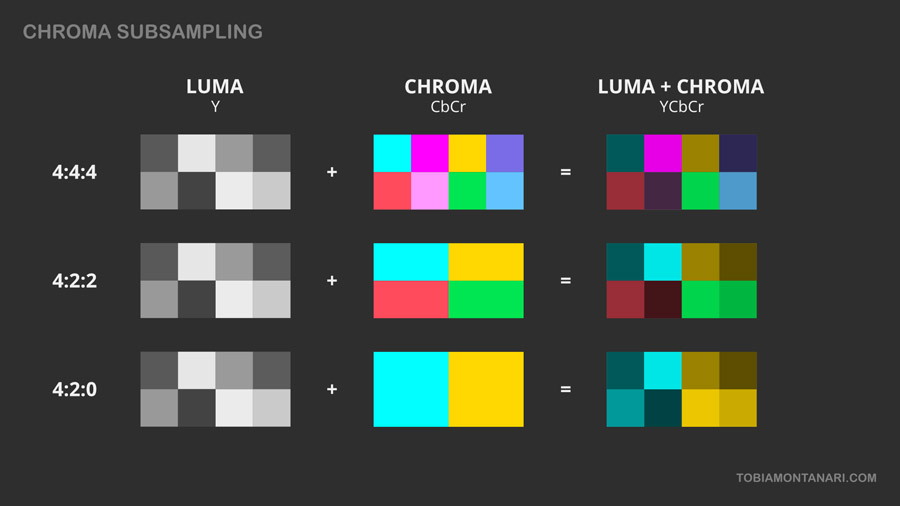
This means Kaleidescape files played back on the Strato M have up to twice the color luminance data compared to Blu-ray Disc, and this leads to more accurate color detail, with less color bleed. The difference is subtle on most content but can be visible on material such as scrolling text and animation.
How Wide is Your Band?
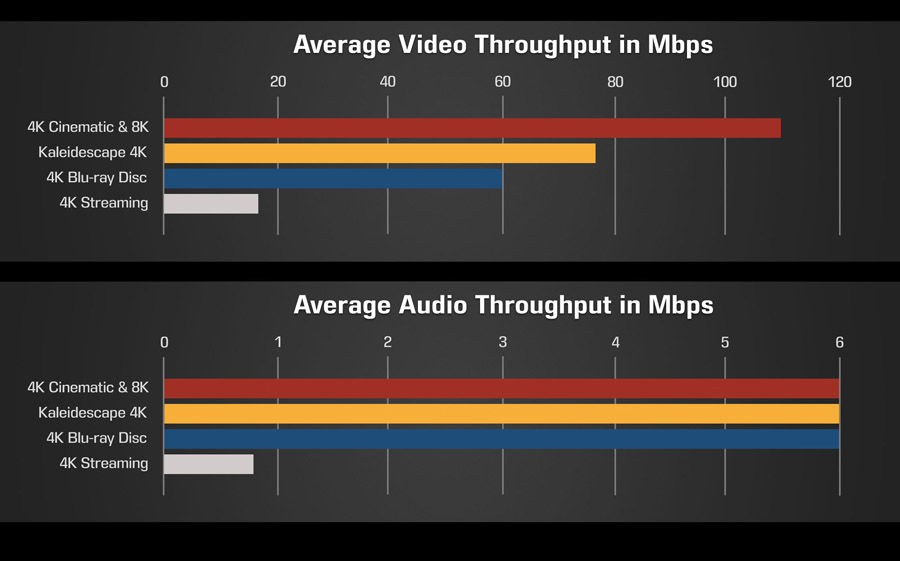
The bit rates or bandwidth of a video file determine how much data is used to encode the video and audio components of a movie or TV show, and this is a direct result of how much compression is applied when the movie or TV show is encoded. Higher compression means a smaller digital file, and the ability to deliver that file over a lower speed connection like we get with streaming services. Smaller file sizes also allow studios to put a movie on a single Blu-ray Disc or UHD Blu-ray Disc, but this is not without compromises. Higher compression rates lead to more video and audio artifacts like mosquito noise, motion smearing, muted color palettes, shrill-sounding audio and loss of detail.
Blu-ray Disc, UHD Blu-ray and Kaleidescape all support lossless audio encoding so all three formats are effectively the same for audio quality. Streaming services all use lossy versions of audio soundtracks, which can lead to audible pumping and harshness in the overall sound. Video compression rates are more variable on physical media and streaming – again, to save space and bandwidth – but none can match Kaleidescape in compression and bandwidth.
Size Matters
Because standard Blu-ray Discs have a maximum size capacity of 25 GB for a single layer disc or 50 GB for a dual layer disc, there is a hard limit on bit rates for Blu-ray Disc. This is particularly limiting for longer movies or shows because this means fitting even more data onto the disc (and applying heavier compression).
Even 4K UHD Blu-ray Discs are limited in file size as dual layer BDXL discs max out at 66 GB and triple layer BDXL discs max out at 100 GB. There is a quad layer BDXL disc with around 128 GB capacity, but this is not part of the UHD Blu-ray spec – it is used primarily by hobbyists to store their own home grown 4K and 8K recordings. The studios can get around this limitation by splitting a longer film out onto multiple discs, but this is fairly uncommon.
Meanwhile Kaleidescape has no hard and fast file size limit, so, for longer movies like “Lawrence of Arabia” or “The Lord of the Rings” films, the service simply increases the file size so they can maintain the video quality by minimizing compression. The 4K version of “Lawrence of Arabia” on Kaleidescape is over 120 GB while the 4K Cinematic version is over 170 GB. Those are big files!
Streaming services tend to be the worst for compression as they need to deliver the full audio and video signal, potentially at 4K resolution with HDR and immersive surround sound, in real time, over a narrow internet connection. This requires a lot of compression, and compression introduces artifacts like color banding, mosquito noise and macro-blocking, all of which impact picture quality. And if the network slows down, the video gets even more compressed and compromised leading to a truly unwatchable image.
Putting the “H” in “HDR”
As for dynamic range, standard DVDs and Blu-ray Discs are limited to SDR (Standard Dynamic Range) while UHD Blu-ray Disc, many streaming services and Kaleidescape support HDR (High Dynamic Range) encoding. HDR enables movies and TV shows to display a much wider range of brightness from the deepest shadows to the brightest sunrise. HDR also affects color perception as colors look more punchy and dynamic when there is a wider range of luminance values available.
The Strato M player supports both HDR10 static HDR and Dolby Vision dynamic HDR decoding. SDR material – even on standard HD Blu-ray Discs – is typically mastered for a peak brightness of 100 nits. While this is adequate peak brightness for a darkened movie theater or home theater, and also matched the capabilities of the CRT and plasma TVs that were popular when the Blu-ray Disc format was first introduced 20 years ago, today’s best displays can reach much higher peak brightness levels. Some OLED TVs can now exceed 2500 nits of peak brightness and many high-end LED-lit LCD TVs can hit luminance peaks of over 4,000 nits. And HDR movies are frequently mastered for 1,000, 2,000 or even 4,000 nits of peak luminance. So a video format that supports HDR is critical to really exploit the performance of today’s best displays.
With HDR content like the 4K titles on Kaleidecape, movies and TV shows can be encoded to display a much wider range of brightness levels, and this allows the TV to maintain shadow detail in dark areas of the screen as well as specular highlights in brighter parts of the screen – sometimes at the same time. HDR enables not just brighter whites but more dynamic, colorful and punchy images that are a better representation of what we see in real life.
#TLDR – It’s Better than Blu-ray Disc
In a nutshell, Kaleidescape’s 4K/HDR files are superior to both 4K Blu-ray and standard Blu-ray in video quality, and equal in audio quality. They also exceed the audio and video quality of 4K streaming by a wider margin. The Strato M player uses these same 4K/HDR video files that the more expensive Strato E and Strato V 4K players use, but the video resolution on the Strato M is scaled down to 2K (1920×1080) resolution at output. However, the Strato M maintains the crucial color accuracy, lower compression rates and HDR capabilities inherent in Kaleidescape’s 4K ecosystem and architecture.
So… What Is This Strato M Exactly?
The Kaleidescape Strato M is a media player that can play any and all of the 13,000+ movies, concerts and TV shows in the Kaleidescape movie store. Unlike streaming services, there are no “FAST” (Free Ad-Supported Television) options, but there is also no monthly subscription fee as you get with a streaming service. To watch content on Kaleidescape, you need to purchase or rent the title from the Kaleidescape store and download that movie or show to the player or to a compatible Kaldeiscape server within your home network.
If your player has limited storage, and you choose not to use a separate server, your purchased titles remain in your account in the cloud for download at any time and newer downloads will replace older purchased movies or shows on your player automatically. With 480 GB of on-board storage, the Strato M has room to store about five or six 4K/HDR movies at any one time.
You can choose among SD, HD or 4K options for most titles at various price points. Prices are comparable to other on-demand and download services such as the Google Play Store, Amazon Prime Video store and Apple iTunes, but the quality is higher on Kaleidescape. In order to get the best visual quality from the Strato M, we recommend downloading the 4K/HDR versions when they’re available. These include the lowest compression as well as high dynamic range encoding. Buying the 4K versions will also allow you to play these titles on other Kaleidescape players in your home network (e.g., Strato K, Strato V, Strato C and Strato E) at full 4K resolution should you choose to expand or upgrade your system in the future.
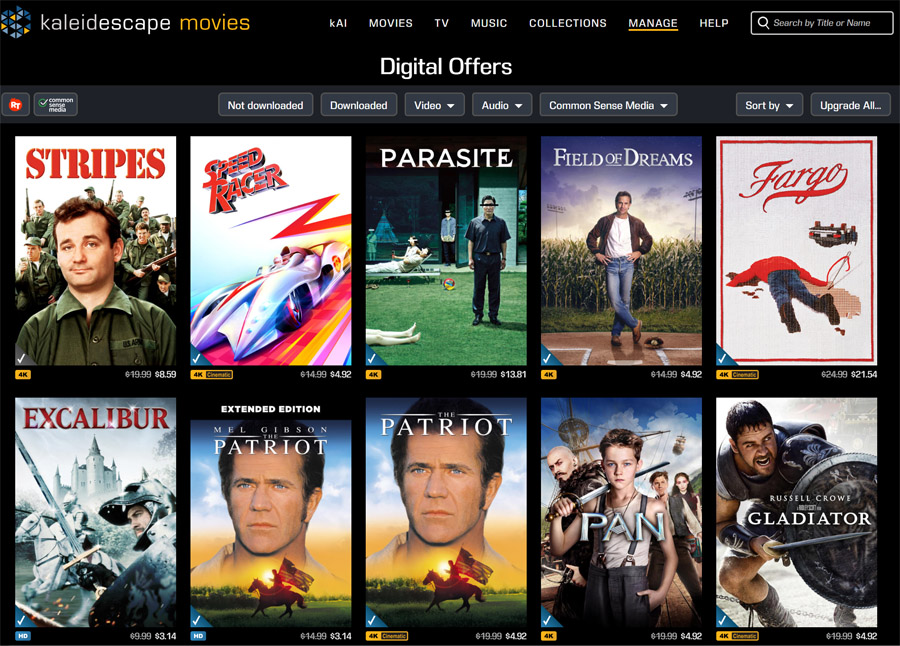
If you already own a title on DVD or Blu-ray Disc, you can scan that disc into your account by attaching a computer Blu-ray Disc (BD-ROM) drive to any Strato player and inserting your disc for its code to be identified. This will then give you access to a “Disc to Digital” offer so you can get the 4K or HD Kaleidescape version at a reduced price. Many of the titles I tested had disc-to-digital deals that offered the 4K version of the film for as low as $4.92, after I scanned the Blu-ray Disc. Some titles were a bit pricier, like $13.81 (for “Parasite” in 4K) or $21.54 (for “Fargo” in 4K) but most were significantly less expensive than buying the movie in 4K on Apple TV or Amazon Prime or buying a physical 4K UHD Blu-ray Disc.
The Set-Up
If this is your first Kaleidescape hardware purchase, you’ll need to create an account on the Kaleidescape store and register a form of payment (credit or debit card) for any purchase. Once this is established, plug your Strato M into your home network using a physical network cable. Because download speed of these large files is critical, Kaleidescape does not include WiFi wireless networking on any of their hardware.
Kaleidescape recommends a network bandwidth of at least 1 GBPS as well as an internet connection of about the same, if not higher. If you have multiple players in your system, you’d be best off with internal network bandwidth of 2.5 GBPS to support multiple concurrent streams. Movie downloads will work over a slower internet connection (80 to 100 MBPS) but they will take appreciably longer. On my 900+ MBPS fiber connection, 4K movies downloaded in around 8 to 12 minutes.
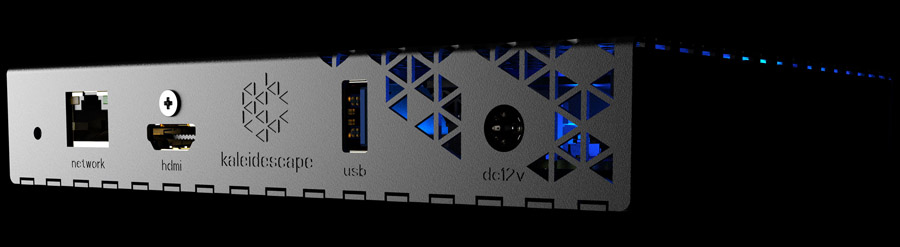
You’ll also need to connect the player to a TV or projector using an HDMI cable. A nice THX branded ultra high speed HDMI cable is included in the box with the player. This provided reliable glitch-free operation during our review period. Once the player is connected and powered up, you will see a message on-screen instructing you how to set-up the player and link it to your Kaleidescape store account. This is where things might get tricky.
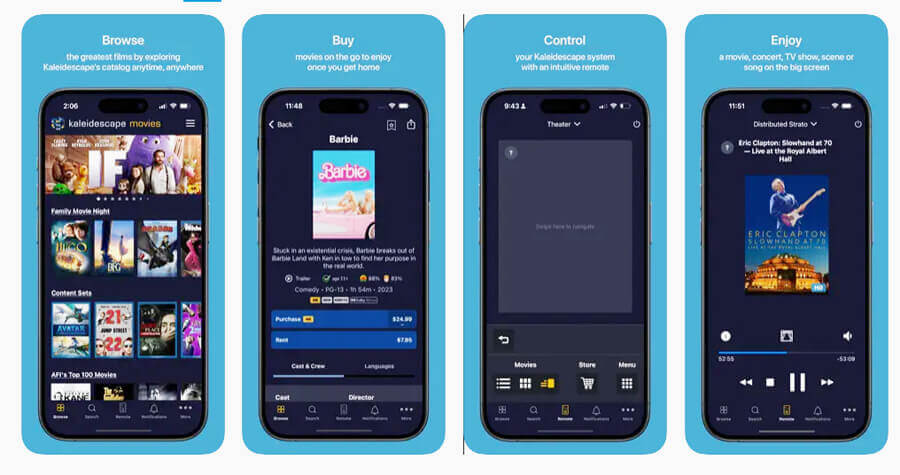
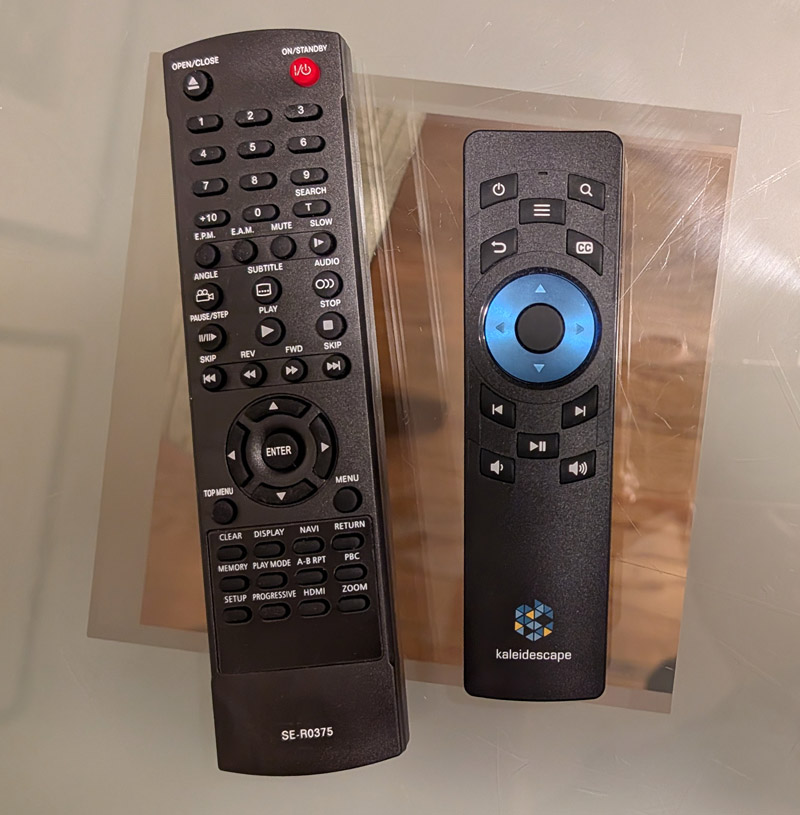
Kaleidescape has chosen to no longer include a remote control with each player. When asked why, their rep told me most of their customers stick the remote in a drawer and never use it as they’ve got a custom-programmed smart remote or tablet installed by their custom installer to operate the system. But my feeling is that, as Kaleidescape is now reaching more affordable price points, a remote is more likely to actually get used. And not including one in the box for a $2,000 (or more) media player is not cool, in my not-so-humble opinion.
If you don’t want to pony up $50 for the Kaleidescape remote, you have a couple of options. You can download the Kaledeiscape app for Android or iOS for free. This allows you to set up the player, access the Kalediscape store for purchases and rentals and actually control the player itself. It also allows you to complete the initial set-up process.
You can also purchase a universal remote or a third party remote that will operate the player. Kaleidescape actually shares IR remote codes with Toshiba, so if you buy a remote that can operate Toshiba DVD players, chances are excellent that it will also operate a Kaleidescape player. I ordered this one for about $6 and it works great to navigate through the Kaleidescape menus. If that one’s not in stock, search for Toshiba SE-R0375 to find a compatible remote.
By the way, when setting up the player for the first time, the player may discover updated software available on the server and may do an automatic update. During this time, the player’s output may be disabled and nothing will appear on screen. If the player is unresponsive during the initial set-up, just give it a few minutes to complete any updates. Once the set-up is complete, the unit will power itself back on and the Kaleidescape store will be available. Pick a few movies from the Kaleidescape store to purchase or rent, wait a few minutes for them to download, then sit back and enjoy.
I should note that you can also purchase and download movies from the Kaleidescape app or the web-based Kaleidescape store at Kaleidescape.com. You can do that while you’re at work or traveling and have them downloaded to your player or server by the time you get home. Don’t forget that “disc to digital” option if you want to purchase the Kaleidescape versions of movies you already own on disc at a discount. Identifying each disc in a BD-ROM drive takes than a minute. If you don’t own a BD-ROM drive, or don’t want to spend the time, many custom installation firms will do this for you (for a fee), in order to build up your Kaleidescape library.
Operationally Speaking
The Kaleidescape user interface is one of its main selling points. It’s quick to navigate and can help organize larger movie collections with its poster-like visual navigation. If you’re looking for suggestions on what to watch, the UI can group movies together by director, actor, genre or other metadata. If you prefer, you can switch to an alphabetical listing of your movies and shows and scroll through your entire collection with a few button clicks.

Like a Blu-ray or DVD player, the Kaleidescape players support standard fast forward and rewind as well as chapter stops for quick navigation. And setting up custom scenes and scripts (which can jump instantaneously from movie to movie, scene to scene) takes only a few minutes.
But honestly, most of these cool features are only really useful if you add a server and have a large enough movie collection where this sort of navigation matters. If you only use the built-in storage on the player, the menu system is less important. But with integration to the movie store and to your own collection of purchased titles in the cloud, it’s easy enough to swap in different movies to the player as long as you don’t mind waiting for the download.
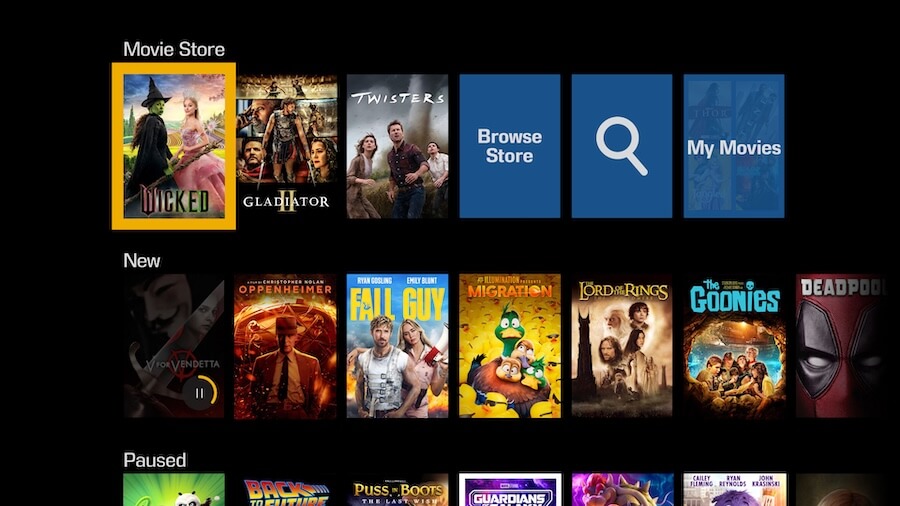
#TLDR – juggling 5 movies at a time on the player is fine but storing a larger collection on a Kaleidescape server is a much more gratifying experience. And Kaleidescape is probably counting on that. Once you have a taste of the Kaleidescape experience, you’ll probably want to expand: more movies, more servers, more players. It’s easy to get hooked.
Viewing Impressions
I watched 4K/HDR and HD movies and shows on the Strato M connected to a Sony BRAVIA 9 II True RGB TV (Dolby Vision), a Samsung S95H QD-OLED TV (HDR10) and a Valerion VisionMaster Max 4K projector (Dolby Vision). For comparison I used the same movies on 1080p Blu-ray Discs through a Panasonic or Samsung UHD Blu-ray Player, set to output 1080p resolution and to 4K UHD Blu-ray Discs with the players set to their native 4K output. I also compared the Strato M to a Strato E also set to its native 4K output.
Comparing the Blu-ray Disc version of “Blade Runner: The Final Cut,” the Strato M’s HDR version of the film was significantly more rich and dynamic. I know the actual number of pixels output by each player was the same, and each display device upconverted the 1080p signal to 4K, but the Strato M/Kaleidescape version looked both brighter and more detailed due to lower compression artifacts, expanded color gamut and HDR.

Comparing the Strato M to the Strato E was a much closer match. The actual files being played back on both players were identical – 4K versions of the movies, with HDR10 and Dolby Vision HDR. The Strato M just outputs the video stream at 1080P with HDR and 4:2:2 chroma encoding while the Strato E outputs at 2160P (4K) with HDR and 4:2:0 chroma encoding. There were some segments where I could spot a slight difference in resolution – like the opening text crawl on “Blade Runner” where the text was slightly softer on the Strato M. But the colors, contrast, black levels, dynamic range and freedom from visual compression artifacts were identical on the two players.
When I moved the Strato M player over to the 4K projector, the quality of the image was still pristine. Blown up to 117 inches on a 2.4:1 CinemaScope screen, the image was crisp and punchy. Detailed picture elements like subtitles and movie credits were still clearly readable and free from significant tearing or pixilation.
I also did some comparisons to streaming or digital copies of films such as “Dune” and “Dune Part Two” on services such as HBO/MAX and Fandango at Home. In all cases, the Kaleidescape versions on the Strato M were cleaner and freer from noise and other video artifacts, with artifact-free lossless audio as well. I did get a “Difficulty Reading Movie” error when viewing one title on the Strato M, but that seemed to have been a temporary glitch. I did confirm in the system settings that network bandwidth to the player was adequate (1 Gbps).
A Few Words About “Ownership”
Many proponents of physical media tout the benefits of media “ownership” vs. the “extended lease” which you get with a system like Kaleidescape. While it is true that a studio could potentially pull the rights to a movie on digital platforms – or the distributor may lose the rights to distribute it – this is something that happens so infrequently as to not be noticeable. And in cases where it has happened to me (on VUDU/Fandango at Home), I actually was credited the initial cost of the film when the digital copy was removed.
I asked Kaleidescape for their stance on this and they told me the following:
“Kaleidescape does not remove previously purchased movies from customer libraries when a studio’s licensing agreement expires. If a studio pulls a title from the Kaleidescape store for future purchases, users who already bought the movie keep full access to it on their local servers with no restrictions in playback. Purchased movies remain in the cloud as well and can be found in the “My Movies” collection. These purchased movies can be downloaded to any server or player in the account.”
Meanwhile, physical media can be subject to decay, damage and loss. If your Blu-ray Disc gets lost or damaged to the point of unplayability, you’re going to have to buy a new copy. You don’t actually own “the movie.” You own the right to play that movie on that specific disc in a private setting (e.g., your living room) for as long as that disc is viable. Meanwhile digital files on Kaleidescape are stored in the cloud. If a server or player fails, you just download a new copy and play it on any of your players with no additional charges. So, basically, both formats have the advantages and disadvantages.
So… Is the Strato M Worth $2,000?
With all that explaining and watching out of the way, the question remains: is it worth spending $2,000 on a “2K” video player? From the many hours I’ve spent watching movies and TV shows on the Strato M, I’d say, “Yes.” Compared to streaming, the Strato M offers a much crisper, more stable, more dynamic and more three dimensional image on movies and shows. And compared to regular Blu-ray, the Strato M provided a visibly superior image. It even held its own against the true 4K Strato E player and against UHD Blu-ray Discs, with only a marginal loss of detail noticeable on some content.
And the lossless Dolby Atmos and DTS-X soundtracks on the Strato M have a smoothness, power and precision in imaging that is unmatched by the lossy streamed versions.
Pros:
- Most affordable Kaleidescape player
- Built-in storage means you won’t need to buy a server (but you still might want to buy a server)
- Outstanding image quality, nearly indistinguishable from Strato E 4K player and 4K Blu-ray Disc
- Sleek, simple and responsive user interface
- Near instant gratification without quality loss inherent with streaming
- Disc-to-Digital allows you to upgrade your DVDs or Blu-ray Discs to 4K/HDR at low cost
Cons:
- Capped at 1080p (HD) resolution
- More expensive than simple media players and most (but not all) UHD Blu-ray Players
- Building (or rebuilding) your movie library and purchasing media servers on Kaleidescape can get expensive (but Disc to Digital helps)
- Not compatible with Digital Copy services such as Movies Anywhere
- No remote control included
- No WiFi
The Bottom Line
While it may seem strange to pay nearly $2,000 for a player that can “only” do 1080p resolution, the more important picture quality elements like high dynamic range and rich color reproduction inherent in the Kaleidescape ecosystem make the Strato M nearly indistinguishable from the highest quality 4K physical media. And that $1,000 saved on the player (compared to the Strato E) can help you to start building up that Kaleidescape movie library. If you can get past that one little spec (resolution), we think you’ll enjoy this most affordable entry into the Kaleidescape universe.
NOTE: as we went to press with this review, we were informed that the Strato M is being discontinued, so those who buy one now will be able to get one at a discounted price while supplies last.
Our Ratings:
★★★★★★★★★★ Picture Quality
★★★★★★★★★★ Design
★★★★★★★★★★ Usability
★★★★★★★★★★ Sound Quality
★★★★★★★★★★ Features
★★★★★★★★★★ Value
Where to Buy:
Related Reading:

Business37 seconds ago
Hard Mountain Dew will pay $1M if you can prove Bigfoot exists

Crypto World1 minute ago
Stripe adds Samsung Pay to Crypto Onramp on Android

Entertainment3 minutes ago
Carrot Top Suffered Suspected OD As New Details Emerge

Fashion1 week ago
Weekend Open Thread – Corporette.com

Fashion3 days ago
Weekend Open Thread: Talbots – Corporette.com

Tech2 weeks ago
Memory prices are slowing because buyers ran out of money

News Videos25 minutes ago
OMFG MAJOR CLARITY ACT COMEBACK!!!! XRP WE’RE BACK!!!!!!!!!!!!!!!!!

News Videos1 hour ago
Ripple XRP Is Going To $32 A Coin This Is Going To Shock The Daylights Out Of You

News Videos1 hour ago
The UNTHINKABLE is About to Happen to the Dollar (& Why Gold and Silver are Next)
-
 Fashion3 days ago
Weekend Open Thread: Talbots – Corporette.com
-

 Tech24 hours ago
Researchers escape OpenAI Codex sandbox to run commands on host
-

 Crypto World7 days ago
Revolut Attackers Warn of Ongoing Daily Customer Data Leaks
-

 Crypto World3 days ago
Circle launches Arc Studio AI agent for building onchain apps
-

 Crypto World6 days ago
Robinhood engineers charged over $50K crypto scheme
-
 NewsBeat3 days ago
Trump says US has reached an agreement to take permanent control of Greenland’s security
-

 Crypto World7 days ago
Kraken Lets xStocks Holders Earn Yield Through DeFi
-

 Crypto World3 days ago
Bitcoin price breaks channel as RSI climbs to 63
-

 Crypto World5 days ago
US Charges Robinhood Engineers Over Crypto Listing Trades
-

 Crypto World6 days ago
What Is the Status of the U.S.-Iran Peace Talks? Here's What Both Sides Are Saying
-
 Crypto World7 days ago
NVIDIA Analysis: Attempted Rising Wedge Breakout Amid Pressure on the AI Sector
-

 Tech6 days ago
Webb’s IC 348 Mosaic Includes Two-Jupiter Dwarfs, Twin Jets, and a Nursery Still Making Worlds
-

 Crypto World3 days ago
World Money launches in 150+ countries with Stripe
-

 Crypto World23 hours ago
Who Needs CLARITY Anyway? ARB Could See 70X Increase: Hodler’s Digest
-

 Crypto World3 days ago
Silver prices recover quickly, hitting weekly high today
-

 Crypto World3 days ago
Trading Bitcoin on Robinhood? Why 2% Spread Has Traders Worried
-
Crypto World7 days ago
Can Circle’s Arc Repeat Robinhood Chain’s Meme Coin Boom?
-

 Entertainment6 days ago
Big Brother Update: Melody Explodes at Drew as Illness Sweeps BB28 House
-
 NewsBeat3 days ago
US was ‘on brink of war’ with China over false AI report of nukes moving in Middle East
-

 Crypto World7 days ago
DOJ Seeks to Seize $61M in Iran Oil Funds From Binance Accounts It Vouched For
You must be logged in to post a comment Login