
Crypto World
Bitcoin could gain from AI bust, Arthur Hayes says


Arthur Hayes has argued that a pullback in U.S. artificial intelligence spending could eventually trigger government support for AI infrastructure or stressed insurers, creating dollar liquidity that he expects would favor Bitcoin.
Summary
- Hayes argues weaker AI compute demand could stress debt markets and eventually increase dollar liquidity.
- Federal Reserve raised rates 25 basis points last week, challenging immediate money-printing expectations from Hayes.
- Apollo estimates AI financing needs could support over $2 trillion in debt through this decade.
- NAIC says private credit transparency and valuation risks require continued monitoring by state insurance regulators.
- Hayes expects government compute purchases or insurance support to expand liquidity and benefit Bitcoin prices.
Hayes wrote in his Sept. 22 essay, Safety First, that recent calls by major U.S. AI companies to slow frontier model development may have an economic explanation alongside the safety concerns they have publicly cited. He suggested demand for expensive AI services could prove weaker than the spending assumptions supporting data centers, chips and related debt.
His interpretation is not the explanation given by the AI companies themselves. OpenAI said in August that it temporarily slowed parts of frontier model development after cybersecurity concerns and stronger internal safeguards became necessary. Anthropic CEO Dario Amodei later called for the industry to pace model development so safety controls could catch up with capabilities. Neither statement attributed the slowdown to falling customer demand.
Arthur Hayes sees AI debt as the pressure point
Hayes’s argument centers on the financing behind the AI infrastructure buildout. He contends that lower demand for training and inference could weaken the cash-flow assumptions supporting data centers, semiconductor purchases and private credit tied to the sector. In his words, “Safety First is by definition compute demand destruction.”
Independent credit research confirms that large amounts of financing are being directed toward AI, although it does not establish Hayes’s projected crisis. Apollo said in August that AI-related issuance accounted for nearly 40% of longer-duration investment-grade corporate bond supply. Its economists estimated that the AI ecosystem could support more than $2 trillion of additional investment-grade debt, while public markets may absorb less than $1 trillion through 2030.
Apollo separately estimated that roughly $5 trillion could be spent on AI infrastructure through 2030. Its research said businesses and consumers would need to spend around $2 trillion annually on AI services to justify that level of infrastructure investment.
Credit dependence has continued to grow. A Sept. 21 Apollo note said consensus forecasts assume operating cash flow at five major hyperscalers — Alphabet, Amazon, Meta, Microsoft and Oracle — will rise from roughly $600 billion to $2 trillion by 2030. Apollo warned that weaker cash-flow growth could lead to wider credit spreads and reduced capital expenditure.
Hayes has made a similar argument before. As previously reported, his earlier AI credit-crisis thesis linked a potential AI downturn with credit stress followed by a monetary response that he expected would favor Bitcoin. A later AI bubble and Bitcoin liquidity argument focused more directly on leveraged data-center financing.
Insurance exposure remains disputed in Hayes’s thesis
The second part of Hayes’s scenario concerns insurers and private credit. Drawing partly on research published by Nick Nemeth, Hayes argues that affiliated reinsurance structures could leave some insurers vulnerable if AI-related debt is downgraded and must be marked lower.
Nemeth estimates that affiliated reinsurance credits across the U.S. life and annuity industry total $1.54 trillion. His analysis argues that some reinsurance assets may provide less economic protection than statutory accounting suggests. The figure is Nemeth’s estimate and does not represent a finding by U.S. insurance regulators.
The NAIC does identify private credit as an area requiring continued supervision. Its July update said private credit has less liquidity, weaker price transparency and less frequent valuation than publicly traded debt. Regulators said those characteristics have prompted closer monitoring of valuation practices, underwriting standards and sector concentrations.
NAIC material on private-equity-owned insurers similarly identifies affiliated investment management and cross-border reinsurance as areas under ongoing regulatory review. The organization counted 139 private-equity-owned U.S. insurers by June 2025.
Current industry data does not establish that the U.S. insurance sector is insolvent because of AI exposure. A recent Moody’s survey reported by the Wall Street Journal estimated direct U.S. insurer exposure to data centers at up to $20 billion, while life insurers hold far larger allocations to private debt generally. Hayes’s much larger systemic-risk argument depends on indirect exposure through private credit, reinsurance and structured financing.
Bitcoin thesis depends on a future liquidity response
Hayes presents two possible government responses if AI infrastructure economics deteriorate. One would involve Washington becoming what he calls a “compute buyer of last resort”, using government spending or offtake agreements to maintain demand for AI capacity. The other would involve financial support for insurers if losses on private credit threaten policyholder claims.
No U.S. authority has announced either policy in response to an AI debt crisis. Hayes argues that both scenarios would require increased government borrowing, banking-system liquidity or direct monetary support, which he expects would raise demand for Bitcoin and other scarce financial assets.
Current Federal Reserve policy is moving in the opposite direction from immediate monetary easing. The Fed raised its target range by 25 basis points on Sept. 16 to 3.75%–4.00%, its first increase since July 2023. The vote was unanimous, and officials said inflation remained elevated.
Reserve-management purchases have paused as well. The New York Fed scheduled no reserve-management purchases for both the Aug. 14–Sept. 14 and Sept. 15–Oct. 14 operating periods, although reinvestment purchases continue. Federal Reserve officials have repeatedly said reserve-management purchases are designed to maintain ample reserves and should not be treated as quantitative easing.
Commercial-bank credit has continued growing during the year. Fed H.8 data showed seasonally adjusted bank credit rising from $19.74 trillion in July to $19.87 trillion by the week ending Sept. 9, driven mainly by loans and leases. The figures document balance-sheet growth but do not establish Hayes’s claim that banks are replacing central-bank money creation as a deliberate stimulus program.
Hayes has previously linked Treasury and banking-system liquidity with Bitcoin. His Treasury liquidity and Bitcoin bull-market call argued in August that higher Treasury buybacks and banking liquidity could support crypto prices even without conventional quantitative easing.
AI companies are still spending despite safety calls
Evidence of an immediate collapse in AI investment remains limited. OpenAI’s official material says it slowed parts of frontier development to install stronger monitoring, alignment and security controls, while continuing to invest in model research. Its GPT-6 Astra work proceeded after the company classified the model at a critical cybersecurity capability level.
Anthropic, meanwhile, is considering another model release despite Amodei’s public request for slower industry development, Reuters reported on Sept. 19. The company is weighing competitive pressure from OpenAI alongside safety reviews and preparations for a possible future IPO.
Financing activity remains substantial. Nvidia announced in August that Apollo, BlackRock, Blackstone, Brookfield, Goldman Sachs and KKR were working on independent AI-compute financing platforms intended to mobilize more than $500 billion in third-party capital over time. The amount represents planned financing capacity, not capital already deployed.
SoftBank began marketing more than $11 billion of high-yield bonds this week to help finance its OpenAI investment, according to the Financial Times. The transaction follows large bridge loans used for earlier funding commitments and provides another current example of AI investment drawing heavily on debt markets.
Meanwhile, Bitcoin traded near $85,700 early Sept. 22 after climbing more than 6% during the previous session.

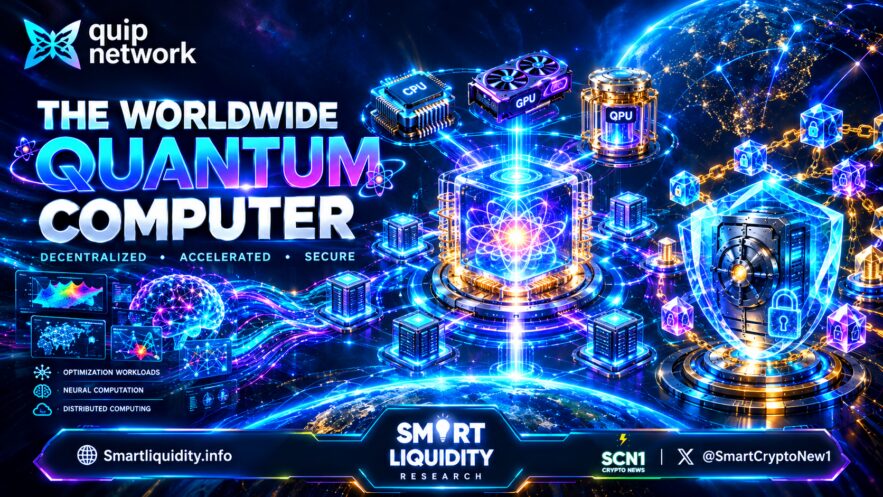
The evolution of decentralized physical infrastructure networks (DePIN) is increasingly moving beyond storage, bandwidth, and conventional computing. One emerging area is the intersection of decentralized compute, quantum computing, and post-quantum cryptography—three technologies that could significantly influence the next generation of Web3 infrastructure.
Quip Network, developed by Postquant Labs and led by co-founders Colton Dillion and Dr. Richard Carback, is designed around this intersection. Its architecture combines a decentralized compute marketplace with a security layer intended to help blockchain assets withstand future advances in quantum computing.
Rather than positioning itself simply as another blockchain or quantum-computing network, Quip takes a dual-layer approach built around the QUIP token. The objective is to create economic utility for otherwise underutilized computing resources while providing Web3 users with tools designed around a post-quantum security model.
Architectural Breakdown: A Two-Pillar Approach
Quip Network can be understood through two complementary components: a compute-consensus layer and an asset-security layer. Both are connected through the network’s token economy while serving different functions.
                    ┌─────────────────────────────────────────┐
                     │              $QUIP Token                │
                     └────────────────────┬────────────────────┘
                                          │
                   ┌──────────────────────┴──────────────────────┐
                   │                                             │
                   ▼                                             ▼
┌──────────────────────────────────────┐     ┌──────────────────────────────────────┐
│       Compute-Consensus Layer        │     │             Asset Layer              │
│       (Quantum Proof of Work)        │     │     (Post-Quantum Vaults & Swaps)    │
├──────────────────────────────────────┤     ├──────────────────────────────────────┤
│ • Aggregates CPUs, GPUs & QPUs       │     │ • Uses WOTS+ signatures              │
│ • Targets useful optimization work   │     │ • Non-custodial asset protection    │
│ • Verifiable computational outputs   │     │ • Cross-chain functionality         │
└──────────────────────────────────────┘     └──────────────────────────────────────┘
1. Compute-Consensus Layer: Quantum Proof of Work
Conventional Proof-of-Work networks use computational resources primarily to perform cryptographic hashing. Quip’s approach instead focuses on useful computational workloads, with the broader concept commonly associated with Proof of Useful Work (PoUW).
The network is designed to aggregate different classes of hardware, potentially including CPUs, GPUs, and quantum processing units (QPUs). Instead of limiting computational activity to arbitrary hash calculations, workloads can involve structured optimization problems.
Potential applications include:
- Financial portfolio optimization
- Logistics and routing
- AI-related computation
- Resource allocation
- Circuit optimization and mapping
- Other computationally difficult optimization problems
A key component is the distinction between computation and verification. Some optimization problems can require substantial resources to solve while allowing a proposed result to be checked comparatively efficiently. This creates an opportunity for a decentralized network to distribute computational workloads while maintaining a verification mechanism.
The architecture is particularly interesting because it does not require every participant to operate quantum hardware. Classical computing resources can potentially contribute to computation, validation, or other network functions, creating a more heterogeneous infrastructure model.
2. Asset Layer: Preparing Web3 for the Post-Quantum Era
The second major component addresses a different problem: the long-term security of blockchain cryptography in a world with sufficiently capable quantum computers.
Many blockchain networks rely on public-key cryptography based on mathematical problems that are considered difficult for classical computers. Cryptographically relevant quantum computers could eventually threaten some of these assumptions, particularly those underlying elliptic-curve cryptography (ECC).
Quip’s asset layer is designed to provide an additional security framework rather than requiring users to immediately abandon their existing blockchain ecosystems.
Quantum-Resistant Vaults
One of the concepts associated with the network is the use of Winternitz One-Time Signatures Plus (WOTS+), a hash-based signature scheme designed to provide resistance against attacks that could threaten certain classical public-key cryptographic systems.
The proposed architecture can combine existing wallet infrastructure with additional post-quantum signing mechanisms. This creates a security model in which transactions can incorporate both conventional signatures and quantum-resistant authorization.
For Web3 users, the broader idea is significant: rather than waiting until quantum computing becomes an immediate threat, assets can potentially be placed under stronger cryptographic protection ahead of that transition.
Cross-Chain Asset Interactions
Cross-chain security represents another important part of the design.
Blockchain bridges have historically introduced additional attack surfaces because assets and messages must move between independent networks. Quip’s architecture explores mechanisms for facilitating cross-chain interactions without depending on a conventional centralized custodian.
Its proposed functionality encompasses ecosystems such as Ethereum, Solana, and Bitcoin, with time-lock mechanisms and cryptographic controls playing a role in coordinating transactions.
The long-term objective is to create a more secure framework for interacting with assets across different blockchain environments while incorporating post-quantum considerations from the beginning.
Core Strengths
1. Turning Specialized Compute Into a Productive Resource
Quantum computing infrastructure is expensive to develop, operate, and maintain. A decentralized marketplace for unused or excess computational capacity could create an additional economic model for hardware providers.
Instead of treating computing infrastructure solely as an internal resource, operators could potentially make available capacity accessible to external workloads.
This concept also extends beyond QPUs. By supporting heterogeneous hardware, the network can explore a broader decentralized-compute economy involving traditional CPUs and GPUs alongside quantum processors.
2. Making Quantum Computing More Accessible
Quantum programming traditionally requires specialized knowledge involving areas such as qubit architecture, circuit design, transpilation, and hardware-specific constraints.
A higher-level SDK abstraction could reduce some of this complexity for developers.
If successful, this type of interface would allow developers to focus more on the computational problem they are trying to solve rather than dealing directly with the underlying quantum hardware stack.
That could be particularly relevant for developers experimenting with optimization problems where quantum approaches may eventually provide practical advantages.
3. A Decoupled Architecture
Another notable characteristic is the separation between the network’s compute and asset-security functions.
A user interested primarily in post-quantum asset protection does not necessarily need to become a quantum-compute operator. Likewise, a hardware provider can participate in the compute economy without making asset-security functionality the central part of its activity.
This separation gives the architecture flexibility and potentially allows different user groups to interact with different parts of the ecosystem.
Challenges and Considerations
Despite its ambitious architecture, Quip Network operates in technically demanding areas where several challenges remain.
1. Quantum Advantage Is Still Highly Specialized
Quantum computing has made significant research progress, but practical quantum advantage remains limited to specific problem classes and experimental environments.
Optimization is one of the areas receiving substantial attention, but not every optimization problem automatically benefits from quantum hardware.
For Quip, demonstrating that its workloads produce measurable economic or computational advantages over conventional infrastructure will therefore be an important factor in assessing the network’s long-term utility.
2. WOTS+ Introduces State Management Complexity
WOTS+ is designed around one-time signatures, meaning key usage must be carefully managed.
This creates a different user experience from conventional blockchain signatures such as ECDSA. Wallet software and infrastructure must correctly track signature states and ensure that keys are not reused improperly.
For mass adoption, this complexity needs to remain largely invisible to end users through robust wallet and protocol abstractions.
3. Decentralized Verification at Scale
A heterogeneous network containing CPUs, GPUs, and QPUs presents a significant verification challenge.
Different hardware architectures can produce computational results with different performance characteristics, and a decentralized protocol must establish reliable ways to determine whether submitted work is valid.
The network therefore needs carefully designed verification rules, workload specifications, incentives, and anti-collusion mechanisms.
Scaling these systems while maintaining decentralization and economic efficiency could become one of the project’s most important technical challenges.
4. Adoption Will Depend on Real-World Utility
The combination of quantum computing and post-quantum security is technologically compelling, but infrastructure networks ultimately need sustained developer, hardware, and user participation.
For Quip, important indicators to watch include:
- Growth in active compute providers
- Actual demand for network workloads
- Developer adoption of its SDK
- Performance of supported optimization workloads
- Deployment of post-quantum asset infrastructure
- Cross-chain adoption
- Sustainability of the network’s token economics
These factors will help determine whether the architecture can progress from an ambitious technical concept into a broadly used infrastructure layer.
Final Takeaway
Quip Network sits at an unusual intersection of DePIN, decentralized computing, quantum technology, and post-quantum cryptography.
Its architecture attempts to address two problems at once: how to make specialized computational infrastructure more economically useful today, and how to prepare blockchain assets for a potential future in which current cryptographic assumptions face greater pressure from quantum computing.
The compute layer provides a framework for coordinating heterogeneous hardware around useful workloads, while the asset layer explores quantum-resistant protection and cross-chain functionality.
The concept is ambitious, and its success will ultimately depend less on the narrative surrounding quantum computing and more on measurable network utility, developer adoption, reliable verification, and practical post-quantum security implementation.
For researchers exploring decentralized compute, developers interested in optimization workloads, hardware operators looking for new infrastructure markets, and Web3 participants following the transition toward quantum-resistant cryptography, Quip Network is a project worth watching closely as its technology and ecosystem develop.
Website | X | Farcaster | Telegram
REQUEST AN ARTICLE

Ripple and Absa Corporate and Investment Banking have launched Absa Digital Asset Custody in South Africa, putting Ripple’s institutional custody technology into a bank-led service nearly a year after the companies first disclosed their partnership.
Summary
- Absa launched institutional digital asset custody in South Africa using Ripple’s custody technology on Monday.
- Ripple and Absa first announced their custody partnership in October 2025, before Monday’s commercial launch.
- Absa says its custody platform protects private keys while supporting institutional transaction and approval controls.
- South African regulators are still developing cross-border crypto rules, with public comments due September 30.
- Ripple’s custody network serves financial institutions across Europe, Asia, Latin America, and the Middle East.
Absa describes the service as a regulated environment for institutional clients to safeguard digital assets and manage the private keys that authorize blockchain transactions. The product gives institutions controls covering assets, transactions and internal approvals while using Absa’s banking governance and compliance framework.
Ripple Middle East and Africa Managing Director Reece Merrick confirmed the Sept. 21 rollout, calling it a major milestone for institutional digital assets on the continent. Merrick said Absa was using Ripple Custody to support secure and compliant digital asset management, describing the service as “bank-grade.”
Ripple custody partnership moves from plan to live service
The commercial launch follows an agreement first disclosed on Oct. 15, 2025. At the time, Ripple announced Absa as its first major custody partner in Africa, with the South African bank planning to use Ripple technology for cryptocurrencies and tokenized assets.
Absa made the same partnership public through its corporate and investment banking division, saying Ripple would provide technology supporting scalable storage and digital asset management. The original announcement did not represent a live service, making the Sept. 21 rollout the point at which the product moved into Absa’s customer offering.
Robyn Lawson, Absa CIB’s head of digital product for custody, later explained that the system combines Ripple’s blockchain transaction capabilities with Absa’s internal infrastructure. She said the bank designed the model around security, governance, recoverability and controlled authorization.
Absa says private-key protections sit inside secure hardware environments so a single point of failure cannot compromise client holdings. The system uses deterministic key derivation instead of permanently storing static private keys, according to Lawson. Cryptographic recovery procedures and layered governance are intended to maintain access during system disruptions.
Absa Digital Asset Custody targets institutional clients
Absa Digital Asset Custody is designed for corporate and institutional customers, not as a retail cryptocurrency trading venue. The bank’s product page states that its focus is safeguarding digital assets, managing keys and controlling transactions and approvals to standards similar to those used for traditional financial assets.
The bank has not publicly disclosed a full list of supported cryptocurrencies, tokenized assets, custody fees or initial customer names. Neither Absa nor Ripple has announced that the service includes cryptocurrency trading, lending or yield products.
Ripple’s current custody documentation explains that digital asset custody centers on protecting the keys that authorize blockchain transactions, since assets themselves remain recorded on their respective blockchains. Ripple notes that loss or compromise of a key can create risks that differ from those attached to conventional financial accounts.
The underlying Ripple Custody software continues to receive technical updates. Version 1.41, released Sept. 14, added validation that checks destination addresses against the selected blockchain format before an endpoint can be created or changed, reducing the risk of transactions becoming stuck because of invalid addresses. Ripple released the update one week before Absa publicized its custody launch.
Ripple’s institutional custody business extends beyond Africa. As previously reported, the company supplies technology for BBVA’s digital asset custody service in Spain, where the bank uses Ripple Custody for Bitcoin and Ethereum under Europe’s MiCA regulatory environment.
South Africa continues building crypto regulation
The service arrives while South Africa continues formalizing its rules for digital asset businesses. The Financial Sector Conduct Authority requires crypto asset service providers to obtain authorization before conducting regulated financial services involving crypto assets.
Crypto assets have been treated as financial products under South Africa’s Financial Advisory and Intermediary Services Act since 2022. The framework brought activities such as advice and intermediary services involving crypto under FSCA supervision, while banks remain subject to their existing prudential and financial-sector requirements.
Cross-border activity is undergoing another regulatory update. South Africa’s National Treasury and Reserve Bank invited comments in August on a draft Crypto Assets Manual that sets out proposed rules for moving digital assets between domestic providers, offshore platforms and non-custodial wallets.
The proposal would require certain crypto transfers to be identified and reported as cross-border flows. It outlines permissions for authorized crypto asset service providers and reporting obligations to the Reserve Bank’s Financial Surveillance Department. The regulator set Sept. 30, 2026, as the deadline for comments, and the framework remains subject to revision.
The Reserve Bank has stressed that the proposal does not make cryptocurrencies legal tender. It forms part of a capital-flow framework intended to operate alongside oversight from the FSCA, Financial Intelligence Centre and South African Revenue Service.
Ripple builds on earlier digital asset expansion in Africa
Custody is one part of Ripple’s growing institutional business across Africa. The company previously expanded its stablecoin distribution through Chipper Cash, VALR and Yellow Card, giving institutions in regional markets access to Ripple USD.
As previously reported, Ripple expanded RLUSD distribution across Africa through three local partners, targeting uses including cross-border payments, treasury management and trading. Ripple said institutional demand was behind the regional rollout.
Ripple’s African payments relationships extend to Chipper Cash, while Absa gives the company a bank-based custody channel. The company opened a larger Middle East and Africa headquarters in Dubai this year to support its regional payments and custody operations. Crypto.news reported on Ripple’s expansion of its Middle East and Africa operations from Dubai in April.
Custody has become a larger part of Ripple’s product stack since its acquisitions of Metaco and Palisade. The Palisade purchase brought wallet technology using multi-party computation and zero-trust architecture into Ripple’s institutional infrastructure. The Palisade acquisition expanded Ripple’s institutional custody capabilities across blockchain networks including XRP Ledger, Ethereum and Solana.
Absa, meanwhile, says its custody platform will be developed iteratively as customer requirements and regulation change. Lawson said the bank plans to start with core custody functions before adding capabilities according to institutional demand and regulatory conditions.
Neither company has announced a timetable for adding specific assets or expanding Absa Digital Asset Custody into other African markets. Institutional customers interested in the current service are being directed to Absa CIB’s custody sales team.


Animoca Brands suspended its reverse merger talks with Currenc but said it remains committed to pursuing a listing on a major exchange.

X has expanded its U.S. Cashtag system by linking stock, ETF and cryptocurrency pages to five outside trading platforms, giving users a shorter route from financial posts to order execution.
Summary
- X now connects supported Cashtags to five U.S. brokerages and crypto exchanges for trade execution.
- Users can view live charts on X before completing trades through participating external brokerage platforms.
- Coinbase, Kraken, Gemini, Interactive Brokers and Moomoo joined the U.S. Cashtag program during initial launch.
- Kraken says its Cashtag integration supports nearly 2,500 assets across centralized and decentralized trading offerings.
- X previously estimated its April Cashtag pilot drove roughly $1 billion in global trading volume.
X announced the U.S. Cashtag Partner Program with Coinbase, Gemini, Kraken, Interactive Brokers and Moomoo, allowing users to select “Trade” after opening a supported ticker such as $BTC or $TSLA. The transaction itself takes place through the selected partner’s mobile app or website, not on X.
X Cashtags now connect market posts with trading platforms
Under the new flow, a user can search for a supported Cashtag or tap one appearing in a post. X displays a live price chart and posts linked to the asset before presenting participating trading providers. Users then choose a brokerage or exchange, sign into an existing account or create one, and complete the trade there.
The setup keeps order execution with companies already operating trading platforms. X does not describe itself as executing the transaction under the Cashtag program, and its launch instructions direct users to the partner platform for the final order. Eligibility, account opening, asset availability and trading terms therefore depend on the selected provider.
Product Engineering Lead Mridul Singhai said, “Cashtags close the gap between a ticker on the timeline and the market itself.” His statement describes X’s goal of reducing the number of steps between viewing a financial discussion and reaching a trading venue.
The program extends the U.S. Cashtag launch with Coinbase, Kraken and other trading partners, which crypto.news previously reported went live with five participating platforms and required trades to be completed outside X.
Kraken and Interactive Brokers confirm launch participation
Kraken independently confirmed that it is an official U.S. Cashtag launch partner. When a user selects Kraken from a supported ticker page, X sends the user to Kraken’s app or web interface, where account authentication and trade execution occur.
Kraken said its integration supports Cashtags covering nearly 2,500 assets across its centralized exchange and decentralized exchange offering. The figure describes Kraken’s supported asset coverage and does not mean every X Cashtag necessarily routes to every asset or trading product for every customer. Geographic restrictions and account eligibility still apply.
Interactive Brokers separately confirmed the integration for U.S. investors. Its system allows a user viewing an asset on X to continue to the IBKR platform, where the person can research the asset or submit an order. New eligible U.S. clients opening and funding qualifying accounts through the Cashtag experience can receive a $100 promotional credit under Interactive Brokers’ launch offer.
Moomoo has described itself as one of X’s first U.S.-regulated brokerage partners. Its integration sends users from supported stock Cashtags to relevant Moomoo pages containing market data, research tools and trading access.
X identified Coinbase and Gemini as the remaining launch partners in its announcement. The social platform has not published a single universal list showing which assets each provider accepts through Cashtags, meaning coverage can differ by brokerage or exchange.
X built the trade links on its Smart Cashtags rollout
The brokerage links build on Smart Cashtags, which X began rolling out earlier in 2026. The feature tied ticker symbols and crypto contract addresses to specific asset pages containing real-time charts and related conversations, reducing confusion when different tokens use similar names or ticker symbols.
Crypto.news previously covered the Smart Cashtags rollout for crypto tickers and contract addresses, which initially focused on identifying specific financial assets and displaying market information within X.
An expanded version reached iPhone users in the U.S. and Canada in April. X Head of Product Nikita Bier later said aggregated information from the trading pilot indicated the feature had driven an “estimated $1 billion” in global trading volume within several days. The number came from X and has not been independently audited, so it remains a company estimate.
The April rollout used Wealthsimple as a trading connection for Canadian users, while the September program introduces a dedicated group of U.S. partners. X has not disclosed commercial terms, referral payments or revenue-sharing arrangements between itself and the five U.S. trading companies.
Cashtag trading remains separate from X Money
The Cashtag program is separate from X Money, the platform’s payments product. Crypto.news reported earlier this year that the company had begun an X Money rollout to selected Premium+ users, including peer-to-peer payments, a digital wallet and other account features.
Nothing in the Cashtag Partner Program announcement says users can fund Coinbase, Kraken, Gemini, Interactive Brokers or Moomoo trades directly from an X Money balance. X’s documented process sends the user from the Cashtag page to the selected partner, where that company handles login, onboarding and execution.
The current U.S. rollout covers stocks, ETFs and cryptocurrencies where supported. Interactive Brokers states that the Cashtag integration is currently available to U.S.-based investors, while product access still varies according to account type, affiliate and residence.
Kraken’s announcement similarly describes the partnership as a U.S. launch. Its users can move from an X Cashtag to Kraken and complete eligible transactions through Kraken’s own infrastructure, subject to the exchange’s normal account requirements.
X has not announced a date for expanding the five-partner program beyond the United States or disclosed whether more brokerages will join. Kraken said “more to come” when describing its participation, but neither company provided a schedule or named additional trading partners.
Australia’s new 40-year Intergenerational Report—released by the Australian Treasury—spotlights artificial intelligence as one of the major forces expected to reshape the economy. Yet the document does not mention crypto or digital assets, even as separate government work in recent months has pointed toward tokenization and upgrades to financial infrastructure.
In the report published Monday, Treasury says agentic AI systems have become “significantly” more capable, more autonomous, and widely adopted, including surpassing human-level performance on some benchmarks. The Intergenerational Report frames technology adoption and productivity gains as critical to Australia’s prosperity over the next four decades, alongside four other transitions: geopolitical conflicts, an aging population, the shift to clean energy, and an industrial transformation toward services.
Key takeaways
- Australia’s Intergenerational Report names agentic AI as a core economic transition but omits crypto and digital assets entirely.
- Treasury’s related “Financial Innovation Strategy” links AI-driven machine-to-machine activity to demand for real-time, interoperable, programmable payment systems.
- Coinbase Australia’s John O’Loghlen argues the government focus on AI misses the financial “rails” that tokenized and stablecoin-based infrastructure could provide.
- The omission stands out against earlier central-bank and research discussions about tokenized finance and potential digital finance gains.
AI as the headline transition—without a digital-assets mention
The Intergenerational Report’s framing is broad and forward-looking. It portrays AI adoption—especially agentic systems that can act with a degree of autonomy—as a productivity driver that could affect how economic activity is organized across industries. Treasury’s report also stresses that Australia’s ability to incorporate new technologies will determine long-term economic outcomes.
However, the report’s silence on crypto stands in contrast to how tokenization has increasingly moved from niche experimentation toward mainstream policy discussion. The article notes that earlier Intergenerational Reports also did not address digital assets, and this new omission arrives despite other public-sector work emphasizing tokenized finance and financial infrastructure upgrades.
Why “financial rails” matter for agentic AI
Agentic AI is often described as technology that can coordinate tasks, including transactions, with reduced human involvement. Treasury’s separate publication—the “Financial Innovation Strategy,” released on Sept. 3—addresses the operational implications of this shift more directly.
That strategy report states that agentic systems could increase automated and machine-to-machine transactions, which would raise demand for real-time, interoperable, and programmable payment mechanisms. In other words, the document connects AI automation to the need for payment infrastructure that can be integrated, scaled, and updated more quickly than traditional models.
Coinbase Australia country director John O’Loghlen, responding by email to the Intergenerational Report, argued that the broader AI focus misses a central piece of the puzzle: the “financial infrastructure those agents will need.” He suggested that policies should extend beyond AI itself to the rules and frameworks that enable digital finance to function as the underlying system layer for automated agents.
Regulatory groundwork exists—but stablecoin rails are next
O’Loghlen pointed to regulatory progress already achieved in Australia, referencing the Digital Asset Platform framework as having provided the “necessary regulatory clarity.” In his view, the policy challenge now is to apply similar focus to additional infrastructure that could support digital finance at scale.
Specifically, he argued that policymakers should turn attention to the tokenized stored-value facility framework for stablecoins and to clear rules for tokenized markets. His framing suggests a sequencing problem: if agentic finance will depend on programmable, interoperable settlement and value transfer, Australia needs well-defined frameworks for stablecoins and tokenized market structures to serve as the rails for that activity.
While the Intergenerational Report itself does not go into these details, the accompanying policy direction in the Financial Innovation Strategy provides a rationale for why such frameworks could become more important as automation increases—particularly if machine-driven transaction flows require payments infrastructure designed for interoperability and programmability.
The broader context: tokenized finance is already on the policy radar
The contrast between the Intergenerational Report’s AI emphasis and its lack of crypto coverage is sharpened by other references highlighted in the source material. It notes that the Reserve Bank of Australia has increased its focus on tokenized finance and financial infrastructure upgrades earlier this year, reflecting growing attention to how tokenization could improve settlement and economic activity.
It also cites a Digital Finance Cooperative Research Centre estimate suggesting digital finance innovations could generate AU$24 billion (about $17.1 billion) in annual economic gains. Taken together, these points indicate that Australia’s policy ecosystem is already engaging with the potential economic impact of digitized financial systems—even if that engagement is not reflected in the Intergenerational Report’s technology-transition shortlist.
For investors and builders, the implication is less about whether crypto is “included” in a long-range economic narrative and more about whether regulatory and infrastructure planning is keeping pace with the transaction demands that agentic AI could accelerate. Treasury’s own mention of real-time, interoperable and programmable payment systems in the Financial Innovation Strategy suggests that the government recognizes how automation changes transaction patterns, even if it does not explicitly name digital assets in the Intergenerational Report.
As Australia moves from strategy language toward operational rules, readers should watch for whether stablecoin-related frameworks and tokenized market regulations receive the same level of prioritization that AI adoption and productivity are given in the Intergenerational outlook—especially given the growing likelihood that automated agents will intensify demand for programmable, interoperable payment “rails.”

Agora has secured preliminary conditional approval from the U.S. Office of the Comptroller of the Currency to establish Agora National Trust Bank, bringing the stablecoin company a step closer to operating its issuance, custody and transaction infrastructure under federal supervision.
Summary
- Agora has received preliminary conditional OCC approval to establish a national trust bank that would handle stablecoin issuance, custody and digital asset transaction services.
- Final authorization remains subject to preopening requirements, including at least $10 million in Tier 1 capital and an OCC examination before operations can begin.
- Agora plans to bring stablecoins, wallets, banking services and software workflows under one regulated entity as part of its financial infrastructure business.
- The proposed bank must raise the required capital within 12 months and open within 18 months of preliminary approval or seek an extension from the OCC.
According to the OCC’s Sept. 18 decision, the proposed New York based bank would operate as a wholly owned subsidiary of Agora Atlas Corp. and conduct limited purpose trust activities once it completes the regulator’s preopening requirements. The agency has not yet authorized the bank to begin operations.
Agora said the proposed trust bank would bring its stablecoin, custody and transaction infrastructure under direct federal supervision. The company plans to combine stablecoins, banking services, wallets and software workflows within a single regulated entity.
“Enterprises shouldn’t have to assemble a collection of vendors who don’t talk to each other,” Agora said while describing the model it plans to build under the charter.
Final authorization remains subject to the company meeting the OCC’s conditions before opening. The regulator retains the authority to modify, suspend or withdraw the preliminary approval before the bank starts operating.
Agora national trust bank would handle stablecoin issuance and custody
Agora National Trust Bank plans to issue and redeem dollar backed stablecoins while providing digital asset custody and transaction services for institutional customers.
The bank would offer fiduciary investment advisory services to selected customers that custody digital assets with the institution. Its planned services include analyzing client asset positions and providing recommendations involving investment and yield generating opportunities in digital asset markets.
Agora Atlas was incorporated in Delaware in October 2023 and sits above several entities in the Agora group, including Agora Bermuda Limited, Agora Blue Ltd. and the Agora Reserve Fund.
Under the proposed structure, Agora intends to bring more of the infrastructure supporting its stablecoin operations inside the group instead of relying on separate providers for individual services.
The company currently operates AUSD, its dollar backed stablecoin. Agora has previously described its business as covering issuance, fiat on and off ramps and ledger infrastructure, while the proposed federal charter would add a regulated U.S. banking entity to that structure.
AUSD has been expanding across blockchain networks since its launch. An earlier AUSD expansion to Injective placed the stablecoin on a network where it could be used for onchain liquidity and decentralized finance applications. Agora said at the time that AUSD was fully collateralized and minted against the U.S. dollar.
Agora has worked with established financial companies for its reserve structure. VanEck manages AUSD’s reserve assets, while State Street serves as custodian, according to previous company disclosures.
The stablecoin has been used in institutional transactions as well. Agora and Galaxy Digital completed the first AUSD OTC transaction, with Agora CEO and co founder Nick van Eck saying at the time that the company intended to position AUSD for the institutional stablecoin market.
Final OCC approval comes with capital and operating conditions
Preliminary approval does not allow Agora National Trust Bank to begin conducting banking operations.
The OCC requires the proposed bank to satisfy its preopening conditions before final authorization can be granted. Agora must maintain at least $10 million in Tier 1 capital and meet requirements covering its management, directors, auditing arrangements and operational readiness.
Agora must notify the regulator before making significant departures from the business plan reviewed during the application process. Its operations must remain limited to trust company activities and related services described in the approved plan.
Stablecoin issuance and redemption must comply with the GENIUS Act and implementing regulations. The OCC can require Agora to change, stop or divest activities if necessary to comply with the federal stablecoin framework or other applicable laws.
The company faces deadlines to complete the process. Capital must be raised within 12 months of the preliminary conditional approval, while Agora National Trust Bank must open within 18 months or the approval will expire. The OCC said extensions are generally opposed except under extenuating circumstances outside an applicant’s control.
Agora submitted its national trust bank application on April 20, according to the OCC’s digital asset licensing records.
The Sept. 18 decision came alongside approvals involving two other digital asset businesses. The OCC granted preliminary conditional approval to Catena Trust Bank and approved Bastion Platforms Trust Company’s conversion to a national trust bank on the same date.
Crypto firms continue moving through OCC charter process
Agora joins a growing group of digital asset companies pursuing federal banking structures as stablecoin and crypto businesses move parts of their operations under OCC supervision.
Crypto.news previously reported that the OCC had listed 13 digital asset applications in August, including applications from Agora, Payward National Trust Company, Dakota National Trust Bank and zerohash. The regulator’s records showed Agora’s application had been pending since April before the Sept. 18 decision.
Several crypto companies had already reached the conditional approval stage. Circle, Ripple, BitGo, Fidelity Digital Assets and Paxos received decisions in December 2025, followed by other applicants during 2026.
Circle moved beyond the conditional stage in July when the OCC gave final trust bank approval for First National Digital Currency Bank after the company completed its preopening requirements. Circle had initially applied in June 2025 and received conditional approval that December.
Conditional charters have not been limited to stablecoin issuers. Stripe owned Bridge received approval in February for a national trust bank designed around stablecoin infrastructure, while Crypto.com secured a conditional decision for Foris DAX National Trust Bank during the same month.
More recently, World Liberty Financial received preliminary approval in August to establish a national trust bank that plans to issue USD1, manage reserves and provide institutional custody services. Its proposed institution must maintain at least $20 million in eligible capital before opening.
National trust banks operate differently from full service commercial banks. The structures pursued by many digital asset companies focus on custody, fiduciary, settlement and related activities and generally do not provide conventional demand deposits or lending.
Agora plans to use its proposed bank to consolidate services that are currently handled across multiple pieces of stablecoin infrastructure. The company said its intended model would combine digital dollars with wallets, banking tools and operational software through one system.
Before opening, Agora National Trust Bank must notify the OCC that all preopening conditions have been met, demonstrate that the institution is operationally ready and request a preopening examination. Final authorization to commence business will depend on the regulator completing that process.

South Korea has approved a pilot that will let public officials pay government operating expenses with blockchain based deposit tokens instead of physical government cards.
Summary
- South Korea has approved a pilot allowing public officials to pay selected government operating expenses with deposit tokens by scanning QR codes on smartphones.
- Six banks will participate in the trial, with transactions processed through blockchain infrastructure linked to the Bank of Korea’s Project Hangang.
- Deposit tokens can be programmed to block purchases in restricted categories, while payments are settled immediately and recorded through the blockchain based system.
- The pilot expands the use of Project Hangang beyond consumer payments as South Korea tests deposit tokens for government spending.
According to The Chosun Daily, the Ministry of Science and ICT approved the project during the 45th ICT Regulatory Sandbox Review Committee meeting held on Sept. 21, with the ministry announcing the decision a day later.
The blockchain based government fund execution project was among nine cases granted regulatory exemptions by the committee. It will allow officials to make eligible payments by scanning QR codes on smartphones and using deposit tokens connected to the Bank of Korea’s digital currency infrastructure.
Existing rules under South Korea’s National Treasury Funds Management Act have limited payment methods for government office operating expenses to tools including government purchase cards and bank transfers. The sandbox exemption creates a route for digital currency to be tested without first changing the underlying law.
Six banks will participate in the government payment trial, including KB Kookmin Bank, NH NongHyup Bank, Shinhan Bank, Woori Bank, Industrial Bank of Korea and Hana Bank.
Deposit tokens will replace cards for selected government payments
Under the pilot, participating public officials will be able to use deposit tokens for expenses such as business promotion costs that would normally be settled through physical government cards.
The tokens form part of Project Hangang, the Bank of Korea’s blockchain based digital money program. Consumers do not directly spend a retail CBDC under the system. Commercial banks issue deposit tokens representing bank deposits, while the Bank of Korea’s wholesale central bank digital currency is used for settlement between financial institutions.
Transactions made with the tokens are processed through the blockchain based infrastructure, allowing payment and settlement to occur at the same time.
Programmable controls can be applied before a transaction takes place. Items or business categories that are not permitted under government expense rules can be designated in advance, preventing the deposit token from being used for restricted purchases.
The Ministry of Science and ICT expects the structure to make government spending easier to verify because payment records are processed through the blockchain based system. Officials expect lower payment fees and immediate settlement to reduce costs for small businesses that receive the payments.
South Korea has spent more than a year testing the underlying technology before bringing it into government spending.
The first phase of Project Hangang began in April 2025 and allowed up to 100,000 people to use deposit tokens issued by participating banks. Users could convert funds held in bank accounts into tokens through banking applications and make QR code payments at approved merchants.
Crypto.news previously reported that the second phase of Project Hangang began in March 2026 with nine banks, expanding the system beyond the original seven institutions. Government subsidy payments became one of the live use cases, while the upgraded system introduced person to person wallet transfers, biometric payment approvals and automatic wallet top ups.
South Korea is extending deposit tokens into everyday payments
Government spending is being tested as South Korean agencies build infrastructure that could support deposit tokens across existing commercial payment networks.
The Ministry of Science and ICT and the Korea Internet & Security Agency launched a 9.6 billion won payment project in July to connect Project Hangang with payment systems already used by merchants and consumers.
Nine commercial banks, eight payment companies and two large merchants joined the program, which is led by the Korea Financial Telecommunications and Clearings Institute.
Instead of requiring merchants to replace their existing payment terminals, the project is designed to connect deposit token transactions with current payment infrastructure. Participating banks can provide token wallets while merchants continue processing transactions through systems already installed at their businesses.
Lower processing costs for small businesses are one of the areas being examined under the program. The new government expense pilot will test a similar feature in the public sector, where participating merchants would receive funds immediately when an eligible payment is completed.
The Bank of Korea and participating lenders have separately discussed keeping deposit tokens in continuous operation while building the systems required for possible commercial use. Plans outlined in June included more merchants, person to person transfers and services developed individually by participating banks.
Banks have said expansion requires more than extending the original pilot infrastructure. A larger system would need anti money laundering controls, fraud detection, suspicious transaction reporting and other operational tools before deposit tokens could be used on a larger scale.
The deposit token expansion plans have included business payments and government related transactions alongside consumer transfers.
Project Hangang keeps CBDC settlement behind bank issued tokens
Project Hangang uses a two layer structure that separates central bank settlement from the digital money consumers and businesses use for payments.
The Bank of Korea provides the wholesale CBDC layer for transactions between financial institutions. Commercial banks issue the deposit tokens used by customers, meaning consumers retain a claim connected to their commercial bank deposits instead of holding a direct retail claim on the central bank.
South Korean authorities have maintained that distinction as debate continues around CBDCs, deposit tokens and privately issued won stablecoins.
Project Hangang’s second phase increased the number of participating banks from seven to nine. It has expanded the functions available to users while retaining the wholesale CBDC and commercial bank deposit token model.
The infrastructure has been tested outside domestic retail payments as well. In July, the Bank of Korea completed tokenized reserve transfer tests under the Bank for International Settlements led Project Agorá.
One domestic transaction involved NongHyup Bank and Shinhan Bank transferring 20 million won using tokenized central bank reserves. The test manually connected Project Hangang with the Project Agorá environment to examine how the domestic digital currency infrastructure could interact with a cross border settlement platform.
KB Kookmin Bank separately completed a deposit token payment test with Japan’s MUFG Bank using a yen based settlement transaction.
Regulatory sandbox clears other digital services
The ICT Regulatory Sandbox Review Committee approved several other projects during the Sept. 21 meeting alongside the government deposit token trial.
One exemption concerns digital communications during urban redevelopment projects. Notices for inaugural meetings required to establish redevelopment associations have traditionally been sent by registered mail.
During the testing period, participating associations will be permitted to send the notices electronically to members who have agreed to receive digital documents.
KT received a regulatory exemption for a separate service covering documents such as billing statements. The telecommunications company will be allowed to send documents directly to mobile devices through its certified electronic document delivery service instead of relying on postal delivery.
The committee changed the regulatory status of MediaScope’s mobile connected open singing booth service from a regulatory exemption to a temporary permit.
MediaScope installs small open singing booths at public facilities including shopping malls, movie theaters and transportation terminals. The temporary permit will allow the service to continue operating while the Ministry of Culture, Sports and Tourism reviews changes to the relevant regulations.
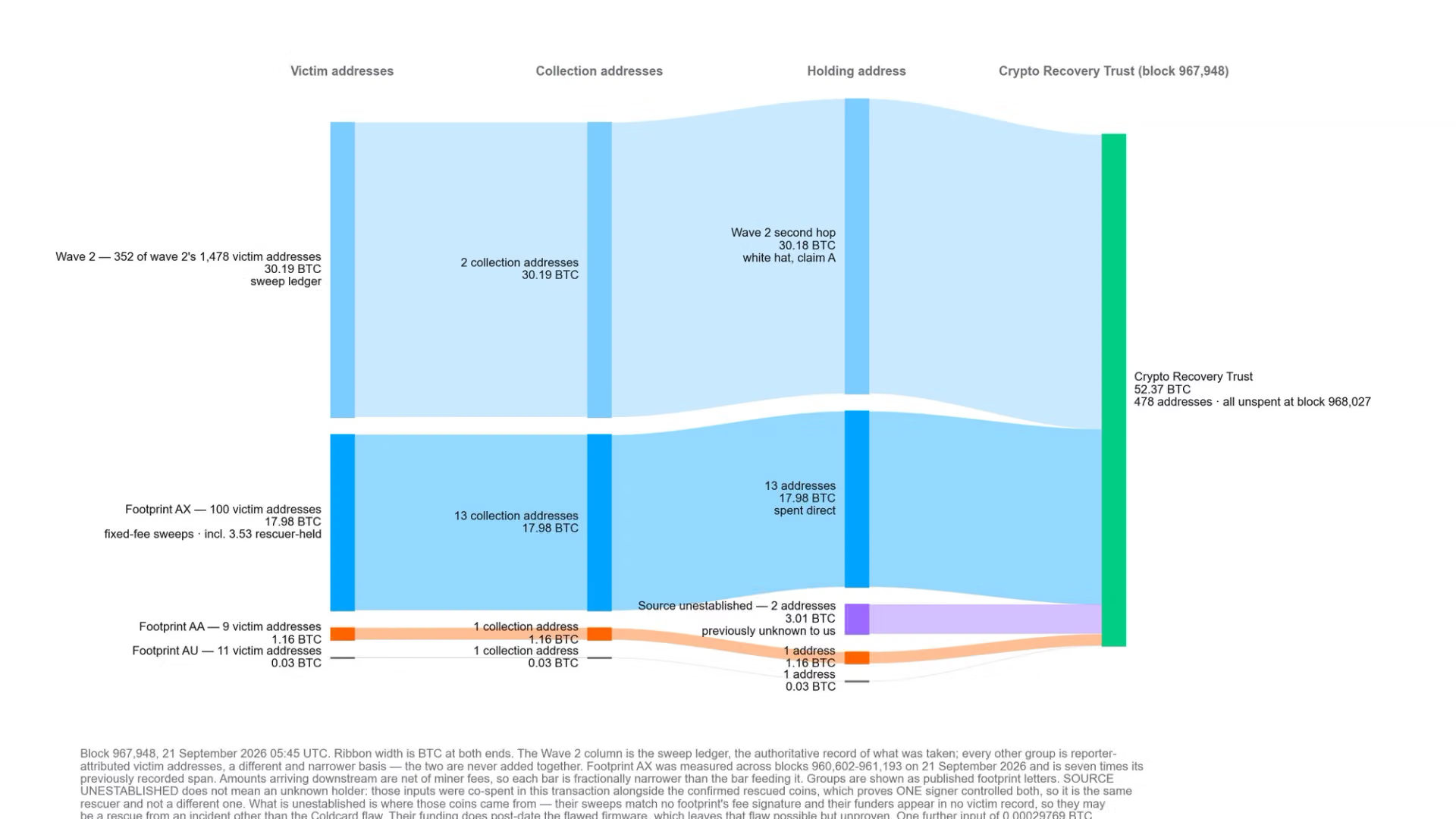
“Whitehat operators” have moved 52.37 BTC to an address linked to a newly formed recovery trust, as part of the ongoing fallout from July’s Coldcard hardware wallet exploit, according to Galaxy Digital’s Head of Research Alex Thorn.
The Coldcard crypto hardware wallet hack began on July 30, with multiple batches (waves 1, 2, and 3) of attacks in subsequent days resulting in estimated losses of over $100 million in bitcoin .
Attackers exploited this, causing wallets to generate seeds using a weaker software-based random number source instead of the wallet’s dedicated random number generator. That made some seeds vulnerable to reconstruction by hackers.
Coinkite, the maker of Coldcard, has since patched the firmware, though funds already exposed under the old seeds remain at risk regardless of the patch.
Read More: Bitcoin cold-wallet attack spreads to 4,500 addresses as losses near $89 million
According to Thorn, some of the coins moved out of victim wallets weren’t taken by malicious actors but by whitehats, or ethical cybersecurity professionals who use hacking skills to find and fix security weaknesses.
These so-called good guys swept the funds specifically to keep them safe until they could be returned.

Polymarket has stepped up talks with European and UK regulators as the prediction market platform seeks financial services oversight for its contracts instead of being regulated primarily under national gambling laws.
Summary
- Polymarket is holding talks with regulators in the EU and UK as it seeks to have its prediction contracts regulated under financial services rules.
- The company is pursuing MiFID treatment in Europe while regulators in France, Germany, Italy and the UK continue to classify many prediction markets under gambling rules.
- ESMA has warned about insider trading risks in prediction markets, while the FCA continues to restrict retail access to binary options over concerns about speculation and consumer harm.
- Polymarket’s regulatory push comes as the company seeks new funding at a valuation above $20 billion and works to expand its international operations.
According to the Financial Times, the New York based company has held discussions with regulators in London, Brussels and several European Union jurisdictions as it works toward securing a European license. People familiar with the discussions said Polymarket wants its contracts treated more like derivatives under financial services rules.
The effort comes as the company pursues international expansion while raising capital at a valuation exceeding $20 billion. Polymarket has argued that supervision under financial markets rules would provide a more suitable framework for its products than the gambling regimes currently applied to prediction markets in several European countries.
Polymarket seeks MiFID treatment for prediction markets
Polymarket has been engaging with the European Securities and Markets Authority and the European Commission, according to people familiar with the matter. Discussions have extended to individual national regulators as the company examines possible licensing routes within Europe.
ESMA chair Verena Ross met two U.S. based members of Polymarket’s legal team in June, accompanied by a Paris based lawyer from A&O Shearman and a Brussels based lobbyist from Hanbury Strategy. Polymarket executives met UK Financial Conduct Authority chief executive Nikhil Rathi the following day.
The company is seeking to convince European authorities that its contracts can operate under the Markets in Financial Instruments Directive, or MiFID, which sets rules for investment firms and financial instruments across the EU.
Such a classification would not automatically give Polymarket unrestricted access to European retail customers. ESMA warned in July that some event based contracts could already qualify as financial instruments under MiFID II, meaning existing EU restrictions on binary options could apply when the products meet the relevant definition.
Polymarket has continued discussions despite the regulatory hurdles.
“As we grow our presence and expand globally, we are committed to engaging early and openly with policymakers and regulators,” the company said.
As part of the effort, Polymarket joined trade group Blockchain For Europe this month and has started discussions with other European industry organizations, according to a person familiar with the matter.
European regulators have treated Polymarket differently
Polymarket’s push for financial regulation faces a fragmented European market where authorities have taken different approaches to event contracts.
National gambling regulators in countries including France, Germany and Italy have maintained that prediction markets require local gambling licenses. Retail access to many of the products remains restricted across Europe, although some users continue accessing overseas platforms through virtual private networks.
France has already taken direct action against Polymarket. French authorities ordered internet providers to restrict access to the platform after treating it as an unauthorized gambling service.
Similar action followed elsewhere in Europe. In July, the Czech Ministry of Finance ordered internet service providers to block Polymarket after authorities classified the service as an unauthorized internet game. Czech regulators said the platform had to comply with the country’s gambling framework regardless of how its contracts were described.
ESMA has taken a separate approach by examining whether certain prediction contracts can fall within existing financial market legislation. Its July guidance said firms offering event based contracts must assess whether individual products qualify as financial instruments under MiFID II.
The distinction depends partly on the structure and underlying event of a contract. Prediction markets allow users to trade positions tied to outcomes across financial markets, sporting events, elections, economic decisions, entertainment awards and weather.
ESMA has remained cautious about loosening existing protections for retail investors. The regulator warned this month that prediction markets face risks involving insider trading, an issue that has drawn scrutiny as trading volumes and the range of available contracts have increased.
UK rules split contracts between two regulators
Britain presents another regulatory hurdle because oversight depends on what event determines a contract’s outcome.
The FCA considers prediction contracts linked to financial events and certain climate outcomes to fall within its regulatory perimeter. Political and sports markets, which account for significant activity across platforms such as Polymarket and Kalshi, would instead come under the Gambling Commission.
Britain has prohibited the sale of binary options to retail consumers since 2019. The FCA has maintained that the products can be highly speculative, resemble gambling and expose consumers to significant potential losses.
However, the regulator has recently discussed whether its treatment of retail financial prediction markets should change. As crypto.news previously reported, the FCA has held talks with trading platforms about potentially reopening access to certain financial prediction products for retail investors.
No formal rule change has been announced. As of September, the FCA had not published a consultation, proposed rule or implementation timetable that would allow Polymarket or another platform to offer financial event contracts broadly to British retail customers.
Gambling regulators have maintained a different position for contracts outside the FCA’s perimeter. Political and sports prediction markets would require the appropriate gambling authorization in the UK, creating separate regulatory routes depending on the event being traded.
Polymarket valuation has climbed during regulatory push
Polymarket’s European lobbying effort comes while the company seeks another major financing round.
The platform has been discussing approximately $1 billion in new funding at a valuation above $20 billion. A proposed round led by Donald Trump Jr. linked 1789 Capital would value Polymarket at $21 billion, with the investment firm planning to contribute roughly $300 million.
1789 Capital had previously invested approximately $200 million in the company, while Intercontinental Exchange has emerged as another major backer. ICE, the parent of the New York Stock Exchange, invested $1 billion in Polymarket in October 2025 and disclosed another $600 million investment in March 2026.
The company has pursued regulated market access in the United States alongside those investments. Its U.S. operation runs through QCX, a Commodity Futures Trading Commission designated contract market acquired by Polymarket as part of its return to the American market.
European expansion remains subject to a different set of rules. Polymarket is seeking financial services treatment at the same time that national gambling authorities continue to require local licenses for many of its products, while existing EU and UK restrictions could limit retail access even when some contracts qualify as financial instruments.
ESMA and the FCA declined to comment on Polymarket’s latest regulatory discussions.

Australia’s new 40-year economic outlook has identified artificial intelligence as one of five major transitions expected to have a profound effect on the economy, while leaving out any mention of crypto.
The latest Intergenerational Report, published on Monday by the Australian Treasury, described agentic AI systems as having become “significantly” more capable, autonomous and widely used — surpassing human-level performance on some benchmarks. The other major transitions are geopolitical conflicts, an aging population, a shift to clean energy and Australia’s industrial transformation toward services.
“The Intergenerational Report makes it clear that Australia’s prosperity over the next 40 years will depend heavily on our ability to adopt new technology and lift productivity,” Coinbase Australia country director John O’Loghlen said in emailed comments. “And while the report focuses heavily on artificial intelligence, it completely misses the financial infrastructure those agents will need.”
Previous Intergenerational Reports also have not addressed digital assets. The latest omission came despite the Reserve Bank of Australia increasing its focus on tokenized finance and financial infrastructure upgrades earlier this year, while the Digital Finance Cooperative Research Centre estimated digital finance innovations could generate 24 billion Australian dollars ($17.1 billion) in annual economic gains.
Despite the omission, Treasury’s separate report called the “Financial Innovation Strategy,’ released on Sept. 3, does address the link between AI and financial infrastructure.
Related: Australia draft payments vision eyes stablecoin interoperability
The report said agentic systems could increase automated and machine-to-machine transactions, creating greater demand for real-time, interoperable and programmable payment systems.
“We’ve made good progress in recent years, including through the Digital Asset Platform framework, which has provided necessary regulatory clarity,” O’Loghlen added.
“The opportunity now is to bring the same focus to the tokenized stored-value facility framework for stablecoins, and clear rules for tokenized markets. Those are the rails digital finance — agentic finance included — will run on and getting them right is how Australia turns this opportunity into reality.”
Magazine: Kyle Samani predicts SOL flippening, claims ‘no one’ uses ETH

Harbor Ares Systematic High Yield ETF Q2 2026 Commentary (SIHY)

Dan Carden on being Blue and feeling hopeful

‘Alarming’ – does WSL have a homegrown problem?




-

 Fashion4 days ago
Weekend Open Thread: Talbots – Corporette.com
-

 Tech1 day ago
Researchers escape OpenAI Codex sandbox to run commands on host
-

 Crypto World6 days ago
Robinhood engineers charged over $50K crypto scheme
-

 Crypto World3 days ago
Circle launches Arc Studio AI agent for building onchain apps
-
 NewsBeat3 days ago
Trump says US has reached an agreement to take permanent control of Greenland’s security
-

 Crypto World3 days ago
Bitcoin price breaks channel as RSI climbs to 63
-

 Crypto World1 day ago
Who Needs CLARITY Anyway? ARB Could See 70X Increase: Hodler’s Digest
-

 Crypto World5 days ago
US Charges Robinhood Engineers Over Crypto Listing Trades
-

 Crypto World6 days ago
What Is the Status of the U.S.-Iran Peace Talks? Here's What Both Sides Are Saying
-

 Crypto World3 days ago
Trading Bitcoin on Robinhood? Why 2% Spread Has Traders Worried
-

 Tech6 days ago
Webb’s IC 348 Mosaic Includes Two-Jupiter Dwarfs, Twin Jets, and a Nursery Still Making Worlds
-
 Crypto World7 days ago
NVIDIA Analysis: Attempted Rising Wedge Breakout Amid Pressure on the AI Sector
-

 Crypto World3 days ago
World Money launches in 150+ countries with Stripe
-

 Crypto World4 days ago
Silver prices recover quickly, hitting weekly high today
-

 Entertainment6 days ago
Big Brother Update: Melody Explodes at Drew as Illness Sweeps BB28 House
-
 NewsBeat3 days ago
US was ‘on brink of war’ with China over false AI report of nukes moving in Middle East
-

 Crypto World4 days ago
Mortgage and refinance interest rates today, Thursday, September 17, 2026
-

 Crypto World24 hours ago
Bitcoin price holds above $81K as key catalysts line up
-

 Tech4 days ago
GPT-6 Astra Reached the Nether in Minecraft, Lost Its Stash to a Creeper, and Farmed Potatoes for Hours
-

 Business6 days ago
Federal Reserve expected to hike interest rates 25 basis points at FOMC meeting
You must be logged in to post a comment Login