
Crypto World
Crypto firms pour $206 million into 2026 US election cycle

Crypto companies have contributed $206 million toward the 2026 U.S. election cycle as industry backed political groups continue directing money into congressional races ahead of the November midterms.
Summary
- Crypto companies have contributed $206 million toward the 2026 US election cycle, according to Public Citizen’s analysis of FEC records.
- Fairshake reported nearly $113 million in cash at the end of July after directing funds into congressional races across both major parties.
- The Fairshake network has supported nearly 50 candidates who secured party nominations during the 2026 primary season.
- Fairshake is preparing at least $30 million to oppose former Sen. Sherrod Brown in the Ohio Senate race.
Public Citizen said in an Aug. 27 analysis of Federal Election Commission records that cryptocurrency companies represented the largest of three technology related sectors driving corporate political spending this election cycle. Crypto contributions reached $206 million, compared with $76 million from online betting companies and $62 million from Big Tech, AI and data center related businesses.
Corporate contributions across all sectors have reached $646 million so far, according to the consumer advocacy group. The figure is already 40% above the $461 million recorded across the entire 2024 presidential election cycle and more than triple the $184.1 million reported during the 2022 midterms.
Crypto companies, online betting firms and businesses connected with AI and data centers contributed a combined $344 million, accounting for 53% of the corporate contributions disclosed to the FEC in Public Citizen’s analysis.
Crypto PAC Fairshake remains at center of election spending
Fairshake has remained the main political vehicle for crypto companies during the 2026 election cycle, with Public Citizen calculating $83 million in corporate contributions to the super PAC through the second quarter. The group listed total crypto corporate contributions at $206 million over the same period.
Federal Election Commission records currently show Fairshake reported $137.4 million in total receipts between Jan. 1, 2025 and July 31, 2026. The committee recorded $88.7 million in total disbursements over the period, including $65 million transferred to affiliated committees and approximately $13.3 million in independent expenditures. Its cash on hand stood at nearly $113 million at the end of July.
Fairshake works alongside Protect Progress, which has primarily participated in Democratic contests, and Defend American Jobs, which has focused on Republican races.
The network entered the election year with substantially more money available. As crypto.news previously reported, Fairshake had built a $193 million war chest by January, backed by crypto companies and investors including Coinbase and Andreessen Horowitz.
By August, Fairshake affiliates had directed money into races across several states. Protect Progress spent roughly $113,120 supporting Rep. Suzan DelBene, around $105,040 backing Rep. Kim Schrier and approximately $103,020 supporting Rep. Marilyn Strickland in Washington. Defend American Jobs spent close to $506,917 supporting Republican Amanda McKinney.
The network had supported nearly 50 candidates who secured party nominations by the end of the primary season. Fairshake entered the final stage of the election cycle with a reported $122 million available for spending before the Nov. 3 general election.
Fairshake has spent across Democratic and Republican races
Fairshake’s affiliates have intervened in races involving candidates from both major parties, with their spending centered on congressional candidates and digital asset policy.
Protect Progress spent $5 million supporting Democrat Christian Menefee in the Texas 18th Congressional District runoff and another $2.8 million opposing then Rep. Al Green. Menefee defeated Green in the May Democratic primary runoff.
Spending continued into other primaries. Fairshake linked groups deployed more than $8 million across races in Maryland, New York and Utah in June, including expenditures supporting Adrian Boafo and Rep. Ritchie Torres.
Protect Progress later spent nearly $1 million in Michigan’s 13th Congressional District Democratic primary in activity tied to Rep. Shri Thanedar and challenger Donavan McKinney. Fairshake affiliates separately supported candidates in Michigan and Washington during August.
Public Citizen described the crypto sector’s 2026 activity as an extension of its 2024 election strategy, when industry backed groups participated in Democratic and Republican primaries and supported or opposed candidates from either party. The organization characterized Fairshake and similar industry funded committees as groups structured around the interests of their corporate backers.
Crypto companies spread political contributions beyond Fairshake
Fairshake has not received all of the sector’s political money.
Gemini Trust Company contributed $10 million to MAGA Inc., a super PAC aligned with President Donald Trump, according to Public Citizen’s review of second quarter filings. The contribution represented most of the $17 million in new corporate money reported by MAGA Inc. during the period.
FEC filings showed the contribution consisted of two Bitcoin transactions made on June 19 and valued at more than $5 million each. The $10 million Gemini contribution was reported in July.
Jump Crypto Holdings contributed another $4 million to Jump PAC during the second quarter, according to the Public Citizen analysis.
Earlier estimates had already placed crypto near the top of corporate political spending. Public Citizen calculated in June that the industry had contributed $189 million during the 2026 cycle. Its August analysis raised the figure to $206 million after incorporating second quarter disclosures, an increase of $17 million from the earlier estimate.
Fairshake prepares another $30 million election push
Fairshake’s spending is continuing as the general election approaches.
The super PAC has prepared at least $30 million to oppose former Sen. Sherrod Brown in Ohio, which would represent its largest planned expenditure of the 2026 election cycle. Brown is seeking a return to the Senate against Republican Sen. Jon Husted in the state’s November special election.
The $30 million Ohio campaign emerged days after the Senate failed to advance the Digital Asset Market Clarity Act on Sept. 15. A procedural motion to begin debate received 50 votes to 49 but needed 60 votes to advance. Disagreements during negotiations included stablecoin rewards, presidential ethics provisions, protections for decentralized software developers and the division of regulatory authority.
Brown previously chaired the Senate Banking Committee between 2021 and January 2025 and raised concerns during his tenure about consumer risks, illicit finance and money laundering involving digital assets. Fairshake spokesperson Josh Vlasto said in 2025 that the group would continue supporting candidates it considers favorable toward crypto and opposing candidates it views as hostile to the industry.
Ohio was Fairshake’s most expensive target during the 2024 election cycle as well. The network spent more than $40 million supporting Republican Bernie Moreno against Brown, according to reporting cited in the latest coverage. Moreno defeated Brown in November 2024 and later joined the Senate Banking Committee.


The first two blood tests for Alzheimer’s disease
The first blood test for the disease, made by Fujirebio, was cleared by the FDA in May 2025. It determines the ratio of two key Alzheimer’s proteins—a form of beta amyloid and a form of tau—which reflects whether amyloid plaques are accumulating in the brain. But the test can only be run on specialized equipment and therefore isn’t widely available in commercial labs.
The second test, made by Roche and FDA-cleared in October 2025, detects levels of a version of tau that correlates with the buildup of amyloid plaques. It’s the first Alzheimer’s blood test that primary care physicians can prescribe to rule out the disease.
The newest Alzheimer’s blood tests
The latest two tests, cleared in August, are intended to make diagnosing Alzheimer’s disease easier and more accurate.
PrecivityAD2, a new blood test from the diagnostics company C2N, is based on an earlier version of the company’s test that was available only via certified labs. It uses a technology called mass spectrometry that is a more sophisticated way of picking up amyloid and tau compared to traditional assays. It provides a probability score that reflects how likely a person is to have amyloid plaques in the brain. Major laboratories as well as specific clinic and health system labs are able to perform it, so it is more widely available for doctors to prescribe.
Stablecoins are moving beyond crypto trading into payments, settlement and cross-border finance. As adoption grows, institutions are turning to a different set of questions: how to manage onchain funds, integrate digital assets into existing operations and keep those systems secure.
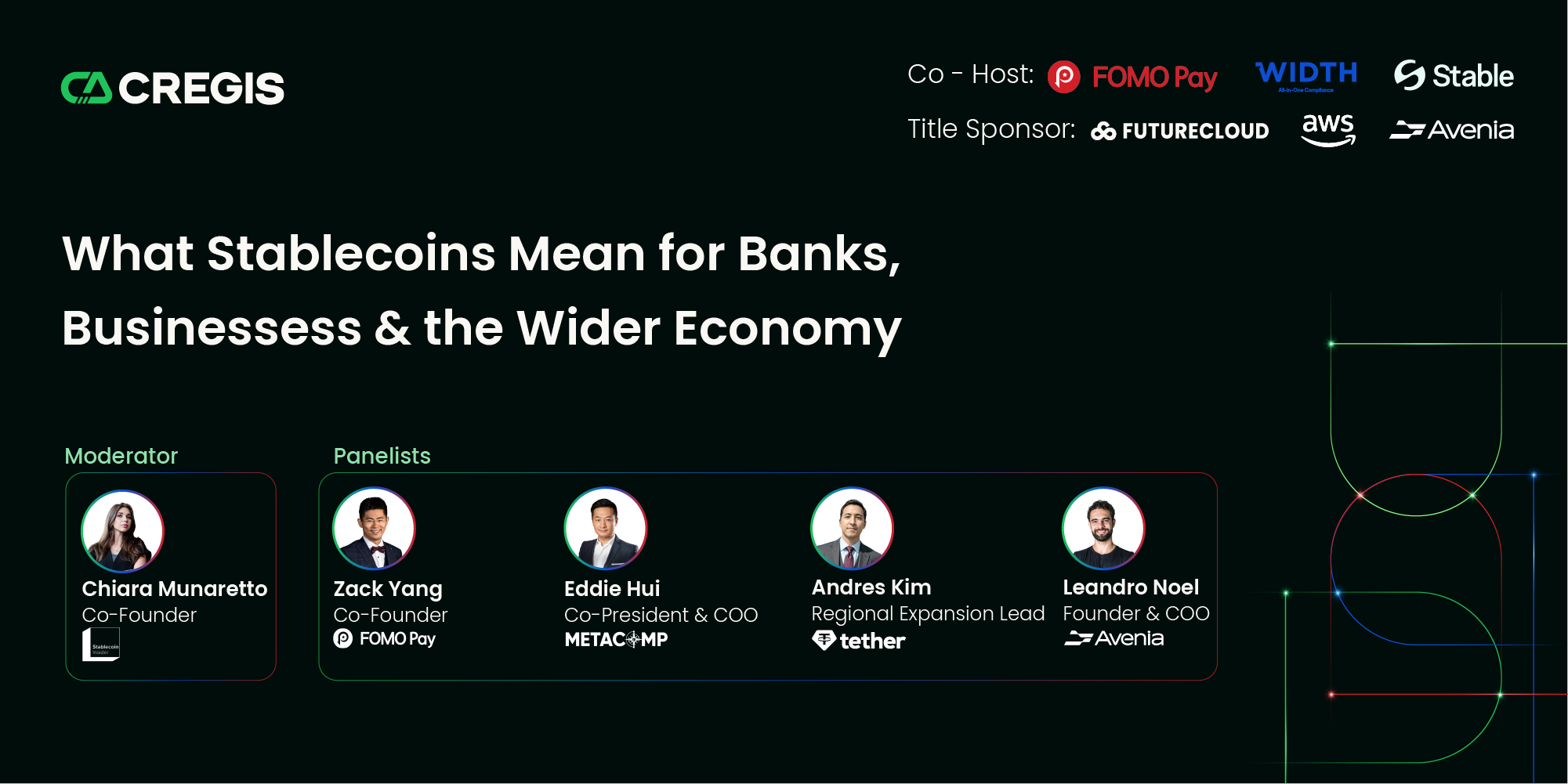
Against this backdrop, digital asset infrastructure provider Cregis will host the Institutional Onchain Finance Summit 2026 in Singapore on 6 October, during TOKEN2049 Week. The summit is also co-hosted by FOMO Pay, a global payment solutions provider; Stable, a stablecoin payments infrastructure company; and Width, a AI-native compliance platform.
Sponsored by FUTURECLOUD, AWS and Avenia, the event will bring together executives and practitioners from financial services, payments, stablecoins, digital asset infrastructure and security.

Stablecoins are finding a growing role in payments and settlement, including cross-border transactions and corporate treasury. The focus is now shifting from adoption to execution — how stablecoins fit into existing financial workflows and infrastructure.
That question will anchor the summit’s opening discussion, “What Stablecoins Mean for Banks, Businesses and the Wider Economy.” The panel will draw on perspectives from across the payments and financial ecosystem, including FOMO Pay Co-Founder Zack Yang, MetaComp Co-President and COO Eddie Hui, Tether Regional Expansion Lead Andres Kim, and Avenia Founder and COO Leandro Noel. The session will be moderated by Chiara Munaretto of Stablecoin Insider.
The discussion will look at how stablecoins are being used across payments, financial services and treasury, as well as what broader adoption could mean for banks and businesses.
As these use cases expand, the infrastructure supporting them must handle increasingly complex fund flows. For institutions, that means looking beyond asset issuance and transfers to areas such as counterparty coordination, access controls, transaction execution and day-to-day operations.

That operational shift also changes the security challenge. As digital assets become part of larger business workflows, risks can sit across signing systems, access controls, third-party infrastructure and human processes — not just wallets or smart contracts.
The summit will explore this changing threat landscape in its second panel, “The New Security Playbook: How Attacks & Defences Are Evolving Across Digital Assets.” Michael Chen, Non-Executive Director at 1exchange; Jason Jiang, CBO of CertiK; Dmytro Matviiv, CEO of HackenProof; and Alexandra Wang, Head of Strategic Partnerships at ZAN, will share their perspectives on how attacks are evolving and where institutions need to strengthen prevention, monitoring and incident response.
Automation and AI are also changing the way attacks are carried out and detected, adding another layer to an already complex operating environment.

The programme will also feature keynote presentations from Cregis COO Jason Ma, Width CEO and Co-Founder Chye Kit Chionh, Stable CEO Brian Mehler and Injective CEO&Co-founder Eric Chen. Their sessions will add perspectives from infrastructure providers working across payments, stablecoins and institutional onchain finance.
For Cregis, the summit reflects a broader shift in the market. As businesses bring digital assets into payments, treasury and other financial workflows, infrastructure needs to support more than blockchain connectivity. Wallets, fund flows, governance and security controls are increasingly part of the operating layer.
The Institutional Onchain Finance Summit 2026 will bring these issues together in one forum, with speakers from financial institutions, payment providers, stablecoin companies, infrastructure providers and security firms sharing practical experience across markets and business models.
About Cregis
Cregis is a digital asset infrastructure platform, providing technology for digital asset collections, payouts and fund operations. Its offerings include wallet infrastructure, fund flow orchestration and regulated custody capabilities. These solutions help businesses manage digital assets with greater security, efficiency and control. Founded in 2017, Cregis serves financial institutions, payment service providers (PSPs), foreign exchange (Forex) brokers, fintechs and Web3 businesses. The company operates across Asia, the Middle East and Latin America. Today, Cregis supports more than 4,000 businesses across over 50 countries.
About FOMO Pay
Founded in 2015, FOMO Pay is a payment institution licensed in Singapore, Hong Kong and the Middle East, providing digital payment, digital banking and digital asset solutions to businesses and institutions. Its services span merchant and corporate payments, transactional banking and corporate treasury, connecting traditional financial services with emerging digital financial infrastructure.
About Stable
Stable is building infrastructure and products for the global stablecoin economy. At its core is StableChain, a USDT-native, EVM-compatible Layer 1 designed for fast, predictable, and low-cost payments and settlement, with USDT serving as both the gas and settlement asset.
About Width
Width is an AI-native compliance platform headquartered in Singapore, bringing KYC, KYB, AML monitoring, fraud detection, case management and regulatory reporting into a unified, auditable system. Its platform combines visual workflow design, AI-powered risk scoring, real-time transaction monitoring, biometric verification and graph intelligence, serving more than 500 banks, fintechs, insurers, digital asset businesses and professional services firms across 180 jurisdictions.
The post Cregis to Host Institutional Onchain Finance Summit 2026 in Singapore appeared first on BeInCrypto.
Crypto World
Visa partner Reap plans Mexican peso stablecoin launch for round-the-clock FX settlement
Reap’s plans suggest a potential use case for local-currency tokens, enabling companies to move money and manage foreign-echange exposure outside banking hours, rather than merely using stablecoins for crypto trading and dollar settlement.
“Demand for non-USD stablecoins is driven by market demand and Reap’s priorities, especially as clients aim to get a more localized and cost-efficient experience,” Guo said.
Reap holds VPIM licenses in Hong Kong and Mexico, making the peso token a practical first addition. It is also considering Hong Kong dollar, euro, won and yen stablecoins for onchain 24/7 foreign exchange, Guo said, without providing a rollout timetable or naming the prospective issuers.
The company said it is integrating stablecoin settlement into a broader product suite that includes cards, cross-border payouts, treasury tools and compliance and fraud controls. Reap’s card and payments volume rose 33% year over year in the first half of 2026, after revenue and volume tripled in 2025, Guo said.
Visa’s stablecoin work operates at the network level, while Reap handles the regulated card-issuing business, including customer checks, bank relationships and cardholder compliance, Guo said.
Visa does not view blockchain settlement as a replacement for conventional payment systems, according to Stephen Karpin, the company’s Asia-Pacific president.


The ECB aims to gain firsthand DLT market experience by buying tokenized public-sector securities and settling the trades through Pontes.
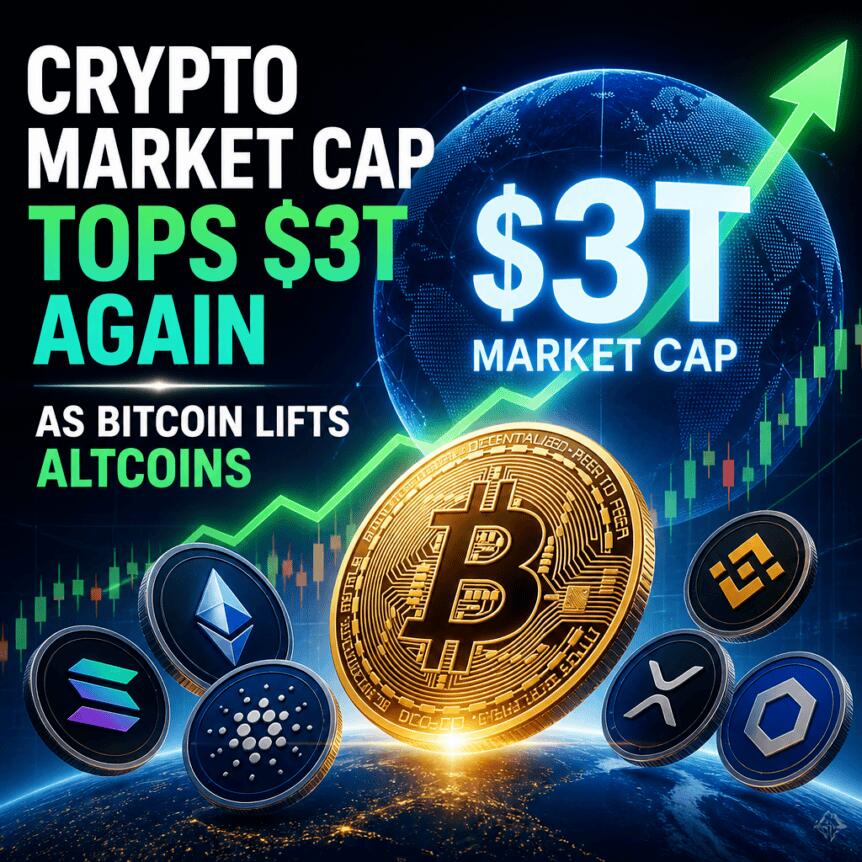
Crypto’s rebound pushed total market capitalization back toward the $3 trillion mark on Tuesday, led by gains in Bitcoin and a broad lift across major altcoins. At the same time, indicators of leverage in derivatives markets rose, underscoring how quickly risk appetite—and speculative positioning—can change during fast-moving rallies.
Bitcoin traded around $86,000, up roughly 4.5% over 24 hours, according to CoinGecko. Ether (ETH) added about 2.3% to $2,745, XRP rose 5.7% to $1.53, and Solana (SOL) climbed around 3.6% to $117. Among other large-cap names, BNB gained about 1.6%, while Dogecoin (DOGE) was reported as one of the strongest performers, rising roughly 11%.
Key takeaways
- Total crypto market cap hovered just under $3 trillion, up around 4.3% day over day, as majors extended a broad rally.
- Perpetual futures open interest rose to nearly $160 billion, the highest level since late October 2025, signaling renewed leverage.
- Liquidations were skewed by a surge: $920 million in bearish positions were reportedly cleared on Monday, which can fuel volatility.
- US spot Bitcoin ETFs recorded nearly $1 billion in inflows on Monday, the largest single-day tally since October 2025.
- Outside the top market leaders, Akedo’s AKE saw outsized momentum, gaining roughly 170% over seven days before a sharp pullback from its weekly high.
Market cap returns near $3 trillion as majors catch a bid
The rally’s breadth mattered: Bitcoin’s rise wasn’t isolated to the market leader, and instead pulled several high-volume peers higher in tandem. CoinGecko data cited in the report placed total crypto market capitalization just below $3 trillion at the time of writing, reflecting an overall gain of about 4.3% from the prior day.
For traders, the key takeaway isn’t only that prices moved up—it’s that the move showed up across multiple segments of the market. When liquidity and risk appetite broaden, it can reduce the probability that the rally is merely a single-asset rebound, though it does not eliminate the risk of a quick reversal if leverage continues building.
Derivatives leverage climbs; liquidations hint at fast feedback loops
Bloomberg reported that open interest across crypto perpetual futures climbed to nearly $160 billion, its highest reading since late October 2025. Alongside that, the same report said more than $920 million in bearish positions were liquidated on Monday as prices rose.
These two datapoints are important when interpreted together. Higher open interest suggests more capital is tied up in leveraged positions, while large liquidation totals indicate that price moves were strong enough to force accounts to unwind. That combination can create a feedback loop: bullish liquidations can push prices higher in the short term, but when sentiment flips, the same leverage can accelerate downside moves.
Investors watching this phase typically track whether open interest continues to rise in parallel with spot prices—or whether it peaks and begins to cool. The former often signals that the market is still adding risk, while the latter can suggest the move is maturing and becoming more dependent on spot demand rather than leverage mechanics.
Spot Bitcoin ETF inflows add a separate layer of demand
While futures positioning reflects speculative appetite, spot Bitcoin ETFs reflect a more direct form of institutional and retail portfolio activity. Earlier coverage referenced in the piece from Cointelegraph said US spot Bitcoin ETFs drew nearly $1 billion on Monday—described as the largest single-day inflow since October 2025.
That matters because sustained ETF inflows can help anchor rallies, especially when leverage-led moves run into profit-taking. The practical question for market participants is whether ETF demand continues beyond a single day and whether it aligns with changes in derivatives open interest. When spot and leverage move in the same direction, rallies tend to have more staying power; when they diverge, volatility often increases.
High-beta tokens flash early strength—then retrace
Beyond majors, the article highlighted Akedo’s AKE token as one of the week’s biggest movers. It was described as ranked 208th among roughly 8,161 active cryptocurrencies listed on CoinMarketCap, with the token up about 170% over the past seven days, lifting market capitalization to around $1.2 billion at the time of writing.
However, the piece also noted a sharp intrawave reversal: AKE reportedly reached an all-time high of $0.1467 on Sunday before dropping more than 60% from its peak. Traders reportedly exchanged $108.9 million worth of AKE in the past 24 hours, reinforcing that the token’s move was accompanied by heavy turnover.
This kind of path—rapid spike to a new high followed by a steep retrace—often reflects speculative momentum and thinner order-book depth at higher price levels. For traders, the most actionable point is to treat “headline gains” in smaller caps as fragile: price can reverse quickly when crowded positions unwind, especially if broader market leverage cools.
Going forward, readers should watch whether total market cap holds near $3 trillion and whether derivatives open interest continues to climb or starts to flatten after the reported liquidation burst. The next tell will likely be whether ETF inflows persist alongside spot strength—or whether the rally becomes increasingly reliant on leveraged positioning, which tends to raise the odds of a sharper pullback.

Animoca Brands suspended discussions for a proposed reverse merger with Currenc Group Inc. (CURR), which would have seen the digital asset investment company secure a Nasdaq listing.
The two companies decided the proposed timeframe to finalize the transaction didn’t align with their respective goals, Animoca announced on Tuesday.
Talks between Animoca and Currenc kicked off late last year, with plans for the former to own 95% of the merged company.
Hong Kong-based Animoca said it “remains fully committed” to listing on a major public exchange, with co-founder Yat Siu adding it will “continue to pursue optimal routes” to a public listing.
Animoca Brands’ portfolio spans decentralized finance (DeFi), AI, non-fungible tokens (NFTs) and gaming, with advisory services forming an increasing chunk of its revenue stream in recent years.
Currenc shares closed at $3.23 on Monday, 1.25% higher on the day, before dropping 0.93% in after-hours trading.
Crypto World
BTC price recovers from Asian-session lows as falling oil price supports risk appetite: Crypto Markets Today
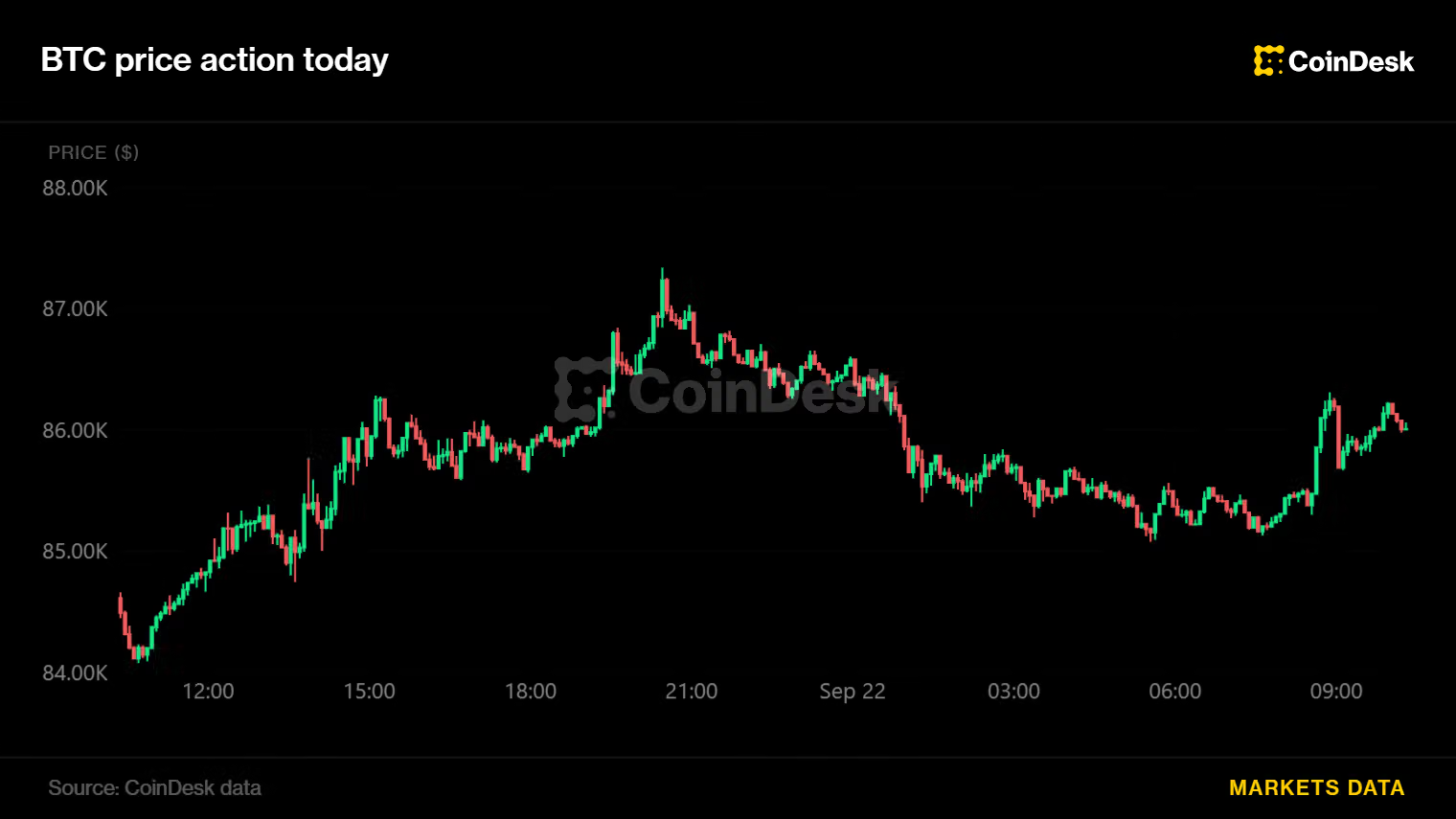
Bitcoin remains in the hunt for further gains as falling oil prices join a growing list of tailwinds supporting the cryptocurrency.
The largest cryptocurrency recently traded near $86,000 after recovering from Asian-session lows of around $85,000. Prices convincingly broke above the May high on Monday, reinforcing the bullish trend. The CoinDesk 20 Index (CD20) rose 2.2% over 24 hours.
U.S.-listed spot bitcoin ETFs attracted nearly $1 billion in inflows on Monday, their largest single-day haul since October last year.
WTI crude futures fell more than 2% to below $90 a barrel, extending their retreat from a recent high of $106. The decline followed a Kyodo report that Iran was willing to reopen the Strait of Hormuz within seven days if the U.S. eased its blockade.
Lower oil prices could help ease inflationary pressures and weaken the case for additional Federal Reserve interest-rate increases in the coming months.
“The crypto market gained ground against the backdrop of a sharp rise in the Nasdaq index. Falling oil prices and US government bond yields, rising global stock markets and optimism regarding US-China negotiations supported risk appetite,” Alex Kuptsikevich, chief market analyst at The FxPro said in an email.
Crypto World
A $3.2 million ‘bitcoin butterfly’ option trade bets on a BTC price of $95,000 by end-October: Crypto Daily

In other words, the trader appears to be positioning for bitcoin to rise from roughly $85,000 to $95,000 over the next four weeks. That view broadly aligns with bitcoin’s daily chart, which shows little obvious resistance between $85,000 and $98,000.
There are no price levels in that zone where bitcoin previously stalled or consolidated, so, all else being equal, the current momentum could push it toward $98,000 in the near-term (check Today’s Signal).
The butterfly was not the only sign of growing bullish positioning. Traders also increased their demand for upside exposure through call options, pushing short-term risk reversals higher.
“Risk reversals have also been volatile, with front-end RRs flipping aggressively in favour of calls during the move up to $85K, before retracing somewhat this morning,” Laser Digital said in a note shared with CoinDesk.
The options market is also showing a broader preference for volatility across major tokens. On Monday, Coinbase Markets said options were pricing one-standard-deviation swings of 8.9% for XRP, 8.0% for SOL, 6.9% for ether and 5.0% for bitcoin through Sept. 27.
The figures measure expected price swings rather than directional bets, with risk of volatility highest in XRP. Stay alert!
Read more: For analysis of today’s activity in altcoins and derivatives, see Crypto Markets Today . For a comprehensive list of events this week, see CoinDesk’s “Crypto Week Ahead.”
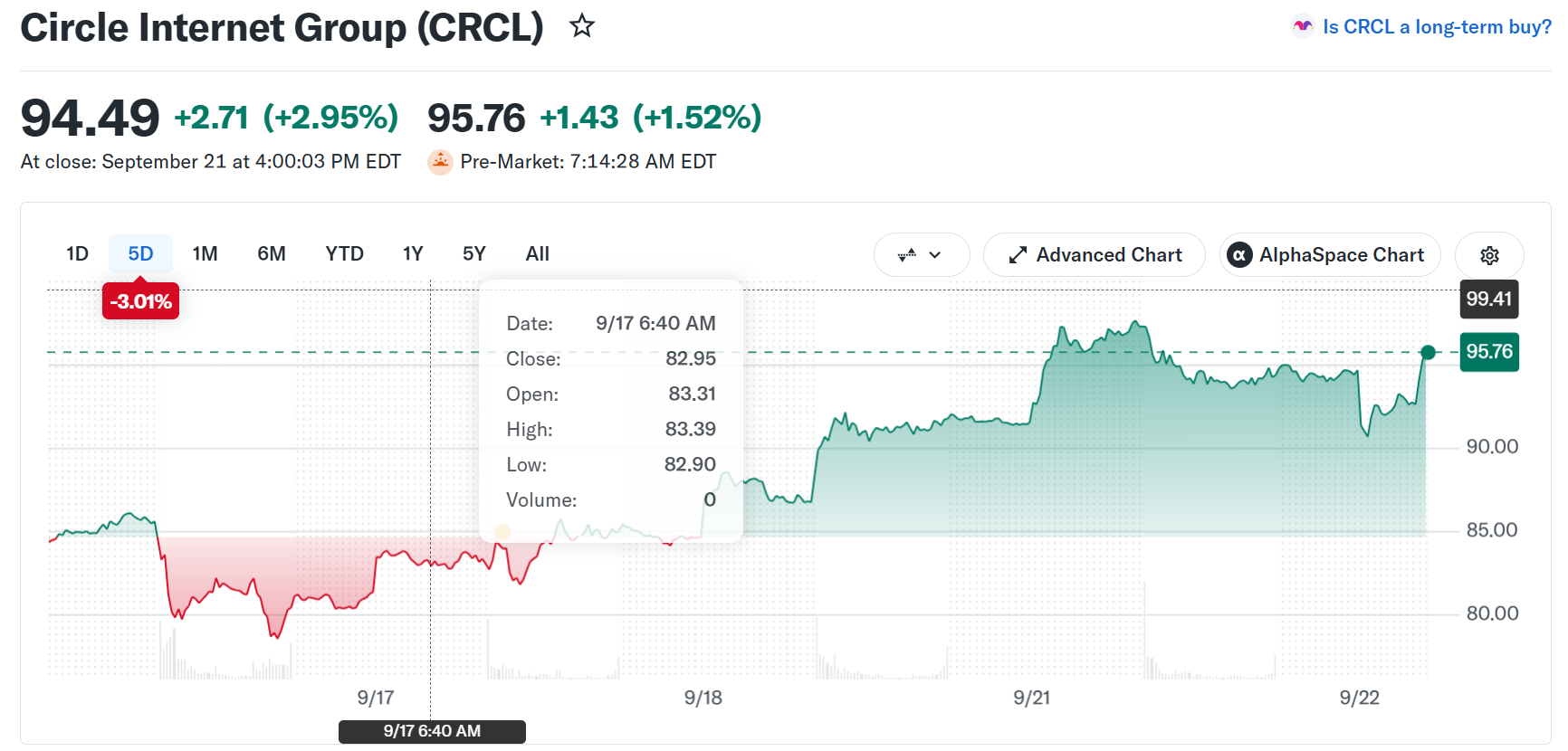
Binance has bought $100 million of stock in Circle Internet Group, the company behind the USDC stablecoin, according to a filing Circle made with the US Securities and Exchange Commission (SEC) on Tuesday.
Circle issued 1,237,011 Class A shares to the exchange at $80.84 each under an agreement signed on September 17. That price sits about 14% below where the stock closed on Monday.
What Binance Received and What It Agreed to Give Up
The shares were sold privately rather than on the open market, which is why they were exempt from SEC registration. Binance cannot sell them for two years, and it cannot hedge the position with offsetting trades during that window.
The lockup can end sooner if Binance walks away from the commercial side of the deal under conditions set out in the filing. Either company can terminate if specified events occur. Binance keeps full voting rights on the shares throughout.
Alongside the equity, the two firms signed a five-year commercial agreement. Binance will promote USDC through Circle’s Modular Smart Contract Wallet, software that lets an app or exchange hold and move digital dollars on a user’s behalf without that user managing private keys.
Circle will pay Binance a monthly incentive fee calculated as a percentage of the USDC sitting in that wallet infrastructure. The filing does not disclose the percentage.
Circle Stock Went Into the Deal Bruised
The timing is tight. Two days before the agreement was signed, the CLARITY Act stalled in the Senate and Circle shares fell 11% in a session, as BeInCrypto reported at the time. The bill would set out which US regulator oversees which digital assets.
The stock has since recovered. It closed at $94.49 on Monday, up 2.95% on the day, and traded at $95.76 in Tuesday pre-market.

Over the past quarter it is up 18.53%, with a relative strength reading of 56.2, a momentum gauge that sits in neutral territory between 30 and 70.
Circle carries a market value near $25.8 billion and trades at about 19 times earnings. It reported $701.3 million of revenue in the latest quarter and $2.75 billion over the past year.
The Cost Side of Distribution
Paying an exchange to push USDC is not new for Circle. The company already shares stablecoin economics with Coinbase, an arrangement that shaped its push into wrapped Bitcoin earlier this year. Distribution costs are the main drag on what stablecoin reserves earn.
USDC is the sixth largest crypto asset with a market value of $74.6 billion, and the token trades at $0.9998.
Investors who kept buying through this year’s slide, including Cathie Wood’s ARK funds, now have a second data point on how outside parties price the company. Binance paid $80.84. The market says $95.50.
The next quarterly report should show whether the new fee widens Circle’s distribution bill or the extra USDC balances cover it.
The post Binance Invests $100M In Circle Equity: How Will Stock React? appeared first on BeInCrypto.
This week’s XRP price prediction will have the Ripple army salivating. The token is trading at $1.54, up an impressive +7% over the past 24 hours after a violent rebound that caught most of the market flat-footed.
The token is now parked right at the edge of a technically loaded resistance band, and the next few sessions could decide whether this rally has legs or just refills the tank for another leg down.
Reports circulating between September 21 and 22 showed XRP gaining roughly 7%–8.2% in a single 24-hour window, adding an estimated $2.2 billion to its market value as short sellers got squeezed out of positions across the broader altcoin complex.
The move followed a scare earlier in the month when XRP briefly lost the $1.14 support level before buyers stepped back in with conviction. Bitcoin’s push above $84,000 during the same stretch didn’t hurt sentiment either; risk appetite returned quickly once liquidations cleared.
The bigger question now is whether this is a genuine trend reversal or a leverage-driven bounce that runs out of steam at resistance. That’s the setup worth dissecting before deciding where the capital goes next.
XRP Price Prediction: Can Ripple Hit $2 This Week?
XRP sits at $1.54 after clearing the $1.45–$1.50 initial resistance zone that had capped price action for weeks. Volume has picked up meaningfully during the rebound, consistent with short covering rather than pure organic demand, a distinction that matters for how sustainable this move actually is.
The 200-day moving average near $1.27–$1.28 held as support during the recent pullback, and that level now functions as the line in the sand for the broader recovery structure.
Bull case: A confirmed break above the $1.49–$1.54 supply zone opens the door to $1.60, with $2 the next major overhead barrier once leverage and funding conditions are factored in.
Base case: Consolidation between $1.45 and $1.54 while the market digests the squeeze.
Bear case: Rejection here sends price back toward $1.30, and a breakdown through that floor exposes the $1.18 moving average and eventually the $0.93–$0.97 demand zone flagged in recent RSI-based technical work.
Longer-range models, including a 2026 projection of $1.52–$2.15 with a $1.79 base case, suggest recent forecasting data may reward patience.
Maxi Doge Targets Early Mover Upside as XRP Tests Key Levels

Anyone holding XRP through the August chop into this bounce has reason to feel validated. But here’s the uncomfortable math: at a market cap north of $80 billion, XRP clearing $1.60 is a healthy move, not a life-changing one. Traders chasing outsized returns are increasingly looking at earlier-stage plays where the upside math works differently.
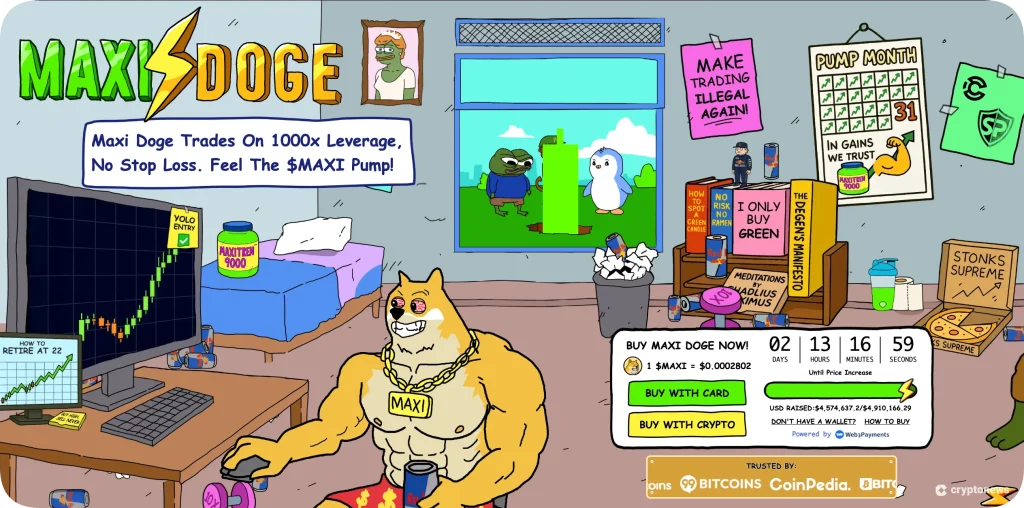
That’s the gap Maxi Doge ($MAXI) fills. It’s an ERC-20 meme token on Ethereum built around a 240-lb canine mascot channeling 1000x-leverage trading culture, complete with holder-only trading competitions and leaderboard rewards.
The presale has raised $4,863,060.23 at a current price of $0.000284, with dynamic APY staking live for early participants. The Maxi Fund treasury backs liquidity and partnerships, and the branding, gym-bro humor aimed squarely at leveraging degens, is unapologetically niche.
Get Ahead of Next Meme Coin Launch Here Earn $50 and Enter $300K Prize Draw on EdgeX
The post Ripple Clears $1.50: XRP Price Prediction Says $2 Next? appeared first on Cryptonews.

VMware Ready to Run CDs Packed Working Linux Virtual Machines Onto Discs Handed Out at Linux World 2000

The Bitcoin Bottom Signal With a 100% Hit Rate Just Triggered

Having a baby in Denmark vs the UK: how different is it?




-

 Fashion4 days ago
Weekend Open Thread: Talbots – Corporette.com
-

 Tech2 days ago
Researchers escape OpenAI Codex sandbox to run commands on host
-

 Crypto World7 days ago
Robinhood engineers charged over $50K crypto scheme
-

 Crypto World3 days ago
Circle launches Arc Studio AI agent for building onchain apps
-
 NewsBeat4 days ago
Trump says US has reached an agreement to take permanent control of Greenland’s security
-

 Crypto World2 days ago
Who Needs CLARITY Anyway? ARB Could See 70X Increase: Hodler’s Digest
-

 Crypto World4 days ago
Bitcoin price breaks channel as RSI climbs to 63
-

 Crypto World6 days ago
US Charges Robinhood Engineers Over Crypto Listing Trades
-

 Crypto World6 days ago
What Is the Status of the U.S.-Iran Peace Talks? Here's What Both Sides Are Saying
-

 Crypto World4 days ago
Trading Bitcoin on Robinhood? Why 2% Spread Has Traders Worried
-

 Tech7 days ago
Webb’s IC 348 Mosaic Includes Two-Jupiter Dwarfs, Twin Jets, and a Nursery Still Making Worlds
-

 Crypto World3 days ago
World Money launches in 150+ countries with Stripe
-

 Crypto World4 days ago
Silver prices recover quickly, hitting weekly high today
-

 Entertainment6 days ago
Big Brother Update: Melody Explodes at Drew as Illness Sweeps BB28 House
-

 Crypto World5 days ago
Mortgage and refinance interest rates today, Thursday, September 17, 2026
-
 NewsBeat4 days ago
US was ‘on brink of war’ with China over false AI report of nukes moving in Middle East
-

 Tech5 days ago
GPT-6 Astra Reached the Nether in Minecraft, Lost Its Stash to a Creeper, and Farmed Potatoes for Hours
-

 Business2 days ago
Analog Devices (ADI) Bets $1.35 Billion on Chips that Let Machines Think for Themselves
-

 Crypto World1 day ago
Bitcoin price holds above $81K as key catalysts line up
-

 Business6 days ago
Federal Reserve expected to hike interest rates 25 basis points at FOMC meeting
You must be logged in to post a comment Login