Connect with us

Business

Viking Therapeutics Stock Skyrockets On Obesity Drug Data. Eli Lilly, Novo Fall.

Published

on

Viking Therapeutics Stock Skyrockets On Obesity Drug Data. Eli Lilly, Novo Fall.

Viking Therapeutics and Roche both reported positive trial data on their obesity treatments. Shares of Viking Therapeutics surged in premarket trading while the U.S. shares of Swiss drug giant Roche were not yet active. Weight-loss drug leaders Eli Lilly and Novo fell slightly. Viking Therapeutics (VKTX) reported that its GLP1/GIP agonist VK2735 delivered placebo-adjusted weight loss after 33 weeks. That…

Copyright ©2026 Investor’s Business Daily, LLC. All rights reserved. 87990cbe856818d5eddac44c7b1cdeb8

Continue Reading
Click to comment

You must be logged in to post a comment Login

Leave a Reply

Business

PPG names Alex Lopez as investor relations and operational finance VP

Published

on

PPG names Alex Lopez as investor relations and operational finance VP

Coatings specialist PPG has appointed Alex Lopez as vice president of investor relations and operational finance, effective 1 October.

Currently serving as director of investor relations, Lopez will report to the company’s senior vice-president and chief financial officer Jamie Beggs.

Under the new arrangement, Lopez will keep responsibility for investor relations and will also oversee enterprise operational finance.

His remit will include capital discipline, productivity oversight and improving the effectiveness of operational finance.

Advertisement

During two decades at PPG, Lopez has held several senior finance positions across business units and corporate functions.

Before moving into investor relations in 2024, he was global finance director for automotive OEM coatings.

In 2017, he moved to Mexico City to become finance director for architectural coatings, Latin America, where he was involved in the development of PPG Comex.

Before joining PPG, Lopez worked in financial planning and liaison roles at GE Appliances and its joint venture Mabe through their financial management programme.

Advertisement

PPG is based in Pittsburgh, US, operates in more than 50 countries and recorded net sales of $15.9bn in 2025.

PPG Latin America vice-president Adriana Macouzet retired in April 2026.

From the same date, Jennifer Solcz, previously vice-president of protective and marine coatings for the US and Canada, was appointed vice-president of protective and marine coatings for the Americas, adding Latin America to her existing responsibilities.

“PPG names Alex Lopez as investor relations and operational finance VP” was originally created and published by Packaging Gateway, a GlobalData owned brand.

Advertisement
Continue Reading

Business

10 Features to Look for in Policy Management Software

Published

on

10 Features to Look for in Policy Management Software

Publishing internal guidelines is easy, but proving that your workforce has actually read and understood them during an unexpected regulatory audit is a high-stakes challenge. To bridge this gap, modern policy management software features must transform static document distribution into an active, verifiable process of compliance. Selecting the right platform allows compliance officers, HR leaders, and IT administrators to replace tedious spreadsheets with automated workflows, ensure target distribution across global teams, and achieve true operational accountability.

This guide breaks down the essential core capabilities—from automated policy distribution and tracking to native Microsoft 365 policy management software integration and audit-ready reporting—so you can evaluate tools effectively, reduce organizational risk, and choose a solution that drives measurable compliance confidence. Here is what to look for when evaluating your options.

The Strategic Value of Enterprise Policy Management Software

At its core, modern policy management involves systematically creating, distributing, tracking, and maintaining an organization’s regulatory and operational documentation. Rather than relying on static file repositories or passive email attachments, dedicated policy management software features actively govern how internal policies move through their lifecycle. It automates delivery, enforces mandatory employee acknowledgements, and records fine-grained activity data to convert passive communication into verifiable compliance.

For compliance officers, HR leads, and IT administrators, relying on manual follow-ups or shared network folders creates severe governance risks. In real-world operations, unread safety guidelines or outdated operational procedures directly expose organizations to regulatory fines, legal liabilities, and failed audits. An enterprise-grade policy management software provides complete visibility, ensuring that critical updates reach the right personnel and that every policy acknowledgement is tracked without heavy administrative burden.

Advertisement

Choosing a platform with robust policy distribution and tracking capabilities transforms compliance from a reactive scramble into a predictable, streamlined workflow. Key operational advantages include:

  • Elimination of Administrative Bottlenecks: Automated notification workflows and reminders remove the need for manual email follow-ups. 
  • Audit Readiness: Continuous collection of digital signatures and access logs creates immediate evidence for internal and external auditors. 
  • Seamless Ecosystem Alignment: Platforms designed for native integration—such as specialized tools like DocRead for SharePoint—allow teams to enforce compliance directly within their existing Microsoft 365 environments without forcing users into unfamiliar third-party software. 

A common misconception is that a standard cloud storage platform or intranet is sufficient for policy governance. However, simple storage lacks the critical enforcement mechanisms, target assignment capabilities, and granular tracking required to maintain a robust, audit-ready compliance posture.

Essential Policy Management Software Features for Enterprise Governance

To build a secure and compliant workplace, evaluating policy management software features requires looking beyond standard document storage. Modern organizations need specialized software capabilities that ensure active engagement, targeted delivery, and continuous compliance verification across every department.

1. Targeted Policy Distribution & Dynamic User Management

Distributing company guidelines across large organizations requires precise targeting. Instead of emailing documents to entire company lists, modern platforms automatically assign policies based on specific roles, departments, locations, or custom AD (Active Directory) groups. When an employee changes roles or a new team member joins, smart assignment rules immediately issue the required reading materials, ensuring seamless onboarding without manual intervention.

2. Mandatory Read & Policy Acknowledgment Tracking Software

A critical distinction in compliance management is moving from publishing a document to confirming understanding. Purpose-built solutions incorporate digital sign-offs where users actively acknowledge that they have read and agreed to the policy. Implementing robust policy acknowledgment tracking software ensures every sign-off is logged with accurate timestamps, creating legally defensible records that protect your organization during disputes or regulatory reviews.

Advertisement

3. Automated Notifications & Deadline Management

Manual follow-ups waste hundreds of administrative hours each year. Leading compliance tools automate task delivery, sending personalized notifications when new documents are assigned or modified. Integrated deadline tracking ensures that if an employee misses a review window, automated escalation rules trigger reminders to the employee and their line manager—maintaining steady progress toward total compliance.

4. Real-Time Audit-Ready Compliance Reporting Software

When auditors arrive, administrative teams often scramble to compile proof of policy distribution. A specialized platform eliminates this panic through real-time dashboards and exported logs. Comprehensive audit-ready compliance reporting software provides instant visibility into compliance rates, pending sign-offs, and overdue tasks across individual departments or the entire workforce.

5. Native Integration with Microsoft 365 & SharePoint

Introducing standalone software often creates user friction, security vulnerabilities, and fragmented workflows. Solutions built natively for your existing ecosystem allow organizations to manage governance directly inside their digital workplace. Choosing a native microsoft 365 policy management software solution ensures that file permissions, access control, and user management remain synchronized with your core infrastructure.

6. Centralized Policy Control & Version Management

Overlapping file versions and outdated policy PDFs stored on local drives pose serious compliance risks. A centralized repository ensures a single source of truth for all operational documentation. Built-in version control archiving automatically archives older revisions while ensuring employees only access and acknowledge the most current, approved policy version.

Advertisement

7. Automated Policy Review Schedules & Lifecycle Management

Policies must evolve alongside regulatory shifts and industry standards. Governance software includes automated lifecycle scheduling that alerts document owners when a policy is due for periodic review. This prevents outdated guidelines from remaining active and keeps governance frameworks continuously aligned with legal requirements.

8. Custom Knowledge Checks & Quizzes

In high-risk industries, simple digital signatures may not suffice to demonstrate understanding. Enterprise platforms allow compliance officers to attach short, customizable quizzes to critical policies. Employees must pass the quiz to complete their acknowledgment, confirming that key safety protocols or regulatory standards are truly comprehended.

9. Tailored User Dashboards

Employees need a clear, distraction-free view of their compliance obligations. User-centric dashboards display assigned tasks, pending acknowledgments, completed certifications, and due dates in a unified portal. This clear layout reduces administrative confusion and empowers staff to manage their required reading efficiently.

10. Granular Security, Permissions, & Admin Controls

Protecting sensitive compliance records requires strict administrative permissions. Platform administrators can set granular access rights controlling who can edit documents, reassign policies, or access executive compliance reports. This ensures sensitive regulatory data remains secure while giving regional managers the exact visibility they need.

Advertisement

Selecting an enterprise platform that delivers these fundamental policy management software features transforms static policy distribution into a proactive, trackable process. By leveraging dedicated solutions like DocRead for SharePoint, compliance officers and IT leads eliminate manual overhead and maintain total audit readiness effortlessly.

How Policy Management Software Solves Compliance Challenges Across Departments

Evaluating software capabilities is most effective when applied to real-world scenarios. Here is how modern enterprise policy governance tools solve everyday operational bottlenecks across different organizational departments.

  • HR & Workforce Onboarding: During rapid company growth, HR teams often struggle with manual policy distribution and follow-ups. By implementing dedicated sharepoint policy management features, HR administrators automate document assignments for new hires based on department roles. New employees receive automated reading tasks with strict deadlines, resulting in 100% policy acknowledgment compliance within their first week while reducing administrative follow-up time by over 80%. 
  • Corporate Compliance & Regulatory Audits: Facing a sudden regulatory audit, a compliance director needs immediate proof that all staff completed mandatory data protection training. Using audit-ready compliance reporting software, the team generates real-time completion reports and timestamped digital signatures across global offices in minutes, completely eliminating audit anxiety and avoiding costly non-compliance fines. 
  • IT & Operations Governance: When updating critical IT security policies, system administrators must ensure employees do not bypass important security protocols. Leveraging automated policy reminders in microsoft 365, the platform sends targeted notifications and escalates overdue tasks to line managers, ensuring rapid organization-wide alignment without disrupting daily IT operations. 

These practical applications demonstrate that investing in the right policy management software features replaces manual tracking with predictable, automated compliance—giving your organization complete visibility and audit readiness.

Best Practices for Implementing Policy Management Software Features

Selecting software is only the first step; maximizing its value requires a thoughtful implementation strategy. Following these practical best practices ensures smooth adoption and long-term compliance success across your enterprise.

  • Map Policies to Roles, Not Individuals: Avoid assigning documents to specific named users. Instead, utilize dynamic role-based policy assignment linked to your Active Directory or Microsoft 365 groups. This guarantees that internal role changes or new hires trigger policy updates automatically, maintaining seamless governance without constant manual maintenance. 
  • Set Realistic Acknowledgment Deadlines: Give employees adequate time to review complex documents while maintaining operational momentum. Establishing clear, reasonable timeframes paired with automated compliance tracking tools prevents administrative bottlenecks while ensuring staff prioritize critical policy reviews. 
  • Leverage Existing Workspace Infrastructure: Minimize user friction by deploying software directly inside the tools your workforce already uses every day. Implementing a purpose-built solution like DocRead for SharePoint keeps policy distribution within your existing intranet, driving higher engagement rates without introducing separate logins. 
  • Audit Your Policy Library Periodically: Technology works best when underlying content is up to date. Schedule regular lifecycle reviews for all corporate documentation to retire obsolete guidelines and ensure employees are only asked to acknowledge active, relevant standards. 

Applying these best practices helps your organization fully unlock the power of core policy management software features, turning compliance into a streamlined, reliable, and stress-free process.

Take Control of Your Governance with Purpose-Built Policy Management

Choosing the right policy management software features is essential for transforming passive document storage into an active, verifiable compliance process. By prioritizing targeted distribution, mandatory acknowledgments, automated reminders, and real-time reporting, compliance leaders and IT administrators can protect their organization from audit risks while saving hundreds of administrative hours. Modern governance relies on clear visibility, complete control, and seamless workplace integration.

Advertisement

Taking action now ensures your organization remains audit-ready, reduces legal exposure, and establishes verifiable accountability across every department. Equipping your workforce with tools built for active policy tracking eliminates compliance gaps before they become costly liabilities.

Ready to streamline your compliance workflows within your existing environment? Explore how Collaboris policy management software empowers enterprise teams to automate policy distribution, track acknowledgments in real time, and achieve complete compliance confidence.

Frequently Asked Questions About Policy Management Software

How do policy management software features help with regulatory audits?

Dedicated policy management software features streamline audits by providing real-time, audit-ready compliance reporting software. Instead of searching through emails or paper records, administrators can instantly generate timestamped logs proving when employees received, read, and acknowledged specific guidelines. This verifiable proof significantly reduces non-compliance risks and ensures your organization remains fully prepared for internal and external regulatory reviews.

Can policy management software integrate with Microsoft 365 and SharePoint?

Yes, modern platforms can integrate natively with your existing digital workplace. Selecting a specialized microsoft 365 policy management software solution like DocRead for SharePoint allows you to manage policy assignments, track acknowledgments, and leverage central document libraries directly within your familiar Microsoft environment without requiring separate user credentials or risky file migrations.

Advertisement

How does policy acknowledgment tracking software handle new employee onboarding?

Advanced platforms utilize dynamic user management tied to Active Directory or Microsoft 365 groups. When a new hire is added to a specific department or role, the system automatically assigns all mandatory policies for their position. Automated reminders and deadline tracking ensure new team members complete their required reading during onboarding without requiring manual administrative follow-up.

What is the difference between document management and policy management software?

While document management systems simply store, organize, and control file versions, dedicated policy management software features actively drive compliance enforcement. Beyond basic storage, policy management tools provide targeted distribution, automated notification workflows, mandatory digital acknowledgments, custom comprehension quizzes, and detailed audit trails to ensure policies are read, understood, and tracked across the workforce.

About the Author

Ryan Malaluan, CAPM®, is an SEO & Content Strategist with over 8 years of experience in search engine optimization, content strategy, and digital marketing. He holds a Bachelor of Arts in Literature and is a Certified Associate in Project Management (CAPM®), combining strong communication skills with structured, results-driven strategies to improve online visibility and organic growth.

Advertisement
Continue Reading

Business

Giants QB Believed to Have Sprained MCL After Hard Hit vs. Rams, MRI Now Set

Published

on

Jaxson Dart
Jaxson Dart
Jaxson Dart

EAST RUTHERFORD, N.J. — New York Giants quarterback Jaxson Dart is believed to have suffered a sprained MCL in his left knee after being hit during Monday Night Football’s loss to the Los Angeles Rams, with the team set to confirm the extent of the injury through an MRI scheduled for Tuesday.

Dart went down on the final play of the Giants’ opening drive, taking a hit from Rams defenders Josaiah Stewart and Byron Young while attempting a third-down deep pass. His left knee bent awkwardly in the collision, and he fell to the ground clutching the joint in pain as trainers rushed onto the field to assess him. Despite the severity of the initial reaction, Dart was able to walk off the field under his own power; the Giants had a cart standing by to transport him off but he declined it, walking slowly down the sideline instead before being evaluated further in the medical tent and eventually taken to the locker room.

X-rays performed at SoFi Stadium came back negative, according to ESPN and NFL Media, offering an early sign that Dart had avoided a more severe structural injury. NFL Network Insiders Ian Rapoport and Mike Garafolo subsequently reported that Dart is believed to have sustained a sprained MCL based on initial exams, with the team scheduling an MRI for Tuesday to confirm the diagnosis and determine the severity of the sprain.

Giants head coach John Harbaugh addressed the injury following the game, cautioning that a fuller picture wouldn’t be available until after Tuesday’s imaging. “We’ll know more tomorrow. That’s in the neighborhood of it,” Harbaugh said when asked about the reported MCL sprain. “We’ll get an MRI tomorrow and have a really good feel for it.”

Giants general manager Joe Schoen offered a more optimistic public assessment in comments to ESPN’s Laura Rutledge during the broadcast, saying simply that Dart is “going to be OK.” According to reporting on the injury, Dart himself pushed to return to the game in the first half, but the Giants’ medical and coaching staff would not allow him back onto the field, ultimately ruling him out for the remainder of the contest early in the third quarter.

Advertisement

Dart’s exit forced backup quarterback Jameis Winston into extended action for the second consecutive week in which the Giants’ offensive game plan had to shift on short notice. Winston completed 11 of 27 passes for 111 yards with an interception as New York’s offense struggled to replicate the form it had shown the previous week in a win over the Dallas Cowboys, ultimately falling 28-6 to the Rams. Giants running back Cam Skattebo spoke to the difficulty of the in-game transition after the loss. “Obviously, it sucks losing your starter because everything you do revolves around the guy that is going to play the game,” Skattebo said. “We have full trust in Jameis when he came in the game. We just couldn’t execute.”

Dart was not the only Giants player banged up during Monday’s loss. Wide receiver Malik Nabers is dealing with a shoulder injury, outside linebacker Brian Burns sustained an ankle injury, and left tackle Andrew Thomas is managing a groin issue, though none of the three is expected to miss significant time, according to sources cited by ESPN.

The injury comes during what had otherwise been a strong start to Dart’s second NFL season. As a rookie in 2025, Dart took over as the Giants’ starting quarterback in Week 4 and went on to complete 63.7% of his passes for 2,272 yards, 15 touchdowns and five interceptions across 12 starts, establishing himself as a foundational piece for a franchise that has posted losing records in 11 of its past 13 seasons. Dart had also weathered an earlier injury scare during the preseason, when he was sacked hard by Minnesota Vikings safety Jay Ward in the first quarter of New York’s preseason opener on August 15, an incident significant enough to send him to the medical tent for evaluation, though he returned to the same drive and threw a touchdown pass to rookie Malachi Fields.

Should Dart require extended time to recover from Monday’s knee injury, the Giants do have experience navigating the offense with Winston under center. During a stretch last season when Dart was sidelined, Winston led the offense to success in starts against the Green Bay Packers and Detroit Lions, throwing for a combined 567 yards and two touchdowns against two interceptions, while also adding a rushing touchdown and a receiving score on a trick play during the game against Detroit.

Advertisement

With Dart’s MRI scheduled for Tuesday, the Giants are expected to have a clearer picture of both the severity of the sprain and an estimated recovery timeline in the coming days. In the meantime, the team faces the challenge of navigating its offensive game plan around Winston, a reversal from the momentum New York had built entering Monday’s matchup off the strength of its win over Dallas the week before.

Continue Reading

Business

Scienture secures distribution deal for naloxone nasal spray

Published

on


Scienture secures distribution deal for naloxone nasal spray

Continue Reading

Business

Two-thirds of Welsh firms upbeat on growth prospects for the Welsh economy

Published

on

Business Live

According to the latest business barometer from Lloyds only 38% of Welsh firms believe Wales isn’t getting a fair deal on public investment

Lloyds.

Three-quarters of indigenous firms are upbeat on the growth prospects for the the Welsh economy over the next three years, shows new research from Lloyds Bank.

Its latest business barometer reveals that of the 75% firms that are upbeat on economic growth, a a third (32%) are very confident

Advertisement

Over a third (34%) believe the Welsh economy’s growth will outperform the UK economy over the next 12 months, while 29% disagree, coming in just above Scotland at 31%.

However, just 38% feel that Wales receives its fair share of public investment, the second lowest reading in the UK, just one percentage point higher than 37% in Yorkshire & Humber.

However, 24% of businesses surveyed say they’ve already witnessed notable growth in the Welsh economy over the previous three years.

Of those who identified growth in the last three years, the main reasons for success were cited as investment in digital infrastructure (38%), apprenticeship schemes (33%) and transport and logistics infrastructure (32%).

Advertisement

Looking ahead to the next three years, Welsh firms anticipate investment in communities, such as town centre regeneration and housing (49%), a local planning regime supportive of business development and growth (45%) and investment in Welsh universities, business incubators and research and development activity (44%) as being the main drivers of economic growth.

Nathan Morgan, area director for Wales at Lloyds, said: “It’s encouraging to see Welsh businesses feeling confident about their growth prospects, particularly when fewer than two in five believe Wales receives its fair share of public investment. Firms are also clear about what this investment should be used to make the biggest difference, including in community development. “

And, with more than a third of firms believing Welsh growth will outpace the UK economy in the next year, there’s clearly ambition about what Wales can achieve. If that confidence is matched by the right level of investment, it can help translate into stronger, sustained economic growth.”

The barometer also shows that more than four in five UK businesses are confident in their regional economic growth in the next three years, with planning and investment in community and transport reported as the key drivers of future regional economic growth.

Advertisement

However, there is a divide in how businesses perceive public investment is distributed across the UK.

Confidence was highest in the North East, where 90% of businesses expect regional economic growth, followed by the South East at 89% and the North West at 88%. When businesses were asked about public investment in their region or nation, 85% of London firms perceive their region receives its fair share.

This falls to 37% of businesses surveyed in Yorkshire and the Humber and 38% for businesses in Wales. This compares to 64% of all businesses across the UK who perceive their region or nation receives its fair share.

Meanwhile, 62% of businesses in London think it will outperform the UK economy in the next 12 months, the highest proportion surveyed. By comparison, only 28% of businesses in the East Midlands and South West believe their region will outperform the UK economy, followed by 31% in Scotland, 34% in Wales and 37% in the East of England.

Advertisement

Amanda Murphy, chief executive for Lloyds Business and Commercial Banking, said: “Businesses across the UK are telling us they see opportunities to grow. “Turning this ambition into action requires public and private investment working together to create the right environment for growth. “

Whether its investment in infrastructure, skills, innovation or research, businesses have a clear view of what they need locally to drive growth. “Every region and nation has its own unique strengths and, by building on these, businesses will have the confidence to invest, create jobs and unlock their full potential.”

Continue Reading

Business

TriplePoint Venture Growth Offers A High Double-Digit Total Return Potential (NYSE:TPVG)

Published

on

Venture Capital concept image with business icons and copyspace.

This article was written by

I’m Cash Flow Venue and I’ve been investing for years trying to build my dividend portfolio. I like dividends doing the work for me, but I also have a separate growth portfolio.I’m an M&A Advisor, which means that I advise people and businesses on selling (but sometimes buying) their businesses.I usually work on some financial models, due dilligence, and negotiations. Oh, yes – and I have to attend too many meetings 🙂 Wha’ts my industry focus? I invest in technology, real estate, software, finance, and consumer staples. I’ve spent years advising clients from these industries. That’s why I pay the closest attention to these sectors when investing and writing.I started writing on Seeking Alpha to learn and share ideas. Dividend investing has played a big role in my financial journey. I believe it’s one of the simplest and most accessible ways to work toward financial freedom. By sharing what I learn, I hope to make the process feel less complicated for anyone building long-term wealth. In the end, the goal is simple: move closer to financial freedom through dividend investing.

Analyst’s Disclosure: I/we have a beneficial long position in the shares of TPVG either through stock ownership, options, or other derivatives. I wrote this article myself, and it expresses my own opinions. I am not receiving compensation for it (other than from Seeking Alpha). I have no business relationship with any company whose stock is mentioned in this article.

The information, opinions, and thoughts included in this article do not constitute an investment recommendation or any form of investment advice.

Advertisement

Seeking Alpha’s Disclosure: Past performance is no guarantee of future results. No recommendation or advice is being given as to whether any investment is suitable for a particular investor. Any views or opinions expressed above may not reflect those of Seeking Alpha as a whole. Seeking Alpha is not a licensed securities dealer, broker or US investment adviser or investment bank. Our analysts are third party authors that include both professional investors and individual investors who may not be licensed or certified by any institute or regulatory body.

Continue Reading

Business

ETH: Stakes Ether Exposure As An Alternative Investment Strategy (NYSEARCA:ETH)

Published

on

Bitcoin and ethereum classic coins competing on checkerboard

Bitcoin and ethereum classic coins competing on checkerboard

Dani VG/iStock Editorial via Getty Images

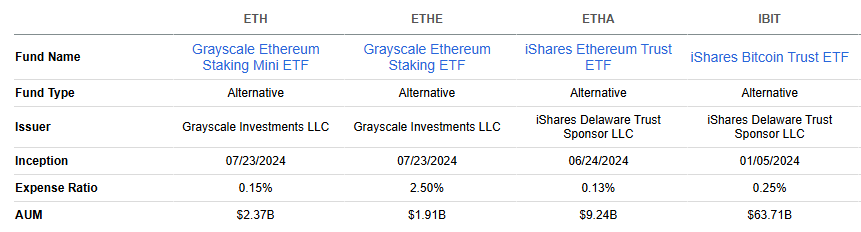
The Grayscale Ethereum Staking Mini ETF (ETH) is a passively managed exchange-traded fund designed to provide exposure to the performance of Ether. Grayscale first launched the Ethereum Staking fund on December 14, 2017 as an open-ended trust for investing in Ether without the need for a specialty brokerage account before transitioning into a listed ETF (ETHE) in 2024 to continue the legacy Trust. ETH was simultaneously launched as a low-cost ETF for investors to gain exposure to Ether in a traditional brokerage account, creating a competitive strategy following the SEC approval of cryptocurrency spot ETFs in January 2024.

Similar to Bitcoin ETFs, ETH can be held in taxable and tax-exempt accounts by investors seeking exposure to Ether as an alternative investment strategy as a component of a diversified portfolio. Given the risky nature of cryptocurrencies, investors seeking exposure to Ether should consider a 1-2% allocation to the assets.

About Grayscale Ethereum Staking Mini ETF

ETH was launched by Grayscale on July 23, 2024 on the NYSE Arca Exchange. The ETF has a competitive management fee of 15bps, on par with peer cryptocurrency funds on the market. ETH exhibits significant market depth with $2.37 billion in net assets and an average trading volume of $56.65 million in share value at the time of writing, providing investors and traders with significant liquidity and a tight 30-day average bid/ask spread of 0.04%.

Advertisement

Seeking Alpha

Seeking Alpha

ETH was designed to solely provide exposure to the performance of Ether and only holds the one asset, making this a non-diversified ETF. ETH should be considered as a speculative alternative investment strategy given that Ether holds no fundamental value as a basis for the price. Essentially, Ether will trade on the market based on supply & demand, driven by market participation and exogenous influence. For example, the price of Ether may be influenced by the development of the Ethereum network and Web 3.0 Infrastructure, public policy, and the adoption of Ether as an alternative currency.

For example, the price of Ether may be influenced by the development of the Ethereum network and Web 3.0 Infrastructure, public policy, and the adoption of Ether as an alternative currency. While these factors may influence the price of Ether, investors should take these factors with a grain of salt as the price of Ether may not uniformly perform to positive or negative influence. Given these risks, ETH may not be suitable for risk-averse investors or those with shorter investment horizons.

The fund participates in staking, which is the locking up of ETH as collateral to participate in the Ethereum network as part of the Proof-of-Stake consensus model, earning protocol-issued rewards. Upon receipt, the reward is verified by the custodian and will then be treated as an asset of the fund. As part of Grayscale’s staking policy, rewards will be liquidated into cash and distributed to shareholders pro rata.

Advertisement

Notably, staking rewards will be treated as “unrelated business taxable income” when held in a tax-exempt account like an Individual Retirement Account [IRA], making the reward subject to US federal income tax.

ETH has approximately 79.55% of the Ether staked as part of the ETF’s strategy, earning a net reward of 2.55%. ETH began paying a monthly distribution in September 2026 at a rate of $0.034765/share, annualized at $0.41/share, for a forward yield of 1.65%.

Investor Suitability

ETH may be used by both long-term and short-term investors seeking to capitalize on the potential price appreciation of Ether. Similar to Bitcoin ETFs, ETH should be considered as an alternative asset with a target allocation of 1-2% by those seeking exposure to Ether. Given the speculative nature of cryptocurrencies, ETH may not be appropriate for risk-averse investors and those nearing retirement as the performance of Ether may not be suitable for their investment needs.

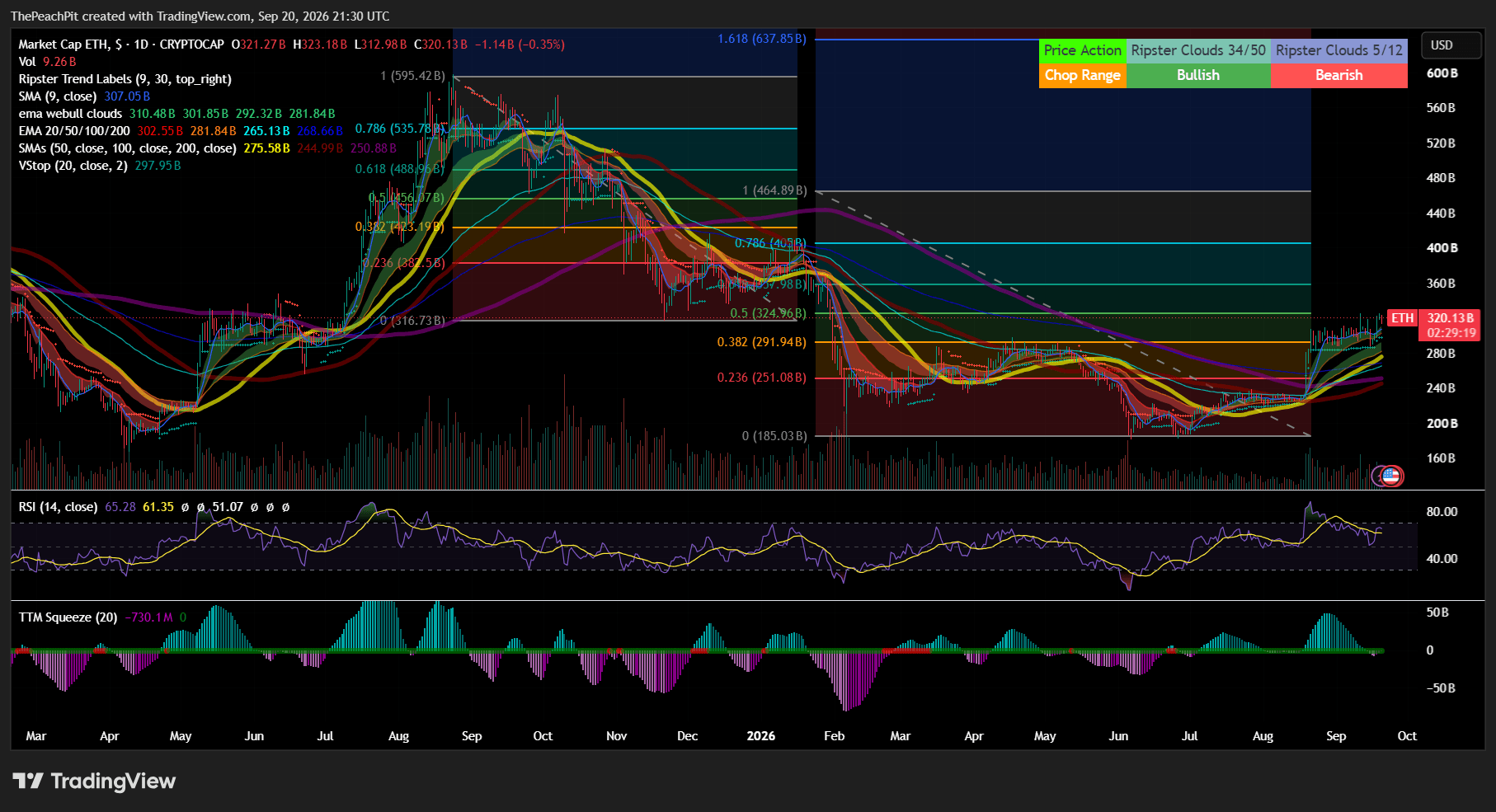
ETH may also be used by active traders seeking to capitalize on the volatility of Ether. Ethereum exhibits substantial market depth with a market capitalization of $320 billion with an active trading market. Given the active market, investors may apply technical trading tactics, such as Elliott Wave Theory, to capitalize on the trading patterns of Ethereum.

Advertisement

TradingView

TradingView

Risks Related to ETH

ETH was designed to provide investors and traders with exposure to the performance of Ether, presenting certain risks that should be considered prior to making a final investment decision. ETH is considered as a speculative asset given that Ether lacks fundamental value for deriving a price. ETH may expose investors to greater volatility and price swings, making the ETF less appropriate for risk-averse investors.

Final Thoughts

ETH can be used as a low-cost investment vehicle for gaining exposure to Ether in a traditional brokerage account. Due to the risky nature of the cryptocurrency, investors seeking a position in ETH should consider 1-2% exposure, similar to Bitcoin, as a component of a diversified portfolio strategy. Due to the risky nature of trading and investing in Ether, ETH may not be appropriate for all investors. Investors should consult with their investment advisor with regard to the tax consequences associated with Ether staking.

This article answers three questions about ETH:

Advertisement
  1. How does ETH track the performance of Ether?
  2. What impacts ETH’s performance?
  3. Which investors is ETH suitable for?

Editor’s note: This article is intended to provide a general overview of the ETF for educational purposes only and, unlike other articles on Seeking Alpha, does not offer an investment opinion about the ETF.

Continue Reading

Business

Pace Digitek shares jump 13% after subsidiary bags Rs 488 crore BESS order

Published

on

Pace Digitek shares jump 13% after subsidiary bags Rs 488 crore BESS order
Pace Digitek shares rallied as much as 13.2% to Rs 175.37 on the NSE during Tuesday’s trading session after the company announced that its material subsidiary, Lineage Power Private Limited (LPPL), secured a Rs 488.46 crore order from NTPC GE Power Services Private Limited (NGSL) for a Battery Energy Storage System (BESS) project at Barh Super Thermal Power Project (STPP), NTPC Stages I and II.

According to the company’s regulatory filing, the order covers the supply, testing, supervision of erection and commissioning of BESS containers, along with Battery Management Systems (BMS) and Energy Management Systems (EMS). The contract also includes five years of annual maintenance services and a seven-year extended warranty for the battery containers.

The project is scheduled to be completed by December 31, 2026.

The order comes as Pace Digitek continues to expand its presence across the battery energy storage system value chain, with LPPL being developed as a product-led BESS business spanning manufacturing, product supply, system integration and lifecycle support.

Advertisement

Pace Digitek said it operationalised 2.5 GWh of BESS manufacturing capacity in 2025, which has since been expanded to 5 GWh. The company plans to scale this further to 10 GWh by Q3 FY2027. So far, it has delivered BESS containers representing more than 1.5 GWh of capacity.


The company is also exploring opportunities in the commercial and industrial (C&I) segment, alongside its existing utility-scale BESS business, as demand from power-intensive users and commercial customers develops.
Commenting on the development, Venugopalrao Maddisetty, Chairman & Managing Director, Pace Digitek Limited, said: “This order is an important step in strengthening LPPL as a product-led BESS business. It brings together product supply, commissioning and long-term lifecycle support, enabling us to deepen our participation across the BESS value chain and strengthen our engagement with customers beyond manufacturing. As we scale our manufacturing capacity and strengthen localisation, integration and service capabilities, our focus is to build a broader Energy platform capable of serving utility-scale requirements as well as emerging C&I applications. We will continue to invest in the capabilities required to support customers across the lifecycle of energy-storage systems.”

Disclaimer: The views/recommendations mentioned in this article, wherever applicable, are those of the respective SEBI-registered Research Analyst/brokerage and have been reproduced/reported with due attribution. They should not be construed as the views or recommendations of The Economic Times Digital or the journalist. Readers are advised to consider the original research report and make their investment decisions based on their own assessment. Brokerage disclaimers here

Continue Reading

Business

Aurora, autonomous truck company, targeting profitability

Published

on

Aurora, autonomous truck company, targeting profitability

Take a drive in Texas on Interstate 45 between Houston and Dallas or I-20 between Fort Worth and El Paso, and you will see dozens and dozens of tractor trailers. They are two of the busiest highways in the country for trucks — and two routes where Aurora Innovation is operating completely autonomous semis.

“It’s using lasers, radar, and cameras to look all around it and see the other cars, see the other trucks on the road, and figure out how to drive safely,” said Chris Urmson, Aurora founder and CEO. He talked with CNBC’s Phil LeBeau for more than three hours as they rode in the cab of an autonomous Aurora truck.

With 20 driverless trucks currently on the road and plans to grow the autonomous fleet to 200 trucks by the end of this year, Aurora is targeting major growth over the next several years. The company’s selling point is that it says an autonomous truck can operate more efficiently and at a lower cost than a semi with a driver behind the wheel.

“We can help them [truck operators] save on fuel economy,” Urmson said. “We can move goods more quickly and then we can fill the need when they can’t hire amazing drivers for their teams.” 

Advertisement

Ravi Shanker, transportation analyst with Morgan Stanley, estimates that “an autonomous fleet should be nearly 7.5X as profitable as a human-driven fleet today.” 

Bank of America, meanwhile, estimates “Aurora services will cost ~$0.85 per mile versus approximately $1.30 per mile for human driver wages and benefits, before considering indirect labour costs.”

With its next generation of driverless trucks to hit the road, Aurora believes its “driver as a service” business model, where customers pay by the mile driven, will be attractive to shipping and freight customers looking to lower costs. 

A shortage of truck drivers in the U.S. has freight firms looking for reliable service at a lower cost. Autonomous trucks have the potential to roll for up to 20 hours a day, while a truck driver’s hours are limited by federal laws that require drivers to take breaks.

Advertisement

Sean Wu, CEO of the freight firm uShip, said he understands the appeal of a driverless truck when it comes to lowering costs, but he questions how many shipping firms will want to ditch their drivers. 

“The drivers do more than just move the rig. There is judgement. There is customer service. There is protection,” Wu told CNBC. “There is just a lot more to think about than ‘Hey they are moving a truck from point A to point B.’”

The Department of Transportation estimates there are approximately 3.5 million Class 8 semitrucks on the road in the U.S. Only a fraction are autonomous, but the market is growing, and Wall Street sees huge potential. Kodiak AI, Gatik and Tesla are also developing autonomous vehicles. 

Aurora CEO Urmson said he knows there are plenty of skeptics, including those who will continue to question the safety of a driverless truck rolling down the highway at 65 or 70 mph.

Advertisement

“We’ve got millions of miles of experience,” he said. “We put this through 15 million tests before we put it out on the road.”

As we completed our freight run in Palmer, Texas, what stood out was the fact the ride was uneventful with no disruptions. The truck pulled off the highway once for less than a minute to reset the hazard lights which had come on for some unknown reason. Otherwise, over the course of three hours on I-45, we saw more than a few double takes from truck drivers passing by who looked twice when they saw nobody behind the wheel.

For Urmson, it is another 200 miles where Aurora’s autonomous driving technology has delivered a shipment. Since it began testing its AV technology on public roads in 2022, Aurora has logged more than 440,000 miles. Most of those included a human safety operator behind the wheel in case the technology failed.  

After losing more than $800 million in 2025, Aurora is targeting positive free cash flow by 2028, driven by a substantial increase in the number autonomous trucks on the road.

Advertisement

“We’ve been able to put out timelines and we’ve basically hit those timelines,” he said.

Continue Reading

Business

Viking Therapeutics: The Market Might Shrug Off The Maintenance Data (NASDAQ:VKTX)

Published

on

Businesswoman Sleeping in a Conference Room With a Blank Screen

This article was written by

Scientist and trader of biotech stock. Focus on trading around events such as trial results and NDA/BLA approvals. Also covering companies in industries regulated by the FDA. Articles present my opinion on stocks, but don’t constitute investment advice.

Analyst’s Disclosure: I/we have no stock, option or similar derivative position in any of the companies mentioned, and no plans to initiate any such positions within the next 72 hours. I wrote this article myself, and it expresses my own opinions. I am not receiving compensation for it (other than from Seeking Alpha). I have no business relationship with any company whose stock is mentioned in this article.

Seeking Alpha’s Disclosure: Past performance is no guarantee of future results. No recommendation or advice is being given as to whether any investment is suitable for a particular investor. Any views or opinions expressed above may not reflect those of Seeking Alpha as a whole. Seeking Alpha is not a licensed securities dealer, broker or US investment adviser or investment bank. Our analysts are third party authors that include both professional investors and individual investors who may not be licensed or certified by any institute or regulatory body.

Advertisement
Continue Reading

Trending

Copyright © 2025