
Crypto World
Bessent Could Add AI Czar Title to Treasury Chief: Conflict Ahead?

US Treasury Secretary Scott Bessent could take on a new role as President Donald Trump’s artificial intelligence (AI) czar, a source familiar with the discussions told Reuters.
No final decision has been made, a second source said, and the Treasury has not issued a public comment. These rumors come as Trump has downplayed calls for stricter AI oversight.
A Treasury Chief Wearing Two Hats
Trump said Saturday he would form an AI Force and name an AI czar, modeled on the Space Force. He gave no details on either initiative.
Bessent already sits at the center of Washington’s AI diplomacy. He led AI risk talks with China in New York on Sunday. That was ahead of Trump’s summit with Chinese President Xi Jinping this week. Washington proposed an AI safety notification system and a US-China AI dialogue, with a focus on national security.
The Treasury chief’s plate is already full. Trump has previously tapped Bessent to lead a revamp of US trade policy and negotiate Ukraine’s critical minerals deal. He also briefly ran the Consumer Financial Protection Bureau (CFPB). Today, he serves as acting commissioner of the Internal Revenue Service (IRS). His department is separately leading a push to isolate Iran through sanctions.
A Need for a Dedicated Treasury Head
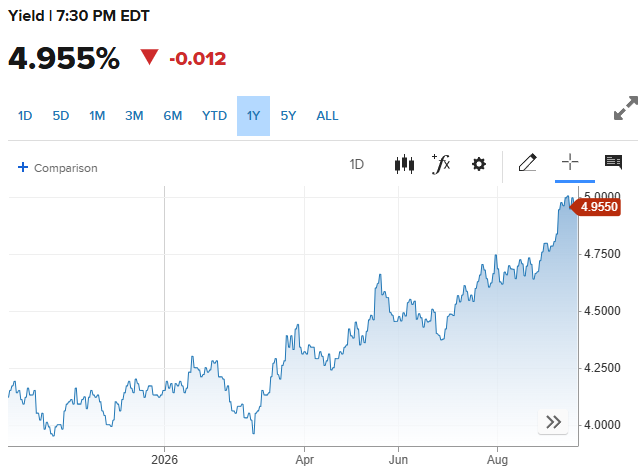
Meanwhile, Bessent’s core job has gotten harder. The 10-year Treasury yield hit a 19-year high near 5.04% last week before retreating to about 4.95%. HSBC now projects a lower 10-year yield near 4.65% by year-end. Other forecasters see it climbing toward 5.3%, with some flagging a 6% risk further out.

That volatility adds pressure just as Trump weighs handing Bessent a second title. Traders have already priced sharp swings in Federal Reserve rate expectations this month. Any sign that Treasury leadership is stretched thin could shape how markets read the department’s next move.
His well-known skepticism toward AI regulation will likely shape whatever mandate the next czar receives. Whether Bessent can manage bond markets, sanctions enforcement, and AI policy at once is an open question. The coming weeks should offer an answer.
The post Bessent Could Add AI Czar Title to Treasury Chief: Conflict Ahead? appeared first on BeInCrypto.


If you’ve had trouble finding something to watch on Netflix (NFLX) lately, you’re not alone. The streaming giant has faced intense competition from rival platforms while also struggling to keep turning out the high-quality hits that hold users’ attention — and it’s showing up in Netflix stock. The picture isn’t entirely bleak. Earnings have continued to grow this year, but…
Copyright ©2026 Investor’s Business Daily, LLC. All rights reserved. 87990cbe856818d5eddac44c7b1cdeb8
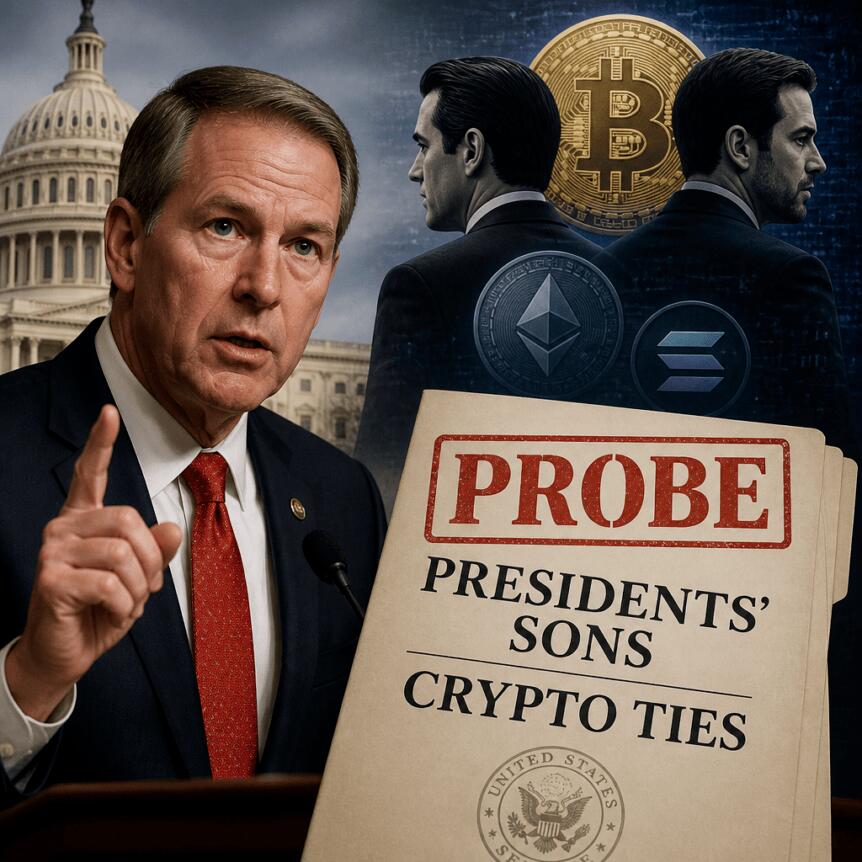
Republican Sen. John Curtis of Utah has urged the Senate Judiciary Committee to investigate whether Donald Trump’s son and President Joe Biden’s son used family ties to the presidency for private gain, with Curtis explicitly pointing to their involvement in cryptocurrency and related financial activities.
In a letter sent to Judiciary Committee Chair Chuck Grassley and ranking member Dick Durbin, Curtis requested subpoenas for Donald Trump Jr. and Hunter Biden, arguing the committee should examine whether presidential family relationships were used for “private financial benefit, preferential treatment, or access by domestic and foreign interest.”
Key takeaways
- Sen. John Curtis asked the Senate Judiciary Committee to investigate Donald Trump Jr. and Hunter Biden using subpoenas.
- Curtis’ allegations focus on potential conflicts of interest and how presidential connections may have translated into value for business dealings.
- For Donald Trump Jr., Curtis specifically cited crypto-linked roles and advisory activities, noting they fall under the regulatory scope of the CFTC.
- Curtis linked Hunter Biden’s case to “substantial business with foreign entities” and the alleged use of presidential ties for advantage.
- The push for investigations arrives amid continued uncertainty around US crypto market-structure legislation, after the Digital Asset Market Clarity Act failed to advance.
Curtis targets crypto and family ties in requested subpoenas
According to Curtis’ letter, the committee should probe whether the sons’ proximity to their respective fathers influenced financial outcomes. He argued the investigation should “establish the facts,” determine which ethics, disclosure, or anti-corruption laws may apply, and identify reforms to ensure the presidency is not used as “a vehicle for private enrichment by those closest to it.”
For Donald Trump Jr., Curtis highlighted multiple points, including the former president’s son’s acceptance of gifts from Russian oligarch Umar Kremlev tied to a wedding, as well as what Curtis described as “active promotion of family-backed cryptocurrency ventures.” The senator also referenced advisory roles with prediction market platforms, arguing those platforms are within the scope of the Commodity Futures Trading Commission.
Curtis also pointed to President Trump’s public statement last week that Donald Trump Jr. had repaid Kremlev for what the couple described as a “generous wedding gift.”
Hunter Biden scrutiny centers on foreign business and possible implied access
Curtis’ request did not stop with Trump Jr. He also called for a similar probe into Hunter Biden, citing what he characterized as “substantial business with foreign entities.”
In the letter, Curtis argued that the committee should look at situations where either man’s relationship to the presidency was “invoked or understood to provide value.” Curtis noted that President Biden issued a pardon for Hunter Biden in December 2024 for crimes Hunter “committed or may have committed or taken part in over the last decade,” and referenced Hunter Biden’s position that he did not involve his father in business dealings.
The senator framed the issue less as a determination of wrongdoing at the outset and more as a fact-finding and legal assessment exercise aimed at clarifying whether existing rules were triggered and what safeguards should be strengthened if they were not.
Why this matters as crypto policy remains contested in the Senate
Curtis’ letter arrives in a political climate where crypto oversight and market regulation continue to be difficult to reconcile in Congress. The renewed push for investigations follows a week after Senate Republicans failed to secure enough Democratic support for the Digital Asset Market Clarity Act, a bill expected to lay out market-structure rules for digital assets.
Some Democrats said they were not willing to support the bill because of concerns that President Trump would “use crypto to turn the presidency into a profit generating machine.” The president has also disclosed that he earned $1.4 billion from ventures tied to digital assets in 2025, according to coverage referenced in the underlying reporting.
Republicans argued the bill incorporated stronger ethics provisions that would affect the president’s crypto investments ahead of the vote. Still, many Democrats maintained that the measures did not go far enough to prevent corruption and improper influence.
Against that backdrop, Curtis’ focus on subpoenas and potential conflict-of-interest patterns reflects a broader theme: even as legislators debate how to regulate crypto markets, they are also pushing for scrutiny of whether public office—and the public’s perception of access to officeholders—can be leveraged through crypto-related business activity.
Investigations into the Trump family’s crypto ties already featured in this Congress
Curtis’ request is not the first attempt during the current Congressional session to draw lawmakers’ attention to potential crypto conflicts around the Trump family. Earlier calls for probes have largely come from House and Senate Democrats, who urged authorities to examine possible conflicts connected to Trump’s memecoin, his family’s World Liberty Financial business, and a separate $500 million deal associated with Abu Dhabi’s royal family.
Earlier coverage also pointed to Senate Democrats pushing for hearings and oversight into whether crypto ventures created incentives that blurred the line between official responsibilities and private financial interests.
Curtis is serving his first term in the Senate and is not up for reelection until 2030.
Readers should watch whether the Judiciary Committee agrees to act on the subpoenas Curtis is urging, and how that decision may intersect with the Senate’s stalled efforts to pass broader market-structure legislation—particularly as lawmakers continue to debate whether existing ethics frameworks can effectively address alleged conflicts tied to crypto.
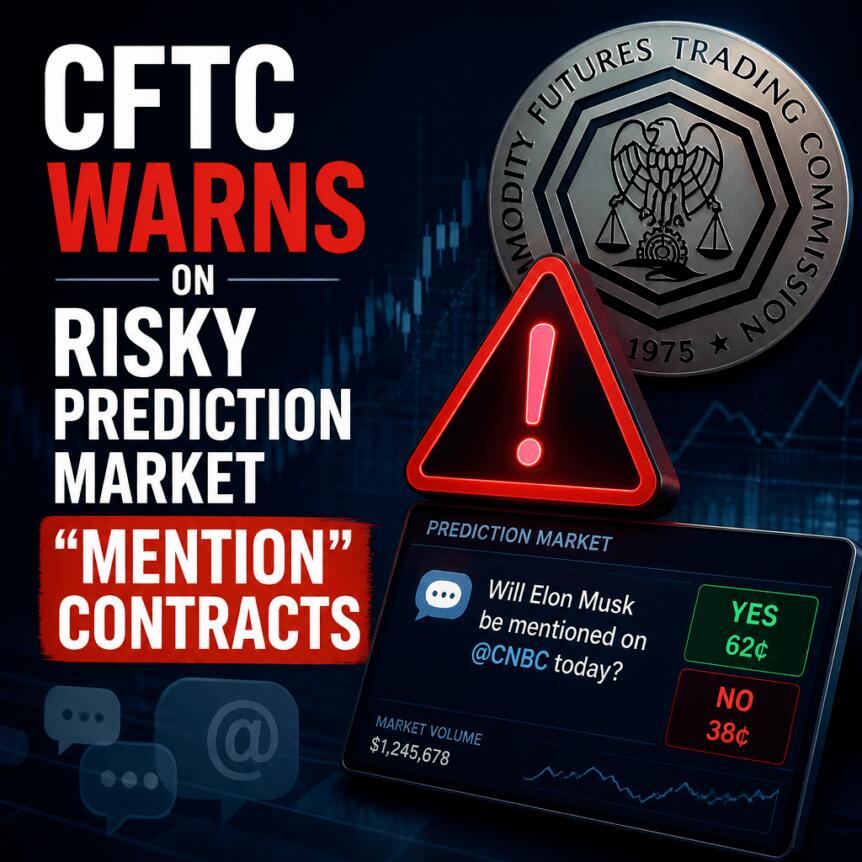
The U.S. Commodity Futures Trading Commission (CFTC) has issued fresh guidance warning that “mention markets” in prediction trading—contracts that settle based on whether a specific person says certain words, attends an event, appears publicly, or interacts with someone—face a heightened risk of manipulation. The regulator’s advisory signals that exchanges seeking to list these products may need to clear a higher bar on oversight, verifiability, and susceptibility to external influence.
In a statement released Tuesday, the CFTC’s Division of Market Oversight said that listing these contract types is generally limited to “limited circumstances” consistent with the Commodity Exchange Act. The agency’s remarks come amid broader scrutiny of how prediction markets are structured and policed, including enforcement actions tied to alleged trading around privileged information.
Key takeaways
- The CFTC warns that mention markets settle on discrete personal conduct that may be neither independently generated nor externally verifiable, increasing manipulation risk.
- Exchanges are encouraged to apply a stricter checklist, including oversight capability and whether settlement triggers are verifiable.
- Recent enforcement in the prediction market space underscores the agency’s focus on information asymmetry and conduct-based settlement mechanics.
- Separate reporting highlights unusual Kalshi trading in an Ether-related market, adding to questions about integrity monitoring even as the platform rejects manipulation claims.
Why the CFTC singled out “mention markets”
The advisory, issued by the CFTC’s Division of Market Oversight, is aimed at regulated entities responsible for bringing contracts to market. The CFTC described mention markets as event-driven derivatives where the settlement depends on what an individual does—such as saying specific words or showing up—rather than on market-wide outcomes or easily measurable external data.
According to the regulator, this structure can create a “heightened risk of manipulation” because the settlement outcome hinges on a person’s conduct, which may not be independently produced and may be hard for outsiders to verify reliably.
The CFTC’s position effectively reframes the issue: it is not merely the fact that a contract references an event, but how the contract defines what counts as an outcome and whether that outcome can be checked without ambiguity.
The agency’s checklist for exchanges
Reporting from CNBC indicates the CFTC letter highlights four considerations that exchanges should evaluate before listing mention-market contracts. Those factors include whether the exchange has adequate oversight measures to detect manipulation, whether the words or actions used for settlement are independently verifiable, whether outside pressure could influence the subject’s conduct, and what obligations the subject of the contract may have.
The regulatory guidance also reinforces that exchanges and contract-issuing parties are expected to think beyond the initial listing proposal. In the CFTC’s framing, the exchange’s role in monitoring market behavior and safeguarding contract integrity becomes central—particularly where the settlement trigger could be influenced by the very person referenced in the contract.
CFTC Chair Mike Selig publicly welcomed the staff guidance on Tuesday, posting that “regulatory clarity drives sound markets,” and stating that the advisory reminds designated contract markets (DCMs) of their obligations to list contracts that are not readily susceptible to manipulation.
The CFTC’s guidance, published as an official advisory, can be found via the regulator’s press materials: CFTC.
Enforcement momentum in conduct-based prediction contracts
The warning is arriving against a backdrop of legal action focused on manipulation risks in prediction markets. Earlier coverage highlighted a case involving a former White House teleprompter operator whose trading was tied to U.S. President Donald Trump’s speeches. That matter reportedly resulted in an order requiring the individual to return $107,539 in profits and pay a $65,000 civil penalty.
Earlier reporting on the enforcement details came from Cointelegraph, including coverage of how the matter related to “Kalshi” contracts tied to what the president would say. The recurrence of scrutiny around speech- and conduct-based settlement mechanisms helps explain why the CFTC is emphasizing the “discrete conduct” problem: when a contract’s payoff is linked to an individual’s behavior, regulators are more likely to see opportunities for information advantages and influence.
Notably, the CFTC’s advisory wording points to a core compliance dilemma for prediction markets: the more directly a contract settles on a person’s specific actions, the more difficult it can be to demonstrate that the settlement will be independently generated and verifiably fair.
Broader scrutiny extends beyond “mention” products
Separate from Tuesday’s mention-market warning, new reporting has drawn attention to unusual trading behavior on Kalshi, a platform that offers event-based contracts. According to a Wall Street Journal report, nearly one million trades worth more than $5 billion occurred in a single market tied to the price of Ether. The Journal said that more than a third of those trades took place in nearly identical amounts around $5,500.
The Wall Street Journal also reported that federal regulators and traders have taken notice of the activity. Kalshi, however, rejected suggestions that the transactions amounted to wash trading, according to the same coverage.
While this Ether-related episode does not necessarily involve the same “mention” contract mechanics, it fits into a larger pattern: regulators and market participants are increasingly focused on whether trading activity and settlement designs can be squared with market integrity expectations. For investors and traders, this means due diligence is likely to extend beyond whether a product is popular or liquid, and toward how an exchange identifies unusual activity and enforces its rules.
Earlier, CNBC and NPR reported in August that the CFTC had begun examining mention markets over manipulation concerns. The reporting also said that Kalshi removed mention markets tied to sporting events “until further notice” while the review proceeded, reflecting the practical impact guidance and enforcement can have on what exchanges list and how quickly they respond to regulatory pressure.
What to watch next
For exchanges and market makers, the immediate question is how strictly they will apply the CFTC’s “limited circumstances” framing when assessing new mention-market proposals, and whether they will tighten verification and monitoring procedures. For traders, the larger takeaway is that conduct-based settlement mechanics—especially where external influence or verifiability issues exist—will likely remain under the microscope, even as platforms continue expanding prediction product lineups.
Crypto World
Did Jim Cramer Just Give GameStop Stock the Kiss of Death When He Said the Turnaround Is Working?


Markets can forgive a company a lot when investors can see a path to growth. GameStop (GME) has spent years searching for that path, moving from video-game retailer to meme-stock phenomenon and now to a company increasingly built around collectibles. The latest numbers suggest the strategy may be working operationally. But a better business does not automatically make a better stock.
GameStop touched a two-year intraday low of $17.79 on Aug. 20. By Sept. 17, it had closed at $22.77, a 28% gain from that low. The rally comes as Jim Cramer says the turnaround is finally taking hold.
More News from Barchart
That may be true. The bigger question for investors is what they are actually buying.

GameStop Is Becoming a Collectibles Company
Let’s start with the good news. GameStop’s latest transformation is showing up in the income statement.
In its fiscal second quarter ended Aug. 1, collectibles revenue jumped 57% year-over-year (YoY) to $356.3 million, representing 45.1% of total sales. Video-game revenue, meanwhile, fell 47% to $263.2 million.
The shift is unmistakable. GameStop still sells video games and pre-owned products while maintaining a small Bitcoin (BTCUSD) position, but collectibles are increasingly the centerpiece. The company generated $160.2 million of operating income in the quarter, up from $66.4 million a year earlier, and raised its fiscal 2026 adjusted EBITDA forecast to more than $650 million.
The collectibles market is large—Grand View Research estimates it will reach $335.7 billion globally in 2026 and $535.5 billion by 2033—but GameStop is hardly alone.
eBay (EBAY) operates a massive secondary marketplace, while Target (TGT) says its trading-card business was on track to exceed $1 billion in 2025. The Pokémon Company sells collectibles and trading cards directly through Pokémon Center, while Hasbro (HAS) uses its Wizards of the Coast business and its Secret Lair store to sell premium Magic: The Gathering products directly to fans. That’s a pretty crowded field, one populated with bigger, healthier, and better-financed businesses.
Cramer Says Buy. Inverse Cramer Says What?

Monica Caldas says she likes “living on the edge.” She’s tasked with rewiring a century-old company for what she calls “the intelligence era.” As EVP and global CIO at Liberty Mutual, her core idea is doing two hard things at once, modernizing old systems while rebuilding around AI. That means embedding AI across core work like underwriting and claims, with more than 100 capabilities already in production.
In May, Liberty became the first insurer to launch a ChatGPT auto-quoting app, part of a bigger bet on “agentic commerce,” where buying insurance shifts from filling out forms to simply having a conversation. “I love to solve big, hairy things with tech,” Caldas says. Her drive started early. She arrived in the U.S. from Portugal in third grade without knowing a word of English and became the first in her family to go to college.





Join Our Telegram channel to stay up to date on breaking news coverage
Strategy bought 950 bitcoin for roughly $75.7 million last week and paid for it from cash on hand rather than new stock sales, according to an 8-K filing dated Sept. 21. The company, formerly known as MicroStrategy, now holds 846,000 BTC, its highest reported total since June.
The filing covers purchases made between Sept. 14 and 20 at an average price of $79,670 per coin. Across all holdings, Strategy has spent about $63.8 billion, an average of $75,416 per bitcoin.
A change in how the buying is funded
What marks this filing out is the funding. Strategy’s recent accumulation runs have typically been financed through at-the-market equity offerings, selling new shares to raise cash. This time the company said the purchases came from its USD Cash reserve, which stood at $1.05 billion as of Sept. 20. A second bucket, the USD Reserve, held $5.04 billion on the same date.
The same filing shows Strategy repurchased 1,771,238 shares of its STRC preferred stock for $174 million, and used $57.4 million of the USD Reserve to pay preferred dividends and interest on outstanding debt. It reported no bitcoin sales under its at-the-market offering during the week.
The shift matters because it suggests the company is no longer leaning on new share issuance to fund the treasury, after a stretch in which its preferred stock traded below par and reserve money went to servicing it. The filing discloses the buyback but not its rationale.
Mark-to-market figures from the week put the holdings at around $71.9 billion, implying roughly $8.1 billion in paper gains. Those numbers move with bitcoin’s price and should be read as a snapshot, not a balance.
846,000 BTC is more than 4% of bitcoin’s 21 million supply cap. The company’s reported peak was 847,363 BTC in June, before it sold 1,363 coins.
Join Our Telegram channel to stay up to date on breaking news coverage

Accenture works with many Fortune 500 companies, helping them deploy AI without becoming locked into a single model or platform. The company has already generated billions of dollars in generative AI bookings, while Guan says deployments for clients like the Australian bank Westpac have cut some workflows from months to days.
Now she’s tackling the cost of scaling those systems. Accenture has recently focused on tokenomics, arguing that firms incorrectly default to the most powerful—and expensive—models even when the work doesn’t require such heft. “Only about 20% of enterprise workflows actually deserve frontier models,” she says.
The U.S. Commodity Futures Trading Commission (CFTC) has issued a warning to regulated exchanges about “mention markets,” a type of prediction contract that settles based on whether a person says or does something. In a Tuesday advisory, the regulator said these contracts carry a heightened risk of manipulation and should only be listed in limited circumstances under the Commodity Exchange Act.
The guidance comes as prediction market activity draws growing regulatory scrutiny, particularly after enforcement actions tied to allegations that traders benefited from non-public information. For exchanges weighing whether to list event contracts tied to an individual’s specific words or conduct, the CFTC’s letter lays out a framework for assessing settlement verifiability and oversight readiness.
Key takeaways
- The CFTC says “mention markets” present a heightened manipulation risk because settlement depends on a person’s discrete conduct, which may not be verifiable or independently generated.
- The commission advised that there are only “limited circumstances” where mention markets can be listed consistently with the Commodity Exchange Act.
- Exchanges should evaluate oversight capabilities to detect manipulation and whether settlement criteria are independently verifiable.
- External pressure that could influence the subject’s conduct—and any related obligations the subject may have—are part of the CFTC’s review.
- The warning follows enforcement involving prediction contracts tied to political speeches, underscoring the regulator’s focus on information advantage and settlement conduct.
Why “mention markets” drew a regulator warning
In its advisory, the CFTC’s Division of Market Oversight said mention markets—contracts based on whether an individual will say certain words, attend or appear at an event, or interact with another person—may be inconsistent with the Commodity Exchange Act except in narrow cases.
The regulator’s central concern is that the settlement mechanism relies on conduct that can be neither independently generated nor externally verifiable. According to the CFTC, that structure “presents a heightened risk of manipulation” because it can make it easier for market participants to affect outcomes or profit from information advantages related to someone’s future actions.
The CFTC press release about the advisory is available via the regulator’s website: https://www.cftc.gov/PressRoom/PressReleases/9302-26.
Enforcement history is shaping the regulator’s approach
The CFTC’s warning arrives amid a string of allegations and cases where traders were accused of using privileged information to profit in prediction markets. One prominent example cited in the report involves a former White House teleprompter operator who was ordered last month to return $107,539 in profits and pay a $65,000 civil penalty related to contracts tied to then-President Donald Trump’s speeches.
Earlier coverage from Cointelegraph discussed that case in the context of how politically tied prediction contracts can intersect with information access. See: https://cointelegraph.com/news/trump-teleprompter-operator-made-100k-betting-kalshi-markets-tied-to-speeches-abc.
By emphasizing the risks tied to “discrete conduct” and limited verifiability, the CFTC’s guidance signals that settlement design matters as much as trading behavior. Even if a contract’s price action reflects legitimate market views, the regulator appears concerned when the contract outcome can be influenced—or when market participants can act on information about what a person will do or say before that conduct becomes public.
What exchanges are expected to consider
According to reporting by CNBC, the CFTC letter outlines four factors that exchanges listing mention markets should consider:
- Whether there are adequate oversight measures in place to detect manipulation.
- Whether the words or actions used for settlement are independently verifiable.
- Whether external pressure could influence the subject’s conduct, potentially affecting whether the event occurs as expected.
- What outside obligations the subject of the mention market may have, which could shape their behavior or the likelihood that the contract condition will be met.
This checklist frames mention markets not just as a novel product category, but as a compliance and risk-management challenge. Exchanges that previously treated these contracts as straightforward event bets may now need to demonstrate stronger controls around how outcomes are determined and how manipulation could realistically occur.
CFTC leadership ties the advisory to “regulatory clarity”
CFTC Chair Mike Selig publicly welcomed the guidance in an X post on Tuesday, saying that “regulatory clarity drives sound markets.” In the post, he referenced staff reminding designated contract markets (DCMs) of their obligation to list only contracts that are not readily susceptible to manipulation.
The chair’s post is available at: https://x.com/ChairmanSelig/status/2102500746834874859?s=20.
While the advisory is addressed to regulated entities, the implications extend across the broader prediction market ecosystem. As more contracts are designed around human behavior—rather than purely observable, externally confirmed outcomes—platforms may face tighter scrutiny on whether the settlement criteria can be verified without ambiguity and whether market structure could incentivize gaming of the subject’s conduct.
What to watch next for prediction markets
Exchanges considering mention markets will likely need to document how their oversight can identify manipulation and how settlement conditions can be verified. The most immediate uncertainty for market participants is how broadly regulators will interpret the “limited circumstances” standard—particularly as more politically or socially contingent contracts come under review.

38 Years Later, HBO Max’s ‘Widow’s Bay’ Replacement Is a Streaming Blockbuster

RBA Board Member Iain Ross Rejects Wage-Price Spiral Threat, Pointing to Enterprise Bargaining Protections

This Bearish Netflix Stock Trade Can Cash In On Video Streaming Giant’s Woes




-

 Fashion4 days ago
Weekend Open Thread: Talbots – Corporette.com
-

 Tech2 days ago
Researchers escape OpenAI Codex sandbox to run commands on host
-

 Crypto World4 days ago
Circle launches Arc Studio AI agent for building onchain apps
-
 NewsBeat4 days ago
Trump says US has reached an agreement to take permanent control of Greenland’s security
-

 Crypto World2 days ago
Who Needs CLARITY Anyway? ARB Could See 70X Increase: Hodler’s Digest
-

 Crypto World4 days ago
Bitcoin price breaks channel as RSI climbs to 63
-

 Crypto World4 days ago
Trading Bitcoin on Robinhood? Why 2% Spread Has Traders Worried
-

 Crypto World6 days ago
US Charges Robinhood Engineers Over Crypto Listing Trades
-

 Crypto World5 days ago
Mortgage and refinance interest rates today, Thursday, September 17, 2026
-

 Crypto World4 days ago
World Money launches in 150+ countries with Stripe
-

 Business2 days ago
Analog Devices (ADI) Bets $1.35 Billion on Chips that Let Machines Think for Themselves
-

 Crypto World5 days ago
Silver prices recover quickly, hitting weekly high today
-

 Tech5 days ago
GPT-6 Astra Reached the Nether in Minecraft, Lost Its Stash to a Creeper, and Farmed Potatoes for Hours
-
 NewsBeat4 days ago
US was ‘on brink of war’ with China over false AI report of nukes moving in Middle East
-

 Crypto World2 days ago
Coinbase, Robinhood, Circle Seen as Tokenized-Stock Winners
-

 Crypto World2 days ago
Bitcoin price holds above $81K as key catalysts line up
-

 Business4 days ago
Newsom accelerates AI oversight, advances ‘kill switch’ plan
-

 Crypto World4 days ago
CFTC sends crypto market structure rulemaking to White House
-
 Crypto World23 hours ago
Meta Jumps 11% As Muse Shines and Investors Show an Appetite for Advancing AI
-
Crypto World5 days ago
Ethereum’s Path to $3,000: All Eyes on This Level Now
You must be logged in to post a comment Login