
Join Mikko Hyppönen and security leaders from the NFL, CHANEL, and Atlassian for a two-hour digital summit on what AI-speed attacks change, what defenders should stop doing, and how to validate, decide, fix, and re-validate at machine speed.
Tech
New ClosedQuorum Windows malware uses AI for attack decisions



A new Windows malware named ClosedQuorum uses Google Gemini, DeepSeek, Qwen, and Mistral AI models to autonomously determine the actions to take during post-compromise stages of an attack.
The Go-based malware acts with no commands from a human operator, using reconnaissance information and a voting system to decide its next step on infected hosts.
When votes are tied, DeepSeek has priority at making the final call, based on the option it considers most appropriate, followed by Qwen, Mistral, and Gemini.
Cisco Talos researchers analyzing ClosedQuorum say that the models are restricted to a predefined set of decisions, including:
- steal — simultaneously runs LSASS credential dumping, browser (Chrome, Edge, Firefox) credential theft, and cryptocurrency-wallet (MetaMast, Exodus, Ethereum) extraction
- inject — generates shellcode, then uses either process hollowing or Early Bird APC injection
- persist — executes the malware’s persistence module
- move — included as a possible lateral movement decision, but the analyzed distribution build has no corresponding handler, so it cannot execute this action
The stolen details are then passed to the operators via a Discord webhook, so apart from the malware delivery, the attack can be fully automated.
.jpg)
Source: Cisco
Talos describes ClosedQuorum as the first publicly documented Windows implant to delegate tactical command-and-control (C2) decisions to a panel of AI models, commenting that this adds greater speed and scaling potential to malicious operations.
The researchers also highlight that this eliminates human interaction, allowing the attack chain to proceed at any time.
However, Cisco notes that this may also pose challenges in certain cases where rate limits are hit, output is malformed, or commercial APIs that the system relies on are temporarily unavailable.
Since it is not a sophisticated piece of malware, it is unclear if ClosedQuorum is a test or experiment. However, the researchers warn that it represents an “architectural shift towards attack-chain automation.”
“While we do not have confirmation of in-the-wild deployment, artifacts from the binary were used to connect the developer to postings on criminal forums related to carding, dating back to 2025,” explains Cisco Talos.
The binary that Cisco Talos analyzed contains placeholder API credentials and a dummy Discord webhook, although the creators can add those in their custom ClosedQuorum builds.
Cisco Talos discovered ClosedQuorum through CAIRN, an open-source toolkit it released to help researchers track and analyze AI-integrated malware.


Continue Reading
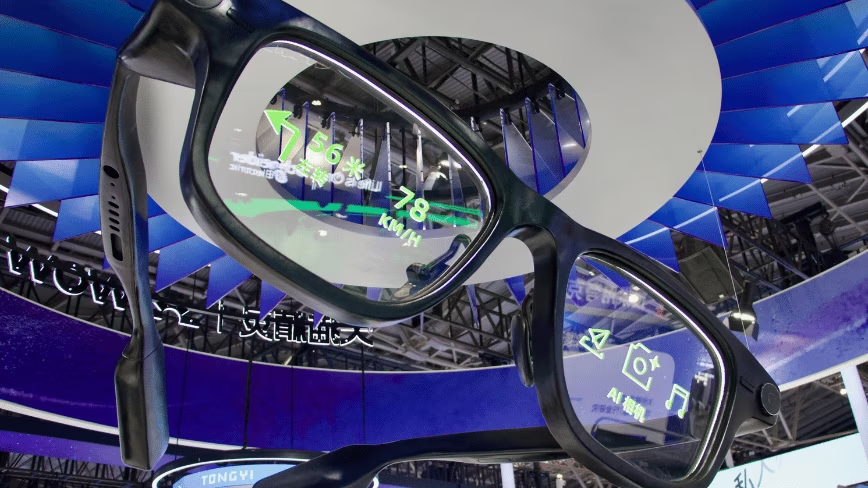
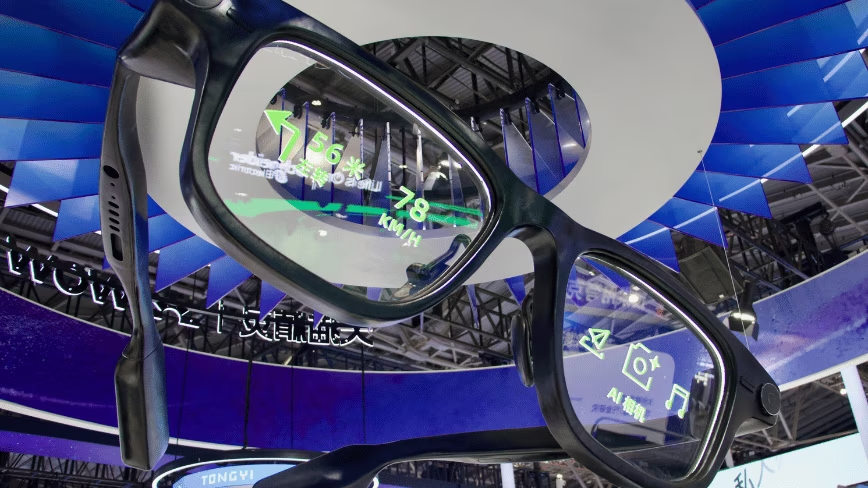
Smart glasses may look cool but there’s absolutely no place in our schools or classrooms for them.
Sabine Winton said that on Tuesday. Western Australia’s education minister was announcing what she called the country’s most comprehensive ban on the devices.
It is not a policy statement. The same day, the department’s director general Jay Peckitt issued an instruction to every public school principal in the state. It takes effect on 12 October, the first day of Term 4.
What the instruction actually orders
The CEO Instruction is short and unusually specific.
Principals must stop students and staff wearing, using, charging or storing the glasses on school premises. The same applies at any school organised event or activity. The charging clause matters, because it closes the locker.
Principals must also bar parents, carers, visitors and contractors from bringing the devices onto school grounds at all. The instruction says the ban should reach government residential colleges too, through separate mechanisms.
It runs on real legal authority rather than guidance. The director general issues it under section 233 of the School Education Act 1999. Principals enforce it under regulations 69 and 70. Those let a principal direct people on school premises, and bar an item from coming in. Both rules say the school must display the order publicly.
The risk nobody expected on the list
The instruction names six risks. Four are the ones you would guess: privacy, child safety and wellbeing, unauthorised recording, and cyber security.
The fifth is disruption to teaching. The sixth is examination and assessment integrity.
That last one reframes the device. The instruction’s own definition runs well past a camera. It lists audio recording, video, photography, artificial intelligence functionality and live streaming. Then internet connectivity, facial recognition, information retrieval and communication.
Principals can still approve the glasses for medical, accessibility or assistive technology use, and for educational programmes they authorise themselves. Students who break the rule fall under the student behaviour policy, staff under staff conduct and discipline. Principals can tell visitors and contractors to take the devices off, and to leave if they refuse.
No incidents, on the record
Winton said the education department has recorded no instances of smart glasses being used irresponsibly in WA schools.
Prevention is the stated driver. Callum Liddelow and Courtney Withers reported the ban for ABC News. Winton pointed to growing community concern about careless, criminal and malicious use, not to anything that has happened in a classroom.
Kya Graves runs the WA Principals Federation. She told the ABC that principals had been writing their own school-level policies, with no departmental decree to work from. Some had incidents on their sites and put measures in place themselves.
Tama Leaver teaches internet studies at Curtin University. The worst outcome would be indecent recording of children, he told the ABC. He raised deepfakes as the second risk, and said it takes about 30 seconds of footage to make one with rudimentary tools.
Canberra asked the councils to do it
The federal government is the one part of this not acting.
Attorney-General Michelle Rowland ruled out an import ban on 31 August. Erin Handley reported for the ABC that Rowland said the government was not consulting on one, though it was not ruling anything out on other measures.
In its place she offered a privacy overhaul. The draft laws carry a right to erasure from large platforms and search engines, a fair and reasonable test on data collection, and meaningful consent rules. An identity document service called IDLock is due in 2027.
Rowland also encouraged councils to restrict the glasses in their own facilities, and suggested retailers could police change rooms.
The eSafety commissioner put the other side. The devices help people with disability, through speech to text for deaf users and scene descriptions for people with low vision.
The councils took the invitation
Matthew Taylor reported for Lawyers Weekly that the City of Sydney and Canterbury-Bankstown have now barred the glasses from their pools and fitness facilities, joining Brisbane and Yarra.
Councillor Matthew Thompson put the motion on Monday. It directs the chief executive to review the council’s conditions of entry and update them, covering leisure centres, libraries, council childcare centres and community centres. The document notes the pools already excluded the glasses.
Canterbury-Bankstown got there first and wrote in enforcement. Its staff can order patrons to remove the eyewear, confiscate it, and move on anyone who refuses. Women and parents raised the concerns that started it.
Brisbane barred non-consensual use of camera-enabled devices at its 21 public pools, a category taking in phones and ordinary cameras. Gold Coast is considering the Brisbane model, Adelaide is weighing its own, and the City of Vincent in Perth ordered a report last week.
Thompson wants the import ban Rowland declined. He told TechRadar that Canberra has left the problem with councils. Federal crossbenchers asked for the same ban in late August.
The office is next
Employment lawyers are now telling Australian employers to write their own rules.
Paul O’Halloran, a partner at Dentons, told Lawyers Weekly the technology exists in public and workplace settings for one practical reason, which is to record people without their knowledge or consent. He said it should be banned outright.
He called the technology insidious, because unlike a phone or a camera there is no obvious moment of recording. That is the feature rather than the flaw, he said.
O’Halloran argues employers already carry the risk. Privacy law and work health and safety codes oblige them to protect staff from harm, including covert surveillance. An employee could be recorded all day, in meetings, in break rooms, even in bathrooms and change facilities, and neither the employer nor the person filmed would know.
Michael Byrnes, a workplace relations partner at Swaab, put it more plainly. Employers should have no hesitation in banning the glasses, he said, and telling staff not to wear them is a reasonable and lawful direction.
His specific worry is audio. Secretly recording private conversations potentially breaches surveillance devices legislation.
Byrnes allows two exceptions. Employees with a visual impairment should be able to use them as far as the work requires. Where the glasses reduce a genuine safety hazard, that may also justify them, with rules on retaining and using any recording.
Three statutes already cover this ground: the NSW Workplace Surveillance Act 2005, the Privacy Act 1988 and the Fair Work Act 2009.
What the evidence says
A University of Sydney study sampled 350 public Instagram videos shot on smart glasses. It found that around 60% could potentially count as harassment of a person or people. We covered that research in August, and the way the algorithm pushed those videos.
Independent testing published this week found a second problem. A hacker can get into some ultra-cheap smart glasses without a password.
People have started building their own defences. A Polish developer released an app that detects the glasses over Bluetooth.
Not only Australia
Courts in England and Wales barred the glasses in August. New York state courts did the same in July. In the United States, cinemas, schools and Immigration and Customs Enforcement have all restricted them.
Australia already banned social media for under-16s, and Victoria bars wearables in schools from January 2027. South Australia’s attorney-general, Kyam Maher, is taking advice on whether state law is adequate, and has been talking to Rowland about nationally consistent rules.
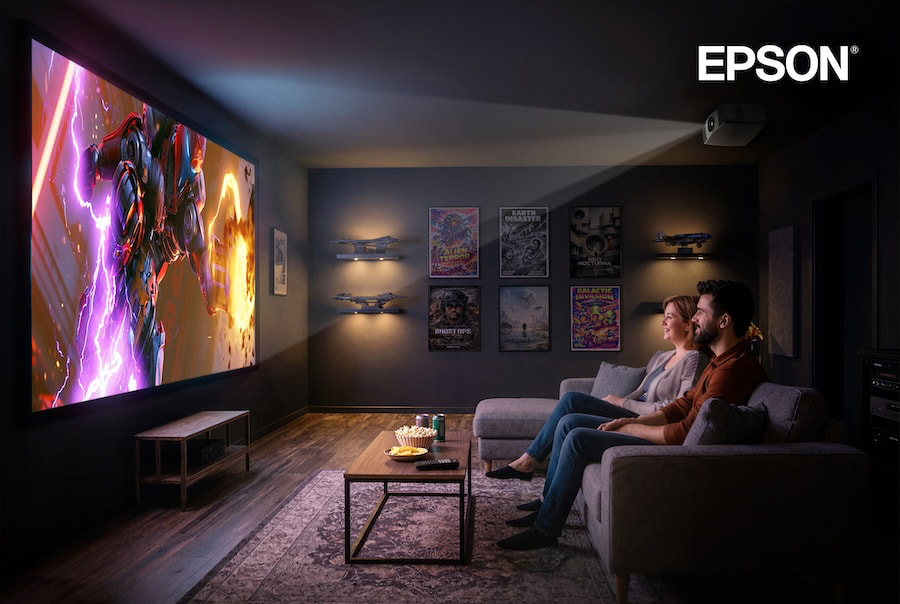
The rapid growth of extra-large TVs measuring 85 inches and larger has put real pressure on the home projector category. Today’s biggest TVs are brighter, smarter, and increasingly affordable, making them a compelling alternative for buyers who once would have automatically considered projection.
Projectors still hold one major advantage, however: sheer image size. In dedicated home theaters and larger multipurpose rooms, projection can deliver a 100-inch, 120-inch, or even larger image without pushing prices into the stratosphere.
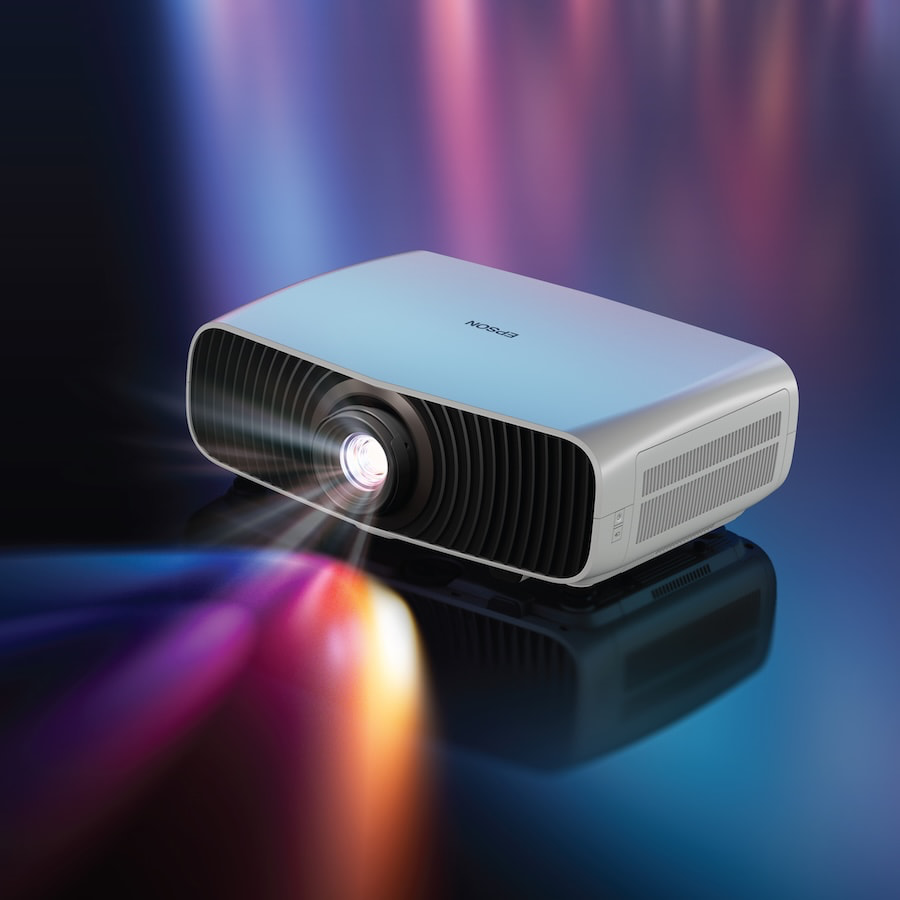
Following the launch of its higher-end Pro Cinema Q-Series 4K Laser Projectors in 2024, Epson is now bringing more attention to its step-down Home Cinema lineup with the new LS5000, LS6000, and LS7500 4K HDR laser projectors. The three models sit below the flagship Q-Series but retain a number of the technologies and features that made those projectors noteworthy.
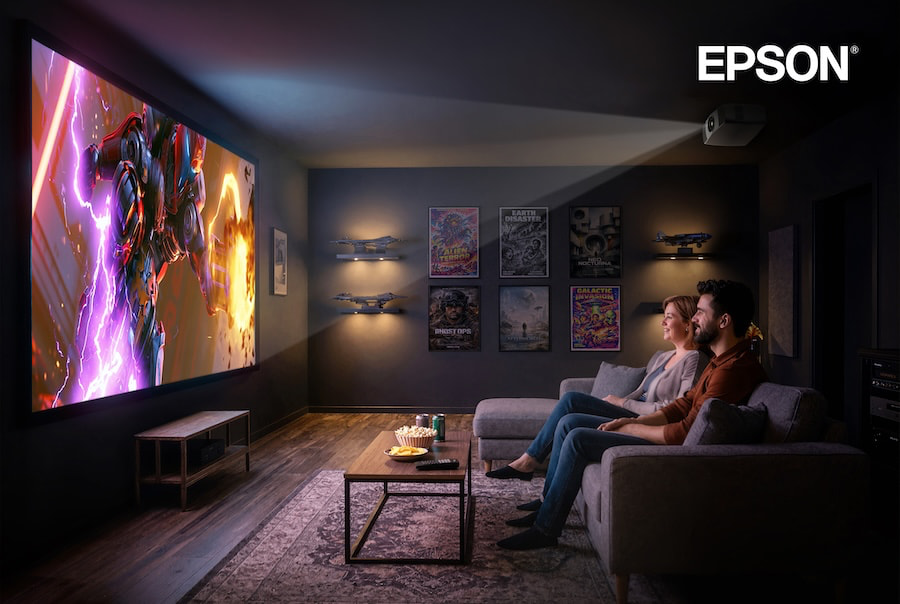
The new LS Series models are built around Epson’s 3-Chip 3LCD technology and use a laser light engine. For owners of older lamp-based projectors, the move to laser brings a longer-lasting light source, more consistent brightness over time, and faster startup and shutdown.
The new models complement Epson’s established Home Cinema projector lineup, which is currently headed by the Home Cinema LS11000, introduced in 2022. Epson says the new Home Cinema projectors are designed to balance image performance with flexible installation and easier integration across a wide range of home entertainment spaces.
“As TVs get bigger, they can also become a design challenge, leaving a large black rectangle that dominates the room when not in use. Projection offers a discreet alternative that virtually disappears when the entertainment ends, while creating immersive experiences not possible with a traditional TV – from everyday 16:9 content to cinematic 21:9 and IMAX-style viewing,” said Fernando Tamashiro, product manager at Epson America, Inc. “By expanding our Home Cinema lineup with these new 4K HDR laser projectors, we’re offering an even broader range of solutions for today’s home entertainment spaces. Combining our unique 3-Chip 3LCD technology with our latest laser light source, Epson projectors are the optimal choice for customers looking to create a big-screen experience tailored to their viewing preferences, space and budget.”
Designed for movies, sports, and immersive gaming, Epson’s new Home Cinema laser projector lineup can display 4K HDR images at screen sizes ranging from 40 to 300 inches.
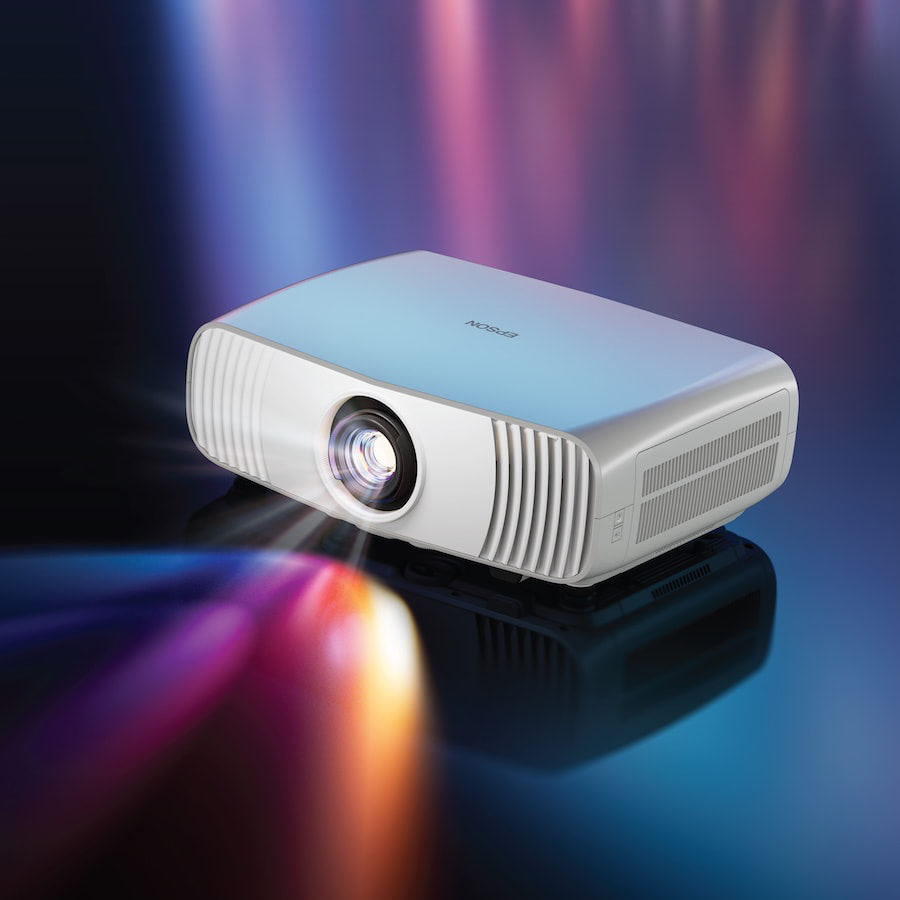
What the Epson LS5000, LS6000, and LS7500 Have in Common
Image Display Technologies: All three projectors use an advanced Epson Picture Processor, proprietary 4K display technology that produces a full 8.29-million-pixel on-screen image via Quad Pixel Shifting, and a 3-Chip 3LCD projection engine powered by a laser-array light source.
Light Output: The three projectors produce between 2,500 and 3,500 lumens of equal Color Brightness (IDMS Rated) and White Brightness (ISO Rated), depending on the model. Epson says the result is a bright, vivid image with strong color performance and deep black levels.
Advanced HDR Capability: Full 10-bit color processing supports HDR10 and HLG content. Additional HDR processing is provided by Epson’s Automatic HDR Scene Correction.
Multiple Aspect Ratios: From 16:9 HDTV content to cinematic 21:9 presentations, the new Home Cinema LS projectors are designed to support a range of screen formats and viewing environments.

Lenses: The Home Cinema LS5000 and LS6000 incorporate Epson Cinema standard-throw lenses, while the Home Cinema LS7500 features a short-throw lens that allows the projector to be positioned closer to the screen than conventional long-throw models. That makes the LS7500 better suited to larger screen sizes in rooms where projector placement is more limited.
High Black Contrast: Producing convincing black levels while maintaining shadow detail has long been a challenge for projectors. Epson specifies dynamic contrast ratios ranging from 800,000:1 to 1,200,000:1 across the three new LS models, depending on the projector. The goal is greater differentiation between bright and dark portions of the image while preserving detail in darker scenes.
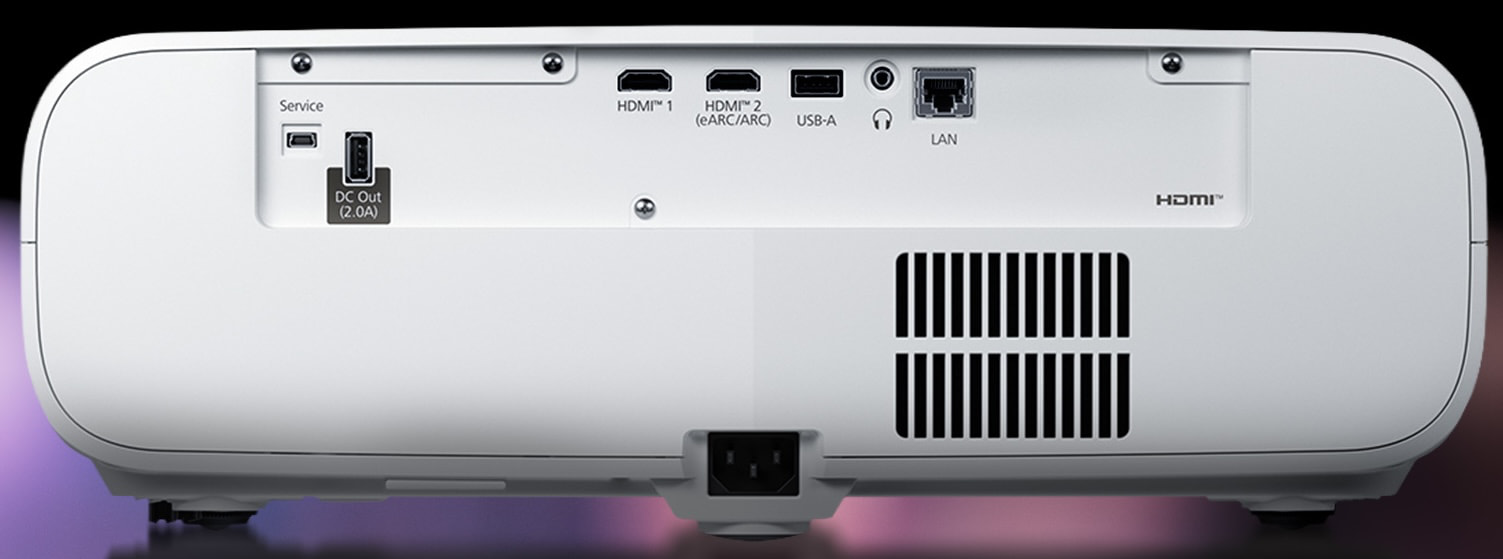
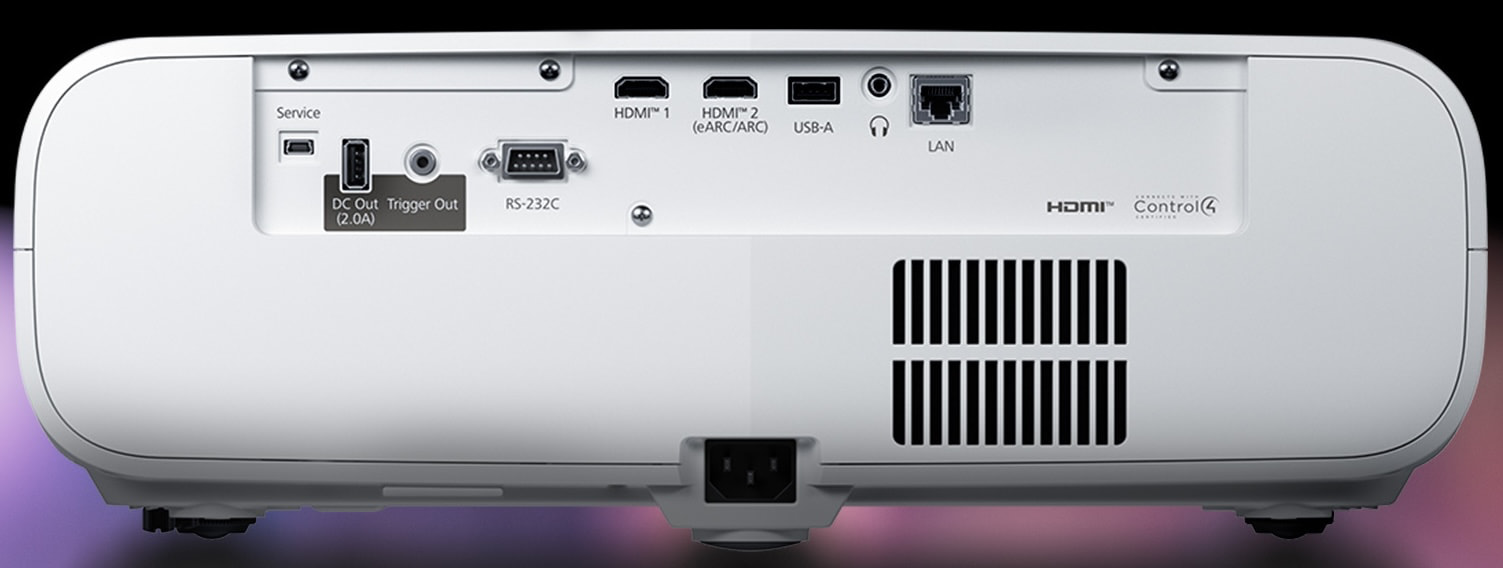
HDMI Connectivity: All three projectors include dual HDMI inputs supporting refresh rates up to 120Hz, with one HDMI port providing eARC for audio passthrough to a compatible AV receiver or soundbar.
Gaming: In addition to supporting refresh rates up to 120Hz, the new LS projectors include Auto Low Latency Mode (ALLM) and input lag rated below 20ms. That combination makes them suitable for gaming with compatible consoles and PCs where faster response times are important.
Flexible Installation: A compact design with quiet, front-exiting airflow provides additional placement flexibility. Manual lens shift of ±21% horizontally and ±59% vertically also makes it easier to position the projector in a variety of home theater and multipurpose spaces.
Bluetooth: Bluetooth connectivity is still not standard across the projector category, but the Home Cinema LS5000, LS6000, and LS7500 include Bluetooth 6.0. This allows audio from HDMI-connected sources to be streamed to compatible wireless headphones or speakers.
Comparison

| Epson Model | LS5000 (2026) |
LS6000 (2026) |
LS7500 (2026) |
LS11000 (2022) |
| Product Type | Video Projector | Video Projector | Video Projector | Video Projector |
| Price | $1,999.99 | $2,199.99 | $2,699.99 | $3,999.99 |
| Projection System | Epson 3LCD | Epson 3LCD | Epson 3LCD | Epson 3LCD |
| Chip Design (Architecture) | 3-chip | 3-chip | 3-chip | 3-chip |
| Light Source | True Laser Diode Array | True Laser Diode Array | True Laser Diode Array | Laser/Phosphor |
| Projection Method | Front, front-ceiling, rear, rear-ceiling | Front, front-ceiling, rear, rear-ceiling | Front, front-ceiling, rear, rear-ceiling | Front, front-ceiling, rear, rear-ceiling |
| Product Color | White | White | White | White |
| Driving Method | Poly-Silicon TFT Active Matrix, 0.62″ wide panel | Poly-Silicon TFT Active Matrix, 0.62″ wide panel | Poly-Silicon TFT Active Matrix, 0.62″ wide panel | Poly-silicon TFT Active Matrix, 0.74″ wide panel |
| Output Resolution | 4K Display Technology1 3840 x 2160 (dual axis: 1920 x 1080) | 4K Display Technology1 3840 x 2160 (dual axis: 1920 x 1080) | 4K Display Technology1 3840 x 2160 (dual axis: 1920 x 1080) | 4K Display 3840 x 2160 (dual-axis: 1920 x 1080) – Upgraded from earlier version that employed PRO UHD |
| Maximum Input Resolution | 4096 x 2160 | 4096 x 2160 | 4096 x 2160 | 4096 x 2160 |
| Supported Resolutions | 3840 x 2160, Full HD 1080p/i, HD 720p, 576p/i, 480p/i | 3840 x 2160, Full HD 1080p/i, HD 720p, 576p/i, 480p/i | 3840 x 2160, Full HD 1080p/i, HD 720p, 576p/i, 480p/i | 3840 x 2160, Full HD 1080p/i, HD 720p, 576p/i, 480p/i |
| Native Aspect Ratio | 16:9 widescreen | 16:9 widescreen | 16:9 widescreen | 16:9 widescreen |
| Color Brightness (IDMS Rated) | 2,500 Lumens | 3,400 Lumens | 3,500 Lumens | 2,500 Lumens |
| White Brightness (ISO Rated) | 2,500 Lumens | 3,400 Lumens | 3,500 Lumens | 2,500 Lumens |
| Contrast Ratio | Up to and over 800,000:1, with dynamic contrast in Normal and Auto Iris On | Up to and over 800,000:1, with dynamic contrast in Normal and Auto Iris On | Up to and over 1,000,000:1, with dynamic contrast in Normal and Auto Iris On | Up to and over 1,200,000:1, with Dynamic Contrast in Normal or High Speed setting |
| White Balance | Not Indicated | Not Indicated | Not Indicated | 14-point temperature adjustment |
| Color Reproduction | Full-color (up to 1.07 billion colors) | Full-color (up to 1.07 billion colors) | Full-color (up to 1.07 billion colors) | Full-color (up to 1.07 billion colors) |
| Size (Projected Distance) | 40″ to 300″ (at 45″ to 28.8′) | 40″ to 300″ (at 45″ to 28.8′) | 40″ to 300″ (at 45″ to 28.8′) – (Zoom: Wide and Zoom: Tele) | 50″ to 300″ (at 58″ to 62’4″) |
| HDR Color Processing | Full 10-bit | Full 10-bit (Partial 12-Bit) | Full 10-bit | Full 10-bit(Partial 12-Bit) |
| Light Source Life | Normal Mode: Up to 20,000 hours | Normal Mode: Up to 20,000 hours | Normal Mode: Up to 20,000 hours | Normal Mode: Up to 20,000 hours Medium Mode: Up to 20,000 hours Eco Mode: Up to 20,000 hours |
| Epson Cinema Lens | Multi-element precision glass structure | Multi-element precision glass structure | Multi-element precision glass structure | 15-element precision glass structure (AGS) |
| Type | Optical Zoom (manual)/Focus (manual) | Optical Zoom (manual)/Focus (manual) | Optical Zoom (manual)/Focus (manual) | Powered focus/optical zoom/lens position |
| F-Number | 1.49 – 1.77 | 1.49 – 1.77 | 1.49 – 1.61 | 2.0 – 3.0 |
| Focal Length | 18.2 mm – 29.2 mm | 18.2 mm – 29.2 mm | 13.9 mm – 18.1 mm | 22.5 – 46.7 mm |
| Zoom Ratio | 1 – 1.62 | 1 – 1.62 | 1 – 1.3 | 1 – 2.1 |
| Throw Ratio Range | 1.32 – 2.15 | 1.32 – 2.15 | 1.0 – 1.3 | 1.35 – 2.84 |
| Keystone Correction | Not Indicated | Not Indicated | Not Indicated | Vertical/Horizontal: ± 30 degrees |
| Lens Shift | Vertical: -59.0% to +59.0% (H center, manual)
Horizontal: -21.0% to +21.0% (V center, manual) |
Vertical: -59.0% to +59.0% (H center, manual)
Horizontal: -21.0% to +21.0% (V center, manual) |
Vertical: -59.0% to +59.0% (H center, manual)
Horizontal: -21.0% to +21.0% (V center, manual) |
Vertical: -96.3% to +96.3% (H center, powered)
Horizontal: -47.1% to +47.1% (V center, powered |
| Lens Cover | Cap | Cap | Cap | Powered, slide lens shutter |
| Connections | 2x HDMI 2.1 (HDCP 2.3), one supporting eARC/ARC
1x USB Type-A 5 V 2.0 A (for power supply) 1x USB Type-A (for Firmware updates) 1x Mini USB (service only) 1x Audio out mini plug (3.5 mm) 1x LAN RJ45 (Projector Control Only |
2x HDMI 2.1 (HDCP 2.3), one supporting eARC/ARC
1x USB Type-A 5 V 2.0 A (for power supply) 1x USB Type-A (for Firmware updates) 1x Mini USB (service only) 1x LAN RJ45 (Projector Control Only |
2x HDMI 2.1 (HDCP 2.3), one supporting eARC/ARC
1x USB Type-A 5 V 2.0 A (for power supply) 1x USB Type-A (for Firmware updates) 1x Mini USB (service only) 1x LAN RJ45 (Projector Control Only |
2x HDMI® 2.1 (HDCP 2.3); one supporting eARC/ARC
1x USB Type-A (for optical HDMI cable; 300 mA maximum power supply only) 1x USB Type-A 5 V, 2.0 A for power and firmware 1x Mini USB (service only) 1x LAN RJ45 (control only) 1x RS-232C (DB-9) 1x Trigger out (On, Off) 12 V DC, 200 mA maximum (3.5mm mono or stereo mini-jack) |
| Dynamic Range Support | HDR10, HLG | HDR10, HLG | HDR10, HLG | HDR10, HDR10+, HLG |
| HDR Adjustment | On/Off | On/Off | On/Off | 16 steps, real-time |
| Color Modes | Dynamic, Vivid, Cinema, Natural | Dynamic, Vivid, Cinema, Natural | Dynamic, Vivid, Cinema, Natural | Dynamic, Vivid, Cinema, Natural |
| Aspect Ratio Adjustment | Yes (Full, Super Zoom) | Yes (Full, Super Zoom) | Yes (Full, Super Zoom, Anamorphic Wide, Horizontal Squeeze) | Yes (Auto/Full/Zoom)
1.9:1 (4096 x 2160) 21:9 (2560 x 1080) 4:3 (1600 x 1200) 9:6 (720 x 480) 5:4 (720 x 576) compatible with Normal, Full or Zoom Mode |
| Input Signal | 480p, 576p, 720p, 1080i, 1080p, 2160p | 480p, 576p, 720p, 1080i, 1080p, 2160p | 480p, 576p, 720p, 1080i, 1080p, 2160p | 480p, 576p, 720p, 1080i, 1080p, 2160p |
| Operating Temperature | 41 °F to 95 °F (5 °C to 35 °C) | 41 °F to 95 °F (5 °C to 35 °C) | 41 °F to 95 °F (5 °C to 35 °C) | 41 °F to 95 °F (5 °C to 35 °C) |
| Power Supply Voltage | 100 V – 240 V AC ± 10%, 50/60 Hz | 100 V – 240 V AC ± 10%, 50/60 Hz | 100 V – 240 V AC ± 10%, 50/60 Hz | 100 V – 240 V AC ± 10%, 50/60 Hz |
| Power Consumption | Normal Mode: 330 W
Quiet Mode: 217 W |
Normal Mode: 330 W
Quiet Mode: 217 W |
Normal Mode: 330 W
Quiet Mode: 217 W |
Normal Mode: 311 W
Medium Mode: 243 W |
| Fan Noise | 22 db – 25 db | 22 db – 25 db | 22 db – 25 db | 22 – 30 dB |
| Wireless LAN | Built-in, Wi-Fi® 6E, for Firmware update only | Built-in, Wi-Fi® 6E, for Firmware update only | Built-in, Wi-Fi® 6E, for Firmware update only | Not supported – Ethernet only |
| Bluetooth | Built-in, supports A2DP, AVRCP, Apt-X | Built-in, supports A2DP, AVRCP, Apt-X, Bluetooth LE | Built-in, supports A2DP, AVRCP, Apt-X | Not Supported |
| Dimensions (WDH – Including Feet) | 17.3″ x 12.4″ x 6.3″ | 17.3″ x 12.4″ x 6.3″ | 17.3″ x 13.1″ x 6.3″ | 20.5″ x 17.6″ x 7.6″ |
| Weight (Approximate) | 17.6 lb (stationary) | 17.6 lb (stationary) | 18.2 lb (stationary) | 28.0 lb |
| What’s Included | 1 x Projector 1 x Power Cable 1x Remote Control 2 x Control Batteries (AA) 1 x Quick Start Guide 1 x Warranty Sheet |
1 x Projector 1 x Power Cable 1x Remote Control 2 x Control Batteries (AA) 1 x Quick Start Guide 1 x Warranty Sheet |
1 x Projector 1 x Power Cable 1x Remote Control 2 x Control Batteries (AA) 1 x Quick Start Guide 1 x Warranty Sheet |
1 x Projector
1 x Power cord 1 x Remote Control Quick Setup Guide |
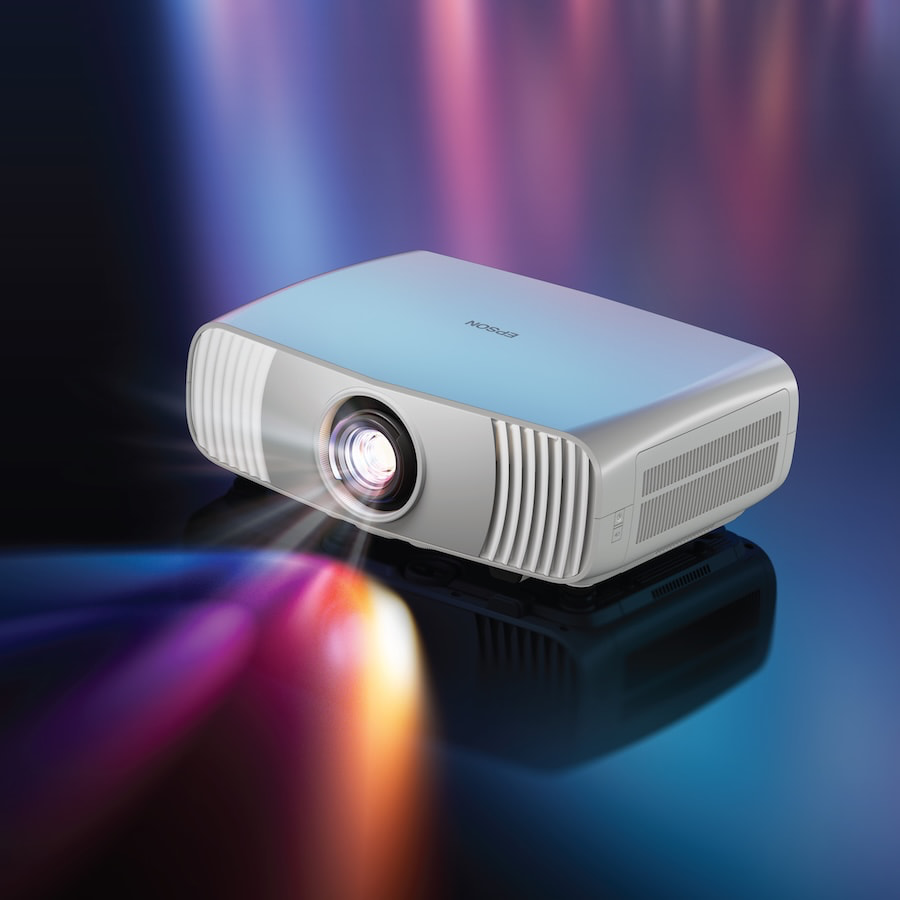
The Bottom Line
Epson’s position as the world’s top-selling projector brand did not happen by accident. Its lineup stretches from classrooms and conference rooms to dedicated home theaters, and the new Home Cinema LS5000, LS6000, and LS7500 fill an important spot just below the company’s more expensive Pro Cinema Q-Series.
What makes these three interesting is not simply that they use laser light sources or can throw a 300-inch image. Epson combines its 3-Chip 3LCD architecture with equal rated color and white brightness, output ranging from 2,500 to 3,500 lumens, Quad Pixel Shifting for an 8.29-million-pixel 4K image, HDR processing with tone mapping, and gaming features that include 120Hz support and ALLM. The LS7500 also adds a short-throw lens for installations where putting a conventional projector farther back in the room simply isn’t practical.
That combination gives the LS Series a legitimate point of differentiation from many single-chip DLP competitors, where white-light output and color-light output can differ substantially. It also gives buyers much of the functionality they actually need for movies, sports, and gaming without forcing them into Epson’s considerably more ambitious Pro Cinema Q-Series.
Competition from Sony, Hisense, Leica, JMGO, Optoma, and others is substantial, and some alternatives offer more light output, different installation options, or integrated entertainment features. But for someone trying to build a genuinely large-screen home theater without entering flagship-projector territory, the LS5000, LS6000, and LS7500 make a strong case for staying with traditional projection. A 98-inch TV might be getting easier to justify; a 150-inch one remains something of a financial incident.
Pro Tip: None of the three projectors includes a built-in speaker system or projection screen, so those need to be factored into the total system cost. Bluetooth is available for wireless audio, but anyone building a serious home theater will still want to budget for an external audio system and an appropriate screen.
Price & Availability
The new Epson Home Cinema LS Projectors are available through Epson’s Online Store and Select Retailers.
Related Reading:
MediaTek is taking its first proper step into desktop-style computing, with its new Dimensity CX C10 Max confirmed for an upcoming premium Googlebook.
The new chip is the first member of MediaTek’s Dimensity Compute Experiences (CX) family, and it’s built around a fairly serious set of hardware. Manufactured on TSMC’s 3nm process, the C10 Max uses an octa-core all-big-core CPU, an 11-core GPU and MediaTek’s eighth-generation NPU.
That last part is particularly important for the Googlebook, as the NPU 890 can deliver up to 55 TOPS of AI performance. MediaTek says it’s designed to handle Gemini Intelligence features, with faster responses and some additional privacy benefits from processing AI tasks on-device.
The chip is also designed with efficiency in mind. MediaTek says its architecture can help manufacturers build thinner, lighter and fanless laptops while still offering all-day battery life. Exactly how long that battery life will be on the first Googlebook remains to be seen, though.
There’s plenty here for everyday laptop duties, too. The C10 Max combines its CPU, GPU and NPU for multitasking, productivity, entertainment and what MediaTek calls ‘agentic AI’. It also supports Wi-Fi 7 at speeds of up to 7.3Gbps and dual-engine Bluetooth 6.0 for wireless accessories and audio.
MediaTek hasn’t stopped at performance. The integrated Imagiq 1090 ISP supports camera sensors up to 32MP, with AI-assisted HDR video, smoother zoom, cinematic video and sustained focus. That should give the upcoming Googlebook some useful headroom for video calls, livestreaming and content creation.
The big question is what this first Googlebook will actually look like and how it will perform in everyday use. Google has confirmed the first five models of Googlebook coming next month, including Snapdragon- and Intel-powered models, but nothing from MediaTek just yet.
For MediaTek, though, the bigger story is the move itself: this is its first SoC for the new Dimensity CX computing family, bringing its mobile chip expertise into a much more laptop-focused category.
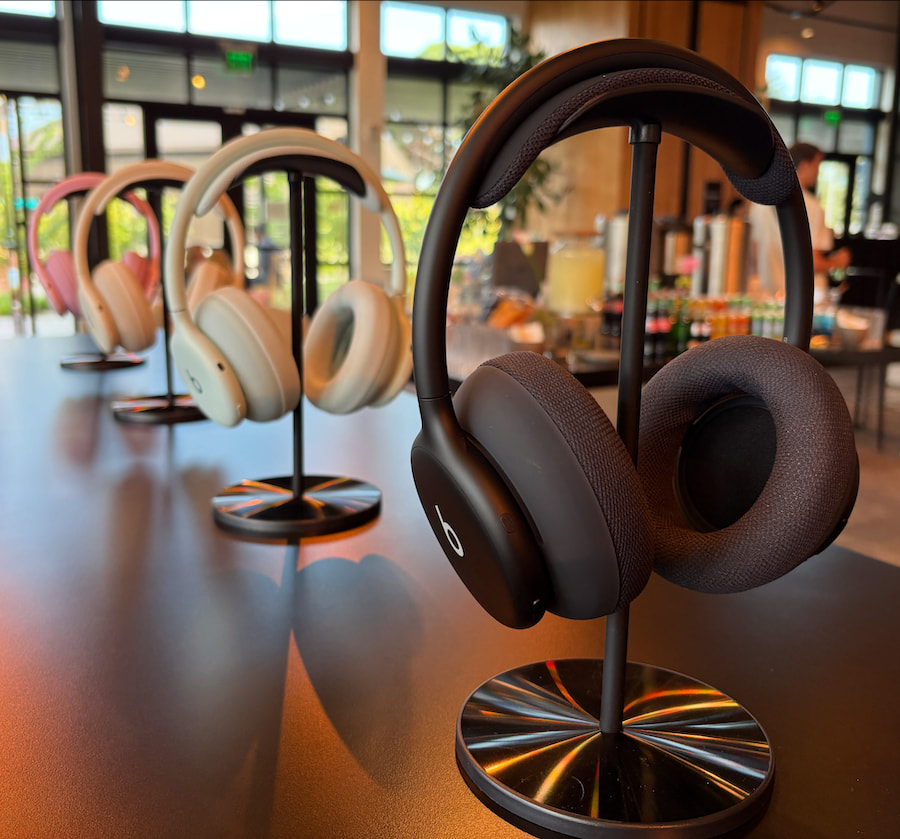
Beats’ new 360 headphones are different from any Beats pair we’ve seen before. They’re designed around an adaptable core frame with easily swappable earcups and headband cushions in multiple colors and styles, along with features like much-improved noise canceling compared with the Studio Pro and IPX4 water resistance.
Their $350 MSRP is the same as the 2023 Beats Studio Pro and considerably less than competing models from Bose, Sony, and others. But can they really be your everything headphones?
Skip the reading? Click play above or watch the Beats 360 review on YouTube.
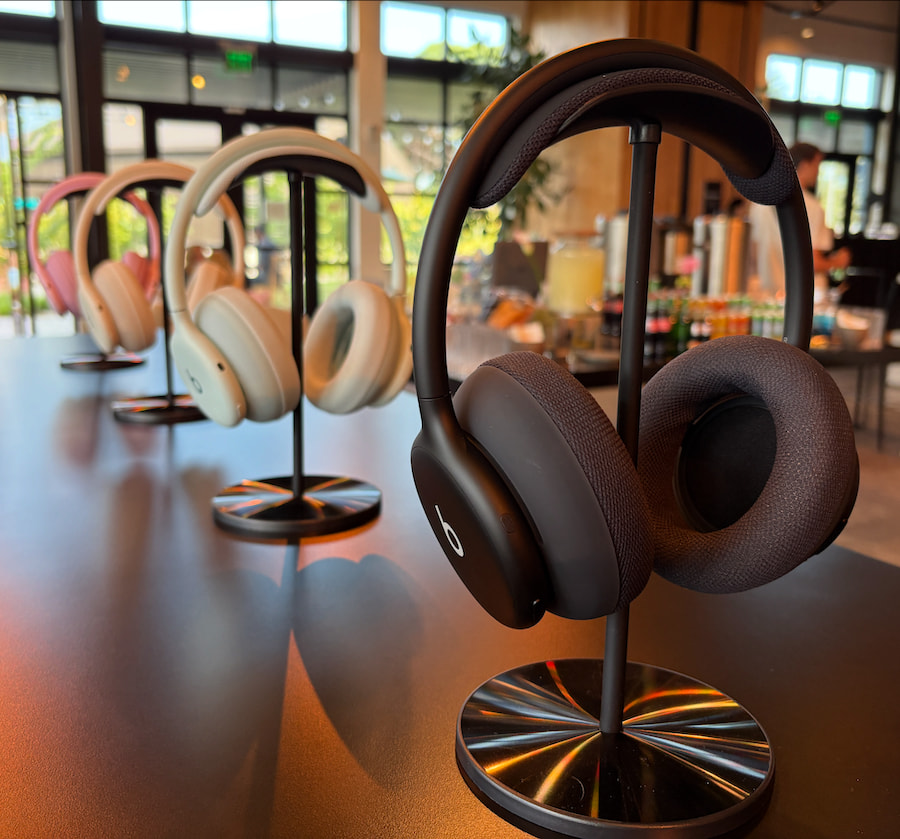
The 360’s unique form factor takes a cue from true wireless earbuds, with a battery and circuitry in each earpiece, allowing for a thin, flexible headband. They’re still relatively heavy at nearly 300 grams, but the balanced design fits well and remained comfortable for hours of wear. The four-piece control system is simpler and more elegant than the Studio Pro’s. There are nine microphones in total; eight are used for noise canceling and transparency mode, while three contribute to excellent call quality alongside DSP and AI-powered noise suppression.
The headphones ship with diamond-knit textile earcups designed for durability, and they work reasonably well for workouts. The core frame comes in four colors: Black, Cloud, Sky, and Pink. The swappable earcups and pads add Navy and Volt Green, along with faux-leather options in white and black. Introductory pricing starts at $10, rising to as much as $50 per set afterward. Custom 40 mm drivers are powered by what Beats calls a “high dynamic range amplifier.”

Features include iOS options like Audio Sharing and hands-free Siri, while both Android and iOS users get one-touch pairing, audio switching between connected devices, and finder functionality. There are no auto-pause sensors, manual EQ, or line-in playback options of any kind. Battery life is rated at 32 hours per charge, with an hour of playback from five minutes of charging, which matched my testing. Unfortunately, the battery continued to drain after the headphones were powered down, at a rate of around 0.5 percent per hour. Beats assumed this was due to the always-on Find My feature, but the issue persisted with Find My turned off. I’m hoping Beats offers a fix soon.
Noise canceling is excellent for the money, testing just a notch or two below top models like Bose’s QC Ultra Gen 2 and Sony’s WH-1000XM6. Transparency mode is also solid, though not as clear or natural-sounding as Apple’s AirPods Pro or AirPods Max.
Sound quality is generally balanced and includes head tracking for 3D audio formats like Dolby Atmos. The bass isn’t as potent as on previous Beats headphones, including the Studio Pro, but it’s musical and well controlled. The treble is brighter than on models like Sony’s XM6, and the 360 doesn’t offer the same level of definition, but it remains relatively detailed across the frequency range, with good clarity and instrumental separation. For a closer look at performance, watch our full video review on YouTube.

The Bottom Line
The latest Beats headphones have a lot to offer, from their adaptable, splash-resistant design to powerful noise canceling and accessible sound. They’re an enticing option for folks who want a stylish, sporty pair of headphones, as well as those who don’t want to spend up for the latest flagship models from Bose, Sony, and others.
I do wish they had a few more features, including auto-pause. It would also be nice to get a hard case, though I don’t expect one from Beats at this point. The biggest issue is the odd battery drain when powered off, which makes the 360 tough to recommend based on my current testing. I’m hoping Beats can fix the problem, and it’s always possible the issue is limited to a small number of units like mine.
Otherwise, the 360’s solid performance and unique design would make them worth considering for anyone looking for versatile headphones that stand out from the crowd.
Pros:
- Distinctive customizable design
- Clear and relatively detailed sound
- Excellent noise-canceling for the money
- Fantastic call quality
- IPX4 water resistance
Cons:
- Potential battery drain issue when powered off
- Bass isn’t as big as Beats fans might require
- No manual EQ or line-in playback options
- No auto-pause
Our Ratings:
Editor’s Note: These ratings reflect the battery drain issue we experienced and will be updated if it’s fixed.
★★★★★★★★★★ Performance
★★★★★★★★★★ Build Quality
★★★★★★★★★★ Comfort
★★★★★★★★★★ Features
★★★★★★★★★★ ANC
★★★★★★★★★★ Value
Where to Buy:
Related Reading:


The most powerful AI chip in China today, delivering three times the performance of its predecessor, the Zhenwu M890.
That is how Eddie Wu described the processor Alibaba unveiled on Tuesday. The chief executive was speaking at Apsara, the company’s annual cloud conference, in Hangzhou.
The chip is the Zhenwu V900. Alibaba said in a post on X that it comes from T-Head, its chip design unit. The company says it handles both high precision model training and ultra low precision inference.
Two other announcements came with it. Alibaba plans models of up to 10 trillion parameters, and 20GW of data centre capacity by 2032.
What is inside the V900
T-Head has published a basic spec sheet for the chip. Simon Sharwood reported the numbers for The Register. The sheet lists 216GB of memory and 1,200 GB/s of inter-chip interconnect bandwidth.
The processor supports FP32 down to FP4 natively. T-Head reworked the Tensor Core arithmetic unit for better instruction precision in FP8 and FP4. The chip also carries more scaling factor formats and block size configurations under MXFP8 and MXFP4.
Wu said a single cluster can hold up to 500,000 of the chips. The resulting machine will power frontier model training and inference, he said. Alibaba launched the M890 in May.
Mass production and commercial release are set for the first quarter of 2027. Liam Mo and Eduardo Baptista reported for Reuters that Wu expects significant growth in annual AI chip shipments.
Alibaba will refresh the lineup every year, Bloomberg reported. It put deliveries of the Zhenwu family at 560,000 units to more than 400 external customers. Alibaba’s own post puts the figure higher, at more than 650 customers. They span industries from cars to language models and embodied intelligence.
The company also set out a roadmap for its next generation Yitian server processors. They are built for agentic AI work and due in 2027.
Qwen 5 is planned at 10 trillion parameters
Alibaba is already training Qwen 4. Wu named the two models after it, Qwen 4.5 and Qwen 5. Both should scale to between five and 10 trillion parameters.
Qwen 3.8 Max, the current flagship, has 2.4 trillion. Alibaba called it its most capable model in August.
Wu framed the jump as a route to artificial superintelligence. The larger models target longer and more complex tasks.
He also said the Qwen team is working on recursive self improvement. A model identifies its own weaknesses, runs experiments and generates training data with little human involvement. He described the progress as meaningful.
Twenty gigawatts by 2032
The third announcement was infrastructure. Wu set a target for Alibaba Cloud to pass 20GW of global data centre capacity by 2032.
Citigroup estimates that much capacity could drive more than $160bn of external revenue for the cloud division, according to Bloomberg.
The commercial property firm Cushman and Wakefield counts 37.7GW of data centres under construction in the United States alone. SpaceX had roughly 1.4GW of AI computing capacity in the middle of this year. It wants to pass 10GW in 2027, the Associated Press reported.
Supply is the constraint Wu named. He said global shortages across the AI data centre supply chain are limiting how fast Alibaba can scale its compute, and that mid to long term industry demand far outpaces what the company can supply.
Alibaba Cloud will start bringing its AI supernodes online at commercial scale this quarter. Wu did not say where the new data centres will be built.
What the push costs
Alibaba has committed more than $53bn over three years to its AI expansion, and raised about $10.2bn in a follow-on share sale in August.
The spending shows in the accounts. Quarterly profit fell by 75% after a spree of almost $10bn.
Executives expect annualised revenue from AI products to reach $10bn this quarter, and say the company can recoup its investment within three years. The target for cloud and AI revenue is $100bn in five years.
Investors took the announcement well. Alibaba’s Hong Kong listed shares rose 5.1% on Tuesday, to their highest in a month, and Tencent gained more than 7%.
Why Alibaba designs its own chips
United States export controls keep Nvidia’s most advanced accelerators out of China. The same controls largely block Chinese firms from using TSMC. Bloomberg reported that it is unclear whether Alibaba works with SMIC, a capacity constrained rival.
Huawei made its own move last week, unveiling new chip technology at its Connect conference.
Neil Shah, vice president at Counterpoint Research, told the AP that using extra computing power to make up for chip limits helps China stay strong locally. His colleague Parv Sharma pointed at manufacturing. How far the gap narrows also depends on China’s ability to advance its own foundries, he said, not just on chip design.
A day before the summit
Xi Jinping arrives in Washington on Wednesday for a state visit and a meeting with Donald Trump. AI, trade and tariffs should all feature. Jensen Huang and Satya Nadella are due at the state dinner.
Treasury Secretary Scott Bessent and Vice Premier He Lifeng met this week. They agreed to set up a dialogue on AI, aimed at a common understanding of goals and threats.
Washington has accused Alibaba and DeepSeek of illicitly accessing American models, a charge Beijing rejects as groundless. Anthropic accused Alibaba of distillation in June.
Dario Amodei, Anthropic’s chief executive, called this month for a slower pace of model development. Wu addressed the argument directly.
Last year, we asserted that the more capable AI becomes, the more powerful humanity will be. Today, I remain steadfast in that conviction.
He calls it machine thinking
Wu avoided the term artificial intelligence through most of his keynote. He used machine intelligence, or machine thinking, instead.
He compared the moment to the industrial revolution. Steam and combustion engines, he said, were built to do what horses and labourers already did, and machine power now drives 99.9% of the world’s physical work.
He expects the same pattern in cognition. Machines currently produce less than 3% of all thinking, by his measure. He predicted they will eventually produce more than 1,000 times the thinking of all humanity combined.
Wu also said the groundbreaking products of the era have not arrived yet. He likened AI coding to the light bulb, an early application of electricity rather than the thing that mattered most.

Monday Google opened preorders for its “Googlebook” laptops, pricing them at $899. A Google’s blog post added that “At launch, you can choose between Intel Core Ultra Series 3 and Snapdragon X Elite processors” (paired with NPUs to power AI features).
“Devices will hit shelves on October 4 in the U.S. and on October 5 in Canada, the U.K., Ireland, France, Germany, and Australia,” TechCrunch points out. But “the real pull for the new devices is that they’ll prominently feature Gemini’s latest capabilities in a new format: the laptop.”
Google is trying to offer a laptop with unique features like an AI-powered cursor, vibe-coded widgets, and support for AI-enhanced dictation. The latter is a feature called Rambler, which cleans up messy, rambling brain dumps into readable text. The move is a bet that AI, specifically Google’s Gemini, could be enough of a draw to get people to buy a new laptop that bakes in AI instead of running them via desktop apps you install or access through the browser… On the Googlebook, Google is trying to reinvent the “point-and-click” experience of desktop computing to now include an AI element: The cursor serves as a conduit to Gemini. The company suggests various ways this could be used, like highlighting content on a web page for Gemini to work with, asking Gemini to see if an email you’ve hovered your cursor over is suspicious, or selecting images and then asking Gemini to visualize them together…
What’s more interesting about the Googlebook is how it’s seemingly part of Google’s longer-term plan to capture a large part of the K-12 market that currently relies on Chromebooks and push them toward the company’s Gemini AI. There are somewhere around 50 million Chromebooks in schools, used by students and educators, Google has said. In May, the company told TechCrunch that its current Chromebooks would continue to be supported, though many would become eligible to transition to the new Googlebook experience in the future…
Flagship devices in the new range are being built by Acer, ASUS, Dell, HP, and Lenovo, with materials like aluminum, magnesium alloy, and carbon fiber… Google says the device will offer up to 14 hours of battery life.
Googlebooks will be decorated with an exterior Glowbar “which dances when you boot up, sweeps to show battery level, and supports other playful patterns,” according to Google’s blog post. “We’re also opening Glowbar access to developers to build custom, interactive animations.”
After testing actual Googlebooks, The Verge’s reviewer first acknowledges that “it might be just another Trojan horse for Gemini.” Still, “The hardware is polished (since it’s based on current laptops). The OS is familiar (if you’ve ever used a Chromebook). But most impressive, it integrates your Android phone with your PC so they feel more like one device. It’s the culmination of a series of new ideas that blur the two devices together.
“After my first look, I went from doubtful to excited by the prospect of Google pulling it all off…”
The Asus was incredibly lightweight; the Lenovo has plenty of ports and an optional mouse with a matching Glowbar light; the Acer’s convertible form factor allows some tablet-like use (and it’s pretty affordable for a Panther Lake laptop). The HP had a great-looking screen and a latticeless keyboard I surprisingly didn’t hate, and the Dell is basically a gold XPS 13 (which is excellent) but with a different chip…
But everything really special about Googlebooks comes down to software… You can cast apps from an Android phone directly to a Googlebook, even without touching your phone. Googlebooks essentially have two app drawers: a G-logo start menu for installed Googlebook apps and a second one beside it that pulls up mobile apps from your phone. Click a phone app and you can fully use that app with the mouse and keyboard or the Googlebook’s touchscreen. It’s a bit like iPhone Mirroring on macOS, but the apps are individually extracted to the desktop OS instead of showing your whole phone interface.
Googlebooks also have a nifty feature called Continue On where the icons of apps you’re currently using on your phone appear in the bottom bar — allowing you to click it on the laptop and hand it off to the Googlebook. These app handoffs can transition to a native app or a web app, depending on how developers have programmed it… The other big way Googlebooks interact with an Android phone is Quick Access, allowing you to see and access all the files stored on your phone right in the desktop Files app… If you have an iPhone then you’re limited to a Link to iOS app that just does some message syncing and replying… [W]hen it comes to mainline gaming, Nvidia’s GeForce Now service is also coming to Googlebooks, and the first year is free with one of Google’s new laptops.
“It’s not every day we get a new player in the desktop operating system and laptop spaces,” the reviewer points out. “There seems to be a higher ceiling of potential with Googlebooks than there was with Chromebooks, along with some cool features, but Google has a lot to prove at higher prices than people are used to paying for its laptops.”


Read more of this story at Slashdot.

Scarlett O’Hara has survived the Civil War, Reconstruction, Rhett Butler walking out the door, VHS, LaserDisc, DVD, Blu-ray and the indignity of streaming compression.
4K UHD Blu-ray was apparently the next hill to climb.
Warner Bros. Discovery Home Entertainment will release Victor Fleming’s Gone With the Wind on 4K Ultra HD Blu-ray for the first time on November 3, 2026, more than 86 years after the film’s Atlanta premiere. The new edition has been remastered in 4K with HDR and will be available as a standard release, limited SteelBook and Walmart-exclusive Collector’s Edition, with a new 4K digital version arriving the same day.
More importantly, this is not simply the old Blu-ray master wearing a new hat.
Gone With the Wind was photographed in 35mm three-strip Technicolor, making it exactly the kind of catalog title that can benefit from a careful modern restoration. Warner has confirmed a newly remastered 4K presentation, while subsequent disc information indicates Dolby Vision, a remastered DTS-HD Master Audio 5.1 soundtrack, and the original theatrical mono mix in DTS-HD Master Audio.
Frankly, my dear, that took long enough.

Why the 4K Restoration Matters
Three-strip Technicolor is one of the reasons Gone With the Wind still looks so distinctive.
The process recorded separate color information onto three black-and-white film elements, which were later combined to create the final image. Restoring that material requires careful alignment, color work and preservation of detail across multiple source elements.
Warner’s 2009 Blu-ray restoration was already considered excellent, so the UHD has a high bar to clear. The real opportunity here is not merely more resolution, but better color reproduction, expanded dynamic range and improved preservation of the movie’s elaborate production design, costumes, painted backgrounds and shadow detail.
Warner has not published a full technical restoration report detailing the scanning resolution or exact source elements used for the 2026 edition, so claims about a specific 8K workflow should be treated cautiously until the studio confirms them.
The feature is also being spread across two 4K UHD discs, rather than squeezing nearly four hours onto one. That should allow for a healthier video bitrate and fewer compromises.
Gone With the Wind 4K UHD Specifications
- Format: 4K Ultra HD Blu-ray
- Resolution: 3840 x 2160
- Video codec: HEVC/H.265
- HDR: Dolby Vision
- Original photography: 35mm three-strip Technicolor
- Aspect ratio: 1.37:1
- Feature presentation: Two UHD discs
- English audio: DTS-HD Master Audio 5.1
- Original audio: Theatrical mono in DTS-HD Master Audio
- Commentary: Film historian Rudy Behlmer
- Subtitles: English SDH, French and Spanish
- U.S. release date: November 3, 2026
- Physical editions: Standard 4K UHD, SteelBook and Walmart-exclusive Collector’s Edition
The Original Mono Track Matters
Keeping the theatrical mono soundtrack may sound like an odd selling point in the Dolby Atmos era, but it is important for film preservation.
Gone With the Wind was not mixed for height channels, rear surrounds or six subwoofers buried beneath the sofa. The remastered 5.1 track offers a more expansive presentation, but including the mono mix gives viewers access to something much closer to the original theatrical experience.
That is exactly how catalog releases should be handled: improve the experience without erasing the original one.

New Bonus Features
Warner has prepared three new supplements:
- Gone with the Wind: The Influence that Endures examines the film’s impact on cinema and popular culture.
- Gone with the Wind: Restoring and Preserving an Epic focuses on the restoration process.
- Scarlett O’Hara: A Woman Ahead of Her Time looks at Vivien Leigh’s performance and the character’s enduring place in film history.
Some international editions include additional legacy material, but Warner has not confirmed that every supplement will appear on every U.S. configuration.
A Box Office Monster That Still Has No Real Equal
The commercial history is almost as extraordinary as the film itself.
Box Office Mojo records roughly $402 million in worldwide nominal theatrical grosses across tracked releases, but that figure tells only part of the story because Gone With the Wind has been reissued repeatedly since 1939.
Adjusted for inflation, the numbers become absurd.
Guinness World Records estimates that the film sold approximately 202 million tickets in the United States during its first three theatrical runs and generated the modern equivalent of roughly $4.5 billion worldwide.
For context, Avatar, the current worldwide box-office leader in unadjusted dollars, has earned about $2.9 billion.
In other words, Gone With the Wind was not merely popular. It operated on a scale that modern theatrical releases are unlikely to reproduce.
The film also won eight competitive Academy Awards, including Best Picture, Best Director and Best Actress, while Hattie McDaniel became the first Black performer to win an Oscar.
The Complicated Part
Any modern release also has to acknowledge the film’s depiction of slavery and the Antebellum South.
Gone With the Wind romanticizes plantation life and minimizes the brutality of slavery, issues that were criticized even when the film was originally released. Warner has chosen to preserve the movie rather than alter it, while acknowledging the offensive and problematic elements of its portrayal.
That is the correct approach. Film preservation should not require pretending history was cleaner than it actually was.

The Bottom Line
Gone With the Wind does not need another release simply because somebody found a new anniversary to print on the box.
It does need a definitive 4K presentation.
The combination of three-strip Technicolor photography, Dolby Vision, two-disc UHD presentation and preservation of the original mono soundtrack gives Warner an opportunity to create one of the more important catalog releases of 2026.
The film remains both a major achievement of Golden Age Hollywood and a deeply flawed depiction of the American South. Preserving it properly allows audiences to confront both.
For a movie that has already earned the modern equivalent of several billion dollars, two UHD discs seems like the least Warner can do.
After all, tomorrow is another day.
Where to pre-order:
(Available November 3, 2026)
Related Reading:


Private and public sectors need to join efforts to make robotaxi deployment a smoother affair, says Geotab’s Edward Kulperger.
Over the past decade, self-driving cars have become a somewhat common sight across several major cities in the US, China and elsewhere. Cautious regulators now want robotaxis on European roads.
Across the region, a number of countries, including Germany, Spain and the UK are allowing companies to pilot the technology in urban areas.
The needle is moving here in Ireland as well, with the Irish Government having approved partially autonomous vehicles (AVs) – also called level 2 AVs – on the country’s roads earlier this year, and kick-starting a strategy towards level 4 autonomous technology, or fully autonomous vehicles.
Though it may be years before we see fleets of driverless taxis in the country.
The safety argument
The argument for robotaxis primarily hinges on safety, according to Edward Kulperger, the senior vice-president for the EMEA region at the Canadian fleet management company Geotab, who tells SiliconRepublic.com that AVs are safe today and would “for sure” be safer than human driving in the future.
Geotab has about 6.5m connected assets, including robotaxis and other logistics vehicles on its platform, Kulperger explains. These assets, that have collectively completed more than 300m miles of complete AV driving, produce approximately 100bn individual data points.
This includes GPS data, vehicle and energy performance, accident data and vital information on other maintenance issues, which are used to monitor vehicles in real time, as well as train future fleets. “That’s a massive baseline to draw from,” says Kulperger.
Waymo, which has more than 200m in AV miles, said that its data indicated that its robotaxis were better than humans at avoiding crashes that result in injuries.
Just days ago, the Estonian ride hailing company Bolt announced a plan to launch its European robotaxi services on 25,000 Lucid-made cars. The company said it would use its extensive existing European data to train up the driverless fleet with hopes of growing the number to 100,000 by 2035.
Kulperger argues that AVs mean no distracted, reckless or drunk driving. While still in its infancy, the fast-advancing technology – now boosted with new advances in AI – will “surpass [humans] from a safety perspective”, he says. It’s also more efficient, he adds. “I think it’s really paramount that we, as a society, dive into fixing this [issue of road deaths].”
Then there’s other problems too, such as road congestion and concentration of pollution in urban streets that Kulperger believes AVs could also help resolve.
Road deaths globally dropped 21pc between 2011 and 2025 according to the World Health Organization (WHO), despite the addition of more than 1bn vehicles within the period. Still, more than 1m lives were taken on roads across the world just last year.
Meanwhile, road fatalities dropped by 3pc on average in the EU last year, amounting to nearly 19,500 deaths. Romania continues to have one of the highest fatality rates in the bloc alongside Bulgaria and Croatia (Croatia’s capital Zagreb was tapped by Uber to launch its first robotaxi service in the continent just last month).
The massive drop in road deaths, though, is attributed to “safe road systems”, says the WHO. This recognises human error as unavoidable, and promotes safer roads, infrastructure, vehicles, speed limits and regulations to hopefully ensure that crash impacts remain within survivable levels. Smarter vehicles, of course, aid in driver safety.
Still, some experts point to a lack of sufficient independent data backing up the narrative that AVs are less crash-prone than humans. They argue that driverless vehicles face problems of an entirely different kind to what humans might experience on the road.
Earlier this year, Waymo recalled pulled 3,900 robotaxis from US streets over a software issue that let AVs enter and drive in closed freeway construction zones. Just a month earlier, the company recalled nearly 3,800 robotaxis from the US over a software issue that could allow vehicles to drive onto flooded roadways.
Meanwhile, last December, the Alphabet-owned company briefly suspended services in San Francisco after a massive outage stalled Waymos on roads, disrupting traffic and adding on to the gridlock.
Waymo’s Chinese competitor Baidu also faced a similar issue in Wuhan after more than 100 of its Apollo Go robotaxis abruptly stopped on the city’s roads in late March.
Bloomberg reported that Chinese authorities, as a result, suspended issuing new licences for level 4 AVs, preventing companies from adding new robotaxis to their fleet or expanding to new cities.
Both countries have seen grievous AV-related injuries in recent years as well.
But according to experts like Kulperger, the hope is that over time, and with enough data captured from different urban layouts globally, issues like these will eventually be fixed. “The rapid adoption and acceleration now is kind of unprecedented – it’s really doable,” he says.
“Our societies have invested a lot in trains and buses – I think we complement that,” Kulperger says when asked what role robotaxis would play in alleviating congestion-related issues. He envisions a mixed fleet of public transport alongside AVs to help people reach destinations safely.
“You take a train, and then maybe you move to an AV to get to your destination…I think the economic and societal benefits [of AVs], will be realised, you know, exponentially as it grows.”
Data is the answer
The robotaxi market is expected to grow to $168bn by 2035, with a global fleet size of 3.6m robotaxis, according to data from Counterpoint Research.
Waymo, Tesla and China’s Baidu Apollo Go, WeRide and Pony.ai are all expected to lead the market, supported by their technology, funding and aggressive roll-out strategies. Meanwhile, ride-hailing leaders, including the likes of Uber, Lyft, Bolt and Grab are continuing to partner with robotaxi builders, connecting companies with their wide customer-base.
In Europe, these businesses are targeting to deploy more than 100 AVs per city by 2030, Kulperger says. “That gives you a little bit of insight into the kind of timeline.
“The thought process is to focus on logistical corridors… so arteries, freightways and to integrate that with various fleets.”
Europe’s old roads and unruly weather – a particular cause for trouble in areas like Ireland – have made expanding into the region somewhat challenging for businesses. Though that hardly seems like a hurdle anymore.
“We work with the largest AV organisations today,” Kulperger says, including one with driverless fleets in the US and recently in Europe. “We’re just at the tipping point of it really starting to scale.
“I think [by] 2030, we’ll see increasingly in, you know, cities like Dublin, a mixed fleet on the road where you have personal vehicles that are completely autonomously driven alongside partially assisted vehicles.”
Regulations need to evolve with the technology, says Kulperger. The bloc has been known to be slow with regulations, but it is attempting to change that across the board in recent years. Earlier this June, 18 EU member states, including Ireland, signed a declaration to support large-scale cross-border testbeds for AVs.
“I think it’s incumbent upon [the] private and public sector to start to really work together at the state and city level to deploy this because the safety and efficiency is kind of demanding it,” Kulperger says.
“The cities that’ll be best positioned to lead this might not be the ones that are most advanced today on autonomous vehicle…[but would be] ones that can combine the technology with the right regulatory infrastructure and commercial environment.”
Don’t miss out on the knowledge you need to succeed. Sign up for the Daily Brief, Silicon Republic’s digest of need-to-know sci-tech news.
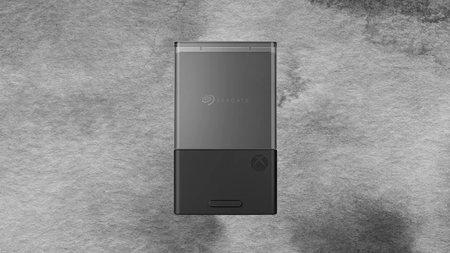
Wouldn’t it be lovely to double your Xbox’s storage for less than half the usual price?
The Seagate Storage Expansion Card, a 1TB NVMe SSD built specifically for the Xbox Series X and S, has fallen from £349.99 to £149.99, a saving that belongs to it and it alone at more than £200 off.
Get 1TB of Xbox Series X/S storage for £149.99, less than half its usual price
For anyone who could use some more storage on their Xbox, £149.99 for a 1TB Xbox compatible SSD is a genuine bargain.

Less than half price on a 1TB SSD built exclusively for Xbox is a genuinely rare drop, especially since most third party storage upgrades still cost close to their full price for years after launch, if they discount at all.
Seagate built this card in partnership with Xbox, so it plugs straight into the Xbox Velocity Architecture and matches the console’s own internal drive for load times rather than trailing behind it in busy games.
There is no complicated setup involved either, since the card slots directly into the dedicated port on the back of an Xbox Series X or S and starts working the moment it clicks into place.
Quick Resume switches between several titles at once without losing speed, whether a game sits on the internal drive or this expansion card. Its compact size also makes it easy to carry a full game library to a friend’s house or swap it between two consoles in seconds.

That reliability is backed by a two year manufacturer’s guarantee, and it clearly shows in the reviews, where the card holds a 4.8 star rating across more than 300 buyers with 98 percent recommending it.
This same speed extends to older titles too, since thousands of Original Xbox, Xbox 360 and Xbox One games run from the Storage Expansion Card at exactly the same peak levels as the console’s internal drive, spanning three console generations.
For anyone whose Xbox Series X or S is already flashing storage warnings, £149.99 for a 1TB card that performs identically to the built-in drive is a genuine bargain at less than half its usual price.
SQUIRREL_PLAYLIST_10148964
First, we are eliminating 268 roles across Halo Studios, other first-party studios, and the XGS management and central functions layer.
Matt Booty put that in an email to Xbox staff on Tuesday morning. Microsoft published the memo in full on Xbox Wire the same day, under the title Continuing Our Reset.
Booty is Xbox’s chief content officer. He wrote that he is deeply grateful for what colleagues have built, and knows how difficult the day will be for those leaving. His memo runs to three parts. The job cuts come first, then a reorganisation of the studios, then an update on the ones Microsoft is trying to sell.
Aaron Holmes had the cuts first. Hours before the memo went out, he reported for The Information that Xbox planned to lay off hundreds of staff. It would also consolidate several studios, he wrote, citing someone briefed on the plans.
268 is only the gaming figure
Microsoft cut more than that on Tuesday. Ashley Stewart put the company-wide figure at around 500 employees, writing in Business Insider. A small number of the roles sat outside gaming, in units such as cloud and AI.
Todd Bishop put it slightly higher. Microsoft described the total as fewer than 600 globally, he reported for GeekWire, with about 300 in Washington state. Cuts also landed in marketing and research.
Microsoft’s own memo gives only the 268.
Activision takes the next Halo
The reorganisation moves Xbox’s biggest franchise out of the studio built to make it.
Activision will develop the next Halo title, Booty wrote, using a new team that is separate from Call of Duty. Activision also picks up Rare, which makes Sea of Thieves, and World’s Edge, which looks after Age of Empires.
Halo Studios does not close. A small team stays to support the community and the games already on sale.
Rob Kostich, Activision’s president, set out the brief in a statement.
For Halo, our goal is clear: make the greatest Halo game ever, worthy of its universe and legacy, while staying true to what made players love it in the first place.
He said the team is already being assembled.
Halo has moved studios before
Halo launched in 2001 alongside the first Xbox, made by Bungie. Bungie left in 2007, after Halo 3. Cecilia D’Anastasio and Jason Schreier reported for Bloomberg that Microsoft then formed 343 Industries to carry the series on.
That studio was renamed Halo Studios. Its games have been expensive, irregular and hard to sell to fans, according to Bloomberg. The most recent release was Halo: Campaign Evolved, a remake of the original, which arrived in July.
Two analysts gave the BBC their read. Christopher Dring, editor-in-chief of The Game Business, said Halo was once Xbox’s crown jewel. It had not been one for more than a decade, he said.
Dring said putting the series under Activision makes sense. His caveat was that the company should be mindful not to lose what makes Halo unique.
Jez Corden of Windows Central called the change a dramatic move. Halo was once to Xbox what Mario is to Nintendo, he told the BBC, but years of mismanagement have eroded that.
Three more studios change hands
Bethesda absorbs Obsidian, the studio behind Fallout: New Vegas. Booty wrote that it keeps its current projects, including Grounded and a new Fallout game made with Bethesda Game Studios.
King, which makes Candy Crush, takes Microsoft Casual Games.
Playground and Turn 10 merge into a single studio for Forza and Fable. Booty described the two as creative and franchise partners for over a decade.
Ninja Theory faces closure
The third part of the memo covers the studios Microsoft is trying to sell.
Two separate agreements to sell Ninja Theory fell through. Microsoft will now open consultation with employees on a proposed closure, Booty wrote, while continuing to explore other paths forward.
The Cambridge studio made Hellblade: Senua’s Sacrifice and won a Bafta for it. It was one of the five studios put up in June.
Arkane, in Lyon, is still in consultation, which Booty expects to run to the end of the year. French law obliged Microsoft to open that process first, Kris Holt noted in Engadget. Only then can it decide whether to sell, spin out or close the studio.
Three of the five got out. Compulsion and Double Fine went back to their management in August with their intellectual property, back catalogues and runway funding. Undead Labs has now done the same.
State of Decay 3 will launch day one on Game Pass under a new publisher.
Independence came at a price. Undead Labs said on LinkedIn that it meant saying goodbye to a significant number of colleagues, and declined to say how many.
There have been far too many announcements like this across the industry, and we hate adding to that list. These are people we’d hire again in a heartbeat, and we hope the industry takes notice.
Three quarters of the way through
Booty wrote that the actions completed since July, including the divestitures, bring Xbox roughly three-quarters of the way through the restructuring it announced this summer.
That programme covers 3,200 jobs and five studios, about a fifth of the division.
Asha Sharma, Xbox’s chief executive, told staff in July that the business was not healthy. Xbox was running at margins three to 10 times lower than comparable businesses, she wrote, according to Bloomberg. We must reset Xbox, she added.
The warning signs were already on the record. Microsoft was considering a spin-off in June, when the division’s margins hit 3%. It had raised console prices three times in 13 months. In July it admitted that cloud gaming had not worked yet.
Booty ended the memo with a date. Xbox holds a town hall on 6 October, where he says the team will look ahead to one of the strongest line-ups in its history.

Entertainment14 seconds ago
8 HBO Miniseries That Have Aged Like Fine Wine

News Videos2 minutes ago
8 Ways For 12-19 Year Olds to Make Money Online
Business4 minutes ago
Portmeirion Group to change name to Spode Group in November




-

 Fashion5 days ago
Weekend Open Thread: Talbots – Corporette.com
-

 Tech2 days ago
Researchers escape OpenAI Codex sandbox to run commands on host
-

 Crypto World4 days ago
Circle launches Arc Studio AI agent for building onchain apps
-
 NewsBeat4 days ago
Trump says US has reached an agreement to take permanent control of Greenland’s security
-

 Crypto World2 days ago
Who Needs CLARITY Anyway? ARB Could See 70X Increase: Hodler’s Digest
-

 Crypto World4 days ago
Bitcoin price breaks channel as RSI climbs to 63
-

 Crypto World4 days ago
Trading Bitcoin on Robinhood? Why 2% Spread Has Traders Worried
-

 Crypto World6 days ago
US Charges Robinhood Engineers Over Crypto Listing Trades
-

 Crypto World4 days ago
World Money launches in 150+ countries with Stripe
-

 Business2 days ago
Analog Devices (ADI) Bets $1.35 Billion on Chips that Let Machines Think for Themselves
-

 Crypto World5 days ago
Mortgage and refinance interest rates today, Thursday, September 17, 2026
-

 Crypto World5 days ago
Silver prices recover quickly, hitting weekly high today
-

 Crypto World2 days ago
Coinbase, Robinhood, Circle Seen as Tokenized-Stock Winners
-

 Tech5 days ago
GPT-6 Astra Reached the Nether in Minecraft, Lost Its Stash to a Creeper, and Farmed Potatoes for Hours
-
 NewsBeat4 days ago
US was ‘on brink of war’ with China over false AI report of nukes moving in Middle East
-

 Crypto World2 days ago
Bitcoin price holds above $81K as key catalysts line up
-

 Entertainment6 days ago
Grey’s Anatomy Showrunner Teases Changes After Cast Exits
-

 Crypto World4 days ago
CFTC sends crypto market structure rulemaking to White House
-
 Crypto World1 day ago
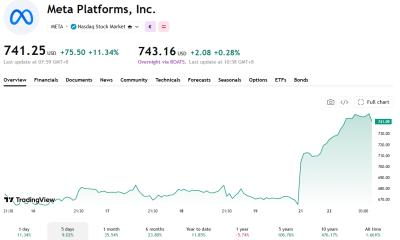
Meta Jumps 11% As Muse Shines and Investors Show an Appetite for Advancing AI
-

 Business5 days ago
Newsom accelerates AI oversight, advances ‘kill switch’ plan
You must be logged in to post a comment Login