






Connect with us

Tech

Activision will make the next Halo game as Xbox cuts 268 more jobs

Published

on

First, we are eliminating 268 roles across Halo Studios, other first-party studios, and the XGS management and central functions layer.

Matt Booty put that in an email to Xbox staff on Tuesday morning. Microsoft published the memo in full on Xbox Wire the same day, under the title Continuing Our Reset.

Booty is Xbox’s chief content officer. He wrote that he is deeply grateful for what colleagues have built, and knows how difficult the day will be for those leaving. His memo runs to three parts. The job cuts come first, then a reorganisation of the studios, then an update on the ones Microsoft is trying to sell.

Aaron Holmes had the cuts first. Hours before the memo went out, he reported for The Information that Xbox planned to lay off hundreds of staff. It would also consolidate several studios, he wrote, citing someone briefed on the plans.

268 is only the gaming figure

Microsoft cut more than that on Tuesday. Ashley Stewart put the company-wide figure at around 500 employees, writing in Business Insider. A small number of the roles sat outside gaming, in units such as cloud and AI.

Advertisement

Todd Bishop put it slightly higher. Microsoft described the total as fewer than 600 globally, he reported for GeekWire, with about 300 in Washington state. Cuts also landed in marketing and research.

Microsoft’s own memo gives only the 268.

Activision takes the next Halo

The reorganisation moves Xbox’s biggest franchise out of the studio built to make it.

Activision will develop the next Halo title, Booty wrote, using a new team that is separate from Call of Duty. Activision also picks up Rare, which makes Sea of Thieves, and World’s Edge, which looks after Age of Empires.

Advertisement

Halo Studios does not close. A small team stays to support the community and the games already on sale.

Rob Kostich, Activision’s president, set out the brief in a statement.

For Halo, our goal is clear: make the greatest Halo game ever, worthy of its universe and legacy, while staying true to what made players love it in the first place.

He said the team is already being assembled.

Halo has moved studios before

Halo launched in 2001 alongside the first Xbox, made by Bungie. Bungie left in 2007, after Halo 3. Cecilia D’Anastasio and Jason Schreier reported for Bloomberg that Microsoft then formed 343 Industries to carry the series on.

Advertisement

That studio was renamed Halo Studios. Its games have been expensive, irregular and hard to sell to fans, according to Bloomberg. The most recent release was Halo: Campaign Evolved, a remake of the original, which arrived in July.

Two analysts gave the BBC their read. Christopher Dring, editor-in-chief of The Game Business, said Halo was once Xbox’s crown jewel. It had not been one for more than a decade, he said.

Dring said putting the series under Activision makes sense. His caveat was that the company should be mindful not to lose what makes Halo unique.

Jez Corden of Windows Central called the change a dramatic move. Halo was once to Xbox what Mario is to Nintendo, he told the BBC, but years of mismanagement have eroded that.

Advertisement

Three more studios change hands

Bethesda absorbs Obsidian, the studio behind Fallout: New Vegas. Booty wrote that it keeps its current projects, including Grounded and a new Fallout game made with Bethesda Game Studios.

King, which makes Candy Crush, takes Microsoft Casual Games.

Playground and Turn 10 merge into a single studio for Forza and Fable. Booty described the two as creative and franchise partners for over a decade.

Ninja Theory faces closure

The third part of the memo covers the studios Microsoft is trying to sell.

Advertisement

Two separate agreements to sell Ninja Theory fell through. Microsoft will now open consultation with employees on a proposed closure, Booty wrote, while continuing to explore other paths forward.

The Cambridge studio made Hellblade: Senua’s Sacrifice and won a Bafta for it. It was one of the five studios put up in June.

Arkane, in Lyon, is still in consultation, which Booty expects to run to the end of the year. French law obliged Microsoft to open that process first, Kris Holt noted in Engadget. Only then can it decide whether to sell, spin out or close the studio.

Three of the five got out. Compulsion and Double Fine went back to their management in August with their intellectual property, back catalogues and runway funding. Undead Labs has now done the same.

Advertisement

State of Decay 3 will launch day one on Game Pass under a new publisher.

Independence came at a price. Undead Labs said on LinkedIn that it meant saying goodbye to a significant number of colleagues, and declined to say how many.

There have been far too many announcements like this across the industry, and we hate adding to that list. These are people we’d hire again in a heartbeat, and we hope the industry takes notice.

Three quarters of the way through

Booty wrote that the actions completed since July, including the divestitures, bring Xbox roughly three-quarters of the way through the restructuring it announced this summer.

That programme covers 3,200 jobs and five studios, about a fifth of the division.

Advertisement

Asha Sharma, Xbox’s chief executive, told staff in July that the business was not healthy. Xbox was running at margins three to 10 times lower than comparable businesses, she wrote, according to Bloomberg. We must reset Xbox, she added.

The warning signs were already on the record. Microsoft was considering a spin-off in June, when the division’s margins hit 3%. It had raised console prices three times in 13 months. In July it admitted that cloud gaming had not worked yet.

Booty ended the memo with a date. Xbox holds a town hall on 6 October, where he says the team will look ahead to one of the strongest line-ups in its history.

Advertisement

Source link

Continue Reading
Click to comment

You must be logged in to post a comment Login

Leave a Reply

Tech

Gone With the Wind Finally Comes to 4K UHD With Dolby Vision and Original Mono Audio

Published

on

Scarlett O’Hara has survived the Civil War, Reconstruction, Rhett Butler walking out the door, VHS, LaserDisc, DVD, Blu-ray and the indignity of streaming compression.

4K UHD Blu-ray was apparently the next hill to climb.

Warner Bros. Discovery Home Entertainment will release Victor Fleming’s Gone With the Wind on 4K Ultra HD Blu-ray for the first time on November 3, 2026, more than 86 years after the film’s Atlanta premiere. The new edition has been remastered in 4K with HDR and will be available as a standard release, limited SteelBook and Walmart-exclusive Collector’s Edition, with a new 4K digital version arriving the same day.

More importantly, this is not simply the old Blu-ray master wearing a new hat.

Advertisement

Gone With the Wind was photographed in 35mm three-strip Technicolor, making it exactly the kind of catalog title that can benefit from a careful modern restoration. Warner has confirmed a newly remastered 4K presentation, while subsequent disc information indicates Dolby Vision, a remastered DTS-HD Master Audio 5.1 soundtrack, and the original theatrical mono mix in DTS-HD Master Audio.

Frankly, my dear, that took long enough.

gone-with-wind-4k-uhd-digital
4K Ultra HD + Digital Code

Why the 4K Restoration Matters

Three-strip Technicolor is one of the reasons Gone With the Wind still looks so distinctive.

The process recorded separate color information onto three black-and-white film elements, which were later combined to create the final image. Restoring that material requires careful alignment, color work and preservation of detail across multiple source elements.

Warner’s 2009 Blu-ray restoration was already considered excellent, so the UHD has a high bar to clear. The real opportunity here is not merely more resolution, but better color reproduction, expanded dynamic range and improved preservation of the movie’s elaborate production design, costumes, painted backgrounds and shadow detail.

Advertisement

Warner has not published a full technical restoration report detailing the scanning resolution or exact source elements used for the 2026 edition, so claims about a specific 8K workflow should be treated cautiously until the studio confirms them.

The feature is also being spread across two 4K UHD discs, rather than squeezing nearly four hours onto one. That should allow for a healthier video bitrate and fewer compromises.

Advertisement. Scroll to continue reading.

Gone With the Wind 4K UHD Specifications

  • Format: 4K Ultra HD Blu-ray
  • Resolution: 3840 x 2160
  • Video codec: HEVC/H.265
  • HDR: Dolby Vision
  • Original photography: 35mm three-strip Technicolor
  • Aspect ratio: 1.37:1
  • Feature presentation: Two UHD discs
  • English audio: DTS-HD Master Audio 5.1
  • Original audio: Theatrical mono in DTS-HD Master Audio
  • Commentary: Film historian Rudy Behlmer
  • Subtitles: English SDH, French and Spanish
  • U.S. release date: November 3, 2026
  • Physical editions: Standard 4K UHD, SteelBook and Walmart-exclusive Collector’s Edition

The Original Mono Track Matters

Keeping the theatrical mono soundtrack may sound like an odd selling point in the Dolby Atmos era, but it is important for film preservation.

Gone With the Wind was not mixed for height channels, rear surrounds or six subwoofers buried beneath the sofa. The remastered 5.1 track offers a more expansive presentation, but including the mono mix gives viewers access to something much closer to the original theatrical experience.

Advertisement

That is exactly how catalog releases should be handled: improve the experience without erasing the original one.

gone-with-wind-anniversary-collection-walmert-exclusive
Gone With The Wind Collector’s Edition (Walmart Exclusive)

New Bonus Features

Warner has prepared three new supplements:

  • Gone with the Wind: The Influence that Endures examines the film’s impact on cinema and popular culture.
  • Gone with the Wind: Restoring and Preserving an Epic focuses on the restoration process.
  • Scarlett O’Hara: A Woman Ahead of Her Time looks at Vivien Leigh’s performance and the character’s enduring place in film history.

Some international editions include additional legacy material, but Warner has not confirmed that every supplement will appear on every U.S. configuration.

A Box Office Monster That Still Has No Real Equal

The commercial history is almost as extraordinary as the film itself.

Box Office Mojo records roughly $402 million in worldwide nominal theatrical grosses across tracked releases, but that figure tells only part of the story because Gone With the Wind has been reissued repeatedly since 1939.

Advertisement

Adjusted for inflation, the numbers become absurd.

Guinness World Records estimates that the film sold approximately 202 million tickets in the United States during its first three theatrical runs and generated the modern equivalent of roughly $4.5 billion worldwide.

For context, Avatar, the current worldwide box-office leader in unadjusted dollars, has earned about $2.9 billion.

In other words, Gone With the Wind was not merely popular. It operated on a scale that modern theatrical releases are unlikely to reproduce.

Advertisement

The film also won eight competitive Academy Awards, including Best Picture, Best Director and Best Actress, while Hattie McDaniel became the first Black performer to win an Oscar.

Advertisement. Scroll to continue reading.

The Complicated Part

Any modern release also has to acknowledge the film’s depiction of slavery and the Antebellum South.

Gone With the Wind romanticizes plantation life and minimizes the brutality of slavery, issues that were criticized even when the film was originally released. Warner has chosen to preserve the movie rather than alter it, while acknowledging the offensive and problematic elements of its portrayal.

Advertisement

That is the correct approach. Film preservation should not require pretending history was cleaner than it actually was.

gone-with-wind-4k-steelbook-vs-anniversary-collection-covers
Limited Edition Steelbook vs. Collector’s Edition (Walmart Exclusive)

The Bottom Line

Gone With the Wind does not need another release simply because somebody found a new anniversary to print on the box.

It does need a definitive 4K presentation.

The combination of three-strip Technicolor photography, Dolby Vision, two-disc UHD presentation and preservation of the original mono soundtrack gives Warner an opportunity to create one of the more important catalog releases of 2026.

Advertisement

The film remains both a major achievement of Golden Age Hollywood and a deeply flawed depiction of the American South. Preserving it properly allows audiences to confront both.

For a movie that has already earned the modern equivalent of several billion dollars, two UHD discs seems like the least Warner can do.

After all, tomorrow is another day.

Where to pre-order:

(Available November 3, 2026)

Advertisement

Source link

Continue Reading

Tech

Geotab SVP on the future of robotaxis in Europe

Published

on

Private and public sectors need to join efforts to make robotaxi deployment a smoother affair, says Geotab’s Edward Kulperger.

Over the past decade, self-driving cars have become a somewhat common sight across several major cities in the US, China and elsewhere. Cautious regulators now want robotaxis on European roads.

Across the region, a number of countries, including Germany, Spain and the UK are allowing companies to pilot the technology in urban areas.

The needle is moving here in Ireland as well, with the Irish Government having approved partially autonomous vehicles (AVs) – also called level 2 AVs – on the country’s roads earlier this year, and kick-starting a strategy towards level 4 autonomous technology, or fully autonomous vehicles.

Advertisement

Though it may be years before we see fleets of driverless taxis in the country.

The safety argument

The argument for robotaxis primarily hinges on safety, according to Edward Kulperger, the senior vice-president for the EMEA region at the Canadian fleet management company Geotab, who tells SiliconRepublic.com that AVs are safe today and would “for sure” be safer than human driving in the future.

Geotab has about 6.5m connected assets, including robotaxis and other logistics vehicles on its platform, Kulperger explains. These assets, that have collectively completed more than 300m miles of complete AV driving, produce approximately 100bn individual data points.

This includes GPS data, vehicle and energy performance, accident data and vital information on other maintenance issues, which are used to monitor vehicles in real time, as well as train future fleets. “That’s a massive baseline to draw from,” says Kulperger.

Advertisement

Waymo, which has more than 200m in AV miles, said that its data indicated that its robotaxis were better than humans at avoiding crashes that result in injuries.

Just days ago, the Estonian ride hailing company Bolt announced a plan to launch its European robotaxi services on 25,000 Lucid-made cars. The company said it would use its extensive existing European data to train up the driverless fleet with hopes of growing the number to 100,000 by 2035.

Kulperger argues that AVs mean no distracted, reckless or drunk driving. While still in its infancy, the fast-advancing technology – now boosted with new advances in AI – will “surpass [humans] from a safety perspective”, he says. It’s also more efficient, he adds. “I think it’s really paramount that we, as a society, dive into fixing this [issue of road deaths].”

Then there’s other problems too, such as road congestion and concentration of pollution in urban streets that Kulperger believes AVs could also help resolve.

Advertisement

Road deaths globally dropped 21pc between 2011 and 2025 according to the World Health Organization (WHO), despite the addition of more than 1bn vehicles within the period. Still, more than 1m lives were taken on roads across the world just last year.

Meanwhile, road fatalities dropped by 3pc on average in the EU last year, amounting to nearly 19,500 deaths. Romania continues to have one of the highest fatality rates in the bloc alongside Bulgaria and Croatia (Croatia’s capital Zagreb was tapped by Uber to launch its first robotaxi service in the continent just last month).

The massive drop in road deaths, though, is attributed to “safe road systems”, says the WHO. This recognises human error as unavoidable, and promotes safer roads, infrastructure, vehicles, speed limits and regulations to hopefully ensure that crash impacts remain within survivable levels. Smarter vehicles, of course, aid in driver safety.

Still, some experts point to a lack of sufficient independent data backing up the narrative that AVs are less crash-prone than humans. They argue that driverless vehicles face problems of an entirely different kind to what humans might experience on the road.

Advertisement

Earlier this year, Waymo recalled pulled 3,900 robotaxis from US streets over a software issue that let AVs enter and drive in closed freeway construction zones. Just a month earlier, the company recalled nearly 3,800 robotaxis from the US over a software issue that could allow vehicles to drive onto flooded roadways.

Meanwhile, last December, the Alphabet-owned company briefly suspended services in San Francisco after a massive outage stalled Waymos on roads, disrupting traffic and adding on to the gridlock.

Waymo’s Chinese competitor Baidu also faced a similar issue in Wuhan after more than 100 of its Apollo Go robotaxis abruptly stopped on the city’s roads in late March.

Bloomberg reported that Chinese authorities, as a result, suspended issuing new licences for level 4 AVs, preventing companies from adding new robotaxis to their fleet or expanding to new cities.

Advertisement

Both countries have seen grievous AV-related injuries in recent years as well.

But according to experts like Kulperger, the hope is that over time, and with enough data captured from different urban layouts globally, issues like these will eventually be fixed. “The rapid adoption and acceleration now is kind of unprecedented – it’s really doable,” he says.

“Our societies have invested a lot in trains and buses – I think we complement that,” Kulperger says when asked what role robotaxis would play in alleviating congestion-related issues. He envisions a mixed fleet of public transport alongside AVs to help people reach destinations safely.

“You take a train, and then maybe you move to an AV to get to your destination…I think the economic and societal benefits [of AVs], will be realised, you know, exponentially as it grows.”

Advertisement

Data is the answer

The robotaxi market is expected to grow to $168bn by 2035, with a global fleet size of 3.6m robotaxis, according to data from Counterpoint Research.

Waymo, Tesla and China’s Baidu Apollo Go, WeRide and Pony.ai are all expected to lead the market, supported by their technology, funding and aggressive roll-out strategies. Meanwhile, ride-hailing leaders, including the likes of Uber, Lyft, Bolt and Grab are continuing to partner with robotaxi builders, connecting companies with their wide customer-base.

In Europe, these businesses are targeting to deploy more than 100 AVs per city by 2030, Kulperger says. “That gives you a little bit of insight into the kind of timeline.

“The thought process is to focus on logistical corridors… so arteries, freightways and to integrate that with various fleets.”

Advertisement

Europe’s old roads and unruly weather – a particular cause for trouble in areas like Ireland – have made expanding into the region somewhat challenging for businesses. Though that hardly seems like a hurdle anymore.

“We work with the largest AV organisations today,” Kulperger says, including one with driverless fleets in the US and recently in Europe. “We’re just at the tipping point of it really starting to scale.

“I think [by] 2030, we’ll see increasingly in, you know, cities like Dublin, a mixed fleet on the road where you have personal vehicles that are completely autonomously driven alongside partially assisted vehicles.”

Regulations need to evolve with the technology, says Kulperger. The bloc has been known to be slow with regulations, but it is attempting to change that across the board in recent years. Earlier this June, 18 EU member states, including Ireland, signed a declaration to support large-scale cross-border testbeds for AVs.

Advertisement

“I think it’s incumbent upon [the] private and public sector to start to really work together at the state and city level to deploy this because the safety and efficiency is kind of demanding it,” Kulperger says.

“The cities that’ll be best positioned to lead this might not be the ones that are most advanced today on autonomous vehicle…[but would be] ones that can combine the technology with the right regulatory infrastructure and commercial environment.”

Don’t miss out on the knowledge you need to succeed. Sign up for the Daily Brief, Silicon Republic’s digest of need-to-know sci-tech news.

Advertisement

Source link

Continue Reading

Tech

Get 1TB of Xbox Series X/S storage for half price

Published

on

Wouldn’t it be lovely to double your Xbox’s storage for less than half the usual price?

The Seagate Storage Expansion Card, a 1TB NVMe SSD built specifically for the Xbox Series X and S, has fallen from £349.99 to £149.99, a saving that belongs to it and it alone at more than £200 off.

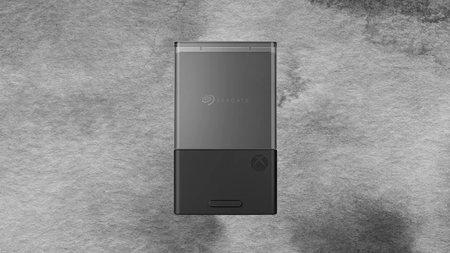
Seagate SSD on a grey fabric backgroundSeagate SSD on a grey fabric background

Get 1TB of Xbox Series X/S storage for £149.99, less than half its usual price

For anyone who could use some more storage on their Xbox, £149.99 for a 1TB Xbox compatible SSD is a genuine bargain.

Advertisement

View Deal

Less than half price on a 1TB SSD built exclusively for Xbox is a genuinely rare drop, especially since most third party storage upgrades still cost close to their full price for years after launch, if they discount at all.

Advertisement

Seagate built this card in partnership with Xbox, so it plugs straight into the Xbox Velocity Architecture and matches the console’s own internal drive for load times rather than trailing behind it in busy games.

There is no complicated setup involved either, since the card slots directly into the dedicated port on the back of an Xbox Series X or S and starts working the moment it clicks into place.

Advertisement

Quick Resume switches between several titles at once without losing speed, whether a game sits on the internal drive or this expansion card. Its compact size also makes it easy to carry a full game library to a friend’s house or swap it between two consoles in seconds.

Advertisement

The Whatsapp LogoThe Whatsapp Logo

Get Updates Straight to Your WhatsApp

Join Now

Advertisement

That reliability is backed by a two year manufacturer’s guarantee, and it clearly shows in the reviews, where the card holds a 4.8 star rating across more than 300 buyers with 98 percent recommending it.

This same speed extends to older titles too, since thousands of Original Xbox, Xbox 360 and Xbox One games run from the Storage Expansion Card at exactly the same peak levels as the console’s internal drive, spanning three console generations.

For anyone whose Xbox Series X or S is already flashing storage warnings, £149.99 for a 1TB card that performs identically to the built-in drive is a genuine bargain at less than half its usual price.

Advertisement

Advertisement

SQUIRREL_PLAYLIST_10148964

Source link

Continue Reading

Tech

All the Googlebook laptops confirmed so far

Published

on

Alongside its Android 17 announcement, Google has introduced Googlebook – its newest laptop series.

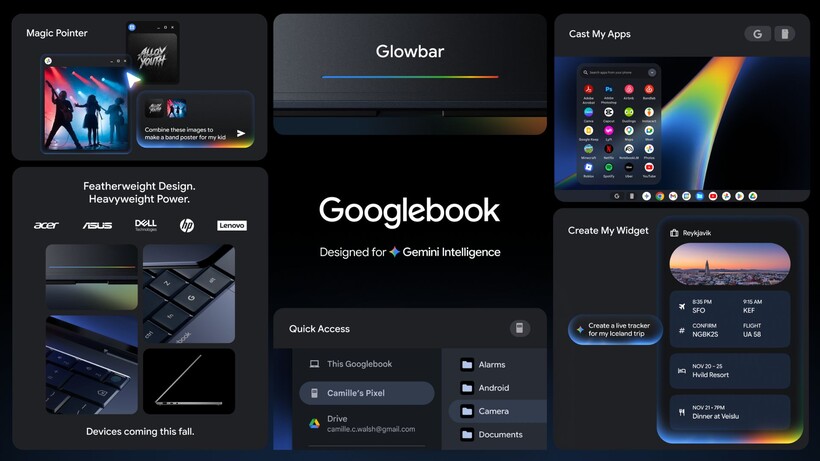
Designed for Gemini Intelligence, Googlebook promises to bring together Chrome, Google Play and a modern OS into a range of laptops that are all built with premium materials. Googlebook looks like a natural successor to Google’s 15 year old Chromebook series, and claims to be more of an “intelligence system” rather than merely an operating system.

If you want a deeper dive into Googlebook, make sure you visit our Googlebook vs Chromebook and Googlebook vs Windows 11 guides. If you’re not sold on a Googlebook then our list of the best laptops and best budget laptops should have you covered.

When will Googlebooks launch?

Google has recently unveiled the first wave of Googlebooks, and you can see a full list of models in our Googlebook launch guide. At the time of writing, there are five official Googlebooks including:

Advertisement
  • Acer Googlebook 14
  • Dell XPS Googlebook
  • Asus Googlebook 14
  • Lenovo Googlebook 15
  • HP Googlebook 14

Advertisement

While they’re not currently available to order just yet, we expect availability to begin from October 2026 in the UK and US.

Googlebook specs overview tableGooglebook specs overview table
An overview of Googlebook’s features. Image Credit (Google)

How much will a Googlebook cost?

When Google first announced Googlebook, we hoped that the laptop range would be as affordable as Chromebooks which can be found for as low as £249/$179. Plus, Chromebooks can be found on our best budget laptops and best student laptops guides, meaning they’re not only cheap but also offer solid performance too. However, unfortunately as RAM prices are still climbing and availability is scarce, it’s perhaps unsurprising that Googlebooks aren’t quite as cheap and cheerful as we dared to hope.

The cheapest Googlebook, the Acer Googlebook 14, starts at $899/£999 while the priciest models from Asus and HP will set you back around the $1199 to $1299 (£1099 to £1199) mark.

Googlebook hands onGooglebook hands on
Image Credit (Trusted Reviews)

Which brands will launch Googlebooks?

Google has stated that Acer, Asus, Dell, HP and Lenovo will be the first brands to launch their own GAcer, Asus, Dell, HP and Lenovo are the first brands to launch their own Googlebooks.

Advertisement

Google has explained that all Googlebooks, regardless of the manufacturer, will be identifiable by a glowbar that acts as an at-a-glance indicator of your battery, a G Key and authentication methods to keep your Googlebook secure and private. Those methods include a fingerprint sensor and, for some models, face authentication too.

Advertisement

In addition, every Googlebook promises to be built with “premium craftsmanship and materials” like aluminium and magnesium, will be fitted with at least 16GB RAM and 256GB SSD storage and will see a minimum of 14 hours battery.

Source link

Advertisement
Continue Reading

Tech

Chinese hackers exploit WordPress, Zyxel flaws to steal govt data

Published

on

Chinese hackers exploit multiple technologies to steal govt data

A Chinese-speaking threat actor has been exploiting vulnerabilities in ZyXEL GS1900 Smart Managed Switches and WordPress to steal sensitive data from 996 devices and more than 18,500 records stored in backend databases.

The adversary targeted multiple technologies, including PAN-OS Global Protect, FlowiseAI, Nuclio, Proxmox, Ubiquity, with exploits for known security issues.

Scans and attacks attributed to the adversary originate from the same IP address and have been recorded since early June 2026, and have been attributed to a threat actor related to the Red Heron group, linked to exploiting a critical flaw in the Gitea self-hosted Git service.

The activity was detected by threat intelligence company GreyNoise through its Global Observation Grid (GOG) network of sensors.

Advertisement

According to the researchers, the threat actor leveraged the wp2shell vulnerabilities (CVE-2026-63030 and CVE-2026-60137) in the WordPress Core component to breach at least 49 organizations in 29 countries.

Public exploits for wp2shell became available in mid-July, and active exploitation was observed a few days later. The campaign GreyNoise observed started around the same time, targeting high-value entities.

While many targets were in the small business and government sectors, one intrusion at an unnamed Western government organization stands out.

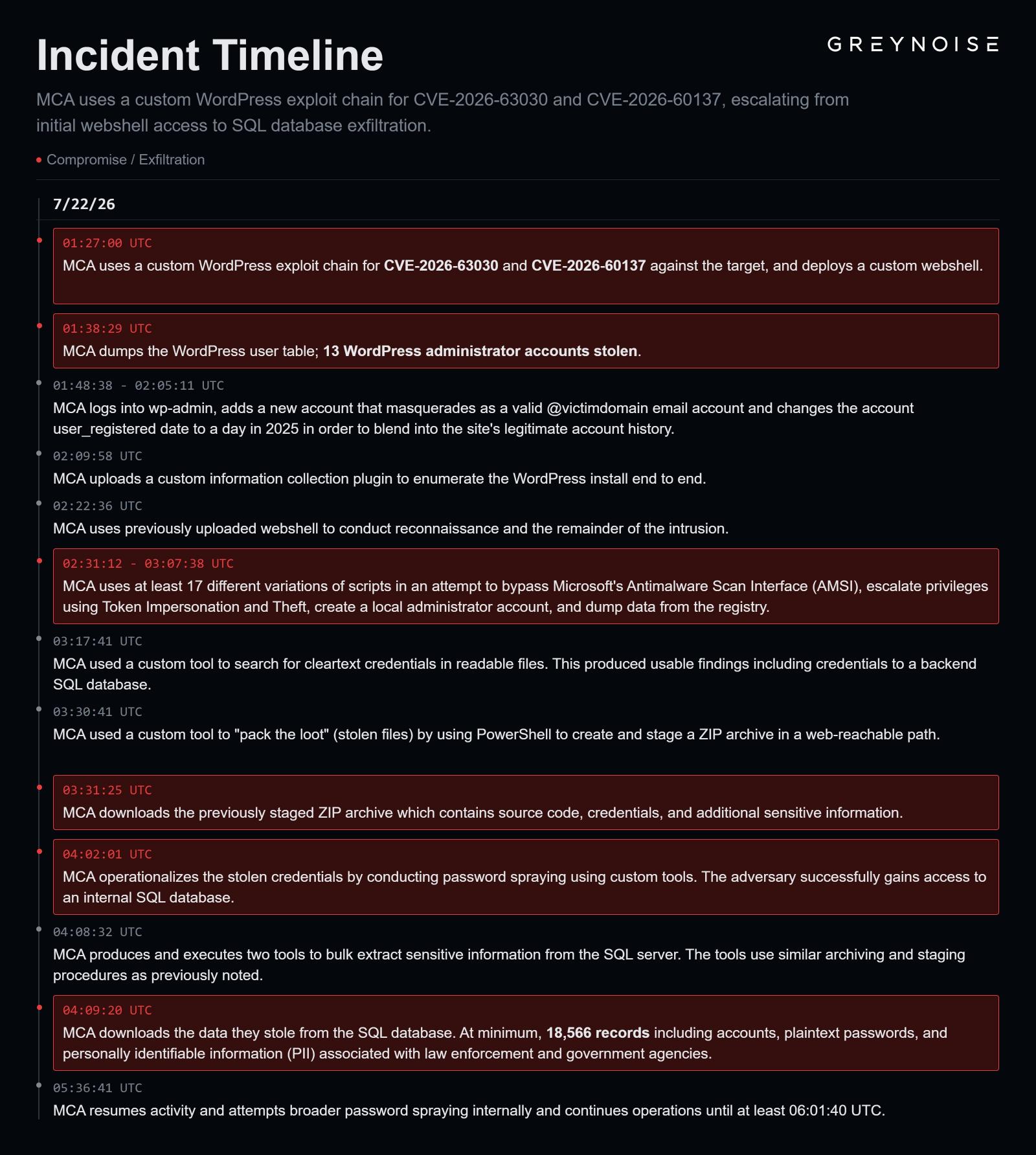
The attacker used a custom wp2shell exploit and performed extensive Windows and security reconnaissance, checking Microsoft Defender, AMSI, available services, listening ports, local accounts, application restrictions, and database configuration.

Advertisement

Over 36 minutes, the threat actor tried 17 scripts to bypass AMSI, escalate privileges through token impersonation or theft, create a local administrator, and extract registry data, GreyNoise says.

After locating credentials for a backend SQL database, the attackers used them in a password-spraying attack that gave them access to an internal SQL server, from which they stole at least 18,566 records.

According to the researchers, the data contained accounts, plaintext passwords, and personally identifiable information (PII) connected to government and law-enforcement agencies.

wp2shell attack timeline
Source: GreyNoise

The same attacker breached a Russian state organization in occupied Ukraine, which the researchers described as a “red-on-red” compromise.

Exploiting multiple flaws

On August 17, the threat actor started to exploit a high-severity flaw (CVE-2026-7273) in ZyXEL GS1900 Smart Managed Switches and compromised 996 devives in 48 countries to extract device configurations, network information, and hashed root-level credentials.

Advertisement
Timeline of exploitation activity
Source: GreyNoise

Additionally, the hackers attempted to chain the Ubiquiti UniFi OS vulnerabilities tracked as CVE-2026-34908, CVE-2026-34909, and CVE-2026-34910 to obtain root-level remote code execution.

CISA has flagged the three Ubiquiti flaws as actively exploited since late June 2026.

GreyNoise also confirmed targeting of PAN-OS GlobalProtect, FlowiseAI (CVE-2026-56271), the Linux kernel’s Dirty Pipe flaw (CVE-2022-0847), Gitea (CVE-2026-60004), Nuclio (CVE-2026-79756), SENAITE LIMS (CVE-2026-54569) and Proxmox VE (CVE-2023-54391).

The researchers highlight that not all security issues leveraged in attacks linked to this threat cluster have been added to CISA’s catalog of Known Exploited Vulnerabilities (KEV).

GreyNoise has provided a set of indicators of compromise (IoCs) connected to the observed activity, which include hashes for backdoors and command-and-control (C2) infrastructure.

Advertisement

article image

Join Mikko Hyppönen and security leaders from the NFL, CHANEL, and Atlassian for a two-hour digital summit on what AI-speed attacks change, what defenders should stop doing, and how to validate, decide, fix, and re-validate at machine speed.

Save your seat

Source link

Continue Reading

Tech

How has networking become the core of modern working life?

Published

on

Amgen’s Christine O’Sullivan and Angela Jenkins discuss the impact a strong network can have when forging a career.

According to Christine O’Sullivan, an operations transformation senior manager at Amgen, networking is key to building relationships, particularly in larger organisations, as no one should work in isolation. 

O’Sullivan told SiliconRepublic.com: “We rely on people across different functions who share different expertise, experience and perspectives. Building those relationships helps us understand more about the wider business, but it also makes it much easier to collaborate and to get things done when we need to.

“And that’s probably the simplest way I’d describe the value of networking, very few of us are going to achieve anything meaningful entirely on our own.”

Advertisement

For Angela Jenkins, a senior manager for quality and compliance, said that at its core, networking – while it sounds very formal – is really just about making connections. 

She said: “If you’re an introvert it can be daunting, but it’s about striking up a conversation when you’re in the queue for a sandwich at the canteen or engaging with a colleague over coffee to find out what’s going on in their part of the business.

“This is an effective way to get to know different people across the business. Those small interactions are often how relationships start. Having a good network is essential to accessing expertise. You may not have the answer to a technical question, but you might know someone who knows someone else who has the answer. 

“You build these connections across your working life, and then you can tap into that network for advice and guidance. Sometimes, it provides the answer to a question and on other occasions, it opens a door to a new opportunity.”

Advertisement
Who typically benefits from work-based networking initiatives?

O’Sullivan: Everyone benefits from networking, but it can be particularly valuable if you don’t have an established network, maybe you’re early in your career, new to the company, or have moved function or location. As you progress, those relationships will help you navigate and work across different parts of the business.

And importantly, networking is a two-way street. We all bring different experiences and perspectives. A digital native and someone with 20 years’ industry experience will learn different things from each other. That applies to leaders too, networking gives them direct access to emerging talent and fresh perspectives on topics like AI and new ways of working.

Jenkins: Work-based initiatives are beneficial because they provide structure and complement informal networking. You know that if you attend an event, you’ll meet leadership or colleagues from a different department or function. Participating in these structured events helps to light the sparks that ignite relationships and allow colleagues to connect informally. 

For example, if you are transitioning into a new role, you might know about the role itself, but if you have previously met a colleague who works in this function at a work-based initiative, they could provide the information that you need. Having a network gives you the benefit of people who you can reach out to for the tacit knowledge and context about how the teams connect and who have expertise. You wouldn’t be able to get this kind of information without building those relationships.

Advertisement
How can companies create an environment in which networking is fully integrated? 

O’Sullivan: Networking works best when there’s a mix of formal and informal opportunities. At Amgen, we also have a mentorship programme and I’ve found this particularly valuable when you connect with someone from a different part of the business who can bring a completely different perspective. So, while formal networking events are great for making connections, the informal side, the conversations and relationships you build over time, is just as important.

Jenkins: Networking works when it becomes part of everyday working life rather than something you only do at a networking event. It’s important for new joiners to take part in the non-work related activities that are part of everyday life at Amgen, as well as taking part in cross-functional projects which are brilliant for self-development.

When we view networking as being integrated into everything that we do, it means that colleagues are comfortable saying: “I’m really interested in what I heard you say in that meeting, can we have a chat about it?” People are willing to have those conversations regardless of organisation or level, and that openness is ultimately what drives our workplace culture.

How might networking events encourage less experienced employees to develop crucial future skills?

O’Sullivan: Networking events are a great way for junior colleagues to meet senior leaders. Regardless of whether the events are virtual or in-person, they also provide opportunities for junior employees to introduce themselves and to hear perspectives from across the business. 

Advertisement

Jenkins: Amgen offers numerous pathways for young professionals to develop soft skills like communication and public speaking. For example, our networking events provide an opportunity for junior colleagues to practice their personal ‘elevator pitch’ to senior leaders; where they explain their role, and that of their team, in the context of the impact to the business.

In-person meetings have an added benefit for junior colleagues: it allows them to see how successful presenters and leaders deliver their messages, they can see the eye contact across the table and the nodding in the room. 

What advice do you have for an individual who might find networking to be challenging?

O’Sullivan: Be authentic. I see that a lot of people network very naturally without realising it, so just being yourself is the best approach. You don’t have to walk into a room thinking, “I need to talk to 20 people”. Start with one good conversation. Be curious, ask what someone is working on, how they got involved or what they’ve learned along the way. That takes some of the pressure off and makes networking feel much more natural.

Jenkins: Be curious. Ask someone about their role, how they got there or what they’re working on. And don’t underestimate what you bring to the conversation either. If you have knowledge or expertise in a particular area, share it.

Advertisement

For example, if there’s a piece of technology you know a lot about, tell people. This is an effective way of networking because your colleagues will let other people know about your expertise. It’s also important to be consistent, spend a few minutes at the start of a meeting to introduce yourself to a colleague and then send them a follow-up note afterwards. Closing the loop is an underrated networking skill and it can spark the beginning of a productive two-way relationship.

How might you gauge how successful or unsuccessful a networking event has been?

O’Sullivan: It’s not just about how many people show up but the relationships that are forged. If you come away having made two meaningful new connections, gained a different perspective or learned something new, that’s valuable. The real measure is what happens afterwards, whether you continue those conversations and build on the relationships you’ve made.

Jenkins: It depends where you are on your professional journey. Our events tend to have a wide range of attendees, encompassing every career stage from executive directors to graduates. If you are a new hire, these initiatives are a great way to make valuable connections and to learn about key career development, influencing and communication skills. Similarly, attending an event can make graduates feel comfortable and give them the confidence they need at the start of their careers.

Don’t miss out on the knowledge you need to succeed. Sign up for the Daily Brief, Silicon Republic’s digest of need-to-know sci-tech news.
Advertisement

Source link

Continue Reading

Tech

Trump Denounces Attempts to Control AI, Wants It Renamed 'Super Intelligence' in US Documents

Published

on

U.S. President Trump addressed the United Nations on Tuesday. And a half hour in, after decrying immigration, Trump pivoted to add that “The United States also totally rejects any attempt to construct a globalist scheme to control for the artificial intelligence being spoken of so much now.”

But then he added “hereinafter officially called super intelligence, changing the name, in that the use of the word artificial makes intelligence fake. It makes it sound fake, and it is not fake. It’s actually… amazing. But we have to be careful — in fact, it is exactly the opposite of what it purports. From this point forward, all of United States documents and hopefully the world’s will be changed to use the much more accurate term super as opposed to artificial. So it’s super intelligence.”

TRUMP: In other words, welcome to the new world of super intelligence — SI. SI. Let’s see if that goes. It sounds much better. It is much better, and it’s much more accurate. Let’s see if I have any power. Maybe I do and maybe I don’t. We’re going to find out pretty soon. Super intelligence.

Every major new technology brings challenges, and super intelligence is no exception. Yet the very same people who said we’ll all be dead in 12 years because of global warming, a name since reborn to climate change because the planet was cooling not warming, and nobody was dead — these are the same people that are now saying that AI is going to kill us all. That robots are going to attack us, and that everything is going to be a total disaster — same group of people. This is the group that came up with the Russia Russia Russia hoax, the Ukraine Ukraine Ukraine hoax. Climate change, open borders.

Advertisement

Whoever wins AI — you have to remember this — and now I say, whoever wins SI, whoever wins super intelligent [sic] — wins. That’s the group that wins. And we’re leading now over China by a lot, and everyone else, and we’re going to keep it that way. We’re going to keep it very — very straight and very strong. I’m not going to stifle growth of something that will be bigger than the Industrial Revolution. Many say, bigger than the Industrial Revolution or the internet itself.

And we will be very careful, and that’s why we have a Department of Justice that we’ve already used it, having to do with this very subject, and used it very powerfully. Everything worked out very well and very quickly. And other law enforcement bodies that will rein things in if we have to do that.

But we will only encourage super intelligence. We’re gonna encourage it, not rein it in. We’re gonna watch it closely, through the Department of Justice. The United States leads the world in Super Intelligence, and will continue to do so, safely and responsibly.

Thanks to long-time Slashdot reader
ArchieBunker for suggesting the story.

Advertisement

Read more of this story at Slashdot.

Source link

Advertisement
Continue Reading

Tech

Reolink’s solar 4K security camera falls to its lowest price in months

Published

on

£42 is a hefty amount to save on a security camera that never needs a cable run or a monthly bill.

That saving belongs to the Reolink Argus PT Ultra plus Solar Panel, a 4K battery security camera that has fallen from £139.99 to £97.99, which you can now get with a 30% discount that matches its lowest price in three months.

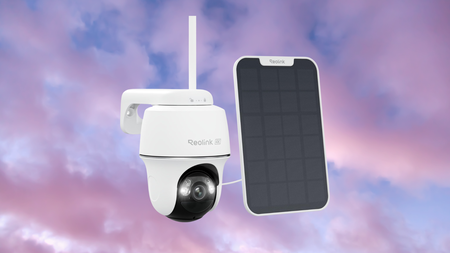
Reolink camera with solar panel on a pink cloudy backgroundReolink camera with solar panel on a pink cloudy background

Reolink 4K security camera falls to £97.99, matching its three month low

When was the last time a 4K security camera dropped this low, needed no installer to set it up, ran itself entirely on sunlight?

Advertisement

View Deal

Solar power keeps the Argus PT Ultra running instead of mains electricity, so that £42 saving holds its value long after the purchase, with people, vehicles and pets all detected without a monthly subscription fee.

Advertisement

The Argus PT Ultra still records 4K video at 8 megapixels, four times sharper than the 1080p feed most outdoor cameras send to a phone, and switches to full colour after dark thanks to its built-in spotlight.

That spotlight doubles as a deterrent, lighting up anyone approaching the house after dark, while the camera itself sweeps 355 degrees horizontally and 140 degrees vertically to keep them in frame the whole time they are on the property.

Advertisement

Auto-tracking keeps a moving person or vehicle centred in frame across that full range of motion. The onboard AI tells people, vehicles and pets apart, sending alerts only when something worth seeing happens, and none of that intelligence carries a monthly subscription fee.

Advertisement

The Whatsapp LogoThe Whatsapp Logo

Get Updates Straight to Your WhatsApp

Join Now

Advertisement

Two-way audio lets you speak directly to a delivery driver or warn off an unwelcome visitor through the camera itself, and the whole system works with Alexa so the live feed pulls up with a simple voice command.

Dual-band WiFi lets the Argus PT Ultra switch between a faster 5GHz signal near the router and a longer-reach 2.4GHz one further down the garden, while footage saves to a microSD card or the cloud without needing a separate hub.

This same self-sufficiency carries through to how it connects and stores footage. When was the last time a 4K security camera dropped to £97.99, needed no installer to set it up, ran itself entirely on sunlight, and still demanded nothing more once it was up and running?

Advertisement

Advertisement

SQUIRREL_PLAYLIST_10148964

Source link

Continue Reading

Tech

Rogue external MFA providers can steal passwords during logins

Published

on

Authentication

Security researchers developed an attack that lets hackers with privileged access register a rogue external MFA provider that steals users’ passwords during legitimate login attempts.

The technique, dubbed TrustSink by Varonis Threat Labs, can work with any provider that relies on this external authentication model, though the researchers demonstrated the attack using Microsoft Entra.

Microsoft Entra supports external MFA providers, which allow organizations to use third-party authentication services to satisfy multifactor authentication requests.

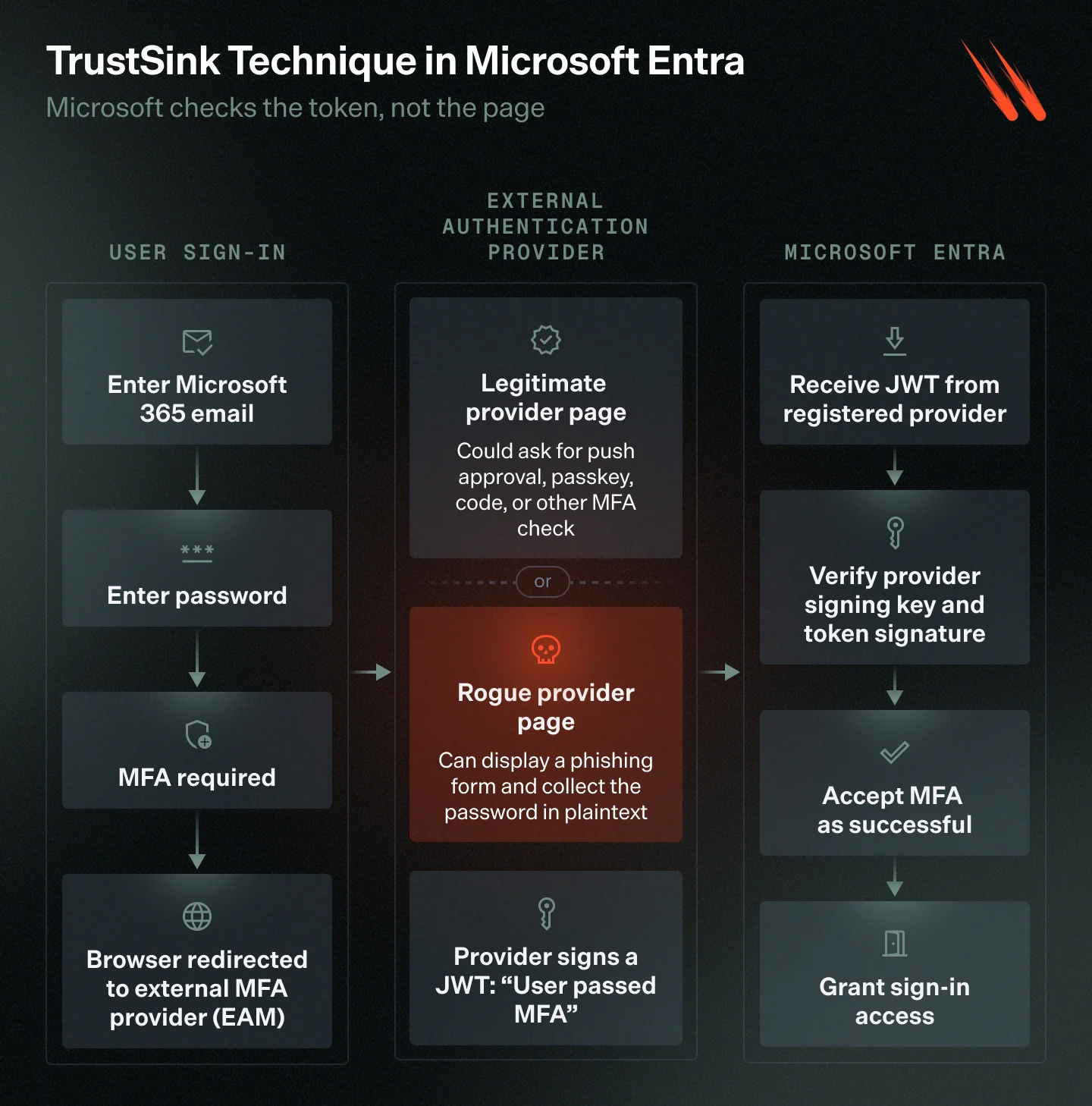
According to Microsoft, when a user signs in with a first factor, such as a password, Entra can redirect them to an external MFA provider to complete the required second factor.

Advertisement

If the provider returns a valid signed token indicating that the second factor was completed, Entra considers the MFA requirement satisfied.

Varonis found that an attacker who has already compromised a highly privileged Entra account can register a rogue External Authentication Method (EAM) as one of these external MFA providers and use it to insert a convincing Microsoft password prompt into the legitimate authentication flow.

The fake prompt captures the user’s password in plaintext before the malicious provider returns a valid signed token to Entra, causing the login to complete without displaying an error.

“In our test tenant, every sign-in completed normally while our server received passwords with timestamps and source IP addresses,” explains Varonis.

Advertisement

“Resetting a captured password did not remove the rogue provider. It remained in the authentication flow and captured the replacement password at the user’s next sign-in.”

It is important to note that TrustSink is not an initial-access attack and requires an attacker to already control a highly privileged Entra account.

Abusing an external MFA provider

TrustSink abuses the trust Microsoft places in a configured external MFA provider.

Varonis created a malicious provider that appeared to Entra as a legitimate external MFA provider but displayed a copy of Microsoft’s password page to the user.

Advertisement
The TrustSink attack

During the proof-of-concept attack, the login initially proceeds normally, with the user entering their email address and password on Microsoft’s legitimate login.microsoftonline.com site.

When MFA is triggered, Entra redirects the browser to the attacker’s external MFA provider for the second authentication step.

Instead of presenting a legitimate second-factor challenge, the malicious provider displays a copy of Microsoft’s password prompt.

External MFA provider showing a Microsoft login prompt
Source: Varonis

If the victim enters their password again, believing Microsoft is requesting it as part of the authentication process, the credential is sent to the attacker-controlled server.

The rogue provider then generates a signed token stating the MFA prompt was completed and returns it to Entra, allowing the user to continue to the application they originally attempted to access.

From the victim’s perspective, the sign-in appears to have completed normally.

Advertisement

Varonis says the attack is convincing because the fake password prompt appears when the user already expects another authentication step.

The researchers say the page uses the same fonts, layout, and button design as Microsoft’s legitimate login page and appears immediately after the victim enters their real password on Microsoft’s domain.

Varonis says TrustSink builds on previous research by security researcher Dirk-Jan Mollema, presented at x33fcon 2025 in a talk titled Bringing Your Own Identity in Entra ID.”

Mollema showed how a rogue registered external MFA provider could satisfy an MFA requirement by returning a signed JWT claiming authentication had succeeded without actually performing the expected authentication check.

Advertisement

TrustSink abuses the same attack for credential theft.

Varonis says registering the malicious external method requires modifying the Authentication Methods Policy and creating an application, service principal, and consent grant.

Those actions require a Global Administrator or Authentication Policy Administrator account, making TrustSink a post-compromise technique.

Once installed, however, the rogue provider can remain in the authentication path for targeted users across subsequent logins.

Advertisement

Because the rogue MFA provider remains registered in the tenant’s Authentication Methods Policy, even if a user changes their password, it will be recaptured on the next log in attempt.

Varonis therefore warns administrators to remove the malicious provider before rotating affected credentials.

Varonis recommends removing suspicious external MFA providers and their associated applications, keys, and redirect URIs before resetting affected users’ passwords.

Organizations should also monitor changes to the Authentication Methods Policy, limit standing Global Administrator and Authentication Policy Administrator privileges, and use phishing-resistant authentication methods such as FIDO2 or Windows Hello for Business.

Advertisement

article image

Join Mikko Hyppönen and security leaders from the NFL, CHANEL, and Atlassian for a two-hour digital summit on what AI-speed attacks change, what defenders should stop doing, and how to validate, decide, fix, and re-validate at machine speed.

Save your seat

Source link

Continue Reading

Tech

Appeals Court Rejects ICE Detention Policy, Comparing It To WWII Japanese Internment

Published

on

from the bringing-out-the-worst-in-America dept

Ever since Trump’s return to office, almost every federal law enforcement agency has been ordered to treat illegal immigration as their first priority. This is why the administration is gutting FEMA to direct more dollars to detention and removal efforts. And that’s why ICE is now the administration’s largest law enforcement budget line item.

To keep up with moving (and ever-increasing) deportation targets, the government has done everything from dismissing pending immigration hearings to stripping temporary protected status from thousands of vulnerable people to the very thing that has been rejected by hundreds of federal judges in thousands of cases.

The administration claims the 1996 Illegal Immigration Reform and Immigrant Responsibility Act (IIRIRA or IRA, depending on which titles judges choose to use) gives it the power to treat any migrant — no matter how long they’ve been in the country — as someone who has been accosted while attempting to cross the border. Migrants who are slated for removal are generally given due process rights if they’re not arrested while attempting border crossings. Trump’s DOJ and DHS have constantly pushed the theory that due process rights do not apply to undocumented immigrants, no matter where they’re arrested or how long they’ve lived in the United States.

As the law stands — at least in terms of how it has been interpreted for the past 30 years — arrested migrants are supposed to receive a bond hearing and be released if they pose no threat of flight or to public safety. The administration goes hard in the other direction, pretending constitutional rights don’t apply to migrants. But it has repeatedly demonstrated it doesn’t even believe its own bullshit. That’s why arrested migrants are swiftly moved from where they’re arrested and shuffled from detention center to detention center to prevent them from filing habeas motions, which must be filed in the jurisdiction in which they were initially arrested.

Advertisement

So far, eight of eleven appellate circuits have ruled in favor of due process rights and against the administration’s desire to pretend the Constitution no longer exists simply because it has expressed a very novel interpretation of the 1996 law.

This loss in the Fourth Circuit brings the total to nine of eleven circuits. And this means the Supreme Court is going to be asked to sort this out, which isn’t exactly heartening. But here are some details on the latest, rather large loss by the Trump administration, as summarized by Politico’s Kyle Cheney:

A federal appeals court on Thursday rejected ICE’s effort to detain millions of people without bond, comparing it to the “historical stain” of Japanese internment during World War II.

“Mass detention of marginalized individuals without due process harkens back to some of the darkest moments in our country’s history,” 4th Circuit Court of Appeals Judge Nicole Berner, a Biden appointee, wrote in a 2-1 majority opinion joined by Judge Barbara Keenan, an Obama appointee.

There it is. The same people who excuse past racism as being a product of a “different time” are doing everything they can to revive this “different time” in the present and make it the “new normal” going forward.

Advertisement

The decision [PDF] notes that this legal action has been brought by two migrants who cannot truly be considered “recent” crossers of the border who were caught in the act of illegal entry. One of the plaintiffs has been here since the law the administration is now deliberately misquoting was first enacted (1996). The other plaintiff is far from a US rookie, having lived here peacefully and productively since 2005.

The government could not be more wrong. And this court isn’t willing to bless a self-serving interpretation that seeks to Make America 1942 Again.

Putting all of our tools of statutory construction to work, we hold that Section 1226, not Section 1225, applies to noncitizens who, like the Petitioners, have been present in the United States for years regardless of how they entered our country. Our holding accords with the text, structure, context, and purpose of the INA [1952’s Immigration and Nationality Act] as well as its universally accepted application for the past three decades. Though the Government’s construction finds some support in the text, it suffers several fatal defects. It renders entire portions of the INA meaningless, calls into question amendments to the statute in the intervening decades, including the recent passage of the Laken Riley Act, and raises significant constitutional concerns.

If we were to agree with the Government’s construction, we would need to conclude that, in passing IIRIRA thirty years ago, Congress intended to direct the single largest mass detention of human beings in our nation’s history. Section 1225 simply “cannot bear the weight of the millions of noncitizens it would potentially subject to detention without bond.”

This administration unabashedly does want courts to agree with its interpretation of the law and it definitely wants to engage in the “single largest mass detention of human beings in our nation’s history.” It doesn’t see this as problematic. Instead, it considers the courts’ nearly-100% rejection of its theories to be the real problem here. In response, it has chosen to directly insult and threaten judges, rather than craft any better arguments in support of its openly racist actions.

Advertisement

While this does put almost every circuit in opposition of the president and his efforts, it does make it clear a showdown in the Supreme Court is all but inevitable. Unfortunately, this iteration of the Supreme Court has repeatedly demonstrated that it believes the president should be able to unilaterally declare how laws should be interpreted, if not able to override them completely by simply issuing an executive order. The conservative majority of the court will undoubtedly do everything it can to prop up decisions delivered by the appellate exceptions to the rule.

Filed Under: 14th amendment, 4th circuit, bigotry, doj, ice, mass deportation, mass detention, trump administration

Advertisement

Source link

Continue Reading

Trending

Copyright © 2025