
Crypto World
Russia sets crypto reporting rules as holdings hit $44B


Russia has warned that investors may have to absorb losses when foreign stablecoin issuers freeze assets outside a Russian depository’s control, as officials estimate residents hold 3.7 trillion rubles, or roughly $44 billion, in crypto and related products.
Summary
- Russia estimates roughly 20 million crypto users collectively hold 3.7 trillion rubles in digital assets.
- Daily Russian crypto transactions total about 50 billion rubles, according to Deputy Finance Minister Chebeskov.
- Investors may bear losses when foreign stablecoin issuers freeze assets beyond direct Russian depositories’ control.
- Russian tax residents must report qualifying crypto activity conducted outside domestic regulated infrastructure beginning 2027.
- Nonqualified investors face a 300,000-ruble annual purchase cap through each intermediary after mandatory testing requirements.
TASS reported that Deputy Finance Minister Ivan Chebeskov put Russia’s crypto user base at around 20 million and daily transaction volume at approximately 50 billion rubles during an interview published Sept. 22. He said the holdings estimate includes direct cryptocurrency ownership and some financial products linked to digital assets.
The figures are expert estimates used by the Finance Ministry, not a complete government count of every wallet or transaction. Officials expect the new regulated framework to provide more precise data as activity moves through licensed exchanges, brokers and digital depositories.
Foreign stablecoin freezes can leave investors with losses
Chebeskov said foreign-issued stablecoins create a risk that Russian infrastructure cannot always control.
“The risk of assets being blocked by a foreign issuer does exist,” he said, using USDT and USDC as examples. Under the framework described by the deputy minister, a Russian digital depository remains responsible for failures in its own accounting, custody and transfer duties, including unauthorized disposal of customer assets.
Federal Law No. 282-FZ draws a separate line for actions carried out by foreign entities. Article 20 permits contracts, including exchange rules, to state that market operators, platform operators and clearing organizations are not liable for customer losses caused by foreign-law persons that seize digital assets or restrict transactions.
Chebeskov said a freeze imposed by a foreign issuer for reasons outside the Russian depository’s control would therefore not automatically require the depository to reimburse the customer.
The issue has already appeared in Russia’s crypto market. Tether said in March 2025 that it helped the U.S. Secret Service freeze $23 million in USDT connected to transactions involving sanctioned Russian exchange Garantex. U.S. authorities later said a coordinated enforcement operation froze more than $26 million in cryptocurrency controlled by the exchange.
As previously reported, Tether’s freeze forced Garantex to suspend operations after billions of rubles in USDT became inaccessible. The incident provides a documented example of the issuer-level control Russian officials now want investors to understand before buying foreign stablecoins.
Circle’s terms similarly state that the issuer can block USDC addresses linked to prohibited activity and may freeze tokens when required by a valid government order.
Russia puts its crypto market at 3.7 trillion rubles
Chebeskov said experts estimate about 20 million people in Russia currently use cryptocurrency.
Their combined investment exposure stands near 3.7 trillion rubles, according to the Finance Ministry estimate. The amount covers cryptocurrency held directly alongside certain crypto-linked financial products, meaning it should not be treated as a pure on-chain wallet-balance total.
Daily crypto activity is estimated at roughly 50 billion rubles. Chebeskov said regulators are not setting a fixed target for how much of that activity must migrate into licensed channels by July 2027. Their immediate focus is creating a market where intermediaries, responsibilities and investor protections can be identified.
Russia’s main cryptocurrency law took effect on Sept. 1. The Bank of Russia said both qualified and nonqualified investors may trade crypto through regulated intermediaries under the new framework. Domestic use of cryptocurrency as payment for goods and services remains prohibited.
As previously reported, Russia opened regulated cryptocurrency trading under Federal Law 282-FZ on Sept. 1, bringing exchanges, brokers, custody providers and cross-border settlement activity into a formal supervisory structure.
For nonqualified investors, the law permits purchases of eligible liquid cryptocurrencies after testing, capped at 300,000 rubles per year through each intermediary. Qualified investors must pass testing as well but do not face the same purchase ceiling.
Foreign crypto activity will trigger tax reporting
Russia’s new rules preserve the ability of residents to use cryptocurrency infrastructure outside the domestic regulated system, but reporting requirements are being added.
Amendments to Russia’s currency-control law state that residents can use addresses not administered by Russian digital depositories. Starting May 2, 2027, covered residents must submit reports to tax authorities on crypto operations involving such addresses, subject to procedures set by the government in coordination with the Bank of Russia.
Chebeskov said Russian tax residents will need to disclose qualifying transactions conducted outside the regulated domestic perimeter to the Federal Tax Service. The reporting framework covers transactions using addresses that Russian digital depositories do not administer.
The rule does not ban self-custody. Federal legislation explicitly permits residents to open non-depository-administered addresses without restriction. Reporting obligations apply to relevant transactions and differ for some residents who spend more than 183 days outside Russia.
The Bank of Russia has meanwhile begun publishing the secondary regulations needed to operate the market. It outlined rules covering organized crypto trading, digital accounts and depositories in July, with required depository capital ranging from 50 million to 250 million rubles depending on the services provided.
Independent cryptocurrency exchanges face a lower threshold. The central bank’s current admission rules set minimum own funds at 15 million rubles for organizations exchanging digital currencies.
Market participants receive a transition period running through July 1, 2027, to obtain the required approvals and bring their operations into line with the framework.
Russian stablecoin model remains under discussion
The Finance Ministry and Bank of Russia are separately studying whether Russia should develop a domestic stablecoin structure.
Chebeskov said it is “too early to talk about a specific model or a final bill.” Officials are examining how such an asset might operate, which transactions it could support and whether there is enough demand to justify a separate framework.
Russian policymakers have discussed local stablecoin alternatives before. Following the Garantex freeze in 2025, Finance Ministry official Osman Kabaloev said the episode had prompted officials to consider instruments similar to USDT but potentially linked to other currencies. As crypto.news previously reported, Russia’s Finance Ministry raised the possibility of a domestic stablecoin after the Tether freeze.
The current law already applies Russian crypto-market requirements to foreign stablecoins. The Bank of Russia confirmed that rules governing cryptocurrencies apply to foreign stablecoins as part of the regulated trading regime.
Enforcement provisions are still developing. Article 21 of Federal Law 282-FZ, scheduled to take effect July 1, 2027, requires banks to restrict payments to entities suspected of illegally organizing cryptocurrency circulation outside the authorized framework.
A separate government bill would create criminal liability for unlicensed digital-currency market operations that cause large losses or generate large illicit income. The State Duma has passed the proposal in first reading, but it has not become law. The draft provides prison terms of up to seven years for aggravated cases and proposes a July 1, 2027 effective date if enacted.



The proposed NU7 change would disable version 4 transactions, leaving ZEC in Zcash’s legacy Sprout shielded pool unspendable.

Cointelegraph is committed to providing independent, high-quality journalism across the crypto, blockchain, AI, and fintech industries.
All news, reviews, and analyses are produced with full journalistic independence and integrity. For more details on our standards and processes, please read our Editorial Policy.
Gold bars are stacked in vaults in Hong Kong and Singapore. This week they got an address on Circle’s Arc blockchain, which now has its first tokenized gold asset.
Matrixdock, which issues the token, says qualifying sellers can have their cash the same day. However, its own rulebook says three working days.
The First Tokenized Gold Asset Still Waits Three Days
In April 2025 a customer walked into a Singapore vault and walked out with a kilogram of gold. Matrixdock had turned a token back into metal. It took three days.
Each XAUm token is one ounce, held by Brink’s or Malca-Amit and traceable to a numbered bar. Matrixdock publishes the reserve reports. It also pays the auditor who checks them.
Gold moves slowly everywhere. London, the biggest market, settles two days after a trade. Matrixdock’s documentation still tells sellers to wait three working days for their money.
The same-day offer covers eligible sales only, and Matrixdock wants proof of the transaction first. The cash-out window runs on New York hours. The vaults are twelve hours ahead.
“Gold has been an institutional reserve asset for centuries, but holding it and using it have always been two different things,” said Eva Meng, head of Matrixdock, in a statement sent to BeInCrypto.
Follow us on X to get the latest news as it happens.
How XAUm Compares With Bigger Gold Tokens
While XAUm promises faster cash than rivals, it asks far less of anyone who wants the metal. Paxos requires 430 PAXG for a London Good Delivery bar, and the customer arranges delivery. Matrixdock asks 32.148 tokens for a one-kilogram bar, collected in Singapore or Hong Kong.
XAUm also runs on more networks than either rival. It lists eight, including Arc. Tether Gold runs on Ethereum and BNB Smart Chain. PAX Gold added Solana in June and otherwise stays on Ethereum.
The low bar to physical metal is a real advantage for anyone who actually wants gold in hand, since $139,000 buys a collectable kilogram from XAUm while PAXG demands roughly $1.8 million before Paxos will release a bar.
However, eight chains on a $71 million token is thin liquidity spread thinner, and the reason XAUt and PAXG stay on two networks is that depth beats reach when someone needs to sell size in a hurry.
A Chain Built for Banks That Opened With Joke Tokens
Meng’s remarks come as Arc tries to prove what it is for. Circle launched the network on September 16 with Visa, BlackRock and Standard Chartered helping run it.
Day one went elsewhere, as sites for minting joke tokens took 82% of the $410.8 million traded on Arc’s opening day, BeInCrypto found.
XAUm is the smallest of the big gold tokens by value. On May 1 it was worth $70 million. Tether Gold was worth $2.52 billion and PAX Gold $2.32 billion.

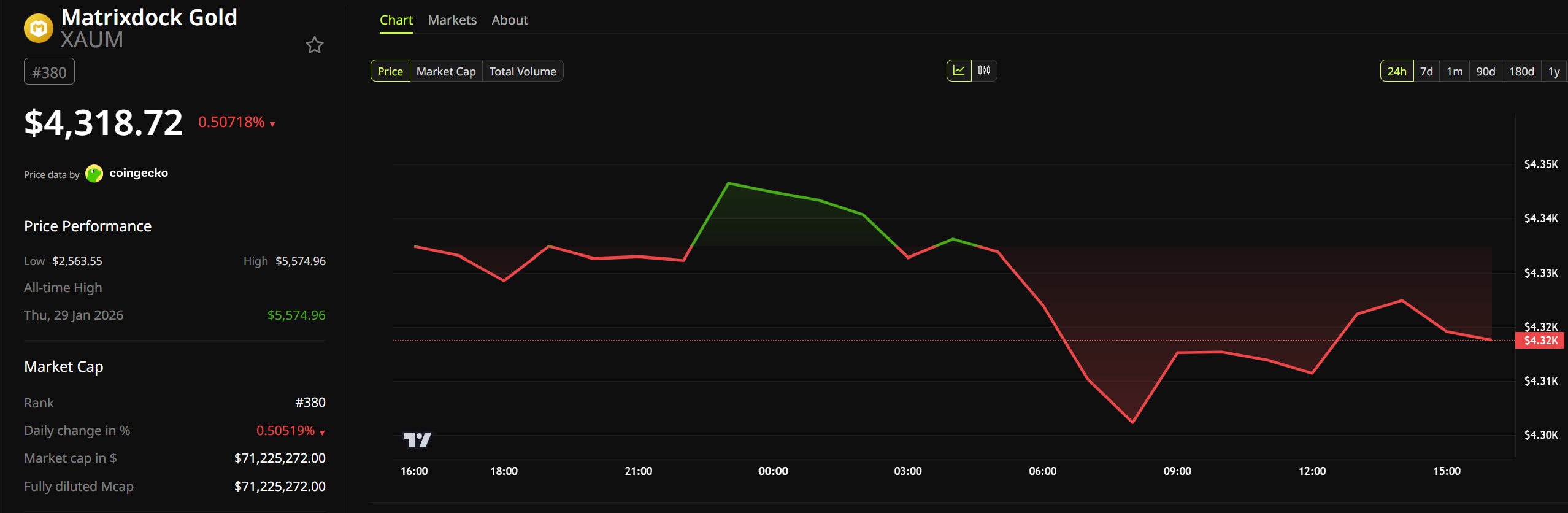
XAUm’s market price sits near $4,318, about $71 million in all. Matrixdock says lending will come later. Today the gold can be sold on Arc. It cannot be borrowed against.
The post Circle's Arc Blockchain is Launching Its First Tokenized Gold Asset appeared first on BeInCrypto.

Bitcoin could face a longer period of regulatory uncertainty after the CLARITY Act stalled in the U.S. Senate, although the setback has not changed BTC’s current classification as a digital commodity.
Summary
- Bitcoin remains classified as a digital commodity despite the CLARITY Act failing to advance in the Senate.
- The setback delays federal rules for crypto spot markets, leaving Bitcoin’s current treatment dependent partly on agency interpretation.
- Spot Bitcoin ETFs returned to inflows after the initial selloff, while BTC recovered from below $76,000 to above $86,000.
- The SEC and CFTC are moving ahead with crypto rules under existing authority while Congress considers whether to revisit the legislation.
According to a Sept. 22 report from Bitplanet Research Lab, the failed Senate vote primarily delayed efforts to put the definition of digital commodities and a regulatory framework for spot markets into federal law. The SEC and CFTC’s existing interpretation of Bitcoin remains unchanged.
The Senate rejected a cloture motion to begin consideration of H.R. 3633 on Sept. 15 by 49 votes to 50, with one senator not voting. The motion needed 60 votes to advance, meaning lawmakers never reached the amendment process or a final vote on the legislation.
As crypto.news reported after the vote, Bitcoin faces less regulatory uncertainty from the setback than altcoins, decentralized finance platforms, exchanges and token issuers. Attention has instead moved toward how the SEC and CFTC use their existing powers while legislation remains stalled.
Bitcoin faces limited immediate impact from the CLARITY Act setback
Bitcoin’s existing regulatory treatment provides some insulation from the failure of the bill.
The SEC and CFTC issued a joint interpretation on March 17 that placed crypto assets into five categories, including digital commodities, digital collectibles, digital tools, stablecoins and digital securities. Bitcoin was among the assets specifically named as examples of digital commodities.
The agencies’ joint crypto interpretation identified BTC alongside Ether, Solana and XRP, among other assets, as digital commodities rather than securities. The interpretation did not replace the Howey test, meaning securities laws can still apply depending on how an asset is offered or sold.
The distinction limits what the failed CLARITY Act vote immediately changes for Bitcoin. Bitplanet said BTC continues to be treated as a commodity under the March interpretation, while the legislative setback concerns the rules surrounding the market in which it trades.
Under the House passed version of the CLARITY Act, digital commodity exchanges, brokers and dealers would have been required to register with the CFTC. Spot trading conducted through entities registered or required to register with the regulator would fall under its exclusive supervision.
Without the legislation, the CFTC still lacks statutory authority to supervise the entire digital commodity spot market, according to the report. Bitcoin therefore keeps its current classification, while the federal registration and supervision regime intended for exchanges and intermediaries remains unfinished.
Bitcoin’s commodity status remains based on agency interpretation
A longer term issue for Bitcoin is that its current regulatory treatment has not been written into federal law.
Bitplanet noted that the SEC and CFTC interpretation is neither a statute nor a binding rule. BlackRock cited the same distinction as a risk factor in the second quarter report for its iShares Bitcoin Trust, noting that a court or future administration could reach a different conclusion.
SEC Chair Paul Atkins has similarly argued that legislation is needed to prevent future regulators from reversing current policy.
The CLARITY Act would have provided a statutory definition of digital commodities and established the regulatory structure surrounding their spot markets. Its failure to clear the Senate procedural hurdle leaves Bitcoin dependent in part on the existing interpretation while Congress considers whether to revisit the legislation.
A crypto.news analysis of digital commodities in June noted that the March classification was interpretive and could be revised by a future administration. The CLARITY Act was designed to put the digital commodity category into federal statute.
For Bitcoin, Bitplanet said the current classification would need to be reassessed if the SEC and CFTC withdrew or amended their March interpretation or if a federal court reached a different conclusion.
Bitcoin ETF flows show the initial market impact has faded
Bitcoin and crypto related markets reacted sharply when the Senate vote failed, although the selloff did not persist.
The 12 U.S. spot Bitcoin ETFs recorded $450.4 million in combined net outflows on Sept. 15. Fidelity’s FBTC lost $214.8 million, while BlackRock’s IBIT posted $161.7 million in withdrawals. The daily total was approximately 2.8 times the $159.9 million net inflow recorded during the previous trading session.
Bitcoin fell 3.39% from $78,316 to $75,663 based on the aggregate price data used by Bitplanet. Coinbase closed 10.10% lower and Circle dropped 11.41% during the same session.
Bitplanet cautioned against treating the CLARITY Act vote as the sole cause. The vote occurred during the Federal Reserve’s September meeting, while interest rates and oil prices were affecting risk assets at the same time. The report said those variables prevented it from isolating the regulatory component of Bitcoin’s decline.
Selling pressure subsequently reversed. Bitcoin rebounded 5.8% to $80,890 on Sept. 18, while spot Bitcoin ETFs recorded $159.5 million in net inflows on Sept. 17 and another $433 million the following day. Short liquidations occurred during the rebound, making it difficult to attribute the recovery solely to regulatory developments.
BTC has since extended its recovery. Bitcoin climbed above $86,000 and briefly touched $87,000 on Sept. 22, its highest level since late January, as falling oil prices, lower Treasury yields, short covering and returning institutional demand supported the move.
HashKey Group senior researcher Tim Sun told crypto.news that ETF inflows confirmed the rally instead of initiating it, while describing short term ETF flows as tending to move with Bitcoin’s price rather than predict its direction.
The recovery has left BTC well above the level seen immediately after the failed Senate vote. Bitplanet identified continued spot ETF flows as one of the factors to monitor, noting that the four trading sessions between Sept. 15 and Sept. 18 still produced a cumulative net outflow of $153.8 million despite the inflows during the final two sessions.
SEC and CFTC rules could determine what comes next for Bitcoin
With the legislation stalled, both regulators are moving ahead with crypto related measures using their existing authority.
CFTC Chairman Michael Selig said in August that staff had been directed to review a crypto asset market structure rule that could proceed under existing statutory powers. The White House Office of Information and Regulatory Affairs received the CFTC’s “Regulation Crypto Asset Transactions and Regulation Crypto Asset Markets” proposal on Sept. 17. The filing was still at the prerule stage when Bitplanet published its report, and its substance had not been made public.
The SEC moved separately after the Senate vote. On Sept. 17, the regulator introduced a five year Innovation Exemption covering qualifying tokenized stock trading platforms and liquidity providers.
Under the five year SEC exemption, eligible tokenized securities venues can facilitate trading in tokenized National Market System stocks through permissioned automated market makers and liquidity pools, subject to conditions covering shareholder rights, trading limits and smart contract transparency.
Bitcoin could have a role in those markets. Bitplanet said trading pairs that exchange eligible tokenized stocks directly against non security crypto assets such as BTC can fall within the exemption. The measure does not change Bitcoin’s classification or give the CFTC authority over the entire spot market.
Congress could still revisit the CLARITY Act. Sen. Thom Tillis voted against the Sept. 15 cloture motion in a way that allowed him to file a motion to reconsider and formally requested reconsideration immediately after the vote. Any second cloture attempt would still require 60 votes to advance.

XRP Ledger has moved PermissionDelegationV1_1 into its 14 day activation period after 29 of the network’s 35 trusted validators backed the account permission upgrade.
Summary
- PermissionDelegationV1_1 could activate on Oct. 5 if validator support remains above the required 80% threshold.
- The upgrade lets XRPL accounts delegate specific permissions without giving another account full control over their keys.
- Permission Delegation does not directly change XRP supply or tokenomics, making any price impact dependent largely on adoption and network activity.
According to the live XRP Ledger amendment dashboard, the countdown began on Sept. 21 and could put PermissionDelegationV1_1 into effect on Oct. 5 at 11:18 UTC if validator support remains above the required threshold throughout the period.
At least 28 of the 35 trusted validators must continue supporting the amendment. If backing falls below that level before the countdown ends, the activation timer will reset.
PermissionDelegationV1_1 splits XRP Ledger account authority
PermissionDelegationV1_1 changes how an XRP Ledger account can give another account authority to perform specific tasks.
Under the current account structure, businesses that need different systems or employees to carry out operations can face the problem of giving an operational account more authority than it actually needs. Permission Delegation is designed to separate those responsibilities.
An account could, for example, authorize another account to make payments without giving it permission to change the primary account’s keys. A stablecoin issuer could keep its main keys offline while giving an internet connected compliance system permission to approve customers to hold its token.
Each delegated account can receive up to 10 permissions, while the account granting the authority retains the ability to change or revoke them.
The arrangement resembles the separation of responsibilities commonly used by financial institutions, where payment, compliance and administrative functions do not necessarily share the same level of access.
PermissionDelegationV1_1 forms part of a larger group of amendments introduced through xrpld 3.3.0. The release included BatchV1_1, ConfidentialTransfer, DynamicMPT and Sponsor alongside Permission Delegation, with several of the features geared toward institutional transactions and token issuance.
Sponsor would allow another entity to cover transaction fees and reserve requirements for users without controlling their accounts. DynamicMPT gives issuers more flexibility over selected Multi Purpose Token properties, while ConfidentialTransfer is designed to conceal MPT balances and payment amounts from public view while retaining access mechanisms for authorized parties.
Crypto.news previously reported that ConfidentialTransfer targets institutional use cases where companies may need transaction privacy while still providing information to auditors and other authorized parties.
Permission Delegation returns after an earlier security flaw
PermissionDelegationV1_1 is the second attempt to bring delegated account permissions to the XRP Ledger.
The original amendment was stopped before reaching the main network after a community tester reported a vulnerability on Sept. 15, 2025.
Under the affected implementation, the software checked whether an account had permission to perform a transaction before properly verifying its signature. Certain rejected transactions could still incur a fee.
An attacker could therefore have submitted unauthorized transactions carrying deliberately high fees and caused another account to pay them even though the transactions were not properly signed. Repeating the process could have depleted the victim’s available XRP balance.
Validators were advised not to support the amendment after the vulnerability was discovered, preventing the affected version from activating on mainnet.
The replacement was included in xrpld 3.3.0 with changes to how unauthorized transactions are handled. Signature verification now takes place before the type of failure that could charge the targeted account.
Permission Delegation is not the only feature from the release to return after security work. BatchV1_1 replaced an earlier Batch implementation after developers found a separate critical signing vulnerability. The revised Batch upgrade has moved through validator voting after fixes and further review.
Could PermissionDelegationV1_1 affect XRP price?
PermissionDelegationV1_1 does not directly change XRP’s supply, issuance schedule or token economics, leaving no mechanical reason for its activation alone to create substantial new demand for XRP.
The amendment deals with account permissions instead of the XRP token itself. Institutions using delegated accounts would still use XRP for the ledger’s normal fees and reserve requirements, but the feature does not require them to buy or hold large amounts of XRP simply to use delegated permissions.
Recent developments on the network show why the distinction between XRPL adoption and XRP demand matters.
A previous analysis of Ripple Prime’s XRP exposure found that even substantial institutional activity inside Ripple’s ecosystem does not automatically translate into equivalent XRP demand. Stablecoins and other issued assets can handle much of the underlying value transfer while XRP retains roles including transaction fees, reserves and some routing functions.
A similar structure applies to Permission Delegation. Stablecoin issuers, tokenized asset providers and other businesses could use the feature without making XRP the asset being transferred.
The possible price connection instead depends on whether the upgrade helps bring more activity to the XRP Ledger over time.
Institutional issuers that want to keep high authority keys offline could use delegated accounts for recurring payments or compliance tasks. If those capabilities contribute to more businesses issuing assets and processing transactions on XRPL, the resulting activity would create more use of the network, where XRP remains the native asset used for fees and reserves.
Evidence so far suggests that network growth and XRP price do not always move together. RLUSD and tokenized assets have expanded on XRPL while XRP has experienced periods of price weakness, showing that rising ledger activity does not necessarily produce immediate buying pressure for the token.
A June institutional test involving JPMorgan, Mastercard, Ondo Finance and Ripple provided another example. The tokenized Treasury redemption used the XRP Ledger, but XRP was not the asset being redeemed. Its direct role remained tied to the underlying network infrastructure.
PermissionDelegationV1_1 could therefore provide another piece of infrastructure for institutional users without becoming a major standalone XRP price catalyst.
A market reaction around activation remains possible because traders can respond to network upgrades and expectations surrounding adoption. Any sustained price effect, however, would depend on subsequent use of the feature and other market factors instead of the amendment simply switching on.
XRP Ledger is building more tools for institutional transactions
Permission Delegation is moving toward activation while several other XRP Ledger features remain at different stages of the amendment process.
BatchV1_1 is designed to bundle multiple operations into a coordinated transaction, allowing every included action to succeed or fail together. Such a structure can support settlement processes where an asset and its payment need to change hands at the same time.
ConfidentialTransfer would give Multi Purpose Token issuers the option to conceal balances and transfer amounts while leaving accounts visible. Authorized parties could still receive information needed for compliance under the proposed design.
XRPL developers have continued work beyond the 3.3.0 release. Version 3.4.0, released on Sept. 16, introduced revisions to proposed lending functions alongside another package of protocol fixes.
The lending framework remains subject to the network’s amendment process, with validator approval required before the proposed functions can become active on mainnet.

NEAR Protocol has gained a new trading catalyst after its native token was deployed on Hyperliquid’s spot market, opening NEAR/USDC trading alongside an already active perpetual futures market.
Summary
- NEAR spot trading has gone live on Hyperliquid, giving users direct access to NEAR/USDC alongside the platform’s existing perpetual market.
- NEAR perpetual open interest on Hyperliquid stood near $344 million as the token traded above $4 following a strong weekly rally.
- Positive funding showed long positions were paying shorts, while new spot activity could provide a clearer picture of demand beyond leveraged trading.
- NEAR’s rally has coincided with growth in Confidential Intents and several recent integrations across its ecosystem.
According to NEAR Protocol’s Sept. 23 announcement, users can now trade NEAR against USDC on Hyperliquid, although the token will take several more days to appear on the platform’s Strict List under its normal deployment process.
NEAR traded near $4.33 following the launch, close to its recent 52 week high of $4.46. The token has risen strongly over the past week after changing hands near $3 in mid September, with several network developments arriving during the rally.
Spot access on Hyperliquid adds another market for direct NEAR purchases at a time when derivatives traders already have substantial exposure to the token. Hyperliquid data compiled by HyperAcademy showed NEAR perpetual open interest at roughly $344.2 million early on Sept. 23, while 24 hour volume stood near $269.1 million.
Funding was positive at 0.0017% per hour during the same snapshot, indicating that long positions were paying shorts. Hyperliquid allows up to 10 times leverage on its NEAR perpetual contract.
NEAR price rally meets heavy derivatives activity
NEAR’s move onto Hyperliquid spot comes after the token recorded one of its strongest weekly runs this year.
On Sept. 17, NEAR traded near $3.05 after gaining 20.8% in 24 hours, leading gains among several large AI linked crypto assets. The token has since moved above $4, putting it roughly 40% above the Sept. 17 level.
Derivatives activity has grown alongside the rally. NEAR perpetuals ranked among Hyperliquid’s most heavily traded markets on Sept. 23, with roughly $248 million in 24 hour volume in a later market snapshot.
Spot trading creates a separate route for Hyperliquid users who want to hold NEAR without taking leveraged perpetual positions. It gives market makers access to NEAR spot and perpetual markets on the same platform, where positions can be hedged between the two markets.
Price action following the deployment will provide more data on whether spot demand can keep pace with the derivatives activity already surrounding NEAR. Open interest remains particularly important after the recent rally because a large leveraged market can produce heavier liquidations when price moves quickly in either direction.
Positive funding shows that traders were paying to maintain long exposure at the latest reading. A continued rise in open interest accompanied by heavily positive funding could leave leveraged long positions more exposed during a price reversal, while stronger spot volume would show that trading activity is not confined to perpetual contracts.
NEAR Confidential Intents activity has grown
The Hyperliquid deployment follows several developments around NEAR’s cross chain infrastructure.
NEAR’s confidential total value locked crossed $70 million on Sept. 17, automatically triggering the first snapshot under its incentive program, crypto.news previously reported.
The snapshot set aside 333,333 milestone tokens for eligible users. Participants must maintain more than $100 in confidential balances and have an active swap history, while individual wallets are limited to 2% of the distribution.
Rewards from the first snapshot remain locked until NEAR’s three day volume weighted average price reaches at least $3.33. NEAR has since moved above that price threshold.
Confidential Intents routes transactions through a private NEAR shard and supports execution across more than 30 connected blockchains. NEAR said the system is designed to prevent transactions from appearing in public mempools, limiting exposure to front running, strategy leakage and other forms of maximal extractable value.
Activity connected to NEAR Intents has continued elsewhere in the ecosystem. Aurora Labs said its solver network has routed more than $30 billion after adding Sui as a destination for one signature cross chain transactions.
NEAR Intents solvers were later used to convert assets during a Zcash NFT auction, where more than $19 million passed through Aurora Intents across 1,718 swaps.
Hyperliquid spot listing follows another NEAR integration
NEAR’s latest Hyperliquid deployment comes as the platform handles billions of dollars in daily derivatives trading.
Hyperliquid generated $429.04 million in revenue between Jan. 1 and Sept. 15, giving it 12.62% of the $3.40 billion revenue pool in CoinGecko’s adjusted comparison of crypto projects. The platform finished more than $106 million ahead of Pump.fun at the Sept. 15 cutoff.
Trading activity has remained concentrated in perpetual futures. Data cited in September showed Hyperliquid recording nearly $237 billion in perpetual trading volume over a 30 day period as more companies began using its infrastructure.
The platform has continued adding trading functions during the same period. Trailing stop orders became available for perpetual markets on Sept. 21, allowing traders to set triggers that follow favorable movements in the mark price before executing a market order after a chosen retracement.
For NEAR, spot deployment now places direct token trading beside the leveraged market that has already accumulated more than $300 million in open positions.
NEAR ecosystem adds tokenized stocks through Ondo
Another NEAR integration arrived one day before the Hyperliquid spot deployment.
NEAR partnered with Ondo Finance to add 20 tokenized assets through near.com and NEAR Intents. The initial selection includes tokenized exposure to Tesla, Nvidia, Apple, Microsoft and Amazon, along with products tied to QQQ, silver and gold.
Eligible users can route supported crypto assets from more than 30 connected blockchains into Ondo Stocks through NEAR Intents without opening a separate brokerage account. Bitcoin and USDC are among the assets that can be used to fund purchases.
Access remains subject to Ondo’s securities restrictions, with U.S. persons excluded from the product. Ondo said the tokenized assets are issued through its Global Markets infrastructure, while NEAR Intents handles the cross chain routing used to reach them.

Bitcoin’s relationship with traditional markets has changed sharply in a matter of weeks, with Santiment data showing that its correlations with stocks, the greenback, and even gold have all weakened.
The part with gold is particularly interesting, as both assets recently moved at the same pace, but BTC now appears to be trading far more independently of all major comparison alternatives.
BTC Breaks Away
Santiment’s analysis highlighted the breakdown in bitcoin’s correlations with major assets, including the precious metal and US equities, indicating that the cryptocurrency is no longer moving closely alongside any of them. This major change materialized over the past several days, after BTC rebounded from the dip to $75,000 following the failure of the CLARITY Act vote and surged to a multi-month peak of over $87,000.
The shift is quite striking because the opposite narrative, especially when compared to gold, dominated only a few weeks ago. As reported in early September, BTC’s 90-day correlation with the precious metal had climbed above 0.50 for the first time in approximately six years. The relationship with the Nasdaq 100, though, had dropped toward the 0.30-0.33 range, prompting suggestions that investors were treating bitcoin less like a high-beta tech asset and more like a scarce monetary hedger.
That interpretation made a lot of sense at the time since BTC and gold both benefited and rallied from renewed concerns over government debt, deficits, and currency debasement, while equities struggled to keep pace. However, that relationship has proved far less durable than it initially appeared, as gold has remained at essentially the same levels, while bitcoin has posted major gains.
Bitcoin Has Completely Broken Away From Stocks & Precious Metals
Bitcoin’s market cap has grown by +36.0% since August 18, dramatically separating from the S&P 500’s +0.8% and gold’s -1.5% performances in that same time. The breakout began as smaller 0.1-10 BTC holders… pic.twitter.com/L8UaFfSsZS
— Santiment Intelligence (@SantimentData) September 23, 2026
Independent Trade?
The reversal speed is arguably more significant than the absolute correlation numbers, as BTC’s strengthening relationship with gold was one of the market’s more notable macro developments just three weeks ago. The data from this week, though, complicates that narrative, as bitcoin has continued advancing even as the precious metal has pulled back from recent highs. At the same time, US stocks have followed their separate trajectory.
The cryptocurrency also absorbed both major negative developments from last week – the Fed’s hike and the CLARITY Act setback, before it rose above $87,000.
None of this means that BTC has permanently decoupled from macro markets. Its historical correlations have repeatedly shifted depending on liquidity, monetary policy, and investor positioning, but the data now shows that it doesn’t move like digital gold, a leveraged tech stock, or an anti-dollar trade; BTC moves on its own.
The post Bitcoin Just Broke Its Correlation With Gold, Stocks, and the Dollar: What Changed? appeared first on CryptoPotato.

Binance has set Sept. 29 as the start of a phased migration that will move non-stock crypto assets from Funding Accounts into Spot Accounts before the Funding Account becomes a dedicated Stocks Account in January 2027.
Summary
- Binance will begin moving non-stock crypto from Funding Accounts to Spot Accounts on September 29.
- Six settlement assets will remain available for stock and stock-options trading through the renamed account.
- Binance will automatically migrate remaining eligible balances in batches beginning January 2027 without manual action.
- P2P advertisers will receive dedicated accounts in December before unmigrated advertisements close after January 2027.
- Direct stock trading on Binance already offers eligible users more than 7,000 U.S. securities globally.
Binance said the migration will continue through January, with individual batches and the exact account-renaming date to be announced later. The Stocks Account will be reserved for U.S. equities, stock options and six settlement assets: USD, USDC, USDT, USD1, U and BNB.
Users do not need to complete the transfer manually. Binance plans to add a One-Click Migration feature for customers who want to move supported balances earlier, while remaining non-stock assets will transfer automatically in batches starting in January. The company says aggregate balances and historical transaction records will remain intact.
Binance Stocks Account will separate equities from crypto
From Sept. 29, the Funding Account will stop accepting on-chain deposits as Binance starts separating stock settlement from its regular cryptocurrency wallet structure. Non-stock crypto deposits and withdrawals will run through Spot Accounts.
The six settlement assets will remain transferable internally between Spot and the future Stocks Account. Binance’s FAQ states that direct on-chain deposits and withdrawals will not be available from the Stocks Account, including for those six assets. A user who wants to withdraw USDT, USDC, BNB or another supported settlement asset must first transfer it internally to Spot.
The account will retain direct U.S. equities and stock options because Binance says securities settlement must occur through a dedicated account. Other crypto assets will be consolidated in Spot, which the exchange says is intended to remove overlap between its current Funding and Spot structures.
A separate distinction applies to bStocks. Binance’s tokenized securities will not remain inside the Stocks Account even though their prices track equities. Existing bStock balances held in Funding Accounts can move through One-Click Migration and will otherwise transfer automatically to Spot beginning in January. Newly converted bStocks will go directly to Spot.
As previously reported, Binance launched tokenized U.S. equities with 24/7 bStocks trading in June. Those products are backed by underlying securities but differ from direct stocks because bStocks are blockchain-based tokens and do not give holders direct shareholder rights.
Sept. 29 changes affect Pay, Convert and Binance Alpha
The migration reaches several services that have historically relied on Funding Accounts.
Beginning Sept. 29, assets received through Binance Pay, Binance Card and Gift Card will be credited to Spot Accounts. Funding balances can temporarily remain payment sources for Pay, but Binance plans to remove Funding before the Stocks Account rename.
Once Funding disappears as a Pay source, recurring send plans funded solely from that account will stop executing. Users relying on those plans will need to select another payment source. Binance has not disclosed the exact date when Funding will stop supporting Pay deductions.
Convert orders receive a similar account change without canceling open trades. Existing limit orders with assets frozen in Funding will stay open, but orders that settle or expire after Sept. 29 will return funds to Spot. New limit orders created from that date will freeze and settle funds solely in Spot.
Recurring Convert orders will settle into Spot or Earn according to the user’s configuration, while failed-order refunds will return to Spot. Binance recommends changing account selections from Funding to Spot where required for existing recurring plans.
For Binance Alpha 2.0, stablecoins used in limit-order purchases and sales will move through Alpha Accounts from Sept. 29. Liquidity-provider rebates for the Alpha limit-order program will be credited there as well. Binance says Alpha users do not need to create a separate account because the Alpha Account already forms part of its account structure.
API users face a technical adjustment. Binance advises integrations that currently reference Funding Accounts to change their account reference to Spot as settlement activity moves away from Funding.
P2P advertisers get a separate account in December
P2P activity will move in stages because advertisers still rely on Funding Accounts for posted advertisements and merchant deposits.
From Sept. 29, normal P2P users who have no advertisement history during the previous three months or do not have merchant status will use Spot as the default source for buy and sell orders after updating the Binance app.
Advertisers will continue using Funding for maker orders, taker orders, advertisements and related deposits until December. Binance then plans to introduce a dedicated P2P Account and guide advertisers through moving assets connected with their listings.
Existing advertisements can remain active during the transition, and Binance says their original update times will be preserved so the migration does not alter ranking information in the P2P marketplace. New advertisers joining after the dedicated P2P Account arrives will be directed into the new structure.
After January 2027, Binance says P2P advertisements that have not moved into the dedicated account will be closed automatically. The exchange warns that P2P activity may be interrupted for app users who fail to update to a version supporting the new account structure.
Stocks Account follows Binance’s equity expansion
The account change comes after Binance spent several months expanding from crypto trading into direct equities and securities-linked products.
On June 1, the exchange launched direct access to more than 7,000 U.S.-listed stocks and ETFs for eligible users. Binance says customers directly own fractional shares held through regulated brokerage infrastructure, with purchases starting from $5. Product access remains subject to regional restrictions.
One month later, Binance reported that users held more than $1 billion in U.S. equities through Direct Stocks and had generated close to $3 billion in cumulative trading volume. Around 73% of users came from emerging markets, according to company data.
In related coverage, Binance’s Direct Stocks product crossed $1 billion in holdings within 30 days after its June launch. The product gives eligible customers direct securities exposure, unlike bStocks or equity-linked perpetual contracts.
Binance expanded the securities lineup on Sept. 1 when it launched physically settled options on selected U.S.-listed stocks and ETFs. Users can buy calls or puts, while the initial version does not permit customers to write options. Exercised contracts settle into the underlying shares.
As crypto.news previously reported, Binance introduced U.S. stock and ETF options for eligible users as part of its TradFi product lineup. Stock options and direct equities will remain in the future Stocks Account, while bStocks stay within Spot after the migration.
Binance later launched an ETF wealth-management offering with 11 U.S.-listed funds. In related coverage, the 11-ETF product focused largely on Treasury and investment-grade bond funds, with actual ETF shares held through brokerage infrastructure.
The Funding Account name will remain visible during the transition and in historical records. Binance says the formal Stocks Account rename will occur sometime in January 2027, but the exact date has not yet been published.
Users with older mobile-app versions will not see the One-Click Migration tool. Binance says their remaining balances will still move automatically once backend migration batches begin, while users wanting to transfer assets earlier should update to the latest iOS or Android application.

Nasdaq-listed exchange Coinbase now allows its users to borrow dollar-pegged stablecoin USDC agains their bitcoin holdings with no surprises on what they’ll pay in interest.
The exchange has rolled out fixed-rate, bitcoin-backed USDC loans, with the interest rate and repayment date set at the time of borrowing, an alternative to the floating-rate loans Coinbase already offers.
“The move takes onchain borrowing beyond the predominantly variable-rate model, giving users greater certainty over the cost and duration of their borrowing,” according to an announcement on Tuesday.
The fixed-rate offering runs on Morpho Midnight, a decentralized, non-custodial lending protocol for fixed-rate and fixed-term crypto loans launched in July this year. It settles transactions on Coinbase’s Ethereum layer 2 network Base.
It marks a meaningful shift from how Coinbase’s lending has worked until now. It’s existing loans run on the Morpho Blue protocol, where rates change, determined by demand and supply conditions and can climb when borrowing demand spikes. The new fixed-rate option sits alongside this floating one, which has more than $1.4 billion in active loans backed by nearly $3 billion of collateral.

Hyperliquid’s open interest has topped $18 billion for the first time, reaching a record as trading activity continues across its crypto and non crypto perpetual markets.
Summary
- Hyperliquid open interest topped $18 billion for the first time, beating the previous record of $16.36 billion reached on Sept. 19.
- Open interest stood above $13 billion at the end of August, putting roughly $5 billion more in outstanding positions on the platform within weeks.
- Bitcoin, Ether and HYPE accounted for roughly $9.33 billion in open interest, while HIP 3 markets continued to draw activity across stocks, commodities and indices.
- HIP 3 markets have brought perpetual contracts tied to assets such as the S&P 500, gold, crude oil and private companies to Hyperliquid.
According to Lookonchain, official Hyperliquid data showed open interest at $18 billion on Sept. 23, above the previous record of $16.36 billion reached on Sept. 19.
The figure represents bilateral open interest, meaning it counts the combined value of long and short positions on the platform. Open interest tracks derivatives positions that remain active and have not yet been closed or settled.
Hyperliquid’s latest reading puts open interest roughly $1.64 billion above the record set four days earlier. The Sept. 19 level had already passed the previous high recorded on Sept. 18, 2025.
Open interest has moved considerably higher over the past few weeks. DefiLlama Research placed the figure at more than $13 billion on Aug. 31, when Hyperliquid was processing roughly $220 billion in perpetual trading volume per month.
The latest $18 billion reading means outstanding positions have grown by close to $5 billion from the level reported at the end of August.
Hyperliquid open interest reaches $18 billion
Hyperliquid has spent the past year building beyond its core cryptocurrency perpetual markets, with stocks, commodities, indices, private companies and event contracts now available through its trading infrastructure.
HIP 3 has played a central role in that expansion since its launch in October 2025. The framework lets third party developers stake HYPE and deploy perpetual markets on Hyperliquid.
Markets launched through HIP 3 now cover assets ranging from U.S. equities and stock indices to gold and crude oil. Private companies, including SpaceX, have been represented through pre IPO perpetual contracts.
By early September, cumulative trading volume across HIP 3 markets had passed $548 billion, according to data cited by Lookonchain.
HIP 3 markets accounted for roughly 30% of Hyperliquid’s total trading volume during the preceding 30 days.
Current market data shows crypto perpetuals still hold some of the largest positions on the platform. HyperIntel data from Sept. 23 put Bitcoin open interest at roughly $4.05 billion, followed by Ether at $3.18 billion and HYPE at $2.10 billion.
Zcash carried around $858.6 million in open interest, while Solana stood at approximately $763.7 million.
Non crypto markets have built sizeable positions as well. An S&P 500 linked perpetual had roughly $418.9 million in open interest, while gold stood near $301.7 million.
HIP 3 markets have become a larger part of Hyperliquid
HIP 3 lets deployers create perpetual markets while using Hyperliquid’s HyperCore infrastructure for trading and margining.
Deployers determine several parts of their markets, including the oracle used to provide prices and parameters such as leverage. HYPE must be staked to deploy a market on mainnet.
Activity through the framework has grown alongside demand for perpetual contracts tied to assets outside the crypto market.
As previously covered by crypto.news, TradeXYZ trading volume reached $202.36 billion during the second quarter, up from $112.93 billion during the previous three months.
Open interest on TradeXYZ stood at $2.96 billion at the end of the quarter, while equity perpetual volume reached $58.9 billion across 55 markets.
Hyperliquid later expanded HIP 3 with permissioned markets on testnet, allowing deployers to limit access through onchain allowlists.
Permissioning remains optional, leaving existing permissionless HIP 3 markets unchanged.
Hyperliquid has moved into event contracts
Hyperliquid has taken a similar approach to prediction markets through HIP 4, which was introduced in May.
HIP 4 added event contracts to the platform, allowing markets based on outcomes instead of the price of an underlying asset.
Third party deployment of HIP 4 markets was opened at the end of August, expanding the framework beyond markets launched directly through Hyperliquid.
The platform has rolled out other trading products during the same period. Native lending lets users borrow USDC and USDT against supported collateral, while recent changes have brought more order types to its perpetual markets.
Hyperliquid launched trailing stops across perpetual markets on Sept. 21. The order type lets traders set a percentage distance from the best price reached after an order is activated.
For long positions, the trigger follows the highest mark price reached after activation. Short positions track the lowest mark price before the order is triggered.
Plans are underway to use HIP 3 for regulated U.S. markets as well.
Payward, Kraken’s parent company, announced this month that Bitnomial would deploy and administer proposed Hyperliquid perpetual markets for eligible U.S. clients, subject to regulatory approval.
Under the planned U.S. structure, Bitnomial Exchange would operate as the HIP 3 deployer, while Bitnomial Clearinghouse would handle clearing and settlement. NinjaTrader Clearing would carry approved customer accounts.
Access would be provided through permissioned HIP 3 markets, with the proposed structure designed to operate under U.S. derivatives rules.

Akan Ada Bantuan Uang # #motivasi #tarot #trending
Why is Arcadis stock sliding today?

Zcash NU7 Upgrade Set to Disable Spending From Sprout Pool




-

 Fashion5 days ago
Weekend Open Thread: Talbots – Corporette.com
-

 Tech2 days ago
Researchers escape OpenAI Codex sandbox to run commands on host
-

 Crypto World4 days ago
Circle launches Arc Studio AI agent for building onchain apps
-
 NewsBeat4 days ago
Trump says US has reached an agreement to take permanent control of Greenland’s security
-

 Crypto World2 days ago
Who Needs CLARITY Anyway? ARB Could See 70X Increase: Hodler’s Digest
-

 Crypto World4 days ago
Trading Bitcoin on Robinhood? Why 2% Spread Has Traders Worried
-

 Crypto World4 days ago
Bitcoin price breaks channel as RSI climbs to 63
-

 Crypto World6 days ago
US Charges Robinhood Engineers Over Crypto Listing Trades
-

 Crypto World5 days ago
Mortgage and refinance interest rates today, Thursday, September 17, 2026
-

 Crypto World4 days ago
World Money launches in 150+ countries with Stripe
-

 Business2 days ago
Analog Devices (ADI) Bets $1.35 Billion on Chips that Let Machines Think for Themselves
-

 Crypto World5 days ago
Silver prices recover quickly, hitting weekly high today
-

 Crypto World2 days ago
Coinbase, Robinhood, Circle Seen as Tokenized-Stock Winners
-

 Tech5 days ago
GPT-6 Astra Reached the Nether in Minecraft, Lost Its Stash to a Creeper, and Farmed Potatoes for Hours
-

 Crypto World2 days ago
Bitcoin price holds above $81K as key catalysts line up
-

 Entertainment7 days ago
Grey’s Anatomy Showrunner Teases Changes After Cast Exits
-
 NewsBeat5 days ago
US was ‘on brink of war’ with China over false AI report of nukes moving in Middle East
-

 Tech4 days ago
Trump suggests rebranding AI with a new name, says he’s also creating an AI Force
-

 Crypto World4 days ago
CFTC sends crypto market structure rulemaking to White House
-

 Business5 days ago
Newsom accelerates AI oversight, advances ‘kill switch’ plan
You must be logged in to post a comment Login