Connect with us

Business

Can You Install a Large Ceiling Fan on a Drop or False Ceiling?

Published

on

Can You Install a Large Ceiling Fan on a Drop or False Ceiling?

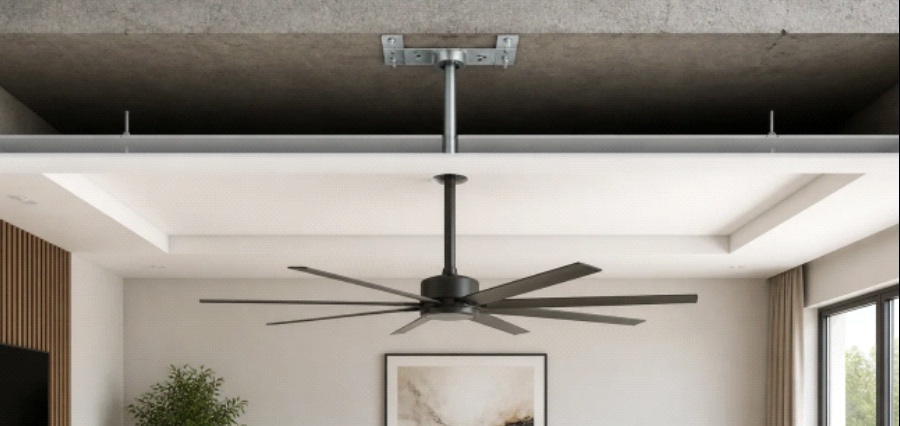
Yes, a large ceiling fan can be installed below many drop or false ceilings, but the visible ceiling surface should not be treated as the fan’s structural support. The fan needs to transfer its load to suitable framing, a structural slab, or another approved support above the finished ceiling.

False ceilings can make a room look cleaner, hide ducts and wiring, and create space for recessed lighting, but they also change how a ceiling fan has to be mounted. A ceiling tile, gypsum panel, POP finish, or suspended grid is usually part of the room’s finish rather than the structure that should carry a large rotating fan. The safest installation keeps those two jobs separate: the building structure supports the fan, while the false ceiling simply surrounds the mounting assembly or downrod.

Think of the false ceiling as a finish layer, not the point that holds the fan up.

Can a Large Ceiling Fan Be Mounted Directly to a Drop Ceiling?

In most situations, the answer is no. A suspended ceiling grid, lightweight ceiling tile, gypsum board, or decorative plaster finish should not automatically be used as the primary support for a large ceiling fan. Those materials may be suitable for lighting panels, diffusers, access tiles, or other lightweight components, but a fan creates a different type of load.

Why Ceiling Tiles and Suspended Grids Are Not the Fan Support

A ceiling fan is not a stationary object. Its motor starts and stops, the blades rotate continuously, and small vibration or torque can be transferred into the mounting point. That means the support has to deal with more than the fan’s static weight. Even if a suspended ceiling system can carry a certain amount of stationary load, that does not mean it should be used as the sole support for a rotating fan.
Advertisement

Can You Install a Large Ceiling Fan on a Drop or False Ceiling?

The Fan Should Be Supported Independently

The mounting system should carry the fan back to a suitable structural element above the false ceiling. The finished ceiling can have an opening for the downrod or mounting assembly, but it should not accidentally become the part that bears the fan’s weight.

A typical load path is: structural slab, joist, beam, or framing -> approved support or mounting assembly -> downrod or hanger -> fan motor and blades. The false ceiling sits around that system rather than replacing it.

What Should Actually Support the Fan Above a False Ceiling?

Structural Framing or the Solid Ceiling Above

The correct support depends on the building. In one room, the fan may be attached to a timber joist. In another, the mounting point may need to connect to a structural slab, a beam, metal framing, or an engineered support member. The important point is that the load reaches a structural element that is appropriate for the fan and the mounting system being used.

Use a Complete Fan Mounting System

Different large ceiling fans vary in total weight, blade span, motor construction, mounting bracket, and supplied hardware. The structural support should therefore be checked against the requirements of the exact model rather than chosen only from the fan’s diameter.

Advertisement

A proper installation may involve a structural connection, a compatible mounting bracket, suitable fasteners, a hanger assembly, and a downrod. Improvising with random anchors or relying on the false-ceiling finish is not a substitute for a planned mounting system.

How Does the Fan Pass Through a Drop or False Ceiling?

Create an Opening Around the Mounting or Downrod Area

When the structural mounting point is above the finished ceiling, the downrod or other parts of the fan assembly may need to pass through the ceiling void. The visible opening should be sized so the mounting components can sit correctly and the ceiling finish can be completed neatly around them. A canopy or trim detail may conceal the opening once the fan is installed.

Do Not Let the False Ceiling Carry the Fan

The opening around the downrod should not be so tight, distorted, or improvised that the false ceiling begins to carry part of the motor load. The finished ceiling should remain a finish layer while the fan remains independently supported from above.

Why Downrod Length Matters With a False Ceiling

The Downrod May Need to Reach Below the Finished Ceiling

A false ceiling creates a gap between the structural ceiling and the finished ceiling. That space may be only a few inches deep or it may be substantial enough to hide ducts, cable trays, lighting, and mechanical systems. The fan mounting point is often above that void, so the downrod has to be considered as part of the whole vertical installation rather than measured only from the visible ceiling.

Advertisement

Final Installed Height Matters More Than Downrod Length Alone

The same principle applies when comparing large ceiling fans for high ceilings: the important measurement is where the fan and blades actually end up relative to the floor and surrounding ceiling features. A longer downrod may be needed to pass through the ceiling void, but the final fan height still has to suit the room.

Before choosing a downrod, measure the structural mounting point, the depth of the false ceiling, the motor and blade position, and the desired clearance above the floor. That gives a more useful picture than selecting a rod length in isolation.
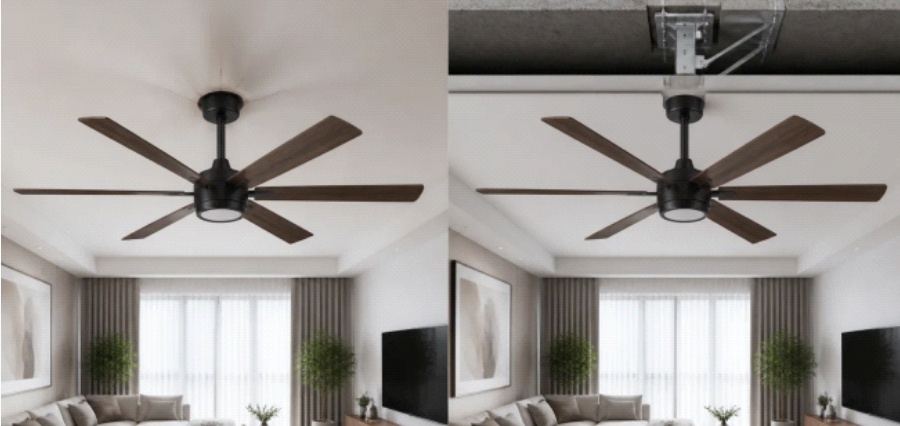
Can You Install a Large Ceiling Fan on a Drop or False Ceiling?

How Much Clearance Does a Large Fan Need Below a False Ceiling?

There is no single clearance number that applies to every large fan. The required space above and around the blades depends on the fan design and the manufacturer’s installation instructions. What matters is that the full rotating blade sweep is clear of ceiling drops, decorative edges, beams, lights, vents, and other obstructions.

Do Not Position the Blades Inside a Ceiling Recess by Accident

A stepped or recessed false ceiling can create an awkward situation where the fan motor is centered in a higher area but the blade tips approach a lower border. Measure the complete blade diameter, not just the center point. The fan should not be placed where the blades pass dangerously close to a lower ceiling section or decorative feature.

Advertisement

What If the False Ceiling Has Different Levels?

Tray ceilings, recessed centers, lowered perimeter sections, and decorative POP or gypsum designs are common. They can work well with a large fan, but they need more careful planning than a flat ceiling.

Place the Fan in a Clear Central Zone

The preferred position is usually one where the entire blade sweep stays within a clear zone. Check the relationship to lower ceiling edges, recessed lights, air-conditioning vents, curtain tracks, beams, and other features before cutting the ceiling or fixing the mount.

Measure the Entire Blade Sweep

A 72-inch fan needs room for a 72-inch rotating diameter, not simply enough space for its center housing. The farther the blade tips extend, the more important it becomes to check every nearby drop, corner, and ceiling transition.

Is a Large Ceiling Fan Too Heavy for a False Ceiling?

The better question is whether the structure above the false ceiling and the selected mounting system are suitable for the fan. If the fan is independently supported from an appropriate structural point, the finished ceiling should not be asked to carry the motor and blades at all.

Advertisement

Blade Span and Fan Weight Are Not the Same Thing

A 60-inch, 72-inch, or 84-inch diameter tells you how far the blades span, but it does not tell you the fan’s total weight. Blade material, blade count, motor size, lighting components, housing construction, and hardware can all change the load. Use the exact model specifications rather than assuming a larger diameter always means a particular weight.

Can You Install a Large Fan Below a Gypsum or POP Ceiling?

Yes, this type of installation is possible when the fan is supported independently from the structural ceiling or framing above. The gypsum board or POP surface can be finished neatly around the downrod or mounting assembly, but it should not be treated as the structural anchor for the rotating fan.

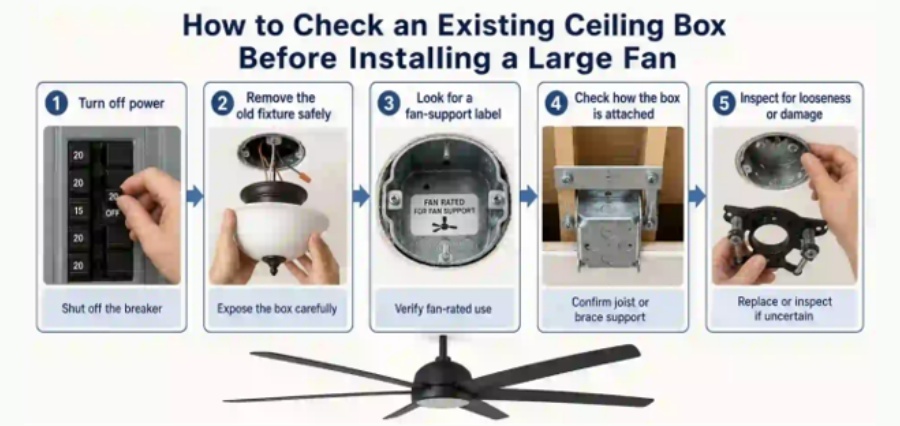
Because decorative false ceilings often hide framing, wiring, and services, planning the fan location before the ceiling is closed can make the work much easier. In an existing room, it may be necessary to inspect the space above the ceiling before the correct mounting point can be confirmed.

Can You Install a Large Fan on a Suspended Tile Ceiling?

Suspended tile ceilings are common in offices, shops, basements, and commercial rooms. The visible T-bar grid is designed to support the ceiling system and compatible lightweight components, not to act automatically as the main mounting structure for a large fan. The fan should have its own support that connects to suitable building structure above the grid.

Advertisement

The ceiling tile can be cut or finished around the fan assembly as required, but the grid and tile should remain separate from the fan’s structural load path.

How to Plan the Installation Before Cutting the False Ceiling

  1. Identify the structural ceiling above. Find out whether the fan location is below a slab, joist, beam, framing member, or another structural element that can be evaluated for the mounting system.
  2. Check the fan’s actual specifications. Confirm total weight, blade span, supplied bracket, downrod options, and any installation requirements for the exact model.
  3. Measure the ceiling void. Record the distance between the structural mounting level and the finished false ceiling.
  4. Determine final fan height. Work from the structural mounting point through the false-ceiling depth to the motor and blade level, then compare that with the room and floor height.
  5. Check the full blade sweep. Make sure the blades will clear stepped ceiling edges, lights, vents, beams, walls, and decorative features.
  6. Plan the ceiling opening and finish. Allow enough space for the assembly to pass through without making the false ceiling carry the fan, while still leaving a clean finished appearance.
  7. Confirm the structural connection before installation. If the support cannot be identified or inspected, solve that uncertainty before the fan is installed.

What Fan Parts Matter Most in a False-Ceiling Installation?

The parts above the motor become especially important when the structural mounting point is hidden above a suspended or decorative ceiling. These can include the mounting bracket, canopy, hanger ball or hanger assembly, downrod, coupler, fasteners, and structural support. If those components are unfamiliar, a large ceiling fan parts and DIY guide can help you identify what each part does before the ceiling opening and final fan position are planned.

Can You Install a Large Ceiling Fan on a Drop or False Ceiling?

The key is to understand which pieces are decorative, which pieces guide the fan through the ceiling, and which pieces actually carry the load. Confusing those roles is one of the easiest ways to create a poor installation.

Common Mistakes When Installing a Fan Below a False Ceiling

Attaching the fan directly to ceiling board. Gypsum, plaster, POP, or decorative panels should not be assumed to provide the structural support required for a large rotating fan.

Using the suspended grid as the main support. A drop-ceiling grid is part of the ceiling system, not automatically the structure for a large fan.

Advertisement

Choosing the downrod before measuring the ceiling void. This can leave the fan too high, too low, or awkwardly positioned relative to the finished ceiling.

Ignoring stepped-ceiling clearance. The fan center may fit perfectly while the blade tips pass too close to a lower ceiling edge.

Cutting the ceiling before locating the structural support. The best-looking ceiling position may not align with an appropriate mounting point above, so the support plan should come first.

Assuming a bigger fan only needs a bigger opening. A larger fan may change the weight, mounting bracket, downrod, clearance, and final installed height as well as the hole in the ceiling.

Advertisement

When Should You Ask a Professional to Handle the Installation?

Professional help is a sensible choice when the structure above the false ceiling cannot be seen, concrete anchoring is required, the ceiling void is deep, the ceiling design is complex, the wiring is old, or the fan is unusually heavy. It is also useful in commercial suspended ceilings, where building services and structural elements may share the same overhead space.

  • The structural mounting point cannot be identified.
  • The fan location does not line up with suitable framing.
  • The installation requires anchors into a structural slab.
  • The false ceiling has multiple levels or fragile decorative work.
  • A long downrod or unusual hanger arrangement is needed.
  • The electrical connection or existing wiring is uncertain.

Quick Decision Guide

Situation Recommended approach
Solid structure directly above the false ceiling Verify a suitable fan mounting system and connect the fan to the structure.
Gypsum or POP finish only Do not rely on the finish layer alone to support the fan.
Suspended tile grid Support the fan independently from suitable structure above the grid.
Deep ceiling void Plan the downrod and final installed height before cutting the ceiling.
Stepped or recessed ceiling Measure the complete blade sweep and all surrounding clearances.
Structural support cannot be identified Inspect the space above the ceiling before installation.
Very large or heavy fan Confirm the model-specific mounting requirements and support method.

Frequently Asked Questions

Can you put a ceiling fan on a drop ceiling?

Yes, but the fan should normally be supported independently from suitable structure above the drop ceiling rather than from the ceiling tile or suspended grid itself.

Is it safe to install a ceiling fan on a false ceiling?

It can be safe when the mounting system transfers the fan load to appropriate structural support and the installation follows the requirements of the fan and mounting hardware.

Advertisement

Can a large ceiling fan hang directly from gypsum board?

Gypsum board should not be assumed to be the primary structural support for a large rotating fan. The fan should be connected to suitable structure or an approved support system above it.

Can you install a ceiling fan under a POP ceiling?

Yes, provided the fan is supported from appropriate structure above the POP finish and the ceiling opening is planned around the mounting or downrod assembly.

Advertisement

How much weight can a drop ceiling hold?

There is no single number that should be used to decide whether a drop ceiling can support a large fan. The fan should generally have an independent structural support path rather than relying on the suspended ceiling system.

Does a false ceiling require a longer downrod?

Sometimes. The correct length depends on the distance from the structural mounting point to the finished ceiling and the final blade height required in the room.

Advertisement

Can fan blades rotate partly inside a false-ceiling recess?

The full blade sweep should have the clearance required by the fan manufacturer. Stepped ceiling edges or recesses should not interfere with the rotating blades.

Can you mount a ceiling fan to a suspended ceiling grid?

The grid itself should not automatically be treated as the main support for a large fan. The fan should be independently connected to suitable building structure above the grid.

Advertisement

How do you choose fan size for a false ceiling?

Choose the fan based on the room and the model’s requirements, then verify structural mounting, blade clearance, final installed height, and the dimensions of the false-ceiling opening.

What should be checked before installing a large fan below a false ceiling?

Check the fan specifications, structural support, ceiling-void depth, mounting hardware, downrod length, final installed height, and clearance around the complete blade sweep.

Advertisement

The Bottom Line

A large ceiling fan can work perfectly well below a drop or false ceiling when the support is planned correctly. The finished ceiling may hide the structure, but it should not replace it. Support the fan from a suitable structural point, use a mounting system that matches the exact fan, allow the downrod or hanger to pass through the ceiling cleanly, and check the final blade height and full sweep before installation. When the structure above the ceiling is unknown, inspection should come before cutting, mounting, or testing the fan.

Continue Reading
Click to comment

You must be logged in to post a comment Login

Leave a Reply

Business

(VIDEO) 10 Things You Must Know About the Upcoming Motorola Signature 27 Flagship Smartphone Global Launch

Published

on

10 Things You Must Know About the Upcoming Motorola Signature

Motorola unveiled its next flagship smartphone, the Signature 27, at Qualcomm’s Snapdragon Summit this week, positioning the device as what the company calls the most advanced smartphone it has ever created. Here are ten things to know about the upcoming phone ahead of its expected launch later this year.

First, the Signature 27 is one of the very first smartphones announced with Qualcomm’s new Snapdragon 8 Elite Extreme Gen 6 chipset, the company’s first mobile processor built on a 2-nanometer manufacturing process. The Signature 27 shares that distinction with the Xiaomi 18 Pro Max, both unveiled alongside Qualcomm’s chip announcement at the summit. Motorola says the new chipset delivers flagship-level performance alongside significantly more powerful on-device artificial intelligence, gaming and camera capabilities than previous generations.

Second, the Signature 27 introduces a new naming convention for Motorola’s top-tier device lineup. Rather than continuing with a traditional numbered sequence, the company will now name each new Signature model using the final two digits of the coming year, meaning the Signature 27 is positioned as a 2027-era flagship despite launching before the end of 2026. The device serves as the second generation of the Signature line, following the original Motorola Signature, which launched earlier this year running on Qualcomm’s step-down Snapdragon 8 Gen 5 chip rather than a true flagship processor.

Advertisement

Third, the phone’s design has drawn immediate attention for its unconventional appearance. The Signature 27 features a distinctive sloped camera bump and a brushed textile-inspired finish that several reviewers have compared to furniture rather than typical smartphone materials. Gizmodo’s senior consumer tech editor, Ray Wong, said the design reminded him of both the Nothing Phone 3 and the rumored Google Pixel 11 Pro.

Fourth, the device will be available in two distinct color and finish combinations. A shade called Coal Smoke, sometimes referred to as Pantone Cool Smoke, features a woven “Tactical Weave” texture designed to improve grip. A second option, called Capulet Green, offers a softer, more fashion-inspired brushed textile finish.

Fifth, the Signature 27’s camera system centers on a quad-camera setup anchored by a 50-megapixel Sony Lytia 910 main sensor, paired with a 200-megapixel periscope telephoto lens. Motorola has not yet confirmed specifications for the remaining two camera sensors included in the setup, though the company has emphasized improved image stabilization and broader camera capabilities compared with its previous flagship efforts.

Sixth, audio has received a significant upgrade with the Signature 27 becoming Motorola’s first smartphone built in partnership with Danish audio company Bang & Olufsen, marketed as “Audio by B&O.” Motorola has said the partnership draws on Bang & Olufsen’s expertise in sound engineering and its reputation for distinctive product design.

Advertisement

Seventh, the Signature 27 features a substantially upgraded cooling system to manage the demands of its new flagship processor. The phone includes a revamped 3D vapor chamber that Motorola says is roughly 40% larger than the cooling system used in the original Signature model, employing what the company describes as nearly every available form of smartphone thermal management technology short of active liquid cooling, aimed at sustaining performance during extended gaming sessions or on-device AI processing.

Eighth, the new chipset’s AI capabilities extend into specific creative software features built into the Signature 27. The phone will support Gemini Omni, which can transform a written prompt, a set of photos, or existing video footage into a polished, edited video, alongside Lyria, a tool for generating original music and custom soundtracks directly on the device. Motorola has also suggested the new processor’s on-device AI performance could eventually allow the phone to run mid-tier AI coding tools locally, without relying on cloud-based processing.

Ninth, Motorola is backing the Signature 27 with an extended software support commitment, promising seven years of Android operating system updates and security patches, a commitment that places the device among the longer-supported smartphones currently available on the market and reflects a broader industry trend toward longer device support windows.

Tenth, while Motorola has not yet confirmed exact pricing, availability details, or a specific release date, the company has said the Signature 27 is expected to launch in markets worldwide later this year, with a North American launch specifically confirmed for the coming months. That U.S. availability marks a notable shift for Motorola, which skipped the American market entirely with the original Signature model, making the Signature 27 the company’s first true attempt in some time to compete directly against flagship devices from Apple and Samsung in the United States. Given that the original Signature launched at roughly $1,210 in markets where it was available, industry observers expect the Signature 27, described by Motorola as its most advanced device ever, to carry a comparable or higher price point once official pricing is announced.

Advertisement

With Qualcomm’s Snapdragon 8 Elite Extreme Gen 6 also expected to power other anticipated 2027 flagships, including the rumored Samsung Galaxy S27 Ultra, the Signature 27’s early arrival gives Motorola a head start in bringing the new chipset to market, setting up a closely watched stretch for the company as it works to reestablish a stronger flagship presence in a smartphone market still dominated by Apple and Samsung.

Continue Reading

Business

10 Simple Ways to Prevent Measles Infection as US Cases Climb to Worst Levels Since 1991, New CDC Figures Show

Published

on

10 Simple Ways to Prevent Measles Infection as US Cases

As measles cases in the United States climb to their highest level in more than three decades, public health officials are renewing calls for vaccination and other preventive steps to help slow the spread of a virus considered among the most contagious known to medicine.

According to the Centers for Disease Control and Prevention, 3,471 confirmed measles cases had been reported across the United States as of September 17, making 2026 the worst year for measles in the country since 1991. The agency has logged 38 new outbreaks so far this year, with 95% of confirmed cases tied to those outbreaks. Utah currently has the largest active outbreak, with more than 500 cases reported, while Pennsylvania has emerged as a newer hot spot in recent weeks. Roughly 93% of measles patients nationally are unvaccinated or have an unknown vaccination status, according to CDC surveillance data, underscoring the central role vaccination gaps have played in driving the current surge.

Health officials point to declining childhood vaccination rates as the primary driver behind the outbreak’s scale. Vaccination coverage among U.S. kindergartners has fallen from 95.2% during the 2019-2020 school year to 92.4% in the 2025-2026 school year, leaving an estimated 280,000 kindergartners without documented protection against the virus this year. Researchers have estimated that even a 1% decline in childhood MMR vaccination rates could translate into roughly 17,000 additional measles cases, 4,000 hospitalizations and 36 preventable deaths annually.

Dr. Dave Chokshi, chair of the Common Health Coalition, emphasized the stakes tied to maintaining strong community vaccination levels. “Vaccination is one of the most powerful investments we can make for the health of our children, but when we fail to maintain high vaccination rates, we all pay the price,” Chokshi said. William Moss of the Johns Hopkins Bloomberg School of Public Health similarly flagged the unusual pace of this year’s outbreak. “Reaching this milestone is particularly striking because we are only in July, and measles cases are still being reported throughout the country, with outbreaks in Virginia and Pennsylvania,” Moss said, in comments made earlier this year as case totals continued climbing through the summer.

Advertisement

With that backdrop in mind, public health guidance points to several concrete steps individuals and families can take to reduce their risk of measles infection.

The first and most effective step remains vaccination. Two doses of the measles, mumps and rubella, or MMR, vaccine are 97% effective at preventing measles, while a single dose offers roughly 93% protection, according to CDC data. The American Academy of Pediatrics recommends routine MMR vaccination for all children as the primary defense against the virus.

Second, families should follow the CDC’s standard childhood vaccination schedule, which calls for the first MMR dose between 12 and 15 months of age and a second dose between ages 4 and 6, ensuring children reach the full two-dose protection level before entering school.

Third, adults and older children who are unsure of their own vaccination history should check with their healthcare provider or state immunization registry to confirm whether they have documented evidence of measles immunity, since gaps in adult vaccination records are common and can leave people unknowingly at risk.

Advertisement

Fourth, anyone planning international travel, including infants as young as 6 months old, should consult a healthcare provider about receiving an early or additional MMR dose before departure, given that global measles activity has continued rising and unvaccinated travelers face elevated exposure risk in many destinations.

Fifth, individuals who develop symptoms consistent with measles, including high fever, cough, runny nose, red or watery eyes and a distinctive rash that typically begins on the face and spreads downward, should isolate themselves from others and contact a healthcare provider promptly, ideally by phone before visiting in person, to avoid exposing others in a waiting room.

Sixth, given how easily measles spreads, with the CDC noting that up to nine out of ten unprotected people nearby will become infected if exposed to someone with the virus, avoiding close contact with anyone showing symptoms of measles is an important precaution, particularly for infants too young to be vaccinated and people with weakened immune systems.

Seventh, practicing routine hand hygiene, including regular handwashing, can help reduce the risk of picking up the virus from contaminated surfaces, even though measles spreads primarily through airborne respiratory droplets rather than surface contact alone.

Advertisement

Eighth, staying informed about outbreaks in your local area through state and local health department alerts can help residents make more informed decisions about vaccination timing and precautions, particularly in communities currently experiencing active outbreaks such as Utah and Pennsylvania.

Ninth, communities benefit collectively from high overall vaccination coverage, since widespread immunity helps protect infants too young for vaccination and individuals who cannot receive the vaccine for medical reasons, a concept public health officials refer to as community or herd immunity.

Tenth, individuals with weakened immune systems, pregnant women, or those with specific medical conditions should consult their healthcare provider directly about additional precautions or guidance tailored to their individual health circumstances, since vaccination recommendations can vary for people with certain underlying health conditions.

With the CDC warning that continued domestic and international travel is likely to produce additional measles cases in the coming months, and with the United States now at risk of losing the official measles elimination status it achieved in 2000, health officials say maintaining high vaccination coverage remains the single most effective tool available for bringing the current surge under control.

Advertisement
Continue Reading

Business

The AI Questions Your Clients Are About to Start Asking You

Published

on

The AI Questions Your Clients Are About to Start Asking You

Somewhere between the insurance certificates and the cyber security questions, larger clients have started asking what AI tools their suppliers use, whether client data goes into them, and who signed that off. Most small businesses cannot answer, because nobody ever decided staff simply started using things.

If you supply anyone larger than you, this is arriving. Here is what will be asked and how to be ready, which turns out to be a smaller job than it sounds.

Why this is landing on small suppliers

Large organisations have spent the past two years writing internal AI policies. Those policies do not stop at their own staff.

Free newsletters
Advertisement

The stories that matter to UK business, straight to your inbox.

Advertisement

Governance obligations flow down a supply chain through contracts and due diligence. When a

client commits to controlling where its data goes, it has to ask the same of everyone it sends data to, which includes your firm. The questionnaire is simply that commitment arriving in your inbox.

The mistake is treating it as a technology question. It is a commercial one. Suppliers who cannot answer get delayed, escalated, or quietly dropped from a shortlist.

The questions you should be able to answer

Six come up repeatedly, and none require technical knowledge to answer well.

Advertisement

Which AI tools does your team use? Including the ones nobody approved. This is the hardest

question for most small firms and the one you should answer honestly.

Does any of our data go into them? Client names, documents, spreadsheets, correspondence. Be specific rather than reassuring.

Are our inputs used to train models? Consumer plans and business plans often differ here, and most firms do not know which they are on.

Advertisement

Where is the data processed, and under whose law? Increasingly asked by clients in regulated sectors and by anyone with their own EU or UK obligations.

Who approved it? A named person, not “the team”. Governance questions want an owner.

What happens when someone leaves? If an employee’s personal account holds three years of client work, that is a real exposure and an easy one to describe badly.

Answering “we don’t use AI” is a poor strategy. It is usually untrue, and it is increasingly not believed.

Advertisement

Get your own house in order first

Start by finding out what is actually being used, without making it a disciplinary matter. Shadow

usage almost always exists because the official route was slower than the deadline, and people will tell you if the question is asked neutrally.

Then write a policy that fits on one page. What may go into an AI tool, what may not, which tools are approved, and who to ask. Long policies do not get read and therefore do not change behaviour.

Give each approved tool a named owner responsible for deciding whether it stays. Unowned tools are the ones that turn up in a questionnaire nobody can answer.

Advertisement

Where UK law actually bites

This is less dramatic than headlines suggest, but it is not nothing.

The ICO requires a Data Protection Impact Assessment where processing is “likely to result in a high risk to the rights and freedoms of natural persons”. Its list of indicators includes the use of innovative technology, invisible processing where data is obtained indirectly, and large-scale profiling. Putting personal data through an AI tool frequently touches at least one.

That does not make AI unlawful. It means you are expected to have thought about the risk and recorded that you did. For most small firms, a short screening assessment covering what data goes in, why, and what could go wrong is proportionate and sufficient.

The failure mode regulators care about is not using AI. It is using it with personal data while having no idea that you are.

Advertisement

Choosing tools with the questionnaire in mind

Once you have seen the questions, tool selection changes shape. The useful criterion is no longer just capability, it is whether you can hand a client a straight answer about the tool’s data terms.

Sometimes that means moving from consumer to business plans on what you already use, which changes the default terms immediately. Sometimes it means choosing an AI assistant for business that does not train on your inputs at all. Often it means neither, and simply keeping client material out of these tools while using them freely for everything else.

Whatever you choose, keep the documentation. The single most useful artifact in a due diligence process is a one-page summary of which tools you use, what data touches them, and where that data goes.

The part that is actually an opportunity

Most of this reads as a burden. It is also a genuine advantage for firms that move early.

Advertisement

Procurement teams at larger organisations are being slowed down badly by suppliers who cannot answer these questions. A small firm that responds inside a day, with a clear one-page document, stands out against competitors who need three weeks and a meeting.

Several sectors are heading toward this becoming a standard rather than a differentiator.

Being early is worth more now than it will be in eighteen months.

What to do this month

Ask your team what they use, without consequences attached. Expect surprises.

Advertisement

Move anyone on consumer plans doing client work onto business plans. This is the highest-value hour in the whole exercise, because it changes the default data terms across the board.

Write the one-page policy and the one-page supplier answer at the same time they contain nearly the same information, aimed at two audiences.

Complete a short DPIA screening for anything touching personal data, and keep it on file.

Diarise a review in six months, because both the tools and the questions will have changed.

Advertisement

The short version

The questions are coming whether or not you are ready, and they are not difficult questions. They are simply questions nobody in your business has been asked before.

An afternoon spent finding out what your team actually uses, followed by two one-page documents, puts you ahead of most of your competitors on something clients are starting to weigh.

Business Matters covers this territory in more depth across its AI and technology sections

Advertisement

Continue Reading

Business

Dave & Buster’s Entertainment, Inc. (PLAY) Q4 2025 Earnings Call Transcript

Published

on

OneWater Marine Inc. (ONEW) Q1 2026 Earnings Call Transcript