



.jpg)









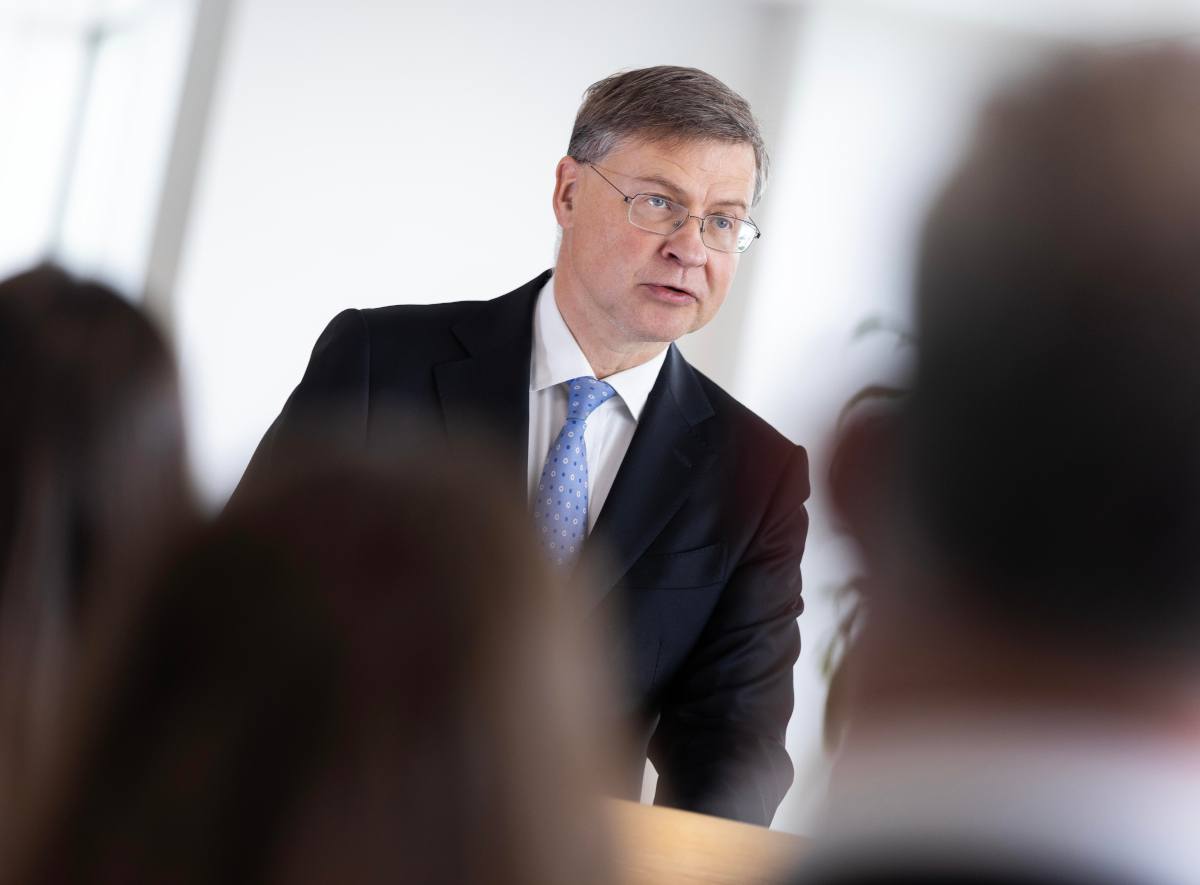

We sat down with Commissioner Valdis Dombrovskis last week. He told us the digital euro would offer ‘cash-like privacy’ and cut Europe’s reliance on foreign card schemes.
The digital euro could go live in 2029 if the Irish Presidency of the Council of the EU gets the legislation over the line before the end of the year, according to EU commissioner Valdis Dombrovskis, formerly prime minister of Latvia.
Speaking to SiliconRepublic.com at a visit to Research Ireland last week (17 September) Dombrovskis, the European commissioner for economy and productivity, implementation and simplification, said Brussels was firmly behind Ireland’s push to conclude talks this year.
“The Irish Presidency has an ambition to finalise the legislative process this year, and from the Commission side, we are very much supporting this,” he said. “And if this is the case, then ECB [European Central Bank] can start the preparations in earnest, and then it would go live as of 2029.”
Ireland took over the rotating Presidency on 1 July and holds it until 31 December, putting it in the chair for the final stage of negotiations between the Council, the European Parliament and the Commission, known as trilogues. The first trilogue took place on 13 July and a further round was scheduled for late September. The Irish Presidency’s programme commits it to working towards agreement on the digital euro framework by year-end.
It has been a long road. The Commission first tabled its proposal in June 2023. The Council agreed its negotiating mandate in December 2025 and the European Parliament adopted its position in July.
‘Cash-like privacy’
Much of the public debate has centred on privacy and fears that a digital currency issued by a central bank could be used to monitor how people spend. Dombrovskis said those concerns had been addressed.
“We have strong privacy safeguards in place, in the offline functionality of the digital euro. It actually offers almost cash-like privacy,” he said.
Indeed, he argued that the digital euro would reveal less about people’s spending than the payment cards they use now. “In a sense, the central bank will know less about citizens’ transactions with the digital euro than banks know now from card transactions.”
He was also keen to stress that the digital euro is not intended to replace notes and coins. “We had been very clear that digital euro is there to complement cash, not to replace cash. It’s a way to bring central bank money into the 21st century, in the digital era.”
Alongside the digital euro proposal, the Commission put forward a separate measure to strengthen the legal tender status of cash. Dombrovskis said this would mean “obliging [euro] area member states to ensure sufficient availability and acceptance of cash so that it can fulfil its legal tender functions”.
Less reliance on foreign card schemes
For Dombrovskis, the case for the digital euro rests on two points. The first is that cash, the only form of central bank money currently available to the public, is in decline.
“Currently, central bank money is cash. And cash use is declining. So that’s why digital euro is a way to bring central bank money in to the digital era and to provide it as an important monetary anchor,” he said.
The second is Europe’s dependence on payment networks based outside the bloc. “It is a way to develop European-based payment solutions because currently we are heavily relying on card schemes which are foreign-based.”
He added: “With this digital euro project, the [European] Central Bank will also develop a pan-euro area payment solution and infrastructure, which we currently don’t have.”
It is all part of the current push towards sovereignty, Dombrovskis said. “This is also a matter of strategic autonomy of the euro area in this more conflictual and less stable world. Financial stability is the blood flow of the economy, so it’s important in a sense that we have our own structure and are not dependent on outside players.”
‘We should not talk ourselves down’
The digital euro sits within Dombrovskis’s wider push on EU competitiveness. When we spoke, he acknowledged that productivity growth in Europe has trailed the US and China for at least two decades, and agreed there was no quick fix.
“There’s probably not one single bullet we can say, you know, we need to do this and that fixes our [competitiveness] problem,” he said.
But he argued Europe has more going for it than it often admits. “We also obviously should not talk ourselves down. We have many strengths. We have the largest single market of 450m consumers.”
Dombrovskis was visiting Research Ireland as part of his Irish visit, and met several prize-winning teams supported through the National Challenge Fund, which is funded under Ireland’s National Recovery and Resilience Plan. Addressing the gathering, he said the research and innovation undertaken here in Ireland continued to make a vital contribution to Europe’s overall competitiveness, resilience and prosperity today.
“It is a contribution that is needed more than ever,” he said. “We are living in a fast-changing and increasingly fragmented world. Our prosperity and security depends on generating knowledge, turning it into new technologies and bringing those innovations to market.”
He noted that Ireland recently marked 60 years since the decision to introduce free secondary school education in Ireland.
“It is credited with transforming the prospects of the Irish economy and laying the foundations for the prosperity the country continues to enjoy today. We should draw inspiration from such a far-sighted, visionary policy to help reach our common objective today: to ensure that Europe remains a global leader in science, technology and innovation.”
Don’t miss out on the knowledge you need to succeed. Sign up for the Daily Brief, Silicon Republic’s digest of need-to-know sci-tech news.













































You must be logged in to post a comment Login