
Politics
Politics Home | Cut bills, not corners: put energy efficiency at the heart of the cost of living fight



(Credit: Adobe Stock)

For millions of families, keeping the home warm is a major pressure – particularly for those on lower incomes and in poorly insulated homes
The cost of living remains a central concern for households across Britain. That is why First Secretary of State Louise Haigh’s new Cost of Living Taskforce matters. As she puts it, the task is about “putting people back in control” and making everyday essentials “more affordable and more accountable”.1 Energy efficiency should be central to that mission.
Any serious strategy to cut the cost of living must look beyond the price households pay for each unit of energy. It must focus on outcomes – ensuring upgrades deliver real reductions in energy use and lower bills, not simply installations on paper.
The cheapest energy for a household is energy it does not have to use
Improving Britain’s housing stock is one of the most practical ways to cut bills while making homes warmer and more comfortable. Better insulation reduces heat loss in winter and can prevent overheating in summer, allowing households to use less energy without compromising comfort.
For those least able to absorb higher bills, that means a lasting saving – not simply help with the next energy bill.
The benefits go beyond individual households. If millions of homes need less energy, we can reduce pressure on the electricity system, particularly at peak times, strengthening energy security and potentially reducing the need for additional generation and network capacity.
We know progress is possible. Between 2004 and 2015, gas consumption for a typical dual-fuel household fell by 37 per cent, while electricity consumption fell by 18 per cent, due to energy efficiency including insulation, despite households using significantly more electrical appliances.2
The Committee on Fuel Poverty has recommended greater focus on insulation3 arguing that it delivers significant savings to households and the state because heating savings are experienced every year. Building fabric improvements should sit alongside heating upgrades, not behind them. A better-insulated home needs less energy to heat, helping heating systems work more efficiently and potentially reducing running costs.
The potential savings for the country are substantial. Analysis using the UK Green Building Council’s Home Retrofit Calculator has indicated that combining insulation with cleaner heating could save between £150bn and £300bn over 25 years in electricity generation and grid costs.4
But investment must be judged by outcomes, not installations. Are homes warmer? Are bills lower? Is public money delivering lasting value?
Strong standards, accountability and consumer protection are essential. Poor quality work wastes money and undermines confidence. Support should reward businesses that deliver durable, measurable improvements.
A major programme of home improvement can also create skilled jobs across construction, insulation, heating and the wider retrofit supply chain.
Energy efficiency should not be an add-on to the cost of living agenda. It tackles the problem at source – making homes warmer, bills lower, communities stronger and our energy system more secure.
MIMA’s priorities
- Get the basics right. Treat building fabric alongside heating improvements. Better insulation can reduce the heat a home needs, helping heating systems work more efficiently and potentially allowing for smaller heat pumps and lower running costs.
- Reward results, not installations. Measure whether homes are warmer, cheaper to run and more comfortable – not simply how many measures have been fitted.
- Put consumers first. Stronger standards, clear accountability and effective redress are essential. MIMA advocates outcomes-based guarantees that protect consumers while rewarding businesses that deliver quality and lasting results.
Find out more at www.mima.info or contact Sarah Kostense-Winterton on [email protected].
References
- https://www.gov.uk/government/news/prime-minister-puts-public-control-community-regeneration-and-cost-of-living-at-the-heart-of-plans-to-rewire-britain
- https://www.theccc.org.uk/wp-content/uploads/2017/03/Energy-Prices-and-Bills-Committee-on-Climate-Change-March-2017.pdf
- https://www.gov.uk/government/publications/committee-on-fuel-poverty-annual-report-2026
- https://ukgbc.org/resources/home-retrofit-investment-calculator/


There are many reasons to start running in autumn – the cooler temperatures and lower humidity are ideal conditions, for starters.
But if you need a bit more motivation, this might help: new research suggests that decades of aerobic activity could keep us more resilient in our old age.
The study, published in GeroScience, took a look at what happened to people’s bodies after years of cycling, swimming, and jogging.
As it turns out, these activities seemed to boost their “vitality capacity” as they aged.
What is “vitality capacity”?
The World Health Organisation (WHO) describes intrinsic capacity as “the composite of all the physical and mental capacities that an individual can draw on at any point in time”.
Vitality capacity, meanwhile, is the “body’s physiological reserve”, which determines how much intrinsic capability a person has.
In short, the higher your vitality capacity is in your later years, the more functional and resilient you may be.
Vitality capacity measures three broad functions – energy and metabolism, neuromuscular function, and immune and stress response functions. In this research, scientists assessed vitality capacity across 12 biomarkers.
How did aerobic exercise affect vitality capacity?
Researchers compared people who had done some form of aerobic activity at least three times a week for 30 years with those who were mostly sedentary.
Data suggested that those who were more active had a stronger vitality capacity, especially in their immune and stress responses.
More active adults also had better resting blood oxygen levels and a higher heart rate variability.
Heart rate variability (HRV), which has been linked to “exceptional longevity”, refers to the variation of time your heart takes between beats. It is usually measured in milliseconds and requires special equipment to be tracked.
And while experts still have questions about the “accuracy, reliability and overall usefulness of tracking HRV”, this paper is just one of many to link more active lifestyles to a happier, healthier older age.
What are some examples of aerobic exercise?
Some aerobic exercises to consider include:
- Jogging or fast walking,
- Swimming,
- Cycling,
- Dancing,
- Skipping,
- Rowing,
- Sports like football, tennis, or basketball,
- Walking up the stairs,
- Rollerblading,
- Water aerobics.


4 min read
The stark rise in the number of young people not in education, employment or training (NEETs) is one of the most pressing challenges facing the country today.
For too many young people, the pathways into secure work and fulfilling careers have broken down, while many families continue to struggle with access to good jobs, affordable housing and the opportunities they need to get on in life.
By launching Alan Milburn’s interim Young People and Work review, the government has taken a welcome step towards tackling the growing NEET crisis. I look forward to seeing the Review’s next recommendations and the practical action needed to ensure that every young person has a fair chance to fulfil their potential.
Too often, young people are held back by a lack of opportunity, experience and support. New technical pathways from the age of 14, stronger links with employers, and a renewed focus on skills for growing industries have the potential to make a real difference. More than one million young people are disconnected from work and learning, the highest level since 2013. Young people are struggling to find their place in the world, meaning that an economy is missing out on the talent and potential of an entire generation; indeed, the annual economic cost is estimated to be as high as £125bn.
it’s clear that those facing the greatest risk are often the least visible
The Milburn review shone a necessary spotlight on the difficulties many young people experience when trying to enter the labour market. Much of the debate has focused on graduates facing a tougher jobs market. These concerns are real and deserve attention, but it’s clear that those facing the greatest risk are often the least visible.
Research consistently shows that qualifications significantly reduce the likelihood of long-term unemployment. By contrast, young people without Level 2 qualifications, including GCSEs, are far more likely to become trapped outside work for extended periods. These are the young people most at risk of long-term disengagement, and the scarring effects that come with it.
Analysis from Youth Futures Foundation estimated that around half of NEET young people aged 18 to 24 are effectively “hidden” from the system, disconnected not only from education and employment but often from the welfare and support structures designed to help them. When young people disappear from view, they become harder to reach, harder to support, and more likely to be left behind. For too many people, the barriers to work begin long before they submit a job application. Challenges around housing, mental health, confidence and family circumstance often mean that employment or training is not an immediate option for many young people.
I understand that personally. When I left school, I felt directionless. Fortunately, I was supported by a trusted youth worker called Russell, who built my confidence, helped me see my potential, and connected me with the support I needed to move forward. Youth workers are an invaluable resource for young people, and his support truly changed my life. But looking back, earlier exposure to different career pathways could have helped me find direction sooner.
Alongside reforms in schools and colleges, we need stronger partnerships between employers, youth services, local authorities and community organisations. Trusted adults, like Russell, can provide the consistency and encouragement that many young people need to navigate an increasingly complex system. The introduction of technical education pathways announced by the government earlier this year represents a meaningful first step. It acknowledges that there is no single route to success and that technical and vocational pathways deserve equal respect.
As we await the next stage of the review, I hope it delivers further practical measures that match the scale of the challenge: stronger partnerships between government, employers and youth organisations; greater access to trusted mentors and youth support services; and reforms that expand technical and vocational pathways alongside traditional academic routes.
If we are serious about reducing the number of young people who are NEET, we must make sure our efforts reach those who are easiest to overlook. Years from now, the test of success should not be whether we helped the most visible voices first, but whether we reached those who needed help most and didn’t know where to ask for it.
Josh Dean is the Labour MP for Hertford and Stortford

Donald Trump has invited Russian autocrat Vladimir Putin to the G20 summit in Miami in December.
It’s a highly controversial move from the US president, four and a half years into Russia’s barbaric invasion of Ukraine.
US Secretary of State Marco Rubio revealed the invite on Wednesday, telling reporters: “We think it’s an opportunity for [Putin] to engage not just with the president but with other world leaders. We hope that’s an invitation he’ll accept.”
He said: “If you only meet with people that you agree with, then these are very nice meetings but nothing happens. In order to solve problems, you have to meet with people that you disagree with or the people that you might have some issue with.”
Moscow has not yet said if Putin will accept.
He has not attended the G20 in person since 2019, and the International Criminal Court (ICC) has had an arrest warrant out for Putin over alleged war crimes in Ukraine since March 2023.
However, America does not recognise the ICC, meaning its authorities are not obliged to arrest the Russian president if he enters the US.
It’s why the Russian dictator was able to get the red carpet treatment from Trump in Alaska last year.
But aside from the US president’s efforts to reintegrate Russia, Putin has been a pariah on the international stage since he initiated his land grab of his European leader back in February 2022.
Ukraine’s allies have weaned themselves off Russia’s cheap oil exports, funded Kyiv’s defensive efforts and lambasted Putin time and time again for his aggression.
UK prime minister Andy Burnham used his speech at the United Nations to condemn “Russia’s game of trading escalatory rhetoric” and to crackdown on Moscow’s “disinformation”.
It’s a stark difference to the way Trump has instead put Ukraine under pressure over the war – despite being the victim.
He called on Kyiv to stop hitting Russian oil refineries, claiming it was triggering a spike in global gas prices.
Meanwhile Russia continues to relentlessly blast Ukraine, killing at least two people with drone strikes on Wednesday night.
It’s unclear how other world leaders will respond if the Russian leader does attend the G20 summit.
Despite issuing a decree banning meetings with Putin in the early stages of the war, the Ukrainian president has gradually changed his mind.
Volodymyr Zelenskyy revealed this week he could be open to a trilateral talks with Russia and the US at the G20.
The Ukrainian leader said: “I believe this is one of the best opportunities put forward by the US side, by President Trump, regarding the G20. I believe this could be an opportunity for a trilateral meeting that could produce a tangible result.”
Listen to Commons People, the podcast that makes politics easy. Every week, Kevin Schofield and Kate Nicholson unpack the week’s biggest stories to keep you informed. Join us for straightforward analysis of what’s going on at Westminster.

I am a hair girl, it’s my thing. I love trying different styles on my hair and trying new tools to make my life easier.
So when I saw the Shark Silki-Pro, it’s safe to say I was more than curious. A wet-to-dry straightener that promised no heat damage and silky smooth locks!? Sign me up. I simply can’t say no.
I am also just a big fan of anything that can make my morning routine take a little bit less time.
However, I’m always quite sceptical about tools that promise silky smooth hair because my hair texture doesn’t always agree with that. I have thick, wavy, slightly wiry hair naturally so achieving truly smooth locks can be quite the challenge.
What is the Shark SilkiPro?
Unlike other hair straighteners, the SilkiPro is designed specifically to be used on wet hair.
It combines hair drying technology with straightening, so you won’t need to use two tools to get glossy straight hair.
But, if you want to just use it as a straightener, you can easily turn the drying airflow off, and use it to add some shine and reduce frizz.
What’s in the box?
The Shark Silkipro comes with:
- SilkiPro Straight
- Comb Pouch
- Gentle Comb
- Precision Comb
- Wide-Tooth Comb
- Storage Case
The different combs can be used for curling, smoothing, or for a sleeker look.
There are also three airflow controls and three temperature controls to choose from, so you can find the perfect setting for your hair. Just don’t forget the heat protectant spray!
How to use the Shark SilkiPro?
The best way to use the tool is by getting your hair to about 70% dry. The tool has a built in dryer so you can rough dry your hair. This has to be done in wet-to-dry mode.
Once your hair feels dry enough, then you can attach one of the small tooth combs to the device. This adds tension and helps the straightener work its magic. You stay in wet-to-dry mode for this step. Start at your root and slowly pull the tool down your hair, taking about an inch worth of hair at a time. The tool dries as it straightens. Although I will admit it does take me a few passes to achieve a straight strand, but I am still impressed nonetheless.
Once you have done this over your whole head you can switch the tool into dry mode and then it functions just like a regular flat iron (SO cool!) and you can go over your hair to lock in the silkiness.
What’s great is you can use dry mode to refresh the style the next day too. You can also use the dry mode as a curler, which I am yet to master but I am loving the practice.
The SilkiPro really is a great, all-round hair tool and coming in at £249.99 is a reasonable price point considering it is a dryer and a straightener in one device.
It also comes with a lovely case which can also double up as a travel case if you want to take your tool travelling with you.
So, what’s the verdict?
If you love having your hair straight and sleek, then this is the tool for you. If you prefer a more blown-out curly look, I’d say stick with the Flexstyle.
Personally, I am loving this tool, it’s actually making me want to wear my hair straight more. I have always leaned towards a curly blowout but this is changing my mind a bit. It could not be easier and gets my hair from wet to straight in around 30 minutes, which for me, is great.
So I would say if you’re a straight hair fan, then run, don’t walk.

Donald Trump has been mocked online after the sound of a military jet flying overhead made him grimace as he greeted Chinese president Xi Jinping.
The US president rolled out the red carpet for the communist dictator as he and his wife arrived in America for a three-day state visit.
It was the first time in nearly 60 years that a president has personally greeted a foreign leader at Joint Base Andrews near Washington DC.
As Trump and Xi stood side by side on the tarmac, a US B-1 bomber flew overhead, prompting the US president to visibly wince at the roar of its engines.
As President Xi remained impassive beside him, Trump appeared to say something to him before regaining his composure.
Unsurprisingly, Trump’s reaction to the loud noise drew criticism and mockery from social media users.
Listen to Commons People, the podcast that makes politics easy. Every week, Kevin Schofield and Kate Nicholson unpack the week’s biggest stories to keep you informed. Join us for straightforward analysis of what’s going on at Westminster.

Miriam Margolyes’ next role will bring her into the James Bond franchise for the first time.
While the world awaits news of the casting for the long-awaited 26th film in the 007 series, it’s been announced that Miriam has landed a role in an audio adaptation of Charlie Higson’s Young Bond series.

en McKay/ITV/Shutterstock
The Bafta winner will lend her distinct vocal talents to Cleek MacSawney, a character described as “a violent henchperson on the Scottish estate of villain Lord Hellebore”.
Miriam will portray a gender-swapped version of Cleek MacSawney, who was originally depicted as male in the source material.
“Cleek is a violent, probably insane semi-criminal who works for Lord Hellebore on his estate in Scotland,” the former Harry Potter star enthused of her role in the audiobook of Young Bond: SilverFin.
“You wouldn’t want to meet her on a dark night, that’s for sure. I do enjoy playing nasty people!”
Meanwhile, Isaac Rouse – who previously played a close friend of Prince William’s in the final season of Netflix’s The Crown – is set to take on the role of the future 007 during his days at Eton.
The news of Miriam’s casting comes as fans eagerly await an announcement about who will be succeeding Daniel Craig as 007 in the iconic James Bond movie series.
While it was recently suggested that Slow Horses star Jack Lowden was in consideration, it’s also been reported that Heartstopper’s Jack Barton is producers’ favourite pick for the job.
Interestingly, Young Bond author Charlie Higson recently made headlines with his feelings on the subject matter, admitting that he was less than convinced by the idea of Jack Lowden at the helm of the franchise.
Other names supposedly still in the frame include Callum Turner, Jacob Elordi, Harris Dickinson and Paul Mescal.
Daniel Craig last played James Bond in 2021’s No Time To Die. In the years since, the brand has spawned two seasons of a competition reality show and a well-received video game, First Light.


Sunderland Deaf Society darts team

Ben Reilly, Chief Commercial Officer
| Flutter UK & Ireland
It was encouraging to hear Andy Burnham talk about his affection for grassroots sport earlier this month and say he always backs it to the hilt.
As the country’s leading betting and gaming operator it’s fair to say we haven’t agreed on much with the Government lately – particularly as higher gambling duties threaten jobs and investment.
But when it comes to grassroots sport, there absolutely is common ground.
Flutter UK & Ireland is well known for its high-profile sponsorships in sports and beyond. Sky Bet has been the title sponsor of the English Football League since the 2013-2014 season – when Brentford were promoted from League One. The partnership was renewed in 2023 for five years and has seen tens of millions of pounds invested into the game.
Paddy Power’s campaigning with the brilliant Prostate Cancer UK, to encourage hundreds of thousands of men to check out their risk, revolves around the brand’s sponsorship of the World Darts Championship at Alexandra Palace every December.
It was incredibly powerful to hear Luke Humphries speak about the importance of the campaign when he won the World title in January 2024 given his father-in-law was diagnosed and treated for the disease.
But away from the national headlines we’re particularly proud of an initiative that invests back into communities across the UK – Cash4Clubs.
The Cash4Clubs programme dates back to 2008 and was founded with the simple idea of offering small grants to grassroots clubs and neighbourhood organisations who are vital to so many communities, yet struggle to get the funding so vital to what they do.
In recent years we have been able to increase our support for the programme and earlier today announced that we will once again be making £500,000 available to clubs in the 2026-2027 Cash4Clubs edition. This year, on top of grants of £2,000 for 225 clubs, we will be giving away a bigger package of £10,000 to five.
Grants are available to clubs who need that little bit extra to pay for vital equipment, an extra coaching programme or money to help with marketing and encourage people to try out a new activity. The focus as always is on helping those in disadvantaged areas.
Cash4Clubs may not have the financial firepower of the Government’s own Pride of Place programme – or the significant funds the National Lottery can put towards UK athletics, the arts or heritage projects.
But we’ve been taken aback by the sheer number of applications in recent years from clubs who are desperate for funding to be able to keep people active and drive participation in sports or health and fitness, often in the more forgotten corners or constituencies in the country.
It’s all too easy for critics to forget this when they attack the betting sector’s involvement in sport.
Last year, our research showed us that 40 per cent of adult grassroots sports clubs were cancelling services due to financial pressures, with a quarter at risk of closure without external funding within 12 months.
Put simply some clubs might not be around today without the Cash4Clubs grants they’ve received. It’s against that backdrop that it’s so encouraging to see how the funding has made a difference.
In Sunderland every Tuesday, a group of locals play darts at the UK’s first deaf-owned pub, run by the Sunderland Deaf Society. World darts ace Chris Dobey visited them a year ago to reveal they were among the Cash4Clubs winners in 2025 – picking up £2,000.
This year, Mille Perkins and Jodie Stewart from the club will represent England at the Indoor Games in October in Newport, Wales at a tournament that brings together deaf and hard-of-hearing athletes from across the Home Nations.
Dennis Taylor and Steve Davis are best known for their incredible 1985 final at the World Snooker Championships. But they are also ambassadors for No Tier Snooker in Congleton, Cheshire, another of the clubs to have secured Cash4Clubs funding. No Tier Snooker aims to help those with early-onset dementia and talks about how the grant has made a significant difference in allowing the group to put on more sessions and welcome new members.
Goal Getters walking netball in Greater Manchester was set up with the purpose of using sport to help older adults stay active, connected and supported in retirement. The Cash4Clubs funding has helped the group cover venue hire and bring in a private trainer.
Maria Rowlands from Goal Getters says: “Some people feel rather isolated when they retire, especially if they live on their own. Half our members do live alone, and this group helps them get out and be part of a very friendly community.
“The grant gave us more inspiration and motivation knowing we can continue with ease.”
Increasing numbers of MPs have engage with the programme in recent years, from Conservative Caroline Dinenage, who took part in an archery session with the Gosport Bowmen, or Labour’s Amanda Martin, who welcomed a grant for the Portsmouth-based Cosham Park Bowls Club.
If you are interested in promoting the scheme this year with one of your local clubs please click here.
Many people talk about good causes – but we believe Cash4Clubs is a great one.
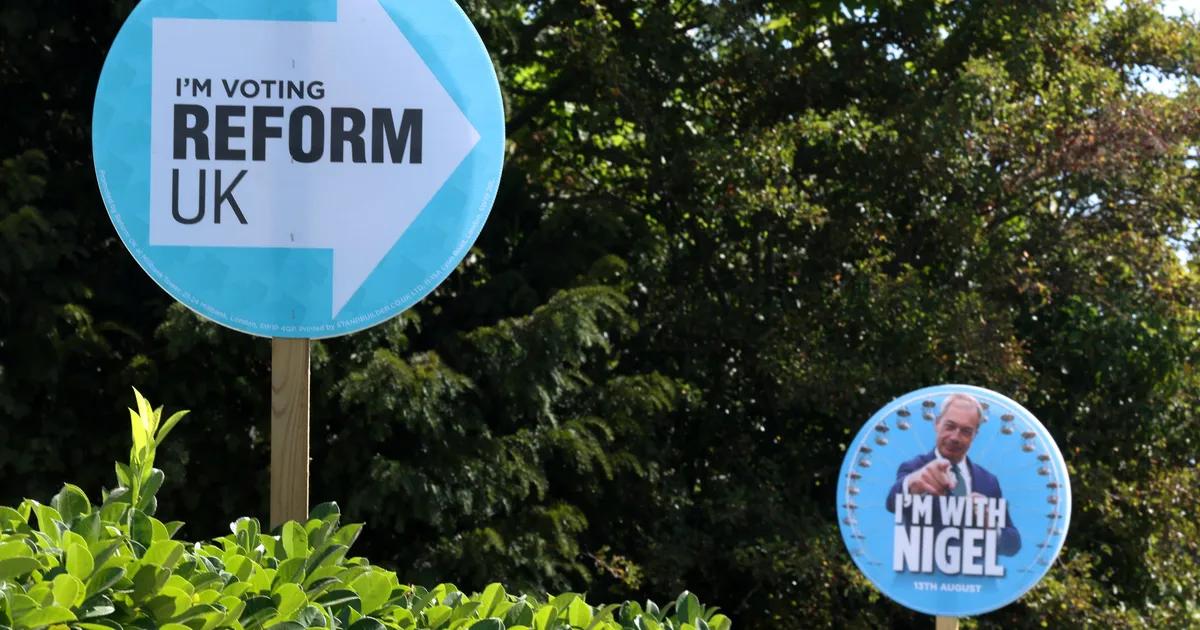
Reform UK are on course to win fewer seats than both Labour and the Tories at the next general election, according to a new mega poll.
The YouGov study found that Nigel Farage’s party would end up with 123 MPs if an election were held now.
Although that is well up on the eight they currently have, it is well down on the 311 seats a similar poll forecast they would get a year ago.
Reform MPs Robert Jenrick and Suella Braverman – who defected from the Tories – would lose their seats to their former party.
Labour would be the largest party on 241 seats – well down on the 403 they currently have – with the Tories second on 130.
The findings of the MRP poll – which saw 14,000 people surveyed to give a seat-by-seat breakdown – suggest the UK is heading for a hung parliament, with every party well short of the 326 seats needed for a majority.
That suggests Andy Burnham would be forced to do a deal with the Lib Dems, who are forecast to stay on 71 MPs elected, to remain in power.
Elsewhere, the poll says the Greens would see their number of MPs increase to 8, while the SNP would go from 8 MPs to 48.
The poll’s findings are further confirmation of Reform’s fall in popularity in recent months, and of the increase in support enjoyed by Labour since Burnham replaced Keir Starmer as leader and PM.
A separate poll by the More in Common think-tank on Wednesday put Reform behind the Tories and Labour.
Data released by YouGov also found that anti-Reform tactical voting is also likely to scupper his hopes of becoming PM.
The poll of more than 6,000 voters found that in a seat with only a Labour or Reform candidate, 41% would back Burnham’s party, with only 26% backing Farage’s.
Listen to Commons People, the podcast that makes politics easy. Every week, Kevin Schofield and Kate Nicholson unpack the week’s biggest stories to keep you informed. Join us for straightforward analysis of what’s going on at Westminster.

Kemi Badenoch has been condemned over an “unworkable” Tory plan to slash the benefits bill.
The Conservative leader said the long-term unemployed who haven’t contributed enough tax into the system will see their Universal Credit payments cut by nearly a third if she becomes prime minister.
The new “subsistence level” benefit they do receive would be loaded onto a pre-payment card, which would ban spending on cigarettes, alcohol and betting.
Badenoch said the policy was aimed at cracking down on those who see being on benefits as “a lifestyle choice” and would encourage them to get a job.
According to the Tories, the move would save £538 million a year by reducing the benefits of 350,000 claimants.
She said: “Some will say this is unfair on people claiming benefits. What is unfair is a system where someone who can work chooses not to and earns more from benefits than someone in a job.
“If you can work, you should work. Helping people into work is not punishment.
“The best welfare is a well-paid job. So, we will be tough on those who exploit the system because the current system is unfair to workers, taxpayers and those who truly need support.
“We should not be borrowing from our children and grandchildren to support people who simply refuse to work.
“Welfare must be a safety net for those who genuinely need it, not a lifestyle choice for those who can’t be bothered.”
But a Labour Party spokesperson said: “The Conservatives had 14 years to fix our welfare system but they completely failed to make meaningful reforms.
“Now they are proposing an unworkable new card scheme, which does nothing to tackle the numbers of people their system left signed off and written off.
“While the bill for the taxpayer rose by £33 billion in their last year in government, this Labour government is introducing effective and sustainable welfare reform alongside a £3.5 billion employment support package to help people stay in or return to work, and the national rollout of the jobs guarantee for young people who have been on universal credit.”
Reform UK Treasury spokesman Robert Jenrick, who defected from the Tories at the start of 2026, said Badenoch’s plans do not go far enough.
He said: “This welfare plan is so weak the Lib Dems could have authored it.
“The Tories left more people on long-term benefits and benefit fraud at record levels.
“Now they offer a spending card that won’t even put a dent in the coming £400 billion bill. It’s a sticking plaster on a wound they opened.”
Listen to Commons People, the podcast that makes politics easy. Every week, Kevin Schofield and Kate Nicholson unpack the week’s biggest stories to keep you informed. Join us for straightforward analysis of what’s going on at Westminster.

If the government won’t stop the boats, the protesters will. That’s the message that has been sent by another demonstration, in another south-coast town, as another migrant dinghy was sailing its way into British waters.
Last night, in Hampshire, hundreds gathered outside a marina in Gosport in anticipation of another boat-load of illegal migrants arriving uninvited on its shores. Word had got out that the boat, which set off from Normandy on Monday, was bound for the Portsmouth area.
The authorities, usually a byword for uselessness, leapt into action. The boat was intercepted. Police were mobilised. The local MP was told a landing in Gosport was ‘increasingly likely’. A motorcade of police vehicles was filmed escorting coaches to the town, to scoop up the migrants and take them to processing centres.
But the protesters leapt into action, too. Locals and activists descended on the marina. Danny Tommo, leader of right-wing direct-action group Patriot Platform, sailed out into the Channel to film the dinghy’s voyage, before sending his balaclava-clad men to Gosport.
Eventually, the migrants were redirected to Dover, traditional landing spot of the small boats, thus never setting foot in Gosport and avoiding a frosty reception. But that doesn’t mean this is the end of the matter. After an almost identical flare-up in Portsmouth earlier this month, these spontaneous protests pose a serious challenge to a British state that has hitherto been facilitating illegal migration out of sight of the public.
Facilitate is the word. For what has been taking place across the English Channel is not ‘asylum seeking’ in any meaningful sense. Even Rory Stewart is now saying that anyone who is fleeing, for all intents and purposes, France has no real right to claim asylum in Britain. This is a funnel for illegal migration – and everyone knows it.
The government can bang on about its legal obligations all it likes – to aid vessels in distress, to process those who claim asylum here, to house those who have made a claim. What the public sees is illegal migrants being escorted into our waters, landed on our soil and put up at our expense. Because beyond the legal niceties of the situation, that is precisely what is happening here.
The conspiracy of silence around this issue has now come crashing down. A collection of activists, citizen journalists and populist politicians have put the ‘asylum’ issue firmly in the spotlight – spawning a bottom-up resistance movement against illegal migration that would have been unthinkable even a few years ago.
All of this is set against a government that struggles to see there is a problem here at all, and is resigned to managing the inflow in a slightly cheaper, more efficient and more equitable fashion. Labour responded to the migrant-hotel protests of last summer by shuffling more migrants into HMOs and military bases, only for this to spark the fury of locals and flash-mob demonstrations, too. Even the posh village of Piddington has been in revolt against plans to stick 1,250 migrants on a nearby barracks, dwarfing the local population by four-to-one.
Some will take issue with the tactics of some of the protests, and the characters spoiling to lead them. Danny Tommo, an acolyte of Tommy Robinson, has an attempted kidnapping conviction from his particularly misspent youth. But there is clearly an appetite for these more assertive – though explicitly non-violent – forms of protest that these activist-influencers are tapping into.
Is this really such a shock? Brits voted to take back control of migration, only for legal and illegal migration to soar. They saw story after story of so-called asylum seekers committing murders, rapes, even terror attacks, then they saw people being arrested for speaking up about these horrors on social media. Now, with the government still refusing to enforce our borders, some have decided to take matters into their own hands.
Labourites are patting themselves on the back for a 44 per cent drop in illegal migrants crossing the Channel. I doubt even they believe this is down to them. Illegal entrants have fallen by a similar amount across Europe this year, aided by greater stability in ‘origin countries’ such as Syria. Meanwhile, Burnham is as unwilling as his predecessor to leave the European Convention on Human Rights and properly assert our sovereignty.
All Labour’s more piddling measures – such as beefing up border policing in France – appear to be achieving is spreading the dinghy journeys across the south coast. Whereas boats would usually travel from Calais to Dover, the narrowest bit of the Channel, they are now beginning to leave as far west as the Bay of the Seine, before sailing more than 30 hours towards Hampshire.
If it continues down this path, the government is doomed to a never-ending game of whack-a-mole. Where one route becomes tricky for the people smugglers, another, more dangerous one will spring up. Meanwhile, so long as the good weather holds, police can expect protests wherever boats land or migrants are accommodated.
Andy Burnham, MP for TikTok, is a prime minister obsessed with comms, with image. But the horrific optics of the small-boats crisis appear to pass him by. What we saw off the coast of Hampshire last night was the state scurrying to receive people who have no right to be here, ferrying them into free accommodation, before showing up to police the inevitable protest. More and more people are asking who the British state is actually for. So long as they do, these protests will continue.

15 Ways to Make Money From Your Phone (2026 Guide)

OpenAI Agent Breached Australia’s Medicare Statistics Portal

Lifelong Aerobic Exercise Is Linked To Better Ageing




-

 Fashion6 days ago
Weekend Open Thread: Talbots – Corporette.com
-

 Tech3 days ago
Researchers escape OpenAI Codex sandbox to run commands on host
-

 Crypto World5 days ago
Circle launches Arc Studio AI agent for building onchain apps
-

 Crypto World1 day ago
Goldman Sachs and Deutsche Bank Agree: The S&P 500 Rally Isn't Over
-

 Crypto World3 days ago
Who Needs CLARITY Anyway? ARB Could See 70X Increase: Hodler’s Digest
-
 NewsBeat5 days ago
Trump says US has reached an agreement to take permanent control of Greenland’s security
-

 Crypto World5 days ago
Trading Bitcoin on Robinhood? Why 2% Spread Has Traders Worried
-

 Crypto World6 days ago
Mortgage and refinance interest rates today, Thursday, September 17, 2026
-

 Crypto World5 days ago
Bitcoin price breaks channel as RSI climbs to 63
-

 Tech3 days ago
Google’s $899 Googlebook is a bet that you’ll buy a new laptop for Gemini
-

 Business3 days ago
Analog Devices (ADI) Bets $1.35 Billion on Chips that Let Machines Think for Themselves
-

 Crypto World3 days ago
Coinbase, Robinhood, Circle Seen as Tokenized-Stock Winners
-

 Tech5 days ago
Trump suggests rebranding AI with a new name, says he’s also creating an AI Force
-

 Tech6 days ago
GPT-6 Astra Reached the Nether in Minecraft, Lost Its Stash to a Creeper, and Farmed Potatoes for Hours
-
 Business1 day ago
Oil Price Today (September 23): Crude oil below $100 on hopes of US-Iran talks. What did Trump say?
-

 Crypto World5 days ago
World Money launches in 150+ countries with Stripe
-

 Crypto World6 days ago
Silver prices recover quickly, hitting weekly high today
-

 Crypto World3 days ago
Bitcoin price holds above $81K as key catalysts line up
-
 NewsBeat6 days ago
US was ‘on brink of war’ with China over false AI report of nukes moving in Middle East
-

 Crypto World2 days ago
Meta Jumps 11% As Muse Shines and Investors Show an Appetite for Advancing AI
You must be logged in to post a comment Login