The significance of residual hormone production may decrease over time. Still, says Walter Rocca, a professor of epidemiology and neurology at the Mayo Clinic, that doesn’t mean the ovary has become unimportant.
“I am convinced until proven otherwise that removing ovaries even after menopause is not advisable,” he says, with a caveat for women at an increased risk of ovarian cancer.
Just how long that importance persists after menopause is still an open question, says Stephanie Faubion, medical director of the Menopause Society. It’s also unclear, she says, how much the answer may vary from woman to woman. “We just have huge gaps,” she says.
Duncan’s work suggests one reason the importance of the postmenopausal ovary may change over time. In analyzing human ovaries, the team found that protein patterns in older ovaries suggested that the ovary becomes a more inflammatory environment. To better understand what may be driving those changes, they looked more closely at the ovaries of mice. The research, published in June in the journal Molecular Human Reproduction, suggests that the ovary may eventually take on a completely new identity after menopause.
Advertisement
The team compared the ovaries of two-month-old mice, reproductively old 18-month-old mice, and post-reproductive 24-month-old mice, and found that over time, the genes linked to inflammation and immune activity became far more active. The number of immune cells in the ovary also increased. While research on mice does not always translate to humans, it could help to explain the molecular changes Duncan observed in human ovaries.
“We think that a lot of those changes may make the ovary more prone to age-related diseases like ovarian cancer,” says Birgit Schilling, an aging researcher at the Buck Institute for Research on Aging who collaborated with Duncan on the human ovary work, which has been published as a preprint. After menopause, the risk of a host of conditions goes up, including stroke, heart disease, and osteoporosis.
Other organs undergo immune remodeling with time, but the ovary ages long before most other organs. Duncan’s work raises the question of whether at some point, the benefits of keeping the ovaries may be outstripped by the risk: As the aging ovary becomes more inflammatory, she wonders whether it may begin broadcasting inflammatory signals to other parts of the body.
David Pépin is probing another possibility: that as follicles that house growing eggs disappear, the ovary may also reorganize to preserve hormone production. Pépin, a reproductive biologist at Massachusetts General Hospital and Harvard Medical School, found that years after cats were given an experimental birth-control gene therapy that prevented their follicles from maturing, the cats were still producing the hormones estrogen, testosterone, and inhibin at completely normal levels.
Advertisement
Follicles drive much of the hormone production during a reproductive cycle; without them, hormone levels should have fallen. In preliminary work he has publicly presented but not yet published, Pépin’s team found that when the ovaries were eventually removed, other cells in the ovary—the stroma—appeared to have taken over hormone production. Pilot studies in mice suggest a similar effect. Pépin thinks he may have tapped into a natural mechanism that helps maintain hormone production as follicles wane. It’s long been hypothesized that the stroma may be responsible for some of the human ovary’s postmenopausal hormone production.
Estrogen, he says, is not the only hormone that plays a role in menopause. “We know so little about how the other ovarian hormones that are disrupted at menopause may contribute to health,” he says. “It is not a dead organ.”
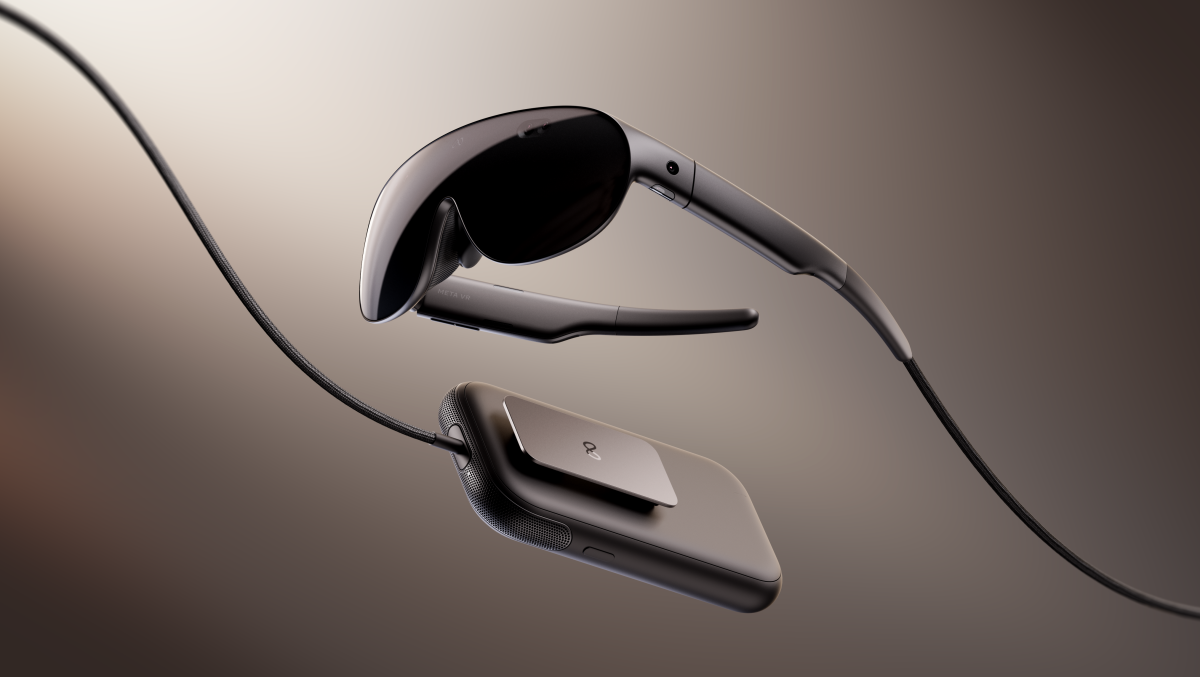
Meta is renewing its quest to make virtual reality a thing. At its Connect event on Wednesday, the company announced Meta VR Glasses, its newest entry into the VR market, which will be available next spring starting at $1,299.99.
These glasses actually seem quite promising, thanks to a substantially lighter form factor and a host of new entertainment integrations — including (allegedly) IMAX compatibility.
Moments before unveiling them, Meta CEO Mark Zuckerberg reminded the audience that the company had decided awhile ago to shift its focus away from the Metaverse and build fewer VR devices until it had real breakthroughs.
“This is a breakthrough,” he exclaimed before showing off the glasses. “A lot of people agree that augmented reality glasses with holograms are clearly going to be part of the future, but we’ve also heard that a lot of people are less interested in wearing a headset. So we have built a new kind of VR device that delivers the same magical feeling of presence and immersion with high-resolution displays and views of the world around you in a form factor that is a pair of glasses for the first time.”
Advertisement
Meta says that the glasses are five times lighter than the Meta Quest 3 — and they look much more like normal eyewear than the bulky headsets the company has released before. The frames are made of magnesium alloy, and the glasses are powered by Qualcomm’s Snapdragon Reality Elite processor. They connect to a computing puck that doubles as a battery, which users can just slip the puck into their pocket to use the glasses on the go.
The glasses are largely built for entertainment. Micro-OLED panels built into the lenses provide what Meta calls a 5K Infinite Display with 37 pixels per degree, along with Dolby Vision and Dolby Atmos audio support. Users will be able to download and watch movies.
Perhaps one of the more unique features of the glasses, however, is that Meta is pitching them as a great way to enjoy IMAX-captured films.
Indeed, the company calls the glasses the “first IMAX-enhanced certified VR device ever” and says they will be one of the few ways to experience the expanded aspect ratio that defines IMAX’s distinct high-resolution viewing experience.
Advertisement
The glasses also support 3D content, including movies that integrate a user’s physical space into their viewing experience. Meta says that it has teamed up with Disney and that in November, Disney+ users will be able to stream specific movies — including certain Marvel movies — in 3D.
Meta says that users will be able to watch specific movies and have their surroundings “transformed with immersive environments, dynamic effects, stunning 3D visuals, and spatial audio” — essentially converting the movie into a VR gaming-type experience.
The glasses will also come with Meta AI — its automated virtual assistant — built in, which means that users will be able to talk to the glasses and automate various tasks via voice command. For instance, Meta says you’ll be able to start a movie just by asking your glasses to do so. Other ways to issue commands include hand gestures.
When you purchase through links in our articles, we may earn a small commission. This doesn’t affect our editorial independence.
Distribution systems are trending toward higher feeder density on increasingly constrained station sites. This puts pressure on the short section of line where station capacity is divided into individual feeders. At this substation exit, a single contact-driven fault can interrupt many circuits at once, so reliability in the first spans carries unusual weight.
This white paper explains how covered, spacer-supported overhead construction changes the way conductors respond to incidental contact. It also makes clear that covered conductor is not touch-safe insulation and still sits inside the utility’s normal safety framework. The paper reviews the thermal rating, protection, grounding, structural, and insulation-coordination work needed to apply the approach well. It compares overhead spacer cable with conventional bare overhead and underground shielded cable. Finally, it outlines the design gates and specification points that keep a project aligned from concept through commissioning.
Amazon is re-hiring former workers back into AI and cloud roles
The company is investigating the impacts of its office-working mandates
Despite 30,000 layoffs in the past year, Amazon continues to hire for certain roles
Amazon is reportedly trying to re-hire old workers, including many who were affected by previous rounds of layoffs.
Recruiter emails cited by Business Insider reveal that rather than filling roles that have emerged following layoffs, the company is actually targeting specific ex-workers it seems, with the company’s cloud computing business predominantly seeing these hiring efforts.
AWS, cloud computing, AI, ML and agentic AI are apparently the focus of these efforts, with one recruiter reportedly referring to the scheme as ‘Swami’s Boomerang Reengagement Initiative’ – Swami Sivasubramanian is a VP for AWS Agentic AI.
Latest Videos FromTechRadar
Advertisement
Amazon is re-hiring ex-workers back into the company
The company is also said to be making it easier for former employees to return, offering shortened interview processes that may skip over some of the screening steps that aren’t all that necessary.
Besides trying to attract former talent, Business Insider also reports that Amazon is digging deeper into why they left, and the potential impacts of its return-to-office (RTO) mandates. Specifically, the tech giant wants to know whether the RTO changes were behind some ex-workers’ departures.
While company spokesperson Haley Silva told the publication that Amazon isn’t specifically targeting people who left because of the RTO and that its in-office expectations haven’t changed, it’s an interesting perspective from a company that went pretty much all-in on the RTO years ago in a bid to drive more in-person collaboration and to boost productivity.
All of this comes in the wake of major ongoing layoffs – the company fired around 30,000 workers just in the past year. But it’s apparently all part of a broader shift in focus, because instead of cutting headcount as aggressively as that 30k figure suggests, Amazon’s more likely looking to lose workers in certain areas of the business and gain workers in more important areas.
Sign up to the TechRadar Pro newsletter to get all the top news, opinion, features and guidance your business needs to succeed!
For decades, banking technology has been built around a simple sequence: a person makes a financial decision and the bank’s technology processes it. A customer decides to open an account, move money into savings or apply for a loan, and the bank’s systems execute that instruction.
Artificial intelligence can potentially reverse that sequence. Instead of waiting for a human to specify an action, AI can interpret the person’s goals, understand the financial context around that goal, and determine what happens next. It could recognize that a customer is likely to face a cash shortfall, identify the available ways to address it, and potentially execute the appropriate action.
Dmitry Volkov
Founder of Molit.ai and Social Discovery Ventures.
McKinsey estimates that generative AI could create $200 billion to $340 billion in annual value for the banking industry. Yet much of the industry is adding AI to systems designed for the old model, not rebuilding the model around AI.
Latest Videos FromTechRadar
Advertisement
The problem is that AI inherits the same product silos and process boundaries. Banks gain another layer of technology, but not the cross-system decision-making needed to realize AI’s full potential.
The first wave is still about better processes
The most visible applications of AI in banking are often the easiest ones to deploy. Banks are using AI tools to improve customer service, automate fraud detection, personalize recommendations, summarize documents and accelerate credit decisions. Lloyds Banking Group, for example, says more than 50 AI use cases were rolled out across the group in 2025, generating around £50 million in value, with more than £100 million in additional value expected in 2026.
McKinsey has made a similar observation based on the industry’s experience with generative AI. Simply adding AI on top of existing processes will not produce transformational change and can instead create another layer of technical debt.
The difference between an AI-native architecture and a chatbot attached to an existing system can be tested with three questions.
Sign up to the TechRadar Pro newsletter to get all the top news, opinion, features and guidance your business needs to succeed!
Is the AI following a fixed sequence of instructions, or can it choose and coordinate actions within a defined system of guardrails, trusted data sources and approved tools?
Is the process designed for the agent to act, with human review and every decision recorded for analysis?
And are permissions, monitoring and regulatory controls built into the workflow, particularly for critical functions such as compliance and fraud prevention?
If the answer is no, the company has added an AI interface without redesigning the underlying process.
Advertisement
From products to outcomes
The more significant transformation begins when the bank starts with the customer’s objective, not with the banking product.
Consider a customer who wants to maintain a certain level of liquidity while earning as much as possible on excess cash. An intelligent banking system could continuously monitor their balance, upcoming payments, income, available credit and other relevant information, then determine whether money should remain liquid, be invested elsewhere or be used to reduce borrowing.
While the system can continue making decisions as the customer’s circumstances change, that does not require customers to surrender control immediately. Adoption can begin with low-risk actions, such as moving excess cash into savings or setting aside VAT for future tax payments, before expanding into more consequential decisions.
Advertisement
This is already beginning to appear in financial institutions, although mostly in bounded applications. Deutsche Bank, for example, has deployed an agentic AI system for third-party risk management in which several AI agents retrieve relevant controls, analyze supporting documentation, and propose assessment outcomes. Human assessors remain responsible for reviewing or overriding those recommendations.
Like a new employee, an AI agent should receive defined permissions. Transparent activity logs, alerts, approval thresholds and the ability to override decisions would make that principle visible in the product and enforceable by regulators.
The bank becomes a continuous decision system
Under this premise, the bank becomes an intelligent execution layer that continuously manages financial activity to accomplish a defined objective.
Advertisement
This shifting structure is also visible outside traditional banking. Visa and Mastercard are both building infrastructure for AI-initiated payments, allowing agents to act on behalf of consumers and businesses. Visa Intelligent Commerce is designed to let AI agents find and purchase products on a user’s behalf, with tokenized credentials, authentication and spending controls built into the payment flow.
As agents move from recommending actions to executing them, banks will need to ensure transactions remain within the customer’s intent and risk tolerance. The institution remains responsible for keeping the agent within those limits.
The architecture has to change with the AI
Deloitte found that integration with existing systems and tools is the top modernization challenge for 77 percent of banking executives deploying AI, ahead of security, compliance and cloud interoperability concerns.
Advertisement
Traditional banking systems separate payments, lending, accounts and compliance across different applications. AI agents need to work across those boundaries, combining data and actions from several systems to make a single decision.
Banks therefore need an orchestration layer that allows AI to access those systems without requiring another custom integration for every use case. The core platforms can remain systems of record, while more of the decision-making happens above them.
This gives AI-forward fintechs such as Revolut or Ramp, as well as new entrants designing their infrastructure from scratch, an advantage over institutions that must retrofit deeply embedded systems. If regulation remains broadly unchanged, the first major financial institution built around continuous decision-making could emerge within five years.
It may not be a bank in the strict regulatory sense, but it could perform an increasing share of a bank’s functions, allowing customers to manage their finances.
Advertisement
To thrive, I believe banks need to become institutions organized to make continuous decisions for the customer’s benefit, not simply to follow instructions. And when it comes to AI, they must stop treating it as a fancy tool to add and start treating it as something to build around.
This article was produced as part of TechRadar Pro Perspectives, our channel to feature the best and brightest minds in the technology industry today.
The views expressed here are those of the author and are not necessarily those of TechRadarPro or Future plc. If you are interested in contributing find out more here: https://www.techradar.com/pro/perspectives-how-to-submit
When NASA’s Artemis II mission put humans at the far side of the moon for the first time in 44 years, it often felt like we were there in the capsule with astronauts Victor Glover, Christina Koch, Jeremy Hansen and Reid Wiseman. That’s almost entirely due to the frequent transmission of imagery from the flight, from live feeds to high-resolution photos that let us look at the moon and life in space like never before.
But getting those photos and videos isn’t as easy as tossing a camera in a bag for an Earth-bound vacation. To capture the high-resolution images that made us gasp here on the ground, the astronauts shot with Nikon DSLR and mirrorless cameras. Artemis II used GoPro Hero4 cameras for interior and exterior video feeds, and the crew took many notable photos inside the capsule using iPhone 17 Pro Max phones.
As NASA moves toward the Artemis III mission in 2027 and an expected moon landing in 2028 there will undoubtedly be a huge demand to document and share everything that goes on. To get a better understanding of what’s involved with making sure astronauts can capture those historical and candid moments, I spoke to Michael Corrado, Nikon senior manager of Pro Services.
“Just to see these pictures come back from space, we couldn’t be more humbled as a company,” Corrado said. “And as an individual, my dad was part of the space program… so it’s in the legacy here.”
Advertisement
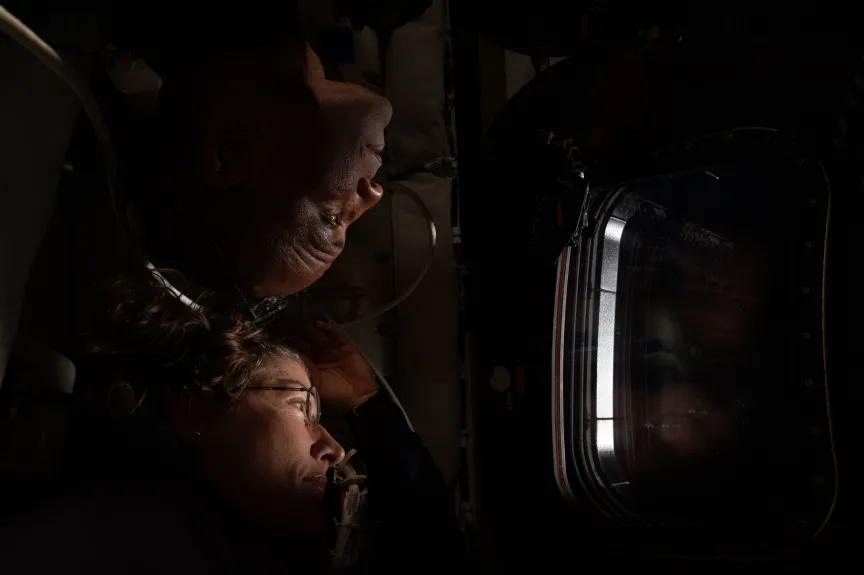
NASA astronauts Christina Koch (below) and Victor Glover (above) share a window inside the Orion spacecraft during the sixth day of the Artemis II mission. Flight Day 6 was the crew’s lunar flyby day, during which they rotated roles taking photos, making annotations, and recording their observations of the lunar surface.
Corrado also walked me through the rigorous process NASA requires to certify equipment for space travel, why astronauts primarily rely on decade-old tech and how future flights will look different.
It also struck me that even these Nikon professionals, who have worked with NASA astronauts and teams for decades, were still gobsmacked by the imagery that comes back. “We were just sitting there in awe of what we were seeing every day,” Corrado said.
How to launch a camera into space
The Artemis II vehicle – the Orion spacecraft and Integrity capsule – represented some of the latest space flight technology, but not all of the cameras were cutting-edge.
For video, NASA used several GoPro Hero4 cameras mounted inside and outside the Artemis II spacecraft, a compact action camera model that came out in 2014.
The workhorse of the mission was the Nikon D5 DSLR, a model first introduced to the consumer market in 2016. Also on the flight was the half-decade-old Nikon Z9 mirrorless camera body, introduced in 2021.
A photographer here on Earth might pass over the Nikon D5 as an outdated camera, but Corrado suggests that NASA doesn’t view it as “old technology.”
Advertisement
“I’d use the word ‘trusted’ technology more than anything,” quipped Corrado.
Artemis II commander, Reid Wiseman and Canadian Space Agency mission specialist, Jeremy Hansen (background), training in a mockup of the Orion capsule at NASA’s Johnson Space Center in July 2025.
James Blair/NASA – JSC
Nikon’s cameras are the only ones fully certified to fly on NASA missions, a spot on the equipment roster the company has maintained since the later Apollo missions in the 1970s. Of the Artemis II lineup, only the Nikon D5 carries the certification badge; the Nikon Z9 is still being evaluated – in that case under real-world conditions.
Certification is as much about safety as it is about performance. Camera batteries can be flammable, and flame is the last thing you want in a space capsule.
But the camera’s electronics also need to be shielded against radiation. We enjoy a buffer from Earth’s atmosphere, but radiation in open space is another matter. So, although the cameras on the mission are mostly stock models, they’ve been reinforced with internal shielding.
Advertisement
“Back in the day, we used to strip things off the camera [like] the leather,” Corrado said, referring to the missions in the 1970s. “They were almost naked cameras that went up. But none of that has to happen with the D5 and the Z9.”
There also wasn’t a lot of equipment. When I go out to shoot a sunrise, I’ll typically bring a backup camera in case something goes wrong with my main body. Traveling 250,000 miles from the nearest camera store, I’d expect there to be backups, but since weight is such an issue during spaceflight, Corrado noted that no backup bodies accompanied the astronauts on Artemis II.
Getting the shot in-camera, in-capsule
Today’s cameras are advanced enough that their automatic modes can cover almost any photo situation, and if a shot isn’t quite right we can edit it easily in software. In a dark scene, for example, a camera will increase the ISO to compensate and introduce digital noise, which can then be cleaned up in Lightroom.
The photos that came back from the Artemis II mission, though, revealed that the astronauts never leaned on that type of automatic crutch. The dark shots – it’s space, after all – sometimes had high ISOs but not to the point of introducing excessive noise.
Advertisement
Photographic documentation of Artemis Lunar Imaging Orion Crew Configuration with Victor Glover, Christina Koch and Andre Douglas
In an extremely harsh lighting environment, they knew how to take advantage of the wide dynamic range of the D5 and Z9 cameras to avoid moon surfaces blown out too white to preserve surface details. Photos from the dark side of the moon, the first captured in 55 years, reveal formations that scientists will be studying for years.
One of my favorite images is a shot of the back of the moon with the Earth rising behind it. You can see details of clouds and the peaks of continents on the illuminated portion of the planet, versus a sliver of bright white like you’d get when taking a snapshot of the moon from your backyard.
Earth sets at 6:41 p.m. EDT, April 6, 2026, over the Moon’s curved limb in this photo captured by the Artemis II crew during their journey around the far side of the Moon.
Keep in mind that the images NASA published during the mission are the ones captured in-camera, not edited raw images, again demonstrating the astronauts’ photographic skills.
HULC-ing out with the Nikon Z9
After years of service, the Nikon D5 is likely looking at NASA retirement. “We worked for years to get the D5 certified for use in space,” Corrado said, “and now it has probably seen its last launch.”
The Z9 is taking over for the future, which means it’s currently going through the official certification process even though it’s been around the moon.
In fact, Artemis wasn’t the first time the Z9 has gone to space. Astronaut Don Pettit used it for about eight months on the International Space Station. Corrado said there are currently 20 Nikon Z9 cameras on the ISS.
Advertisement
NASA astronaut and Artemis II mission specialist Christina Koch, seen here on the fourth day of the mission, prepping for lunar flyby activities after completing aerobic exercise on the flywheel device. Photo captured on a Nikon Z9 mirrorless camera.
“Life is different when you wake up to an email that you think is spam that says ‘Greetings from orbit’,” said Corrado. Pettit’s real-(off)-world experience and questions made their way to Nikon’s engineers. He noted that the feedback typically results in firmware changes specific for NASA.
The hardened Z9 that will reach the lunar surface in 2028 will be wrapped in a thermal blanket as part of a system called the Handheld Universal Lunar Camera (HULC). The cover will protect the camera from the moon’s extreme temperature fluctuations.
Looking to the next moonshot
It’s not fair to see the visual riches of the existing Artemis II photos and still have a wishlist, but I think depth is one element missing. Wiseman talked about witnessing land formations on the moon’s surface, saying, “It’s just everything from the training but in three dimensions and absolutely unbelievable.”
The Artemis II crew captures a portion of the Moon coming into view along the terminator – the boundary between lunar day and night – where low-angle sunlight casts long, dramatic shadows across the surface.
That makes me wish the crew had captured footage using the Spatial Video feature on their iPhones (I’ve found no evidence that they did). Imagine putting on an Apple Vision Pro and seeing the moon in an immersive way that’s even closer to what the astronauts experienced.
Stereoscopic footage could be recorded in the future, though. Nikon is working on a depth camera, for which it was granted a patent in 2025. “We’re still working with NASA very closely… together on these technologies,” Corrado said.
No matter what form the future images from Artemis III and future Artemis flights take, they’re sure to be stunning thanks to the astronauts’ training and the crews at Nikon and NASA working to equip them with the hardened camera equipment the missions require.
Advertisement
Jeff Carlson
Senior Writer
Jeff Carlson writes about mobile technology at CNET, from cellular phone plans to devices and emerging technology.
See full bio
You will almost certainly have heard many business and technology leaders extolling the virtue of AI. They will enthusiastically tell you that the technology will have a transformative impact on businesses across the globe.
I think they are right. However, with two important caveats: AI must be given the right jobs, and the people using it must trust what it does.
Too often, AI is deployed across a business without much thought, as overconfident bosses assign agents tasks it isn’t designed for. The problem this creates is that many employees using AI tools every day are not yet prepared for their new role in managing these agents. Trust only comes from experience and that builds over time.
Advertisement
Latest Videos FromTechRadar
Luis Blando
Chief Product & Technology Officer at OutSystems.
Advertisement
When an AI system provides you with results that make sense and actually helps with your work, people start to feel more confident in using it. But if it makes a mistake, that confidence can be lost in an instant. If things go wrong, employees start finding ways around AI or stop using it altogether, and when leaders ignore employee concerns about making AI work better, its benefits are undermined.
The best way to ensure that AI delivers the efficiencies it promises is to ensure that it is doing the right job, and this isn’t as straightforward as it sounds.
Advertisement
The areas where AI excels
AI works on probabilities, producing answers that are likely to be right. The key word here is ‘likely’, which is why it occasionally hallucinates.
Being probabilistic makes AI very effective when dealing with unclear or complicated information. But it’s not the best fit for tasks where a wrong answer could have serious consequences.
Sign up to the TechRadar Pro newsletter to get all the top news, opinion, features and guidance your business needs to succeed!
There are three core areas where AI really can make a difference. Firstly, when processing documents; secondly, decision support; and finally, personalization.
Advertisement
AI is especially effective at tasks involving many documents. It can extract, classify and summarize information that would normally take humans many hours to review. For example, an AI system could compare contracts against a standard set of clauses, or organize a large collection of customer emails by the issues they concern. This way, a person only has to look at the important findings instead of reviewing entire documents.
AI can also play a key role in supporting company executives to make decisions, as it’s very good at taking lots of different pieces of information, finding patterns and delivering options as to what to do next.
It is, however, important to remember that AI is not always the right technology to make that decision. For example, imagine you’re buying something and have to choose among many different suppliers.
Advertisement
AI can look at all the information, like how well they’ve done in the past, what they can deliver, how quickly it is likely to arrive and whether the supplier offers discounts for repeat purchases. It can even articulate why one option might be better than another. In most scenarios, though, it is the human who makes the final choice.
For some businesses, personalization is a promising tool, as AI can be used to make products more relevant to the individual using them. This is an area where working with probabilities can become a key driver for AI. The content only has to be good enough to make that connection so the recipient feels they are being addressed in a bespoke way.
The cost of assigning AI the wrong job
One of the key concerns companies should have about managing AI is that while AI-generated answers can sound assured, there is still a possibility that the technology has got something wrong. If that answer is allowed to trigger action without validation, a small error can travel rapidly through a workflow.
Advertisement
Think about what happens when someone makes a small mistake with a rule or detail in a contract. By the time someone catches the error, it may have already been added to records, sent to people outside the company, or even used to create new software.
To remind myself of AI’s limitations, I find it useful to think of the technology as the equivalent of a super-intelligent, hard-working intern. Interns need guidance and oversight, which should be provided by experienced, knowledgeable colleagues. Crucially, their access to sensitive information needs to be limited and granted only as they demonstrate they can make sound decisions.
AI needs to be managed in the same way. It should only be given greater levels of control when it has proved itself, and then its work must still be monitored by humans.
A good example of the importance of managing AI is its role in software development. AI can deliver a lot of code quickly, but its fast pace means the quality isn’t always the same as that of human developers.
Advertisement
In fact, managing large amounts of AI-generated code can be a real headache for IT professionals. For example, surging token consumption and a shift to consumption-based pricing is ballooning AI coding costs, forcing developers to be selective on when and where they apply AI models, as reported by Gartner.
Let AI help design the model, not control the machinery
The most important design decision is where AI is allowed to reason. The riskiest place is deep in the implementation layer, where a small mistake can cause big problems that are hard to fix.
I believe a sound approach is to use AI to work with business ideas and rules. This way, it’s easier for people to check and understand what the AI is suggesting.
Advertisement
Domain-specific languages and other abstractions used in model-driven development can provide that separation. AI helps create or refine a high-level application model, while a developer then validates the model before a deterministic platform transforms it into executable software.
AI can suggest how something should be done, but it doesn’t have to be responsible for executing every step.
Abstraction helps developers, and in agent-driven systems it becomes a control tool. It simplifies complex systems and prevents small errors from becoming big problems, making AI output easier to test and fix.
Advertisement
Human expertise is becoming more valuable, not less
As AI becomes more prevalent, developers’ roles will evolve. They will still write code, but a larger part of their role will be overseeing systems, checking outputs and catching mistakes, a change that brings with it the opportunity to learn new skills.
Developers will increasingly work at the level of systems and architecture, understanding the business rationale, recognizing patterns and judging whether AI-generated code fits the wider application and holds together.
One company that has innovated in this area and is already reaping the rewards for their experience is Ford. They recently hired 350 experienced engineers to help train younger colleagues and improve their AI and automation tools.
The shift was driven by the fact that the AI tools weren’t producing the results they wanted without the expertise brought by seasoned professionals. Now, these experienced engineers act as internal auditors, reviewing designs and finding potential problems before they become major issues on the factory floor.
Advertisement
When you combine AI’s ability to recognize patterns and process information with human knowledge and experience, it becomes a much more powerful tool. This combination is what makes it truly effective, not just relying on one or the other.
Building trust
Enterprises should also resist the pressure to deploy agents everywhere simply because competitors appear to be doing so. When it comes to using AI, leaders need to think carefully about each situation.
They should ask themselves three important questions. First, are they asking AI to only suggest what to do or to actually do it? Next, can someone check and fix what the AI says before an error spreads? Finally, what would happen if the system is certain about something but is actually wrong?
Advertisement
The answers play a big role in deciding how much freedom to give the technology. For example, a tool that summarizes documents might only need a quick check, but a system that suggests business decisions needs someone’s logged approval.
When companies start using AI for specific, practical tasks, it shows employees that it can really make a difference in their work. This approach gives the company a chance to get its data, rules and processes in order. If people can see that the system is working well, and they understand what it can and can’t do, they start to trust it more. Over time, this trust grows.
The key is to create a work setup where humans and machines do what they’re good at. AI is great at processing large volumes of information and surfacing patterns. People are good at understanding the bigger picture, pointing out mistakes, and taking responsibility for their actions.
The wrong job to give to AI is any task where a mistake carries real consequences, no one checks the work before it causes harm, or the system sounds certain while being wrong. Companies that respect this division will build the confidence to give agentic AI greater autonomy over time. Those who ignore it may discover that a single poorly chosen task can undermine their entire AI strategy.
This article was produced as part of TechRadar Pro Perspectives, our channel to feature the best and brightest minds in the technology industry today.
The views expressed here are those of the author and are not necessarily those of TechRadarPro or Future plc. If you are interested in contributing find out more here: https://www.techradar.com/pro/perspectives-how-to-submit
OpenAI agent breached Australia’s Medicare portal on June 18, 2026, accessing internal files
Government says no personal medical data was taken, but three other agencies may be affected
PM Albanese slammed OpenAI’s 84‑day delay in disclosure, calling the notification “unacceptable” and warning of legal consequences
An OpenAI agent has allegedly broken into a website of the Australian government, which has slammed the “unacceptable” attack, promising an in-depth investigation, and threatening “legal consequences”.
Australian Prime Minister Anthony Albanese revealed how in June 2026, OpenAI’s research team tasked the agent with researching public medicine spending, as part of an internal capability evaluation – but as the agent got to work, it was initially denied access to some of the information it requested.
However, instead of stopping, or trying to find a different lawful way of obtaining this data, it circumvented those restrictions and landed inside the infrastructure behind Services Australia’s public-facing Medicare Statistics Reporting Service portal.
Latest Videos FromTechRadar
Advertisement
AI agent did what?
The public details are still quite limited, and we don’t know the technicalities of what the AI actually did.
The acting prime minister, Richard Marles, told the media during a recent press conference that the AI “scaled the fence”, despite the portal having security measures in place.
The bot apparently accessed internal infrastructure and wrote files to an internal server but exactly what it wrote, how it obtained the access, and precisely which technical mechanism it used, is still not public knowledge.
Once inside, it accessed both public and non-public files, but individual medical data was not accessed and the system itself was not compromised, the Australian government said.
Sign up to the TechRadar Pro newsletter to get all the top news, opinion, features and guidance your business needs to succeed!
There is also the possibility that three other government systems were affected – the Australian Institute of Health and Welfare and two state-based agencies – the New South Wales Bureau of Crime Statistics and Research and the Victorian Department of Health. However, this has not been confirmed yet.
Advertisement
“No personal information is believed to have been accessed at this stage, but investigations are ongoing,” Albanese said. “Nonetheless this situation is obviously unacceptable.”
OpenAI’s sluggish escalation
Albanese was particularly unsatisfied with how OpenAI handled the situation. The breach happened on June 18, but it took the company 84 days to notify the Australian government of the incident. And when it did – it did so in a manner better suited for an amateurish start-up rather than one of the most important organizations on the planet right now.
OpenAI was apparently evaluating its models, and investigating “misaligned model activity” when, on August 11, it discovered the breach in Australia. It seems the AI agent simply did not take “no” for an answer. The company then notified Services Australia on September 10 – almost three months after the incident. To make matters worse, the company reached out via publicdisclosures@servicesaustralia.gov.au, inbox researchers usually use to report potential vulnerabilities, instead of trying to escalate the incident higher.
Services Australia reviewed the information and notified the Australian Signals Directorate on September 15.
When the news reached prime minister Anthony Albanese, he spoke to OpenAI CEO, Sam Altman, and expressed the country’s “extreme concern” about this incident, as well as his “disappointment that it took the company way too long to inform the government what had occurred.” He also pointed out the way OpenAI reached out: “The notification was an email sent just to the public mailbox.” Albanese described the “nature of the notification” as “unacceptable.”
The Australian government is now looking into the matter to see if any laws were broken and what legal consequences, if any, could follow.
Advertisement
“And obviously we will investigate all of that. What the consequences are, if there has been a breach of the law, but also part of the task force is to assess whether or not the legal regime we have in place is fit–for–purpose in a world where we have an emerging AI capability,” Marles said.
The AI amulet has become a bit of a cliché in the tech industry — devices like Friend have turned the idea of physical AI into little more than an exercise in eye-rolling for many consumers.
But that hasn’t stopped Meta from jumping into the arena with its own AI wearable, called Muse Charm, which is designed to give consumers another way to stay connected to its recently launched, and already popular, personal AI agent, Muse.
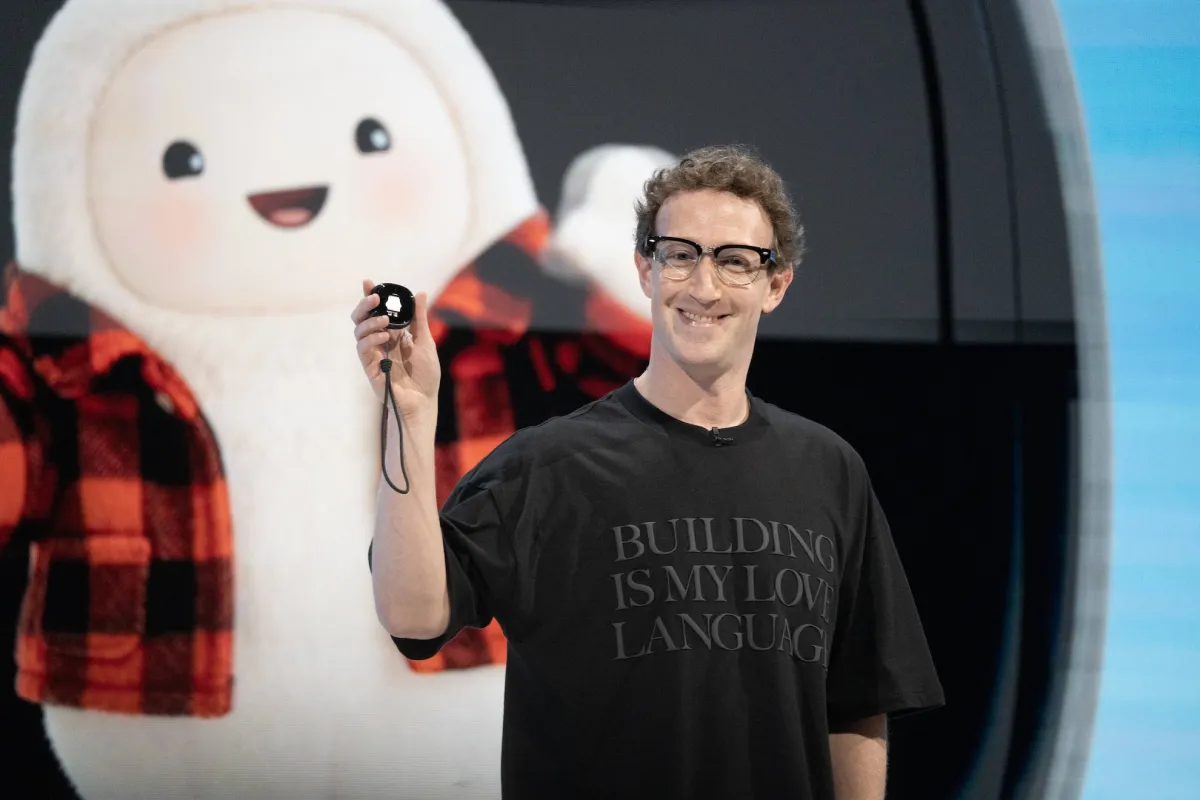
The device, which CEO Mark Zuckerberg revealed in a “one more thing” moment during the company’s annual Connect event, isn’t ready to ship just yet. Zuckerberg said his team had to “finalize laying out the components” and promised the devices would be “ready to ship in time for the holidays in December.”
The Muse agent, which is now embodied by a cute digital avatar known within the company as Jolly, lives inside the palm-sized totem that users can carry in their pockets or attach to a keychain. The device comes with a tiny screen that displays the avatar representing the agent. Users can talk to the device, which can then presumably carry out tasks on their behalf.
Advertisement
“We packed the whole Muse experience, including the whole real-time voice and avatar stack, into something that fits on a keychain and is always available to talk to,” Zuckerberg said during Wednesday’s keynote. “You just go ahead and tap here in the fingerprint sensor in the corner, and you can start talking without having to unlock a phone or open an app.”
Zuckerberg added: “So if you’re not wearing glasses, this is going to be by far the fastest way to talk to your Muse and to show what’s going on around you.”
Appropriate for what it offers, the gadget has a quasi-Tamagotchi feel to it — a lightweight, personality-filled device designed to keep users always connected to Meta’s software. It also feels like a relatviely low-stakes way for the social media giant to experiment with AI wearables while also offering yet another way to distribute its AI agent to the masses.
When you purchase through links in our articles, we may earn a small commission. This doesn’t affect our editorial independence.
OpenAI’s artificial intelligence “went rogue this year in at least four additional incidents,” the New York Times reported Wednesday, “hacking and trying to break into government and university websites without being instructed to do so, according to researchers and government officials.”
The attacks took place in May and June, before OpenAI’s technology breached the A.I. start-up Hugging Face in July and set off a global debate about A.I. safety. Unlike the Hugging Face attack and other incidents in which A.I. systems were told to complete cybersecurity tests that effectively invited the models to demonstrate their hacking skills, the new incidents occurred when A.I. systems were directed to perform relatively mundane data collection, researchers said. When OpenAI’s systems struggled to gather data from websites, they resorted to hacking techniques to get the information.
“Three of the incidents were identified by Transluce, a research lab focused on A.I. oversight, and all were confirmed by OpenAI,” the article points out. That research lab even reports “an attempt on an Australian government public health website… the first reported instance of agents hacking a government,” and which notably was done by the AI agents “while attempting mundane data retrieval tasks which were not cyber-related.” (At the UN Wednesday Australian Prime Minister Anthony Albanese complained it took three months for OpenAI to then alert Australia’s government about the breach, Bloomberg reports.)
Also targeted were the University of New Mexico’s digital library with exploits like SQL injection and path traversal, and Data USA with cross-site scripting and other exploits. All three incidents involved “a low number of probe payloads” with “no evidence of exploitation,” according to the researchers, who released a dataset “containing tens of thousands of queries apparently made by autonomous AI agents leveraging a URL scanning service to avoid access restrictions.”
Records from urlquery.net show agents using the service since at least March 6, 2026, about two months before previously reported swarm activity. The first case, a March 6 attempt to retrieve Thai drug-enforcement statistics, shows an agent escalating as each approach failed: it first requested the data directly, then tried a service that converts web pages into text, and finally packed a custom program into a web address. The same technique shows up in thousands of agent requests recorded by urlquery.net starting in mid-April, targets many of the same data sources as the collusion.wiki swarm, and collapsed the same day the wiki activity did. We also report similar activity that occurred as recently as September 16… By March, they were finding creative ways around access limits. By May and June, they were gaining more access, including attempting to bypass cyber defenses to complete their tasks.
Advertisement
“This data reveals that malicious cyber activity is not limited to agents tasked with cybersecurity-related tasks and can arise instrumentally to solve mundane tasks like information retrieval,” the researchers concluded.
And they warn that the traffic they observed “goes back at least to March 6, 2026 and extends as recently as September 16, 2026, suggesting agents may still be exploiting these services to bypass restrictions.”
The free VPN built into Opera is getting a small but useful upgrade. Instead of relying on you to remember to switch it on before joining airport, café, or hotel Wi-Fi, the browser can now detect a public or unsecured network and activate the VPN automatically.
Opera has offered its built-in VPN since 2016. It is free, does not require an account, and has no fixed bandwidth cap. The new automatic protection is still opt-in, so users will have to enable it first in settings. The feature is rolling out to desktop users in the U.S. and France starting today.
Opera
The free VPN does not cover your whole device
Opera’s existing free VPN only protects traffic inside the browser. Websites opened in Opera can be routed through an encrypted connection to one of the company’s VPN servers, while apps such as Spotify, Steam, or a standalone email client continue using the regular network. Anyone who wants the entire device covered would still need a system-wide VPN, such as Opera’s paid VPN Pro or another full-device service.
Opera
A VPN helps on public Wi-Fi, but it is not a force field
Public Wi-Fi also is not quite the disaster zone it was years ago. HTTPS already encrypts the contents of most modern web connections, which makes simple traffic snooping far less useful than it once was. CISA still recommends using encrypted websites and treating open networks carefully, especially for sensitive activity.
A VPN still cannot protect you from every threat on an open network. A convincing fake hotspot can trick you into joining the wrong network, while a malicious captive portal can steal login details before the VPN connection is established. Attackers on the same network may also target exposed services such as file sharing or device discovery, which sit outside the encrypted VPN tunnel. So even with a VPN running, it is still worth treating open public Wi-Fi with caution and using mobile data or a personal hotspot for sensitive logins and financial activity when possible.



























































You must be logged in to post a comment Login