
Crypto World
America, China and the Evolving New World Order


Beijing is pursuing this ambition at a moment when Washington, despite its power, appears less willing to shoulder the traditional burdens of global leadership. Its domestic political divisions, the Trump Administration’s apparent disregard for international law, and its erratic approach to foreign policy and global conflicts have raised questions about the future of American stewardship.
Yet China is not inheriting a vacuum. Thanks to its power, Washington remains deeply entrenched in the institutions, alliances, and technologies that underpin its supremacy. China is gaining room to shape the international order, but it is not yet replacing the power that built much of it. Instead, Beijing is creating alternatives that allow other countries to become less dependent on the existing American-led system.
China’s new new world vision
Perhaps the most powerful element of China’s vision for a different international order is not its defense of national sovereignty or multipolarity, but its proposition about development. Beijing is asking a pointed question: what if countries need not follow the Western path to modernity?

Crypto World
Solana news: Solana Foundation hires Binance, Polygon veterans for tokenized finance push

The Solana Foundation has appointed former Binance executive Rachel Conlan as its new chief strategy officer, adding a high-profile crypto industry veteran as the Solana (SOL) blockchain makes a bigger push into institutional finance and tokenized assets.
Conlan will lead strategy across institutional partnerships, ecosystem growth and efforts to bring more companies onto Solana, the foundation said Thursday. She spent previously three years at Binance, most recently as global chief marketing officer, before leaving the crypto exchange in June.
The foundation also hired Jamal Raees as general manager for payments. Raees joins from Polygon Labs, the development organization behind the Polygon network (POL), and previously worked at stablecoin infrastructure firm Bridge (now part of Stripe) and crypto payments firm Wyre. He will focus on getting payments companies and other businesses to use Solana for moving money.
The appointments come as Solana increasingly courts traditional financial firms and positions its network as infrastructure for more than crypto trading. Stablecoin payments, tokenized funds and equities have become a bigger part of that pitch as financial institutions experiment with moving assets and settlement onto public blockchains.
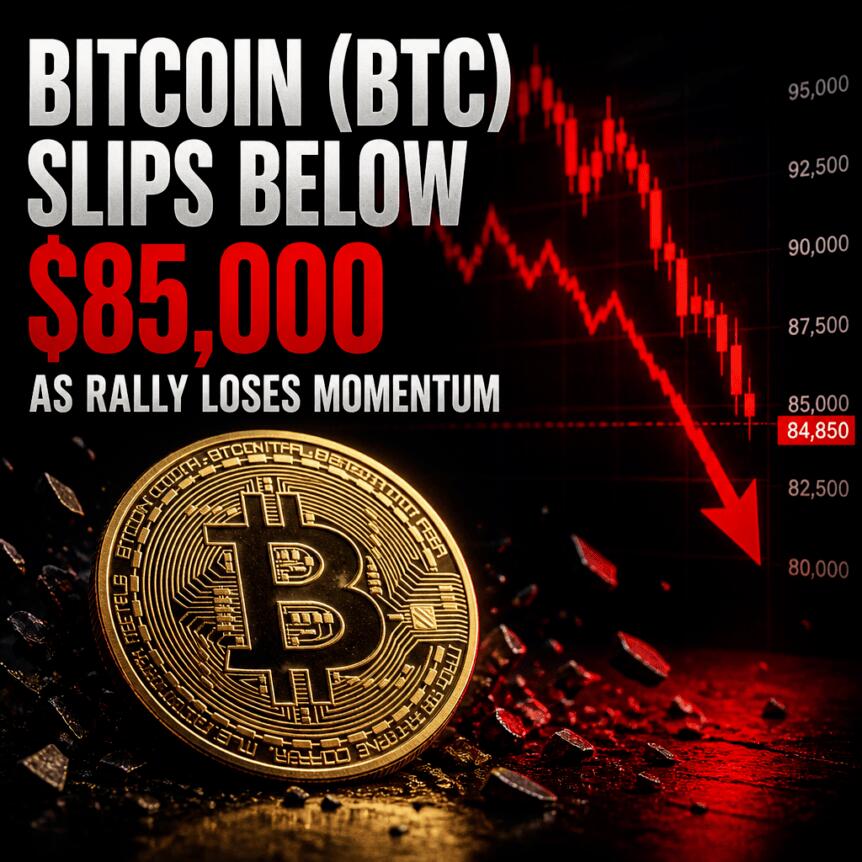
Bitcoin’s latest rally has lost momentum after reaching a high of $87,397 on Monday (September 21). The price pulled back sharply after stronger-than-expected PMI data pushed Treasury yields higher and flushed $125.9 million in long positions.
The flagship cryptocurrency is currently trading around $83,698, down 2.58% over the past 24 hours.
Bitcoin (BTC) Pulls Back After $87,000 Rejection
<a href=
This article was originally published as Bitcoin (BTC) Slips Below $85,000 As Rally Loses Momentum on Crypto Breaking News – your trusted source for crypto news, Bitcoin news, and blockchain updates.
Crypto World
ARK Invest, Securitize (SECZ) tokenize venture fund with OpenAI, Anthropic stakes on Ethereum

Cathie Wood’s ARK Invest is putting its venture fund on blockchain rails, bringing a portfolio that includes stakes in OpenAI, Anthropic, Stripe and Databricks onto blockchain rails.
The ARK Venture Fund (ARKVX) will issue tokenized interests using infrastructure from Securitize (SECZ), with the tokenization firm handling onchain issuance and the investor experience.
ARKVX will be first available on Ethereum with other networks potentially following, the firms said.
“Making the ARK Venture Fund available onchain is a natural extension of our mission to democratize access to technologically enabled disruptive innovation,” Wood, ARK’s founder, CEO and chief investment officer, said in a statement.
For Securitize CEO Carlos Domingo, one draw is giving investors diversified exposure to sought-after private technology companies.
“If you don’t know whether OpenAI or Anthropic are gonna win the AI race, here you get both of them in a diversified pool,” Domingo told CoinDesk TV.
Crypto World
Pressure from the bond market hits a new level, and US stocks slide on worries about inflation

NEW YORK (AP) — Pressure from the U.S. bond market hit a new level on Wall Street Wednesday after a surprisingly strong report on the economy raised worries about inflation, while oil prices halted their slide. The squeeze caused U.S. stocks to sink.
The S&P 500 fell 0.8% after finishing the prior day just 0.4% below its record set last month. The Dow Jones Industrial Average dropped 352 points, or 0.7%, while the Nasdaq composite sank 1.1% from its own all-time high.
Stocks wilted after the yield on the 10-year Treasury jumped to 5.10% from 4.96% late Tuesday, which is a considerable move for the bond market. High yields undercut prices for stocks and other investments, while also slowing the economy by making it more expensive for everyone to borrow money.
Wednesday’s jump briefly sent the 10-year yield near 5.14%, back to where it was in 2007 before the global financial crisis caused yields to crater. Yields have been climbing since bottoming out in the COVID pandemic, and they’ve accelerated recently because of worries about high inflation, the U.S. government’s heavy debt and other concerns.
Worries about inflation got a jolt Wednesday morning after a preliminary report suggested growth in U.S. business activity surged to its strongest level in more than five years. That’s an encouraging signal, to be sure, but it indicates the economy may have plenty of fuel for more inflation.
The report also suggested costs for businesses are leaping at the fastest rate in four years, in part because of more expensive oil, according to Chris Williamson, chief business economist at S&P Global Market Intelligence. That could mean businesses will pass those higher costs onto their customers in coming months.
Oil prices are high because of worries that the war with Iran will keep oil bottled up in the Middle East for a long time.
The price for a barrel of Brent oil to be delivered in November rose 3.9% to $103.08 on Wednesday. That reversed a decline for Brent, which had been falling since it neared $110 last week. Talks are continuing with mediators between U.S. and Iranian officials, but nothing concrete has come from it yet.
Brent oil to be delivered in December, where most of the trading in the market has moved, rose 2.8% to $98.12 per barrel.
Even with its recent decline, the price for a barrel of Brent remains much higher than the roughly $72 it cost before the war with Iran began.
Inflation has remained so stubbornly high that the Federal Reserve raised its short-term interest rate last week for the first time in three years in hopes of slowing down increases in the cost of living.

An AI ad for crypto prediction market Kalshi stole a YouTube video by popular Asian content creator Elliot Choy and “turned him into a white dude.”
Choy shared a screenshot of Kalshi’s advert alongside his original New York apartment video yesterday.
The content creator said, “I guess Kalshi saw this and thought they should steal my video, turn me into a white dude, and run it as an ad.”

Read more: Suspicious Kalshi bot shuts down amid wash trading claims
NPR correspondent Bobby Allyn confirmed that Kalshi’s advert was real and that the firm is now reviewing its relationship with its marketing agency.
Kalshi told Allyn it was an old advert, and that it no longer uses AI-generated ads.
Despite this claim, the advert was promoted this week on YouTube and spotted by Choy.
Another Kalshi ad branded ‘insane’
Another AI-generated Kalshi ad is also being ridiculed by users online.
Made in the style of a Pixar animation, it depicts a couple in financial trouble and features cheating as its main theme.
By the end of the video, one partner reveals she isn’t cheating, and that she’s actually gambling egg prices on Kalshi using her knowledge of running a bakery.
Users have described the spot as “cringe,” “out of touch,” and “insane.”
Some have noted that the animation style might make it appealing to kids, while others suggested that the woman depicted in the ad might actually be insider trading.
One user bluntly pointed out that “this ad is just showing gambling addiction.”
Kalshi accused of wash-trading
Kalshi has been under a lot of scrutiny this week after it was forced to deny a series of wash trading allegations.
The Wall Street Journal recently found that there was $5 billion worth of uniform $5,500 trades across ETH perp volume in one month.
Its report built upon the findings of quant analyst Benoit Dubosson, who decided to investigate the platform after falling out with its crypto lead IcoBeast.eth.
Read more: CFTC orders Kalshi to continue operations amid New York lawsuit
To top it off, users have begun to speculate that Kalshi paid various popular X accounts, many of which are unrelated to the prediction market niche, to share its rejection of wash trading allegations.
Others claim to have spotted Kalshi inflating user metrics by boosting the number of people chatting.
Protos has reached out to Kalshi for comment and will update this piece should we hear anything back.
Got a tip? Send us an email securely via Protos Leaks. For more informed news and investigations, follow us on X, Bluesky, and Google News, or subscribe to our YouTube channel.
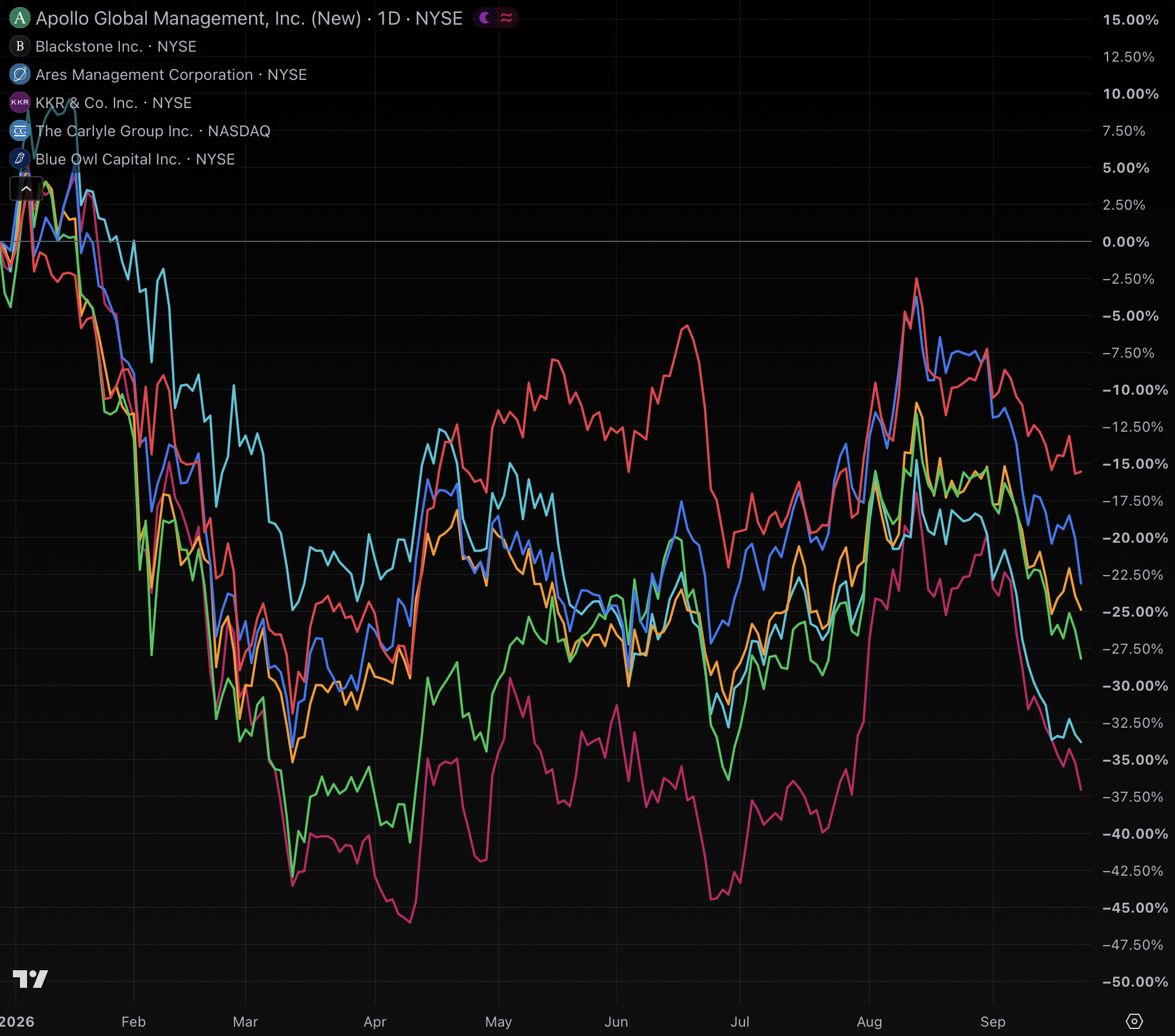
The slow-motion liquidity crisis in private credit has rolled into its third quarter, with Apollo gating another three months of withdrawal requests from its flagship retail private credit fund.
On Tuesday, the fund disappointed investors who had asked to cash out 14.7% of their shares.
It will honor about two thirds less at just 5%, and has gated withdrawals for at least nine months.
The rationed exit is supposed to prevent a stampede for the exits that gating during the first and second quarters was supposed to alleviate.
Stock prices across the private credit market continue to crater. Apollo’s own common stock closed down 14% year-to-date, far underperforming the S&P 500 at +12% YTD.
Private credit peers are also underperforming their benchmarks year-to-date: Blackstone has lost 22%, Ares is down 24%, KKR is down 23%, Carlyle is down 33%, and Blue Owl has declined 36%.
Apollo Debt Solutions BDC, a private credit fund, is a retail vehicle holding a $25.9 billion portfolio of senior secured loans.
Investors wanted to redeem 11.2% of shares in the first quarter but were told to expect about 45 cents per dollar worth of requests.
In the second quarter, they asked for 16.8% of shares back, yet received just 5%.
Apollo has even titled its quarterly 5% limitation using corporate jargon. It prefers another name for denials of its customers’ full withdrawal requests: “Quarterly Liquidity: Considered & Intentional.”
Read more: Private credit firms prepare for bank run-type panic by gating investor withdrawals
Private credit redemption requests have piled up
Cliffwater’s $31 billion Corporate Lending Fund similarly limited withdrawals to 5% this month after investors asked for about 16%.
It was that fund’s third consecutive redemption limitation.
Blackstone also had to limit withdrawals this quarter. Its $77 billion BCRED private credit fund gated third quarter withdrawals at 5%, with requests running at roughly double that threshold.
Another fund, BlackRock’s HPS Corporate Lending Fund, fielded requests for 11.5% of shares that it will only honor at 5% this quarter.
Apollo tried to recast the ongoing crisis in a positive light for media in August, estimating that many withdrawal requests were simplying carrying over from prior months.
To everyone’s ostensible relief, withdrawals weren’t accelerating in current months. “The vast majority of third-quarter requests reflect investors re-tendering unfulfilled requests from prior quarters,” the company claimed.
Apollo also tried to highlight its other fundamentals. It booked $200 million in gross subscriptions for the quarter, it said, and reported a net total return of 8.2% since launch.
Industry-wide, analysts at Fitch estimated the US private credit default rate at a record 6.3% for the 12 months ending August 2026.
Got a tip? Send us an email securely via Protos Leaks. For more informed news and investigations, follow us on X, Bluesky, and Google News, or subscribe to our YouTube channel.
Crypto World
Judge Orders White House to Restore Access for CNN, MS NOW, and Politico. What Happens Next?

Vowing to fight any legal block on his ban, Trump insisted: “Almost without question and, as usual, we’ll go for appeal, because fake news people and publications that only write negatively, and who violate our national security by writing false and defamatory stories with unknown ‘sources,’ shouldn’t be allowed access to the [Oval Office].”
However, in the court filing, Kelly has stated that “temporary restraining orders are generally unappealable.”
Instead, during the 14-day period, the court “will set a schedule for expedited briefing on a motion for a preliminary injunction,” allowing Trump and the media outlets to submit further evidence for Kelly to consider.
Trump, during his first term, revoked the White House press credentials of Jim Acosta, who was then a CNN correspondent, after a tense exchange during a news conference.
Stablecoin infrastructure company HIFI has raised $37 million in a Series A funding round led by Left Lane Capital as the use of stablecoins for payments and cross-border transfers continues to grow despite weakness in the broader crypto market.
Cross-border stablecoin flows rose 77.5% to $220.3 billion in the 12 months ending June 2026, even as the wider crypto market shrank by more than a third over the same period, according to Chainalysis.
HIFI CEO Zach Walsh told Cointelegraph that the Series A is the company’s first priced funding round. The company did not disclose its valuation. “HIFI is processing approximately $7 billion in annualized volume directly through its platform,” Walsh said.
The funding comes as more payments and financial assets move onto blockchains, increasing demand for infrastructure connecting those networks to the banking system.
Firms such as Visa and the Depository Trust & Clearing Corporation (DTCC) have been rolling out or testing blockchain-based financial infrastructure.
HIFI expands into tokenized capital markets
HIFI’s infrastructure allows customers to move dollars into and out of stablecoins, send payouts through US banking rails and cards, and settle the cash side of tokenized repo and Treasury transactions in US dollars.
“This financing will support the scaling of HIFI’s tokenized capital markets infrastructure and the expansion of its broader product suite, including stablecoin payments products,” Walsh told Cointelegraph.
In July, DTCC conducted production trades using tokenized securities across several market functions, including US Treasury and repo settlement, equity transactions, securities lending and collateral workflows. HIFI was among more than 30 firms that participated, alongside BlackRock, Goldman Sachs and Nasdaq.
The transactions included US Treasury and repo delivery-versus-payment trades, equity transactions, securities lending and collateral workflows using assets held at the Depository Trust Company that had been converted into tokenized representations. DTCC plans to launch its Tokenization Service in October.
Related: US stablecoin adoption could surge with bank-like protections: Visa survey
HIFI has also expanded into card-based payouts through Visa Direct. Its platform allows customers to convert USDC and send the proceeds to eligible Visa debit and credit cards globally, according to the company’s website.
The expansion comes as Visa reports growing use of stablecoins across its payments network. On Sept. 9, the company said more than 160 stablecoin-linked card programs were live globally during its fiscal second quarter, with payment volume through those programs rising nearly 200% year over year.
Visa also said its stablecoin settlement volume had surpassed a $20 billion annualized run rate, more than 15 times its level a year earlier.
Magazine: Winners and losers of the SEC’s new tokenized stocks rules

Mint.io has opened its Web3 player economy across its full web platform, connecting games, XP, leaderboards and rewards ahead of the planned activation of its MNTD token.
Summary
- Mint has opened a Web3 player economy that connects XP, ranks, leaderboards and rewards across supported games.
- Eligible leaderboard progress on the web platform and Telegram Mini App will convert into MNTD allocations when the token is activated.
- MNTD emissions will be capped and linked to platform revenue, with reward limits and controls designed to manage exploitation.
- Mint plans to add more games, token denominated leaderboard seasons and new content through its AI assisted production pipeline.
According to Mint, the platform was built with token mechanics from the start and uses a multi chain infrastructure layer to connect progression and rewards across supported games. Technology for the platform is supplied by Hero Gaming Group, an iGaming business founded in 2013.
Players can collect XP through eligible activity, move through different tiers and compete for prize pools without their progression being limited to a single title. Mint said onchain verification is used for core reward flows, while AI assisted models are used to manage token emissions and balance the player economy as activity changes.
A free to play Telegram Mini App sits alongside the main web platform, giving users another route into the progression system.

MNTD allocations will draw from pre launch activity
Players who participated before the MNTD launch will have their accumulated leaderboard standings converted into token allocations when the asset is activated, according to Mint.
Eligible activity has carried a 200% XP boost during the run up to the launch. Progress recorded through both the main web platform and Mint’s free to play Telegram Mini App will count toward the allocation process.
The system builds on ranks, seasons and XP already available to users, with each eligible session contributing to a player’s position on the platform. Mint has not disclosed the conversion rate between leaderboard progress and MNTD allocations.
Mint said emissions will be capped and linked to platform revenue. Reward limits are part of the same structure, while controls have been introduced to deal with promotional abuse and attempts to exploit the progression system.
Under the model described by the company, token distribution is connected to eligible platform activity instead of relying solely on rewards distributed around the launch itself. Mint said the setup is intended to keep emissions manageable during periods of higher volume as well as slower market conditions.
Its existing reward system already links eligible activity to progression. Mint’s help center says real mode gameplay uses supported cryptocurrency balances, with qualifying activity able to contribute to XP or other rewards depending on the applicable rules. Demo play, where available, does not generate XP or real money rewards.
Web platform connects progression across supported games
Mint’s infrastructure connects supported games to a common progression layer, allowing XP, ranks and rewards to carry across the platform instead of operating separately within each title.
AI assisted systems are used in two parts of the platform. Incentive modeling helps manage token emissions as participation changes, while Mint said its content pipeline can produce themed experiences with token utility in roughly 10 days.
Core reward flows use onchain verification. A free to play Telegram Mini App provides another entry point into the ecosystem, with eligible progress there contributing to the same MNTD allocation process used by the main web platform.
Telegram Mini Apps have become one route for Web3 gaming projects to reach users inside the messaging platform. Crypto.news previously covered the Telegram gaming ecosystem as developers experimented with social games that could be accessed without a separate application.
Mint’s Telegram product complements its main web platform, where supported cryptocurrency balances can be used for real mode gameplay. Qualifying activity can contribute to XP and other rewards depending on the applicable rules, while demo play does not generate XP or real money rewards.
Mint caps token emissions based on platform revenue
MNTD emissions will be hard capped and linked to revenue generated by the platform, Mint said.
Reward limits will determine how much can enter circulation through the player economy, while controls against exploitation are intended to restrict abuse of promotional and progression systems. Eligible platform activity will determine participation in the reward structure.
Mint said the model was designed to operate through changes in player volume and weaker market conditions without depending on unrestricted token distribution. The company has not provided projections for MNTD’s market value or the monetary value of allocations earned during the current campaign.
More games and leaderboard seasons are planned
Mint plans to bring more titles onto its shared infrastructure after the MNTD launch, with future games expected to use the same XP, ranking and reward framework.
Additional leaderboard seasons with token denominated prize pools are planned, while the company intends to continue using its AI assisted pipeline to produce new themed experiences. Mint has not disclosed how many games will be added or provided a timetable for individual integrations.
Mint.io is operated by Sage Shark Ltd under Anjouan gaming license No. ALSI-202507035-FI2. Its web platform and Telegram Mini App are already operational, with qualifying leaderboard standings accumulated during the pre launch period set to convert into MNTD allocations at token activation.
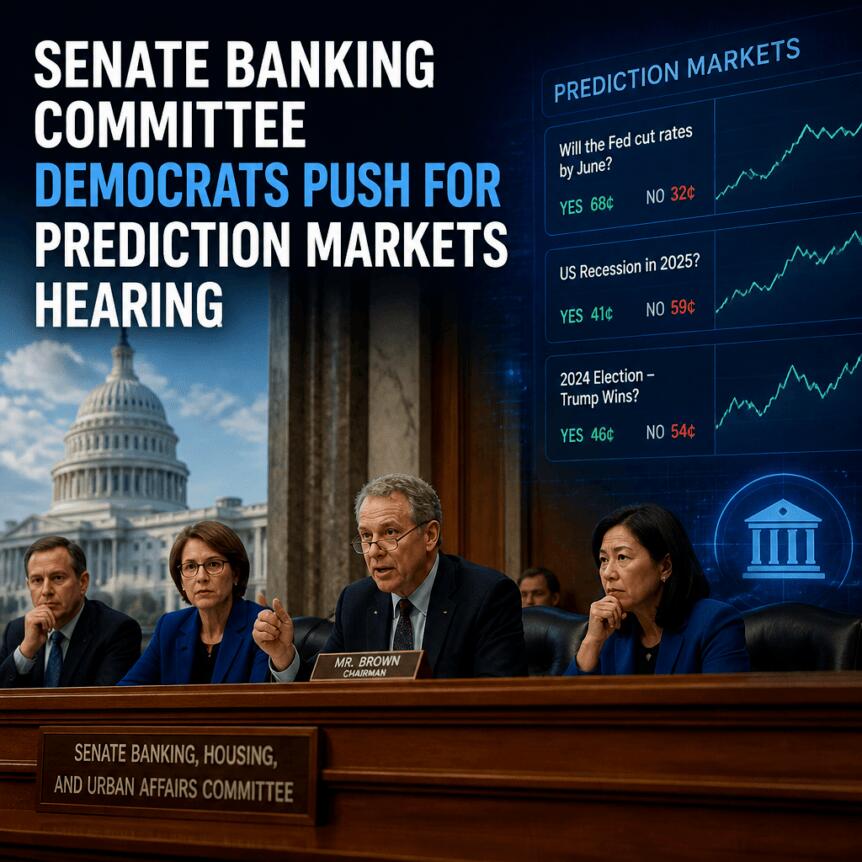
Senate Banking Committee Democrats have written a letter urging committee chair Tim Scott to hold a congressional hearing on prediction markets.
The demand came the same day Scott and Senate Banking Committee Republicans held a private meeting with Kalshi CEO Tarek Mansour.
Democrats Push For Congressional Hearing
Senate Banking Committee Democrats wrote a letter to Scott stating that the panel has a critical role in overseeing prediction markets and platforms like Kalshi. Several Democratic Senators, including Elizabeth Warren, Catherine Cortez Masto, Jack Reed, Mark Warner, Raphael Warnock, Ruben Gallego, and Angela Alsobrooks, signed the letter.
“It is critical that Congress examine prediction markets on a bipartisan basis in a public hearing—not behind closed doors in a Republican-only, industry-friendly roundtable.”
News of the meeting between Senate Banking Committee Republicans and Mansour was first reported by Punchbowl News. Scott confirmed the meeting in a separate statement sent to The Block. The Banking Committee Chair said the committee’s Republican members and Kalshi officials met to “better understand the opportunities and challenges presented by securities-linked products.” The statement read,
“We discussed the importance of bringing innovation onshore, how investors use these products, ways to protect retail investors, and the regulatory questions Congress should address. My goal is to ensure that America leads in financial innovation while protecting investors and providing the regulatory clarity these emerging markets need.”
Who Regulates Prediction Markets
There remains substantial confusion about which body has oversight of prediction markets like Kalshi. The Commodity Futures Trading Commission (CFTC) has stepped in to regulate prediction markets. However, it has faced pushback from states such as New York and Arizona that argue they have the authority to regulate event contracts. State and federal regulators have repeatedly clashed over who should regulate prediction markets, with lawmakers mulling whether Congress should step in to break the deadlock.
Lawmakers have raised doubts about whether existing laws and the CFTC’s limited resources are enough to oversee the rapidly growing sector. Rep. Dusty Johnson, R-S.D., stated during a House Agriculture Committee digital assets subcommittee hearing,
“As with many emerging technologies, our laws are being asked to answer questions that we had never really contemplated when we wrote the laws years ago.”
The House Agriculture Committee and Senate Agriculture Committee have primary jurisdiction over the CFTC. On the other hand, the Securities and Exchange Commission (SEC) falls under the Senate Banking Committee’s jurisdiction. Senate Democrats have argued that prediction market products offer bets tied to company performance indicators, thus falling under the SEC’s regulatory purview.
Cboe Global Markets has also asked the SEC for the green light to list “all-or-nothing options” tied to the earnings results of companies. Senate committee Democrats cited Cboe’s request in their letter, stating,
“As industry participants request SEC approval for options tied to corporate earnings, the full Senate Banking Committee has a critical oversight role to play.”
Meanwhile, prediction markets remain trapped in a high-stakes tug-of-war between federal and state regulators.
Disclaimer: This article is provided for informational purposes only. It is not offered or intended to be used as legal, tax, investment, financial, or other advice.

Young men are swinging away hard from Republicans, pessimistic about economy, new poll finds

Man dies after van and tractor crash in Hamsterley

General Mills’ recovery story still being written




-

 Fashion6 days ago
Weekend Open Thread: Talbots – Corporette.com
-

 Tech4 days ago
Researchers escape OpenAI Codex sandbox to run commands on host
-

 Crypto World2 days ago
Goldman Sachs and Deutsche Bank Agree: The S&P 500 Rally Isn't Over
-

 Crypto World5 days ago
Circle launches Arc Studio AI agent for building onchain apps
-

 Crypto World4 days ago
Who Needs CLARITY Anyway? ARB Could See 70X Increase: Hodler’s Digest
-
 NewsBeat6 days ago
Trump says US has reached an agreement to take permanent control of Greenland’s security
-

 Crypto World6 days ago
Trading Bitcoin on Robinhood? Why 2% Spread Has Traders Worried
-

 Crypto World7 days ago
Mortgage and refinance interest rates today, Thursday, September 17, 2026
-

 Crypto World6 days ago
Bitcoin price breaks channel as RSI climbs to 63
-

 Tech3 days ago
Google’s $899 Googlebook is a bet that you’ll buy a new laptop for Gemini
-

 Business4 days ago
Analog Devices (ADI) Bets $1.35 Billion on Chips that Let Machines Think for Themselves
-

 Crypto World4 days ago
Coinbase, Robinhood, Circle Seen as Tokenized-Stock Winners
-
 Business1 day ago
Oil Price Today (September 23): Crude oil below $100 on hopes of US-Iran talks. What did Trump say?
-

 Tech7 days ago
GPT-6 Astra Reached the Nether in Minecraft, Lost Its Stash to a Creeper, and Farmed Potatoes for Hours
-

 Tech5 days ago
Trump suggests rebranding AI with a new name, says he’s also creating an AI Force
-

 Crypto World5 days ago
World Money launches in 150+ countries with Stripe
-

 Crypto World6 days ago
Silver prices recover quickly, hitting weekly high today
-
 NewsBeat6 days ago
US was ‘on brink of war’ with China over false AI report of nukes moving in Middle East
-

 Crypto World3 days ago
Bitcoin price holds above $81K as key catalysts line up
-

 Crypto World2 days ago
Meta Jumps 11% As Muse Shines and Investors Show an Appetite for Advancing AI
You must be logged in to post a comment Login