

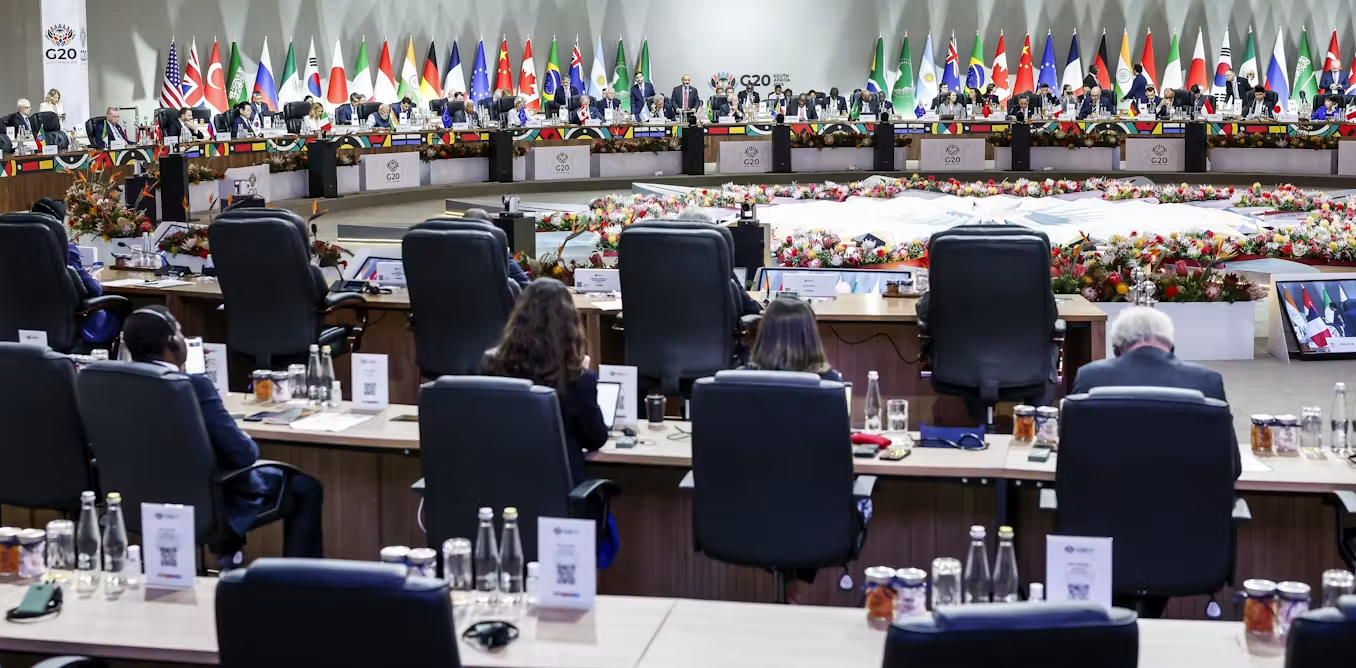
In December, the UK will take over the G20 presidency from the United States. The world is a remarkably different place since the UK last hosted the G20 in 2009. Back then, it led a collective response to the 2008 financial crash, mobilising more than US$1 trillion (£740 billion) to rebuild economies across the world.
In 2027, it will arguably face an even stiffer challenge – leading cooperation when the major powers in the world no longer see eye-to-eye on the nature of problems, let alone the pathway to solutions.
The world is experiencing the highest number of armed conflicts since 1946. Strategic rivalry now runs deeper through trade, technology, energy and finance. Yet these are precisely the areas where no country can secure prosperity by acting alone. The old order is fractured, but our interdependence is stronger than ever.
At Davos in January 2026, the Canadian prime minister, Mark Carney, rightly called on the world’s middle powers to band together in the face of attempts by great powers such as the US and China to turn economic integration, tariffs, financial infrastructure and supply chains into instruments of coercion. The same applies across the other converging pressures of today, from debt and financial resilience to climate, emerging technologies and food security.
Since then, the European Union has opened the door to Canada becoming its first associate member, proposing deeper collaboration on technology, critical minerals, energy and defence. These are examples of countries building flexible partnerships around shared risks and shared capabilities, rather than waiting for universal agreement. This is the logic the G20 now needs.
À lire aussi :
Mark Carney: a master of statecraft in an era short of great orators
The US presidency of G20 this year has been characterised by a lack of action and strained relationships between countries. So Andy Burnham’s government has a rare opportunity to set a new direction on global cooperation.
The UK has the chance to pioneer a new approach to international leadership suited to the world as it is now. In this era of fragmentation, G20 leadership will be judged not by declarations alone. It needs to demonstrate an ability to realign governance with the realities of shared risk, and to demonstrate that collective action remains possible in a divided world.
New approach
I believe the UK should adopt a new, three-tier approach – pushing for consensus where sufficiently ambitious action can command universal support, and broad agreement where an overwhelming majority is ready to proceed. Most importantly, under UK leadership, the G20 needs to strive to build open, problem-specific coalitions where neither of those routes can produce meaningful action.
The idea starts from a simple but important reversal: begin with the problem, and ask what outcome is needed. Then consider which countries, institutions, businesses and communities have the capabilities to deliver that desired outcome, and which policies are able to work together, rather than against one another.
Consensus remains valuable, but it stops being a precondition for progress. Instead, what’s needed is a way of turning partial agreement into practical cooperation.
An example of how this can work is in tackling sovereign debt – a country’s borrowing from domestic or foreign creditors to fund public spending and investments. Here, progress doesn’t depend on involving every G20 member. It requires the debtor country, its bilateral and private creditors, multilateral lenders and the relevant financial institutions to act together.
EPA/Ronald Wittek
The necessary coalition will, of course, be different depending on the issue involved, such as food security, artificial intelligence, critical minerals or resilient supply chains. This proposal would enable the G20 to match nations with key issues, rather than trying to create a fixed club of middle powers or an alternative geopolitical bloc.
Adopting this framework will also enable the countries of the global south, who led the last four G20 presidencies, to ensure their voices are heard on the most pressing issues directly affecting their countries.
New Alignment
To achieve this, UCL’s Institute for Global Prosperity has developed a new framework for global cooperation called The New Alignment. I co-lead our new global convening platform, the New Alignment Hub, with economist Dennis Snower.
We aim to build the necessary infrastructure to make this level of deep, cross-border collaboration possible – bringing together universities, thinktanks, research institutes, civil society, business and practitioner networks across many different regions.
Its working groups can develop and test proposals to shape policy. It can provide the collaborative engine for the UK’s G20 presidency, and help make the Think20 process (the G20’s official engagement group for thinktanks and research institutes) into a route from ideas to implementation.
With that infrastructure in place, the UK’s opportunity is larger than choosing the right list of G20 themes and priorities, because it extends to changing how the institution works. Success should be measured by coalitions formed, resources mobilised and policies implemented at local, national and international levels.
Britain showed in 2009 that it could convene the institutions required to meet a global emergency. In 2027, it can demonstrate something just as important: that a divided world is not condemned to inaction.
This new approach offers a route away from consensus-seeking towards deep, meaningful collaboration between key players on the most pressing issues of our time. And the UK has the opportunity to lead the way in achieving it.









.png?quality=75&auto=webp&width=960)














































You must be logged in to post a comment Login