Connect with us

Business

Lowe’s launching drone delivery service with DoorDash, Alphabet

Published

on

Lowe's launching drone delivery service with DoorDash, Alphabet

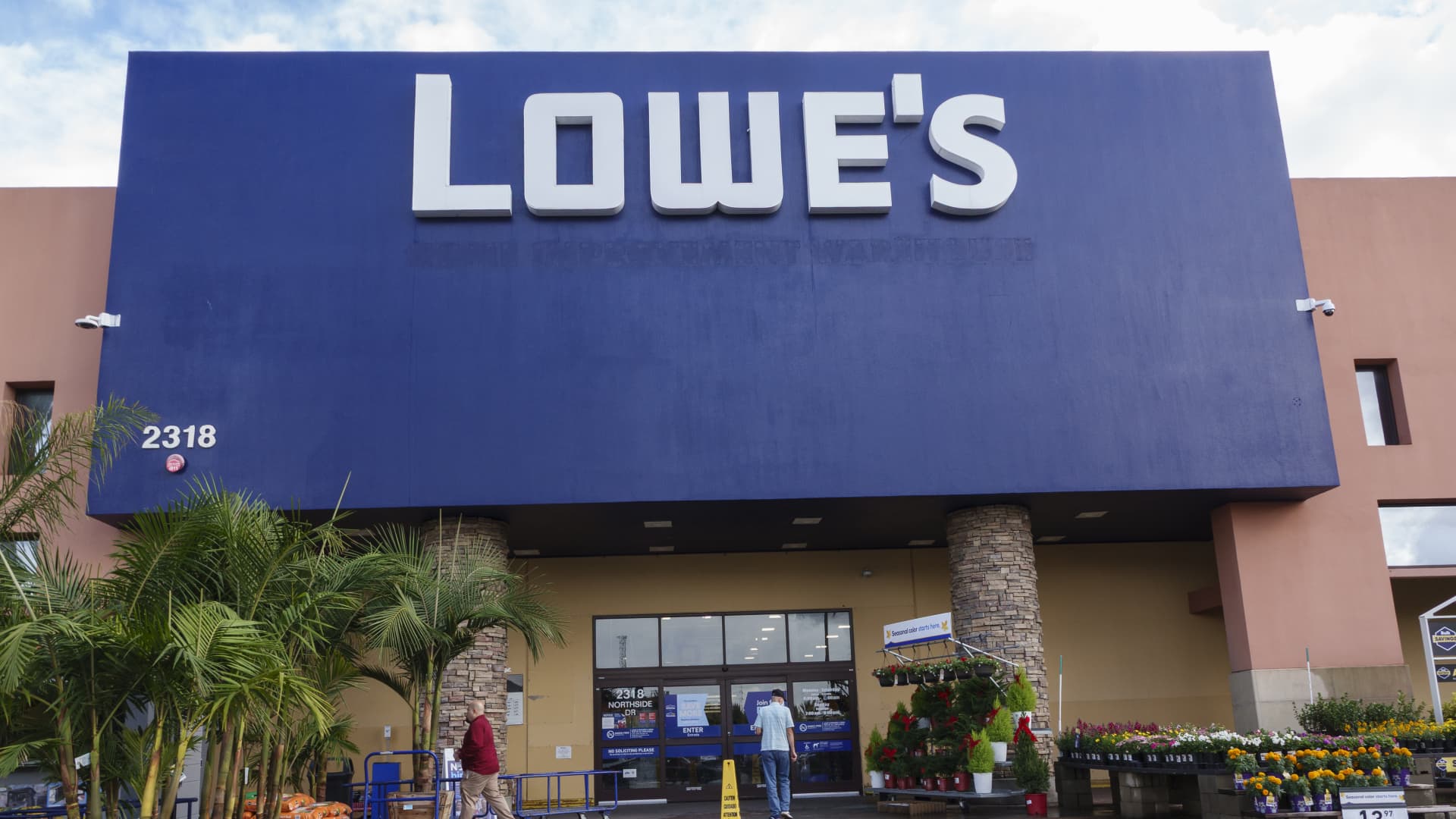
Lowe’s is launching a drone delivery service in partnership with DoorDash and Alphabet‘s Wing, CNBC has learned exclusively.

The company said the new drone delivery service — a first in the home improvement retail space — will give customers access to over 100 products in a delivery window as fast as 20 minutes. A pilot program is already live in North Carolina, with plans for expansion.

Customers can order products directly through DoorDash, which will have drone delivery listed as an option for eligible customers. The drones currently transport orders of roughly 2.5 pounds per flight and operate within a 5-mile radius of the store in Matthews, North Carolina, according to the company.

Seemantini Godbole, chief information and artificial intelligence officer at Lowe’s, said shoppers often tell the company they realize halfway through a project that they’re missing a crucial item.

Advertisement

“Drone delivery fits perfectly because this was one of the friction points, like you’re doing a project, and you’re getting interrupted,” Godbole said. “[But] you never left your home, you never left your job site, and then you just continued with the project. That’s the whole premise.”

She said the company is still testing the service, but if it’s successful, Lowe’s may expand the drone program beyond the North Carolina store.

“We wanted our tech teams to be positioned. … We literally are going to the store every day,” she said. “We are observing. We are listening to the feedback from our store associates and from DoorDash, and we could make changes as needed and be really agile, and so that’s why we started here.”

Godbole added that the drone delivery is not “technology for the sake of tech,” but rather is a move to keep up with the changing needs of the Lowe’s customer as part of the company’s overall technology strategy.

Advertisement

With the announcement, Lowe’s joins a growing cohort of retailers adding drone delivery to their options to optimize convenience and technology for customers in an effort to lift sales. Amazon, Walmart and Uber Eats already use drones to offer fast delivery to customers.

Godbole said the distinction for Lowe’s is that it’s the first home improvement retailer to offer drone delivery.

But drone technology has also faced criticism across the country from people concerned about noise and privacy issues, especially in states like New Jersey. Navigating more crowded airspace also requires regulatory approval.

Godbole said Lowe’s is working to ensure its drones meet all standards and is leaning on the expertise of both DoorDash and Wing.

Advertisement

Godbole said while the drones are an important milestone in the company’s technological advances, Lowe’s is still focusing on improving its express same-day delivery and innovation for its shoppers while also incorporating AI into its internal processes for store associates.

“When associates and customers are interacting with Lowe’s, I really want the technology to disappear, and I want the experience to shine through,” Godbole said. “I want them to remember the projects they are doing, the items they are buying, the fulfillment experience they got, and all our technology efforts are geared towards that.”

Continue Reading
Click to comment

You must be logged in to post a comment Login

Leave a Reply

Business

Sebi clears PRIM route for PMS players to invest in mutual funds, SIFs; Rs 25 lakh minimum ticket

Published

on

Sebi clears PRIM route for PMS players to invest in mutual funds, SIFs; Rs 25 lakh minimum ticket
The Securities and Exchange Board of India (SEBI) board has cleared the introduction of a Portfolio Managers’ Route for Investing in Mutual Fund Units (PRIM), allowing portfolio management services (PMS) players to invest clients’ money in direct plans of mutual fund schemes, including exchange-traded funds (ETFs), index funds and specialised investment funds (SIFs).

Under the new framework, an existing portfolio manager will be able to offer PRIM as a separate investment approach, with a minimum ticket size of Rs 25 lakh.

The move could expand the scope of PMS beyond direct equity and other traditional portfolio-management strategies by allowing managers to construct professionally managed portfolios using mutual fund and SIF products, suggest experts.

The regulatory change also comes at a time when investors have access to a growing range of mutual fund products, but portfolio construction, asset allocation and periodic rebalancing remain important challenges.

Advertisement

Also Read: Sebi board approves FPI play in non-agri commodity derivatives, expands scope of PMS

PMS access widens through mutual fund route

Commenting on the development, Vikas Khemani, Chairman, Association of Portfolio Managers in India (APMI), said the SEBI board’s decision marks a significant step forward for the PMS industry.
According to Khemani, allowing portfolio managers to offer mutual fund and SIF-based strategies at a Rs 25 lakh ticket size could widen access to professionally managed portfolios while keeping the framework within a regulated structure.

He added that the industry views the move as a step towards greater innovation and participation, while maintaining focus on governance and transparency.

The PRIM framework will allow PMS players to invest in direct plans of mutual funds, including ETFs, index funds and SIFs offered by Indian asset management companies. This gives portfolio managers another route to construct portfolios without necessarily relying on direct stock selection.

From product selection to portfolio management

Sandeep Jethwani, Co-founder, Dezerv, said the significance of PRIM goes beyond simply providing investors with another route to access mutual funds.

Advertisement

According to Jethwani, access to mutual funds is no longer the primary challenge for investors. The bigger challenge is deciding which funds to own, how much to allocate, when to rebalance and how to remain disciplined through different market cycles.

Jethwani cited Dezerv’s research based on more than 8 lakh portfolio reviews, which he said showed that over half of investor portfolios underperformed their benchmarks.

He attributed this gap, in part, to behavioural and portfolio-construction issues, including investors entering funds after periods of strong performance, holding overlapping funds, misallocating capital or struggling to remain invested during market volatility.

“PRIM changes this by putting these decisions with a regulated portfolio manager,” Jethwani said, adding that the framework creates clearer accountability for fund selection, allocation, rebalancing and navigating market cycles.

Advertisement

MF-only PMS model gets regulatory recognition

The move could also provide greater visibility to PMS models that use mutual funds as the primary investment vehicle rather than relying predominantly on individual stocks.

Jethwani noted that Dezerv launched a mutual-fund-only PMS in 2022, at a time when stock-based PMS was the more common industry model. The firm believed professional portfolio management could help investors use mutual funds more effectively across market cycles.

He described SEBI’s decision to create a formal route for such strategies as a significant validation of the model.

Advertisement

Dezerv said its flagship mutual-fund-only PMS strategies currently manage Rs 8,674 crore, with a four-year live track record.

(Disclaimer: Recommendations, suggestions, views, and opinions given by experts are their own. These do not represent the views of the Economic Times)

Continue Reading

Business

Airbus identifies A321neo quality issue, says no safety risk

Published

on


Airbus identifies A321neo quality issue, says no safety risk

Continue Reading

Business

Everpure Shares Soar 17.44% to New High as CEO Calls Data Storage Firm’s Growth an ‘Inflection Point’

Published

on

Sunrise Energy Metals Shares Surge 14% on Critical Minerals Momentum

SANTA CLARA, Calif. — Shares of Everpure Inc., the data storage and management company formerly known as Pure Storage, surged 17.44% to $128.77 in Wednesday trading, adding $19.12, pushing the stock to a fresh high as investors continued reacting to an ambitious growth outlook the company laid out at its annual investor meeting earlier this week.

The rally extends a rapid run for Everpure shares, which climbed 6.41% on Tuesday alone following the company’s 2026 Financial Analyst Meeting, held at company headquarters in Santa Clara. That gain came on top of a broader surge that has carried the stock from the low $90s just weeks earlier to recent closes above $120, a move of roughly 30% over a relatively short span, driven by a combination of strong underlying financial results, inclusion in a major stock index, and an aggressive new long-term growth outlook.

At Tuesday’s investor meeting, Everpure outlined what it described as four strategic growth vectors underpinning its expansion plans: its core storage business alongside a related “Core AI” offering, Modern Data Software, Scale AI, and Hyperscale Solutions. The company said its traditional core storage business is expected to continue gaining market share, while the three newer growth areas, Modern Data Software, Scale AI and Hyperscale Solutions, are projected to account for roughly 20% of total company revenue by fiscal 2030.

Everpure Chief Executive Officer Charlie Giancarlo described the company’s current position in stark terms during the presentation, saying Everpure is at an “inflection point” as it expands beyond its traditional storage business into enterprise data management and hyperscale computing solutions.

Advertisement

The company reaffirmed its fiscal 2027 guidance at the meeting, projecting revenue of between $5.03 billion and $5.07 billion, representing year-over-year growth of 37% to 38%, alongside non-GAAP operating income of $940 million to $960 million, an increase of 48% to 51% from the prior year. Looking further ahead, Everpure introduced a preliminary fiscal 2028 outlook, projecting revenue of $7 billion to $7.3 billion, representing growth of 39% to 45%, with non-GAAP operating income projected at $1.7 billion to $1.9 billion, implying year-over-year growth of 80% to 100%. The company said its capital allocation priorities going forward include organic investment, maintaining balance-sheet strength, strategic acquisitions and share repurchases.

That ambitious guidance followed a strong second-quarter earnings report in August, when Everpure posted sales of $1.186 billion, comfortably ahead of the $1.097 billion analysts had expected, alongside adjusted earnings of 70 cents per share, beating the 58-cent consensus estimate.

Wednesday’s gains also continue to reflect investor enthusiasm tied to Everpure’s addition to the S&P 500 index, effective at the market open on September 21, when the company replaced The Trade Desk among the index’s 500 constituent companies. Everpure Chief Financial Officer Tarek Robbiati framed the milestone as a validation of the company’s recent execution. “Joining the S&P 500 is a powerful validation of the disciplined execution and progress our team has delivered quarter after quarter,” Robbiati said. “As enterprises race to make their data AI-ready, this milestone reflects the strength of our financial results and the confidence the capital markets place in our strategy. We are energized for what’s ahead.”

Index inclusion of this kind often triggers substantial buying activity independent of a company’s underlying fundamentals, since funds that track the S&P 500 are required to purchase shares of any newly added company to maintain alignment with the index, a dynamic that market analysts have said contributed meaningfully to Everpure’s rapid share price appreciation in the days surrounding the rebalance.

Advertisement

Wall Street’s assessment of the stock has grown increasingly bullish in recent weeks. Needham analyst Matthew Calitri initiated coverage of Everpure with a Buy rating and a $140 price target on September 17, citing robust customer demand and channel checks pointing to rising storage needs even after recent price increases. Morgan Stanley has maintained an Overweight rating on the stock, though the firm has told clients it prefers to buy into any post-earnings weakness rather than chase the stock higher ahead of the company’s most recent print, a stance that reflected caution about how richly the stock’s recent rally had already priced in expectations for strong results.

Not every assessment of the stock’s valuation has been as favorable. An analysis from GuruFocus flagged Everpure as significantly overvalued following its gains earlier this week, with the stock trading roughly 40% above the firm’s estimated fair value at the time, even as the same analysis assigned the company a GF Score of 79 out of 100, reflecting above-average financial health and growth prospects overall.

Everpure, founded in 2009 by John Colgrove and John Hayes, operated for 16 years under the name Pure Storage before rebranding to its current name in 2026. The company describes its platform as helping organizations manage their data more efficiently while reducing energy consumption, positioning its technology as particularly well-suited to the demands of artificial intelligence workloads that require rapid, reliable access to large volumes of data.

With shares having climbed roughly 70% since the start of the year even before Wednesday’s gain, and with the company now guiding toward accelerating profit growth through fiscal 2028, investors are likely to continue watching closely for execution against that ambitious roadmap, particularly given how much of the stock’s recent rally appears tied to expectations for continued strong performance across its newer AI, hyperscale and modern data software growth areas.

Advertisement
Continue Reading

Business

US stocks: S&P 500 ends nearly flat as US-Iran talks help stocks pare losses

Published

on

US stocks: S&P 500 ends nearly flat as US-Iran talks help stocks pare losses
The S&P 500 ended nearly flat on Thursday as a decline in Microsoft offset gains in Meta Platforms, while uncertainty over the Middle East pushed oil prices and Treasury yields higher, Reuters reported.

The S&P 500 and Nasdaq recovered from their session lows after Reuters reported that US and Iranian negotiators were exploring a phased path to ending the war. The proposed plan would involve Tehran reopening the Strait of Hormuz and Washington lifting its economic blockade of Iran.

US and Iranian leaders traded barbs this week at the UN General Assembly. Brent crude climbed about 4% to $107 a barrel after a Houthi missile attack on Saudi Arabia revived concerns about supply disruptions.

“This just reinforces the view that we’re dealing with one major market catalyst right now,” Bill Northey, senior investment director at US Bank Wealth Management, told Reuters. “It’s really all about oil and inflation and the effect on interest rates, and then the interest rate cascading across the capital markets.”

Advertisement

Major AI stocks were mixed. Microsoft and Broadcom fell about 1%, while Advanced Micro Devices gained 1%.


Meta Platforms rose 3.4%, a day after the social media company unveiled a small handheld device designed for use with its recently launched AI assistant.
Oracle dropped 4.1% after a report said the company had issued a “force majeure” notice concerning a New Mexico data center. Blue Owl, the project’s developer, fell 5%.Treasury yields climbed, with the 30-year bond yield reaching its highest level since 2004.

Meanwhile, the S&P 500 lost 2.20 points, or 0.03%, to end at 7,703.83 points, while the Nasdaq Composite gained 1.76 points, or 0.01%, to 26,937.79. The Dow Jones Industrial Average fell 162.41 points, or 0.32%, to 51,349.18.

The S&P 500 has traded just below 19 times expected earnings this week, its lowest valuation since 2023, according to LSEG data. AI-related heavyweights have accounted for much of the recent increase in earnings expectations.

US President Donald Trump welcomed Chinese President Xi Jinping to the White House for a summit expected to be rich in symbolism but offer limited substance on issues including AI, trade, Taiwan and the Middle East war.

Advertisement

Data released on Wednesday pointing to strong business activity strengthened expectations that the Federal Reserve could raise interest rates again after last week’s 25-basis-point increase. Traders are pricing in a nearly 70% chance of another hike next month, according to the CME FedWatch Tool.

New York Fed President John Williams, a voting member of the Federal Open Market Committee, said on Thursday that it was reasonable to expect the central bank might need to raise rates again before the end of the year.

MGM Resorts tumbled 11% after media mogul Barry Diller’s People Inc. withdrew its proposal to acquire the casino operator.

(Disclaimer: This article is based on inputs from agencies. These do not represent the views of The Economic Times)

Advertisement
Continue Reading

Business

TD Synnex: AI Is Accelerating Growth And Swallowing Cash (Rating Downgrade)

Published

on

Broadcom Stock: AI Capex Panic Is Your Opportunity (NASDAQ:AVGO)

TD Synnex: AI Is Accelerating Growth And Swallowing Cash (Rating Downgrade)

Continue Reading

Business

ADM promotes regenerative agriculture process

Published

on

ADM promotes regenerative agriculture process

CHICAGO — ADM’s fourth annual regenerative agriculture report released on Sept. 15 highlighted the company’s recent progress in supporting farmers, strengthening agricultural supply chains and delivering measurable environmental outcomes around the world. 

In 2025, ADM’s regenerative agriculture programs engaged more than 56,000 farmers across approximately 4.6 million acres, 11 countries and 10 crops. Compared with regional benchmarks, the programs resulted in approximately 946,000 tonnes of CO₂e reductions, the report said. 

“Resilience starts on the farm,” said Greg Morris, ADM’s senior vice president and president, Ag Services and Oilseeds. “By improving and protecting soil health, farmers can be better equipped to adapt to changing conditions and maintain productive operations. That resilience can extend across the value chain, helping strengthen the food system we all depend on.” 

ADM also expanded collaboration across the value chain through new partnerships. The company announced in July that General Mills and Walmart joined ADM in a strategic collaboration to accelerate regenerative agriculture across 40,000 Midwest wheat acres, specifically key growing regions where General Mills sources wheat from ADM for products sold through Walmart and Sam’s Club. A year ago, ADM, PepsiCo, Inc. and Mars, Inc. announced they would support 24 farmers on 5,454 hectares in adopting sustainable applications across their crop rotations in Poland.

Advertisement

The Chicago-based company said these collaborations bring together farmers, ADM and downstream customers to help scale regenerative agriculture while creating value across the supply chain. 

“ADM views agriculture as a powerful way to meet evolving customer needs, and our work in regenerative agriculture demonstrates ways in which we are uniquely positioned to connect agricultural production with lower-carbon markets at scale,” Morris added. 

Since 2023, ADM’s annual report has provided a transparent view of the program’s approach, progress and results, as well as the partnerships helping move the work forward. 

“For this progress to last, regenerative agriculture has to work on the farm and across the value chain,” Morris said. “That means listening to farmers, using data to understand outcomes and improve our programs, and working with customers and partners to build market demand that can help these practices endure and grow.” 

Advertisement
Continue Reading

Business

Burcon NutraScience Corporation (BU:CA) Shareholder/Analyst Call Transcript

Published

on

OneWater Marine Inc. (ONEW) Q1 2026 Earnings Call Transcript