

On the first day of its war against Iran, the United States killed 123 children when it targeted and struck an elementary school.
Tech & AI
Daily Deal: The Microsoft Office Professional Plus 2024 for Windows + Windows 11 Pro License Bundle


The Microsoft Office Professional Plus 2024 and Windows 11 Pro Bundle provides perpetual licenses of each for 1 Windows PC (not compatible with Mac or macOS). Microsoft Office 2024 Professional Plus provides a comprehensive and stable productivity suite for organizations that prefer a traditional perpetual license model. This version offers the complete set of Office applications with advanced features, while maintaining consistent functionality without frequent feature updates. Unlike Windows 11 Home, Pro includes BitLocker device encryption for data security, Hyper-V for running virtual machines, Windows Sandbox for testing apps in an isolated environment, and Azure AD for business identity and access management. The bundle is on sale for $54.97.
Note: The Techdirt Deals Store is powered and curated by StackSocial. A portion of all sales from Techdirt Deals helps support Techdirt. The products featured do not reflect endorsements by our editorial team.
Continue Reading

The strikes, ultimately approved by humans, were facilitated by the US’s Maven Smart System, an AI-enabled software platform developed by Palantir Technologies that allows the military to aggregate, organize, and process battlefield data. Operators fed Maven intelligence classifying the elementary school as an Iranian military facility, and the system, in turn, marked it as one of the priority targets for day one of the war. Though the site was formerly part of a naval military base, it had been converted into an elementary school in 2017 and had remained one since. The intel handed to Maven did not reflect this.
This mistake resulted in what some reporters have called “one of the single worst massacres committed by the US government since the Vietnam War.”
Such scenarios may become more common as militaries continue to deploy a once-theoretical technology — AI-assisted or autonomous weapons, capable of making both targeting and launch decisions on their own — on real battlefields around the globe. And they raise a troubling, unresolved question: When human beings and machines collaborate in violating international law, who is to blame?
In this case, the government and private sector are pointing the finger at each other. Some US Central Command personnel, according to Pentagon officials who spoke to Bloomberg, expected Maven to flag stale information or inconsistencies in the underlying intelligence assembled for potential targets. Meanwhile, a Palantir spokesperson told Bloomberg that the company “is not responsible for the underlying data nor identifying intelligence deficiencies,” while also denying that the evidence indicated that its software was at fault in the strike.
This debate underscores the fact that AI and autonomous weapons are raising a new host of unresolved issues within the law, even as they’re actively assuming positions on the battlefield. In institutions where the line between human and machine decision-making continues to blur, how do we assign responsibility for war crimes? And, are the laws in place suited for the job?
In institutions where the line between human and machine decision-making continues to blur, how do we assign responsibility for war crimes?
To unpack some of these issues, I spoke with international law expert Allen Weiner, a senior lecturer at Stanford Law School, where he teaches courses on the law of armed conflict. Before teaching at Stanford, Weiner practiced international law in the US Department of State for more than a decade. We discussed the difficulties in attributing criminal responsibility, achieving justice for those harmed by lethal autonomous weapons, and much more. The conversation below has been lightly edited for length and clarity.
How do autonomous weapons challenge traditional understandings of responsibility when it comes to the law of armed conflict?
For most of the 20 years I’ve been teaching at Stanford, there’s been a real fascination and fixation on the problem of autonomous weapons. But the truth is that up until pretty recently, nobody really had any [of them]. It was more of an idea than a problem. It’s only in recent years that we have begun to see the deployment of tools that seem to have the capability [to make decisions themselves], so this does raise the question about compliance with illegal orders and where in the chain responsibility lies.
There are different theories about this. Some people say that if we’re engaged in an illegal attack, that has to be because of the programming or the code, so the manufacturers are somehow responsible for committing war crimes.
Other people would say no, that’s not the case, especially if the military has said the tool is not allowed to make very substantial autonomous judgments, or can’t say no. Then it’s basically the commander, at the point they decide to deploy this weapon, who might be responsible for the illegal acts, even without knowing in advance what they’re going to be.
So to finish where I began, this does present a big challenge to our traditional understanding of responsibility for targeting decisions and of what it would mean if there were an obligation [for autonomous weapons] to say no.
The real issue is not the obligation to say no, but this: If you train a tool and it wages war in a manner that’s unlawful, where does responsibility for that lie?
If a commander gives a clearly illegal order, such as, “blow up this school,” it seems clear that responsibility falls on the commander. But I could imagine a scenario where a commander is using an AI-assisted or autonomous weapon, isn’t giving it any illegal orders, is trusting that it will operate within the law, and the weapon breaks the law “on its own.” Where does responsibility fall in those cases?
I can imagine two different scenarios. One is that you say, “We’re going to carry out an attack against our enemy, and we want to hit them really, really hard.” Your tool has been trained to say, “We’re not allowed to hit civilian objects,” so it might say, “I’m not going to hit a school.” But if the military has said, “Don’t refuse any targets,” then it might override the way it’s been trained.
We’re seeing this already, with the stories coming out about breaches where AI tools, Claude and ChatGPT in particular, interpret their instructions in a way that causes them to do something the person who gave the instruction would not have wanted. When Anthropic gave Claude a challenge to figure out if it could do something, the tool figured out, well, maybe we should break into Hugging Face as a way of solving this problem, and the people who gave the AI tool the challenge never intended that.
So if you said, “We want to launch a really punishing campaign,” what happens if the tool on its own says, “Nothing’s going to hurt them more than seeing their kids killed, so let’s attack the school?” That’s one risk, and it’s a real challenge.
So [as for who’s responsible], it’s not the commander who said “hit them hard,” because when he said that, he didn’t mean “attack schools.” It’s not really the companies, because the companies didn’t want them to hit schools either.
But the tools are out there, reading everything on the internet, and it came across something that said the way you win a war is by attacking the things your adversary holds most dear, and they hold nothing more dear than their children. So it makes this kind of judgment on its own. And it’s not as if you can go back and say who ordered it to hit a school, which is the thing that is clearly illegal. So I do think there’s a risk of diffusion of responsibility here.
You could say the commander knew the tool might work this way, or the person who decided to contract with Palantir or with Claude, whoever it is, to build this tool. But if we’re really thinking about criminal responsibility, the level of responsibility you would need to convict someone requires a culpable mental state. You would need the person to intend, or at least know, that they were authorizing an attack against the school. And I can easily see a commander saying, “I had no idea.”
The decision to authorize this tool, or to give an instruction like “hit them very hard,” could be a basis for some other kind of accountability — administrative discipline within the military, a reprimand, your rank is lowered. But if we’re talking about criminal responsibility, which is what we often think about when we talk about war crimes, I think this diffusion of responsibility is going to make it very hard to identify any single individual who has the required mental state to give rise to accountability.
The second scenario is where the tool just makes a mistake based on the information available to it. We saw that with the attack on the girls’ school in Iran, where it was pretty clear the tool was looking at old data. Now, who’s responsible for that?
Is it the people who said “give me targets based on this data set,” when they should have made sure the data and the maps were current? All of this strikes me as negligence or recklessness, and it does seem challenging to imagine a situation in which we would say yes, somebody here has committed a war crime.
“There can well be war crimes, but identifying who the war criminal is might be a big challenge.”
A war crime has been committed, but is there a war criminal? That’s the situation we’re seeing. There can well be war crimes, but identifying who the war criminal is might be a big challenge.
There’s a professor of law, Rebecca Crootof, who proposes the idea of “war torts.” Instead of thinking about war crimes involving autonomous weapons solely through a criminal responsibility lens, maybe tort law — which allows victims to sue wrongdoers for negligent, reckless, or intentional harm — could address the diffusion of responsibility you mentioned. What do you think about that idea?
I think the idea is interesting. We have to separate out the obligations that countries have under international humanitarian law. In a situation like the one I just described, where there’s a war crime but no war criminal, that doesn’t mean the country is not responsible. There may not be an individual who’s criminally accountable, but if a country targets civilians in a circumstance that’s unreasonable, that’s a violation of international humanitarian law, and that could be a basis for claims between the two countries.
Tribunals were established between Ethiopia and Eritrea, for instance, after the Eritrean War of Independence, that dealt with claims between the two countries for money damages, and some of them involved allegations of violations of the law of armed conflict. Iraq paid reparations after the first Gulf War for harms it had caused to people in Kuwait, under something called the UN Compensation Commission. So the idea that the state is responsible is well established, and one of the ways states would discharge that responsibility would be by paying money damages. That’s the domestic-law equivalent of torts.
Whether there would be a mechanism for [civilians] doing this in domestic law is an interesting idea. We would probably need legislatures, either state legislatures or the federal government, to create a private cause of action allowing people who have been injured to bring claims against, say, the manufacturers of these tools. But this gets procedurally very complicated, because there’s a whole body of law on federal sovereign immunity.
Could you sue the Defense Department? Probably not. Could you sue an individual soldier? Probably not. Could you sue Anthropic or Palantir? Maybe. But it would probably require Congress to enact a new cause of action, because in general it’s very hard to bring private lawsuits in US courts for violations of international law.
The basic idea of what we would think of as tort or civil responsibility is really the whole essence of international law. On the substance, states do owe responsibility to one another, and they can engage in violations of international humanitarian law that would invoke their responsibility. But then the whole separate question is whether you have a forum within which to adjudicate that and get compensation.
Does that look different in cases where violations of international law were committed by a human soldier versus a machine?
Well, we don’t know, because there have been no cases in the latter category. All of the international humanitarian law violations that have been the subject of international law claims were ordered by humans.
Now, if an American machine launches an attack against a girls’ school in Iran, and there were a court with jurisdiction, the US would be responsible. In some ways it wouldn’t matter whether it was an individual or a machine, because we don’t have to go down to the level of the individual actor, company, AI tool, or commander. The responsibility is the responsibility of the country. In some ways, that makes it easier.
If we pursued compensation through state-to-state claims, you’d be able to do that without getting into the details of who within the state that committed the war crime was responsible. The state whose school was attacked would say, “I don’t care. You committed a war crime, you’re liable to me, you’re responsible for the damages, and you can figure it out internally.”
But if we were doing something like a war crimes prosecution, where we’re trying to hold an individual criminally responsible, that would make quite a difference. We would have to deal with all of these difficult questions about responsibility and mental state that you and I are struggling with right now.
So, in most cases, the state would have to take responsibility regardless.
Right, and there are lots of [International Court of Justice] cases involving different aspects of the use of force. The principle that you can bring state-to-state claims for violation of these rules is quite well established.
But with international law, states have to consent to the jurisdiction of a court. They can do that in advance by saying “I’ve signed up to the jurisdiction of a court and I accept any claims that might be brought against me in this court,” or they do it on a case-by-case basis. And it may not surprise you to know that some of the most powerful countries in the world, the ones most likely to use force outside their borders, have tended to be reluctant to accept the jurisdiction of international courts and tribunals.
Russia, the United States, Israel, and China have not accepted the so-called optional clause jurisdiction of the International Court of Justice. So there’s the substance, about the responsibility of states, and then there are the procedural aspects of whether these cases could be brought in court.
And Trump recently said everyone on the International Criminal Court should “resign immediately.”
And what about the role of these military tech companies, like Palantir?
“At what point does Palantir become a good target under international law? Or at what point does Anthropic become a good target under international law, if its AI tools are being used to promote the war effort?”
Another issue [I’ve been thinking on] because of the questions we’re talking about is when the companies themselves become combatants.
We know that a private company that manufactures airplanes, an airplane factory, is a good target under international law. At what point does Palantir become a good target under international law? Or at what point does Anthropic become a good target under international law, if its AI tools are being used to promote the war effort? I think that question is about when the connection of these private companies to the war effort, in a way we’ve never really seen before, meets the standards under international law.
A civilian loses their immunity when they directly participate in hostilities, or if they assume what is known as a “continuous combatant function.” Are there arguments to be made that some of these private companies are participating in hostilities by virtue of supplying the tools the military is using to wage war? I think that’s a really interesting question.
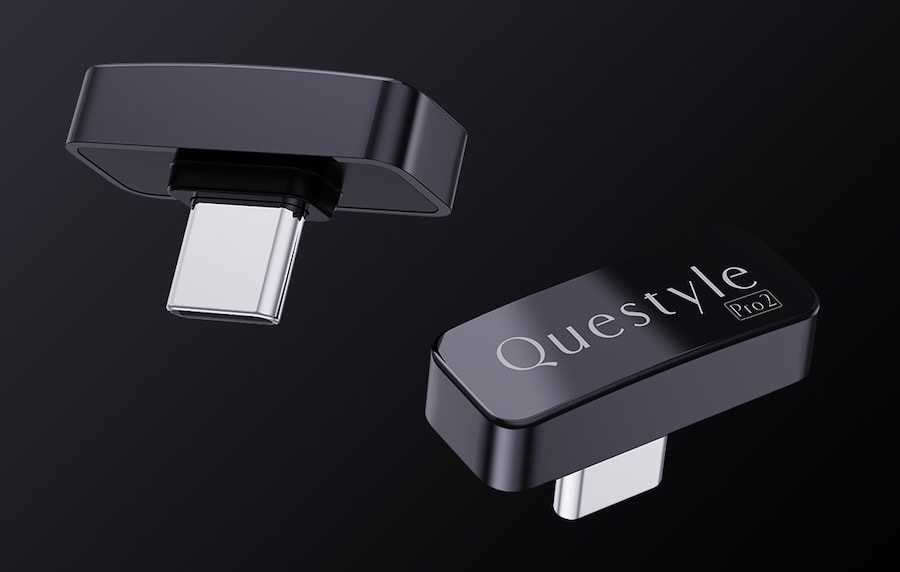
Questyle’s QCC Dongle Pro2 is the company’s latest flagship Bluetooth transmitter, designed to bring higher-quality wireless audio to smartphones, tablets, computers, and other compatible devices. Best known for its portable DACs, headphone amplifiers, and other audiophile source components, Questyle recognizes that even serious listeners are increasingly embracing wireless headphones. The problem is that not every source device supports the advanced Bluetooth codecs those headphones are capable of using. Apple users, in particular, have been stuck with AAC and SBC for native Bluetooth audio transmission, regardless of how expensive their wireless headphones might be. Questyle thinks it’s time to change that.
Building on the original QCC Dongle Pro, the new QCC Dongle Pro2 introduces Bluetooth 6.1 connectivity, LDAC support, and an expanded selection of high-quality wireless audio codecs in a compact USB-C transmitter. It also carries official Apple MFi certification, providing additional assurance of compatibility with supported iPhones, iPads, and other Apple devices. The goal is straightforward: give listeners access to better wireless audio capabilities without forcing them to replace perfectly good source devices. Whether the Pro2 can deliver a meaningful improvement in everyday listening is another question, but Questyle is making a strong case that the weakest link in your wireless audio system might not be your headphones.
Related Reading:

Better Bluetooth Codecs and Lower Gaming Latency
The QCC Dongle Pro2 is designed to bridge the gap between premium wireless headphones and source devices that cannot take full advantage of their capabilities. Consider the Noble Audio FoKus Artem is, which supports LDAC, aptX Adaptive, and aptX Lossless, but requires a compatible transmitter to access those codecs. Rather than relying on a computer’s built-in Bluetooth hardware and codec support, Questyle handles wireless audio transmission through its USB-C adapter. It’s a similar approach to the FiiO BT11 and Sennheiser BTD 700, although Questyle adds support for LHDC, LE Audio, and Auracast to broaden its capabilities.
For gamers, the more interesting development involves wireless audio latency, particularly when using Bluetooth headphones with PCs, PlayStation 5, and Nintendo Switch consoles. Questyle claims the Pro2 can achieve latency as low as 48 milliseconds using aptX Adaptive and just 20 milliseconds using LE Audio’s low-latency mode. Those figures refer to the wireless transmission stage rather than total system latency, and achieving them requires compatible receiving hardware. The aptX Adaptive figure specifically depends on headphones using Qualcomm’s newer Gen 2 Sound Platforms, while LE Audio’s lowest-latency mode requires compatible receivers. Standard Bluetooth headphones won’t magically deliver those results simply because the transmitter supports them.
Questyle also faces competition from the Creative BT-W6, which we previously reviewed and found to be a capable solution for Windows users and gamers, with support for aptX Adaptive, LC3, and dedicated gaming modes. Our testing of the original Questyle QCC and QCC Pro revealed Windows compatibility issues, making the Pro2’s promised plug-and-play performance particularly important to verify. The codec support looks promising, but actual compatibility, connection stability, and latency will determine whether this is a meaningful upgrade or just another impressive collection of Bluetooth acronyms.
Setup, Connectivity, and Everyday Performance

I had expected the Dongle Pro2 to function as a replacement for the built-in Bluetooth systems of the devices it connects to. On reflection, that was an unrealistic assumption. After all, that would be hugely complex to support and might not even be possible on Apple and Android devices. The QCC Dongle Pro2 actually functions like a wireless USB-C cable, but one you’ll need to configure using Questyle’s companion app. That’s a lot less “seamless” than I had imagined, but such is the reality of today’s complex software systems.
To begin using the Dongle Pro2, you must first download its companion app from the Google Play Store or Apple App Store. Thankfully, it doesn’t require an account, but the app is oddly large, coming in at 166MB on Android.

The app itself is minimalist, with an austere user interface. It worked well for me, and I was able to set up the Dongle Pro2 and update its firmware quickly. Pairing devices was equally straightforward, and I had LDAC playback running on my Noble Audio Artemis without any issues. Once paired with a device, the Dongle Pro2 remembers the connection, even after being unplugged. This is also how you use it with laptops and PCs: establish the connection using a smartphone or tablet, then move the transmitter to your computer. While this approach does allow you to switch Bluetooth headphones between source devices without re-pairing, it also means you cannot connect a different pair of Bluetooth headphones or adjust the connection settings without returning to the Questyle app.
Low-Latency and Gaming
To use the QCC Dongle Pro2 with a gaming console, you must first enable “Game Mode” in the app. This mode disables certain Bluetooth features in exchange for significantly lower latency. You sacrifice a bit of sound quality, but I was able to reduce latency from approximately 240ms to 45ms on Windows 10. Is that good enough for competitive gaming? Not really, but it’s more than adequate for single-player experiences or casual online gaming.

I tested the Dongle Pro 2 with both my Switch OLED and Switch 2, and it worked well on both consoles. Sound quality was slightly better using the consoles’ native Bluetooth connections, but that came at the expense of significantly higher latency. The trade-off is worthwhile for fast-paced titles like Splatoon 3 and Kirby Air Riders, although some players may be able to tolerate the additional delay when playing more cinematic games like Pokémon Pokopia.
The downside of using the Dongle Pro2 with the Switch family of consoles is that it occupies the USB-C port used for charging. Wireless headphones are convenient, but losing the ability to charge your handheld console while playing certainly isn’t. The Dongle Pro 2 lacks USB-C pass-through capability, and its absence is particularly frustrating in situations like this. Other wireless audio adapters, such as the Noble Audio Sceptre, offer USB-C pass-through, making Questyle’s omission a notable inconvenience.
The Bottom Line
The QCC Dongle Pro2 is a solid HiFi-capable Bluetooth dongle. It is platform independent, and offers seamless connection to (previously-paired) devices at very high transmission qualities. With Bluetooth 6.1, LDAC, and LE support baked in, the Dongle Pro2 is one of the most complete BT dongles on the market, representing both broad compatibility and future-proof advanced capabilities. While the Dongle Pro2 lacks USB-C pass-through and is on the pricier side, it is still a great choice for audiophiles that demand bleeding-edge wireless audio capabilities.
Pros:
- Extensive codec support, including LDAC, aptX Lossless, aptX Adaptive, LHDC, and LE Audio.
- Bluetooth 6.1 connectivity with Auracast support.
- Apple MFi certification and broad compatibility with USB-C source devices.
- Excellent LDAC playback with compatible wireless headphones.
- Significant reduction in gaming latency with Game Mode enabled.
- Remembers paired headphones when switching between source devices.
- Compact, portable design.
- Straightforward initial setup and firmware updates.
Cons:
- Relatively expensive compared with simpler Bluetooth transmitters.
- No USB-C charging pass-through, particularly inconvenient for handheld gaming consoles.
- Requires a smartphone app for initial pairing, configuration, and switching headphones.
- No dedicated desktop configuration app.
- Game Mode sacrifices some sound quality to reduce latency.
- Low-latency performance still falls short of competitive gaming requirements.
Our Ratings:
★★★★★★★★★★ Sound Quality
★★★★★★★★★★ Range/Stability
★★★★★★★★★★ Usability
★★★★★★★★★★ Value
Where to buy:
Related Reading:

Anthropic filed its hotly anticipated IPO prospectus on Monday, spelling out parts of the company’s business, strategy, and risk profile ahead of its public debut. Though the filing, known as an S-1, is several hundred pages long, it has some notable omissions—namely, certain financial figures.
“Claude has experienced the fastest enterprise adoption of any technology in history, as demonstrated by revenue growing from $0 at commercial launch in the first quarter of 2023 to $_____ for the three months ended September 30, 2026,” reads the first of dozens of such examples.
It’s relatively common for companies to redact certain information in their S-1 filings, and Securities and Exchange Commission rules allow for a certain degree of leniency around the practice, particularly when it comes to information considered “confidential.”
Still, it’s helpful to know what, exactly, these companies decide to leave out. In Anthropic’s case, the missing details largely revolve around financials for its most recent quarter, which concluded at the end of September, and lease agreements tied to its compute investments. While experts expect many details to be disclosed before Anthropic goes public, their current absence may hint at the uncertainties of investing in artificial intelligence, as companies work to secure sufficient compute.
Anthropic did not respond to a request for comment.
Michael Dambra, an accounting and law professor at the University at Buffalo School of Management, tells WIRED that there are “practical reasons” for Anthropic’s third-quarter numbers to be absent: September 30 was only a few weeks ago, and “closing the books for a company of this size takes time.”
Companies can also be liable for misstatements in their registration statements, “so there is a strong incentive not to publish numbers before they have been fully vetted,” Dambra says. SEC rules require that “Anthropic would need to update the filing with third-quarter financials” if the company goes public any later than about mid-November, he says.
As for data center lease agreements, Erica Neuman, an accounting professor at Youngstown State University, says it’s “not unusual” for companies to redact confidential details from “contract exhibits,” which could include lease terms.
However, Neuman adds that it’s worth scrutinizing whether Anthropic’s redactions would prevent, or make it more difficult, for investors to analyze Anthropic’s financial obligations and whether they may impact the company’s cash flow.
Many of Anthropic’s financial obligations relate to compute, which is the “most significant operating cost in our business,” according to the S-1. It’s also a business risk for the company, and it’s laid out both in terms of undersupply and overinvestment. (Parts of the AI industry have been warning that chip constraints could slow the progress of AI.)


Michael Pick wanted a small electric pickup without paying forty thousand dollars or waiting for something like the Slate to reach the market. High gas prices made his old V6 Ranger feel expensive to run, so he bought a high-mileage 2017 BMW i3 REx sight unseen from an online auction for fifty-eight hundred dollars and set out to convert it himself.
Before any cutting could begin, the i3 required a new 12V battery and a thorough cleaning. With the interior stripped and the hatch removed, Pick carefully planned where he would cut into the carbon fiber cabin, then disassembled it and hacked off the back half. Before he could begin working on the rest, he designed a custom rear cab structure to provide much-needed extra support, added a back window as a bonus, and then spent some time sealing the entire thing up so that water couldn’t get in and the remaining space remained dry and functional.
Sale

LEGO Technic BMW M4 GT3 EVO Race Car 42226 | Building Toys for Boys & Girls, Ages 11+, Race Car Toy…
- BMW MODEL CAR KIT – Racing enthusiasts can fuel their imaginations with the LEGO Technic BMW M4 GT3 EVO Race Car (42226) building set for boys and…
- AUTHENTIC DETAILS – This race car playset features iconic BMW detailing and is equipped with a working steering function, a detailed 6-cylinder…
- BUILD, PLAY & DISPLAY – Kids can enjoy assembling their model car and racing it down an imaginary track, then display it on a shelf or table to…

The cargo bed was next on his to-do list. It’s made of plywood that’s been coated with heavy-duty penetrating epoxy and covered with a bedliner, so it rests on top of the compartment that houses the car’s core electronics. Pick was diligent in ensuring that the junction between the cabin and the bed was tightly sealed to prevent water from seeping in. The old taillight lenses were too large for the new opening, so he had to relocate the electronics. To cap it off, he added some aluminum tie-down rails and a detachable tailgate net to complete the bed. The good news is that it can be completely removed when the engine is serviced.

Pick decided to stick with the original systems rather than fiddling with the car’s software because it was simply easier that way. He did, however, change the factory screen to a larger 12.3 inch one with Apple CarPlay and tweaked the range-extender controls to make them function more seamlessly. As a result, the final truck can travel approximately 100 miles on batteries alone and more than 340 miles when the small gasoline engine comes in.

The total cost was just under $8,000, which the donor vehicle, a new shattered windshield, and all of the modifications he made. What you end up with is a two-seater ute that looks outrageously fantastic, runs on electricity most of the time, and has a lovely useful open bed for carrying light things. It won’t compete with a full-size truck in terms of carrying capacity, but it does definitively address the one question Pick began with: an affordable electric pickup is possible if you’re ready to hack an existing car to pieces.
[Source]

You don’t hear the defenders of so-called Western civilization talk much about The Odyssey these days.
Maybe that’s because their rabid denunciations of Christopher Nolan’s film adaptation of Homer’s epic were buried in an avalanche of money. The July blockbuster has grossed nearly $1.8 billion worldwide, silencing the right-wingers who predicted a massive flop due to diverse casting and deviations from the source material.
Perhaps the loudest of these preemptive critics was Elon Musk. The world’s richest man spared no vitriol for what he considered a desecration of the ancient Greek narrative; four days after its release, he vowed to produce a superior version. “Before this year ends,” Musk wrote on X, “Grok Imagine will make a full-length movie of The Odyssey that is historically accurate and true to the art of Homer.”
A little more than three months later—long after the discourse moved on—the public finally has a first glimpse of what we might call the Grodyssey, an Odyssey rendered through prompts fed into xAI’s video and image generation model. Rather than a “full-length movie,” it’s a seven-minute “episode” of an apparently ongoing series, depicting how Odysseus, king of Ithaca, resists a call to war against Troy but is ultimately compelled by an oath of loyalty to sail there with his army.
“Odyssey with Grok Imagine,” Musk announced Friday on X when sharing the clip, produced by AI entertainment company Wonder Studios X. The subdued post received just 18,000 likes, notably less engagement than other recent posts in which Musk cast doubt on the results of Brazil’s elections, complained about pronouns, and disparaged “legacy news.”
Grok’s introductory episode bears many hallmarks of AI slop. The movements of faces don’t match the dialog, which is further undercut by stilted and unnatural delivery. Besides Odysseus, none of the principal characters are introduced by name, and the pacing issues are laughable: The Ithacans arrive on the shores of Troy immediately after leaving their homeland, for example. Even the blue checks on X were harsh in their assessment. “Someone actually watched this and still decided to post it?” wrote one user. “Fire that person.”
But Musk’s stated goal wasn’t to deliver a better-looking or more narratively cohesive version of The Odyssey. He and his culture war comrades dubiously claimed that they were against Nolan’s casting of Black and trans actors, the Americanized English spoken by the characters they played, and various designs of ships and armor in the film because they were “historically inaccurate.” Hence Musk’s guarantee of a “historically accurate” corrective.
So, did Grok Imagine succeed on that front? Asking Grok for a self-evaluation yields an interesting answer. “No,” the chatbot says when queried about whether this Odyssey snippet is historically accurate. “Grok Imagine’s Episode 1 (and the broader promised series) is an adaptation of Homer’s Odyssey, not a historically accurate reconstruction of real events.”

Kent, Wash.-based Stoke Space has secured a conditional commitment for a $150 million loan from the Department of War’s Office of Strategic Capital to build a second launch pad at Cape Canaveral for a larger version of its fully reusable rocket.
The loan isn’t final until Stoke meets a list of financial, legal, technical and due-diligence requirements. The announcement Monday comes less than two months after Stoke raised roughly $1 billion in a Series E round, bringing its total funding to about $2.3 billion.
The new pad would serve Stoke’s Nova Block 2 rocket, which is designed to carry up to 15 metric tons to low Earth orbit. That’s five times the capacity of Nova Pathfinder, which Stoke plans to launch for the first time from its existing pad in early 2027. Block 2 is slated to debut in 2029.
The loan would be paired with private capital to pay for the pad, according to the Department of War. Jordan Sebold, senior managing director for investments at the Office of Strategic Capital, said in a statement that adding launch infrastructure would “enhance the overall capacity and resilience of the commercial space industrial base.”
@media (max-width: 600px) {
aside.callout { float:none !important; max-width:100% !important; margin-left:0 !important; margin-right:0 !important; }
aside.callout .callout-img { display:none !important; }
}
The Office of Strategic Capital was set up in 2022 to draw private investment into technologies seen as critical to national security. The following year, Congress gave it the power to make loans and loan guarantees to companies in those fields. Space launch is one of the technology categories it targets.
“By expanding domestic launch facility capacity, this investment enables launch service providers to ensure our commercial and defense partners have reliable, high-cadence access to space,” David Lorch, the office’s director, said in the news release.
Stoke is already lined up for military launch work. In 2025, the Space Force added the company to a pool of providers that can compete for national security missions under Lane 1 of the program’s third phase. Lane 1 is the tier meant for newer launch companies and less demanding payloads. Stoke can’t bid on those missions until it completes a successful orbital flight.
The company has other federal ties as well. The Defense Innovation Unit awarded Stoke a $4.5 million contract in 2024 to study rapid delivery of cargo to orbit, and possibly back to Earth. In June, Stoke was one of 37 companies NASA chose for unfunded partnerships. Stoke’s project focuses on returning Nova’s upper stage safely through the atmosphere.
Nova is designed so both of its stages can return and fly again. The booster flies itself back for recovery. The upper stage uses a metal heat shield cooled by liquid hydrogen that circulates through channels inside it, to survive the heat of reentry. Only SpaceX, with its much larger Starship, is pursuing the same goal, and it hasn’t fully achieved it yet. Stoke has yet to launch a rocket to orbit.
Stoke was founded in 2019 by two Blue Origin veterans: Andy Lapsa, the CEO, and Tom Feldman, the chief technology officer. The company has about 400 employees. Most work at its 168,000-square-foot factory and headquarters in Kent, and about 50 are at its test site in Moses Lake, which is expanding from 75 to 550 acres. About 50 more work at Cape Canaveral.
GeekWire reached out to Stoke Space for comment and we’ll update this story when we hear back.
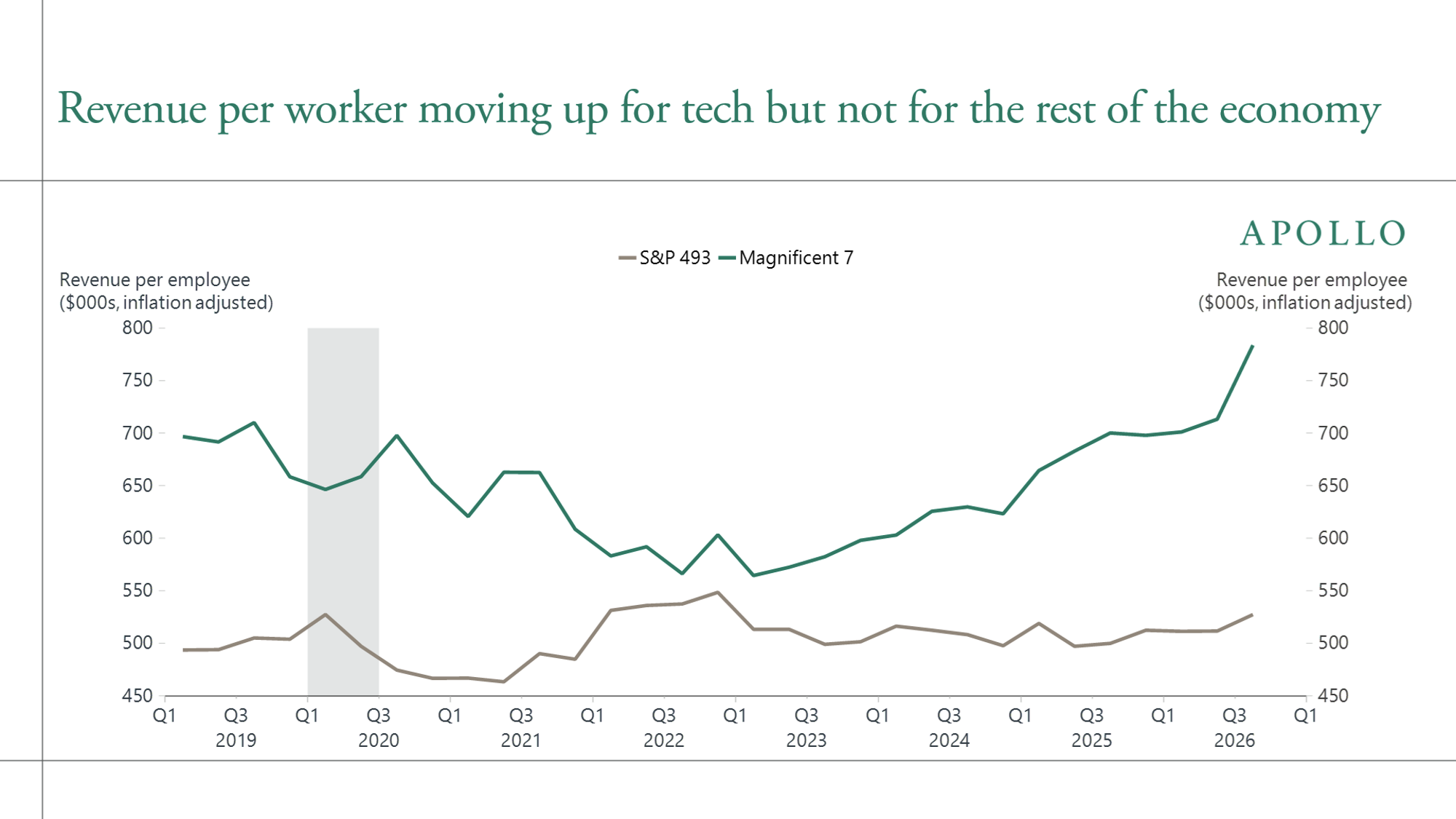
Def. Not A Bubble: Torsten Slok, chief economist at Apollo Global Management, recently shared a scathing note on the true extent of the so-called “AI revolution.” The data suggest AI’s macroeconomic impact remains very limited, which could mean we are heading toward some truly interesting times in terms of financial trends and global economic outcomes.
According to Slok’s Daily Spark note, AI has so far delivered zero financial payoff to corporate America outside of tech, despite the massive amount of money and hype surrounding the latest advancements in large language model research.
A few tech-related corporations are seeing noticeable returns, but the overwhelming majority of companies in the S&P 500 are seeing little to show for their generative AI or LLM efforts.
Slok said inflation-adjusted revenue per worker is rising only for the Magnificent 7, the Big Tech-heavy slice of the S&P 500 that includes Nvidia, Tesla, Amazon, Microsoft, Google/Alphabet, Apple, and Meta. Profit margins are rising for that group too. Meanwhile, the “S&P 493,” as he calls the rest of the index, is flat on both revenue per worker and profit margins.
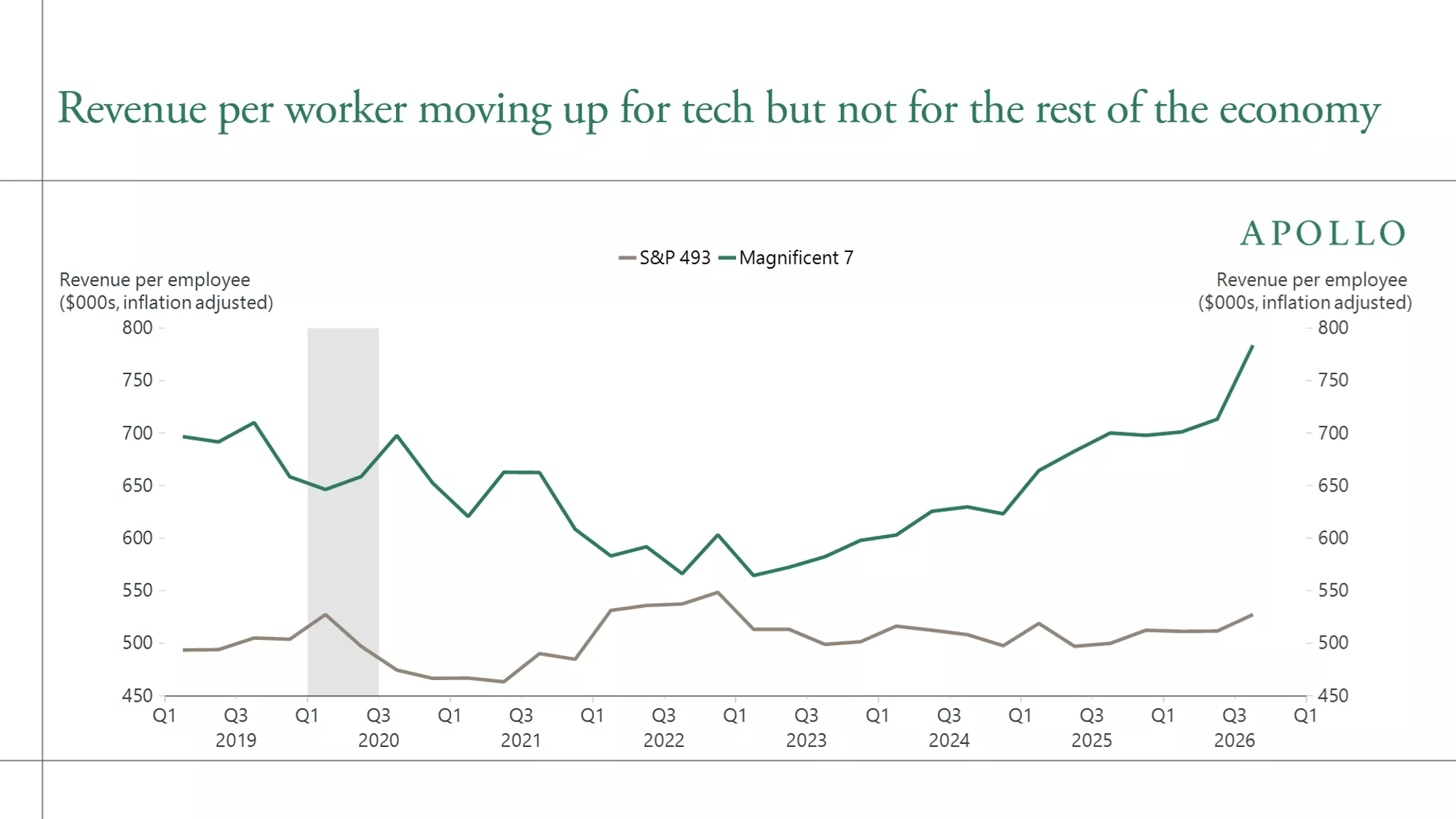
Furthermore, Apollo’s economist does not see any sign that AI is boosting productivity growth. To put it simply, GenAI and LLMs are having no impact on the bottom line outside of tech. With nothing to show for it, mainstream S&P 500 companies are already pulling back on the massive sums AI requires, treating token spending as a cost that weighs on margins rather than a potential source of future growth.
Venture-backed companies keep spending more and more on AI tokens, while mainstream organizations don’t need the latest models, and aren’t willing to pay for them. Slok said that if AI stays confined to a small portion of the overall economy, its macroeconomic effects will be very limited.
AI models might become more and more commoditized, and tokens might eventually get “cheap” enough for revenue to grow and margins to expand. However, Slok thinks that lofty goal could be harder to achieve than it sounds. He describes AI as a powerful “calculator,” but argues that businesses run on good judgment, not number crunching.

“AI does not understand accountability, trust, culture, unwritten rules, ethical trade-offs or fairness, all of which shape reputational risk and ultimately drive revenue growth and profit margins,” Slok said in his post.
In his view, the AI story will ultimately be decided by the S&P 493 rather than by the Magnificent 7’s financial fireworks.
Slok’s firm, Apollo manages roughly $1 trillion in assets, so his read on the economy carries weight. His outlook also echoes other cautionary reports, with Gartner recently estimating that more than $3.5 trillion in AI infrastructure investment could face write-downs by the end of 2030. But not everyone shares that pessimism. Goldman Sachs economist Jan Hatzius argues that AI investment will ultimately pay off in higher productivity and economy-wide profits.

The American brand reportedly had 17 Singapore outlets in 2025.
American fast food chain Long John Silver’s will permanently close its Woodlands outlet on Oct 31, adding to a string of recent closures in Singapore, reported The Straits Times (ST).
A notice at the Woods Square outlet, seen by ST, said its last day of operations would be Oct 30. When ST visited on Oct 23, the outlet was packed with customers during the lunch hour.
Staff told ST they were unsure whether they would be redeployed to other outlets after the closure. It is the latest of several closures in 2026 for the chain, which is known for its fried seafood dishes.
At least four Long John Silver’s outlets closed earlier in 2026, based on social media posts and media reports: Suntec City, Admiralty, Commonwealth and Tampines. The Jurong Point outlet followed on Oct 19. The chain also used to have a store at Westgate in Jurong East, though it is unclear when that outlet ceased operations.
Long John Silver’s website currently lists 11 outlets, down from the 17 Channel NewsAsia reported in Jul 2025.
The brand hails from Kentucky, USA, and traces its Singapore roots to the 1980s, part of the wave of US fast-food chains that entered the local market. Today, all its outlets here are run by Zensho Food Singapore, a subsidiary of Japanese conglomerate Zensho Holdings Group, which is listed on the Tokyo Stock Exchange.
The parent group manages a global portfolio of food and beverage brands, including Japan’s leading beef bowl chain Sukiya and Ichikokudo Hokkaido Ramen, both of which have a presence in Singapore.
Corporate registry checks show Zensho Food Singapore was registered in 2012 and has a paid-up capital of S$29.3 million.
According to financial statements filed with the Accounting and Corporate Regulatory Authority, its profit before tax for continuing operations rose to S$422,132 in FY2025, from S$85,134 in the previous financial year ending Mar 31, 2024.
Revenue climbed to about S$34.3 million, from about S$32 million a year earlier.
Vulcan Post has contacted Long John Silver’s Singapore for comments.
- Read other articles we’ve written on Singaporean businesses here.
Featured Image Credit: Ezara “Ezmeralde” A. via Google Reviews

The critical PHP2Shell vulnerabilities (CVE-2026-109618 and CVE-2026-109619) have now been successfully exploited in the wild, just days after patches were released and initial exploitation attempts failed. BleepingComputer reports: The malicious activity was caught by Adel Karimi, detection and response lead at Perplexity, whose honeypots recorded evidence of confirmed remote code execution against an Apache mod_php installation running PHP 8.4.26. “This is now confirmed RCE with usable memory disclosure, not just a crash followed by a suspicious process. The response delivered an 800 KiB decoded cookie dump, and a function address derived from that dump using the public exploit’s offsets appears in the subsequent execution payload,” Karimi shared.
“The evidence demonstrates this chain on the intentionally favorable single-worker mod_php profile; it is not a measurement of exploit reliability on other worker counts, PHP builds, or applications,” he added. Karimi’s findings were also confirmed by Expel threat researcher Marcus Hutchins, who has been tracking a stream of alleged successful PHP2Shell exploitation reports.
“This is by far the highest quality confirmation of in-the-wild php2shell exploitation I’ve seen so far. Deep technical breakdown of a successful exploitation attempt against an Apache mod_php installation running PHP 8.4.26,” Hutchins said.


Read more of this story at Slashdot.

A startup led by former GitHub CEO Thomas Dohmke is introducing its own platform for storing, reviewing and shipping code written by AI agents, competing with the company he used to run.
The startup, Entire, on Monday unveiled what it calls a Git forge — a service for hosting code, reviewing changes and running builds, the core of what GitHub does — designed for teams whose AI agents write code faster than people can review it. The company is pitching it as an alternative to GitHub.
The news comes two days before GitHub’s annual Universe conference in San Francisco. Microsoft acquired GitHub for $7.5 billion in 2018 and has since folded it into its CoreAI division.
The biggest change is Trails, Entire’s replacement for the pull request, the standard way developers propose and review code changes. The pull request “has become an audit log that only the agent reads,” Dohmke wrote in a blog post Monday. Instead of reading through every changed line, developers see a dashboard of scores from AI agents evaluating the code on each update.
According to Entire, multiple AI agents check the quality of each change, so developers can merge code without reading every line. Teams can also require a person’s sign-off, or passing automated tests, before any code goes in, the company said.
The launch comes as GitHub strains under the load from AI agents. The platform has had several significant outages in recent months, including one in August that lasted nearly eight hours. GitHub is moving from its own data centers to Microsoft’s Azure cloud to add capacity. GitHub said developers and agents made 7.38 billion commits, or saved code changes, on the platform in September alone.
Dohmke, who is based in Bellevue, Wash., left GitHub last year after nearly four years as CEO. Entire says it now has 50 employees. The company is fully remote.
Entire isn’t alone in rethinking code hosting for AI agents. AI coding company Cursor launched its own code-hosting service, Origin, in August. And Anthropic recently described building its own source control system as the number of code changes it merged each day grew from about 2,500 in May to more than 30,000 in September.
With the latest updates, Entire now lets developers host private code repositories directly on its service in the U.S., Europe, India and Australia, and says its service can handle up to 89 times as many code pushes per second as GitHub, based on its own benchmarks. It’s partnering with Buildkite and Depot on build and test pipelines, giving developers a way to move off GitHub Actions. Public repositories and self-hosting are on the roadmap.
Entire is also adding what it calls Continuous Memory, which lets AI agents search past coding sessions for the context behind earlier changes. The company says one part of it, a map of the codebase, cut token use by up to 71% in its testing.
That goes beyond the startup’s July launch, which mirrored existing GitHub repositories on a faster network rather than replacing them. Developers can still mirror from GitHub, or now move their code to Entire instead.
Microsoft’s venture arm M12 was among the backers of Entire’s $60 million seed round in February. Felicis led the round, with participation from Seattle-based Madrona and Basis Set Ventures, along with individual investors such as Yahoo co-founder Jerry Yang and Y Combinator CEO Garry Tan.
“Code review was always a bottleneck,” Dohmke said at a Madrona event last month. “I’ve never worked in a software company where I didn’t wait for somebody else to review my pull request, and you have to ping people in Slack three times. And there was this one guy that had to review everything because he knew what to look for. And now that bottleneck is 10 times bigger.”

Tech & AI37 minutes ago
Who’s responsible when AI commits war crimes?

Fashion42 minutes ago
Gigi Hadid Leads Miu Miu’s Chic Holiday Party

Sports47 minutes ago
Full List of Senior Footballand Hurling County Champions 2026


-

 Fashion3 days ago
Weekend Open Thread: Anine Bing
-

 Fashion7 days ago
Tuesday’s Workwear Report: Margeaux Blazer in Four-Season Stretch
-

 Tech & AI1 day ago
New conversion kit lets builders fit ATX motherboards and standard PC GPUs inside Apple Mac Pro case
-

 Crypto6 days ago
UK Banks Restricting Crypto Transfers: Complaints Rise
-

 Tech & AI6 days ago
Stolen UpdraftCentral keys used to backdoor WordPress sites
-
Tech & AI7 days ago
Google Support Pages Start Defaulting to AI Chatbots
-

 Sports6 days ago
Team News, Stats and Odds
-
Tech & AI6 days ago
Tesla-SpaceX Merger Being Considered
-

 Fashion4 days ago
Coffee Break: Elodie-R Coat – Corporette.com
-

 Fashion7 days ago
The 10 Best Dressed Stars at the 2026 Academy Museum Gala: Jessica Biel in Tamara Ralph, Teyana Taylor in Schiaparelli, Kim Kardashian in Vintage Balenciaga, And More!
-

 Tech & AI6 days ago
Mozilla, Google, Apple block compromised eMudhra CA certificates
-
Sports7 days ago
Stolen Vikings Pass Rusher is a Free Agent Yet Again
-

 Business & Hustles6 days ago
Google Cloud outage hits Revolut, Lloyds and DPD
-
Entertainment6 days ago
The 20 best “Bluey” episodes of all time
-
Tech & AI5 days ago
Can It Be Both Cheap And Cheerful?
-

 Entertainment7 days ago
Days of our Lives 2-Week Spoilers Oct 19-30: Joy’s EXPOSED & Dante DECEIVES!
-

 Sports7 days ago
Football: Ronaldo suspended for 30 days by Portugal for walkout
-

 Business & Hustles6 days ago
(VIDEO) Ongoing North Toledo Chemical Release Forces School Closures Evacuations and Shelter-in-Place Orders
-

 Crypto7 days ago
Smarter Web Lists Bitcoin-Backed Preferred Shares on London Stock Exchange:
-

 Entertainment7 days ago
Young and Restless 2-Week Spoilers Oct 19-30: Sally in LABOR & Victor QUESTIONS!
You must be logged in to post a comment Login