

Crypto World
Inside HYPE’s bear market resilience



The crypto bear market has dragged down most major digital assets this year, but HYPE has moved in the opposite direction. Year to date, the token is up 23.9%, matching gold’s gain over the same period. The S&P 500 is slightly negative, while bitcoin has fallen 23.7% and ether more than 33%.
The divergence is notable not only because HYPE is crypto-native, but because it has decoupled from the broader digital asset market. Its performance increasingly reflects the value of the platform behind it rather than the market’s direction.
HyperLiquid, the decentralized derivatives exchange that underpins HYPE, is built to monetize activity rather than price appreciation. In bull markets, capital tends to concentrate in spot exposure. In choppier conditions marked by drawdowns and macro shocks, derivatives volume tends to persist. Traders shift from buying to positioning, and the platform collects fees on both sides.
While trading volume on competitor platforms Aster and Lighter has tumbled in recent months, HyperLiquid’s has increased, rising from $169 billion in December to more than $200 billion for both January and February. Aster, meanwhile, went from $177 billion in December to less than $100 billion in February, with Lighter suffering an even sharper drop, DefiLlama data shows.
Total volume on HyperLiquid since its inception has now hit a whopping $4 trillion.
Volatility as a business model
HyperLiquid’s core product is perpetual futures, which allow traders to go long or short with leverage. When prices grind higher, leverage amplifies upside. When markets slide, shorting and basis trades step in. The exchange collects fees on both sides.
That structure becomes particularly relevant in a year marked by turbulence across asset classes. Rather than relying on sustained price appreciation, the exchange captures turnover. In sideways or declining markets, traders often increase frequency, hedge exposure, or rotate into relative-value strategies. Activity replaces direction as the primary driver.
And that business model has yielded positive results. Gross protocol revenue grew by 96% in Q3 of 2025 to $354 million, with the fourth-quarter total hitting $286 million, the majority of which came from perpetual trading fees.
That revenue comes from a super-lean team of fewer than 15 employees, with half focused on engineering. HyperLiquid founder Jeff Yan has also refused investment from venture capitalists to maintain independence – a bold approach uncommon in the crypto industry.
Trading beyond market hours
More recently, HyperLiquid has expanded beyond crypto-native pairs. It now offers synthetic exposure to foreign exchange, commodities and major equity indices. It also provides weekend trading for U.S. equities, an innovation that resonates with retail traders accustomed to crypto’s round-the-clock rhythm.
For a generation raised on app-based brokerage platforms, the traditional market calendar feels restrictive. As seen over the past weekend, geopolitical escalations often land outside the typical weekday trading window. HyperLiquid’s structure allows traders to react in real time rather than wait for Monday’s open.
HyperLiquid’s silver market has also been a resounding success with trading volume nearing $750 million over a recent 24-hour trading period despite traditional markets being closed for the majority of Sunday.
The exchange has also introduced pre-IPO perpetual markets tied to companies such as Anthropic, OpenAI and SpaceX. These instruments are synthetic and do not confer equity ownership, but they offer directional exposure to private companies. In effect, they create a parallel venue for price discovery among retail participants otherwise excluded from late-stage venture valuations.
The product FTX tried to build
The model carries echoes of an earlier vision. FTX pitched 24-hour trading, tokenized equities and seamless leverage across asset classes. Its collapse stemmed from custody risk, shoddy balance-sheet practices, and the commingling of funds.
HyperLiquid operates on a non-custodial framework, with on-chain settlement and transparent vault mechanics. Users interact with smart contracts rather than deposit funds into a centralized entity’s balance sheet. In a post-FTX landscape, that distinction carries weight. Retail traders who absorbed losses from centralized failures remain sensitive to counterparty exposure.
HyperLiquid delivers many of the features once marketed by FTX, but through infrastructure designed to reduce reliance on a single custodian.
The exchange also leans into competition and gamification. Leaderboards prominently rank traders by performance, creating protagonists like James Wynn, who lost $100 million on HyperLiquid after engaging in a high-risk long-only trading strategy using leverage when bitcoin was above $100,000.
The mechanic encourages engagement. Traders can build reputations through short positions, market-neutral strategies or well-timed directional bets, and that creates a buzz on social media – effectively acting as a marketing vehicle even in volatile markets.
The centralization test
Claims that HyperLiquid is insulated from bear markets require context. One year ago, the protocol faced a credibility shock that raised questions about decentralization.
In April 2025, the total value locked in the Hyperliquidity Provider vault fell from $540 million to $150 million within a month. The trigger was a trading episode involving a token called JELLY. A trader opened a large short position on HyperLiquid while simultaneously buying the token on illiquid decentralized exchanges. Thin liquidity distorted price feeds and forced the vault into a toxic position via liquidation.
As JELLY’s reported price spiked to levels unsupported by deep liquidity, the vault’s unrealized losses mounted. HyperLiquid intervened, force-closing the market and settling JELLY at $0.0095 rather than the roughly $0.50 price being relayed by oracles. The decision protected the vault from substantial losses, but it ignited backlash.
Critics argued that a protocol marketed as decentralized had exercised discretionary control reminiscent of a centralized exchange. Governance optics deteriorated quickly. Yield on the vault fell sharply, and users withdrew capital.
Security researchers described the episode as an economic design flaw rather than a smart contract exploit. Jan Philipp Fritsche of Oak Security characterized it as unpriced vega risk, where leveraged exposure to volatile assets drained the risk fund in a predictable manner. The episode underscored that economic vulnerabilities can be as destabilizing as technical bugs.
HyperLiquid later modified its governance process, shifting asset delistings to an on-chain validator voting mechanism. The change did not eliminate scrutiny, but it addressed one of the central criticisms.
The vault has since recovered to $380 million in TVL, offering users a 6.93% APR.
Resilience through activity
Despite the controversy, trading volume on the exchange remained robust, and with competitors Aster and Lighter losing momentum, HyperLiquid is positioning itself as a mainstay in the ongoing cryptocurrency bear market.
Risks remain. Regulatory attention could intensify around synthetic exposure to private companies and U.S. equities. Liquidity fragmentation in thinner markets could resurface pricing distortions. Governance mechanisms will continue to be tested under stress.
Yet HYPE’s relative strength this year reflects a structural distinction. Rather than functioning as a high-beta bet on digital asset appreciation, it increasingly behaves like a claim on a venue that monetizes volatility.
In a cycle defined less by sustained rallies and more by sharp swings, that positioning has mattered.



U.S. spot Bitcoin ETFs added 21,000 BTC worth $1.45 billion, marking the first major accumulation wave since mid-October 2025.
Spot Bitcoin exchange-traded funds (ETFs) recorded one of their best days for weeks in terms of inflows on February 25, marking their first meaningful increase in holdings since mid-October 2025.
The shift comes as analysts point to falling retail flows and heavy unrealized losses among newer buyers as signs that market structure could be turning.
The Institutional Signal vs. Retail Exit
In a March 2 market update, analyst Amr Taha tracked two key data points that suggest a major shift in how Bitcoin moves between different types of investors. The first chart tracks 30-day cumulative Bitcoin inflows to Binance, separated into retail inflows (small investor flows) and whale inflows (large investor flows).
According to the chart, between February 6 and March 2, retail inflows dropped significantly, going from $14.1 billion down to $9.05 billion, a total contraction of approximately $5 billion.
What makes this interesting, Taha explained, is that nearly identical patterns appeared twice in 2025, with retail inflows contracting by about $8 billion from March 5 to April 7 of that year and falling by around $5 billion from June 6 to June 22. In both cases, the drop in retail inflows happened right before significant market movements.
The second chart tracks the total Bitcoin held by all US spot ETFs combined. Here, Taha observed something important occurring on February 25: for the first time since mid-October, ETF holdings increased meaningfully. Approximately 21,000 BTC flowed into the funds, equivalent to $1.45 billion at current prices, marking what Taha called the first noticeable accumulation wave after months of stagnation.
“Historically, rising ETF demand tends to be constructive for price, while declining demand often aligns with price weakness,” the crypto trader noted.
However, data from SoSoValue and FarSide show a different number. Both sites claim that the actual net inflows on February 25 were just over $500 million, or almost three times less than what Taha suggested. Nevertheless, it was still the best day for net inflows since mid-January.
You may also like:
Market Situation and Sentiment
The broader backdrop for this on-chain signal has been brutal, with Bitcoin posting five consecutive monthly losses for the first time since 2018, after ending February with a nearly 15% drop. The asset is currently trading just above $66,000, down by over 20% in the past month and sitting 47% below its October 2025 all-time high.
Analyst Crypto Dan offered additional context on market psychology, noting that most investors who purchased Bitcoin within the past two years are currently in loss positions.
“In the investment market, sharp reductions often follow when the majority of people are making big profits, and conversely, strong rallies tend to begin after most people experience significant losses,” he pointed out.
Dan suggested that if Bitcoin’s price drops below $60,000, putting the majority of investors (excluding very long-term holders) into loss territory, it could represent an accumulation opportunity for those with clear entry criteria.
As it is, Taha’s data suggests institutional buyers are already making that calculation, even as retail traders step back.
Binance Free $600 (CryptoPotato Exclusive): Use this link to register a new account and receive $600 exclusive welcome offer on Binance (full details).
LIMITED OFFER for CryptoPotato readers at Bybit: Use this link to register and open a $500 FREE position on any coin!
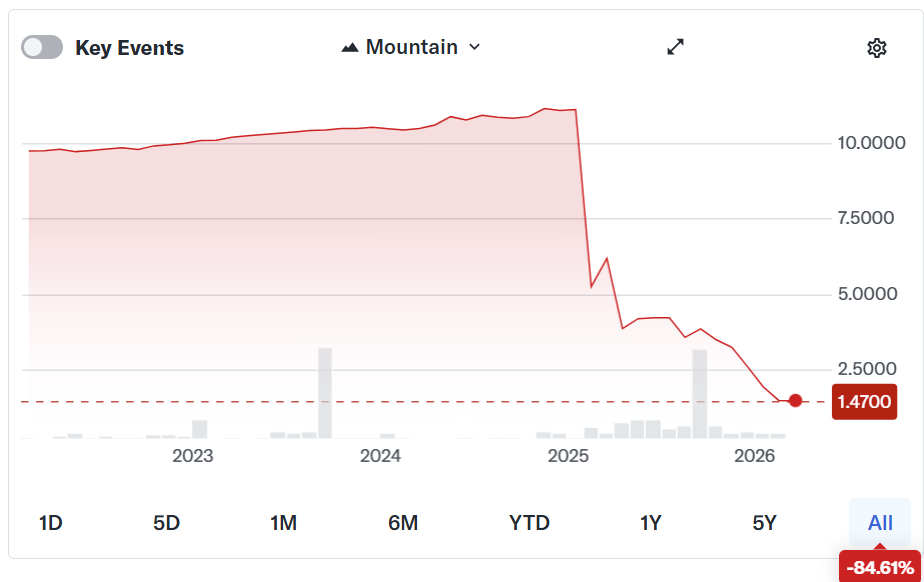
Fold, a publicly traded Bitcoin financial services company, has eliminated $66.3 million in convertible debt, removing a potential source of share dilution and simplifying its balance sheet as it prepares to expand its product lineup.
In a recent disclosure, Fold said it retired two outstanding convertible notes, which are debt instruments that can be converted into equity at a later date. By paying them off, the company reduces the risk that new shares would be issued in the future, which may dilute existing shareholders.
Fold also said it released 521 Bitcoin (BTC) that had been pledged as collateral against the debt. With the notes retired, those Bitcoin holdings are no longer encumbered and can now be used for corporate purposes.
The company said the restructuring leaves it with fewer financing restrictions and greater operational flexibility. Fold plans to use that flexibility to support growth initiatives, including the rollout of a consumer-targeted Bitcoin rewards credit card that offers BTC instead of traditional points or cash-back rewards.
Founded in 2019, Fold went public on the Nasdaq in February 2025 through a SPAC merger with FTAC Emerald Acquisition, becoming one of the first Bitcoin-focused financial services companies to trade on a major US exchange.

Related: ProCap boosts Bitcoin holdings to 5,457 BTC, aims to narrow NAV discount
Crypto rewards cards compete for users
Fold built its brand as a Bitcoin rewards platform, offering a debit card that allows users to spend US dollars while earning Bitcoin cashback on everyday purchases. Over time, the company expanded its services to include savings features and merchant partnerships aimed at encouraging Bitcoin accumulation rather than direct crypto spending.
Competition is fierce in the crypto rewards space, with a number of other companies offering similar products.
The Coinbase Card, for example, allows users to spend cryptocurrency balances directly and earn crypto rewards on purchases. It is now part of Coinbase’s broader “super app” strategy announced last fall, which aims to integrate payments, trading and other financial services into a single platform.
Rival offering Nexo Card lets customers borrow against their crypto holdings to make purchases without selling their assets, while earning rewards. Bybit and Crypto.com offer Visa-branded cards that provide cashback in crypto tokens tied to their platforms.

More recently, Mastercard and MetaMask launched a US crypto-linked card that allows users to spend digital assets at any merchant that accepts Mastercard, with crypto converted to fiat at the point of sale.
Related: PayPal draws takeover interest following 46% stock slide: Report

TLDR
- Turkey proposed a new bill that introduces a 10% tax on cryptocurrency income and gains.
- Lawmakers stated that platforms must withhold the tax on a quarterly basis for all users.
- The bill allows the president to adjust the withholding rate between 0% and 20%.
- Service providers would pay a 0.03% transaction tax on every crypto trade they facilitate.
- Authorities confirmed that tax enforcement will rely on detailed records kept by platforms.
- The bill connects all crypto definitions to the existing Capital Markets Law for consistency.
Turkey’s ruling party advanced a new plan that would introduce a 10% tax on cryptocurrency gains, and lawmakers presented the draft to parliament as they moved to update current tax laws while outlining new rules for service providers.
Proposed Crypto Tax Framework
Turkey introduced a draft bill that creates a new structure for crypto taxation, and lawmakers placed the proposal before the Grand National Assembly as they sought clear rules for the sector. They stated that platforms regulated under the Capital Markets Law must withhold a 10% tax on quarterly income and gains, and officials confirmed that this applies to residents and non-residents.
The bill grants the president the power to adjust the withholding rate, and officials said it could move between 0% and 20% depending on asset type. They also linked the tax rate to holding periods and wallet usage, and they highlighted that different token categories may face different rules.
The legislation introduces a 0.03% transaction tax for service providers, and it applies to the sale amount or market value of assets. Lawmakers said this measure covers platforms that facilitate trades, and they reported that brokers must maintain detailed records.
Authorities emphasized that incomplete user information may trigger enforcement, and the tax agency would pursue shortfalls directly from the user. The bill ties terms such as “crypto asset,” “wallet,” and “platform” to existing financial regulations, and it ensures consistent definitions across the law.
Market Context and International Comparisons
Chainalysis reported that Turkey recorded $200 billion in crypto activity between July 2024 and June 2025, and analysts stated that rising volumes followed economic pressure in recent years. They wrote that Turkey’s economic conditions pushed many users toward digital assets, and the report said people used crypto for alternative savings.
Turkey experienced inflation that peaked at 85% in late 2022, and the rate later stabilized near 30% by early 2025. Officials believe tax reform can support regulatory oversight, and they said the new framework aims to match existing market behavior.
Lawmakers referenced international trends, and they pointed to a Dutch plan that proposed a 36% capital gains tax on digital holdings. They acknowledged that the Dutch proposal awaits a Senate vote, and they said the measure could start in 2028.
The Turkish draft includes a VAT exemption for crypto deliveries covered by the transaction tax, and lawmakers confirmed that service providers fall under the updated expenditure rules. They also stated that foundation university hospitals will lose corporate tax exemptions in 2027, and they kept this clause in the broader bill.
TLDR
- Chainlink enabled the transfer of Coinbase’s cbBTC to Monad through its CCIP system.
- The integration opened new access to Bitcoin-backed liquidity for developers building on the Monad Foundation network.
- Early adopters such as Curvance and Neverland prepared markets built around cbBTC on Monad.
- Coinbase confirmed that cbBTC remains backed 1:1 by Bitcoin held in custody across multiple networks.
- CCIP now supports more movement of tokenized Bitcoin and enables new trading and lending products on high-speed systems.
The update links Coinbase’s cbBTC with Monad through Chainlink’s CCIP, and the move expands access to Bitcoin-backed liquidity while it also provides developers a direct route to build new on-chain financial products across the network.
Chainlink Expands cbBTC Access Through CCIP
Chainlink enabled the transfer of Coinbase’s cbBTC to Monad through its CCIP system, and the rollout opened new routes for Bitcoin-backed liquidity across DeFi. The network confirmed the integration on March 2, and it stated that it aims to support developers building on fast-settlement environments.
The bridge now moves cbBTC from Base to Monad, and users can place the asset in lending or trading markets without delays. Curvance and Neverland adopted the token early, and the two platforms plan to deploy structured products built around cbBTC.
Coinbase issues cbBTC with a 1:1 Bitcoin backing, and the asset holds more than $5 billion in circulation across multiple chains. The supply spans Ethereum, Base, Arbitrum, and Solana, and the new pathway expands distribution further into high-speed environments.
Chainlink said CCIP has processed over $28 trillion in on-chain value, and the protocol uses a standardized security model for cross-chain transactions. “The system moves assets with institutional-grade protection,” said Johann Eid, and he emphasized that the design supports broad multi-network activity.
Keone Hon of the Monad Foundation said the integration gives developers a strong base asset, and he stated that builders gain faster ways to expand Bitcoin-based markets. The network expects growing use cases that center on automated routing and high-frequency strategies.
cbBTC Liquidity Extends to Monad
cbBTC now enters markets that target high-speed settlement, and developers can design products that use Bitcoin-backed liquidity with lower fees. The network targets up to 10,000 transactions per second, and it aims for sub-second finality.
The integration creates access to deeper liquidity pools, and teams can design derivatives tied to Bitcoin prices with improved execution. Lending markets will also expand, and early platforms have begun preparing launch timelines.
Users gain additional ways to earn returns on Bitcoin-backed assets, and some current cbBTC markets already offer returns near 3%. The new route brings that activity to Monad, and teams intend to scale borrowing products around the asset.
The addition of cbBTC also increases available capital for automated trading programs, and developers gain predictable settlement times. This pairing aligns with the network’s push toward capital-intensive applications, and builders will test new strategies anchored to Bitcoin.
Monad now receives more than $5 billion in potential inflows from cbBTC, and teams across the ecosystem expect rising on-chain liquidity as markets expand access to Bitcoin-backed instruments.
Strategy (MSTR), the world’s largest publicly traded corporate holder of bitcoin, expanded its position last week by acquiring 3,015 BTC for approximately $204.1 million, or an average price of $67,700 each.
Bitcoin is trading at $66,000 on Monday morning, with MSTR shares flat in early action.
To fund the buys, Strategy raised roughly $229.9 million through common stock sales, along with $7.1 million in net proceeds of its Variable Rate Series A Perpetual Stretch Preferred Stock, STRC, according to a Monday filing.
Following the latest purchase, the company now holds 720,737 BTC acquired for roughly $54.77 billion, or an average price of approximately $75,985 per coin.


Magic Eden is winding down its Ethereum, Polygon, and Bitcoin NFT marketplaces to pivot resources toward its Solana operations and growing iGaming platform, Dicey.
The decision, confirmed by CEO Jack Lu, is that the platform will cease support for non-Solana chains by early April 2025, following a broad collapse in cross-chain trading volumes.
- Magic Eden will terminate support for Bitcoin and EVM marketplaces starting March 9, with full wallet shutdowns scheduled for April 1.
- The pivot follows internal data showing Solana markets account for over 85% of volume while multi-chain maintenance costs remained high.
- Resources will be reallocated to Dicey, a crypto gambling platform that processed $15 million in wagers during its closed beta.
In his post, CEO Jack Lu outlined a phased sunset for EVM and Bitcoin-based Runes and Ordinals markets.
Trading support will end on March 9, followed by the Bitcoin API on March 27. The platform’s crypto wallet will switch to an export-only mode in the middle of March before a full shutdown on April 1.
Lu stated the company is “doubling down” on Dicey, citing a “massive opportunity” in the intersection of finance and entertainment. The casino platform’s closed beta recently saw 200 users wager over $15 million in just two months.
The strategic shift mirrors a broader trend where crypto funds and companies are diversifying revenue streams; for instance, venture firm Paradigm plans to expand into AI and robotics to capture value beyond traditional digital assets.
Magic Eden plans to replicate this diversification by launching a sportsbook to compete with blockchain gambling heavyweights like Stake.
Discover: The next crypto to explode
Falling NFT Volume Forces Strategic Realignment
The retreat from multi-chain operations reflects a stark consolidation of NFT liquidity on Solana.
Despite raising over $130 million to expand support for Ethereum and Bitcoin Ordinals, market data indicates that Solana assets continued to drive over 85% of the platform’s trading volume in late 2024.
While Ethereum retains dominance in stablecoin infrastructure, its NFT sector has suffered prolonged decline, making the maintenance of cross-chain compatibility technically burdensome for decreasing returns.
Lu noted that the shift was ultimately driven by the fact that most of the platform’s non-Solana products were not contributing significantly to revenues.
The marketplace had briefly ranked No. 1 globally in early 2024 following its Bitcoin expansion, but sustained engagement failed to materialize as the Ordinals and Runes hype cycles cooled.
Going forward, the platform will exclusively focus on NFT packs that bundle random assets, attempting to gamify the remaining trading experience.
Will Magic Eden Exit Cause Token Volatility and Liquidity Concerns?
The announcement precipitated severe volatility for the ME token, which reportedly fell nearly 2.5% in the last 24 hours, although this was broadly in line with Ethereum’s losses over the period.
The exit also leaves a significant vacuum in the Bitcoin Ordinals market, which may strengthen competitors like OKX and UniSat that remain committed to the Bitcoin ecosystem.
Magic Eden’s long-term valuation now hinges on its ability to convert NFT traders into active gamblers on Dicey.
The platform’s user retention metrics after April 1 will be most insightful; if the pivot fails to capture the high volume gambling cohort, the total loss of the multichain user base could isolate the protocol from future liquidity cycles on Bitcoin and Ethereum.
Discover: The best Solana meme coins
The post Magic Eden Winds Down EVM and Bitcoin NFT Markets in Strategic Pivot appeared first on Cryptonews.


Prediction market Kalshi apparently allowed traders to bet on the ousting of Iranian Supreme Leader Ayatollah Ali Khamenei, racked up $54 million in trades, then voided the result the moment he was killed in a US-Israeli airstrike.
Kalshi listed its “Ali Khamenei out as Supreme Leader?” prediction market contract before he was killed on Saturday.
Although a fiery death at the business end of a US or Israeli missile would certainly, in most people’s eyes, count as being “out,” Kalshi’s rules technically contained a death carve-out.
Specifically, the fine print specified that if Khamenei’s removal happened via death, the contract wouldn’t pay out.
Traders were predictably furious. “Getting rugged on a 100% correct prediction because of a fine-print ‘death carveout’ is wild,” one user wrote on Kalshi’s Discord.
“What you’re doing is stealing,” wrote another.
Critics accused Kalshi of trying to have its cake and eat it too by platforming a contract in the first place that involved bets on human death, then hiding behind compliance language when reality hit.
It had the option all along to not list the market for trading, after all. It decided to list it and accept trades.
Using crypto to profit from death
Even though the market involved potential death, Kalshi promoted it on social media for days. Users wagered $54 million on it.
US Senator Chris Murphy called it “insane this is legal.”
Ex-SEC Chief of Staff Amanda Fischer told NPR that prediction markets are “promoting opportunities to bet on events that can only be seen as a proxy for war or assassination… this betting market shouldn’t exist in the first place”
Six Democratic senators had already urged the CFTC in late February to ban contracts tied to anyone’s death. Wagers on Khamenei’s killing made their letter prophetic.
On Polymarket, Kalshi’s less-regulated offshore competitor, the numbers were uglier.
Roughly half a billion dollars changed hands on contracts tied to when US forces would strike Iran which, again, has obvious ramifications on human life.
Crypto keeps building death markets
Sadly, crypto wagers on death are nothing new. Early concepts of cryptographic assassination markets have circulated since at least a 1995 essay by cypherpunk Jim Bell.
In 2018, crypto prediction platform Augur launched with assassination markets appearing almost immediately.
Read more: Lord Miles wants YouTubers to help settle Polymarket scandal
In September 2025, Polymarket hosted a multimillion-dollar market on whether YouTuber Lord Miles would survive a 40-day desert fast . Trading odds crashed when fears spread that he had actually died.
Hivemind progenitor Paul Sztorc repeated his multi-year call for a “fully peer-to-peer prediction market system that cannot be shut off by anyone under any circumstances.”
More recently, in January 2026, an anonymous Polymarket trader made $400,000 on a suspiciously well-timed bet on Venezuelan leader Nicolás Maduro’s downfall.
In February, Israeli authorities indicted two people for using IDF classified information to bet on Polymarket during military conflict last June between Israel and Iran.
Got a tip? Send us an email securely via Protos Leaks. For more informed news, follow us on X, Bluesky, and Google News, or subscribe to our YouTube channel.
TLDR
- Bitcoin moved near $70,000 while holders showed no panic during rising Middle East tensions.
- Short-term holder loss transfers dropped to a 2- week low as selling pressure eased.
- Realized losses fell to 3,700 BTC even as geopolitical risks increased across the region.
- BTC derivatives showed reduced risk as Binance open interest declined by 25 %.
- The leverage ratio reached a low weekly average that aligned with ongoing deleveraging.
Bitcoin traded near $70,000 on Monday as war fears grew across the Middle East, and the market held steady and pushed higher. Traders watched exchange activity closely because short-term flows shifted again. The latest chain data showed cooling loss-driven selling, and futures activity kept falling as open interest reset lower during the session.
Short-term Flows Shift as Loss Transfers Fall
Short-term holder loss transfers dropped to a two-week low, and this shift aligned with slowing exchange flows across major venues. Realized losses fell to 3,700 BTC on March 1 as tensions rose, and traders kept BTC above $63,000 as inflows stayed muted.
The reduction contrasted with early February, and that period saw 89,000 BTC sent at a loss within one day. Analysts said the current environment showed reduced stress and “zero panic,” and loss-driven inflows kept compressing into March.
This decline showed less pressure from recent buyers, and the market tracked whether losses would surge again. The steadier flows set a calmer tone, and traders watched if the pattern would hold under geopolitical pressure.
Bitcoin Holders Watch Liquidity Bands
BTC moved through $70,000 on the four-hour chart, and the price approached liquidity between $70,000 and $71,500. Traders said this area could turn into support, and they pointed to past supply reactions near $80,000.
Analysts highlighted growing clusters near the range highs, and these pockets sat between $70,000 and $73,000. They said these areas often pull price when they grow, and the market kept scanning for reactions.
Spot flows supported the move, and Binance recorded $7.79 million in positive delta during the breakout. Coinbase added $1.16 million, and OKX logged $3.7 million, and this pattern pointed to steady spot demand.
The activity showed stronger bidding across venues, and the move came while leverage decreased again. Traders then turned to the $71,500 band, and they watched for a reaction if buyers held the zone.
Derivatives Reset as Leverage Drops for Bitcoin holders
Futures data showed a clear reduction in risk, and analysts tracked a 25% contraction in Binance open interest since the year began. The metric fell from 130,800 BTC to 97,680 BTC, and the reset aligned with calmer positioning.
The estimated leverage ratio slipped to a 0.146 weekly average, and past cycles tied low readings with heavy deleveraging. This trend revealed a lighter market structure, and traders monitored the shift as BTC tested key monthly metrics.
BTC attempted to reclaim its Monthly RVWAP in the high-$68,000 zone, and trading above it placed the month’s average buyer in profit. Analysts said this move often changes positioning, and they watched to see if BTC could stabilize above the level.
The session ended with BTC near the $71,500 liquidity band, and the market focused on spot flows as the price tested the region.


After dipping over the weekend as the U.S. began strikes against Iran, bitcoin shot higher on Monday, at one point nearing $70,000 before pulling back to the current $69,000.
While any rally in bitcoin is welcome by the bulls, today’s move comes after a relentless months-long slide that has halved the price and weighed on sentiment. One analyst suggests Monday’s quick gains carry the hallmarks of a positioning squeeze, with traders who had bet on further downside forced to unwind those trades as prices rose.
“This is clearly a flushing of shorts due to the confluence of the Iranian attacks causing a rebalancing across the whole capital stack with bitcoin having a tailwind from a reversal of spot bitcoin ETF outflows,” said Mark Connors, chief investment officer at Risk Dimensions. In other words, macro shocks triggered repositioning across markets, and bitcoin benefited as some investors rotated back into risk, and recent spot bitcoin ETF outflows slowed or reversed.
A short flush can create sharp, fast rallies. When traders who borrowed to bet on falling prices rush to close their positions, they must buy back the asset, adding fuel to the move. That dynamic can push prices higher than fundamentals alone would justify, at least in the short term.
“This is not a signal of the march back to $100,000 and through the very important 75,000 resistance,” said a cautious Connors In his view, the rally does not yet mark a decisive break from the broader downtrend. Key resistance levels remain overhead, and without sustained spot demand, the bounce could stall as quickly as it began.
Market positioning data underscores his caution and shows how tightly wound the derivatives market has become.
Data from CoinGlass’ liquidation heat map shows a $218 million cluster of positions that will be liquidated if price tumbles to between $65,250 and $64,650, which was the base from which Mondays’ rally began.
This, coupled with open interest rising by 6% over the past 24 hours while price increased by 3.8%, suggests the move is backed by leverage rather than spot buying, leading a number of traders to take profits at the psychological $70,000 level of resistance.
On the other hand, a break above $70,000 would trigger around $90 million worth of short liquidations — likely enough fuel to challenge February’s high of $72,000.
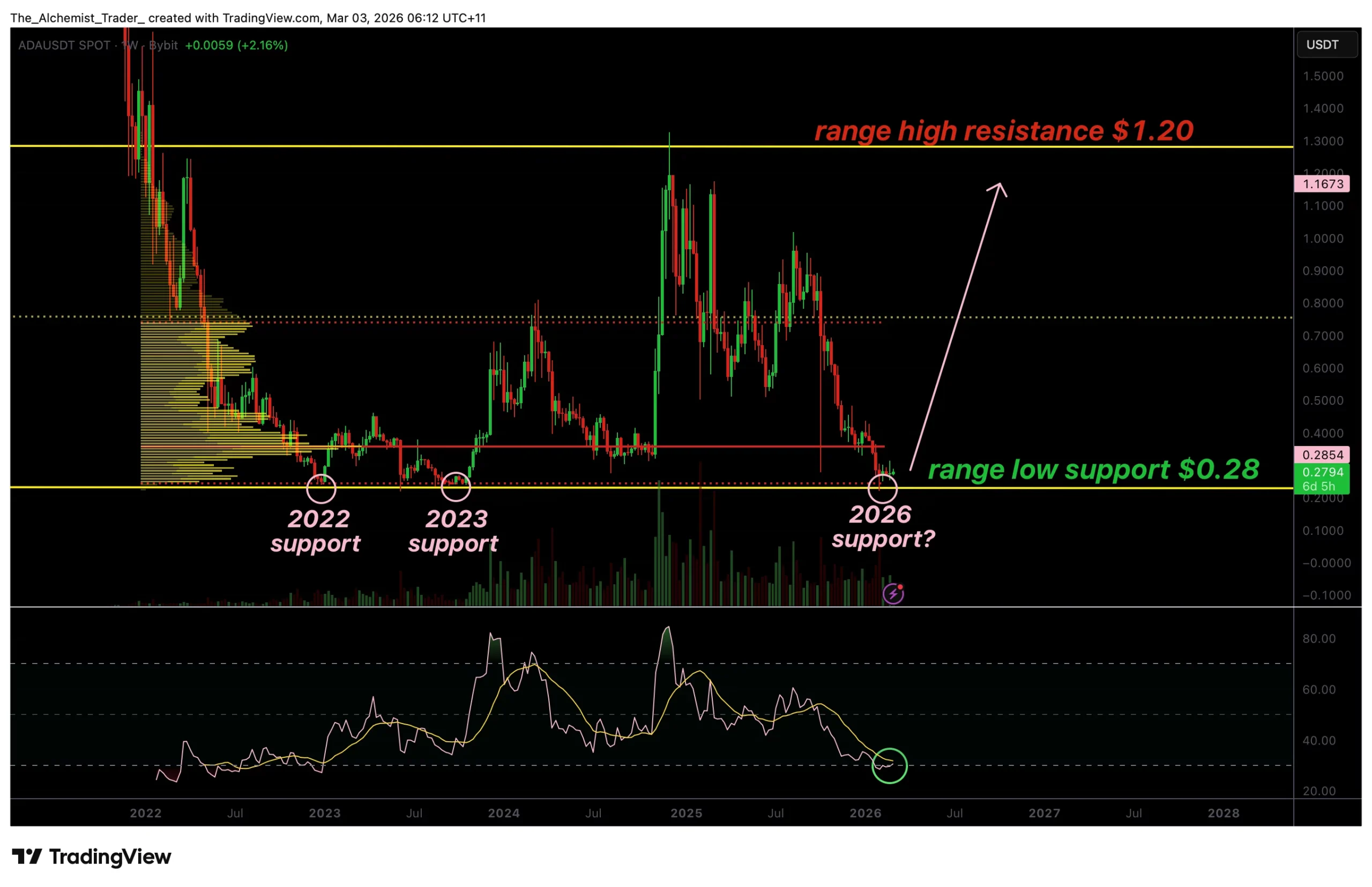
Cardano price has returned to a major historical support zone near $0.28 as RSI plunges into extreme oversold territory.
Summary
- $0.28 aligns with 2022 and 2023 historical support
- RSI in extreme oversold conditions
- Holding support opens bounce toward range midpoint
Cardano (ADA) is once again testing a long-term demand zone that previously acted as a structural bottom during the 2022 bear market. The same region later served as a foundation for the 2023 cycle low, reinforcing its significance as a high timeframe support area.
Cardano price key technical points
- Major Support: $0.28 aligns with the historical 2022 and 2023 demand zone.
- Oversold Signal: RSI in extreme oversold territory.
- Range Structure: Price remains within a broader high timeframe trading range.
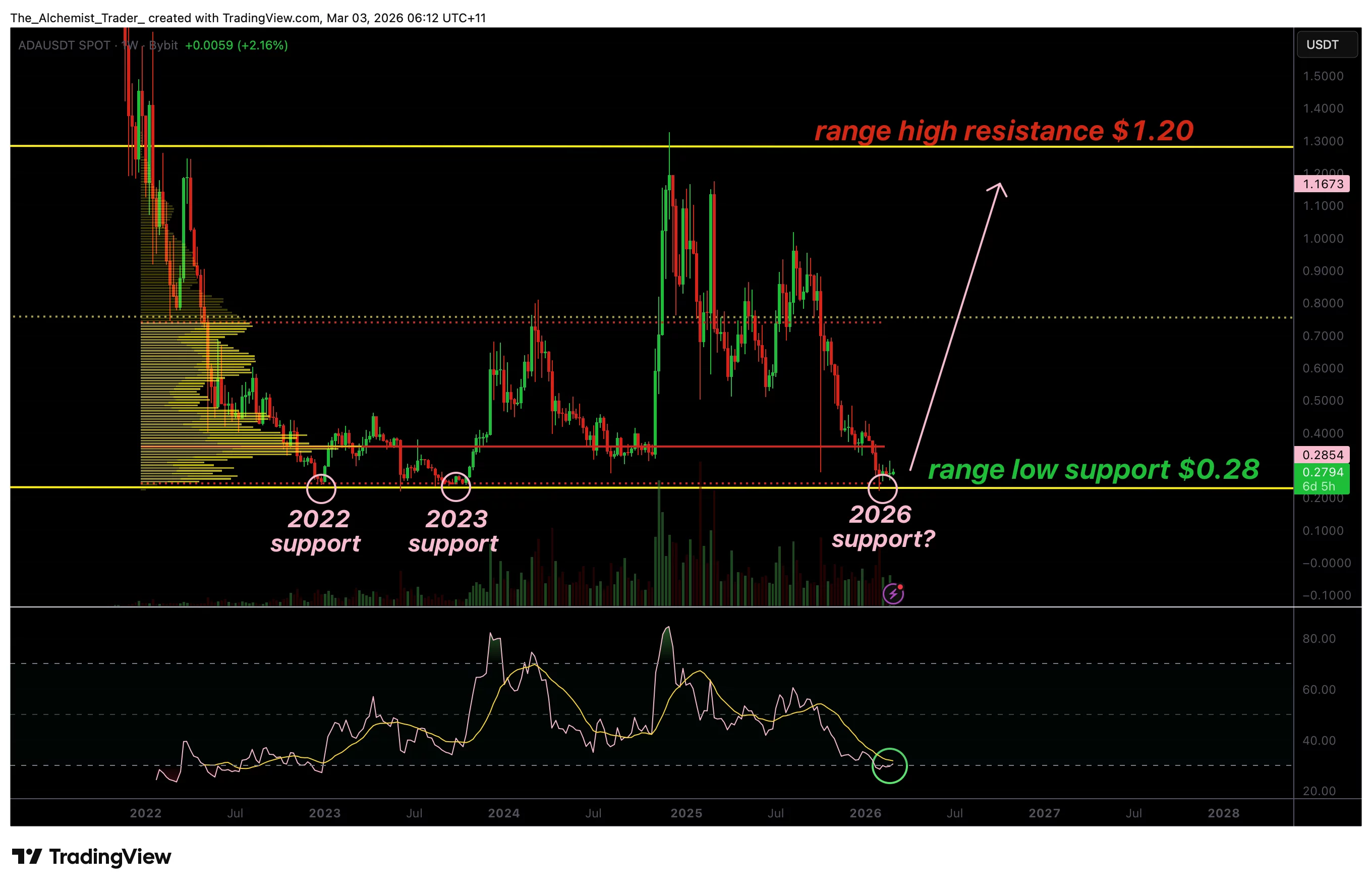
Cardano’s current price action reflects heightened selling pressure, but it is unfolding at a technically important location. The $0.28 region represents both the value area low and the broader range low within the current high timeframe structure. Historically, this level provided a strong base during the 2022 downturn and later marked the 2023 cycle bottom, establishing it as a critical liquidity zone.
Momentum indicators further strengthen the case for a potential reversal. The Relative Strength Index (RSI) has entered extreme oversold territory, signaling that selling pressure may be approaching exhaustion. While oversold conditions alone do not guarantee an immediate rebound, they often precede periods of relief rallies, particularly when aligned with significant structural support.
From a market structure perspective, Cardano continues to trade within a larger consolidation range rather than a confirmed breakdown trend. As long as price remains above the $0.28 range support, the probability favors continuation within this established structure.
Markets frequently rotate between range extremes before deciding on longer-term direction, and the current setup mirrors previous historical rotations, even as Cardano price remains under pressure despite the Midnight Foundation unveiling major blue-chip companies as node operators.
If support holds and RSI begins to recover through a bullish crossover, the first upside target would likely be the range midpoint, followed by the upper boundary of the trading range. Previous cycles have demonstrated that once oversold momentum unwinds, Cardano can produce sharp relief rallies toward equilibrium zones.
However, traders should remain cautious. A confirmed breakdown below the historical support would invalidate the bullish reversal thesis and expose deeper downside levels. For now, the technical evidence leans toward a potential bounce scenario, given the confluence of oversold momentum and long-standing demand.
Volume dynamics will be critical in determining the strength of any recovery. A rise in buying participation near $0.28 would confirm accumulation behavior, while continued weak demand could delay reversal attempts.
Overall, Cardano finds itself at a decisive inflection point. The combination of historical support and extreme oversold readings creates conditions favorable for a relief rally, but confirmation depends on whether buyers can defend the range low.
What to expect in the coming price action
As long as Cardano holds above the $0.28 range support, the probability favors a short-term rebound toward the range midpoint and potentially the range high. A breakdown below this level would shift structure bearish and increase downside risk, but current oversold conditions suggest a bounce remains likely in the near term.

Retail Exits While Institutional ETF Holdings Surge

Michael B. Jordan’s Co-Star Breaks Silence on BAFTA Racial Slur

Before Sanju Samson’s 97 in Kolkata: How 15 balls reignited India’s T20 World Cup campaign | Cricket News


-

 Fashion3 days ago
Weekend Open Thread: Iris Top
-

 Politics4 days ago
ITV enters Gaza with IDF amid ongoing genocide
-

 Business6 days ago
True Citrus debuts functional drink mix collection
-

 Tech2 days ago
Unihertz’s Titan 2 Elite Arrives Just as Physical Keyboards Refuse to Fade Away
-
Sports3 days ago
The Vikings Need a Duck
-

 Crypto World7 days ago
XRP price enters “dead zone” as Binance leverage hits lows
-
 NewsBeat2 days ago
Dubai flights cancelled as Brit told airspace closed ’10 minutes after boarding’
-

 NewsBeat5 days ago
Cuba says its forces have killed four on US-registered speedboat | World News
-

 Tech6 days ago
Unsurprisingly, Apple's board gets what it wants in 2026 shareholder meeting
-
 NewsBeat2 days ago
The empty pub on busy Cambridge road that has been boarded up for years
-
 NewsBeat5 days ago
Manchester Central Mosque issues statement as it imposes new measures ‘with immediate effect’ after armed men enter
-

 NewsBeat1 day ago
‘Significant’ damage to boarded-up Horden house after fire
-

 NewsBeat2 days ago
Abusive parents will now be treated like sex offenders and placed on a ‘child cruelty register’ | News UK
-
 NewsBeat6 days ago
Police latest as search for missing woman enters day nine
-

 Entertainment12 hours ago
Baby Gear Guide: Strollers, Car Seats
-

 Business5 days ago
Discord Pushes Implementation of Global Age Checks to Second Half of 2026
-

 Business4 days ago
Only 4% of women globally reside in countries that offer almost complete legal equality
-
 Tech3 days ago
NASA Reveals Identity of Astronaut Who Suffered Medical Incident Aboard ISS
-

 Crypto World6 days ago
Entering new markets without increasing payment costs
-
Politics2 days ago
FIFA hypocrisy after Israel murder over 400 Palestinian footballers